Is a set of criteria that will help
organizations develop the capability to
create and retain satisfied customers.
 It is not a product standard-there are no
requirements for specific products or
services- only criteria that apply to the
management of an organizations when
determining customer needs and
expectations and supplying products and
services that are intended to satisfy those
needs and expectations.
Define the required elements of an
effective quality management system.
Can be applied to any company
Technical specifications and criteria to be
used as rules, guidelines, or definitions of
characteristics to ensure that materials,
products, processes, and services are fit for
their purpose.
• Meet customer requirements
• Meet regulatory requirements
• Improve quality
• Increase profitability
ISO stands for International Organization for Standardization
The 3 fundamental parameters
that determine their saleability:
• Price
• Quality
• Delivery
Interested party Success Criteria
Owner Financial return
Employees Job satisfaction, pay and conditions
and quality of leadership
Customers Quality of products and services
Suppliers Satisfactory mutual trading
Investors Value of shares
Government Compliance with legislation
Community Contribution to the community – jobs,
support for other traders in the
community – care for the local
environment
Criteria used by interested parties to judge business
organization effectiveness or success:
Verification is a Quality control process that is used to evaluate
whether or not a product, service, or system complies with
regulations, specifications, or conditions imposed at the start of
a development phase.
Validation is Quality assurance process of establishing
evidence that provides a high degree of assurance that a
product, service, or system accomplishes its intended
requirements.
Validation
“building the right thing”
Verification
“building the thing right”
ISO 9000 provides a tried and tested framework for taking
a systematic approach to managing the organization’s
processes so that they consistently turn out product that
satisfies customers’ expectation.
Some of the requirements in ISO 9001 includes:
- A set of procedures that cover all key processes in the
business;
- Monitoring processes to ensure they are effective;
- Keeping adequate records;
- Checking output for defects, with appropriate and
corrective action where necessary;
- Regularly reviewing individual processes and the quality
system itself for effectiveness; and
- Facilitating continual improvement.
Auditing
Two types of auditing are required to become
registered to the standard:
1. Auditing by an external certification body
(external audit)
2. Auditing by internal staff trained for this
process (internal audits)
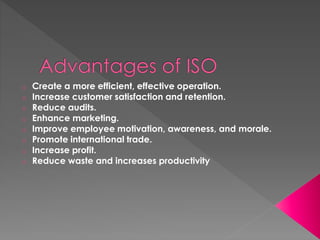
o Create a more efficient, effective operation.
o Increase customer satisfaction and retention.
o Reduce audits.
o Enhance marketing.
o Improve employee motivation, awareness, and morale.
o Promote international trade.
o Increase profit.
o Reduce waste and increases productivity
PRINCIPLE 1: Customer Focus
PRINCIPLE 2: Leadership
PRINCIPLE 3: Involvement of People
PRINCIPLE 4: Process Approach
PRINCIPLE 5: System approach to management
PRINCIPLE 6: Continual Improvement
PRINCIPLE 7: Factual approach to decision making
PRINCIPLE 8: Mutually beneficial supplier relationships
Iso

Iso

  • 2.
    Is a setof criteria that will help organizations develop the capability to create and retain satisfied customers.  It is not a product standard-there are no requirements for specific products or services- only criteria that apply to the management of an organizations when determining customer needs and expectations and supplying products and services that are intended to satisfy those needs and expectations.
  • 3.
    Define the requiredelements of an effective quality management system. Can be applied to any company Technical specifications and criteria to be used as rules, guidelines, or definitions of characteristics to ensure that materials, products, processes, and services are fit for their purpose.
  • 4.
    • Meet customerrequirements • Meet regulatory requirements • Improve quality • Increase profitability ISO stands for International Organization for Standardization
  • 5.
    The 3 fundamentalparameters that determine their saleability: • Price • Quality • Delivery
  • 7.
    Interested party SuccessCriteria Owner Financial return Employees Job satisfaction, pay and conditions and quality of leadership Customers Quality of products and services Suppliers Satisfactory mutual trading Investors Value of shares Government Compliance with legislation Community Contribution to the community – jobs, support for other traders in the community – care for the local environment Criteria used by interested parties to judge business organization effectiveness or success:
  • 8.
    Verification is aQuality control process that is used to evaluate whether or not a product, service, or system complies with regulations, specifications, or conditions imposed at the start of a development phase. Validation is Quality assurance process of establishing evidence that provides a high degree of assurance that a product, service, or system accomplishes its intended requirements.
  • 9.
    Validation “building the rightthing” Verification “building the thing right”
  • 10.
    ISO 9000 providesa tried and tested framework for taking a systematic approach to managing the organization’s processes so that they consistently turn out product that satisfies customers’ expectation. Some of the requirements in ISO 9001 includes: - A set of procedures that cover all key processes in the business; - Monitoring processes to ensure they are effective; - Keeping adequate records; - Checking output for defects, with appropriate and corrective action where necessary; - Regularly reviewing individual processes and the quality system itself for effectiveness; and - Facilitating continual improvement.
  • 11.
    Auditing Two types ofauditing are required to become registered to the standard: 1. Auditing by an external certification body (external audit) 2. Auditing by internal staff trained for this process (internal audits)
  • 12.
    o Create amore efficient, effective operation. o Increase customer satisfaction and retention. o Reduce audits. o Enhance marketing. o Improve employee motivation, awareness, and morale. o Promote international trade. o Increase profit. o Reduce waste and increases productivity
  • 13.
    PRINCIPLE 1: CustomerFocus PRINCIPLE 2: Leadership PRINCIPLE 3: Involvement of People PRINCIPLE 4: Process Approach PRINCIPLE 5: System approach to management PRINCIPLE 6: Continual Improvement PRINCIPLE 7: Factual approach to decision making PRINCIPLE 8: Mutually beneficial supplier relationships