Mathematics has a Major Role in our
every day life.
There were many mathematicians like
Aryabhatta , Srinivasa Ramanujan
, Alan Turing etc..
But I am here to talk about Islamic
Mathematicians and their devotion to
Mathematics.
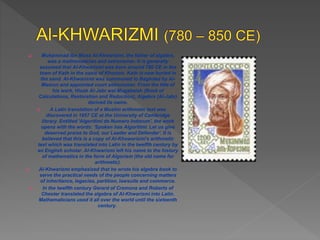
 Muhammad Ibn Musa Al-Khwarizmi, the father of algebra,
was a mathematician and astronomer. It is generally
assumed that Al-Khwarizmi was born around 780 CE in the
town of Kath in the oasis of Khorzen. Kath is now buried in
the sand. Al-Khwarizmi was summoned to Baghdad by Al-
Mamun and appointed court astronomer. From the title of
his work, Hisab Al-Jabr wal Mugabalah (Book of
Calculations, Restoration and Reduction), Algebra (Al-Jabr)
derived its name.
 A Latin translation of a Muslim arithmetic text was
discovered in 1857 CE at the University of Cambridge
library. Entitled 'Algoritimi de Numero Indorum', the work
opens with the words: 'Spoken has Algoritimi. Let us give
deserved praise to God, our Leader and Defender'. It is
believed that this is a copy of Al-Khowarizmi's arithmetic
text which was translated into Latin in the twelfth century by
an English scholar. Al-Khwarizmi left his name to the history
of mathematics in the form of Algorism (the old name for
arithmetic).
 Al-Khwarizmi emphasized that he wrote his algebra book to
serve the practical needs of the people concerning matters
of inheritance, legacies, partition, lawsuits and commerce.
 In the twelfth century Gerard of Cremona and Roberts of
Chester translated the algebra of Al-Khwarizmi into Latin.
Mathematicians used it all over the world until the sixteenth
century.
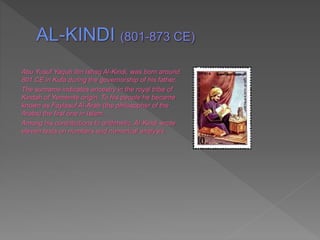
Abu Yusuf Yaqub Ibn Ishaq Al-Kindi, was born around
801 CE in Kufa during the governorship of his father.
The surname indicates ancestry in the royal tribe of
Kindah of Yemenite origin. To his people he became
known as Faylasuf Al-Arab (the philosopher of the
Arabs) the first one in Islam.
Among his contributions to arithmetic, Al-Kindi wrote
eleven texts on numbers and numerical analysis.
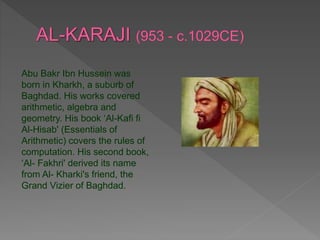
Abu Bakr Ibn Hussein was
born in Kharkh, a suburb of
Baghdad. His works covered
arithmetic, algebra and
geometry. His book ‘Al-Kafi fi
Al-Hisab' (Essentials of
Arithmetic) covers the rules of
computation. His second book,
‘Al- Fakhri' derived its name
from Al- Kharki's friend, the
Grand Vizier of Baghdad.
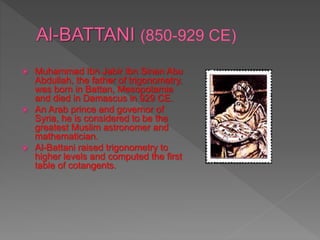
 Muhammad Ibn Jabir Ibn Sinan Abu
Abdullah, the father of trigonometry,
was born in Battan, Mesopotamia
and died in Damascus in 929 CE.
 An Arab prince and governor of
Syria, he is considered to be the
greatest Muslim astronomer and
mathematician.
 Al-Battani raised trigonometry to
higher levels and computed the first
table of cotangents.
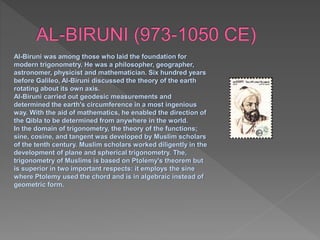
Al-Biruni was among those who laid the foundation for
modern trigonometry. He was a philosopher, geographer,
astronomer, physicist and mathematician. Six hundred years
before Galileo, Al-Biruni discussed the theory of the earth
rotating about its own axis.
Al-Biruni carried out geodesic measurements and
determined the earth's circumference in a most ingenious
way. With the aid of mathematics, he enabled the direction of
the Qibla to be determined from anywhere in the world.
In the domain of trigonometry, the theory of the functions;
sine, cosine, and tangent was developed by Muslim scholars
of the tenth century. Muslim scholars worked diligently in the
development of plane and spherical trigonometry. The,
trigonometry of Muslims is based on Ptolemy's theorem but
is superior in two important respects: it employs the sine
where Ptolemy used the chord and is in algebraic instead of
geometric form.
Thank You
Have a Mathy day!
O <
u
Islamic Mathematicians And Their Devotions In Maths

Islamic Mathematicians And Their Devotions In Maths

  • 2.
    Mathematics has aMajor Role in our every day life. There were many mathematicians like Aryabhatta , Srinivasa Ramanujan , Alan Turing etc.. But I am here to talk about Islamic Mathematicians and their devotion to Mathematics.
  • 3.
     Muhammad IbnMusa Al-Khwarizmi, the father of algebra, was a mathematician and astronomer. It is generally assumed that Al-Khwarizmi was born around 780 CE in the town of Kath in the oasis of Khorzen. Kath is now buried in the sand. Al-Khwarizmi was summoned to Baghdad by Al- Mamun and appointed court astronomer. From the title of his work, Hisab Al-Jabr wal Mugabalah (Book of Calculations, Restoration and Reduction), Algebra (Al-Jabr) derived its name.  A Latin translation of a Muslim arithmetic text was discovered in 1857 CE at the University of Cambridge library. Entitled 'Algoritimi de Numero Indorum', the work opens with the words: 'Spoken has Algoritimi. Let us give deserved praise to God, our Leader and Defender'. It is believed that this is a copy of Al-Khowarizmi's arithmetic text which was translated into Latin in the twelfth century by an English scholar. Al-Khwarizmi left his name to the history of mathematics in the form of Algorism (the old name for arithmetic).  Al-Khwarizmi emphasized that he wrote his algebra book to serve the practical needs of the people concerning matters of inheritance, legacies, partition, lawsuits and commerce.  In the twelfth century Gerard of Cremona and Roberts of Chester translated the algebra of Al-Khwarizmi into Latin. Mathematicians used it all over the world until the sixteenth century.
  • 4.
    Abu Yusuf YaqubIbn Ishaq Al-Kindi, was born around 801 CE in Kufa during the governorship of his father. The surname indicates ancestry in the royal tribe of Kindah of Yemenite origin. To his people he became known as Faylasuf Al-Arab (the philosopher of the Arabs) the first one in Islam. Among his contributions to arithmetic, Al-Kindi wrote eleven texts on numbers and numerical analysis.
  • 5.
    Abu Bakr IbnHussein was born in Kharkh, a suburb of Baghdad. His works covered arithmetic, algebra and geometry. His book ‘Al-Kafi fi Al-Hisab' (Essentials of Arithmetic) covers the rules of computation. His second book, ‘Al- Fakhri' derived its name from Al- Kharki's friend, the Grand Vizier of Baghdad.
  • 6.
     Muhammad IbnJabir Ibn Sinan Abu Abdullah, the father of trigonometry, was born in Battan, Mesopotamia and died in Damascus in 929 CE.  An Arab prince and governor of Syria, he is considered to be the greatest Muslim astronomer and mathematician.  Al-Battani raised trigonometry to higher levels and computed the first table of cotangents.
  • 7.
    Al-Biruni was amongthose who laid the foundation for modern trigonometry. He was a philosopher, geographer, astronomer, physicist and mathematician. Six hundred years before Galileo, Al-Biruni discussed the theory of the earth rotating about its own axis. Al-Biruni carried out geodesic measurements and determined the earth's circumference in a most ingenious way. With the aid of mathematics, he enabled the direction of the Qibla to be determined from anywhere in the world. In the domain of trigonometry, the theory of the functions; sine, cosine, and tangent was developed by Muslim scholars of the tenth century. Muslim scholars worked diligently in the development of plane and spherical trigonometry. The, trigonometry of Muslims is based on Ptolemy's theorem but is superior in two important respects: it employs the sine where Ptolemy used the chord and is in algebraic instead of geometric form.
  • 8.
    Thank You Have aMathy day! O < u