Awais Ahmad
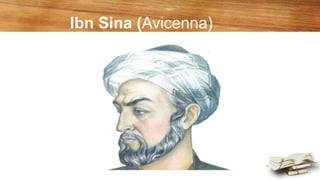
Ibn Sina (Avicenna)
Early life
He was born in around 370 (AH) / 980 (AD) in Afshana, his m
other's home, a small city now part of Uzbekistan
 His father, a respected Ismaili scholar, was from Balkh now
part of Afghanistan .He had his son very carefully educated at
Bukhara.
 Ibn Sina's independent thought was served by an extraordinar
y intelligence and memory, which allowed him to overtake his
teachers at the age of fourteen.
Early life
According to his autobiography, ibn sina had memorised the
entire Quran by at the age of 10 and Persian poetry as well.
He learned Indian arithmetic from Mahmoud Massahi
He also studied Fiqh (Islamic jurisprudence).
Ibn Sina's when a teenager, he was greatly troubled by the Met
aphysics of Aristotle, which he could not understand until he rea
d al-Farabi's .
He also studied philosophy.
Father of Modern Medicine
He turned to medicine at 16.
He achieved full status as a qualified physician at age 18 and
found that "Medicine is no hard and thorny science, like mat
hematics and metaphysics so I soon made great progress; I
became an excellent doctor and began to treat patients, using
approved remedies.“
The youthful physician's fame spread quickly, and he treated m
any patients without asking for payment
Reward
Ibn Sina's first appointment was that of physician to the emir.
In reward for this service was access to the royal library of t
he Samanids, well-known patrons of scholarship and scholars.
When the library was destroyed by fire not long after, the en
emies of Ibn Sina accused him of burning it
When Ibn Sina was 22 years old, he lost his father.
 Ibn Sina seems to have declined the offers of Mahmud of G
hazni, and proceeded in modern Turkmenistan.
 Ibn Sina wandered from place to place through the districts
of Nishapur and Merv to the borders of Khorasan.
 Ibn Sina settled at Rey (Tehran).
Ibn Sina's composed about thirty books in Rey
Books
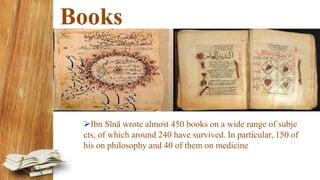
Ibn Sīnā wrote almost 450 books on a wide range of subje
cts, of which around 240 have survived. In particular, 150 of
his on philosophy and 40 of them on medicine
Later life and death
The remaining ten or twelve years of Ibn Sīnā's life were spe
nt in the service of ruler Muhammad ibn Rustam Dushmanziy
ar
His friends advised him to slow down and take life moderate
ly. He refused, however, stating that: "I prefer a short life wit
h width to a narrow one with length".
 He bestowed his goods on the poor, restored unjust gains, fr
eed his slaves.
He read through the Quran every three days until his death.
He died in June 1037, in his fifty-eighth year, in the month
of Ramadan and was buried in Hamadan Iran
Work
Medicine
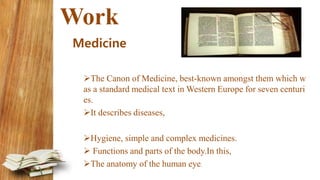
The Canon of Medicine, best-known amongst them which w
as a standard medical text in Western Europe for seven centuri
es.
It describes diseases,
Hygiene, simple and complex medicines.
 Functions and parts of the body.In this,
The anatomy of the human eye.
Medicine
It includes five books
First and second discuss physiology, pathology and hygiene.
 The third and fourth deal with the methods of treating disease.
The fifth describes the composition and preparation of remedies
.
 This last part contains some personal observations
A Few of his Discoveries
Medicine and Pharmacology
The introduction of:
infectious diseases
experimental medicine
evidence-based medicine
clinical trials
clinical pharmacology
risk factor analysis,
tuberculosis
diabetes
heart as a valve
And the influence of climate and environment on health.
momentum
steam distillation
extraction of essential oils
uniformitarianism and law of superposition in geology
modern clinical trials
Philosophy
Ibn Sina wrote extensively on the subjects of philosophy, logic,
ethics, metaphysics and other disciplines.
Most of his works were written in Arabic.
some were written in the Persian language.
Psychophysiology and Psychosomatic medicine
Recognized 'physiological psychology' in the treatment of illne
sses involving emotions, and developed a system for associatin
g changes in the pulse rate with inner feelings.
Avicenna is reported to have treated a very ill patient by "feeli
ng the patient's pulse and reciting aloud to him the names of pr
ovinces, districts, towns, streets, and people." He noticed how t
he patient's pulse increased when certain names were mentione
d, from which Avicenna deduced that the patient was in love w
ith a girl whose home Avicenna was "able to locate by the digit
al examination." Avicenna advised the patient to marry the girl
he is in love with, and the patient soon recovered from his illne
ss after his marriage.
Earth Sciences
On earth
Formation of mountain
The advantages of mountain in the formation of cloud
Source of water
Origin of Earthquake
Formation of mineral
The diversity of earth terrain.
Above the earth
Clouds and rain
Causes of rainbow
Sun reflection
Winder
Thunder, lighting
Catastrophic event which effect the surface of earth
Physics
In mechanics The Book of Healing, developed a theory of mo
tion.
In which he made a distinction between the inclination and for
ce of a projectile, and concluded that motion was a result of an
inclination transferred to the projectile by the thrower, and tha
t projectile motionin a vacuum would not cease
Astronomy and astrology
He believed that each planet had some influence on the earth
, but argued against astrologers being able to determine the exa
ct effects
Avicenna wrote an attack on astrology titled Resāla fī ebṭāl a
ḥkām al-nojūm
Theology
His aim was to prove the existence of God and His creation of
the world scientifically and through reason and logic.
Avicenna's views on philosophy were enormously influential, f
orming part of the core of the curriculum at Islamic religious s
chools until the 19th century.
Avicenna wrote a number of short treatises dealing with Islami
c theology. These included treatises on the prophets (whom he
viewed as "inspired philosophers"), and also on various scienti
fic and philosophical interpretations of the Quran.
In general these treatises linked his philosophical writings to I
slamic religious ideas;
for example, the body after life
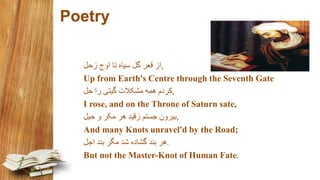
Poetry
,‫زحل‬ ‫اوج‬ ‫تا‬ ‫سياه‬ ‫گل‬ ‫قعر‬ ‫از‬
Up from Earth's Centre through the Seventh Gate
,‫حل‬ ‫را‬ ‫گيتی‬ ‫مشکالت‬ ‫همه‬ ‫کردم‬
I rose, and on the Throne of Saturn sate,
,‫حيل‬ ‫و‬ ‫مکر‬ ‫هر‬ ‫زقيد‬ ‫جستم‬ ‫بيرون‬
And many Knots unravel'd by the Road;
.‫اجل‬ ‫بند‬ ‫مگر‬ ‫شد‬ ‫گشاده‬ ‫بند‬ ‫هر‬
But not the Master-Knot of Human Fate.
Quotes
The world is divided into men who have wit and no religion
and men who have religion and no wit.
As to the mental essence, we find it in infants devoid of ever
y mental form.
That whose existence is necessary must necessarily be one es
sence.
Therefore in medicine we ought to know the causes of sickn
ess and health.
Thank you

Ibn Sina Avicenna

  • 1.
  • 2.
  • 3.
    Early life He wasborn in around 370 (AH) / 980 (AD) in Afshana, his m other's home, a small city now part of Uzbekistan  His father, a respected Ismaili scholar, was from Balkh now part of Afghanistan .He had his son very carefully educated at Bukhara.  Ibn Sina's independent thought was served by an extraordinar y intelligence and memory, which allowed him to overtake his teachers at the age of fourteen.
  • 4.
    Early life According tohis autobiography, ibn sina had memorised the entire Quran by at the age of 10 and Persian poetry as well. He learned Indian arithmetic from Mahmoud Massahi He also studied Fiqh (Islamic jurisprudence). Ibn Sina's when a teenager, he was greatly troubled by the Met aphysics of Aristotle, which he could not understand until he rea d al-Farabi's . He also studied philosophy.
  • 5.
    Father of ModernMedicine He turned to medicine at 16. He achieved full status as a qualified physician at age 18 and found that "Medicine is no hard and thorny science, like mat hematics and metaphysics so I soon made great progress; I became an excellent doctor and began to treat patients, using approved remedies.“ The youthful physician's fame spread quickly, and he treated m any patients without asking for payment
  • 6.
    Reward Ibn Sina's firstappointment was that of physician to the emir. In reward for this service was access to the royal library of t he Samanids, well-known patrons of scholarship and scholars. When the library was destroyed by fire not long after, the en emies of Ibn Sina accused him of burning it When Ibn Sina was 22 years old, he lost his father.
  • 7.
     Ibn Sinaseems to have declined the offers of Mahmud of G hazni, and proceeded in modern Turkmenistan.  Ibn Sina wandered from place to place through the districts of Nishapur and Merv to the borders of Khorasan.  Ibn Sina settled at Rey (Tehran). Ibn Sina's composed about thirty books in Rey
  • 8.
    Books Ibn Sīnā wrotealmost 450 books on a wide range of subje cts, of which around 240 have survived. In particular, 150 of his on philosophy and 40 of them on medicine
  • 9.
    Later life anddeath The remaining ten or twelve years of Ibn Sīnā's life were spe nt in the service of ruler Muhammad ibn Rustam Dushmanziy ar His friends advised him to slow down and take life moderate ly. He refused, however, stating that: "I prefer a short life wit h width to a narrow one with length".  He bestowed his goods on the poor, restored unjust gains, fr eed his slaves. He read through the Quran every three days until his death. He died in June 1037, in his fifty-eighth year, in the month of Ramadan and was buried in Hamadan Iran
  • 10.
    Work Medicine The Canon ofMedicine, best-known amongst them which w as a standard medical text in Western Europe for seven centuri es. It describes diseases, Hygiene, simple and complex medicines.  Functions and parts of the body.In this, The anatomy of the human eye.
  • 11.
    Medicine It includes fivebooks First and second discuss physiology, pathology and hygiene.  The third and fourth deal with the methods of treating disease. The fifth describes the composition and preparation of remedies .  This last part contains some personal observations
  • 12.
    A Few ofhis Discoveries Medicine and Pharmacology The introduction of: infectious diseases experimental medicine evidence-based medicine clinical trials clinical pharmacology risk factor analysis, tuberculosis diabetes heart as a valve And the influence of climate and environment on health. momentum steam distillation extraction of essential oils uniformitarianism and law of superposition in geology modern clinical trials
  • 13.
    Philosophy Ibn Sina wroteextensively on the subjects of philosophy, logic, ethics, metaphysics and other disciplines. Most of his works were written in Arabic. some were written in the Persian language.
  • 14.
    Psychophysiology and Psychosomaticmedicine Recognized 'physiological psychology' in the treatment of illne sses involving emotions, and developed a system for associatin g changes in the pulse rate with inner feelings. Avicenna is reported to have treated a very ill patient by "feeli ng the patient's pulse and reciting aloud to him the names of pr ovinces, districts, towns, streets, and people." He noticed how t he patient's pulse increased when certain names were mentione d, from which Avicenna deduced that the patient was in love w ith a girl whose home Avicenna was "able to locate by the digit al examination." Avicenna advised the patient to marry the girl he is in love with, and the patient soon recovered from his illne ss after his marriage.
  • 15.
    Earth Sciences On earth Formationof mountain The advantages of mountain in the formation of cloud Source of water Origin of Earthquake Formation of mineral The diversity of earth terrain.
  • 16.
    Above the earth Cloudsand rain Causes of rainbow Sun reflection Winder Thunder, lighting Catastrophic event which effect the surface of earth
  • 17.
    Physics In mechanics TheBook of Healing, developed a theory of mo tion. In which he made a distinction between the inclination and for ce of a projectile, and concluded that motion was a result of an inclination transferred to the projectile by the thrower, and tha t projectile motionin a vacuum would not cease
  • 18.
    Astronomy and astrology Hebelieved that each planet had some influence on the earth , but argued against astrologers being able to determine the exa ct effects Avicenna wrote an attack on astrology titled Resāla fī ebṭāl a ḥkām al-nojūm
  • 19.
    Theology His aim wasto prove the existence of God and His creation of the world scientifically and through reason and logic. Avicenna's views on philosophy were enormously influential, f orming part of the core of the curriculum at Islamic religious s chools until the 19th century. Avicenna wrote a number of short treatises dealing with Islami c theology. These included treatises on the prophets (whom he viewed as "inspired philosophers"), and also on various scienti fic and philosophical interpretations of the Quran. In general these treatises linked his philosophical writings to I slamic religious ideas; for example, the body after life
  • 20.
    Poetry ,‫زحل‬ ‫اوج‬ ‫تا‬‫سياه‬ ‫گل‬ ‫قعر‬ ‫از‬ Up from Earth's Centre through the Seventh Gate ,‫حل‬ ‫را‬ ‫گيتی‬ ‫مشکالت‬ ‫همه‬ ‫کردم‬ I rose, and on the Throne of Saturn sate, ,‫حيل‬ ‫و‬ ‫مکر‬ ‫هر‬ ‫زقيد‬ ‫جستم‬ ‫بيرون‬ And many Knots unravel'd by the Road; .‫اجل‬ ‫بند‬ ‫مگر‬ ‫شد‬ ‫گشاده‬ ‫بند‬ ‫هر‬ But not the Master-Knot of Human Fate.
  • 21.
    Quotes The world isdivided into men who have wit and no religion and men who have religion and no wit. As to the mental essence, we find it in infants devoid of ever y mental form. That whose existence is necessary must necessarily be one es sence. Therefore in medicine we ought to know the causes of sickn ess and health.
  • 22.