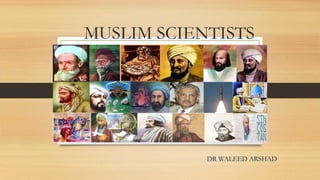
MUSLIM SCIENTISTS
DR WALEED ARSHAD
Al-Ma'mun Abbāsid caliph(813–833)
Al-Mamun is renowned for his patronage of learning, commissioning translations of
classical Greek texts.
He founded the famous 'Bayt al-Hikmah' (House of Wisdom} in Baghdad and
personally presided over discussions on logical,theological,and legal matters.
The Bayt al-Hikma became an important center of translation for Greek and other
ancient texts into Arabic. He employed a large number of translators and patronized
many scholars. It was under his patronage that the works
of Plato, Aristotle,Hippocrates, and others were first translated into Arabic.
Al-Ma'mun was interested in every aspect of science, philosophy and especially
in astronomy. He himself conducted, on the plains of Mesopotamia, two astronomical
operations intended to determine the value of a terrestrial degree.
The first one to attempt to measure the dimensions of the Earth.
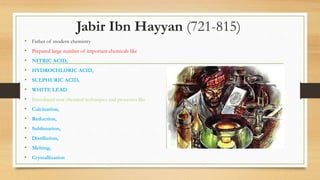
Jabir Ibn Hayyan (721-815)
• Father of modern chemistry
• Prepared large number of important chemicals like
• NITRIC ACID,
• HYDROCHLORIC ACID,
• SULPHURIC ACID,
• WHITE LEAD
• Introduced new chemical techniques and processes like
• Calcination,
• Reduction,
• Sublimation,
• Distillation,
• Melting,
• Crystallization
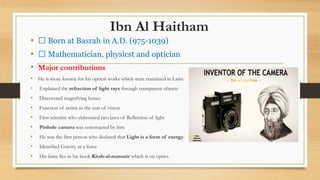
Ibn Al Haitham
• Born at Basrah in A.D. (975-1039)
• Mathematician, physicst and optician
• Major contributions
• He is more known for his optical works which were translated in Latin
• Explained the refraction of light rays through transparent objects
• Discovered magnifying lenses
• Function of retina as the seat of vision
• First scientist who elaborated two laws of Reflection of light
• Pinhole camera was constructed by him
• He was the first person who declared that Light is a form of energy.
• Identified Gravity as a force
• His fame lies in his book Kitab-al-manazir which is on optics.
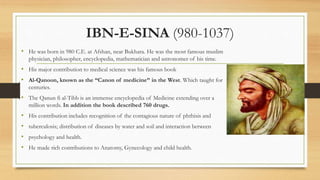
IBN-E-SINA (980-1037)
• He was born in 980 C.E. at Afshan, near Bukhara. He was the most famous muslim
physician, philosopher, encyclopedia, mathematician and astronomer of his time.
• His major contribution to medical science was his famous book
• Al-Qanoon, known as the “Canon of medicine” in the West. Which taught for
centuries.
• The Qanun fi al-Tibb is an immense encyclopedia of Medicine extending over a
million words. In addition the book described 760 drugs.
• His contribution includes recognition of the contagious nature of phthisis and
• tuberculosis; distribution of diseases by water and soil and interaction between
• psychology and health.
• He made rich contributions to Anatomy, Gynecology and child health.
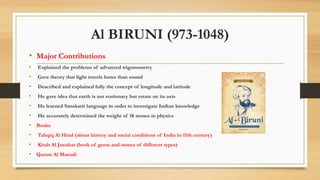
Al BIRUNI (973-1048)
• Major Contributions
• Explained the problems of advanced trigonometry
• Gave theory that light travels faster than sound
• Described and explained fully the concept of longitude and latitude
• He gave idea that earth is not stationary but rotate on its axis
• He learned Sanskarit language in order to investigate Indian knowledge
• He accurately determined the weight of 18 stones in physics
• Books
• Tahqiq Al Hind (about history and social conditions of India in 11th century)
• Kitab Al Jawahar (book of gems and stones of different types)
• Qanun Al Masudi
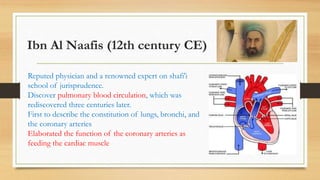
Ibn Al Naafis (12th century CE)
Reputed physician and a renowned expert on shafi'i
school of jurisprudence.
Discover pulmonary blood circulation, which was
rediscovered three centuries later.
First to describe the constitution of lungs, bronchi, and
the coronary arteries
Elaborated the function of the coronary arteries as
feeding the cardiac muscle
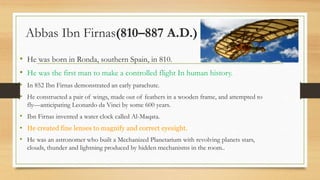
Abbas Ibn Firnas(810–887 A.D.)
• He was born in Ronda, southern Spain, in 810.
• He was the first man to make a controlled flight In human history.
• In 852 Ibn Firnas demonstrated an early parachute.
• He constructed a pair of wings, made out of feathers in a wooden frame, and attempted to
fly—anticipating Leonardo da Vinci by some 600 years.
• Ibn Firnas invented a water clock called Al-Maqata.
• He created fine lenses to magnify and correct eyesight.
• He was an astronomer who built a Mechanized Planetarium with revolving planets stars,
clouds, thunder and lightning produced by hidden mechanisms in the room..
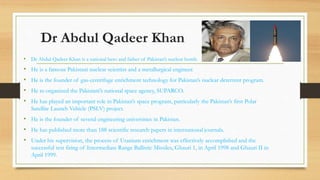
Dr Abdul Qadeer Khan
• Dr Abdul Qadeer Khan is a national hero and father of Pakistan’s nuclear bomb.
• He is a famous Pakistani nuclear scientist and a metallurgical engineer.
• He is the founder of gas-centrifuge enrichment technology for Pakistan’s nuclear deterrent program.
• He re-organized the Pakistani’s national space agency, SUPARCO.
• He has played an important role in Pakistan’s space program, patricularly the Pakistan’s first Polar
Satellite Launch Vehicle (PSLV) project.
• He is the founder of several engineering universities in Pakistan.
• He has published more than 188 scientific research papers in international journals.
• Under his supervision, the process of Uranium enrichment was effectively accomplished and the
successful test firing of Intermediate Range Ballistic Missiles, Ghauri 1, in April 1998 and Ghauri II in
April 1999.

Muslim scientists

  • 1.
  • 2.
    Al-Ma'mun Abbāsid caliph(813–833) Al-Mamunis renowned for his patronage of learning, commissioning translations of classical Greek texts. He founded the famous 'Bayt al-Hikmah' (House of Wisdom} in Baghdad and personally presided over discussions on logical,theological,and legal matters. The Bayt al-Hikma became an important center of translation for Greek and other ancient texts into Arabic. He employed a large number of translators and patronized many scholars. It was under his patronage that the works of Plato, Aristotle,Hippocrates, and others were first translated into Arabic. Al-Ma'mun was interested in every aspect of science, philosophy and especially in astronomy. He himself conducted, on the plains of Mesopotamia, two astronomical operations intended to determine the value of a terrestrial degree. The first one to attempt to measure the dimensions of the Earth.
  • 3.
    Jabir Ibn Hayyan(721-815) • Father of modern chemistry • Prepared large number of important chemicals like • NITRIC ACID, • HYDROCHLORIC ACID, • SULPHURIC ACID, • WHITE LEAD • Introduced new chemical techniques and processes like • Calcination, • Reduction, • Sublimation, • Distillation, • Melting, • Crystallization
  • 4.
    Ibn Al Haitham •Born at Basrah in A.D. (975-1039) • Mathematician, physicst and optician • Major contributions • He is more known for his optical works which were translated in Latin • Explained the refraction of light rays through transparent objects • Discovered magnifying lenses • Function of retina as the seat of vision • First scientist who elaborated two laws of Reflection of light • Pinhole camera was constructed by him • He was the first person who declared that Light is a form of energy. • Identified Gravity as a force • His fame lies in his book Kitab-al-manazir which is on optics.
  • 5.
    IBN-E-SINA (980-1037) • Hewas born in 980 C.E. at Afshan, near Bukhara. He was the most famous muslim physician, philosopher, encyclopedia, mathematician and astronomer of his time. • His major contribution to medical science was his famous book • Al-Qanoon, known as the “Canon of medicine” in the West. Which taught for centuries. • The Qanun fi al-Tibb is an immense encyclopedia of Medicine extending over a million words. In addition the book described 760 drugs. • His contribution includes recognition of the contagious nature of phthisis and • tuberculosis; distribution of diseases by water and soil and interaction between • psychology and health. • He made rich contributions to Anatomy, Gynecology and child health.
  • 6.
    Al BIRUNI (973-1048) •Major Contributions • Explained the problems of advanced trigonometry • Gave theory that light travels faster than sound • Described and explained fully the concept of longitude and latitude • He gave idea that earth is not stationary but rotate on its axis • He learned Sanskarit language in order to investigate Indian knowledge • He accurately determined the weight of 18 stones in physics • Books • Tahqiq Al Hind (about history and social conditions of India in 11th century) • Kitab Al Jawahar (book of gems and stones of different types) • Qanun Al Masudi
  • 7.
    Ibn Al Naafis(12th century CE) Reputed physician and a renowned expert on shafi'i school of jurisprudence. Discover pulmonary blood circulation, which was rediscovered three centuries later. First to describe the constitution of lungs, bronchi, and the coronary arteries Elaborated the function of the coronary arteries as feeding the cardiac muscle
  • 8.
    Abbas Ibn Firnas(810–887A.D.) • He was born in Ronda, southern Spain, in 810. • He was the first man to make a controlled flight In human history. • In 852 Ibn Firnas demonstrated an early parachute. • He constructed a pair of wings, made out of feathers in a wooden frame, and attempted to fly—anticipating Leonardo da Vinci by some 600 years. • Ibn Firnas invented a water clock called Al-Maqata. • He created fine lenses to magnify and correct eyesight. • He was an astronomer who built a Mechanized Planetarium with revolving planets stars, clouds, thunder and lightning produced by hidden mechanisms in the room..
  • 9.
    Dr Abdul QadeerKhan • Dr Abdul Qadeer Khan is a national hero and father of Pakistan’s nuclear bomb. • He is a famous Pakistani nuclear scientist and a metallurgical engineer. • He is the founder of gas-centrifuge enrichment technology for Pakistan’s nuclear deterrent program. • He re-organized the Pakistani’s national space agency, SUPARCO. • He has played an important role in Pakistan’s space program, patricularly the Pakistan’s first Polar Satellite Launch Vehicle (PSLV) project. • He is the founder of several engineering universities in Pakistan. • He has published more than 188 scientific research papers in international journals. • Under his supervision, the process of Uranium enrichment was effectively accomplished and the successful test firing of Intermediate Range Ballistic Missiles, Ghauri 1, in April 1998 and Ghauri II in April 1999.