MUSLIM
HISTORIOGRAPHY
Part 2
HIST 3750
DR ELMIRA AKHMETOVA
DEPT OF HISTORY AND CIVILISATION
IIUM
Features of Muslim
Historiography
Isnad
Chronology
Theological View of History
Periodization
Habar History
Isnad
Muslim historiography begins with the biographies of the Prophet SAW
Historians used the collected hadith – traditions, so you need to examine critically – should be
traced on original eyewitness
This using of isnad for history helped Muslims to develop history as science with critical method
from the early times
Prerequisites of Historian to write seerah books:
1. The spirit of independent inquiry
2. Critical insight
So isnad was used to write seerah or maghazi books
Traditions were tested and examined through isnad system, which means the chain of
authorities by which a narrative can be traced to the original eye-witness who narrated it
Isnad
Each narrative, in order to be trustworthy, should be traceable through a known series of
transmitters to its source pervades historical composition till quite late time.
Provided a spirit of inquiry and critical insight to the Muslim mind
Problem of weak hadiths, fabricated ones
Isnad was used until al-Tabari (9th century)
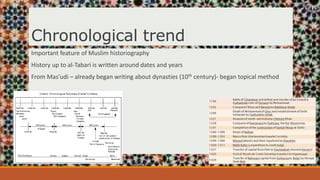
Chronological trend
Important feature of Muslim historiography
History up to al-Tabari is written around dates and years
From Mas’udi – already began writing about dynasties (10th century)- began topical method
Theological Viewpoint
Muslim history was always interpreted from theological viewpoint (!)
History was interpreted in the light of Divine plan
Also was sociological viewpoint like in Ibn Khaldun (but started by Mas’udi)
Mainly was a study of ummah – later, larger scope as they began focusing on Greek, Roman,
Chinese and Indian history
Geography became a part of history from Mas’udi, writing about animal life, plant life,
geographical features
Also, Muslim historiography had developed with freedom from all political biasness. Ibn Ishaq,
Ibn Hisham and al-Tabari wrote history without being influenced by political parties.
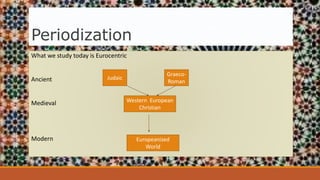
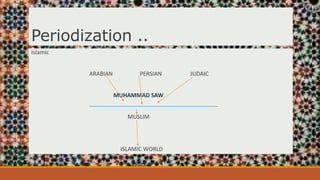
Periodization
What we study today is Eurocentric
Ancient
Medieval
Modern
Judaic
Graeco-
Roman
Western European
Christian
Europeanized
World
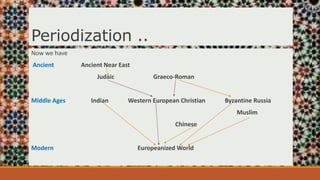
Periodization ..
Now we have
Ancient Ancient Near East
Judaic Graeco-Roman
Middle Ages Indian Western European Christian Byzantine Russia
Muslim
Chinese
Modern Europeanized World
Periodization ..
Islamic
ARABIAN PERSIAN JUDAIC
MUHAMMAD SAW
------------------------------------------------------------------
MUSLIM
ISLAMIC WORLD
Basic forms of Muslim
Historiography
Khabar History
The Oldest form of Muslim history writing, a direct continuation of the battle-day narratives
A well-rounded description of a single event, usually no more than a few pages
It is also used in larger historical works under the title of khabar
Its character is a self-contained unit is stressed by the chain of transmitters which precedes each
khabar
It has three features:
1. by its nature, it does not admit of establishment of a causal nexus between two or three
events
each khabar is complete in itself, no any explanation is needed or added
Khabar …
If historical work is made up from more than one habar as necessary – the
juxtaposition (comparison, contrast, connection) of the individual habars (if
they are not much different versions of the same story) may occasionally
indicate a transfer of the historical locale from one geographical region to
another, but as a rule it indicates progress in time – chronological continuity
It looks that no historical penetration or critical thinking is allowed in this form
It is suitable for happenings within a short time
Unmanageable to explain continuous long stories
Khabar ..
2. since it was continuation of the Battle day narratives, it remained the character of vividly told
short story
The action usually is presented in the form of a dialogue between the principal participants
So historian should follow this real task, leaving the analysis to the reader
The frequent battle scenes make reading khabar enjoyable but actual fact reminds under a cloud
Language has high literary quality
Later historians began entering khabar as chapters in their universal history books
3. the nature of mixed blessing
It required the presence of poetical insertions and artistic form of expression
Khabar ..
Entering poetry becomes a rule (tradition) in history writing as well later, but
sometimes even not having relation to the topic – just as a stylistic law or type of
self-expression
Khabar was in existence in pre-Islamic Arabia – entered to Muslim narration of
history
Who was the first writer of khabar – we do not know, did not survive
Should be in the first year of hijrah as private works (oral transmissions as well)
But elements are found in seerah books – blended with genealogy
Occurs in many forms of later historical works but already well-blended with
other styles – not in its pure form
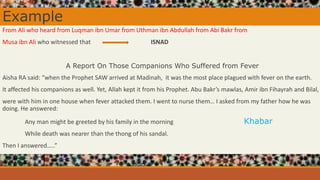
Example
From Ali who heard from Luqman ibn Umar from Uthman ibn Abdullah from Abi Bakr from
Musa ibn Ali who witnessed that ISNAD
A Report On Those Companions Who Suffered from Fever
Aisha RA said: “when the Prophet SAW arrived at Madinah, it was the most place plagued with fever on the earth.
It affected his companions as well. Yet, Allah kept it from his Prophet. Abu Bakr’s mawlas, Amir ibn Fihayrah and Bilal,
were with him in one house when fever attacked them. I went to nurse them… I asked from my father how he was
doing. He answered:
Any man might be greeted by his family in the morning Khabar
While death was nearer than the thong of his sandal.
Then I answered…..”
The Annalistic form
Another earliest form of history writing in early Islam
A specialized form of chronological historiography
It is some writing like “In the year n… “ or “when there was the year of n..”
Relation between the year (time) and event
But how to interpret details – the author decides
Developed during the period of al-Tabari (first decade of the 10 century), so all happenings were narrated
until 914-915 CE
He was not first to apply this form - so Muslim historians began to use data at the very early age of Islamic
history
Lesser Forms
Dynastic historiography
About reigns of caliphs or rulers
Contains a list of children, wives, parents, officials and other statistic material
Separate section for each caliph
Example: al-Quda’I’s Muqtabis gives a detailed information about of caliphs and rulers of the
Muslim Andalusia, the list of officials, scholars, poets and opponents of the ruler
Ibn Ishaq “History of the Caliphs”
Perhaps was the influence of Persian historiography (Rosenthal)
Pre-Islamic history was also presented in the form of nations and dynasties
Lesser Forms …
TABAQAT
Means layer
Was used in the meaning of generation
Such tabaqat division is genuinely Islamic – contributed to Muslim critical thinking
Comparing different tabaqat
It was the natural consequence of the concept sahabah, tabi’in, tabi’in al-tabi’in
Also was used for different classes or professions
Examples: Tabaqat al-Atibba, Tabaqat al-Fuqaha (al-Shirazi) – practical for religious sciences
Early Historical Writings
Maghazi
Military expeditions of the Prophet SAW, began in Madinah with conjunction with the study of hadith, some
scholars wanted to study more beyond the limitations of the juridical aspect of the subject
Rich material about the wars, participants, small details of the battles, aims, list of casualties, leader of the
army,
Short description
Usually pioneers are scholars of hadith, isnad
Also the popular tales passed by word of mouth – storytelling, folklore – isnad was not required because this
was he early age of history writing, historians were flexible and the exact form of rules of using isnad was not
established yet
Some information from the Qur’an, hadith and eye-witnesses
It began with ‘Urwah bin Zubayr, later –Ibn Ishaq – al-Waqidi
They paid a special attention to the career of the Prophet as a military leader
Maghazi
Main foundation for later seerah books
Main writers: Aban b. Uthman (20-100H), ‘Urwah b. Zubayr (23-94H), al-Zuhri (51-124H), ‘Abdullah al-
Waqidi (?).
It covers various aspects of the Prophet’s life: the beginning of revelation, some personal affairs and not only
about battles
Free from exaggerations,
Some writers like ‘Urwah ibn Zubayr even extended it into later khulafa al-Rashidun time and spoke about
the battle of Yarmuk
Then seerah works began to appear
SIYAR (sirah, seerah)
Biographical details of the Prophet Muhammad SAW, his actions, sayings and practices
From the birth until his death
Firstly –oral
Reason?
Spread to Yemen, Syria and Iraq in the 2nd century H (Duri)
By the end of the third century , the lines of the seerah were laid and the bulk of basic material was
collected
First writers: Abān b. ‘Uthmān, ‘Urwa b. al-Zubair b. al-`Awwām, Ibn Shihāb al-Zuhrî, Ibn Ishāq, Zayyat al-
Bakkā’i.
Al-Zuhri was among the first writers (51-124H) from Madinah school
Nature: in chapters, based on hadith and emphasis on isnad
Futuhat
From fath
Deal with the time of four caliphs and the large-scale openings of new places outside Arabian peninsula to Islam
during their times
Syria, Palestine, Egypt, Iraq/Iran, Armenia, Jurjan, Tabaristan
Time-scale: first decades of Muslim history after the death of the Prophet SAW
5o books are known by names today
Speak about great battles, entering to cities,
Some are thematically strict like Futuh al-Sham by al-Azdi (d.190) – about opening of Syria only
Futuh Misr wa Akhbaruha by Ibn Abdul Hakam (d.257)
Ansab (Geneologies)
Important since pre-Islamic period
Islam brought equality to all, yet, Arabs remained being proud of their backgrounds
Usually described within the framework of ridda, futuh and fitnah
High nobility: caliphs, governors and the Prophet’s family
Ansab al-Ashraf by al-Baladhuri talks about the importance of ansab-related matters in society
Another forms:
Sirat al-Khulafa
Futun
Ridda Wars

Forms - Muslim Historiography

  • 1.
    MUSLIM HISTORIOGRAPHY Part 2 HIST 3750 DRELMIRA AKHMETOVA DEPT OF HISTORY AND CIVILISATION IIUM
  • 2.
    Features of Muslim Historiography Isnad Chronology TheologicalView of History Periodization Habar History
  • 3.
    Isnad Muslim historiography beginswith the biographies of the Prophet SAW Historians used the collected hadith – traditions, so you need to examine critically – should be traced on original eyewitness This using of isnad for history helped Muslims to develop history as science with critical method from the early times Prerequisites of Historian to write seerah books: 1. The spirit of independent inquiry 2. Critical insight So isnad was used to write seerah or maghazi books Traditions were tested and examined through isnad system, which means the chain of authorities by which a narrative can be traced to the original eye-witness who narrated it
  • 4.
    Isnad Each narrative, inorder to be trustworthy, should be traceable through a known series of transmitters to its source pervades historical composition till quite late time. Provided a spirit of inquiry and critical insight to the Muslim mind Problem of weak hadiths, fabricated ones Isnad was used until al-Tabari (9th century)
  • 5.
    Chronological trend Important featureof Muslim historiography History up to al-Tabari is written around dates and years From Mas’udi – already began writing about dynasties (10th century)- began topical method
  • 6.
    Theological Viewpoint Muslim historywas always interpreted from theological viewpoint (!) History was interpreted in the light of Divine plan Also was sociological viewpoint like in Ibn Khaldun (but started by Mas’udi) Mainly was a study of ummah – later, larger scope as they began focusing on Greek, Roman, Chinese and Indian history Geography became a part of history from Mas’udi, writing about animal life, plant life, geographical features Also, Muslim historiography had developed with freedom from all political biasness. Ibn Ishaq, Ibn Hisham and al-Tabari wrote history without being influenced by political parties.
  • 7.
    Periodization What we studytoday is Eurocentric Ancient Medieval Modern Judaic Graeco- Roman Western European Christian Europeanized World
  • 8.
    Periodization .. Now wehave Ancient Ancient Near East Judaic Graeco-Roman Middle Ages Indian Western European Christian Byzantine Russia Muslim Chinese Modern Europeanized World
  • 9.
    Periodization .. Islamic ARABIAN PERSIANJUDAIC MUHAMMAD SAW ------------------------------------------------------------------ MUSLIM ISLAMIC WORLD
  • 10.
    Basic forms ofMuslim Historiography Khabar History The Oldest form of Muslim history writing, a direct continuation of the battle-day narratives A well-rounded description of a single event, usually no more than a few pages It is also used in larger historical works under the title of khabar Its character is a self-contained unit is stressed by the chain of transmitters which precedes each khabar It has three features: 1. by its nature, it does not admit of establishment of a causal nexus between two or three events each khabar is complete in itself, no any explanation is needed or added
  • 11.
    Khabar … If historicalwork is made up from more than one habar as necessary – the juxtaposition (comparison, contrast, connection) of the individual habars (if they are not much different versions of the same story) may occasionally indicate a transfer of the historical locale from one geographical region to another, but as a rule it indicates progress in time – chronological continuity It looks that no historical penetration or critical thinking is allowed in this form It is suitable for happenings within a short time Unmanageable to explain continuous long stories
  • 12.
    Khabar .. 2. sinceit was continuation of the Battle day narratives, it remained the character of vividly told short story The action usually is presented in the form of a dialogue between the principal participants So historian should follow this real task, leaving the analysis to the reader The frequent battle scenes make reading khabar enjoyable but actual fact reminds under a cloud Language has high literary quality Later historians began entering khabar as chapters in their universal history books 3. the nature of mixed blessing It required the presence of poetical insertions and artistic form of expression
  • 13.
    Khabar .. Entering poetrybecomes a rule (tradition) in history writing as well later, but sometimes even not having relation to the topic – just as a stylistic law or type of self-expression Khabar was in existence in pre-Islamic Arabia – entered to Muslim narration of history Who was the first writer of khabar – we do not know, did not survive Should be in the first year of hijrah as private works (oral transmissions as well) But elements are found in seerah books – blended with genealogy Occurs in many forms of later historical works but already well-blended with other styles – not in its pure form
  • 14.
    Example From Ali whoheard from Luqman ibn Umar from Uthman ibn Abdullah from Abi Bakr from Musa ibn Ali who witnessed that ISNAD A Report On Those Companions Who Suffered from Fever Aisha RA said: “when the Prophet SAW arrived at Madinah, it was the most place plagued with fever on the earth. It affected his companions as well. Yet, Allah kept it from his Prophet. Abu Bakr’s mawlas, Amir ibn Fihayrah and Bilal, were with him in one house when fever attacked them. I went to nurse them… I asked from my father how he was doing. He answered: Any man might be greeted by his family in the morning Khabar While death was nearer than the thong of his sandal. Then I answered…..”
  • 15.
    The Annalistic form Anotherearliest form of history writing in early Islam A specialized form of chronological historiography It is some writing like “In the year n… “ or “when there was the year of n..” Relation between the year (time) and event But how to interpret details – the author decides Developed during the period of al-Tabari (first decade of the 10 century), so all happenings were narrated until 914-915 CE He was not first to apply this form - so Muslim historians began to use data at the very early age of Islamic history
  • 16.
    Lesser Forms Dynastic historiography Aboutreigns of caliphs or rulers Contains a list of children, wives, parents, officials and other statistic material Separate section for each caliph Example: al-Quda’I’s Muqtabis gives a detailed information about of caliphs and rulers of the Muslim Andalusia, the list of officials, scholars, poets and opponents of the ruler Ibn Ishaq “History of the Caliphs” Perhaps was the influence of Persian historiography (Rosenthal) Pre-Islamic history was also presented in the form of nations and dynasties
  • 17.
    Lesser Forms … TABAQAT Meanslayer Was used in the meaning of generation Such tabaqat division is genuinely Islamic – contributed to Muslim critical thinking Comparing different tabaqat It was the natural consequence of the concept sahabah, tabi’in, tabi’in al-tabi’in Also was used for different classes or professions Examples: Tabaqat al-Atibba, Tabaqat al-Fuqaha (al-Shirazi) – practical for religious sciences
  • 18.
  • 19.
    Maghazi Military expeditions ofthe Prophet SAW, began in Madinah with conjunction with the study of hadith, some scholars wanted to study more beyond the limitations of the juridical aspect of the subject Rich material about the wars, participants, small details of the battles, aims, list of casualties, leader of the army, Short description Usually pioneers are scholars of hadith, isnad Also the popular tales passed by word of mouth – storytelling, folklore – isnad was not required because this was he early age of history writing, historians were flexible and the exact form of rules of using isnad was not established yet Some information from the Qur’an, hadith and eye-witnesses It began with ‘Urwah bin Zubayr, later –Ibn Ishaq – al-Waqidi They paid a special attention to the career of the Prophet as a military leader
  • 20.
    Maghazi Main foundation forlater seerah books Main writers: Aban b. Uthman (20-100H), ‘Urwah b. Zubayr (23-94H), al-Zuhri (51-124H), ‘Abdullah al- Waqidi (?). It covers various aspects of the Prophet’s life: the beginning of revelation, some personal affairs and not only about battles Free from exaggerations, Some writers like ‘Urwah ibn Zubayr even extended it into later khulafa al-Rashidun time and spoke about the battle of Yarmuk Then seerah works began to appear
  • 21.
    SIYAR (sirah, seerah) Biographicaldetails of the Prophet Muhammad SAW, his actions, sayings and practices From the birth until his death Firstly –oral Reason? Spread to Yemen, Syria and Iraq in the 2nd century H (Duri) By the end of the third century , the lines of the seerah were laid and the bulk of basic material was collected First writers: Abān b. ‘Uthmān, ‘Urwa b. al-Zubair b. al-`Awwām, Ibn Shihāb al-Zuhrî, Ibn Ishāq, Zayyat al- Bakkā’i. Al-Zuhri was among the first writers (51-124H) from Madinah school Nature: in chapters, based on hadith and emphasis on isnad
  • 22.
    Futuhat From fath Deal withthe time of four caliphs and the large-scale openings of new places outside Arabian peninsula to Islam during their times Syria, Palestine, Egypt, Iraq/Iran, Armenia, Jurjan, Tabaristan Time-scale: first decades of Muslim history after the death of the Prophet SAW 5o books are known by names today Speak about great battles, entering to cities, Some are thematically strict like Futuh al-Sham by al-Azdi (d.190) – about opening of Syria only Futuh Misr wa Akhbaruha by Ibn Abdul Hakam (d.257)
  • 23.
    Ansab (Geneologies) Important sincepre-Islamic period Islam brought equality to all, yet, Arabs remained being proud of their backgrounds Usually described within the framework of ridda, futuh and fitnah High nobility: caliphs, governors and the Prophet’s family Ansab al-Ashraf by al-Baladhuri talks about the importance of ansab-related matters in society Another forms: Sirat al-Khulafa Futun Ridda Wars