June 2019
CEDIR
Center for Disposal and Reuse of
Informatics Residuals
Tereza Cristina Carvalho
terezacarvalho@usp.br
E-waste
• It consists of discarded electro-electronic
equipment.
• It contains toxic and harmful substances, often
buried in landfills.
• IDC estimates that 1.4 million WEEE annually are
discarded in Brazil, with 10% being in the ICT area.
• Part of the world garbage is exported to developing
countries, where people work under inadequate
and unregulated conditions.
WEEE Classifications
• Brown Line - Tv / monitor TV, plasma / LCD TV /
monitor, DVD / VHS, audio products;
• Green Line - desktops, notebooks, printers, cell
phones;
• White Line - refrigerators, refrigerators and
freezers, stoves, washer, air-conditioning;
• Blue Line - blenders, blenders, electric irons and
drills.
The productive chain of WEEE is composed by:
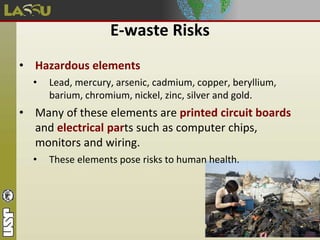
E-waste Risks
• Hazardous elements
• Lead, mercury, arsenic, cadmium, copper, beryllium,
barium, chromium, nickel, zinc, silver and gold.
• Many of these elements are printed circuit boards
and electrical parts such as computer chips,
monitors and wiring.
• These elements pose risks to human health.
USP ACTIONS
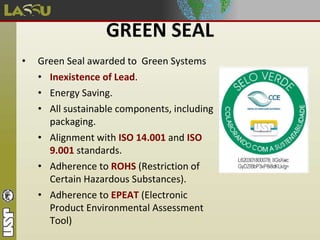
GREEN SEAL
• Green Seal awarded to Green Systems
• Inexistence of Lead.
• Energy Saving.
• All sustainable components, including
packaging.
• Alignment with ISO 14.001 and ISO
9.001 standards.
• Adherence to ROHS (Restriction of
Certain Hazardous Substances).
• Adherence to EPEAT (Electronic
Product Environmental Assessment
Tool)
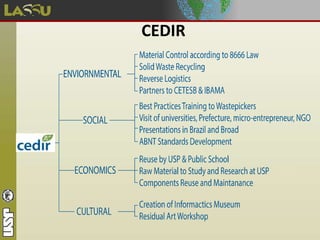
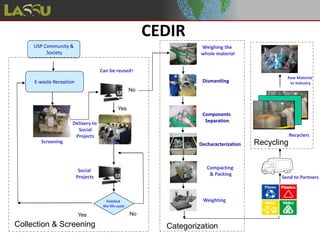
CEDIR
CEDIR
USP Community &
Society
E-waste Reception
Delivery to
Social
Projects
Screening
Yes
Can be reused?
No
Finished
the life-cycle
Yes No
Social
Projects
Collection & Screening
Dismantling
Components
Separation
Compacting
& Packing
Weighting
Send to Partners
Decharacterization
Weighing the
whole material
Raw Material
to Industry
Recyclers
Categorization
Recycling
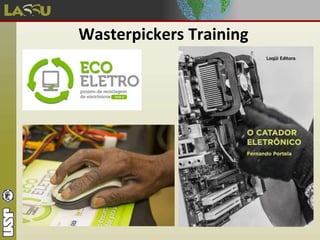
Wasterpickers Training
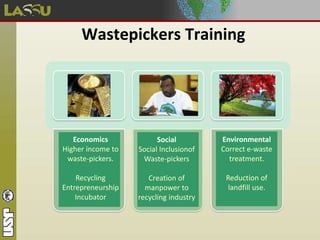
Wastepickers Training
Economics
Higher income to
waste-pickers.
Recycling
Entrepreneurship
Incubator
Social
Social Inclusionof
Waste-pickers
Creation of
manpower to
recycling industry
Environmental
Correct e-waste
treatment.
Reduction of
landfill use.
Wastepickers Training
RESULTS
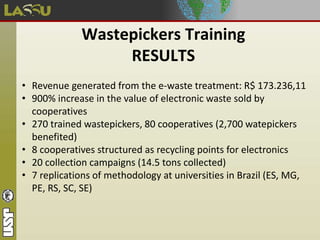
• Revenue generated from the e-waste treatment: R$ 173.236,11
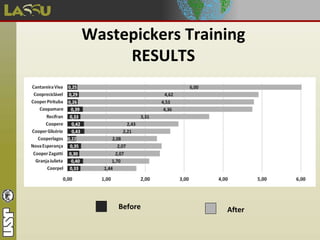
• 900% increase in the value of electronic waste sold by
cooperatives
• 270 trained wastepickers, 80 cooperatives (2,700 watepickers
benefited)
• 8 cooperatives structured as recycling points for electronics
• 20 collection campaigns (14.5 tons collected)
• 7 replications of methodology at universities in Brazil (ES, MG,
PE, RS, SC, SE)
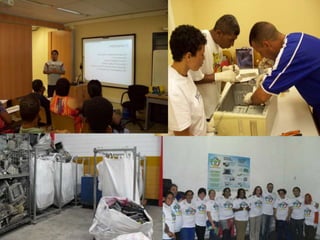
Wastepickers Training
RESULTS
Before After
Awards
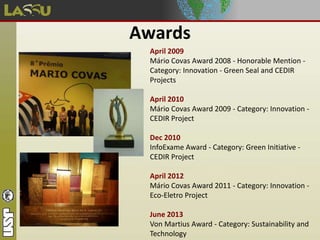
April 2009
Mário Covas Award 2008 - Honorable Mention -
Category: Innovation - Green Seal and CEDIR
Projects
April 2010
Mário Covas Award 2009 - Category: Innovation -
CEDIR Project
Dec 2010
InfoExame Award - Category: Green Initiative -
CEDIR Project
April 2012
Mário Covas Award 2011 - Category: Innovation -
Eco-Eletro Project
June 2013
Von Martius Award - Category: Sustainability and
Technology
Final considerations
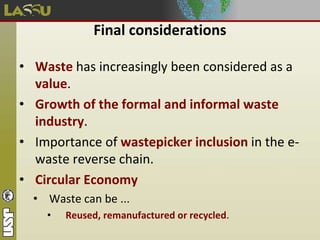
• Waste has increasingly been considered as a
value.
• Growth of the formal and informal waste
industry.
• Importance of wastepicker inclusion in the e-
waste reverse chain.
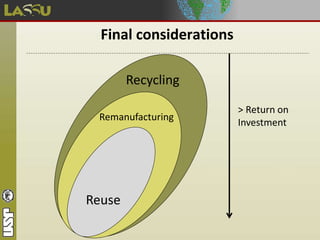
• Circular Economy
• Waste can be ...
• Reused, remanufactured or recycled.
Remanufacturing
Reuse
Recycling
> Return on
Investment
Final considerations

ISCN 2019 - Rapid Round

  • 1.
    June 2019 CEDIR Center forDisposal and Reuse of Informatics Residuals Tereza Cristina Carvalho terezacarvalho@usp.br
  • 2.
    E-waste • It consistsof discarded electro-electronic equipment. • It contains toxic and harmful substances, often buried in landfills. • IDC estimates that 1.4 million WEEE annually are discarded in Brazil, with 10% being in the ICT area. • Part of the world garbage is exported to developing countries, where people work under inadequate and unregulated conditions.
  • 3.
    WEEE Classifications • BrownLine - Tv / monitor TV, plasma / LCD TV / monitor, DVD / VHS, audio products; • Green Line - desktops, notebooks, printers, cell phones; • White Line - refrigerators, refrigerators and freezers, stoves, washer, air-conditioning; • Blue Line - blenders, blenders, electric irons and drills. The productive chain of WEEE is composed by:
  • 4.
    E-waste Risks • Hazardouselements • Lead, mercury, arsenic, cadmium, copper, beryllium, barium, chromium, nickel, zinc, silver and gold. • Many of these elements are printed circuit boards and electrical parts such as computer chips, monitors and wiring. • These elements pose risks to human health.
  • 5.
  • 6.
    GREEN SEAL • GreenSeal awarded to Green Systems • Inexistence of Lead. • Energy Saving. • All sustainable components, including packaging. • Alignment with ISO 14.001 and ISO 9.001 standards. • Adherence to ROHS (Restriction of Certain Hazardous Substances). • Adherence to EPEAT (Electronic Product Environmental Assessment Tool)
  • 7.
  • 8.
    CEDIR USP Community & Society E-wasteReception Delivery to Social Projects Screening Yes Can be reused? No Finished the life-cycle Yes No Social Projects Collection & Screening Dismantling Components Separation Compacting & Packing Weighting Send to Partners Decharacterization Weighing the whole material Raw Material to Industry Recyclers Categorization Recycling
  • 9.
  • 10.
    Wastepickers Training Economics Higher incometo waste-pickers. Recycling Entrepreneurship Incubator Social Social Inclusionof Waste-pickers Creation of manpower to recycling industry Environmental Correct e-waste treatment. Reduction of landfill use.
  • 12.
    Wastepickers Training RESULTS • Revenuegenerated from the e-waste treatment: R$ 173.236,11 • 900% increase in the value of electronic waste sold by cooperatives • 270 trained wastepickers, 80 cooperatives (2,700 watepickers benefited) • 8 cooperatives structured as recycling points for electronics • 20 collection campaigns (14.5 tons collected) • 7 replications of methodology at universities in Brazil (ES, MG, PE, RS, SC, SE)
  • 13.
  • 14.
    Awards April 2009 Mário CovasAward 2008 - Honorable Mention - Category: Innovation - Green Seal and CEDIR Projects April 2010 Mário Covas Award 2009 - Category: Innovation - CEDIR Project Dec 2010 InfoExame Award - Category: Green Initiative - CEDIR Project April 2012 Mário Covas Award 2011 - Category: Innovation - Eco-Eletro Project June 2013 Von Martius Award - Category: Sustainability and Technology
  • 15.
    Final considerations • Wastehas increasingly been considered as a value. • Growth of the formal and informal waste industry. • Importance of wastepicker inclusion in the e- waste reverse chain. • Circular Economy • Waste can be ... • Reused, remanufactured or recycled.
  • 16.