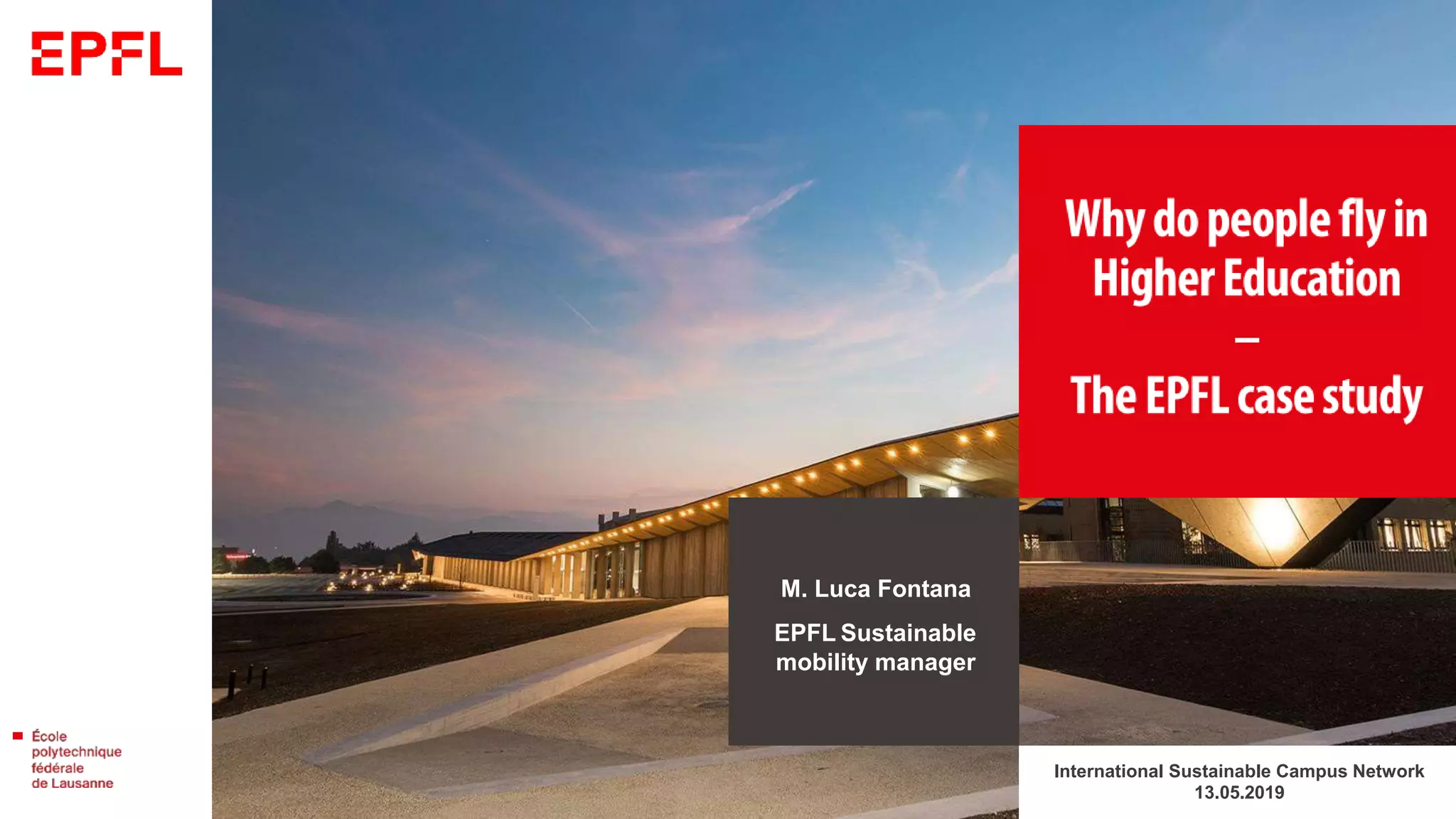
M. Luca Fontana
EPFL Sustainable
mobility manager
International Sustainable Campus Network
13.05.2019
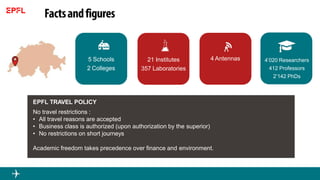
5 Schools
2 Colleges
4’020 Researchers
412 Professors
2’142 PhDs
4 Antennas21 Institutes
357 Laboratories
EPFL TRAVEL POLICY
No travel restrictions :
• All travel reasons are accepted
• Business class is authorized (upon authorization by the superior)
• No restrictions on short journeys
Academic freedom takes precedence over finance and environment.
-
1,40
1,20
1,00
0,80
0,60
0,40
0,20
2015 2017
tCO2-eq/FTE
CO2 emissions /FTE
Air Rail
2016
Vehicles
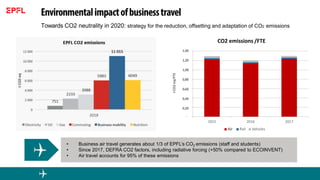
• Business air travel generates about 1/3 of EPFL’s CO2 emissions (staff and students)
• Since 2017, DEFRA CO2 factors, including radiative forcing (+50% compared to ECOINVENT)
• Air travel accounts for 95% of these emissions
Towards CO2 neutrality in 2020: strategy for the reduction, offsetting and adaptation of CO2 emissions
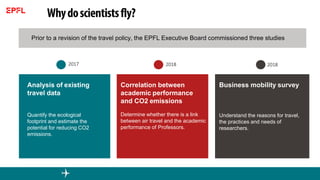
Prior to a revision of the travel policy, the EPFL Executive Board commissioned three studies
Analysis of existing
travel data
Quantify the ecological
footprint and estimate the
potential for reducing CO2
emissions.
Business mobility survey
Understand the reasons for travel,
the practices and needs of
researchers.
Correlation between
academic performance
and CO2 emissions
Determine whether there is a link
between air travel and the academic
performance of Professors.
2017 2018 2018
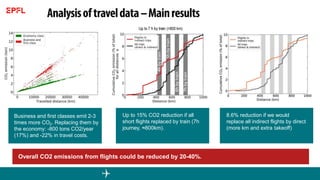
Business and first classes emit 2-3
times more CO2. Replacing them by
the economy: -800 tons CO2/year
(17%) and -22% in travel costs.
Up to 15% CO2 reduction if all
short flights replaced by train (7h
journey, ≈800km).
Overall CO2 emissions from flights could be reduced by 20-40%.
8.6% reduction if we would
replace all indirect flights by direct
(more km and extra takeoff)
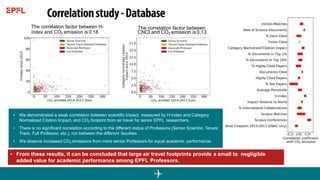
The correlation factor between H-
index and CO2 emission is 0.18
The correlation factor between
CNCI and CO2 emission is0.13
• We demonstrated a weak correlation between scientific impact, measured by H-index and Category
Normalized Citation Impact, and CO2 footprint from air travel for senior EPFL researchers.
• There is no significant correlation according to the different status of Professors (Senior Scientist, Tenure
Track, Full Professor, etc.), nor between the different faculties.
• We observe increased CO2 emissions from more senior Professors for equal academic performance.
• From these results, it can be concluded that large air travel footprints provide a small to negligible
added value for academic performance among EPFL Professors.
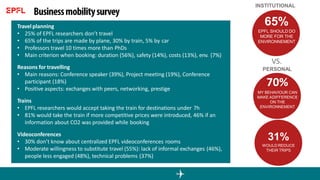
Travel planning
• 25% of EPFL researchers don’t travel
• 65% of the trips are made by plane, 30% by train, 5% by car
• Professors travel 10 times more than PhDs
• Main criterion when booking: duration (56%), safety (14%), costs (13%), env. (7%)
Reasons for travelling
• Main reasons: Conference speaker (39%), Project meeting (19%), Conference
participant (18%)
• Positive aspects: exchanges with peers, networking, prestige
Trains
• EPFL researchers would accept taking the train for destinations under 7h
• 81% would take the train if more competitive prices were introduced, 46% if an
information about CO2 was provided while booking
Videoconferences
• 30% don’t know about centralized EPFL videoconferences rooms
• Moderate willingness to substitute travel (55%): lack of informal exchanges (46%),
people less engaged (48%), technical problems (37%)
INSTITUTIONAL
65%
EPFL SHOULD DO
MORE FOR THE
ENVIRONNEMENT
VS.
PERSONAL
70%
MY BEHAVIOUR CAN
MAKE ADIFFERENCE
ON THE
ENVIRONNEMENT
31%
WOULD REDUCE
THEIR TRIPS
Initial reactions and follow-up of the project
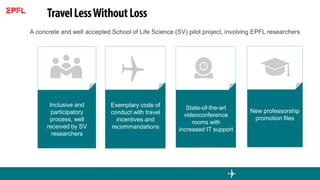
A concrete and well accepted School of Life Science (SV) pilot project, involving EPFL researchers
Exemplary code of
conduct with travel
incentives and
recommandations
State-of-the-art
videoconference
rooms with
increased IT support
New professorship
promotion files
Inclusive and
participatory
process, well
received by SV
researchers
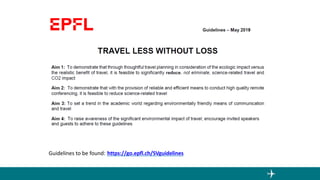
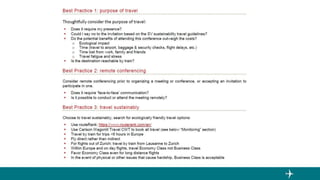
Guidelines to be found: https://go.epfl.ch/SVguidelines
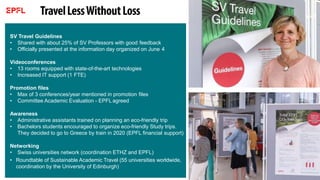
SV Travel Guidelines
• Shared with about 25% of SV Professors with good feedback
• Officially presented at the information day organized on June 4
Videoconferences
• 13 rooms equipped with state-of-the-art technologies
• Increased IT support (1 FTE)
Promotion files
• Max of 3 conferences/year mentioned in promotion files
• Committee Academic Evaluation - EPFLagreed
Awareness
• Administrative assistants trained on planning an eco-friendly trip
• Bachelors students encouraged to organize eco-friendly Study trips.
They decided to go to Greece by train in 2020 (EPFL financial support)
Networking
• Swiss universities network (coordination ETHZ and EPFL)
• Roundtable of Sustainable Academic Travel (55 universities worldwide,
coordination by the University of Edinburgh)
Bottom-up
1. Raise
awareness
and engage
2. Create a
shared
vision
3. Introduce
incentives
and restrictions
4. Evaluate
and refine
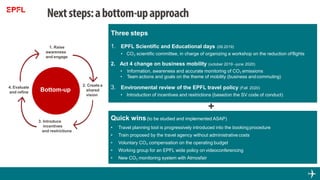
Three steps
1. EPFL Scientific and Educational days (09.2019)
• CO₂ scientific committee, in charge of organizing a workshop on the reduction offlights
2. Act 4 change on business mobility (october 2019 –june 2020)
• Information, awareness and accurate monitoring of CO₂ emissions
• Team actions and goals on the theme of mobility (business andcommuting)
3. Environmental review of the EPFL travel policy (Fall 2020)
• Introduction of incentives and restrictions (basedon the SV code of conduct)
+
Quick wins(to be studied and implemented ASAP)
• Travel planning tool is progressively introduced into the booking procedure
• Train proposed by the travel agency without administrative costs
• Voluntary CO₂ compensation on the operating budget
• Working group for an EPFL wide policy on videoconferencing
• New CO₂ monitoring system with Atmosfair
Muito obrigado pela suaatenção
Luca Fontana, EPFL Sustainable mobility manager
E-mail: luca.fontana@epfl.ch

ISCN 2019 - Rapid Round

  • 1.
    M. Luca Fontana EPFLSustainable mobility manager International Sustainable Campus Network 13.05.2019
  • 2.
    5 Schools 2 Colleges 4’020Researchers 412 Professors 2’142 PhDs 4 Antennas21 Institutes 357 Laboratories EPFL TRAVEL POLICY No travel restrictions : • All travel reasons are accepted • Business class is authorized (upon authorization by the superior) • No restrictions on short journeys Academic freedom takes precedence over finance and environment.
  • 3.
    - 1,40 1,20 1,00 0,80 0,60 0,40 0,20 2015 2017 tCO2-eq/FTE CO2 emissions/FTE Air Rail 2016 Vehicles • Business air travel generates about 1/3 of EPFL’s CO2 emissions (staff and students) • Since 2017, DEFRA CO2 factors, including radiative forcing (+50% compared to ECOINVENT) • Air travel accounts for 95% of these emissions Towards CO2 neutrality in 2020: strategy for the reduction, offsetting and adaptation of CO2 emissions
  • 4.
    Prior to arevision of the travel policy, the EPFL Executive Board commissioned three studies Analysis of existing travel data Quantify the ecological footprint and estimate the potential for reducing CO2 emissions. Business mobility survey Understand the reasons for travel, the practices and needs of researchers. Correlation between academic performance and CO2 emissions Determine whether there is a link between air travel and the academic performance of Professors. 2017 2018 2018
  • 5.
    Business and firstclasses emit 2-3 times more CO2. Replacing them by the economy: -800 tons CO2/year (17%) and -22% in travel costs. Up to 15% CO2 reduction if all short flights replaced by train (7h journey, ≈800km). Overall CO2 emissions from flights could be reduced by 20-40%. 8.6% reduction if we would replace all indirect flights by direct (more km and extra takeoff)
  • 6.
    The correlation factorbetween H- index and CO2 emission is 0.18 The correlation factor between CNCI and CO2 emission is0.13 • We demonstrated a weak correlation between scientific impact, measured by H-index and Category Normalized Citation Impact, and CO2 footprint from air travel for senior EPFL researchers. • There is no significant correlation according to the different status of Professors (Senior Scientist, Tenure Track, Full Professor, etc.), nor between the different faculties. • We observe increased CO2 emissions from more senior Professors for equal academic performance. • From these results, it can be concluded that large air travel footprints provide a small to negligible added value for academic performance among EPFL Professors.
  • 7.
    Travel planning • 25%of EPFL researchers don’t travel • 65% of the trips are made by plane, 30% by train, 5% by car • Professors travel 10 times more than PhDs • Main criterion when booking: duration (56%), safety (14%), costs (13%), env. (7%) Reasons for travelling • Main reasons: Conference speaker (39%), Project meeting (19%), Conference participant (18%) • Positive aspects: exchanges with peers, networking, prestige Trains • EPFL researchers would accept taking the train for destinations under 7h • 81% would take the train if more competitive prices were introduced, 46% if an information about CO2 was provided while booking Videoconferences • 30% don’t know about centralized EPFL videoconferences rooms • Moderate willingness to substitute travel (55%): lack of informal exchanges (46%), people less engaged (48%), technical problems (37%) INSTITUTIONAL 65% EPFL SHOULD DO MORE FOR THE ENVIRONNEMENT VS. PERSONAL 70% MY BEHAVIOUR CAN MAKE ADIFFERENCE ON THE ENVIRONNEMENT 31% WOULD REDUCE THEIR TRIPS
  • 8.
    Initial reactions andfollow-up of the project
  • 9.
    A concrete andwell accepted School of Life Science (SV) pilot project, involving EPFL researchers Exemplary code of conduct with travel incentives and recommandations State-of-the-art videoconference rooms with increased IT support New professorship promotion files Inclusive and participatory process, well received by SV researchers
  • 10.
    Guidelines to befound: https://go.epfl.ch/SVguidelines
  • 12.
    SV Travel Guidelines •Shared with about 25% of SV Professors with good feedback • Officially presented at the information day organized on June 4 Videoconferences • 13 rooms equipped with state-of-the-art technologies • Increased IT support (1 FTE) Promotion files • Max of 3 conferences/year mentioned in promotion files • Committee Academic Evaluation - EPFLagreed Awareness • Administrative assistants trained on planning an eco-friendly trip • Bachelors students encouraged to organize eco-friendly Study trips. They decided to go to Greece by train in 2020 (EPFL financial support) Networking • Swiss universities network (coordination ETHZ and EPFL) • Roundtable of Sustainable Academic Travel (55 universities worldwide, coordination by the University of Edinburgh)
  • 13.
    Bottom-up 1. Raise awareness and engage 2.Create a shared vision 3. Introduce incentives and restrictions 4. Evaluate and refine Three steps 1. EPFL Scientific and Educational days (09.2019) • CO₂ scientific committee, in charge of organizing a workshop on the reduction offlights 2. Act 4 change on business mobility (october 2019 –june 2020) • Information, awareness and accurate monitoring of CO₂ emissions • Team actions and goals on the theme of mobility (business andcommuting) 3. Environmental review of the EPFL travel policy (Fall 2020) • Introduction of incentives and restrictions (basedon the SV code of conduct) + Quick wins(to be studied and implemented ASAP) • Travel planning tool is progressively introduced into the booking procedure • Train proposed by the travel agency without administrative costs • Voluntary CO₂ compensation on the operating budget • Working group for an EPFL wide policy on videoconferencing • New CO₂ monitoring system with Atmosfair
  • 14.
    Muito obrigado pelasuaatenção Luca Fontana, EPFL Sustainable mobility manager E-mail: luca.fontana@epfl.ch