INTRODUCTION
• A Computer Virus is actually a computer program
  that can increase its own number by replicating
  itself and keeps on infecting the other files by
  changing their properties continuously.
• It can be sent by various means such as over the
  internet, by email, or can be carried on various
  storage mediums such as Floppy, Portable Hard
  Disks, Pen Drives, Bluetooth, CD's & DVD's etc.
ETYMOLOGY
• In 1984 Fred Cohen from the University of
  Southern California wrote his paper "Computer
  Viruses - Theory and Experiments“. It was the first
  paper to explicitly call a self-reproducing program
  a "virus", a term introduced by Cohen's mentor
  Leonard Adleman.
• The actual term "virus" was first used to denote a
  self-reproducing program in a short story by
  David Gerrold in Galaxy magazine in 1969 - and
  later in his 1972 novel, When HARLIE Was One.
HISTORY
• In 1971, The Creeper was the first detected
  Virus on ARPANET, the forerunner of internet.
• In 1981, A program called “Elk Cloner” was the
  first computer Virus that appeared outside the
  single computer or lab written by Richard
  Skrenta.
• In 1986, The first PC Virus was a boot sector
  virus dubbed ©Brain created by Farooq Alvi
  Brothers in Lahore, Pakistan.
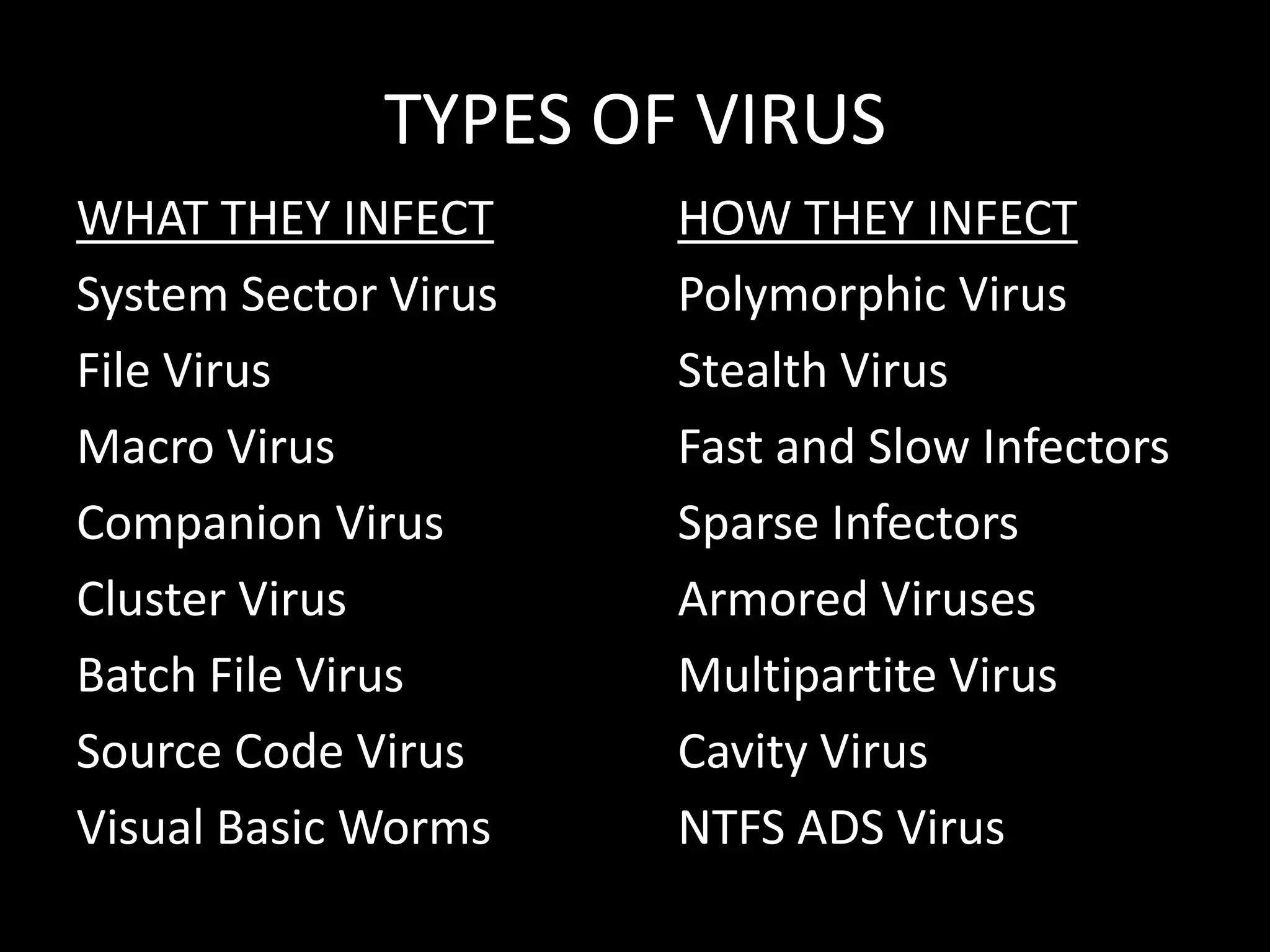
TYPES OF VIRUS
WHAT THEY INFECT      HOW THEY INFECT
System Sector Virus   Polymorphic Virus
File Virus            Stealth Virus
Macro Virus           Fast and Slow Infectors
Companion Virus       Sparse Infectors
Cluster Virus         Armored Viruses
Batch File Virus      Multipartite Virus
Source Code Virus     Cavity Virus
Visual Basic Worms    NTFS ADS Virus
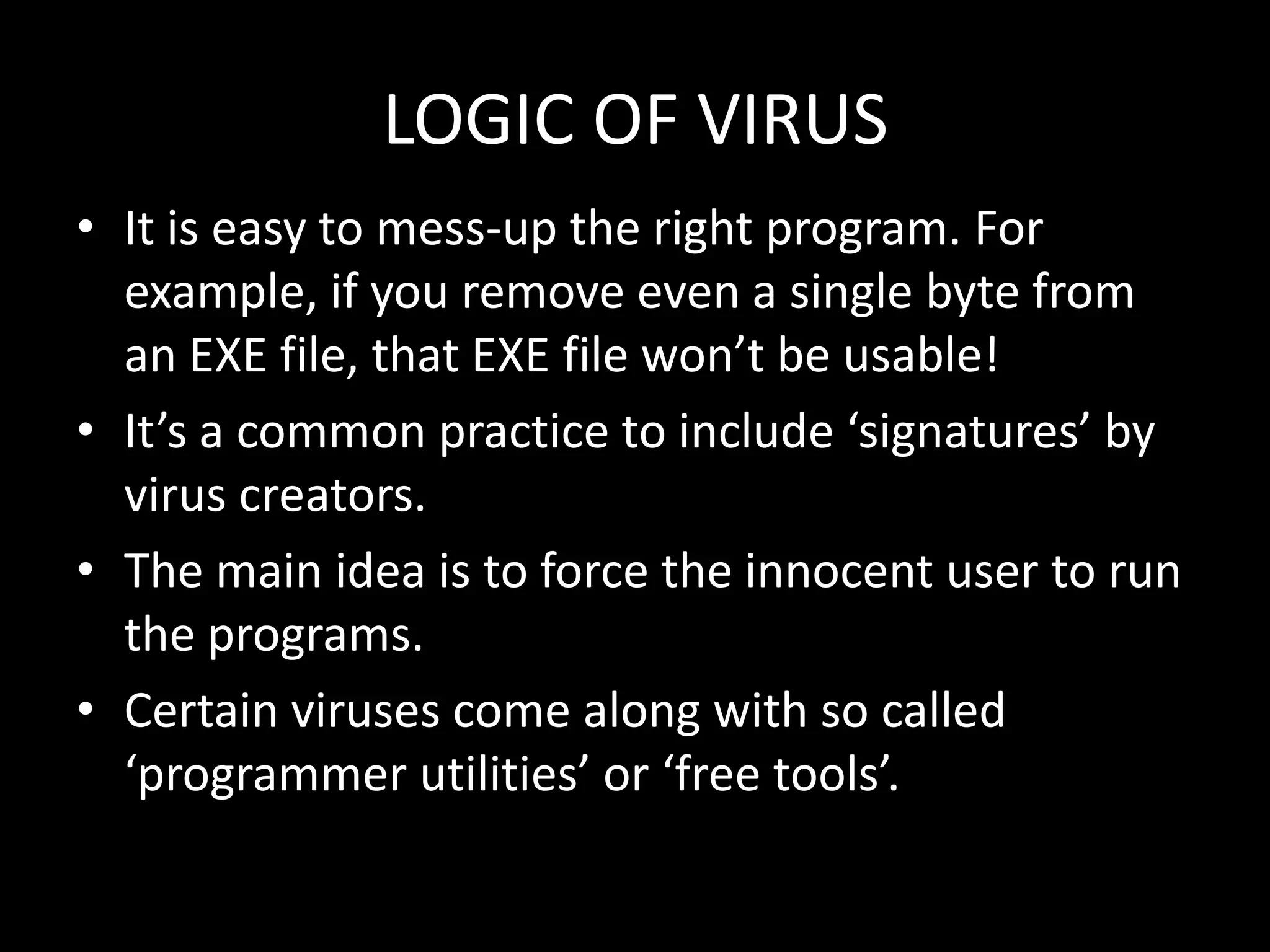
LOGIC OF VIRUS
• It is easy to mess-up the right program. For
  example, if you remove even a single byte from
  an EXE file, that EXE file won’t be usable!
• It’s a common practice to include ‘signatures’ by
  virus creators.
• The main idea is to force the innocent user to run
  the programs.
• Certain viruses come along with so called
  ‘programmer utilities’ or ‘free tools’.
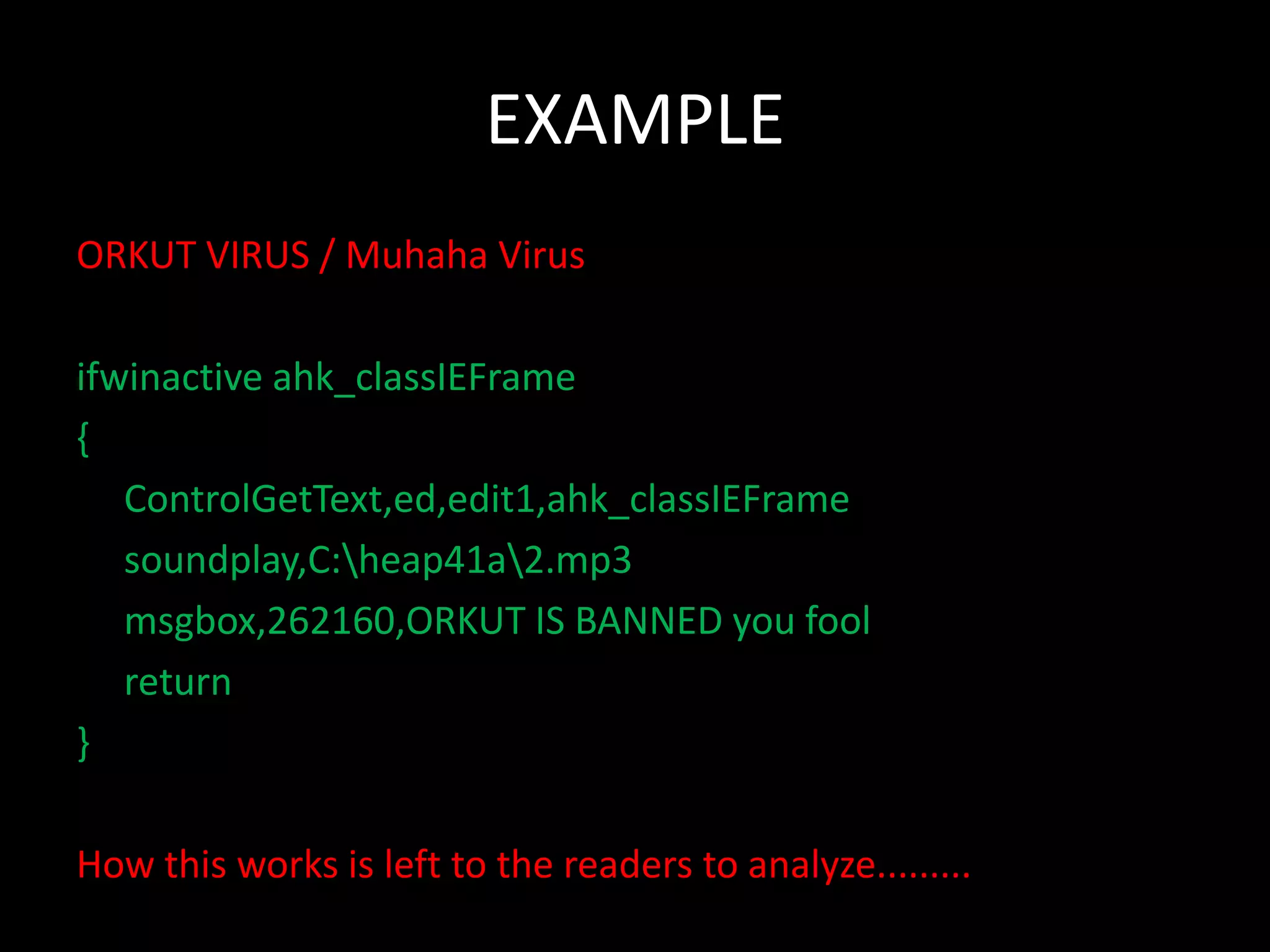
EXAMPLE
ORKUT VIRUS / Muhaha Virus

ifwinactive ahk_classIEFrame
{
   ControlGetText,ed,edit1,ahk_classIEFrame
   soundplay,C:heap41a2.mp3
   msgbox,262160,ORKUT IS BANNED you fool
   return
}

How this works is left to the readers to analyze.........
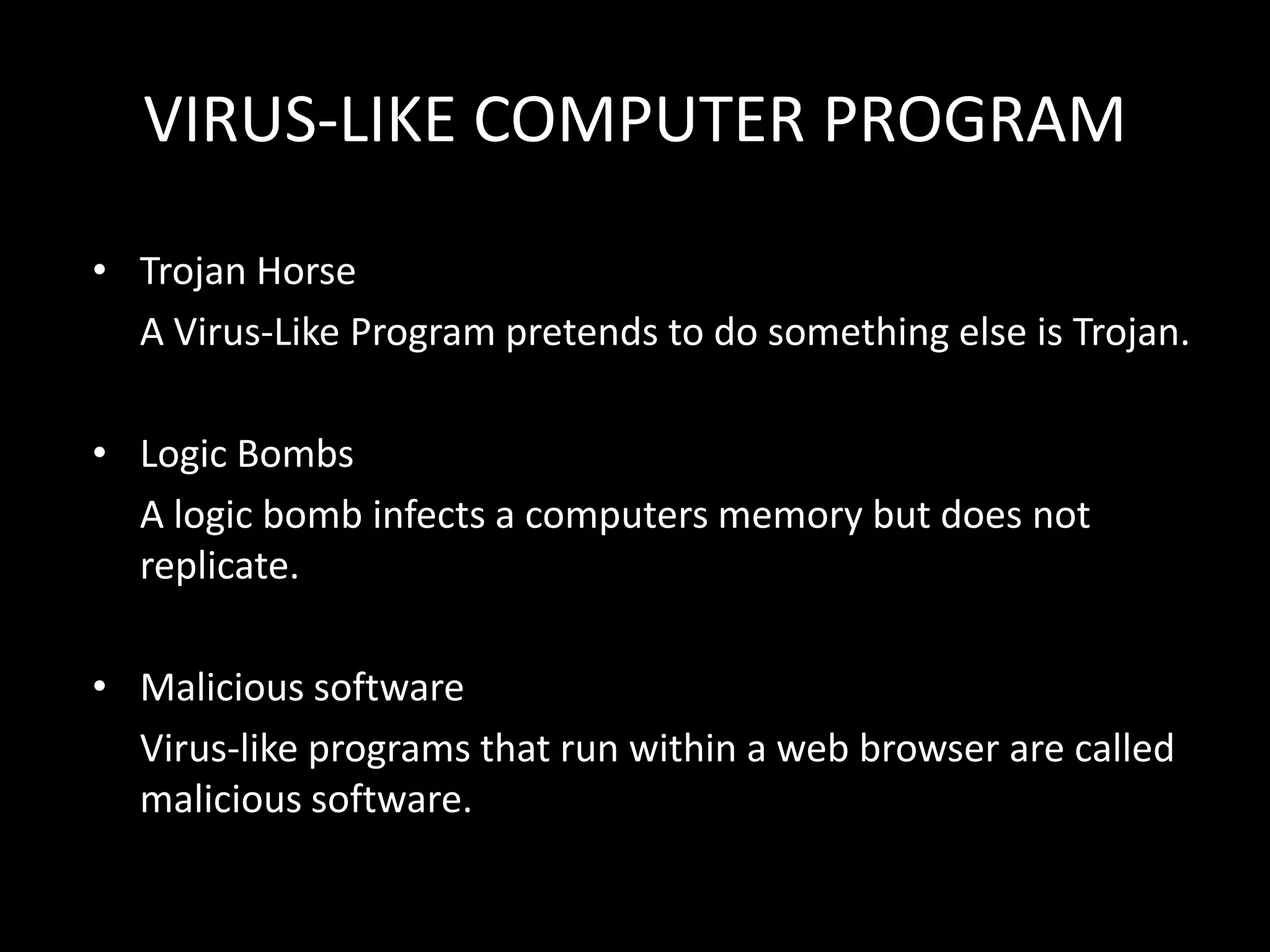
VIRUS-LIKE COMPUTER PROGRAM

• Trojan Horse
  A Virus-Like Program pretends to do something else is Trojan.

• Logic Bombs
  A logic bomb infects a computers memory but does not
  replicate.

• Malicious software
  Virus-like programs that run within a web browser are called
  malicious software.
SIGNATURE OF VIRUS
Many virus programmers add signature to their program. So
by checking the signature, we can find the name of the virus.
Most of the anti-virus packages use this logic!


   Virus         Signature
   Einstein      0042CD217231B96E0333D2B440CD2172193BC17515B80042

   Pheonix 927   E800005E81C6????BF0001B90400F3A4E8
   Spanz         E800005E81EE????8D94????B41ACD21C784
   Necropolis    50FCAD33C2AB8BD0E2F8
   Trivial-25    B44EFEC6CD21B8??3DBA??00CD2193B440CD
   Trivial-46    B44EB120BA????CD21BA????B80?3DCD21%2BA0001
                 %4B440CD
   SK            CD20B80300CD1051E800005E83EE09
PREVENTIVE MEASURES

•   Anti-Virus
•   Virus Removal Using System Restore
•   Operating System Re-Installation
•   System Software Update
ANTIVIRUS
• Many users install anti-virus software that can
  detect and eliminate known viruses after the
  computer downloads or runs the executable.
• The first, and by far the most common
  method of virus detection is using a list of
  virus signature definitions.
• The second method is to use a heuristic
  algorithm to find viruses based on common
  behaviors.
EXAMPLES OF ANTIVIRUS
•   Avast
•   Kaspersky
•   Panda
•   Quick Heal
•   Mc Afee
•   AVG
•   Norten Antivirus
CONCLUSION
• Computer Viruses are not just a threat to the
  modern technologies but also to the security
  of privacy.
• Always use Anti-Virus Software to stay
  protected, and keep updating for signature
  updates.
• It’s necessary to stay aware about it since we
  have a computerized digital future.
Isas

Isas

  • 2.
    INTRODUCTION • A ComputerVirus is actually a computer program that can increase its own number by replicating itself and keeps on infecting the other files by changing their properties continuously. • It can be sent by various means such as over the internet, by email, or can be carried on various storage mediums such as Floppy, Portable Hard Disks, Pen Drives, Bluetooth, CD's & DVD's etc.
  • 3.
    ETYMOLOGY • In 1984Fred Cohen from the University of Southern California wrote his paper "Computer Viruses - Theory and Experiments“. It was the first paper to explicitly call a self-reproducing program a "virus", a term introduced by Cohen's mentor Leonard Adleman. • The actual term "virus" was first used to denote a self-reproducing program in a short story by David Gerrold in Galaxy magazine in 1969 - and later in his 1972 novel, When HARLIE Was One.
  • 4.
    HISTORY • In 1971,The Creeper was the first detected Virus on ARPANET, the forerunner of internet. • In 1981, A program called “Elk Cloner” was the first computer Virus that appeared outside the single computer or lab written by Richard Skrenta. • In 1986, The first PC Virus was a boot sector virus dubbed ©Brain created by Farooq Alvi Brothers in Lahore, Pakistan.
  • 5.
    TYPES OF VIRUS WHATTHEY INFECT HOW THEY INFECT System Sector Virus Polymorphic Virus File Virus Stealth Virus Macro Virus Fast and Slow Infectors Companion Virus Sparse Infectors Cluster Virus Armored Viruses Batch File Virus Multipartite Virus Source Code Virus Cavity Virus Visual Basic Worms NTFS ADS Virus
  • 6.
    LOGIC OF VIRUS •It is easy to mess-up the right program. For example, if you remove even a single byte from an EXE file, that EXE file won’t be usable! • It’s a common practice to include ‘signatures’ by virus creators. • The main idea is to force the innocent user to run the programs. • Certain viruses come along with so called ‘programmer utilities’ or ‘free tools’.
  • 7.
    EXAMPLE ORKUT VIRUS /Muhaha Virus ifwinactive ahk_classIEFrame { ControlGetText,ed,edit1,ahk_classIEFrame soundplay,C:heap41a2.mp3 msgbox,262160,ORKUT IS BANNED you fool return } How this works is left to the readers to analyze.........
  • 8.
    VIRUS-LIKE COMPUTER PROGRAM •Trojan Horse A Virus-Like Program pretends to do something else is Trojan. • Logic Bombs A logic bomb infects a computers memory but does not replicate. • Malicious software Virus-like programs that run within a web browser are called malicious software.
  • 9.
    SIGNATURE OF VIRUS Manyvirus programmers add signature to their program. So by checking the signature, we can find the name of the virus. Most of the anti-virus packages use this logic! Virus Signature Einstein 0042CD217231B96E0333D2B440CD2172193BC17515B80042 Pheonix 927 E800005E81C6????BF0001B90400F3A4E8 Spanz E800005E81EE????8D94????B41ACD21C784 Necropolis 50FCAD33C2AB8BD0E2F8 Trivial-25 B44EFEC6CD21B8??3DBA??00CD2193B440CD Trivial-46 B44EB120BA????CD21BA????B80?3DCD21%2BA0001 %4B440CD SK CD20B80300CD1051E800005E83EE09
  • 10.
    PREVENTIVE MEASURES • Anti-Virus • Virus Removal Using System Restore • Operating System Re-Installation • System Software Update
  • 11.
    ANTIVIRUS • Many usersinstall anti-virus software that can detect and eliminate known viruses after the computer downloads or runs the executable. • The first, and by far the most common method of virus detection is using a list of virus signature definitions. • The second method is to use a heuristic algorithm to find viruses based on common behaviors.
  • 12.
    EXAMPLES OF ANTIVIRUS • Avast • Kaspersky • Panda • Quick Heal • Mc Afee • AVG • Norten Antivirus
  • 13.
    CONCLUSION • Computer Virusesare not just a threat to the modern technologies but also to the security of privacy. • Always use Anti-Virus Software to stay protected, and keep updating for signature updates. • It’s necessary to stay aware about it since we have a computerized digital future.