Overview
Meaning
History
How do we get viruses ?
Effects of computer viruses
Types of computer infections
Keeping computer virus free
Anti-viruses
Some facts
Conclusion
Meaning
• A computer virus is a program or piece of code that is loaded onto
your computer without your knowledge and runs against your
wishes. Viruses can also replicate themselves. All computer viruses
are man-made. A simple virus that can make a copy of itself over
and over again is relatively easy to produce. Even such a simple
virus is dangerous because it will quickly use all available memory
and bring the system to a halt. An even more dangerous type of
virus is one capable of transmitting itself across networks and
bypassing security systems.
History…
• The Creeper virus was first detected on ARPANET, the forerunner
of the Internet, in the early 1970s.
• Creeper was an experimental self-replicating program written by
Bob Thomas at BBN Technologies in 1971.
• Creeper used the ARPANET to infect DEC PDP-10 computers
running the TENEX operating system.
• Creeper gained access via the ARPANET and copied itself to the
remote system where the message, "I'm the creeper, catch me if
you can!" was displayed. The Reaper program was created to
delete Creeper.
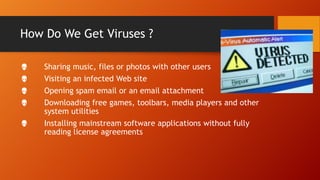
How Do We Get Viruses ?






Sharing music, files or photos with other users
Visiting an infected Web site
Opening spam email or an email attachment
Downloading free games, toolbars, media players and other
system utilities
Installing mainstream software applications without fully
reading license agreements
Effects of Viruses
Slow computer performance
Erratic computer behavior
Unexplained data loss
Frequent computer crashes
Sapping computer memory
 Files/Directories disappear
 Denial of service
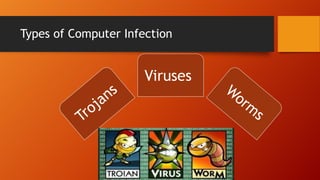
Types of Computer Infection

Viruses
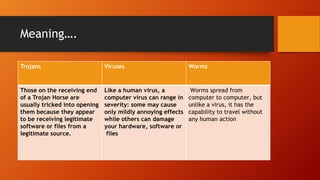
Meaning….
Trojans

Viruses

Worms

Those on the receiving end
of a Trojan Horse are
usually tricked into opening
them because they appear
to be receiving legitimate
software or files from a
legitimate source.

Like a human virus, a
computer virus can range in
severity: some may cause
only mildly annoying effects
while others can damage
your hardware, software or
files

Worms spread from
computer to computer, but
unlike a virus, it has the
capability to travel without
any human action
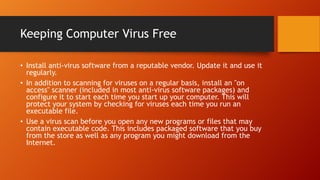
Keeping Computer Virus Free
• Install anti-virus software from a reputable vendor. Update it and use it
regularly.
• In addition to scanning for viruses on a regular basis, install an "on
access" scanner (included in most anti-virus software packages) and
configure it to start each time you start up your computer. This will
protect your system by checking for viruses each time you run an
executable file.
• Use a virus scan before you open any new programs or files that may
contain executable code. This includes packaged software that you buy
from the store as well as any program you might download from the
Internet.
Keeping Computer Virus Free…
• If you are a member of an online community or chat room, be very
careful about accepting files or clicking links that you find or that
people send you within the community.
• Make sure you back up your data (documents, bookmark files,
important email messages, etc.) on disc so that in the event of a
virus infection, you do not lose valuable work.
• Scan all incoming email attachments
• The more computers flash cards, CDs, zip cards and floppies have
been used on, the better the chance of a virus infecting them –
clean them before use
Anti-viruses
• “Antivirus" is protective software designed to defend your
computer against malicious software. Malicious software, or
"malware" includes: viruses, Trojans, keyloggers, hijackers,
dialers, and other code that vandalizes or steals your computer
contents. In order to be an effective defense, your antivirus
software needs to run in the background at all times, and should
be kept updated so it recognizes new versions of malicious
software.
Some facts…
• Mydoom Virus in January 2004 infected almost 1 million computers
in as little as one day
• Melissa Virus in March 1999 was powerful enough to have Microsoft
and various other companies to shut down emailing systems until
the virus could finally be stopped.
• Storm Worm in January 2007 was said to have infected 50,000
computers by October of that year.
• Over 6,000 new computer viruses are released every month.
Some facts…
• The first virus that came into wild was elk cloner virus.This virus
was created by Richard Skrenta in 1981 when he was a student in
high school.He created it as a joke and inserted it in a game on a
floppy disk.The elk cloner virus get activated on its 50th use and
displays a poem "Elk Cloner: The program with a personality."
• Farooq Alvi Brothers of Lahore,Pakistan created the first pc virus
in 1986.It was a boot sector virus.
• The term virus to denote a self replicating program was first used
in 1969 in a short story of a Galaxy Magaine written by David
Gerrold.
Conclusion…
• I think with enough knowledge about viruses and the right kind of
software they can almost be preventable, you just have to use
common sense.
• Don’t open emails and download software that does not look like
it is from a reliable source
• Download Software that prevents and helps protect against
viruses
computer viruses

computer viruses

  • 2.
    Overview Meaning History How do weget viruses ? Effects of computer viruses Types of computer infections Keeping computer virus free Anti-viruses Some facts Conclusion
  • 3.
    Meaning • A computervirus is a program or piece of code that is loaded onto your computer without your knowledge and runs against your wishes. Viruses can also replicate themselves. All computer viruses are man-made. A simple virus that can make a copy of itself over and over again is relatively easy to produce. Even such a simple virus is dangerous because it will quickly use all available memory and bring the system to a halt. An even more dangerous type of virus is one capable of transmitting itself across networks and bypassing security systems.
  • 4.
    History… • The Creepervirus was first detected on ARPANET, the forerunner of the Internet, in the early 1970s. • Creeper was an experimental self-replicating program written by Bob Thomas at BBN Technologies in 1971. • Creeper used the ARPANET to infect DEC PDP-10 computers running the TENEX operating system. • Creeper gained access via the ARPANET and copied itself to the remote system where the message, "I'm the creeper, catch me if you can!" was displayed. The Reaper program was created to delete Creeper.
  • 5.
    How Do WeGet Viruses ?      Sharing music, files or photos with other users Visiting an infected Web site Opening spam email or an email attachment Downloading free games, toolbars, media players and other system utilities Installing mainstream software applications without fully reading license agreements
  • 6.
    Effects of Viruses Slowcomputer performance Erratic computer behavior Unexplained data loss Frequent computer crashes Sapping computer memory  Files/Directories disappear  Denial of service
  • 7.
    Types of ComputerInfection Viruses
  • 8.
    Meaning…. Trojans Viruses Worms Those on thereceiving end of a Trojan Horse are usually tricked into opening them because they appear to be receiving legitimate software or files from a legitimate source. Like a human virus, a computer virus can range in severity: some may cause only mildly annoying effects while others can damage your hardware, software or files Worms spread from computer to computer, but unlike a virus, it has the capability to travel without any human action
  • 9.
    Keeping Computer VirusFree • Install anti-virus software from a reputable vendor. Update it and use it regularly. • In addition to scanning for viruses on a regular basis, install an "on access" scanner (included in most anti-virus software packages) and configure it to start each time you start up your computer. This will protect your system by checking for viruses each time you run an executable file. • Use a virus scan before you open any new programs or files that may contain executable code. This includes packaged software that you buy from the store as well as any program you might download from the Internet.
  • 10.
    Keeping Computer VirusFree… • If you are a member of an online community or chat room, be very careful about accepting files or clicking links that you find or that people send you within the community. • Make sure you back up your data (documents, bookmark files, important email messages, etc.) on disc so that in the event of a virus infection, you do not lose valuable work. • Scan all incoming email attachments • The more computers flash cards, CDs, zip cards and floppies have been used on, the better the chance of a virus infecting them – clean them before use
  • 11.
    Anti-viruses • “Antivirus" isprotective software designed to defend your computer against malicious software. Malicious software, or "malware" includes: viruses, Trojans, keyloggers, hijackers, dialers, and other code that vandalizes or steals your computer contents. In order to be an effective defense, your antivirus software needs to run in the background at all times, and should be kept updated so it recognizes new versions of malicious software.
  • 13.
    Some facts… • MydoomVirus in January 2004 infected almost 1 million computers in as little as one day • Melissa Virus in March 1999 was powerful enough to have Microsoft and various other companies to shut down emailing systems until the virus could finally be stopped. • Storm Worm in January 2007 was said to have infected 50,000 computers by October of that year. • Over 6,000 new computer viruses are released every month.
  • 14.
    Some facts… • Thefirst virus that came into wild was elk cloner virus.This virus was created by Richard Skrenta in 1981 when he was a student in high school.He created it as a joke and inserted it in a game on a floppy disk.The elk cloner virus get activated on its 50th use and displays a poem "Elk Cloner: The program with a personality." • Farooq Alvi Brothers of Lahore,Pakistan created the first pc virus in 1986.It was a boot sector virus. • The term virus to denote a self replicating program was first used in 1969 in a short story of a Galaxy Magaine written by David Gerrold.
  • 15.
    Conclusion… • I thinkwith enough knowledge about viruses and the right kind of software they can almost be preventable, you just have to use common sense. • Don’t open emails and download software that does not look like it is from a reliable source • Download Software that prevents and helps protect against viruses