

This work is licensed under a Creative Commons Licence.


        Teaching through Multimedia Storytelling
              (or getting the dog to whistle!)


                                                              The Easy Steps Way®
                                                              Susan Lieberman
                                                                    June 2012
                                                           The Business School
                                                          Humber College ITAL
Storytelling Session
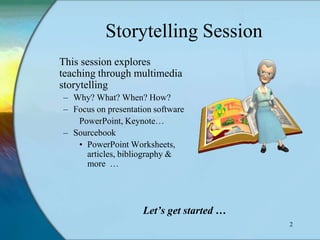
This session explores
teaching through multimedia
storytelling
– Why? What? When? How?
– Focus on presentation software
   PowerPoint, Keynote…
– Sourcebook
   • PowerPoint Worksheets,
     articles, bibliography &
     more …


                     Let’s get started …
                                           2
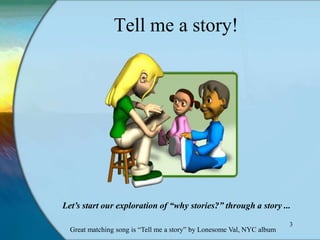
Tell me a story!


Let’s start our exploration of “why stories?” through a story ...

                                                                        3
  Great matching song is “Tell me a story” by Lonesome Val, NYC album
Napoleon
                                                          Why stories?
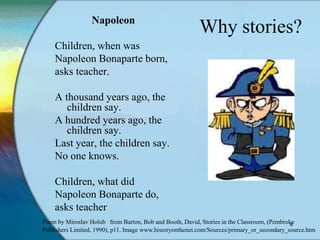
    Children, when was
    Napoleon Bonaparte born,
    asks teacher.

    A thousand years ago, the
       children say.
    A hundred years ago, the
       children say.
    Last year, the children say.
    No one knows.

    Children, what did
    Napoleon Bonaparte do,
    asks teacher
Poem by Miroslav Holub from Barton, Bob and Booth, David, Stories in the Classroom, (Pembroke
                                                                                            4
Publishers Limited, 1990), p11. Image www.historyonthenet.com/Sources/primary_or_secondary_source.htm
Napoleon cont.
           Won a war, the children say.
           Lost a war, the children say.
           No one knows.

           Our butcher had a dog
           Called Napoleon,
           Says Frantisek
           The butcher used to beat him and the dog died
           Of hunger
           A year ago.

           And all the children are now sorry
           For Napoleon.
                                                                             Miroslav Holub

Barton, Bob and Booth, David, Stories in the Classroom, (Pembroke Publishers Limited, 1990), p11
                                                                                            5
What would a student remember about
            Napoleon?


            So, why use stories? ...
                                       6
Buzz Session
• Turn to a person sitting in
  a near-by seat
• Identify at least 2 reasons
  why we would use a
  story in our teaching


                                7
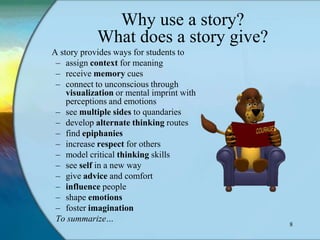
Why use a story?
            What does a story give?
A story provides ways for students to
 – assign context for meaning
 – receive memory cues
 – connect to unconscious through
    visualization or mental imprint with
    perceptions and emotions
 – see multiple sides to quandaries
 – develop alternate thinking routes
 – find epiphanies
 – increase respect for others
 – model critical thinking skills
 – see self in a new way
 – give advice and comfort
 – influence people
 – shape emotions
 – foster imagination
 To summarize…
                                           8
Getting the Dog to Whistle Story
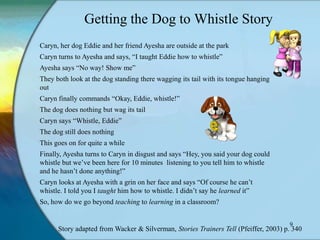
Caryn, her dog Eddie and her friend Ayesha are outside at the park
Caryn turns to Ayesha and says, “I taught Eddie how to whistle”
Ayesha says “No way! Show me”
They both look at the dog standing there wagging its tail with its tongue hanging
out
Caryn finally commands “Okay, Eddie, whistle!”
The dog does nothing but wag its tail
Caryn says “Whistle, Eddie”
The dog still does nothing
This goes on for quite a while
Finally, Ayesha turns to Caryn in disgust and says “Hey, you said your dog could
whistle but we‟ve been here for 10 minutes listening to you tell him to whistle
and he hasn‟t done anything!”
Caryn looks at Ayesha with a grin on her face and says “Of course he can‟t
whistle. I told you I taught him how to whistle. I didn‟t say he learned it”
So, how do we go beyond teaching to learning in a classroom?


                                                                                     9
      Story adapted from Wacker & Silverman, Stories Trainers Tell (Pfeiffer, 2003) p. 340
Teaching?
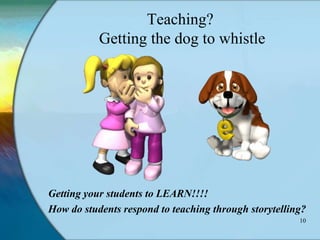
           Getting the dog to whistle


Getting your students to LEARN!!!!
How do students respond to teaching through storytelling?
                                                       10
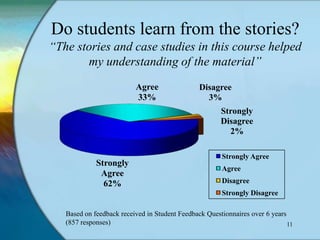
Do students learn from the stories?
“The stories and case studies in this course helped
       my understanding of the material”
                          Agree                 Disagree
                          33%                     3%
                                                       Strongly
                                                       Disagree
                                                         2%

                                                       Strongly Agree
             Strongly
                                                       Agree
              Agree
               62%                                     Disagree
                                                       Strongly Disagree

   Based on feedback received in Student Feedback Questionnaires over 6 years
   (857 responses)                                                            11
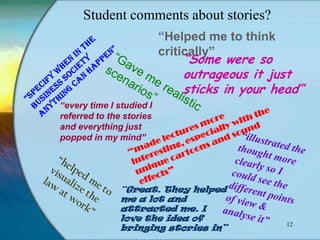
Student comments about stories?
                          “Helped me to think
                          critically”
                              “Some were so
                              outrageous it just
                              sticks in your head”
“every time I studied I
referred to the stories
and everything just
popped in my mind”


               “Great. They helped
               me a lot and
               attracted me. I
               love the idea of
                                                12
               bringing stories in”
ESL/Multicultural Response

   “It was very helpful because for my
      case, I have language problem
      therefore, the stories helped me to
      understand ... much easier”


• Stories provide rich context-
  embedded comprehensible input 
• And stories have been shown to
  have physiological importance…


                                            13
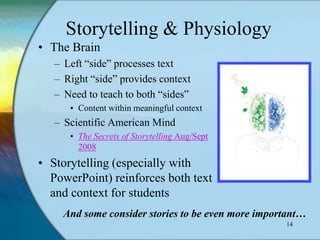
Storytelling & Physiology
• The Brain
   – Left “side” processes text
   – Right “side” provides context
   – Need to teach to both “sides”
      • Content within meaningful context
   – Scientific American Mind
      • The Secrets of Storytelling Aug/Sept
        2008
• Storytelling (especially with
  PowerPoint) reinforces both text
  and context for students
     And some consider stories to be even more important…
                                                    14
Jacques Cousteau
“My grandfather shifted a paradigm in our world
on how we understand our oceans, and he did that
by telling stories and engaging people to think about
the issues and to take action in their communities...”
(Alexandra Cousteau, G & M, July 17, 2010)


                                                 15
          Photo purchased from iStock
“OK, so what’s a story?”
• Narrative unit with
  –   Beginning, middle and end
  –   Conflict or challenge
  –   Rhythm
  –   Emotional context/shaping
  –   Sensory details
• Refer to
  – Kieran Egan‟s an imaginative
    approach to teaching
  – Robert Fulford‟s The Triumph of
    Narrative (1999 Massey Lectures)
                                       16
But, what about ….
• Other „story‟ forms, such as
  – Examples, case studies &
    problems used for problem-
    based learning (PBL)
• For me, stories
  – „Fly‟ – more freedom to play
    with imagination
  – Enhance connection to learners
  – Deliberate
  – Don‟t need listeners to go to
    outside research
    … So “when” do we tell stories? ...
                                      Anytime    17
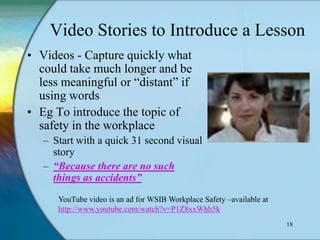
Video Stories to Introduce a Lesson
• Videos - Capture quickly what
  could take much longer and be
  less meaningful or “distant” if
  using words
• Eg To introduce the topic of
  safety in the workplace
   – Start with a quick 31 second visual
     story
   – “Because there are no such
     things as accidents”
      YouTube video is an ad for WSIB Workplace Safety –available at
      http://www.youtube.com/watch?v=P1Z8xxWhh5k
                                                                       18
Stories to Develop Concepts
• Issue: Conflict resolution
   – When, how and why use different
     options?

• Sam bought a new cell phone from
  the manufacturer‟s outlet, Cool
  Energy Life Ltd (CELL). She paid a
  lot of money for the phone and it
  stopped working after three days!
  She is miserable!!!

• What can Sam do?
   – Negotiation …
        Yes, stories work anytime in a lesson, not just as
        “after the fact” examples
               And remember ….                               19
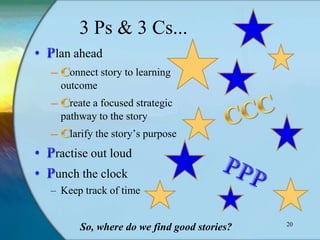
3 Ps & 3 Cs...
 lan ahead
    onnect story to learning
  outcome
    reate a focused strategic
  pathway to the story
    larify the story‟s purpose
 ractise out loud
 unch the clock
– Keep track of time


                                           20
      So, where do we find good stories?
Where do we find stories?☺
• Everywhere!!!
  – Newspapers, books, magazines
  – TV, radio, YouTube, videos, in
    ternet
  – Home, work, leisure activities
    and places
  – Food, clothing, pets
  – Friends, family, colleagues,
  – Examples already used, and
  – Our friendly dinosaurs
                                     21
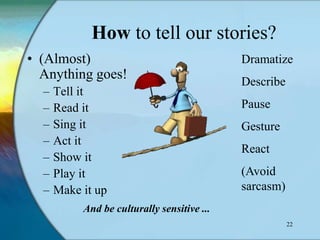
How to tell our stories?
• (Almost)                                   Dramatize
  Anything goes!                             Describe
  –   Tell it
  –   Read it                                Pause
  –   Sing it                                Gesture
  –   Act it
                                             React
  –   Show it
  –   Play it                                (Avoid
  –   Make it up                             sarcasm)
           And be culturally sensitive ...
                                                        22
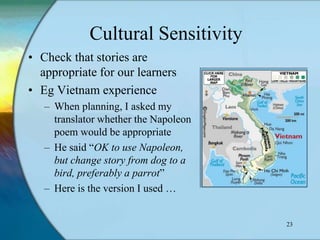
Cultural Sensitivity
• Check that stories are
  appropriate for our learners
• Eg Vietnam experience
   – When planning, I asked my
     translator whether the Napoleon
     poem would be appropriate
   – He said “OK to use Napoleon,
     but change story from dog to a
     bird, preferably a parrot”
   – Here is the version I used …


                                       23
Naploeon cont.
                 Won a war, the children say.
                 Lost a war, the children say.
                 No one knows.

                 Our neighbour has a parrot
                 Called Napoleon,
                 Says Binh
                 The parrot is famous because
                 It can dance.

                 And now all the children
                 Want to meet
                 Napoleon the parrot.
Adapted from Barton, Bob and Booth, David, Stories in the Classroom, (Pembroke Publishers
                                              24
Limited, 1990), p11
What would be remembered about
          Napoleon?


 So be sure to make use of multimedia
 storytelling with PowerPoint (or Keynote)!!!
                                                25
Unleash the POWER in PowerPoint
• PowerPoint features? ☺
  –   Organization
  –   Sound and music
  –   Picture
  –   Video
  –   Animation
  –   Hyper-linking
       • Websites, documents, other
         presentations & slides
  – Transitions
  – Underlining, highlighting
  – Charts, graphs …
                       Have fun and .....
                                            26
Take risks
• Our students want
  entertainment and
  involvement!!!!
• We “teach” while they (&
  we) have fun AND learn
• Use PowerPoint slides to
  imprint stories
• Be flexible, take risks and
  enjoy!


                                    27
Wrap-up

• Teach through
  Multimedia storytelling!
• Have fun with your
  PowerPoint slides
• And remember - It‟s all
  about getting the dog to
  whistle!

         Great matching whistling tune is “Main Hoon Na” by Javed Akhtar
                                                                           28
Citations
•The original presentation includes several animations and sounds.
Images, Cartoons & Sounds not already cited are from the
following subscribed (s) or royalty-free (r) sources
 Microsoft Office clips (s)
 www.iStock.com (s)
 www.Animation.com (s)
 www.cartoonstock.com (s)
 The Nightingale Voice Box (s)
 ClickART Cartoons (s)


This presentation is also available in the form of a
Squidoo lens at
http://www.squidoo.com/TeachCollege
Thank You & The End


                      30

Teaching through Multimedia Storytelling (or getting the dog to whistle!)

  • 1.
    This work islicensed under a Creative Commons Licence. Teaching through Multimedia Storytelling (or getting the dog to whistle!) The Easy Steps Way® Susan Lieberman June 2012 The Business School Humber College ITAL
  • 2.
    Storytelling Session This sessionexplores teaching through multimedia storytelling – Why? What? When? How? – Focus on presentation software PowerPoint, Keynote… – Sourcebook • PowerPoint Worksheets, articles, bibliography & more … Let’s get started … 2
  • 3.
    Tell me astory! Let’s start our exploration of “why stories?” through a story ... 3 Great matching song is “Tell me a story” by Lonesome Val, NYC album
  • 4.
    Napoleon Why stories? Children, when was Napoleon Bonaparte born, asks teacher. A thousand years ago, the children say. A hundred years ago, the children say. Last year, the children say. No one knows. Children, what did Napoleon Bonaparte do, asks teacher Poem by Miroslav Holub from Barton, Bob and Booth, David, Stories in the Classroom, (Pembroke 4 Publishers Limited, 1990), p11. Image www.historyonthenet.com/Sources/primary_or_secondary_source.htm
  • 5.
    Napoleon cont. Won a war, the children say. Lost a war, the children say. No one knows. Our butcher had a dog Called Napoleon, Says Frantisek The butcher used to beat him and the dog died Of hunger A year ago. And all the children are now sorry For Napoleon. Miroslav Holub Barton, Bob and Booth, David, Stories in the Classroom, (Pembroke Publishers Limited, 1990), p11 5
  • 6.
    What would astudent remember about Napoleon? So, why use stories? ... 6
  • 7.
    Buzz Session • Turnto a person sitting in a near-by seat • Identify at least 2 reasons why we would use a story in our teaching 7
  • 8.
    Why use astory? What does a story give? A story provides ways for students to – assign context for meaning – receive memory cues – connect to unconscious through visualization or mental imprint with perceptions and emotions – see multiple sides to quandaries – develop alternate thinking routes – find epiphanies – increase respect for others – model critical thinking skills – see self in a new way – give advice and comfort – influence people – shape emotions – foster imagination To summarize… 8
  • 9.
    Getting the Dogto Whistle Story Caryn, her dog Eddie and her friend Ayesha are outside at the park Caryn turns to Ayesha and says, “I taught Eddie how to whistle” Ayesha says “No way! Show me” They both look at the dog standing there wagging its tail with its tongue hanging out Caryn finally commands “Okay, Eddie, whistle!” The dog does nothing but wag its tail Caryn says “Whistle, Eddie” The dog still does nothing This goes on for quite a while Finally, Ayesha turns to Caryn in disgust and says “Hey, you said your dog could whistle but we‟ve been here for 10 minutes listening to you tell him to whistle and he hasn‟t done anything!” Caryn looks at Ayesha with a grin on her face and says “Of course he can‟t whistle. I told you I taught him how to whistle. I didn‟t say he learned it” So, how do we go beyond teaching to learning in a classroom? 9 Story adapted from Wacker & Silverman, Stories Trainers Tell (Pfeiffer, 2003) p. 340
  • 10.
    Teaching? Getting the dog to whistle Getting your students to LEARN!!!! How do students respond to teaching through storytelling? 10
  • 11.
    Do students learnfrom the stories? “The stories and case studies in this course helped my understanding of the material” Agree Disagree 33% 3% Strongly Disagree 2% Strongly Agree Strongly Agree Agree 62% Disagree Strongly Disagree Based on feedback received in Student Feedback Questionnaires over 6 years (857 responses) 11
  • 12.
    Student comments aboutstories? “Helped me to think critically” “Some were so outrageous it just sticks in your head” “every time I studied I referred to the stories and everything just popped in my mind” “Great. They helped me a lot and attracted me. I love the idea of 12 bringing stories in”
  • 13.
    ESL/Multicultural Response “It was very helpful because for my case, I have language problem therefore, the stories helped me to understand ... much easier” • Stories provide rich context- embedded comprehensible input  • And stories have been shown to have physiological importance… 13
  • 14.
    Storytelling & Physiology •The Brain – Left “side” processes text – Right “side” provides context – Need to teach to both “sides” • Content within meaningful context – Scientific American Mind • The Secrets of Storytelling Aug/Sept 2008 • Storytelling (especially with PowerPoint) reinforces both text and context for students And some consider stories to be even more important… 14
  • 15.
    Jacques Cousteau “My grandfathershifted a paradigm in our world on how we understand our oceans, and he did that by telling stories and engaging people to think about the issues and to take action in their communities...” (Alexandra Cousteau, G & M, July 17, 2010) 15 Photo purchased from iStock
  • 16.
    “OK, so what’sa story?” • Narrative unit with – Beginning, middle and end – Conflict or challenge – Rhythm – Emotional context/shaping – Sensory details • Refer to – Kieran Egan‟s an imaginative approach to teaching – Robert Fulford‟s The Triumph of Narrative (1999 Massey Lectures) 16
  • 17.
    But, what about…. • Other „story‟ forms, such as – Examples, case studies & problems used for problem- based learning (PBL) • For me, stories – „Fly‟ – more freedom to play with imagination – Enhance connection to learners – Deliberate – Don‟t need listeners to go to outside research … So “when” do we tell stories? ... Anytime  17
  • 18.
    Video Stories toIntroduce a Lesson • Videos - Capture quickly what could take much longer and be less meaningful or “distant” if using words • Eg To introduce the topic of safety in the workplace – Start with a quick 31 second visual story – “Because there are no such things as accidents” YouTube video is an ad for WSIB Workplace Safety –available at http://www.youtube.com/watch?v=P1Z8xxWhh5k 18
  • 19.
    Stories to DevelopConcepts • Issue: Conflict resolution – When, how and why use different options? • Sam bought a new cell phone from the manufacturer‟s outlet, Cool Energy Life Ltd (CELL). She paid a lot of money for the phone and it stopped working after three days! She is miserable!!! • What can Sam do? – Negotiation … Yes, stories work anytime in a lesson, not just as “after the fact” examples And remember …. 19
  • 20.
    3 Ps &3 Cs... lan ahead onnect story to learning outcome reate a focused strategic pathway to the story larify the story‟s purpose ractise out loud unch the clock – Keep track of time 20 So, where do we find good stories?
  • 21.
    Where do wefind stories?☺ • Everywhere!!! – Newspapers, books, magazines – TV, radio, YouTube, videos, in ternet – Home, work, leisure activities and places – Food, clothing, pets – Friends, family, colleagues, – Examples already used, and – Our friendly dinosaurs 21
  • 22.
    How to tellour stories? • (Almost) Dramatize Anything goes! Describe – Tell it – Read it Pause – Sing it Gesture – Act it React – Show it – Play it (Avoid – Make it up sarcasm) And be culturally sensitive ... 22
  • 23.
    Cultural Sensitivity • Checkthat stories are appropriate for our learners • Eg Vietnam experience – When planning, I asked my translator whether the Napoleon poem would be appropriate – He said “OK to use Napoleon, but change story from dog to a bird, preferably a parrot” – Here is the version I used … 23
  • 24.
    Naploeon cont. Won a war, the children say. Lost a war, the children say. No one knows. Our neighbour has a parrot Called Napoleon, Says Binh The parrot is famous because It can dance. And now all the children Want to meet Napoleon the parrot. Adapted from Barton, Bob and Booth, David, Stories in the Classroom, (Pembroke Publishers 24 Limited, 1990), p11
  • 25.
    What would beremembered about Napoleon? So be sure to make use of multimedia storytelling with PowerPoint (or Keynote)!!! 25
  • 26.
    Unleash the POWERin PowerPoint • PowerPoint features? ☺ – Organization – Sound and music – Picture – Video – Animation – Hyper-linking • Websites, documents, other presentations & slides – Transitions – Underlining, highlighting – Charts, graphs … Have fun and ..... 26
  • 27.
    Take risks • Ourstudents want entertainment and involvement!!!! • We “teach” while they (& we) have fun AND learn • Use PowerPoint slides to imprint stories • Be flexible, take risks and enjoy! 27
  • 28.
    Wrap-up • Teach through Multimedia storytelling! • Have fun with your PowerPoint slides • And remember - It‟s all about getting the dog to whistle! Great matching whistling tune is “Main Hoon Na” by Javed Akhtar 28
  • 29.
    Citations •The original presentationincludes several animations and sounds. Images, Cartoons & Sounds not already cited are from the following subscribed (s) or royalty-free (r) sources  Microsoft Office clips (s)  www.iStock.com (s)  www.Animation.com (s)  www.cartoonstock.com (s)  The Nightingale Voice Box (s)  ClickART Cartoons (s) This presentation is also available in the form of a Squidoo lens at http://www.squidoo.com/TeachCollege
  • 30.
    Thank You &The End 30