EXPLANATORY HANDBOOK
ON
CODES,FOREARTHQUAKE
ENGINEERING
(IS : 1893-1975AND IS : 4326-1976)
EXPLANATORY
HANDBOOK
ONCODES i=OR
EARTHQUAKE
ENGINEERING
BS:3882-7975 & IS:432S-7878
( Incorporating errata and other editorial corrections )
BUREAU OF INDIAN STANDARDS
MANAK BHAVAN, 9 BAHADUR SHAH ZAFAR MARG
NEW DELHI 110002
SP 22 : 1982
FIRSTPUBLISHEDFEBR~JARY 1983
FIRSTREPRINTFEBRIJARY 1989
SECOKDREPRINTOCTOBER 1993
THIRDREPRINTOCTOBER1995
FOURTH REPRINTFEBRUARY 1999
0 BUREAU OF INDIAN STANDARDS
IJIX 699-841 (021)
ISBN 81-7061-016-8
PRICE Rs 225.00
PRINTED IN INDIA
AT CENTRAL ELECTRIC PRESS, NEW DELHI 110028
AND PUBLJSHED BY
BUREAU OF INDIAN STANDARDS, NEW DELHI 110002
SP i-22 - 1982
FOREWORD
Users of various civil engineering codes have been feeling the need for explanatory
handbooks and other compilations based on Indian Standards. The need has been
further emphasized in view of the publication of the National Building Code of
India 1970 and its implementation. In 1972, the Department of Science and
Technology set up an Expert Group on Housing and Construction Technology
under the Chairmanship of Maj-Gen Harkirat Singh. This Group carried out
in-depth studies in various areas of civil engineefmg and construction practices.
During the preparation of the Fifth Five-Year Plan in 1975, the Group was assigned
the task of producing a Science and Technology plan for research, development
and extension work in the sector of housing and construction technology. One of
the items .of this plan was the production of design handbooks, explanatory
handbooks and design aids based on the National Building Code and various Indian
Standards and other activities in the promotion of the National Building Code. The
Expert Group gave high priority to this item and on the recommendation of the
Department of Science and Technology the Planning Commission approved the
following two projects which were assigned to the Indian Standards Institution.
_
a) Development programme on Code implementation for building and civil
engineering construction, and
b) Typification for industrial buildings.
A special Committee for Implementation of Science and Technology Projects
(SCIP) consisting of experts connected with different aspects (see page vi) was set
up in 1974 to advise the IS1 Directorate General in identification and for guiding
the development of the work under the Chairmanship of Maj-Gen Harkirat Singh,
Retired Engineer-in-Chief, Army Headquarters and formerly Adviser (Construction)
Planning Commission, Government of India. The Committee has so far identified
subjects for several explanatory handbooks/compilations covering appropriate Indian
Standards/Codes/Specifications which include the following:
Design Aids for Reinforced Concrete to IS : 456-1978
Explanatory Handbook on Masonry Code
Explanatory Handbook on Codes for Earthquake Engineering (IS : 1893-1975,
IS : 43261976)
Concrete Mixes
Summaries of Indian Standards for Building Materials
Explanatory Handbook on Indian Standard Code of R&ice for Plain and
Reinforced Concrete (IS : 4561978)
Causes and Prevention of Cracks in Buildings
Foundation of Buildings
Timber Engineering
Functional Requirements of Buildings
Functional Requirments of Industrial Buildings
Concrete Reinforcement
Building Construction Practices
Fire Safety
Tall Buildings
Bulk Storage Structures in Steel
Construction Safety Practices
Steel Code (IS : 800)
Form Work
Prefabrication
Loading Code
Design of Industrial Steel Structures
Inspection of Different Items of Building Work
One of the explanatory handbooks identified is on codes for earthquake engineer-
ing. This handbook is-in two parts: Part I Explanations ‘on IS : 1893-1975 Criteria
SPr22-1982
for Earthquake Resistant Design of Structures (third revision) and Part II Explana-
tions on IS : 43261976 Code of Practice for Earthquake Resistant Design and
Construction (first revision). This Handbook provides information on the source,
interpretation/explanations to certain clauses and worked out examples to illustrate
the application of coda1 provisions wherever required.
Some important points to be kept in view in the use of this Handbook are as follows:
a) In this Handbook wherever the expression “the Code” is used it refers to either
IS : 1893-1975 or IS : 4326-1976 depending upon the part in which it is used.
b) This Handbook is to be read along with the relevant codes.
c) The clause numbers in the Explanatory Handbook correspond to the corres-
ponding clause numbers in the relevant code. Only those clauses for which
explanations are required find a mention in the Handbook in the same sequence
as they occur in the respective codes.
d) Wherever there is any dispute about the interpretation or opinion expressed
in this Handbook, the provisions of the code only shall apply; the provisions
in this Handbook should be considered as only supplementary and informative.
The Explanatory Handbook is based on the draft prepared by Department of
Earthquake Engineering, University of Roorkee, Roorkee. The draft Handbook was
circulated for review to Central Public Works Department, New Delhi; India
Meteorological Department, New Delhi; Engineer-in-Chief’s Branch, Army Head-
quarters, New Delhi; Tata Consulting Engineers, Bombay; Dr Jai Krishna,
Chairman of Earthquake Engineering Sectional Committee, BDC 39; International
Airports Authority of India, New Delhi; Geological Survey of India, Calcutta;
Central Water Commission, New Delhi and the views received were taken into
consideration while.finalizing the Handbook.
SPECIAL COMMITTEE FOR IMPLEMENTATION OF SCIENCE AND
TECHNOLOGY PROJECTS (SCIP)
Chairman
MAJ-GEN HARKIRATSINGH
W-51 Greater Kailash 1, New Delhi I 10048
Members
SHRI A. K. BANERJEE
PROFDINESHMOHAN
DR S. MAUDGAL
DR M. RAMAIAH
SHRIA. SANKARAN
SHRIA. CHAKRA~ORTY(Alternate)
SHRIT. K. SARAN
DR H. C. VISVESVARAYA
SHRIG. RAMAN (Member Secretary)
Representing
Metallurgical and Engineering Consultants (India)
Limited, Ranchi
Central Building Research Institute, Roorkee
Department of Science and Technology, New Delh
Structural Engineering Research Centre, Madras
Central Public Works Department, New Delhi
Bureau of Public Enterprises, New Delhi
Cement Research Institute of India, New Delhi
Indian Standards Institution, New Delhi
PART I
EXPLANATIONS oN
IS : 18934975 CRITERIA FOR EARTHQUAKE
RESISTANT DESIGN OF STRUCTURES
(Third Revision)
As in the Original Standard, this Page is Intentionally Left Blank
2. TERMINOLOGY
2.2 Centre of Rigidity - The point through which
the resultant of the restoring forces due to stiffnes-
ses of the various structural elements of a system
acts is called the centre of rigidity. In structures
which are symmetrical in plan and elevation and
having constant stiffness, centre of mass and
centre of rigidity are coincident. However,
when the structure is unsymmetrical, the centre of
rigidity would be closer to the stiffer section of the
structure, and the centre of mass could be away
from the centre of rigidity causing torsion.
2.3 Critical Damping - Friction with air, fric-
tion between particles constituting a structure,
friction at junctions of structural elements, yielding
of the structural material and qther processes of
dissipation of energy depress the amplitude of
motion of a vibrating structure and the vibrations
die out in course of time. When such internal
and or external friction fully dissipates the energy
of the structural system during its motion from a
displaced position to its initial position of rest,
inhibiting oscillations of the structure, the structure
is considered to be critically damped. Thus the
damping beyond which the motion will not be
oscillatory, is described as ‘critical damping’.
2.4 Damping -The ecfect of energy dissipation
in reducing the successive amplitude of vibrations
of a structure displaced from its position of static
equilibrium is called damping and is expressed as
a percentage of critical damping.
2.5 Epicentre - The point on the earth’s sur-
face located at the source or vertically above the
source of such seismic waves originating from an
earthquake is known as epicentre and its location
is described by its latitude and longitude.
2.6 Focus - The source propagating seismic
waves is called focus of the earthquake and is also
designated as hypocentre. The depth of the
source (focus) below the earth’s surface is referred
to as focal depth.
2.7 Intensity of Earthquake - The intensity of
an earthquake at a place is a measure of the degree
of shaking caused during the earthquake and thus
charactcrises the erects of the earthquake. Most
of the study of earthquakes up to the begining of
the twentieth century dealt only with various effects
of ea;.thquakes and in order to express these
effects in a quantitative way. intensity scales were
introduced by various investigators. De Rossi in
Italy proposed the first more commonly used
intensity scale between 1874 and 1878. In 1881
Fore1 in Switzerland proposed a similar scale and
soon thereafter they jointly developed the Rossi-
Fore1 Scale. This Rossi-Fore1 intensity scale had
ten subdivisions. This scale has undergone several
revisions Mercalli in 1888 proposed a scale with
twelve subdivisions to permit a clearer distinction
SP : 22 - 1982
in shocks of extreme intensity or the great catas-
trophic degree X in Rossi-Fore1 Scale. In 1904
Cancani suggested that the degrees of the Mercaili
scale be correlated with the maximum ground
particle acceleration produced by the earthquake.
An elaboration of the Mercalli scale incorporating
earthquake effects of many kinds was published
by Seiberg in 1923,which was subsequently revised
by Wood and Newmann in the USA in 1931,
and was called the Modified Mercalli Scale or
simply the MM scale. Another revision of MM
scale was made by Richter in 19.56. An abridged
version of MM scale of seismic intensities is given
in Appendix D of the Code.
3. GENERAL PRINCIPLES AND DESIGN
CRITERIA
3.1 The various sub-clauses under this clause
are self explanatory. However, for a few
clauses additional clarifications are given below:
a) Ground vibrates (moves) in all directions
during earthquakes. The horizontal com-
ponents of the ground motion is generally
more intense than that of vertical compo-
nents during strong earthquakes. The
ground motion is random in nature and
generally the maximum peaks of various
directions may not occur simultaneously.
Hence, for design purposes, at any one
time. it is assumed that only one hori-
zontal component acts in any one
direction.
b) All structures are designed for withstand-
ing their own weight. This could be
deemed, as though a vertical acceleration
of one gravity is applied to various masses
of the system. Since the design vertical
forces proposed in the Code are small as
compared to the acceleration of one
gravity, the same emphasis has not been
given to vertical forces as compared to
horizontal forces. However, the Code
emphasizes that in case of structures
where stability is a criterion for design,
vertical seismic forces must be considered.
3.2 Assumptions - Earthquake causes impul-
sive ground motion which is complex and irregu-
lar in character, changing in period and amplitude
each lasting for small duration. Therefore, reso-
nance of the type as visualized under steady state
sinusoidal excitations will not occur as it would
need time to build up such amplitudes.
a) The first assumption is amply proved by
case studies of several strong motion
accelerograms. For example, if the
damping in an idealized linear single
degree freedom system is 5 percent, then
for any period the ratio of the peak
response acceleration to the peak ground
SP : 22 - 1982
acceleration is of the order of three, but
in the case of steady state excitation this
ratio would be ten. It is, therefore,
obvious that full resonance is not achieved
during earthquakes.
b) It is a faut that earthquakes are a rare
phenomena. It is, therefore, very unlikely
that the maximum earthquake will coin-
cide with maximum of other occasional
forces like wind, floods, etc. Therefore,
for design purposes, these are assumed not
to occur simultaneously.
3.3 Permissible Increase in Stresses and Load
Factors
3.3.1 The Code specifies the use of elastic design
(working stress method) permitting an increase of
336 percent in the normal working stresses. in
materials (concrete, steel, wood, etc.) when the
effects of earthquake load are combined with
other normal dead and live loads. In prestressed
concrete members, the tensile stress in an extreme
fibre of the concrete is permitted up to a maximum
oft of the modulus of rupture of concrete. It is
restricted that the stress in steel with a definite
yield point should remain below the yield stress,
and in steel without a definite yield point, the
stress should remain less than 80 percent of the
ultimate strength. The increase in stresses is
permitted in view of the occasional nature and
instantaneous action of the load. Earthquake and
wind effects are not to be considered simulta-
neously.
3.3.2 Since the increase of permissible stresses
cuts into the factor of safety, it is natural that
load factor in the ultimate load method of analysis
should be reduced proportionately as compared
with normal dead and live loads. Taking an
average load factor of 1% for DL and LL for
reinforced concrete (IS : 456-1961) and .Steel (IS :
800-1962) structures, the load factor for earthquake
1.85
condition was kept as m= 1’4. Similarly taking
average load factor of 2 for prestressed concrete
(IS : 1343-1964) for DL and LL the load factor
for earthquake condition was kept as 1.5.
The load factor (partial safety factor) for con-
crete structures in limit state method of design is
to. be taken as 1.2 when dead load, live load and
earthquake load are combined in accordance with
IS : 456-1978 and IS : 1343-1980.
Since earthquake occurs suddenly and without
warning, it is very necessary to avoid construction
practices that cause brittle failure (sudden col-
lapse). The current philosophy relies heavily on
the action of members to absorb the vibrational
energy resulting from strong ground motion by
designing members to behave in a ductile manner.
In this manner even if earthquake of greater inten-
sity than foreseen occurs, complete collapse of the
structure will be avoided.
Ductile coefficients are given in IS : 4326-
1976*.
3.3.3 Permissible Increase in Allowable Bearing
Prkure of Soils - Similar to the increase in
stresses in the materials of construction, the allow-
able bearing pressure in ’ soils also has been
increased whenever the earthquake forces are
considered alongwith other normal design forces.
However, the factor of safety against failure has
been reduced for materials of, construction;. the
same is not true for ah soils under all condrtions.
This is because unlike other materials, the allow-
able bearing pressure of soils is obtained either by
adopting a factor of safety against shear failure
in the soil or by considering the permissible settle-
ments of the foundations. If the allowable bearing
pressure is governed by the former criterion, the
permissible increase in its va!ue can be looked
upon as a permissible reduction in factor of safety.
However, under most of the circumstances, the
latter criterion, namely, settlement of foundation,
will be the governing factor. Here, the earthquake
induced settlement which evidently is a function
of the soil-foundation system will govern the
permissible increase in the allowable bearing pres-
sure. Where the earthquakes are not expected to
cause any significant settlement, it is imperative
that the allowable bearing pressure be increased
for earthquake loading conditions so as to avoid
undesirable differential settlements which can take
place prior to earthquake occurrence. This is
illustrated below:
Since the earthquake resistant designs are
generally performed by pseudo-static analysis, the
earthquake loads on the foundations are consi-
derel as static loads and thus capable of producing
settlements as under the dead loads. Therefore,
as the footings are usually designed for equal
stresses under them, the footings for exterior
columns will have to be made wider. This is
because the earthquake forces will cause larger
stresses below the exterior columns (see Fig. 1).
Prior to the earthquake, however, this design wil:
lead to a condition of unequal stresses and hence
larger settlements of the column foundations with
heavier stress intensities. The differential settle-
ments in the structure is thus increased and to
avoid this, the allowable bearing pressure is increas-
ed. Consequently, this will necessitate only
smaller amount of enlargement of foundations
when earthquake forces are also included and will
thus be causing only smaller amount of differential
settlements. In poor soil foundation systems,
ground shaking of even short duration can cause
fairly large settlements and so any increase in
allowable bearing pressure will lead to unsafe
designs. In short, the permissible increase in the
allowable bearing pressure will have to depend on
the soil-foundation system. Where Pmall settle-
ments are likely to occur during earthquakes
*Code of practice for earthquake resistant design and
construction of buildings (firsr revision).
4
SP :22-1982
FOOTING DESIGN
FOR STATIC
LOAD
ENLARGED FOR
NO ENLARGEMENT
FOOTING.
ENLARGED TO
SETTLEMENTS ACCOUNT FOR
SEISMIC LOADS
FIG. 1 EFFECT OF SEISMIC LOADS ON THBSBTUERENT BEHAVIOUROF A TYPICAL BUILDING
larger increase can be permitted and vice-versa. only on the soil-foundation systems though there
The quantity of increase in the allowable bearing appears to be some scope of identifying the
pressure has been arrived at on the basis of influence of the superstructure as well. The pre-
experience and engineering judgement. For the sent provisions and explanations to Table 1 of the
present, the permissible increase has been based Code are as below:
PERMISSIBLE IXCREASE IN ALLOWABLE BEARING PRESSURE OR RESISTANCE OF SOILS
TYPE OF SOIL
(1)
Type I Rock or Hard Soils - Well
graded gravelsand sand gravel mixtures
with or without clay binder and clayey
sands poorly graded or sand clay
mixtures (GB, CW, SB. SW and SC)*
having N above 30, where N is the
s,tandard penetration value
Type II Medium Soil - All soils with Piles passing
N between 10 and 30 and poorly graded through this soil
sands or gravelly sands with little but resting on
or no fines (SP*) with N > 15 Type I soil
TYPE OF
FOUNDATION
(2)
All typesof foun-
dations
Piles not covered
under the above
PERMISSIBLE EXPLANATIONS
INcRi2~st2IN
ALLOWABLE
BEARING
PRESSURE,
PERCENTAGE
(3)
50
(4)
Only small settlements of foundations
are expected duringearthquakes though
for cohesionless soils short duration
loads also can cause deformations.
the soils are considered to be stiff
enough so as to have sufficient factor
of safety against failure under earth-
quake loading conditions
50
25
Since the piles will act as bearing piles
on Type I, the possibility of large
settlements is ruled out
For friction piles the resisting forces
are fouild to be less during vibration
and hence larger settlements. Same
will hold good even for piles with
enlarged base contained wholly in soil
of Type II
Raft foundation 50 Differential settlements will be much
less and hence larger increase permit-
ted
Other types of
foundations
25 The soil itself being less dense thah
Type I, more settlement can be
expected
‘See Is : 1498-1970. (Continued)
5
SP : 22 - 1982
PERMISSIBLE INCREASE IN ALLOWABLE BEARING PRESSURE OR RESISTANCE OF SOILS - Contd
TYPE op !hIL TYPE OF PERMISJIBLE EXPLANATIONS
FOUNDA~ON INCREASEm
ALLOWABLE
BSSARINQ
PRESURE,
PERCENTACH
(1)
TypeIll Soft Soils
(2)
Piles passing
through this soil
but resting on
Type I soil
(3) (4)
50 Same as for Type II
Piles not covered
under the above
25 Same as for Type II
Raft foundations
Combined or iso-
lated RCC foot-
ing with tie
beams
50
25
Same as for Type II
Because of the tie beams, the chances
of damage due to differential settle-
ments are considered smaller
Isolated RCC -
footing without
tie beams or un-
reinforced strip
foundations
Under these conditions the founda-
tions are considered to be liable to
damage when subjected to settlements
and hence no increase is permitted
Well foundation 25 From the classification of soils it will
be noticed that soils likely to liquefy
have been excluded where liquefaction
does not occur. The well foundations
have been found to be satisfactory with
little settlements and hence 25 percent
increase has been permitted
TABLE 1, NOTB 3 -It has been observed in many
earthquakes that the foundation soil consisting of
saturated sand behaved just like a fluid. The
associated phenomenon has been termed as lique-
faction; Iiquefaction of loose sand had been solely
responsible for the damage to many structures during
some of the past earthquakeslike Bihar-Nepal 1934,
Niigata (Japan) 1964, etc. Thestructures resting on
such soils experienced large settlements and tilts. The
soils lose shear strength due to earthquake pressure
which is found to be dependent on the earthquake
parameters, mainly acceleration, amplitude and
duration of ground shaking, and the soil parameters,
like the relative density and grain size. If this factor
is not taken care of, any amount of safety in the
superstructure will not be of any help in the event
of an earthquake leading to liquefaction of foun-
dation soil. Therefore, the zones where earthquakes
large enough to cause liquefaction of soils falling
under soil classification SP have been identified with
standard penetration values (see Note 5 of Table 1
of the Code).
Methods are available at present to evaluate
the liquefaction potential of soils based on the
soil data and the design earthquake force for the
site. Such procedures have been successfully used
to analyse the.occurrence of liquefaction in some
of the past cases and are being increasingly used to
predict the liquefaction potential of sites of impor-
tant structures. If a site is found susceptible to
liquefaction, preventive measures like densification
or. use of deep foundations to avoid damages
during earthquakes are found suitable. If deep
foundations are used, it must be borne in mind
that it is not a preventive measure of liquefaction
itself. Liquefaction usually initiates at some depth
below the ground surface and propagates down-
wards to different depths depending upon the
duration of ground shaking. The dissipation of
the excess pore pressures also make the top soil to
lose its strength. Thus the shear strength of the
soil extending from the ground surface to some
depth below will be totally lost during liquefaction
and hence should not be considered to contribute
any resistance to foundation displacements. The
lateral resistance of the pile foundations must,
therefore, be calculated taking this factor into
account as specified in Note 4 of Table 1
of the Code which states ‘The piles should be
designed for lateral loads neglecting lateral
resistance of soil layers liable to liquefy’. Some of
the references for further study on the evalua-
tion of liquefaction potential of soils are given
below:
a) Seed (HB) and Idriss (IM). Simplified
Procedure for Evaluating Liquefaction
Potential. Journal of the Soil Mechanics
and Foundation Division, ASCE, Vol 97,
SM No. 9; P 1249-1973; (1971).
6
b)
cl
Gupta (M K). Liquefaction of Sands
During Earthquakes (1977) Ph.D. Thesis,
University of Roorkee, Roorkee, India.
Arya (A S), Nandakumaran (P), Puri
(V K) and Mukerjee (S) 1978. Verification
of Liquefaction Potential by Field Blast
Tests. Proc. 2nd International Conference
on Microzonation, Seattle, U. S. A. Vol II;- ___
‘P 865.
d) Nandakumaran (P) and Mukerjee (S).
Evaluation of Liquefaction Potential for
Silty Soils (1981). Proc. National Sympo-
sium on Earthquake Disaster Mitigation,
University of Roorkee, Roorkee, India.
3.4 Design Seismic Coefficient for Different Zones
- Background leading to the present seismic
zoning map of India (see Fig. 1 of the Code) is
described in Appendix A.
Philosophy-The force attracted by a structure
during an earthquake is dynamic in nature and is a
function of the ground motion and the properties
of the structure itself. The dominant effect is equi-
valent to a horizontal force varying over the height
of structure. Therefore, the assumption of a uniform
force to be applied along one axis at a time is an
over simplification which can be justified for
reasons of saving efforts in dynamic analysis.
However, a large number of structures designed
on this basis have withstood earthquake shocks
during the past eighty years or so, which justifies
the use of uniform seismic coefficient in a seismic
design. In the Code, therefore, it is considered
adequate to provide uniform seismic coefficient for
ordinary structures. Important and special stru-
ctures. however, need to be designed on the basis
of dynamic analysis.
Seismic coefficients specified in the Code are
based on a compromise with regard to degree of
desired safety and the cost of earthquake resistant
construction. In an effort to economise, it is
essential to fully utilise the total energy absorbing
capacity of the structure without resulting in a
complete collapse. This has resulted in the
current philosophy of earthquake resistant design:
(a) to adopt lower seismic coefficient and low
working stresses, and (b) to have high seismic
coefficient and high working stresses. The values
of coefficients are fixed arbitrarily on safety and
minimum damage criteria. In the Code the
maximum value was fixed at 0.08 because the
practice in Assam before the Code was originally
written in 1960 was to design structures for this
value arbitrarily. The structures thus designed
withstood the 1950 Assam earthquake (Richter’s
Magnitude 8.3) which had caused Mbf intensity
IX. With this background the basic seismic
cofficient for Zone V has been fixed at 0.08. In
other zones the values have been reduced as 0.05,
SP : 22 - 1982
0.04, 0.02 and 0.01 for IV, III, II and I, respectively
(see Appendix A)..
The Code also provides for design to be
carried out using response spectrum approach.
For this purpose, it is recommended that average
spectra be used together with different multiplying
factors for each seismic zone. These factors have
been determined in such a way that in the short
period range (small structures like two or three
storeyed buildings) the seismic coefficient derived
from spectral considerations would be nearly the
same as the basic seismic coefficients mentioned
earlier. The multiplying factors are interpreted
as seismic zone factors and are given as O-4, 0.25,
0.20, 0.10 and 0.05 for Zone V, IV, III, II and I,
respectively. It may be noted that these have the
same relative values as the corresponding seismic
coefficients.
3.4.2 (a) - Seismic Coc$cient Method - In this
method, mass of the structure multiplied by design
seismic coefficient, acts statically in a horizontal
direction. It is also assumed here that the
magnitude of the coefficient is uniform for the
entire members of the structure. Design shears
at different levels in a building shall be computed
from the assumption of linear distribution horizon-
tal accelerations, varying from zero at the base
of the structure to a maximum at the top. For
important and complicated structures this method
is not adequate (see 4.2 and 5.1.2 of the Code).
b) Response Spectrum Method - It is a
dynamic method of analysis. In the calculation of
structural response (whether modal analysis or
otherwise), the structure should be so represented
by means of an analytical or computational model
that reasonable and rational results can be
obtained by its behaviour. Whe:-eresponse spectrum
method is used with modal analysis procedure. at
least 3 modes of response of the structure should
be considered except in those cases where it can be
shown qualitatively that either third mode or the
second mode produces negligible response. When
appropriate. the model maxima should be combined
using the square root of the sum of the squares of
the individual model values. In this method the
building is considered 3s a flexible structure with
lumped masses concentrated at floor levels, with
each mass having one degree of freedom that of
lateral displacement in the direction under con-
sideration.
3.4.2.2 In both the above methods, importance
of the structure and its soil foundation system shall
be considered and also the increase in bearing
stress of the foundation soil shall be checked
according to Table 1 of the Code.
3.4.2.3 The value of p (coefficient depending on
soil-foundation system) shall be obtained from
Table 3 of the Code. The value of I (coefficient
depending upon the importance of the structure)
shall be based on Table 4 of the Code.
7
SP : 22 - 1982
The value of c(,, (basic horizontal seismic
coefficient) and F,, (iseismiczone factor for average
acceleration spectra) shall be obtained from
Table 2 of the Code.
sa (IF average acceleration coefficient) shali be
read from Fig. 2 of the Code for appropriate
natural period of time (s?e Note below 4.2.1.1 of
the Code) and damping of the structure. The
damping to be adopted for different types of
structures are given in Appendix F of the Code.
The method of using the spectra for calculating
the horizontal seismic force is also indicated in
Appendix F of the Code.
Natural period (T) of any structure is a func-
tion of the structural characteristics and the
distribution of the structural masses. It is the time
taken by the system in completing one cycle of
vibration. In calculating the natural period of
vibrations, it is assumed that the structure is fixed
at the base. The values given in 4.2.1.1 of the
Code may be adopted when exact analysis is not
required.
3.4.3 Soil-Foundation Factor - To take into
account the soil-foundation systems on which the
structure is founded, a factor @ for various cases
is given in Table 3 of the Code.
The effect of the soil-foundation system on the
earthquake effect on structures is two-fold: (a) the
interaction between the soil foundation system and
the super-structure, and (b) the behaviour of the
found&ion itself under the induced load. It is
essentially the latter which is taken care of by the
factor specified in the Code. In other words,
since the effect of the soil-foundation system on
the natural period of the structure (determined on
the assumption of infinitely rigid foundation) is
to elongate the natural periods, the use of spectra
given in Fig. 2 of the Code will show smaller
values of 2 for larger flexibility of the soil
foundationzystem. The effect of flexibility of the
soil alone (indicated by hardness and softness of
the soil) may, to some extent, be taken care of if
soil-dependent spectra were to be used. However,
the effect of foundation type on the soil structure
interaction can be accounted for, only if the
structure is modelled properly and a dynamic
analysis is carried out. Because of the large
number of variables involved, it would not be
possible nor would it be rational to specify coeffi-
cients to account for this effect without specifying
the type of superstructure as well. Moreover, as
already stated, the natural periods of structures
are ordinarily computed on the basis of fixed base
and since the flexibility of the foundations elongate
the periods the spectrum method as given in this
Code gives conservative values of seismic coefficient
if soil-structure interaction effects are neglected.
The effects of the earthquake ground motion on
the damage that can be caused to the structure are
indeed dependent on the soil at site as well as the
type of foundation. This is obvious because of
the fact that though the softness of the soil founda-
tion system will cause only smaller forces to be
transmitted through it to the super-structure, the
strains in the sub-structure will themselves be
quite large enough thereby causing excessive and
sometimes objectionable deformations of the super-
structure. As can be readily seen, the type of
soil, has the greatest influence in this regard; the
poorer the soil, larger the chances of damage. A
lot of this possible damage can be avoided by
engineering better type of foundations, to judi-
ciously transmit the loads to the subsoil.
Table 3 of the Code is self explanatory as far as
the type of soil and different types of foundations
are concerhed, as already explained und.er 3.4.
Because of the uniform loading on the foundation
soil and the associated settlements, the value of B
is taken as equal to 1.0 for dams.
As can be seen, isolated RCC footings without
tie beams of unreinforced strip foundations and
well foundations have been considered most
vulnerable while in soft soils, only raft founda-
tions, due to its possibility of reducing differential
settlements have been considered effective.
It is observed by past experience that founda-
tion of a building should act in an integral manner
if damage is to be the minimum. In this context
it is recommended that foundation units be tied
together.
3.4.4 Additional factor of safety is required to
be provided against earthquake damage for struc-
tures whose functioning is of special importance
after an earthquake, such as hospitals. And also
for structures whose damage is catastrophic to life
and property, such as atomic power reactors and
dams. The same has been identified and given in
Table 4 of the Code. As per the note the impor-
tance factors given are for guidance and it is to be
based on judgement in every particular case.
3.4.5 Since the ground moves in all directions
in an earthquake and even tilts and rotates; consi-
deration of the combined effect of all these motions
must be included in the design of important
structures. In most cases, only lateral forces are
created by earthquakes, but in actual fact large
vertical accelerations can also occur, particularly
in epicentral regions. The same must be taken
into account particularly where stability is a
criterion for design. The vertical seismic coefficient
(or the average acceleration coefficient in response
spectrum approach) is recommended *to be taken
as half of horizontal coefficient although it varies
considerably with distance from epicentre. It may
be about 0.25 to 0.75 times the horizontal com-
ponent, the higher values being at places close to
the epicentre. In the Code therefore, an average
value of 0.50 is recommended.
SP : 22 - 1982
4. BUILDINGS
4.1 Design Live Loads
4.1.1 The weight at any floor level of a building
would equal the dead load plus live load present.
In case of live load, ,only a fraction of value
normally taken for static design is recommended
by the Code. This is in view of the probability of
its presence during the time of earthquake and
also because the 1iveJoads provided iti the relevant
code included impact effect of live load which
does not possess mass. For load class 200, 250 and
300 category buildings, only 25 percent of normal
design live loads are recommended while for
heavier category that is, 400 and above class the
recommended values are 50 percent because
mostly office buildings and other public buildings
fall in this category where quite a good percentage
of Iive load is always present. The Code correctly
recommends that if live load at the time of earth-
quake can be assessed, the same may be used in
the seismic design. However the value of design
live load assumed shall not be less than the values
specified in the Code.
It is to be noted that the same fraction of live
loads mentioned above: shall also be used for
computing stresses due to vertical loads for com-
bining with those due to earthquake forces. The
Code recommends that under this condition, the
entire building frame may be assumed loaded with
the above fraction of live load except the roof.
4.2 Design Criteria for Multistoreyed Buildiogs -
It is recognized that dynamic forces on multi-
storeyed buildings are best computed through a
detailed vibration analysis. This, however, is a
costly preposition for certain buildings and, there-
fore, it is recommended that detailed dynamic
analysis or modal analysis or pseudo static analysis
should be carried out depending on the importance
of the problem. With this background, it is
essential to make detailed dynamic analysis for
buildings taller than 90 m in zones III, IV and V
while modal analysis is recommended for such
buildings in Zones I and II. Buildings having
heights between 40m and 90m in Zones IV and V
must be analysed by modal method while either
modal method or pseudo static method is recom-
mended for Zones I to III. Buildings having
height less than 40 m may be analysed by pseudo
static method.
Pseudo Static Method
In all the methods of analysing multistorey
buildings recommended in the Code, tht structure
is treated as discrete system having concentrated
masses at floor levels which include half that
of columns and walls above and below the
floor. In addition, the appropriate amount of
live load at this floor is also lumped with it. It is
also assumed that the structure is flexible and will
deflect with respect to the position of the founda-
tion. The lumped mass system reduces to the
solution of a system of second-order differential
equation. These equations are formed by distri-
bution of mass and stiffness in a structure, together
with its damping characteristics and the dynamic
characteristics of the ground motion. In this
method, which is also referred to as seismic coeffi-
cient method, the design base shear is worked out
by the equation given in the Code,
...(l)
This method though called pseudo static method,
does take into account the fact that with increase
in period (r) of a building the seismic shear must
reduce. Factor C has a value 1.0 up to period
equal to about 0.35 seconds and reduces to about
0.2 at period of 3.0 seconds. The method, there-
for, requires an estimate of period (T) of the
building to choose the value of C in equation (1).
For this purpose the Code provides use of two
empirical formulae*.
In case, the designer is able toget better estimates
of T, that is, either experimentally or otherwise,
the same may be used to obtain the value of C
above.
Distribution of Seismic Ford.2 along Height of
Building
Dynamic analysis of buildings has indicated that
the seismic forces increase from zero at base to
maximum at the top. One type of distribution of
this force is an inverted triangle which is used by
many designers. This is suitable only for structures
in which mass and stiffness in each storey is equal,
but since it is usually not so the distributios
suggested in the Code gives parabolic distribution
of seismic forces such that the seismic shears are
higher near top storeys for the same base shear.
The distribution of forces along with the height of
the building is given by the formula given in the
Code,
The Code restricts the use of pseudo static
method to ordinary or normal structures/buildings
and excludes all special layouts like Plaza type
building or building with flexible first storey or
building on hill slopes (see Fig. 4 of the Code). For
such buildings, modal method of analysis is
recommended.
*A. W. Andcrson,,J. A. Blume, H. J. Degenkolb, H. B.
Jammill, E. M. Knaplk, H. L. Marchand, H. C. Powers,
J. E. Rinne, G. A Sedgnick, and H 0. Sioberg. Lateral
Forces of Earthquake and Wind. Trans. ASCE, Vol. 117;
P 716-780 (1952).
9
SP : 22 - 1982
E
In
.
z II iD ID
;
WALL 12 cm
/ALROUND
ul.
iii
0
1:1?U)
50 cm *JOem
L 3@7*5m=22_5m
PLAN
--I
- . __- _----___ -_
ELEVATLON
FIG. 2
In calculations of building as regards the
influence of seismic forces. they will be considered
slabs may be assumed’as 15 cm thick.
alround is 12 cm thick.
The wall
as static. The static parameters (bending moments,
shear and normal forces, moments due to torsion).
which are the result of their influence on the
building, will be obtained by the usual static
methods.
Example 1
a) Dead weights
Weight of beams
= 24 x 7.5 x 0.4 x 0.25 x 24
= 43.2 t
An eight storeyed RCC framed building with
live load of 300 kg/m” (see Fig. 2) is to be con-
structed in Agra (seismic zone III). Work out
seismic forces on the structure. All beams and
columns may be assumed to be of 25 x 40 cm
and 40 x 50 cm respectively. The roof and floor
10
Weight of columns
=16x 3 x 0.4 x 05x 2.4
= 23.04 t
Weight of slab
= 22.5 x 225 x 0.15 x 24
= 18225 t
Weight of walls
= 22.5 x 4 x 3 x 0.12 x 2-O
= 64.8 t
b) Live load at all floors except roof floor
= 22.5 x 22.5 x 0.3 x 0.25
= ,37*97 t
c) Lumped mass at floor level 1
4
. .
0)
= W, = 43.2 + 23.04 + 182-25
+ 64.8 + 37.97 - 351’26 t
Similarly
W, = w, = w, = w, = w,
= W, = W, = 351.26 t
Lumped mass at roof floor,
w, = 313.29 t
Base shear, VB = Ca, W
W = Total gravity load of the building
= 2 772.11 t
The building is without bracing or shear
walls.
Therefore, T = 0.1 n = 0.1 x 8
= 0.8 seconds
Design seismic coefficient aA= @Ic+,.For the
present case it is assumed that foundation
is of pile foundation resting on hard soil
which would give fi = 1.0; importance
factor will be taken as I.0 (since it is an
ordinary office building) and a,, = 0.04.
ah = 1 X 1 X 0.04 = 0’04
c ( f& Fig. 3 of the CO+ ) == 0’62
i=8
VB = c a,, c w
i=l
= 0.62 x 0.03 x 2 772-11 = 68.75 t
Distribution of lateral seismic shear force
induced along the height of the building is
given by the formula,
W,h;
Qi= VB i-n -
B W,hf
1=1
in which hi is the height of ith floor
measured from the base of the building.
SP:22- 1982
- h,=3m,h,=6m,h,=9m,h,=IZm,
** h,= 15m,h,= 18m,h,=21m and
h, = 24 m.
With these forces Q1 to Q, are worked out
and shear forces in the various storeys are
also computed as shown in Table 1.
TABLE 1 NODAL FORCES AND SEISMIC SHEAR
FORCES AT VARIOUS LEVELS
FLOOR W, /I, Wih: Qt Vt(SHEARFORCE)
0) (4 0) 0)
1 351’26 3 3 161.34 0.35 68.75
2 do 6 12 645.36 1.39 6840
3 do 9 28 45206 314 67.01
4 do 12 50 58144 5’58 63.87
5 do 15 79 033.50 8.72 58.29
6 do 18 113 808.24 12.56 49.57
7 do 21 154905.66 17.09 37.01
8 313.29 21 180455tM 19.91 19.91
_-_--
623 042.64
The seismic shear force for which the building is to be
designed is indicated in the last column of Table 1.
4.2.2 ModalAnalysis - This method of analysis
is based on the dynamic response of the building
idealized as having a lumped mass and stiffnesses
in various storeys. It is shown that response of
a N-degree freedom system (or N-storeyed building)
can be computed by using the normal mode theory
in which the system can be considered as if made
of N single degrees of freedom systems whose
response is superimposed. For this purpose, the
first three modes of the building response are consi-
dered to be adequate [see commentary on 3.4.2
(b)]. Response in each mode is determined first
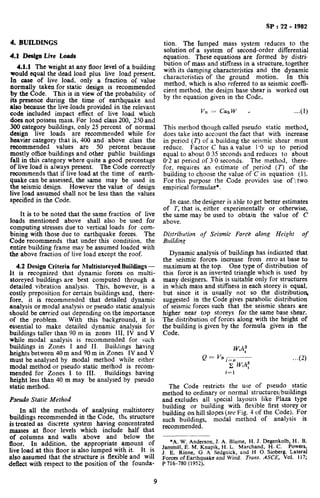
by using the following relationship:
Qy’ = Wi4:’ crarc’ ...(3)
in which Q,V’ = Force at ith floor level when
vibrating in its-rth mode.
Wi = dead load + appropriate percentage
of live load at level hi measured above
the ground level,
4(i) = mode shape coefficient for ith floor
level when vibrating in rth mode, and
C, = mode participation factor for
different floor levels when vibrating
in the rth mode.
; W#”
c, = i=l
11
SP : 22 - 1982
where n is total number of storeys in the
building
8’ = Design seismiccoefficient correspond-h
ing to rth mode given by,
O(C)
where p and I are soil-foundation factor and
$‘I
0
importance factor, - is the average accelera-
tion coe&ient in thg rth mode (from Fig. 2 of
Code) and FOis the seismic zone factor.
After obtaining Qy’ values, shear forces _
various storeys are obtained by summing up Qs
values from top and up to the storey in question.
These are termed as Vi” values, which must be
computed for at least the first three modes. The
combination or superimposition of various modal
values of force is then carried out using the
following law:
r-p
vi = (1 - y) r, Vj” + y J X U+“}r ...(4)
where y is a function of the height of building
as defined in the code; V;‘r”= absolute value of
maximum shear at the ith storey in the rth mode.
Determination of mode shape coeficient (#y’
values) - The Code has simply stated that 4:”
values are obtained from free vibration analysis,
but has not suggested any method of doing so
because such methods are given in detail in books
on theory of vibration. However, a brief descrip-
tion of the formulation of problem is included in
the following paragraph‘s:
A popular method for the determination of
the fundamental mode is the iterative Stodola
method, as this method is usually formulated
using matrix notations, it is also called matrix
iteration. The equation of motion for a freely
vibrating motion of a multi-storeyed lumped
mass (undamped) can be written as:
[Ml [Xl-+ VI VI = 0 ...(a)
in which it4 is the diagonal mass matrix, K the
stiffness matrix in relation to lateral displace-
ments and, d and X are displacement vector
corresponding to storey displacements and
acceleration vector corresponding to storey
acclerations matrices, respectively. Assuming
the free vibration is simple harmonic,
[X] = [4] sin pt ...(b)
4 represents the shape of vibrating system
which does not change with time ‘t’ but varies
only with amplitude, p represents circular fre-
quency of the system.
Equation (a) can be rewritten as,
-P’ [Ml Ml + VI Ml = 0 ...(c)
or d w-l M = WI Ml ...(d)
Premultiplying by K-l on both sides, one
obtains
Wl-l[Ml &I = $ Ml ...(e)
putting K-l as G (or flexibility matrix),
Equation (e) assumes the following form,
VI WI Ml =$ Ml -**(f)
Equation (f) is of the form
AX=XX
which represents’an eigen value problem whose
solution leads to evaluation of natural fre-
quencies and corresponding mode shapes. The
methods of solution are generally iterative and,
are easily amenable to computer programming*.
To start with, trial shape 4(o) shall be assumed.
If the assumed shape were a true mode shape
4 (I), then the same frequency would be
obtained by taking the coordinate of the struc-
ture. However, the desired shape will differ
from 4(o), and a different result will be
obtained for each displacement coordinate.
Because of this reason a better approximation
of frequency can be obtained by an averaging
process. The best averaging procedure consists
of including the mass distribution a weighting
factor. Knowing p, the fundamental period
for mode one may be computed as:
T z2”1
Pl
Example 2
Analyse a 15-storeyed RC building as shown in
Fig. 3. The live load on all the floors is 200 kg/m’
and.soil below the building is hard. The site lies
in Zone V. All the beams are of size 40 x 50 cm
and slabs are 15cm thick. The sizes of columns are
60 x 60 cm in all the storeys and the wall alround
is 12 cm thick.
Analysis of the Building
a) Calculation of dead load, live load and
storey stiffnesses: As in case of seismic
coefficient method, dead loads and live loads
at each floor are computed and lumped.
Stiffness in a storey is ‘lumped assuming all
the columns to be acting in parallel with
each column contributing stiffness corres-
ponding to Kc = 12EI/L3, where I is the
moment of inertia about bending axis, L the
column height and E the elastic modulus of
column material. The total stiffness of a
storey is thus CKc. The lumped mass at all
*For details, reference may be made to any book on
Theory of Vi&ration.
12
SP:22 -1982
PLAN
FIG. 3
floor levels is 52.43(t.sa/m) and at roof
level is 40(t.sa/m). The values of I, Kc and
IX, for all the floors/storeys is 1.08 x lo6
cmJ, 9 024 t/m and 180 480 t/m, respectively.
b) The first three natural frequencies and the
corresponding mode shapes are determined
using Stodola Vienello iteration procedure
and are given in Table 2.
TABLE 2 PERIODS AND MODE SHAPE
COEFFICIENTS AT VARIOUS LEVELS
FOR FIRST THREE MODES
Mode (r)
Period in
Seconds
1 2 3
1.042 0,348 0.210
Mode shape coefficients at various floor levels
+I;’ 0,356 -0.355 0.353
+I;’ 0.353 -0.330 0.283
&’ 0,347 -0.273 ci.140
4I;’ 0.336 -0.190 -0.039
4;;’ 0.323 -0.089 -0.208
4;b’ 0.305 0.019 -0.324
dg’ 0.285 0.127 -0.355
4I;’ o-261 0.222 -0 296
4p’ 0.235 0.296 -0.158
4?’ 0.206 0.342 0.019
4:” 0.175 0.356 0192
4:” 0143 0.336 0.315
4s” 0.108 0.285 0’356
4:” 0 073 0.206 0.305
41(I) 0.037 0’108 0.175
13
--I3@7*5m = 22.5 m
ELEVAl ION
Horizontal seismic coefficient for design is
given by,
Assuming 5 percent damping in all the
three modes, I I= 1.0 and 8 = 1’0, from
Table 5 of Code, the design seismic
coefficient for zone V(Fo-=0.40)in the
three mode work out as follows:
c(l)
1st Mode: = 0.105; a:) = 0.042
s’2’
2nd Mode $ = O-184;a:) = 0.073 7
s’3’
3rd Mode $ = 0.200; c$’ = 0.080
d) The next step is to obtain seismic forces
at each floor level in each individual mode
as required in Equation (3). Mode parti-
cipation factors in each mode is to be
obtained. For this, Table 3 would be
found convenient wherein the method is’
explained for computation of C, (mode
participation factor for first mode).
SP : 22 - 1982
TABLE 3 COMPUTATION OF MODE TABLE 5 COMPUTATION OF LATERAL FORCES
PARTICJPATION FACTOR C, AND SHEAR (MODE 2)
p-
w
-a
51.53
46.66
37.38
24’56
9.42
-6.61
--a01
-3533
4931
-51.01
-51.88
47.85
-39’29
-27.02
-1219
No.
4i
0’037 1903 0.70
No.
l
6
7
8
9
10
11
12
13
14
15
514.34 0.108 1.18 x 4’87
0.073 7
do 928
do 1282
do 15.14
do 16.03
do 15.40
do 1332
do 9’98
do 5.70
do 0.87
do -4.03
do -8.56
do -1227
do -14.83
do -12.19
0’073 37’55 2’74
0.108 55.55 6’00
0.143 73.55 10’52
0’175 90.01 15.75
0.206 105.95
1 778.88
21’83 C,=498’08
0.235
0.261
0.285
0.305
0.323
0.336
0347
0353
0.356
120.87
13424
14659
156.87
166.13
172.82
178.47
181.56
139.69
---
2840 =3’571
35.03
41.78
47.85
53.66
58.07
61.93
6409
49’73
1
2 5r4.34 0.206
3 51434 0.285
4 51434 0.336
5 51434 0.356
6 51434 0.342
7 514.34 0.296
8 51434 0.222
9 514.34 0.127
10 514.34 0.019
11 51434 -0.089
12 514.34 -0.190
13 51434 -0.275
14 514.34 -0.330
15 392-40 -0.355
21 778.88 2498’08
TABLE 6 COMPUTATION OF LATERAL FORCES
Having obtained C, = 3-57, Cs and
AND SHEARS (MODE 3)
C., are obtained similarly as l-18 and FLOOR wi $i
Wi4i
5’01 19.37
8.73 14’36
10’18 5.63
9.00 -4.55
5.49 -13.55
0.56 -19’04
4.52 -19’60
-8.42 -15.08
-10.15 -6.66
-925 3.49
-5.95 1274
-1’12 18.69
4.01 19.81
8.10 15.80
7.70 7.70
0%98,respectively. -
Seismic force acting at each floor is No’
then computed as per Equation(3) and is
given conveniently in tabular form for
1
mode 1 as shown in Table 4. This table 2
also gives the shears in each storey in this
mode. Similarly, Tables 5 and 6 tabulate
3
the forces for the second and third mode
4
i
respectively. 6
514’34 @175
51434 0.305
514’34 0.356
514.34 0.315
51434 0.192
514’34 0.019
514.34 a158
514.34 -0.295
514.54 --0’355
51434 -0.324
514’34 -0.208
514.34 -0.039
51434 0.140
514.34 0.283
39240 0.353
O-698 x
0 (~80
do
do
do
do
do
do
do
do
do
do
do
do
do
do
7
8
9
10
11
12
13
14
15
TABLE 4 COMPUTATION OF LATERAL FORCES
AND SHEARS (FIRST MODE)
No.
1 514’34 0.037 0-150x
o-042
x Widi %?j”
2-81 265.29
2 51434 o-073 do 5’58 262.98
3 ,51434 0.108 do 830 25690
4 514-34 0.143 do 1I.03 248.60
5 51434 0’175 do 13.45 237 67
6 51434 0.206 do 15.82 22422
7 514’34 0.235 do 18.03 20840
8 51434 0’261 do 2004 190.37
9 514’34 0’285 do 21.84 170.33
10 514% 0’305 do 23.42 148.49
11 SW34 0.323 do 24.74 125.07
12 514’34 0.336 do 25.80 100.33
13 514.34 0.347 do 2659 7453
14 SW34 0353 do 27.10 4794
15 39240 0.356 do 20.84 20.84
e) Combination of shears for the three
modes:
After getting shear forces in each
individual mode, the total shear force in
each storey is obtained in accordance with
4.2.2.2 of the Code, total shear force,
v, = (1 - y) Wj” t Y
I/
x(vy)*
For height of building equal to 45 m,
Y = 0.65, shear in any storey say top
(15th), is given by,
14
FIG. 4 PLAN OF UNSYMMETRICALSTR~~~~RB
VI;= (1 - 0.65) [(20’84+ 12.19 + 7*70)]
+ 0*65*r(20*84)*+ (1219)% + (7.7)’
= 30.73 t
Similarly, shear in all other storeys
(to be taken by all columns) are computed
as follows:
V, = 391.37 t V, = 217.14 t
V, = 38293 t VI, = 188.17 t
V, = 367.19 t V,, = 161.08 t
v, = 346.10 t 6, = 132.71 t
V, = 321.95 t v,, = 103.03 t
V,, = 296.95 t V,, = 68.98 t
V, = 272.81 t I’,, = 30.73 t
V, = 245.96 t
The above values of shear forces in
various storeys are to be taken for seismic
condition in analysis. Tab!e 7 gives
maximum interstorey displacement of the
building.
NOTE1 - In building in which the floors and roofs
consist of solid or hollow slabs, or of other elements
with an equivalent horizontal rigidity, the shearing force
Vi acting at level i shall be distributed along the various
vertical elements in proportion to their rigidity.
NOTE2 - The rigidity and the resistance of the slab
shall be verified to determine that they are capable of
providing such distribution of loading. If the amount
of deformation of the slab is not negligible, the effect of
their flexibility shall be taken into account in the
distribution of the shearing forces.
4.2.3 Drifi ( Lateral Displacement or Sway ) -
The drift limitation is necessary to save elements
(non-structural elements) which form an integral
part of the structure and to avoid upsetting of the
TABLE 7 DRurlr OR MAXIMUM INTERSTOREY
DISPLACEMENT OF BUILDING (EXAMPLE
MODAL ANALYSIS)
ST~REY
i
1 391.37 1 804*80
2 38293 1804-80
3 367.19 1804.80
4 346.10 1 804.80
5 321.95 1804-80
6 296.95 1804.80
7 272.81 1 804.80
8 242.96 1804.80
9 217.14 1804.80
10 188.17 1 804.80
11 161’08 1804-80
12 132.71 1804.80
13 103.03 1 804.80
14 68’98 1804.80
15 30.73 1 804.80
SHEAR,
Vi (t)
STIFFNESS.
Ki(t/cm)
RELATIVE
DISPLACEMENT,
MAX
Vi/Ki (cm)
0217
O-212
0.203
0’192
O-178
0.165
0.151
0.136
O-120
0.104
0’089
O-074
0’057
@038
O-017
occupants psychologically. It is felt that @004
of the interstorey height is a good limit for this
purpose. Buildings analysed for seismic forces
must be checked for this drift limitation also.
In a 15 storeyed building analysed in Example 2,
the drift is worked out in Table 7. It is seen
that in a few storeys the drift exceeds 0.004 x 3 =
0.012 m and hence the design needs revision from
this point of view;-
4.2.4 Torsion of Buildings - Horizontal twis-
ting occurs in buildings when centre of mass and
centre of rigidity do not caincide. The distance
between these two is called eccentricity (e). Lateral
force multiplied by this ‘e’ cause a’ torsional
moment which must be resisted by the structure
15
8Pr22-1982
in addition to the normal seismic force. There-
fore, the Code stipulates that provision shall be
made for increase in shear forces acting on parti-
cular elements resulting from the horizontal torsion
due to an eccentricity between the centre of mass
and the centre of rigidity.
It is desirable to plan structural elements of the
building in such a way that there is no eccentricity
or the building is symmetrically planned with
respect to the mass centre. However, it is very
difficult to do so in practice and some provision
has to be made for it.
Since there could be quite a bit of variation in
computed value of i, it is recommended by the
Code that design eccentricity shall be 1.5 e. The
net effect of this torsion is to increase shear in
certain structural elements and reduction in certain
others. The Code recommends that reduction in
shear on account of torsion should not be applied
and only increased shears in the elements be
considered.
The torsional forces shall be distributed to the
various vertical components of the seismic resisting
system with due consideration given to the relative
stiffnesses of the vertical components and the
diaphragm. It is then corrected for torsion taking
into account the increases produced, but not the
decreases as specified in the Code.
In order to understand the method of deter-
mining the additional shears due to torsion, the
building plan given in Fig. 4 may be examined.
Assuming the origin at point 0, the coordinates.
of centre of rigidity (geometric centre of stiffnesses
of various vertical resistance elements) or point of
rotation are computed as follows:
in which x, y are the coordinates of and K#, Kv
are stiffness of the various elements in the two
directions, respectively. The rotational stiffness
Zzr of the structure about centre of rotation C, is
given by,
I,, = B [K, - YOI+ Ky . X2]
in which x and y are the distances of elements.
from the centre of rigidity C,. If the torsional
moment is T (equal to Ve), the torsional shears.
V, and VV on any column line can be computed
as:
V. = f - y - Km, and
P
vr = f -x . K,,”
9
in which K,s and K,, are the total stiffness of the
column line under consideration in the x and y
directions, respectively.
Example 3
A four storeyed building (with load
300 kg/m*) has the plan as shown in Fig. 5
and is to be designed in seismic Zone III. Work
out the seismic shears in the various storeys of the
16
SP : 22 - 1982
proposed building. The factor @may be assumed
as 1.0 and importance factor I also as 1-O.
a) Total weight of beams in a storey
= 14 x 7.5 x 0.4 x 0.5 x 2.4
:= 50.4 t
Total weight of columns in a storey
== 18 x 3 x 0.4 x 0.6 x 24
= Jl*lOt
Total weight of slab in a storey
= (22.5 x is + 15-x 15) x 0.15
x 2.4 = 202.5 t
Total weight of walls
:= (22’5 + 15 + 7’5 + 30 + 15 + 15)
x 0.2 x 3 x 2.0 = 126 t
Live load in each floor
= (22.5 x 15 + 15 x 15) x0.3x0.25
= 42-18 t
,Lumped weight at floors 1, 2 and 3
= (410.00 + 42.18) = 452.18 t
Lumped weight at roof floor
= 410.00 t
Total weight of building
= 452.18 x 3 + 410.00
= 1 766.5 t
b) Base shear:
T ==0’1 x 4 = 0.4 s
C (from Fig. 3 of the Code) = 0.90
VB= lah C.W.
==. 1 x 1 x 0.04 x 0.90 x 1 766.5
==63.59 t
c) The shear forces in various
computed as shown in Table 8:
storeys are
d) e0 and ev.are computed as:
em= 13*75- 13.51 = 0.24 m (design value
= @36 m)’
= @35m (for top floor,
design value
= 0.52)
e, = lO*OO- 9.76 = 0.24m (design value
= 0.36 m)
= 0.30 m (for top floor, design value
= 0.45 m)
Total rotational stiffness IP about centre of
rigidity is given by,
Ip = (J&P + J&P)
K,P = 2 673.78 [5(10’) $ 5 (2.5*)
+ 5(52) x 3 (12’5J21
= 3 016 023.8
KvXa= 6 016 [4(13.753 + 4 (6.25’) +
4 (1.25”) + 3(8.758) + 3 (16’25”)]
= 11 674.799.0
I,, = 3 016 023.8 + 11 674 799.0
L= 14 690 822.8
e) Torsional moment T at various floors is as
follows, considering seismic force in X-
direction only,
T, = 63.59 x 0.36 = 22.89 t.m
Tz = 61.36 x 0.36 = 22.18 t.m
T3 = 52.44 x 0.26 = 18.88 t.m
Td = 32.36 x 0.45 = 14.56 t.m
Torsional shear at each column line is
worked out in Table 9 by using equation:
TABLE 8 NODAL FORCES AND SEISMIC SHEAR TABLE 9 TORSIONAL SHEARS IN VARIOUS
FORCES AT VARIOUS LEVELS STOREYS IN X-DIRECTION (IN TONNES)
FLOOR Wr fit Wihf Qc
(SHEAR ?ORCL)
COLUMN FIRST SECOND THIRD FOURTH
LINE STOREY STOHEY STOKEY STOREY
(0 (m, (t) (0 (1) (2) (3) (4)
1 452.18 3 4 069.62 2.23 63.59 VZ V, V, V&!
2 ,, 6 16 278.48 8.92 61.36
3
1 0.20 0.178 0.140 0’119
41&O
9 36 626.58 20.07 52.44
4 12 59 04om 32G6
2 0.50 0.044 0’034 0’029
32.36 3 0.10 -0’088 -0.060----- -0’071
1 16 014.68 4 0.15 -0.132 -0’105 -0.891
17
SP : 22 - 1982
f) Torsional moment in the various storeys
considering seismic force to be acting in
Y-direction:
T, = 63.59 x O-36 = 22.89 t.m
Tz = 61.36 x a36 = 22.18 t.m
T, = 52.44 x 0.36 = 18.88 t.m
T, = 32.36 x 0.52 = 16.82 t.m
Torsional shears at each column line in
this direction are worked out in Table 10
according to expression for
NOTE- Itwill be noted from Tables 9 and 10 that
column lines 1, 2 (in case of seismic force in X-direction-
left to right or right to left) and A, B (in Y-direction) will
be having increase of shear due to torsion. Other
column lines will be relieved of some shear but Code
recommends not to reduce the seismic shear on
account of such relief.
TABLE 10 TORSIONALSHEARS IN VARIOUS
STOREYS IN Y-DIRECTION (IN TONNES)
COLUMN FIRST
LINE STOREY
(1)
v,
A 0.49
B 0.277
C 0.049
D O-242
E 0.444
SECOND
STOREY
(2)
VW
0.428
0,194
0.039
0.207
0.380
THIRD
STOREY
(31
V”
0.342
0’159
0.032
0.169
0.309
FOURTH
STOREY
(4)
1'Y
0.362
0.162
0.032
0.175
G-318
4.4 Miscellaneous
4.4.1 and 4.4.2 Under these clauses the Code
advises the designer to be extra careful in design
of vertical and horizontal projections like towers,
tanks, chimneys, balconies and other cantilever
projections or appendages in buildings. Experience
from past earthquakes has shown that such
appendages get damaged considerably and many
lives are lost due to their collapse. Such systems
are subject to larger motions than the building to
which they are attached. Therefore. the Code
recommends that the seismic coefficient for the
design of vertical cantilever projections attached
to tne building should be taken as five times the
ah specified for the main structure. Similarly, the
vertical seismic coefficient for all horizontal pro-
jections shall be 5 times a”. However, it must be
clearly understood that this provision is only for
designing the projecting part and their connections
with the main structure. This provision is not to
be applied to main structure.
Example 4 - A vertical appendage of size
30 x 30 cm and 1.0 m high is attached to a four
storeyed building in Zone III. Work out the design
forces for the appendage structure. Take impor-
tance factor as 1.0 and soil foundation factor 8
as 1.2.
For the Zone III, basic seismic coefficient is
0.04. The design horizontal seismic coefficient for
the structure is given by,
aA = 1.0 x l-2 x 0.04 = 0.048
For the appendage the seismic coefficient
= 5 x O-048 = O-24. The seismic force on the
appendage is given bp,
F = 0.24 x 0.3 x 0.3 x 1 x 2.4 = O-052t
The appendage connection should be designed
for a shear force equal to O-052t and bending
moment equal to 0.052 x 0.5 = 0.026 t.m.
Example 5 .- A horizontal cantilever of. size
1 x 1 m having average thickness of 6 cm projects
out from the wall of a brick building room (size
5 x 4.5 m). The building has a height of 3 m and
has flat roof with 12 cm slab and roof finishing
with 240 kg/ma. Thickness of wall is 20 cm. The
building is located in seismic Zone V (see Fig. 6).
The cantilever is to be designed for a vertical
seismic coefficient equal to five times the vertical
r12 cm
n
c:.;:.‘.::: .‘.t.;. ‘;:
---I-
1.0m &- 1-O m ---_ct
t
I!====4....._...,...,.....:.
1 6 cm-t
M
-A--0.2m
I2-O m
I
FIG. 6
18
SP:22-1982
coefficient for the zone :. aI, = 5 x ) x 0.08
- O-20. The cantilever if designed for static
forces will be found to be safe because under
seismic condition the moments and shears will
increase only by 20 percent whereas the allowable
stresses are to be increased by 339 percent as per
3.3of the Code.
For checking the stability of the cantilever,
however, it is important to use a. as acting down-
ward for the cantilever and upward for the main
structure which may be the worst condition in view
of difference in characteristics of the two portions
(main building and cantilever). This leads to
increased overturning moment and reduced stabi-
lizing moment. Referring to Fig. 7 where forces
are indicated, the stabilizing moment is given by:
t
M, = W(1 -aw)--
2
and overturning moment by:
For stability, M, must be greater than MO.
W, = 1 x 1 x 0.06 x 2.4 = 0,144 t
Alo = 0.144 (1 + 0.2) x 0.5
= 0.086 4 t.m.
Weight of the wall above the cantilever
= 0.2 x 1.0 X x 2”O= 0.4 x t
Weight of roof slab per metre run including
finishes = 0.8 t
:. W = 0.4 X + 0.8 X = 1.2 X
:.M,= 1*2Xx 0.1 x (1 -0.2)
= O-096 X t.m.
Equating M, and M,,,
0.096 X = 0.086 4
x = 0.086 4
----=0_9m= l’Om(say).
0.096
The cantilever will have to be embedded under
1.0 m length of wall. In other words the anchorage
length will be 1.0 m or equal to the width of the
cantilever itself.
5.2 Elevated Tower Supported Tanks - No
empirical formulae are available for prediction of
period of water towers, and even though water
towers generally have longer period and effective
acceleratior. coefficients are smaller than the peak
of the acceleration response spectra, this reduction
is not made use of in the seismic coefficient method.
It would be desirable that in future revision of the
Code. response spectrum method for determina-
tion of a! is recommended for all zones. Alterna-
tively, smce a majority of prototype water towers
tested have periods longer than 06 s, for preli-
minary design a reduction factor of 0.75 be used
such that the design seismic coefficient
ah = O-75&I. a0
.w11-O m
W I
III”’t
l I
W
d-t-c L /
4
FIG. 7
5.2.4 The analysis based on energy considcra-
tion (Reference 1) shows that when the mass m of
the tank (including contents) is much greater than
the mass of the staging m,, the equivalent mass
will be
M=mfQm,
and when the mass m is smaller than m,, the
equivalent mass will be
M=m+)m,,
In general the mass of the staging would be
smaller than the mass of the tank (including water)
and hence the equivalent mass recommended in
the Code is + of actual mass.
The reason for considering only Qof the staging
weight at the centroid of the tank is that 4 of the
staging weight will act at the bottom of the tank
at ground level and hence will not contribute to
vibration.
52.7 Hydrodynamic Pressure in Tanks - When
a tank containing fluid with a free surface is
subjected to earthquake ground motion, it expcri-
ences dynamic fluid pressures of two types.
Firstly, when the walls of tank accelerate,
the adjacent fluid also accelerates and exerts on
the wall an impulsive pressure which is directly
proportional to the acceleration of the wall.
Secondly, the effect of the impulsive pressure
exerted by the wall on the fluid is to excite the
fluid into oscillation and the oscillatory accelera-
tion of the fluid produces convective pressures
on the walls and bottom whose amplitudes are
proportional to the amplitude of oscillation.
19
SP : 22 - 1982
ASSUMED
DIRECTION
EXAMPLE
FIG. 8 ELEVATEDWATERTANK
Assuming the fluid to be incompressible and
fluid displacements small, analytical results have
been obtained for rectangular and cylindrical type
of tanks (Reference 2). The convective pressures
during earthquakes are considerably less in magni-
tude as compared to impulsive pressures and are
therefore usually neglected.
53.7.2 and 5.2.7.3 In case of tanks resting on
ground, the acceleration of the fluid in the tank is
deemed to be the same as that of ground whereas
for tanks supported on staging, the acceleration
may correspond to the response acceleration of
tank which would be different from that of the
ground.
Nowadays, sophisticated methods, such as space
frame analysis, are available for evaluation of the
stiffness (or its inverse, the flexibility) of the
staging. However, the approximate method as
illustrated in Example 6 would do.
Example 6 - Consider an elevated water tower
supported on a concrete staging of 8 columns
located on the circumference of a circle of 9 m
diameter. The height of the staging is 16 m and
horizontal bracing is provided at a vertical spacing
4 m. The circular columns are 52 cm in diameter.
Diagonal steel bracing in the form of 18 mm dia
bars are provided in all bays (see Fig. 8).
Equivalent Spring Constant I
The staging is assumed to be composed of
springs in series connected at the horizontal brace
level. The stiffness of the spring in one bay is made
up of stiffness of columns and diagonal braces
acting as parallel springs.
a) Stiffness of a column in a bay
12EI
kb =L8
Let
E - 2 x lo6 t/m’;
L = 4 m (centre to centre distance)
The moment of inertia is assumed to be evaiuat-
ed based on the gross area of concrete.
I F t&/64 = n x (0.52)4/64
= 3.589 x IO-*m4
k,, - 12 x 2 x 10’ x 3.589 x 10-s/4a
=l 345.9 t/m
Stiffness of 8 columns acting in parallel
T;ka= 8 x 1 345.9 = 10 767.2 t/m
b) Stiffness of diagonals in a bay (see Fig. 8)
It is assumed that only the tension diagonals
contribute to stiffness. The stiffness may be taken
as:
kb = y COS’8
where A is the area of cross-section, E the modulus
of elasticity, L the length and 0 the angle with the
horizontal.
A = vc x (@018)*/4 = 2545 x lbdmS;
,?$=2*1 x lO’t/m*
The projected lengths of the diagonals on a
vertical plane in the direction of earthquake are
different. Denoting them by L, and L,
L1 = 3.444 set 8,; L, = 2435 see e*
tan 01 = 413444 and tan 0, = 412435,
kbl = 430.84 t/m and kb%= 308.58 t/m
20
SP : 22 - 1982
As there are 2 braces in the plane parallel to the
direction of motion and 4 braces at an inclination
to it, 2 braces do not contribute to stiffness being
in a plane at right angles to the direction of
motion. This gives
Xkb = 2kbI + 4kba = 2 096 t/m
c) Stiffness of one bay is given by
k = I;k, + ZZka- 12 863.2 t/m
d) There are 4 bays. The equivalent spring
of the system K is obtained by summing the stiff-
nesses of all bays in series.
1
K= +
c
K = k/4 = 12 863.214 = 3 215.8 t/m
A similar procedure may be used if earthquake
force is applied in any other direction and the
worst situation evaluated for design.
Example 7 - An elevated water tank has a
capacity of 600 m3. The tank is circular with an
internal diameter of 12 m and height 6 m. The
tank is supported on a concrete staging 16 m in
height. The staging consists of columns, and
horizontal and diagonal braciags. The structure
is located in Zone IV and founded on Type II
medium type of soil.
Let the weight of empty tank be 250 t. The
weight of water in the tank when it is full is 600 t.
Let the weight of staging consisting of columns
and bracings be 150 t and the stiffness of the
staging in any direction is 3200 t/m The value
of stiffness K may be obtained by any method of
static analysis known to the designer (see Example
6). K is the lateral force required to cause unit
deflection at the centre of gravity of the tank.
Lumped Weights
a>Tank empty
b)
Equivalent weight acting at the centre of
gravity of tank
W*=250ffx 150=300t
Tank full
Equivalent weight,
W, = 300 + 600 = 900 t
Fundamental Period
J
-T = 2n
Here W is the lumped weight at ceatre of gra-
vity of the tank and K is the stiffness of the
staging.
Therefore,
T
a) Tank empty
= O-614s.
b) Tank full
T= 2x wf = 2x
J-
900
CK 9.81 x 3 200
= I.064 s.
Average Acceleration Coeficient
Assuming a damping of 5 percent of critical,
for the above periods, the average acceleration
coefficient (from Fig. 2 of the Code) would be:
a) Tank e;npty,
S,,/g = 0.148
b) Tank furl,
s,/g = 0.101
a,, = p I.F,. Sa/g
p = 1.0, I = 1.5 and F,, = 0.25
a) Tank empty,
ah = 0.055 5
b) Tank full,
ah = 0’039
Shear Force
V= ahe W
a) Tank empty,
V = ah’ W, = 0.055 5 x 300 = 16.65 t
b) Tank furl,
V = ah Wf = 0’039 0 X 900 = 35.10 t
Tank full is the severest condition. The force
35.10 t acts horizontally at the centre of gravity of
the tank in the plane in whit h the structure is
assumed to oscillate.
Hydrodynamic Pressure
The tank wall will be subjected to an accelera-
tion of (a,, g) 38.259 cm/$ (corresponding to
a,, = WO39)with a natural period of 1 064 s, this
would correspond to a displacement of
21
SP:22-1982
T”
O-43 =
38.259 x (l-064)’ = le09, cm
4x’
where u is acceleration.
Impulsive Pressure
Height of water in tank
600
= * = 5305 m
Pressure on Wall,
Pv is maximum when cos 4’
= 1 (for d;’ = 0)
pw= 0’039 x 1 000 X 5.305 x 0
C
$- +
at y = 0.2 h
pu = 34535 x 0.18 = 6216 kg/ma
at y = 0.4 h
pv = 345.35 x 0.42 = 145.06 kg/m2
at y = 0.6 h
pm = 345.35 x 0.42 = 14506 kg/ma
at y = O-8h
pw = 345.35 x 0.48 = 165.76 kg/ma
at y=l*Oh
pv = 345.35 x 0.5 = 172.20 kg/m’
Pressure on the bottom of the tank on a strip of
width 21’ is
taking value of 1’ =I R, the above expression
becomes
at x=0
pb=o
at x= &:2R
pb = 48.77 x 0401 9 = f 19.60 kg/m*
at x= =t:0.4 R
pb = 48.77 x 0.866 3 = & 42*25kg/m’
at x= f 0.6 R
pb IL 48.77 x 1.465 3 = f 71.46 kg/m4
at x=f@8R
pb = 48.77 x 2.292 1 = &- 111.78 kg/ma
at x=fl.OR
pb = 48.77 x 3.475 3 = f 169.49 kg/m’
The distribution of pressure along the wall
and at the base are as shown in Fig. .9B for
6’ = 0 and I’ = R. Similarly, pressure distri-
butions along the wall and base at various loca-
tions can be found out by changing the values of
6 and I’ and studied for design.
0 50 100 150
PRESSURE IN kg/d
FIG. 9A RBCTANGULARTANK
22
SP : 22 - 1982
Example 8 - An elevated water tank has a
capacity of 600 ms. The tank is rectangular
12 m x 9 m in size and 6 m in height. The tank is
supported on a concrete staging 16 m high. The
staging consists of columns, horizontal and diago-
nal bracings. The structure is located in Zone IV
and founded on a Type II medium type of soil.
Let the weight of the empty tank be 250 t. The
weight of the water in the tank when it is full is
600 t. Let the weight of the staging, consisting of
columns and bracings be 150 t and the stiffness of
the staging in any direction is 3 200 t/m.
Lumped Weights
a) Tank empty
Equivalent weight acting at the centre of
gravity of tank
W,=25O+Q x 150=3OOt
b) Tank fill
Equivalent Weight
W/ = 300 + 600 = 900 t
,Fundamental Period
T = 2x
J
X
a
Here A is the static horizontal deflection at the top
of the tank which can be found out by any of the
methods from structural analysis.
Using the relation A = 2
where W is the lumped weight at centre of gravity
of the tank and K the stiffness of the staging the
expression for fundamental period becomes
a) Tank empty
7-z 2x _!!? = 2x
J-- gK J
300
9.81 x 3 200
= 0.614 s
b) Tank full
J
___T = 2~ -!?_ = 2x
J
900
gK 9.81 x 3 200
= 1,064 s.
Average Acceleration Coeficient
Assuming damping as 5 percent of the critical
value, for the above periods, the average accelera-
tion coefficients (from Fig. 2 of the Code) would
be
a) Tank empty
&’ = ij.148
g
b) Tank full
z!J = 0.104
g
Seismic Coeficien t
ah = p .I.F,, $
$ = 1.0, F, = 0.25
a) Tank empty alp= 0.055 5
b) Tank fill1 ‘a, = O-039
Shear Force V = aI. W
a) Tank empty
V = ah.W. = @055 5 x 300 = 16.65 t
b) Tank Full
V = ah.Wj = O-039 X 900 = 35.10 t
Tank full is the severest condition.
The force 35.10 t acts horizontally at the centre
of gravity of the tank in the plane in which the
structure is assumed to oscillate.
Hydrodynamic Pressure
The tank wall will be subjected to an accelera-
tion of (a,.g) 38.259 cm/s* (corresponding to
an = 0.039) with a natural period of 1.064 s, this
would correspond to a displacement of
P 38.259 x (1.064)’
a x z;l = -- 4d - = 1.097 cm
where a is acceleration.
Impulsive Pressure
Height of water in the tank = -&
= 5.556 m
Pressure on the wall,
pw = a,.w.h *rZ-
= 0.039 x 1 000 x 5.556
23
SP : 22- 1982
= 3752629 [$-&( $>“I
x 0,953 63
= 357.8624 [ $ - +( $)“I
Yat -&- I= 0
pw = 0
at $ ----.0.2
pw = 357.862 4 x 0.18 = 64.4 kg/m2
at $; == 0.4
pw =- 357~8624 x 0.32 = 114.5 kg/m2
at $- = 0.6
pw = 357.862 4 x 0.42 = 150.3 kg/m2
at j. = 0.8
pw = 357862 4 x 0.48 = 171.8 kg/m2
at s = 1.0
pw L- 357.862 4 x 0.5 = 178.9 kg/m2
The pressure on the bottom of the tank
cpb = a/,.w.h -
2
= 0.039 x 1 000 x 5.556 X 5
2
0’039 x 1 000 x 5.556 x &-=
2 x 3.323
x sinh fl
( >+
Z 56.464 5 sinh K ( 2 >
at -T = 0
pb = 0
at 5
I
= f0.2
pb E %*464 5 X 0.382 9 = 21.62 kg/m’
at $ = f0.4
pb = 56.464 5 X 082 = 46.30 kg/m’
at 5
I
= *to.6
pb = 56464 5 X l-373 = 77.54 kg/ma
at 5
I
= f0.8
pb = 56.464 5 x 2.120 9 = 119.76 kg/m’
at 5
I
= f1.0
pb = 56.464 5 x 3.168 9 = 178.93 kg/m’
The above type of pressure distribution are
plotted and are shown in Figure 9A
0 50 100 150 200
PRESSURE IN kg/m2
FIG. 9B CIRCULARTANK
5.3 Stacklike Structure
General - Stacklike structures are those in
which mass and stiffness is more or less uniformly
distributed along the height. For the purpose of
analysis these could be treated as cantilever beams.
If the structure is long compared to its cross-
sectional dimensions, bending deformations are
predominant, but in general shear and rotary
inertia deformations should also be considered in
the analysis.
24
The formulae given in the Code concerning
period of vibration, base shear and base moments
are based on the research work (Reference 3). The
following parameters have been varied in the
analysis of various types of chimneys:
The slenderness ratio at base, r,,, has been varied
from 5 to 50 where the lower limit corresponds
to short and stout chimneys and the upper limit to
long and slender ones. The radius of gyration, r,
as well as the area of cross-section, A, varied
linearly along the length L. That is, at any section,
distance ‘x*from the base,
r,/r,, = AillAo = 1 - (1 - 8) xJL
In addition, for a few cases, the variation of A,
is assumed as,
AJA, = 1 - [(l - i3)x/U
The taper ratio p has been varied, from a value
of 1*Oto 0.2 which covers a wide range. In all
cases, bending moment and shear have been
computed both at the base as well as along the
length. The term response has been used here to
denote such quantities.
Recorded ground motion corresponding to
actual earthquakes, namely, NS component of El
Centro earthquake of 18 May 1940 and N69W
component of Taft earthquake of 21 July 1952
have been used to compute the various response.
The undamped fundamental period of vibration
had two values, namely, two seconds corresponding
to larger values of r,, and one second correspond-
ing to shorter values of r,,. Where r, is slender-
ness ratio = L/r, r being radius of gyration. The
first three modes of vibration have been used for
mode superposition purposes. Modes of higher
order have not been considered as the correspond-
ing periods are so short that ground motion
accelerations are not defined for such periods. Two
combinations of damping have been considered. In
one case, damping has been assumed to be the
same in al1 modes and in the other, damping
increased with increase in order of modes thus
representing structural damping phenomenon. The
first case, in which damping is the same in all
modes, would be conservative and gives slightly
larger response. For the combination of modes,
response has been obtained time-wise and maximum
values have also been determined.
In another method of determining response,
ground motion has been assumed to be such that
the velocity spectra 2x%G, is independent of
period. This has been termed as ‘flat spectra*.
Such an assumption nearly corresponds to that of
Housner’s average spectra. Flat spectra criterion
generally gives larger response for higher modes
compared to actual ground motion if the data is
so normalized such that first mode response is the
same in all cases. Assuming damping to be the
SPi22-1982
same in all modes and using flat spectra, maximum
value of response in each mode has been worked
out. The total response has been assumed to
be equal to the root mean square value of the first
three modes.
As far as the distribution of the shear forces
and bending moments along the height is concern-
ed, the formulae have been kept unchanged right
from the first version of IS : 1893 and is based on’
Housner’s paper (see Reference 4).
The Code provisions should not apply to those
cases where some heavy concentrated masses may
be located at some levels or to structures supported
on stagings like silos.
The Code also assumes that foundation condi-
tions are reasonably good and structure could be
assumed to be fixed at the foundation level.
Example 9 - A reinforced concrete chimney
of height 28 m is located in seismic Zone V. The
outer diameters at base and top are 3-O m and
I.8 m, respectively. The wall thickness of the struc-
tural shell is @3 m throughout the height and the
asbestos lining is 0.10 m thick. It is required to
evaluate earthquake forces on this chimney. The
modulus of elasticity of the structural material is
2’1 x lOat/ms.
a) Period of Vibration
Area of cross section A at the base
= $ (D’ - fl)
= % (38 - 2*4*)= 2.54 m*
Moment of inertia I at the base = $(fY - d’)
= 2 (3.04 - 24”) = 2347 m4
Radius of gyration r =
J
I
-2
= O-96m
Slenderness ratio = L/r = 28 =
0.96
29.167
Coefficient CT = 54534
Weight of Chimney:
Let the density of the shell and lining be 24 t/ma
and 20 t/m”, respectively.
Mean diameter of the shell D,
= ) (mean diameter at top + mean dia-
meter at base)
= ) (27 + 1.5) = 2.10 m
25
SP:22- 1982
The volume of the shell = x . Dm . T . h’
= x x 2.10 ‘x 0.3 x 28
= 55.39 m3
Mean diameter of lining = 4 (23 + 1.1) = I.7 m
Volume of the lining = 1.7 x O-1 x 28
= 1495 ms
Total weight of chimney
wt = 55.39 x 24 + 14.95
x 2.0
= 162.84 t
Period of vibration
T-CT
J-
EA.g
= 54534 J
162.84 x 28
2.1 x lo8 x 2.54 x 9.81
= 0.509 s
b) Design Seismic Coeficient
The acceleration coefficient S,/g corresponding
to 5 percent damping is O-159. The design seismic
coefficient cc* = p . I . F,, F. For hard and
medium soils for the type of foundation used
l3= 1.O.Assuming that the chimney is the part of
power house complex, the importance factor
Z = 1.5. In Zone V, F,, = 0.4.
a* = 1.0 x 1.5 x 0.4 x 0.159
= 0.095 4
c) Shear Force and Bending Moment
The design shear force V at a distance X’ from
the top is calculated by the following formula:
v=Ga*wt[;(;) - +(gy]
Coe5cient C, = I.342 (from Table 5 of the Code)
V = 1.342 x 0.095 4 x 162.84L-0+ ;
2 x”
-7- zs( )I
= 20.848 [O-O595 X’ - O*OOO85 (X’)a]
at X’ = 0
v=o
at x’ = O-2h’
V = 20.848 (0,333 2 - 0.026 7) = 6.39 t
at X’ = @4 h’
V = 20.848 (0.666 2 - 0.106 62) = 11’67 t
at X’ = 0.6 h’
V = 20.848 (0.999 6 - 0.229 9) = 15.84 t
at X’ = 0.8 h’
V = 2@848 (1.332 8 - 0.426 5) = 18.89 t
atX’= h’
V = 20.848 (I.666 - 0.666 4) = 20.85 t
The design bending moment M at a distance X’
from the top is calculated by the following
formula:
M - ah WLh [O-6( ;rIa+0.4 ($)(I
ii- = O-458h’ = 12.834 m
M = 0.0954 x 162.84 x 12.834
[ 0*6($)tn+04 (;)l
= 199*375[0*6(;)1”+0.4(;~]
at X’ = 0
M=O
at X’=@2h
M = 199.375 (0.6 (0*2)“* + 0.4 (0*2)4]
= 199.375 (0.268 3 + 0.000 64)
= 53.62 t . m
at X’ = 0.4 h’
M= 199.375 [0.6 (0*4)1/*+ 0.4 (0.4)4]
= 199.375 (0.379 5 + 0.010 24)
= 77.70 t.m
at X’ = 0.6 h
M = 199.375 [@6 (0’6)l’* + 0.4 (0*6)‘]
= ,J99*375 (0464 8 + 0.051 84)
= 103fMIt.m
at X’ = 0.8 h’
M = 199.375 IO.6(08)‘R + 0.4 (0*8)4]
= 199.375 (0.536 7 + 0.163 8)
= 139.67 t.m
26
at X’ = l*Oh
M = 199.375[O-6(1-0)1/s+ 0.4 (l-o)‘]
= 199.37t.m
6. BRIDGES
6.1.1 The safety of bridge as a whole and that
of its individual components, such as superstruc-
ture, bearings, piers and foundation is, important
during an earthquake. The two directions critical
for the earthquake resistant design are the axis
along the length of the bridge and perpendicular
to the axis of the bridge. The horizontal seismic
force is assumed to act in one of these
directions at a time. For the purpose of design,
bridge could be divided into several elements,
such as superstructure, bearings, piers, etc. The
seismic force equal to weight of the element times
the design seismiccoefficientshould be applied at
SP:22- 1982
the centre of gravity of the element. The appli-
cation of seismicforce to.various elements in the
two perpendicular directions of the bridge is shown
in Fig. 1OAand JOB.
6.13 The damage study of bridges during past
earthquakes has clearly shown that masonry arch
bridges are more vulnerable to damage due to
brittleness of material. Further, the failure of
one of the continuous arch spans causes the failure
in other spans. Therefore, construction of mason-
ry arch bridges of span more than 10m are not
recommended in Zones IV and V. Slab, box and
pipe culverts are usually not designed for earth-
quake force. Bridges of length smaller than 60 m
and spans less than 15 m are less susceptible to
damage due to minor shocks and should, therefore,
be designed for earthquake forces only in severe
Zones IV and V. Lengths and spans mentioned
ahw2
ROCKER
i-
dh”‘3
ROLLER
W,= WEIGHT OF GIRDER
W2= WEIGHT bF BEARINGS
Wa- WEIGHT OF PIER
W4= WEIGHT OF WELL
FOUNDATION
ahW2
ahwb
FIG. l()A SEISMICFORCEON BRIDGEINDIFPBRBNT‘~MPONBNTSINLoNGITuDINALD~~GN
DECK
&hw2 ahw2
Ft~.loB Sxts~~cFoxcx ONBRXDGBCGMPGNENTSIN TRANSVERSE DIRECTION
SP : 22 - 1982
above are more or less arbitrary taking into
consideration the observations during past earth-
quakes.
6.13 The special types of bfidges, such as
suspension bridge, bascule bridge, cable stayed
bridge, horizontally curved bridge, reinforced
concrete arch bridge or steel bridge and the bridges
having piers taller than 30 m and spans more than
120 m, are susceptible to damage due to structural
vibrations. It is, therefore, recommended that
dynamic behaviour of bridge in such cases must
be taken into account. The modal analysis should
be carried out particularly, for bridges in Zones IV
and V. All other bridges should be designed by
seismic coefficient method.
6.1.4 Earthquake force shall be calculated on
the basis of depth of scour caused by the discharge
corresponding to mean annual flood. The
discharge corresponding to mean annual flood
should be worked out by taking the average of
maximum yearly flood discharges. The design
value of earthquake and maximum flood shall be
assumed not to occur simultaneously.
6.2 The significant point to be noted in this
Clause is regarding the weight W,. The reductions
due to buoyancy or uplift are neglected because
buoyancy is a force. The inertia forces are not
calculated on a force, these are calculated only on
mass.
6.3.1 The live load here implies .vehicular
traffic. The seismic force acting on the live load
is ignored in the direction of traffic because such
a force would cause the wheels to roll and very
little or no inertia force would be transmitted to
the substructure on this account. Since the bridges
are designed for longitudinal force due to braking
effects, it is assumed that any inertia force trans-
mitted to the substructure in the traffic direction
would be covered by the design for longitudinal
braking force. Since the rolling of wheels is not
possible in transverse direction, the seismic effects
on live loa should be included in this direction.
6.3.2 The amount of design live load to be
considered for seismic force evaluation on live
load is dependent upon the probability of its
presence on the bridge at the time of ?n earth-
quake. It is assumed that 100 percent of design
live load may be present ia railway bridges and
50 percent of design live load may be present on
road bridges at the instant of earthquake. These
figures are based on probabilistic considerations
and should be used for computing stresses due to
live loads when combined with earthquake effects.
The seismic force on live load is recommended to
be considered on 50 percent of the design live load
at the time of earthquake. The reduction in design
live load for seismic load evaluation is based on
the fact that the live load is friction supported on
the $cck or on the rail and only partial effect
could be transmitted to the supporting structure.
In view of this, a factor of 50 percent of design
live load (without impact) for railway bridges and
25 percent of design live load (without impact) for
road bridges for the purpose of seismic load
evaluation on live load in transverse direction
(current direction) is recommended.
6.4.1 Besides horizontal seismic coefficient, the
superstructure should also be designed for vertical
seismic force. The vertical seismic force has
caused jumping of girders in some cases and can
cause additional forces and deflection in the girder
particularly for longer spans. The vertical seismic
force should also be considered on 100 percent
design live load (without impact) for railway bridges
and 50 percent of design liveload (without impact)
for road b$dges.
6.4.2 The proper securing of superstructure with
the substructure through the bearings is I%&&
due to following reasons:
a)
‘4
The anchor bolts can shear off during an
earthquake. In order to prevent such action,
anchor bolts should be designed for hori-
zontal seismic force on the girder.
The rollers can be dislodged off their bearings
during an earthquake. In order to prevent
such an action connecting plates or segmen-
tal rollers or stoppers should be used. To
avoid the jumping of girder, special hooks
must be employed which connect the top and
the bottom shoe. A typical arrangement for
roller bearing is shown in Fig. 11.
6.4.3 Overturning of girders in the transverse
direction is one of ‘the possible modes of failure
of superstructure during an earthquake. Therefore,
it is recommended that a factor of safety of l-5
against overturning should be ensured for super-
structure. The v@cal seismic force should also
be considered as: explained in 6.4.1 while
considering stability. The direction of vertical
seismic force should be such that it gives the worst
effect.
6.5.1 a) The transfer of forces from super-
structure to substructure through the
bearings is worked out in example 1.0
given below:
Example 10 -<see Fig. 7A of the Code)
w’ = 800 t, e = 68 m, p = O-3,
ah = 0.05
L’ = 90 m, a0 - @O
Horizontal seismic force on girder
F’ = aI W’=.O*O5 x 800=4Ot
28
SP : 22 - 1982
SPECIAL HOOK TO
PREVENT JUMPING -,
LPLATES TO PREVENT
ESCAPING OF ROLLER
’ lLOCK SARS
FIG. 11 DESIGNOFROLLERBEARINGSFORPREVBNTINGEXAPINGOF ROLLERS
Change in vertical reactions ExampleII - Calculation of hydrodynamic
= & 3.022t
R, = 400-&3.022= 403.022tand 396978t
15.24
For pier portion, 1”;’- 1.2
pR, = 120.90 t and 119.09 t = 12.7 > 4.0 (C, = 0.73)
F’J2 = 20 t
Fl= F'/2= 20t since PR,> F'/2
h 3055
For well portion, 2 = -
2.75
F,= F -Fl = 40- 20= 20t
If au = 0.025, there will be further change in
vertical reaction = & 0.025 x 800 = f 20 t.
With this change in vertical reaction included,
~RI will be still greater than F’/2. Therefore,
Fl= Fz = 20t in this case also.
= 11.09 > 4.0 (C, = 0.73)
an= a& a,,= 0.08 x 1.5 X 1.5 = 018
Weight of water in enveloping cylinder for pier
WeI= ; x 2.4’ x 15.24 x 1 = 69*0t
Weight of water in enveloping cylinder for well
b) Horizontal and vertical seismic forces on
the piers and wells should be applied at the
centre of masses, respectively. The effects
of buoyancy and uplift should be neglected
as these are reactive forces.
6.5.2 The additional dynamic force in the form
of hydrodynamic force arises on the submerged
portion of the piers. This force is primarily due
to the vibration of certain mass of water surround-
ing the pier along with the pier and this is assumed
to act in the direction of seismic force. The
computation of hydrodynamic force is based on
cylinder analogy. For the purpose of simplifying the
analysis, this analogy assumes that certain portion
of water in the enveloping cylinder formed for
the plan of pier acts along with the mass of the
pier and gives rise to hydrodynamic force. The
circular cross-sectional area to be adopted for
enveloping cylinder is dependent upon orientation
of pier with respect to earthquake force. Some
typical cases of enveloping cylinders are illustrated
in Fig. 9 of the Code.
6.5.2.1 Example 11 below demonstrates the
method of calculating hydrodynamic force and
hydrodynamic pressure distribution for substrue-
ture of a bridge.
force and pressure distribution on -bridge sub-
structure (see Fig. 12).
we’=; x 55’ x 30.55 x 1 = 7260 t
Hydrodynamic force on pier,
Fl= 0.73 x 0.18 x 69.0 = 9.06 t
Hydrodynamic force on well,
F2= 0.73 x 0 18 x 726 = 95.50 t
F = Fl+ F,= 9.06+ 95.5= 10456t
For pier,
9.06
- = 0’714 t/m
1524
The pressure distribution for the pier is worked
out and is presented in Table 11.
F
For Well,Pb2 = 1.2 x _r
h,
- 1’2 X g - 3.75 t/m
The pressure distribution for the well portion is
worked out and is presented in Table 12.
The pressure distribution is shown in Fig. 13.
29
24 m-
S’m
HWL V
-t
15.2bm
30
10
5000
4 5-S m I_
PRESSURE, kg h2
FIG. ~~~,BRIDGJ~-~~~TR~CTURB FIG. 13 HYDRODYNAMICPRESSURBDISTRIBIJTION
ON BRIDGESTRU~TIJRB
Non - In actual practice earthquake forces would be
calculatedabove scour depth in accordance with 6.1.4 of TABLE 12 PRESSURE DISTRIBUTION IN
the&de. WELL PORTION
c, Cxh, C, C8br (t/m)
TABIE 11 PRESSURE DISTRIBUTION ON PIER ;:;
3.055 O-410
6.110 O-673 ::::42
C,h, Cl c$bl (t/m)
o-3 9.165 O-832 3.834
C* 12’220 0.922 4-172
O-1 1’524 0’410 0’292 ;:; 15.275 o-970 4-352
0.6 18330 O?HO 4.427
o-2 3.048 O-673 0.480 08 24440 o-999 4’460
o-3 4’572 0832 o-594 1’0 30-550 1’000 4-464
o-4 6’096 O-922 Q.658
o-5 7.620 O-970
Example 12 - J’he pier well of a submersible
0.692 bridge is shown in Fig. 14.
O-6 9’144 0990 o-707
Q-8 12.192 o-999 o-713
Design horizontal seismic coefficient
1’0 15’240 l’ooo 0.714 a1 = 0.18
Hydrodynamic pressures at A, B, and C are
6.6 Submersible Bridges - Example 12 demons- given below:
trates the method of calculation of hydrodynamic PA = 875 x O-18436X@ x 5%lO
pressure in a submersible bridge. = 2 1197 kg/m’
30
SPr22- 1982
SCOUR LEVEL
FIG. 14 SUBSTRUCTURE FOR S~JBMBR~IBLB
PB = 875 x 0.18 436.09 x 20-24
= 4 256-76 kg/ml
PC = 875 x 0-l 8 436.09 x 36.09
= 5 684.18 kg/m”
BRIDGE
Total horizontal shear and moment per metre
width.at A, B and C due to hydrodynamic pres-
sure are as follows:
VA= + x 2 115.72 x 5 = 7 052.40 kg/m
MA = ;5 x 2 115.72 x 5’
= 14 104.80 kgm/m
VB = + x 4 256.76 x 20.24
= 57 43788 kg/m
MB = $ x 4 25676 x 2@28
= 465 017% kgm/m
Vc = 5 x 5 684.18 x 36.09
-1 136 761.35 kg/m
MC=; x 5 684.18 x 36.09’
= 1 974 287.10 kgm/m
7.3 Gravity Dams - At the time of an earth-
quake, besides the normal forces, namely, self
weight, water pressure and silt or earth pressure,
inertia and hydrodynamic forces act on a dam.
The inertia force is the product of mass and
acceleration and this force acts in the direction
opposite to that of the ground motion. The hori-
zontal inertia force acts from upstream to down
stream as well as from down stream to upstream.
Similarly the vertical inertia force acts from down-
wards as well as from upwards to downwards
direction. An acceleration downwards decreases
the weight. The dam is designed for the worst
combination that is for the horizontal and vertical
inertia forces.
The interaction effect between the dam and
reservoir causes the hydrodynamic forces on the
dam. The direction of hydrodynamic force is
opposite to the direction of earthquake accelera-
tion but the acceleration changes sign in practice.
Hence, the force could be either pressure or
suction. Zanger’s method (Reference 5) is generally
adopted in design practice to find the hydrodyna-
mic forces and it is based on the following
assumptions:
a) The fluid is incompressible, and
b) The dam is rigid and hence has the same
motion throughout its body as that of the
base of the dam.
The dynamic behaviour or dam-reservoir system
is usually evaluated treating the dam and reservoir
as two uncoupled systems, namely, dynamic
response of the dam ignoring the effect of reservoir
water and hydrodynamic pressure on the dam to
represent the effect of reservoir water. It is
invariably assumed that the interaction effects
between the dam and reservoir are small so that’
the solutions of the uncoupled system can be com-
bined to obtain a complete solution for the
response of the dam.
For determination of earthquake forces on dams,
two methods are suggested, (a) one based on
seismic coefficient method, and (b) the other on
response spectrum method. The seismic coefficient
method has been suggested fcr dams up to 100
metres in height and the response spectrum method
has to be used for dams above this height. The
idea of choosing a value of 100 meters is that
most of the dams up to this height will have
periods shorter than O-3sand the spectral accelera-
tion may not be influenced by change of period in
31
SP : 22- 1982
this range. Further, dams beyond 100 metres in
height may be thought to be more important
requiring more sophisticated analysis.
In the seismic coefficient method, the horizontal
acceleration is assumed to have the shape of an
inverted triangle. The value at the top has been
taken as 1.5 times the seismic coefficient a,,. If one
takes the shape of the dam as triangular and the
distribution of acceleration as an inverted triangle,
the base shear would be equal to 0.5 Wa, (see
Fig. 15), but since the section of the dam is not
a triangle, the base shear tends to be 0.6 Wa,.
vv=J(g Y)(I -Y/H) l*5ah.wmdy
= 1*5a,, H“(yT’_&)W”
Vtf 4.0-25 0th. BH Wm= 0.5 aI . w
This compares well with the base shear coeffi-
cient given in response spectrum method
VB = 0.6 Wa,
The various formulae given in the response
spectrum method are based on research work
carried out at Roorkee University.
6 and 7).
(Reference
Vertical Earthquake
In both the methods, the vertical acceleration
has ‘been assumed to have a shape of an inverted
triangle with the value at the top of dam being
equal to half ths horizontal acceleration. This
DAM SECTION
value of half implies that the vertical intensity of
earthquake is equal to half the horizontal intensity.
However, in the case of the response spectrum
method this value may not be exactly half because
of the different definitions of the term ah.
An example illustrating the pertinent clauses of
the Code is given below:
Example 13 - A 100 metre high concrete
gravity dam, as shown in Fig. 16 is located in
seismic Zone V. Unit weight of the material of
dam is 2.5 t/m3 and modulus of elasticity of
the material is 2.1 x 10⁶t/ma. Work out the
earthquake forces by seismic coefficient method
add as well as by response spectrum method
for a unit length of dam.
a) Seismic Coeficlent Method - Horizontal
seismic coefficient a’, at the top of the
dam, is given by
T
‘h
= 1*5gZa,,[from clause 3.4.2.3 (a)1
p = 1.0,
z = 2.0,
a0 = 0.08,
T
ah = I.5 x 1.0 x 2.0 x 0.08 = 0.24.
It varies linearly from a value of 0.24 at the
top to zero at the base.
ACCELERATION
FIG. 15-DAM SECTIONWITH ACCELERATION
32
SP : 22 - 1982
= 39.9 -t_680.4 = 720.3 t
L-7Om.i
FIG. 16 SBCTIONOF A CONCRETEDAM
At 10 m from top
WO= weight above this level for a unit length
and height dx
=lx7x2*5xdx=l7’5du
Shear force
10
= I
0
as.WS where a,, = (1 - 0’01~) 0.24
v,, = y (1 - 0*01x) (0.24) (175) dx = 39.9 t
Moment MI, = ra.. w. (10 - x)
0
= i(l - O’OlX)0.24 x 175 (10 - x) dx
= 203-Ot.m
At the base,
Wl = weight for height dx (between 10 m and
base)
= 1 [7 + 0.7 (x - IO)]dx 25
=0’7x x 2*5dr
= 1.75xdx
vwo=vlo i-1lo- 0.01x) (024) 1.75 dx
MB = M,, + v,, x 90 + ty(l - 0*01x)
10
x (0.24) (1.75~) (100 - x)dx
= 602 + 33 169.5
= 33 771.5 t.m
b) Response Spectrum Method
i) The fundamental period of vibration of
the dam is given by
= 0.278 s
ii) Design seismic coeficient
ah = $IF,,F
Values of 8 and J are same as taken in
previous case.
S.3
F0 = O-4and g = O-19, for 5 percent
damping
ah = 1.0 x 20 x 04 x 019 = 0152
iii) Base shear
VB=@6 Wa*=@6 x 1 x 2.5
x 7x100+6~)xo.152
(
= 805.98 t
iv) Base moment
MB=@9W.x.ah
.7 x 100 x y++ ~63x90~~
z = ____~_ 3 >
7 x 100 + t x 63 x 90
= 33.96 m
MB = Q9 X 8 837.5 X 33.96 X 0.152
= 41 056.62 t.m
v) Shear at depth y from top is given by
v, = C”’ Bv
33
At 10 m from top
C; = O-08, I’,, = O-08 x 805.98
= 64.48 t
vi) Moment at depth y from top is given by
Mv = CA MB
At 10 m from top
C; = O-02,MI, = 0.02 x 41 056.62
= 821.13 t.q
It is seen that seismic coefficient method gives
somewhat lower values at the base but consi-
derably lower values near the top. This is due to
the load diagram which is specified in first method,
whereas in the second method shears and moments
are specified.
Hydrodynamic Pressure (or Suction)
a) The hydrodynamic pressure at depth y below
the reservoir surface is given by,
p ,= C, *aI- w.h
C, = + {x(2 -$)+JX(2-f)j
C, = @735 (from Fig. 10 for 0 = 0”)
+&(2-h)]
p+5{yys(2-&)
+&(2-&)j x 0.152 x 1 x 98
= 5.474 3 {&(2-i&)
+ &(2--&j
At depth 8 m from reservoir level or 10 m
from top dam
pi,, = 3.023 t/ma
At depth I8 m from reservoir level
pea = 499 t/m’
At depth 38 m from reservoir level
Peo = 775 t/m’
At depth 58 m from reservior level
pso = 9.56 t/m”
At depth 78 m from reservoir level
pea = lO%Ot/m’
At depth 98 m from reservoir level
ploo = 1@95t/ma
b) Horizontal shear at any deptn y from
reservoir level due to hydrodynamic pressure
is given by,
VA = !I726 py
At depth 8 m from reservoir level or 10 m
from top of dam
VI0 = 0’726 x 3.023 x 8 = 1756 t/m
At depth 18 m from reservoir level
V,, = @726 x 4.99 x 18 = 692’5 t/m
At depth 38 m from reservoir level
I’,, =’ O-726 x 7-751 x 38
= 213-84 t/m
At depth 58 m from reservoir level
V,,, = 0.726 x 9.56 x 58 = 40255 t/m
At depth 78 m from reservoir level
V8Q= 0.726 x 10.606 x 78
= 600%0 t/m
At depth 98 m from reservoir level
I’,,,,, = 0.726 x 1@949 x 98
= 778.99 t/m
c) Moment at any depth y from reservoir level
due to hydrodynamic pressure is given by,
Mn = 0299 pv’
At depth 8 m from reservoir level or 10 m
from the top of the dam
MI0 = 0.299 x 3.023 x (8)’
= 5785 t.m/m
At depth 18 m from reservoir level
Mao = O-299 x 4.99 x (18)’
= 483.41 t.m/m
At depth 38 m from reservoir level
M,, = O-299 x 7-751 x (38)’
= 3 346-54 t.m/m
At depth 58 m from reservoir level
M,, = O-299 x 9.56 x (58)’
= 9 615.79 t.m/m
34
SP : 22 - 1992
At depth 78 m from reservoir level
M,, = 0299 x 10.606 x (78)O
= 19 293.54 t.m/m
At depth 98 m from reservoir level
MI,, = 0.299 x 10.949 x (98)’
= 31 441.10 t.m/m
Example 14 - A 100 m high concrete dam as
shown in Fig. 17 is located in seismic Zone V, has
to resist pressure from 98 m depth of water. Find
the hydrodynamic pressure at base and at depth
10m from top of the dam. Take value of ah as
0.152.
a) The hydrodynamic pressure at any depth y
below the reservoir surface is given by,
p = G.a,.w - h
here C, = !$.(2- 5)
The height of the vertical portion zif the up-
stream face of the dam is less than one half the
total height of dam. Therefore, modified slope for
design purpose is obtained by joining the point of
Intersection of the upstream face of the dam and
reservoir surface with the point of intersection of
upstream face of the dam and the foundation
I
r20
I
FIG.
t
7m
C,,, =I 0.725 (from Fig. 10 of the Code)
C. q&(2-$)+ &(2- &))
p=~{_?_(2_&)
+mr$)} x0.152x 1x98
= 5.399 8 {&(2-a)
At depth 8 m from reservoir level or 10 m
from top of dam
plo = 2.982 tIma
At depth 48 m from reservoir level
psO= 8.638 tIma
At depth 98 m from reservoir level
proo = 10.8 t/m*
b) Horizontal shear at any depth J*from reser-
voir level due to hydrodynamic pressure is
iien by
vh = 0.726 py
1 10 m
m -4
17 A SEWIONOFA CONCREI-BDAM
3-5
sp : 22 - 1982
At depth 8 m from reservoir level or 10 m
from top of dam
V,, = O-726 x 2.98 x 8 = 17.32 t/m
At dep& 48 m from reservoir level
V, 0 = 0.726 x 8.638 x 48
= 301.02 t/m
At depth 98 m from reservoir level
I’,,, = 0.726 x 108 x 98
= 76840 t/m
c) Moment at any depth y from reservoir level
due to hydrodynamic pressure is given by,
MA = 0.299 py’
At depth 8 m from reservoir level or 10 m from
top of dam
M,, = O-299 x 2’982 x (8)’ = 57.06 t.m/m
At depth 48 m from reservoir level
M,, = 0299 x 8.638 x (48)’ = 5 95@68t.m/m
At depth 98 m from reservoir level
M 1oo= @299 x 10.8 x (98)’ = 31013.26 t-m/m
l@kctbfHorizontal &rthquake Coe#cient on the
Vertical Component of Reservoir
Since the hydrodynamic pressure acts normal to
the face of the dam, there will be a vertical com-
ponent of this force, if the face of the dam against
which it is acting is sloping. The magnitude of this
load at any horizontal section is given by
Wn=(Va- VJtan8
where
Wn = increase or decrease in vertical compo-
nent of load due to hydrodynamic force,
V, = total shear due to horizontal component
of hydrodynamic force at the elevation of
the section being considered,
VI = total shear due to horizontal component
of hydrodynamic force at the elevation at
which the slope of the dam face com-
mences, and
0 = angle between the face of the dam and
vertical.
At the depth 10 m from top of dam from where
the upstream slope commences, W,, = @Ot
At depth 50 m from top of dam
v, = 3Ol.02 t
v, = 17.32 t
tane = 0.05
W, = (301.017 - 17319) 0.05 = 1418 t
At depth 100 m from top of dam
V, = 76840
v, = 17*32t
tan0 = 0.05
WI, = (768.398 - 17.319) 005 = 37.55 t
Eflect of Vertical Earthquake Acceleration
a) Seismic Coe#cient Method
Vertical Seismic Coefficient a: at the top of
the dam is taken as,
= = 0.75 lx=%I h
where
a: = pZa0
Here 8, Zand a,, have the same values as used
earlier.
X
a = 1.0 x 2.0 x 0.08 = 0.16
L
a: = 0.75 x 0.16 = 0:12
It varies linearly from a value of @12 at the top
to zero at the base.
At 10 m from top
W# = weight above this level for a unit length,
and height dx = 1 x 7 x 25 x dx = 17’5 d.x
Increase or decrease in weight
=Taa* Wo.dr(wheream=(l -O*Olx)@l2)
= ;“(I - 0.01 x) (0’12) (17’5)dr = 19.95 t
0
At the base,
We, weight for height dx (between 10 m and base)
= 1 x (7 -+ 0’7 (x - 10)) u!x2.5
= 1.75 x x dx
Increase or decrease in weight
= 19.9i$l - @lx) (0’12) 1*75x.dx
= 1995 + 340.2 = 360.15 t
b) Reiponse Spectrum Method
ah = 0. I52 (as taken earlier)
a: = 0’75 x 0.152 = al14
It varies from a value of 0.114 at the top to zero
at base.
36
At 10 m from top
Increase or decrease in weight
10
zzz $ aa:. WpI . dx
0.
(where aa = (1 - 0.01x) 0’114)
= ;‘(l - 0.01~) 0.114 x 17.5 dx
0
= 18.95 t
At the base
Increase or decrease in weight
100
= 18.95 + llo(i - 0*01x) 0.114 x 1.75 dx
= 18.95 + 323.19
= 342.14 t
7.4 Earthand Rockfill Dams and Embankments -
The dynamic analysis of a dam should be directed
towards determining the deformations that an
earthquake will cause. Once this is known,adesign
to prevent catastrophic failure is possible. Thecon-
cept of a factor of safety is sufficient and reliable
for design when earthquake forces are absent
because factor of safety less than unity will mean
failure along the critical slip surface. However,
under the dynamic loads, as during an earthquake,
the factor of safety greater than unity does not
guarantee safety against failure while a value less
than unity does not necessarily mean failure. The
reasons for this are as follows:
a) The factor of safety is determined from statics
where an additional horizontal force i:
included to account for the dynamic loads.
‘4
C)
While the horizontal load as given above is
taken to act permanently, the earthquake
forces are acting only for short periods and
reverse in direction many times during these
periods.
The strength characteristics of the materials
forming the dam does not figure in these types
of analysis. While in certain conditions the
strength of earth under the dynamic loads are
greater than its static strength, in some others
there may be considerable reduction in
strength due to increase in pore pressures, etc.
Therefore, a blanket increase or decrease in
strength to account for dynamic loads will
furnish erroneous information on the safety
of dams from the concept of a ‘factor of
safety’.
Therefore, a proper dynamic analysis should
consist of the following steps:
a) Determination of stress conditions and dis-
placement in the dam at various points due
to earthquake.
b)
4
SP : 22 - 1982
Determination of the strength properties of
the materials under the computed stress con-
ditions.
Determination of the displacement at all
points in the dam section from the knowledge
of stresses and stress strain characteristics.
From the above, it can be seen that all the quan-
tities are time dependent and so, very much com-
plicated and difficult to be made use of in design.
New analytical techniques, such as the finite
element method, have made it possible to deter-
mine the stress conditions in the dam section
considering even the non-linear behaviour of soils.
However, the non-linear behaviour of soils can be
determined only after step (b) has been performed.
Thus step (b) and (c) are complementary to each
other. The lack of proper apparatus for deter-
mining the strength characteristics of earth mate-
rials under dynamic condition, therefore, is a
serious draw back in conducting a proper dynamic
analysis of earth and rockfill dams.
In the absence of a proper dynamic analysis it
will be worthwhile to consider a safe analysis.
Unless excess pore pressures are allowed to develop
within the dam section .thcreby causing undesirable
consequences, the concept of ‘factor of safety’ can
be seen to be a safe form of design. However, it is
possible to extend this concept nearer to the actual
behaviour of dams by considering realistic forces
for design.
7.4.2 Seismic Force on Soil Mass - The fuoda-
mental period of an embankment dam can be
K.Ht
expressed as Tl = 7
I
where
K = a value dependent on the assumption of
the shape of the dam,
= 2.404 8 for triangular sections,
= 2.38 for trapezoidal sections. (This value
becomes 2.9 when the value of shear
modulus is changed to account for ooo-
uniformity of stresses along horizontal
anes.) ,
Ht = height of the dam, and
V, = velocity of shear waves through the dam.
The above formula is based on the assumption
of shear deformation only and has been adopted
in the Code.
It will be seen that the value of the fundamental
natural period is dependent on the velocity of
shear waves propagating through the dam. This
quantity cannot be a constant one as it depends on
the value of the shear modulus of the material
which increases with increase in confinement prcs-
sure in granular materials. Therefore, it is desirable
37
SP ?22 - 1982
to consider the value of G in the equation in the
form G = (K&,,oa (u~)O.~. l’he value of (Kz)moo
may be suitably determined by field or laboratory
tests and em may be considered at mid-height of
the dam.
l%om the elastic analysis of a typical dam
section, it can be found that the crest of the dam
is subjected to much larger forces than the toe, the
increase in acceleration from the toe to the crest
being almost parabolic in nature. This behaviour
has been borne out even by actual measurements
in different dams in Japan. Therefore, design of
upper portions of the dam to resist larger forces
become essential. This can be achieved by assuming
probable slip surfaces entirely in the upper ranges
only, say extending to the upper 7/8 to 314range
from the top. Because of the larger horizontal
forces, the stability will be least for such slip circles
especially in the absence of cohesion. Therefore, in
clauses 7.4.2.1 and 7.4.2.2 of the Code the method
of determining the seismic coefficients have been
given for any slip circle whether extending for the
full height from top or contained only for a limited
portion from top. The procedure can be summari-
zed as below:
After obtaining the fundamental period, the
spectral acceleration (Sa) can be read from the
average acceleration spectra as given in Fig. 2
of the Code. Damping values of 10 percent of
critical would be appropriate as it is not desirable
to permit large deformations.
From the above value of spectral acceleration,
the design seismic coefficient a,, can be worked out
as 2 Fo(S,/g) where 2 is the importance factor and
r;b is the zone factor. If the lowest point of the
rupture wedge considered extends to a distance of
only y below the crest of the dam, instead of the
full height of the dam, then the equivalent uniform
seismic coefficient for design will be given as,
au =
(
4.0-24y
H )
ah ...... ... ......(1)
The inertia force acting at the centre of gravity of
the rupture wedge will be equal to aLytimes the
weight of the wedge. Where His the height of the
dam. This relationship is shown diagramatically in
Fig. 18.
WI and W, are the weight of the rupture wedges
acting at their centre of gravity.
If, however, the design spectra for the dam site is
available after rigorous seismological studies, the
equation (I) can be rewritten as:
ay =
(
2.5 - 1.5 -2 Y$!
>
where So is the spectral acceleration for the com-
puted fundamental period of the dam from the
spectra for the site.
7.4.3.3 As hydrodynamic suction due to the
acceleration on water has already been taken into
account as per 7.4.3.2 of the Code, it is considered
not necessary to consider any increase in pore
pressure also because it is unlikely that in the well
compacted embankments larger pore pressures
than the hydrodynamic suction will develop.
All the above provisions are for the stability of
slips alone, assuming that a transverse motion of
the ground takes place during an earthquake.
However, there are many more complex problems
connected with the stability of a dam for which
code provisions are impossible with the present
state of knowledge. The important factors to be
considered in this regard are:
a) Spillways, their connections with the main
dam, spillway lining, etc;
b) Drainage provisions, in case failure of the
dam takes place and emptying of the reservoir
becomes necessary to facilitate repairs;
c) Abutments of the dam; and
d) Other appurtenant structures which may have
any connections with the main dam.
For embankment dams, the Code specifies OmY
a pseudo static stability analysis wherein a factor
-I 2.U&- DAM SECTION AND ASSUMED
RUPTURE SURFACE
FIG. 18 SEISMICCO-EFFICIBNTDISTRIBWION WITH HEIGHT-DAM SECTION
AND ASSUMEDRUPTURE SURFACE
38
SP : 22 - 1982
of safety is ascgtained for the upstream and down-
stream slopes. The inertia force considered in the
above analysis is fairly rational since the height of
the dam, the average material properties and also
the response characteristics are accounted for to
some extent. The main drawback of this method
however, is that the averaging technique used for
obtaining the seismic coeflicient considers only the
shear forces and not the duration for which these
forces are operative. In other words, the damage
potential. of these forces have not been consi-
dered in this method at all. Obviously, the damage
potential of the forces depends on the magnitude
of the forces, the duration for which the forces
act and also the strength (or stress-strain) charac-
teristics of the dam material. Thus even if the
factor of safety as calculated by the method speci-
fied is less than unity, it may not mean ‘failure’
by any means if the total duration of the earth-
quake is short or if the dynamic strength of the
dam material considered is that corresponding to a
larger number of cycles of loading than that during
the actual earthquake. Conversely, if the dynamic
strength considered is on the unsafe side (whenfew
number of cycles of loading than the earthquake
has been considered for fixing the dynamic strength
characteristics) even a f&tot of safety of unity and
more cannot guarantee safety of the dam since
undesirably large deformation could result. The
deformation of the dam will manifest itself on the
dam in the form of settlement or slumping of the
crest, flattening of the slopes, minor or major
longitudinal cracks or minor or major transverse
cracks. If these deformations had been anticipated
and measures adopted to avoid undesirable conse-
quences, these deformations could be termed as
permissible and repairs undertaken after the event.
For example, a slumping of the crest of the dam
if anticipated, can be taken care of by provision of
additional free board; cracks in the dam made less
harmful by engineering the structure to prevent
concentrated leaks, etc, are some of the more com-
monly adopted techniques.
It thus becomes clear that a proper and rational
method of arriving at the seismic stability of
embankment dams is to ascertain the deformation
of the dam when subjected to the earthquake
forces. The methods that can be used are:
a) Determining the yield acceleration of the
structure considering the effective stress para-
meters and computing the displacements on
the assumption that the ruptured mass is
similar to a rigid mass resting on an inclined
plane (Reference 8).
b) Determining the average stress conditions
along potential slip circles prior to and during
the earthquake and ascertaining the strains
these stresses will cause on representative soil
samples tested in the laboratory. Summing up
the strains to obtain loss of free board has
also been attempted.
c) Use of averages from a parametric study to
obtain the order of deformations.
8. Retaining Walls
8.1 Retaining walls are designed to resist the lateral
earth pressure caused by the backfill. The earth
pressure is dependent on the geometry, the back-
till properties as well as the wall movements. The
stability of retaining walls, therefore, is calculated in
terms of factors of safety against sliding, against
overturning and against failureof foundation. Soil-
survey of damage during past earthquakes shows
that earth retaining structures have moved out
away from the backfill. in the absence of a theory
to predict the displacement of retaining walls
under earthquake loading conditions, the philo-
sophy of design adopted is the one in which the
active earth pressures have beeh considered to
increase and the lateral earth resistance to decrease
during earthquakes.
The earliest approach to account for the above
was to consider a reduction in the value of the
angle of internal friction of the backfill material.
The reduced value was recommended as +dln,
the angle of repose of a cohesionless material
under the influence of a horizontal acceleration
in addition to the vertical acceleration due to
gravity. The value of $hd “,, to be used for design
would thus be,
4dln = 4, - tan-’ a*
where $ is the angle of internal friction of the
backfill material and ah is the horizontal seismic
coefficient.
When the vertical earthquakes accelerations are
also considered,
where aDis the vertical seismic coefficient.
According to the practice, the modified value of
&n was used in conjunction with either Rankine’s
theory or Coulomb’s theory, the two classical earth
pressure theories widely used all over the world.
8.1.1 The formula ,given is the result of the
modification of the wedge theory of Coulomb. All
the assumptions of the Coulomb’s theory are, there-
fore, made in this as well. In addition, it ISassumed
that the earthquake forces can be represented by
inertia forces acting as static forces. The equilibrium
of the wedges are ascertained with two additional
forces besides the forces considered in Coulomb’s
theory. These forces are:
a) A horizontal force equal to the horizontal
seismic coefficient times the weight of the
wedge, and
39
SP : 22 - 1982
b) A vertical force equal to the vertical seismic
coefficient times the weight of the wedge. The
horizontal force has been considered to act
away from the backfill.
The vertical force, however, has to be considered
in conjunction with the stability of the retaining
wall. Here, depending upon the properties of the
wall, a. vertica1 downward inertia force may mean
larger pressure as well as larger resistance. There-
fore, both the directions of the force will have to
be considered to ascertain the critical one for
design. Accordingly, the sign preceding aa has been
specified as either positive or negative.
When inertia forces are considered in addition
to the forces in Couloinb’s theory, the resultant of
the weight and the inertia force is weight com-
ponent (say W) of the wedge becomes inclined at
an angle / equal to tan-l and also its value
PV(I f a0)
is increased to -----~---------. Now, if the plane of
cos h
the problem is given a rotation through an angle X
so as to make the resistant weight component ver-
tical, Coulomb’s theory can be used as such.
However, the rotation effected as described above
causes the inclination of the face of the wall with
vertical to increase from a to (a + A) and the slope
of the backfill with horizontal to increase from i
to (i + h). But, the length of the face of the wall
remains equal to &where h is the height of
the wall. Thus, substituting (a + A) for a and
(i + h) for i in the Coulomb’s theory, the active
earth pressure on the retaining walls is obtained as
per the formula given.
(1 & a”) .
It will be noticed that the term --cos-x- 1s asso-
ciated with the increase in the weight component
while the terms Co? a in the denominator which
remains unaltered as compared to Coulomb’s
theory is indicative of the length of the face of
the wall remaining unaltered due to the rotation.
8.1.1.1The graphical method due to Culmann is
a procedure of graphical differentiation of the
problem of the equilibrium of the rupture wedge
with a plane rupture surface that is Coulomb’s
theory itself. The procedure given in Appendix H
of the Code is a modification of the original Cul-
mann’s procedure wherein ihe inertia forces are
also considered. For simple geometry as shown in
the method, the rupture wedges are taken to be of
weight as simple multiples of the first wedge. This
will reduce the calculations to the minimum. ’
NOTE- If the method is to be used for the cases where
the backfill has a broken surface or carries a surcharge,
suitable modifications will be necessary. It needs to be
remembered that the resultant of the weight and inertia
40
forces are marked on the BB’ line (set Fig. 19 of the
Code).
8.1.1.2 As has been amply described in literature,
Coulomb theory does not give any idea of the
distribution of earth pressure on the retaining wall.
The magnitude of pressure alone is given by the
theory. However, the form of the final equation
and the use of Rankine’s theory had led designers
to adopt a hydrostatic distribution of Coulomb
pressures. Also, a large number of laboratory tests
appear to support this assumption. I
When Coulomb’s theory was modified by
Japanese investigators Monomobe and Okabe to
derive the equation given under 8.1.1, the
distribution of pressures was not considered
differently from the static case.
Different laboratory tests have led to the distri-
bution of dynamic pressures being assumed to be
of different types. All the experimental studies have
demonstrated that the magnitude of the dynamic
component of the earth pressure does not increase
with depth but has the maximum value somewhere
in between the top and the base of the wall. If a
simple form of distribution of the dynamic com-
ponent of pressures is desired, a parabola is found
to be quite accurate and sufficient. This will mean
that the dynamic component will have a point of
application at mid-height of the wall. Thus, the
earth-pressure on the wall, computed in accordance
with the formula given in 8.1.1 of the Code and
which consists of the effects of the static forces as
well as the inertia forces, is split into two; the static
component by neglecting the inertia forces and the
dynamic component being the difference between the
dynamic pressure and the static component. While
the static component is assumed to be distributed
hydrostatically, a parabolic pressure distribution
with the maximum value at mid-height of the wall
is considered for the dynamic component. As
already described, since the point of application is
immaterial in Coulomb’s theory, none of the con-
ditions of the derivation of the formula is vitiated
by such assumptions of the pressure distribution.
8.1.2 to 8.1.2.1 The passive pressure which in
reality isequal to the lateral earth resistance, is also
calculated on the same principles as for the active
earth pressure, that is, as a modification of
Coulomb’s theory. The only difference in this case is
that the inertia forces are considered to act towards
the backfill as this condition gives the minimum
value of passive pressures.
8.1.2.2 In the absence of any laboratory test
data a very conservative assumption regarding the
point of application of the passive pressures is
made. Accordingly, the dynamic component
(reduction over the static passive pressures) is
arbitrarily assumed to have a point of application
at 4 the height of the wall above its base.
8.1.3 The concept is the sarrle as Coulomb’s
theory.
8.1.3.1 As described earlier, the static earth
pressure due to the gravity effects is distributed
hydrostatically thereby indioating a constant value
of earth pressure coefficient with depth. (The earth
pressure coefficient is the ratio between the lateral
pressure and the effective vertical pressure at any
point). But the dynamic component of earth pres-
sure is distributed in a parabolic fashion which
indicates that the coefficient of earth pressure is
distributed as an inverted triangle with the largest
value at the top and decreasing to zero at the base
of the wall.
Since the uniform surcharge on the surface of
the backfill leads to a constant increask in the verti-
cal pressure at all depths, the lateral pressure due
to surcharge will have a distribution similar to the
distribution of the earth pressure coefficient with
depth. Accordingly, the dynamic increment in
-active pressures due to uniform surcharge shall be
applied at an elevation of 0.66 h above the base
of the wall while the static component shall be
applied at mid-height of the wall.
8.1.4 This forms modification of Coulomb’s
theory.
8.1.4.1 In the absence of data, the same pro-
vision as for active pressures will apply.
8.2.2 The value of tan Ais increased by a factor
s where ws is the saturated unit weight of the
8
backfill material. This is based on the considera-
tion that while the reaction along the rupture plane
is a function of the effective pressures and hence
the submerged unit weight, the inertia force is the
product of the design acceleration and the mass of
the solid particles as well as the water in the pores.
Thus, the inertia force on the wedge is equal to
(Volume) x (wI) x (an) while the effective weight
is equal to (Volume) x (w, - 1) x (I f a”) thus,
tan A = <w, - Yj’(r”* a.).
8.2.3 Due to the fact that the inertia force due
to the mass of water contained in the pores has
already been taken into account, as stated above,
hydrodynamic pressure is not taken separately.
8.3 Partially Submerged Backfill - It has already
been described that the earth pressure coefficients
are different for the submerged and dry backfills
because of the changes in the values of 6. the
angle of wall friction and X. Thus, the distri-
bution of the coefiicient of dynamic increment
with height will be as shown in Fig. 13 of the
Code. The value of the earth pressure coefficient
at different elevations has been worked out on the
basis of the total pressure which has been kept
equal to thi one computed by the formula given
in 8.1.1of the Code.
8.3.2 If the ratio of dynamic decrement of pas-
sive pressures with the vertical effective stress is
derived from a stepped triangular distribution
similar to that of Fig. 13 of the Code, the point of
application of dynamic decrement of passive pres-
sure. will be below 0.66 h from the base, which
would be in violation of 8.1.2.2 and 8.1.4.1 of the
Code. The procedure to be utilized in this clause
for evaluation of distribution of dynamic decre-
ments of passive pressures will have suitable
inverted triangular distribution of ratio of lateral
dynamic decrement in passive pressures to the
vertical effective pressures so that the point of
application of dynamic decrement of passive
pressures is at a height of 0.66 h from the base in
accordance with 8.1.2.2 and 8.1.4.1 of the Code.
8.4 Concrete or masonry inertia force will have to
be considered while ascertaining the stability of
retaining walls. Also in view of the shorter duration
of the earthquake vibrations, the factors of safety
against sliding, overtuning and failure of the foun-
dation soil have been kept at lower levels than
under a static loading conditions as can be seen in
the Note under 8.4 of the Code.
Example 15
Height = 12m
Slope of earthfill (i) = 5”
Inclination of wall with vertical a = 15”
Angle of internal friction Q = 30”
Angle of friction between wall and earthfill
6 = 20
Density of saturated soil wI 1 2 t/mJ
Density of dry/moist soil = l-6 t/m3
Retaining wall is located in seismic Zone V
Height of water table = 6 m
Horizontal seismic coefficient ah = @.I. a0
= 1 x 1 x 0.08 = 0.08
Vertical seismic coeffidient may be taken as:
av = 4 ah = O-04
h = (Corresponding to + an) = 8.746
h = (Corresponding to - ao) = 9462
Active Earth Pressure
[for Submerged Soil 6 = 4 6 (dry)]
For f av :
cos (4 - h - a) = COS(30 - 8.746 - 15)
= 0994
COS(6 + a + A) = COS(10 + 15 + 8.746)
= 0.831
Sin (# - i - A) = Sin (30 - 5 - 8.746)
= 0279
41
SP I 22 - 1982
Cos X = Cos (8.746) = @988
COS a = Cos (15) = @965
Cos (a - i) = Cos (15 - 5) = a984
Sin (4 -I- S) = Sin (30 + 10) = 0642
(1 + aA Cos* (4 - a - A)ca e --_
COS X COG a COS (6 + a -t A)
[
1 
X , +
{
Sin (4 + 6) Sin (4 - i - A) I/*
Cos (a -- i) Cos (8 + a + A)
11
1fM x (O-994)”
=: = 3988 x (0.965)’ x O.831
= 1.344 x 0.464 = @623
For -av :
cos (# - X - a) = Cos (30 - 9462 - 15)
= 0.995
COS (6 + a + A) = COS(10 + 15 + 9.462)
= 0.824
Sin (4 - i - A) = Sin (30 - 5 - 9462)
= 0.267
Cos (A) = Cos (9.462) = 0.986
COS (a) = COS (15) = O-965
Cos (a - i) = Cos (15 - 5) = 0984
Sin (+ + 6) = Sin (30 + 10) = O-642
c# = -... ?~96x_P?Y
a @986 x’(O.965)* x 0.824
L
1 8
-__-___
x I +
t
pyc42 x 0.267 llf__~__
0,984 x 0.824
1 I
= I.256 x O469 = 0.589
when ah = a0 = h = 0
Cos (4 - A - a) = COS 15 = 0.965
Cos (6 + a + A) = COS25 = O-906
Sin (4 - i - A) = Sin 25 = 0422
cos h = cos 0 = 1
Cos a = COS 15 = 0.965
COS (a - i) = Cos 10 = 0.984
Sin (# + 8) = Sin 40 = O-642
ra = I x (0*%5y
1 x (@96S)r x OW6
1.
0.642 x O.422
O.984 x 0906
= 1.103 x 0.415 = 0.457
For Dry/Moist Back Fills, 8 = 20”:
@08
h=tan-ll ya, =tan-11f0.04
h (corresponding to + ae) = 4.398
h (corresponding to - ati) = 4763
.For + a0 :
cos (4 - A - a) = Cos (30 - 4398 - 15)
= @982
Cos (6 + a + A) = COS (20 + 15 + 4.398)
= 0.772
Sin (4 - i - A) = Sin (30 - 5 - 4.398)
= 0351
Cos h = Cos 4.398 = O.997
COS a = COS 15 = O-965
Cos (a - i) = Cos 10 =0*984
Sin (4 + 6) = Sin (30 + 20) = O-766
c, = 1’04 _x JO,98‘2):.
0.997 x (0.965)% x 0772
I
X
= 1.399 x 0.393 = 0.549
For - a. :
COS($-A-a)=Cos(30-4.763- 15)
-- 0.984
COS (6+a+h)=C0~(20+ 15.+4763)
= 0.968
Sin (d; - i - A) = Sin (30 - 5 - 4763)
= 0346
cos x = Cos (4763) = 0.996
cos cc = cos (15) = 0965
COS (a - i) = C& (15 - 5) = @984
Sin ($‘+ S) = Sin (30 + 20) = @766
42
SPr22- 1982
c, = O-96 x (O-984)’
0.996 x (0965)* x 0.768
1
X
’ -i-
{ 0766 x
0984 x
0346 rJm
0768
= I.305 x O.394 = 0514
When ah = act = h = 0
cos(q5-A - a) = COS(30 - 15) = @965
Cos (4 + a + A) = COS (20 + 5) = @819
Sin (4 - i - A) = sin (30 - 5) = 0.422
Gosh- coso = 1
COSa = COS 15 = O.965
Cos (a - i)=c0s(15~ 5) =@984
Sin (4 + 6) = Sin (30 + 20) = @766
x. = 1 x (0.965)”
1 x (0.965)a x 0.819
= 1.221 x O-374 = O.456
Pasive Earth Pressure for Submerged Soil:
For -I- av :
Cos (4 -I-,a - A)= Cos (30 $ 15 - 8.746)
= O.806
cos (6 - a + A) = COS (IO - 15 + 8.746)
= O.997
Sin (4 + i - A) = Sin (30 + 5 - 8.746)
= O.442
Cos h = Cos (8.746) = a988
Cosa = COS (15) = 0965
Sin (4 + 6) = Sin (30 + 10) = @624
Cos (a - i) = Cos (15 - 5) = @984
1.04 x (0’806)’
‘a = O-988 x (O-965)’ x O.997
a
= 0’736 x 4531 = 3.335
For - a# :
cos (95+ a-l) = cos (30 + 15 - 9462)
= 0.813
cos (8 - a + A) = Cos (10 - 15 + 9.462)
= 0.997 
Sin (I# + i - A) = Sin (30 + 5 - 9462)
= 0431
cos h = Cos 9462 = 0.986
COSa = cos 15 = 0.965
Sin (4 + 6) = Sin (30 + 10) = 0.624
Cos (a - i) = Cos (15 - 5) = 0984.
0.96 x (0.813)’
Cl = 0.986 x (0.965)’ x 0.997
X
l-
= 0.693 x 4.406 = 3.053
when ah = ae = r= 0
Cos (4 + a -A) = cos (30 + 15) = 0.707
COS(S -a + A) = COS(10 - 15) = @996
Sin (# + i - A) = Sin (30 + 5) = O-573
cos h = cos 0 = 1
Cos a = Cos 15 = 0.965
Sin (+ + 6) = Sin (30 + 10) = 0$42
COS(a - i) = Cos (15 - 5) = 0.984
1 x (0.707p
K: = 1 x (0.965)” x (0.996)
= 0.539 x 6.665 = 3.592
For Dry]Moist Backfill, 6 = 20”
For + av :
COS(4 + a - A) = COS (30 + 15 - 4398)
= 0.759
Cos (6 - a f A) = COS (20 - 15 + 4.398)
= 0.986
Sin (4 + i - A) = Sin (30 + 5 : 4398)
= @5q9
Cos A = Cos (4398) = 0997
43
SP I 22 - 1982
cosa =&slS = Q%7
Cos (a - i) = co8 (15 - n = 0984
sin (4 + 8) = Sin(30 +20) = 0766
C
1.04 x (O.759)’
l =@997 x (0*%7y x 0986
1
6766 x 0*509
0.984 x 0986
= 0651 x 7.462 = 4857
For -a*:
c-(9 + a-a) = Cos(30 + 15 - 4763)
= 0.763
Cos (I - a + A) = COS(20 - 15 + 4.763)
= 0.985
Sin ($ + i - X) = Sin (30 + 5 - 4763)
= 0.503
co9 h = Cos (4.763) = 0.996
COS‘a = cos (15) = 0.965
Cos (a -. I’) = cos (15 - 5) = O.984
Sin64 + 8) = Sin (30 + 20) = 0766
c. =
0.96 x (0.763j4
0.996 x (0.965)’ x 0.985
X
@984 x 0.985
= @611 x 7324 = 4475
For ai = aV = h = 0 :
Cos (4 + a --A) = cos (30 + 15) = 0707
cos (6 - a + A) = Coo (20 -15) = O.996
Sin (4 + i - h) = Sin (30 + 5) = @573
cos A = Cos 0 1
COSa = cos 15 f O.965
Cos (a - i) = Cos (15 - 5) = 0.984
Sin (4 4 6) = Sin (30 + 20) = 0766
K, =
1 x (O.707)’
1 x (O.965)’ x 0.996
= 0.539 x 9.139 = 4926
Active Earth Pressure (Dry or Moist Case)
P. (for +av) = * wh” (Cd
= + x 1.6 x 12 x 12 x 0549
= 63.244 t
P, (for -ao) = 4 wP (Cd
= 3 x 1.6 x 12 x 12 x0.514
- 59.212 t
PO(static active pressure)
= 4 x 1.6 x 12 x 12 x 0.456
= 52.531 t
This will be acting at a height of 4 m from the
base of wall (see Fig. 19).
WALL FACE
I
FIG. 19 DRY ORMOISTCASEPOR+a*
44
SP : 22 - 1982
1.3LL
3c 2.5
1x6
Water PressureDistribution of the ratio (Lateral Dynamic Vertical Effective Dynamic Increment Static Pressure
Increment/Vertical Effective Pressure) Pressure
FIG. 20 DISTRIBUTIONOFPRBWJREWITHHEIGHTOFWALL
,
Dynamic Increment for Active Pressure
(for -I- am)= 63.244 - 52531 = 1@713 t
This will -be acting at a height of 6 m from the
base of wall (see Fig. 19 and 20).
3 (C, - .K,) = 3 (0.549 - 0.456) = 0.28
3 (C6 - K,’ ) ; = 3 (0.623
6
- 0.457) B
= 0.25
Dynamic Increment for Active Pressure
(For -aD)
= 59.212 - 52531
This will be acting at a
base of wall (Fig. 21).
= 6681
height of 6 m from the
3 (Ca - Ka) = 3 (0.514 - 0.456) = 0.174
3 (C;- K;) ; = (3(0.589 - 0.457)) ;
E 0.198
Passive Earth Pressure (Dry or Moist Case)
Pp (for +av) = 4 wh8 Ca
= 4 x 1.6 x 12 x 12 x 3.335
= 384192
P, (for _-an) = 1 wha C,
= fr x 1.6 x 12 x 12 x 3.053
= 351.705t
FIG. 21 DRY ORMOISTCASBFOR-a
45
SP t 22 - 1982
Distribution of the ratio (L&era/ Vertical
9.6
16x1
Dynamk Increment/Vertical
Effective Pressure)
Effective Pressure
1-6~6x K,
11~1.6~ Ka 4-4
Dynamic
Increment
Static Pressure Water Pressure
FIG. 22 DISTRIBUTIONOFFRESURBWITHHEIGHTOFWALL
FIG. 23 DRY ORMOISTCASEFOR+ao FIG. 24 DRYORMOISTCASEFOR-av
1x6
PO(sfutic passive pressure) This will be acting at a height of (066 /I) = 792 m
= 8 x 1.6 x 12 x 12 x3.592 = 413.798 t
from the base of wall (see Fig. 23).
This will act at a height of 4 m from the base of
Dynamic Decrement for Passive Pressure (for - aD)
the wall (see Fig. 22).
(‘seeFig. 24)
= 413.798 - 351.705 = 6209 t
Dynamic Decrement for Passive Pressure for +a,
= 413.798 - 384192 = 29.606 t
‘I$i;,9;ill act at a height of (7.92 m) from the base
. /
46
3P ,22- 19112
APPENDIX A
(Cluuse3.4)
BACKGROUND TO SEISMIC ZONING MAP OF INDIA
Various attempts have been made in the past
for seismic zoning of India based on available
data on earthquake occurrence. Zoning maps
were prepared in which the country was classified
into different zones indicating intensity of damage
or frequency of earthquake occurrence of probable
accelerations or factor of safety to -be adopted in
the seismic design of structures. These maps
provided a qualitative schematization of earth-
quake effects and thus served limited purpose.
In 1960, the Indian Standards Institution initiated
action for the formulation of unified recommen-
dations for earthquake resistant design of struc-
tures which resulted in publication of IS : 1893-
1962 Recommendations for earthquake resistant
design of structures. This standard incorporated
a seismic zoning map of India to provide a unified
picture of seismicity taking into consideration the
available data on earthquake occurrence and
seismotectonic frame-work of the country. This
portrayed the probable maximum intensity of
earthquake for evaluation of strong ground
,motion characteristics to evaluate the basic design
seismic coefficients for earthquake resistant design
of structures in different parts of the country. A
brief description of the general approach followed
in the preparation of seismic zoning maps in 1962
and its subsequent revisions in 1966 and 1970 is
given in the following paragraphs.
SEISMIC ZONING MAPS
Seismic zoning was undertaken to demarcate
the characteristics of earthquake occurrence in
future so that the resulting map of the region can
be utilized to provide information of expected
earthquake effects. Maximum intensity of earth-
quake (M. M. Intensity), or peak ground motion
(acceleration, velocity, displacement, etc) to evalu-
ate design response spectra or seismic coefficient
(expressed as a fraction of g) are generally port-
rayed in seismic zoning maps, and associated back-
ground information in the form of eplcentral map,
tectonic map, etc, helps in making various
decisions for earthquake resistant design of
structures.
SEISMIC ZONING MAP OF INDIA IN
IS : 1893-1962
With the development of systematic study of
earthquake engineering problems in the country,
it was considered necessary to have a seismic
zoning map to indicate broadly the seismic coeffi-
cients that could generally be adopted for design
in different parts of the country. The data avail-
able in the preparation of the seismic zoning map
included in IS : 1893-1962 consisted of epicentral
distribution of earthquakes of Richters magnitude
5 and above, and known tectonic and geological
feather of the country. The following procedure
has been followed in preparing the seismic zoning
map shown in Fig. 25 :
4
b)
C!
The epicentres of all known earthquakes
of magnitude 5 and above, and maximum
Modified Mercalli intensities at various
points were plotted from the isoseismals
of major eathquakes for which records
were available. Since the 1819 Kutch
earthquake, 1897 and 1950 Assam earth-
quakes, 1905 Kangra earthquake, and
1934 Bihar-Nepal earthquake were of
very high magnitudes; they adequately
encompassed the effects of the lesser
magnitude eafthquakes occurring in diffe-
rent regions. In addition to these severe
earthquakes, a number of other earth-
quakes taken into consideration including a
few smaller earthquakes in the Himalayas,
Delhi earthquakes, Satpura and Rewa
earthquakes, Bellary earthquake and
the Zone of minor tremors from Trivand-
rum to Madras and East Coast regions.
After plotting the idealized isoseismals for
the earthquakes, enveloping lines for
different M. M. intensities were drawn.
These lines were modified where necessary,
taking into account the magnitude of
intervening earthquakes, local ground
conditions, principal ?ectonic trends as
portrayed in the preliminary Tectonic
Map of India (Prepared by the Geological
Survey of India in 19621, basement confi-
guration of the Indo-Gangetic Plains and
other alluvial basins as revealed by
geophysical surveys of the Oil and Natural
Gas Commission and the likely trend of
the Ganga-Brahmaputra rift postulated by
Mithal and Srivastava (1959).
After drawing the modified isoseismals,
the zones with M. M. intensity, V, VI,
VII, VIII, IX and X and above were
designated as seismic zones I, II, III, IV,
V and VI and the region with M. M.
intensity less than V was designated as
seismic Zone 0. This zero Zone was not
a Zone of zero earthquakes, but the
designation was given to suggest that no
earthquake problem of any significance
may occur in this region.
47
SP:.22-1982
d) Suitable seismic coefficients were assigned
based on an engineering judgement of the
likely intensity in each zone and variation
of these coefficients according to ground
conditions and type of structure were
specified.
It is important to note that the seismic
coefficient, used in the design of any structure is
dependent on many variable factors including the
influence of local soil conditions and soil-founda-
tion-structure interaction. It is, therefore, necessary
to indicate broadly the seismic coefficients that
could generally be adopted in different parts of
Zones of the country though of course a rigorous
analysis considering all the factors involved has
got to be made in the case of all important pro-
jects in order to arrive at suitable time-history of
ground motion for evaluation of design forces.
The object of seismic zoning map is to classify the
area of the country into a number of zones in
which one can reasonably forecast the characteris-
tics of the strong ground motion shocks which
will occur in the event of a future earthquake
which need not necessarily be always the severest
that would occur anywhere within the given zone.
It is possible in some cases that earthquake result-
ing in more severe strong ground motion may
occur at any particular place which is unpredic-
table. The probabilities, however, are that a
structure designed on the assumption that strong
ground motion characteristics indicated for each
Zone are about the maximum that are likely to
occur, would ensure a reasonable amount of
safety.
It has to he appreciated that in view of scanty
data available, the statistical approach is not
likely to give realistic estimate of earthquake
parameters or ground motion characteristics, and
zoning is also not possible based entirely on
scientific basis. Though the magnitudes of
different earthquakes which have occurred in the
past are known to a reasonable amount of accuracy,
the strong ground motion caused by these earth-
quakes at various distances have so far been mostly
estimated from ratings of intensity of earthquakes
based on damage surveys and there is little instru-
mental evidence to corroborate the conclusions
arrived therefrom. Maximum intensity of earth-
quake at different places is rated on the basis of
the observations made and recorded after the
earthquake and thus a zoning map which is based
on such ratings is likely to lead in some cases to
an incorrect conclusion in view of : (a) incorrect-
ness in the assessment of earthquake intensity
rating: (b) human error in judgement during the
damage survey; and (c) variation in quality and
design of structures causing variation in type and
extent of damage to the structures for the same
intensity of earthquake. However, in the absence
of strong ground motion data. a rational approach
to the problem would be to arrive at intensity map
based on available data on earthquake occurrence
in terms of intensity rating magnitudes and
epicentral locations assuming all other conditions
as being average, and to modify such an average
idealized isoseismal map in the light of tectonics,
lithology and the maximum intensities as recorded
from damage surveys, etc.
The seismic zoning map of India in IS : 1893-
1962 utilized intensity of earthquake based on
data on earthquake occurrence as the main para-
meter for zoning with the basic assumption that
the geology of the area is the dominant controlling
factor, both for intensities and frequencies of
major earthquake occurrence. Thus, seismic zone
based on intensity evaluation would be in confor-
mity with earthquake occurrence and geology
(including tectonics) of the region. However, such
an assumption will be valid if data on earthquake
occurrence are available for sufficiently long dura-
tion. Epicentral distribution could then be con-
sidered to demonstrate the trend and extent of the
seismotectonic belts conforming to the geology
(and tectonics) of the region and earthquake
intensities can be utilized as quantitative measures
of seismicity in different parts of the region for
preparation of seismic zoning maps. However, as
data on earthquake occurrence in India is not
available for a long period, seismic zoning maps
prepared on statistical evaluation of long term
seismicity from limited and or short data on
earthquake occurrencedue to lack of historical
records and suitable network of seismological
observatories, presents a picture with greater in-
fluence of known earthquakes and does not
necessarily reflect the seismotectonic set up of
the region, in which major earthquakes could
occur due to the occurrence of geotectonic pro-
cesses. With this in view when additional data on
geology, tectonics and earthquake occurrence
became available for the revision of the seismic
Zoning map 1966 (IS : I893- 1966) shown in
Fig. 26, in 1970 (IS : 1893-1970) and in 1975
(IS : 1893-1975) shown in Fig. 27 and the seis-
motectonic set up of the country was given greater
significance.
SEISMIC ZONING MAP OF INDIA IN
IS: 1893-1966AND IS 1893-1970
The seismic zoning map of India in IS : 1893 -
1966 (Fig. 26) took into account additional data
on earthquake occurrence and detailed informa-
tion on the tectonic framework of the country by
(Geological Survey of India Tectonic Map of
India published at the time of the International
Geological Congress held at New Delhi in 1964) and
followed the same general approach as for the 1962
map except that a greater recognition was given to
the tectonic features.
In both seismic zoning maps of Tndia in IS :
I893-1962 and IS : 1893-1966 outlined
mostly data on. past earthquake occurrence
and it was assumed that the pattern of earthquake
occurrence in the past will repeat itself in future.
However, as data on earthquake occurrence and
48
its effects was not still available for a considerably
long duration, these maps did not provide realistic
and reasonable assessment of intensity of earth-
quake in future and the intensity estimates for
many parts of the country were conjectural or
arbitrary in character. In 1968 after the Koyna
earthquake of 11 December 1967,it was considered
essential to give greater emphasis to the geo-
tectonic set up so that the seismotectonic features
as source regions of earthquake occurrence in
future were identified with genetic significance and
estimates of earthquake intensity were consistent
with the geological I cause, seismotectonic frame-
work and the pattern of earthquake occurrence in
each seismic zone.. Thus taking into consideration
the tectogenesis and geological history of the
country and the understanding of the operative
processes responsible for the development of the
various structural and related physiographicai
features which could lead to earthquake occurrence
in future, the seismic zones were demarcated to
broadly follaw the area1 extent and distribution of
five nrincinal seismotcctonic units of India (see
Table
1)
2)
3)
4)
5)
13):

the erogenic unit of Cainozonic folding and
faulting:
the unit of Himalayan fore deep and
marginal depression;
the unit of Peninsular Shield segmented by
territory;
quaternary fault movements, including the
Gondawana graben and adjacent parts
of the Shield as well as marginal parts of
the Peninsular Shield with platform cover
of Mesozoic-Cainozoic sediments; and
the unit of generally stabl: Peninsular
Shield with locally partitioned areas bearing
relatively ancient faults and localized seismic
activity (see Table 13).
Though a reasonable estimate of the probable
maximum magnitude in each of the tectonic units
could be obtained, little information was available
on depth of focus. It was difficult to establish
<definite associations of earthquake occurrence
with tectouic features in these tectonic units. Thus
probable maximum intensities around the tecto-
nic features, based on known earthquake data,
were mostly tentative, till evidence of movements
along these feature during earthquakes could be
confirmed. It was also considered desirable to
reduce the number of zones from seven zones in
IS : 1893-1966 map to five zones in IS : 1893-
1970 map, as the earthquake effects below Modi-
SP : 22 - 1982
fied Mercalli intensity VI (seismic zones 0 and I
of IS : 1893-1962 and IS : 1893-1966 seismic
zoning maps of India) are insignificant in terms
of design to call for a separation, Likewise the
seismic zone VI of IS : 1893-1962 and IS :
18951966 seismic zoning maps for M.M. inten-
sity and above was omitted as recorded strong
ground motion characteristics in regions with
Modified Mercalli intensity IX and above show
comparable ground accelerations, though with
longer durations of strong ground motion with
increase in magnitude. Thus the separation
between seismic zone V and VI was considered to
be of little practical utility.
From the foregoing description it will be noted
that seismic zoning based on data on past earth-
quake occurrence had. greater acceptability by the
users in the initial stages of the implementation
of the Indian Standard recommendations for
earthquake resistant design of structures. The
seismic zoning maps in IS : 1893-1962 and IS :
1893-1966 were thus mostly based on data on
past earthquake occurrence and probable correla-
tious with known tectonic features. With the
general understanding of the earthquake engineer-
ing problems, greater recognition to seismotectonic
framework of the various parts of the country to
predict new potential earthquake source regions
and their effects could be given in the preparation
of the 1970 seismic zoning map included in IS :
1893-1970. This made it possible to take into
consideration the probable seismic activity in
potential earthquake source regions where there
had been a gap in activity during the period for
which data is available, and serious economic
losses could be reduced due to seismological uprise
in such gaps in future. This has been incorporated
in the third revision of the Code (IS : 1893-19751
without any modification. All these maps are
based on subjective estimates of intensity from
available information on earthquake occurrence,
geology and tectonics of the country. However,
as more data on earthquake occurrence in India
and their associated seismotectonic elements be-
come available for seismic risk analysis to provide
adequate safety during the desired life of the
structures these zones will need revision. It is
emphasized that seismic zoning of a country is a
continuous process depending on its gradual
acceptance by users, and the guiding philosophy
and methodology of analysis, evaluation of seismic
risk for seismic zoning depend on the available
data and state of knowledge of the fundamental
seismological, geological and tectonic principles
for the physical understanding and forecasting
earthquake occurrence in future.
49
SP122=1¶s2
TABLE 13 GENERALISED TECTONIC UNITS OF INDIA WITH DECREASING MAGNITUDE AND
FREQUENCY OF EARTHQUAKE OCCURRENCE AFTER KRISHNASWAMY’-’
f
NalItC
Orogenic unit
TIKTONIC UNIT
----1
Description
Orogenic unit of Cainozoic
folding and faulting. The
Shillong massif. which
has been greatly affected
by this faulting has been
included in this zone
EARTHQUAKE
OCCURRENCE
SalSMlC
zoNas
Foredeep and marginal Unit of Himalayan fore-
depression unit deep and marginal depres-
sion (where the boundary
is not positively establi-
shed, some of the Shield
may really be included in
this Zone. The tectonic
map provisionally defines
the boundary at 200 to
1 000 m contour of the
basement at margin of
the Shield)
west Coast and Unit of Shield with tertiary
Narmada Tapti unit quartcrnary fault move-
ment including the West
Coast seismogenic Zone,
the Narmada-Son rift
Zone, the Tapti rift Zone
and their postulated
extensions
Gondwana Rifts unit
Shield unit
Unit of Shield with Mes-
ozoic fault movements and
later adjustments. includes
the Gondwana rift zone
and adjacent parts of the
Shield, marginal parts of
the Peninsular Shield to
the east and north with
platform cover of Meso-
zoic-Cainozoic sediments
Generally a seismogenic
and partitioned areas of
the Peninsular Shield with
ancient faults and with
localized faults and with
localized seismogeoic fea-
tures
Common shocks of magnitude
5-6-5 with a aumbcr of shocks
of magnitude +5-7.5, a few
shocks of magnitude 7.5-g and
occasional shocks greater than
8 originating on some of the
major Himalayan thrust and
faults (Satlitta thrust. Panjal
thrust, Central Himalayan
thrust, Dauki fault, etc.)
Common shocks of magnitude
5-6 with a few shocks of mag-
nitude 6-7 and occasional
shocks of magnitude 7.5-8
originatihg along active faults
in the basement (Pataa fault of
other basement faults, Kutch
faults)
Common shocks of magnitude
5-6 with few shocks of magni-
tude 6-7 in the Narmada and
Tapti rifts, past epicentres can
be related to extensions of
partly mapped faults. Maxi-
mum recorded magnitude on
West Coast Zone 6’6-7, on
Narmda rift 6-5, Tapti rift
6.25
Occasional shocks of magni-
tude 5-6 with few centrcs
which may have magnitude
6-6.5 and may be related to
boundary faults of the Gond-
wana basin and faults of
limited extent in the Mesozoic-
C3inozoic cover on the plat-
form
Occasional shocks of magni-
tude 5-6 with exceptional
activity along local faults in the
Archaeans with magnitude
6-6.5
V and IV
IV and III with islet
of v
III with islets of M
III
I and II with islets
of III
50
As in the Original Standard, this Page is Intentionally Left Blank
LS
43qeJdlgJES'arxln[oAuo!lPJornamuIo~dJesJaA!uuv
qJJ!aq,U?e3XlSaUqS!J)i!eyU!8Q!JaaU@J~~~IlbqlJ~~
'z'deq3e!pn~JO%u!uoz~ys!as(s7)VAV~SVAI~S
‘6961!p'ON'9IO/:cfx?O[
-OU?f3.9~JyDnbqI'U~_/O&J!3OgUqtpUl‘lilgE?!pUI30
defiSU~OZ3!tuS!a~aql110alONv*(s7)VAVISVAIWS
‘(65fJ)aayJOOx‘aaqJOO~J0h!S
-JaAyn'%U!JaaU!%Ugayenbq$Jt?aDOmn!sodmLglSJ!d
'UO$a~EJlndUR?qeJg-B%uk?DJOSayJnbqlJE&tpueoo!l
-!SOd3!uOPa,Oa~'(s~)VAVLSVAI~~;PUT!(Sx)-IVH.LIJY
‘18-LL
‘!q[aaMaN‘LL61‘%U!J3JU@l_3a2pznbqlJEa0003UaJaJ
-003pIJO&q,X!S'J!UaAnOS'e!pUIJOdet.ufiU!UOZ
?!UlS!aSaql10uO!ln[OAaaqL'&A)AWVMSVNHSI?I)l[
'!q[aaMaN‘UO!lnl!PUISpJEpU'JlS
ue!ptq'(u0~s~Aa.Ip1.y)S?JIl~3rlJ~Sjouz$aploels!saJ
'JTIsnbqlJEaJOJE!Jal!JDpJEpUt?lSuE!puISL6[-Ecj81:SI
‘!q[aaM9N'UO!ln)!lSUIpJtpUQS
ne!pq‘(uofs!na~puozw)saJnl3nJlsJo@sapluels!saJ
?~enbqtJt!aJOJE!Jal!JL)pJ72pUElSU'e!pUI()L(jl-Efj8I:S]
‘!li[aaMaN‘UO!,nl!lSU~SpJEpUstS
ue!puIO(uog!nadrsr$)samlmqsjou@sapluels!saJ
a~t?ubqlJeaJOJE!J?l!J3pJepUI?lSUEYpUI9901-&681:S1
'!q[aaMaN'uO!lnl!~SU~SpJepUSlS
ue!pu~'saJn)DnJlsJOu?saaluels!saxaxenbqlJe3
JOJsuo!~epuamuxo3a~PJEpUElSue!puIZ9fjI-Ecj81:sI
‘E*ON‘~1[o,j~anbptymoag‘Say??nbqlJEa%UOJlS
OlsinepqlleaJOasuodsaa'vwvnvSpueSATSVlraWV
‘9L6[‘,30-r([nf'lii?!SJQ@llJJU
-!Slq*smap3uaw~ueqtuaJOuB!sapaq3ofSuoyJap
-!SUOCia~ienby$Jt?~'NV~VWflsVaNVNpUEVNHSI2IxIVf
Z861-Et:dS
‘~~61’33s~‘amlmrSpwoddnsyUqpuvymg
j0cWllDlUJOjlJ~UO‘03ctjf/v!JJds/O301d'SuOyuI
-JoJaaluar.u?ueqrugJos!sicltzuv.owoxput2zIaN3saa
'IZ‘.PL6I
I(ew’33s~aDf*uepoJpuea[uesJaddnJOLl![!qets
+.mqa~,(~)Hoaavspueyfa)NoJ.Ava‘(88)Noart
'OZ‘9961W'XXV@d-MIST.s”JePWJ=Jo
U%!Sapluels!saJa2pznbq)JeaJopoqlaLUV'(8H)Uz%S
*z'0~‘~110~‘5961anb!uq3?)oa%sluamyueqwa
‘61
puesLuepu0a~enbqlJeaJosJ3aga.(MN)DVWM3N
‘OL6[‘aa~JOO~j0kl!SJaA!Un‘UO!lElJaSS!a
“a'fl‘,aDJOJaqenbqllea%U!Jap!SUO3UO!lJaSUIEa
K~AE?JDaiaJDuo3Jo@sapUrim!ldg,'(xx)IVM-~VOV
'81
'EL61'aa~Joo~j04!S
-Ja,yun'uo!ge)Jass!a'3'~.,sayenbylJea03pai3aFqns
scoopdl!At?J%alaJ3uoDJoJnO!Aeqaa[,'(HA)IN8Vnlng
'LI
'(ES61)ZOI-E6‘01s!%=JVssaJK3
[eluauI!Jadx~’30s'30Jd'sayenbq$Jea[I2)UOZ!JOq01
anpSLIIepuoaJnSSaJd3!UJ?Udp-OJpl(H'(N3)tla'3NVZ
‘91‘gS61I(ln[‘I‘ON‘82lOA‘iWIl,WU~almU0~UV3pwqf
ayrj0]DU.JnOf*,sa~enbqlJsaJOsa!]JadoJd+tK?U~pUO
paseq@sap]uer3!saJayEnbqlJe3,'(~19)EINSnOH
'SII_'OL6Iq3JEw-UEf‘!q[aaMaN‘<rJAJUQpUDlUJlUJ3
'SAaUUI!q3JOUO!leJq!A'(aV)NVaVETSV8aNVH3'E
'LS(jIbJF3lUE~'IJaqLKInN‘LP[OA'E3!JaUlv
'91JoLla!30sp@o~orus!asJou!la11ng3Jauyuo3p!nU
paleJaIaz0aDOSaJnSSaJd3yueuLa*(AE))miano~~‘Z
'II
'01
'6
'8
'EI'8561'3NI‘~u~d~“3W"lI
([!HMEJf>3M%UO!,EJq!A%U!JaaU!%lg'(ST)N2SEO3Vf'1
As in the Original Standard, this Page is Intentionally Left Blank
PART II
EXPLANATIONS ON
IS:4326-1976CODE OF PRACTICE
FOREARTHQUAKERESISTANT
DESIGN AND CONSTRUCTION
As in the Original Standard, this Page is Intentionally Left Blank
0. FOREWORD
The Code of practice for earthquake resistant
design of structures was originally brought out in
1962 and has been revised three times and the
current version of the Code in use being IS : 1893-
lY75. This Code deals with the seismic forces to
be taken into account ‘while designing different
structures in various parts of the country. How-
ever, a need was felt to lay down specific provisions
indicating various construction features to be
incorporated in buildings to be constructed in
various seismic regions. IS : 4326 was, therefore,
brought out for this purpose originally in 1967
and has been revised in 1976. This Code takes
into account the prevailing construction practices
in the country and lays down guidelines for
construction of steel, reinforced concrete, masonry
and timber buildings.
2. TERMINOLOGY
2.1.1 Crumple Section - A separation section
filled with appropriate material like sheet metal
flashing, particle board, cork, etc, which can
crumple or fracture in an earthquake. The mate-
rial filled will not obstruct the free movement of
the building when it vibrates during an earth-
qcake.
2.2 Centre of Rigidity - The centre of rigidity
and centre of mass at which the lateral load acts
are two different terms. Centre of rigidity is
calculated considering the stiffnesses of resisting
elements like columns and walls in the respective
directions. Centre of rigidity is the point in a
structure where a lateral force shall be applied to
produce equal deflections of its components at
any one level in any particular direction.
2.3 Shear Watt - See Fig. 1.
2.4 Space Frame - See Fig. 2.
2.4.2 Moment Rcsistarlt Frame - See Fig. 3.
2.4.3. Moment Resistant Frame with Shear Walls
- See Fig. 4.
2.5 Box System - The box system utilizes
walls which support vertical loads and also resist
seismic forces. There may be other elements, such
as a partial simple frame system, which support
a portion of the vertical loads. This system also
has horizontal resisting elements, such as dia-
phragms and trusses, which transmit the seismic
forces to the walls.
Box system functions in the same manner as a
rectangular box in resisting the internal forces in
an earthquake. As illustrated in Fig. 5, the
principal elements of the system are as follows:
a)
b)
GL
-
Vertical Beams - The exterior walls and
interior partitions act ai vertical beams
delivering reactions to the floors.
Horizontal Diaphragms - The floor and
roof act as horizontal girders which resist
the reactions from the vertical elements,
GL
FIG. 1 SHEARWALL
FIG. 2 SPACEFRAME
61
sP:22 -1982
fA r
FORCES FROM
DIAPHRAGMS
,-OVERTURNING
FORCE =SUM OF
YDATION
BEAM SHEARS
%i:~FY
ENLARGEMENT Al A
FRAME ELEVATION
FIG. 3 MOM RESISTINGFRAME

SHEAR WALI
FIG. 4 MOMENTRESISTANTFRAMJJWITH
SHEARWALLS
as well as inertia forces generated from the
mass of the floor or roof itself.
c) Shear Walls - The structural walls orient-
ed parallel to the direction of the load
resist the reactions from the diaphragm
as well as inertia forces from the mass of
the wall itself. The shear wall then acts
as a vertical cantilevered beam supported
at the base of its foundation.
The basic elements of the box system listed above
can take any one of a number of forms, but the
basic function will remain same. The diaphragm
can consist of almost any structural material or
could be replaced by horizontal trusses or bracing
systems consisting of steel, wood or concrete
members without departing from the basic system.
Similarly, the shear walls could consist of any of
many different materials or even replaced by a
system of bracing or vertical trusses.
2.6 Band - A reinforced concrete or reinforced
brick runner provided in the walls to tie them
together, so that the structure acts as one unit to
resist the earthquake effects. These bands are
generally provided at plinth, lintel or roof level.
The most common among these is the lintel band.
3.2 Continuity of Construction
3.2.1 Generally all parts of the building should
be tied together in such a manner that the building
acts as one unit. Plinth band, lintel band or roof
band are used for this in brick masonry construc-
tion.
3.23 Continuous rows of openings in a load
bearing wall makes it weak and hence it should be
preferably avoided or otherwise the openings should
be staggered. The openings should also be reinforc-
ed all round.
62
SP t 22 - 1982
ROOF OIAPHRAGM
BUILDING BOX
pREACTlON AT ROOF
lNERTlAL
FORCES REACTION
AT FiObR
SECTION AA
REACTION FROM WALLS
INERTIAL FORCES
l REACTION TO END WALLS
REACTIONS
PLAN OF ROOF AT GROUND
DIAPHRAGM
ELEVATION OF
END WALL
FIG. 5 Box SYSTEM
3.2.4 If a new structure is built by the side of
an existing structure adequate precaution should
be taken to provide separation between them to
avoid hammering during seismic vibration.
33 Projecting Parts
33.1 Overhanging parts, such as projecting
,comices, balconies, parapets and chimneys are the
first to fall during an esrthqnake. Not only that
there is damage to the building but such parts,
when they fall, injure the people who may be
running out of the houses or moving on the
streets. Such projecting and overhanging parts
should be avoided as far as possible or enough
care should be taken to reinforce them and anchor
them to the main structure adequately.
3.3.2 Ceiling plaster should be as thin as possible
and the suspended ceiling should be avoided as
far as possible. Light weight suspended ceiling
in any building-should be adequately fastened.
Such ceilings often used for aesthetic reasons are
usually brittle and weak and incapable of resisting
horizontal vibrations. Thus special care is requir-
ed in the design of suspended ceilings if they
cannot be avoided. They should be strong and
rigidly tied to the roof truss or be ductile enough
to withstand the strains during ground motion.
63
SP:22-19412
3.4 Shape of Building
3.4.1 IJnsym&trical buildings usually develop
torsion due to seismic forces. Hence the
building should have a simple rectangular plan
and be symmetrical both with respect to mass and
rigidity, so that the centre of mass and centre of
rigidity of the building coincide with each other
and there is no eccentricity. Since zero eccentri-
city is very dificult to achieve in design, efforts
should be made to have minimum eccentricity in
the building with suitable provisions for torsional
eflect. Irregular shape buildings may be designed
as a combination of few regular shapes with
suitabie construction joints. The design require-
ments for torsion are covered in IS : 1893-1975*.
3.4.2 If symmetry of the structure is not
possible in plan and elevation, provisions should
be made for torsional effect due to earthquake
forces in the structural design by increasing the
lateral shear. Also parts of different rigidities may
be separated. Betwe.en the separation’sections the
length to width ratio of the buildings should not
PLANS
DO
El
a
normally exceed three. Simple rules for plan
layouts are illustrated in Fig. 6.
3.5 Strength in Various Directions - The
structure should be designed to nave adequate
strength against earthquake effects along both the
horizontal axes. In providing resisting elements
care should be taken to see that the structure has
more or less equal stiffness in both directions.
Large differences in stiffness in two directions may
lead to large eccentricity causing torsion in the
structure.
3.6 Foundations - The foundations founded
on soils liable to liquefy need design considera-
tions to avoid damage to the structure due to
foundation failure. However, such designs will
be much expensive.
3.7 Ductility - To avoid sudden collapse of
the structures during an earthquake and to enable
them to absorb energy by deformation beyond
yield point, the main structural elements aqd their
connections should be so designed that the failure
REMARKS
Ideal for behaviour and analysis
Good symmetry, analysis less easy
Beware of differential behavic ur at opposite ends of long
buildings
Bad for asymmetrical effects
Although symmetrical long wings give behaviour predic-
tion problem
Projecting access towers, problems with analysis and
detailing
Asymmetry of members
sis and torsion problems.
resisting horizontal shear anaiy-
FIG. 6 GUIDELINESFORPLANNING OF SEISMICBUILDINGS
*Criteriafor earthquake resistant design of structures (third revision).
64
is of a ductile nature. From earthquake consider-
ations a ductile structure is preferable as it has
enough energy to absorb the shocks. Therefore,
detailing of the member (including minimum
reinforcement) should be such that the sudden
collapse of structure is avoided in the event of any
failure.
Ductile structure yields and absorbs and
dissipates very large amounts of energy by moving
out of the elastic range well into the inelastic
range. In favourable cases, the displacements of
the inelastic structure are similar to those of elastic
structure and, therefore, the forces in the elastic
yielding structure are mtich less.
3.8 Damage to Non-Structural Parts - Non-
structural parts, such as filler walls, partitions, etc,
should be designed and connected to the main
structure in such a manner so as to minimize
their damage during an earthquake. The reason
for this are that in addition to being hazardous,
repairs or replacement of such parts is quite
costly.
3.9 Fire Safety -- It has been observed that
fire frequently follows an earthquake and, there-
fore, rlie buildings should be constructed to make
them fire resistant in accordance with the provi-
sions of relevant Indian standards for fire safety.
If fire breaks out, the components of the building
should be able to retard the.fire for a few hours.
that is the material used in construction should
have fire resistance ratings specified in the National
Building Code.
4. SPECIAL CONSTRUCTION FEATURES
4.1 The Code specifies the gap widths for the
various types of buildings and for different seismic
coefficients.
The separation of the joints should be complete
except below the plinth level, since the structure
is assumed fixed at that level and only the structure
above vibrates.
4.2.1 The clearance between adjacent structures
or parts of the same structure which are dissimilar
in mass or stiffness should provide for maximum
amplitudes of the motion of each structure or
part thereof. Fragile crumple joints continuous
through.walls and roof, are often used to cover
this gap. The Code suggests details of such crumple
sections (see Fig. 2 of the Code).
4.3 Foundations
4.3.1 The following Indian standards are useful
in the design of building foundations which should
take into account seismic forces on the structure
specified in IS : 1893-1975*:
*Criteria for earthquake resistant design of structures
(third revision).
I) IS : 108@1980
2) IS : 1904-1978
3) IS: 2950
(Part I)-1982
4) IS:2911
{Par; I/Set l)-
5) IS : 29 11 (Part I/
Set 2)-1979
6) IS : 2911 (Part I/
Set 3)-1979
7) IS:2911
(Part III)- 1980
Code of practice for design
and construction of pile
foundations : Part I Con-
crete piles, Section 3
Driven precast concrete
piles (j&W revision)
Code of practice for
design and construction
of pile foundations : Part
III Under-reamed piles
(jr3f rel~ision)
4.3.2 The Code recommends that as far as
possible entire building should be founded on the
same type of soil in order to avoid differential
settlement.
4.3.3 Loose fine sand, soft silt and expansive
clays may give rise to large differential settlements
and should generally be avoided. However, a raft
foundation in such soils is less vulnerable and may
be used. Alternatively, a pile foundation would
also obviate such a problem. If the structure is
light (where a pile/raft foundation is not required),
the Code suggests some methods for improving
the foundation soil.
4.3.4 To avoid lal.ge differential settlements,
all the individual footings or pile caps in Type III
soft soils shall be connected by ties or slab. The
ties or the slab should be designed to take up the
forces resulting from the seismic forces. The
magnitude of these forces is difficult to determine.
8P : 22 - 1982
Code of practice for design
and construction of simple
spread foundations (@St
revision)
Code of practice for struc-
tural safety of buildings :
Shallow foundations
(second revision)
Code of practice for
design and construction of
raft foundations : Part I
Design ( second revision)
Code of practice for design
and construction of pile
foundations : Part I Con-
crete piles, Section 1
Driven cast irt-situconcrete
piles (first revision)
Code of practice for
design and construction
of pile foundations: Part I
Concrete piles, Section 2
Bored cast in-siru piles
(jrst revision)
65
sP : 22 - 1982
A conservative approach for design of these mem-
bers is indicated in the Code, recognizing the
buckling aspect of the members.
4.4.1 & 4.4.1.1 .The floor and roof construction
should be made as rigid as possible in the horizon-
tal plane and shall be built into the walls along
their perimeter. There have been evidences in
1934 earthquake of Bihar that the verandah and
porches with series of independent pillars with
roof merely resting on top had failed badly; jack
arched roofs and roofs consisting of beams and
rafters supporting brick tiles were damaged and
ill maintained tiled roof proved very hazardous.
Due to shaking, the gap.between two joists widened,
and tiles and bricks fell. Such roofing and flooring
units. where used instead of monolithic slabs, are
to be tied together and fixed to the supporting
members so as to prevent their dislodging due to
shaking. For this reason, corrugated iron or
asbestos sheets would be found better than earthern
tiles, slates, etc. Joists, timber or reinforced
concrete, if used for supporting flooring units,
should be blocked at ends and tied together so as
to prevent any relative displacement between
them.
4.4.2 Pent Rooj?
4.4.2.1 Due to the horizontal force acting
on the truss at the time of an earthquake, if the
ends are not held down by bolts, the truss
will be displaced horizontally and may fall
off its bearing and may be hazardous. Hence,
it is recommended that ends of the truss should
be bolted down to take up the required seismic
force.
4.4.2.2 Diagonal bracing should also be pro-
vided at the tie level of the trusses so as to make
them stiffer and distribute the horizontal forces
due to the earthquakes.
4.4.3 Jack Arches - The behaviour of arches
has been found to be unsatisfactory in resisting
the horizontal loads due to earthquake as they
have a tendency to separate out and collapse.
To prevent this, the Code recom.mends that Jack
arch roofs or floors where used should be provided
with mild steel ties in the end spans and where the
number of spans is large, such ties should also be
provided in every fourth span.
4.5 Staircases
4.5.1 Concrete stairways often suffer seismic
damage due to differential displacement of the
connected floors. This can be avoided by provid-
ing open joints in each floor at the stairway to
eliminate the bracing effects or by providing an
adequate load path for the forces by using stair-
wails extending the full height of stairs. Three
types of staircases are recommended in the
Code.
5. TYPES OF CONSTRUCTION
5.2 Framed Constraction - This construction ia
suitable where heavy loads are expected such as
in multistoreyed buildings and also in industrial
structures.
5.2.2.1 In the case of design of moment resistant
frames with shear walls the total lateral force due
to earthquake should be distributed to frame and
the shear wall. Although the shear wall would
take up most of the lateral load in view of its
large in plane stiffness, the frame by itself should
also be capable of resisting some part of load. A
minimum value equivalent to 25 percent of total
earthquake force is recommended by the Code for
this purpose.
5.2.2.3 On the basis of studies carried out, it
is observed that if the height of shear walls is
about 85 percent of the total height of building,
the efficiency is optimum.
5.3 Box Type Construction - See Fig. 5.
6. STEEL CONSTRUCTION
Steel frames consist of four main parts which
play their role in lateral load resistance : beams,
columns, connections and diaphragms. All parts
must be so designed that they have adequate
stiffness, strength and plastic deformation capacity.
The significant features are:
a)
W
Beams - The factors to be checked
besides bending strength are:
1) Local buckling of plate elements in
compression,
2) Lateral buckling of compressionflange,
and
3) Ultimate shear strength.
Since the moments due to earthquake
forces are reversible in nature, both
flanges must be checked for local and
lateral buckling. It may be pointed out
that since the criterion of design now
is deformation capacity, the limits on
minimum dimensions will be more than
in the elastic range particularly in the
plastic hinge zones. The moment gradient
along the length of beam should be taken
into account in determining more economic
limits of buckling parameters.
Columns - Under earthquake condition,
the columns are usually bent into double
curvature and carry axial loading which
may be from 15 to 50 percent of the yield
load PY of the section. The plastic hinge s,
if any, occur at the end of columns.
The buckling of column in the plane of
66
bending or in the perpendicular plane
decreases the rotation capacity at the ends.
Therefore, it is important to check the
column section for slenderness ratio in
both the principal planes, local buckling
of plate elements, twist buckling of the
section and combined axial load and
bending. Again, the restriction will be
much more severe than in the elastic range.
Since the collapse of a column will lead
to the collapse of a part of the building,
this type of damage is too serious to be
left to chance. The best course perhaps
would be to avoid this problem by pre:
paring a weak-girder strong-column design
of the steel frame forcing the plastic hinges
to develop in the beams rather than in the
columns.
c) Connectioxs - In steel frame buildings,
usually the columns are made continuous
through the joints and the beams are
connrscted to them. If the plastic hinges
under earthquake or wind loading are
forced to form at the beam ends, *the
connections are automatically required to
have adequate strength and ductility to
meet the demand. Where connections are
made by riveting or bolting, the ductility
is provided by connecting angles and tees.
Where connections are made by welding,
such details should be adopted that the
welds are not required to yield but the
connecting plates should provide the yield-
ing. In each case, stitfncrs must be included
on column webs to prevent web crippling
and shear buckling and all plate elements
must satisfy the local buckling design
criteria for plastic deformations.
d) Diuphrn:~~s - In all tier buildings, th:
floors act as the horizontal diaphragms
and transmit the lateral load to the stiffer
elements, that is, vertical diaphragms like
shear walls. The connecting elements
between the two will have to carry heavy
axial and lateral forces and must be
designed adequately. Diagonal bracing
elements including tension members should
also have such slenderness ratios that
elastic buckling does not occur.
7. REINFORCED CONCRETE
CONSTRUCTION
7.1.2 The primary members of stiucture, such
as beams and columns, are subject to stress reversals
from earthquake loads. The reinforcement must
be provided considering the reversal of sign of
moments in the beams and columns.
7.1.3 The monolithic beam-column connections
arc desirable so to accommodate reversible lateral
deformations after the formation of plastic hinges.
The maximum moments caused by earthquake
SP : 22 - 1982
occur near the ends of the beams and columns,
the plastic hinges are likely to occur there and
most of the ductility requirement apply to sec-
tions near the junctions.
7.1.4 The earthquake shear forces can change
sign in the beam. The vertical closed stirrups are
preferable to inclined bars because the vertical
closed stirrups can resist shears of any sign. The
Code recommends to restrict the shear capacity of
inclined bars to 50 percent because of its partial
effectiveness in resisting reversible shears. The
close spacing of steel stirrups is desirable because
it increases the ultimate strain in concrete and
improves the behaviour of beam in diagonal
tension.
7.1.5 The earthquake motion often induces
forces large enough to cause inelastic deforma-
tions in the structure. If the structure is brittle,
sudden failure could occur. Hut if the structure
had ductile behaviour, the structure will be able
to sustain the earthquake effect with some deflec-
tion An1 larger than the yield deflection Ay by
absorption of energy. Therefore, besides the
design for strength of the frame, ductility is also
required as an essential element for safety from
sudden collapse during severe shocks. The past
experience on the behaviour of buildings during
earthquakes has clearly shown that structures
designed for low seismic coefficients of the Code
survived the severe earthquake because of energy
absorption in plastic deformations. The plastic
deformations are, therefore, considered to bring
down the effective values of design seismic coefi-
cients. The decision on the extent of admissible
plastic deformation should rest with the designer.
A ductility factor of about 5 is considered
adequate for reinforced con.:rete. To withstand
the severe shocks, the Code recommends that duc-
tility provisions be carefully adopted. This recom-
mendation is generally applicable to all seismic
zones but its importance is greater where the
severe earthquake loading will become much more
significant than other concurrent loads, as may be
the case where the design seismic coefficient
(including the effects of soil-foundation and
importance factors) will be 0.05 or more. There-
fore, the Code specifies these requirements
especially in these cases. It will certainly be safer
to adopt them for smaller design coefficient cases
as well.
7.2 Flexural Members
a) OEjecIive of Design - The purpose of
earthquake resistant design in reinforced
concrete is to avoid sudden collapse due to
diagonal tension, buckling or bond failure.
The possibility of such failures should not
arise at all before the members become
fully plastic and achieve their ultimate
strength in flexure.
67
SP :
W
9
22 - 1982
Flexural Capacity at Ultimate Strength -
Members designed to resist earthquake
effects should be such that the upper limit of
strain of compressed concrete reaches after
yielding of tension steel. This may be
achieved by keeping tensile steel ratio suffi-
ciently less than the balanced value. Such
sections are classified as moderately rein-
forced sections, these contain
0.75 to 2 percent steel for Iv?%) concrete.
These sections will attain their ultimate
capacity after development of considerable
inelastic strain in steel. The over reinforced
sections in which the upper limit of strain of
compressed concrete reaches before yielding
of tensile steel are undesirable in earthquake
resistant design because of their restricted
energy absorption capacity.
Ductility Ratio - The ductility ratio of a
member in the limit state design is often
defined as the ratio of deformation at
ultimate to that at yield. A convenient
measure of ductility is thus a ratio $u/+V,
the ratio of curvature at ultimate to that at
yield.
7.2.1 For moderately reinforced section with
minimum tensile steel ratio (IL), the ratio of depth
of neutral axis at ultimate to effective depth will
lie in the following limits:
...(I)
where
ecu = Concrete strain at ultimate
cw = yield strain of steel
lb = strain at strain hardening in steel
p = A&f tensile steel ratio
FY = yield stress in steel
f0s= average stress in concrete in the com-
pression zone at ultimate
= 0.7f;
= 035 Fc
f; = 28 day cylinder strength
FO = 28 day cube strength
The minimum and maximum steel ratio can be
obtained from equation (I), that is,
...(3)
Here a ductility factor 5 is included in denomi-
nator of equation (3). This meaus that steel strain
is required to be 5 times more than aI. For
members with compression steel ratio, p, the
expression for K,, takes the following form?
& = (P- PO)Flf
f 0”
...(4)
where p = tensile steel ratio.
Making use of (3) and (4), the maximum tensile
steel ratio can be obtained from,
(Pmsx - P$ <
ecu
5ru + ecu
.
Using cc,, = 0’033, tZb = O-024,
fcu = 0.55 F, in Equation (2)
p&n = ~0611;
V
For M 150 concrete, Fe = 150 kg/cma,
and Fu = 2 600 kg/cma
l pm1n= 0.003 52
Under the action of an actual earthquake,
flexural members will probably be subjected to a
number of reversals of bending moment. To meet
this situation, a minimum amount of compression
steel equal to about 0.35 percent of the section
must be provided which should be anchored
adequately so as to be able to act as tension
reinforcement also. Similarly, the same minimum
amount of reinforcement should also be provided
at the top of beam throughout the length so as to
take care of the shifting of the points of contra-
flexure towards the ccntre of span due to increase
of negative moment at one end and decrease at
the other. Not less than 2 bars each should be
provided at top as well as bottom of any section.
7.2.2 The maximum tensile steel ratio in a
doubly reinforced member specified in this clause
can be obtained from equation (5) :
Calculation of amount of maximum tensile steel,
pmax: substituting fcu-=0.55 F. in equation (5),
pmax = pc -I- 0.55 (5cVc; cO”)% ...(6)
Using, cou = 0.003, cy = 0.001 2
pmsx -; pe + @19 Fo/Fv
For M 150 concrete, F, = 150 kg/cm*,
and Fv = 2 600 kg/cm=
pmsx = pc + O*Oll ...(7)
For concrete reinforced with cold worked defor-
med bars,
lBlume J. A., Newmark N. M. and Coming L. H.
Design of Multistorey Reinforced Concrete Building for
Earthquake Motions. Portland Cement Association, USA.
68
SP:22- 1982
rCONflNUOUS BARS NOT
LESS THAN % AREA OF
BARS OF COLUMN
2 STIRRUPS
TIESmh
Designer should pro-
vide dimension A.
A=distance to point of inflection plus anchorage length but *Provide not less than
s. d. II anchorage
not less than L/4. Designer may cut some bars shorter
than this but at least one third the area of bars of
two stirrup ties throu-
length, cutoff points the column must extend this distance
ghout splice length,
of discontinuous bars,
spaced no further
d = beam design depth apart than 16 bar dia-
etc ZR=4D minimum, 6D preferable meters or 30 cm
ZI=t;;ce required by destgn for moment plus anchorage
D=diameter of bar
FIG. 7 EXAMPLEOF TYPICALBAR DETAILSFORSPECIALDUCTILEMOMENTRESISTINGFRAMES
CY ==0.00167, ecu = 0.003
Pmax= PC+ 0.15 FcjFv
7.2.3 The required amount of longitudinal
reinforcement shall be continuous through inter-
mediate supports. When framing into external
columns, it shall be extended to the far face of the
confined region and anchored by bond, hooks, or
mechanical anchors to develop the yield strength
of the reinforcement at the support. Figure 7
shows the typical detail for a beam framing into
column from one side or two sides. Such an
arrangement will ensure a ductile junction and
provide adequate anchorage of beam reinforcement
into columns. Top and bottom longitudinal steel
for beams framing into both sides of column
should extend through the column without
splicing.
7.2.4 The tensile steel bars should not be spliced
at sections of maximum tension. Continuous top
bars should be spliced near the centre of a span
in regular frames where earthquake moments are
usually minimum and gravity load moments do
not usually produce tensile stress. For splices in
the reinforcement, full bond length (development
length) preferably with standard hooks at the ends
should be used and the splice should be contained
within at least two stirrup ties so that the splice
does not open out. The stirrup ties should be of
closed type (see Fig. 8).
7.2.5 Shear Reinforcement - Let a beam of
span (I) carry dead and load and live load (D and L)
and let the plastic moment capacities at ends of
the beam be Mpo and M,a for hogging, and Mi.
and Afib for sagging moments respectively. The
maximum and minimum shears that can be
caused at the two ends of the beam will be as
follows:
.D+.L
(Vo)mln = PO
Ma.+ Mpk$ -..__
I
(Vb)max = vb
Di-L + !!!q: _KVE
1Od
FIG. 8 CLOSEDSTIRRUP
69
SP : 22 - 1982
NOTE- In the above stated equations ‘a’ is for left
support and ‘b’ is for right support of the beam. V,, is the
shear force taken upward to the left of the section.
Moments are taken positive if M,, and MD* arc hogging
and MPi and Mab are sagging.
It can be seen from the above that theminimum
sheare forces may change their sign and shear
failure is particularly undesirable. Therefore,
vertica! closed stirrups will be preferable to inclined
bars because the vertical stirrups will be able to
resist shears of any sign. The sectional area as
of all vertical legs of a stirrup and spacing of the
stirrups may be designed for the maximum :hear
force using yield stress in steel F,, as usual. For good
behaviour of beam in diagonal tension, ttieir
spacing should not exceed (l;-! in a length of the
beam equal to 2ti measured from the face of
column. The first stirrup may be located 5 cm
from the face of the column. In the remaining
ler.gth of the beam, the maximum spacing should
be I’lmited to d/2.
7.3 Columns Subjected to Axial Load and Bend-
ing -- Ductility requirement is more difficult to
achieve in columns because of buckling effects.
The ductility in the column section can be increased
considerably by the con!inement of concrete by
means of special lateral reinforcement in the form
of spirals or closely spaced lateral hoops particu-
larly near the junctions of beam. In addition to
this, the dimensions of the column section s!jould
be chosen so that it does not become a long
column.
While designing columns, it is to be kept in
view that columns should not fail before beams,
as loss of the columns support may allow collapse
of the floor system. ’
7.3.2 S.prcial Reinforcement in Cohws --- For
working out the amount of lateral hoops for
necessary confinement, the criterion may be
adopted that the load carrying capacity of the
cross-section of the column may be made equal to
that of the column without the shell concrete.
Load deformation behaviour of such a column
is superior to ordinarily tied columns. Using this
criterion, the cross-sectional area of the bar for-
ming circular hoops or a spiral used for confine-
ment of concrete is given in the Code.
7.3.3 As with flexural members the most
critical situation for column is adjacent to the
beam column joint. This dadSe defines the range
within which the required transverse reinforce-
ment is to be provided.
7.3.4 In addition to the .abovg, transverse
reinforcement should be provided throughout the
length of the column to resist shear force, the
spacing of which shall not be less than (i/2,
7.4 Beam Columu Connections - Joints between
exterior columns and adjoining flexural members
shall be confined by transverse column reinforce-
ment through the joint. Such reinforcement shall
consist of helical reinforcement or ties as required
at the column ends. This is required because on
exterior and corner columns the joint core is not
confined by flexural members on all sides. To
provide some measure of confinement in these
situations givi?! some strength against brittle
failure in the Jomt core, transverse reinforcement
as required at the column ends is continued
through the joint core (see Fig. 9).
The transverse reinforcement as required at the
end of the column applies to connection as well.
If the connection is confined by beams from alt
four sides, the amount of transverse reinforcement
may be reduced to half this value. The tie
reinforcement may be reduced to half this value.
The tie reinforcement at beam column joints may
be provided by U-shaped ties, the length of the
legs beyond the columns being kept is dictated by
bond requirements so as to develop full strength
of the ties.
_L
END REGION (See clause ‘1.3-3)
COLUMN CORE ’
I
I-END REGION (See etause 7.34)
~COLUMN
*Column core has to be confined by hoop or helical rein-
forcement in accordance with end region spacing
FIG. 9 BEAM-COLUMNJOINT AT EXTERNAL COLUMNS
70
8. MASONRY CONSTKUCTION
8.1 Geoer:al- From the numerous observations
of damage, it appears that unreinforced brick,
composite constructions, and adobe houses are not
the suitable forms of construction in seismic
areas since these have large weight and almost
no lateral strength or ductility. Besides, work-
manship is yet another factor which effects
its performance and hence emphasis should be
given on good quality of workmanship in order
to achieve best rssults in this material. The basic
advantage of this construction lies in the fact that
it is possible to use the same elements to perform
a variety of functi0n.s which in a framed building
have to be provided for separately with conse-
quent complication in detailed construction. This
form thucl simultaneously provides the structure,
subdivision of space, thermal and acoustic insula-
tion, fire and other weather protection. There-
fore, finding effective methods of improving their
earthquake resistance is of utmost importance for
a vast majority of people throughout the world.
For closer examination, building components
could be studied separately also to establish where
each one lacks stiength and should be strengthened.
The following paragraphs discuss the behaviour of
such buildings in detail and make a review of
the methods of strengthzningsuch buildings against
seismic forces.
Srructural Action of Building Elm.ws - Buil-
dings respond to ground motion like al! other
structures and attract inertia forces depending on
their stiKncss and damping characteristics. Follow-
ing this. the roof tends to separate from supports,
the roof ‘covering tends to be dislodged and
walls tend to tear apart. if unable to do so, the
walls tend to shear off diagonally in the direction
of motion. In case of filler walls in reinforced
concrete or timber frame, these may fall out of the
frame unless properly tied to the frame. In this
section, however, only load bearing wall type
construction are discussed. For this, some of the
basic ideas must be understood first. The walls
which resist forces in their own planes will be
referred to as shear walls and those in perpendi-
SP : 22 - 1982
cular direction as cross walls. It is thus clear
that in a building the same walls could act as
shear walls or cross walls depending on direction
of earthquake motion. Referring to Fig. 10, for
the X-direction of motion, walls B act as shear
walls while offering resistance against the collapse
of wall A as well. Wall A acts as vertical slab
supported on two vertical sides and bottom and
subjected to inertia force of its own mass. Near
the edges, the wall will have bending moments in
the horizontal plane for which brickwork has
little strength. This may result in cracking and
separation of the walls. If, however, a horizontal
bsnding member is introduced at a suitable level
in wall A and continued in wall B, the tension in
horizontal plane may be taken cart: of, Tension
on account or vertical bending may generally get
relieved due to self weight and can be made to
take care of bending tensions. The same will be
true for wall B when ground motion is in Y-direc-
tion. Thus the horizontal bending member is a
very desirable provision in such buildings. Such a
member is called a runner or a band and depend-
ing on its location it may be called a roof band,
lintel band, or gable band.
The roof slab transfers its inertia force at top
of the walls causing shearing and overturning
forces in them. Major portion of this load is
taken up by the shear walls on account of
their large inplane stiffness compared to the
cross walls. However, the slab must have
enough strength in bending in horizontal plane
to be able to transfer the force in the aforesaid
manner. Reinforced concrete or reinforced
brick slabs would normally possess this but other
types of roof/floor, such as brick-tile coverings
or timber planks-joists floors, must be connected
together and fixed to walls suitably to achieve
this purpose. Shear walls should of course be
able to take the shear of the slab in addition to
its own inertia forces and should be designed safe
for the bending and normal stresses resulting from
such forces.
In the barrack type construction, the roof
trusses rest on walls ‘A’ while the walls ‘B’ are
FIG. 10 SHEARWALLS
71
AND CROSS WALLS
SP:22-1982
FIG. 11 BARRACKTYPESTNJCTURE
gabled to receive the purlins (see Fig. 11). In
such cases, the trusses must be anchored into the
walls by ‘holding down bolts’ and the walls ‘A’
must be treated as vertical cantilevers. Also a
band may be necessary to transfer the horizontal
forces. Alternately, diagonal bracing may be pro-
vided at the main tie level extending from one
gable end to the other.
The above structural behavicur leads to the
following requirements of structural safety of
brick building against earthquake forces:
a) A free wall must be designed as vertical
cantilever:
b) Shear walls must resist forces transferred to
4
4
it by its deformation;
Roof/floor elements must be tied together
and be capable of transferring their inertia
forces to the walls; and
Walls must be effectively tied together to
avoid separation at joints due to shaking.
Horizontal bands may be provided for this
purpose at suitable places.
Behaviour of Brick Shear Walls - Shear walls
are the main elements resisting the lateral forces
in a building. In fact, the strength of such walls
determines the lateral load carrying capacity of
the building. However, their strength depends on
a number of factors which are sometimes very
difficult to take into account in a theoretical
analysis. The main source of error and uncertainty
is the workmanship. With this difficult parameter
playing an important part in the strength of a
shear wall, any effort to use the more sophisticated
methods may appear to be an exercise in futility.
Simpler approaches were, therefore, suggested in
which a masonry wall was treated as a series of
piers formed by the opening- in a shear wall (see
Fig. 12). For calculating stresses in such piers, it is
assumed that the rotational component of defor-
mations of the portions above and below the
openings are small compared to those of the piers
between the openings and are neglected. The
points of contraflexure are assumed at the mid
height of such piers and the forces (the lateral
shear) are shared among the piers such that their
tops deflect by equal amount. The deflection of
each pier is calculated by assuming the ends to be
restrained against rotation. Thus the deflection is
given by:
*= _g+lL?!$ ..4)
in which V is shear in the pier, h its height, A the
area of cross-section, I the moment of inertia,
E the modulus of elasticity and G the modulus of
rigidity of the material. The shear stiffness S, of
the pier is given by,
S= V/A ...(2)
The total horizontal shear in a wall will, there-
fore, be distributed in the various piers in propor-
tion to their shear stiffnesses. This shear causes
bending moment equal to Vh/2 at the top and
bottom sections of the pier. Also, there would be
overturning forces in these piers on account of
this horizontal force in addition to the direct
stresses due to the dead load of the building above
the lintel level. The total stress a is given by,
0 = ab + ad + a0 ...(3)
in which ab is the stress due to bending, ad the
stress due to the dead load and a,, the stress due to
overturning forces. Such computations should be
made along each axis of the building for reversible
earthquake force. If the combined stress a exceeds
the ultimate strength of brickwork in tension,
cracking would occur. The sections of the piers.
72
SP I 22 - 1982
PIER A PIER B
12A Wall with door and window 12B Deflection of a typical pier
FIG. 12 A TYPICALSHEARWALLWITHPIERSANDTHE BEHAVIOUROF PER
UNDERLATERAL FORCE
should either be designed such that tension does
not appear or else provision should be made for
intervals of 60 cm and also hollow concrete block
reinforcing the section at such crucial points.
masonry which possesses adequate strength as Iaid
down in the relevant standards.
Sections along the jambs of openings and the
corners in a shear wall have been identified as the
vulnerable points in the walls. Since the ordinary
brickwork has very little strength in tension, it
may seem essential that such wall sections be
strengthened by reinforcing steel in vertical direc-
tion, particularly in active seismic zones. Taking a
clue from here, the efficacy of such strengthening
measures was examined-and experimental study of
house models was carried out. Tbe various streng-
thening measures studied included vertical steel at
corners, vertical steel at jambs and their combi-
nations with the lintel band. It was found that the
strength of models increased many folds with the
introduction of these methods. Further, it became
very clear that such measures would not allow the
entire building to collapse during an earthquake.
The quantity of such reinforcing steel would
naturally depend on the number of storeys in a
building and on the severity of the zone. With
these methods, it is possible to go up to four
storeyed construction. The Code provides for
such special measures in detail. Special features
of design and construction for earthquake resis-
tance masonry buildings, in Zones 111, IV and V
are also covered in IS : 1905-1980*.
8.1.2 Mortar - Since strength of masonry build-
ing is largely dependent upon the strength of mortar
used, it is recommended in the Code that only
those mortars which possess adequate strength
characteristics be used in construction. On this
basis, Table 3 in the Code is formulated.
If a reinforcing bar is used in masonry, it is
desirable to have richer material around it to
ensure proper bond. For this purpose, either 1 : 4
cement-sand mortar or M 10or M 15grade concrete
is recommended for use.
8.2 Walls
8.1.1 Materials - In view of the explanation
given under 8.1 the Code recommends good quality
bricks, and prohibits the use of sun dried bricks. It
also permits use of squared stone masonry or ran-
dom rubble masonry brought to courses at regular
8.2.1 The Code recommends that load bearing
masonry walls should not be more than I5 m total
height or four storeys. Moinfar (1972) from his
experience on observations of earthquake damage
to brick masonry buildings in Iran has reported that
for ordinary workmanship 2nd quality of building
materials the height of a dwelling should not exceed
three storeys. preferably two, and under no cir-
cumstances should the total height of the dwelling
exceed I 1 m including the height of the parapet.
However, this experience is based on observations
of unreinforced buildings Here up to 4 storeys
are allowed in view of proposed reinforcing.
*Code of practice for structural safety of buildings:
Masonry walls (second revision).
Random rubble masonry (brought to courses at
60 cm vertical intervals) is recommended only up
to 2 storeys or (8 m in height) in view of its poor
performance observed during the past earthquakes.
8.2.2 The load bearing walls must be straight
and symmetrical in plan so that torsional ; shears
are avoided or minimized.
13
sp: 22. 1982
8.2.3As explained. in 8.1(see Fig. 10) wall A
acts as a vertical slab supported on two shear
walls, the bottom and the roof slab. It is subject-
ed to inertia for&c on its own mass and thus
deforms as a plate under the action of such forces.
For simplicity of computations, the Code advises
that a check should be made on the strength of a
unit width of such walls assuming them to be
vertical beams subjected to inertia forces of their
own mass. This would be a conservative check as
far as safety is concerned.
Example 1 - Check a wall panel of a room
64 m x 4.4 m in plan having 20 cm thick, 3*5m
high brick masonry walls in I : 6 cement sand
mortar. The roof is in RB weighing 300 kg/m%.
The design seismic coefficient is 0.04 (see Fig. 13).
Considering 1m wide strip of the wall, the bend-
ing moment at the point A (and B) will be given by
M=J$
in which w is inertia force per unit length of
vertical strip and h is the height of room. At
section A the compressive stress will be the
mininium because the self weight of wall is nil and
only the RB slab gives some compression. From
the safety point of view tension should not exceed
the safe limit for the 1 : 6 cement-sand mortar.
w = 0.04 x 1.0 x 1.0 x 0.20 x 1.92
= I.54 x 1O-at/m
Bending moment at A,
M” = 1.54 x IO-” x 3.5’
12
= 1.57 x 10-l kg.m
Z = !!?!_ = 0.006 67 ms
6
* Bending stress. .
ob - oyG;7 = 2.4 t/m2 (0’24 kg/c&)
Weight of RB slab per metre
= 0.300 x 6.4 x 4.4 = o_4Q6t
2(6’2+42)
* Direct stress. .
0.406
Qd =&ix1- = 2.03 t/ma (0.203 kg/cm*)
Therefore, the net tensile stress in the brick
element works out as (1.2 - &203) = O-997
kg/cm8 (camp) which is well within the permissible
value of tension in brick masonry with 1: 6 cement
mortar.
It turns out that panel walls having storey
heights of the order of 3.5 m or so and laterally
supported at top will be found to be safe and,
therefore, the Code mentions this in the Note
following this clause.
8.2.4 A free standing wall is recommended to
have a factor of safety of 1.5 in overturning in
view of the importance of such walls.
Example 2 - Check overturning factor of safety
for a 3 m high 20 cm thick uniform brick wall
forming boundary of a factory, located in seismic
Zone IV (see Fig. 14).
Considering unit length of wall the overturning
moment (due to inertia forces) MO is given by,
MO = @04 x I.0 x 3-o x 0.2 x I.92 ,x 1.5
= 0.089 t.m
Stabilizing moment (due to dead weight) about
point A is given by
M‘ = 3 x 1.0 x 0.20 x 1.92 x 0.10
= 0’115 t.m
FIG. 13
74
FIG. 14
The wall, therefore, has a factor of safety against
overturning
= z9 =6> 1.5 (O.K.)
8.2.5 During au earthquake shaking, infills ,in
framed building will behave according to Its
physical connection with the frames. The itills
usually 8dd to the stiffness and strength of a build-
ing if bonded properly with the frame. It is,
therefore, recommended in the Code that the
bonding should be done properly either by suitable
mortar or dowels. If this is not achieved, the
infills would behave just like a free standing wall.
In either situation, the infill should be checked
for safety against inertia force acting on its own
mass as provided in 8.2.3 or 8.2.4 of the Code.
8.3 Openings in Bearing Wails
8.3.1 to 8.3.6 Openings divide a bearing wall into
a series of piers whose strength determines the
strength of the wall element. Analysis has shown
that sections around jambs of openings are the
vulnerable sections and must be safeguarded. It
is also seen that the larger the opening, smaller is
the strength of wall. Also the strength of wall
depends upon the placing of opening in the wall.
The more central location of opening leads to a
higher strength and higher the opening higher is
‘the strength. In view of these, the Code recom-
mends certain specifications as regards the size
and placing of openings in load bearing walls.
If openings do not comply with the recommen-
dations made in the various subclauses, the Code
recommends strengthening of openings by providing
steel at jambs or by framing the opening in rein-
forced concrete as shown in Fig. 11 of the Code.
It also suggests that as far as possible all open-
ings in a storey should have their top at the same
level to facilitate provision of continuous rein-
forced concrete band alround the building.
8.3.7 Projecting parts are always potential
hazards during an earthquake and, therefore, these
must be well anchored in reinforced masonry or.
concrete.
SP : 22 - 1982
83.8 Observatiqns in past earthquakes have
shown that use of arches to span across openings
is a source of weakness and must be avoided
unless steel ties are provided.
8.4 Stren8theniag Arrangements
8.4.1 This is the most important operative
clause of the Code. It specifies the strengthening
measures to be adopted in case of masonry build-
ings for which design seismic coefficient is worked
out first in accordance with provisions of IS :
1893-1975*. It may be recalled that design seismic
coefficient is worked out on the basis of seismic,
zone, soil-foundation factor @) and importance
factor (I).
Depending upon the value of design seismic
coefficient, the strengthening arrangements vary -
higher seismic coefficient inviting more elaborate
provisions compared to those for lower coefficients.
Basically the following six provisions are specified:
a) Masonry mortar (see explanatory 8.1.2);
b) Lintel band alround to tie up the building;
c) Roof band (and gable band in case of slop-
ing roofs);
d) Vertical steel at corners and junctions of
walls to take up tension which occurs at
these points;
e) Vertical steel in jambs of openings (see
explanatory 8.3.6); and
f) Bracing in plan at tie level (see explanatory
4.4.2.2).
(b), (c) and (d) are explained in the following sub-
clauses.
8.4.2 to 8.4.5 Bands or Runners -- Lack of
proper connection between various elements of
the buildings, like walls or between walls and roof
(or floor), has often resulted in damage to
masonry buildings during earthquakes. As explain-
ed in 8, runners or bands of reinforced concrete
or reinforcEd brickwork provided in all the load
bearing walls at different levels together with
vertical reinforced concrete elements which are
not necessarily load bearing, provide excellent
connections for the building to act as one unit
under earthquake motion. thus increasing consi-
derably its resistance and minimizing damage.
Locating the runners at lintel and/or roof level
is recommended depending upon the seismic
intensity, type of construction and soil strength.
The various bands may be made in Ml5 or
richer concrete on reinforced brickwork in cement
sand mortar not leaner than 1 : 3. A minimum
thickness of 7.5 cm and width equal to thickness
of the wall is recommended.
*Criteria for earthquake resistant design of structures
(third revision).
75
m ,.,?
SP : 22 - 1982
One steel bar near each face of the wall is
recommended in the reinforced concrete band.
In reinforced brickwork, the reinforcement may
be provided in two consecutive courses with two
bars near each face of the wall so that the total
area of steel is the same as in a reinforced concrete
band. That is, with the number of bars doubled,
the diameter of bars may be reduced to 70 percent
for obtaining the same total steel area. The
joints in reinforced brickwork containing the steel
bars should be increased so as to have a minimum
mortar cover of 6 mm around the bar. Figure
15 shows typical sections of such bands. Exam-
ple 3 illustrates the design of such bands.
Example 3 :
Figure 16 shows a single room building with
brick masonry walls (20 cm thick) 3.5 m high.
The reinforced brickwork roof slab weighs 300
kg/ma. The design seismic coefficient is, @OS.
Design the lintel band and the roof band.
a) Design of Lintel Band
Neglecting openings, horizontal seismic
load coming on lintel band (perpendicular
to plane of wall)
= 53.76 kg/m
Assuming continuity of band at corners of
walls, maximum bending moment in the
band (horizont.aI bending) is given by
6.22
M = 53.76 x -lo
= 206.66 kg. m
L EAR
FACE
6 mm DIA LINKS
/
f
7.5 cm
I
Also maximum shear force is given by
F = 53.66 x 6@
2
= 160.98 kg/m
Taking the normal allowable bending compres-
sion in concrete as 50 kg/cma and shear as 5
kg/cm2 with tensile stress in steel as 1 400 kg/cm’
and allowing an increase of 33) percent in these
values for seismic condition, the area of steel
reinforcement (on either face) is worked out as
follows:
At =
206.66 x 100
1.33 x 1400 x 15
=0*738 cma
in which 15 cm is the distance between the steel
reinforcement at the inner and the outer faces.
The thickness of band from consideration of
diagonal tension works out to
160-98
f =iqx5xo;g&~5= l-61 cm
However a minimum thickness of 7.5 cm is
recommended in view of the proper cover for steel
on both the sides. The requirement of steel is
also less but a minimum of one bar of 12 mm
diameter on each face is recommended together
with links of 6 mm dia spaced at 15 cm apart for
tying the two bars together. However, this
arrangement is valid for spans say up to 8 m or
so beyond which the adequacy of band must be
checked as above.
11 BAR ON EACH
FACE OF WALL
15A Concrete band
Fw. 15 CROSSSECTIONOFRUNNERS
:m_cl k2.5 cmS ON EACH
OF WALL
4
1
2.5 cm
4
Y .A 10’cm
.-&
2.5 cm
0
/I 1O’crr
-+
.L_*Ocm ---I
15BReinforcedbrickworkband
FIG. 15 CROSSSECTIONOF RUNNERS
76
SPr22-1962
ROOF BAND-/ LINTEL BAN; Mm
-+
2-l m
FIG. 16 BUILDING WITH KOOF BAND AND LINTEL’BAND
b) Design of Roof Band
The inertia force due to load coming on roof
band depends upon the arrangement of roofing
material. Assuming that the roofing elements are
tied to longitudinal walls, the inertia force on roof
band is given by
qh = 0.08 X 300 X r4-4 + 0.20 x 1 920
I.4
x2
= 74.30 kg/m
Bending moment is then obtained as
iU=
67
7430 x -@-= 285.62 kg.m
and shear force
F = 74.30 x y = 222.90 kg
Assuming same working stresses as in the earlier
example,
Al = l.3yz golr 15 = 1.02 cm*
Thickness of band
222.90
f = 1.33 x 5 x 0.86 x 17.5 = 2.23 cm
Minimum reinforcement and thickness as in
case of lintel band are to be used.
In case of sloping roofs, the roof band is made
continuous over the gable ends of the end wall
below the purlins. Obviously, the. specifications
for the gable band, roof band and lintel band are,
therefore, the same.
77
In case of structures where design seismic
coefficient works out more than 008 (due to impor-
tance of the structure or soil foundation system),
these bands are provided with more reinforcement
as given in Table 4 of the Code.
Roof band is not required in case of reinforced
concrete or reinforced brick slabs which are conti-
nuous over the whole building or between crum-
pled sections, if any, and cover the width of walls
fully as they have a binding action on the walls
and are also capable of transmitting their inertia
force to the shear walls.
Runners/bands at any level should be ma&
continuous at the corners and junctions of walls.
The gable band should also be continuous with
the roof band at tie level. Typical details for
continuity are shown in Fig. 17.
8.4.6 Horizontal runners may not be much
effective by themselves in increasing the lateral
resistance of buildings. Vertical steel at corners
and jambs of openings provides much greater
strengthening, particularly in combination with the
horizontal steel reinforcement bars in runners.
By reinforcing these critical sections alone, brick
buildings up to four storeys are strengthened
sufficiently at a small extra cost and without addi-
tional skill required in construction to escape
collapse even under most severe earthquake forces.
The recommendations of the Code are btied on
this cost consideration rather than on no damage
criterion.
Vertical steel need not be provided in buildings
up to 2 storeys in places where design seismic
coefficient works out as O-06 < ah < @08. HOW-
ever, if in this situation, 3 or 4 storeyed buildings
must have vertical steel in view of possible ampli-
$P t 22 - 1982
LGAP LENGTH
17A
FIG. 17 BANDREINFORCEMENTD~AIL AT CORNERAND JUNCTION OF WALLS
fication of acceleration in such structures. Of 9.2 Timber is not as strong as other materials
course; if the design seismic coefficient is greater
than O-08,all buildings (1 to 4 storeys) must be
of construction, namely, masonry or reinforced
reinforced by such steel. The quantity of steel in
concrete and although it has a high strength per
each case i, specified in Table 5 of the Code. The
unit weight its construction is generally advised to
d&ails of providjog the vertical steel in brickwork,
be restricted to two storeys in seismic areas.
hoilow block and stone masonry at corners, T- 9.3 Quite often fire breaks out following an
sections and jambs of openings are also illustrated earthquake on account of electric short circuiting,
in Fig. 8, 9 and 10 of the Code. kitchen fire, etc, and for this reason the Code
recommends that attention should also be paid to
9. TIMBER CONSTRUCTION fire safety in timber construction.
9.0 Timber is often used for structural work 9.4 In order to ensure an integrated action by
the structure during an earthquake, it is necessaryparticularly in hilly regions as also for tempoiary
construction. It is well known that timber has to make the superstructure rigid by appropriate
poor weather resistance and is liable to seasonal techniques so that it behaves as one unit during
changes, cracks and warping.
vibration
. Therefore, attention must be paid to
9.1 Earthquake force attracted by a structure is
suitable construction detailing of junctions of the
p~portional to its weight. Also it is well known
members and the wall panels since the rigidity is
that failure occurs on account of tension in struti-
very intimately associated with such detailing.
tures as was explained in 8 on masonry. A 9.5 Foundations
titable material for earthquake resistance would,
thczefore, be one in which the strength per unit 9.5.1to 9.5.2.2 For timber buildings, it must be
weight is higher. Timber has a high strength to ensured that the structure remains intact all the
unit weight ratio and is, therefore, very suitable time for which the Code recommends that the
for earthquake resistant construction. portion of the building below the plinth level must
78
SP : 22 - 1982
be ecmdm%d in masonry or concrete. This is
de&able in view of the fact that timber may
deteriorate or rot if taken underground. The
superstructure may or may not be rigidly connected
to the plinth masonry. Experience from past
earthquakes has shown that buildings not fixed
with the foundation escape collapse although they
could move side ways. The Code also suggests
appropriate details of connection of columns with
the foundation masonry in case it is desired to have
the superstructure rigidly fixed into the plinth
masonry/concrete foundation. In case of small
buildings, however, the Code permits the vertical
Boles to be embedded into the ground.
9.6 Stud wall construction and brick nogged
timber frame construction are generally adopted in
practice while constructing buildings in timber.
The Code recommends appropriate sizes of struc-
tural’members for use in these two types of cons-
truction. These dimensions are based on an
estimate of earthquake forces expected in the
various seismic zones and the minimum sizes
indicated in the Code correspond to the expected
earthquake forces in Zone V.
9.7 Stud Wall Construction
9.7.1 to 9.7.10 In this form of construction, the
timber studs and corner posts are framed into sills,
top plates and wall plates. Horizontal studs and
diagonal members are used to stiffen the frame
against latera! forces. The joints must be covered
by suitable steel strap. The wall cladding can be
either timber boards or the conventional EKRA
construction in some parts of the country. The
Code recommends the minimum size of the studs
and diagonal bracings depending on the seismic
coefficient for two categories of timber, namely.
Class I and Class II as defined in IS : 883-1970*.
9.8 Brick Nogged Timber Frame
This form of construction consists of intermedi-
ate verticals, columns, sills, wall plates, horizontal
nogging members and diagonal members framed
into each other and the space between the remain-
ing members is filled with tight fitting masonry.
The minimum size of various timber elements to
be used in this construction is specified in the
Code. The joints of wall plate and sill plate with
studs must be covered with suitable steel straps.
9.9 Connections Between Timber Members -
Cutting and notching are very important and signi-
ficantly affect the strength of a member. For this
reason, the Code recommends that notching or
cutting should be limited to about 20 mm in depth
unless steel strips are provided to strengthen the
notched face of the member to compensate for the,
loss of material. Where it is necessary to cut or
notch a member by about 40 mm in depth, the
steel reinforcing strip should be placed along the
notch only. However, where the cut is more than
40 mm in depth or a member is completely cut
through steel strips should be placed on both edges
of the member. Figure 15 of the Code indicates
the detail of such notching and reinforcing.
9.10 Bridging and Blocking -In order to provide
rigidity to the timber frame, the Code recommends
cross bridging of wooden joists at every 3.5 m
length. The Code also recommends providing
blocks at all bearings of such joists to block the
space between joists.
*Code of practice for design of structural timber in buil-
dings (fhird revision).
79

Sp22

  • 2.
  • 3.
    EXPLANATORY HANDBOOK ONCODES i=OR EARTHQUAKE ENGINEERING BS:3882-7975 &IS:432S-7878 ( Incorporating errata and other editorial corrections ) BUREAU OF INDIAN STANDARDS MANAK BHAVAN, 9 BAHADUR SHAH ZAFAR MARG NEW DELHI 110002
  • 4.
    SP 22 :1982 FIRSTPUBLISHEDFEBR~JARY 1983 FIRSTREPRINTFEBRIJARY 1989 SECOKDREPRINTOCTOBER 1993 THIRDREPRINTOCTOBER1995 FOURTH REPRINTFEBRUARY 1999 0 BUREAU OF INDIAN STANDARDS IJIX 699-841 (021) ISBN 81-7061-016-8 PRICE Rs 225.00 PRINTED IN INDIA AT CENTRAL ELECTRIC PRESS, NEW DELHI 110028 AND PUBLJSHED BY BUREAU OF INDIAN STANDARDS, NEW DELHI 110002
  • 5.
    SP i-22 -1982 FOREWORD Users of various civil engineering codes have been feeling the need for explanatory handbooks and other compilations based on Indian Standards. The need has been further emphasized in view of the publication of the National Building Code of India 1970 and its implementation. In 1972, the Department of Science and Technology set up an Expert Group on Housing and Construction Technology under the Chairmanship of Maj-Gen Harkirat Singh. This Group carried out in-depth studies in various areas of civil engineefmg and construction practices. During the preparation of the Fifth Five-Year Plan in 1975, the Group was assigned the task of producing a Science and Technology plan for research, development and extension work in the sector of housing and construction technology. One of the items .of this plan was the production of design handbooks, explanatory handbooks and design aids based on the National Building Code and various Indian Standards and other activities in the promotion of the National Building Code. The Expert Group gave high priority to this item and on the recommendation of the Department of Science and Technology the Planning Commission approved the following two projects which were assigned to the Indian Standards Institution. _ a) Development programme on Code implementation for building and civil engineering construction, and b) Typification for industrial buildings. A special Committee for Implementation of Science and Technology Projects (SCIP) consisting of experts connected with different aspects (see page vi) was set up in 1974 to advise the IS1 Directorate General in identification and for guiding the development of the work under the Chairmanship of Maj-Gen Harkirat Singh, Retired Engineer-in-Chief, Army Headquarters and formerly Adviser (Construction) Planning Commission, Government of India. The Committee has so far identified subjects for several explanatory handbooks/compilations covering appropriate Indian Standards/Codes/Specifications which include the following: Design Aids for Reinforced Concrete to IS : 456-1978 Explanatory Handbook on Masonry Code Explanatory Handbook on Codes for Earthquake Engineering (IS : 1893-1975, IS : 43261976) Concrete Mixes Summaries of Indian Standards for Building Materials Explanatory Handbook on Indian Standard Code of R&ice for Plain and Reinforced Concrete (IS : 4561978) Causes and Prevention of Cracks in Buildings Foundation of Buildings Timber Engineering Functional Requirements of Buildings Functional Requirments of Industrial Buildings Concrete Reinforcement Building Construction Practices Fire Safety Tall Buildings Bulk Storage Structures in Steel Construction Safety Practices Steel Code (IS : 800) Form Work Prefabrication Loading Code Design of Industrial Steel Structures Inspection of Different Items of Building Work One of the explanatory handbooks identified is on codes for earthquake engineer- ing. This handbook is-in two parts: Part I Explanations ‘on IS : 1893-1975 Criteria
  • 6.
    SPr22-1982 for Earthquake ResistantDesign of Structures (third revision) and Part II Explana- tions on IS : 43261976 Code of Practice for Earthquake Resistant Design and Construction (first revision). This Handbook provides information on the source, interpretation/explanations to certain clauses and worked out examples to illustrate the application of coda1 provisions wherever required. Some important points to be kept in view in the use of this Handbook are as follows: a) In this Handbook wherever the expression “the Code” is used it refers to either IS : 1893-1975 or IS : 4326-1976 depending upon the part in which it is used. b) This Handbook is to be read along with the relevant codes. c) The clause numbers in the Explanatory Handbook correspond to the corres- ponding clause numbers in the relevant code. Only those clauses for which explanations are required find a mention in the Handbook in the same sequence as they occur in the respective codes. d) Wherever there is any dispute about the interpretation or opinion expressed in this Handbook, the provisions of the code only shall apply; the provisions in this Handbook should be considered as only supplementary and informative. The Explanatory Handbook is based on the draft prepared by Department of Earthquake Engineering, University of Roorkee, Roorkee. The draft Handbook was circulated for review to Central Public Works Department, New Delhi; India Meteorological Department, New Delhi; Engineer-in-Chief’s Branch, Army Head- quarters, New Delhi; Tata Consulting Engineers, Bombay; Dr Jai Krishna, Chairman of Earthquake Engineering Sectional Committee, BDC 39; International Airports Authority of India, New Delhi; Geological Survey of India, Calcutta; Central Water Commission, New Delhi and the views received were taken into consideration while.finalizing the Handbook. SPECIAL COMMITTEE FOR IMPLEMENTATION OF SCIENCE AND TECHNOLOGY PROJECTS (SCIP) Chairman MAJ-GEN HARKIRATSINGH W-51 Greater Kailash 1, New Delhi I 10048 Members SHRI A. K. BANERJEE PROFDINESHMOHAN DR S. MAUDGAL DR M. RAMAIAH SHRIA. SANKARAN SHRIA. CHAKRA~ORTY(Alternate) SHRIT. K. SARAN DR H. C. VISVESVARAYA SHRIG. RAMAN (Member Secretary) Representing Metallurgical and Engineering Consultants (India) Limited, Ranchi Central Building Research Institute, Roorkee Department of Science and Technology, New Delh Structural Engineering Research Centre, Madras Central Public Works Department, New Delhi Bureau of Public Enterprises, New Delhi Cement Research Institute of India, New Delhi Indian Standards Institution, New Delhi
  • 7.
    PART I EXPLANATIONS oN IS: 18934975 CRITERIA FOR EARTHQUAKE RESISTANT DESIGN OF STRUCTURES (Third Revision)
  • 8.
    As in theOriginal Standard, this Page is Intentionally Left Blank
  • 9.
    2. TERMINOLOGY 2.2 Centreof Rigidity - The point through which the resultant of the restoring forces due to stiffnes- ses of the various structural elements of a system acts is called the centre of rigidity. In structures which are symmetrical in plan and elevation and having constant stiffness, centre of mass and centre of rigidity are coincident. However, when the structure is unsymmetrical, the centre of rigidity would be closer to the stiffer section of the structure, and the centre of mass could be away from the centre of rigidity causing torsion. 2.3 Critical Damping - Friction with air, fric- tion between particles constituting a structure, friction at junctions of structural elements, yielding of the structural material and qther processes of dissipation of energy depress the amplitude of motion of a vibrating structure and the vibrations die out in course of time. When such internal and or external friction fully dissipates the energy of the structural system during its motion from a displaced position to its initial position of rest, inhibiting oscillations of the structure, the structure is considered to be critically damped. Thus the damping beyond which the motion will not be oscillatory, is described as ‘critical damping’. 2.4 Damping -The ecfect of energy dissipation in reducing the successive amplitude of vibrations of a structure displaced from its position of static equilibrium is called damping and is expressed as a percentage of critical damping. 2.5 Epicentre - The point on the earth’s sur- face located at the source or vertically above the source of such seismic waves originating from an earthquake is known as epicentre and its location is described by its latitude and longitude. 2.6 Focus - The source propagating seismic waves is called focus of the earthquake and is also designated as hypocentre. The depth of the source (focus) below the earth’s surface is referred to as focal depth. 2.7 Intensity of Earthquake - The intensity of an earthquake at a place is a measure of the degree of shaking caused during the earthquake and thus charactcrises the erects of the earthquake. Most of the study of earthquakes up to the begining of the twentieth century dealt only with various effects of ea;.thquakes and in order to express these effects in a quantitative way. intensity scales were introduced by various investigators. De Rossi in Italy proposed the first more commonly used intensity scale between 1874 and 1878. In 1881 Fore1 in Switzerland proposed a similar scale and soon thereafter they jointly developed the Rossi- Fore1 Scale. This Rossi-Fore1 intensity scale had ten subdivisions. This scale has undergone several revisions Mercalli in 1888 proposed a scale with twelve subdivisions to permit a clearer distinction SP : 22 - 1982 in shocks of extreme intensity or the great catas- trophic degree X in Rossi-Fore1 Scale. In 1904 Cancani suggested that the degrees of the Mercaili scale be correlated with the maximum ground particle acceleration produced by the earthquake. An elaboration of the Mercalli scale incorporating earthquake effects of many kinds was published by Seiberg in 1923,which was subsequently revised by Wood and Newmann in the USA in 1931, and was called the Modified Mercalli Scale or simply the MM scale. Another revision of MM scale was made by Richter in 19.56. An abridged version of MM scale of seismic intensities is given in Appendix D of the Code. 3. GENERAL PRINCIPLES AND DESIGN CRITERIA 3.1 The various sub-clauses under this clause are self explanatory. However, for a few clauses additional clarifications are given below: a) Ground vibrates (moves) in all directions during earthquakes. The horizontal com- ponents of the ground motion is generally more intense than that of vertical compo- nents during strong earthquakes. The ground motion is random in nature and generally the maximum peaks of various directions may not occur simultaneously. Hence, for design purposes, at any one time. it is assumed that only one hori- zontal component acts in any one direction. b) All structures are designed for withstand- ing their own weight. This could be deemed, as though a vertical acceleration of one gravity is applied to various masses of the system. Since the design vertical forces proposed in the Code are small as compared to the acceleration of one gravity, the same emphasis has not been given to vertical forces as compared to horizontal forces. However, the Code emphasizes that in case of structures where stability is a criterion for design, vertical seismic forces must be considered. 3.2 Assumptions - Earthquake causes impul- sive ground motion which is complex and irregu- lar in character, changing in period and amplitude each lasting for small duration. Therefore, reso- nance of the type as visualized under steady state sinusoidal excitations will not occur as it would need time to build up such amplitudes. a) The first assumption is amply proved by case studies of several strong motion accelerograms. For example, if the damping in an idealized linear single degree freedom system is 5 percent, then for any period the ratio of the peak response acceleration to the peak ground
  • 10.
    SP : 22- 1982 acceleration is of the order of three, but in the case of steady state excitation this ratio would be ten. It is, therefore, obvious that full resonance is not achieved during earthquakes. b) It is a faut that earthquakes are a rare phenomena. It is, therefore, very unlikely that the maximum earthquake will coin- cide with maximum of other occasional forces like wind, floods, etc. Therefore, for design purposes, these are assumed not to occur simultaneously. 3.3 Permissible Increase in Stresses and Load Factors 3.3.1 The Code specifies the use of elastic design (working stress method) permitting an increase of 336 percent in the normal working stresses. in materials (concrete, steel, wood, etc.) when the effects of earthquake load are combined with other normal dead and live loads. In prestressed concrete members, the tensile stress in an extreme fibre of the concrete is permitted up to a maximum oft of the modulus of rupture of concrete. It is restricted that the stress in steel with a definite yield point should remain below the yield stress, and in steel without a definite yield point, the stress should remain less than 80 percent of the ultimate strength. The increase in stresses is permitted in view of the occasional nature and instantaneous action of the load. Earthquake and wind effects are not to be considered simulta- neously. 3.3.2 Since the increase of permissible stresses cuts into the factor of safety, it is natural that load factor in the ultimate load method of analysis should be reduced proportionately as compared with normal dead and live loads. Taking an average load factor of 1% for DL and LL for reinforced concrete (IS : 456-1961) and .Steel (IS : 800-1962) structures, the load factor for earthquake 1.85 condition was kept as m= 1’4. Similarly taking average load factor of 2 for prestressed concrete (IS : 1343-1964) for DL and LL the load factor for earthquake condition was kept as 1.5. The load factor (partial safety factor) for con- crete structures in limit state method of design is to. be taken as 1.2 when dead load, live load and earthquake load are combined in accordance with IS : 456-1978 and IS : 1343-1980. Since earthquake occurs suddenly and without warning, it is very necessary to avoid construction practices that cause brittle failure (sudden col- lapse). The current philosophy relies heavily on the action of members to absorb the vibrational energy resulting from strong ground motion by designing members to behave in a ductile manner. In this manner even if earthquake of greater inten- sity than foreseen occurs, complete collapse of the structure will be avoided. Ductile coefficients are given in IS : 4326- 1976*. 3.3.3 Permissible Increase in Allowable Bearing Prkure of Soils - Similar to the increase in stresses in the materials of construction, the allow- able bearing pressure in ’ soils also has been increased whenever the earthquake forces are considered alongwith other normal design forces. However, the factor of safety against failure has been reduced for materials of, construction;. the same is not true for ah soils under all condrtions. This is because unlike other materials, the allow- able bearing pressure of soils is obtained either by adopting a factor of safety against shear failure in the soil or by considering the permissible settle- ments of the foundations. If the allowable bearing pressure is governed by the former criterion, the permissible increase in its va!ue can be looked upon as a permissible reduction in factor of safety. However, under most of the circumstances, the latter criterion, namely, settlement of foundation, will be the governing factor. Here, the earthquake induced settlement which evidently is a function of the soil-foundation system will govern the permissible increase in the allowable bearing pres- sure. Where the earthquakes are not expected to cause any significant settlement, it is imperative that the allowable bearing pressure be increased for earthquake loading conditions so as to avoid undesirable differential settlements which can take place prior to earthquake occurrence. This is illustrated below: Since the earthquake resistant designs are generally performed by pseudo-static analysis, the earthquake loads on the foundations are consi- derel as static loads and thus capable of producing settlements as under the dead loads. Therefore, as the footings are usually designed for equal stresses under them, the footings for exterior columns will have to be made wider. This is because the earthquake forces will cause larger stresses below the exterior columns (see Fig. 1). Prior to the earthquake, however, this design wil: lead to a condition of unequal stresses and hence larger settlements of the column foundations with heavier stress intensities. The differential settle- ments in the structure is thus increased and to avoid this, the allowable bearing pressure is increas- ed. Consequently, this will necessitate only smaller amount of enlargement of foundations when earthquake forces are also included and will thus be causing only smaller amount of differential settlements. In poor soil foundation systems, ground shaking of even short duration can cause fairly large settlements and so any increase in allowable bearing pressure will lead to unsafe designs. In short, the permissible increase in the allowable bearing pressure will have to depend on the soil-foundation system. Where Pmall settle- ments are likely to occur during earthquakes *Code of practice for earthquake resistant design and construction of buildings (firsr revision). 4
  • 11.
    SP :22-1982 FOOTING DESIGN FORSTATIC LOAD ENLARGED FOR NO ENLARGEMENT FOOTING. ENLARGED TO SETTLEMENTS ACCOUNT FOR SEISMIC LOADS FIG. 1 EFFECT OF SEISMIC LOADS ON THBSBTUERENT BEHAVIOUROF A TYPICAL BUILDING larger increase can be permitted and vice-versa. only on the soil-foundation systems though there The quantity of increase in the allowable bearing appears to be some scope of identifying the pressure has been arrived at on the basis of influence of the superstructure as well. The pre- experience and engineering judgement. For the sent provisions and explanations to Table 1 of the present, the permissible increase has been based Code are as below: PERMISSIBLE IXCREASE IN ALLOWABLE BEARING PRESSURE OR RESISTANCE OF SOILS TYPE OF SOIL (1) Type I Rock or Hard Soils - Well graded gravelsand sand gravel mixtures with or without clay binder and clayey sands poorly graded or sand clay mixtures (GB, CW, SB. SW and SC)* having N above 30, where N is the s,tandard penetration value Type II Medium Soil - All soils with Piles passing N between 10 and 30 and poorly graded through this soil sands or gravelly sands with little but resting on or no fines (SP*) with N > 15 Type I soil TYPE OF FOUNDATION (2) All typesof foun- dations Piles not covered under the above PERMISSIBLE EXPLANATIONS INcRi2~st2IN ALLOWABLE BEARING PRESSURE, PERCENTAGE (3) 50 (4) Only small settlements of foundations are expected duringearthquakes though for cohesionless soils short duration loads also can cause deformations. the soils are considered to be stiff enough so as to have sufficient factor of safety against failure under earth- quake loading conditions 50 25 Since the piles will act as bearing piles on Type I, the possibility of large settlements is ruled out For friction piles the resisting forces are fouild to be less during vibration and hence larger settlements. Same will hold good even for piles with enlarged base contained wholly in soil of Type II Raft foundation 50 Differential settlements will be much less and hence larger increase permit- ted Other types of foundations 25 The soil itself being less dense thah Type I, more settlement can be expected ‘See Is : 1498-1970. (Continued) 5
  • 12.
    SP : 22- 1982 PERMISSIBLE INCREASE IN ALLOWABLE BEARING PRESSURE OR RESISTANCE OF SOILS - Contd TYPE op !hIL TYPE OF PERMISJIBLE EXPLANATIONS FOUNDA~ON INCREASEm ALLOWABLE BSSARINQ PRESURE, PERCENTACH (1) TypeIll Soft Soils (2) Piles passing through this soil but resting on Type I soil (3) (4) 50 Same as for Type II Piles not covered under the above 25 Same as for Type II Raft foundations Combined or iso- lated RCC foot- ing with tie beams 50 25 Same as for Type II Because of the tie beams, the chances of damage due to differential settle- ments are considered smaller Isolated RCC - footing without tie beams or un- reinforced strip foundations Under these conditions the founda- tions are considered to be liable to damage when subjected to settlements and hence no increase is permitted Well foundation 25 From the classification of soils it will be noticed that soils likely to liquefy have been excluded where liquefaction does not occur. The well foundations have been found to be satisfactory with little settlements and hence 25 percent increase has been permitted TABLE 1, NOTB 3 -It has been observed in many earthquakes that the foundation soil consisting of saturated sand behaved just like a fluid. The associated phenomenon has been termed as lique- faction; Iiquefaction of loose sand had been solely responsible for the damage to many structures during some of the past earthquakeslike Bihar-Nepal 1934, Niigata (Japan) 1964, etc. Thestructures resting on such soils experienced large settlements and tilts. The soils lose shear strength due to earthquake pressure which is found to be dependent on the earthquake parameters, mainly acceleration, amplitude and duration of ground shaking, and the soil parameters, like the relative density and grain size. If this factor is not taken care of, any amount of safety in the superstructure will not be of any help in the event of an earthquake leading to liquefaction of foun- dation soil. Therefore, the zones where earthquakes large enough to cause liquefaction of soils falling under soil classification SP have been identified with standard penetration values (see Note 5 of Table 1 of the Code). Methods are available at present to evaluate the liquefaction potential of soils based on the soil data and the design earthquake force for the site. Such procedures have been successfully used to analyse the.occurrence of liquefaction in some of the past cases and are being increasingly used to predict the liquefaction potential of sites of impor- tant structures. If a site is found susceptible to liquefaction, preventive measures like densification or. use of deep foundations to avoid damages during earthquakes are found suitable. If deep foundations are used, it must be borne in mind that it is not a preventive measure of liquefaction itself. Liquefaction usually initiates at some depth below the ground surface and propagates down- wards to different depths depending upon the duration of ground shaking. The dissipation of the excess pore pressures also make the top soil to lose its strength. Thus the shear strength of the soil extending from the ground surface to some depth below will be totally lost during liquefaction and hence should not be considered to contribute any resistance to foundation displacements. The lateral resistance of the pile foundations must, therefore, be calculated taking this factor into account as specified in Note 4 of Table 1 of the Code which states ‘The piles should be designed for lateral loads neglecting lateral resistance of soil layers liable to liquefy’. Some of the references for further study on the evalua- tion of liquefaction potential of soils are given below: a) Seed (HB) and Idriss (IM). Simplified Procedure for Evaluating Liquefaction Potential. Journal of the Soil Mechanics and Foundation Division, ASCE, Vol 97, SM No. 9; P 1249-1973; (1971). 6
  • 13.
    b) cl Gupta (M K).Liquefaction of Sands During Earthquakes (1977) Ph.D. Thesis, University of Roorkee, Roorkee, India. Arya (A S), Nandakumaran (P), Puri (V K) and Mukerjee (S) 1978. Verification of Liquefaction Potential by Field Blast Tests. Proc. 2nd International Conference on Microzonation, Seattle, U. S. A. Vol II;- ___ ‘P 865. d) Nandakumaran (P) and Mukerjee (S). Evaluation of Liquefaction Potential for Silty Soils (1981). Proc. National Sympo- sium on Earthquake Disaster Mitigation, University of Roorkee, Roorkee, India. 3.4 Design Seismic Coefficient for Different Zones - Background leading to the present seismic zoning map of India (see Fig. 1 of the Code) is described in Appendix A. Philosophy-The force attracted by a structure during an earthquake is dynamic in nature and is a function of the ground motion and the properties of the structure itself. The dominant effect is equi- valent to a horizontal force varying over the height of structure. Therefore, the assumption of a uniform force to be applied along one axis at a time is an over simplification which can be justified for reasons of saving efforts in dynamic analysis. However, a large number of structures designed on this basis have withstood earthquake shocks during the past eighty years or so, which justifies the use of uniform seismic coefficient in a seismic design. In the Code, therefore, it is considered adequate to provide uniform seismic coefficient for ordinary structures. Important and special stru- ctures. however, need to be designed on the basis of dynamic analysis. Seismic coefficients specified in the Code are based on a compromise with regard to degree of desired safety and the cost of earthquake resistant construction. In an effort to economise, it is essential to fully utilise the total energy absorbing capacity of the structure without resulting in a complete collapse. This has resulted in the current philosophy of earthquake resistant design: (a) to adopt lower seismic coefficient and low working stresses, and (b) to have high seismic coefficient and high working stresses. The values of coefficients are fixed arbitrarily on safety and minimum damage criteria. In the Code the maximum value was fixed at 0.08 because the practice in Assam before the Code was originally written in 1960 was to design structures for this value arbitrarily. The structures thus designed withstood the 1950 Assam earthquake (Richter’s Magnitude 8.3) which had caused Mbf intensity IX. With this background the basic seismic cofficient for Zone V has been fixed at 0.08. In other zones the values have been reduced as 0.05, SP : 22 - 1982 0.04, 0.02 and 0.01 for IV, III, II and I, respectively (see Appendix A).. The Code also provides for design to be carried out using response spectrum approach. For this purpose, it is recommended that average spectra be used together with different multiplying factors for each seismic zone. These factors have been determined in such a way that in the short period range (small structures like two or three storeyed buildings) the seismic coefficient derived from spectral considerations would be nearly the same as the basic seismic coefficients mentioned earlier. The multiplying factors are interpreted as seismic zone factors and are given as O-4, 0.25, 0.20, 0.10 and 0.05 for Zone V, IV, III, II and I, respectively. It may be noted that these have the same relative values as the corresponding seismic coefficients. 3.4.2 (a) - Seismic Coc$cient Method - In this method, mass of the structure multiplied by design seismic coefficient, acts statically in a horizontal direction. It is also assumed here that the magnitude of the coefficient is uniform for the entire members of the structure. Design shears at different levels in a building shall be computed from the assumption of linear distribution horizon- tal accelerations, varying from zero at the base of the structure to a maximum at the top. For important and complicated structures this method is not adequate (see 4.2 and 5.1.2 of the Code). b) Response Spectrum Method - It is a dynamic method of analysis. In the calculation of structural response (whether modal analysis or otherwise), the structure should be so represented by means of an analytical or computational model that reasonable and rational results can be obtained by its behaviour. Whe:-eresponse spectrum method is used with modal analysis procedure. at least 3 modes of response of the structure should be considered except in those cases where it can be shown qualitatively that either third mode or the second mode produces negligible response. When appropriate. the model maxima should be combined using the square root of the sum of the squares of the individual model values. In this method the building is considered 3s a flexible structure with lumped masses concentrated at floor levels, with each mass having one degree of freedom that of lateral displacement in the direction under con- sideration. 3.4.2.2 In both the above methods, importance of the structure and its soil foundation system shall be considered and also the increase in bearing stress of the foundation soil shall be checked according to Table 1 of the Code. 3.4.2.3 The value of p (coefficient depending on soil-foundation system) shall be obtained from Table 3 of the Code. The value of I (coefficient depending upon the importance of the structure) shall be based on Table 4 of the Code. 7
  • 14.
    SP : 22- 1982 The value of c(,, (basic horizontal seismic coefficient) and F,, (iseismiczone factor for average acceleration spectra) shall be obtained from Table 2 of the Code. sa (IF average acceleration coefficient) shali be read from Fig. 2 of the Code for appropriate natural period of time (s?e Note below 4.2.1.1 of the Code) and damping of the structure. The damping to be adopted for different types of structures are given in Appendix F of the Code. The method of using the spectra for calculating the horizontal seismic force is also indicated in Appendix F of the Code. Natural period (T) of any structure is a func- tion of the structural characteristics and the distribution of the structural masses. It is the time taken by the system in completing one cycle of vibration. In calculating the natural period of vibrations, it is assumed that the structure is fixed at the base. The values given in 4.2.1.1 of the Code may be adopted when exact analysis is not required. 3.4.3 Soil-Foundation Factor - To take into account the soil-foundation systems on which the structure is founded, a factor @ for various cases is given in Table 3 of the Code. The effect of the soil-foundation system on the earthquake effect on structures is two-fold: (a) the interaction between the soil foundation system and the super-structure, and (b) the behaviour of the found&ion itself under the induced load. It is essentially the latter which is taken care of by the factor specified in the Code. In other words, since the effect of the soil-foundation system on the natural period of the structure (determined on the assumption of infinitely rigid foundation) is to elongate the natural periods, the use of spectra given in Fig. 2 of the Code will show smaller values of 2 for larger flexibility of the soil foundationzystem. The effect of flexibility of the soil alone (indicated by hardness and softness of the soil) may, to some extent, be taken care of if soil-dependent spectra were to be used. However, the effect of foundation type on the soil structure interaction can be accounted for, only if the structure is modelled properly and a dynamic analysis is carried out. Because of the large number of variables involved, it would not be possible nor would it be rational to specify coeffi- cients to account for this effect without specifying the type of superstructure as well. Moreover, as already stated, the natural periods of structures are ordinarily computed on the basis of fixed base and since the flexibility of the foundations elongate the periods the spectrum method as given in this Code gives conservative values of seismic coefficient if soil-structure interaction effects are neglected. The effects of the earthquake ground motion on the damage that can be caused to the structure are indeed dependent on the soil at site as well as the type of foundation. This is obvious because of the fact that though the softness of the soil founda- tion system will cause only smaller forces to be transmitted through it to the super-structure, the strains in the sub-structure will themselves be quite large enough thereby causing excessive and sometimes objectionable deformations of the super- structure. As can be readily seen, the type of soil, has the greatest influence in this regard; the poorer the soil, larger the chances of damage. A lot of this possible damage can be avoided by engineering better type of foundations, to judi- ciously transmit the loads to the subsoil. Table 3 of the Code is self explanatory as far as the type of soil and different types of foundations are concerhed, as already explained und.er 3.4. Because of the uniform loading on the foundation soil and the associated settlements, the value of B is taken as equal to 1.0 for dams. As can be seen, isolated RCC footings without tie beams of unreinforced strip foundations and well foundations have been considered most vulnerable while in soft soils, only raft founda- tions, due to its possibility of reducing differential settlements have been considered effective. It is observed by past experience that founda- tion of a building should act in an integral manner if damage is to be the minimum. In this context it is recommended that foundation units be tied together. 3.4.4 Additional factor of safety is required to be provided against earthquake damage for struc- tures whose functioning is of special importance after an earthquake, such as hospitals. And also for structures whose damage is catastrophic to life and property, such as atomic power reactors and dams. The same has been identified and given in Table 4 of the Code. As per the note the impor- tance factors given are for guidance and it is to be based on judgement in every particular case. 3.4.5 Since the ground moves in all directions in an earthquake and even tilts and rotates; consi- deration of the combined effect of all these motions must be included in the design of important structures. In most cases, only lateral forces are created by earthquakes, but in actual fact large vertical accelerations can also occur, particularly in epicentral regions. The same must be taken into account particularly where stability is a criterion for design. The vertical seismic coefficient (or the average acceleration coefficient in response spectrum approach) is recommended *to be taken as half of horizontal coefficient although it varies considerably with distance from epicentre. It may be about 0.25 to 0.75 times the horizontal com- ponent, the higher values being at places close to the epicentre. In the Code therefore, an average value of 0.50 is recommended.
  • 15.
    SP : 22- 1982 4. BUILDINGS 4.1 Design Live Loads 4.1.1 The weight at any floor level of a building would equal the dead load plus live load present. In case of live load, ,only a fraction of value normally taken for static design is recommended by the Code. This is in view of the probability of its presence during the time of earthquake and also because the 1iveJoads provided iti the relevant code included impact effect of live load which does not possess mass. For load class 200, 250 and 300 category buildings, only 25 percent of normal design live loads are recommended while for heavier category that is, 400 and above class the recommended values are 50 percent because mostly office buildings and other public buildings fall in this category where quite a good percentage of Iive load is always present. The Code correctly recommends that if live load at the time of earth- quake can be assessed, the same may be used in the seismic design. However the value of design live load assumed shall not be less than the values specified in the Code. It is to be noted that the same fraction of live loads mentioned above: shall also be used for computing stresses due to vertical loads for com- bining with those due to earthquake forces. The Code recommends that under this condition, the entire building frame may be assumed loaded with the above fraction of live load except the roof. 4.2 Design Criteria for Multistoreyed Buildiogs - It is recognized that dynamic forces on multi- storeyed buildings are best computed through a detailed vibration analysis. This, however, is a costly preposition for certain buildings and, there- fore, it is recommended that detailed dynamic analysis or modal analysis or pseudo static analysis should be carried out depending on the importance of the problem. With this background, it is essential to make detailed dynamic analysis for buildings taller than 90 m in zones III, IV and V while modal analysis is recommended for such buildings in Zones I and II. Buildings having heights between 40m and 90m in Zones IV and V must be analysed by modal method while either modal method or pseudo static method is recom- mended for Zones I to III. Buildings having height less than 40 m may be analysed by pseudo static method. Pseudo Static Method In all the methods of analysing multistorey buildings recommended in the Code, tht structure is treated as discrete system having concentrated masses at floor levels which include half that of columns and walls above and below the floor. In addition, the appropriate amount of live load at this floor is also lumped with it. It is also assumed that the structure is flexible and will deflect with respect to the position of the founda- tion. The lumped mass system reduces to the solution of a system of second-order differential equation. These equations are formed by distri- bution of mass and stiffness in a structure, together with its damping characteristics and the dynamic characteristics of the ground motion. In this method, which is also referred to as seismic coeffi- cient method, the design base shear is worked out by the equation given in the Code, ...(l) This method though called pseudo static method, does take into account the fact that with increase in period (r) of a building the seismic shear must reduce. Factor C has a value 1.0 up to period equal to about 0.35 seconds and reduces to about 0.2 at period of 3.0 seconds. The method, there- for, requires an estimate of period (T) of the building to choose the value of C in equation (1). For this purpose the Code provides use of two empirical formulae*. In case, the designer is able toget better estimates of T, that is, either experimentally or otherwise, the same may be used to obtain the value of C above. Distribution of Seismic Ford.2 along Height of Building Dynamic analysis of buildings has indicated that the seismic forces increase from zero at base to maximum at the top. One type of distribution of this force is an inverted triangle which is used by many designers. This is suitable only for structures in which mass and stiffness in each storey is equal, but since it is usually not so the distributios suggested in the Code gives parabolic distribution of seismic forces such that the seismic shears are higher near top storeys for the same base shear. The distribution of forces along with the height of the building is given by the formula given in the Code, The Code restricts the use of pseudo static method to ordinary or normal structures/buildings and excludes all special layouts like Plaza type building or building with flexible first storey or building on hill slopes (see Fig. 4 of the Code). For such buildings, modal method of analysis is recommended. *A. W. Andcrson,,J. A. Blume, H. J. Degenkolb, H. B. Jammill, E. M. Knaplk, H. L. Marchand, H. C. Powers, J. E. Rinne, G. A Sedgnick, and H 0. Sioberg. Lateral Forces of Earthquake and Wind. Trans. ASCE, Vol. 117; P 716-780 (1952). 9
  • 16.
    SP : 22- 1982 E In . z II iD ID ; WALL 12 cm /ALROUND ul. iii 0 1:1?U) 50 cm *JOem L 3@7*5m=22_5m PLAN --I - . __- _----___ -_ ELEVATLON FIG. 2 In calculations of building as regards the influence of seismic forces. they will be considered slabs may be assumed’as 15 cm thick. alround is 12 cm thick. The wall as static. The static parameters (bending moments, shear and normal forces, moments due to torsion). which are the result of their influence on the building, will be obtained by the usual static methods. Example 1 a) Dead weights Weight of beams = 24 x 7.5 x 0.4 x 0.25 x 24 = 43.2 t An eight storeyed RCC framed building with live load of 300 kg/m” (see Fig. 2) is to be con- structed in Agra (seismic zone III). Work out seismic forces on the structure. All beams and columns may be assumed to be of 25 x 40 cm and 40 x 50 cm respectively. The roof and floor 10 Weight of columns =16x 3 x 0.4 x 05x 2.4 = 23.04 t
  • 17.
    Weight of slab =22.5 x 225 x 0.15 x 24 = 18225 t Weight of walls = 22.5 x 4 x 3 x 0.12 x 2-O = 64.8 t b) Live load at all floors except roof floor = 22.5 x 22.5 x 0.3 x 0.25 = ,37*97 t c) Lumped mass at floor level 1 4 . . 0) = W, = 43.2 + 23.04 + 182-25 + 64.8 + 37.97 - 351’26 t Similarly W, = w, = w, = w, = w, = W, = W, = 351.26 t Lumped mass at roof floor, w, = 313.29 t Base shear, VB = Ca, W W = Total gravity load of the building = 2 772.11 t The building is without bracing or shear walls. Therefore, T = 0.1 n = 0.1 x 8 = 0.8 seconds Design seismic coefficient aA= @Ic+,.For the present case it is assumed that foundation is of pile foundation resting on hard soil which would give fi = 1.0; importance factor will be taken as I.0 (since it is an ordinary office building) and a,, = 0.04. ah = 1 X 1 X 0.04 = 0’04 c ( f& Fig. 3 of the CO+ ) == 0’62 i=8 VB = c a,, c w i=l = 0.62 x 0.03 x 2 772-11 = 68.75 t Distribution of lateral seismic shear force induced along the height of the building is given by the formula, W,h; Qi= VB i-n - B W,hf 1=1 in which hi is the height of ith floor measured from the base of the building. SP:22- 1982 - h,=3m,h,=6m,h,=9m,h,=IZm, ** h,= 15m,h,= 18m,h,=21m and h, = 24 m. With these forces Q1 to Q, are worked out and shear forces in the various storeys are also computed as shown in Table 1. TABLE 1 NODAL FORCES AND SEISMIC SHEAR FORCES AT VARIOUS LEVELS FLOOR W, /I, Wih: Qt Vt(SHEARFORCE) 0) (4 0) 0) 1 351’26 3 3 161.34 0.35 68.75 2 do 6 12 645.36 1.39 6840 3 do 9 28 45206 314 67.01 4 do 12 50 58144 5’58 63.87 5 do 15 79 033.50 8.72 58.29 6 do 18 113 808.24 12.56 49.57 7 do 21 154905.66 17.09 37.01 8 313.29 21 180455tM 19.91 19.91 _-_-- 623 042.64 The seismic shear force for which the building is to be designed is indicated in the last column of Table 1. 4.2.2 ModalAnalysis - This method of analysis is based on the dynamic response of the building idealized as having a lumped mass and stiffnesses in various storeys. It is shown that response of a N-degree freedom system (or N-storeyed building) can be computed by using the normal mode theory in which the system can be considered as if made of N single degrees of freedom systems whose response is superimposed. For this purpose, the first three modes of the building response are consi- dered to be adequate [see commentary on 3.4.2 (b)]. Response in each mode is determined first by using the following relationship: Qy’ = Wi4:’ crarc’ ...(3) in which Q,V’ = Force at ith floor level when vibrating in its-rth mode. Wi = dead load + appropriate percentage of live load at level hi measured above the ground level, 4(i) = mode shape coefficient for ith floor level when vibrating in rth mode, and C, = mode participation factor for different floor levels when vibrating in the rth mode. ; W#” c, = i=l 11
  • 18.
    SP : 22- 1982 where n is total number of storeys in the building 8’ = Design seismiccoefficient correspond-h ing to rth mode given by, O(C) where p and I are soil-foundation factor and $‘I 0 importance factor, - is the average accelera- tion coe&ient in thg rth mode (from Fig. 2 of Code) and FOis the seismic zone factor. After obtaining Qy’ values, shear forces _ various storeys are obtained by summing up Qs values from top and up to the storey in question. These are termed as Vi” values, which must be computed for at least the first three modes. The combination or superimposition of various modal values of force is then carried out using the following law: r-p vi = (1 - y) r, Vj” + y J X U+“}r ...(4) where y is a function of the height of building as defined in the code; V;‘r”= absolute value of maximum shear at the ith storey in the rth mode. Determination of mode shape coeficient (#y’ values) - The Code has simply stated that 4:” values are obtained from free vibration analysis, but has not suggested any method of doing so because such methods are given in detail in books on theory of vibration. However, a brief descrip- tion of the formulation of problem is included in the following paragraph‘s: A popular method for the determination of the fundamental mode is the iterative Stodola method, as this method is usually formulated using matrix notations, it is also called matrix iteration. The equation of motion for a freely vibrating motion of a multi-storeyed lumped mass (undamped) can be written as: [Ml [Xl-+ VI VI = 0 ...(a) in which it4 is the diagonal mass matrix, K the stiffness matrix in relation to lateral displace- ments and, d and X are displacement vector corresponding to storey displacements and acceleration vector corresponding to storey acclerations matrices, respectively. Assuming the free vibration is simple harmonic, [X] = [4] sin pt ...(b) 4 represents the shape of vibrating system which does not change with time ‘t’ but varies only with amplitude, p represents circular fre- quency of the system. Equation (a) can be rewritten as, -P’ [Ml Ml + VI Ml = 0 ...(c) or d w-l M = WI Ml ...(d) Premultiplying by K-l on both sides, one obtains Wl-l[Ml &I = $ Ml ...(e) putting K-l as G (or flexibility matrix), Equation (e) assumes the following form, VI WI Ml =$ Ml -**(f) Equation (f) is of the form AX=XX which represents’an eigen value problem whose solution leads to evaluation of natural fre- quencies and corresponding mode shapes. The methods of solution are generally iterative and, are easily amenable to computer programming*. To start with, trial shape 4(o) shall be assumed. If the assumed shape were a true mode shape 4 (I), then the same frequency would be obtained by taking the coordinate of the struc- ture. However, the desired shape will differ from 4(o), and a different result will be obtained for each displacement coordinate. Because of this reason a better approximation of frequency can be obtained by an averaging process. The best averaging procedure consists of including the mass distribution a weighting factor. Knowing p, the fundamental period for mode one may be computed as: T z2”1 Pl Example 2 Analyse a 15-storeyed RC building as shown in Fig. 3. The live load on all the floors is 200 kg/m’ and.soil below the building is hard. The site lies in Zone V. All the beams are of size 40 x 50 cm and slabs are 15cm thick. The sizes of columns are 60 x 60 cm in all the storeys and the wall alround is 12 cm thick. Analysis of the Building a) Calculation of dead load, live load and storey stiffnesses: As in case of seismic coefficient method, dead loads and live loads at each floor are computed and lumped. Stiffness in a storey is ‘lumped assuming all the columns to be acting in parallel with each column contributing stiffness corres- ponding to Kc = 12EI/L3, where I is the moment of inertia about bending axis, L the column height and E the elastic modulus of column material. The total stiffness of a storey is thus CKc. The lumped mass at all *For details, reference may be made to any book on Theory of Vi&ration. 12
  • 19.
    SP:22 -1982 PLAN FIG. 3 floorlevels is 52.43(t.sa/m) and at roof level is 40(t.sa/m). The values of I, Kc and IX, for all the floors/storeys is 1.08 x lo6 cmJ, 9 024 t/m and 180 480 t/m, respectively. b) The first three natural frequencies and the corresponding mode shapes are determined using Stodola Vienello iteration procedure and are given in Table 2. TABLE 2 PERIODS AND MODE SHAPE COEFFICIENTS AT VARIOUS LEVELS FOR FIRST THREE MODES Mode (r) Period in Seconds 1 2 3 1.042 0,348 0.210 Mode shape coefficients at various floor levels +I;’ 0,356 -0.355 0.353 +I;’ 0.353 -0.330 0.283 &’ 0,347 -0.273 ci.140 4I;’ 0.336 -0.190 -0.039 4;;’ 0.323 -0.089 -0.208 4;b’ 0.305 0.019 -0.324 dg’ 0.285 0.127 -0.355 4I;’ o-261 0.222 -0 296 4p’ 0.235 0.296 -0.158 4?’ 0.206 0.342 0.019 4:” 0.175 0.356 0192 4:” 0143 0.336 0.315 4s” 0.108 0.285 0’356 4:” 0 073 0.206 0.305 41(I) 0.037 0’108 0.175 13 --I3@7*5m = 22.5 m ELEVAl ION Horizontal seismic coefficient for design is given by, Assuming 5 percent damping in all the three modes, I I= 1.0 and 8 = 1’0, from Table 5 of Code, the design seismic coefficient for zone V(Fo-=0.40)in the three mode work out as follows: c(l) 1st Mode: = 0.105; a:) = 0.042 s’2’ 2nd Mode $ = O-184;a:) = 0.073 7 s’3’ 3rd Mode $ = 0.200; c$’ = 0.080 d) The next step is to obtain seismic forces at each floor level in each individual mode as required in Equation (3). Mode parti- cipation factors in each mode is to be obtained. For this, Table 3 would be found convenient wherein the method is’ explained for computation of C, (mode participation factor for first mode).
  • 20.
    SP : 22- 1982 TABLE 3 COMPUTATION OF MODE TABLE 5 COMPUTATION OF LATERAL FORCES PARTICJPATION FACTOR C, AND SHEAR (MODE 2) p- w -a 51.53 46.66 37.38 24’56 9.42 -6.61 --a01 -3533 4931 -51.01 -51.88 47.85 -39’29 -27.02 -1219 No. 4i 0’037 1903 0.70 No. l 6 7 8 9 10 11 12 13 14 15 514.34 0.108 1.18 x 4’87 0.073 7 do 928 do 1282 do 15.14 do 16.03 do 15.40 do 1332 do 9’98 do 5.70 do 0.87 do -4.03 do -8.56 do -1227 do -14.83 do -12.19 0’073 37’55 2’74 0.108 55.55 6’00 0.143 73.55 10’52 0’175 90.01 15.75 0.206 105.95 1 778.88 21’83 C,=498’08 0.235 0.261 0.285 0.305 0.323 0.336 0347 0353 0.356 120.87 13424 14659 156.87 166.13 172.82 178.47 181.56 139.69 --- 2840 =3’571 35.03 41.78 47.85 53.66 58.07 61.93 6409 49’73 1 2 5r4.34 0.206 3 51434 0.285 4 51434 0.336 5 51434 0.356 6 51434 0.342 7 514.34 0.296 8 51434 0.222 9 514.34 0.127 10 514.34 0.019 11 51434 -0.089 12 514.34 -0.190 13 51434 -0.275 14 514.34 -0.330 15 392-40 -0.355 21 778.88 2498’08 TABLE 6 COMPUTATION OF LATERAL FORCES Having obtained C, = 3-57, Cs and AND SHEARS (MODE 3) C., are obtained similarly as l-18 and FLOOR wi $i Wi4i 5’01 19.37 8.73 14’36 10’18 5.63 9.00 -4.55 5.49 -13.55 0.56 -19’04 4.52 -19’60 -8.42 -15.08 -10.15 -6.66 -925 3.49 -5.95 1274 -1’12 18.69 4.01 19.81 8.10 15.80 7.70 7.70 0%98,respectively. - Seismic force acting at each floor is No’ then computed as per Equation(3) and is given conveniently in tabular form for 1 mode 1 as shown in Table 4. This table 2 also gives the shears in each storey in this mode. Similarly, Tables 5 and 6 tabulate 3 the forces for the second and third mode 4 i respectively. 6 514’34 @175 51434 0.305 514’34 0.356 514.34 0.315 51434 0.192 514’34 0.019 514.34 a158 514.34 -0.295 514.54 --0’355 51434 -0.324 514’34 -0.208 514.34 -0.039 51434 0.140 514.34 0.283 39240 0.353 O-698 x 0 (~80 do do do do do do do do do do do do do do 7 8 9 10 11 12 13 14 15 TABLE 4 COMPUTATION OF LATERAL FORCES AND SHEARS (FIRST MODE) No. 1 514’34 0.037 0-150x o-042 x Widi %?j” 2-81 265.29 2 51434 o-073 do 5’58 262.98 3 ,51434 0.108 do 830 25690 4 514-34 0.143 do 1I.03 248.60 5 51434 0’175 do 13.45 237 67 6 51434 0.206 do 15.82 22422 7 514’34 0.235 do 18.03 20840 8 51434 0’261 do 2004 190.37 9 514’34 0’285 do 21.84 170.33 10 514% 0’305 do 23.42 148.49 11 SW34 0.323 do 24.74 125.07 12 514’34 0.336 do 25.80 100.33 13 514.34 0.347 do 2659 7453 14 SW34 0353 do 27.10 4794 15 39240 0.356 do 20.84 20.84 e) Combination of shears for the three modes: After getting shear forces in each individual mode, the total shear force in each storey is obtained in accordance with 4.2.2.2 of the Code, total shear force, v, = (1 - y) Wj” t Y I/ x(vy)* For height of building equal to 45 m, Y = 0.65, shear in any storey say top (15th), is given by, 14
  • 21.
    FIG. 4 PLANOF UNSYMMETRICALSTR~~~~RB VI;= (1 - 0.65) [(20’84+ 12.19 + 7*70)] + 0*65*r(20*84)*+ (1219)% + (7.7)’ = 30.73 t Similarly, shear in all other storeys (to be taken by all columns) are computed as follows: V, = 391.37 t V, = 217.14 t V, = 38293 t VI, = 188.17 t V, = 367.19 t V,, = 161.08 t v, = 346.10 t 6, = 132.71 t V, = 321.95 t v,, = 103.03 t V,, = 296.95 t V,, = 68.98 t V, = 272.81 t I’,, = 30.73 t V, = 245.96 t The above values of shear forces in various storeys are to be taken for seismic condition in analysis. Tab!e 7 gives maximum interstorey displacement of the building. NOTE1 - In building in which the floors and roofs consist of solid or hollow slabs, or of other elements with an equivalent horizontal rigidity, the shearing force Vi acting at level i shall be distributed along the various vertical elements in proportion to their rigidity. NOTE2 - The rigidity and the resistance of the slab shall be verified to determine that they are capable of providing such distribution of loading. If the amount of deformation of the slab is not negligible, the effect of their flexibility shall be taken into account in the distribution of the shearing forces. 4.2.3 Drifi ( Lateral Displacement or Sway ) - The drift limitation is necessary to save elements (non-structural elements) which form an integral part of the structure and to avoid upsetting of the TABLE 7 DRurlr OR MAXIMUM INTERSTOREY DISPLACEMENT OF BUILDING (EXAMPLE MODAL ANALYSIS) ST~REY i 1 391.37 1 804*80 2 38293 1804-80 3 367.19 1804.80 4 346.10 1 804.80 5 321.95 1804-80 6 296.95 1804.80 7 272.81 1 804.80 8 242.96 1804.80 9 217.14 1804.80 10 188.17 1 804.80 11 161’08 1804-80 12 132.71 1804.80 13 103.03 1 804.80 14 68’98 1804.80 15 30.73 1 804.80 SHEAR, Vi (t) STIFFNESS. Ki(t/cm) RELATIVE DISPLACEMENT, MAX Vi/Ki (cm) 0217 O-212 0.203 0’192 O-178 0.165 0.151 0.136 O-120 0.104 0’089 O-074 0’057 @038 O-017 occupants psychologically. It is felt that @004 of the interstorey height is a good limit for this purpose. Buildings analysed for seismic forces must be checked for this drift limitation also. In a 15 storeyed building analysed in Example 2, the drift is worked out in Table 7. It is seen that in a few storeys the drift exceeds 0.004 x 3 = 0.012 m and hence the design needs revision from this point of view;- 4.2.4 Torsion of Buildings - Horizontal twis- ting occurs in buildings when centre of mass and centre of rigidity do not caincide. The distance between these two is called eccentricity (e). Lateral force multiplied by this ‘e’ cause a’ torsional moment which must be resisted by the structure 15
  • 22.
    8Pr22-1982 in addition tothe normal seismic force. There- fore, the Code stipulates that provision shall be made for increase in shear forces acting on parti- cular elements resulting from the horizontal torsion due to an eccentricity between the centre of mass and the centre of rigidity. It is desirable to plan structural elements of the building in such a way that there is no eccentricity or the building is symmetrically planned with respect to the mass centre. However, it is very difficult to do so in practice and some provision has to be made for it. Since there could be quite a bit of variation in computed value of i, it is recommended by the Code that design eccentricity shall be 1.5 e. The net effect of this torsion is to increase shear in certain structural elements and reduction in certain others. The Code recommends that reduction in shear on account of torsion should not be applied and only increased shears in the elements be considered. The torsional forces shall be distributed to the various vertical components of the seismic resisting system with due consideration given to the relative stiffnesses of the vertical components and the diaphragm. It is then corrected for torsion taking into account the increases produced, but not the decreases as specified in the Code. In order to understand the method of deter- mining the additional shears due to torsion, the building plan given in Fig. 4 may be examined. Assuming the origin at point 0, the coordinates. of centre of rigidity (geometric centre of stiffnesses of various vertical resistance elements) or point of rotation are computed as follows: in which x, y are the coordinates of and K#, Kv are stiffness of the various elements in the two directions, respectively. The rotational stiffness Zzr of the structure about centre of rotation C, is given by, I,, = B [K, - YOI+ Ky . X2] in which x and y are the distances of elements. from the centre of rigidity C,. If the torsional moment is T (equal to Ve), the torsional shears. V, and VV on any column line can be computed as: V. = f - y - Km, and P vr = f -x . K,,” 9 in which K,s and K,, are the total stiffness of the column line under consideration in the x and y directions, respectively. Example 3 A four storeyed building (with load 300 kg/m*) has the plan as shown in Fig. 5 and is to be designed in seismic Zone III. Work out the seismic shears in the various storeys of the 16
  • 23.
    SP : 22- 1982 proposed building. The factor @may be assumed as 1.0 and importance factor I also as 1-O. a) Total weight of beams in a storey = 14 x 7.5 x 0.4 x 0.5 x 2.4 := 50.4 t Total weight of columns in a storey == 18 x 3 x 0.4 x 0.6 x 24 = Jl*lOt Total weight of slab in a storey = (22.5 x is + 15-x 15) x 0.15 x 2.4 = 202.5 t Total weight of walls := (22’5 + 15 + 7’5 + 30 + 15 + 15) x 0.2 x 3 x 2.0 = 126 t Live load in each floor = (22.5 x 15 + 15 x 15) x0.3x0.25 = 42-18 t ,Lumped weight at floors 1, 2 and 3 = (410.00 + 42.18) = 452.18 t Lumped weight at roof floor = 410.00 t Total weight of building = 452.18 x 3 + 410.00 = 1 766.5 t b) Base shear: T ==0’1 x 4 = 0.4 s C (from Fig. 3 of the Code) = 0.90 VB= lah C.W. ==. 1 x 1 x 0.04 x 0.90 x 1 766.5 ==63.59 t c) The shear forces in various computed as shown in Table 8: storeys are d) e0 and ev.are computed as: em= 13*75- 13.51 = 0.24 m (design value = @36 m)’ = @35m (for top floor, design value = 0.52) e, = lO*OO- 9.76 = 0.24m (design value = 0.36 m) = 0.30 m (for top floor, design value = 0.45 m) Total rotational stiffness IP about centre of rigidity is given by, Ip = (J&P + J&P) K,P = 2 673.78 [5(10’) $ 5 (2.5*) + 5(52) x 3 (12’5J21 = 3 016 023.8 KvXa= 6 016 [4(13.753 + 4 (6.25’) + 4 (1.25”) + 3(8.758) + 3 (16’25”)] = 11 674.799.0 I,, = 3 016 023.8 + 11 674 799.0 L= 14 690 822.8 e) Torsional moment T at various floors is as follows, considering seismic force in X- direction only, T, = 63.59 x 0.36 = 22.89 t.m Tz = 61.36 x 0.36 = 22.18 t.m T3 = 52.44 x 0.26 = 18.88 t.m Td = 32.36 x 0.45 = 14.56 t.m Torsional shear at each column line is worked out in Table 9 by using equation: TABLE 8 NODAL FORCES AND SEISMIC SHEAR TABLE 9 TORSIONAL SHEARS IN VARIOUS FORCES AT VARIOUS LEVELS STOREYS IN X-DIRECTION (IN TONNES) FLOOR Wr fit Wihf Qc (SHEAR ?ORCL) COLUMN FIRST SECOND THIRD FOURTH LINE STOREY STOHEY STOKEY STOREY (0 (m, (t) (0 (1) (2) (3) (4) 1 452.18 3 4 069.62 2.23 63.59 VZ V, V, V&! 2 ,, 6 16 278.48 8.92 61.36 3 1 0.20 0.178 0.140 0’119 41&O 9 36 626.58 20.07 52.44 4 12 59 04om 32G6 2 0.50 0.044 0’034 0’029 32.36 3 0.10 -0’088 -0.060----- -0’071 1 16 014.68 4 0.15 -0.132 -0’105 -0.891 17
  • 24.
    SP : 22- 1982 f) Torsional moment in the various storeys considering seismic force to be acting in Y-direction: T, = 63.59 x O-36 = 22.89 t.m Tz = 61.36 x a36 = 22.18 t.m T, = 52.44 x 0.36 = 18.88 t.m T, = 32.36 x 0.52 = 16.82 t.m Torsional shears at each column line in this direction are worked out in Table 10 according to expression for NOTE- Itwill be noted from Tables 9 and 10 that column lines 1, 2 (in case of seismic force in X-direction- left to right or right to left) and A, B (in Y-direction) will be having increase of shear due to torsion. Other column lines will be relieved of some shear but Code recommends not to reduce the seismic shear on account of such relief. TABLE 10 TORSIONALSHEARS IN VARIOUS STOREYS IN Y-DIRECTION (IN TONNES) COLUMN FIRST LINE STOREY (1) v, A 0.49 B 0.277 C 0.049 D O-242 E 0.444 SECOND STOREY (2) VW 0.428 0,194 0.039 0.207 0.380 THIRD STOREY (31 V” 0.342 0’159 0.032 0.169 0.309 FOURTH STOREY (4) 1'Y 0.362 0.162 0.032 0.175 G-318 4.4 Miscellaneous 4.4.1 and 4.4.2 Under these clauses the Code advises the designer to be extra careful in design of vertical and horizontal projections like towers, tanks, chimneys, balconies and other cantilever projections or appendages in buildings. Experience from past earthquakes has shown that such appendages get damaged considerably and many lives are lost due to their collapse. Such systems are subject to larger motions than the building to which they are attached. Therefore. the Code recommends that the seismic coefficient for the design of vertical cantilever projections attached to tne building should be taken as five times the ah specified for the main structure. Similarly, the vertical seismic coefficient for all horizontal pro- jections shall be 5 times a”. However, it must be clearly understood that this provision is only for designing the projecting part and their connections with the main structure. This provision is not to be applied to main structure. Example 4 - A vertical appendage of size 30 x 30 cm and 1.0 m high is attached to a four storeyed building in Zone III. Work out the design forces for the appendage structure. Take impor- tance factor as 1.0 and soil foundation factor 8 as 1.2. For the Zone III, basic seismic coefficient is 0.04. The design horizontal seismic coefficient for the structure is given by, aA = 1.0 x l-2 x 0.04 = 0.048 For the appendage the seismic coefficient = 5 x O-048 = O-24. The seismic force on the appendage is given bp, F = 0.24 x 0.3 x 0.3 x 1 x 2.4 = O-052t The appendage connection should be designed for a shear force equal to O-052t and bending moment equal to 0.052 x 0.5 = 0.026 t.m. Example 5 .- A horizontal cantilever of. size 1 x 1 m having average thickness of 6 cm projects out from the wall of a brick building room (size 5 x 4.5 m). The building has a height of 3 m and has flat roof with 12 cm slab and roof finishing with 240 kg/ma. Thickness of wall is 20 cm. The building is located in seismic Zone V (see Fig. 6). The cantilever is to be designed for a vertical seismic coefficient equal to five times the vertical r12 cm n c:.;:.‘.::: .‘.t.;. ‘;: ---I- 1.0m &- 1-O m ---_ct t I!====4....._...,...,.....:. 1 6 cm-t M -A--0.2m I2-O m I FIG. 6 18
  • 25.
    SP:22-1982 coefficient for thezone :. aI, = 5 x ) x 0.08 - O-20. The cantilever if designed for static forces will be found to be safe because under seismic condition the moments and shears will increase only by 20 percent whereas the allowable stresses are to be increased by 339 percent as per 3.3of the Code. For checking the stability of the cantilever, however, it is important to use a. as acting down- ward for the cantilever and upward for the main structure which may be the worst condition in view of difference in characteristics of the two portions (main building and cantilever). This leads to increased overturning moment and reduced stabi- lizing moment. Referring to Fig. 7 where forces are indicated, the stabilizing moment is given by: t M, = W(1 -aw)-- 2 and overturning moment by: For stability, M, must be greater than MO. W, = 1 x 1 x 0.06 x 2.4 = 0,144 t Alo = 0.144 (1 + 0.2) x 0.5 = 0.086 4 t.m. Weight of the wall above the cantilever = 0.2 x 1.0 X x 2”O= 0.4 x t Weight of roof slab per metre run including finishes = 0.8 t :. W = 0.4 X + 0.8 X = 1.2 X :.M,= 1*2Xx 0.1 x (1 -0.2) = O-096 X t.m. Equating M, and M,,, 0.096 X = 0.086 4 x = 0.086 4 ----=0_9m= l’Om(say). 0.096 The cantilever will have to be embedded under 1.0 m length of wall. In other words the anchorage length will be 1.0 m or equal to the width of the cantilever itself. 5.2 Elevated Tower Supported Tanks - No empirical formulae are available for prediction of period of water towers, and even though water towers generally have longer period and effective acceleratior. coefficients are smaller than the peak of the acceleration response spectra, this reduction is not made use of in the seismic coefficient method. It would be desirable that in future revision of the Code. response spectrum method for determina- tion of a! is recommended for all zones. Alterna- tively, smce a majority of prototype water towers tested have periods longer than 06 s, for preli- minary design a reduction factor of 0.75 be used such that the design seismic coefficient ah = O-75&I. a0 .w11-O m W I III”’t l I W d-t-c L / 4 FIG. 7 5.2.4 The analysis based on energy considcra- tion (Reference 1) shows that when the mass m of the tank (including contents) is much greater than the mass of the staging m,, the equivalent mass will be M=mfQm, and when the mass m is smaller than m,, the equivalent mass will be M=m+)m,, In general the mass of the staging would be smaller than the mass of the tank (including water) and hence the equivalent mass recommended in the Code is + of actual mass. The reason for considering only Qof the staging weight at the centroid of the tank is that 4 of the staging weight will act at the bottom of the tank at ground level and hence will not contribute to vibration. 52.7 Hydrodynamic Pressure in Tanks - When a tank containing fluid with a free surface is subjected to earthquake ground motion, it expcri- ences dynamic fluid pressures of two types. Firstly, when the walls of tank accelerate, the adjacent fluid also accelerates and exerts on the wall an impulsive pressure which is directly proportional to the acceleration of the wall. Secondly, the effect of the impulsive pressure exerted by the wall on the fluid is to excite the fluid into oscillation and the oscillatory accelera- tion of the fluid produces convective pressures on the walls and bottom whose amplitudes are proportional to the amplitude of oscillation. 19
  • 26.
    SP : 22- 1982 ASSUMED DIRECTION EXAMPLE FIG. 8 ELEVATEDWATERTANK Assuming the fluid to be incompressible and fluid displacements small, analytical results have been obtained for rectangular and cylindrical type of tanks (Reference 2). The convective pressures during earthquakes are considerably less in magni- tude as compared to impulsive pressures and are therefore usually neglected. 53.7.2 and 5.2.7.3 In case of tanks resting on ground, the acceleration of the fluid in the tank is deemed to be the same as that of ground whereas for tanks supported on staging, the acceleration may correspond to the response acceleration of tank which would be different from that of the ground. Nowadays, sophisticated methods, such as space frame analysis, are available for evaluation of the stiffness (or its inverse, the flexibility) of the staging. However, the approximate method as illustrated in Example 6 would do. Example 6 - Consider an elevated water tower supported on a concrete staging of 8 columns located on the circumference of a circle of 9 m diameter. The height of the staging is 16 m and horizontal bracing is provided at a vertical spacing 4 m. The circular columns are 52 cm in diameter. Diagonal steel bracing in the form of 18 mm dia bars are provided in all bays (see Fig. 8). Equivalent Spring Constant I The staging is assumed to be composed of springs in series connected at the horizontal brace level. The stiffness of the spring in one bay is made up of stiffness of columns and diagonal braces acting as parallel springs. a) Stiffness of a column in a bay 12EI kb =L8 Let E - 2 x lo6 t/m’; L = 4 m (centre to centre distance) The moment of inertia is assumed to be evaiuat- ed based on the gross area of concrete. I F t&/64 = n x (0.52)4/64 = 3.589 x IO-*m4 k,, - 12 x 2 x 10’ x 3.589 x 10-s/4a =l 345.9 t/m Stiffness of 8 columns acting in parallel T;ka= 8 x 1 345.9 = 10 767.2 t/m b) Stiffness of diagonals in a bay (see Fig. 8) It is assumed that only the tension diagonals contribute to stiffness. The stiffness may be taken as: kb = y COS’8 where A is the area of cross-section, E the modulus of elasticity, L the length and 0 the angle with the horizontal. A = vc x (@018)*/4 = 2545 x lbdmS; ,?$=2*1 x lO’t/m* The projected lengths of the diagonals on a vertical plane in the direction of earthquake are different. Denoting them by L, and L, L1 = 3.444 set 8,; L, = 2435 see e* tan 01 = 413444 and tan 0, = 412435, kbl = 430.84 t/m and kb%= 308.58 t/m 20
  • 27.
    SP : 22- 1982 As there are 2 braces in the plane parallel to the direction of motion and 4 braces at an inclination to it, 2 braces do not contribute to stiffness being in a plane at right angles to the direction of motion. This gives Xkb = 2kbI + 4kba = 2 096 t/m c) Stiffness of one bay is given by k = I;k, + ZZka- 12 863.2 t/m d) There are 4 bays. The equivalent spring of the system K is obtained by summing the stiff- nesses of all bays in series. 1 K= + c K = k/4 = 12 863.214 = 3 215.8 t/m A similar procedure may be used if earthquake force is applied in any other direction and the worst situation evaluated for design. Example 7 - An elevated water tank has a capacity of 600 m3. The tank is circular with an internal diameter of 12 m and height 6 m. The tank is supported on a concrete staging 16 m in height. The staging consists of columns, and horizontal and diagonal braciags. The structure is located in Zone IV and founded on Type II medium type of soil. Let the weight of empty tank be 250 t. The weight of water in the tank when it is full is 600 t. Let the weight of staging consisting of columns and bracings be 150 t and the stiffness of the staging in any direction is 3200 t/m The value of stiffness K may be obtained by any method of static analysis known to the designer (see Example 6). K is the lateral force required to cause unit deflection at the centre of gravity of the tank. Lumped Weights a>Tank empty b) Equivalent weight acting at the centre of gravity of tank W*=250ffx 150=300t Tank full Equivalent weight, W, = 300 + 600 = 900 t Fundamental Period J -T = 2n Here W is the lumped weight at ceatre of gra- vity of the tank and K is the stiffness of the staging. Therefore, T a) Tank empty = O-614s. b) Tank full T= 2x wf = 2x J- 900 CK 9.81 x 3 200 = I.064 s. Average Acceleration Coeficient Assuming a damping of 5 percent of critical, for the above periods, the average acceleration coefficient (from Fig. 2 of the Code) would be: a) Tank e;npty, S,,/g = 0.148 b) Tank furl, s,/g = 0.101 a,, = p I.F,. Sa/g p = 1.0, I = 1.5 and F,, = 0.25 a) Tank empty, ah = 0.055 5 b) Tank full, ah = 0’039 Shear Force V= ahe W a) Tank empty, V = ah’ W, = 0.055 5 x 300 = 16.65 t b) Tank furl, V = ah Wf = 0’039 0 X 900 = 35.10 t Tank full is the severest condition. The force 35.10 t acts horizontally at the centre of gravity of the tank in the plane in whit h the structure is assumed to oscillate. Hydrodynamic Pressure The tank wall will be subjected to an accelera- tion of (a,, g) 38.259 cm/$ (corresponding to a,, = WO39)with a natural period of 1 064 s, this would correspond to a displacement of 21
  • 28.
    SP:22-1982 T” O-43 = 38.259 x(l-064)’ = le09, cm 4x’ where u is acceleration. Impulsive Pressure Height of water in tank 600 = * = 5305 m Pressure on Wall, Pv is maximum when cos 4’ = 1 (for d;’ = 0) pw= 0’039 x 1 000 X 5.305 x 0 C $- + at y = 0.2 h pu = 34535 x 0.18 = 6216 kg/ma at y = 0.4 h pv = 345.35 x 0.42 = 145.06 kg/m2 at y = 0.6 h pm = 345.35 x 0.42 = 14506 kg/ma at y = O-8h pw = 345.35 x 0.48 = 165.76 kg/ma at y=l*Oh pv = 345.35 x 0.5 = 172.20 kg/m’ Pressure on the bottom of the tank on a strip of width 21’ is taking value of 1’ =I R, the above expression becomes at x=0 pb=o at x= &:2R pb = 48.77 x 0401 9 = f 19.60 kg/m* at x= =t:0.4 R pb = 48.77 x 0.866 3 = & 42*25kg/m’ at x= f 0.6 R pb IL 48.77 x 1.465 3 = f 71.46 kg/m4 at x=f@8R pb = 48.77 x 2.292 1 = &- 111.78 kg/ma at x=fl.OR pb = 48.77 x 3.475 3 = f 169.49 kg/m’ The distribution of pressure along the wall and at the base are as shown in Fig. .9B for 6’ = 0 and I’ = R. Similarly, pressure distri- butions along the wall and base at various loca- tions can be found out by changing the values of 6 and I’ and studied for design. 0 50 100 150 PRESSURE IN kg/d FIG. 9A RBCTANGULARTANK 22
  • 29.
    SP : 22- 1982 Example 8 - An elevated water tank has a capacity of 600 ms. The tank is rectangular 12 m x 9 m in size and 6 m in height. The tank is supported on a concrete staging 16 m high. The staging consists of columns, horizontal and diago- nal bracings. The structure is located in Zone IV and founded on a Type II medium type of soil. Let the weight of the empty tank be 250 t. The weight of the water in the tank when it is full is 600 t. Let the weight of the staging, consisting of columns and bracings be 150 t and the stiffness of the staging in any direction is 3 200 t/m. Lumped Weights a) Tank empty Equivalent weight acting at the centre of gravity of tank W,=25O+Q x 150=3OOt b) Tank fill Equivalent Weight W/ = 300 + 600 = 900 t ,Fundamental Period T = 2x J X a Here A is the static horizontal deflection at the top of the tank which can be found out by any of the methods from structural analysis. Using the relation A = 2 where W is the lumped weight at centre of gravity of the tank and K the stiffness of the staging the expression for fundamental period becomes a) Tank empty 7-z 2x _!!? = 2x J-- gK J 300 9.81 x 3 200 = 0.614 s b) Tank full J ___T = 2~ -!?_ = 2x J 900 gK 9.81 x 3 200 = 1,064 s. Average Acceleration Coeficient Assuming damping as 5 percent of the critical value, for the above periods, the average accelera- tion coefficients (from Fig. 2 of the Code) would be a) Tank empty &’ = ij.148 g b) Tank full z!J = 0.104 g Seismic Coeficien t ah = p .I.F,, $ $ = 1.0, F, = 0.25 a) Tank empty alp= 0.055 5 b) Tank fill1 ‘a, = O-039 Shear Force V = aI. W a) Tank empty V = ah.W. = @055 5 x 300 = 16.65 t b) Tank Full V = ah.Wj = O-039 X 900 = 35.10 t Tank full is the severest condition. The force 35.10 t acts horizontally at the centre of gravity of the tank in the plane in which the structure is assumed to oscillate. Hydrodynamic Pressure The tank wall will be subjected to an accelera- tion of (a,.g) 38.259 cm/s* (corresponding to an = 0.039) with a natural period of 1.064 s, this would correspond to a displacement of P 38.259 x (1.064)’ a x z;l = -- 4d - = 1.097 cm where a is acceleration. Impulsive Pressure Height of water in the tank = -& = 5.556 m Pressure on the wall, pw = a,.w.h *rZ- = 0.039 x 1 000 x 5.556 23
  • 30.
    SP : 22-1982 = 3752629 [$-&( $>“I x 0,953 63 = 357.8624 [ $ - +( $)“I Yat -&- I= 0 pw = 0 at $ ----.0.2 pw = 357.862 4 x 0.18 = 64.4 kg/m2 at $; == 0.4 pw =- 357~8624 x 0.32 = 114.5 kg/m2 at $- = 0.6 pw = 357.862 4 x 0.42 = 150.3 kg/m2 at j. = 0.8 pw = 357862 4 x 0.48 = 171.8 kg/m2 at s = 1.0 pw L- 357.862 4 x 0.5 = 178.9 kg/m2 The pressure on the bottom of the tank cpb = a/,.w.h - 2 = 0.039 x 1 000 x 5.556 X 5 2 0’039 x 1 000 x 5.556 x &-= 2 x 3.323 x sinh fl ( >+ Z 56.464 5 sinh K ( 2 > at -T = 0 pb = 0 at 5 I = f0.2 pb E %*464 5 X 0.382 9 = 21.62 kg/m’ at $ = f0.4 pb = 56.464 5 X 082 = 46.30 kg/m’ at 5 I = *to.6 pb = 56464 5 X l-373 = 77.54 kg/ma at 5 I = f0.8 pb = 56.464 5 x 2.120 9 = 119.76 kg/m’ at 5 I = f1.0 pb = 56.464 5 x 3.168 9 = 178.93 kg/m’ The above type of pressure distribution are plotted and are shown in Figure 9A 0 50 100 150 200 PRESSURE IN kg/m2 FIG. 9B CIRCULARTANK 5.3 Stacklike Structure General - Stacklike structures are those in which mass and stiffness is more or less uniformly distributed along the height. For the purpose of analysis these could be treated as cantilever beams. If the structure is long compared to its cross- sectional dimensions, bending deformations are predominant, but in general shear and rotary inertia deformations should also be considered in the analysis. 24
  • 31.
    The formulae givenin the Code concerning period of vibration, base shear and base moments are based on the research work (Reference 3). The following parameters have been varied in the analysis of various types of chimneys: The slenderness ratio at base, r,,, has been varied from 5 to 50 where the lower limit corresponds to short and stout chimneys and the upper limit to long and slender ones. The radius of gyration, r, as well as the area of cross-section, A, varied linearly along the length L. That is, at any section, distance ‘x*from the base, r,/r,, = AillAo = 1 - (1 - 8) xJL In addition, for a few cases, the variation of A, is assumed as, AJA, = 1 - [(l - i3)x/U The taper ratio p has been varied, from a value of 1*Oto 0.2 which covers a wide range. In all cases, bending moment and shear have been computed both at the base as well as along the length. The term response has been used here to denote such quantities. Recorded ground motion corresponding to actual earthquakes, namely, NS component of El Centro earthquake of 18 May 1940 and N69W component of Taft earthquake of 21 July 1952 have been used to compute the various response. The undamped fundamental period of vibration had two values, namely, two seconds corresponding to larger values of r,, and one second correspond- ing to shorter values of r,,. Where r, is slender- ness ratio = L/r, r being radius of gyration. The first three modes of vibration have been used for mode superposition purposes. Modes of higher order have not been considered as the correspond- ing periods are so short that ground motion accelerations are not defined for such periods. Two combinations of damping have been considered. In one case, damping has been assumed to be the same in al1 modes and in the other, damping increased with increase in order of modes thus representing structural damping phenomenon. The first case, in which damping is the same in all modes, would be conservative and gives slightly larger response. For the combination of modes, response has been obtained time-wise and maximum values have also been determined. In another method of determining response, ground motion has been assumed to be such that the velocity spectra 2x%G, is independent of period. This has been termed as ‘flat spectra*. Such an assumption nearly corresponds to that of Housner’s average spectra. Flat spectra criterion generally gives larger response for higher modes compared to actual ground motion if the data is so normalized such that first mode response is the same in all cases. Assuming damping to be the SPi22-1982 same in all modes and using flat spectra, maximum value of response in each mode has been worked out. The total response has been assumed to be equal to the root mean square value of the first three modes. As far as the distribution of the shear forces and bending moments along the height is concern- ed, the formulae have been kept unchanged right from the first version of IS : 1893 and is based on’ Housner’s paper (see Reference 4). The Code provisions should not apply to those cases where some heavy concentrated masses may be located at some levels or to structures supported on stagings like silos. The Code also assumes that foundation condi- tions are reasonably good and structure could be assumed to be fixed at the foundation level. Example 9 - A reinforced concrete chimney of height 28 m is located in seismic Zone V. The outer diameters at base and top are 3-O m and I.8 m, respectively. The wall thickness of the struc- tural shell is @3 m throughout the height and the asbestos lining is 0.10 m thick. It is required to evaluate earthquake forces on this chimney. The modulus of elasticity of the structural material is 2’1 x lOat/ms. a) Period of Vibration Area of cross section A at the base = $ (D’ - fl) = % (38 - 2*4*)= 2.54 m* Moment of inertia I at the base = $(fY - d’) = 2 (3.04 - 24”) = 2347 m4 Radius of gyration r = J I -2 = O-96m Slenderness ratio = L/r = 28 = 0.96 29.167 Coefficient CT = 54534 Weight of Chimney: Let the density of the shell and lining be 24 t/ma and 20 t/m”, respectively. Mean diameter of the shell D, = ) (mean diameter at top + mean dia- meter at base) = ) (27 + 1.5) = 2.10 m 25
  • 32.
    SP:22- 1982 The volumeof the shell = x . Dm . T . h’ = x x 2.10 ‘x 0.3 x 28 = 55.39 m3 Mean diameter of lining = 4 (23 + 1.1) = I.7 m Volume of the lining = 1.7 x O-1 x 28 = 1495 ms Total weight of chimney wt = 55.39 x 24 + 14.95 x 2.0 = 162.84 t Period of vibration T-CT J- EA.g = 54534 J 162.84 x 28 2.1 x lo8 x 2.54 x 9.81 = 0.509 s b) Design Seismic Coeficient The acceleration coefficient S,/g corresponding to 5 percent damping is O-159. The design seismic coefficient cc* = p . I . F,, F. For hard and medium soils for the type of foundation used l3= 1.O.Assuming that the chimney is the part of power house complex, the importance factor Z = 1.5. In Zone V, F,, = 0.4. a* = 1.0 x 1.5 x 0.4 x 0.159 = 0.095 4 c) Shear Force and Bending Moment The design shear force V at a distance X’ from the top is calculated by the following formula: v=Ga*wt[;(;) - +(gy] Coe5cient C, = I.342 (from Table 5 of the Code) V = 1.342 x 0.095 4 x 162.84L-0+ ; 2 x” -7- zs( )I = 20.848 [O-O595 X’ - O*OOO85 (X’)a] at X’ = 0 v=o at x’ = O-2h’ V = 20.848 (0,333 2 - 0.026 7) = 6.39 t at X’ = @4 h’ V = 20.848 (0.666 2 - 0.106 62) = 11’67 t at X’ = 0.6 h’ V = 20.848 (0.999 6 - 0.229 9) = 15.84 t at X’ = 0.8 h’ V = 2@848 (1.332 8 - 0.426 5) = 18.89 t atX’= h’ V = 20.848 (I.666 - 0.666 4) = 20.85 t The design bending moment M at a distance X’ from the top is calculated by the following formula: M - ah WLh [O-6( ;rIa+0.4 ($)(I ii- = O-458h’ = 12.834 m M = 0.0954 x 162.84 x 12.834 [ 0*6($)tn+04 (;)l = 199*375[0*6(;)1”+0.4(;~] at X’ = 0 M=O at X’=@2h M = 199.375 (0.6 (0*2)“* + 0.4 (0*2)4] = 199.375 (0.268 3 + 0.000 64) = 53.62 t . m at X’ = 0.4 h’ M= 199.375 [0.6 (0*4)1/*+ 0.4 (0.4)4] = 199.375 (0.379 5 + 0.010 24) = 77.70 t.m at X’ = 0.6 h M = 199.375 [@6 (0’6)l’* + 0.4 (0*6)‘] = ,J99*375 (0464 8 + 0.051 84) = 103fMIt.m at X’ = 0.8 h’ M = 199.375 IO.6(08)‘R + 0.4 (0*8)4] = 199.375 (0.536 7 + 0.163 8) = 139.67 t.m 26
  • 33.
    at X’ =l*Oh M = 199.375[O-6(1-0)1/s+ 0.4 (l-o)‘] = 199.37t.m 6. BRIDGES 6.1.1 The safety of bridge as a whole and that of its individual components, such as superstruc- ture, bearings, piers and foundation is, important during an earthquake. The two directions critical for the earthquake resistant design are the axis along the length of the bridge and perpendicular to the axis of the bridge. The horizontal seismic force is assumed to act in one of these directions at a time. For the purpose of design, bridge could be divided into several elements, such as superstructure, bearings, piers, etc. The seismic force equal to weight of the element times the design seismiccoefficientshould be applied at SP:22- 1982 the centre of gravity of the element. The appli- cation of seismicforce to.various elements in the two perpendicular directions of the bridge is shown in Fig. 1OAand JOB. 6.13 The damage study of bridges during past earthquakes has clearly shown that masonry arch bridges are more vulnerable to damage due to brittleness of material. Further, the failure of one of the continuous arch spans causes the failure in other spans. Therefore, construction of mason- ry arch bridges of span more than 10m are not recommended in Zones IV and V. Slab, box and pipe culverts are usually not designed for earth- quake force. Bridges of length smaller than 60 m and spans less than 15 m are less susceptible to damage due to minor shocks and should, therefore, be designed for earthquake forces only in severe Zones IV and V. Lengths and spans mentioned ahw2 ROCKER i- dh”‘3 ROLLER W,= WEIGHT OF GIRDER W2= WEIGHT bF BEARINGS Wa- WEIGHT OF PIER W4= WEIGHT OF WELL FOUNDATION ahW2 ahwb FIG. l()A SEISMICFORCEON BRIDGEINDIFPBRBNT‘~MPONBNTSINLoNGITuDINALD~~GN DECK &hw2 ahw2 Ft~.loB Sxts~~cFoxcx ONBRXDGBCGMPGNENTSIN TRANSVERSE DIRECTION
  • 34.
    SP : 22- 1982 above are more or less arbitrary taking into consideration the observations during past earth- quakes. 6.13 The special types of bfidges, such as suspension bridge, bascule bridge, cable stayed bridge, horizontally curved bridge, reinforced concrete arch bridge or steel bridge and the bridges having piers taller than 30 m and spans more than 120 m, are susceptible to damage due to structural vibrations. It is, therefore, recommended that dynamic behaviour of bridge in such cases must be taken into account. The modal analysis should be carried out particularly, for bridges in Zones IV and V. All other bridges should be designed by seismic coefficient method. 6.1.4 Earthquake force shall be calculated on the basis of depth of scour caused by the discharge corresponding to mean annual flood. The discharge corresponding to mean annual flood should be worked out by taking the average of maximum yearly flood discharges. The design value of earthquake and maximum flood shall be assumed not to occur simultaneously. 6.2 The significant point to be noted in this Clause is regarding the weight W,. The reductions due to buoyancy or uplift are neglected because buoyancy is a force. The inertia forces are not calculated on a force, these are calculated only on mass. 6.3.1 The live load here implies .vehicular traffic. The seismic force acting on the live load is ignored in the direction of traffic because such a force would cause the wheels to roll and very little or no inertia force would be transmitted to the substructure on this account. Since the bridges are designed for longitudinal force due to braking effects, it is assumed that any inertia force trans- mitted to the substructure in the traffic direction would be covered by the design for longitudinal braking force. Since the rolling of wheels is not possible in transverse direction, the seismic effects on live loa should be included in this direction. 6.3.2 The amount of design live load to be considered for seismic force evaluation on live load is dependent upon the probability of its presence on the bridge at the time of ?n earth- quake. It is assumed that 100 percent of design live load may be present ia railway bridges and 50 percent of design live load may be present on road bridges at the instant of earthquake. These figures are based on probabilistic considerations and should be used for computing stresses due to live loads when combined with earthquake effects. The seismic force on live load is recommended to be considered on 50 percent of the design live load at the time of earthquake. The reduction in design live load for seismic load evaluation is based on the fact that the live load is friction supported on the $cck or on the rail and only partial effect could be transmitted to the supporting structure. In view of this, a factor of 50 percent of design live load (without impact) for railway bridges and 25 percent of design live load (without impact) for road bridges for the purpose of seismic load evaluation on live load in transverse direction (current direction) is recommended. 6.4.1 Besides horizontal seismic coefficient, the superstructure should also be designed for vertical seismic force. The vertical seismic force has caused jumping of girders in some cases and can cause additional forces and deflection in the girder particularly for longer spans. The vertical seismic force should also be considered on 100 percent design live load (without impact) for railway bridges and 50 percent of design liveload (without impact) for road b$dges. 6.4.2 The proper securing of superstructure with the substructure through the bearings is I%&& due to following reasons: a) ‘4 The anchor bolts can shear off during an earthquake. In order to prevent such action, anchor bolts should be designed for hori- zontal seismic force on the girder. The rollers can be dislodged off their bearings during an earthquake. In order to prevent such an action connecting plates or segmen- tal rollers or stoppers should be used. To avoid the jumping of girder, special hooks must be employed which connect the top and the bottom shoe. A typical arrangement for roller bearing is shown in Fig. 11. 6.4.3 Overturning of girders in the transverse direction is one of ‘the possible modes of failure of superstructure during an earthquake. Therefore, it is recommended that a factor of safety of l-5 against overturning should be ensured for super- structure. The v@cal seismic force should also be considered as: explained in 6.4.1 while considering stability. The direction of vertical seismic force should be such that it gives the worst effect. 6.5.1 a) The transfer of forces from super- structure to substructure through the bearings is worked out in example 1.0 given below: Example 10 -<see Fig. 7A of the Code) w’ = 800 t, e = 68 m, p = O-3, ah = 0.05 L’ = 90 m, a0 - @O Horizontal seismic force on girder F’ = aI W’=.O*O5 x 800=4Ot 28
  • 35.
    SP : 22- 1982 SPECIAL HOOK TO PREVENT JUMPING -, LPLATES TO PREVENT ESCAPING OF ROLLER ’ lLOCK SARS FIG. 11 DESIGNOFROLLERBEARINGSFORPREVBNTINGEXAPINGOF ROLLERS Change in vertical reactions ExampleII - Calculation of hydrodynamic = & 3.022t R, = 400-&3.022= 403.022tand 396978t 15.24 For pier portion, 1”;’- 1.2 pR, = 120.90 t and 119.09 t = 12.7 > 4.0 (C, = 0.73) F’J2 = 20 t Fl= F'/2= 20t since PR,> F'/2 h 3055 For well portion, 2 = - 2.75 F,= F -Fl = 40- 20= 20t If au = 0.025, there will be further change in vertical reaction = & 0.025 x 800 = f 20 t. With this change in vertical reaction included, ~RI will be still greater than F’/2. Therefore, Fl= Fz = 20t in this case also. = 11.09 > 4.0 (C, = 0.73) an= a& a,,= 0.08 x 1.5 X 1.5 = 018 Weight of water in enveloping cylinder for pier WeI= ; x 2.4’ x 15.24 x 1 = 69*0t Weight of water in enveloping cylinder for well b) Horizontal and vertical seismic forces on the piers and wells should be applied at the centre of masses, respectively. The effects of buoyancy and uplift should be neglected as these are reactive forces. 6.5.2 The additional dynamic force in the form of hydrodynamic force arises on the submerged portion of the piers. This force is primarily due to the vibration of certain mass of water surround- ing the pier along with the pier and this is assumed to act in the direction of seismic force. The computation of hydrodynamic force is based on cylinder analogy. For the purpose of simplifying the analysis, this analogy assumes that certain portion of water in the enveloping cylinder formed for the plan of pier acts along with the mass of the pier and gives rise to hydrodynamic force. The circular cross-sectional area to be adopted for enveloping cylinder is dependent upon orientation of pier with respect to earthquake force. Some typical cases of enveloping cylinders are illustrated in Fig. 9 of the Code. 6.5.2.1 Example 11 below demonstrates the method of calculating hydrodynamic force and hydrodynamic pressure distribution for substrue- ture of a bridge. force and pressure distribution on -bridge sub- structure (see Fig. 12). we’=; x 55’ x 30.55 x 1 = 7260 t Hydrodynamic force on pier, Fl= 0.73 x 0.18 x 69.0 = 9.06 t Hydrodynamic force on well, F2= 0.73 x 0 18 x 726 = 95.50 t F = Fl+ F,= 9.06+ 95.5= 10456t For pier, 9.06 - = 0’714 t/m 1524 The pressure distribution for the pier is worked out and is presented in Table 11. F For Well,Pb2 = 1.2 x _r h, - 1’2 X g - 3.75 t/m The pressure distribution for the well portion is worked out and is presented in Table 12. The pressure distribution is shown in Fig. 13. 29
  • 36.
    24 m- S’m HWL V -t 15.2bm 30 10 5000 45-S m I_ PRESSURE, kg h2 FIG. ~~~,BRIDGJ~-~~~TR~CTURB FIG. 13 HYDRODYNAMICPRESSURBDISTRIBIJTION ON BRIDGESTRU~TIJRB Non - In actual practice earthquake forces would be calculatedabove scour depth in accordance with 6.1.4 of TABLE 12 PRESSURE DISTRIBUTION IN the&de. WELL PORTION c, Cxh, C, C8br (t/m) TABIE 11 PRESSURE DISTRIBUTION ON PIER ;:; 3.055 O-410 6.110 O-673 ::::42 C,h, Cl c$bl (t/m) o-3 9.165 O-832 3.834 C* 12’220 0.922 4-172 O-1 1’524 0’410 0’292 ;:; 15.275 o-970 4-352 0.6 18330 O?HO 4.427 o-2 3.048 O-673 0.480 08 24440 o-999 4’460 o-3 4’572 0832 o-594 1’0 30-550 1’000 4-464 o-4 6’096 O-922 Q.658 o-5 7.620 O-970 Example 12 - J’he pier well of a submersible 0.692 bridge is shown in Fig. 14. O-6 9’144 0990 o-707 Q-8 12.192 o-999 o-713 Design horizontal seismic coefficient 1’0 15’240 l’ooo 0.714 a1 = 0.18 Hydrodynamic pressures at A, B, and C are 6.6 Submersible Bridges - Example 12 demons- given below: trates the method of calculation of hydrodynamic PA = 875 x O-18436X@ x 5%lO pressure in a submersible bridge. = 2 1197 kg/m’ 30
  • 37.
    SPr22- 1982 SCOUR LEVEL FIG.14 SUBSTRUCTURE FOR S~JBMBR~IBLB PB = 875 x 0.18 436.09 x 20-24 = 4 256-76 kg/ml PC = 875 x 0-l 8 436.09 x 36.09 = 5 684.18 kg/m” BRIDGE Total horizontal shear and moment per metre width.at A, B and C due to hydrodynamic pres- sure are as follows: VA= + x 2 115.72 x 5 = 7 052.40 kg/m MA = ;5 x 2 115.72 x 5’ = 14 104.80 kgm/m VB = + x 4 256.76 x 20.24 = 57 43788 kg/m MB = $ x 4 25676 x 2@28 = 465 017% kgm/m Vc = 5 x 5 684.18 x 36.09 -1 136 761.35 kg/m MC=; x 5 684.18 x 36.09’ = 1 974 287.10 kgm/m 7.3 Gravity Dams - At the time of an earth- quake, besides the normal forces, namely, self weight, water pressure and silt or earth pressure, inertia and hydrodynamic forces act on a dam. The inertia force is the product of mass and acceleration and this force acts in the direction opposite to that of the ground motion. The hori- zontal inertia force acts from upstream to down stream as well as from down stream to upstream. Similarly the vertical inertia force acts from down- wards as well as from upwards to downwards direction. An acceleration downwards decreases the weight. The dam is designed for the worst combination that is for the horizontal and vertical inertia forces. The interaction effect between the dam and reservoir causes the hydrodynamic forces on the dam. The direction of hydrodynamic force is opposite to the direction of earthquake accelera- tion but the acceleration changes sign in practice. Hence, the force could be either pressure or suction. Zanger’s method (Reference 5) is generally adopted in design practice to find the hydrodyna- mic forces and it is based on the following assumptions: a) The fluid is incompressible, and b) The dam is rigid and hence has the same motion throughout its body as that of the base of the dam. The dynamic behaviour or dam-reservoir system is usually evaluated treating the dam and reservoir as two uncoupled systems, namely, dynamic response of the dam ignoring the effect of reservoir water and hydrodynamic pressure on the dam to represent the effect of reservoir water. It is invariably assumed that the interaction effects between the dam and reservoir are small so that’ the solutions of the uncoupled system can be com- bined to obtain a complete solution for the response of the dam. For determination of earthquake forces on dams, two methods are suggested, (a) one based on seismic coefficient method, and (b) the other on response spectrum method. The seismic coefficient method has been suggested fcr dams up to 100 metres in height and the response spectrum method has to be used for dams above this height. The idea of choosing a value of 100 meters is that most of the dams up to this height will have periods shorter than O-3sand the spectral accelera- tion may not be influenced by change of period in 31
  • 38.
    SP : 22-1982 this range. Further, dams beyond 100 metres in height may be thought to be more important requiring more sophisticated analysis. In the seismic coefficient method, the horizontal acceleration is assumed to have the shape of an inverted triangle. The value at the top has been taken as 1.5 times the seismic coefficient a,,. If one takes the shape of the dam as triangular and the distribution of acceleration as an inverted triangle, the base shear would be equal to 0.5 Wa, (see Fig. 15), but since the section of the dam is not a triangle, the base shear tends to be 0.6 Wa,. vv=J(g Y)(I -Y/H) l*5ah.wmdy = 1*5a,, H“(yT’_&)W” Vtf 4.0-25 0th. BH Wm= 0.5 aI . w This compares well with the base shear coeffi- cient given in response spectrum method VB = 0.6 Wa, The various formulae given in the response spectrum method are based on research work carried out at Roorkee University. 6 and 7). (Reference Vertical Earthquake In both the methods, the vertical acceleration has ‘been assumed to have a shape of an inverted triangle with the value at the top of dam being equal to half ths horizontal acceleration. This DAM SECTION value of half implies that the vertical intensity of earthquake is equal to half the horizontal intensity. However, in the case of the response spectrum method this value may not be exactly half because of the different definitions of the term ah. An example illustrating the pertinent clauses of the Code is given below: Example 13 - A 100 metre high concrete gravity dam, as shown in Fig. 16 is located in seismic Zone V. Unit weight of the material of dam is 2.5 t/m3 and modulus of elasticity of the material is 2.1 x 10⁶t/ma. Work out the earthquake forces by seismic coefficient method add as well as by response spectrum method for a unit length of dam. a) Seismic Coeficlent Method - Horizontal seismic coefficient a’, at the top of the dam, is given by T ‘h = 1*5gZa,,[from clause 3.4.2.3 (a)1 p = 1.0, z = 2.0, a0 = 0.08, T ah = I.5 x 1.0 x 2.0 x 0.08 = 0.24. It varies linearly from a value of 0.24 at the top to zero at the base. ACCELERATION FIG. 15-DAM SECTIONWITH ACCELERATION 32
  • 39.
    SP : 22- 1982 = 39.9 -t_680.4 = 720.3 t L-7Om.i FIG. 16 SBCTIONOF A CONCRETEDAM At 10 m from top WO= weight above this level for a unit length and height dx =lx7x2*5xdx=l7’5du Shear force 10 = I 0 as.WS where a,, = (1 - 0’01~) 0.24 v,, = y (1 - 0*01x) (0.24) (175) dx = 39.9 t Moment MI, = ra.. w. (10 - x) 0 = i(l - O’OlX)0.24 x 175 (10 - x) dx = 203-Ot.m At the base, Wl = weight for height dx (between 10 m and base) = 1 [7 + 0.7 (x - IO)]dx 25 =0’7x x 2*5dr = 1.75xdx vwo=vlo i-1lo- 0.01x) (024) 1.75 dx MB = M,, + v,, x 90 + ty(l - 0*01x) 10 x (0.24) (1.75~) (100 - x)dx = 602 + 33 169.5 = 33 771.5 t.m b) Response Spectrum Method i) The fundamental period of vibration of the dam is given by = 0.278 s ii) Design seismic coeficient ah = $IF,,F Values of 8 and J are same as taken in previous case. S.3 F0 = O-4and g = O-19, for 5 percent damping ah = 1.0 x 20 x 04 x 019 = 0152 iii) Base shear VB=@6 Wa*=@6 x 1 x 2.5 x 7x100+6~)xo.152 ( = 805.98 t iv) Base moment MB=@9W.x.ah .7 x 100 x y++ ~63x90~~ z = ____~_ 3 > 7 x 100 + t x 63 x 90 = 33.96 m MB = Q9 X 8 837.5 X 33.96 X 0.152 = 41 056.62 t.m v) Shear at depth y from top is given by v, = C”’ Bv 33
  • 40.
    At 10 mfrom top C; = O-08, I’,, = O-08 x 805.98 = 64.48 t vi) Moment at depth y from top is given by Mv = CA MB At 10 m from top C; = O-02,MI, = 0.02 x 41 056.62 = 821.13 t.q It is seen that seismic coefficient method gives somewhat lower values at the base but consi- derably lower values near the top. This is due to the load diagram which is specified in first method, whereas in the second method shears and moments are specified. Hydrodynamic Pressure (or Suction) a) The hydrodynamic pressure at depth y below the reservoir surface is given by, p ,= C, *aI- w.h C, = + {x(2 -$)+JX(2-f)j C, = @735 (from Fig. 10 for 0 = 0”) +&(2-h)] p+5{yys(2-&) +&(2-&)j x 0.152 x 1 x 98 = 5.474 3 {&(2-i&) + &(2--&j At depth 8 m from reservoir level or 10 m from top dam pi,, = 3.023 t/ma At depth I8 m from reservoir level pea = 499 t/m’ At depth 38 m from reservoir level Peo = 775 t/m’ At depth 58 m from reservior level pso = 9.56 t/m” At depth 78 m from reservoir level pea = lO%Ot/m’ At depth 98 m from reservoir level ploo = 1@95t/ma b) Horizontal shear at any deptn y from reservoir level due to hydrodynamic pressure is given by, VA = !I726 py At depth 8 m from reservoir level or 10 m from top of dam VI0 = 0’726 x 3.023 x 8 = 1756 t/m At depth 18 m from reservoir level V,, = @726 x 4.99 x 18 = 692’5 t/m At depth 38 m from reservoir level I’,, =’ O-726 x 7-751 x 38 = 213-84 t/m At depth 58 m from reservoir level V,,, = 0.726 x 9.56 x 58 = 40255 t/m At depth 78 m from reservoir level V8Q= 0.726 x 10.606 x 78 = 600%0 t/m At depth 98 m from reservoir level I’,,,,, = 0.726 x 1@949 x 98 = 778.99 t/m c) Moment at any depth y from reservoir level due to hydrodynamic pressure is given by, Mn = 0299 pv’ At depth 8 m from reservoir level or 10 m from the top of the dam MI0 = 0.299 x 3.023 x (8)’ = 5785 t.m/m At depth 18 m from reservoir level Mao = O-299 x 4.99 x (18)’ = 483.41 t.m/m At depth 38 m from reservoir level M,, = O-299 x 7-751 x (38)’ = 3 346-54 t.m/m At depth 58 m from reservoir level M,, = O-299 x 9.56 x (58)’ = 9 615.79 t.m/m 34
  • 41.
    SP : 22- 1992 At depth 78 m from reservoir level M,, = 0299 x 10.606 x (78)O = 19 293.54 t.m/m At depth 98 m from reservoir level MI,, = 0.299 x 10.949 x (98)’ = 31 441.10 t.m/m Example 14 - A 100 m high concrete dam as shown in Fig. 17 is located in seismic Zone V, has to resist pressure from 98 m depth of water. Find the hydrodynamic pressure at base and at depth 10m from top of the dam. Take value of ah as 0.152. a) The hydrodynamic pressure at any depth y below the reservoir surface is given by, p = G.a,.w - h here C, = !$.(2- 5) The height of the vertical portion zif the up- stream face of the dam is less than one half the total height of dam. Therefore, modified slope for design purpose is obtained by joining the point of Intersection of the upstream face of the dam and reservoir surface with the point of intersection of upstream face of the dam and the foundation I r20 I FIG. t 7m C,,, =I 0.725 (from Fig. 10 of the Code) C. q&(2-$)+ &(2- &)) p=~{_?_(2_&) +mr$)} x0.152x 1x98 = 5.399 8 {&(2-a) At depth 8 m from reservoir level or 10 m from top of dam plo = 2.982 tIma At depth 48 m from reservoir level psO= 8.638 tIma At depth 98 m from reservoir level proo = 10.8 t/m* b) Horizontal shear at any depth J*from reser- voir level due to hydrodynamic pressure is iien by vh = 0.726 py 1 10 m m -4 17 A SEWIONOFA CONCREI-BDAM 3-5
  • 42.
    sp : 22- 1982 At depth 8 m from reservoir level or 10 m from top of dam V,, = O-726 x 2.98 x 8 = 17.32 t/m At dep& 48 m from reservoir level V, 0 = 0.726 x 8.638 x 48 = 301.02 t/m At depth 98 m from reservoir level I’,,, = 0.726 x 108 x 98 = 76840 t/m c) Moment at any depth y from reservoir level due to hydrodynamic pressure is given by, MA = 0.299 py’ At depth 8 m from reservoir level or 10 m from top of dam M,, = O-299 x 2’982 x (8)’ = 57.06 t.m/m At depth 48 m from reservoir level M,, = 0299 x 8.638 x (48)’ = 5 95@68t.m/m At depth 98 m from reservoir level M 1oo= @299 x 10.8 x (98)’ = 31013.26 t-m/m l@kctbfHorizontal &rthquake Coe#cient on the Vertical Component of Reservoir Since the hydrodynamic pressure acts normal to the face of the dam, there will be a vertical com- ponent of this force, if the face of the dam against which it is acting is sloping. The magnitude of this load at any horizontal section is given by Wn=(Va- VJtan8 where Wn = increase or decrease in vertical compo- nent of load due to hydrodynamic force, V, = total shear due to horizontal component of hydrodynamic force at the elevation of the section being considered, VI = total shear due to horizontal component of hydrodynamic force at the elevation at which the slope of the dam face com- mences, and 0 = angle between the face of the dam and vertical. At the depth 10 m from top of dam from where the upstream slope commences, W,, = @Ot At depth 50 m from top of dam v, = 3Ol.02 t v, = 17.32 t tane = 0.05 W, = (301.017 - 17319) 0.05 = 1418 t At depth 100 m from top of dam V, = 76840 v, = 17*32t tan0 = 0.05 WI, = (768.398 - 17.319) 005 = 37.55 t Eflect of Vertical Earthquake Acceleration a) Seismic Coe#cient Method Vertical Seismic Coefficient a: at the top of the dam is taken as, = = 0.75 lx=%I h where a: = pZa0 Here 8, Zand a,, have the same values as used earlier. X a = 1.0 x 2.0 x 0.08 = 0.16 L a: = 0.75 x 0.16 = 0:12 It varies linearly from a value of @12 at the top to zero at the base. At 10 m from top W# = weight above this level for a unit length, and height dx = 1 x 7 x 25 x dx = 17’5 d.x Increase or decrease in weight =Taa* Wo.dr(wheream=(l -O*Olx)@l2) = ;“(I - 0.01 x) (0’12) (17’5)dr = 19.95 t 0 At the base, We, weight for height dx (between 10 m and base) = 1 x (7 -+ 0’7 (x - 10)) u!x2.5 = 1.75 x x dx Increase or decrease in weight = 19.9i$l - @lx) (0’12) 1*75x.dx = 1995 + 340.2 = 360.15 t b) Reiponse Spectrum Method ah = 0. I52 (as taken earlier) a: = 0’75 x 0.152 = al14 It varies from a value of 0.114 at the top to zero at base. 36
  • 43.
    At 10 mfrom top Increase or decrease in weight 10 zzz $ aa:. WpI . dx 0. (where aa = (1 - 0.01x) 0’114) = ;‘(l - 0.01~) 0.114 x 17.5 dx 0 = 18.95 t At the base Increase or decrease in weight 100 = 18.95 + llo(i - 0*01x) 0.114 x 1.75 dx = 18.95 + 323.19 = 342.14 t 7.4 Earthand Rockfill Dams and Embankments - The dynamic analysis of a dam should be directed towards determining the deformations that an earthquake will cause. Once this is known,adesign to prevent catastrophic failure is possible. Thecon- cept of a factor of safety is sufficient and reliable for design when earthquake forces are absent because factor of safety less than unity will mean failure along the critical slip surface. However, under the dynamic loads, as during an earthquake, the factor of safety greater than unity does not guarantee safety against failure while a value less than unity does not necessarily mean failure. The reasons for this are as follows: a) The factor of safety is determined from statics where an additional horizontal force i: included to account for the dynamic loads. ‘4 C) While the horizontal load as given above is taken to act permanently, the earthquake forces are acting only for short periods and reverse in direction many times during these periods. The strength characteristics of the materials forming the dam does not figure in these types of analysis. While in certain conditions the strength of earth under the dynamic loads are greater than its static strength, in some others there may be considerable reduction in strength due to increase in pore pressures, etc. Therefore, a blanket increase or decrease in strength to account for dynamic loads will furnish erroneous information on the safety of dams from the concept of a ‘factor of safety’. Therefore, a proper dynamic analysis should consist of the following steps: a) Determination of stress conditions and dis- placement in the dam at various points due to earthquake. b) 4 SP : 22 - 1982 Determination of the strength properties of the materials under the computed stress con- ditions. Determination of the displacement at all points in the dam section from the knowledge of stresses and stress strain characteristics. From the above, it can be seen that all the quan- tities are time dependent and so, very much com- plicated and difficult to be made use of in design. New analytical techniques, such as the finite element method, have made it possible to deter- mine the stress conditions in the dam section considering even the non-linear behaviour of soils. However, the non-linear behaviour of soils can be determined only after step (b) has been performed. Thus step (b) and (c) are complementary to each other. The lack of proper apparatus for deter- mining the strength characteristics of earth mate- rials under dynamic condition, therefore, is a serious draw back in conducting a proper dynamic analysis of earth and rockfill dams. In the absence of a proper dynamic analysis it will be worthwhile to consider a safe analysis. Unless excess pore pressures are allowed to develop within the dam section .thcreby causing undesirable consequences, the concept of ‘factor of safety’ can be seen to be a safe form of design. However, it is possible to extend this concept nearer to the actual behaviour of dams by considering realistic forces for design. 7.4.2 Seismic Force on Soil Mass - The fuoda- mental period of an embankment dam can be K.Ht expressed as Tl = 7 I where K = a value dependent on the assumption of the shape of the dam, = 2.404 8 for triangular sections, = 2.38 for trapezoidal sections. (This value becomes 2.9 when the value of shear modulus is changed to account for ooo- uniformity of stresses along horizontal anes.) , Ht = height of the dam, and V, = velocity of shear waves through the dam. The above formula is based on the assumption of shear deformation only and has been adopted in the Code. It will be seen that the value of the fundamental natural period is dependent on the velocity of shear waves propagating through the dam. This quantity cannot be a constant one as it depends on the value of the shear modulus of the material which increases with increase in confinement prcs- sure in granular materials. Therefore, it is desirable 37
  • 44.
    SP ?22 -1982 to consider the value of G in the equation in the form G = (K&,,oa (u~)O.~. l’he value of (Kz)moo may be suitably determined by field or laboratory tests and em may be considered at mid-height of the dam. l%om the elastic analysis of a typical dam section, it can be found that the crest of the dam is subjected to much larger forces than the toe, the increase in acceleration from the toe to the crest being almost parabolic in nature. This behaviour has been borne out even by actual measurements in different dams in Japan. Therefore, design of upper portions of the dam to resist larger forces become essential. This can be achieved by assuming probable slip surfaces entirely in the upper ranges only, say extending to the upper 7/8 to 314range from the top. Because of the larger horizontal forces, the stability will be least for such slip circles especially in the absence of cohesion. Therefore, in clauses 7.4.2.1 and 7.4.2.2 of the Code the method of determining the seismic coefficients have been given for any slip circle whether extending for the full height from top or contained only for a limited portion from top. The procedure can be summari- zed as below: After obtaining the fundamental period, the spectral acceleration (Sa) can be read from the average acceleration spectra as given in Fig. 2 of the Code. Damping values of 10 percent of critical would be appropriate as it is not desirable to permit large deformations. From the above value of spectral acceleration, the design seismic coefficient a,, can be worked out as 2 Fo(S,/g) where 2 is the importance factor and r;b is the zone factor. If the lowest point of the rupture wedge considered extends to a distance of only y below the crest of the dam, instead of the full height of the dam, then the equivalent uniform seismic coefficient for design will be given as, au = ( 4.0-24y H ) ah ...... ... ......(1) The inertia force acting at the centre of gravity of the rupture wedge will be equal to aLytimes the weight of the wedge. Where His the height of the dam. This relationship is shown diagramatically in Fig. 18. WI and W, are the weight of the rupture wedges acting at their centre of gravity. If, however, the design spectra for the dam site is available after rigorous seismological studies, the equation (I) can be rewritten as: ay = ( 2.5 - 1.5 -2 Y$! > where So is the spectral acceleration for the com- puted fundamental period of the dam from the spectra for the site. 7.4.3.3 As hydrodynamic suction due to the acceleration on water has already been taken into account as per 7.4.3.2 of the Code, it is considered not necessary to consider any increase in pore pressure also because it is unlikely that in the well compacted embankments larger pore pressures than the hydrodynamic suction will develop. All the above provisions are for the stability of slips alone, assuming that a transverse motion of the ground takes place during an earthquake. However, there are many more complex problems connected with the stability of a dam for which code provisions are impossible with the present state of knowledge. The important factors to be considered in this regard are: a) Spillways, their connections with the main dam, spillway lining, etc; b) Drainage provisions, in case failure of the dam takes place and emptying of the reservoir becomes necessary to facilitate repairs; c) Abutments of the dam; and d) Other appurtenant structures which may have any connections with the main dam. For embankment dams, the Code specifies OmY a pseudo static stability analysis wherein a factor -I 2.U&- DAM SECTION AND ASSUMED RUPTURE SURFACE FIG. 18 SEISMICCO-EFFICIBNTDISTRIBWION WITH HEIGHT-DAM SECTION AND ASSUMEDRUPTURE SURFACE 38
  • 45.
    SP : 22- 1982 of safety is ascgtained for the upstream and down- stream slopes. The inertia force considered in the above analysis is fairly rational since the height of the dam, the average material properties and also the response characteristics are accounted for to some extent. The main drawback of this method however, is that the averaging technique used for obtaining the seismic coeflicient considers only the shear forces and not the duration for which these forces are operative. In other words, the damage potential. of these forces have not been consi- dered in this method at all. Obviously, the damage potential of the forces depends on the magnitude of the forces, the duration for which the forces act and also the strength (or stress-strain) charac- teristics of the dam material. Thus even if the factor of safety as calculated by the method speci- fied is less than unity, it may not mean ‘failure’ by any means if the total duration of the earth- quake is short or if the dynamic strength of the dam material considered is that corresponding to a larger number of cycles of loading than that during the actual earthquake. Conversely, if the dynamic strength considered is on the unsafe side (whenfew number of cycles of loading than the earthquake has been considered for fixing the dynamic strength characteristics) even a f&tot of safety of unity and more cannot guarantee safety of the dam since undesirably large deformation could result. The deformation of the dam will manifest itself on the dam in the form of settlement or slumping of the crest, flattening of the slopes, minor or major longitudinal cracks or minor or major transverse cracks. If these deformations had been anticipated and measures adopted to avoid undesirable conse- quences, these deformations could be termed as permissible and repairs undertaken after the event. For example, a slumping of the crest of the dam if anticipated, can be taken care of by provision of additional free board; cracks in the dam made less harmful by engineering the structure to prevent concentrated leaks, etc, are some of the more com- monly adopted techniques. It thus becomes clear that a proper and rational method of arriving at the seismic stability of embankment dams is to ascertain the deformation of the dam when subjected to the earthquake forces. The methods that can be used are: a) Determining the yield acceleration of the structure considering the effective stress para- meters and computing the displacements on the assumption that the ruptured mass is similar to a rigid mass resting on an inclined plane (Reference 8). b) Determining the average stress conditions along potential slip circles prior to and during the earthquake and ascertaining the strains these stresses will cause on representative soil samples tested in the laboratory. Summing up the strains to obtain loss of free board has also been attempted. c) Use of averages from a parametric study to obtain the order of deformations. 8. Retaining Walls 8.1 Retaining walls are designed to resist the lateral earth pressure caused by the backfill. The earth pressure is dependent on the geometry, the back- till properties as well as the wall movements. The stability of retaining walls, therefore, is calculated in terms of factors of safety against sliding, against overturning and against failureof foundation. Soil- survey of damage during past earthquakes shows that earth retaining structures have moved out away from the backfill. in the absence of a theory to predict the displacement of retaining walls under earthquake loading conditions, the philo- sophy of design adopted is the one in which the active earth pressures have beeh considered to increase and the lateral earth resistance to decrease during earthquakes. The earliest approach to account for the above was to consider a reduction in the value of the angle of internal friction of the backfill material. The reduced value was recommended as +dln, the angle of repose of a cohesionless material under the influence of a horizontal acceleration in addition to the vertical acceleration due to gravity. The value of $hd “,, to be used for design would thus be, 4dln = 4, - tan-’ a* where $ is the angle of internal friction of the backfill material and ah is the horizontal seismic coefficient. When the vertical earthquakes accelerations are also considered, where aDis the vertical seismic coefficient. According to the practice, the modified value of &n was used in conjunction with either Rankine’s theory or Coulomb’s theory, the two classical earth pressure theories widely used all over the world. 8.1.1 The formula ,given is the result of the modification of the wedge theory of Coulomb. All the assumptions of the Coulomb’s theory are, there- fore, made in this as well. In addition, it ISassumed that the earthquake forces can be represented by inertia forces acting as static forces. The equilibrium of the wedges are ascertained with two additional forces besides the forces considered in Coulomb’s theory. These forces are: a) A horizontal force equal to the horizontal seismic coefficient times the weight of the wedge, and 39
  • 46.
    SP : 22- 1982 b) A vertical force equal to the vertical seismic coefficient times the weight of the wedge. The horizontal force has been considered to act away from the backfill. The vertical force, however, has to be considered in conjunction with the stability of the retaining wall. Here, depending upon the properties of the wall, a. vertica1 downward inertia force may mean larger pressure as well as larger resistance. There- fore, both the directions of the force will have to be considered to ascertain the critical one for design. Accordingly, the sign preceding aa has been specified as either positive or negative. When inertia forces are considered in addition to the forces in Couloinb’s theory, the resultant of the weight and the inertia force is weight com- ponent (say W) of the wedge becomes inclined at an angle / equal to tan-l and also its value PV(I f a0) is increased to -----~---------. Now, if the plane of cos h the problem is given a rotation through an angle X so as to make the resistant weight component ver- tical, Coulomb’s theory can be used as such. However, the rotation effected as described above causes the inclination of the face of the wall with vertical to increase from a to (a + A) and the slope of the backfill with horizontal to increase from i to (i + h). But, the length of the face of the wall remains equal to &where h is the height of the wall. Thus, substituting (a + A) for a and (i + h) for i in the Coulomb’s theory, the active earth pressure on the retaining walls is obtained as per the formula given. (1 & a”) . It will be noticed that the term --cos-x- 1s asso- ciated with the increase in the weight component while the terms Co? a in the denominator which remains unaltered as compared to Coulomb’s theory is indicative of the length of the face of the wall remaining unaltered due to the rotation. 8.1.1.1The graphical method due to Culmann is a procedure of graphical differentiation of the problem of the equilibrium of the rupture wedge with a plane rupture surface that is Coulomb’s theory itself. The procedure given in Appendix H of the Code is a modification of the original Cul- mann’s procedure wherein ihe inertia forces are also considered. For simple geometry as shown in the method, the rupture wedges are taken to be of weight as simple multiples of the first wedge. This will reduce the calculations to the minimum. ’ NOTE- If the method is to be used for the cases where the backfill has a broken surface or carries a surcharge, suitable modifications will be necessary. It needs to be remembered that the resultant of the weight and inertia 40 forces are marked on the BB’ line (set Fig. 19 of the Code). 8.1.1.2 As has been amply described in literature, Coulomb theory does not give any idea of the distribution of earth pressure on the retaining wall. The magnitude of pressure alone is given by the theory. However, the form of the final equation and the use of Rankine’s theory had led designers to adopt a hydrostatic distribution of Coulomb pressures. Also, a large number of laboratory tests appear to support this assumption. I When Coulomb’s theory was modified by Japanese investigators Monomobe and Okabe to derive the equation given under 8.1.1, the distribution of pressures was not considered differently from the static case. Different laboratory tests have led to the distri- bution of dynamic pressures being assumed to be of different types. All the experimental studies have demonstrated that the magnitude of the dynamic component of the earth pressure does not increase with depth but has the maximum value somewhere in between the top and the base of the wall. If a simple form of distribution of the dynamic com- ponent of pressures is desired, a parabola is found to be quite accurate and sufficient. This will mean that the dynamic component will have a point of application at mid-height of the wall. Thus, the earth-pressure on the wall, computed in accordance with the formula given in 8.1.1 of the Code and which consists of the effects of the static forces as well as the inertia forces, is split into two; the static component by neglecting the inertia forces and the dynamic component being the difference between the dynamic pressure and the static component. While the static component is assumed to be distributed hydrostatically, a parabolic pressure distribution with the maximum value at mid-height of the wall is considered for the dynamic component. As already described, since the point of application is immaterial in Coulomb’s theory, none of the con- ditions of the derivation of the formula is vitiated by such assumptions of the pressure distribution. 8.1.2 to 8.1.2.1 The passive pressure which in reality isequal to the lateral earth resistance, is also calculated on the same principles as for the active earth pressure, that is, as a modification of Coulomb’s theory. The only difference in this case is that the inertia forces are considered to act towards the backfill as this condition gives the minimum value of passive pressures. 8.1.2.2 In the absence of any laboratory test data a very conservative assumption regarding the point of application of the passive pressures is made. Accordingly, the dynamic component (reduction over the static passive pressures) is arbitrarily assumed to have a point of application at 4 the height of the wall above its base. 8.1.3 The concept is the sarrle as Coulomb’s theory.
  • 47.
    8.1.3.1 As describedearlier, the static earth pressure due to the gravity effects is distributed hydrostatically thereby indioating a constant value of earth pressure coefficient with depth. (The earth pressure coefficient is the ratio between the lateral pressure and the effective vertical pressure at any point). But the dynamic component of earth pres- sure is distributed in a parabolic fashion which indicates that the coefficient of earth pressure is distributed as an inverted triangle with the largest value at the top and decreasing to zero at the base of the wall. Since the uniform surcharge on the surface of the backfill leads to a constant increask in the verti- cal pressure at all depths, the lateral pressure due to surcharge will have a distribution similar to the distribution of the earth pressure coefficient with depth. Accordingly, the dynamic increment in -active pressures due to uniform surcharge shall be applied at an elevation of 0.66 h above the base of the wall while the static component shall be applied at mid-height of the wall. 8.1.4 This forms modification of Coulomb’s theory. 8.1.4.1 In the absence of data, the same pro- vision as for active pressures will apply. 8.2.2 The value of tan Ais increased by a factor s where ws is the saturated unit weight of the 8 backfill material. This is based on the considera- tion that while the reaction along the rupture plane is a function of the effective pressures and hence the submerged unit weight, the inertia force is the product of the design acceleration and the mass of the solid particles as well as the water in the pores. Thus, the inertia force on the wedge is equal to (Volume) x (wI) x (an) while the effective weight is equal to (Volume) x (w, - 1) x (I f a”) thus, tan A = <w, - Yj’(r”* a.). 8.2.3 Due to the fact that the inertia force due to the mass of water contained in the pores has already been taken into account, as stated above, hydrodynamic pressure is not taken separately. 8.3 Partially Submerged Backfill - It has already been described that the earth pressure coefficients are different for the submerged and dry backfills because of the changes in the values of 6. the angle of wall friction and X. Thus, the distri- bution of the coefiicient of dynamic increment with height will be as shown in Fig. 13 of the Code. The value of the earth pressure coefficient at different elevations has been worked out on the basis of the total pressure which has been kept equal to thi one computed by the formula given in 8.1.1of the Code. 8.3.2 If the ratio of dynamic decrement of pas- sive pressures with the vertical effective stress is derived from a stepped triangular distribution similar to that of Fig. 13 of the Code, the point of application of dynamic decrement of passive pres- sure. will be below 0.66 h from the base, which would be in violation of 8.1.2.2 and 8.1.4.1 of the Code. The procedure to be utilized in this clause for evaluation of distribution of dynamic decre- ments of passive pressures will have suitable inverted triangular distribution of ratio of lateral dynamic decrement in passive pressures to the vertical effective pressures so that the point of application of dynamic decrement of passive pressures is at a height of 0.66 h from the base in accordance with 8.1.2.2 and 8.1.4.1 of the Code. 8.4 Concrete or masonry inertia force will have to be considered while ascertaining the stability of retaining walls. Also in view of the shorter duration of the earthquake vibrations, the factors of safety against sliding, overtuning and failure of the foun- dation soil have been kept at lower levels than under a static loading conditions as can be seen in the Note under 8.4 of the Code. Example 15 Height = 12m Slope of earthfill (i) = 5” Inclination of wall with vertical a = 15” Angle of internal friction Q = 30” Angle of friction between wall and earthfill 6 = 20 Density of saturated soil wI 1 2 t/mJ Density of dry/moist soil = l-6 t/m3 Retaining wall is located in seismic Zone V Height of water table = 6 m Horizontal seismic coefficient ah = @.I. a0 = 1 x 1 x 0.08 = 0.08 Vertical seismic coeffidient may be taken as: av = 4 ah = O-04 h = (Corresponding to + an) = 8.746 h = (Corresponding to - ao) = 9462 Active Earth Pressure [for Submerged Soil 6 = 4 6 (dry)] For f av : cos (4 - h - a) = COS(30 - 8.746 - 15) = 0994 COS(6 + a + A) = COS(10 + 15 + 8.746) = 0.831 Sin (# - i - A) = Sin (30 - 5 - 8.746) = 0279 41
  • 48.
    SP I 22- 1982 Cos X = Cos (8.746) = @988 COS a = Cos (15) = @965 Cos (a - i) = Cos (15 - 5) = a984 Sin (4 -I- S) = Sin (30 + 10) = 0642 (1 + aA Cos* (4 - a - A)ca e --_ COS X COG a COS (6 + a -t A) [ 1 ¶ X , + { Sin (4 + 6) Sin (4 - i - A) I/* Cos (a -- i) Cos (8 + a + A) 11 1fM x (O-994)” =: = 3988 x (0.965)’ x O.831 = 1.344 x 0.464 = @623 For -av : cos (# - X - a) = Cos (30 - 9462 - 15) = 0.995 COS (6 + a + A) = COS(10 + 15 + 9.462) = 0.824 Sin (4 - i - A) = Sin (30 - 5 - 9462) = 0.267 Cos (A) = Cos (9.462) = 0.986 COS (a) = COS (15) = O-965 Cos (a - i) = Cos (15 - 5) = 0984 Sin (+ + 6) = Sin (30 + 10) = O-642 c# = -... ?~96x_P?Y a @986 x’(O.965)* x 0.824 L 1 8 -__-___ x I + t pyc42 x 0.267 llf__~__ 0,984 x 0.824 1 I = I.256 x O469 = 0.589 when ah = a0 = h = 0 Cos (4 - A - a) = COS 15 = 0.965 Cos (6 + a + A) = COS25 = O-906 Sin (4 - i - A) = Sin 25 = 0422 cos h = cos 0 = 1 Cos a = COS 15 = 0.965 COS (a - i) = Cos 10 = 0.984 Sin (# + 8) = Sin 40 = O-642 ra = I x (0*%5y 1 x (@96S)r x OW6 1. 0.642 x O.422 O.984 x 0906 = 1.103 x 0.415 = 0.457 For Dry/Moist Back Fills, 8 = 20”: @08 h=tan-ll ya, =tan-11f0.04 h (corresponding to + ae) = 4.398 h (corresponding to - ati) = 4763 .For + a0 : cos (4 - A - a) = Cos (30 - 4398 - 15) = @982 Cos (6 + a + A) = COS (20 + 15 + 4.398) = 0.772 Sin (4 - i - A) = Sin (30 - 5 - 4.398) = 0351 Cos h = Cos 4.398 = O.997 COS a = COS 15 = O-965 Cos (a - i) = Cos 10 =0*984 Sin (4 + 6) = Sin (30 + 20) = O-766 c, = 1’04 _x JO,98‘2):. 0.997 x (0.965)% x 0772 I X = 1.399 x 0.393 = 0.549 For - a. : COS($-A-a)=Cos(30-4.763- 15) -- 0.984 COS (6+a+h)=C0~(20+ 15.+4763) = 0.968 Sin (d; - i - A) = Sin (30 - 5 - 4763) = 0346 cos x = Cos (4763) = 0.996 cos cc = cos (15) = 0965 COS (a - i) = C& (15 - 5) = @984 Sin ($‘+ S) = Sin (30 + 20) = @766 42
  • 49.
    SPr22- 1982 c, =O-96 x (O-984)’ 0.996 x (0965)* x 0.768 1 X ’ -i- { 0766 x 0984 x 0346 rJm 0768 = I.305 x O.394 = 0514 When ah = act = h = 0 cos(q5-A - a) = COS(30 - 15) = @965 Cos (4 + a + A) = COS (20 + 5) = @819 Sin (4 - i - A) = sin (30 - 5) = 0.422 Gosh- coso = 1 COSa = COS 15 = O.965 Cos (a - i)=c0s(15~ 5) =@984 Sin (4 + 6) = Sin (30 + 20) = @766 x. = 1 x (0.965)” 1 x (0.965)a x 0.819 = 1.221 x O-374 = O.456 Pasive Earth Pressure for Submerged Soil: For -I- av : Cos (4 -I-,a - A)= Cos (30 $ 15 - 8.746) = O.806 cos (6 - a + A) = COS (IO - 15 + 8.746) = O.997 Sin (4 + i - A) = Sin (30 + 5 - 8.746) = O.442 Cos h = Cos (8.746) = a988 Cosa = COS (15) = 0965 Sin (4 + 6) = Sin (30 + 10) = @624 Cos (a - i) = Cos (15 - 5) = @984 1.04 x (0’806)’ ‘a = O-988 x (O-965)’ x O.997 a = 0’736 x 4531 = 3.335 For - a# : cos (95+ a-l) = cos (30 + 15 - 9462) = 0.813 cos (8 - a + A) = Cos (10 - 15 + 9.462) = 0.997 Sin (I# + i - A) = Sin (30 + 5 - 9462) = 0431 cos h = Cos 9462 = 0.986 COSa = cos 15 = 0.965 Sin (4 + 6) = Sin (30 + 10) = 0.624 Cos (a - i) = Cos (15 - 5) = 0984. 0.96 x (0.813)’ Cl = 0.986 x (0.965)’ x 0.997 X l- = 0.693 x 4.406 = 3.053 when ah = ae = r= 0 Cos (4 + a -A) = cos (30 + 15) = 0.707 COS(S -a + A) = COS(10 - 15) = @996 Sin (# + i - A) = Sin (30 + 5) = O-573 cos h = cos 0 = 1 Cos a = Cos 15 = 0.965 Sin (+ + 6) = Sin (30 + 10) = 0$42 COS(a - i) = Cos (15 - 5) = 0.984 1 x (0.707p K: = 1 x (0.965)” x (0.996) = 0.539 x 6.665 = 3.592 For Dry]Moist Backfill, 6 = 20” For + av : COS(4 + a - A) = COS (30 + 15 - 4398) = 0.759 Cos (6 - a f A) = COS (20 - 15 + 4.398) = 0.986 Sin (4 + i - A) = Sin (30 + 5 : 4398) = @5q9 Cos A = Cos (4398) = 0997 43
  • 50.
    SP I 22- 1982 cosa =&slS = Q%7 Cos (a - i) = co8 (15 - n = 0984 sin (4 + 8) = Sin(30 +20) = 0766 C 1.04 x (O.759)’ l =@997 x (0*%7y x 0986 1 6766 x 0*509 0.984 x 0986 = 0651 x 7.462 = 4857 For -a*: c-(9 + a-a) = Cos(30 + 15 - 4763) = 0.763 Cos (I - a + A) = COS(20 - 15 + 4.763) = 0.985 Sin ($ + i - X) = Sin (30 + 5 - 4763) = 0.503 co9 h = Cos (4.763) = 0.996 COS‘a = cos (15) = 0.965 Cos (a -. I’) = cos (15 - 5) = O.984 Sin64 + 8) = Sin (30 + 20) = 0766 c. = 0.96 x (0.763j4 0.996 x (0.965)’ x 0.985 X @984 x 0.985 = @611 x 7324 = 4475 For ai = aV = h = 0 : Cos (4 + a --A) = cos (30 + 15) = 0707 cos (6 - a + A) = Coo (20 -15) = O.996 Sin (4 + i - h) = Sin (30 + 5) = @573 cos A = Cos 0 1 COSa = cos 15 f O.965 Cos (a - i) = Cos (15 - 5) = 0.984 Sin (4 4 6) = Sin (30 + 20) = 0766 K, = 1 x (O.707)’ 1 x (O.965)’ x 0.996 = 0.539 x 9.139 = 4926 Active Earth Pressure (Dry or Moist Case) P. (for +av) = * wh” (Cd = + x 1.6 x 12 x 12 x 0549 = 63.244 t P, (for -ao) = 4 wP (Cd = 3 x 1.6 x 12 x 12 x0.514 - 59.212 t PO(static active pressure) = 4 x 1.6 x 12 x 12 x 0.456 = 52.531 t This will be acting at a height of 4 m from the base of wall (see Fig. 19). WALL FACE I FIG. 19 DRY ORMOISTCASEPOR+a* 44
  • 51.
    SP : 22- 1982 1.3LL 3c 2.5 1x6 Water PressureDistribution of the ratio (Lateral Dynamic Vertical Effective Dynamic Increment Static Pressure Increment/Vertical Effective Pressure) Pressure FIG. 20 DISTRIBUTIONOFPRBWJREWITHHEIGHTOFWALL , Dynamic Increment for Active Pressure (for -I- am)= 63.244 - 52531 = 1@713 t This will -be acting at a height of 6 m from the base of wall (see Fig. 19 and 20). 3 (C, - .K,) = 3 (0.549 - 0.456) = 0.28 3 (C6 - K,’ ) ; = 3 (0.623 6 - 0.457) B = 0.25 Dynamic Increment for Active Pressure (For -aD) = 59.212 - 52531 This will be acting at a base of wall (Fig. 21). = 6681 height of 6 m from the 3 (Ca - Ka) = 3 (0.514 - 0.456) = 0.174 3 (C;- K;) ; = (3(0.589 - 0.457)) ; E 0.198 Passive Earth Pressure (Dry or Moist Case) Pp (for +av) = 4 wh8 Ca = 4 x 1.6 x 12 x 12 x 3.335 = 384192 P, (for _-an) = 1 wha C, = fr x 1.6 x 12 x 12 x 3.053 = 351.705t FIG. 21 DRY ORMOISTCASBFOR-a 45
  • 52.
    SP t 22- 1982 Distribution of the ratio (L&era/ Vertical 9.6 16x1 Dynamk Increment/Vertical Effective Pressure) Effective Pressure 1-6~6x K, 11~1.6~ Ka 4-4 Dynamic Increment Static Pressure Water Pressure FIG. 22 DISTRIBUTIONOFFRESURBWITHHEIGHTOFWALL FIG. 23 DRY ORMOISTCASEFOR+ao FIG. 24 DRYORMOISTCASEFOR-av 1x6 PO(sfutic passive pressure) This will be acting at a height of (066 /I) = 792 m = 8 x 1.6 x 12 x 12 x3.592 = 413.798 t from the base of wall (see Fig. 23). This will act at a height of 4 m from the base of Dynamic Decrement for Passive Pressure (for - aD) the wall (see Fig. 22). (‘seeFig. 24) = 413.798 - 351.705 = 6209 t Dynamic Decrement for Passive Pressure for +a, = 413.798 - 384192 = 29.606 t ‘I$i;,9;ill act at a height of (7.92 m) from the base . / 46
  • 53.
    3P ,22- 19112 APPENDIXA (Cluuse3.4) BACKGROUND TO SEISMIC ZONING MAP OF INDIA Various attempts have been made in the past for seismic zoning of India based on available data on earthquake occurrence. Zoning maps were prepared in which the country was classified into different zones indicating intensity of damage or frequency of earthquake occurrence of probable accelerations or factor of safety to -be adopted in the seismic design of structures. These maps provided a qualitative schematization of earth- quake effects and thus served limited purpose. In 1960, the Indian Standards Institution initiated action for the formulation of unified recommen- dations for earthquake resistant design of struc- tures which resulted in publication of IS : 1893- 1962 Recommendations for earthquake resistant design of structures. This standard incorporated a seismic zoning map of India to provide a unified picture of seismicity taking into consideration the available data on earthquake occurrence and seismotectonic frame-work of the country. This portrayed the probable maximum intensity of earthquake for evaluation of strong ground ,motion characteristics to evaluate the basic design seismic coefficients for earthquake resistant design of structures in different parts of the country. A brief description of the general approach followed in the preparation of seismic zoning maps in 1962 and its subsequent revisions in 1966 and 1970 is given in the following paragraphs. SEISMIC ZONING MAPS Seismic zoning was undertaken to demarcate the characteristics of earthquake occurrence in future so that the resulting map of the region can be utilized to provide information of expected earthquake effects. Maximum intensity of earth- quake (M. M. Intensity), or peak ground motion (acceleration, velocity, displacement, etc) to evalu- ate design response spectra or seismic coefficient (expressed as a fraction of g) are generally port- rayed in seismic zoning maps, and associated back- ground information in the form of eplcentral map, tectonic map, etc, helps in making various decisions for earthquake resistant design of structures. SEISMIC ZONING MAP OF INDIA IN IS : 1893-1962 With the development of systematic study of earthquake engineering problems in the country, it was considered necessary to have a seismic zoning map to indicate broadly the seismic coeffi- cients that could generally be adopted for design in different parts of the country. The data avail- able in the preparation of the seismic zoning map included in IS : 1893-1962 consisted of epicentral distribution of earthquakes of Richters magnitude 5 and above, and known tectonic and geological feather of the country. The following procedure has been followed in preparing the seismic zoning map shown in Fig. 25 : 4 b) C! The epicentres of all known earthquakes of magnitude 5 and above, and maximum Modified Mercalli intensities at various points were plotted from the isoseismals of major eathquakes for which records were available. Since the 1819 Kutch earthquake, 1897 and 1950 Assam earth- quakes, 1905 Kangra earthquake, and 1934 Bihar-Nepal earthquake were of very high magnitudes; they adequately encompassed the effects of the lesser magnitude eafthquakes occurring in diffe- rent regions. In addition to these severe earthquakes, a number of other earth- quakes taken into consideration including a few smaller earthquakes in the Himalayas, Delhi earthquakes, Satpura and Rewa earthquakes, Bellary earthquake and the Zone of minor tremors from Trivand- rum to Madras and East Coast regions. After plotting the idealized isoseismals for the earthquakes, enveloping lines for different M. M. intensities were drawn. These lines were modified where necessary, taking into account the magnitude of intervening earthquakes, local ground conditions, principal ?ectonic trends as portrayed in the preliminary Tectonic Map of India (Prepared by the Geological Survey of India in 19621, basement confi- guration of the Indo-Gangetic Plains and other alluvial basins as revealed by geophysical surveys of the Oil and Natural Gas Commission and the likely trend of the Ganga-Brahmaputra rift postulated by Mithal and Srivastava (1959). After drawing the modified isoseismals, the zones with M. M. intensity, V, VI, VII, VIII, IX and X and above were designated as seismic zones I, II, III, IV, V and VI and the region with M. M. intensity less than V was designated as seismic Zone 0. This zero Zone was not a Zone of zero earthquakes, but the designation was given to suggest that no earthquake problem of any significance may occur in this region. 47
  • 54.
    SP:.22-1982 d) Suitable seismiccoefficients were assigned based on an engineering judgement of the likely intensity in each zone and variation of these coefficients according to ground conditions and type of structure were specified. It is important to note that the seismic coefficient, used in the design of any structure is dependent on many variable factors including the influence of local soil conditions and soil-founda- tion-structure interaction. It is, therefore, necessary to indicate broadly the seismic coefficients that could generally be adopted in different parts of Zones of the country though of course a rigorous analysis considering all the factors involved has got to be made in the case of all important pro- jects in order to arrive at suitable time-history of ground motion for evaluation of design forces. The object of seismic zoning map is to classify the area of the country into a number of zones in which one can reasonably forecast the characteris- tics of the strong ground motion shocks which will occur in the event of a future earthquake which need not necessarily be always the severest that would occur anywhere within the given zone. It is possible in some cases that earthquake result- ing in more severe strong ground motion may occur at any particular place which is unpredic- table. The probabilities, however, are that a structure designed on the assumption that strong ground motion characteristics indicated for each Zone are about the maximum that are likely to occur, would ensure a reasonable amount of safety. It has to he appreciated that in view of scanty data available, the statistical approach is not likely to give realistic estimate of earthquake parameters or ground motion characteristics, and zoning is also not possible based entirely on scientific basis. Though the magnitudes of different earthquakes which have occurred in the past are known to a reasonable amount of accuracy, the strong ground motion caused by these earth- quakes at various distances have so far been mostly estimated from ratings of intensity of earthquakes based on damage surveys and there is little instru- mental evidence to corroborate the conclusions arrived therefrom. Maximum intensity of earth- quake at different places is rated on the basis of the observations made and recorded after the earthquake and thus a zoning map which is based on such ratings is likely to lead in some cases to an incorrect conclusion in view of : (a) incorrect- ness in the assessment of earthquake intensity rating: (b) human error in judgement during the damage survey; and (c) variation in quality and design of structures causing variation in type and extent of damage to the structures for the same intensity of earthquake. However, in the absence of strong ground motion data. a rational approach to the problem would be to arrive at intensity map based on available data on earthquake occurrence in terms of intensity rating magnitudes and epicentral locations assuming all other conditions as being average, and to modify such an average idealized isoseismal map in the light of tectonics, lithology and the maximum intensities as recorded from damage surveys, etc. The seismic zoning map of India in IS : 1893- 1962 utilized intensity of earthquake based on data on earthquake occurrence as the main para- meter for zoning with the basic assumption that the geology of the area is the dominant controlling factor, both for intensities and frequencies of major earthquake occurrence. Thus, seismic zone based on intensity evaluation would be in confor- mity with earthquake occurrence and geology (including tectonics) of the region. However, such an assumption will be valid if data on earthquake occurrence are available for sufficiently long dura- tion. Epicentral distribution could then be con- sidered to demonstrate the trend and extent of the seismotectonic belts conforming to the geology (and tectonics) of the region and earthquake intensities can be utilized as quantitative measures of seismicity in different parts of the region for preparation of seismic zoning maps. However, as data on earthquake occurrence in India is not available for a long period, seismic zoning maps prepared on statistical evaluation of long term seismicity from limited and or short data on earthquake occurrencedue to lack of historical records and suitable network of seismological observatories, presents a picture with greater in- fluence of known earthquakes and does not necessarily reflect the seismotectonic set up of the region, in which major earthquakes could occur due to the occurrence of geotectonic pro- cesses. With this in view when additional data on geology, tectonics and earthquake occurrence became available for the revision of the seismic Zoning map 1966 (IS : I893- 1966) shown in Fig. 26, in 1970 (IS : 1893-1970) and in 1975 (IS : 1893-1975) shown in Fig. 27 and the seis- motectonic set up of the country was given greater significance. SEISMIC ZONING MAP OF INDIA IN IS: 1893-1966AND IS 1893-1970 The seismic zoning map of India in IS : 1893 - 1966 (Fig. 26) took into account additional data on earthquake occurrence and detailed informa- tion on the tectonic framework of the country by (Geological Survey of India Tectonic Map of India published at the time of the International Geological Congress held at New Delhi in 1964) and followed the same general approach as for the 1962 map except that a greater recognition was given to the tectonic features. In both seismic zoning maps of Tndia in IS : I893-1962 and IS : 1893-1966 outlined mostly data on. past earthquake occurrence and it was assumed that the pattern of earthquake occurrence in the past will repeat itself in future. However, as data on earthquake occurrence and 48
  • 55.
    its effects wasnot still available for a considerably long duration, these maps did not provide realistic and reasonable assessment of intensity of earth- quake in future and the intensity estimates for many parts of the country were conjectural or arbitrary in character. In 1968 after the Koyna earthquake of 11 December 1967,it was considered essential to give greater emphasis to the geo- tectonic set up so that the seismotectonic features as source regions of earthquake occurrence in future were identified with genetic significance and estimates of earthquake intensity were consistent with the geological I cause, seismotectonic frame- work and the pattern of earthquake occurrence in each seismic zone.. Thus taking into consideration the tectogenesis and geological history of the country and the understanding of the operative processes responsible for the development of the various structural and related physiographicai features which could lead to earthquake occurrence in future, the seismic zones were demarcated to broadly follaw the area1 extent and distribution of five nrincinal seismotcctonic units of India (see Table 1) 2) 3) 4) 5) 13): the erogenic unit of Cainozonic folding and faulting: the unit of Himalayan fore deep and marginal depression; the unit of Peninsular Shield segmented by territory; quaternary fault movements, including the Gondawana graben and adjacent parts of the Shield as well as marginal parts of the Peninsular Shield with platform cover of Mesozoic-Cainozoic sediments; and the unit of generally stabl: Peninsular Shield with locally partitioned areas bearing relatively ancient faults and localized seismic activity (see Table 13). Though a reasonable estimate of the probable maximum magnitude in each of the tectonic units could be obtained, little information was available on depth of focus. It was difficult to establish <definite associations of earthquake occurrence with tectouic features in these tectonic units. Thus probable maximum intensities around the tecto- nic features, based on known earthquake data, were mostly tentative, till evidence of movements along these feature during earthquakes could be confirmed. It was also considered desirable to reduce the number of zones from seven zones in IS : 1893-1966 map to five zones in IS : 1893- 1970 map, as the earthquake effects below Modi- SP : 22 - 1982 fied Mercalli intensity VI (seismic zones 0 and I of IS : 1893-1962 and IS : 1893-1966 seismic zoning maps of India) are insignificant in terms of design to call for a separation, Likewise the seismic zone VI of IS : 1893-1962 and IS : 18951966 seismic zoning maps for M.M. inten- sity and above was omitted as recorded strong ground motion characteristics in regions with Modified Mercalli intensity IX and above show comparable ground accelerations, though with longer durations of strong ground motion with increase in magnitude. Thus the separation between seismic zone V and VI was considered to be of little practical utility. From the foregoing description it will be noted that seismic zoning based on data on past earth- quake occurrence had. greater acceptability by the users in the initial stages of the implementation of the Indian Standard recommendations for earthquake resistant design of structures. The seismic zoning maps in IS : 1893-1962 and IS : 1893-1966 were thus mostly based on data on past earthquake occurrence and probable correla- tious with known tectonic features. With the general understanding of the earthquake engineer- ing problems, greater recognition to seismotectonic framework of the various parts of the country to predict new potential earthquake source regions and their effects could be given in the preparation of the 1970 seismic zoning map included in IS : 1893-1970. This made it possible to take into consideration the probable seismic activity in potential earthquake source regions where there had been a gap in activity during the period for which data is available, and serious economic losses could be reduced due to seismological uprise in such gaps in future. This has been incorporated in the third revision of the Code (IS : 1893-19751 without any modification. All these maps are based on subjective estimates of intensity from available information on earthquake occurrence, geology and tectonics of the country. However, as more data on earthquake occurrence in India and their associated seismotectonic elements be- come available for seismic risk analysis to provide adequate safety during the desired life of the structures these zones will need revision. It is emphasized that seismic zoning of a country is a continuous process depending on its gradual acceptance by users, and the guiding philosophy and methodology of analysis, evaluation of seismic risk for seismic zoning depend on the available data and state of knowledge of the fundamental seismological, geological and tectonic principles for the physical understanding and forecasting earthquake occurrence in future. 49
  • 56.
    SP122=1¶s2 TABLE 13 GENERALISEDTECTONIC UNITS OF INDIA WITH DECREASING MAGNITUDE AND FREQUENCY OF EARTHQUAKE OCCURRENCE AFTER KRISHNASWAMY’-’ f NalItC Orogenic unit TIKTONIC UNIT ----1 Description Orogenic unit of Cainozoic folding and faulting. The Shillong massif. which has been greatly affected by this faulting has been included in this zone EARTHQUAKE OCCURRENCE SalSMlC zoNas Foredeep and marginal Unit of Himalayan fore- depression unit deep and marginal depres- sion (where the boundary is not positively establi- shed, some of the Shield may really be included in this Zone. The tectonic map provisionally defines the boundary at 200 to 1 000 m contour of the basement at margin of the Shield) west Coast and Unit of Shield with tertiary Narmada Tapti unit quartcrnary fault move- ment including the West Coast seismogenic Zone, the Narmada-Son rift Zone, the Tapti rift Zone and their postulated extensions Gondwana Rifts unit Shield unit Unit of Shield with Mes- ozoic fault movements and later adjustments. includes the Gondwana rift zone and adjacent parts of the Shield, marginal parts of the Peninsular Shield to the east and north with platform cover of Meso- zoic-Cainozoic sediments Generally a seismogenic and partitioned areas of the Peninsular Shield with ancient faults and with localized faults and with localized seismogeoic fea- tures Common shocks of magnitude 5-6-5 with a aumbcr of shocks of magnitude +5-7.5, a few shocks of magnitude 7.5-g and occasional shocks greater than 8 originating on some of the major Himalayan thrust and faults (Satlitta thrust. Panjal thrust, Central Himalayan thrust, Dauki fault, etc.) Common shocks of magnitude 5-6 with a few shocks of mag- nitude 6-7 and occasional shocks of magnitude 7.5-8 originatihg along active faults in the basement (Pataa fault of other basement faults, Kutch faults) Common shocks of magnitude 5-6 with few shocks of magni- tude 6-7 in the Narmada and Tapti rifts, past epicentres can be related to extensions of partly mapped faults. Maxi- mum recorded magnitude on West Coast Zone 6’6-7, on Narmda rift 6-5, Tapti rift 6.25 Occasional shocks of magni- tude 5-6 with few centrcs which may have magnitude 6-6.5 and may be related to boundary faults of the Gond- wana basin and faults of limited extent in the Mesozoic- C3inozoic cover on the plat- form Occasional shocks of magni- tude 5-6 with exceptional activity along local faults in the Archaeans with magnitude 6-6.5 V and IV IV and III with islet of v III with islets of M III I and II with islets of III 50
  • 58.
    As in theOriginal Standard, this Page is Intentionally Left Blank
  • 60.
    As in theOriginal Standard, this Page is Intentionally Left Blank
  • 62.
    As in theOriginal Standard, this Page is Intentionally Left Blank
  • 63.
    LS 43qeJdlgJES'arxln[oAuo!lPJornamuIo~dJesJaA!uuv qJJ!aq,U?e3XlSaUqS!J)i!eyU!8Q!JaaU@J~~~IlbqlJ~~ 'z'deq3e!pn~JO%u!uoz~ys!as(s7)VAV~SVAI~S ‘6961!p'ON'9IO/:cfx?O[ -OU?f3.9~JyDnbqI'U~_/O&J!3OgUqtpUl‘lilgE?!pUI30 defiSU~OZ3!tuS!a~aql110alONv*(s7)VAVISVAIWS ‘(65fJ)aayJOOx‘aaqJOO~J0h!S -JaAyn'%U!JaaU!%Ugayenbq$Jt?aDOmn!sodmLglSJ!d 'UO$a~EJlndUR?qeJg-B%uk?DJOSayJnbqlJE&tpueoo!l -!SOd3!uOPa,Oa~'(s~)VAVLSVAI~~;PUT!(Sx)-IVH.LIJY ‘18-LL ‘!q[aaMaN‘LL61‘%U!J3JU@l_3a2pznbqlJEa0003UaJaJ -003pIJO&q,X!S'J!UaAnOS'e!pUIJOdet.ufiU!UOZ ?!UlS!aSaql10uO!ln[OAaaqL'&A)AWVMSVNHSI?I)l[ '!q[aaMaN‘UO!lnl!PUISpJEpU'JlS ue!ptq'(u0~s~Aa.Ip1.y)S?JIl~3rlJ~Sjouz$aploels!saJ 'JTIsnbqlJEaJOJE!Jal!JDpJEpUt?lSuE!puISL6[-Ecj81:SI ‘!q[aaM9N'UO!ln)!lSUIpJtpUQS ne!pq‘(uofs!na~puozw)saJnl3nJlsJo@sapluels!saJ ?~enbqtJt!aJOJE!Jal!JL)pJ72pUElSU'e!pUI()L(jl-Efj8I:S] ‘!li[aaMaN‘UO!,nl!lSU~SpJEpUstS ue!puIO(uog!nadrsr$)samlmqsjou@sapluels!saJ a~t?ubqlJeaJOJE!J?l!J3pJepUI?lSUEYpUI9901-&681:S1 '!q[aaMaN'uO!lnl!~SU~SpJepUSlS ue!pu~'saJn)DnJlsJOu?saaluels!saxaxenbqlJe3 JOJsuo!~epuamuxo3a~PJEpUElSue!puIZ9fjI-Ecj81:sI ‘E*ON‘~1[o,j~anbptymoag‘Say??nbqlJEa%UOJlS OlsinepqlleaJOasuodsaa'vwvnvSpueSATSVlraWV ‘9L6[‘,30-r([nf'lii?!SJQ@llJJU -!Slq*smap3uaw~ueqtuaJOuB!sapaq3ofSuoyJap -!SUOCia~ienby$Jt?~'NV~VWflsVaNVNpUEVNHSI2IxIVf Z861-Et:dS ‘~~61’33s~‘amlmrSpwoddnsyUqpuvymg j0cWllDlUJOjlJ~UO‘03ctjf/v!JJds/O301d'SuOyuI -JoJaaluar.u?ueqrugJos!sicltzuv.owoxput2zIaN3saa 'IZ‘.PL6I I(ew’33s~aDf*uepoJpuea[uesJaddnJOLl![!qets +.mqa~,(~)Hoaavspueyfa)NoJ.Ava‘(88)Noart 'OZ‘9961W'XXV@d-MIST.s”JePWJ=Jo U%!Sapluels!saJa2pznbq)JeaJopoqlaLUV'(8H)Uz%S *z'0~‘~110~‘5961anb!uq3?)oa%sluamyueqwa ‘61 puesLuepu0a~enbqlJeaJosJ3aga.(MN)DVWM3N ‘OL6[‘aa~JOO~j0kl!SJaA!Un‘UO!lElJaSS!a “a'fl‘,aDJOJaqenbqllea%U!Jap!SUO3UO!lJaSUIEa K~AE?JDaiaJDuo3Jo@sapUrim!ldg,'(xx)IVM-~VOV '81 'EL61'aa~Joo~j04!S -Ja,yun'uo!ge)Jass!a'3'~.,sayenbylJea03pai3aFqns scoopdl!At?J%alaJ3uoDJoJnO!Aeqaa[,'(HA)IN8Vnlng 'LI '(ES61)ZOI-E6‘01s!%=JVssaJK3 [eluauI!Jadx~’30s'30Jd'sayenbq$Jea[I2)UOZ!JOq01 anpSLIIepuoaJnSSaJd3!UJ?Udp-OJpl(H'(N3)tla'3NVZ ‘91‘gS61I(ln[‘I‘ON‘82lOA‘iWIl,WU~almU0~UV3pwqf ayrj0]DU.JnOf*,sa~enbqlJsaJOsa!]JadoJd+tK?U~pUO paseq@sap]uer3!saJayEnbqlJe3,'(~19)EINSnOH 'SII_'OL6Iq3JEw-UEf‘!q[aaMaN‘<rJAJUQpUDlUJlUJ3 'SAaUUI!q3JOUO!leJq!A'(aV)NVaVETSV8aNVH3'E 'LS(jIbJF3lUE~'IJaqLKInN‘LP[OA'E3!JaUlv '91JoLla!30sp@o~orus!asJou!la11ng3Jauyuo3p!nU paleJaIaz0aDOSaJnSSaJd3yueuLa*(AE))miano~~‘Z 'II '01 '6 '8 'EI'8561'3NI‘~u~d~“3W"lI ([!HMEJf>3M%UO!,EJq!A%U!JaaU!%lg'(ST)N2SEO3Vf'1
  • 64.
    As in theOriginal Standard, this Page is Intentionally Left Blank
  • 65.
    PART II EXPLANATIONS ON IS:4326-1976CODEOF PRACTICE FOREARTHQUAKERESISTANT DESIGN AND CONSTRUCTION
  • 66.
    As in theOriginal Standard, this Page is Intentionally Left Blank
  • 67.
    0. FOREWORD The Codeof practice for earthquake resistant design of structures was originally brought out in 1962 and has been revised three times and the current version of the Code in use being IS : 1893- lY75. This Code deals with the seismic forces to be taken into account ‘while designing different structures in various parts of the country. How- ever, a need was felt to lay down specific provisions indicating various construction features to be incorporated in buildings to be constructed in various seismic regions. IS : 4326 was, therefore, brought out for this purpose originally in 1967 and has been revised in 1976. This Code takes into account the prevailing construction practices in the country and lays down guidelines for construction of steel, reinforced concrete, masonry and timber buildings. 2. TERMINOLOGY 2.1.1 Crumple Section - A separation section filled with appropriate material like sheet metal flashing, particle board, cork, etc, which can crumple or fracture in an earthquake. The mate- rial filled will not obstruct the free movement of the building when it vibrates during an earth- qcake. 2.2 Centre of Rigidity - The centre of rigidity and centre of mass at which the lateral load acts are two different terms. Centre of rigidity is calculated considering the stiffnesses of resisting elements like columns and walls in the respective directions. Centre of rigidity is the point in a structure where a lateral force shall be applied to produce equal deflections of its components at any one level in any particular direction. 2.3 Shear Watt - See Fig. 1. 2.4 Space Frame - See Fig. 2. 2.4.2 Moment Rcsistarlt Frame - See Fig. 3. 2.4.3. Moment Resistant Frame with Shear Walls - See Fig. 4. 2.5 Box System - The box system utilizes walls which support vertical loads and also resist seismic forces. There may be other elements, such as a partial simple frame system, which support a portion of the vertical loads. This system also has horizontal resisting elements, such as dia- phragms and trusses, which transmit the seismic forces to the walls. Box system functions in the same manner as a rectangular box in resisting the internal forces in an earthquake. As illustrated in Fig. 5, the principal elements of the system are as follows: a) b) GL - Vertical Beams - The exterior walls and interior partitions act ai vertical beams delivering reactions to the floors. Horizontal Diaphragms - The floor and roof act as horizontal girders which resist the reactions from the vertical elements, GL FIG. 1 SHEARWALL FIG. 2 SPACEFRAME 61
  • 68.
    sP:22 -1982 fA r FORCESFROM DIAPHRAGMS ,-OVERTURNING FORCE =SUM OF YDATION BEAM SHEARS %i:~FY ENLARGEMENT Al A FRAME ELEVATION FIG. 3 MOM RESISTINGFRAME SHEAR WALI FIG. 4 MOMENTRESISTANTFRAMJJWITH SHEARWALLS as well as inertia forces generated from the mass of the floor or roof itself. c) Shear Walls - The structural walls orient- ed parallel to the direction of the load resist the reactions from the diaphragm as well as inertia forces from the mass of the wall itself. The shear wall then acts as a vertical cantilevered beam supported at the base of its foundation. The basic elements of the box system listed above can take any one of a number of forms, but the basic function will remain same. The diaphragm can consist of almost any structural material or could be replaced by horizontal trusses or bracing systems consisting of steel, wood or concrete members without departing from the basic system. Similarly, the shear walls could consist of any of many different materials or even replaced by a system of bracing or vertical trusses. 2.6 Band - A reinforced concrete or reinforced brick runner provided in the walls to tie them together, so that the structure acts as one unit to resist the earthquake effects. These bands are generally provided at plinth, lintel or roof level. The most common among these is the lintel band. 3.2 Continuity of Construction 3.2.1 Generally all parts of the building should be tied together in such a manner that the building acts as one unit. Plinth band, lintel band or roof band are used for this in brick masonry construc- tion. 3.23 Continuous rows of openings in a load bearing wall makes it weak and hence it should be preferably avoided or otherwise the openings should be staggered. The openings should also be reinforc- ed all round. 62
  • 69.
    SP t 22- 1982 ROOF OIAPHRAGM BUILDING BOX pREACTlON AT ROOF lNERTlAL FORCES REACTION AT FiObR SECTION AA REACTION FROM WALLS INERTIAL FORCES l REACTION TO END WALLS REACTIONS PLAN OF ROOF AT GROUND DIAPHRAGM ELEVATION OF END WALL FIG. 5 Box SYSTEM 3.2.4 If a new structure is built by the side of an existing structure adequate precaution should be taken to provide separation between them to avoid hammering during seismic vibration. 33 Projecting Parts 33.1 Overhanging parts, such as projecting ,comices, balconies, parapets and chimneys are the first to fall during an esrthqnake. Not only that there is damage to the building but such parts, when they fall, injure the people who may be running out of the houses or moving on the streets. Such projecting and overhanging parts should be avoided as far as possible or enough care should be taken to reinforce them and anchor them to the main structure adequately. 3.3.2 Ceiling plaster should be as thin as possible and the suspended ceiling should be avoided as far as possible. Light weight suspended ceiling in any building-should be adequately fastened. Such ceilings often used for aesthetic reasons are usually brittle and weak and incapable of resisting horizontal vibrations. Thus special care is requir- ed in the design of suspended ceilings if they cannot be avoided. They should be strong and rigidly tied to the roof truss or be ductile enough to withstand the strains during ground motion. 63
  • 70.
    SP:22-19412 3.4 Shape ofBuilding 3.4.1 IJnsym&trical buildings usually develop torsion due to seismic forces. Hence the building should have a simple rectangular plan and be symmetrical both with respect to mass and rigidity, so that the centre of mass and centre of rigidity of the building coincide with each other and there is no eccentricity. Since zero eccentri- city is very dificult to achieve in design, efforts should be made to have minimum eccentricity in the building with suitable provisions for torsional eflect. Irregular shape buildings may be designed as a combination of few regular shapes with suitabie construction joints. The design require- ments for torsion are covered in IS : 1893-1975*. 3.4.2 If symmetry of the structure is not possible in plan and elevation, provisions should be made for torsional effect due to earthquake forces in the structural design by increasing the lateral shear. Also parts of different rigidities may be separated. Betwe.en the separation’sections the length to width ratio of the buildings should not PLANS DO El a normally exceed three. Simple rules for plan layouts are illustrated in Fig. 6. 3.5 Strength in Various Directions - The structure should be designed to nave adequate strength against earthquake effects along both the horizontal axes. In providing resisting elements care should be taken to see that the structure has more or less equal stiffness in both directions. Large differences in stiffness in two directions may lead to large eccentricity causing torsion in the structure. 3.6 Foundations - The foundations founded on soils liable to liquefy need design considera- tions to avoid damage to the structure due to foundation failure. However, such designs will be much expensive. 3.7 Ductility - To avoid sudden collapse of the structures during an earthquake and to enable them to absorb energy by deformation beyond yield point, the main structural elements aqd their connections should be so designed that the failure REMARKS Ideal for behaviour and analysis Good symmetry, analysis less easy Beware of differential behavic ur at opposite ends of long buildings Bad for asymmetrical effects Although symmetrical long wings give behaviour predic- tion problem Projecting access towers, problems with analysis and detailing Asymmetry of members sis and torsion problems. resisting horizontal shear anaiy- FIG. 6 GUIDELINESFORPLANNING OF SEISMICBUILDINGS *Criteriafor earthquake resistant design of structures (third revision). 64
  • 71.
    is of aductile nature. From earthquake consider- ations a ductile structure is preferable as it has enough energy to absorb the shocks. Therefore, detailing of the member (including minimum reinforcement) should be such that the sudden collapse of structure is avoided in the event of any failure. Ductile structure yields and absorbs and dissipates very large amounts of energy by moving out of the elastic range well into the inelastic range. In favourable cases, the displacements of the inelastic structure are similar to those of elastic structure and, therefore, the forces in the elastic yielding structure are mtich less. 3.8 Damage to Non-Structural Parts - Non- structural parts, such as filler walls, partitions, etc, should be designed and connected to the main structure in such a manner so as to minimize their damage during an earthquake. The reason for this are that in addition to being hazardous, repairs or replacement of such parts is quite costly. 3.9 Fire Safety -- It has been observed that fire frequently follows an earthquake and, there- fore, rlie buildings should be constructed to make them fire resistant in accordance with the provi- sions of relevant Indian standards for fire safety. If fire breaks out, the components of the building should be able to retard the.fire for a few hours. that is the material used in construction should have fire resistance ratings specified in the National Building Code. 4. SPECIAL CONSTRUCTION FEATURES 4.1 The Code specifies the gap widths for the various types of buildings and for different seismic coefficients. The separation of the joints should be complete except below the plinth level, since the structure is assumed fixed at that level and only the structure above vibrates. 4.2.1 The clearance between adjacent structures or parts of the same structure which are dissimilar in mass or stiffness should provide for maximum amplitudes of the motion of each structure or part thereof. Fragile crumple joints continuous through.walls and roof, are often used to cover this gap. The Code suggests details of such crumple sections (see Fig. 2 of the Code). 4.3 Foundations 4.3.1 The following Indian standards are useful in the design of building foundations which should take into account seismic forces on the structure specified in IS : 1893-1975*: *Criteria for earthquake resistant design of structures (third revision). I) IS : 108@1980 2) IS : 1904-1978 3) IS: 2950 (Part I)-1982 4) IS:2911 {Par; I/Set l)- 5) IS : 29 11 (Part I/ Set 2)-1979 6) IS : 2911 (Part I/ Set 3)-1979 7) IS:2911 (Part III)- 1980 Code of practice for design and construction of pile foundations : Part I Con- crete piles, Section 3 Driven precast concrete piles (j&W revision) Code of practice for design and construction of pile foundations : Part III Under-reamed piles (jr3f rel~ision) 4.3.2 The Code recommends that as far as possible entire building should be founded on the same type of soil in order to avoid differential settlement. 4.3.3 Loose fine sand, soft silt and expansive clays may give rise to large differential settlements and should generally be avoided. However, a raft foundation in such soils is less vulnerable and may be used. Alternatively, a pile foundation would also obviate such a problem. If the structure is light (where a pile/raft foundation is not required), the Code suggests some methods for improving the foundation soil. 4.3.4 To avoid lal.ge differential settlements, all the individual footings or pile caps in Type III soft soils shall be connected by ties or slab. The ties or the slab should be designed to take up the forces resulting from the seismic forces. The magnitude of these forces is difficult to determine. 8P : 22 - 1982 Code of practice for design and construction of simple spread foundations (@St revision) Code of practice for struc- tural safety of buildings : Shallow foundations (second revision) Code of practice for design and construction of raft foundations : Part I Design ( second revision) Code of practice for design and construction of pile foundations : Part I Con- crete piles, Section 1 Driven cast irt-situconcrete piles (first revision) Code of practice for design and construction of pile foundations: Part I Concrete piles, Section 2 Bored cast in-siru piles (jrst revision) 65
  • 72.
    sP : 22- 1982 A conservative approach for design of these mem- bers is indicated in the Code, recognizing the buckling aspect of the members. 4.4.1 & 4.4.1.1 .The floor and roof construction should be made as rigid as possible in the horizon- tal plane and shall be built into the walls along their perimeter. There have been evidences in 1934 earthquake of Bihar that the verandah and porches with series of independent pillars with roof merely resting on top had failed badly; jack arched roofs and roofs consisting of beams and rafters supporting brick tiles were damaged and ill maintained tiled roof proved very hazardous. Due to shaking, the gap.between two joists widened, and tiles and bricks fell. Such roofing and flooring units. where used instead of monolithic slabs, are to be tied together and fixed to the supporting members so as to prevent their dislodging due to shaking. For this reason, corrugated iron or asbestos sheets would be found better than earthern tiles, slates, etc. Joists, timber or reinforced concrete, if used for supporting flooring units, should be blocked at ends and tied together so as to prevent any relative displacement between them. 4.4.2 Pent Rooj? 4.4.2.1 Due to the horizontal force acting on the truss at the time of an earthquake, if the ends are not held down by bolts, the truss will be displaced horizontally and may fall off its bearing and may be hazardous. Hence, it is recommended that ends of the truss should be bolted down to take up the required seismic force. 4.4.2.2 Diagonal bracing should also be pro- vided at the tie level of the trusses so as to make them stiffer and distribute the horizontal forces due to the earthquakes. 4.4.3 Jack Arches - The behaviour of arches has been found to be unsatisfactory in resisting the horizontal loads due to earthquake as they have a tendency to separate out and collapse. To prevent this, the Code recom.mends that Jack arch roofs or floors where used should be provided with mild steel ties in the end spans and where the number of spans is large, such ties should also be provided in every fourth span. 4.5 Staircases 4.5.1 Concrete stairways often suffer seismic damage due to differential displacement of the connected floors. This can be avoided by provid- ing open joints in each floor at the stairway to eliminate the bracing effects or by providing an adequate load path for the forces by using stair- wails extending the full height of stairs. Three types of staircases are recommended in the Code. 5. TYPES OF CONSTRUCTION 5.2 Framed Constraction - This construction ia suitable where heavy loads are expected such as in multistoreyed buildings and also in industrial structures. 5.2.2.1 In the case of design of moment resistant frames with shear walls the total lateral force due to earthquake should be distributed to frame and the shear wall. Although the shear wall would take up most of the lateral load in view of its large in plane stiffness, the frame by itself should also be capable of resisting some part of load. A minimum value equivalent to 25 percent of total earthquake force is recommended by the Code for this purpose. 5.2.2.3 On the basis of studies carried out, it is observed that if the height of shear walls is about 85 percent of the total height of building, the efficiency is optimum. 5.3 Box Type Construction - See Fig. 5. 6. STEEL CONSTRUCTION Steel frames consist of four main parts which play their role in lateral load resistance : beams, columns, connections and diaphragms. All parts must be so designed that they have adequate stiffness, strength and plastic deformation capacity. The significant features are: a) W Beams - The factors to be checked besides bending strength are: 1) Local buckling of plate elements in compression, 2) Lateral buckling of compressionflange, and 3) Ultimate shear strength. Since the moments due to earthquake forces are reversible in nature, both flanges must be checked for local and lateral buckling. It may be pointed out that since the criterion of design now is deformation capacity, the limits on minimum dimensions will be more than in the elastic range particularly in the plastic hinge zones. The moment gradient along the length of beam should be taken into account in determining more economic limits of buckling parameters. Columns - Under earthquake condition, the columns are usually bent into double curvature and carry axial loading which may be from 15 to 50 percent of the yield load PY of the section. The plastic hinge s, if any, occur at the end of columns. The buckling of column in the plane of 66
  • 73.
    bending or inthe perpendicular plane decreases the rotation capacity at the ends. Therefore, it is important to check the column section for slenderness ratio in both the principal planes, local buckling of plate elements, twist buckling of the section and combined axial load and bending. Again, the restriction will be much more severe than in the elastic range. Since the collapse of a column will lead to the collapse of a part of the building, this type of damage is too serious to be left to chance. The best course perhaps would be to avoid this problem by pre: paring a weak-girder strong-column design of the steel frame forcing the plastic hinges to develop in the beams rather than in the columns. c) Connectioxs - In steel frame buildings, usually the columns are made continuous through the joints and the beams are connrscted to them. If the plastic hinges under earthquake or wind loading are forced to form at the beam ends, *the connections are automatically required to have adequate strength and ductility to meet the demand. Where connections are made by riveting or bolting, the ductility is provided by connecting angles and tees. Where connections are made by welding, such details should be adopted that the welds are not required to yield but the connecting plates should provide the yield- ing. In each case, stitfncrs must be included on column webs to prevent web crippling and shear buckling and all plate elements must satisfy the local buckling design criteria for plastic deformations. d) Diuphrn:~~s - In all tier buildings, th: floors act as the horizontal diaphragms and transmit the lateral load to the stiffer elements, that is, vertical diaphragms like shear walls. The connecting elements between the two will have to carry heavy axial and lateral forces and must be designed adequately. Diagonal bracing elements including tension members should also have such slenderness ratios that elastic buckling does not occur. 7. REINFORCED CONCRETE CONSTRUCTION 7.1.2 The primary members of stiucture, such as beams and columns, are subject to stress reversals from earthquake loads. The reinforcement must be provided considering the reversal of sign of moments in the beams and columns. 7.1.3 The monolithic beam-column connections arc desirable so to accommodate reversible lateral deformations after the formation of plastic hinges. The maximum moments caused by earthquake SP : 22 - 1982 occur near the ends of the beams and columns, the plastic hinges are likely to occur there and most of the ductility requirement apply to sec- tions near the junctions. 7.1.4 The earthquake shear forces can change sign in the beam. The vertical closed stirrups are preferable to inclined bars because the vertical closed stirrups can resist shears of any sign. The Code recommends to restrict the shear capacity of inclined bars to 50 percent because of its partial effectiveness in resisting reversible shears. The close spacing of steel stirrups is desirable because it increases the ultimate strain in concrete and improves the behaviour of beam in diagonal tension. 7.1.5 The earthquake motion often induces forces large enough to cause inelastic deforma- tions in the structure. If the structure is brittle, sudden failure could occur. Hut if the structure had ductile behaviour, the structure will be able to sustain the earthquake effect with some deflec- tion An1 larger than the yield deflection Ay by absorption of energy. Therefore, besides the design for strength of the frame, ductility is also required as an essential element for safety from sudden collapse during severe shocks. The past experience on the behaviour of buildings during earthquakes has clearly shown that structures designed for low seismic coefficients of the Code survived the severe earthquake because of energy absorption in plastic deformations. The plastic deformations are, therefore, considered to bring down the effective values of design seismic coefi- cients. The decision on the extent of admissible plastic deformation should rest with the designer. A ductility factor of about 5 is considered adequate for reinforced con.:rete. To withstand the severe shocks, the Code recommends that duc- tility provisions be carefully adopted. This recom- mendation is generally applicable to all seismic zones but its importance is greater where the severe earthquake loading will become much more significant than other concurrent loads, as may be the case where the design seismic coefficient (including the effects of soil-foundation and importance factors) will be 0.05 or more. There- fore, the Code specifies these requirements especially in these cases. It will certainly be safer to adopt them for smaller design coefficient cases as well. 7.2 Flexural Members a) OEjecIive of Design - The purpose of earthquake resistant design in reinforced concrete is to avoid sudden collapse due to diagonal tension, buckling or bond failure. The possibility of such failures should not arise at all before the members become fully plastic and achieve their ultimate strength in flexure. 67
  • 74.
    SP : W 9 22 -1982 Flexural Capacity at Ultimate Strength - Members designed to resist earthquake effects should be such that the upper limit of strain of compressed concrete reaches after yielding of tension steel. This may be achieved by keeping tensile steel ratio suffi- ciently less than the balanced value. Such sections are classified as moderately rein- forced sections, these contain 0.75 to 2 percent steel for Iv?%) concrete. These sections will attain their ultimate capacity after development of considerable inelastic strain in steel. The over reinforced sections in which the upper limit of strain of compressed concrete reaches before yielding of tensile steel are undesirable in earthquake resistant design because of their restricted energy absorption capacity. Ductility Ratio - The ductility ratio of a member in the limit state design is often defined as the ratio of deformation at ultimate to that at yield. A convenient measure of ductility is thus a ratio $u/+V, the ratio of curvature at ultimate to that at yield. 7.2.1 For moderately reinforced section with minimum tensile steel ratio (IL), the ratio of depth of neutral axis at ultimate to effective depth will lie in the following limits: ...(I) where ecu = Concrete strain at ultimate cw = yield strain of steel lb = strain at strain hardening in steel p = A&f tensile steel ratio FY = yield stress in steel f0s= average stress in concrete in the com- pression zone at ultimate = 0.7f; = 035 Fc f; = 28 day cylinder strength FO = 28 day cube strength The minimum and maximum steel ratio can be obtained from equation (I), that is, ...(3) Here a ductility factor 5 is included in denomi- nator of equation (3). This meaus that steel strain is required to be 5 times more than aI. For members with compression steel ratio, p, the expression for K,, takes the following form? & = (P- PO)Flf f 0” ...(4) where p = tensile steel ratio. Making use of (3) and (4), the maximum tensile steel ratio can be obtained from, (Pmsx - P$ < ecu 5ru + ecu . Using cc,, = 0’033, tZb = O-024, fcu = 0.55 F, in Equation (2) p&n = ~0611; V For M 150 concrete, Fe = 150 kg/cma, and Fu = 2 600 kg/cma l pm1n= 0.003 52 Under the action of an actual earthquake, flexural members will probably be subjected to a number of reversals of bending moment. To meet this situation, a minimum amount of compression steel equal to about 0.35 percent of the section must be provided which should be anchored adequately so as to be able to act as tension reinforcement also. Similarly, the same minimum amount of reinforcement should also be provided at the top of beam throughout the length so as to take care of the shifting of the points of contra- flexure towards the ccntre of span due to increase of negative moment at one end and decrease at the other. Not less than 2 bars each should be provided at top as well as bottom of any section. 7.2.2 The maximum tensile steel ratio in a doubly reinforced member specified in this clause can be obtained from equation (5) : Calculation of amount of maximum tensile steel, pmax: substituting fcu-=0.55 F. in equation (5), pmax = pc -I- 0.55 (5cVc; cO”)% ...(6) Using, cou = 0.003, cy = 0.001 2 pmsx -; pe + @19 Fo/Fv For M 150 concrete, F, = 150 kg/cm*, and Fv = 2 600 kg/cm= pmsx = pc + O*Oll ...(7) For concrete reinforced with cold worked defor- med bars, lBlume J. A., Newmark N. M. and Coming L. H. Design of Multistorey Reinforced Concrete Building for Earthquake Motions. Portland Cement Association, USA. 68
  • 75.
    SP:22- 1982 rCONflNUOUS BARSNOT LESS THAN % AREA OF BARS OF COLUMN 2 STIRRUPS TIESmh Designer should pro- vide dimension A. A=distance to point of inflection plus anchorage length but *Provide not less than s. d. II anchorage not less than L/4. Designer may cut some bars shorter than this but at least one third the area of bars of two stirrup ties throu- length, cutoff points the column must extend this distance ghout splice length, of discontinuous bars, spaced no further d = beam design depth apart than 16 bar dia- etc ZR=4D minimum, 6D preferable meters or 30 cm ZI=t;;ce required by destgn for moment plus anchorage D=diameter of bar FIG. 7 EXAMPLEOF TYPICALBAR DETAILSFORSPECIALDUCTILEMOMENTRESISTINGFRAMES CY ==0.00167, ecu = 0.003 Pmax= PC+ 0.15 FcjFv 7.2.3 The required amount of longitudinal reinforcement shall be continuous through inter- mediate supports. When framing into external columns, it shall be extended to the far face of the confined region and anchored by bond, hooks, or mechanical anchors to develop the yield strength of the reinforcement at the support. Figure 7 shows the typical detail for a beam framing into column from one side or two sides. Such an arrangement will ensure a ductile junction and provide adequate anchorage of beam reinforcement into columns. Top and bottom longitudinal steel for beams framing into both sides of column should extend through the column without splicing. 7.2.4 The tensile steel bars should not be spliced at sections of maximum tension. Continuous top bars should be spliced near the centre of a span in regular frames where earthquake moments are usually minimum and gravity load moments do not usually produce tensile stress. For splices in the reinforcement, full bond length (development length) preferably with standard hooks at the ends should be used and the splice should be contained within at least two stirrup ties so that the splice does not open out. The stirrup ties should be of closed type (see Fig. 8). 7.2.5 Shear Reinforcement - Let a beam of span (I) carry dead and load and live load (D and L) and let the plastic moment capacities at ends of the beam be Mpo and M,a for hogging, and Mi. and Afib for sagging moments respectively. The maximum and minimum shears that can be caused at the two ends of the beam will be as follows: .D+.L (Vo)mln = PO Ma.+ Mpk$ -..__ I (Vb)max = vb Di-L + !!!q: _KVE 1Od FIG. 8 CLOSEDSTIRRUP 69
  • 76.
    SP : 22- 1982 NOTE- In the above stated equations ‘a’ is for left support and ‘b’ is for right support of the beam. V,, is the shear force taken upward to the left of the section. Moments are taken positive if M,, and MD* arc hogging and MPi and Mab are sagging. It can be seen from the above that theminimum sheare forces may change their sign and shear failure is particularly undesirable. Therefore, vertica! closed stirrups will be preferable to inclined bars because the vertical stirrups will be able to resist shears of any sign. The sectional area as of all vertical legs of a stirrup and spacing of the stirrups may be designed for the maximum :hear force using yield stress in steel F,, as usual. For good behaviour of beam in diagonal tension, ttieir spacing should not exceed (l;-! in a length of the beam equal to 2ti measured from the face of column. The first stirrup may be located 5 cm from the face of the column. In the remaining ler.gth of the beam, the maximum spacing should be I’lmited to d/2. 7.3 Columns Subjected to Axial Load and Bend- ing -- Ductility requirement is more difficult to achieve in columns because of buckling effects. The ductility in the column section can be increased considerably by the con!inement of concrete by means of special lateral reinforcement in the form of spirals or closely spaced lateral hoops particu- larly near the junctions of beam. In addition to this, the dimensions of the column section s!jould be chosen so that it does not become a long column. While designing columns, it is to be kept in view that columns should not fail before beams, as loss of the columns support may allow collapse of the floor system. ’ 7.3.2 S.prcial Reinforcement in Cohws --- For working out the amount of lateral hoops for necessary confinement, the criterion may be adopted that the load carrying capacity of the cross-section of the column may be made equal to that of the column without the shell concrete. Load deformation behaviour of such a column is superior to ordinarily tied columns. Using this criterion, the cross-sectional area of the bar for- ming circular hoops or a spiral used for confine- ment of concrete is given in the Code. 7.3.3 As with flexural members the most critical situation for column is adjacent to the beam column joint. This dadSe defines the range within which the required transverse reinforce- ment is to be provided. 7.3.4 In addition to the .abovg, transverse reinforcement should be provided throughout the length of the column to resist shear force, the spacing of which shall not be less than (i/2, 7.4 Beam Columu Connections - Joints between exterior columns and adjoining flexural members shall be confined by transverse column reinforce- ment through the joint. Such reinforcement shall consist of helical reinforcement or ties as required at the column ends. This is required because on exterior and corner columns the joint core is not confined by flexural members on all sides. To provide some measure of confinement in these situations givi?! some strength against brittle failure in the Jomt core, transverse reinforcement as required at the column ends is continued through the joint core (see Fig. 9). The transverse reinforcement as required at the end of the column applies to connection as well. If the connection is confined by beams from alt four sides, the amount of transverse reinforcement may be reduced to half this value. The tie reinforcement may be reduced to half this value. The tie reinforcement at beam column joints may be provided by U-shaped ties, the length of the legs beyond the columns being kept is dictated by bond requirements so as to develop full strength of the ties. _L END REGION (See clause ‘1.3-3) COLUMN CORE ’ I I-END REGION (See etause 7.34) ~COLUMN *Column core has to be confined by hoop or helical rein- forcement in accordance with end region spacing FIG. 9 BEAM-COLUMNJOINT AT EXTERNAL COLUMNS 70
  • 77.
    8. MASONRY CONSTKUCTION 8.1Geoer:al- From the numerous observations of damage, it appears that unreinforced brick, composite constructions, and adobe houses are not the suitable forms of construction in seismic areas since these have large weight and almost no lateral strength or ductility. Besides, work- manship is yet another factor which effects its performance and hence emphasis should be given on good quality of workmanship in order to achieve best rssults in this material. The basic advantage of this construction lies in the fact that it is possible to use the same elements to perform a variety of functi0n.s which in a framed building have to be provided for separately with conse- quent complication in detailed construction. This form thucl simultaneously provides the structure, subdivision of space, thermal and acoustic insula- tion, fire and other weather protection. There- fore, finding effective methods of improving their earthquake resistance is of utmost importance for a vast majority of people throughout the world. For closer examination, building components could be studied separately also to establish where each one lacks stiength and should be strengthened. The following paragraphs discuss the behaviour of such buildings in detail and make a review of the methods of strengthzningsuch buildings against seismic forces. Srructural Action of Building Elm.ws - Buil- dings respond to ground motion like al! other structures and attract inertia forces depending on their stiKncss and damping characteristics. Follow- ing this. the roof tends to separate from supports, the roof ‘covering tends to be dislodged and walls tend to tear apart. if unable to do so, the walls tend to shear off diagonally in the direction of motion. In case of filler walls in reinforced concrete or timber frame, these may fall out of the frame unless properly tied to the frame. In this section, however, only load bearing wall type construction are discussed. For this, some of the basic ideas must be understood first. The walls which resist forces in their own planes will be referred to as shear walls and those in perpendi- SP : 22 - 1982 cular direction as cross walls. It is thus clear that in a building the same walls could act as shear walls or cross walls depending on direction of earthquake motion. Referring to Fig. 10, for the X-direction of motion, walls B act as shear walls while offering resistance against the collapse of wall A as well. Wall A acts as vertical slab supported on two vertical sides and bottom and subjected to inertia force of its own mass. Near the edges, the wall will have bending moments in the horizontal plane for which brickwork has little strength. This may result in cracking and separation of the walls. If, however, a horizontal bsnding member is introduced at a suitable level in wall A and continued in wall B, the tension in horizontal plane may be taken cart: of, Tension on account or vertical bending may generally get relieved due to self weight and can be made to take care of bending tensions. The same will be true for wall B when ground motion is in Y-direc- tion. Thus the horizontal bending member is a very desirable provision in such buildings. Such a member is called a runner or a band and depend- ing on its location it may be called a roof band, lintel band, or gable band. The roof slab transfers its inertia force at top of the walls causing shearing and overturning forces in them. Major portion of this load is taken up by the shear walls on account of their large inplane stiffness compared to the cross walls. However, the slab must have enough strength in bending in horizontal plane to be able to transfer the force in the aforesaid manner. Reinforced concrete or reinforced brick slabs would normally possess this but other types of roof/floor, such as brick-tile coverings or timber planks-joists floors, must be connected together and fixed to walls suitably to achieve this purpose. Shear walls should of course be able to take the shear of the slab in addition to its own inertia forces and should be designed safe for the bending and normal stresses resulting from such forces. In the barrack type construction, the roof trusses rest on walls ‘A’ while the walls ‘B’ are FIG. 10 SHEARWALLS 71 AND CROSS WALLS
  • 78.
    SP:22-1982 FIG. 11 BARRACKTYPESTNJCTURE gabledto receive the purlins (see Fig. 11). In such cases, the trusses must be anchored into the walls by ‘holding down bolts’ and the walls ‘A’ must be treated as vertical cantilevers. Also a band may be necessary to transfer the horizontal forces. Alternately, diagonal bracing may be pro- vided at the main tie level extending from one gable end to the other. The above structural behavicur leads to the following requirements of structural safety of brick building against earthquake forces: a) A free wall must be designed as vertical cantilever: b) Shear walls must resist forces transferred to 4 4 it by its deformation; Roof/floor elements must be tied together and be capable of transferring their inertia forces to the walls; and Walls must be effectively tied together to avoid separation at joints due to shaking. Horizontal bands may be provided for this purpose at suitable places. Behaviour of Brick Shear Walls - Shear walls are the main elements resisting the lateral forces in a building. In fact, the strength of such walls determines the lateral load carrying capacity of the building. However, their strength depends on a number of factors which are sometimes very difficult to take into account in a theoretical analysis. The main source of error and uncertainty is the workmanship. With this difficult parameter playing an important part in the strength of a shear wall, any effort to use the more sophisticated methods may appear to be an exercise in futility. Simpler approaches were, therefore, suggested in which a masonry wall was treated as a series of piers formed by the opening- in a shear wall (see Fig. 12). For calculating stresses in such piers, it is assumed that the rotational component of defor- mations of the portions above and below the openings are small compared to those of the piers between the openings and are neglected. The points of contraflexure are assumed at the mid height of such piers and the forces (the lateral shear) are shared among the piers such that their tops deflect by equal amount. The deflection of each pier is calculated by assuming the ends to be restrained against rotation. Thus the deflection is given by: *= _g+lL?!$ ..4) in which V is shear in the pier, h its height, A the area of cross-section, I the moment of inertia, E the modulus of elasticity and G the modulus of rigidity of the material. The shear stiffness S, of the pier is given by, S= V/A ...(2) The total horizontal shear in a wall will, there- fore, be distributed in the various piers in propor- tion to their shear stiffnesses. This shear causes bending moment equal to Vh/2 at the top and bottom sections of the pier. Also, there would be overturning forces in these piers on account of this horizontal force in addition to the direct stresses due to the dead load of the building above the lintel level. The total stress a is given by, 0 = ab + ad + a0 ...(3) in which ab is the stress due to bending, ad the stress due to the dead load and a,, the stress due to overturning forces. Such computations should be made along each axis of the building for reversible earthquake force. If the combined stress a exceeds the ultimate strength of brickwork in tension, cracking would occur. The sections of the piers. 72
  • 79.
    SP I 22- 1982 PIER A PIER B 12A Wall with door and window 12B Deflection of a typical pier FIG. 12 A TYPICALSHEARWALLWITHPIERSANDTHE BEHAVIOUROF PER UNDERLATERAL FORCE should either be designed such that tension does not appear or else provision should be made for intervals of 60 cm and also hollow concrete block reinforcing the section at such crucial points. masonry which possesses adequate strength as Iaid down in the relevant standards. Sections along the jambs of openings and the corners in a shear wall have been identified as the vulnerable points in the walls. Since the ordinary brickwork has very little strength in tension, it may seem essential that such wall sections be strengthened by reinforcing steel in vertical direc- tion, particularly in active seismic zones. Taking a clue from here, the efficacy of such strengthening measures was examined-and experimental study of house models was carried out. Tbe various streng- thening measures studied included vertical steel at corners, vertical steel at jambs and their combi- nations with the lintel band. It was found that the strength of models increased many folds with the introduction of these methods. Further, it became very clear that such measures would not allow the entire building to collapse during an earthquake. The quantity of such reinforcing steel would naturally depend on the number of storeys in a building and on the severity of the zone. With these methods, it is possible to go up to four storeyed construction. The Code provides for such special measures in detail. Special features of design and construction for earthquake resis- tance masonry buildings, in Zones 111, IV and V are also covered in IS : 1905-1980*. 8.1.2 Mortar - Since strength of masonry build- ing is largely dependent upon the strength of mortar used, it is recommended in the Code that only those mortars which possess adequate strength characteristics be used in construction. On this basis, Table 3 in the Code is formulated. If a reinforcing bar is used in masonry, it is desirable to have richer material around it to ensure proper bond. For this purpose, either 1 : 4 cement-sand mortar or M 10or M 15grade concrete is recommended for use. 8.2 Walls 8.1.1 Materials - In view of the explanation given under 8.1 the Code recommends good quality bricks, and prohibits the use of sun dried bricks. It also permits use of squared stone masonry or ran- dom rubble masonry brought to courses at regular 8.2.1 The Code recommends that load bearing masonry walls should not be more than I5 m total height or four storeys. Moinfar (1972) from his experience on observations of earthquake damage to brick masonry buildings in Iran has reported that for ordinary workmanship 2nd quality of building materials the height of a dwelling should not exceed three storeys. preferably two, and under no cir- cumstances should the total height of the dwelling exceed I 1 m including the height of the parapet. However, this experience is based on observations of unreinforced buildings Here up to 4 storeys are allowed in view of proposed reinforcing. *Code of practice for structural safety of buildings: Masonry walls (second revision). Random rubble masonry (brought to courses at 60 cm vertical intervals) is recommended only up to 2 storeys or (8 m in height) in view of its poor performance observed during the past earthquakes. 8.2.2 The load bearing walls must be straight and symmetrical in plan so that torsional ; shears are avoided or minimized. 13
  • 80.
    sp: 22. 1982 8.2.3Asexplained. in 8.1(see Fig. 10) wall A acts as a vertical slab supported on two shear walls, the bottom and the roof slab. It is subject- ed to inertia for&c on its own mass and thus deforms as a plate under the action of such forces. For simplicity of computations, the Code advises that a check should be made on the strength of a unit width of such walls assuming them to be vertical beams subjected to inertia forces of their own mass. This would be a conservative check as far as safety is concerned. Example 1 - Check a wall panel of a room 64 m x 4.4 m in plan having 20 cm thick, 3*5m high brick masonry walls in I : 6 cement sand mortar. The roof is in RB weighing 300 kg/m%. The design seismic coefficient is 0.04 (see Fig. 13). Considering 1m wide strip of the wall, the bend- ing moment at the point A (and B) will be given by M=J$ in which w is inertia force per unit length of vertical strip and h is the height of room. At section A the compressive stress will be the mininium because the self weight of wall is nil and only the RB slab gives some compression. From the safety point of view tension should not exceed the safe limit for the 1 : 6 cement-sand mortar. w = 0.04 x 1.0 x 1.0 x 0.20 x 1.92 = I.54 x 1O-at/m Bending moment at A, M” = 1.54 x IO-” x 3.5’ 12 = 1.57 x 10-l kg.m Z = !!?!_ = 0.006 67 ms 6 * Bending stress. . ob - oyG;7 = 2.4 t/m2 (0’24 kg/c&) Weight of RB slab per metre = 0.300 x 6.4 x 4.4 = o_4Q6t 2(6’2+42) * Direct stress. . 0.406 Qd =&ix1- = 2.03 t/ma (0.203 kg/cm*) Therefore, the net tensile stress in the brick element works out as (1.2 - &203) = O-997 kg/cm8 (camp) which is well within the permissible value of tension in brick masonry with 1: 6 cement mortar. It turns out that panel walls having storey heights of the order of 3.5 m or so and laterally supported at top will be found to be safe and, therefore, the Code mentions this in the Note following this clause. 8.2.4 A free standing wall is recommended to have a factor of safety of 1.5 in overturning in view of the importance of such walls. Example 2 - Check overturning factor of safety for a 3 m high 20 cm thick uniform brick wall forming boundary of a factory, located in seismic Zone IV (see Fig. 14). Considering unit length of wall the overturning moment (due to inertia forces) MO is given by, MO = @04 x I.0 x 3-o x 0.2 x I.92 ,x 1.5 = 0.089 t.m Stabilizing moment (due to dead weight) about point A is given by M‘ = 3 x 1.0 x 0.20 x 1.92 x 0.10 = 0’115 t.m FIG. 13 74
  • 81.
    FIG. 14 The wall,therefore, has a factor of safety against overturning = z9 =6> 1.5 (O.K.) 8.2.5 During au earthquake shaking, infills ,in framed building will behave according to Its physical connection with the frames. The itills usually 8dd to the stiffness and strength of a build- ing if bonded properly with the frame. It is, therefore, recommended in the Code that the bonding should be done properly either by suitable mortar or dowels. If this is not achieved, the infills would behave just like a free standing wall. In either situation, the infill should be checked for safety against inertia force acting on its own mass as provided in 8.2.3 or 8.2.4 of the Code. 8.3 Openings in Bearing Wails 8.3.1 to 8.3.6 Openings divide a bearing wall into a series of piers whose strength determines the strength of the wall element. Analysis has shown that sections around jambs of openings are the vulnerable sections and must be safeguarded. It is also seen that the larger the opening, smaller is the strength of wall. Also the strength of wall depends upon the placing of opening in the wall. The more central location of opening leads to a higher strength and higher the opening higher is ‘the strength. In view of these, the Code recom- mends certain specifications as regards the size and placing of openings in load bearing walls. If openings do not comply with the recommen- dations made in the various subclauses, the Code recommends strengthening of openings by providing steel at jambs or by framing the opening in rein- forced concrete as shown in Fig. 11 of the Code. It also suggests that as far as possible all open- ings in a storey should have their top at the same level to facilitate provision of continuous rein- forced concrete band alround the building. 8.3.7 Projecting parts are always potential hazards during an earthquake and, therefore, these must be well anchored in reinforced masonry or. concrete. SP : 22 - 1982 83.8 Observatiqns in past earthquakes have shown that use of arches to span across openings is a source of weakness and must be avoided unless steel ties are provided. 8.4 Stren8theniag Arrangements 8.4.1 This is the most important operative clause of the Code. It specifies the strengthening measures to be adopted in case of masonry build- ings for which design seismic coefficient is worked out first in accordance with provisions of IS : 1893-1975*. It may be recalled that design seismic coefficient is worked out on the basis of seismic, zone, soil-foundation factor @) and importance factor (I). Depending upon the value of design seismic coefficient, the strengthening arrangements vary - higher seismic coefficient inviting more elaborate provisions compared to those for lower coefficients. Basically the following six provisions are specified: a) Masonry mortar (see explanatory 8.1.2); b) Lintel band alround to tie up the building; c) Roof band (and gable band in case of slop- ing roofs); d) Vertical steel at corners and junctions of walls to take up tension which occurs at these points; e) Vertical steel in jambs of openings (see explanatory 8.3.6); and f) Bracing in plan at tie level (see explanatory 4.4.2.2). (b), (c) and (d) are explained in the following sub- clauses. 8.4.2 to 8.4.5 Bands or Runners -- Lack of proper connection between various elements of the buildings, like walls or between walls and roof (or floor), has often resulted in damage to masonry buildings during earthquakes. As explain- ed in 8, runners or bands of reinforced concrete or reinforcEd brickwork provided in all the load bearing walls at different levels together with vertical reinforced concrete elements which are not necessarily load bearing, provide excellent connections for the building to act as one unit under earthquake motion. thus increasing consi- derably its resistance and minimizing damage. Locating the runners at lintel and/or roof level is recommended depending upon the seismic intensity, type of construction and soil strength. The various bands may be made in Ml5 or richer concrete on reinforced brickwork in cement sand mortar not leaner than 1 : 3. A minimum thickness of 7.5 cm and width equal to thickness of the wall is recommended. *Criteria for earthquake resistant design of structures (third revision). 75 m ,.,?
  • 82.
    SP : 22- 1982 One steel bar near each face of the wall is recommended in the reinforced concrete band. In reinforced brickwork, the reinforcement may be provided in two consecutive courses with two bars near each face of the wall so that the total area of steel is the same as in a reinforced concrete band. That is, with the number of bars doubled, the diameter of bars may be reduced to 70 percent for obtaining the same total steel area. The joints in reinforced brickwork containing the steel bars should be increased so as to have a minimum mortar cover of 6 mm around the bar. Figure 15 shows typical sections of such bands. Exam- ple 3 illustrates the design of such bands. Example 3 : Figure 16 shows a single room building with brick masonry walls (20 cm thick) 3.5 m high. The reinforced brickwork roof slab weighs 300 kg/ma. The design seismic coefficient is, @OS. Design the lintel band and the roof band. a) Design of Lintel Band Neglecting openings, horizontal seismic load coming on lintel band (perpendicular to plane of wall) = 53.76 kg/m Assuming continuity of band at corners of walls, maximum bending moment in the band (horizont.aI bending) is given by 6.22 M = 53.76 x -lo = 206.66 kg. m L EAR FACE 6 mm DIA LINKS / f 7.5 cm I Also maximum shear force is given by F = 53.66 x 6@ 2 = 160.98 kg/m Taking the normal allowable bending compres- sion in concrete as 50 kg/cma and shear as 5 kg/cm2 with tensile stress in steel as 1 400 kg/cm’ and allowing an increase of 33) percent in these values for seismic condition, the area of steel reinforcement (on either face) is worked out as follows: At = 206.66 x 100 1.33 x 1400 x 15 =0*738 cma in which 15 cm is the distance between the steel reinforcement at the inner and the outer faces. The thickness of band from consideration of diagonal tension works out to 160-98 f =iqx5xo;g&~5= l-61 cm However a minimum thickness of 7.5 cm is recommended in view of the proper cover for steel on both the sides. The requirement of steel is also less but a minimum of one bar of 12 mm diameter on each face is recommended together with links of 6 mm dia spaced at 15 cm apart for tying the two bars together. However, this arrangement is valid for spans say up to 8 m or so beyond which the adequacy of band must be checked as above. 11 BAR ON EACH FACE OF WALL 15A Concrete band Fw. 15 CROSSSECTIONOFRUNNERS :m_cl k2.5 cmS ON EACH OF WALL 4 1 2.5 cm 4 Y .A 10’cm .-& 2.5 cm 0 /I 1O’crr -+ .L_*Ocm ---I 15BReinforcedbrickworkband FIG. 15 CROSSSECTIONOF RUNNERS 76
  • 83.
    SPr22-1962 ROOF BAND-/ LINTELBAN; Mm -+ 2-l m FIG. 16 BUILDING WITH KOOF BAND AND LINTEL’BAND b) Design of Roof Band The inertia force due to load coming on roof band depends upon the arrangement of roofing material. Assuming that the roofing elements are tied to longitudinal walls, the inertia force on roof band is given by qh = 0.08 X 300 X r4-4 + 0.20 x 1 920 I.4 x2 = 74.30 kg/m Bending moment is then obtained as iU= 67 7430 x -@-= 285.62 kg.m and shear force F = 74.30 x y = 222.90 kg Assuming same working stresses as in the earlier example, Al = l.3yz golr 15 = 1.02 cm* Thickness of band 222.90 f = 1.33 x 5 x 0.86 x 17.5 = 2.23 cm Minimum reinforcement and thickness as in case of lintel band are to be used. In case of sloping roofs, the roof band is made continuous over the gable ends of the end wall below the purlins. Obviously, the. specifications for the gable band, roof band and lintel band are, therefore, the same. 77 In case of structures where design seismic coefficient works out more than 008 (due to impor- tance of the structure or soil foundation system), these bands are provided with more reinforcement as given in Table 4 of the Code. Roof band is not required in case of reinforced concrete or reinforced brick slabs which are conti- nuous over the whole building or between crum- pled sections, if any, and cover the width of walls fully as they have a binding action on the walls and are also capable of transmitting their inertia force to the shear walls. Runners/bands at any level should be ma& continuous at the corners and junctions of walls. The gable band should also be continuous with the roof band at tie level. Typical details for continuity are shown in Fig. 17. 8.4.6 Horizontal runners may not be much effective by themselves in increasing the lateral resistance of buildings. Vertical steel at corners and jambs of openings provides much greater strengthening, particularly in combination with the horizontal steel reinforcement bars in runners. By reinforcing these critical sections alone, brick buildings up to four storeys are strengthened sufficiently at a small extra cost and without addi- tional skill required in construction to escape collapse even under most severe earthquake forces. The recommendations of the Code are btied on this cost consideration rather than on no damage criterion. Vertical steel need not be provided in buildings up to 2 storeys in places where design seismic coefficient works out as O-06 < ah < @08. HOW- ever, if in this situation, 3 or 4 storeyed buildings must have vertical steel in view of possible ampli-
  • 84.
    $P t 22- 1982 LGAP LENGTH 17A FIG. 17 BANDREINFORCEMENTD~AIL AT CORNERAND JUNCTION OF WALLS fication of acceleration in such structures. Of 9.2 Timber is not as strong as other materials course; if the design seismic coefficient is greater than O-08,all buildings (1 to 4 storeys) must be of construction, namely, masonry or reinforced reinforced by such steel. The quantity of steel in concrete and although it has a high strength per each case i, specified in Table 5 of the Code. The unit weight its construction is generally advised to d&ails of providjog the vertical steel in brickwork, be restricted to two storeys in seismic areas. hoilow block and stone masonry at corners, T- 9.3 Quite often fire breaks out following an sections and jambs of openings are also illustrated earthquake on account of electric short circuiting, in Fig. 8, 9 and 10 of the Code. kitchen fire, etc, and for this reason the Code recommends that attention should also be paid to 9. TIMBER CONSTRUCTION fire safety in timber construction. 9.0 Timber is often used for structural work 9.4 In order to ensure an integrated action by the structure during an earthquake, it is necessaryparticularly in hilly regions as also for tempoiary construction. It is well known that timber has to make the superstructure rigid by appropriate poor weather resistance and is liable to seasonal techniques so that it behaves as one unit during changes, cracks and warping. vibration . Therefore, attention must be paid to 9.1 Earthquake force attracted by a structure is suitable construction detailing of junctions of the p~portional to its weight. Also it is well known members and the wall panels since the rigidity is that failure occurs on account of tension in struti- very intimately associated with such detailing. tures as was explained in 8 on masonry. A 9.5 Foundations titable material for earthquake resistance would, thczefore, be one in which the strength per unit 9.5.1to 9.5.2.2 For timber buildings, it must be weight is higher. Timber has a high strength to ensured that the structure remains intact all the unit weight ratio and is, therefore, very suitable time for which the Code recommends that the for earthquake resistant construction. portion of the building below the plinth level must 78
  • 85.
    SP : 22- 1982 be ecmdm%d in masonry or concrete. This is de&able in view of the fact that timber may deteriorate or rot if taken underground. The superstructure may or may not be rigidly connected to the plinth masonry. Experience from past earthquakes has shown that buildings not fixed with the foundation escape collapse although they could move side ways. The Code also suggests appropriate details of connection of columns with the foundation masonry in case it is desired to have the superstructure rigidly fixed into the plinth masonry/concrete foundation. In case of small buildings, however, the Code permits the vertical Boles to be embedded into the ground. 9.6 Stud wall construction and brick nogged timber frame construction are generally adopted in practice while constructing buildings in timber. The Code recommends appropriate sizes of struc- tural’members for use in these two types of cons- truction. These dimensions are based on an estimate of earthquake forces expected in the various seismic zones and the minimum sizes indicated in the Code correspond to the expected earthquake forces in Zone V. 9.7 Stud Wall Construction 9.7.1 to 9.7.10 In this form of construction, the timber studs and corner posts are framed into sills, top plates and wall plates. Horizontal studs and diagonal members are used to stiffen the frame against latera! forces. The joints must be covered by suitable steel strap. The wall cladding can be either timber boards or the conventional EKRA construction in some parts of the country. The Code recommends the minimum size of the studs and diagonal bracings depending on the seismic coefficient for two categories of timber, namely. Class I and Class II as defined in IS : 883-1970*. 9.8 Brick Nogged Timber Frame This form of construction consists of intermedi- ate verticals, columns, sills, wall plates, horizontal nogging members and diagonal members framed into each other and the space between the remain- ing members is filled with tight fitting masonry. The minimum size of various timber elements to be used in this construction is specified in the Code. The joints of wall plate and sill plate with studs must be covered with suitable steel straps. 9.9 Connections Between Timber Members - Cutting and notching are very important and signi- ficantly affect the strength of a member. For this reason, the Code recommends that notching or cutting should be limited to about 20 mm in depth unless steel strips are provided to strengthen the notched face of the member to compensate for the, loss of material. Where it is necessary to cut or notch a member by about 40 mm in depth, the steel reinforcing strip should be placed along the notch only. However, where the cut is more than 40 mm in depth or a member is completely cut through steel strips should be placed on both edges of the member. Figure 15 of the Code indicates the detail of such notching and reinforcing. 9.10 Bridging and Blocking -In order to provide rigidity to the timber frame, the Code recommends cross bridging of wooden joists at every 3.5 m length. The Code also recommends providing blocks at all bearings of such joists to block the space between joists. *Code of practice for design of structural timber in buil- dings (fhird revision). 79