इंटरनेट मानक 
Disclosure to Promote the Right To Information 
Whereas the Parliament of India has set out to provide a practical regime of right to 
information for citizens to secure access to information under the control of public authorities, 
in order to promote transparency and accountability in the working of every public authority, 
and whereas the attached publication of the Bureau of Indian Standards is of particular interest 
to the public, particularly disadvantaged communities and those engaged in the pursuit of 
education and knowledge, the attached public safety standard is made available to promote the 
timely dissemination of this information in an accurate manner to the public. 
“प0रा1 को छोड न' 5 तरफ” 
SP 16 (1980): Design Aids for Reinforced Concrete to IS 
456:1978 [CED 2: Cement and Concrete] 
“!ान $ एक न' भारत का +नम-ण” 
Satyanarayan Gangaram Pitroda 
“Invent a New India Using Knowledge” 
Jawaharlal Nehru 
“Step Out From the Old to the New” 
“जान1 का अ+धकार, जी1 का अ+धकार” 
Mazdoor Kisan Shakti Sangathan 
“The Right to Information, The Right to Live” 
“!ान एक ऐसा खजाना > जो कभी च0राया नहB जा सकता है” 
Bhartṛhari—Nītiśatakam 
“Knowledge is such a treasure which cannot be stolen” 
हहहै””
DESIGN AIDS 
FOR 
REINFORCED CONCRETE 
TO IS : 456-l 978
As in the Original Standard, this Page is Intentionally Left Blank
Design Aids 
For ReinforcedC oncrete 
to IS : 4564978 
BUREAU OF INDIAN STANDARDS 
BAHADUR SHAH ZAFAR MARC, NEW DLEHI 110 002
SP16:1980 
FIRST PUBLISHED SEPTEMBER 1980 
ELEVENTH REPRINT MARCH 1999 
(Incorporatinp Amendment No. I) 
0 BUREAU OF INDIAN STANDARDS 
UDC 624.0 12.45.04 (026) 
PRICE Rs. 500.00 
I’KiNTED 1N INDIA AT 
VlB, PRESS PVT. LTD., 122 DSIDC SHEDS. OKHLA INDL!STRIAL ARtA. PfIASE-I. NEW DELHI 110(!20 
AND PI II3LISHED BY 
I<I!REAI OF INDIAN STANDARDS. NEW DELI11 II0002
FOREWORD 
Users of various civil engineering codes have been feeling the need for explanatory hand-books 
and other compilations based on Indian Standards. The need has been further emphasized 
in view of the publication of the National Building Code of India 1970 and its implementation. 
In 1972, the Department of Science and Technology set up an Expert Group on Housing and 
Construction Technology under the Chairmanship of Maj-Gen Harkirat Singh. This Group 
carried out in-depth studies in various areas of civil engineering and constr,uction practices. 
During the preparation of the Fifth Five Year Plan in 1975, the Group was assigned the task 
of producing a ,Science and Technology plan for research, development and extension work 
in the sector of housing and construction technology. One of the items of this plan was the 
production of design handbooks, explanatory handbooks and design aids based on the National 
Building Code and various Indian Standards and other activities in the promotion of National 
Building Code. The Expert Group gave high priority to this item and on the recommendation 
of the Department of Science and Technology the. Planning Commission approved the follow-ing 
two projects which were assigned to the Indian Standards Institution: 
a) Development programme on Code implementation for building and civil engineering 
construction, and 
b) Typification for industrial buildings. 
A Special Committee for Implementation of Science and Technology Projects (SCIP) 
consisting of experts connected with different aspects (see page viii ) was set up in 1974 to advise 
the IS1 Directorate General in identification and for guiding the development of the work under 
the Chairmanship of Maj-Gen Harkirat Singh, Retired Engineer-in-Chief, Army Headquarters 
and formerly Adviser ( Construction) Planning Commission, Government of India. The 
Committee has so far identified subjects for several explanatory handbooks/compilations 
covering appropriate Indian Standards/Codes/Specifications which include the following: 
Functional Requirements of Buildings 
Functional Requirements of Industrial Buildings 
Summaries of Indian Standardsfor Building Materials 
Building Construction Practices 
Foundation of Buildings 
Explanatory Handbook on Earthquake Resistant Design and Construction (IS : 1893 
. 
Des& %?for Reinforced Concrete to IS : 456- 1978 
Explanatory Handbook on Masonry Code 
Commentary on Concrete Code ( IS : 456 ) 
Concrete Mixes 
Concrete Reinforcement 
Form Work 
Timber Engineering 
Steel Code ( IS : 800 ) 
Loading Code 
Fire Safety 
Prefabrication 
, 
Tall Buildings 
Design of Industrial Steel Structures 
Inspection of Different Items of Building Work 
Bulk Storage Structures in Steel 
Bulk Storage Structures in Concrete 
Liquid Retaining Structures
. 
Construction Safety Practices 
Commentaries on Finalized Building Bye-laws 
Concrete Industrial Structures 
One of the explanatory handbooks identified is on IS : 456-1978 Code of practice for 
plain and reinforced concrete ( third revision). This explanatory handbook which is under 
preparation would cover the basis/source of each clause; the interpretation of the clause and 
worked out examples to illustrate the application of the clauses. However, it was felt that some 
design aids would be of help in designing as a supplement to the explanatory handbook. The 
objective of these design aids is to reduce design time in the use of certain clauses in the Code 
for the design of beams, slabs and columns in general building structures. 
For the preparation of the design aids a detailed examination of the following handbooks 
was made : 
4 
‘4 
cl 
4 
CP : 110 : Part 2 : 1972 Code of practice for the structural use of concrete : Part 2 
Design charts for singly reinforced beams, doubly reinforced beams and rectangular 
columns. British Standards Institution. 
AC1 Publication SP-17(73) Design Handbook in accordance with the strength design 
methods of AC1 318-71, Volume 1 ( Second Edition). 1973. American Concrete 
Institute. 
Reynolds ( Charles E ) and Steadman ( James C ). Reinforced Concrete Designer’s 
Handbook. 1974. Ed. 8. Cement and Concrete Association, UK. 
Fintel ( Mark ), Ed. Handbook on Concrete Engineering. 1974. Published by Van 
Nostrand Reinhold Company, New York. 
The charts and tables included in the design aids were selected after consultation with 
some users of the Code in India. 
The design aids cover the following: 
a) Material Strength and Stress-Strain Relationships; 
b) Flexural Members ( Limit State Design); 
c) Compression Members ( Limit State Design ); 
d) Shear and Torsion ( Limit State Design ); 
e) Development Length and Anchorage ( Limit State Design ); 
f) Working Stress Method; 
g) Deflection Calculation; and 
h) General Tables. 
The format of these design aids is as follows: 
a) Assumptions regarding material strength; 
b) Explanation of the basis of preparation of individual sets of design aids as related 
to the appropriate clauses in the Code; and 
c) Worked example illustrating the use of the design aids. 
Some important points to be noted in the use of the design aids are: 
4 
b) 
4 
d) 
4 
vi 
The design units are entirely in SI units as per the provisions of IS : 456-1978. 
It is assumed that the user is well acquainted with the provisions of IS : 456-1978 
before using these design aids. 
Notations as per IS : 456-1978 are maintained here as far as possible. 
Wherever the word ‘Code’ is used in this book, it refers to IS : 456-1978 Code of 
practice for plain and reinforced concrete ( third revision ). 
Both charts and tables are given for flexural members. The charts can be used con-veniently 
for preliminary design and for final design where greater accuracy is needed, 
tables may be used.
f) Design of columns is based on uniform distribution of steel on two faces or on four 
faces. 
g) Charts and tables for flexural members do not take into consideration crack control 
and are meant for strength calculations cnly. Detailing rules given in the Code should 
be followed for crack control. 
h) If the steel being used in the design has a strength which is slightly different from the 
one used in the Charts and Tables, the Chart or Table for the nearest value may be 
used and area of reinforcement thus obtained modified in proportion to the ratio of 
the strength of steels. 
j) In most of the charts and tables, colour identification is given on the right/left-hand 
corner along with other salient values to indicate the type of steel; in other charts/ 
tables salient values have been given. 
These design aids have been prepared on the basis of work done by Shri P. Padmanabhan, 
Officer on Special Duty, ISI. Shri B. R. Narayanappa, Assistant Director, IS1 was also 
associated with the work. The draft Handbook was circulated for review to Central Public 
Works Department, New Delhi; Cement Research Institute of India, New Delhi; Metallurgical 
and Engineering Consultants (India) Limited, Ranchi, Central Building Research Institute, 
Roorkee; Structural Engineering Research Centre, Madras; M/s C. R. Narayana Rao, Madras; 
and Shri K. K. Nambiar, Madras and the views received have been taken into consideration 
while finalizing the Design Aids. 
vii
.SPECIAL COMMIlTEE FOR IMPLEMENTATION OF SCIENCE AND 
TECHNOLOGY PROJECTS (SCIP) 
Members 
SEIR~ A. K. BANERJEE 
PROF DINESH MOHAN 
DR S. MAUDOAL 
DR M. RAMAIAH 
SHRI T. K. SARAN 
SHRI T. S. VEDAGIRI 
DR ‘H. C. VISVESVARAYA 
SHRI D. AJITHA SIMHA 
(Member Secrewv) 
. . . 
Vlll 
Chairman 
MAJ-GEN HARKIRAT SINGH 
W-51 Greater Kailash I, New Delhi 110048 
Metallurgical and Engineering Consultants (India) Limited, 
Ran&i 
Central Building Research Institute, Roorkee 
Department of Science and Technology, New Delhi 
Structural Engineering Research Centre, Madras 
Bureau of Public Enterprises, New Delhi 
Central Public Works Department, New Delhi 
Cement Research Institute of India, New Delhi 
Indian Standards Institution, New Delhi
CONTENTS 
Page 
LIST OF TABLES M THE EXPLANATORY -TEXT . . . . . . x 
LIST OF CHARTS . . . . . . xi 
LIST OF TABLES . . . . . . Xiv 
SYMBOLS . . . . . . xvii 
CONVERSK)N FACTORS . . . . . . xix 
1. MATERIAL STRENGTH AND STRESS-STRAIN RELATIONSHIPS 3 
1.1 Grades of Concrete 
1.2 Types and Grades of Reinforcement 
1.3 Stress-strain Relationship for Concrete 
1.4 Stress-strain Relationship for Steel 
2. FLEXURAL MEMBERS 
2.1 
Assumptions 
2.2 
Maximum Depth of Neutral Axis 
2.3 
Rectangular Sections 
2.3.1 
Under-Reinforced Sections 
2.3.2 
Doubly Reinforced Sections 
2.4 
T-Sections 
2.5 
Control of Deflection 
3. COMPRESSION MEMBERS 
3.1 
3.2 
3.2.1 
3.2.2 
Axially Loaded Compression Members 
Combined Axial Load and Uniaxial BendIng 
Assumptions 
3.2.3 
3.3 
3.4 
Stress Block Parameters when the Neutral iAxis Lies 
Outside the Section 
Construction of Interaction Diagram 
Compression Members Subject to Biaxial Bending 
Slender Compression Members 
4. SHEAR AND TORSION 
4.1 Design Shear Strength of Concrete 
4.2 Nominal Shear Stress 
4.3 Shear Reinforcement 
4.4 Torsion 
. . 
. . . 
. . . 
. . . 
. . . 
. . . 
. . . 
. . . 
. . . 
. . . 
. . . 
. . . 
. . . 
. . . 
. . . 
..* 
. . . 
. . . 
. . . 
. . . 
. . . 
. . . 
. . . 
. . . 
. . . 
. . . 3 
. . . 3 
. . . 4 
. . . 4 
. . . 9 
. . . 9 
. . . 9 
. . . 9 
. . . 10 
. . . 12 
. . . 14 
. . . 14 
. . . 99 
. . . 99 
. . . 99 
. . . 100 
. . . 101 
. . . 101 
. . . 104 
. . . 106 
. . . 175 
..* 175 
. . . 175 
. . . 175 . 
. . . 175 
ix
Page 
5. 
5.1 
5.2 
6. 
6.1 
6.1.1 
6.1.2 
6.1.3 
6.2 
6.3 
6.4 
7. 
7.1 
7.2 
DEVELOPMENT LENGTH AND ANCHORAGE . . . 
Development Length of Bars . . . 
Anchorage Value of Hooks and Bends . . . 
WORKING STRESS DESIGN . . . 
Flexural Members . . . 
Balanced Section . . . 
Under-Reinforced Section . . . 
Doubly Reinforced Section . . . 
Compression Members . . . 
Shear and Torsion . . . 
Development Length and Anchorage . . . 
DEFLECTION CALCULATION . . . 
Effective Moment of Inertia . . . 
Shrinkage and Creepl)eflections . . . 
. . . 183 
. . . 183 
. . . - 183 
. . . 189 
. . . 189 
. . . 189 
. . . 189 
. . . 190 
. . . 190 
. . . 191 
1.. 191 
. . . 213 
. . . 213 
. . . 213 
LIST OF TABLES IN THE EXPLANATORY TEXT 
Table 
A 
B 
C 
D 
E 
F 
G 
H 
I 
J 
K 
L 
M 
X 
Salient Points on the Design Stress Strain Curve for Cold Worked 
Bars . . . . . . 
Values of F for Different Grades of Steel . . . . . . 
Limiting Moment of Resistance and Reinforcement Index for Singly 
Reinforced Rectangular Sections . . . . . . 
Limiting Moment of Resistance Factor Mu,ii,/bd’, N/mm2 for Singly. 
Reinforced Rectangular Sections . . . . . . 
Maximum Percentage of Tensile Reinforcement Pt,lim for Singly 
Reinforced Rectangular Sections . . . .., 
Stress in Compression Reinforcement, fX N/mma in Doubly 
Reinforced Beams with Cold Worked Bars . . . . . . 
Multiplying Factors for Use with Charts 19 and 20 . . . . . . 
Stress Block Parameters When the Neutral Axis Lies Outside the 
Section . . . . . . 
Additional Eccentricity for Slender Compression Members . . . . , . 
Maximum Shear Stress rc,max . . . . . . 
Moment of Resistance Factor M/bd’, N/mm” for Balanced 
Rectangular Section . . . . . . 
Percentage of Tensile Reinforcement P1,b.i for Singly Reinforced 
Balanced Section .*. . . . 
Values of the Ratio A,/&, . . . . . . 
6 
9 
10 
10 
10 
13 
13 
101 
106 
175 
I89 
189 
190
LIST OF CHARTS 
chart 
No. PW 
FLEXURE - Singly Reinforced Section 
1 
2 
3 
4 
5 
6 
7 
8 
9 
10 
11 
12 
13 
14 
15 
16 
17 
18 
CL = 15 N/mm’, fy = 250 N/mm’ 
Lk - 15 N/mm*, fu = 250 N/mm* 
f etr- 15 N/mm*, fr= 250 N/mms 
f ck = 15 N/mm*, fy = 415 N/mm* 
f Ed- 15 N/mm*, fi - 415 N/mm* 
fsk - 15 N/mm*, f, - 415 N/mm* 
f ck = 15 N/mm*, fi - 500 N/mm* 
f ctr= 15 N/mm*, fy - 500N /mm* 
f & - 15 N/mm*, ’ fv - 500 N/mm* 
f & x 20 N/mm*, .fy = 250 N/u& 
f & - 20 N/mm*, fy - 250 N/mm% 
f ek = 20 N/mm’, f, = 2% N/mm’ 
fh - 20 N/mm*, I; - 415 N/mm* 
fdr I 20 N/mm*, fv - 415 N/mm’ 
f ck - 20 N/mm*, fy - 415 N/m’ 
f & - 20 N/mm’, fy - 500 N/mm* 
fd - 20 N/mm’, fr - 500 N/mm* 
hk - 20 N/mm*, & = 500 N/mm* 
d- 5 to 30 cm . . . 17 
d = 30 to 55 cm .*. 18 
d - 55 to 80 cm . . . 19 
d= 5 to 30 cm . . . 21 
d I 30 to 55 cm . . . 22 
d-55 to 80 cm . . . 23 
d== 5 to 30 cm . . . 25 
d = 30 to 55 cm . . . 26 
d-55 to 80 cm . . . 27 
,d P 5 to 30 cm . . . 29 
d - 30 to 55 cm . . . 30 
d = 55 to 80 cm . . . 31 
d- 5 to 30 cm . . . 33 
d-30 to 55 cm . . . 34 
d- 55 to 80 cm . . . 35 
d= 5 to 30 cm . . . 37 
d-30 to 55 cm . . . 38 
d I 55 to 80 cm . . . 39 
FLEXURE - Doubly Reinforced Section 
19 fr I 250 N/mm’, d-d’ - 20 to 50 cm 
20 fr I 250 N/mm*, d-d’ - 50 to 80 cm 
. . . . . . 41 
. . . . . . 42 
CONTROL OF DEFLECTION 
21 fr - 250 N/mm’ . . . . . . 43 
22 fr I 415 N/mm’ . . . ,.. 44 
23 fi - 500 N/mm’ . . . . . . 45 
AXIAL COMPRESSION 
24 h - 250 N/mm’ . . . .“. 109 
25 ft - 415 N/mm’ . . . . . . 110 
26 A-5OON/mm’ . . . . . . 111 
xi
Chart 
No. 
27 f, = 250 N/mm% d’/D = 0.05 
28 fi = 250 N/mms d’/D = 0.10 
29 h I 250 N/mm9 d’/D = 0.15 
30 fv LI 250 N/mm9 d’/D = 020 
31 fr = 415 N/mm9 d’/D = 0.05 
32 fu = 415 N/mm9 d’/D - 0.10 
33 fr PD 415 N/mm9 d’/D P 0.15 
34 fy - 415 N/mm9 d’/D - 0.20 
35 fr - 508 N/mm9 d’/D = 0.05 
36 fr - 500 N/mm4 d’/D = 0.10 
37 fr = 500 N/mm9 d’/D = 0.15 
38 fy - 500 N/mm3 d’/D - 0.20 
39 J, I) 250 N/mm* d’/D - 0.05 
40 .fx I 250 N/mm” d’/D = 0.10 
41 fy = 250 N/mm9 d’/D = 0.15 
42 fy - 250 N/mm2 d’lD = 0.20 
43 fy II 415 N/mm9 d’/D = 0.05 
44 fr P 415 N/mm9 d’/D c 0.10 
45 fr I 415 N/mm9 d’/D = 0.15 
46 fr - 415 N/mm9 d’/D = 0.20 
47 fy = 500 N/mm3 d’/D P 0.05 
48 f, - 500 N/mm9 d’/D = 0.10 
49 fv - 500 N/mm’ d’lD = 0.15 
50 fu = 500 N/mm9 d’/D = 0.20 
COMPRESSION WlTH BENDlNG - Circular Section 
51 fx - 250 N/mm9 d’/D = 0.05 
52 fv P 250 N/mm2 d’/D = 0.10 
53 fy = 250 N/mm’ d’/D = 0.15 
54 fr = 250 N/mm’ d’/D = 0.20 
55 fy P 415 N/mm9 d’/D = 0.05 
56 fr - 415 N/mm9 d’!D = 0.10 
57 fy = 415 N/mm’ d’/D = 0.15 
58 fy - 415 N/mm9 d’/D I= 0.20 
59 fi - 500 N/mm9 d’/D = 0.05 
60 fu - 500 N/mm” d’/D = 0.10 
61 h-500 N/mm* d’/D = 0.15 
62 fv-500 N/mm* d’/D = 020 
63 
64 
65 
Values of Puz for Compression Members . . . . . . 
Biaxial Bending in Compression Members . . . . . . 
Slender Compression Members - Multiplying Factor k for . . . 
Additional Moments 
Page 
COMPRESSION WITH BENDING - Rectangular Section - 
Reinforcement Distributed Equally on Two Sides 
. . . 
. . . 
. . . 
. . . 
. . . 
1.. 
. . . 
. . . 
. . . 
. . . 
. . . 
. . . 
. . . 112 
. . . 113 
. . . 114 
. . . 115 
. . . 116 
. . . 117 
. . . 118 
. . . 119 
. . . 120 
. . . 121 
. . . 122 
. . . 123 
COMPRESSION WITH BENDING - Rectangular Section - 
Reinforcement Distributed Equally on Four Sides 
. . . . . . 124 
. . . . . . 125 
. . . . . . 126 
. . . . . . 127 
. . . . . . 128 
. . . . . . 129 
. . . . . . 130 
. . . . . . 131 
. . . . . . 132 
. . . . . . 133 
. . . . . . 134 
. . . . . . 135 
. . . 
. . . 
. . . 
. . . 
. . . 
. . . 
. . . 
. . . 
. . . . 
. . . 
. . . 
. . . 
. . . 136 
. . . 137 
. . . 138 
. . . 139 
. . . 140 
. . . 141 
. . . 142 
i . . 143 
. . . 144 
. . . 145 
. . . 146 
. . . 147 
148 
149 
150 
xii
ClUWt 
No. 
TENSION WITH BENDING - Rectangular Section - 
Reinfomment Distributed Equally on Two Sides 
66 h - 250 N/mm’ 
67 fr - 250 N/mm’ 
68 fr - 415 N/mm’ 
69 & = 415 N/mm* 
70 h - 415 N/mm’ 
71 /r - 415 N/mm’ 
72 II-=5OON/llltII’ 
73 h-5OON/IIUU’ 
74 h-SOON/mm’ 
75 &-so0 N/lIlOI’ 
d’/D = @l5 and 020 . . . . . . 
d’/D -0.05 and 010 . . . . . . 
d’/D - @OS . . . . . . 
d’/D a 0.10 . . . . . . 
d’/D P 0.15 . . ., .., 
d’/D - 020 . . . . . . 
d’/D - 0.05 . . . . . . 
d’/D = 010 . . . . . . 
d’/D - 0.15 . . . . . . 
d’/D - O-20 . . . . . . 
TENSION WITH BENDING - Rectangular Section - Reinforcement 
Distributed Equally on Four Sides 
76 
77 
78 
79 
80 
81 
82 
83 
a4 
85 
86 
87 
88 
89 
90 
‘Pl 
92 
f, - 250 N/mm’ d’/D - 0.05 and 010 . . . . . . 
fr - 250 N/mm* d’/D - 0.15 and 020 . . . .,. 
/r - 415 N/mm’ d’/D = 0.05 . . . . . . 
/r I 415 N/mma d’/D P 0.10 . . . . . . 
fr - 415 N/mm’ al/D - 0.15 . . . . . . 
fr = 415 N/mm’ d’/D - 090 . . . . . . 
h-5OON/mm’ d’/D = 0.05 . . . . . . 
Jt-5OON/lIllII’ d’/D = 0.10 . . . . . . 
fr - 500 N/mm* d’/D - 0.15 . . . . . . 
A-5OON/IUlll’ d*/D = 020 . . . . . . 
Axial Compiession (Working Stress Design) 0, - 130 N/mm* . . . 
Axial Compression (Working Stress Design) am - 190 N/mm* . . . 
Moment of Inertia of T-Beams . . . 
Effective Moment of Inertia for Calculating Deflection . . . 
Percentage, Area and Spacing of Bars in Slabs . . . 
Effective Length of Columns - Frame Restrained .Against Sway . . . 
Effective Length of Columns - Frame Without Restraiht to Sway 
Page 
151 
152 
153 
154 
155 
156 
157 
158 
159 
160 
161 
162 
163 
164 
165 
166 
l6i 
l68 
169 
170 
193 
194 
215 
216 
217 
218 
219 
. . . 
xul
LIST OF TABLES 
Table 
No. Page 
FLEXURE - Reinforcement Percentage, pI for Singly Reinforced Sections 
1 fft - 15 N/mm’ ...... 47 
2 f CL = 20 N/mm’ ...... 48 
3 f CL- 25. N/mm* ...... 49 
4 fd = 30 N/mm’ ...... 50 
FLEXURE - Moment of Resistance of Slabs, kN.m Per Metre Width 
5 
6 
7 
8 
9 
10 
11 
12 
13 
14 
15 
16 
17 
18 
19 
20 
21 
22 
23 
24 
25 
26 
27 
28 
29 
30 
31 
32 
33 
34 
fd - 15 N/mm’ /r- 250 N/mm* Thickness - 10.0 cm 
f ck- 15N /llIHlf’y - 250 N/mm* Thickness - 11.0 cm 
fdr - 15 N/mm* fr I 250 N/mm* Thickness = 120 cm 
fdr-15 N/mm’ fy- 250 N/mm* Thickness - 13.0 cm 
f & - 15 N/mm’. fy w 250 N/mm* Thickness = 14.0 cm 
Id-15 N/mm’ f,- 250 N/mm’ Thickness - 15.0 cm 
fd - 15 N/mm* fy- 250 N/mm* Thickness - 175 cm 
fck- 15 N/mm’ fy- 250 N/mm* Thickness = 20.0 cm 
fd - 15 N/mm* fi - 250 N/mm* Thickness - 22.5 cm 
fck - ,15 N/mm* fy - 250 N/mm* Thickness = 25.0 cm 
fck - 15 N/mm* fy - 415 N/mm* Thickness - 10.0 cm 
2: f :: :rGI i- - 415 N/mm* Thickness - 1112.00 cm 
fd - 15 N/mm* fy I 415 N/mm* Thickness .- 13.0 cm 
fd - 15 N/mm* fv I 415 N/mm* Thcikness - 140 cm 
f ck - 15 N/mm* f, - 415 N/mm* Thickness - 15.0 cm 
fck = 15 N/mm* fv- 415 N/mm* Thickness - 17.5 cm 
fdt - 15 N/mm* fr - 415 N/mm* Thickness - 20.0 cm 
fsk- 15 N/mm’ fy E 415 N/mm* Thickness I 225 cm 
fa- 15 N/m* fy = 415 N/mm* Thickness - 25.0 cm 
f clr-m N/mm* $, - 250 N/mm* Thickness - 10.0 cm 
f ck - 20 N/mm’ f, - 250 N/mm* Thickness - 11.0 cm 
f clr-mN/=’ &I - 250 N/mm* Thickness - 12.0 cm 
fck -2ON/mm* h - 250 N/mm* Thickness - 13.0 cm 
f: z $ :=I 2 -I 250 N/mm* Thickness -- 154.0 ccm 
fd - 20 N/m+ h I 250 N/mm* Thickness - 17.5 cm 
fck - 20 N/mm* fr - 250 N/mm* Thickness I 20.; cm 
f& - 20 N/mm’ fy - 250 N/mm* Thickness - 22.5 cm 
fck - 20 N/mm’ f, I 250 N/mm* Thickness - 25.0 cm, 
. . . 51 
. . . 51 
. . . 52 
. . . 52 
. . . 53 
. . . 53 
. . . 54 
. . . 55 
. . . 56 
. . . 57 
. . . 58 
. . . 58 
. . . 59 
. . . 59 
. . . 60 
. . . 61 
. . . 62 
. . . 63 
. . . 64 
. . . 65 
. . . 66 
. . . 66 
. . . 67 
. . . 67 
. . . 68 
. . . 68 
a*- 69 
. . . 70 
. . . 71 
. . . 72 
xiv
Table 
NO. 
35 
36 
37 
38 
39 
40 
41 
42 
43 
44 
f ck - 20 N/mm2 h - 415 N/mm2 Thickness - 100 cm 
fti- 20 N/mm2 h I 415 N/mm2 Thickness - 110 cm 
1; - 20 N/mm2 h - 415 N/mm2 Thickness - 12.0 cm 
- 415 N/mm2 Thickness - 13.0 cm 
- 415 N/mm2 Thickness - 14.0 cm 
f ,+ - 20 N/mm2 f, - 415 N/mm2 Thickness - 15.0 cm 
fck - 20 N/mm2 fy - 415 N/mm2 Thickness - 175 cm 
- 415 N/mm2 
2: 1: i/z: i - 415 N/mm2 
Thickness - 200 cm 
Thickness - 225 cm 
f ck - 20 N/mm2 fy - 415 N/mm2 Thickness - 25.0 cm 
FLEXURE - Reinforcement Percentages for Doubly 
Reinforced Sections 
45 
46 
47 
48 
49 
50 
51 
52 
53 
54 
55 
56 
f & - 15 N/mm2 fr - 250 N/mm2 . . . 
fr - 250 N/mm2 . . . 
& - 250 N/mm2 . . . 
f;k- 30 N/mm2 fr P 250 N/mm2 . . . 
f ek- 15 N/mm2 fy I 415 N/mm’ . . . 
fy I 415 N/mm2 . . . 
fr - 415 N/mm2 . . . 
fck - 30 N/mm2 fu - 415 N/mm2 . . . 
fdr- 15 N/mm2 fr- 500N /mm2 . . . 
fck - 20 N/mm2 fY I: 500 N/mm2 . . . 
f ck = 25 N/mm2 fy - 500 N/mm2 . . . 
f ck - 30 N/mm2 fr-5OON/r.llm2 . . . 
. . . 
. . . 
. . . 
. . . 
. . . 
. . . 
. . . 
. . . 
. . . 
. . . 
. . . 
. . . 
. . . 
. . . 
. . . 
. . . 
. . . 
. . . 
. . . 
. . . 
. . . 
. . . 
73 
73 
74 
74 
75 
76 
77 
78 
79 
80 
81 
82 
83 
84 
85 
86 
87 
88 
89 
90 
91 
92 
57 
58 
59 
60 
61 
62 
63 
FLEXURE - Limiting Moment of Resistance Factor, Mo,u,&,# /a, for 
Singly Reinforced T-beams N/mm* 
fv - 250 N/mm’ . . . . . . 
fy - 415 N/mm= . . . ..* 
fy - 500 N/mm’ . . . . . . 
Slender Compression Members - Values of P, . . . . . . 
Shear - Design Shear Strength of Concrete, rc, N/mm* . . . . . . 
Shear - Vertical Stirrups . . . . . . 
Shear - Bent-up Bars . . . . . . 
93 
94 
95 
171 
178 
179 
179 
DEVELOPMENT LENGTH 
64 Plain Bars . . . . . . 184 
65 Deformed bars, fu P 415 N/mm* . . . . . . 184 
66 Deformed bars, fr - 500 N/mm* . . . . . . La5 
67 Anchorage Value of Hooks and Bends . . . 2.. 186 
2 
70 
71 
WORKING STRESS METHOD - FLEXURE - Moment of 
Resistance Factor, M/bd’, N/mm’ for Singly Reinforced Sections 
a* - 5-O N/mm* . . . . . . 
u,bc - 7.0 N/mm’ . . . . . . 
uca - 8.5 N/mm’ . . . .*. 
ucbc - 10.0 N/mm* . . . . . . 
195 
:: 
198 
xv
Table 
No. 
72 
73 
74 
75 
76 
77 
78 
79 
WORKING STRESS DESIGN - FLEXURE - Rchforccmcnt 
Percentages for Doubly Reinforced S&ions 
uck- 5.0 N/mm1 aa - 140 N/mm8 . . . 
acbs- 79 N/mms w I 140 N/mm’ . . . 
oti - 8.5 N}mn’ an I 140 N/mm’ . . . 
a&C- 10.0 N/mm* au - 140 .N/J& . . . 
ati I 5.0 N/m& u,, - 230 N/mm’ . . . 
aa - 7.0 N/mm* au P 230 N/inn+ . . . 
oca - 8.5 v/mm’ a,( - 230 N/mm’ . . . 
oek - 10.0 N/mm* ust - 230 N/mm’ . . . 
WORKING STRJZSS METHOD-SHEAR 
. . . 
. . . 
. . . 
. . . 
. . . 
. . . 
. . . 
. . . . 
80 
81 
82 
Permiklble Shear Stress in Concrete rc, N/mm* . . . . . . 
Vertical Stirrups . . . . . . 
Bent-up Bars . . . . . . 
WORKING STRESS METHOD - DEVELOPMENT LENGTH 
83 Plain Bars . . . 
84 Deformed Bars - uat - 230 N/mm*, e - 190 N/mm’ . . . 
85 Deformed Bars - u,, - 275 N/mm*, uc - 190 N/mm’ . . . 
86 Moment of Inertia - Values of b@/l2 000 . . . 
MOMENT OF INERTIA OF CRACKED SECTION-Values of Ir/ 
87 &Id - 095 . . . . . . 
88 d’ld - 090 . . . . . . 
89 d’jd - 015 . . . . . . 
90 d’ld - 020 . . . ..I 
DEPTH OF NEUTRAL &US - Values of n/d by Elastic Theory 
91 d’/d I 005 
92 d’/d - 0.10 
93 d’/d - 0.15 
94 d’jd = 020 
1.. . . . 225 
l . . . . . 226 
. . . . . . 227 
. . . . . . 228 
95 Areas of Given Numbers of Bars in cm* . . . . . . 
96 Areas of Bars at Given Spacings . . . . . . 
97 Fixed End Moments for Prismatic Beams . . . . . . 
98 Detlection Formulae for Prismatic Beams . . . . . . 
221 
222 
223 
224 
229 
230 
a31 
232 
xvi
SYMBOLS 
AC 
4 
A* 
AC 
A I” 
A so 
act 
6 
b 
br 
bw 
b, 
D 
Di 
d 
d’,d’ 
d, 
EC 
ES 
ha 
C.Y 
f ck 
= Area of concrete 
I Gross area of section 
= Area of steel in a column or in a 
singly reinforced beam or slab 
- Area of compression steel 
= Area of stirrups 
DC Area of additional tensile 
reinforcement 
= Deflection due to creep 
= Deflection due to shrinkage 
= Breadth of beam or shorter 
dimensions of a rectangular 
column 
= Effective width of flange in a 
T-beam 
= Breadth of web in a T-beam 
= Centre-to-centre distance between 
corner bars in the direction of 
width 
I Overall depth of beam or slab or 
diameter of column or large1 
dimension in a rectangular 
column or dimension of a 
rectangular column in the 
direction of bending 
LI Thickness of flange in a T-beam 
- Effective depth of a beam or slab 
= distance of centroid of com-pression 
reinforcement from 
the extreme compression fibre 
of the concrete section 
G Centre to centre distance between 
comer bars in the direction of 
depth 
= Modulus of elasticity of concrete 
= Modulus of elasticity of steel 
P Eccentricity with respect to major 
axis (xx-axis) 
= Eccentricity with respect to 
minor axis (yy-axis) 
= Minimum eccentricity 
= Compressive stress in concrete at 
the level of centroid of 
compression reinforcement 
= Charircteristic compressive 
strength of concrete 
E Flexural tensik strength 
(modulus of rupture) of 
concrete 
= Stress in steel 
- Compressive stress in steel 
corresponding to a strain of 
0402 
= Stress in the reinforcement 
nearest to the tension face of a 
member subjected to combined 
axial load and bending 
= Cytrteristic yield strength of 
P Design yield strength of steel 
= Effective moment of inertia 
P Moment of inertia of the gross 
section about centroidal axis, 
neglecting reinforcement 
= Moment of inertia of cracked 
section 
= Flexural stiffness of beam 
:= Fkxural stiffness of column 
= Constant or coefficient or factor 
= Development length of bar 
= Length of column or span of 
beam 
= Effective length of a column, 
bending about xx-axis 
= Effective length of a column, 
bending about yy-axis 
= Maximum moment under service 
loads 
- Cracking moment 
= Design moment for limit state 
Design (factored moment) 
M u3h-n - Limiting moment of resistance of 
a singly reinforced rectangular 
beam 
Mu, e Design moment about xx-axis 
MUY a Design moment about &-axis 
M”l, = Maximum uniaxial moment 
capacity of the section with 
axial load, bending about 
xx-axis 
xvii
&I - Maximum uniaxial moment 
capacity of the section with 
axial load, bending about 
yy-axis 
Mel - Equivalent bending moment 
MU, - Additional moment, MU - Mn,tim 
in doubly reinforced beams 
Mu,timrr= Limiting moment of resistance 
m 
P 
pb 
P” 
P 
PC 
PC 
Ptr 
ST 
T” 
V 
VS 
V&l 
VW 
x 
of a T-beam 
= Modular ratio 
= Axial load 
- Axial load corresponding to the 
condition of maximum 
compressive strain of 0903 5 in 
concrete and OQO2 in the 
outermost layer of tension 
steel in a compression member 
= Design axial load for limit state 
design (factored load) 
P Percentage of reinforcement 
- Percentage of compression 
reinforcement, 100 A,,/bd 
let Percentage of tension reinforce-ment, 
-l,OOA st/bd 
- Additional percentage of tensile 
reinforcement ’ doubly 
reinforced beams, ‘I”00 A,t,/bd 
- Spacing of stirrups 
- Torsional moment due to 
factored loads 
- Shear force 
I Strength of shear reinforcement 
(working stress design) 
= Sbear force due to factored loads 
= Stren 
8h 
of shear reinforcement 
imit state design) 
= Dept;: neutral axis at service 
Xl = Shorter dimension of the stirrup 
&I = Depth of neutral axis at the 
limit state of collapse 
Xu,mox = Maximum depth of neutral axis 
in limit state design 
Yc = Distance from centroidal axis 
of gross section, neglecting 
reinforcement, to extreme fibre 
in tension 
Yl = Longer dimension of stirrup 
z = Lever arm 
a P Angle 
Yr - Partial safety factor for load 
Ym - Partial safety factor for material 
strength 
t = Creep strain in concrete 
ecbc - Permissible stress in concrete in 
bending compression 
6X = Permjssible stress in concrete in 
direct compression 
01 = Stress in steel bar 
es 3: Permissible stress in steel in 
compression 
011 = Permissible stress in steel in 
tension 
es, I Permissible stress in shear 
reinforcement 
7Y P Nominal shear stress 
7bd P Design bond stress 
k - Shear stress in concrete 
‘5w - Equivalent shear stress 
Q,mu - Maximum shear stress in concrete 
with shear reinforcement 
8 i Creep coefficient 
9 - Diameter of bar 
. . . 
XVlll
CONVERSION FACTORS 
To Convert into 
Conversely 
Mu&ply by Multiply 
by 
(1) I 
Loads and Forces 
(2) -~ (3) (4) 
Newton 
Kilonewton 
Moments and Torques 
Newton metre 
Kilonewton metre 
Stresses 
kilogram o-102 0 9.807 
Tonne 0.102 0 9.807 
kilogram metre o-102 0 9.807 
Tonne metre o-102 0 9.807 
Newton per mm* 
Newton per mm’ 
kilogram per mm’ 
kilogram per cm2 
o-102 0 9.807 
10.20 O-098 1 
xix
As in the Original Standard, this Page is Intentionally Left Blank
1. MATERIAL STRENGTHS AND 
STRESS-STRAIN RELATIONSHIPS 
I.1 GRADES OF CONCRETE 
The following six grades of concrete can 
be used for reinforced concrete work as 
specified in Table 2 of the Code (IS : 4% 
1978*) : 
M 15, M 20, M 25, M 30, M 35 and M 40. 
The number in the grade designation refers 
to the characteristic compressive strength, 
fti, of 15 cm cubes at 28 days, expressed in 
N/mmZ ; the characteristic strength being 
defined as the strength below which not 
more than 5 percent of the test results are 
expected to fall. 
*Code d practice for plain and reinforced concrete 
( third revision ). 
1.1.1 Generally. Grades ;ti IS and M 20 are 
used for flexural members. Charts for flexural 
members and tables for slabs are, therefore, 
given for these two grades ordy. However, 
tables for design of flexural members are 
given for Grades M 15, M 20, M 25 and M 30. 
1.1.2 The charts for compression members 
are applicable to all grades of concrete. 
1.2 TYPES AND GRADES OF 
REINFORCEMENT BARS 
The types of steel permitted for use as re-inforcement 
bars in 4.6 of the Code and their 
characteristic strengths (specified minimum 
yield stress or O-2 percent proof stress) 
are as follows: 
Type oj Steel 
Mild steel (plain bars) 
Mild steel (hot-rolled deform-ed 
bars) 
Medium tensile steel (plain 
bars) 
Medium tensile steel (hot-rolled 
deformed bars) 
High yield strength steel (hot-rolled 
deformed bars) 
High yield strength steel 
(cold-twisted deformed 
bars) 
Hard-drawn steel wire fabric 
Indian Standard 
IS : 432 (Part I)-1966* 1 
IS : 1139-1966t r 
I-IS 
: 432 (Part I)-1966*> 
I 
IS : 1139-1966t 
1 
IS : 1139-1966t 
IS : 1786-1979$ 7 
IS : 1566-19674 and 
IS : 432 (Part II)-19661 
Yield Stress or O-2 Percent 
Proof Stress 
26 z$fm;rni,or bars up to 
24 kgf/mm* for bars over 
20 mm dia 
36 lkfe;i2’ . bars up to 
34.5 kgf/mm* for bars over 
20 mm’dia up to 40 mm 
iiia 
33 kgf/mm” for bars over 
40 mm dia 
42.5 kgf/mm2 for all sizes 
4 15 N/mm2 for all bar sizes 
500 N/mm* for all bar sizes 
49 kgf/mm* 
Nom-S1 units have been used in IS: 1786-19793; in other Indian Standards. SI units will be adopted 
in their next revisions. 
*Specification for mild steel and medium tensile steel bars and hard-drawn steel wire for concrete 
reinforcement: Part I Mild steel and medium tensile steel bars (second revision). 
tSpecification for hot rolled mild steel, medium tensile steel and high yield strength steel deformed 
bars for concrete reinforcement (revised). 
$Specificatiod for cold-worked steel high strength &formed bars for concrete reinforcement (second 
WlSiO#). 
&+eciiication for hard-drawn steel wire fabric for concrete reinforcement (#rsr revisfon ). 
ijSpecification for mild steel and medium tensile steel bars and hard-drawn steel wire for 
concrete reinforcement: Part II Hard drawn steel wire (second revision). 
MATERIAL STRENGTHS AND STRESS-STRAIN RELATIONSHIPS 3
Taking the above values into consideration, 
most of the charts and tables have been 
prepared for three grades of steel having 
characteristic strength& equal to 250 N/mm*, 
415 N/mm2 and 500 N/mm2. 
1.2.1 If the steel being used in a design has 
a strength which is slightly diflerent from the 
above values, the chart or table for the nearest 
value may be used and the area ofreinforce-ment 
thus obtained be modi$ed in proportion 
to the ratio of the strengths. 
1.2.2 Five values of fY (includinglthe value 
for hard-drawn steel wire fabric) have been 
included in the tables for singly reinforced 
sections. 
1.3 STRESS-STRAIN RELATIONSHIP 
FOR CONCRETE 
The Code permits the use of any appro-priate 
curve for the relationship between the 
compressive stress and strain distribution 
in concrete, subject to the condition that it 
results in the prediction of strength in subs-tantial 
agreement with test results [37.2(c) 
of the Code]. An acceptable stress-strain 
curve (see Fig. 1) given in Fig. 20 of the Code 
will form the basis for the design aids in this 
publication. The compressive strength of con-crete 
in the structure is assumed to be O-67 fd. 
With a value of l-5 for the partial safety 
factor ym for material strength (35.4.2.1 of 
the Code), the maximum compressive stress 
in concrete for design purpose is 0.446 fck 
(see Fig. I). 
1.4 STRESS-STRAIN RELATIONSHIP 
FOR STEEL 
The modulus of elasticity of steel, E,, is 
taken as 200 000 N/mm2 (4.6.2 of the Code). 
This value is applicable to all types of 
reinforcing steels. 
The design yield stress (or 0.2 percent proof 
stress) of steel is equal to fr/ym. With a value 
of l-15 for ym (3.5.4.2.2 of the Code), the 
design yield stress fv 
becomes 0#87 f,. The 
stress-strain relations1 .t p for steel in tension 
and compression is assumed to be the same. 
For mild steel, the stress is proportional 
to strain up to yield point and thereafter the 
strain increases at constant stress (see Fig. 2). 
For cold-worked bars, the stress-strain 
relationship given in Fig. 22 of the Code will 
I/ / 
.I 
I a.002 0’001 
STRAIN 
FIG. 1 DESIGN STRKSS-STRAIN CURVE FOR 
CONCRETE 
. 200000 N/mm’ 
? -- 
STRAIN 
FIG. 2 STRESS-STRAINC URVE FOR MILD STEEL 
be adopted. According to this, the stress 
is proportional to strain up to a stress of 
0.8 fY. Thereafter, the stress-strain curve is 
defined as given below: 
Stress hu#aslic~ srrain 
O*SOfy Nil 
0.85 fr OQOOl 
0*9ofy 0.0% 3 
0*9sf, o*ooo 7 
0.975 fy 0~0010 
l-O& 0.002 0 
The stress-strain curve for design purposes is 
obtained by substituting fYe for fY in the 
above. For two grades of cold-worked bars 
with 0.2 percent proof stress values of 
415 N/mms and 500 N/mm2 respectively, 
the values of total strains and design stresses 
corresponding to the points defined above 
are given in Table A (see page 6). The stress-strain 
curves for these two grades of cold-worked 
bars have been plotted in Fig. 3. 
4 DESIGN AIDS FOR REINFORCED CONCRETE
T 
< 
2. 
500 
450 
400 
350 
300 
250 
200 
150 
100 
50 
0 
1 
so0 
m2 
soo/ 
‘iv’ 
‘1.0 
‘mnl 
1-n 
UC/l 
0 0.001 o-002 0.003 o-004 0*005 
STRAIN 
FIG. 3 STRESS-STRAICNU RVESF OR COLD-WORKED STEELE 
MATERIAL SrRENGTHS AND STRESS-STRAIN RELATIONSHIPS 5
TABLE A SALIENT POINTS ON THE DESlGN STRESS-STRAIN CURVE GOR 
COLD-WORKED BARS 
( Chse 1.4 ) 
STRESS LEVEL f, 0 415 N/mm’ fy = 500 N/mm8 
f-- * > ,_-.-k b 
Strain Stress Strain Stress 
(1) (‘1 (3) (4) (5) 
N/mm* N/mm* 
0.80 fyd 090144 288.1, woo174 347.8 
0.85 fyd 0031 63 306.7 0.001 95 369.6 
0.90&l 0~00192 324.8 0.002 26 391.3 
0’95 fyd 0032 4 I 342.8 0.002 77 413.0 
0.975 fyd 0.002 76 351.8 0.003 12 423.9 
l’ofyd 0.003 80 360.9 MO4 17 434.8 
NOTE -- Linear interpolation may be done for intermediate values. 
6
As in the Original Standard, this Page is Intentionally Left Blank
2. FLEXURAL MEMBERS 
2.2 ASSUMPTJONS 2.2 MAXIMUM DEPTH OF NEUTRAL 
. AXIS 
The basic assumptions in the design of 
flexur&l members for the limit state of col-lapse 
are fciven below (see 37.2 of the Code): 
Assumptions (b) and (f’) govern the maximum 
depth of neutral axis in flexural members. 
4 Plane sections normal to the axis of 
the member remain plane after bending. 
This means that the strain at any point 
on the cross section is directly propor-tional 
to the distance from the neutral 
RXiS. 
W Ihe maximum strain in concrete at 
the outermost compression fibre is 
0903 5. 
T& strain distribution across a member 
corresponding to those limiting conditions 
is shown in Fig, 4. The maximum depth of 
neutral axis x,,, - is obtained directly from 
the strain diagram by considering similar 
triangles. 
x0,,_ 0.003 5 
d (0.005 5 f 0.87 f,/&) 
d The design stress-strain relationship 
for concrete is taken as indicated in 
Fig. 1. 
The values of * for three grades of 
reinforcing steel are given in Table B. 
d) The tensile strength of concrete is TABLE B 
ignored. 
VALUES OF F FOR 
e), Tbt design stresses in reinforcement 
DIFFERENT GRADES OF STEEL 
are derived from the strains using 
(Cfuu.r2e.2 ) 
the stress-strain relationship given -in f,, N/mms 250 415 500 
Fig. 2 and 3. 
f) The strain in the tension reinforcement 0531 0.479 O-456 
is to be not less than 
7 
2.3 RECTANGULAR SECTIONS 
This assumption is intended to ensure The compressive stress block for concrete 
ductile fail&e, that is, the tensile is represented by the design stress-strain 
reinforcement has to undergo a certain 
curve as in Fig. 1. It is. seen from this stress 
degree of inelastic deformation before 
the concrete fails in compression. 
block (see Fig. 4) that the centroid of com-pressive 
force in a rectangular section lies 
0*0035 
f 
X t 
u,m*a 
!zzx + 0*002 
E* 
STRAIN 
OIAGRAM 
FIQ. 4 SINOLY REINFQRCSD SECTION 
O= 87 f-, 
STRESS 
DIAGRAM 
FLEXURAL MRMM3R.S
at a distance or U-416 xu (wnlcn nas oecn 
rounded off to 0.42 xu in the code) from the 
extreme compression fibre; and the total force 
of compression is 0.36 fck bxu. The lever arm, 
that is, the distance between the centroid 
of compressive force and centroid of tensile 
force is equal to (d - 0.416 x,). Hence the 
upper limit for the moment of resistance of a 
singly reinforced rectangular section is given 
by the following equation: 
M u,lim = O-36& bxu,,, 
x(d - 0.416 ~u,mu) 
Substituting for xu,- from Table B and 
transposing fdr bd2, we get the values of 
tie limiting moment of resistance factors for 
singly reinforced rectangular beams and 
slabs. These values are given in Table C. 
The tensile reinforcement percentage, pt,lim 
corresponding to the limiting moment of 
resistance is obtained by equating the forces 
of tension and compression. 
Substituting for xu,mPxf rom Table B, we get 
the values of Pt,lim fYj& as given in Table C. 
TABLE C LIMITING MOMENT OF 
RESISTANCE AND REINFORCEMENT INDEX 
FOR SINGLY REl;~&FOR~N~ RECTANGULAR 
(Clause 2.3) 
j& N/mm* 250 415 500 
M*,lhl -- - 
0.149 W138 0.133 
Lk bd’ 
Plrllrnf y 
/ ck 
21.97 19.82 18.87 
The values of the limiting moment of resis-tance 
factor Mu/bd2 for different grades of 
concrete and steel are given in Table D. The 
corresponding percentages of reinforcements 
are given in Table E. These are the maximum 
permissible percentages for singly reinforced 
sections. 
TABLE D LIMITING MOMENT OF 
RESISTANCE FAVOR Mu,,im/bd’, N/mm’ FOR 
SINGLY REINFC);&yE$sECTANGULAR 
(Clause 2.3) 
/CL, 
N/mm’ 
fy, N/-Y 
rK------ 500 
15 2.24 
I3s.4: 5 
2.00 
3: 23..9783 23.6363 
30 4.47 414 3.99 
TABLE E MAXIMUM PERCENTAGE OF 
TENSILE REINFORCEMENT pt,lim FOR 
SINGLY REINFStRmTNSRE!aANGW 
(c%u.w 2.3) 
fdr, /y, Nhm’ 
N/mm* r b 
250 415 u)o 
15 1.32 
4 
1.76 
220 
;g “0% 
2% l.43 Y.E 
2.3.1 Under-Reinforced Section 
Under-reinforced section means a singly 
reitiorced section with reinforcement per-centage 
not exceeding the appropriate value 
given in Table E. For such sections, the 
depth of neutral axis xu will be smaller than 
x”,,,,~. The strain in steel at the limit state 
of collapse will, therefore, be more than 
0- .87 fy + 0902 and, the design stress in 
E. 
steel will be 0937 fy. The depth of neutral 
axis is obtained by equating the forces of 
tension and compression. 
‘G (0.87 fr) - 0.36 fdr b xu 
The moment of resistance of the section is 
equal to the prdduct of the tensile force 
and the lever arm. 
Mu = pG (@87f,) (d - 0,416 xu) 
=O*87fy & 
( )( 
l- 0.4165 
) 
bd2 
Substituting foi $ we get 
_ _ 
x 1 
C 
- 1.005 &$]bda 
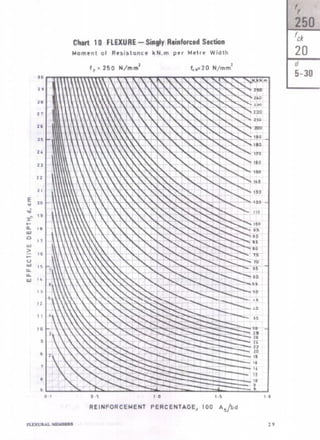
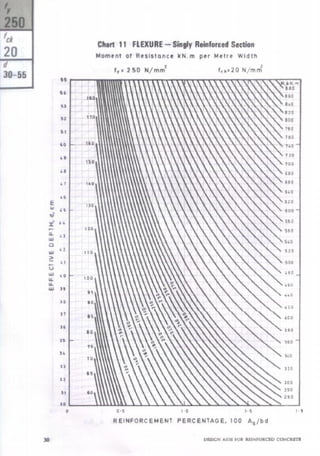
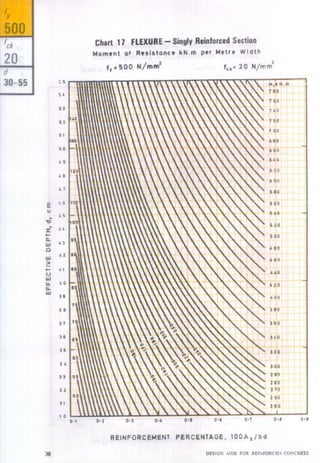
2.3.Z.Z Charts 1 to 28 have been prepared 
by assigning different values to Mu/b and 
plotting d versus pt. The moment values in 
the charts are in units of kN.m per metr$ 
width. Charts are given for three grades of 
steel and, two grades of concrete, namely 
M 15 and M 20, which are most commonly 
used for flexural members. Tables 1 to 4 
cover a wider range, that ‘is, five values of 
fy and four grades of concrete up to M 30. 
In these tables, the values of percentage of 
reinforcement pt have been tabulated against 
Mu/bd2. 
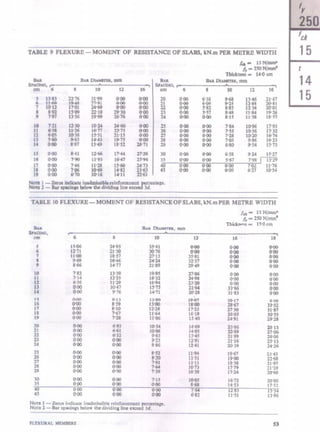
10 DESIGN AIDS FOR WNFORCED CONCRETE
2.3.2.2 The moment of resistance of slabs, 
with bars of different diameters and spacings 
are given in Tables 5 to 44. Tables are given 
for concrete grades M 15 and M 20, with 
two grades of steel. Ten different thicknesses 
ranging from 10 cm to 25 cm, are included. 
These tables take into account 25.5.2.2 
of the Code, that is, the maximum bar 
diameter does not exceed one-eighth the thick-ness 
of the slab. Clear cover for reinforce-ment 
has been taken as 15 mm or the bar 
diameter, whichever is greater [see 25.4.1(d) 
of the Code]. Jn these tables, the zeros at 
the top right hand comer indicate the region 
where the reinforcement percentage would 
exceed pt,lim; and the zeros at the lower 
left hand comer indicate the region where 
the reinforcement is less than the minimum 
according to 25.5.2.1 of the Code. 
Example 1 Singly Reinforced Beam 
Determine the main tension reinforcement 
required for a rectangular beam section 
with the following data: 
Sixe of beam 3ox6Ocm 
Concrete mix M 15 
Characteristic strength 415 N/mm’ 
of reinforcement 
*Factored moment 170 kN.m 
*Assuming 25 mm dia bars with 25 mm 
clear cover, 
Effective depth I 60 - 2.5 -2;- 5625 cm 
From Table D, for fr P 415 N/mm’ and 
fcr-c 15 N/mm* 
MWliUJM’ p 2.07 N/mm: 
v$g$ x (1000)’ 
e; 2.07 x 101 kN/m* 
:. &am - 2.07 x 1O’W 
I 2-07 x 10’ x f3a0 x 
I 1965 kN.m 
$%ua] moment. of. 170 kN.m is less *than 
The sectton 1s therefore to be destgned 
as u’~mm’singrlyei nforced (unde&einforced) 
rectangular section. 
fVfM’HODO F RBFQIRIGNT OFU3XURECHART 
For referring to Chart, we need the value of 
moment per metre width. 
Mu/b-g = 567 kN.m per metre width. 
*The term ‘factored moment’ means the moment 
due to characteristic loads multiplied by the appro-priate 
value of p&rtial safety factor yf. 
Retbrring to C/r& 6, corresponding to 
h&,/b - 567 kN.m and d = 5625 cm, 
Percentage of steel pt - lOMO As= 0.6 
0.6 bd 
.* . A,= -jijiy 
0.6~30~5625 __O1 ,,* 
100 
For referring to Tables, we need the value 
of Mu w 
M” 170 x IO’ 
bd’ - -3m6.25 x 56.25 x IO’ 
I 1.79 N/mm’ 
From Table 1, 
Percentage of reinforcement, pt = 0.594 
0.594 x 30 x 56.25 _ ,omo2 ,,* 
.* . As- 
100 
Example 2 Slab 
Determine the main reinforcement re-quired 
for a slab with the following data: 
Factored moment 9.60 kN.m 
E%etre 
Depth of slab 10 cm 
Concrete mix M 15 
Characteristic strength a) 4 15 N/mm2 
of reinforcement b) 250 N/mm* 
h&l-HODO F REPERRINGTO TABLESF OR SLABS 
Referring to Table 15 (for fy - 415 N/mmz), 
directly we get the following reinforcement 
for a moment of resistance of 9.6 kN.m 
per metre width: 
8 mm dia at 13 cm spacing 
or 10 mm dia at 20 cm spacing 
Reinforcement given in the tables is based 
on a cover of 15 mm or bar diameter which-ever 
is greater. 
MFXHOD OF RFNRRJNG TO FLBXURB CHART 
Assume 10 mm dia bars with 15 mm cover, 
d - 10 - 1.5 - 9 =8cm 
a) For fy = 415 N/mm’ 
From Table D, Mu,tidb# = 2.07 N/mm* 
:. J%lirn - 2.07 x lOa x z x (A)’ 
= 13.25 kN.m ’ _’ 
Actual bending moment of 960 kN.m is less 
than the limiting bending moment. 
FLExuRALmMBERs 11
Referring to Chart 4, reinforcement per-centage, 
pt 6 0.475 
Referring to Chart 90, provide 
8 mm dia at 13 cm spacing 
or 10 mm dia at 20 cm spacing. 
Alternately, 
A, = O-475 x 100 x &J = 3.8 cm* per 
metre width. 
From Table %, we get the same reinforce-ment 
as before. 
b) Forf, = 250 N/mm* 
From Table D, Mu&bd” = 2.24 N/mm2 
M u&m = 2.24 x 10’ x 1 x(h) 
= 14.336 kN.m ‘---’ 
Actual bending moment of 9.6 kN.m is less 
than the limiting bending moment. 
Referring to Chart 2, reinforcement per-centage, 
pt = 0.78 
Referring to Churf PO, provide 10 mm dia 
at 13 cm spacing. 
2.3.2 Doubly Reinforced Sections - Doubly 
reinforced sections are generally adopted 
when the dimensions of the beam have been 
predetermined from other considerations 
and the design moment exceeds the moment 
of resistance of a singly reinforced section. 
The additional moment of resistance needed 
is obtained by providing compression re-inforcement 
and additional tensile reinforce-ment. 
The moment of resistance of a doubly 
reinforced section is thus the sum of the 
limiting moment of resistance Mu,lim of a 
singly reinforced .section and the additional 
moment of resistance Mu,. Given the values 
of Mu which is greater than M”,lim, the value 
of Mu, can be calculated. 
Mu, = Mu - Muslim 
The lever arm for the additional moment of 
resistance is equal to the distance between 
centroids of tension reinforcement and com-pression 
reinforcement, that is (d-d’) where 
d’ is the distance from the extreme compres-sion 
fibre to the centroid of compression 
reinforcement. Therefore, considering the 
moment of resistance due to the additional 
tensile reinforcement and the compression 
reinforcement we get the following: 
Mu, - Asts (0*87f,) (d - a,) 
also, Mu, =&Us-fQC)(d-J’) 
where 
A1t2 is the area of additional tensile rein-forcement, 
AK is the area of compression reinforce-ment, 
I= is the stress in compression reinforce-ment, 
and 
fee is the compressive stress in concrete at 
the level of the centroid of compres-sion 
reinforcement. 
Since the additional tensile force is balanced 
by the additional compressive force, 
A, (l;c - fee) = At, (0*87&j 
Any two of the above three equations may 
be used for finding Alt, and A,. The total 
tensile reinforcement Ast is given by, 
Ast = Pblim mb d$ Asc, 
It will be noticed that we need the values of 
frc and J& before we can calculate Al. 
The approach, given here is meant for design 
of sections and not for analysing a given 
section. The depth of neutral axis is, therefore, 
taken as equal to x,,,-. As shown in Fig. 5, 
strain at the level of the compression reinforce-ment 
will be equal to O-003 5 
( 
d’ 1- - 
XU,UW>Z 
12 
STRAIN OlAGRkM 
FIG. 5 DOUBLY REINKIRCED SECI-ION 
DESIGN AIDS FOR REINFORCED CONCRIXE
For values of d’/d up to 0.2, feei se qual to 
0446 fck; and for mild steel reinforcement 
fz would be equal to the design yield stress 
of 0.87 fY. When the reinforcement is cold-worked 
bars, the design stress in compression 
reinforcement fw for different values of 
d’/d up to 0.2 will be as given in Table F. 
TABLE F STRESS IN COMPRESSION 
REINFORCEMENT ftc, N/mm* IN DOUBLY 
REINFORCED BEAMS WITH COLD-WORKED 
BARS 
(Clause 2.3 2) 
f Y9 
N/mm’ 
415 
500 
d’ld 
-A , 
0.0s 0.10 O-15 0.20 
355 353 342 329 
424 412 395 370 
2.3.2.2 Astz has been plotted against (d -d’) 
for different values of MU, in Charts 19 and 
20. These charts have been prepared for 
fs = 217.5 N/mm2 and it is directly appli-cable. 
for mild steel reinforcement with yield 
stress of 250 N/mm*. Values of Aat? for other 
grades of steel and also the values of A, can 
be obtained by multiplying the value read 
from the chart by the factors given in Table G. 
The multiplying factors for A=, given in 
this Table, are based on a value of fee corres-ponding 
to concrete grade M20, but it can 
be used for all grades of concrete with little 
error. 
TABLE G MULTIPLYING FACTORS FOR 
USE WITH CHARTS 19 AND 20 
‘Clause 2.3.2.1) 
f 
N&P 
FACTOR FACTOR FOR A, FOR d’jd 
FOR 
A 
c-- 
at* 0.05 0.10 0.15 0.2 
250 1.00 1.04 1.04 1.04 1.04 
415 0.60 0.63 0.63 0.65 0.68 
500 0.50 0.52 0.54 0.56 0.60 
2.3.2.2 The expression for the moment of 
resistance of a doubly reinforced section may 
also be written in the following manner: 
Mu = Mu,lim + %(0*87fy) (d-d’) 
Mu Mu,lim 
bj2 = ___b d” + -&(0*87f,)( I- ;> 
where 
ptz is the additional percentage of tensile 
reinforcement. 
Pt = phlim + pt2 
PC =P”[-L-] 
The values of pt and pc for four values of 
d’jd up to 0.2 have been tabulated against 
MU/bd2 in Tables 45 to 56. Tables are given 
for three grades of steel and four grades 
of concrete. 
Example 3 Doubly Reinforced Beam 
Determine the main reinforcements re-quired 
for a rectangular beam section with 
the following data: 
Size of beam 30 x 6Ocm 
Concrete mix M 15 
Characteristic strength of 415 N/mm2 
reinforcement 
Factored moment 320 kN.m 
Assuming 25 mm dia bars with 25 mm 
clear cover, 
d = fj0 - 2.5 - 225 = 56*25 cm 
From Table D, for fy = 415 N/mm2 and 
f ck = 15 N/mm2 
Mu,linJbd”=2.07 N/mm2 = 2.07 x IO2 kN/m” 
.*. Mu,lim -2.07 x 10³ bd2 
30 56.25 56.25 
-2.07 x 10” x loo x Ts- x -100- 
= 196.5 kN.m 
Actual moment of 320 kN.m is greater 
than Mu,lim 
.* . The section is to be designed as a doubly 
reinforced section. 
Reinforcement from Tables 
Mu 320 
$$ = O-562 5)2 x 10³~~~~~ N/mm2 
d’/d c 2.5 + 1.25 i o,07 
5625 > 
Next higher value of d’/d = 0.1 will be used 
for referring to Tables. 
Referring to Table 49 corresponding to 
MU/bd2 = 3.37 and $ = 0.1, 
Pt = 1.117, pc = 0.418 
. 
. . At - 18.85 cm2, A, = 7.05 cm2 
REINFORCEMENT FROM CHARTS 
(d-d’) = (56.25 - 3.75) - 52.5 cm 
Mu2 - (320 - 196.5) = 123.5 kN.m 
Chart is given only for fy = 250 N/mm2; 
therefore use Chart 20 and modification 
factors according to Table G. 
Referring to Chart 20, 
Art2 (for fY = 250 N/mm2) = 10.7 cm2 
FLEXURAL MEMBERS 13
usia Jl¶odibrion factors given in 
for B Y = 415 N/nuns, 
I& - 10.7 x 0.60 r! 6-42 cm* 
,& I 10.7 x 0.63 = 674cm’ 
Referring to ruble E, 
Table G 
pt,nm - 072 
* Ast,u,n -0.72 .x 
5625 x 30 
. . ,oo - 1215cm’ 
A*: E 12.15 + 642 = 18.57 cm’ 
These values of At and AE are comparable 
to the values obtained from the table. 
2.4 T-SECTIONS 
The moment of resistancoef a T-beam can 
be considered as the sum of the moment of 
resistance of the concrete in the web of width 
b, and the contribution due to ,flanges of 
width br. 
The maximum moment of resistance is ob-tained 
when the depth of neutral axis is x,,,~. 
When the thickness of flange is small, 
that is, less than about 0.2 d, the stress in the 
flange will be uniform or nearly uniform 
(see Fig. 6) and the centroid of the compres-sive 
force in the flange can be taken at Df/2 
from the extreme compression fibre. There-fore, 
the following expression is obtained for 
the limiting moment of resistance of T-beams 
with small values of Dfjd. 
x(br-bw)h( d-$) 
where Mll,llltniiveb 
30.36 fd bwxu,,,(,d.-xO .416 x0,,,,&. 
The equation given in E-2.2 of the code is the 
same as above, with the numericals rounded 
off to two decimals. When the flange thick-, 
ness is greater than about 0.2 d, the above 
expression is not corre4zt because the stress 
distribution in the flanp would not be uni-form. 
The expression Bven in E-22.1 of the 
Code is an approximation which makes allo-wance 
for the variation of stress in the flange. 
This expression is obtained by substitutin# 
JY for &in the equation of E-2.2 of the CO& 
yf being equal to (0.15 X,,m& + 065 or) 
but not greater than Dr. With this m&&a-tion, 
M udin~~T 9 Mu,lirn,web f 0446 f& 
Mr-WY+ - f ) 
Dividing both sides by&k bw P, 
x(& l)$(l+$) 
where 
xu;= + 0.65 !$ 
but .f < $ 
Using the above expression, the ~2: 
of the moment of resistance 
M u,lim,T~ck b,# for different values of h/b* 
and &/d have been worked out and given in 
Tables 57 to 59 for three grades of steel. 
2.5 CONTROL OF DEFLECTION 
2.5.2 The deffection of beams and slabs 
would generally be, within permissible limits 
if the ratio of span to effective depth of the 
member does not exceed the values obtained 
in accordance with 22.2.1 of the Code. The 
following basic values of span to effective 
depth are given: 
En!;;;Eorted 
20 
Cantilever 
“4 
0.0. 
047 f” 
-* 0.002 
0.87 f, 
-_b E, 
STRAIN DIAGRAM STRESS DIAORAM 
ho. 6 T-SECTION 
14 DBSIGN AIDS FOR REINPORCED CDNCRETE
Further modifying factors are given in 
order to account for the effects of grade and 
percentage of tension reinforcement and 
percentage of compression reinforcement. 
2.5.2 In normal designs where the reinforce-ment 
provided is equal to that required from 
strength considerations, the basic values of 
span to effective depth can be multiplied by 
the appropriate values of the modifying 
factors and given in a form suitable for direct 
reference. Such charts have been prepared 
as explained below : 
4 
b) 
The basic span to effective depth ratio 
for simply supported members is multi-plied 
by the modifying factor for ten-sion 
reinforcement (Fig. 3 of the Code) 
and plotted as the base curve in the 
chart. A separate chart is drawn for 
each grade of steel. In the chart, span 
to effective depth ratio is plotted on 
the vertical axis and the tensile 
reinforcement percentage is dotted on 
the horizontal axis. 
When the tensile reinforcement ex- 
.ceeds ~I,II,,, the section will be doubly 
reinforced. The percentage of compres-sion 
reinforcement is proportional to 
the additional tensile reinforcement 
@t - PM,,) as explained in 2.3.2. 
However, the value of Pt,lim and pc 
will depend on the grade of concrete 
also. Therefore, the values of span to 
effective depth ratio according to base 
curve is modified as follows for each 
grade of concrete: 
1) 
2) 
3) 
For values of pt greater than 
the appropriate value of pt,lim, 
the value of (pt - pt,lim) is cal-culated 
and then the percentage of 
compression reinforcement p= re-quired 
is calculated. Thus, the 
value of pc corresponding to a value 
of pt is obtained. (For this purpose 
d’/d has been assumed as 0.10 but 
the chart, thus obtained can gene-rally 
be used for all values of d’/d 
in the normal range, without signi-ficant 
error in the value of maximum 
span to effective depth ratio.) 
The value of span to effective depth 
ratio of the base curve is multiplied 
by the modifying factor for com-pression 
reinforcement from Fig. 4 
of the Code. 
The value obtained above is plotted 
on the same Chart in which the base 
curve was drawn earlier. Hence 
the span to effective depth ratio for 
doubly reinforced section is plotted 
against the tensile reinforcement 
percentage pt without specifically 
indicating the value of pc on the 
Chart. 
25.3 The values read from these Charts 
are directly applicable for simply supported 
members of rectangular cross section for 
spans up to 10 m. For simply supported or 
continuous spans larger than 10 m, the values 
should be further multiplied by the factor 
(lo/span in me&es). For continuous spans 
or cantilevers, the values read from the charts 
are to be modified in proportion to the basic 
values of span to effective depth ratio. The 
tn.l~G$ing factors for this purpose are as 
.. 
conned; spans 
& 
In the case of cantilevers which are longer 
than 10 m the Code recommends that the 
deflections should be calculated in order to 
ensure that they do. not exceed permissible 
limits. 
2.54 For flanged beams, the Code recom-mends 
that the values of span to effective 
depth ratios may be determined as for rectan- 
Eoeons, subject to the followmg modi- 
.. 
4 
b) 
The reinforcement percentage should 
be,bcz&zm the area brd while referrmg 
The value of span to effective depth 
ratio obtained as explained earlier 
should be reduced by multiplying by the 
following factors: 
b&v Factor 
>:::3 
For intermediate values, linear interpola-tion 
may be done. 
Nom --The above method for flanged beams 
alay sometimes give anomalous mwlts. If the fhges 
arc ignored and the beam is considered as a rectangular 
section, the value of span to effective depth ratio thus 
obtained (percen 
Y 
of rciaforcemcnt being based 
on the area l&) s ould always be oa the safe side. 
2.5.5 In the case of tw way slabs supported 
on all four sides, the s P orter span should be 
considered for the purpose of calculating the 
span to effective depth ratio (see Note 1 below 
23.2 of the Code). 
2.5.6 In the case of flat slabs the longer span 
should be considered (30.2.2 of the Code). 
When drop panels conforming to 30.2.2 of 
the Code are not provided, the values of span 
to effective depth ratio obtained from the 
Charts should be multiplied by 0.9. 
Example 4 Control of Deflection 
Check whether the depth of the member 
in the following cases is adequate for control-ling 
deflection : 
a) Beam of Example 1, as a simply suppor-ted 
beam over a span of 7.5 m 
FLBXURAL MEMBERS 15
b) 
Cl 
Beam of Example 3, as a cantilever beam 
over a span of 4.0 m 
Slab .of Example 2, as a continuous 
slab spanning in two directions the 
shorter and longer spans being, 2.5 m 
and 3.5 m respectively. The moment 
given in Example 2 corresponds to 
shorter spa’n. 
Actual ratio of Span 
a> 
Eflective depth 
= (56.;5;,oo) = 13.33 
Percentage of tension reinforcement 
required, 
pt = 0.6 
Referring to Char1 22, value of Max 
Span 
T 
( > 
corresponding to Pt = 0.6, is 22.2. 
Actual ratio of span to effective depth is less 
than the allowable value. Hence the depth 
provided is adequate for controlling deflec-tion. 
b) Actual ratio of Span 
Etfective depth 
‘(d&J = 7.11 
Percentage of tensile reinforcement, 
pr = 1.117 
Referring to Churl 22, 
Max value of %!a? = 21.0 
( 1 Cl 
For cantilevers, values read from the 
Chart are to be multiplied by 0.35. 
:. Max value of 1 
I/d for ) =21.0x0*35=7.35 
cantilever J 
.* . The section is satisfactory for control 
of deflection. 
c) Actual ratio of Span 
Effective depth 
=-=2 .5 31.25 
0.08 
(for slabs spanning in two directions, 
the shorter of the two is to be con-sidered) 
(i) Forfv = 415 N/mm2 
pt = 0,475 
Referring to Chart 22, 
Max Span = 23.6 
(-> d 
For continuous slabs the factor 
obtained from the Chart should be 
multiplied by 1.3. 
:. Max “7 for continuous slab 
= 23.6 x 1.3 F 30.68 
Actual ratio of span to effective depth is 
slightly greater than the allowable. Therefore 
the section may be slightly modified or actual 
deflection calculations may be made to as-certain 
whether it is within permissible limits. 
(ii) F0r.j; = 250 N/mm2 
pt = 0.78 
Referring to Chart 21, 
Max Span = 31.3 
(-1 d 
:. For continuous slab, 
Max %% = 31.3 x 1.3 
d 
= 40.69 
Actual ratio of span to effective depth is 
less than the allowable value. Hence the 
section provided is adequate for controlling 
deflection. 
16 DESIGN AIDS FOR REINFORCED CONCRETE
As in the Original Standard, this Page is Intentionally Left Blank
TABLE 1 FLEXURE - REINFORCEMENT PERCENTAGE, pc FOR SINGLY 
REINFORCED SECTIONS 
N/mm= b 
E 
040 
O-45 
O-50 
1.10 
l-12 
l-14 
l-16 
l-18 
1.20 
1.22 
::z 
l-28 
1.30 
l-32 
1.34 
I:: 
250 415 480 
0.141 Oa5 0.074 
O-166 @lOO OQ86 
8.’ E 8.’ ::; o&E 
Q240 O-144 O-125 
O-276 
O-302 
O-329 
O-356 
O-383 
O-265 
0.290 
E 
O-368 
0.159 
0.175 
i-E 
Oh 
0.138 
0.151 
0.164 
O-178 
0’191 
0.410 
O-421 
0.433 
IZ 
O-394 O-237 Q-205 
O-405 0.244 0.211 
O-415 O-250 O-216 
O-426 O-257 o-222 
O-437 0’263 O-227 
8::;; 
0489 
O-500 
O-512 
0448 O-270 
O-458 0.276 
0469 0283 
0.480 O-289 
0.491 0.2% 
0.523 
O-535 
0.546 
0.558 
O-570 
O-502 
0.513 
0.524 
8:::; 
0.303 
EJ 
O-323 
O-329 
0.262 
o-267 
O-273 
O-279 
O-285 
O-581 
0393 
@605 
8.’ :;; 
0.558 
0370 
0.581 
0.592 
O-604 
Ei 
O-350 
O-357 
O-364 
O-291 
O-297 
O-303 
O-309 
O-315 
0.641 O-615 0.371 0.321 
0.653 0.627 0.378 0.327 
O-665 O-639 0.385 0.333 
O-678 O-650 0.392 O-339 
O-690 O-662 O-399 O-345 
8E I:G 
O-727 O-698 
O-740 O-710 
0.752 O-722 
0.765 
O-778 
x:z 
0.816 
O-734 
o-747 
0.759 
0.771 
O-784 
0442 
X:t:Y 
O-465 
0.472 
O-382 
O-389 
0.395 
x:z 
0993 
l-007 
1*021 
1935 
l-049 
l-136 
l-151 
l-166 
1.181 
l-197 
l-212 
1228 
1,243 
1.259 
1.275 
i’ . 
O-503 
O-510 
O-398 
i;: 
0.423 
O-518 
O-526 
8:Z 
0’550 
O-448 
0.455 
O-461 
0468 
O-475 
O-430 
O-436 
O-443 
8::: 
0.558 0482 o-463 
O-566 0489 O-469 
0’574 0.496 O-476 
O-582 0’503 0483 
O-590 o-510 0.490 
O-517 
0.525 
O-532 
0.539 
0.546 
O-497 
o”:?i 
0.518 
0.525 
0554 
0.561 
0.569 
O-576 
O-584 
O-532 
0.539 
0.685 
O-693 
O-703 
0.712 
O-592 
fY 
240 
250 
415 
480 
500 : 
7 ck 
25 
NOTE -Blanks indicate inadmissible reinforcement percentage (see Table E). 
FLeXURAL MEMBERS
240 
250 
415 
480 
f ck 
20 
-- 
TABLE 2 FLEXURE -REINFORCEMENT PERCENTAGE, pt FOR SINGLY 
REINFORCED ‘SECTIONS 
l-05 0.538 
1.10 O-566 
1’15 
OO’E 
:‘.z O*- 650 
E 
O-678 
O-707 
E 0.736 
O-765 
l-50 0.795 
1.55 O-825 
;:g 8.$ ;: 
l-70 O-916 
l-75 0947 
l-80 
I-85 %*! 
E 
1’041 
1.073 
200 lm6 
3g 
l-119 
E 
:::z 
l-159 
210 l-172 
f’:: 
l-185 
. 1*199 
f’.: ; :‘.E 
220 l-239 
“0% 
O-188 
O-213 
O-237 
0.517 
O-543 
0.570 
0.597 
@624 
O-651 
O-679 
0.707 
0.735 
0’763 
O-073 
Efl 
0.111 
0’123 
izi! 
F. EJ 
O-131 
O-143 
XE 
O-181 
O-201 
::E 
0.242 
0.255 
O-193 
Ffg 
O-245 
::a:; 
O-297 
O-311 
0’325 
0.258 
8:;:; 
0.298 
0312 
0.339 
O-354 
E.L ! 
0397 
X:E ;:gj 
O-521 0.500 
o-537 O-515 
0.553 o-531 
0.537 
0’543 
O-550 
O-556 
O-562 
f& - zO.N/m' 
1.253 
:‘26: 
1% 
LOZ 
l-323 
E 
:‘.: z 
:‘.z 
l-423 
l-438 
l-452 
l-203 
l-216 
:z 
1.256 
l-338 
l-352 
1966 
1380 
1’394 
1467 
1~482 
l-497 
:::;; 
1.542 1481 
l-558 1’495 
::z :::1’: 
l-604 l-540 
1.782 
:‘.E 
l-833 
1.632 
l-647 
l-663 
_g. ;; 
l-711 
:‘.% 
l-760 
O-627 
O-633 
I:: 
0.661 
pj 
. 
O-690 
o-697 
0.704 
o-711 
o-719 
O-726 
O-734 
O-741 
O-748 
0.756 
0.764 
x.’ % 
O-615 
0.621 
0.628 
O-635 
xzz 
0.655 
0.662 
Num -Blanks lndk$tei nadmissiblere inforcemenptc mntagc (see Table J% 
48 DESIGNA IDS FOR REINFORCEDC GNCRRI’E
TABLE 3 FLEXURE - REINFORCEMENT PERCENTAGE, pt FOR SINGLY 
REINFORCED SECTIONs 
/ck = 25 N/mms 
0.30 
0.35 
g 
0.146 
O-171 
O-195 
:z 
O-271 
O-296 
0?321 
O-347 
O-373 
0.80 
O-85 
8C 
lfl0 
0.399 
t-I.425 
0.451 
O-477 
O-504 
l-05 
1.10 
1.15 
::z 
O-530 
8% 
O-611 
O-638 
l-30 
l-35 
:z 
1.50 
0.666 
0.693 
0.721 
0.749 
O-777 
1.80 0.949 
l-83 0979 
1.90 l-009 
1.95 l-038 
2-00 1,068 
2-05 
210 
2.15 
$12”: 
:z 
l-160 
l-191 
1.222 
l-254 
13283 
l-317 
l-350 
l-382 
250 415 480 500. 
0.140 0.084 
0.164 O-099 
0188 0.113 
O-211 Of27 
0.236 O-142 
O-070 
:%z 
O-106 
O-118 
O-260 
!% 
0.333 
O-358 
O-156 
0.171 
0.186 
O-201 
O-216 
0.130 
0.142 
O-154 
0167 
0.179 
0231 
X% 
0.276 
O-291 
0191 
O-204 
0.216 
0229 
O-242 
0.509 
6535 
O-561 
z-.; ;: 
0.307 
O-322 
0.338 
0353 
0.369 
0.255 
0.267 
0.280 
0.293 
0.306 
0.639 
X:% 
@719 
0.746 
o-773 
8::: 
0.856 
O-883 
O-385 
O-401 
w417 
0.433 
O-449 
0.333 
0.347 
8% 
O-388 
0.320 
O-333 
0.346 
O-359 
0373 
O-466 
O-482 
0.499 
0.515 
O-532 
0403 
x:::: 
8:% 
O-387 
x%Y 
0.428 
O-442 
O-911 
O-940 
0968 
Y.Z 
O-549 
O-566 
O-583 
O-601 
O-618 
O-415 
O-489 
fj:$ 
0.456 
0.470 
0.484 
O-498 
o-513 
1.055 
: :% 
l-143 
1.173 
O-635 
O-653 
0.671 
0.689 
O-707 
8% 
O-580 
0.596 
0.611 
O-527 
0542 
O-557 
O-572 
0.587 
l-204 
l-234 
l-265 
: :% 
0.725 
O-743 
0.762 
0781 
o-799 
O-627 
O-643 
ZR 
O-691 
O-602 
0.617 
O-632 
0.648 
0.663 
Mlw2, fu, N/mm2 
L 
N/mms 7’ 
--Y 
250 415 500 
1.415 1.358 
1448 l-390 
1482 l-422 
1.515 l-455 
l-549 1487 
% 
290 
2-95 
3.00 
l-584 
1.618 
1.653 
l-689 
l-724 
3.05 
3.10 
3.15 
:::: 
l-760 
1.797 
1.834 
l-871 
1909 
33% 
:::t 
3-38 
1.947 l-869 
l-962 l-884 
l-978 l-899 
1993 l-914 
2QO9 l-929 
2.025 l-944 
Z:% :‘z. c 
2.072 l-989 
2-088 2.005 
2.104 
2.120 
z::: 
2.170 
3.60 
3.62 
::z 
3.68 
2.186 
2.203 
2.219 
;:22:; 
3.70 2.270 
3-72 2.287 
3.74 2.304 
NOTE- Blanks indicate inadmissible reinforcement percentage (see Table E). 
l-520 
:::z 
l-621 
l-655 
::% 
l-760 
l-796 
1.832 
2.099 
2.115 
2.131 
2.147 
2.163 
2.179 
2196 
O-818 
0.837 
::::z 
O-896 
::;:z 
O-956 
o-977 
0.997 
1.018 
1.039 
l-061 
l-082 
1.104 
::::; 
:::z 
1.162 
O-679 
:z: 
O-727 
O-744 
8% 
O-794 
O-811 
0.828 
0.845 
O-863 
0.880 
0.898 
O-916 
0.935 
0942 
fY 
240 
250 
4'15 
480 
500 
7 ck 
25 
m3xuRAL MEMBERS 49
'Y 
240 
250 
415 
480 
500 
f ck 
30 
TABLE 4 FLEXURE - REINFORCEMENT PERCENTAGE, pi FOR SINGLY 
REINFORCED SECTIONS 
250 500 
0.140 
8’.: :; 
@211 
0235 
0380 
0405 
0.429 
0.454 
0.479 
0.525 
0552 
0.578 
x.’z 
~~i?i 
0.712 
0739 
0.766 
@631 
x::: 
0.709 
0’735 
8’;1;: 
oi49 
x:zi 
0.762 
0.788 
xz:: 
0.868 
0.932 0.895 
0961 0.922 
0.989 0.950 
1.018 0977 
1946 1.005 
1.075 
:x. 
1.163 
1.192 
1’173 
::i!f 
1.260 
1289 
MUW, A. N/mm2 
N/mm2 r240 
* -7 
250 415 480 500 
0.070 
0.082 
0.093 
0.105 
0.117 
255 1.374 1.319 
fZ ::zi ::zi 
270 1467 1.408 
275 1.498 1.438 
c8”: 
tz 
3.00 
3.05 
3.10 
3.15 
33:g 
0.252 
0.265 
Ct.277 
0.290 
0.303 
3.30 1.859 
3.35 1.893 
:z zi 
3.50 1998 
0316 
xz 
0.355 
0.368 
3.55 
3.60 
3.65 
3.70 
3.75 
@381 3.80 
0.394 3.85 
x:z it:z 
0.434 4.00 
oo:z 
0.475 
0488 
0502 
fd = 30 N/mm2 
1.530 
1.562 
1.594 
1.626 
1.659 
~~~ 
1.530 
1.561 
1.592 
1.691 1.624 
1.725 1.656 
1.758 1.687 
1.791 1.720 
1.825 1.752 
1.785 1.075 0.930 
1.818 1.095 0.947 
1.851 1.115 0.964 
I.884 1.135 0.981 
1.918 1.156 0.999 
2z 
2105 
2.142 
2.178 
1.952 l-176 
1.986 1.197 
2021 1.218 
2056 1.239 
2091 1.260 
2215 
2253 
2291 
2329 
2367 
f:iz i::z 
2485 2386 
2.525 2.424 
2566 2463 
NOTE- Blanksi ndicatei nadmissiblree inforcemenpty ceniage( see TableE ). 
0.794 @687 
0.812 0.702 
0.830 0.718 
0.848 0.733 
0.866 0.749 
is; 
0.797 
0813 
0.829 
0.978 
zz3 
1.036 
1.055 
0.846 0.812 
0.862 0.828 
0.879 0.844 
0.896 0.860 
0.913 0.876 
KG; 
1.053 
1.071 
1.089 
1.281 
1.303 
1.325 
1.347 
1.369 
1.108 
:‘.: z 
1.164 
1.184 
1.391 
1.414 
0.734 
0.750 
0.765 
0.781 
0.796 
0976 zf : 1.028 
1.046 
KS 
1.099 
1.118 
so DESIGN AIDS FOR REmFORCJiD CONCREIB
As in the Original Standard, this Page is Intentionally Left Blank
3. COMPRESSION MEMBERS 
3.1 A$MU;,OADED COMPRESSION lower sectioqs would eliminate tho need for 
any calculation. This is particularly useful 
All compression members arc to be designed 
as an aid for deciding the sizes of columns 
at the preliminary design stage of multi-for 
a minimum eccentricity of load in two 
oribcioal directions. Clause 24.4 of the Code 
sforeyed buildings. 
I specifiks the following minimum eccentri-city, 
emin for the design of columns: Example 5 Axially Loaded Column 
1 
emin=ggg i-D 3o subject to a minimum of 
Determine the cross section and the 
reinforcement required for an axially loaded 
2 cm. columc with the following data: 
where 
Factored load 
Concrete grade 
Characteristic strength of 
reinforcement 
3000kN 
M20 
415 N/mm’ 
1 is the unsupported length of the column 
(see 24.1.3 of the Code for definition of 
unsupported length), and 
D is the lateral dimension of the column 
in the direction under consideration. 
Unyoyior;d length of 3.0 m 
After determining the eccentricity, the section 
should be designed for combined axial load 
and bending (see 3.2). However, as a simplifi-cation, 
when the value of the mininium 
eccentricity calculated as above is less than or 
equal to 0*05D, 38.3 of the Code permits 
the design of short axially loaded compression 
members by the following equation: 
P,=@4f,k AC-i-0.67 fY Ar 
The cross-sectional dimensions required will 
depend on the percentage of reinforcement. 
Assuming 1.0 percent reinforcement and 
referring to Chart 25, 
Required cross-sectional area of column, 
A, - 2 700 cm* 
Provide a section of 60 x 45 cm. 
Area of reinforcement, A, - 1.0 x m~$,j2 
where 1: 27 cm8 
PU is the axial load (ultimate), 
A, is the area of concrete, and 
Asc is the afea of reinforcement. 
The above equation can be written as 
We have to check whether the minimum 
eccentricity to be considered is within 0.05 
times the lateral dimensions of the column. 
In the direction of longer dimension, 
I D 
&in - -- 
P” = 0.4 f& 500 +30 PA, A, - +$) t- 0.67fy loo 
where 
As is the gross area of cross section, and 
p is the percentage of reinforcement. 
Dividing both sides by A,, 
PU = @4&( 1 - j&) +“‘67fy $j 
Charts 24 to 26 can be used for designing 
short columns in accordance with the above 
equations. In the lower section of these 
charts, P./A, has been plotted against 
reinforcement percentage p for different 
grades of concrete. If the cross section of 
the column is known, PU/Al can be calculated 
and the reinforcement percentage read from 
the chart. In the upper section of the charts, 
PU/As is plotted against PU for various values 
of AS. The combined use of the upper and 
= 3*0x 102 60 
500 
+ jg P 0.6 j-2.0 - 2.6 cm 
or, e&D = 26160 = O-043 
In the direction of the shorter dimension, 
emrn = 3.0 x 10² 500 + 45 
30 = 0.6 + 1.5 
= 2.1 cm 
or, e,i,/b = 2*1/45 = @047 
The minimum eccentricity ratio is less than 
@05 in both directions. Hence the design of 
the section by the simplified method of 38.3 
of the Code is valid. 
3.2 COMBINED AXIAL LOAD AND 
UNIAXIAL BENDING 
As already mentioned in 3.1, all com-pression 
members should be designed for 
COMPRESSION MEMBERS 99
minimum eccentricity of load. It should 
alwaysbe ensuredthat the scotionis designed 
for a moment whichis not lessthan that due 
to the prescribedtinimum eccentricity. 
3.2.1 Amanptio&Assumptiom (a), (c), 
(d) and (e) for flexural members (see 2.1) 
are also applicable to members subjcoted 
to combined axial load and bending. ‘The 
assumption (b) that the maximum strain 
in concrete at the outermost eom ression 
fibre is 04N35 is also applicablewi en the 
neutralaxis k withinthe seotionand in the 
limitingcase when the neutralaxis lies along 
one edge of the section; in the latter oasc 
the strain varies from 0@035 at the highly 
compressed edge to zero at the opposik 
ed~. For purely axial compression, the 
strain is assumed to be uniformly equal 
00002 acxossthe seotion[see 38.l(a) of the 
Code]. The strairidistributionlines for these 
~’ oases intersecteaeh other at a depth of 
~ffom the highly compressed edge. This 
point is assumedto act as a fulcrum for the 
strain distribution line when the neutral 
axis lies outsidethe motion(see Fig. 7). This 
leads to the assumption that the strain at 
the highly compresseded~ is 00035 minus 
0?5 times the strain at the leastcompressed 
edge [see 38.Z(b) of the Cole], 
: 1 
“-i t- - ---1-” 
I 
l J: IHIWilmY 
l ‘* l 
I 
l 
* 
l 
l i 
l 
l 
c 
b 
l : 
0 0 
I I 
! 
* l 
t 
l 00 EOOE 
C6MPRE SSE II 
CENTRO13AL AXIS 
+’+ ikhROW OF REINFORCEMENT 
STRAIN DIAGRAMS 
0035 
Neutral axis 
wlthln the scctlon 
-30/7 
-1 
-— ----- Neutral axis 
outside the sect ion 
FIG. 7 Cmramm Am- LOAD AND UNIAXIAL BENDING 
No DESIGNAIDSIK)RREINFORCEDCONCR81E
3.2.2 Stress Block Parameters Wh&n the Area of stress block 
Neutral Ax& Lies O&side the Section - When 
the neutral axis lies outside the section, - 0446f,D-5 
g 4 
the shape of the stress block will be as. indi- 
,-D 
( > 
cated in Fig. 8. The stress is uniformly 
0446fd for a distance of Ly from the highly 
= 04461&D +gD 
compressed edge because the strain is more - 0446fdr D 
than 0402 and thereafter the stress diagram [l-&&J] 
is parabolic. 
The centroid of the stress block will be 
found by taking moments about the highly 
compressed edge. 
Moment about the highly compressed edge 
pO1446fckD (Di 1 -$ gD 
t 
i 
The position of the centroid is obtained by 
dividing the moment by the area. For diier-ent 
values of k, the area of stress block and 
STRAIN DIAORAM the position of its centroid are given in 
Table H. 
O-446 1, 
BTRESS OIAORAW 
FIG. 8 STRBSSB LOCK WHEN THE NEUTRAL 
Am h¶ oUT?3IDE THE SECTION 
Let x0- kD and let g be the ditference 
between the strxs at the highly compressed 
edgo and the stress at the least compressed 
edge. Considering the geometric properties 
of a parabola, 
-o+Mf& & 
( 1 
1 
TABLE H STRESS BLOCK PARAhUTTERS 
WHEN THE NETmmtA&mA?LNI ES OUTSIDE 
(Clause 3.2.2) 
Nom-Values of stress block parametersh ave 
been tabulatedf or valueso f k upt o 4’00f or infom-tion 
only. For construction of interaction d@cams 
it b merally adaquatat o considerv alues of k up to 
about 1.2. 
33.3 Construction of Interaction Diagram - 
Design charts for combined axial compression 
and bending are given in the form of inter-action 
diagmms in which curyes for PJbDfd 
versus MdbD* fb are plotted for different 
values of p/f&, where p is the reinforcement 
percentage. 
COMPRESSlON MEMBERS 101
3.2.3.2 For the case of purely axial com-pression, 
the points plotted on the y-axis 
of the charts are obtained as follows: 
P,= 0446f,rbd + ‘g (A - 0.446 fek) 
where 
fr is the compressive stress in steel corres-ponding 
to a strain of 0.002. 
The second term within parenthesis repre-sents 
the deduction for the concrete replaced 
by the reinforcement bars. This term is 
usually neglected for convenience. However, 
a9 a better approximation, a constant value 
corresponding to concrete grade M20 has 
been used in the present work so that the 
error is negligibly small over ;he range of 
concrete mixes normally used. An accurate 
consideration of this term will necessitate 
the preparation of separate Charts for each 
grade of concrete, which is not considered 
worthwhile. 
3.2.3.2 When bending moments are also 
acting in addition to axial load, the points 
for plotting the Charts are obtained by 
assuming different positions of neutral axis. 
For each position of neutral axis, the strain 
distribution across the section and the 
stress block parameters are determined as 
explained earlier. The stresses in the rein-forcement 
are also calculated from the 
known strains. Thereafter the resultant axial 
force and the moment about the centroid 
of the section are calculated as follows: 
a) When the neutral axis lies outside the 
section 
li 
where 
Cl - 
Pi - 
i-1 
coefficient for the 
block to be taken 
(see 3.2.2); 
area of stress 
from Table H 
Ad 
bx where A,i is the area of rein-forcement 
in the ith row; 
fii - stress in the ith row of reinform 
fci - 
n - 
102 
ment, compression being positive 
and tension being negative; 
stress in concrete at the level of 
the ith row of reinforcement; and 
number of rows of reinforcement. 
The above expression can be written as 
n 
Taking moment of the forces about the 
centroid of the section, 
+ x g (.Ai - fci).Yi 
where 
i- 1 
C,D is the distance of the centroid of the 
concrete stress block, measured from 
the highly compressed edge; and 
Yi is the distance from the centroid of the 
section to the ith row of reinforce-ment; 
positive towards the highly 
compressed edge and negative to-wards 
the least compressed edge. 
Dividing both sides of the equation by 
fck bD”, 
c, (O-5-Cd 
n 
+X*(&i -&i)(s) 
i- 1 
b) When the neutral axis lies within the 
section 
In this case, the stress block parameters 
are simpler and they can be directly incorpora-ted 
into the expressions which are otherwise 
same as for the earlier case. Thus we get the 
following r;xpressions: 
=@36k+ c &j&&d 
i-1 
n 
where 
k- Depth of neutral axis 
D 
DESIGN AIDS FOR REINFORCED CONCRETE
An approximation is made for the value 
Offci for M20, as in the case of 3.2.3.1. For 
circular sections the procedure is same as 
above, except that the stress block para-meters 
given earlier are not applicable; 
hence the section is divided into strips and 
summation is done for determining the 
forces and moments due to the stresses in 
concrete. 
3.2.3.3 Chartsfor compression with bending - 
Charts for rectangular sections have been 
given for reinforcement on two sides (Charts 
27 to 38) and for reinforcement on four 
sides (Charts 39 to 50). The Charts for the 
latter case have been prepared for a section 
with 20 bars equally distributed on all sides, 
but they can be used without significant. 
error for any other number of bars (greater 
than 8) provided the bars are distributed 
equally on the four sides. The Charts for 
circular section (Charts 51 to 62) have been 
prepared for a section with 8 bars, but they 
can generally be used for sections with any 
number of bars but not less than 6. Charts 
have been given for three grades of steel 
and four values of d’/D for each case men-tioned 
above. 
The dotted lines in these charts indicate 
the stress in the bars nearest to the tension 
face of the member. The line for fs, I; 0 
indicates that the neutral axis lies along the 
outermost row of reinforcement. For points 
lying above this line on the Chart, all the 
bars in the section will be in compression. 
The line for fSt = fYd indicates that the 
outermost tension reinforcement reaches the 
design yield strength. For points below this 
line, the outermost tension reinforcement 
undergoes inelastic deformation while succes-sive 
inner rows may reach a stress of fyd. 
It should be noted that all these stress values 
are at the failure condition corresponding 
to the limit state of collapse and not at work-ing 
Ioads. 
3.2.3.4 Charts for tension with bending - 
These Charts are extensions of the Charts 
for compression with bending. Points for 
plotting these Charts are obtained by assum-ing 
low values of k in the expressions given 
earlier. For the case of purely axial tension, 
Pu - g (O-87 fy) 
hk (@87fy) 
Charts 66 to 75 are given for rectangular 
sections with reinforcement on two sides 
and Charts 76 to 85 are for reinforcement 
on four sides. It should be noted that these 
charts are meant for strength calculations 
only; they do not take into account crack 
control which may be important for tension 
members. 
Example 6 Square Column with Uniaxial 
Bending 
Determine the reinforcement to be provided 
in a. square column subjected to uniaxial 
bending, with the following data: 
Size of column 45 x 45cm 
Concrete mix M 25 
Characteristic strength of 415 N/mm% 
reinforcement 
Factored load 2500kN 
(characteristic load 
multiplied by yr) 
Factored moment 200 kN.m 
Arraugement of 
reinforcement: (a) On two sides 
(b) On four sides 
(Assume moment due to minimum eccentri-city 
to be less than the actual moment). 
Assuming 25 mm bars with 40 mm cover, 
d = 40 + 12.5 OP 52.5 mm z 5.25 cm 
d’/D = 5.25145 - 0.12 
Charts for d’/D = 0.15 will be used 
f& = 25 x 2 4550 0x x4 51 0x3 lo2 = 0.494 
25x452~0405 ~x4 51~01_60 3 - = 0.088 
a) Reinforcement on two sides, 
Referring to Chart 33, 
p/fck = 0.09 
Percentage of reinforcement, 
p = 0.09 x 25 - 2.25 
As = p bD/lOO = 2.25 x 45 x 45/100 
= 45.56 cm2 
b) Reinforcement on four sides 
from Chart 45, 
p&k = 0.10 
p p. 0.10 x 25 = 2.5 
As = 2.5 x 45 x 45/100 = 50.63 cm” 
Example 7 Circular Column with Uniaxial 
Bending 
Determine the reinforcement to be pro-vided 
in a circular column with the following 
data: 
Diameter of column 50 cm 
Grade of concrete M20 
Characteristic strength 250 N/mm2 for 
of reinforcement bars up to 
20 mm+ 
240 N/mm2 for 
bars over 
20mm# 
COMPRESSION MEMBERS 103
Factored load 16OOkN 
Factored moment 125 kN.m 
Lateral reinforcement : 
(a) Hoop reinforcement 
(b) Helical reinforcement 
(Assume moment due to minimum eccentri-city 
to be less than the actual moment). 
Assuming 25 mm bars with 40 mm cover, 
d’ = 40 x 12.5 = 52.5 mm m 5.25 cm 
d’/D - 5.25150 = 0.105 
Charts for d’/D = 0.10 will be used. 
(a) Column with hoop reinforcement 
1600 x 103 
20 x 50 x 50 x ioa - o’32 
125 x 10 
20 x 50 x 50 x 50 x 103 - 0.05 
Referring to Chart 52, for fy I 250 N/mm1 
p/fck = o-87 
= 0.87 x 20 = 1.74 
A: = pnD2/400 
= 1.74 x nx50x50/400=34*16cm2 
Forf, I 240 N/mm2, 
AS = 34.16 x 2501240 = 35.58 cm2 
(b) Column with Helical Reinforcement 
According to 38.4 of the Code, the $rength 
of a compression member with hehcal re-- 
inforcement is 1.05 times the strength of a 
similar member with lateral ties. Therefore, 
the, given load and moment should be divided 
by 1.05 before referring to the chart. 
Hence, 
From Chart 52, for fy = 250 N/mm2, 
p,$_k = 0.078 
p = 0.078 x 20 = 1.56 
As = 1.56 x x x 50 x 50/44X 
= 30.63 cm2 
For fy = 240 N/mm%, A, = 30.63 x 2501240 
= 31.91 cm2 
According to 38.4.1 of the Code the ratio 
of the volume of helical reinforcement to the 
volume of the core shall not be less than 
0.36 (A,/Ac - 1) fck Ify where A, is the 
gross area of the section and Ac is the area 
of the core measured to the outside diameter 
of the helix. Assuming 8 mm dia bars for the 
helix, 
Core_diie;; = 50-2 (4-O - 0.8) 
AI/AC IP 5O’/43*6’ = 1.315 
0.36 (A,,& - 1) falJlr 
I egg; 0.315 x 201250 
Volume of helical reinforcement 
Volume of core 
--_-A--a-r--c= .(42*8) 0.09 A,J, 
;(43*6%) Q, a, 
where, Ash is the area of the bar forming 
the helix and sh is the pitch of the helix. 
In order to satisfy the coda1 requirement, 
0.09 Art&k > O*OO91 
For 8 mm dia bar, Ati = O-503 cm2 
sh ( 0.09 x 0.503 
’ 0.0091 
‘__ < 4.97 cm 
3.3 COMPRESSION MEMBERS SUB-JECT 
TO BIAXIAL BENDING 
Exact design of members subject to axial 
load and biaxial bending is extremely 
laborious. Therefore, the Code permits the 
design of such members by the following 
equation : 
lhere 
M,,, M,, are the moments about x and y 
axes respectively due to design loads, 
M “Xl, MUYl are the maximum uniaxial 
moment capacities with an axial load 
P,, bending about x and y axes res-pectively, 
and 
ozn is an exponent whose value depends on 
Pu/Puz (see table below) where 
P uz = 0.45 fck A, + 0*75fy As: 
PUIPUZ ‘an 
go.2 1.0 
)0*8 2.0 
For intermediate values, linear interpo-lation 
may be done. Chart 63 can be used 
for evaluating Puz. 
For different values of Pu/Puz, the appro-priate 
value of azn has been taken and curves 
for the. equation 
(!$)“’ + (z)=” = 1.0 have been 
plotted in Chart 64. 
104 DESIGN AIDS FOR REINFORCED CONCRETE .
ExampIe 8 Rectangular colrmu, with Biaxial 
Be?tdi?lg 
DeWmine the reinforcement to be pro-vided 
in a short column subjected to biaxial 
bending, with the following data: 
size of column 
Concrete mix EPcm 
Characteristic strength 
of reinforcement 
415 N/mm’ 
Factored load, P,, 1600kN 
Factored moment acting 120 kN 
parallel to the larger 
dimension, M,w 
Factored moment acting 90 kN 
parallel to the shorter 
dimension, Mu, 
Moments due to minimum eccentricity are 
less than the values given above. 
Reinforcement is distributed equally on 
four sides. 
As a iirst trial assume the reinforcement 
percentage, p= 1.2 
P&k - 1*2/l 5 - 0.08 
Uniaxial moment capacity of the section 
about xx-axis : 
Referring to Churn 64, the permissible v&a 
onMf sBa, ,q rmsponding to the above v&see 
qual to 0.58. 
The actual value of 0.617 is only sli&ly 
higher than the value read from the Chart. 
This can be made up by slight increase in 
reinforcement. 
A6 - 1-2x40x60 _2&8,.& 
100 
12 bars of 18 mm will give A.130.53 c& 
Reinforcement percentage provided, 
p _ 30.65o3 xx4 01 00 - 1.27 
With this percentage, the section may be 
rechecked as follows: 
p/f& - l-27115 = 0.084 7 
Referring to Chart 44, 
d’/D 
5.25 
- 6. - 0.087 5 
Chart for d’/D = 0.1 will be used. 
p&k bD = 1600 x 10s 
15 x 40 x 60 x 10” - 0444 
Referring to Chart 44, l M&k bD= = 0.09 
:. MUX, - 0.09 x 15 x 40 x 60’ x loylo~ 
- 194.4 kN.m 
Uniaxial moment capacity of the section 
about yv_axis : 
5.25 
d’JD = 40- 0.131 
Chart for d’/D - 0.15 will be used. 
Referring to Chart 45, 
M&k bD’ - 0.083 
:. MuYl - 0.083 x 15 x 60 x40*x 10a/lO’ 
I 119.52 kN.m 
Calculation of P,,: 
Referring to Chart 63 corresponding to 
p = 1.2, fu = 415 and fck = 15, 
10.3 x 40 x 
108/10Sk N 
2 472 kN 
60X 
f$ - 0,095 
Mw z 0.;9; &li x 40 x 60’ x 10*/10* 
. . 
Referring to Chart 45 
f+ 
- 0.085 
M WI z W&354x &52 60 x 40’ x 10a/lO’ 
Referring to Char; 63, 
APUl Z= 10.4 N/mm2 
Puz - 10.4 x 60 x 40 x lO’/lO~ 
- 2 496 kN 
Referring to Chart 64, 
Corresponding to the above values of 
Muy PU 
MuY, and z’ the permissible value of 
-M UX is 0.6. 
MUX, 
Hence the section is O.K. 
COMPRESSION, MEMBERS 105
3.4 SLENDER COMPRESSION 
MEMBERS 
When the slenderness ratio D& ?. or # of 
a compression member exceeds 12, it is 
considered to be a slender compression 
member (see 24.2.2 of the Code); In and i, 
being the effective lengths with respect to 
the major axis and minor axis respectively. 
When a compression member is slender with 
respect to the major axis, an additional 
moment Mu given by the following equation 
(modified as indicated later) should be 
taken into account in the design (see 38.7.1 
of the Code) : 
Similarly, if the column is slender about the 
minor axis an additional moment M.,, should 
be considered. 
M = Pub &” 
ay ( 1 2000 b 
The expressions for the additional moments 
can be written in the form of eccentricities 
of load, as follows: 
Mu - P, eu 
where 
Table 1 gives the values b or 3 for 
different values of slenderness ratio. 
TABLE I ADDITIONAL ECCENTRICITY FOR 
SLENDER COMPRESSION MEMBERS 
(Chuxe 3.4) 
In accordance with 38.7.1.1 of the Code, 
the additional moments may be reduced by 
the multiplying factor k given below: 
where 
P,, = 0.45 &k Ac + 0.75 fy A, which 
may be obtained from Chart 63, and Pb is the 
axial load corresponding to the condition of 
maximum compressive strain of 0.003 5 
in concrete and tensile strain of O%Ml2 in 
outermost layer of tension steel. 
Though this modification is optional ac-cording 
to the Code, it should always be 
taken advantage of, since the value of k 
could be substantially less than unity. 
The value of Pb will depend on arrangement 
of reinforcement and the cover ratio d’/D, 
in addition to the grades of concrete and 
steel. The values of the coefficients required 
for evaluating Pb for various cases are given 
in Table 60. The values given in Table 60 
are based on the same assumptions as for 
members with axial load and uniaxial bending. 
The expression for k can be written as 
follows : 
Chart 65 can be used for finding the ratio 
of k after calculating the ratios P,/Pu, and 
pb/&z. 
Example 9 Slender Column (with biaxial 
bending) 
Determine the reinforcement required for 
a column which is restrained against sway, 
with the following data: 
Size of column 40 x 30 cm 
Concrete grade M 30 
Characteristic strength 415 N/mm1 
of reinforcement 
Effective length for 6-O m 
bending parallel to 
larger dimension, Z, 
Effective length for 5.0 m 
bending parallel to 
shorter dimension, ly 
Unsupported length 70m 
Factored load 1500kN 
Factored.moment in the 40 kN.m at top 
d!““;f larger and 22.5 kN.m 
at bottom 
DESIGN AIDS FOR RRINFORCED CONCRKI-E
Factored moment in the 30 kN.m at top 
direction of shorter 
dimension 
~tdJOcN.xn 
The column is bent in double curvature. 
Reinforcement will be distributed equally 
on four sides. 
‘-LD x P 6-o 4x0 100 = 15.0 > 12 
cIy = 5.0 x 100 
b 30 
= 16-7 > 12 
Therefore the column is slender about 
both the axes. 
From Table I, 
For Lz P 15, eJD = 0.113 
For bl ay = 167, e,/b = O-140 
Additional moments: 
M 1x = Puex = 1 500 x0-1 13 x & -67.8kN.m 
May = Pue, = 1 500 x0*14x &=63*0 kN.m 
The above moments will have to be reduced 
in accordance with 38.7.1.1 of the Code; 
but multiplication factors can be evaluated 
only if the reinforcement is known. 
For first trial, assumep p: 3.0 (with reinforce-ment 
equally on all the four sides). 
&-=40x 30= 1200cm2 
From Chart 63, Puz/As = 22.5 N/mm2 
.- . Pu = 22.5 x 1200 x 102/10s =2 700 kN 
Calculation of Pb : 
Assuming 25 mm dia bars with 40 mm cover 
d’/D (about xx-axis) cs g = 0.13 
Chart or Table for d’/d P O-15 will be 
used. 
5.25 
d’/D (about yy-axis) = 3. = 0.17 
Chart or Table for d’/d = 0.20 will be 
used. 
From Table 60, 
Pb (about xx-axis) = (k, + k2 &rbD 
3 0.196 + 0.203 X o 
x 30 x 30 x 40 x 102/103 
= -779 kN 
Pb (about yy-axis) i 0.184 -+ O-02380 x 3 
x40x30x30 
x 10*/1os 
.pby - 672 kN 
.* . k, I p -;b; I ‘;ym- 17r 
= oG5 
k Puz - Pu 2700-1500 
.y = p “7. - pb y - 2 700 - 672 
= o-592 
The additional moments calculated earlier, 
will now be multiplied by the above values 
of k. 
= 67.8 x O-625 = 42.4 kN.m 
:: = 63.0 x 0.592 - 37.3 kN.m 
The additional moments due to slenderness 
effects should be added to the initial moments 
after modifying the initial moments as 
follows (see Note 1 under 38.7.2 of the Code) : 
M,,=(O*6 x 40 - 0.4 x 22.5) = 15-O kN.m 
KY= (0.6 x 30 - 0.4 x 20) = 10.0 kN.m 
The above actual moments should be com-pared 
with those calculated from minimum 
eccentricity consideration (see 24.4 of the 
Code) and greater value is to be taken as the 
initial moment for adding the additional 
moments. 
&+$-7g 40 
ex = - + 3o= 2*73cm 
= 2.4 cm 
Both e, and e, are greater than 20 cm. 
Moments due to minimum eccentricity: 
Mux = 1 500 x ‘g = 41.0 kN.m 
> 15.0 kN.m 
Muy - 1500x2’4 100 = 36.0 kN.m 
> 10.0 kN.m 
:. Total moments for which the column 
is to be designed are: 
MUX - 41.0 + 42.4 = 83.4 kN.m 
iu Uy = 36.0 + 37.3 = 73.3 kN.m 
The section is to be checked for biaxial 
betiding. 
Pul& bD = 
1500 x 10s 
30x 30 x40 x 102 
= 0.417 
COMPRESSION MEMBERS 107
i 
Plfck - .g = 0.10 
:. MUX1 = 0.104 x 30 x 30 x 40 x 40 x 
103/10’ 
= 149.8 kN.m 
Refep; to ihart 46 (d’/D P O-20), 
v cka = 2 0,096 
:. M”Yl =0*096 x 30 x 40 x 30’~ 30 x 
103/106 
= 103.7 kN.m 
M”, 83.4 
- ic - e 0.56 
M”,, 149.8 
MUY 73.3 
M- Ic -1 03.7 = 0.71 
UYl 
PulPu, = - 1500 
2700 
= 0.56 
Referring to Chciit 64, the maximum allow-able 
value of M,,/M,,, corresponding to the 
above values of M,,/M,,, and PuIPuz is 0.58 
which is slightly higher than’ the actual value 
of 0.56. The assumed reinforcement of 3.0 
percent is therefore satisfactory. 
A s = pbD/lOO - 3.0 x 30 x 40/100 
L= 36.0 cm2 
108
'Y 
250 
415 
- 500 
f ck 
15 
20 
25 
30 
Chart 63 VALUES OF Puz for COMPRESSION MEMBERS 
ti i i i i i i i i i i i i i i i i i i IWi 
148 ._ DESIGN AIDS FOR REINFORCED CONCRETE
Chart 64 BIAXIALBENDINGIN COMPRESSION MEMBERS 
0 0.1 O-2 O-3 0.4 0.5 O-6 O-7 0.8 0.9 1.0 
%/L 
COMPRFSSIONMEMBERS
a 04 
04 
O-3 
0*2 
o-1 
0 
Chart 65 SLENDER COMPRESSION MEMBERS - 
Multiplying Factor k for Additional Moments 
P 
ur-pu 
k+ P UZ -Pe 
150 DESIGN AIDS FOR REINFORCED CONCRl3-b
TABLE 60 SLENDER COMPRESSION MEMBERS-VALUES OF A 
lktMgdW_: 
Valora of k, 
&ID 
r 
005 WlO 
9 
015 OQQ 
0219 om7 01% 0184 
0172 @MO 0149 0.138 
V@mof4 
#ID fr r  
N,‘mrn~ O-05 0.10 &lS 020 
COMPRESSIONM EMBERS 171
As in the Original Standard, this Page is Intentionally Left Blank
4. SHEAR AND TORSION 
4.f DESIGN SHEAR STRENGTH OF 
CONCRETE 
*The design shear strength of concrete is 
given in Table 13 of the Code. The values 
given in the Code are based on the following 
equation: 
where 
g =0.8 fck/6*89pl, but not less than 1.0, 
and Pt = 100 A&&. 
The value of ‘F~ corresponding to pl varying 
from 0.20 to 3.00 at intervals of 0.10 are given 
in Table 61 for different grades of concrete. 
4.2 NOMINAL SHEAR STRESS 
The nominal shear stress 7” is calculated 
by the following equation: 
VU 
7” = - bd 
where 
V,, is the shear force. 
When rv exceeds 7c, shear reinforcement 
should be provided for carrying a shear 
equal to Vu- Q bd. The shear stress rv should 
not in any case exceed the values of T~,~, 
given in Table J. (If T”> T~,~~, the section 
is to be redesigned.) 
TABLE J MAXIMUM SHEAR STRESS w,mu 
CON- GRADE Ml5 M20 M25 M30 M35 M40 
Q., mu, N/mm’ 25 2% 3-l 3.5 3-l 40 
4.3 SHEAR REINFORCEMENT 
The design shear strength of vertical 
stirrups is given by the following equation: 
v _ @87f,A,vd 
“I - sv 
where 
For a series of inclined stirrups, the value 
of Vup/d for vertical stirrups should be 
multiplied by (since i- coscc) where cc is 
the angle between the inclined stirrups and 
the axis of the member. The multiplying 
factor works out to 1.41 and 1.37 for 45” 
and 60” angles respectively. 
For a bent up bar, 
V uI = 0*87fY ASv since 
Values of V,,, for different sizes of bars, 
bent up at 45” and 60” to the axis of the 
member are given in Table 63 for two grades 
of steel. 
4.4 TORSION 
Separate Charts or Tables are not given 
for torsion. The method of design for torsion 
is based on the calculation of an equivalent 
shear force and an equivalent bending 
moment. After determining these, some of 
the Charts and Tables for shear and flexure 
can be used. The method of design for 
torsion is illustrated in Example 11. 
Example 10 Shear 
Determine the shear reinforcement (vertical 
stirrups) required for a beam section with 
the following data: 
Ream size ‘30 x 60 cm 
Depth of beam acrn 
Concrete grade M 15 
Characteristic strength 250 N/mma 
of stirrup reinforcement 
Tensile reinforcement 0.8 
percentage 
Factored shear force, Vu 180 kN 
Assuming 25 mm dia bars with 25 mm cover, 
d = 60 -T - 2.5 = 56.25 cm 
Shear stress, 7” =i g -30 ~8p,$o,“,, 
= l-07 N/mm* 
A,” is the total cross sectional area of From Table J for M15, 7c,max = 2.5 N/mm2 
the vertical legs of the stirrups, and T” is less than 7c,mu 
sv is the spacing (pitch) of the stirrups. 
From Table 61, for P1=0.8, ~~20.55 N/mm* 
The shear strength expressed as Vu/d are given 
in Table 62 for different diameters and Shear capacity of concrete section = Q bd 
spacings of stirrups, for two grades of steel. = 0*55 x 30 x 56.25 x 102/103=92*8 kN 
SHEAR AND TORSION 175
Shear to be carried by stirrups, VU,==V , -~bd 
= 180 - 92.8 = 87.2 kN 
-VE”L, -- 87.2 = 
d 5625 
1.55 kN/cm 
Referring to Table 62, for steelf, -250 N!mme. 
Provide 8 mm diameter two legged vertical 
stirrups at 14 cm spacing. 
Example I I Torsion 
Determine the reinforcements required for 
a rectangular beam section with the following 
data : 
Size of the beam 30 Y 6Ocm 
Concrete grade M 15 
Characteristic strength 415 N/mm2 
of steel 
Factored shear force 95 kN 
Factored torsional 45 kN.m 
moment 
Factored bending moment 11 S kN.m 
Assuming 25 mm dia bars with 25 mm cover, 
d = 60 - 2.5 - ‘G - 56.25 cm 
Equivalent shear, 
Vc = V-I- 1*6( f , 
595-t 1*6x m4 5 = 95-l-240 = 335 kN 
Equivalent shear stress. 
V, 335 x 101 
%e = Fd = 3. x 56.25 >r lo2 = 1.99 N/mm* 
From Table J, for M 15, ‘F~,,,,.~= 2.5 N/mm” 
~~~ is less than sc.,,,-; hence the section does 
not require revision. 
From Table 61, for an assumed value of 
pt = 0.5, 
T. = 0.46 N/mm* c T”=. 
Hence longitudinal and transverse reinforcc-ments 
are to be designed Longitudinal 
reinforcement (see 40.4.2 of the Code): 
Equivalent bending moment, 
Me,.= M,C Mt * 
= 115-J-79.4 
= 194.4 kN.m 
M,Jbd2 = 
194.4x 10” 
30 x (56.292 x 103 = 2.05 N/mma 
Referring to Table I, corresponding to 
Mujbdz .= 2.05 
PI = 0.708 
A,, = O-708 x 30 x 5625/100 = 1 l-95 cm* 
Provide 4 bars of 20 mm dia (A*= 12.56 cm*) 
on the flexural tensile face. As Mt is less 
than MU, we need not consider Me, according 
to 40.4.2.1 of the Code. Therefore, provide 
only two bars of 12 mm dia on the compres-sion 
face, one bar being at each corner. 
As the depth of the beam is more than 
45 cm, side face reinforcement of 0.05 percent 
on each side is to be provided (see 25.5.1.7 
and 25.5.1.3 of the Code). Providing one 
bar at the middle of each side, 
Spacing of bar = 53.412 = 267 cm 
Area required for each bar= 0..-0 5 x, o3o0 x 26.7 
= 040 cm* 
Provide one bar of 12 mm dia on each side. 
Transverse reinforcement (see 40.4.3 of the 
Code) : 
Area of two legs of the stirrup should satisfy 
the following: 
1 Y&6cm 
-m 
- 
= 23 cm k 
I 7 
W---30 cm-b, 
6C 1 
d, 953-4 
cm 
1 
cm 
,-FLEXURAL 
TENSION 
FACE 
* 
176 DESIGN AIDS FOR REINFORCED CONCREFE
Assuming diameter of stirrups as 10 mm 
da = 60 - (2.5 + l-O)-(2*5+0%)-53.4 cm 
b1=30-2(25+1.0)=23cm 
Aav (0*87&J 45 x 10’ 
S” -23 x 53.4 x lOa 
+25 x9 55 x3 .4IO x? 10- 366.4-l-71.2 
= 437.6 N/mm 
P 438 kN/cm 
Area of all the legs of the stirrup should 
satisfy the condition that A& should not 
From Table 61, for tensile reinforcement 
percentage of @71, the value of o is O-53 
N/mm’ 
- (I.99 - 0.53) 
30 x 10 
II 438 N/mm -438 kN/cm 
Nom-It is only a coincidence that the values of 
Aav (@87/rllSv cdcuhted by the hvo cqlm-tions 
8rc the srmc. 
Referring T&e 62 (forfr - 415 N/mm’). 
Provide 10 mm + two legged stirrups at 
12.5 cm spacing. 
According to 25.5.2.7(u) of the Code, the 
spacing of stirrupa shall not exceed xl, 
(x, C yJ4 and 300 mm, where x1 and 
arc the short and long dimensions of 
1 
tL 
stirrup. 
xl - 30 - 2(2.5 - O-5) = 26 cm 
y,r60-2(25-05)=56cm 
(xl f y&/4 - (26 i- 56)/4 - 20.5 cm 
10 mm + two legged stirru at 12.5 cm 
spacing will satisfy all the cod $ requirements. 
SHEAR AND TORSION 177
f ck 
15 
20 
25 
30 
35 
40 
- 
pt 
TABLE 61 SHEAR - DESIGN SHEAR STRENGTH OF CONCRETE, TC) N/mm2 
fck, N/mm* 
I - --. , 
IS 20 25 30 35 40 
0.80 
% 
1.10 
1.20 
1.30 
1’40 
1.50 
1*60 
1.70 
:z 
2.00 
210 
220 
2.30 
f % 
E 
E 
3.00 
032 0.33 0.33 0.33 0.34 034 
0.38 0.39 0.39 0.40 0.40 0.41 
0.43 8:Z 0.45 045 046 046 
0.46 0.49 0.50 0.50 0.51 
0.50 0.51 0.53 0.54 0.54 0.55 
0.53 0.55 056 0.57 0.58 059 
0.55 0.57 0.59 iE 0.61 062 
0.57 8:Z 0.62 
O%O 0.64 066 
8:; 0.65 
0.68 
0.62 ~~~ 0.66 0.68 069 0.70 
0.63 0.69 0.70 0.72 0.73 
065 0.68 0.71 0.72 0.74 0.75 
0.67 0.70 072 0.74 076 0.77 
068 072 0.74 076 0.78 0.79 
0.69 073 076 0.78 0.80 0.81 
0.71 0.75 0.77 0.80 0.81 0.83 
0.71 076 0.79 0.81 0.83 0.85 
0.71 077 0.80 0.83 085 086 
0.71 0.79 0.82 084 0.86 088 
0.71 0.80 0.83 086 0.88 090 
071 0.81 0.84 087 0.89 0.91 
0.71 0.82 0.86 088 0.91 0.93 
0.71 082 0.87 092 0.94 
0.71 0.82 0.88 ;I: 0.93 0.95 
0.71 0.82 X:E 0.92 094 097 
0.71 0.82 0.93 0.96 0.98 
x::: @0.8822 09.912 0.945 09.978 0l*.o9O9 
0.71 0.82 0.92 0.96 0.99 1.01 
178 DESIGN AIDS FGR RHNFGRCBD CGNCmB
'v 
250 
415 
STIRRUP 
SPmNO, 
em 
5 
, 
6 
1537 
l-367 
-1.230 
TABLE 62 SHEAR -VERTICAL STIRRUPS 
Values of VW/d for two legged stirrups, kN/cm. 
J, = 250 N/mm2 
DIAMEIZRm, m 
8 10 
4373 6833 
3644 
3.124 6E 
2733 4271 
2429 3.796 
2186 3,416 
1.988 3.106 
1.822 2847 
1682 2628 
1.562 
1.458 ::z 
::E 
2135 
2010 
1.215 1.898 
1.151 1.798 
1.093 1.708 
0.875 1.367 
0.729 1.139 
0625 0.976 
0.547 0.854 
0.486 0.759 
-7 
12 
4472 
4100 
3.784 
Et 
3.075 
2894 
2733 
2589 
2460 
/x = 415 N/mm* 
DIAMETERm, m 
’ 6 8 10 
4083 
7.259 11.342 
3403 
f :% 984.15022 
t:;:: 
4537 7089 
2269 
4.033 6302 
2042 
3.630 5.671 
I.856 
3.299 5.156 
1.701 
3.025 4726 
1.571 
2792 4363 
1.458 
2593 4051 
1.361 
2420 3.781 
1.276 
2269 3.545 
1.201 
2135 3.336 
1.134 
1.075 
:8:8 
1.020 
0.817 
0681 
0’583 
0.510 
0.454 
3.151 . 2985 
1.815 2.836 
l-452 
1.210 :z 
1.037 1.620 
0907 1.418 
0.807 1.260 
7424 
6806 
L% 
5445 
5.104 
4804 
t:;:;: 
4083 
TABLE 63 SHEAR- BENT-UP BARS 
Values of Vu, for singal bar, kN 
BAR /i - 250 N/mm* fy = 415 N/mm2 
Dm, I , I 
mm a = 45’ a=60° Q i= 45” 
> 
a=60° 
:; 1270389 2114.7390 208.0857 23455.366 
:B” 309.1942 437.9837 5614.3937 %E 
20 48.32 5918 SO.21 98.23 
5846 7160 
75.49 9246 
94.70 115.98 
123.69 151.49 
15654 191.73 
9_7. .0_5_ 
125.32 
15720 
205.32 
25986 
118.86 
:;;*z. 
251.47 
318-27 
NOTE- a is the angle between the bent-up bar and the axis of the member. 
8HEAR AND TOIlsION 179
As in the Original Standard, this Page is Intentionally Left Blank
5. DEVELOPMENT LENGTH 
AND ANCHORAGE 
5.2 DEVELOPMENT LENGTH OF 
BARS 
The development length Ld, is given by 
Ld = ~+ es 
4 Tbd 
where 
4 is the diameter of the bar, 
a, is the stress in the bar, and 
7bd is the design bond stress given in 
25.2.1.1 of the Code. 
The value of the development kngth 
corresponding to a stress of 0937 fY in the 
reinforcement, is required for determining 
the maximum permissible bar diameter for 
positive moment reinforcement [see 25.2.3.3(c) 
of the Code] and for determining the length 
of lap splices (see 25.2.5.2 of the Code). 
Values of this development length for diffe-rent 
grades of steel and concrete are given 
in Tables 64 to 66. The tables contain the 
development length values for bars in tension 
as well as compression. 
5.2 ANCHORAGE VALUE OF HOOKS 
AND BENDS 
In the case of bars in tension, a standard 
hook has an anchorage value equivalent to a 
straight length of 16# and a 90” bend has 
an anchorage value of 84. The anchorage 
values of standard hooks and bends for 
different bar diameters are given in Table 67. 
DEVIXWMENT LRNGTH AND ANCHORAGE 183
'v 
250 
415 
f ck 
15 
20 
25 
30 
TABLE 64 DEVELOPMENT LENGTH FOR FULLY STRESSED PLAIN BARS 
Jj = 250 N/mm* for bars up to 20 mm diameter. 
= 240 K/mm’ for bars over 20 mm diameter. 
Tabulated values are in ccatimatns. 
TENSIONB ARS COMPRESSIONB ARS 
BAR GRADE OF CONCRETE GRADE OF CONCRETE 
DIAMETER, f-A----, 
mm Ml5 M20 M25 
, 
M30 Ml5 M20 M25 -M301 
x 4332.65 % 2331.31 219.08 236418 21.8 18.6 174 
10 544 453 38.8 
23.2 
363 43.5 z:: 
65.3 544 46.6 
290 
12 435 522 435 348 
:: 897.09 7812.56 62919 65583.0 6789.63 655&.3O 459579 zt 
z 10148.8 z.76 782707 72656 8917.09 72656 652.16 58.0 
61.2 
25 
;; 
36 
1305 108.8 93.2 870 104.4 87.0 
146.2 
132912.8 1lW1943 191714.4 13136.96 974 
:z:x 
1566 1342 125.3 150.3 f:::: 
NOTE -The development lengths given above ara for a stress of @87/y in the bar. 
746 696 
9853.55 % 
107.4 10&2 
_ 
TABLE 65 DEVELOPMENT LENGTH FOR FULLY STRESSED DEFORMED BARS 
fy PI 415 N/mm* 
Tabulated values are in cantimetrcs. 
TENSION BARS COMPRESSION BARS 
BAR GRADE OF CONCRETE GRADE OF CONCRETE 
DIAMETER, C- A- -- I - 
Ml5 M20 M25 M30 Ml5 M20 M25 M30 
33’8 28.2 
242 
22.6 271 
45.1 37.6 
322 
391 361 
564 47-o 
37.6 45.1 
677 564 
45.1 542 
193 18.1 
25.8 241 
322 30.1 
38.7 361 
1% 
112.8 
124-l 
75.2 
846 
940 
103.4 
z:: 
SC 
827 
72.2 
81.2 
z*: 
141.0 
1580 
180.5 
203.1 
117.5 
1 :A:: 
169.3 
100.7 940 112.8 94.0 
1128 105.3 126.4 105.3 
128.9 120.3 144.4 120.3 
145.0 135.4 162.5 135.4 
51.6 48.1 
58.0 542 
%Z %“z 
806 75.2 
1E 2:: 
1161 108.3 
Nora-The development lengths given above are for a stress of 087fy in the bars. 
184 DESIGN AIDS FOR REINFORCED CONCRETE
TABLE 67 ANCHORAGE VALUE OF HOOKS AND BENDS 
Tabulated values are in centimetres. 
BAR DIAMETER, 
mm 
Anchorage Value of 
hook 
Anchorage Value of 
90” bend 
6 8 10 12 16 18 20 22 25 28 32 36 
9.6 128 160 192 25.6 28.8 320 35.2 40.0 448 51.2 57-6 
4.8 6.4 8-O 9.6 12.8 14.4 16.0 17.6 20-O 22.4 25.6 28.8 
-I--- 
4 cb mir 
_L_- 
STANDARD HOOK STANDARD 90’ BEND 
STANDARD HOOK AND BEND 
Type of Steel Min Valye of k 
Mild steel 2 
Cold worked steel 4 
NOTE 1 -Table is applicable to all grades of reinforcqment bars. 
No,rli 2 - Hooks and binds shall conform to the details given above. 
186 DESIGN AIDS FOR REINFORCED CONCRETE
As in the Original Standard, this Page is Intentionally Left Blank
6. WORKING STRESS DESIGN 
6.1 FLEXURAL MEMBERS 
Design of flexural members by working 
stress method is based on the well known 
assumptions given in 43.3 of the Code. 
The value of the modular ratio, m is given by 
280 93.33 
m E-E- 
3 acbc acbc 
Therefore, for all values of acb we have 
m acbc = 93.33 
-7.b;bc 
l-k 
T-1 
FIG. 9 BALANCEDSE CTION(W ORKING 
STRESSD ESIGN) 
6.1.1 Balanced Section (see Fig. 9) 
Stress in steel = ast =maLbc(+-1) 
-1= 
k 
k= 
93.33 
as( f- 93.33 
The value of k for balanced section depends 
only on qt. It is independent of a,bc. Moment 
of resistance of a balanced section is given 
by hfbal = yach k( 1 - f ); The values 
of Mbal/bd2 for different values of U&c and 
asI are given in Table K. 
TABLE K MOMENT OF RESISTANCE FACTOR 
M/b@, N/mm* FOR BALANCED 
RECTANGULAR SECTION 
=cbc ‘%IN, /mm* 
N/mm’ c +‘- 
140 230 275 
5.0 0.87 0.65 0.58 
7-o 1.21 0.91 O-81 
8.5 147 1.11 0.99 
10-o 1.73 1.30 l-16 
Reinforcement percentage Pt,bal for balanced 
section is determined by equating the com-pressive 
force and tensile force. 
a_, h kdb _ PI,~I bd as1 
2 100 
hbal = 
50 k.a,a 
a t 
. 
The value of pt,w for different values of 
a,bc and a,t are given in Table L. 
TABLE L PERCENTAGE OF TENSILE 
REINFORCEMENT P..,,., FOR SINGLY .,“_. REINFORCED BALANCED SECTION 
(Clause 6.1.1) 
$&ma 
esl N/mm* 
Gil 
L , 
230 275 
5.0 0.71 0.31 O-23 
7.0 l-00 0.44 0.32 
8.5 1.21 053 0.39 
10.0 1.43 0.63 O-46 
6.1.2 Under Reinforced Section 
The position of the neutral axis is found 
by equating the moments of the equivalent 
areas. 
bkdz pt bd 
2 
= loo m (d - kd) 
bd2 7 = bd2 ‘$ (1 - k) 
k2 = p$(l - k) 
k2 + !$- !!!=o. 
The positive root of this equation is given by 
k = -- Ptm + p2,m2 
100 J 
+ ptm 
F (100)” - 50 
This is the general expression for the depth 
of neutral axis of a singly reinforced section. 
Moment of resistance of an under-reinforced 
section is given by 
Values of the moment of resistance factor 
M/bd2 have been tabulated against pt in 
WORKINGS TRm DESIGN 189
FIG. 10 DOUBLY R~r~~onci?n SECTION 
(WORKING Smm.s D~SGN) 
Tables 68 to 71. The Tables cover four 
grades of concrete and five values of uu. 
6.1.3 Doubly Reinforced Section - Doubly 
reinforced sections are adopted when the 
bending moment exceeds the moment of 
resistance of a balanced section. 
M=b&i-M’ 
The additional moment M’ is resisted by 
providing compression reinforcement and 
0 additional tensile reinforcement. The stress 
in the compression reinforcement is taken 
as I.5 m times the stress in the surrounding 
concrete. 
Taking moment about the centroid of 
tensile reinforcement, 
M’ = P-lCd bcd (1.5 m - 1) ucbc 
x (1 -;)a& 
To& tensile reinforcement A,l is given by 
Ast = AM, -f- Astt 
where Atu = pl,bPI &f 
100 
and A,Q = 
The compression reinforcement can be ex-pressed 
as a ratio of the additional tensile 
reinforcement area Altp. 
USI 1 
= Qcbc (1.5 m - 1) (l-d’/kd) 
Values of this ratio have been tabulated for 
different values of d’/d and ucbc in Table M. 
The table includes two values of ust. The 
values of pt and pc for fear values of d’/d 
have been tabulated against’ M/bd’ in 
Tables 72 to 79. Tables are given for four 
grades of concrete and two grades of steel. 
I +& (1.5m - 1) uck 
x(1 -$)(I-;)bd’ 
Equating the additional tensile force and 
dditional compressive force, 
Xi k$! (1.5 m - l)U&( l-2) 
or (pt - pt,bd olt 
=pc (1*5m-l)ucbc 
(l-ii) 
TABLE M VALUES OF THE RATIO A&,,, 
(Clause 6.1.3) 
%t “cbc d’ld 
N/mm’ N/mm’ m-- 
0.15 0.20 
5.0 1.19 1.38 l-66 2.07 
1.20 I.68 2.11 
140 I ;:y 
i 10.0 
l-22 % 1.70 213 
1.23 l-44 1.72 2.15 
;:g 2.615 3.6505 5.5634 
22.1142 22..6718 ;I$ :*. :I: 
6.2 COMPRESSION MEMBERS 
Charts 86 and 87 are given for determining 
the permissible axial load on a pedestal or 
short column reinforced with longitudinal 
bars and lateral ties. Charts are given for 
two vrdues of 0%. These charts have been 
made in accordance with 45.1 of the Code. 
190 DESIGN AIDS FOR REINFORCED CONCRETE
According to 46.3 of the Code, members 
subject to combined axial load and bending 
designed by methods based bn elastic theory 
should be further checked for their strength 
under ultimate load conditions. Therefore 
it would be advisable to design such members 
directly by the limit state method. Hence, 
no design aids are given for designing such 
members-- by elastic theory. 
Tables 81 and 82 are given for design of 
shear reinforcement. 
6.4 DEVELOPMENT LENGTH AND 
ANCHORAGE 
The method of calculating development 
length is the same as given under limit state 
design. The difference is only in the values 
of bond stresses. Development lenaths for 
6.3 SHEAR AND TORSION plain bars and two grade; of deformed bars 
The method of design for shear and torsion are given in Tables 83 to 85. 
by working stress method are similar to the Anchorage value of standard hoolcs and 
limit state method. The values of Permissible bends as given in Table 67 are applicable 
shear stress in concrete are given in Table 80. to working stress method also. 
WORKlNC3 STRESS DESlCiN 191
As in the Original Standard, this Page is Intentionally Left Blank
%t 
130 
I WORKING STRESS METHOD 140 
190 
230 
SINGLY REINFORCED SECTIONS 275 
TABLE 68 FLEXURE - MOMENT OF RESISTANCE FACTOR, iU/bda, N/mm* FOR 
130 
0,146 
O-158 
O-170 
O-181 
O-193 
0.205 
0.216 
O-228 
8.’ ::: 
O-262 
::z 
o-297 
O-308 
O-319 
O-331 
O-342 
O-353 
0’364 
O-376 
O-387 
O-398 
:z 
0431 
o-443 
ez 
O-476 
O-487 
O-498 
190 
x:2: 
O-248 
O-265 
O-282 
O-299 
O-316 
O-333 
x’.: :; 
O-383 
0400 
0.417 
0.433 
O-450 
0.467 
O-483 
Oao 
@516 
@533 
0.631 
0.647 
O-663 
O-679 
0.695 
O-711 
0.728 
230 
O-258 
E.i 
O-321 
O-341 
O-362 
O-383 
E.s 
0444 
275 
pt 
est. N/mma 
5 .0 
f L-130 140 190 230 275 
0.47 0.542 0.583 
0.48 O-553 0.595 
O-49 O-564 O-607 
0.50 O-574 O-619 
O-51 0.585 0.630 
@52 0.5% O-642 
O-53 O-607 O-654 
O-54 0,618 O-665 
0.55 0.629 0x77 
0.56 OTi40 O-689 
O-650 O-700 
O-661 O-712 
0:672 0.724 
O-683 0.735 
O-693 O-747 
0.62 
0.63 
x:s 
O-66 
0.704 O-758 
O-715 O-770 
0.726 O-781 
O-736 O-793 
0.747 O-804 
O-758 
0.768 
O-779 
X:E 
X:iE 
0’839 
O-850 
O-862 
O-811 
O-821 
:i.i ; 
O-853 
O-77 O-864 
z; 8.’ 0;: 
O+O 0.895
%t 
130 
140 
190 
230 
275 
%bc 
7.0 
1 WORKING STRESS METHOD 1 
TABLE 69 FLEXURE - MOMENT OF RESISTANCE FACTOR, M/hP, N/mm* FOR 
SINGLY REINFORCED SECTIONS 
us:, N/mm* 
130 140 190 230 275 - 
O-242 
0.428 
O-266 
0.470 
O-289 
0.511 
@552 
::.: : 
O-593 
O-358 
O-381 
:zi 
O-449 
O-523 O-633 
O-557 O-674 
x.’z !i z:: 
O-657 O-795 
O-757 
O-806 
8.Z 
iFg 
. 
O-539 
O-551 
O-562 
O-573 
O-584 
O-690 
O-723 
0.739 
X.’ Ei 
:z 
O-821 
0837 
O-854 
O-835 
x::;: 
O-581 
O-593 
@605 
O-617 
0.629 
O-641 
O-653 
:zE 
OS89 
O-651 
:z . 
:z 
@701 
O-713 
x!. 
O-748 
O-951 
O-967 
O-983 
SE 
0706 
O-717 
O-728 
0.739 
O-750 
O-760 
:z 
O-795 
0807 
O-761 
K& 
. 
O-804 
0.815 O-878 
X.’ E t’.E 
Om8 O-913 
O-859 O-925 
pt 
O-76 
O-77 
0.78 
O-79 
0.80 
O-81 
O-82 
0.83 
8:: 
O-86 
O-87 
O-88 
O-89 
O-90 
O-96 
O-97 
O-98 
099 
1.00 
130 
O-869 
@880 
0.891 
8ZZ 
l-031 
l*!Ml 
l-052 
:iE 
l-084 
::z: 
1.116 
l-127 
::::I 
1.158 
l-169 
l-180 
140 190 230 27i 
O-936 
0948 
O-960 
0.971 
O-983 
o-994 
F% 
1.029 
l-041 
l-052 
-l- 0_6_4 . 
l-075 
l-087 
l-099 
l-110 
l-122 
l-133 
l-145 
l-156 
1.16 
1.179 
l*l!bl 
1.202 
1% DElION AIDS FOR RRINKRkCRD CDNCRR’I’B
1 WORKING STRESS METHOD ( 
TABLE 70 FLEXURE-MOMENT OF RESISTANCE FACTOR, hf/bd¶, N/mm* FOR 
SINGLY REINFORCED SECTIONS 
pt 
a, N/mm’ 
’ 130 140 190 230 275- 
O-244 
0.262 
0.288 
8::;: 
O-313 
O-314 
O-337 
Ei 
O-30 0.361 
O-32 O-394 
0.34 O-407 
O-36 O-430 
O-38 O-453 
O-388 
O-413 
tee 
@488 
O-476 
O-498 
O-521 
O-544 
O-567 
O-512 
x:::: 
O-586 
0.610 
O-50 
0.52 
O-54 
056 
O-58 
O-589 
O-612 
O-634 
x:::3 
O-634 
O-659 
0%83 
0.707 
0.731 
0.701 
0.723 
0.746 
O-768 
O+Ml 
0.70 0.812 O-875 
O-72 O-834 O-898 
O-74 0.856 0.922 
O-76 0.878 0946 
0.78 0900 0.969 
O-80 
O-82 
O-83 
O-84 
0.85 
XE 
O-955 
O-966 
0.977 
0993 
:%. 
:zE 
8:: 
O-88 
O-89 
090 
0.987 
0998 
ltM9 
l-020 
l-031 
l-042 
E.: 
l-074 
l-085 
1.122 
l-134 
1.145 
l-157 
l-169 
x::;: 
O-425 
O-459 
O-493 
O-431 O-515 0.96 
O-473 O-565 0.97 
@514 0.615 0.98 
O-556 O-664 O-99 
0.597 O-714 1.00 
O-527 O-638 
O-561 0.679 
O-595 O-720 
O-628 0.761 
O-662 O-801 
Ow2 
::tiz 
O-962 
l-002 
1.042 
l-082 
l-025 
l-057 
l-090 
::i:: 
l-187 
l-219 
O-763 
O-812 
O-861 
E 
pt 
1.11 
1.12 
1.13 
1.14 
1.15 
1.16 
1.17 
1.18 
1.19 
1.20 
1.21 
1.22 
1.23 
E 
1.26 
::f; 
i-29 
1.30 
1.31 
:::z 
:*.: : 
1.36 
1.37 
’ 130 
1.096 
x: 
1.128 
1.139 
::E 
1.171 
1.182 
1.193 
1.203 
::z 
1.236 
1.246 
1.310 
l-321 
1.332 
::E: 
1.364 
1.374 
:::;: 
1406 
1.417 
1.427 
1.438 
1448 
1.459 
1469 
1,480 
1.491 
1 a501 
I.512 
1.522 
1.533 
140 190 230 275 
1.180 
1.192 
1.203 
1.215 
1.227 
1.238 
1.250 
l-411 
l-423 
1.434 
:‘.% 
1468 
130 
140 
190 
230 
275 
%bc ’ 
8.5 
WORKING STRESS DESIGN 197
%t 
130 
140 
190 
230 
275 
%bc 
10.0 
I TABLE 71 FLEXURE - MOMENT OF RESISTANCE FACTOR, M/bd2, N/mm2 FOR 
SINGLY REINFORCED SECTIONS 
230 
O-433 
0.475 
O-517 
X:E 
OTi42 
O-683 
O-724 
ALE 
0.847 
x.’ % 
O-969 
1*009 
1.049 
;:g 
l-210 
1.250 
l-289 
Pl 
’ 130 
I.10 1.257 
1.12 l-279 
1.14 1.301 
I.16 1.322 
1.18 l-344 
1.365 
1.387 
1.408 
l-430 
l-451 
1’30 l-473 
1’31 l-483 
l-32 l-494 
l-33 l-505 
1’34 l-515 
l-35 
:::4 
1.38 
l-39 
1.526 
l-537 
1.547 
l-558 
1.569 
;:g 
. 
1.43 
l-44 
1.45 l-632 
1.46 1.643 
1.47 1.653 
l-48 l-664 
1.49 1.675 
1.50 
1.51 
1.52 
1.53 
1.54 
1.685 
E.E 
l-717 
l-727 
135 
1.56 
:z. 
1.59 
1.738 
l-749 
1.759 
1.770 
l-780 
l-60 l-791 
WC = 10.0 N/mm’ 
USI, N/mm* 
140 190 230 27; 
%i 
1.401 
1.424 
1’447 
1.470 
1.494 
E . 
l-563 
1.586 
l-597 
:z 
1,632 
1.643 
l-655 
t%. i 
l-689 
1’701 
t ::i: 
DESIGN AIDS FOR RBINFORCED CON-
1 WORKING STRESS METHOD 1 
MJbd a 
N/mm2 
TABLE 73 FLEXURE - REINFORCEMENT PERCENTAGES FOR DOUBLY 
d’Jd is 0.05 
I 3 
pt PO . 
1.22 1 a05 
1.25 l-028 
:::i KG 
140 l-140 
oaK 
O-033 
O-078 
O-124 
O-169 
1.45 1.178 
150 1.216 
1.55 1.253 
l-60 1.291 
l-65 l-328 
1.70 
::ii 
l-85 
1.90 
::z ::z 
1441 O-531 
1.479 0.576 
l-516 0.621 
1.95 
2.00 
2.05 
2.10 
2.15 
O-666 
0.712 
O-757 
@802 
O-847 
z 
2.30 
2.35 
240 
: ::;3 
::i:: 
1.892 
Ef 
0.983 
l-028 
l-073 
245 
2.50 
255 
E 
t:;zt 
2005 
2.043 
2080 
1.119 
1.164 
l-209 
1::;; 
2-70 2-118 l-345 
2’75 2.155 1.390 
280 2193 l-435 
285 2231 l-480 
290 2268 1.526 
295 
::z 
3.10 
3.15 
::z 
:::: 
340 
2306 l-571 
2343 l-616 
2381 1.661 
2.419 1 a707 
2.456 1.752 
2.494 
2531 
2569 
f:fg 
1.797 
I.842 
f:E 
1.978 
REINFORCED SECTIONS 
d’/d pi O-10 
6dc = 7.0 N/mm2 
qt = 140 N/mm2 
d’ld = 0.15 d’/d = 0.20 
r- -A------- 
pt PO- pt PC p, PC - 
lTM6 
l-031 
l-073 
1*:15 
l-157 
X:E 
O-123 
O-193 
0.264 
1.006 0.013 
1.033 oa69 
l-077 O-163 
l-122 O-257 
1.167 0.351 
1.188 
1228 
l-267 
::z:: 
0.264 I.199 
O-319 1.241 
O-375 1.283 
0.431 l-325 
O-486 1.367 
0.335 
:% 
0.547 
O-618 
1.211 0.445 
1.255 0539 
l-301 0.633 
1.345 0.727 
1.390 0.821 
1.386 
1.426 
1.466 
1.505 
1.545 
:::ii 
0,653 
0.709 
0.765 
1409 0.689 1.435 0.915 
1.451 O-760 1.479 1009 
1.493 0.830 1.524 l-103 
1.535 0901 l-568 1.197 
l-577 0.972 l-613 l-291 
1.585 
1.624 
Kz 
I.743 
O-821 1.619 1 a43 1.658 1.385 
0.876 1.661 1.113 1.702 1.479 
O-932 l-703 1.184 1.747 1.573 
O-988 l-745 1.255 1.792 1.667 
l-043 1.787 I.326 1.836 1.761 
l-783 
1.823 
l-862 
1902 
l-942 
1.099 
1.155 
::ti: 
1.322 
1.829 I.396 1.881 1.855 
1.871 1.467 1.926 1.949 
1.913 l-538 1.970 2.043 
l-955 l-609 2.015 2.137 
l-997 1.680 2.060 2.231 
1.981 
Et 
2101 
2140 
1.378 2.039 1.750 2.104 2.325 
1.433 2.081 1.821 2.149 2.419 
1.489 2123 l-892 2.193 2.513 
1.545 2165 l-963 ’ 2.238 2.607 
l%OO 2-207 2.033 2283 2701 
2180 
3% 
2.299 
2339 
1.656 
1.712 
:34: 
1.879 
2.249 2.104 
2.291 2.175 
2.333 2.246 
2375 2.316 
2-417 2387 
‘2.327 
2.372 
::t :: 
2506 
2.795 
2.888 
2.982 
3.076 
3.170 
2378 1.934 
3% ::Ez 
2497 2.102 
2-537 2.157 
2.459 2.458 
2501 2-529 
2.543 2.599 
2585 2.670 
2.627 2741 
2.551 
2-595 
;zg 
3.264 
3.358 
3.452 
3.546 
3-540 
2.577 2.213 2.669 2.812 2.774 3.734 
2.616 2.269 2.711 2883 2818 3.828 
2.656 2324 2.754 2.953 2.863 3.922 
2696 2.380 2796 3.024 2908 4.016 
2-735 2.436 2.838 3.095 2-952 4.110 
200 DESIGN AIDS FOR REINFORCED CONCRETE
1 WORKING !3T@ESS METHOD 1 
TABLE 80 SHEAR - PERMISSIBLE SHEAR STRESS IN CONCRETE, sc, N/mm* 
M30 
o-21 
O-25 
E 
033 
O-36 
O-38 
0.39 
o-41 
0.43 
E 
gz 
0.49 
8:: 
O-52 
O-53 
O-54 
0.54 
0.55 
@56 
o-57 
x::: 
O-59 
O-59 
M35 
O-21 
O-25 
LE 
O-34 
XG 
040 
O-42 
O-43 
O-45 
E 
O-49 
o-50 
O-51 
0.52 
0.53 
O-54 
O-55 
O-56 
O-57 
iE: 
O-59 
la40 
O-21 
0.25 
iz 
:3$ 
O-39 
O-41 
O-42 
O-44 
O-45 
0.47 
O-48 
O-49 
851 
O-52 
0.53 
O-54 
0.55 
O-56 
@57 
O-58 
0.59 
O-60 
8:: 
:::i 
STIRRUP 
sPAuNo, 
col 
: 
7 
x 
16 
:: 
13 
TABLE 81 SHEAR - VERTICAL. STIRRUPS 
Valueso f 9 for hvo leggeds tirrupsk, N/cm 
Gv 3: MN/mm* UN - 230 N/mma 
Dmmnm, mm I)l-. mm 
l-979 
1.863 
I -759 
1.667 
l-583 
1.267 
l-056 
0905 
:z 
2081 
1 a734 
f’ii! 
1:156 
WOltKlNO STRBSS DSlCiN 207
1 WORKING SfRESS METHOD 1 
TABLE 82 SHEAR - BENT UP BARS 
Valuewf V, for single bar, kN 
%V = 140 N/mm* up to 20 mm diameter 
= 130 N/mm’ over 20 mm diameter 
, 
0=4S0 
b 
a=60° 
778 
1120 
lP90 
25-19 
31.10 
r-a= 
9.52 
13.71 iii*%3 
2438 3270 
3086 41.39 
38.09 51.09 
E . 
93.57 
6P32 
PO-54 
11460 
%v= 230 N/mm’ 
NOTE - a is the an6 between the bent up bar and the axis of the member. 
450 
1277 
61.82 
7Pa3 
100-14 
130-80 
16554 
TABLE 83 DEVELOPMENT LENGTH FOR PLAIN BARS 
us,= 140 N/mm* for bars up to 20 mm diameter 
= 130 N/mm* for bars over 20 mm diameter 
0 IE = 130 N/mm’ for all diameter 
Tabulated values are in centimetres. 
TENSIONB ARS tikXlPRE%SlON BARS 
D&R. , 
Gnrse OF CONCRETE GRAIX OF CONCRETEi 
3 
mm Ml5 M20 T ‘M1S MU) M2S M30 
6 35-o 263 23.3 21.0 lP-5 17.3 15.6 
8 
z7:0 -O 
35.0 31.1 28-O 
z:(: 
23-l 208 
f8 :s:: 4368.-7P 3425.0 4532.03 E3P3 O z:; 2361-.2o 
:; 19035-.30 780-.0a 67202.0 6536.-0O 678P-3o, ;:3 4562.02 416.68 
z 1ll1P627 8w7-54 77P.48 701-.5O 896937 E 6537.-6a :27.p 
258 13551-.74 11031-.6a 
:: 17935.03 14360.-3O 
1Z 
11350.06 
981-.3o 10281.3 - 891-.3o za z:: 
11074-o 13586.07 10147-0o 1E 893.26 
208 DESIGN AIDS FOR REINFORCED CONCRBIg
WORKING STRESS METHOD 
I 
BAR 
DIAMETER, 
mm 
: 
10 
12 
16 
18 
TABLE 84 DEVELOPMENT LENGTH FOR DEFORMED BARS 
Tabulated values are in centimetres. 
%t = 230 N/mm* 
SC = 190 N/mm’ 
xi----- 
41.1 
54.8 
68-5 
82-l 
109.5 
123.2 
136-9 
150.6 
171’1 
191.7 
219.0 
2464 
TENSION BARS 
GRADE OF CONCRETE 
PA_ 
M20 M25 
30.8 27-4 
41.1 36.5 
51.3 45.6 
61.6 548 
82-l 73.0 
92.4 82.1 
1027 91.3 
1129 100.4 
128.3 114.1 
143.8 127.8 
164.3 146.0 
184.8 164.3 
M30 ’ TiiY 
24.6 27.1 
329 36.2 
41.1 45.2 
49.3 ,54*3 
65.7 
724 
73.9 
81.4 
82.1 
90.4 
z*: 
1027 113.1 
115*0 126.7 
131.4 144.8 
147.9 1629 
COMPREWON BARS 
GRADE OF CONCRETE 
M20 M25 M3d 
20.4 18.1 16.3 
27.1 24-l 21-7 
33.9 302 27.1 
40.7 36.2 32-6 
54.3 48.3 43.4 
61.1 54-3 48-9 
67-9 EC: 54-3 
74.6 597 
84.8 75.4 67-9 
95.0 84.4 
108.6 96.5 L!&! 
122.1 108.6 97.7 
BAR 
DLAMEI-ER, 
mm 
16 
18 
;: 
TABLE 85 DEVELOPMENT LENGTH FOR DEFORMED BARS 
Tabulated values are in centimetres. 
Qll = 275 N/mm* 
0,=19ON/mm 
_.___T._E_N_ SIONB ARS 
GRADE OF CONCRETE 
,_-__h_ > 
Ml5 M20 M25 M30 
49-l 36.8 327 29.5 
:::; 46911.4 4534,.76 439.13 
98.2 73.7 65.5 58.9 
131-o 98.2 87.3 78,6 
147.3 ::I; 98.2 88.4 
163.7 109*1 98.2 
180.1 135.0 120.6 108.0 
% f 15713.59 13526.48 1228 
261.9 196.4 174.6 z: 
2946 221.0 1964 176.8 
27.1 
36.2 
45.2 
54-3 
72.4 
81.4 
E: 
COMPRESSIOBNA RS 
GRADE OF CONCRETE 
M20 M25 M30 
20.4 18.1 
27.1 241 
33.9 30.2 
40.7 36.2 
z: 48-3 
67.9 z:: 
74-6 66.3 
 
16.3 
21.7 
27-l 
326 
43.4 
E 
597 
113.1 848 75.4 67.9 
126.7 95.0 84.4 76.0 
144.8 108.6 96.5 86.9 
162.9 1221 108.6 97.7 
WORKXNQ STRBSS DESIGN 209
As in the Original Standard, this Page is Intentionally Left Blank
7. DEFLECTION CALCULATION 
7.1 EFFECTIVE MOMENT OF 
INERTIA 
A method of calculating the deflections is 
given in Appendix E of the Code. This 
method requires the use of an effective 
moment of inertia I& given by the following 
equation 
I&r - Z* 
1.2-s; 1-2 +_ 
( ) 
but, Ir < Za < b 
Whrn 
Ir is the moment of inertia of the cracked 
section ; 
Mr is the cracking moment, equal to -f cllll 
where 
Yt 
fa is the modulus of rupture of con-crete, 
Zm is the moment of inertia of 
the gross section neglecting the re-inforcement 
and yt is the distance 
from the centroidal axis of the 
gross section to the extreme fibre in 
tension ; 
M is the maximum moment under service 
loads; 
z is the lever arm; 
d is the effective depth; 
x is the depth of neutral axis; 
b, is the breadth of the web; and 
b is the breadth of the compression face. 
The values of x and z are those obtained 
by elastic theory. Hence z = d - x/3 for 
rectangular sections; also b = b, for rec-tangular 
sections. For flanged sections where 
the flange is in compression, b will be equal 
to the flange width br. The value of z for 
flanged beams will depend on the tlange 
dimensions, but in order to simplify the 
calculations it is conservatively assumed the 
value of z for ganged beam is also d - x/3. 
With this assumption, the expression e&c-tive 
moment of inertia may be written as 
follows : 
but, F > 1 
r 
and Zen< Zm 
Chorr 89 can be used for finding the value of 
F in accordance with the above equation. 
I 
The. chart takes into account the condition 
4 > 1. After finding the value of Zd it has 
I 
to be compared with Z* and the lower of 
the two values should be used for calcula-ting 
the deflection. 
For continuous beams, a weighted average 
value of Z~lr should be used, as given in 
B-2.1 of the Code. 
7.2 SHRINKAGE AND CREEP 
DEFLECTIONS 
Deflections due to shrinkage and creep can 
be calculated in accordance with clauses B-3 
and B-4 of the Code. This is illustrated in 
Example 12. 
Example 12 Check for deflection 
Calculate the deflection of a cantilever 
beam of the section designed in Example 3, 
with further data as given below: 
Span of cantilever 4.0 m 
Redidimoment at service 210 kN.m 
Sixty percent of the above moment is due to 
rmanent 
% 
loads, the loading being distri-uted 
uniformly on the span. 
BP 
300 x @O)* _ 5.4 x 10’ mm’ 
ZE =-i-T= 12 
From clause 5.2.2 of the Code, 
Flexural tensile strength, 
fcr = 0.74 z N/mm9 
fcr P O-7 t/E = 2.71 N/mm’ 
Yt -D/2=~=3OOmm 
2.71 x 5.4 x 10’ 
- 488 x 10’ N.mm 
- O-067 
a’/d II 005 will be used in referring to Tables. 
From 5.2.3.Z of the Code, 
EC = 5700 q/fck N/mm* 
I 5 700 d/13= 22-l x 10’ N/mm* 
A?& P 200 kN/mm* = 2 x 10s N/mm% 
DEFLECTION CALCULATION 213
From Example 3, 
p, = 1.117.p, =0.418 
p,(m - I)/@, m) = (0.418 X 8.05)/ 
(1.117 X 9.05) = 0.333 
PJ?? = 1.117 x 9.05 = 10.11 
Referring to Table 87, 
I,/(bd’/ 12) = 0.720 
. . I, = 0.720 X 300 X (562.5)‘/ 12 
= 3.204 X IO9 mm4 
Referring to Table 91, 
J = 0.338 
Moment at service load, M = 210 kN.m 
= 21.0 X 10’ N.mm 
Mr/ M = 
4.88 X 10’ 
21.0 x lo’= o.232 
Referring to Chart 89. 
I,,,/ I, = 1.0 
. Ierr = I, = 3.204 X IO9 mm’ 
For a cantilever with uniformly distributed 
load, 
2 
Elastic deflection = f .g 
cll 
z -__---2 1. o X 10’ x (4000)? 
4 x 22.1 X lo3 x 3.204 X 10” 
= I I.86 mm . ..( 1) 
Deflection due to shrinkage (see clause B-3 
of the Code): 
II Lo = k+ Vv, I‘ 
ki = 0.5 for cantilevers 
p, = l.l17,p, = 0.418 
pi--p<= 1.117-0.418=0.699< 1.0 
.. . ~4=0.72Xy& ’ 
Pt 
= 0,72 x (1.1.17 - 0.418) 
fii-iT 
== 0.476 
In the absence of data, the value of the 
ultimate shrinkage strain &, is taken as 
0.000 3 as given in 5.2.4.1 of the Code. 
L)=6OOmm 
.’ . Shrinkagecurvature qIr,,= k4 g 
= 0.476 X 0.000 3 = 
600 
2 38 x 1o-7 
a,, = 0.5 X 2.38 X 10e7 X (4 000)2 
= 1.90 mm . ..(2) 
Deflection due to creep, 
a,, (pcrm=) a,,, (p,r,nj- a, ,,,cmr, 
In the absence of data, the age at loading 
is assumed to be 28 days and the value of 
creep coefficient, 8 is taken as 1.6 from 
5.2.5.1 of the Code. 
EC, = E, 
1 +e 
= 22.1 x IO3 
1 + 1.6 = 8.5 X 10’ N/mm2 
E, 2x IO5 
m = z = 8.5 X lo3 
= 23.53 
p, = 1.117, pL = 0.418 
pc (m - l)/(p,m) = 0.418(23.53 - I)/ 
(1.117 X 23.53) 
= 0.358 
Referring to Table 87, 
t,/(bd’/ 12) = I,.497 
I, = 1.497 X 300 (562.5)3/ 12 
= 6.66 X lo9 mm” 
I, < Lrr d I$q 
6.66)X 10” d I,,, < 5.4 x IO9 
.* . Ierr = 5.4 X 10’ mm4 
alcc (,,rr,,r, = Initial plus creep deflection due to 
permanent loads obtained using the 
Above modulus of elasticity 
-1- - Ml2 
= 4 E&r 
= $X 
(0.6 X 21 X 10’) (4 000)2 
8.5 X IO3 X 5.4 X IO9 
= 10.98 mm 
a I (pwn = Short term deflection due to 
permanent load obtained using EC 
1 (0.6 X 21 X 10’) (4 000)’ 
=i-x- 22.1 X 10’ X 3.204 X IO9 
= 7.12 mm 
.. . a‘r(pc.,m=) 10.98 - 7.12 = 3.86 . ..(3) 
. . Total deflection (long term) due to initial 
load, shrinkage and creep 
= 1 1.86 + 1.90 + 3.86 = 17.62 mm. 
According to 22.2(a) of the Code the final 
deflection should not exceed span/2SO. 
. 
Permlsslble deflection = ‘&25!I0? !=!? 1 6 mm. 
The calculated deflection is only slightly 
greater than the permissible value and hence 
the section may not be revised. 
214 DESIGN AIDS FOR REINFORCED CONCRETE
i 
w 
t 
ii 
L 
1.0 
10 
RATIO bf/bw 
DEFLECTION CALCULATION 215
Chart 89 EFFECTIVE MOMENT OF INERTIA FOR 
CALCULATING DEFLECTION 
f 
i-b- 
0 
3i 
1.0 
1.1 L_;______;-__; -c_$ 
IY 
I I I I I I hi-- 
I I I i I I I I I I 
- 1 
I I Al I I I I I% ++-II “ 8 
l-4 
l-5 
1.6 
1.7 
1.8 
l-9 
2~0"""""""'~""""""~ 
216 DESIGN AIDS FOR REINFORCED CONCRETE
Chart 90 PERCENTAGE, AREA AND SPACING ‘OF BARS 
IN SLABS 
29 
24 
23 
22 
21 
20 
19 
10 
9 
0 1 2 J b s 9 1 D 9 10 11 12 13 14 19 
AREA OF REINFORCEMENT cm’ PER METER WIOTH 
+USf ECfCCtlVL OCfTM OR OVERALL WHICHEVER IS USLO POR CALCUlATING p 
DBFLECTION CALCULATION 217
Chart 91 EFFECTIVE LEhlGlH OF COLUMNS-Frame 
Restrained Against Sway 
FUED 0 
0.6 0*7 0.8 0.9 l*O 
P 
E 
ii P a 8 
z 
r 
BX and Pa are the values of 19 at the top and bottom of the column when, p-sKc 
done for the members framin8 into r joint; KC and Kb arc the fkxural 
the summation being 
r;K, + tKb ’ 
of column and &m mpiwfy. 
stiffacoses 
218 
DESk3N AIDS FOR REINFORCED CONCRHI
0*9 
04 
P 0.6 
1 
FIXED 0 
chrrt 92 EFFECTIVE LENGTH OF COLUMNS - 
Frame Wiiut Restraint to Sway 
o 0.1 0.2 0.3 04 03 0*6 0.7 0.8 0.9 1-O 
wp P 2 
x 
ii 
hand @,a re the values of b at the top and bottom of the column. where b’~Kc~sKbtb,e swnmatiobenin g 
done for tbo mombem framing into a joint; KC and Kb are the llex~rd dfhessu of &Umn and beam respeCtivclY. 
DFMACMON CALCULATION 219
TABLE 86 MOMENT OF INERTIA- VALUES OF M/12 000 
d. cm 
15 20 25 
b, cm 
30 35 40 45 50 
10 
1.2 
l-7 
$; 
53-3 
61.7 
E 
922 
lW2 
117-2 
131.2 
146-3 
1626 
180-O 
%:X 
351.6 
4267 
511.8 767.7 
607-s 911’3 
7145 1071.7 
833.3 1250.0 
;; 
;:; 
46 
10-O 
:::4 
15.2 
17.3 
19.5 
220 
24-6 
27-4 
30-5 
33.8 45.0 
41.0 546 
49.1 65.5 
58.3 77’8 
68.6 91-5 
it: 
:z3 
138-2 
106-7 
123.5 
1420 
1622 
:843 
:f:; 
196.8 
219-5 
243-9 
208-3 260-4 
234.3 2929 
i;::‘: ~%I: 
325.2 406.5 
270-O 
343.3 
428.7 
527-3 
640.0 
360.0 
::::7’ 
703.1 
853.3 
1023.5 
%X 
1666-7 
g:‘: 
10-2 
12-l 
143 
g 
146 
17-l 
326 
36-6 
41-o 
45-7 
50-8 
z:: 
81.9 
97.2 
1143 
67-5 
81.9 
98.3 
fK4 
::::: 
177-5 
202-8 
23@4 
3125 364.6 
351.5 410-l 
393.7 459-3 
439-o 5122 
487.8 569-l 
450.0 5400 
5721 686.6 
7146 857.5 
878.9 10547 
1066-7 1280-O 
1279-4 
1518.8 
1786-2 
2083.3 
z:: 
2143.4 
2500.0 
1rt 
14-3 
17-O 
20-O 
23.3 
27-o 
31.1 
35.5 
40.3 
45.6 
51.3 
z:t 
71-l 
78.8 
95.6 
114.6 
136-l 
160.0 
186.7 
216-l 
248.5 
283.9 
322.6 
630.0 
801.0 
fzz 
1493’3 
1791.2 
2126-3 
K:: 
::: 
5-8 
;:; 
11.3 
z 
19-4 
m9 
52-l 
:!:f 
73-2 
81.3 
90.0 
109.2 
131.0 
:z . 
213.3 
E8 
324-5 
368.6 
416-7 
iii:; 
585-4 
650-4 
ES . 
tz:: 
1706-7 
2047-l 
ii% . 
3333’3 
::g 
6-5 
1:: 
:::: 
18.4 
21.9 
25.7 
58.6 
65.9 
i::!! 
91.5 
101.3 
122.9 
147-4 
175.0 
205.8 
2400 
277.8 
3194 
365.0 
4147 
E: 
590-5 
658.6 
731.7 
8AO.O 
10298 
1286-2 
15820 
192@0 
4-2 
5.5 
;‘2 
11.4 
14-l 
17-l 
z 
28.6 
33.3 
38-6 
iii:: 
57-6 
65-l 
73-2 
82-O 
91.5 
101.6 
1125 
%5 . 
194-4 
228.6 
266.7 
:::I: 
405-6 
460-8 
5208 
i%; 
731.7 
813-O 
1E 
:%-ii 
2133:3 
%T . 
3572’4 
4166-7 
220 DEMON AIDS FOR REINFORCED CONCRETE
TABLE 87 MOMENT OF INERTIA OF CRACKED SECTION - 
VALUES OF &/(R”) 
. 
0-O 
O-298 
:::z 
0398 
O-430 
iz 
x’.: ;; 
O-601 
O-628 
@653 
O-678 
O-703 
0.839 
O-860 
O-881 
:zi 
l-123 
l-156 
l-188 
1.220 
l-250 
O-3 
O-100 
11::;1;: 
O-226 
O-264 
O-472 
FiTi 
O-596 
O-625 
O-654 
O-682 
O-710 
0,738 
0765 
O-792 
O-818 
O-844 
O-870 
0.8 
O-100 
Ki 
0229 
0269 
O-490 
O-525 
0.559 
zi 
8.’ :;; 
O-723 
O-755 
O-787 
O-818 
0.850 
0.880 
O-911 
0942 
1.121 
l-179 
:-.z z 
l-351 
;:g 
l-575 
l-630 
l-685 
l-739 
::z 
1902 
1.6 
0.310 
O-348 
O-386 
O-424 
0460 
0.4% 
0332 
O-567 
o”:zz 
O-670 
O-704 
O-738 
0.771 
0.804 
O-837 
x:ii; 
0.934 
0.966 
0998 
l-030 
l-061 
1.093 
l-124 
1.155 
l-217 
I.278 
l-340 
1400 
1461 
l-521 
l-581 ::z 
l-758 
l-817 
l-876 
1.934 
1993 
DEFLECTIONC ALCULATION 221
TABLE 88 MOMENT OF INERTIA OF CRACKED SECTION - 
VALUES OF h,(z) 
0.0 
E! 
O-366 
O-398 
O-430 
0.727 
X:E 
O-795 
O-818 
O-839 
O-860 
0881 
Ez 
o-942 
0.980 
1.018 
1:E 
l-123 
l-156 
I*188 
f:E 
12$ 
1.337 
:::9”: 
@l 
E 
O-185 
O-224 
O-262 
0.298 
O-333 
O-367 
Et! 
O-463 
O-493 
0523 
O-551 
O-580 
O-607 
O-634 
;:z 
o-71 1 
O-854 
O-876 
0.898 
:E 
0962 
EZ 
l-082 
1*120 
1.157 
1.193 
::E! 
l-296 
l-329 
:::: 
1.425 
l-455 
O-3 
O-100 
O-144 
O-185 
O-225 
O-263 
O-300 
0.335 
0.370 
0403 
O-436 
0468 
O-499 
O-530 
O-560 
O-589 
O-618 
::zE 
O-701 
O-727 
0999 
l-045 
:d~ 
l-176 
1.218 
I.260 
1301 
::z: 
04 
&lOO 
0.144 
0.185 
0225 
O-263 
O-300 
@336 
O-371 
0405 
O-438 
0.470 
O-502 
8:::: 
O-593 
0.622 
o-651 
0680 
O-708 
0735 
8:::; 
O-815 
O-841 
0867 
l-247 
1.291 
:::z 
I.419 
1461 
::E 
l-583 
l-623 
O-6 O-8 
0.100 
O-144 
O-186 
O-226 
0264 
O-100 
O-144 
Q186 
::z 
0.302 
0338 
O-373 
zz 
O-303 
O-340 
O-376 
O-41 1 
O-445 
O-479 
O-512 
8:::: 
0.609 
O-632 
z: 
O-720 
0.749 
I:E 
8E 
l-022 
O-792 
z:: 
E.z 
:z: 
0.993 
l-021 
lft49 
l-077 1.103 
l-131 1.160 
l-185 l-217 
l-239 1.274 
1.292 I.330 
l-298 
1.347 
::z 
l-489 
l-344 
1.3% 
::g 
I.551 
l-535 lTjO1 
1582 1.652 
t-.E :E 
l-718 1*801 
1.0 
F$$ 
0.413 
O-448 
0.483 
o-517 
0.550 
0.583 
O-616 
O-648 
::tE! 
0.743 
O-774 
0.805 
O-836 
O-866 
f:E 
0956 
O-986 
l-015 
fZ 
1.386 
1441 
f :Zf 
I.606 
222 DESIGN AIDS FOR RRINFORCED CONCRETE
TABLE 89 MOMENT OF INERTIA OF CRACKED SECTION - 
VALUES OF It/ s 
t ) 
r 
o-0 0.1 
O-100 
0.143 
O-185 
x:z 
0.100 
O-143 
0.185 
O-224 
0.262 
O-298 
EZ 
O-398 
0.430 
O-298 
O-333 
0.367 
O-399 
0.43 1 
x:z 
0519 
0547 
O-575 
O-462 
X:iE 
0.550 
O-578 
0.601 
O-628 
O-653 
O-678 
o-703 
O-605 
O-632 
O-658 
O-683 
o-708 
O-727 O-733 
0750 0.757 
0773 0.781 
0.795 O-804 
0.818 O-827 
0.839 0.849 
O-860 0871 
O-881 0.893 
0902 0914 
O-922 O-935 
O-942 
0956 
O-980 
0997 
l-018 
l-036 
l-054 
1.075 
1 a89 
J-112 
1.123 
l-156 
I.188 
1.220 
l-250 
1.148 
1.184 
l-219 
I *252 
J-286 
1.280 
1.308 
I.337 
l-364 
1.391 
O-2 
O-100 
O-143 
O-185 
O-224 
O-262 
O-298 
O-333 
O-367 
z! 
0.463 
@494 
O-523 
O-552 
O-581 
O-608 
O-635 
0.662 
O-688 
0.714 
O-739 
O-764 
O-788 
O-812 
@836 
O-859 
O-882 
;z 
0.970 
I-012 
I .054 
I.094 
I.134 
I.172 
l-210 
1.247 
I.283 
I.319 
1.318 1.354 
J-350 1.388 
l-381 I.422 
I-411 1455 
1441 1488 
0.3 
@JO0 
O-143 
0.185 
O-224 
O-262 
O-298 
0334 
O-368 
0401 
O-433 
O-465 
O-495 
O-525 
O-555 
O-583 
0.611 
0639 
8:E 
O-719 
0,745 
@770 
O-795 
0820 
O-844 
O-868 
0.891 
O-915 
O-938 
O-960 
0.983 
1.027 
l-070 
1.112 
J-154 
J-194 
1234 
I.274 
1.312 
1.350 
1.387 
J-424 
J-461 
1.4% 
1.532 
O-4 o-6 
o-100 
0.143 
0.185 
O-224 
0262 
O-100 
@I43 
0.185 
OQ24 
0.262 
0.299 
O-334 
O-368 
O-402 
0,434 
x:E 
O-369 
0403 
0.436 
zz! 
0.527 
O-557 
O-586 
0468 
Ei 
O-561 
O-591 
O-614 
O-643 
0.670 
0.697 
0724 
0.620 
O-649 
0.678 
O-706 
O-733 
O-750 
0.776 
O-802 
0827 
O-852 
0,761 
O-788 
0814 
O-841 
0.867 
O-876 O-893 
0901 O-918 
0.925 0943 
0,949 O-969 
0.972 0.993 
E 
1.086 
l-130 
1.173 
:::t 
l-115 
l-162 
1 a208 
I.216 
I.257 
I.299 
l-339 
1.379 
1.419 
: ::z: 
l-535 
1.573 
I.476 
zzi 
l-605 
1 a7 
O-8 
O-100 
0.143 
xi!: 
O-263 
0.300 
FL::: 
O-405 
O-438 
0.471 
o-503 
O-534 
O-565 
0.596 
O-626 
O-655 
O-685 
O-713 
O-742 
O-770 
0.798 
O-826 
O-853 
O-880 
X:K 
0.960 
0.987 
l-013 
J-039 
l-090 
I.141 
l-191 
l-240 
I:627 
l-574 
1E 
I.712 
J-0 
O*lOO 
0.143 
8‘.: :: 
O-263 
0473 
O-505 
O-537 
O-569 
O-600 
O-631 
0.661 
O-691 
O-721 
O-750 
O-779 
P808 
O-836 
::8896: 
0.92 I 
O-948 
O-976 
l-003 
1 a30 
l-057 
1~111 
1.164 
1.216 
l-268 
I.320 
1.371 
I -422 
I.473 
I.523 
1.573 
‘I :x:3 
I.721 
1 a770 
DEFLMXION CALCULATION 223
TABLE 90 MOMENT OF INERTIA OF CRACKED SECTION - 
VALUES OF Jr/ $ 
( ) 
Am--l)/(m) 
d'/d-O-20 
0-l O-2 0.3 O-4 O-6 O-8 19’ 
;; 
O-399 
O-430 
O-298 
O-333 
!E! 
O-298 
O-333 
EZ 
O-431 
a298 
O-333 
@367 
X% 
0.298 
O-333 
O-367 
%. i 
Ei 
O-368 
O-401 
O-434 
O-462 
O-492 
:::: 
O-579 
8% 
0.523 
0.552 
@580 
yg 
O-554 
O-583 
:%! 
0528 
O-558 
@588 
O-603 
zz 
O-681 
O-706 
O-605 
O-632 
O-658 
Ei 
O-607 
0.634 
iT% 
0.712 
0o:g 
O-663 
O-689 
O-715 
@614 
O-643 
O-671 
O-699 
O-726 
@617 
ic 
O-731 
O-730 
0754 
Ei 
Of23 
O-734 
O-758 
0.782 
EE 
O-741 
0.766 
O-791 
O-815 
O-839 
0.753 
O-779 
O-806 
O-832 
O-857 
x’.: :: 
O-812 
0839 
O-865 
0.863 0.874 
O-887 O-898 
0910 O-922 
z:: ii% 
0.883 
Ei 
@958 
O-983 
Ei 
1931 
:%i 
o-961 
:izz 
l-082 
l-120 
0969 
l-012 
:z!z 
l-135 
O-978 
l-022 
la65 
x.i 
O-993 
1 so39 
l-085 
l-129 
l-173 
l-007 
1955 
1.103 
:z 
ST% 
1.119 
l-168 
1:216 
1141 
l-176 
:-.i ii 
l-276 
l-174 
l-212 
:%. 
l-324 
1.189 
:zz 
1.307 
1.345 
l-217 
l-259 
1:E 
l-384 
1.308 
l-339 
:%. i 
l-429 
l-334 
1368 
::zi 
1464 
l-383 
1,420 
:1E 
1.528 
1.425 
::zz 
l-545 
l-584 
l-241 
l-287 
l-331 
:*.: z 
1463 
l-506 
:::;; 
l-633 
Et 
1358 
1 a5 
1.451 
1.497 
l-542 
l-587 
l-632 
1.677 
224 DESIGN AIDS FOR REINFORCED CONCRETE
TABLE 91 DEPTH OF NEUTRAL AXES - VALUES OF x/d 
BY ELASTIC THEORY 
d’/d=@OS 
O-132 
O-159 
O-181 
EY 
O-131 o-131 
O-158 O-157 
O-180 0.178 
O-198 0.197 
O-215 O-213 
0.130 O-128 
O-155 O-153 
O-176 O-173 
O-194 @190 
O-209 0205 
0227 
E!i 
O-263 
O-274 
0225 
O-238 
O-249 
z: 
O-223 
0235 
i!Lg 
0.218 O-214 
tz! x:z 
O-251 O-245 
O-260 O-253 
0.287 
@297 
Ei 
O-323 
EJ 
0.305 
O-312 
0.276 
O-284 
O-292 
Ez 
O-268 
0.276 
;ij 
0.261 
0.269 
0.276 
0.282 
0.289 
O-336 
8E 
O-358 
O-365 
0.330 
O-338 
0345 
0.352 
O-358 
@325 
E 
O-345 
@351 
0.319 O-314 0.304 
O-326 0:321 O-310 
O-333 O-327 O-316 
O-339 O-333 O-321 
O-345 O-339 C+326 
O-294 
O-300 
O-305 
::::: 
@358 
O-363 
0.369 
0374 
O-380 
0.351 
EZ 
O-367 
O-372 
:::t ::E 
0.341 0328 
0.345 0332 
O-350 0.336 
MO2 
Oar7 
O-413 
O-418 
0,423 
O-393 
O-398 
O-403 
z! 
O-385 
O-390 
O-394 
O-399 
O-404 
EZ 
O-378 
O-382 
@386 
O-418 
O-427 
E 
O-451 
:iti 
0.425 
O-432 
O-439 
O-399 
:zi 
O-421 
0428 
x- 
O-459 
0465 
0.471 
O-383 
@388 
0392 
O-396 
0400 
O-507 
O-513 
0519 
O-525 
O-531 
O-491 
0497 
0503 
8E 
Ez 
0488 
O-493 
0.498 
::g 
O-411 
0.414 
O-417 
DEFLECTlON CALCULAflON 225
TABLE 92 DEPTH OF NEUTRAL AXIS - VALUES OF x/d 
BY ELASTIC THEORY 
01 0.2 
0.132 0.131 
@158 0.158 
@MO 0.179 
0.199 0.198 
0.215 0.214 
0230 
odz 
0.268 
0.278 
0228 
0242 
0254 
0.265 
0275 
0285 
ii 
. 
0.319 
0331 
0.339 
%: 
0.359 
0.327 
0.334 
0.341 
0347 
0.354 
8% 
0.371 
0.377 
0.382 
0.394 
x:z 
0.410 
0.414 
0.419 
0.428 
0.437 
0445 
0.453 
fii$ 
0481 
0487 
0.493 
Ei 
8% 
0.387 
0.392 
0.397 
;:z 
0.411 
00::;; 
0.435 
0442 
0449 
0456 
E; 
0.475 
0.4 0.6 0.8 1.6 
0.131 0.130 0.130 0.130 
0.157 0.156 0.155 0.154 
0.178 ml76 P175 0.174 
0.196 0.194 0.192 0.190 
0211 0209 0.206 0.204 
0.225 
0.238 
0249 
0.260 
0.270 
XE 
0245 
0.255 
0.265 
0.219 
0.231 
0241 
0.251 
0.260 
0.279 
0288 
812Z 
0.311 
0.273 
0.282 
0289 
0296 
0303 
0263 
0.270 
x:18’: 
0289 
0.318 
0.325 
0.331 
0.337 
0.343 
0.310 
0316 
0322 
“0:::: 
X:E 
0.313 
@318 
0.323 
0.295 
0.300 
0.305 
0310 
0.314 
0.349 0.338 
0.354 0.343 
0.359 0.348 
0.364 0.352 
0.369 0.357 
8% 
::::: 
0.345 
x:::: 
“0:::: 
0.335 
0.361 
0365 
8% 
0377 
0.349 
0.353 
0.357 
0.360 
0.363 
0.395 
0403 
X% 
0.423 
0.380 
O-387 
@394 
0400 
0406 
0.367 
0.373 
8% 
0.389 
0354 
0.360 
O-365 
0.370 
0.375 
0.411 
0.416 
0.421 
0.426 
0.431 
226 DESIGN AIDS FOR REINFORCBD CONCRBTB
TABLE 93 DEPTH OF NEUTRAL AXIS - VALUES OF x/d 
BY ELASTIC THEORY 
’ o-0 0.1 O-2 0.3 o-4 0.6 0.8 1-d 
0.132 
O-159 
O-181 
0.199 
O-216 
O-132 
O-159 
8’.: : 
O-215 
0.132 0.132 
O-159 @159 
O-180 @180 
O-198 O-198 
O-214 O-214 
o-133 
0.158 
:::;Y 
0.212 
0.133 0.133 
0.158 O-lS8 
O-179 0.178 
O-196 O-195 
O-211 O-209 
z-z 
0:258 
O-270 
O-281 
O-231 
0.244 
0.257 
O-268 
0.279 
0229 O-228 
O-242 OatI 
0.254 0.252 
O-265 0.263 
O-275 O-273 
0224 O-222 
0.236 0.234 
0.247 0.244 
0.257 O-254 
0266 0.262 
O-292 
0301 
O-311 
ii::: 
O-289 O-287 0.285 0.282 
O-299 O-296 0294 O-291 
@308 0.305 @302 O-299 
0.316 O-313 O-310 o-307 
O-324 O-321 0.318 o-315 
0.278 
0.287 
0.294 
x:z 
O-274 
O-282 
O-290 
@297 
0.303 
0.270 
O-278 
O-285 
8:ZE 
O-336 0.332 O-329 O-325 0322 
0.344 O-340 O-336 0.332 O-329 
o-351 O-347 0.343 fF339 O-335 
O-358 0.354 O-349 O-345 O-341 
0.365 O-360 O-356 0.351 o-347 
O-315 
O-322 
O-328 
x:::: 
0309 
O-315 
O-321 
O-326 
O-332 
O-304 
8Z 
0.320 
O-324 
0372 
O-378 
O-384 
O-390 
O-396 
0.367 
O-373 
O-379 
O-385 
O-390 
0.362 
O-368 
O-374 
0.379 
0.384 
8:::: 
O-369 
0.374 
O-379 
0.353 
O-358 
0.364 
O-369 
0.374 
O-344 
0.349 
x::::: 
0.364 
0.336 0.329 
O-341 O-333 
O-346 O-338 
0.350 O-342 
O-354 O-345 
0402 
O-407 
O-413 
O-418 
O-423 
0.396 
O-401 
0406 
0.411 
O-416 
0.390 
O-395 
:‘iz 
O-409 
0384 0.378 O-368 O-358 
0.389 0.383 O-372 0.362 
O-393 O-387 0.376 O-366 
0.398 0.392 O-380 O-369 
0402 O-396 0.384 O-373 
0.349 
O-353 
0.356 
“o::zi 
O-428 
O-437 
Et 
0.463 
O-420 
0.429 
0.438 
iEi 
0.413 
O-422 
O-430 
0.438 
O-445 
O-407 
O-415 
O-422 
O-430 
O-437 
OaO 
8::; 
0422 
0.429 
O-388 
O-395 
O-401 
0.408 
O-414 
O-376 
O-383 
“0::;; 
O-un 
O-366 
O-372 
0.377 
O-382 
O-387 
0462 
O-469 
O-476 
O-482 
O-489 
O-452 
0.459 
O-466 
8:::; 
O-444 
O-450 
0.456 
O-462 
O-468 
0.435 
O-441 
O-447 
::t:: 
0419 0405 
0.425 O-410 
0.430 0.415 
O-435 O-419 
O-440 O-423 
ZE 
O-401 
0405 
O-408 
0495 
O-501 
O-506 
0.512 
O-517 
@484 
0.489 
0.494 
x:z 
0.473 
0.478 
X:E 
0493 
O-463 
0468 
::t:‘7 
0.481 
::I$ . 
0.453 
0.457 
O-460 
0.427 0.412 
0431 O-415 
O-435 0.419 
0438 O-422 
O-442 0.425 
DEFLECTION CALCULATION 227
ptm 
1.0 
1.5 
;:; 
3-o 
3.5 
9:; 
5.0 
5.5 
:I’: 
3:: 
8-O 
11-o 
11’5 
:I:; 
13.0 
13.5 
140 
14-5 
15.0 
15-5 
16-o 
17.0 
18-o 
19.0 
20.0 
21-O 
3:*8 
24-o 
25-O 
TABLE 94 DEPTH OF NEUTRAL AXIS - VALUES OF x/d 
BY ELASTIC THEORY 
d'jd=0.20 
PC@+-lMptm) 
. 0.0 0.1 0.2 0.3 0.4 0.6 0.8 1.6 
O-132 0.133 0.133 
O-159 0.160 O-160 
O-181 O-181 O-182 
0.200 0.200 0.200 
O-217 0.216 O-216 
0134 O-135 0.135 
O-160 0.161 O-161 
O-182 0.182 0.182 
8:% 8% ::z 
0136 
0162 
O-183 
0.200 
0215 
0.232 
0246 
0.258 
O-270 
0.281 
O-231 O-231 
8:;;; x:z 
0.269 O-268 
O-280 O-279 
0.231 O-230 0230 0229 0228 
0.244 O-243 0.242 O-241 0.240 
0.256 @255 O-254 0.252 0.251 
0.267 0.266 O-264 0.262 O-261 
O-277 0.276 0.274 O-272 0.270 
0.292 
0.301 
@311 
0.319 
O-328 
0290 
O-300 
O-309 
x:::: 
x:4:: 
O-307 
0.315 
0.323 
0.287 
0*29., 
0305 
0.313 
O-321 
0.286 
0.295 
ii:::: 
0319 
,0.283 
0.291 
0.300 
0.307 
0.314 
0280 
8:;;: 
0303 
0.310 
O-278 
0.286 
0.293 
~:~ 
0.336 O-333 O-331 O-328 0.326 0.321 0317 0.313 
O-344 0.341 0.338 0.335 0.333 O-328 0.323 0.318 
O-351 O-348 O-345 O-342 0339 O-334 0329 0.324 
O-358 0.355 O-352 O-348 0.345 0.340 0.334 0.329 
0365 0362 0.358 O-355 0.351 0.345 0.340 O-334 
O-368 o-364 
O-374 O-370 
0.380 0.376 
0.386 O-382 
0.391 0387 
0.357 
0.363 
O-368 
:%I 
0.351 
0356 
0361 
0.366 
O-370 
0.339 
O-343 
0.348 
0352 
0.356 
8% 
O-413 
O-418 
0.423 
0.397 O-392 0388 
O-402 0.397 0.392 
0407 0402 0.397 
O-412 0407 O-402 
O-417 0.411 O-406 
O-383 
8% 
0397 
0401 
0375 
0.379 
k% 
0391 
8% 
0.375 
0.379 
O-382 
0.360 
0364 
::z: 
O-374 
o-428 
0.437 
0446 
t%: 
8% 
0.439 
O-448 
O-456 
0.416 O-410 0405 
O-425 O-419 0.413 
0.433 0.427 f-b.421 
O-441 O-434 0.428 
O-448 0441 0434 
O-395 
0402 
%z 
O-422 
O-386 0377 
0.393 0384 
O-399 0.389 
0405 0.395 
0410 0400 
0471 
0.479 
O-486 
@493 
O-500 
O-455 
0462 
0.469 
O-475 
0.481 
0448 
O-454 
0461 
:z: 
0441 
0447 
O-453 
0.459 
O-464 
O-428 O-416 
a433 0.421 
0.439 O-426 
:zi x:1:‘: 
O-405 
8:Z 
O-418 
O-422 
@478 
0.483 
O-488 
tz;ii 
0469 
X% 
O-484 
0488 
0.453 0.439 
@458 O-443 
@462 O-447 
0.466 O-450 
O-470 0.454 
0426 
O-429 
@433 
x:1:9” 
228 DESlGN AIDS FOR REINFORCED CONCRET’E
TABLE 95 AREAS OF GIVEN NUMBERS OF BARS IN Cm) 
NUMBER 
BAR DIANKIER. mm 
OPBAW - 
, 
6 10 12 14 16 18 20 22 25 28 32 36 
::i; 21..2163 3I. -0574 24.o012 z 3.14 3..8 0 491 
235 339 461 6.03 763 i% 1% l:% 
:z: 455.625 67.6195 108.054 102.1727 152.5760 159.0200 21495643 
6.16 8 01 IO.18 
1231 1608 2035 
18.47 24.12 30.53 
2463 32.17 40.71 
30.78 40.21 50.89 
5.65 10.05 
6.78 923 12% 15.26 
7.91 10.77 14.07 17.81 
9.04 1231 l&O8 20.35 
10.17 13.85 18.09 2290 
11.31 15.39 20.10 2544 
8.63 1244 1693 211 2799 
9.42 13.57 18.47 24.12 30.53 
10.21 1470 20.01 26.13 33.08 
1099 15.83 21.55 28.14 35.62 
11.78 16.96 23.09 30.15 38.17 
1:::: 
18.09 -. 24.63 __ 
3217 40.71 
i9*i2 
2617 3i*iS 43.26 
1413 
20.35 27.70 36.19 45.80 
1492 
21.48 2924 38.20 48.34 
15.70 
22.62 30.78 40.21 50.89 
l&85 
2199 
25.13 
iK 
34.55 
37.69 
z% 
47.12 
50% 
53.40 
56.54 
5969 
6283 
22.80 29.45 
zz ii::; 
34.21 44.17 
38.01 49.08 
41.81 5399 
45.61 5890 
4941 63.81 
:;g . g*;; 
z% ix 
68.42 88.35 
;;g ;;g 
36.94 48.25 61.07 
43.10 56.29 71.25 
49.26 6434 81.43 
55.41 7238 91 a 
61.57 80.42 101.78 
67.73 
88.46 
73.89 
96.5 I 
80.04 
101.55 
86.20 
92.36 
: g:;; 
111.96 
122.14 
132.32 
142.50 
152.68 
98.52 128.68 
104.67 136.72 
1 IO.83 144.76 
116.99 152.80 
123.15 160.85 
162.86 
f ;;:;; 
193.39 
203.57 
DEFLECTION CALCULATlON 229
TABLE 96 AREAS OF BARS AT GIVEN SPACINGS 
Values in cm2 per Meter Width 
cm 6 8 10 
5.65 
471 
% 
3.14 
10.05 15.71 
8.38 13.09 
7-18 11-22 
6.28 9.82 
5.58 8.73 
10 
t:. 
:: 
2.83 
257 
z7” 
2.02 
5.03 7.85 
4.57 7.14 
4.19 6.54 
ZJ 4:: 
15 1.88 3.35 5.24 
16 l-77 3.14 4.91 
17 l-66 2.96 4-62 
18 1.57 2.79 4.36 
19 1.49 2.65 4.13 
1.41 2.51 3.93 
1.35 239 3-74 
l-28 2-28 3.57 
1.23 218 3’41 
1.18 2-09 3.27 
l-13 2.01 
3.14 
1.09 1.93 
l-05 1.86 
;:Ff 
1 *Ol 1.79 
2.80 
0.97 1.73 
271 
30 
32 
34 
36 
:: 
O-94 
0.88 
0.83 
0.78 
0.74 
071 
1.68 
1.57 
1.48 
:z 
1.26 
2.62 
245 
2.31 
2.18 
2.07 
1.96 
BAR DIAMEIER. mm 
1 
12 14 
22.62 30-79 
18.85 25.66 
16.16 2199 
14-14 19-24 
12-57 17.10 
11.31 
10’28 ::-s*z 
9.42 1283 
a.70 11.84 
S-08 11-00 
% 
10.26 
9-62 
f:E 
9.05 
8-55 
5.95 8.10 
5.65 7.70 
5.39 7.33 
5-14 
4-92 ::z! 
4’71 6.41 
4.52 6.16 
4.35 5.92 
419 5-70 
4.04 5.50 
3-90 5-31 
3.77 5.13 
3-53 4.81 
3.33 4.53 
3.14 4,28 
2.98 4.05 
2.83 3.85 
16 18 
40-21 
33.51 
f E 
22.34 
50.89 
4241 
36.35 
31.81 
28.27 
20-11 25.45 
18.28 23.13 
1675 21.21 
15.47 19-57 
1436 18.18 
1340 1696 
1257 15?w 
11-83 14-97 
11.17 1444 
IO-58 13.39 
10.05 12.72 
9-57 12.12 
9.14 11.57 
8.74 11.06 
8.38 10-60 
8.04 
7-73 
7.45 
7.18 
6-93 
6-70 8.48 
6-28 7.95 
5.91 7.48 
5.58 7.07 
5.29 6.70 
5.03 6.36 
20 22 
6283 76.03 
52.36 63.36 
44.88 54.30 
39.27 47.52 
3491 4224 
31.42 38.01 
28.56 34.56 
26.18 31.68 
24.17 29.24 
22.44 27.15 
20.94 25.34 
19.63 23.76 
18.48 22.36 
17.45 21.12 
16.53 20-01 
15.71 19.01 
14.96 18.10 
4.28 17.28 
13’66 16-53 
13.09 15.84 
12.57 15.20 
1208 14.62 
11.64 1408 
1 l-22 13.58 
10.83 13.11 
10-47 12.67 
9-82 11.88 
5.24 11-18 
8.73 10-56 
8.27 
7.85 ‘!?z. 
25 28 32 . 
98.17 123’15 
16085 
81.81 102%8 
70.12 87.96 
:4qs 
61.36 76-9 
10053 
54-54 68’42 
89-36 
49-09 61.57 80-42 
44.62 55.98 73.11 
40-91 51-31 6702 
37.76 47-37 61.86 
35.06 43.98 57.45 
:z 
28.87 
27.27 
25.84 
41.05 53.62 
38.48 50-27 
36.22 47.3 1 
2421 44.68 
32-41 42.33 
24.54 30-79 40.21 
23.37 29.32 3830 
22.31 2799 36-56 
21.34 26.77 34.97 
20.54 25.66 33.51 
19.63 
18.88 
18.18 
17.53 
16-93 
24.63 
f E 
21.99 
21.23 
g:;; 
29.79 
28.76 
27.73 
16.36 20.52 26.81 
15.34 19.24 25.13 
14.44 18.11 23.65 
13.63 17.10 22.34 
12.92 16.20 21.16 
12.27 15.39 20.11 
230 DESICSNA IDS FOR REINFORCED CONCRETE
Table 97 FIXED END MOMENTS FOR PRISMATIC BEAMS 
LOAD TYPE 
W 
A 
t-----‘----l 
M rr 
Pab’ 
(’ 
PI I- 
% 
w, [’ 
12 1’ 
-7 
121’ 
w I’ 
+12 
12 ad+ s2 (I-3b)l 
2 I (31~e4+3s’) 
WI’ 
+20 
Mm 
Pdb 
1’ 
‘,f+-3S) 
w I2 
-12 
5Wl’ 
-96 
w I2 
-30 
IXSf’LECT’ION CALCULATION 
231
Table 98 DEFLECTION FORMULAE FOR PRISMATIC BEAMS 
P &Ii+‘ /2t 
I 
L&! 
L ( w 
, 
,’ , rrrrcrrl ,, P 1 --I 
Pl’ 
48EI 
23PI’ 
6= 
H!t 
6E1 
P 1’ 
3 
Note:- W is total distributed load 
P 1’ 
192 
5 PI’ 
646 EI 
2 
L,MI 
16 EI 
DESIGN AIDS FOR REINEORCED CONCRETE

IS.SP.16.1980

  • 1.
    इंटरनेट मानक Disclosureto Promote the Right To Information Whereas the Parliament of India has set out to provide a practical regime of right to information for citizens to secure access to information under the control of public authorities, in order to promote transparency and accountability in the working of every public authority, and whereas the attached publication of the Bureau of Indian Standards is of particular interest to the public, particularly disadvantaged communities and those engaged in the pursuit of education and knowledge, the attached public safety standard is made available to promote the timely dissemination of this information in an accurate manner to the public. “प0रा1 को छोड न' 5 तरफ” SP 16 (1980): Design Aids for Reinforced Concrete to IS 456:1978 [CED 2: Cement and Concrete] “!ान $ एक न' भारत का +नम-ण” Satyanarayan Gangaram Pitroda “Invent a New India Using Knowledge” Jawaharlal Nehru “Step Out From the Old to the New” “जान1 का अ+धकार, जी1 का अ+धकार” Mazdoor Kisan Shakti Sangathan “The Right to Information, The Right to Live” “!ान एक ऐसा खजाना > जो कभी च0राया नहB जा सकता है” Bhartṛhari—Nītiśatakam “Knowledge is such a treasure which cannot be stolen” हहहै””
  • 5.
    DESIGN AIDS FOR REINFORCED CONCRETE TO IS : 456-l 978
  • 6.
    As in theOriginal Standard, this Page is Intentionally Left Blank
  • 7.
    Design Aids ForReinforcedC oncrete to IS : 4564978 BUREAU OF INDIAN STANDARDS BAHADUR SHAH ZAFAR MARC, NEW DLEHI 110 002
  • 8.
    SP16:1980 FIRST PUBLISHEDSEPTEMBER 1980 ELEVENTH REPRINT MARCH 1999 (Incorporatinp Amendment No. I) 0 BUREAU OF INDIAN STANDARDS UDC 624.0 12.45.04 (026) PRICE Rs. 500.00 I’KiNTED 1N INDIA AT VlB, PRESS PVT. LTD., 122 DSIDC SHEDS. OKHLA INDL!STRIAL ARtA. PfIASE-I. NEW DELHI 110(!20 AND PI II3LISHED BY I<I!REAI OF INDIAN STANDARDS. NEW DELI11 II0002
  • 9.
    FOREWORD Users ofvarious civil engineering codes have been feeling the need for explanatory hand-books and other compilations based on Indian Standards. The need has been further emphasized in view of the publication of the National Building Code of India 1970 and its implementation. In 1972, the Department of Science and Technology set up an Expert Group on Housing and Construction Technology under the Chairmanship of Maj-Gen Harkirat Singh. This Group carried out in-depth studies in various areas of civil engineering and constr,uction practices. During the preparation of the Fifth Five Year Plan in 1975, the Group was assigned the task of producing a ,Science and Technology plan for research, development and extension work in the sector of housing and construction technology. One of the items of this plan was the production of design handbooks, explanatory handbooks and design aids based on the National Building Code and various Indian Standards and other activities in the promotion of National Building Code. The Expert Group gave high priority to this item and on the recommendation of the Department of Science and Technology the. Planning Commission approved the follow-ing two projects which were assigned to the Indian Standards Institution: a) Development programme on Code implementation for building and civil engineering construction, and b) Typification for industrial buildings. A Special Committee for Implementation of Science and Technology Projects (SCIP) consisting of experts connected with different aspects (see page viii ) was set up in 1974 to advise the IS1 Directorate General in identification and for guiding the development of the work under the Chairmanship of Maj-Gen Harkirat Singh, Retired Engineer-in-Chief, Army Headquarters and formerly Adviser ( Construction) Planning Commission, Government of India. The Committee has so far identified subjects for several explanatory handbooks/compilations covering appropriate Indian Standards/Codes/Specifications which include the following: Functional Requirements of Buildings Functional Requirements of Industrial Buildings Summaries of Indian Standardsfor Building Materials Building Construction Practices Foundation of Buildings Explanatory Handbook on Earthquake Resistant Design and Construction (IS : 1893 . Des& %?for Reinforced Concrete to IS : 456- 1978 Explanatory Handbook on Masonry Code Commentary on Concrete Code ( IS : 456 ) Concrete Mixes Concrete Reinforcement Form Work Timber Engineering Steel Code ( IS : 800 ) Loading Code Fire Safety Prefabrication , Tall Buildings Design of Industrial Steel Structures Inspection of Different Items of Building Work Bulk Storage Structures in Steel Bulk Storage Structures in Concrete Liquid Retaining Structures
  • 10.
    . Construction SafetyPractices Commentaries on Finalized Building Bye-laws Concrete Industrial Structures One of the explanatory handbooks identified is on IS : 456-1978 Code of practice for plain and reinforced concrete ( third revision). This explanatory handbook which is under preparation would cover the basis/source of each clause; the interpretation of the clause and worked out examples to illustrate the application of the clauses. However, it was felt that some design aids would be of help in designing as a supplement to the explanatory handbook. The objective of these design aids is to reduce design time in the use of certain clauses in the Code for the design of beams, slabs and columns in general building structures. For the preparation of the design aids a detailed examination of the following handbooks was made : 4 ‘4 cl 4 CP : 110 : Part 2 : 1972 Code of practice for the structural use of concrete : Part 2 Design charts for singly reinforced beams, doubly reinforced beams and rectangular columns. British Standards Institution. AC1 Publication SP-17(73) Design Handbook in accordance with the strength design methods of AC1 318-71, Volume 1 ( Second Edition). 1973. American Concrete Institute. Reynolds ( Charles E ) and Steadman ( James C ). Reinforced Concrete Designer’s Handbook. 1974. Ed. 8. Cement and Concrete Association, UK. Fintel ( Mark ), Ed. Handbook on Concrete Engineering. 1974. Published by Van Nostrand Reinhold Company, New York. The charts and tables included in the design aids were selected after consultation with some users of the Code in India. The design aids cover the following: a) Material Strength and Stress-Strain Relationships; b) Flexural Members ( Limit State Design); c) Compression Members ( Limit State Design ); d) Shear and Torsion ( Limit State Design ); e) Development Length and Anchorage ( Limit State Design ); f) Working Stress Method; g) Deflection Calculation; and h) General Tables. The format of these design aids is as follows: a) Assumptions regarding material strength; b) Explanation of the basis of preparation of individual sets of design aids as related to the appropriate clauses in the Code; and c) Worked example illustrating the use of the design aids. Some important points to be noted in the use of the design aids are: 4 b) 4 d) 4 vi The design units are entirely in SI units as per the provisions of IS : 456-1978. It is assumed that the user is well acquainted with the provisions of IS : 456-1978 before using these design aids. Notations as per IS : 456-1978 are maintained here as far as possible. Wherever the word ‘Code’ is used in this book, it refers to IS : 456-1978 Code of practice for plain and reinforced concrete ( third revision ). Both charts and tables are given for flexural members. The charts can be used con-veniently for preliminary design and for final design where greater accuracy is needed, tables may be used.
  • 11.
    f) Design ofcolumns is based on uniform distribution of steel on two faces or on four faces. g) Charts and tables for flexural members do not take into consideration crack control and are meant for strength calculations cnly. Detailing rules given in the Code should be followed for crack control. h) If the steel being used in the design has a strength which is slightly different from the one used in the Charts and Tables, the Chart or Table for the nearest value may be used and area of reinforcement thus obtained modified in proportion to the ratio of the strength of steels. j) In most of the charts and tables, colour identification is given on the right/left-hand corner along with other salient values to indicate the type of steel; in other charts/ tables salient values have been given. These design aids have been prepared on the basis of work done by Shri P. Padmanabhan, Officer on Special Duty, ISI. Shri B. R. Narayanappa, Assistant Director, IS1 was also associated with the work. The draft Handbook was circulated for review to Central Public Works Department, New Delhi; Cement Research Institute of India, New Delhi; Metallurgical and Engineering Consultants (India) Limited, Ranchi, Central Building Research Institute, Roorkee; Structural Engineering Research Centre, Madras; M/s C. R. Narayana Rao, Madras; and Shri K. K. Nambiar, Madras and the views received have been taken into consideration while finalizing the Design Aids. vii
  • 12.
    .SPECIAL COMMIlTEE FORIMPLEMENTATION OF SCIENCE AND TECHNOLOGY PROJECTS (SCIP) Members SEIR~ A. K. BANERJEE PROF DINESH MOHAN DR S. MAUDOAL DR M. RAMAIAH SHRI T. K. SARAN SHRI T. S. VEDAGIRI DR ‘H. C. VISVESVARAYA SHRI D. AJITHA SIMHA (Member Secrewv) . . . Vlll Chairman MAJ-GEN HARKIRAT SINGH W-51 Greater Kailash I, New Delhi 110048 Metallurgical and Engineering Consultants (India) Limited, Ran&i Central Building Research Institute, Roorkee Department of Science and Technology, New Delhi Structural Engineering Research Centre, Madras Bureau of Public Enterprises, New Delhi Central Public Works Department, New Delhi Cement Research Institute of India, New Delhi Indian Standards Institution, New Delhi
  • 13.
    CONTENTS Page LISTOF TABLES M THE EXPLANATORY -TEXT . . . . . . x LIST OF CHARTS . . . . . . xi LIST OF TABLES . . . . . . Xiv SYMBOLS . . . . . . xvii CONVERSK)N FACTORS . . . . . . xix 1. MATERIAL STRENGTH AND STRESS-STRAIN RELATIONSHIPS 3 1.1 Grades of Concrete 1.2 Types and Grades of Reinforcement 1.3 Stress-strain Relationship for Concrete 1.4 Stress-strain Relationship for Steel 2. FLEXURAL MEMBERS 2.1 Assumptions 2.2 Maximum Depth of Neutral Axis 2.3 Rectangular Sections 2.3.1 Under-Reinforced Sections 2.3.2 Doubly Reinforced Sections 2.4 T-Sections 2.5 Control of Deflection 3. COMPRESSION MEMBERS 3.1 3.2 3.2.1 3.2.2 Axially Loaded Compression Members Combined Axial Load and Uniaxial BendIng Assumptions 3.2.3 3.3 3.4 Stress Block Parameters when the Neutral iAxis Lies Outside the Section Construction of Interaction Diagram Compression Members Subject to Biaxial Bending Slender Compression Members 4. SHEAR AND TORSION 4.1 Design Shear Strength of Concrete 4.2 Nominal Shear Stress 4.3 Shear Reinforcement 4.4 Torsion . . . . . . . . . . . . . . . . . . . . . . . . . . . . . . . . . . . . . . . . . . . . ..* . . . . . . . . . . . . . . . . . . . . . . . . . . . . . . 3 . . . 3 . . . 4 . . . 4 . . . 9 . . . 9 . . . 9 . . . 9 . . . 10 . . . 12 . . . 14 . . . 14 . . . 99 . . . 99 . . . 99 . . . 100 . . . 101 . . . 101 . . . 104 . . . 106 . . . 175 ..* 175 . . . 175 . . . 175 . . . . 175 ix
  • 14.
    Page 5. 5.1 5.2 6. 6.1 6.1.1 6.1.2 6.1.3 6.2 6.3 6.4 7. 7.1 7.2 DEVELOPMENT LENGTH AND ANCHORAGE . . . Development Length of Bars . . . Anchorage Value of Hooks and Bends . . . WORKING STRESS DESIGN . . . Flexural Members . . . Balanced Section . . . Under-Reinforced Section . . . Doubly Reinforced Section . . . Compression Members . . . Shear and Torsion . . . Development Length and Anchorage . . . DEFLECTION CALCULATION . . . Effective Moment of Inertia . . . Shrinkage and Creepl)eflections . . . . . . 183 . . . 183 . . . - 183 . . . 189 . . . 189 . . . 189 . . . 189 . . . 190 . . . 190 . . . 191 1.. 191 . . . 213 . . . 213 . . . 213 LIST OF TABLES IN THE EXPLANATORY TEXT Table A B C D E F G H I J K L M X Salient Points on the Design Stress Strain Curve for Cold Worked Bars . . . . . . Values of F for Different Grades of Steel . . . . . . Limiting Moment of Resistance and Reinforcement Index for Singly Reinforced Rectangular Sections . . . . . . Limiting Moment of Resistance Factor Mu,ii,/bd’, N/mm2 for Singly. Reinforced Rectangular Sections . . . . . . Maximum Percentage of Tensile Reinforcement Pt,lim for Singly Reinforced Rectangular Sections . . . .., Stress in Compression Reinforcement, fX N/mma in Doubly Reinforced Beams with Cold Worked Bars . . . . . . Multiplying Factors for Use with Charts 19 and 20 . . . . . . Stress Block Parameters When the Neutral Axis Lies Outside the Section . . . . . . Additional Eccentricity for Slender Compression Members . . . . , . Maximum Shear Stress rc,max . . . . . . Moment of Resistance Factor M/bd’, N/mm” for Balanced Rectangular Section . . . . . . Percentage of Tensile Reinforcement P1,b.i for Singly Reinforced Balanced Section .*. . . . Values of the Ratio A,/&, . . . . . . 6 9 10 10 10 13 13 101 106 175 I89 189 190
  • 15.
    LIST OF CHARTS chart No. PW FLEXURE - Singly Reinforced Section 1 2 3 4 5 6 7 8 9 10 11 12 13 14 15 16 17 18 CL = 15 N/mm’, fy = 250 N/mm’ Lk - 15 N/mm*, fu = 250 N/mm* f etr- 15 N/mm*, fr= 250 N/mms f ck = 15 N/mm*, fy = 415 N/mm* f Ed- 15 N/mm*, fi - 415 N/mm* fsk - 15 N/mm*, f, - 415 N/mm* f ck = 15 N/mm*, fi - 500 N/mm* f ctr= 15 N/mm*, fy - 500N /mm* f & - 15 N/mm*, ’ fv - 500 N/mm* f & x 20 N/mm*, .fy = 250 N/u& f & - 20 N/mm*, fy - 250 N/mm% f ek = 20 N/mm’, f, = 2% N/mm’ fh - 20 N/mm*, I; - 415 N/mm* fdr I 20 N/mm*, fv - 415 N/mm’ f ck - 20 N/mm*, fy - 415 N/m’ f & - 20 N/mm’, fy - 500 N/mm* fd - 20 N/mm’, fr - 500 N/mm* hk - 20 N/mm*, & = 500 N/mm* d- 5 to 30 cm . . . 17 d = 30 to 55 cm .*. 18 d - 55 to 80 cm . . . 19 d= 5 to 30 cm . . . 21 d I 30 to 55 cm . . . 22 d-55 to 80 cm . . . 23 d== 5 to 30 cm . . . 25 d = 30 to 55 cm . . . 26 d-55 to 80 cm . . . 27 ,d P 5 to 30 cm . . . 29 d - 30 to 55 cm . . . 30 d = 55 to 80 cm . . . 31 d- 5 to 30 cm . . . 33 d-30 to 55 cm . . . 34 d- 55 to 80 cm . . . 35 d= 5 to 30 cm . . . 37 d-30 to 55 cm . . . 38 d I 55 to 80 cm . . . 39 FLEXURE - Doubly Reinforced Section 19 fr I 250 N/mm’, d-d’ - 20 to 50 cm 20 fr I 250 N/mm*, d-d’ - 50 to 80 cm . . . . . . 41 . . . . . . 42 CONTROL OF DEFLECTION 21 fr - 250 N/mm’ . . . . . . 43 22 fr I 415 N/mm’ . . . ,.. 44 23 fi - 500 N/mm’ . . . . . . 45 AXIAL COMPRESSION 24 h - 250 N/mm’ . . . .“. 109 25 ft - 415 N/mm’ . . . . . . 110 26 A-5OON/mm’ . . . . . . 111 xi
  • 16.
    Chart No. 27f, = 250 N/mm% d’/D = 0.05 28 fi = 250 N/mms d’/D = 0.10 29 h I 250 N/mm9 d’/D = 0.15 30 fv LI 250 N/mm9 d’/D = 020 31 fr = 415 N/mm9 d’/D = 0.05 32 fu = 415 N/mm9 d’/D - 0.10 33 fr PD 415 N/mm9 d’/D P 0.15 34 fy - 415 N/mm9 d’/D - 0.20 35 fr - 508 N/mm9 d’/D = 0.05 36 fr - 500 N/mm4 d’/D = 0.10 37 fr = 500 N/mm9 d’/D = 0.15 38 fy - 500 N/mm3 d’/D - 0.20 39 J, I) 250 N/mm* d’/D - 0.05 40 .fx I 250 N/mm” d’/D = 0.10 41 fy = 250 N/mm9 d’/D = 0.15 42 fy - 250 N/mm2 d’lD = 0.20 43 fy II 415 N/mm9 d’/D = 0.05 44 fr P 415 N/mm9 d’/D c 0.10 45 fr I 415 N/mm9 d’/D = 0.15 46 fr - 415 N/mm9 d’/D = 0.20 47 fy = 500 N/mm3 d’/D P 0.05 48 f, - 500 N/mm9 d’/D = 0.10 49 fv - 500 N/mm’ d’lD = 0.15 50 fu = 500 N/mm9 d’/D = 0.20 COMPRESSION WlTH BENDlNG - Circular Section 51 fx - 250 N/mm9 d’/D = 0.05 52 fv P 250 N/mm2 d’/D = 0.10 53 fy = 250 N/mm’ d’/D = 0.15 54 fr = 250 N/mm’ d’/D = 0.20 55 fy P 415 N/mm9 d’/D = 0.05 56 fr - 415 N/mm9 d’!D = 0.10 57 fy = 415 N/mm’ d’/D = 0.15 58 fy - 415 N/mm9 d’/D I= 0.20 59 fi - 500 N/mm9 d’/D = 0.05 60 fu - 500 N/mm” d’/D = 0.10 61 h-500 N/mm* d’/D = 0.15 62 fv-500 N/mm* d’/D = 020 63 64 65 Values of Puz for Compression Members . . . . . . Biaxial Bending in Compression Members . . . . . . Slender Compression Members - Multiplying Factor k for . . . Additional Moments Page COMPRESSION WITH BENDING - Rectangular Section - Reinforcement Distributed Equally on Two Sides . . . . . . . . . . . . . . . 1.. . . . . . . . . . . . . . . . . . . . . . 112 . . . 113 . . . 114 . . . 115 . . . 116 . . . 117 . . . 118 . . . 119 . . . 120 . . . 121 . . . 122 . . . 123 COMPRESSION WITH BENDING - Rectangular Section - Reinforcement Distributed Equally on Four Sides . . . . . . 124 . . . . . . 125 . . . . . . 126 . . . . . . 127 . . . . . . 128 . . . . . . 129 . . . . . . 130 . . . . . . 131 . . . . . . 132 . . . . . . 133 . . . . . . 134 . . . . . . 135 . . . . . . . . . . . . . . . . . . . . . . . . . . . . . . . . . . . . . . . . 136 . . . 137 . . . 138 . . . 139 . . . 140 . . . 141 . . . 142 i . . 143 . . . 144 . . . 145 . . . 146 . . . 147 148 149 150 xii
  • 17.
    ClUWt No. TENSIONWITH BENDING - Rectangular Section - Reinfomment Distributed Equally on Two Sides 66 h - 250 N/mm’ 67 fr - 250 N/mm’ 68 fr - 415 N/mm’ 69 & = 415 N/mm* 70 h - 415 N/mm’ 71 /r - 415 N/mm’ 72 II-=5OON/llltII’ 73 h-5OON/IIUU’ 74 h-SOON/mm’ 75 &-so0 N/lIlOI’ d’/D = @l5 and 020 . . . . . . d’/D -0.05 and 010 . . . . . . d’/D - @OS . . . . . . d’/D a 0.10 . . . . . . d’/D P 0.15 . . ., .., d’/D - 020 . . . . . . d’/D - 0.05 . . . . . . d’/D = 010 . . . . . . d’/D - 0.15 . . . . . . d’/D - O-20 . . . . . . TENSION WITH BENDING - Rectangular Section - Reinforcement Distributed Equally on Four Sides 76 77 78 79 80 81 82 83 a4 85 86 87 88 89 90 ‘Pl 92 f, - 250 N/mm’ d’/D - 0.05 and 010 . . . . . . fr - 250 N/mm* d’/D - 0.15 and 020 . . . .,. /r - 415 N/mm’ d’/D = 0.05 . . . . . . /r I 415 N/mma d’/D P 0.10 . . . . . . fr - 415 N/mm’ al/D - 0.15 . . . . . . fr = 415 N/mm’ d’/D - 090 . . . . . . h-5OON/mm’ d’/D = 0.05 . . . . . . Jt-5OON/lIllII’ d’/D = 0.10 . . . . . . fr - 500 N/mm* d’/D - 0.15 . . . . . . A-5OON/IUlll’ d*/D = 020 . . . . . . Axial Compiession (Working Stress Design) 0, - 130 N/mm* . . . Axial Compression (Working Stress Design) am - 190 N/mm* . . . Moment of Inertia of T-Beams . . . Effective Moment of Inertia for Calculating Deflection . . . Percentage, Area and Spacing of Bars in Slabs . . . Effective Length of Columns - Frame Restrained .Against Sway . . . Effective Length of Columns - Frame Without Restraiht to Sway Page 151 152 153 154 155 156 157 158 159 160 161 162 163 164 165 166 l6i l68 169 170 193 194 215 216 217 218 219 . . . xul
  • 18.
    LIST OF TABLES Table No. Page FLEXURE - Reinforcement Percentage, pI for Singly Reinforced Sections 1 fft - 15 N/mm’ ...... 47 2 f CL = 20 N/mm’ ...... 48 3 f CL- 25. N/mm* ...... 49 4 fd = 30 N/mm’ ...... 50 FLEXURE - Moment of Resistance of Slabs, kN.m Per Metre Width 5 6 7 8 9 10 11 12 13 14 15 16 17 18 19 20 21 22 23 24 25 26 27 28 29 30 31 32 33 34 fd - 15 N/mm’ /r- 250 N/mm* Thickness - 10.0 cm f ck- 15N /llIHlf’y - 250 N/mm* Thickness - 11.0 cm fdr - 15 N/mm* fr I 250 N/mm* Thickness = 120 cm fdr-15 N/mm’ fy- 250 N/mm* Thickness - 13.0 cm f & - 15 N/mm’. fy w 250 N/mm* Thickness = 14.0 cm Id-15 N/mm’ f,- 250 N/mm’ Thickness - 15.0 cm fd - 15 N/mm* fy- 250 N/mm* Thickness - 175 cm fck- 15 N/mm’ fy- 250 N/mm* Thickness = 20.0 cm fd - 15 N/mm* fi - 250 N/mm* Thickness - 22.5 cm fck - ,15 N/mm* fy - 250 N/mm* Thickness = 25.0 cm fck - 15 N/mm* fy - 415 N/mm* Thickness - 10.0 cm 2: f :: :rGI i- - 415 N/mm* Thickness - 1112.00 cm fd - 15 N/mm* fy I 415 N/mm* Thickness .- 13.0 cm fd - 15 N/mm* fv I 415 N/mm* Thcikness - 140 cm f ck - 15 N/mm* f, - 415 N/mm* Thickness - 15.0 cm fck = 15 N/mm* fv- 415 N/mm* Thickness - 17.5 cm fdt - 15 N/mm* fr - 415 N/mm* Thickness - 20.0 cm fsk- 15 N/mm’ fy E 415 N/mm* Thickness I 225 cm fa- 15 N/m* fy = 415 N/mm* Thickness - 25.0 cm f clr-m N/mm* $, - 250 N/mm* Thickness - 10.0 cm f ck - 20 N/mm’ f, - 250 N/mm* Thickness - 11.0 cm f clr-mN/=’ &I - 250 N/mm* Thickness - 12.0 cm fck -2ON/mm* h - 250 N/mm* Thickness - 13.0 cm f: z $ :=I 2 -I 250 N/mm* Thickness -- 154.0 ccm fd - 20 N/m+ h I 250 N/mm* Thickness - 17.5 cm fck - 20 N/mm* fr - 250 N/mm* Thickness I 20.; cm f& - 20 N/mm’ fy - 250 N/mm* Thickness - 22.5 cm fck - 20 N/mm’ f, I 250 N/mm* Thickness - 25.0 cm, . . . 51 . . . 51 . . . 52 . . . 52 . . . 53 . . . 53 . . . 54 . . . 55 . . . 56 . . . 57 . . . 58 . . . 58 . . . 59 . . . 59 . . . 60 . . . 61 . . . 62 . . . 63 . . . 64 . . . 65 . . . 66 . . . 66 . . . 67 . . . 67 . . . 68 . . . 68 a*- 69 . . . 70 . . . 71 . . . 72 xiv
  • 19.
    Table NO. 35 36 37 38 39 40 41 42 43 44 f ck - 20 N/mm2 h - 415 N/mm2 Thickness - 100 cm fti- 20 N/mm2 h I 415 N/mm2 Thickness - 110 cm 1; - 20 N/mm2 h - 415 N/mm2 Thickness - 12.0 cm - 415 N/mm2 Thickness - 13.0 cm - 415 N/mm2 Thickness - 14.0 cm f ,+ - 20 N/mm2 f, - 415 N/mm2 Thickness - 15.0 cm fck - 20 N/mm2 fy - 415 N/mm2 Thickness - 175 cm - 415 N/mm2 2: 1: i/z: i - 415 N/mm2 Thickness - 200 cm Thickness - 225 cm f ck - 20 N/mm2 fy - 415 N/mm2 Thickness - 25.0 cm FLEXURE - Reinforcement Percentages for Doubly Reinforced Sections 45 46 47 48 49 50 51 52 53 54 55 56 f & - 15 N/mm2 fr - 250 N/mm2 . . . fr - 250 N/mm2 . . . & - 250 N/mm2 . . . f;k- 30 N/mm2 fr P 250 N/mm2 . . . f ek- 15 N/mm2 fy I 415 N/mm’ . . . fy I 415 N/mm2 . . . fr - 415 N/mm2 . . . fck - 30 N/mm2 fu - 415 N/mm2 . . . fdr- 15 N/mm2 fr- 500N /mm2 . . . fck - 20 N/mm2 fY I: 500 N/mm2 . . . f ck = 25 N/mm2 fy - 500 N/mm2 . . . f ck - 30 N/mm2 fr-5OON/r.llm2 . . . . . . . . . . . . . . . . . . . . . . . . . . . . . . . . . . . . . . . . . . . . . . . . . . . . . . . . . . . . . . . . . . . . . 73 73 74 74 75 76 77 78 79 80 81 82 83 84 85 86 87 88 89 90 91 92 57 58 59 60 61 62 63 FLEXURE - Limiting Moment of Resistance Factor, Mo,u,&,# /a, for Singly Reinforced T-beams N/mm* fv - 250 N/mm’ . . . . . . fy - 415 N/mm= . . . ..* fy - 500 N/mm’ . . . . . . Slender Compression Members - Values of P, . . . . . . Shear - Design Shear Strength of Concrete, rc, N/mm* . . . . . . Shear - Vertical Stirrups . . . . . . Shear - Bent-up Bars . . . . . . 93 94 95 171 178 179 179 DEVELOPMENT LENGTH 64 Plain Bars . . . . . . 184 65 Deformed bars, fu P 415 N/mm* . . . . . . 184 66 Deformed bars, fr - 500 N/mm* . . . . . . La5 67 Anchorage Value of Hooks and Bends . . . 2.. 186 2 70 71 WORKING STRESS METHOD - FLEXURE - Moment of Resistance Factor, M/bd’, N/mm’ for Singly Reinforced Sections a* - 5-O N/mm* . . . . . . u,bc - 7.0 N/mm’ . . . . . . uca - 8.5 N/mm’ . . . .*. ucbc - 10.0 N/mm* . . . . . . 195 :: 198 xv
  • 20.
    Table No. 72 73 74 75 76 77 78 79 WORKING STRESS DESIGN - FLEXURE - Rchforccmcnt Percentages for Doubly Reinforced S&ions uck- 5.0 N/mm1 aa - 140 N/mm8 . . . acbs- 79 N/mms w I 140 N/mm’ . . . oti - 8.5 N}mn’ an I 140 N/mm’ . . . a&C- 10.0 N/mm* au - 140 .N/J& . . . ati I 5.0 N/m& u,, - 230 N/mm’ . . . aa - 7.0 N/mm* au P 230 N/inn+ . . . oca - 8.5 v/mm’ a,( - 230 N/mm’ . . . oek - 10.0 N/mm* ust - 230 N/mm’ . . . WORKING STRJZSS METHOD-SHEAR . . . . . . . . . . . . . . . . . . . . . . . . . 80 81 82 Permiklble Shear Stress in Concrete rc, N/mm* . . . . . . Vertical Stirrups . . . . . . Bent-up Bars . . . . . . WORKING STRESS METHOD - DEVELOPMENT LENGTH 83 Plain Bars . . . 84 Deformed Bars - uat - 230 N/mm*, e - 190 N/mm’ . . . 85 Deformed Bars - u,, - 275 N/mm*, uc - 190 N/mm’ . . . 86 Moment of Inertia - Values of b@/l2 000 . . . MOMENT OF INERTIA OF CRACKED SECTION-Values of Ir/ 87 &Id - 095 . . . . . . 88 d’ld - 090 . . . . . . 89 d’jd - 015 . . . . . . 90 d’ld - 020 . . . ..I DEPTH OF NEUTRAL &US - Values of n/d by Elastic Theory 91 d’/d I 005 92 d’/d - 0.10 93 d’/d - 0.15 94 d’jd = 020 1.. . . . 225 l . . . . . 226 . . . . . . 227 . . . . . . 228 95 Areas of Given Numbers of Bars in cm* . . . . . . 96 Areas of Bars at Given Spacings . . . . . . 97 Fixed End Moments for Prismatic Beams . . . . . . 98 Detlection Formulae for Prismatic Beams . . . . . . 221 222 223 224 229 230 a31 232 xvi
  • 21.
    SYMBOLS AC 4 A* AC A I” A so act 6 b br bw b, D Di d d’,d’ d, EC ES ha C.Y f ck = Area of concrete I Gross area of section = Area of steel in a column or in a singly reinforced beam or slab - Area of compression steel = Area of stirrups DC Area of additional tensile reinforcement = Deflection due to creep = Deflection due to shrinkage = Breadth of beam or shorter dimensions of a rectangular column = Effective width of flange in a T-beam = Breadth of web in a T-beam = Centre-to-centre distance between corner bars in the direction of width I Overall depth of beam or slab or diameter of column or large1 dimension in a rectangular column or dimension of a rectangular column in the direction of bending LI Thickness of flange in a T-beam - Effective depth of a beam or slab = distance of centroid of com-pression reinforcement from the extreme compression fibre of the concrete section G Centre to centre distance between comer bars in the direction of depth = Modulus of elasticity of concrete = Modulus of elasticity of steel P Eccentricity with respect to major axis (xx-axis) = Eccentricity with respect to minor axis (yy-axis) = Minimum eccentricity = Compressive stress in concrete at the level of centroid of compression reinforcement = Charircteristic compressive strength of concrete E Flexural tensik strength (modulus of rupture) of concrete = Stress in steel - Compressive stress in steel corresponding to a strain of 0402 = Stress in the reinforcement nearest to the tension face of a member subjected to combined axial load and bending = Cytrteristic yield strength of P Design yield strength of steel = Effective moment of inertia P Moment of inertia of the gross section about centroidal axis, neglecting reinforcement = Moment of inertia of cracked section = Flexural stiffness of beam := Fkxural stiffness of column = Constant or coefficient or factor = Development length of bar = Length of column or span of beam = Effective length of a column, bending about xx-axis = Effective length of a column, bending about yy-axis = Maximum moment under service loads - Cracking moment = Design moment for limit state Design (factored moment) M u3h-n - Limiting moment of resistance of a singly reinforced rectangular beam Mu, e Design moment about xx-axis MUY a Design moment about &-axis M”l, = Maximum uniaxial moment capacity of the section with axial load, bending about xx-axis xvii
  • 22.
    &I - Maximumuniaxial moment capacity of the section with axial load, bending about yy-axis Mel - Equivalent bending moment MU, - Additional moment, MU - Mn,tim in doubly reinforced beams Mu,timrr= Limiting moment of resistance m P pb P” P PC PC Ptr ST T” V VS V&l VW x of a T-beam = Modular ratio = Axial load - Axial load corresponding to the condition of maximum compressive strain of 0903 5 in concrete and OQO2 in the outermost layer of tension steel in a compression member = Design axial load for limit state design (factored load) P Percentage of reinforcement - Percentage of compression reinforcement, 100 A,,/bd let Percentage of tension reinforce-ment, -l,OOA st/bd - Additional percentage of tensile reinforcement ’ doubly reinforced beams, ‘I”00 A,t,/bd - Spacing of stirrups - Torsional moment due to factored loads - Shear force I Strength of shear reinforcement (working stress design) = Sbear force due to factored loads = Stren 8h of shear reinforcement imit state design) = Dept;: neutral axis at service Xl = Shorter dimension of the stirrup &I = Depth of neutral axis at the limit state of collapse Xu,mox = Maximum depth of neutral axis in limit state design Yc = Distance from centroidal axis of gross section, neglecting reinforcement, to extreme fibre in tension Yl = Longer dimension of stirrup z = Lever arm a P Angle Yr - Partial safety factor for load Ym - Partial safety factor for material strength t = Creep strain in concrete ecbc - Permissible stress in concrete in bending compression 6X = Permjssible stress in concrete in direct compression 01 = Stress in steel bar es 3: Permissible stress in steel in compression 011 = Permissible stress in steel in tension es, I Permissible stress in shear reinforcement 7Y P Nominal shear stress 7bd P Design bond stress k - Shear stress in concrete ‘5w - Equivalent shear stress Q,mu - Maximum shear stress in concrete with shear reinforcement 8 i Creep coefficient 9 - Diameter of bar . . . XVlll
  • 23.
    CONVERSION FACTORS ToConvert into Conversely Mu&ply by Multiply by (1) I Loads and Forces (2) -~ (3) (4) Newton Kilonewton Moments and Torques Newton metre Kilonewton metre Stresses kilogram o-102 0 9.807 Tonne 0.102 0 9.807 kilogram metre o-102 0 9.807 Tonne metre o-102 0 9.807 Newton per mm* Newton per mm’ kilogram per mm’ kilogram per cm2 o-102 0 9.807 10.20 O-098 1 xix
  • 25.
    As in theOriginal Standard, this Page is Intentionally Left Blank
  • 26.
    1. MATERIAL STRENGTHSAND STRESS-STRAIN RELATIONSHIPS I.1 GRADES OF CONCRETE The following six grades of concrete can be used for reinforced concrete work as specified in Table 2 of the Code (IS : 4% 1978*) : M 15, M 20, M 25, M 30, M 35 and M 40. The number in the grade designation refers to the characteristic compressive strength, fti, of 15 cm cubes at 28 days, expressed in N/mmZ ; the characteristic strength being defined as the strength below which not more than 5 percent of the test results are expected to fall. *Code d practice for plain and reinforced concrete ( third revision ). 1.1.1 Generally. Grades ;ti IS and M 20 are used for flexural members. Charts for flexural members and tables for slabs are, therefore, given for these two grades ordy. However, tables for design of flexural members are given for Grades M 15, M 20, M 25 and M 30. 1.1.2 The charts for compression members are applicable to all grades of concrete. 1.2 TYPES AND GRADES OF REINFORCEMENT BARS The types of steel permitted for use as re-inforcement bars in 4.6 of the Code and their characteristic strengths (specified minimum yield stress or O-2 percent proof stress) are as follows: Type oj Steel Mild steel (plain bars) Mild steel (hot-rolled deform-ed bars) Medium tensile steel (plain bars) Medium tensile steel (hot-rolled deformed bars) High yield strength steel (hot-rolled deformed bars) High yield strength steel (cold-twisted deformed bars) Hard-drawn steel wire fabric Indian Standard IS : 432 (Part I)-1966* 1 IS : 1139-1966t r I-IS : 432 (Part I)-1966*> I IS : 1139-1966t 1 IS : 1139-1966t IS : 1786-1979$ 7 IS : 1566-19674 and IS : 432 (Part II)-19661 Yield Stress or O-2 Percent Proof Stress 26 z$fm;rni,or bars up to 24 kgf/mm* for bars over 20 mm dia 36 lkfe;i2’ . bars up to 34.5 kgf/mm* for bars over 20 mm’dia up to 40 mm iiia 33 kgf/mm” for bars over 40 mm dia 42.5 kgf/mm2 for all sizes 4 15 N/mm2 for all bar sizes 500 N/mm* for all bar sizes 49 kgf/mm* Nom-S1 units have been used in IS: 1786-19793; in other Indian Standards. SI units will be adopted in their next revisions. *Specification for mild steel and medium tensile steel bars and hard-drawn steel wire for concrete reinforcement: Part I Mild steel and medium tensile steel bars (second revision). tSpecification for hot rolled mild steel, medium tensile steel and high yield strength steel deformed bars for concrete reinforcement (revised). $Specificatiod for cold-worked steel high strength &formed bars for concrete reinforcement (second WlSiO#). &+eciiication for hard-drawn steel wire fabric for concrete reinforcement (#rsr revisfon ). ijSpecification for mild steel and medium tensile steel bars and hard-drawn steel wire for concrete reinforcement: Part II Hard drawn steel wire (second revision). MATERIAL STRENGTHS AND STRESS-STRAIN RELATIONSHIPS 3
  • 27.
    Taking the abovevalues into consideration, most of the charts and tables have been prepared for three grades of steel having characteristic strength& equal to 250 N/mm*, 415 N/mm2 and 500 N/mm2. 1.2.1 If the steel being used in a design has a strength which is slightly diflerent from the above values, the chart or table for the nearest value may be used and the area ofreinforce-ment thus obtained be modi$ed in proportion to the ratio of the strengths. 1.2.2 Five values of fY (includinglthe value for hard-drawn steel wire fabric) have been included in the tables for singly reinforced sections. 1.3 STRESS-STRAIN RELATIONSHIP FOR CONCRETE The Code permits the use of any appro-priate curve for the relationship between the compressive stress and strain distribution in concrete, subject to the condition that it results in the prediction of strength in subs-tantial agreement with test results [37.2(c) of the Code]. An acceptable stress-strain curve (see Fig. 1) given in Fig. 20 of the Code will form the basis for the design aids in this publication. The compressive strength of con-crete in the structure is assumed to be O-67 fd. With a value of l-5 for the partial safety factor ym for material strength (35.4.2.1 of the Code), the maximum compressive stress in concrete for design purpose is 0.446 fck (see Fig. I). 1.4 STRESS-STRAIN RELATIONSHIP FOR STEEL The modulus of elasticity of steel, E,, is taken as 200 000 N/mm2 (4.6.2 of the Code). This value is applicable to all types of reinforcing steels. The design yield stress (or 0.2 percent proof stress) of steel is equal to fr/ym. With a value of l-15 for ym (3.5.4.2.2 of the Code), the design yield stress fv becomes 0#87 f,. The stress-strain relations1 .t p for steel in tension and compression is assumed to be the same. For mild steel, the stress is proportional to strain up to yield point and thereafter the strain increases at constant stress (see Fig. 2). For cold-worked bars, the stress-strain relationship given in Fig. 22 of the Code will I/ / .I I a.002 0’001 STRAIN FIG. 1 DESIGN STRKSS-STRAIN CURVE FOR CONCRETE . 200000 N/mm’ ? -- STRAIN FIG. 2 STRESS-STRAINC URVE FOR MILD STEEL be adopted. According to this, the stress is proportional to strain up to a stress of 0.8 fY. Thereafter, the stress-strain curve is defined as given below: Stress hu#aslic~ srrain O*SOfy Nil 0.85 fr OQOOl 0*9ofy 0.0% 3 0*9sf, o*ooo 7 0.975 fy 0~0010 l-O& 0.002 0 The stress-strain curve for design purposes is obtained by substituting fYe for fY in the above. For two grades of cold-worked bars with 0.2 percent proof stress values of 415 N/mms and 500 N/mm2 respectively, the values of total strains and design stresses corresponding to the points defined above are given in Table A (see page 6). The stress-strain curves for these two grades of cold-worked bars have been plotted in Fig. 3. 4 DESIGN AIDS FOR REINFORCED CONCRETE
  • 28.
    T < 2. 500 450 400 350 300 250 200 150 100 50 0 1 so0 m2 soo/ ‘iv’ ‘1.0 ‘mnl 1-n UC/l 0 0.001 o-002 0.003 o-004 0*005 STRAIN FIG. 3 STRESS-STRAICNU RVESF OR COLD-WORKED STEELE MATERIAL SrRENGTHS AND STRESS-STRAIN RELATIONSHIPS 5
  • 29.
    TABLE A SALIENTPOINTS ON THE DESlGN STRESS-STRAIN CURVE GOR COLD-WORKED BARS ( Chse 1.4 ) STRESS LEVEL f, 0 415 N/mm’ fy = 500 N/mm8 f-- * > ,_-.-k b Strain Stress Strain Stress (1) (‘1 (3) (4) (5) N/mm* N/mm* 0.80 fyd 090144 288.1, woo174 347.8 0.85 fyd 0031 63 306.7 0.001 95 369.6 0.90&l 0~00192 324.8 0.002 26 391.3 0’95 fyd 0032 4 I 342.8 0.002 77 413.0 0.975 fyd 0.002 76 351.8 0.003 12 423.9 l’ofyd 0.003 80 360.9 MO4 17 434.8 NOTE -- Linear interpolation may be done for intermediate values. 6
  • 31.
    As in theOriginal Standard, this Page is Intentionally Left Blank
  • 32.
    2. FLEXURAL MEMBERS 2.2 ASSUMPTJONS 2.2 MAXIMUM DEPTH OF NEUTRAL . AXIS The basic assumptions in the design of flexur&l members for the limit state of col-lapse are fciven below (see 37.2 of the Code): Assumptions (b) and (f’) govern the maximum depth of neutral axis in flexural members. 4 Plane sections normal to the axis of the member remain plane after bending. This means that the strain at any point on the cross section is directly propor-tional to the distance from the neutral RXiS. W Ihe maximum strain in concrete at the outermost compression fibre is 0903 5. T& strain distribution across a member corresponding to those limiting conditions is shown in Fig, 4. The maximum depth of neutral axis x,,, - is obtained directly from the strain diagram by considering similar triangles. x0,,_ 0.003 5 d (0.005 5 f 0.87 f,/&) d The design stress-strain relationship for concrete is taken as indicated in Fig. 1. The values of * for three grades of reinforcing steel are given in Table B. d) The tensile strength of concrete is TABLE B ignored. VALUES OF F FOR e), Tbt design stresses in reinforcement DIFFERENT GRADES OF STEEL are derived from the strains using (Cfuu.r2e.2 ) the stress-strain relationship given -in f,, N/mms 250 415 500 Fig. 2 and 3. f) The strain in the tension reinforcement 0531 0.479 O-456 is to be not less than 7 2.3 RECTANGULAR SECTIONS This assumption is intended to ensure The compressive stress block for concrete ductile fail&e, that is, the tensile is represented by the design stress-strain reinforcement has to undergo a certain curve as in Fig. 1. It is. seen from this stress degree of inelastic deformation before the concrete fails in compression. block (see Fig. 4) that the centroid of com-pressive force in a rectangular section lies 0*0035 f X t u,m*a !zzx + 0*002 E* STRAIN OIAGRAM FIQ. 4 SINOLY REINFQRCSD SECTION O= 87 f-, STRESS DIAGRAM FLEXURAL MRMM3R.S
  • 33.
    at a distanceor U-416 xu (wnlcn nas oecn rounded off to 0.42 xu in the code) from the extreme compression fibre; and the total force of compression is 0.36 fck bxu. The lever arm, that is, the distance between the centroid of compressive force and centroid of tensile force is equal to (d - 0.416 x,). Hence the upper limit for the moment of resistance of a singly reinforced rectangular section is given by the following equation: M u,lim = O-36& bxu,,, x(d - 0.416 ~u,mu) Substituting for xu,- from Table B and transposing fdr bd2, we get the values of tie limiting moment of resistance factors for singly reinforced rectangular beams and slabs. These values are given in Table C. The tensile reinforcement percentage, pt,lim corresponding to the limiting moment of resistance is obtained by equating the forces of tension and compression. Substituting for xu,mPxf rom Table B, we get the values of Pt,lim fYj& as given in Table C. TABLE C LIMITING MOMENT OF RESISTANCE AND REINFORCEMENT INDEX FOR SINGLY REl;~&FOR~N~ RECTANGULAR (Clause 2.3) j& N/mm* 250 415 500 M*,lhl -- - 0.149 W138 0.133 Lk bd’ Plrllrnf y / ck 21.97 19.82 18.87 The values of the limiting moment of resis-tance factor Mu/bd2 for different grades of concrete and steel are given in Table D. The corresponding percentages of reinforcements are given in Table E. These are the maximum permissible percentages for singly reinforced sections. TABLE D LIMITING MOMENT OF RESISTANCE FAVOR Mu,,im/bd’, N/mm’ FOR SINGLY REINFC);&yE$sECTANGULAR (Clause 2.3) /CL, N/mm’ fy, N/-Y rK------ 500 15 2.24 I3s.4: 5 2.00 3: 23..9783 23.6363 30 4.47 414 3.99 TABLE E MAXIMUM PERCENTAGE OF TENSILE REINFORCEMENT pt,lim FOR SINGLY REINFStRmTNSRE!aANGW (c%u.w 2.3) fdr, /y, Nhm’ N/mm* r b 250 415 u)o 15 1.32 4 1.76 220 ;g “0% 2% l.43 Y.E 2.3.1 Under-Reinforced Section Under-reinforced section means a singly reitiorced section with reinforcement per-centage not exceeding the appropriate value given in Table E. For such sections, the depth of neutral axis xu will be smaller than x”,,,,~. The strain in steel at the limit state of collapse will, therefore, be more than 0- .87 fy + 0902 and, the design stress in E. steel will be 0937 fy. The depth of neutral axis is obtained by equating the forces of tension and compression. ‘G (0.87 fr) - 0.36 fdr b xu The moment of resistance of the section is equal to the prdduct of the tensile force and the lever arm. Mu = pG (@87f,) (d - 0,416 xu) =O*87fy & ( )( l- 0.4165 ) bd2 Substituting foi $ we get _ _ x 1 C - 1.005 &$]bda 2.3.Z.Z Charts 1 to 28 have been prepared by assigning different values to Mu/b and plotting d versus pt. The moment values in the charts are in units of kN.m per metr$ width. Charts are given for three grades of steel and, two grades of concrete, namely M 15 and M 20, which are most commonly used for flexural members. Tables 1 to 4 cover a wider range, that ‘is, five values of fy and four grades of concrete up to M 30. In these tables, the values of percentage of reinforcement pt have been tabulated against Mu/bd2. 10 DESIGN AIDS FOR WNFORCED CONCRETE
  • 34.
    2.3.2.2 The momentof resistance of slabs, with bars of different diameters and spacings are given in Tables 5 to 44. Tables are given for concrete grades M 15 and M 20, with two grades of steel. Ten different thicknesses ranging from 10 cm to 25 cm, are included. These tables take into account 25.5.2.2 of the Code, that is, the maximum bar diameter does not exceed one-eighth the thick-ness of the slab. Clear cover for reinforce-ment has been taken as 15 mm or the bar diameter, whichever is greater [see 25.4.1(d) of the Code]. Jn these tables, the zeros at the top right hand comer indicate the region where the reinforcement percentage would exceed pt,lim; and the zeros at the lower left hand comer indicate the region where the reinforcement is less than the minimum according to 25.5.2.1 of the Code. Example 1 Singly Reinforced Beam Determine the main tension reinforcement required for a rectangular beam section with the following data: Sixe of beam 3ox6Ocm Concrete mix M 15 Characteristic strength 415 N/mm’ of reinforcement *Factored moment 170 kN.m *Assuming 25 mm dia bars with 25 mm clear cover, Effective depth I 60 - 2.5 -2;- 5625 cm From Table D, for fr P 415 N/mm’ and fcr-c 15 N/mm* MWliUJM’ p 2.07 N/mm: v$g$ x (1000)’ e; 2.07 x 101 kN/m* :. &am - 2.07 x 1O’W I 2-07 x 10’ x f3a0 x I 1965 kN.m $%ua] moment. of. 170 kN.m is less *than The sectton 1s therefore to be destgned as u’~mm’singrlyei nforced (unde&einforced) rectangular section. fVfM’HODO F RBFQIRIGNT OFU3XURECHART For referring to Chart, we need the value of moment per metre width. Mu/b-g = 567 kN.m per metre width. *The term ‘factored moment’ means the moment due to characteristic loads multiplied by the appro-priate value of p&rtial safety factor yf. Retbrring to C/r& 6, corresponding to h&,/b - 567 kN.m and d = 5625 cm, Percentage of steel pt - lOMO As= 0.6 0.6 bd .* . A,= -jijiy 0.6~30~5625 __O1 ,,* 100 For referring to Tables, we need the value of Mu w M” 170 x IO’ bd’ - -3m6.25 x 56.25 x IO’ I 1.79 N/mm’ From Table 1, Percentage of reinforcement, pt = 0.594 0.594 x 30 x 56.25 _ ,omo2 ,,* .* . As- 100 Example 2 Slab Determine the main reinforcement re-quired for a slab with the following data: Factored moment 9.60 kN.m E%etre Depth of slab 10 cm Concrete mix M 15 Characteristic strength a) 4 15 N/mm2 of reinforcement b) 250 N/mm* h&l-HODO F REPERRINGTO TABLESF OR SLABS Referring to Table 15 (for fy - 415 N/mmz), directly we get the following reinforcement for a moment of resistance of 9.6 kN.m per metre width: 8 mm dia at 13 cm spacing or 10 mm dia at 20 cm spacing Reinforcement given in the tables is based on a cover of 15 mm or bar diameter which-ever is greater. MFXHOD OF RFNRRJNG TO FLBXURB CHART Assume 10 mm dia bars with 15 mm cover, d - 10 - 1.5 - 9 =8cm a) For fy = 415 N/mm’ From Table D, Mu,tidb# = 2.07 N/mm* :. J%lirn - 2.07 x lOa x z x (A)’ = 13.25 kN.m ’ _’ Actual bending moment of 960 kN.m is less than the limiting bending moment. FLExuRALmMBERs 11
  • 35.
    Referring to Chart4, reinforcement per-centage, pt 6 0.475 Referring to Chart 90, provide 8 mm dia at 13 cm spacing or 10 mm dia at 20 cm spacing. Alternately, A, = O-475 x 100 x &J = 3.8 cm* per metre width. From Table %, we get the same reinforce-ment as before. b) Forf, = 250 N/mm* From Table D, Mu&bd” = 2.24 N/mm2 M u&m = 2.24 x 10’ x 1 x(h) = 14.336 kN.m ‘---’ Actual bending moment of 9.6 kN.m is less than the limiting bending moment. Referring to Chart 2, reinforcement per-centage, pt = 0.78 Referring to Churf PO, provide 10 mm dia at 13 cm spacing. 2.3.2 Doubly Reinforced Sections - Doubly reinforced sections are generally adopted when the dimensions of the beam have been predetermined from other considerations and the design moment exceeds the moment of resistance of a singly reinforced section. The additional moment of resistance needed is obtained by providing compression re-inforcement and additional tensile reinforce-ment. The moment of resistance of a doubly reinforced section is thus the sum of the limiting moment of resistance Mu,lim of a singly reinforced .section and the additional moment of resistance Mu,. Given the values of Mu which is greater than M”,lim, the value of Mu, can be calculated. Mu, = Mu - Muslim The lever arm for the additional moment of resistance is equal to the distance between centroids of tension reinforcement and com-pression reinforcement, that is (d-d’) where d’ is the distance from the extreme compres-sion fibre to the centroid of compression reinforcement. Therefore, considering the moment of resistance due to the additional tensile reinforcement and the compression reinforcement we get the following: Mu, - Asts (0*87f,) (d - a,) also, Mu, =&Us-fQC)(d-J’) where A1t2 is the area of additional tensile rein-forcement, AK is the area of compression reinforce-ment, I= is the stress in compression reinforce-ment, and fee is the compressive stress in concrete at the level of the centroid of compres-sion reinforcement. Since the additional tensile force is balanced by the additional compressive force, A, (l;c - fee) = At, (0*87&j Any two of the above three equations may be used for finding Alt, and A,. The total tensile reinforcement Ast is given by, Ast = Pblim mb d$ Asc, It will be noticed that we need the values of frc and J& before we can calculate Al. The approach, given here is meant for design of sections and not for analysing a given section. The depth of neutral axis is, therefore, taken as equal to x,,,-. As shown in Fig. 5, strain at the level of the compression reinforce-ment will be equal to O-003 5 ( d’ 1- - XU,UW>Z 12 STRAIN OlAGRkM FIG. 5 DOUBLY REINKIRCED SECI-ION DESIGN AIDS FOR REINFORCED CONCRIXE
  • 36.
    For values ofd’/d up to 0.2, feei se qual to 0446 fck; and for mild steel reinforcement fz would be equal to the design yield stress of 0.87 fY. When the reinforcement is cold-worked bars, the design stress in compression reinforcement fw for different values of d’/d up to 0.2 will be as given in Table F. TABLE F STRESS IN COMPRESSION REINFORCEMENT ftc, N/mm* IN DOUBLY REINFORCED BEAMS WITH COLD-WORKED BARS (Clause 2.3 2) f Y9 N/mm’ 415 500 d’ld -A , 0.0s 0.10 O-15 0.20 355 353 342 329 424 412 395 370 2.3.2.2 Astz has been plotted against (d -d’) for different values of MU, in Charts 19 and 20. These charts have been prepared for fs = 217.5 N/mm2 and it is directly appli-cable. for mild steel reinforcement with yield stress of 250 N/mm*. Values of Aat? for other grades of steel and also the values of A, can be obtained by multiplying the value read from the chart by the factors given in Table G. The multiplying factors for A=, given in this Table, are based on a value of fee corres-ponding to concrete grade M20, but it can be used for all grades of concrete with little error. TABLE G MULTIPLYING FACTORS FOR USE WITH CHARTS 19 AND 20 ‘Clause 2.3.2.1) f N&P FACTOR FACTOR FOR A, FOR d’jd FOR A c-- at* 0.05 0.10 0.15 0.2 250 1.00 1.04 1.04 1.04 1.04 415 0.60 0.63 0.63 0.65 0.68 500 0.50 0.52 0.54 0.56 0.60 2.3.2.2 The expression for the moment of resistance of a doubly reinforced section may also be written in the following manner: Mu = Mu,lim + %(0*87fy) (d-d’) Mu Mu,lim bj2 = ___b d” + -&(0*87f,)( I- ;> where ptz is the additional percentage of tensile reinforcement. Pt = phlim + pt2 PC =P”[-L-] The values of pt and pc for four values of d’jd up to 0.2 have been tabulated against MU/bd2 in Tables 45 to 56. Tables are given for three grades of steel and four grades of concrete. Example 3 Doubly Reinforced Beam Determine the main reinforcements re-quired for a rectangular beam section with the following data: Size of beam 30 x 6Ocm Concrete mix M 15 Characteristic strength of 415 N/mm2 reinforcement Factored moment 320 kN.m Assuming 25 mm dia bars with 25 mm clear cover, d = fj0 - 2.5 - 225 = 56*25 cm From Table D, for fy = 415 N/mm2 and f ck = 15 N/mm2 Mu,linJbd”=2.07 N/mm2 = 2.07 x IO2 kN/m” .*. Mu,lim -2.07 x 10³ bd2 30 56.25 56.25 -2.07 x 10” x loo x Ts- x -100- = 196.5 kN.m Actual moment of 320 kN.m is greater than Mu,lim .* . The section is to be designed as a doubly reinforced section. Reinforcement from Tables Mu 320 $$ = O-562 5)2 x 10³~~~~~ N/mm2 d’/d c 2.5 + 1.25 i o,07 5625 > Next higher value of d’/d = 0.1 will be used for referring to Tables. Referring to Table 49 corresponding to MU/bd2 = 3.37 and $ = 0.1, Pt = 1.117, pc = 0.418 . . . At - 18.85 cm2, A, = 7.05 cm2 REINFORCEMENT FROM CHARTS (d-d’) = (56.25 - 3.75) - 52.5 cm Mu2 - (320 - 196.5) = 123.5 kN.m Chart is given only for fy = 250 N/mm2; therefore use Chart 20 and modification factors according to Table G. Referring to Chart 20, Art2 (for fY = 250 N/mm2) = 10.7 cm2 FLEXURAL MEMBERS 13
  • 37.
    usia Jl¶odibrion factorsgiven in for B Y = 415 N/nuns, I& - 10.7 x 0.60 r! 6-42 cm* ,& I 10.7 x 0.63 = 674cm’ Referring to ruble E, Table G pt,nm - 072 * Ast,u,n -0.72 .x 5625 x 30 . . ,oo - 1215cm’ A*: E 12.15 + 642 = 18.57 cm’ These values of At and AE are comparable to the values obtained from the table. 2.4 T-SECTIONS The moment of resistancoef a T-beam can be considered as the sum of the moment of resistance of the concrete in the web of width b, and the contribution due to ,flanges of width br. The maximum moment of resistance is ob-tained when the depth of neutral axis is x,,,~. When the thickness of flange is small, that is, less than about 0.2 d, the stress in the flange will be uniform or nearly uniform (see Fig. 6) and the centroid of the compres-sive force in the flange can be taken at Df/2 from the extreme compression fibre. There-fore, the following expression is obtained for the limiting moment of resistance of T-beams with small values of Dfjd. x(br-bw)h( d-$) where Mll,llltniiveb 30.36 fd bwxu,,,(,d.-xO .416 x0,,,,&. The equation given in E-2.2 of the code is the same as above, with the numericals rounded off to two decimals. When the flange thick-, ness is greater than about 0.2 d, the above expression is not corre4zt because the stress distribution in the flanp would not be uni-form. The expression Bven in E-22.1 of the Code is an approximation which makes allo-wance for the variation of stress in the flange. This expression is obtained by substitutin# JY for &in the equation of E-2.2 of the CO& yf being equal to (0.15 X,,m& + 065 or) but not greater than Dr. With this m&&a-tion, M udin~~T 9 Mu,lirn,web f 0446 f& Mr-WY+ - f ) Dividing both sides by&k bw P, x(& l)$(l+$) where xu;= + 0.65 !$ but .f < $ Using the above expression, the ~2: of the moment of resistance M u,lim,T~ck b,# for different values of h/b* and &/d have been worked out and given in Tables 57 to 59 for three grades of steel. 2.5 CONTROL OF DEFLECTION 2.5.2 The deffection of beams and slabs would generally be, within permissible limits if the ratio of span to effective depth of the member does not exceed the values obtained in accordance with 22.2.1 of the Code. The following basic values of span to effective depth are given: En!;;;Eorted 20 Cantilever “4 0.0. 047 f” -* 0.002 0.87 f, -_b E, STRAIN DIAGRAM STRESS DIAORAM ho. 6 T-SECTION 14 DBSIGN AIDS FOR REINPORCED CDNCRETE
  • 38.
    Further modifying factorsare given in order to account for the effects of grade and percentage of tension reinforcement and percentage of compression reinforcement. 2.5.2 In normal designs where the reinforce-ment provided is equal to that required from strength considerations, the basic values of span to effective depth can be multiplied by the appropriate values of the modifying factors and given in a form suitable for direct reference. Such charts have been prepared as explained below : 4 b) The basic span to effective depth ratio for simply supported members is multi-plied by the modifying factor for ten-sion reinforcement (Fig. 3 of the Code) and plotted as the base curve in the chart. A separate chart is drawn for each grade of steel. In the chart, span to effective depth ratio is plotted on the vertical axis and the tensile reinforcement percentage is dotted on the horizontal axis. When the tensile reinforcement ex- .ceeds ~I,II,,, the section will be doubly reinforced. The percentage of compres-sion reinforcement is proportional to the additional tensile reinforcement @t - PM,,) as explained in 2.3.2. However, the value of Pt,lim and pc will depend on the grade of concrete also. Therefore, the values of span to effective depth ratio according to base curve is modified as follows for each grade of concrete: 1) 2) 3) For values of pt greater than the appropriate value of pt,lim, the value of (pt - pt,lim) is cal-culated and then the percentage of compression reinforcement p= re-quired is calculated. Thus, the value of pc corresponding to a value of pt is obtained. (For this purpose d’/d has been assumed as 0.10 but the chart, thus obtained can gene-rally be used for all values of d’/d in the normal range, without signi-ficant error in the value of maximum span to effective depth ratio.) The value of span to effective depth ratio of the base curve is multiplied by the modifying factor for com-pression reinforcement from Fig. 4 of the Code. The value obtained above is plotted on the same Chart in which the base curve was drawn earlier. Hence the span to effective depth ratio for doubly reinforced section is plotted against the tensile reinforcement percentage pt without specifically indicating the value of pc on the Chart. 25.3 The values read from these Charts are directly applicable for simply supported members of rectangular cross section for spans up to 10 m. For simply supported or continuous spans larger than 10 m, the values should be further multiplied by the factor (lo/span in me&es). For continuous spans or cantilevers, the values read from the charts are to be modified in proportion to the basic values of span to effective depth ratio. The tn.l~G$ing factors for this purpose are as .. conned; spans & In the case of cantilevers which are longer than 10 m the Code recommends that the deflections should be calculated in order to ensure that they do. not exceed permissible limits. 2.54 For flanged beams, the Code recom-mends that the values of span to effective depth ratios may be determined as for rectan- Eoeons, subject to the followmg modi- .. 4 b) The reinforcement percentage should be,bcz&zm the area brd while referrmg The value of span to effective depth ratio obtained as explained earlier should be reduced by multiplying by the following factors: b&v Factor >:::3 For intermediate values, linear interpola-tion may be done. Nom --The above method for flanged beams alay sometimes give anomalous mwlts. If the fhges arc ignored and the beam is considered as a rectangular section, the value of span to effective depth ratio thus obtained (percen Y of rciaforcemcnt being based on the area l&) s ould always be oa the safe side. 2.5.5 In the case of tw way slabs supported on all four sides, the s P orter span should be considered for the purpose of calculating the span to effective depth ratio (see Note 1 below 23.2 of the Code). 2.5.6 In the case of flat slabs the longer span should be considered (30.2.2 of the Code). When drop panels conforming to 30.2.2 of the Code are not provided, the values of span to effective depth ratio obtained from the Charts should be multiplied by 0.9. Example 4 Control of Deflection Check whether the depth of the member in the following cases is adequate for control-ling deflection : a) Beam of Example 1, as a simply suppor-ted beam over a span of 7.5 m FLBXURAL MEMBERS 15
  • 39.
    b) Cl Beamof Example 3, as a cantilever beam over a span of 4.0 m Slab .of Example 2, as a continuous slab spanning in two directions the shorter and longer spans being, 2.5 m and 3.5 m respectively. The moment given in Example 2 corresponds to shorter spa’n. Actual ratio of Span a> Eflective depth = (56.;5;,oo) = 13.33 Percentage of tension reinforcement required, pt = 0.6 Referring to Char1 22, value of Max Span T ( > corresponding to Pt = 0.6, is 22.2. Actual ratio of span to effective depth is less than the allowable value. Hence the depth provided is adequate for controlling deflec-tion. b) Actual ratio of Span Etfective depth ‘(d&J = 7.11 Percentage of tensile reinforcement, pr = 1.117 Referring to Churl 22, Max value of %!a? = 21.0 ( 1 Cl For cantilevers, values read from the Chart are to be multiplied by 0.35. :. Max value of 1 I/d for ) =21.0x0*35=7.35 cantilever J .* . The section is satisfactory for control of deflection. c) Actual ratio of Span Effective depth =-=2 .5 31.25 0.08 (for slabs spanning in two directions, the shorter of the two is to be con-sidered) (i) Forfv = 415 N/mm2 pt = 0,475 Referring to Chart 22, Max Span = 23.6 (-> d For continuous slabs the factor obtained from the Chart should be multiplied by 1.3. :. Max “7 for continuous slab = 23.6 x 1.3 F 30.68 Actual ratio of span to effective depth is slightly greater than the allowable. Therefore the section may be slightly modified or actual deflection calculations may be made to as-certain whether it is within permissible limits. (ii) F0r.j; = 250 N/mm2 pt = 0.78 Referring to Chart 21, Max Span = 31.3 (-1 d :. For continuous slab, Max %% = 31.3 x 1.3 d = 40.69 Actual ratio of span to effective depth is less than the allowable value. Hence the section provided is adequate for controlling deflection. 16 DESIGN AIDS FOR REINFORCED CONCRETE
  • 43.
    As in theOriginal Standard, this Page is Intentionally Left Blank
  • 47.
    As in theOriginal Standard, this Page is Intentionally Left Blank
  • 51.
    As in theOriginal Standard, this Page is Intentionally Left Blank
  • 55.
    As in theOriginal Standard, this Page is Intentionally Left Blank
  • 59.
    As in theOriginal Standard, this Page is Intentionally Left Blank
  • 63.
    As in theOriginal Standard, this Page is Intentionally Left Blank
  • 69.
    As in theOriginal Standard, this Page is Intentionally Left Blank
  • 70.
    TABLE 1 FLEXURE- REINFORCEMENT PERCENTAGE, pc FOR SINGLY REINFORCED SECTIONS N/mm= b E 040 O-45 O-50 1.10 l-12 l-14 l-16 l-18 1.20 1.22 ::z l-28 1.30 l-32 1.34 I:: 250 415 480 0.141 Oa5 0.074 O-166 @lOO OQ86 8.’ E 8.’ ::; o&E Q240 O-144 O-125 O-276 O-302 O-329 O-356 O-383 O-265 0.290 E O-368 0.159 0.175 i-E Oh 0.138 0.151 0.164 O-178 0’191 0.410 O-421 0.433 IZ O-394 O-237 Q-205 O-405 0.244 0.211 O-415 O-250 O-216 O-426 O-257 o-222 O-437 0’263 O-227 8::;; 0489 O-500 O-512 0448 O-270 O-458 0.276 0469 0283 0.480 O-289 0.491 0.2% 0.523 O-535 0.546 0.558 O-570 O-502 0.513 0.524 8:::; 0.303 EJ O-323 O-329 0.262 o-267 O-273 O-279 O-285 O-581 0393 @605 8.’ :;; 0.558 0370 0.581 0.592 O-604 Ei O-350 O-357 O-364 O-291 O-297 O-303 O-309 O-315 0.641 O-615 0.371 0.321 0.653 0.627 0.378 0.327 O-665 O-639 0.385 0.333 O-678 O-650 0.392 O-339 O-690 O-662 O-399 O-345 8E I:G O-727 O-698 O-740 O-710 0.752 O-722 0.765 O-778 x:z 0.816 O-734 o-747 0.759 0.771 O-784 0442 X:t:Y O-465 0.472 O-382 O-389 0.395 x:z 0993 l-007 1*021 1935 l-049 l-136 l-151 l-166 1.181 l-197 l-212 1228 1,243 1.259 1.275 i’ . O-503 O-510 O-398 i;: 0.423 O-518 O-526 8:Z 0’550 O-448 0.455 O-461 0468 O-475 O-430 O-436 O-443 8::: 0.558 0482 o-463 O-566 0489 O-469 0’574 0.496 O-476 O-582 0’503 0483 O-590 o-510 0.490 O-517 0.525 O-532 0.539 0.546 O-497 o”:?i 0.518 0.525 0554 0.561 0.569 O-576 O-584 O-532 0.539 0.685 O-693 O-703 0.712 O-592 fY 240 250 415 480 500 : 7 ck 25 NOTE -Blanks indicate inadmissible reinforcement percentage (see Table E). FLeXURAL MEMBERS
  • 71.
    240 250 415 480 f ck 20 -- TABLE 2 FLEXURE -REINFORCEMENT PERCENTAGE, pt FOR SINGLY REINFORCED ‘SECTIONS l-05 0.538 1.10 O-566 1’15 OO’E :‘.z O*- 650 E O-678 O-707 E 0.736 O-765 l-50 0.795 1.55 O-825 ;:g 8.$ ;: l-70 O-916 l-75 0947 l-80 I-85 %*! E 1’041 1.073 200 lm6 3g l-119 E :::z l-159 210 l-172 f’:: l-185 . 1*199 f’.: ; :‘.E 220 l-239 “0% O-188 O-213 O-237 0.517 O-543 0.570 0.597 @624 O-651 O-679 0.707 0.735 0’763 O-073 Efl 0.111 0’123 izi! F. EJ O-131 O-143 XE O-181 O-201 ::E 0.242 0.255 O-193 Ffg O-245 ::a:; O-297 O-311 0’325 0.258 8:;:; 0.298 0312 0.339 O-354 E.L ! 0397 X:E ;:gj O-521 0.500 o-537 O-515 0.553 o-531 0.537 0’543 O-550 O-556 O-562 f& - zO.N/m' 1.253 :‘26: 1% LOZ l-323 E :‘.: z :‘.z l-423 l-438 l-452 l-203 l-216 :z 1.256 l-338 l-352 1966 1380 1’394 1467 1~482 l-497 :::;; 1.542 1481 l-558 1’495 ::z :::1’: l-604 l-540 1.782 :‘.E l-833 1.632 l-647 l-663 _g. ;; l-711 :‘.% l-760 O-627 O-633 I:: 0.661 pj . O-690 o-697 0.704 o-711 o-719 O-726 O-734 O-741 O-748 0.756 0.764 x.’ % O-615 0.621 0.628 O-635 xzz 0.655 0.662 Num -Blanks lndk$tei nadmissiblere inforcemenptc mntagc (see Table J% 48 DESIGNA IDS FOR REINFORCEDC GNCRRI’E
  • 72.
    TABLE 3 FLEXURE- REINFORCEMENT PERCENTAGE, pt FOR SINGLY REINFORCED SECTIONs /ck = 25 N/mms 0.30 0.35 g 0.146 O-171 O-195 :z O-271 O-296 0?321 O-347 O-373 0.80 O-85 8C lfl0 0.399 t-I.425 0.451 O-477 O-504 l-05 1.10 1.15 ::z O-530 8% O-611 O-638 l-30 l-35 :z 1.50 0.666 0.693 0.721 0.749 O-777 1.80 0.949 l-83 0979 1.90 l-009 1.95 l-038 2-00 1,068 2-05 210 2.15 $12”: :z l-160 l-191 1.222 l-254 13283 l-317 l-350 l-382 250 415 480 500. 0.140 0.084 0.164 O-099 0188 0.113 O-211 Of27 0.236 O-142 O-070 :%z O-106 O-118 O-260 !% 0.333 O-358 O-156 0.171 0.186 O-201 O-216 0.130 0.142 O-154 0167 0.179 0231 X% 0.276 O-291 0191 O-204 0.216 0229 O-242 0.509 6535 O-561 z-.; ;: 0.307 O-322 0.338 0353 0.369 0.255 0.267 0.280 0.293 0.306 0.639 X:% @719 0.746 o-773 8::: 0.856 O-883 O-385 O-401 w417 0.433 O-449 0.333 0.347 8% O-388 0.320 O-333 0.346 O-359 0373 O-466 O-482 0.499 0.515 O-532 0403 x:::: 8:% O-387 x%Y 0.428 O-442 O-911 O-940 0968 Y.Z O-549 O-566 O-583 O-601 O-618 O-415 O-489 fj:$ 0.456 0.470 0.484 O-498 o-513 1.055 : :% l-143 1.173 O-635 O-653 0.671 0.689 O-707 8% O-580 0.596 0.611 O-527 0542 O-557 O-572 0.587 l-204 l-234 l-265 : :% 0.725 O-743 0.762 0781 o-799 O-627 O-643 ZR O-691 O-602 0.617 O-632 0.648 0.663 Mlw2, fu, N/mm2 L N/mms 7’ --Y 250 415 500 1.415 1.358 1448 l-390 1482 l-422 1.515 l-455 l-549 1487 % 290 2-95 3.00 l-584 1.618 1.653 l-689 l-724 3.05 3.10 3.15 :::: l-760 1.797 1.834 l-871 1909 33% :::t 3-38 1.947 l-869 l-962 l-884 l-978 l-899 1993 l-914 2QO9 l-929 2.025 l-944 Z:% :‘z. c 2.072 l-989 2-088 2.005 2.104 2.120 z::: 2.170 3.60 3.62 ::z 3.68 2.186 2.203 2.219 ;:22:; 3.70 2.270 3-72 2.287 3.74 2.304 NOTE- Blanks indicate inadmissible reinforcement percentage (see Table E). l-520 :::z l-621 l-655 ::% l-760 l-796 1.832 2.099 2.115 2.131 2.147 2.163 2.179 2196 O-818 0.837 ::::z O-896 ::;:z O-956 o-977 0.997 1.018 1.039 l-061 l-082 1.104 ::::; :::z 1.162 O-679 :z: O-727 O-744 8% O-794 O-811 0.828 0.845 O-863 0.880 0.898 O-916 0.935 0942 fY 240 250 4'15 480 500 7 ck 25 m3xuRAL MEMBERS 49
  • 73.
    'Y 240 250 415 480 500 f ck 30 TABLE 4 FLEXURE - REINFORCEMENT PERCENTAGE, pi FOR SINGLY REINFORCED SECTIONS 250 500 0.140 8’.: :; @211 0235 0380 0405 0.429 0.454 0.479 0.525 0552 0.578 x.’z ~~i?i 0.712 0739 0.766 @631 x::: 0.709 0’735 8’;1;: oi49 x:zi 0.762 0.788 xz:: 0.868 0.932 0.895 0961 0.922 0.989 0.950 1.018 0977 1946 1.005 1.075 :x. 1.163 1.192 1’173 ::i!f 1.260 1289 MUW, A. N/mm2 N/mm2 r240 * -7 250 415 480 500 0.070 0.082 0.093 0.105 0.117 255 1.374 1.319 fZ ::zi ::zi 270 1467 1.408 275 1.498 1.438 c8”: tz 3.00 3.05 3.10 3.15 33:g 0.252 0.265 Ct.277 0.290 0.303 3.30 1.859 3.35 1.893 :z zi 3.50 1998 0316 xz 0.355 0.368 3.55 3.60 3.65 3.70 3.75 @381 3.80 0.394 3.85 x:z it:z 0.434 4.00 oo:z 0.475 0488 0502 fd = 30 N/mm2 1.530 1.562 1.594 1.626 1.659 ~~~ 1.530 1.561 1.592 1.691 1.624 1.725 1.656 1.758 1.687 1.791 1.720 1.825 1.752 1.785 1.075 0.930 1.818 1.095 0.947 1.851 1.115 0.964 I.884 1.135 0.981 1.918 1.156 0.999 2z 2105 2.142 2.178 1.952 l-176 1.986 1.197 2021 1.218 2056 1.239 2091 1.260 2215 2253 2291 2329 2367 f:iz i::z 2485 2386 2.525 2.424 2566 2463 NOTE- Blanksi ndicatei nadmissiblree inforcemenpty ceniage( see TableE ). 0.794 @687 0.812 0.702 0.830 0.718 0.848 0.733 0.866 0.749 is; 0.797 0813 0.829 0.978 zz3 1.036 1.055 0.846 0.812 0.862 0.828 0.879 0.844 0.896 0.860 0.913 0.876 KG; 1.053 1.071 1.089 1.281 1.303 1.325 1.347 1.369 1.108 :‘.: z 1.164 1.184 1.391 1.414 0.734 0.750 0.765 0.781 0.796 0976 zf : 1.028 1.046 KS 1.099 1.118 so DESIGN AIDS FOR REmFORCJiD CONCREIB
  • 119.
    As in theOriginal Standard, this Page is Intentionally Left Blank
  • 121.
    As in theOriginal Standard, this Page is Intentionally Left Blank
  • 122.
    3. COMPRESSION MEMBERS 3.1 A$MU;,OADED COMPRESSION lower sectioqs would eliminate tho need for any calculation. This is particularly useful All compression members arc to be designed as an aid for deciding the sizes of columns at the preliminary design stage of multi-for a minimum eccentricity of load in two oribcioal directions. Clause 24.4 of the Code sforeyed buildings. I specifiks the following minimum eccentri-city, emin for the design of columns: Example 5 Axially Loaded Column 1 emin=ggg i-D 3o subject to a minimum of Determine the cross section and the reinforcement required for an axially loaded 2 cm. columc with the following data: where Factored load Concrete grade Characteristic strength of reinforcement 3000kN M20 415 N/mm’ 1 is the unsupported length of the column (see 24.1.3 of the Code for definition of unsupported length), and D is the lateral dimension of the column in the direction under consideration. Unyoyior;d length of 3.0 m After determining the eccentricity, the section should be designed for combined axial load and bending (see 3.2). However, as a simplifi-cation, when the value of the mininium eccentricity calculated as above is less than or equal to 0*05D, 38.3 of the Code permits the design of short axially loaded compression members by the following equation: P,=@4f,k AC-i-0.67 fY Ar The cross-sectional dimensions required will depend on the percentage of reinforcement. Assuming 1.0 percent reinforcement and referring to Chart 25, Required cross-sectional area of column, A, - 2 700 cm* Provide a section of 60 x 45 cm. Area of reinforcement, A, - 1.0 x m~$,j2 where 1: 27 cm8 PU is the axial load (ultimate), A, is the area of concrete, and Asc is the afea of reinforcement. The above equation can be written as We have to check whether the minimum eccentricity to be considered is within 0.05 times the lateral dimensions of the column. In the direction of longer dimension, I D &in - -- P” = 0.4 f& 500 +30 PA, A, - +$) t- 0.67fy loo where As is the gross area of cross section, and p is the percentage of reinforcement. Dividing both sides by A,, PU = @4&( 1 - j&) +“‘67fy $j Charts 24 to 26 can be used for designing short columns in accordance with the above equations. In the lower section of these charts, P./A, has been plotted against reinforcement percentage p for different grades of concrete. If the cross section of the column is known, PU/Al can be calculated and the reinforcement percentage read from the chart. In the upper section of the charts, PU/As is plotted against PU for various values of AS. The combined use of the upper and = 3*0x 102 60 500 + jg P 0.6 j-2.0 - 2.6 cm or, e&D = 26160 = O-043 In the direction of the shorter dimension, emrn = 3.0 x 10² 500 + 45 30 = 0.6 + 1.5 = 2.1 cm or, e,i,/b = 2*1/45 = @047 The minimum eccentricity ratio is less than @05 in both directions. Hence the design of the section by the simplified method of 38.3 of the Code is valid. 3.2 COMBINED AXIAL LOAD AND UNIAXIAL BENDING As already mentioned in 3.1, all com-pression members should be designed for COMPRESSION MEMBERS 99
  • 123.
    minimum eccentricity ofload. It should alwaysbe ensuredthat the scotionis designed for a moment whichis not lessthan that due to the prescribedtinimum eccentricity. 3.2.1 Amanptio&Assumptiom (a), (c), (d) and (e) for flexural members (see 2.1) are also applicable to members subjcoted to combined axial load and bending. ‘The assumption (b) that the maximum strain in concrete at the outermost eom ression fibre is 04N35 is also applicablewi en the neutralaxis k withinthe seotionand in the limitingcase when the neutralaxis lies along one edge of the section; in the latter oasc the strain varies from 0@035 at the highly compressed edge to zero at the opposik ed~. For purely axial compression, the strain is assumed to be uniformly equal 00002 acxossthe seotion[see 38.l(a) of the Code]. The strairidistributionlines for these ~’ oases intersecteaeh other at a depth of ~ffom the highly compressed edge. This point is assumedto act as a fulcrum for the strain distribution line when the neutral axis lies outsidethe motion(see Fig. 7). This leads to the assumption that the strain at the highly compresseded~ is 00035 minus 0?5 times the strain at the leastcompressed edge [see 38.Z(b) of the Cole], : 1 “-i t- - ---1-” I l J: IHIWilmY l ‘* l I l * l l i l l c b l : 0 0 I I ! * l t l 00 EOOE C6MPRE SSE II CENTRO13AL AXIS +’+ ikhROW OF REINFORCEMENT STRAIN DIAGRAMS 0035 Neutral axis wlthln the scctlon -30/7 -1 -— ----- Neutral axis outside the sect ion FIG. 7 Cmramm Am- LOAD AND UNIAXIAL BENDING No DESIGNAIDSIK)RREINFORCEDCONCR81E
  • 124.
    3.2.2 Stress BlockParameters Wh&n the Area of stress block Neutral Ax& Lies O&side the Section - When the neutral axis lies outside the section, - 0446f,D-5 g 4 the shape of the stress block will be as. indi- ,-D ( > cated in Fig. 8. The stress is uniformly 0446fd for a distance of Ly from the highly = 04461&D +gD compressed edge because the strain is more - 0446fdr D than 0402 and thereafter the stress diagram [l-&&J] is parabolic. The centroid of the stress block will be found by taking moments about the highly compressed edge. Moment about the highly compressed edge pO1446fckD (Di 1 -$ gD t i The position of the centroid is obtained by dividing the moment by the area. For diier-ent values of k, the area of stress block and STRAIN DIAORAM the position of its centroid are given in Table H. O-446 1, BTRESS OIAORAW FIG. 8 STRBSSB LOCK WHEN THE NEUTRAL Am h¶ oUT?3IDE THE SECTION Let x0- kD and let g be the ditference between the strxs at the highly compressed edgo and the stress at the least compressed edge. Considering the geometric properties of a parabola, -o+Mf& & ( 1 1 TABLE H STRESS BLOCK PARAhUTTERS WHEN THE NETmmtA&mA?LNI ES OUTSIDE (Clause 3.2.2) Nom-Values of stress block parametersh ave been tabulatedf or valueso f k upt o 4’00f or infom-tion only. For construction of interaction d@cams it b merally adaquatat o considerv alues of k up to about 1.2. 33.3 Construction of Interaction Diagram - Design charts for combined axial compression and bending are given in the form of inter-action diagmms in which curyes for PJbDfd versus MdbD* fb are plotted for different values of p/f&, where p is the reinforcement percentage. COMPRESSlON MEMBERS 101
  • 125.
    3.2.3.2 For thecase of purely axial com-pression, the points plotted on the y-axis of the charts are obtained as follows: P,= 0446f,rbd + ‘g (A - 0.446 fek) where fr is the compressive stress in steel corres-ponding to a strain of 0.002. The second term within parenthesis repre-sents the deduction for the concrete replaced by the reinforcement bars. This term is usually neglected for convenience. However, a9 a better approximation, a constant value corresponding to concrete grade M20 has been used in the present work so that the error is negligibly small over ;he range of concrete mixes normally used. An accurate consideration of this term will necessitate the preparation of separate Charts for each grade of concrete, which is not considered worthwhile. 3.2.3.2 When bending moments are also acting in addition to axial load, the points for plotting the Charts are obtained by assuming different positions of neutral axis. For each position of neutral axis, the strain distribution across the section and the stress block parameters are determined as explained earlier. The stresses in the rein-forcement are also calculated from the known strains. Thereafter the resultant axial force and the moment about the centroid of the section are calculated as follows: a) When the neutral axis lies outside the section li where Cl - Pi - i-1 coefficient for the block to be taken (see 3.2.2); area of stress from Table H Ad bx where A,i is the area of rein-forcement in the ith row; fii - stress in the ith row of reinform fci - n - 102 ment, compression being positive and tension being negative; stress in concrete at the level of the ith row of reinforcement; and number of rows of reinforcement. The above expression can be written as n Taking moment of the forces about the centroid of the section, + x g (.Ai - fci).Yi where i- 1 C,D is the distance of the centroid of the concrete stress block, measured from the highly compressed edge; and Yi is the distance from the centroid of the section to the ith row of reinforce-ment; positive towards the highly compressed edge and negative to-wards the least compressed edge. Dividing both sides of the equation by fck bD”, c, (O-5-Cd n +X*(&i -&i)(s) i- 1 b) When the neutral axis lies within the section In this case, the stress block parameters are simpler and they can be directly incorpora-ted into the expressions which are otherwise same as for the earlier case. Thus we get the following r;xpressions: =@36k+ c &j&&d i-1 n where k- Depth of neutral axis D DESIGN AIDS FOR REINFORCED CONCRETE
  • 126.
    An approximation ismade for the value Offci for M20, as in the case of 3.2.3.1. For circular sections the procedure is same as above, except that the stress block para-meters given earlier are not applicable; hence the section is divided into strips and summation is done for determining the forces and moments due to the stresses in concrete. 3.2.3.3 Chartsfor compression with bending - Charts for rectangular sections have been given for reinforcement on two sides (Charts 27 to 38) and for reinforcement on four sides (Charts 39 to 50). The Charts for the latter case have been prepared for a section with 20 bars equally distributed on all sides, but they can be used without significant. error for any other number of bars (greater than 8) provided the bars are distributed equally on the four sides. The Charts for circular section (Charts 51 to 62) have been prepared for a section with 8 bars, but they can generally be used for sections with any number of bars but not less than 6. Charts have been given for three grades of steel and four values of d’/D for each case men-tioned above. The dotted lines in these charts indicate the stress in the bars nearest to the tension face of the member. The line for fs, I; 0 indicates that the neutral axis lies along the outermost row of reinforcement. For points lying above this line on the Chart, all the bars in the section will be in compression. The line for fSt = fYd indicates that the outermost tension reinforcement reaches the design yield strength. For points below this line, the outermost tension reinforcement undergoes inelastic deformation while succes-sive inner rows may reach a stress of fyd. It should be noted that all these stress values are at the failure condition corresponding to the limit state of collapse and not at work-ing Ioads. 3.2.3.4 Charts for tension with bending - These Charts are extensions of the Charts for compression with bending. Points for plotting these Charts are obtained by assum-ing low values of k in the expressions given earlier. For the case of purely axial tension, Pu - g (O-87 fy) hk (@87fy) Charts 66 to 75 are given for rectangular sections with reinforcement on two sides and Charts 76 to 85 are for reinforcement on four sides. It should be noted that these charts are meant for strength calculations only; they do not take into account crack control which may be important for tension members. Example 6 Square Column with Uniaxial Bending Determine the reinforcement to be provided in a. square column subjected to uniaxial bending, with the following data: Size of column 45 x 45cm Concrete mix M 25 Characteristic strength of 415 N/mm% reinforcement Factored load 2500kN (characteristic load multiplied by yr) Factored moment 200 kN.m Arraugement of reinforcement: (a) On two sides (b) On four sides (Assume moment due to minimum eccentri-city to be less than the actual moment). Assuming 25 mm bars with 40 mm cover, d = 40 + 12.5 OP 52.5 mm z 5.25 cm d’/D = 5.25145 - 0.12 Charts for d’/D = 0.15 will be used f& = 25 x 2 4550 0x x4 51 0x3 lo2 = 0.494 25x452~0405 ~x4 51~01_60 3 - = 0.088 a) Reinforcement on two sides, Referring to Chart 33, p/fck = 0.09 Percentage of reinforcement, p = 0.09 x 25 - 2.25 As = p bD/lOO = 2.25 x 45 x 45/100 = 45.56 cm2 b) Reinforcement on four sides from Chart 45, p&k = 0.10 p p. 0.10 x 25 = 2.5 As = 2.5 x 45 x 45/100 = 50.63 cm” Example 7 Circular Column with Uniaxial Bending Determine the reinforcement to be pro-vided in a circular column with the following data: Diameter of column 50 cm Grade of concrete M20 Characteristic strength 250 N/mm2 for of reinforcement bars up to 20 mm+ 240 N/mm2 for bars over 20mm# COMPRESSION MEMBERS 103
  • 127.
    Factored load 16OOkN Factored moment 125 kN.m Lateral reinforcement : (a) Hoop reinforcement (b) Helical reinforcement (Assume moment due to minimum eccentri-city to be less than the actual moment). Assuming 25 mm bars with 40 mm cover, d’ = 40 x 12.5 = 52.5 mm m 5.25 cm d’/D - 5.25150 = 0.105 Charts for d’/D = 0.10 will be used. (a) Column with hoop reinforcement 1600 x 103 20 x 50 x 50 x ioa - o’32 125 x 10 20 x 50 x 50 x 50 x 103 - 0.05 Referring to Chart 52, for fy I 250 N/mm1 p/fck = o-87 = 0.87 x 20 = 1.74 A: = pnD2/400 = 1.74 x nx50x50/400=34*16cm2 Forf, I 240 N/mm2, AS = 34.16 x 2501240 = 35.58 cm2 (b) Column with Helical Reinforcement According to 38.4 of the Code, the $rength of a compression member with hehcal re-- inforcement is 1.05 times the strength of a similar member with lateral ties. Therefore, the, given load and moment should be divided by 1.05 before referring to the chart. Hence, From Chart 52, for fy = 250 N/mm2, p,$_k = 0.078 p = 0.078 x 20 = 1.56 As = 1.56 x x x 50 x 50/44X = 30.63 cm2 For fy = 240 N/mm%, A, = 30.63 x 2501240 = 31.91 cm2 According to 38.4.1 of the Code the ratio of the volume of helical reinforcement to the volume of the core shall not be less than 0.36 (A,/Ac - 1) fck Ify where A, is the gross area of the section and Ac is the area of the core measured to the outside diameter of the helix. Assuming 8 mm dia bars for the helix, Core_diie;; = 50-2 (4-O - 0.8) AI/AC IP 5O’/43*6’ = 1.315 0.36 (A,,& - 1) falJlr I egg; 0.315 x 201250 Volume of helical reinforcement Volume of core --_-A--a-r--c= .(42*8) 0.09 A,J, ;(43*6%) Q, a, where, Ash is the area of the bar forming the helix and sh is the pitch of the helix. In order to satisfy the coda1 requirement, 0.09 Art&k > O*OO91 For 8 mm dia bar, Ati = O-503 cm2 sh ( 0.09 x 0.503 ’ 0.0091 ‘__ < 4.97 cm 3.3 COMPRESSION MEMBERS SUB-JECT TO BIAXIAL BENDING Exact design of members subject to axial load and biaxial bending is extremely laborious. Therefore, the Code permits the design of such members by the following equation : lhere M,,, M,, are the moments about x and y axes respectively due to design loads, M “Xl, MUYl are the maximum uniaxial moment capacities with an axial load P,, bending about x and y axes res-pectively, and ozn is an exponent whose value depends on Pu/Puz (see table below) where P uz = 0.45 fck A, + 0*75fy As: PUIPUZ ‘an go.2 1.0 )0*8 2.0 For intermediate values, linear interpo-lation may be done. Chart 63 can be used for evaluating Puz. For different values of Pu/Puz, the appro-priate value of azn has been taken and curves for the. equation (!$)“’ + (z)=” = 1.0 have been plotted in Chart 64. 104 DESIGN AIDS FOR REINFORCED CONCRETE .
  • 128.
    ExampIe 8 Rectangularcolrmu, with Biaxial Be?tdi?lg DeWmine the reinforcement to be pro-vided in a short column subjected to biaxial bending, with the following data: size of column Concrete mix EPcm Characteristic strength of reinforcement 415 N/mm’ Factored load, P,, 1600kN Factored moment acting 120 kN parallel to the larger dimension, M,w Factored moment acting 90 kN parallel to the shorter dimension, Mu, Moments due to minimum eccentricity are less than the values given above. Reinforcement is distributed equally on four sides. As a iirst trial assume the reinforcement percentage, p= 1.2 P&k - 1*2/l 5 - 0.08 Uniaxial moment capacity of the section about xx-axis : Referring to Churn 64, the permissible v&a onMf sBa, ,q rmsponding to the above v&see qual to 0.58. The actual value of 0.617 is only sli&ly higher than the value read from the Chart. This can be made up by slight increase in reinforcement. A6 - 1-2x40x60 _2&8,.& 100 12 bars of 18 mm will give A.130.53 c& Reinforcement percentage provided, p _ 30.65o3 xx4 01 00 - 1.27 With this percentage, the section may be rechecked as follows: p/f& - l-27115 = 0.084 7 Referring to Chart 44, d’/D 5.25 - 6. - 0.087 5 Chart for d’/D = 0.1 will be used. p&k bD = 1600 x 10s 15 x 40 x 60 x 10” - 0444 Referring to Chart 44, l M&k bD= = 0.09 :. MUX, - 0.09 x 15 x 40 x 60’ x loylo~ - 194.4 kN.m Uniaxial moment capacity of the section about yv_axis : 5.25 d’JD = 40- 0.131 Chart for d’/D - 0.15 will be used. Referring to Chart 45, M&k bD’ - 0.083 :. MuYl - 0.083 x 15 x 60 x40*x 10a/lO’ I 119.52 kN.m Calculation of P,,: Referring to Chart 63 corresponding to p = 1.2, fu = 415 and fck = 15, 10.3 x 40 x 108/10Sk N 2 472 kN 60X f$ - 0,095 Mw z 0.;9; &li x 40 x 60’ x 10*/10* . . Referring to Chart 45 f+ - 0.085 M WI z W&354x &52 60 x 40’ x 10a/lO’ Referring to Char; 63, APUl Z= 10.4 N/mm2 Puz - 10.4 x 60 x 40 x lO’/lO~ - 2 496 kN Referring to Chart 64, Corresponding to the above values of Muy PU MuY, and z’ the permissible value of -M UX is 0.6. MUX, Hence the section is O.K. COMPRESSION, MEMBERS 105
  • 129.
    3.4 SLENDER COMPRESSION MEMBERS When the slenderness ratio D& ?. or # of a compression member exceeds 12, it is considered to be a slender compression member (see 24.2.2 of the Code); In and i, being the effective lengths with respect to the major axis and minor axis respectively. When a compression member is slender with respect to the major axis, an additional moment Mu given by the following equation (modified as indicated later) should be taken into account in the design (see 38.7.1 of the Code) : Similarly, if the column is slender about the minor axis an additional moment M.,, should be considered. M = Pub &” ay ( 1 2000 b The expressions for the additional moments can be written in the form of eccentricities of load, as follows: Mu - P, eu where Table 1 gives the values b or 3 for different values of slenderness ratio. TABLE I ADDITIONAL ECCENTRICITY FOR SLENDER COMPRESSION MEMBERS (Chuxe 3.4) In accordance with 38.7.1.1 of the Code, the additional moments may be reduced by the multiplying factor k given below: where P,, = 0.45 &k Ac + 0.75 fy A, which may be obtained from Chart 63, and Pb is the axial load corresponding to the condition of maximum compressive strain of 0.003 5 in concrete and tensile strain of O%Ml2 in outermost layer of tension steel. Though this modification is optional ac-cording to the Code, it should always be taken advantage of, since the value of k could be substantially less than unity. The value of Pb will depend on arrangement of reinforcement and the cover ratio d’/D, in addition to the grades of concrete and steel. The values of the coefficients required for evaluating Pb for various cases are given in Table 60. The values given in Table 60 are based on the same assumptions as for members with axial load and uniaxial bending. The expression for k can be written as follows : Chart 65 can be used for finding the ratio of k after calculating the ratios P,/Pu, and pb/&z. Example 9 Slender Column (with biaxial bending) Determine the reinforcement required for a column which is restrained against sway, with the following data: Size of column 40 x 30 cm Concrete grade M 30 Characteristic strength 415 N/mm1 of reinforcement Effective length for 6-O m bending parallel to larger dimension, Z, Effective length for 5.0 m bending parallel to shorter dimension, ly Unsupported length 70m Factored load 1500kN Factored.moment in the 40 kN.m at top d!““;f larger and 22.5 kN.m at bottom DESIGN AIDS FOR RRINFORCED CONCRKI-E
  • 130.
    Factored moment inthe 30 kN.m at top direction of shorter dimension ~tdJOcN.xn The column is bent in double curvature. Reinforcement will be distributed equally on four sides. ‘-LD x P 6-o 4x0 100 = 15.0 > 12 cIy = 5.0 x 100 b 30 = 16-7 > 12 Therefore the column is slender about both the axes. From Table I, For Lz P 15, eJD = 0.113 For bl ay = 167, e,/b = O-140 Additional moments: M 1x = Puex = 1 500 x0-1 13 x & -67.8kN.m May = Pue, = 1 500 x0*14x &=63*0 kN.m The above moments will have to be reduced in accordance with 38.7.1.1 of the Code; but multiplication factors can be evaluated only if the reinforcement is known. For first trial, assumep p: 3.0 (with reinforce-ment equally on all the four sides). &-=40x 30= 1200cm2 From Chart 63, Puz/As = 22.5 N/mm2 .- . Pu = 22.5 x 1200 x 102/10s =2 700 kN Calculation of Pb : Assuming 25 mm dia bars with 40 mm cover d’/D (about xx-axis) cs g = 0.13 Chart or Table for d’/d P O-15 will be used. 5.25 d’/D (about yy-axis) = 3. = 0.17 Chart or Table for d’/d = 0.20 will be used. From Table 60, Pb (about xx-axis) = (k, + k2 &rbD 3 0.196 + 0.203 X o x 30 x 30 x 40 x 102/103 = -779 kN Pb (about yy-axis) i 0.184 -+ O-02380 x 3 x40x30x30 x 10*/1os .pby - 672 kN .* . k, I p -;b; I ‘;ym- 17r = oG5 k Puz - Pu 2700-1500 .y = p “7. - pb y - 2 700 - 672 = o-592 The additional moments calculated earlier, will now be multiplied by the above values of k. = 67.8 x O-625 = 42.4 kN.m :: = 63.0 x 0.592 - 37.3 kN.m The additional moments due to slenderness effects should be added to the initial moments after modifying the initial moments as follows (see Note 1 under 38.7.2 of the Code) : M,,=(O*6 x 40 - 0.4 x 22.5) = 15-O kN.m KY= (0.6 x 30 - 0.4 x 20) = 10.0 kN.m The above actual moments should be com-pared with those calculated from minimum eccentricity consideration (see 24.4 of the Code) and greater value is to be taken as the initial moment for adding the additional moments. &+$-7g 40 ex = - + 3o= 2*73cm = 2.4 cm Both e, and e, are greater than 20 cm. Moments due to minimum eccentricity: Mux = 1 500 x ‘g = 41.0 kN.m > 15.0 kN.m Muy - 1500x2’4 100 = 36.0 kN.m > 10.0 kN.m :. Total moments for which the column is to be designed are: MUX - 41.0 + 42.4 = 83.4 kN.m iu Uy = 36.0 + 37.3 = 73.3 kN.m The section is to be checked for biaxial betiding. Pul& bD = 1500 x 10s 30x 30 x40 x 102 = 0.417 COMPRESSION MEMBERS 107
  • 131.
    i Plfck -.g = 0.10 :. MUX1 = 0.104 x 30 x 30 x 40 x 40 x 103/10’ = 149.8 kN.m Refep; to ihart 46 (d’/D P O-20), v cka = 2 0,096 :. M”Yl =0*096 x 30 x 40 x 30’~ 30 x 103/106 = 103.7 kN.m M”, 83.4 - ic - e 0.56 M”,, 149.8 MUY 73.3 M- Ic -1 03.7 = 0.71 UYl PulPu, = - 1500 2700 = 0.56 Referring to Chciit 64, the maximum allow-able value of M,,/M,,, corresponding to the above values of M,,/M,,, and PuIPuz is 0.58 which is slightly higher than’ the actual value of 0.56. The assumed reinforcement of 3.0 percent is therefore satisfactory. A s = pbD/lOO - 3.0 x 30 x 40/100 L= 36.0 cm2 108
  • 171.
    'Y 250 415 - 500 f ck 15 20 25 30 Chart 63 VALUES OF Puz for COMPRESSION MEMBERS ti i i i i i i i i i i i i i i i i i i IWi 148 ._ DESIGN AIDS FOR REINFORCED CONCRETE
  • 172.
    Chart 64 BIAXIALBENDINGINCOMPRESSION MEMBERS 0 0.1 O-2 O-3 0.4 0.5 O-6 O-7 0.8 0.9 1.0 %/L COMPRFSSIONMEMBERS
  • 173.
    a 04 04 O-3 0*2 o-1 0 Chart 65 SLENDER COMPRESSION MEMBERS - Multiplying Factor k for Additional Moments P ur-pu k+ P UZ -Pe 150 DESIGN AIDS FOR REINFORCED CONCRl3-b
  • 194.
    TABLE 60 SLENDERCOMPRESSION MEMBERS-VALUES OF A lktMgdW_: Valora of k, &ID r 005 WlO 9 015 OQQ 0219 om7 01% 0184 0172 @MO 0149 0.138 V@mof4 #ID fr r N,‘mrn~ O-05 0.10 &lS 020 COMPRESSIONM EMBERS 171
  • 195.
    As in theOriginal Standard, this Page is Intentionally Left Blank
  • 197.
    As in theOriginal Standard, this Page is Intentionally Left Blank
  • 198.
    4. SHEAR ANDTORSION 4.f DESIGN SHEAR STRENGTH OF CONCRETE *The design shear strength of concrete is given in Table 13 of the Code. The values given in the Code are based on the following equation: where g =0.8 fck/6*89pl, but not less than 1.0, and Pt = 100 A&&. The value of ‘F~ corresponding to pl varying from 0.20 to 3.00 at intervals of 0.10 are given in Table 61 for different grades of concrete. 4.2 NOMINAL SHEAR STRESS The nominal shear stress 7” is calculated by the following equation: VU 7” = - bd where V,, is the shear force. When rv exceeds 7c, shear reinforcement should be provided for carrying a shear equal to Vu- Q bd. The shear stress rv should not in any case exceed the values of T~,~, given in Table J. (If T”> T~,~~, the section is to be redesigned.) TABLE J MAXIMUM SHEAR STRESS w,mu CON- GRADE Ml5 M20 M25 M30 M35 M40 Q., mu, N/mm’ 25 2% 3-l 3.5 3-l 40 4.3 SHEAR REINFORCEMENT The design shear strength of vertical stirrups is given by the following equation: v _ @87f,A,vd “I - sv where For a series of inclined stirrups, the value of Vup/d for vertical stirrups should be multiplied by (since i- coscc) where cc is the angle between the inclined stirrups and the axis of the member. The multiplying factor works out to 1.41 and 1.37 for 45” and 60” angles respectively. For a bent up bar, V uI = 0*87fY ASv since Values of V,,, for different sizes of bars, bent up at 45” and 60” to the axis of the member are given in Table 63 for two grades of steel. 4.4 TORSION Separate Charts or Tables are not given for torsion. The method of design for torsion is based on the calculation of an equivalent shear force and an equivalent bending moment. After determining these, some of the Charts and Tables for shear and flexure can be used. The method of design for torsion is illustrated in Example 11. Example 10 Shear Determine the shear reinforcement (vertical stirrups) required for a beam section with the following data: Ream size ‘30 x 60 cm Depth of beam acrn Concrete grade M 15 Characteristic strength 250 N/mma of stirrup reinforcement Tensile reinforcement 0.8 percentage Factored shear force, Vu 180 kN Assuming 25 mm dia bars with 25 mm cover, d = 60 -T - 2.5 = 56.25 cm Shear stress, 7” =i g -30 ~8p,$o,“,, = l-07 N/mm* A,” is the total cross sectional area of From Table J for M15, 7c,max = 2.5 N/mm2 the vertical legs of the stirrups, and T” is less than 7c,mu sv is the spacing (pitch) of the stirrups. From Table 61, for P1=0.8, ~~20.55 N/mm* The shear strength expressed as Vu/d are given in Table 62 for different diameters and Shear capacity of concrete section = Q bd spacings of stirrups, for two grades of steel. = 0*55 x 30 x 56.25 x 102/103=92*8 kN SHEAR AND TORSION 175
  • 199.
    Shear to becarried by stirrups, VU,==V , -~bd = 180 - 92.8 = 87.2 kN -VE”L, -- 87.2 = d 5625 1.55 kN/cm Referring to Table 62, for steelf, -250 N!mme. Provide 8 mm diameter two legged vertical stirrups at 14 cm spacing. Example I I Torsion Determine the reinforcements required for a rectangular beam section with the following data : Size of the beam 30 Y 6Ocm Concrete grade M 15 Characteristic strength 415 N/mm2 of steel Factored shear force 95 kN Factored torsional 45 kN.m moment Factored bending moment 11 S kN.m Assuming 25 mm dia bars with 25 mm cover, d = 60 - 2.5 - ‘G - 56.25 cm Equivalent shear, Vc = V-I- 1*6( f , 595-t 1*6x m4 5 = 95-l-240 = 335 kN Equivalent shear stress. V, 335 x 101 %e = Fd = 3. x 56.25 >r lo2 = 1.99 N/mm* From Table J, for M 15, ‘F~,,,,.~= 2.5 N/mm” ~~~ is less than sc.,,,-; hence the section does not require revision. From Table 61, for an assumed value of pt = 0.5, T. = 0.46 N/mm* c T”=. Hence longitudinal and transverse reinforcc-ments are to be designed Longitudinal reinforcement (see 40.4.2 of the Code): Equivalent bending moment, Me,.= M,C Mt * = 115-J-79.4 = 194.4 kN.m M,Jbd2 = 194.4x 10” 30 x (56.292 x 103 = 2.05 N/mma Referring to Table I, corresponding to Mujbdz .= 2.05 PI = 0.708 A,, = O-708 x 30 x 5625/100 = 1 l-95 cm* Provide 4 bars of 20 mm dia (A*= 12.56 cm*) on the flexural tensile face. As Mt is less than MU, we need not consider Me, according to 40.4.2.1 of the Code. Therefore, provide only two bars of 12 mm dia on the compres-sion face, one bar being at each corner. As the depth of the beam is more than 45 cm, side face reinforcement of 0.05 percent on each side is to be provided (see 25.5.1.7 and 25.5.1.3 of the Code). Providing one bar at the middle of each side, Spacing of bar = 53.412 = 267 cm Area required for each bar= 0..-0 5 x, o3o0 x 26.7 = 040 cm* Provide one bar of 12 mm dia on each side. Transverse reinforcement (see 40.4.3 of the Code) : Area of two legs of the stirrup should satisfy the following: 1 Y&6cm -m - = 23 cm k I 7 W---30 cm-b, 6C 1 d, 953-4 cm 1 cm ,-FLEXURAL TENSION FACE * 176 DESIGN AIDS FOR REINFORCED CONCREFE
  • 200.
    Assuming diameter ofstirrups as 10 mm da = 60 - (2.5 + l-O)-(2*5+0%)-53.4 cm b1=30-2(25+1.0)=23cm Aav (0*87&J 45 x 10’ S” -23 x 53.4 x lOa +25 x9 55 x3 .4IO x? 10- 366.4-l-71.2 = 437.6 N/mm P 438 kN/cm Area of all the legs of the stirrup should satisfy the condition that A& should not From Table 61, for tensile reinforcement percentage of @71, the value of o is O-53 N/mm’ - (I.99 - 0.53) 30 x 10 II 438 N/mm -438 kN/cm Nom-It is only a coincidence that the values of Aav (@87/rllSv cdcuhted by the hvo cqlm-tions 8rc the srmc. Referring T&e 62 (forfr - 415 N/mm’). Provide 10 mm + two legged stirrups at 12.5 cm spacing. According to 25.5.2.7(u) of the Code, the spacing of stirrupa shall not exceed xl, (x, C yJ4 and 300 mm, where x1 and arc the short and long dimensions of 1 tL stirrup. xl - 30 - 2(2.5 - O-5) = 26 cm y,r60-2(25-05)=56cm (xl f y&/4 - (26 i- 56)/4 - 20.5 cm 10 mm + two legged stirru at 12.5 cm spacing will satisfy all the cod $ requirements. SHEAR AND TORSION 177
  • 201.
    f ck 15 20 25 30 35 40 - pt TABLE 61 SHEAR - DESIGN SHEAR STRENGTH OF CONCRETE, TC) N/mm2 fck, N/mm* I - --. , IS 20 25 30 35 40 0.80 % 1.10 1.20 1.30 1’40 1.50 1*60 1.70 :z 2.00 210 220 2.30 f % E E 3.00 032 0.33 0.33 0.33 0.34 034 0.38 0.39 0.39 0.40 0.40 0.41 0.43 8:Z 0.45 045 046 046 0.46 0.49 0.50 0.50 0.51 0.50 0.51 0.53 0.54 0.54 0.55 0.53 0.55 056 0.57 0.58 059 0.55 0.57 0.59 iE 0.61 062 0.57 8:Z 0.62 O%O 0.64 066 8:; 0.65 0.68 0.62 ~~~ 0.66 0.68 069 0.70 0.63 0.69 0.70 0.72 0.73 065 0.68 0.71 0.72 0.74 0.75 0.67 0.70 072 0.74 076 0.77 068 072 0.74 076 0.78 0.79 0.69 073 076 0.78 0.80 0.81 0.71 0.75 0.77 0.80 0.81 0.83 0.71 076 0.79 0.81 0.83 0.85 0.71 077 0.80 0.83 085 086 0.71 0.79 0.82 084 0.86 088 0.71 0.80 0.83 086 0.88 090 071 0.81 0.84 087 0.89 0.91 0.71 0.82 0.86 088 0.91 0.93 0.71 082 0.87 092 0.94 0.71 0.82 0.88 ;I: 0.93 0.95 0.71 0.82 X:E 0.92 094 097 0.71 0.82 0.93 0.96 0.98 x::: @0.8822 09.912 0.945 09.978 0l*.o9O9 0.71 0.82 0.92 0.96 0.99 1.01 178 DESIGN AIDS FGR RHNFGRCBD CGNCmB
  • 202.
    'v 250 415 STIRRUP SPmNO, em 5 , 6 1537 l-367 -1.230 TABLE 62 SHEAR -VERTICAL STIRRUPS Values of VW/d for two legged stirrups, kN/cm. J, = 250 N/mm2 DIAMEIZRm, m 8 10 4373 6833 3644 3.124 6E 2733 4271 2429 3.796 2186 3,416 1.988 3.106 1.822 2847 1682 2628 1.562 1.458 ::z ::E 2135 2010 1.215 1.898 1.151 1.798 1.093 1.708 0.875 1.367 0.729 1.139 0625 0.976 0.547 0.854 0.486 0.759 -7 12 4472 4100 3.784 Et 3.075 2894 2733 2589 2460 /x = 415 N/mm* DIAMETERm, m ’ 6 8 10 4083 7.259 11.342 3403 f :% 984.15022 t:;:: 4537 7089 2269 4.033 6302 2042 3.630 5.671 I.856 3.299 5.156 1.701 3.025 4726 1.571 2792 4363 1.458 2593 4051 1.361 2420 3.781 1.276 2269 3.545 1.201 2135 3.336 1.134 1.075 :8:8 1.020 0.817 0681 0’583 0.510 0.454 3.151 . 2985 1.815 2.836 l-452 1.210 :z 1.037 1.620 0907 1.418 0.807 1.260 7424 6806 L% 5445 5.104 4804 t:;:;: 4083 TABLE 63 SHEAR- BENT-UP BARS Values of Vu, for singal bar, kN BAR /i - 250 N/mm* fy = 415 N/mm2 Dm, I , I mm a = 45’ a=60° Q i= 45” > a=60° :; 1270389 2114.7390 208.0857 23455.366 :B” 309.1942 437.9837 5614.3937 %E 20 48.32 5918 SO.21 98.23 5846 7160 75.49 9246 94.70 115.98 123.69 151.49 15654 191.73 9_7. .0_5_ 125.32 15720 205.32 25986 118.86 :;;*z. 251.47 318-27 NOTE- a is the angle between the bent-up bar and the axis of the member. 8HEAR AND TOIlsION 179
  • 203.
    As in theOriginal Standard, this Page is Intentionally Left Blank
  • 205.
    As in theOriginal Standard, this Page is Intentionally Left Blank
  • 206.
    5. DEVELOPMENT LENGTH AND ANCHORAGE 5.2 DEVELOPMENT LENGTH OF BARS The development length Ld, is given by Ld = ~+ es 4 Tbd where 4 is the diameter of the bar, a, is the stress in the bar, and 7bd is the design bond stress given in 25.2.1.1 of the Code. The value of the development kngth corresponding to a stress of 0937 fY in the reinforcement, is required for determining the maximum permissible bar diameter for positive moment reinforcement [see 25.2.3.3(c) of the Code] and for determining the length of lap splices (see 25.2.5.2 of the Code). Values of this development length for diffe-rent grades of steel and concrete are given in Tables 64 to 66. The tables contain the development length values for bars in tension as well as compression. 5.2 ANCHORAGE VALUE OF HOOKS AND BENDS In the case of bars in tension, a standard hook has an anchorage value equivalent to a straight length of 16# and a 90” bend has an anchorage value of 84. The anchorage values of standard hooks and bends for different bar diameters are given in Table 67. DEVIXWMENT LRNGTH AND ANCHORAGE 183
  • 207.
    'v 250 415 f ck 15 20 25 30 TABLE 64 DEVELOPMENT LENGTH FOR FULLY STRESSED PLAIN BARS Jj = 250 N/mm* for bars up to 20 mm diameter. = 240 K/mm’ for bars over 20 mm diameter. Tabulated values are in ccatimatns. TENSIONB ARS COMPRESSIONB ARS BAR GRADE OF CONCRETE GRADE OF CONCRETE DIAMETER, f-A----, mm Ml5 M20 M25 , M30 Ml5 M20 M25 -M301 x 4332.65 % 2331.31 219.08 236418 21.8 18.6 174 10 544 453 38.8 23.2 363 43.5 z:: 65.3 544 46.6 290 12 435 522 435 348 :: 897.09 7812.56 62919 65583.0 6789.63 655&.3O 459579 zt z 10148.8 z.76 782707 72656 8917.09 72656 652.16 58.0 61.2 25 ;; 36 1305 108.8 93.2 870 104.4 87.0 146.2 132912.8 1lW1943 191714.4 13136.96 974 :z:x 1566 1342 125.3 150.3 f:::: NOTE -The development lengths given above ara for a stress of @87/y in the bar. 746 696 9853.55 % 107.4 10&2 _ TABLE 65 DEVELOPMENT LENGTH FOR FULLY STRESSED DEFORMED BARS fy PI 415 N/mm* Tabulated values are in cantimetrcs. TENSION BARS COMPRESSION BARS BAR GRADE OF CONCRETE GRADE OF CONCRETE DIAMETER, C- A- -- I - Ml5 M20 M25 M30 Ml5 M20 M25 M30 33’8 28.2 242 22.6 271 45.1 37.6 322 391 361 564 47-o 37.6 45.1 677 564 45.1 542 193 18.1 25.8 241 322 30.1 38.7 361 1% 112.8 124-l 75.2 846 940 103.4 z:: SC 827 72.2 81.2 z*: 141.0 1580 180.5 203.1 117.5 1 :A:: 169.3 100.7 940 112.8 94.0 1128 105.3 126.4 105.3 128.9 120.3 144.4 120.3 145.0 135.4 162.5 135.4 51.6 48.1 58.0 542 %Z %“z 806 75.2 1E 2:: 1161 108.3 Nora-The development lengths given above are for a stress of 087fy in the bars. 184 DESIGN AIDS FOR REINFORCED CONCRETE
  • 209.
    TABLE 67 ANCHORAGEVALUE OF HOOKS AND BENDS Tabulated values are in centimetres. BAR DIAMETER, mm Anchorage Value of hook Anchorage Value of 90” bend 6 8 10 12 16 18 20 22 25 28 32 36 9.6 128 160 192 25.6 28.8 320 35.2 40.0 448 51.2 57-6 4.8 6.4 8-O 9.6 12.8 14.4 16.0 17.6 20-O 22.4 25.6 28.8 -I--- 4 cb mir _L_- STANDARD HOOK STANDARD 90’ BEND STANDARD HOOK AND BEND Type of Steel Min Valye of k Mild steel 2 Cold worked steel 4 NOTE 1 -Table is applicable to all grades of reinforcqment bars. No,rli 2 - Hooks and binds shall conform to the details given above. 186 DESIGN AIDS FOR REINFORCED CONCRETE
  • 211.
    As in theOriginal Standard, this Page is Intentionally Left Blank
  • 212.
    6. WORKING STRESSDESIGN 6.1 FLEXURAL MEMBERS Design of flexural members by working stress method is based on the well known assumptions given in 43.3 of the Code. The value of the modular ratio, m is given by 280 93.33 m E-E- 3 acbc acbc Therefore, for all values of acb we have m acbc = 93.33 -7.b;bc l-k T-1 FIG. 9 BALANCEDSE CTION(W ORKING STRESSD ESIGN) 6.1.1 Balanced Section (see Fig. 9) Stress in steel = ast =maLbc(+-1) -1= k k= 93.33 as( f- 93.33 The value of k for balanced section depends only on qt. It is independent of a,bc. Moment of resistance of a balanced section is given by hfbal = yach k( 1 - f ); The values of Mbal/bd2 for different values of U&c and asI are given in Table K. TABLE K MOMENT OF RESISTANCE FACTOR M/b@, N/mm* FOR BALANCED RECTANGULAR SECTION =cbc ‘%IN, /mm* N/mm’ c +‘- 140 230 275 5.0 0.87 0.65 0.58 7-o 1.21 0.91 O-81 8.5 147 1.11 0.99 10-o 1.73 1.30 l-16 Reinforcement percentage Pt,bal for balanced section is determined by equating the com-pressive force and tensile force. a_, h kdb _ PI,~I bd as1 2 100 hbal = 50 k.a,a a t . The value of pt,w for different values of a,bc and a,t are given in Table L. TABLE L PERCENTAGE OF TENSILE REINFORCEMENT P..,,., FOR SINGLY .,“_. REINFORCED BALANCED SECTION (Clause 6.1.1) $&ma esl N/mm* Gil L , 230 275 5.0 0.71 0.31 O-23 7.0 l-00 0.44 0.32 8.5 1.21 053 0.39 10.0 1.43 0.63 O-46 6.1.2 Under Reinforced Section The position of the neutral axis is found by equating the moments of the equivalent areas. bkdz pt bd 2 = loo m (d - kd) bd2 7 = bd2 ‘$ (1 - k) k2 = p$(l - k) k2 + !$- !!!=o. The positive root of this equation is given by k = -- Ptm + p2,m2 100 J + ptm F (100)” - 50 This is the general expression for the depth of neutral axis of a singly reinforced section. Moment of resistance of an under-reinforced section is given by Values of the moment of resistance factor M/bd2 have been tabulated against pt in WORKINGS TRm DESIGN 189
  • 213.
    FIG. 10 DOUBLYR~r~~onci?n SECTION (WORKING Smm.s D~SGN) Tables 68 to 71. The Tables cover four grades of concrete and five values of uu. 6.1.3 Doubly Reinforced Section - Doubly reinforced sections are adopted when the bending moment exceeds the moment of resistance of a balanced section. M=b&i-M’ The additional moment M’ is resisted by providing compression reinforcement and 0 additional tensile reinforcement. The stress in the compression reinforcement is taken as I.5 m times the stress in the surrounding concrete. Taking moment about the centroid of tensile reinforcement, M’ = P-lCd bcd (1.5 m - 1) ucbc x (1 -;)a& To& tensile reinforcement A,l is given by Ast = AM, -f- Astt where Atu = pl,bPI &f 100 and A,Q = The compression reinforcement can be ex-pressed as a ratio of the additional tensile reinforcement area Altp. USI 1 = Qcbc (1.5 m - 1) (l-d’/kd) Values of this ratio have been tabulated for different values of d’/d and ucbc in Table M. The table includes two values of ust. The values of pt and pc for fear values of d’/d have been tabulated against’ M/bd’ in Tables 72 to 79. Tables are given for four grades of concrete and two grades of steel. I +& (1.5m - 1) uck x(1 -$)(I-;)bd’ Equating the additional tensile force and dditional compressive force, Xi k$! (1.5 m - l)U&( l-2) or (pt - pt,bd olt =pc (1*5m-l)ucbc (l-ii) TABLE M VALUES OF THE RATIO A&,,, (Clause 6.1.3) %t “cbc d’ld N/mm’ N/mm’ m-- 0.15 0.20 5.0 1.19 1.38 l-66 2.07 1.20 I.68 2.11 140 I ;:y i 10.0 l-22 % 1.70 213 1.23 l-44 1.72 2.15 ;:g 2.615 3.6505 5.5634 22.1142 22..6718 ;I$ :*. :I: 6.2 COMPRESSION MEMBERS Charts 86 and 87 are given for determining the permissible axial load on a pedestal or short column reinforced with longitudinal bars and lateral ties. Charts are given for two vrdues of 0%. These charts have been made in accordance with 45.1 of the Code. 190 DESIGN AIDS FOR REINFORCED CONCRETE
  • 214.
    According to 46.3of the Code, members subject to combined axial load and bending designed by methods based bn elastic theory should be further checked for their strength under ultimate load conditions. Therefore it would be advisable to design such members directly by the limit state method. Hence, no design aids are given for designing such members-- by elastic theory. Tables 81 and 82 are given for design of shear reinforcement. 6.4 DEVELOPMENT LENGTH AND ANCHORAGE The method of calculating development length is the same as given under limit state design. The difference is only in the values of bond stresses. Development lenaths for 6.3 SHEAR AND TORSION plain bars and two grade; of deformed bars The method of design for shear and torsion are given in Tables 83 to 85. by working stress method are similar to the Anchorage value of standard hoolcs and limit state method. The values of Permissible bends as given in Table 67 are applicable shear stress in concrete are given in Table 80. to working stress method also. WORKlNC3 STRESS DESlCiN 191
  • 215.
    As in theOriginal Standard, this Page is Intentionally Left Blank
  • 218.
    %t 130 IWORKING STRESS METHOD 140 190 230 SINGLY REINFORCED SECTIONS 275 TABLE 68 FLEXURE - MOMENT OF RESISTANCE FACTOR, iU/bda, N/mm* FOR 130 0,146 O-158 O-170 O-181 O-193 0.205 0.216 O-228 8.’ ::: O-262 ::z o-297 O-308 O-319 O-331 O-342 O-353 0’364 O-376 O-387 O-398 :z 0431 o-443 ez O-476 O-487 O-498 190 x:2: O-248 O-265 O-282 O-299 O-316 O-333 x’.: :; O-383 0400 0.417 0.433 O-450 0.467 O-483 Oao @516 @533 0.631 0.647 O-663 O-679 0.695 O-711 0.728 230 O-258 E.i O-321 O-341 O-362 O-383 E.s 0444 275 pt est. N/mma 5 .0 f L-130 140 190 230 275 0.47 0.542 0.583 0.48 O-553 0.595 O-49 O-564 O-607 0.50 O-574 O-619 O-51 0.585 0.630 @52 0.5% O-642 O-53 O-607 O-654 O-54 0,618 O-665 0.55 0.629 0x77 0.56 OTi40 O-689 O-650 O-700 O-661 O-712 0:672 0.724 O-683 0.735 O-693 O-747 0.62 0.63 x:s O-66 0.704 O-758 O-715 O-770 0.726 O-781 O-736 O-793 0.747 O-804 O-758 0.768 O-779 X:E X:iE 0’839 O-850 O-862 O-811 O-821 :i.i ; O-853 O-77 O-864 z; 8.’ 0;: O+O 0.895
  • 219.
    %t 130 140 190 230 275 %bc 7.0 1 WORKING STRESS METHOD 1 TABLE 69 FLEXURE - MOMENT OF RESISTANCE FACTOR, M/hP, N/mm* FOR SINGLY REINFORCED SECTIONS us:, N/mm* 130 140 190 230 275 - O-242 0.428 O-266 0.470 O-289 0.511 @552 ::.: : O-593 O-358 O-381 :zi O-449 O-523 O-633 O-557 O-674 x.’z !i z:: O-657 O-795 O-757 O-806 8.Z iFg . O-539 O-551 O-562 O-573 O-584 O-690 O-723 0.739 X.’ Ei :z O-821 0837 O-854 O-835 x::;: O-581 O-593 @605 O-617 0.629 O-641 O-653 :zE OS89 O-651 :z . :z @701 O-713 x!. O-748 O-951 O-967 O-983 SE 0706 O-717 O-728 0.739 O-750 O-760 :z O-795 0807 O-761 K& . O-804 0.815 O-878 X.’ E t’.E Om8 O-913 O-859 O-925 pt O-76 O-77 0.78 O-79 0.80 O-81 O-82 0.83 8:: O-86 O-87 O-88 O-89 O-90 O-96 O-97 O-98 099 1.00 130 O-869 @880 0.891 8ZZ l-031 l*!Ml l-052 :iE l-084 ::z: 1.116 l-127 ::::I 1.158 l-169 l-180 140 190 230 27i O-936 0948 O-960 0.971 O-983 o-994 F% 1.029 l-041 l-052 -l- 0_6_4 . l-075 l-087 l-099 l-110 l-122 l-133 l-145 l-156 1.16 1.179 l*l!bl 1.202 1% DElION AIDS FOR RRINKRkCRD CDNCRR’I’B
  • 220.
    1 WORKING STRESSMETHOD ( TABLE 70 FLEXURE-MOMENT OF RESISTANCE FACTOR, hf/bd¶, N/mm* FOR SINGLY REINFORCED SECTIONS pt a, N/mm’ ’ 130 140 190 230 275- O-244 0.262 0.288 8::;: O-313 O-314 O-337 Ei O-30 0.361 O-32 O-394 0.34 O-407 O-36 O-430 O-38 O-453 O-388 O-413 tee @488 O-476 O-498 O-521 O-544 O-567 O-512 x:::: O-586 0.610 O-50 0.52 O-54 056 O-58 O-589 O-612 O-634 x:::3 O-634 O-659 0%83 0.707 0.731 0.701 0.723 0.746 O-768 O+Ml 0.70 0.812 O-875 O-72 O-834 O-898 O-74 0.856 0.922 O-76 0.878 0946 0.78 0900 0.969 O-80 O-82 O-83 O-84 0.85 XE O-955 O-966 0.977 0993 :%. :zE 8:: O-88 O-89 090 0.987 0998 ltM9 l-020 l-031 l-042 E.: l-074 l-085 1.122 l-134 1.145 l-157 l-169 x::;: O-425 O-459 O-493 O-431 O-515 0.96 O-473 O-565 0.97 @514 0.615 0.98 O-556 O-664 O-99 0.597 O-714 1.00 O-527 O-638 O-561 0.679 O-595 O-720 O-628 0.761 O-662 O-801 Ow2 ::tiz O-962 l-002 1.042 l-082 l-025 l-057 l-090 ::i:: l-187 l-219 O-763 O-812 O-861 E pt 1.11 1.12 1.13 1.14 1.15 1.16 1.17 1.18 1.19 1.20 1.21 1.22 1.23 E 1.26 ::f; i-29 1.30 1.31 :::z :*.: : 1.36 1.37 ’ 130 1.096 x: 1.128 1.139 ::E 1.171 1.182 1.193 1.203 ::z 1.236 1.246 1.310 l-321 1.332 ::E: 1.364 1.374 :::;: 1406 1.417 1.427 1.438 1448 1.459 1469 1,480 1.491 1 a501 I.512 1.522 1.533 140 190 230 275 1.180 1.192 1.203 1.215 1.227 1.238 1.250 l-411 l-423 1.434 :‘.% 1468 130 140 190 230 275 %bc ’ 8.5 WORKING STRESS DESIGN 197
  • 221.
    %t 130 140 190 230 275 %bc 10.0 I TABLE 71 FLEXURE - MOMENT OF RESISTANCE FACTOR, M/bd2, N/mm2 FOR SINGLY REINFORCED SECTIONS 230 O-433 0.475 O-517 X:E OTi42 O-683 O-724 ALE 0.847 x.’ % O-969 1*009 1.049 ;:g l-210 1.250 l-289 Pl ’ 130 I.10 1.257 1.12 l-279 1.14 1.301 I.16 1.322 1.18 l-344 1.365 1.387 1.408 l-430 l-451 1’30 l-473 1’31 l-483 l-32 l-494 l-33 l-505 1’34 l-515 l-35 :::4 1.38 l-39 1.526 l-537 1.547 l-558 1.569 ;:g . 1.43 l-44 1.45 l-632 1.46 1.643 1.47 1.653 l-48 l-664 1.49 1.675 1.50 1.51 1.52 1.53 1.54 1.685 E.E l-717 l-727 135 1.56 :z. 1.59 1.738 l-749 1.759 1.770 l-780 l-60 l-791 WC = 10.0 N/mm’ USI, N/mm* 140 190 230 27; %i 1.401 1.424 1’447 1.470 1.494 E . l-563 1.586 l-597 :z 1,632 1.643 l-655 t%. i l-689 1’701 t ::i: DESIGN AIDS FOR RBINFORCED CON-
  • 223.
    1 WORKING STRESSMETHOD 1 MJbd a N/mm2 TABLE 73 FLEXURE - REINFORCEMENT PERCENTAGES FOR DOUBLY d’Jd is 0.05 I 3 pt PO . 1.22 1 a05 1.25 l-028 :::i KG 140 l-140 oaK O-033 O-078 O-124 O-169 1.45 1.178 150 1.216 1.55 1.253 l-60 1.291 l-65 l-328 1.70 ::ii l-85 1.90 ::z ::z 1441 O-531 1.479 0.576 l-516 0.621 1.95 2.00 2.05 2.10 2.15 O-666 0.712 O-757 @802 O-847 z 2.30 2.35 240 : ::;3 ::i:: 1.892 Ef 0.983 l-028 l-073 245 2.50 255 E t:;zt 2005 2.043 2080 1.119 1.164 l-209 1::;; 2-70 2-118 l-345 2’75 2.155 1.390 280 2193 l-435 285 2231 l-480 290 2268 1.526 295 ::z 3.10 3.15 ::z :::: 340 2306 l-571 2343 l-616 2381 1.661 2.419 1 a707 2.456 1.752 2.494 2531 2569 f:fg 1.797 I.842 f:E 1.978 REINFORCED SECTIONS d’/d pi O-10 6dc = 7.0 N/mm2 qt = 140 N/mm2 d’ld = 0.15 d’/d = 0.20 r- -A------- pt PO- pt PC p, PC - lTM6 l-031 l-073 1*:15 l-157 X:E O-123 O-193 0.264 1.006 0.013 1.033 oa69 l-077 O-163 l-122 O-257 1.167 0.351 1.188 1228 l-267 ::z:: 0.264 I.199 O-319 1.241 O-375 1.283 0.431 l-325 O-486 1.367 0.335 :% 0.547 O-618 1.211 0.445 1.255 0539 l-301 0.633 1.345 0.727 1.390 0.821 1.386 1.426 1.466 1.505 1.545 :::ii 0,653 0.709 0.765 1409 0.689 1.435 0.915 1.451 O-760 1.479 1009 1.493 0.830 1.524 l-103 1.535 0901 l-568 1.197 l-577 0.972 l-613 l-291 1.585 1.624 Kz I.743 O-821 1.619 1 a43 1.658 1.385 0.876 1.661 1.113 1.702 1.479 O-932 l-703 1.184 1.747 1.573 O-988 l-745 1.255 1.792 1.667 l-043 1.787 I.326 1.836 1.761 l-783 1.823 l-862 1902 l-942 1.099 1.155 ::ti: 1.322 1.829 I.396 1.881 1.855 1.871 1.467 1.926 1.949 1.913 l-538 1.970 2.043 l-955 l-609 2.015 2.137 l-997 1.680 2.060 2.231 1.981 Et 2101 2140 1.378 2.039 1.750 2.104 2.325 1.433 2.081 1.821 2.149 2.419 1.489 2123 l-892 2.193 2.513 1.545 2165 l-963 ’ 2.238 2.607 l%OO 2-207 2.033 2283 2701 2180 3% 2.299 2339 1.656 1.712 :34: 1.879 2.249 2.104 2.291 2.175 2.333 2.246 2375 2.316 2-417 2387 ‘2.327 2.372 ::t :: 2506 2.795 2.888 2.982 3.076 3.170 2378 1.934 3% ::Ez 2497 2.102 2-537 2.157 2.459 2.458 2501 2-529 2.543 2.599 2585 2.670 2.627 2741 2.551 2-595 ;zg 3.264 3.358 3.452 3.546 3-540 2.577 2.213 2.669 2.812 2.774 3.734 2.616 2.269 2.711 2883 2818 3.828 2.656 2324 2.754 2.953 2.863 3.922 2696 2.380 2796 3.024 2908 4.016 2-735 2.436 2.838 3.095 2-952 4.110 200 DESIGN AIDS FOR REINFORCED CONCRETE
  • 230.
    1 WORKING !3T@ESSMETHOD 1 TABLE 80 SHEAR - PERMISSIBLE SHEAR STRESS IN CONCRETE, sc, N/mm* M30 o-21 O-25 E 033 O-36 O-38 0.39 o-41 0.43 E gz 0.49 8:: O-52 O-53 O-54 0.54 0.55 @56 o-57 x::: O-59 O-59 M35 O-21 O-25 LE O-34 XG 040 O-42 O-43 O-45 E O-49 o-50 O-51 0.52 0.53 O-54 O-55 O-56 O-57 iE: O-59 la40 O-21 0.25 iz :3$ O-39 O-41 O-42 O-44 O-45 0.47 O-48 O-49 851 O-52 0.53 O-54 0.55 O-56 @57 O-58 0.59 O-60 8:: :::i STIRRUP sPAuNo, col : 7 x 16 :: 13 TABLE 81 SHEAR - VERTICAL. STIRRUPS Valueso f 9 for hvo leggeds tirrupsk, N/cm Gv 3: MN/mm* UN - 230 N/mma Dmmnm, mm I)l-. mm l-979 1.863 I -759 1.667 l-583 1.267 l-056 0905 :z 2081 1 a734 f’ii! 1:156 WOltKlNO STRBSS DSlCiN 207
  • 231.
    1 WORKING SfRESSMETHOD 1 TABLE 82 SHEAR - BENT UP BARS Valuewf V, for single bar, kN %V = 140 N/mm* up to 20 mm diameter = 130 N/mm’ over 20 mm diameter , 0=4S0 b a=60° 778 1120 lP90 25-19 31.10 r-a= 9.52 13.71 iii*%3 2438 3270 3086 41.39 38.09 51.09 E . 93.57 6P32 PO-54 11460 %v= 230 N/mm’ NOTE - a is the an6 between the bent up bar and the axis of the member. 450 1277 61.82 7Pa3 100-14 130-80 16554 TABLE 83 DEVELOPMENT LENGTH FOR PLAIN BARS us,= 140 N/mm* for bars up to 20 mm diameter = 130 N/mm* for bars over 20 mm diameter 0 IE = 130 N/mm’ for all diameter Tabulated values are in centimetres. TENSIONB ARS tikXlPRE%SlON BARS D&R. , Gnrse OF CONCRETE GRAIX OF CONCRETEi 3 mm Ml5 M20 T ‘M1S MU) M2S M30 6 35-o 263 23.3 21.0 lP-5 17.3 15.6 8 z7:0 -O 35.0 31.1 28-O z:(: 23-l 208 f8 :s:: 4368.-7P 3425.0 4532.03 E3P3 O z:; 2361-.2o :; 19035-.30 780-.0a 67202.0 6536.-0O 678P-3o, ;:3 4562.02 416.68 z 1ll1P627 8w7-54 77P.48 701-.5O 896937 E 6537.-6a :27.p 258 13551-.74 11031-.6a :: 17935.03 14360.-3O 1Z 11350.06 981-.3o 10281.3 - 891-.3o za z:: 11074-o 13586.07 10147-0o 1E 893.26 208 DESIGN AIDS FOR REINFORCED CONCRBIg
  • 232.
    WORKING STRESS METHOD I BAR DIAMETER, mm : 10 12 16 18 TABLE 84 DEVELOPMENT LENGTH FOR DEFORMED BARS Tabulated values are in centimetres. %t = 230 N/mm* SC = 190 N/mm’ xi----- 41.1 54.8 68-5 82-l 109.5 123.2 136-9 150.6 171’1 191.7 219.0 2464 TENSION BARS GRADE OF CONCRETE PA_ M20 M25 30.8 27-4 41.1 36.5 51.3 45.6 61.6 548 82-l 73.0 92.4 82.1 1027 91.3 1129 100.4 128.3 114.1 143.8 127.8 164.3 146.0 184.8 164.3 M30 ’ TiiY 24.6 27.1 329 36.2 41.1 45.2 49.3 ,54*3 65.7 724 73.9 81.4 82.1 90.4 z*: 1027 113.1 115*0 126.7 131.4 144.8 147.9 1629 COMPREWON BARS GRADE OF CONCRETE M20 M25 M3d 20.4 18.1 16.3 27.1 24-l 21-7 33.9 302 27.1 40.7 36.2 32-6 54.3 48.3 43.4 61.1 54-3 48-9 67-9 EC: 54-3 74.6 597 84.8 75.4 67-9 95.0 84.4 108.6 96.5 L!&! 122.1 108.6 97.7 BAR DLAMEI-ER, mm 16 18 ;: TABLE 85 DEVELOPMENT LENGTH FOR DEFORMED BARS Tabulated values are in centimetres. Qll = 275 N/mm* 0,=19ON/mm _.___T._E_N_ SIONB ARS GRADE OF CONCRETE ,_-__h_ > Ml5 M20 M25 M30 49-l 36.8 327 29.5 :::; 46911.4 4534,.76 439.13 98.2 73.7 65.5 58.9 131-o 98.2 87.3 78,6 147.3 ::I; 98.2 88.4 163.7 109*1 98.2 180.1 135.0 120.6 108.0 % f 15713.59 13526.48 1228 261.9 196.4 174.6 z: 2946 221.0 1964 176.8 27.1 36.2 45.2 54-3 72.4 81.4 E: COMPRESSIOBNA RS GRADE OF CONCRETE M20 M25 M30 20.4 18.1 27.1 241 33.9 30.2 40.7 36.2 z: 48-3 67.9 z:: 74-6 66.3 16.3 21.7 27-l 326 43.4 E 597 113.1 848 75.4 67.9 126.7 95.0 84.4 76.0 144.8 108.6 96.5 86.9 162.9 1221 108.6 97.7 WORKXNQ STRBSS DESIGN 209
  • 233.
    As in theOriginal Standard, this Page is Intentionally Left Blank
  • 235.
    As in theOriginal Standard, this Page is Intentionally Left Blank
  • 236.
    7. DEFLECTION CALCULATION 7.1 EFFECTIVE MOMENT OF INERTIA A method of calculating the deflections is given in Appendix E of the Code. This method requires the use of an effective moment of inertia I& given by the following equation I&r - Z* 1.2-s; 1-2 +_ ( ) but, Ir < Za < b Whrn Ir is the moment of inertia of the cracked section ; Mr is the cracking moment, equal to -f cllll where Yt fa is the modulus of rupture of con-crete, Zm is the moment of inertia of the gross section neglecting the re-inforcement and yt is the distance from the centroidal axis of the gross section to the extreme fibre in tension ; M is the maximum moment under service loads; z is the lever arm; d is the effective depth; x is the depth of neutral axis; b, is the breadth of the web; and b is the breadth of the compression face. The values of x and z are those obtained by elastic theory. Hence z = d - x/3 for rectangular sections; also b = b, for rec-tangular sections. For flanged sections where the flange is in compression, b will be equal to the flange width br. The value of z for flanged beams will depend on the tlange dimensions, but in order to simplify the calculations it is conservatively assumed the value of z for ganged beam is also d - x/3. With this assumption, the expression e&c-tive moment of inertia may be written as follows : but, F > 1 r and Zen< Zm Chorr 89 can be used for finding the value of F in accordance with the above equation. I The. chart takes into account the condition 4 > 1. After finding the value of Zd it has I to be compared with Z* and the lower of the two values should be used for calcula-ting the deflection. For continuous beams, a weighted average value of Z~lr should be used, as given in B-2.1 of the Code. 7.2 SHRINKAGE AND CREEP DEFLECTIONS Deflections due to shrinkage and creep can be calculated in accordance with clauses B-3 and B-4 of the Code. This is illustrated in Example 12. Example 12 Check for deflection Calculate the deflection of a cantilever beam of the section designed in Example 3, with further data as given below: Span of cantilever 4.0 m Redidimoment at service 210 kN.m Sixty percent of the above moment is due to rmanent % loads, the loading being distri-uted uniformly on the span. BP 300 x @O)* _ 5.4 x 10’ mm’ ZE =-i-T= 12 From clause 5.2.2 of the Code, Flexural tensile strength, fcr = 0.74 z N/mm9 fcr P O-7 t/E = 2.71 N/mm’ Yt -D/2=~=3OOmm 2.71 x 5.4 x 10’ - 488 x 10’ N.mm - O-067 a’/d II 005 will be used in referring to Tables. From 5.2.3.Z of the Code, EC = 5700 q/fck N/mm* I 5 700 d/13= 22-l x 10’ N/mm* A?& P 200 kN/mm* = 2 x 10s N/mm% DEFLECTION CALCULATION 213
  • 237.
    From Example 3, p, = 1.117.p, =0.418 p,(m - I)/@, m) = (0.418 X 8.05)/ (1.117 X 9.05) = 0.333 PJ?? = 1.117 x 9.05 = 10.11 Referring to Table 87, I,/(bd’/ 12) = 0.720 . . I, = 0.720 X 300 X (562.5)‘/ 12 = 3.204 X IO9 mm4 Referring to Table 91, J = 0.338 Moment at service load, M = 210 kN.m = 21.0 X 10’ N.mm Mr/ M = 4.88 X 10’ 21.0 x lo’= o.232 Referring to Chart 89. I,,,/ I, = 1.0 . Ierr = I, = 3.204 X IO9 mm’ For a cantilever with uniformly distributed load, 2 Elastic deflection = f .g cll z -__---2 1. o X 10’ x (4000)? 4 x 22.1 X lo3 x 3.204 X 10” = I I.86 mm . ..( 1) Deflection due to shrinkage (see clause B-3 of the Code): II Lo = k+ Vv, I‘ ki = 0.5 for cantilevers p, = l.l17,p, = 0.418 pi--p<= 1.117-0.418=0.699< 1.0 .. . ~4=0.72Xy& ’ Pt = 0,72 x (1.1.17 - 0.418) fii-iT == 0.476 In the absence of data, the value of the ultimate shrinkage strain &, is taken as 0.000 3 as given in 5.2.4.1 of the Code. L)=6OOmm .’ . Shrinkagecurvature qIr,,= k4 g = 0.476 X 0.000 3 = 600 2 38 x 1o-7 a,, = 0.5 X 2.38 X 10e7 X (4 000)2 = 1.90 mm . ..(2) Deflection due to creep, a,, (pcrm=) a,,, (p,r,nj- a, ,,,cmr, In the absence of data, the age at loading is assumed to be 28 days and the value of creep coefficient, 8 is taken as 1.6 from 5.2.5.1 of the Code. EC, = E, 1 +e = 22.1 x IO3 1 + 1.6 = 8.5 X 10’ N/mm2 E, 2x IO5 m = z = 8.5 X lo3 = 23.53 p, = 1.117, pL = 0.418 pc (m - l)/(p,m) = 0.418(23.53 - I)/ (1.117 X 23.53) = 0.358 Referring to Table 87, t,/(bd’/ 12) = I,.497 I, = 1.497 X 300 (562.5)3/ 12 = 6.66 X lo9 mm” I, < Lrr d I$q 6.66)X 10” d I,,, < 5.4 x IO9 .* . Ierr = 5.4 X 10’ mm4 alcc (,,rr,,r, = Initial plus creep deflection due to permanent loads obtained using the Above modulus of elasticity -1- - Ml2 = 4 E&r = $X (0.6 X 21 X 10’) (4 000)2 8.5 X IO3 X 5.4 X IO9 = 10.98 mm a I (pwn = Short term deflection due to permanent load obtained using EC 1 (0.6 X 21 X 10’) (4 000)’ =i-x- 22.1 X 10’ X 3.204 X IO9 = 7.12 mm .. . a‘r(pc.,m=) 10.98 - 7.12 = 3.86 . ..(3) . . Total deflection (long term) due to initial load, shrinkage and creep = 1 1.86 + 1.90 + 3.86 = 17.62 mm. According to 22.2(a) of the Code the final deflection should not exceed span/2SO. . Permlsslble deflection = ‘&25!I0? !=!? 1 6 mm. The calculated deflection is only slightly greater than the permissible value and hence the section may not be revised. 214 DESIGN AIDS FOR REINFORCED CONCRETE
  • 238.
    i w t ii L 1.0 10 RATIO bf/bw DEFLECTION CALCULATION 215
  • 239.
    Chart 89 EFFECTIVEMOMENT OF INERTIA FOR CALCULATING DEFLECTION f i-b- 0 3i 1.0 1.1 L_;______;-__; -c_$ IY I I I I I I hi-- I I I i I I I I I I - 1 I I Al I I I I I% ++-II “ 8 l-4 l-5 1.6 1.7 1.8 l-9 2~0"""""""'~""""""~ 216 DESIGN AIDS FOR REINFORCED CONCRETE
  • 240.
    Chart 90 PERCENTAGE,AREA AND SPACING ‘OF BARS IN SLABS 29 24 23 22 21 20 19 10 9 0 1 2 J b s 9 1 D 9 10 11 12 13 14 19 AREA OF REINFORCEMENT cm’ PER METER WIOTH +USf ECfCCtlVL OCfTM OR OVERALL WHICHEVER IS USLO POR CALCUlATING p DBFLECTION CALCULATION 217
  • 241.
    Chart 91 EFFECTIVELEhlGlH OF COLUMNS-Frame Restrained Against Sway FUED 0 0.6 0*7 0.8 0.9 l*O P E ii P a 8 z r BX and Pa are the values of 19 at the top and bottom of the column when, p-sKc done for the members framin8 into r joint; KC and Kb arc the fkxural the summation being r;K, + tKb ’ of column and &m mpiwfy. stiffacoses 218 DESk3N AIDS FOR REINFORCED CONCRHI
  • 242.
    0*9 04 P0.6 1 FIXED 0 chrrt 92 EFFECTIVE LENGTH OF COLUMNS - Frame Wiiut Restraint to Sway o 0.1 0.2 0.3 04 03 0*6 0.7 0.8 0.9 1-O wp P 2 x ii hand @,a re the values of b at the top and bottom of the column. where b’~Kc~sKbtb,e swnmatiobenin g done for tbo mombem framing into a joint; KC and Kb are the llex~rd dfhessu of &Umn and beam respeCtivclY. DFMACMON CALCULATION 219
  • 243.
    TABLE 86 MOMENTOF INERTIA- VALUES OF M/12 000 d. cm 15 20 25 b, cm 30 35 40 45 50 10 1.2 l-7 $; 53-3 61.7 E 922 lW2 117-2 131.2 146-3 1626 180-O %:X 351.6 4267 511.8 767.7 607-s 911’3 7145 1071.7 833.3 1250.0 ;; ;:; 46 10-O :::4 15.2 17.3 19.5 220 24-6 27-4 30-5 33.8 45.0 41.0 546 49.1 65.5 58.3 77’8 68.6 91-5 it: :z3 138-2 106-7 123.5 1420 1622 :843 :f:; 196.8 219-5 243-9 208-3 260-4 234.3 2929 i;::‘: ~%I: 325.2 406.5 270-O 343.3 428.7 527-3 640.0 360.0 ::::7’ 703.1 853.3 1023.5 %X 1666-7 g:‘: 10-2 12-l 143 g 146 17-l 326 36-6 41-o 45-7 50-8 z:: 81.9 97.2 1143 67-5 81.9 98.3 fK4 ::::: 177-5 202-8 23@4 3125 364.6 351.5 410-l 393.7 459-3 439-o 5122 487.8 569-l 450.0 5400 5721 686.6 7146 857.5 878.9 10547 1066-7 1280-O 1279-4 1518.8 1786-2 2083.3 z:: 2143.4 2500.0 1rt 14-3 17-O 20-O 23.3 27-o 31.1 35.5 40.3 45.6 51.3 z:t 71-l 78.8 95.6 114.6 136-l 160.0 186.7 216-l 248.5 283.9 322.6 630.0 801.0 fzz 1493’3 1791.2 2126-3 K:: ::: 5-8 ;:; 11.3 z 19-4 m9 52-l :!:f 73-2 81.3 90.0 109.2 131.0 :z . 213.3 E8 324-5 368.6 416-7 iii:; 585-4 650-4 ES . tz:: 1706-7 2047-l ii% . 3333’3 ::g 6-5 1:: :::: 18.4 21.9 25.7 58.6 65.9 i::!! 91.5 101.3 122.9 147-4 175.0 205.8 2400 277.8 3194 365.0 4147 E: 590-5 658.6 731.7 8AO.O 10298 1286-2 15820 192@0 4-2 5.5 ;‘2 11.4 14-l 17-l z 28.6 33.3 38-6 iii:: 57-6 65-l 73-2 82-O 91.5 101.6 1125 %5 . 194-4 228.6 266.7 :::I: 405-6 460-8 5208 i%; 731.7 813-O 1E :%-ii 2133:3 %T . 3572’4 4166-7 220 DEMON AIDS FOR REINFORCED CONCRETE
  • 244.
    TABLE 87 MOMENTOF INERTIA OF CRACKED SECTION - VALUES OF &/(R”) . 0-O O-298 :::z 0398 O-430 iz x’.: ;; O-601 O-628 @653 O-678 O-703 0.839 O-860 O-881 :zi l-123 l-156 l-188 1.220 l-250 O-3 O-100 11::;1;: O-226 O-264 O-472 FiTi O-596 O-625 O-654 O-682 O-710 0,738 0765 O-792 O-818 O-844 O-870 0.8 O-100 Ki 0229 0269 O-490 O-525 0.559 zi 8.’ :;; O-723 O-755 O-787 O-818 0.850 0.880 O-911 0942 1.121 l-179 :-.z z l-351 ;:g l-575 l-630 l-685 l-739 ::z 1902 1.6 0.310 O-348 O-386 O-424 0460 0.4% 0332 O-567 o”:zz O-670 O-704 O-738 0.771 0.804 O-837 x:ii; 0.934 0.966 0998 l-030 l-061 1.093 l-124 1.155 l-217 I.278 l-340 1400 1461 l-521 l-581 ::z l-758 l-817 l-876 1.934 1993 DEFLECTIONC ALCULATION 221
  • 245.
    TABLE 88 MOMENTOF INERTIA OF CRACKED SECTION - VALUES OF h,(z) 0.0 E! O-366 O-398 O-430 0.727 X:E O-795 O-818 O-839 O-860 0881 Ez o-942 0.980 1.018 1:E l-123 l-156 I*188 f:E 12$ 1.337 :::9”: @l E O-185 O-224 O-262 0.298 O-333 O-367 Et! O-463 O-493 0523 O-551 O-580 O-607 O-634 ;:z o-71 1 O-854 O-876 0.898 :E 0962 EZ l-082 1*120 1.157 1.193 ::E! l-296 l-329 :::: 1.425 l-455 O-3 O-100 O-144 O-185 O-225 O-263 O-300 0.335 0.370 0403 O-436 0468 O-499 O-530 O-560 O-589 O-618 ::zE O-701 O-727 0999 l-045 :d~ l-176 1.218 I.260 1301 ::z: 04 &lOO 0.144 0.185 0225 O-263 O-300 @336 O-371 0405 O-438 0.470 O-502 8:::: O-593 0.622 o-651 0680 O-708 0735 8:::; O-815 O-841 0867 l-247 1.291 :::z I.419 1461 ::E l-583 l-623 O-6 O-8 0.100 O-144 O-186 O-226 0264 O-100 O-144 Q186 ::z 0.302 0338 O-373 zz O-303 O-340 O-376 O-41 1 O-445 O-479 O-512 8:::: 0.609 O-632 z: O-720 0.749 I:E 8E l-022 O-792 z:: E.z :z: 0.993 l-021 lft49 l-077 1.103 l-131 1.160 l-185 l-217 l-239 1.274 1.292 I.330 l-298 1.347 ::z l-489 l-344 1.3% ::g I.551 l-535 lTjO1 1582 1.652 t-.E :E l-718 1*801 1.0 F$$ 0.413 O-448 0.483 o-517 0.550 0.583 O-616 O-648 ::tE! 0.743 O-774 0.805 O-836 O-866 f:E 0956 O-986 l-015 fZ 1.386 1441 f :Zf I.606 222 DESIGN AIDS FOR RRINFORCED CONCRETE
  • 246.
    TABLE 89 MOMENTOF INERTIA OF CRACKED SECTION - VALUES OF It/ s t ) r o-0 0.1 O-100 0.143 O-185 x:z 0.100 O-143 0.185 O-224 0.262 O-298 EZ O-398 0.430 O-298 O-333 0.367 O-399 0.43 1 x:z 0519 0547 O-575 O-462 X:iE 0.550 O-578 0.601 O-628 O-653 O-678 o-703 O-605 O-632 O-658 O-683 o-708 O-727 O-733 0750 0.757 0773 0.781 0.795 O-804 0.818 O-827 0.839 0.849 O-860 0871 O-881 0.893 0902 0914 O-922 O-935 O-942 0956 O-980 0997 l-018 l-036 l-054 1.075 1 a89 J-112 1.123 l-156 I.188 1.220 l-250 1.148 1.184 l-219 I *252 J-286 1.280 1.308 I.337 l-364 1.391 O-2 O-100 O-143 O-185 O-224 O-262 O-298 O-333 O-367 z! 0.463 @494 O-523 O-552 O-581 O-608 O-635 0.662 O-688 0.714 O-739 O-764 O-788 O-812 @836 O-859 O-882 ;z 0.970 I-012 I .054 I.094 I.134 I.172 l-210 1.247 I.283 I.319 1.318 1.354 J-350 1.388 l-381 I.422 I-411 1455 1441 1488 0.3 @JO0 O-143 0.185 O-224 O-262 O-298 0334 O-368 0401 O-433 O-465 O-495 O-525 O-555 O-583 0.611 0639 8:E O-719 0,745 @770 O-795 0820 O-844 O-868 0.891 O-915 O-938 O-960 0.983 1.027 l-070 1.112 J-154 J-194 1234 I.274 1.312 1.350 1.387 J-424 J-461 1.4% 1.532 O-4 o-6 o-100 0.143 0.185 O-224 0262 O-100 @I43 0.185 OQ24 0.262 0.299 O-334 O-368 O-402 0,434 x:E O-369 0403 0.436 zz! 0.527 O-557 O-586 0468 Ei O-561 O-591 O-614 O-643 0.670 0.697 0724 0.620 O-649 0.678 O-706 O-733 O-750 0.776 O-802 0827 O-852 0,761 O-788 0814 O-841 0.867 O-876 O-893 0901 O-918 0.925 0943 0,949 O-969 0.972 0.993 E 1.086 l-130 1.173 :::t l-115 l-162 1 a208 I.216 I.257 I.299 l-339 1.379 1.419 : ::z: l-535 1.573 I.476 zzi l-605 1 a7 O-8 O-100 0.143 xi!: O-263 0.300 FL::: O-405 O-438 0.471 o-503 O-534 O-565 0.596 O-626 O-655 O-685 O-713 O-742 O-770 0.798 O-826 O-853 O-880 X:K 0.960 0.987 l-013 J-039 l-090 I.141 l-191 l-240 I:627 l-574 1E I.712 J-0 O*lOO 0.143 8‘.: :: O-263 0473 O-505 O-537 O-569 O-600 O-631 0.661 O-691 O-721 O-750 O-779 P808 O-836 ::8896: 0.92 I O-948 O-976 l-003 1 a30 l-057 1~111 1.164 1.216 l-268 I.320 1.371 I -422 I.473 I.523 1.573 ‘I :x:3 I.721 1 a770 DEFLMXION CALCULATION 223
  • 247.
    TABLE 90 MOMENTOF INERTIA OF CRACKED SECTION - VALUES OF Jr/ $ ( ) Am--l)/(m) d'/d-O-20 0-l O-2 0.3 O-4 O-6 O-8 19’ ;; O-399 O-430 O-298 O-333 !E! O-298 O-333 EZ O-431 a298 O-333 @367 X% 0.298 O-333 O-367 %. i Ei O-368 O-401 O-434 O-462 O-492 :::: O-579 8% 0.523 0.552 @580 yg O-554 O-583 :%! 0528 O-558 @588 O-603 zz O-681 O-706 O-605 O-632 O-658 Ei O-607 0.634 iT% 0.712 0o:g O-663 O-689 O-715 @614 O-643 O-671 O-699 O-726 @617 ic O-731 O-730 0754 Ei Of23 O-734 O-758 0.782 EE O-741 0.766 O-791 O-815 O-839 0.753 O-779 O-806 O-832 O-857 x’.: :: O-812 0839 O-865 0.863 0.874 O-887 O-898 0910 O-922 z:: ii% 0.883 Ei @958 O-983 Ei 1931 :%i o-961 :izz l-082 l-120 0969 l-012 :z!z l-135 O-978 l-022 la65 x.i O-993 1 so39 l-085 l-129 l-173 l-007 1955 1.103 :z ST% 1.119 l-168 1:216 1141 l-176 :-.i ii l-276 l-174 l-212 :%. l-324 1.189 :zz 1.307 1.345 l-217 l-259 1:E l-384 1.308 l-339 :%. i l-429 l-334 1368 ::zi 1464 l-383 1,420 :1E 1.528 1.425 ::zz l-545 l-584 l-241 l-287 l-331 :*.: z 1463 l-506 :::;; l-633 Et 1358 1 a5 1.451 1.497 l-542 l-587 l-632 1.677 224 DESIGN AIDS FOR REINFORCED CONCRETE
  • 248.
    TABLE 91 DEPTHOF NEUTRAL AXES - VALUES OF x/d BY ELASTIC THEORY d’/d=@OS O-132 O-159 O-181 EY O-131 o-131 O-158 O-157 O-180 0.178 O-198 0.197 O-215 O-213 0.130 O-128 O-155 O-153 O-176 O-173 O-194 @190 O-209 0205 0227 E!i O-263 O-274 0225 O-238 O-249 z: O-223 0235 i!Lg 0.218 O-214 tz! x:z O-251 O-245 O-260 O-253 0.287 @297 Ei O-323 EJ 0.305 O-312 0.276 O-284 O-292 Ez O-268 0.276 ;ij 0.261 0.269 0.276 0.282 0.289 O-336 8E O-358 O-365 0.330 O-338 0345 0.352 O-358 @325 E O-345 @351 0.319 O-314 0.304 O-326 0:321 O-310 O-333 O-327 O-316 O-339 O-333 O-321 O-345 O-339 C+326 O-294 O-300 O-305 ::::: @358 O-363 0.369 0374 O-380 0.351 EZ O-367 O-372 :::t ::E 0.341 0328 0.345 0332 O-350 0.336 MO2 Oar7 O-413 O-418 0,423 O-393 O-398 O-403 z! O-385 O-390 O-394 O-399 O-404 EZ O-378 O-382 @386 O-418 O-427 E O-451 :iti 0.425 O-432 O-439 O-399 :zi O-421 0428 x- O-459 0465 0.471 O-383 @388 0392 O-396 0400 O-507 O-513 0519 O-525 O-531 O-491 0497 0503 8E Ez 0488 O-493 0.498 ::g O-411 0.414 O-417 DEFLECTlON CALCULAflON 225
  • 249.
    TABLE 92 DEPTHOF NEUTRAL AXIS - VALUES OF x/d BY ELASTIC THEORY 01 0.2 0.132 0.131 @158 0.158 @MO 0.179 0.199 0.198 0.215 0.214 0230 odz 0.268 0.278 0228 0242 0254 0.265 0275 0285 ii . 0.319 0331 0.339 %: 0.359 0.327 0.334 0.341 0347 0.354 8% 0.371 0.377 0.382 0.394 x:z 0.410 0.414 0.419 0.428 0.437 0445 0.453 fii$ 0481 0487 0.493 Ei 8% 0.387 0.392 0.397 ;:z 0.411 00::;; 0.435 0442 0449 0456 E; 0.475 0.4 0.6 0.8 1.6 0.131 0.130 0.130 0.130 0.157 0.156 0.155 0.154 0.178 ml76 P175 0.174 0.196 0.194 0.192 0.190 0211 0209 0.206 0.204 0.225 0.238 0249 0.260 0.270 XE 0245 0.255 0.265 0.219 0.231 0241 0.251 0.260 0.279 0288 812Z 0.311 0.273 0.282 0289 0296 0303 0263 0.270 x:18’: 0289 0.318 0.325 0.331 0.337 0.343 0.310 0316 0322 “0:::: X:E 0.313 @318 0.323 0.295 0.300 0.305 0310 0.314 0.349 0.338 0.354 0.343 0.359 0.348 0.364 0.352 0.369 0.357 8% ::::: 0.345 x:::: “0:::: 0.335 0.361 0365 8% 0377 0.349 0.353 0.357 0.360 0.363 0.395 0403 X% 0.423 0.380 O-387 @394 0400 0406 0.367 0.373 8% 0.389 0354 0.360 O-365 0.370 0.375 0.411 0.416 0.421 0.426 0.431 226 DESIGN AIDS FOR REINFORCBD CONCRBTB
  • 250.
    TABLE 93 DEPTHOF NEUTRAL AXIS - VALUES OF x/d BY ELASTIC THEORY ’ o-0 0.1 O-2 0.3 o-4 0.6 0.8 1-d 0.132 O-159 O-181 0.199 O-216 O-132 O-159 8’.: : O-215 0.132 0.132 O-159 @159 O-180 @180 O-198 O-198 O-214 O-214 o-133 0.158 :::;Y 0.212 0.133 0.133 0.158 O-lS8 O-179 0.178 O-196 O-195 O-211 O-209 z-z 0:258 O-270 O-281 O-231 0.244 0.257 O-268 0.279 0229 O-228 O-242 OatI 0.254 0.252 O-265 0.263 O-275 O-273 0224 O-222 0.236 0.234 0.247 0.244 0.257 O-254 0266 0.262 O-292 0301 O-311 ii::: O-289 O-287 0.285 0.282 O-299 O-296 0294 O-291 @308 0.305 @302 O-299 0.316 O-313 O-310 o-307 O-324 O-321 0.318 o-315 0.278 0.287 0.294 x:z O-274 O-282 O-290 @297 0.303 0.270 O-278 O-285 8:ZE O-336 0.332 O-329 O-325 0322 0.344 O-340 O-336 0.332 O-329 o-351 O-347 0.343 fF339 O-335 O-358 0.354 O-349 O-345 O-341 0.365 O-360 O-356 0.351 o-347 O-315 O-322 O-328 x:::: 0309 O-315 O-321 O-326 O-332 O-304 8Z 0.320 O-324 0372 O-378 O-384 O-390 O-396 0.367 O-373 O-379 O-385 O-390 0.362 O-368 O-374 0.379 0.384 8:::: O-369 0.374 O-379 0.353 O-358 0.364 O-369 0.374 O-344 0.349 x::::: 0.364 0.336 0.329 O-341 O-333 O-346 O-338 0.350 O-342 O-354 O-345 0402 O-407 O-413 O-418 O-423 0.396 O-401 0406 0.411 O-416 0.390 O-395 :‘iz O-409 0384 0.378 O-368 O-358 0.389 0.383 O-372 0.362 O-393 O-387 0.376 O-366 0.398 0.392 O-380 O-369 0402 O-396 0.384 O-373 0.349 O-353 0.356 “o::zi O-428 O-437 Et 0.463 O-420 0.429 0.438 iEi 0.413 O-422 O-430 0.438 O-445 O-407 O-415 O-422 O-430 O-437 OaO 8::; 0422 0.429 O-388 O-395 O-401 0.408 O-414 O-376 O-383 “0::;; O-un O-366 O-372 0.377 O-382 O-387 0462 O-469 O-476 O-482 O-489 O-452 0.459 O-466 8:::; O-444 O-450 0.456 O-462 O-468 0.435 O-441 O-447 ::t:: 0419 0405 0.425 O-410 0.430 0.415 O-435 O-419 O-440 O-423 ZE O-401 0405 O-408 0495 O-501 O-506 0.512 O-517 @484 0.489 0.494 x:z 0.473 0.478 X:E 0493 O-463 0468 ::t:‘7 0.481 ::I$ . 0.453 0.457 O-460 0.427 0.412 0431 O-415 O-435 0.419 0438 O-422 O-442 0.425 DEFLECTION CALCULATION 227
  • 251.
    ptm 1.0 1.5 ;:; 3-o 3.5 9:; 5.0 5.5 :I’: 3:: 8-O 11-o 11’5 :I:; 13.0 13.5 140 14-5 15.0 15-5 16-o 17.0 18-o 19.0 20.0 21-O 3:*8 24-o 25-O TABLE 94 DEPTH OF NEUTRAL AXIS - VALUES OF x/d BY ELASTIC THEORY d'jd=0.20 PC@+-lMptm) . 0.0 0.1 0.2 0.3 0.4 0.6 0.8 1.6 O-132 0.133 0.133 O-159 0.160 O-160 O-181 O-181 O-182 0.200 0.200 0.200 O-217 0.216 O-216 0134 O-135 0.135 O-160 0.161 O-161 O-182 0.182 0.182 8:% 8% ::z 0136 0162 O-183 0.200 0215 0.232 0246 0.258 O-270 0.281 O-231 O-231 8:;;; x:z 0.269 O-268 O-280 O-279 0.231 O-230 0230 0229 0228 0.244 O-243 0.242 O-241 0.240 0.256 @255 O-254 0.252 0.251 0.267 0.266 O-264 0.262 O-261 O-277 0.276 0.274 O-272 0.270 0.292 0.301 @311 0.319 O-328 0290 O-300 O-309 x:::: x:4:: O-307 0.315 0.323 0.287 0*29., 0305 0.313 O-321 0.286 0.295 ii:::: 0319 ,0.283 0.291 0.300 0.307 0.314 0280 8:;;: 0303 0.310 O-278 0.286 0.293 ~:~ 0.336 O-333 O-331 O-328 0.326 0.321 0317 0.313 O-344 0.341 0.338 0.335 0.333 O-328 0.323 0.318 O-351 O-348 O-345 O-342 0339 O-334 0329 0.324 O-358 0.355 O-352 O-348 0.345 0.340 0.334 0.329 0365 0362 0.358 O-355 0.351 0.345 0.340 O-334 O-368 o-364 O-374 O-370 0.380 0.376 0.386 O-382 0.391 0387 0.357 0.363 O-368 :%I 0.351 0356 0361 0.366 O-370 0.339 O-343 0.348 0352 0.356 8% O-413 O-418 0.423 0.397 O-392 0388 O-402 0.397 0.392 0407 0402 0.397 O-412 0407 O-402 O-417 0.411 O-406 O-383 8% 0397 0401 0375 0.379 k% 0391 8% 0.375 0.379 O-382 0.360 0364 ::z: O-374 o-428 0.437 0446 t%: 8% 0.439 O-448 O-456 0.416 O-410 0405 O-425 O-419 0.413 0.433 0.427 f-b.421 O-441 O-434 0.428 O-448 0441 0434 O-395 0402 %z O-422 O-386 0377 0.393 0384 O-399 0.389 0405 0.395 0410 0400 0471 0.479 O-486 @493 O-500 O-455 0462 0.469 O-475 0.481 0448 O-454 0461 :z: 0441 0447 O-453 0.459 O-464 O-428 O-416 a433 0.421 0.439 O-426 :zi x:1:‘: O-405 8:Z O-418 O-422 @478 0.483 O-488 tz;ii 0469 X% O-484 0488 0.453 0.439 @458 O-443 @462 O-447 0.466 O-450 O-470 0.454 0426 O-429 @433 x:1:9” 228 DESlGN AIDS FOR REINFORCED CONCRET’E
  • 252.
    TABLE 95 AREASOF GIVEN NUMBERS OF BARS IN Cm) NUMBER BAR DIANKIER. mm OPBAW - , 6 10 12 14 16 18 20 22 25 28 32 36 ::i; 21..2163 3I. -0574 24.o012 z 3.14 3..8 0 491 235 339 461 6.03 763 i% 1% l:% :z: 455.625 67.6195 108.054 102.1727 152.5760 159.0200 21495643 6.16 8 01 IO.18 1231 1608 2035 18.47 24.12 30.53 2463 32.17 40.71 30.78 40.21 50.89 5.65 10.05 6.78 923 12% 15.26 7.91 10.77 14.07 17.81 9.04 1231 l&O8 20.35 10.17 13.85 18.09 2290 11.31 15.39 20.10 2544 8.63 1244 1693 211 2799 9.42 13.57 18.47 24.12 30.53 10.21 1470 20.01 26.13 33.08 1099 15.83 21.55 28.14 35.62 11.78 16.96 23.09 30.15 38.17 1:::: 18.09 -. 24.63 __ 3217 40.71 i9*i2 2617 3i*iS 43.26 1413 20.35 27.70 36.19 45.80 1492 21.48 2924 38.20 48.34 15.70 22.62 30.78 40.21 50.89 l&85 2199 25.13 iK 34.55 37.69 z% 47.12 50% 53.40 56.54 5969 6283 22.80 29.45 zz ii::; 34.21 44.17 38.01 49.08 41.81 5399 45.61 5890 4941 63.81 :;g . g*;; z% ix 68.42 88.35 ;;g ;;g 36.94 48.25 61.07 43.10 56.29 71.25 49.26 6434 81.43 55.41 7238 91 a 61.57 80.42 101.78 67.73 88.46 73.89 96.5 I 80.04 101.55 86.20 92.36 : g:;; 111.96 122.14 132.32 142.50 152.68 98.52 128.68 104.67 136.72 1 IO.83 144.76 116.99 152.80 123.15 160.85 162.86 f ;;:;; 193.39 203.57 DEFLECTION CALCULATlON 229
  • 253.
    TABLE 96 AREASOF BARS AT GIVEN SPACINGS Values in cm2 per Meter Width cm 6 8 10 5.65 471 % 3.14 10.05 15.71 8.38 13.09 7-18 11-22 6.28 9.82 5.58 8.73 10 t:. :: 2.83 257 z7” 2.02 5.03 7.85 4.57 7.14 4.19 6.54 ZJ 4:: 15 1.88 3.35 5.24 16 l-77 3.14 4.91 17 l-66 2.96 4-62 18 1.57 2.79 4.36 19 1.49 2.65 4.13 1.41 2.51 3.93 1.35 239 3-74 l-28 2-28 3.57 1.23 218 3’41 1.18 2-09 3.27 l-13 2.01 3.14 1.09 1.93 l-05 1.86 ;:Ff 1 *Ol 1.79 2.80 0.97 1.73 271 30 32 34 36 :: O-94 0.88 0.83 0.78 0.74 071 1.68 1.57 1.48 :z 1.26 2.62 245 2.31 2.18 2.07 1.96 BAR DIAMEIER. mm 1 12 14 22.62 30-79 18.85 25.66 16.16 2199 14-14 19-24 12-57 17.10 11.31 10’28 ::-s*z 9.42 1283 a.70 11.84 S-08 11-00 % 10.26 9-62 f:E 9.05 8-55 5.95 8.10 5.65 7.70 5.39 7.33 5-14 4-92 ::z! 4’71 6.41 4.52 6.16 4.35 5.92 419 5-70 4.04 5.50 3-90 5-31 3.77 5.13 3-53 4.81 3.33 4.53 3.14 4,28 2.98 4.05 2.83 3.85 16 18 40-21 33.51 f E 22.34 50.89 4241 36.35 31.81 28.27 20-11 25.45 18.28 23.13 1675 21.21 15.47 19-57 1436 18.18 1340 1696 1257 15?w 11-83 14-97 11.17 1444 IO-58 13.39 10.05 12.72 9-57 12.12 9.14 11.57 8.74 11.06 8.38 10-60 8.04 7-73 7.45 7.18 6-93 6-70 8.48 6-28 7.95 5.91 7.48 5.58 7.07 5.29 6.70 5.03 6.36 20 22 6283 76.03 52.36 63.36 44.88 54.30 39.27 47.52 3491 4224 31.42 38.01 28.56 34.56 26.18 31.68 24.17 29.24 22.44 27.15 20.94 25.34 19.63 23.76 18.48 22.36 17.45 21.12 16.53 20-01 15.71 19.01 14.96 18.10 4.28 17.28 13’66 16-53 13.09 15.84 12.57 15.20 1208 14.62 11.64 1408 1 l-22 13.58 10.83 13.11 10-47 12.67 9-82 11.88 5.24 11-18 8.73 10-56 8.27 7.85 ‘!?z. 25 28 32 . 98.17 123’15 16085 81.81 102%8 70.12 87.96 :4qs 61.36 76-9 10053 54-54 68’42 89-36 49-09 61.57 80-42 44.62 55.98 73.11 40-91 51-31 6702 37.76 47-37 61.86 35.06 43.98 57.45 :z 28.87 27.27 25.84 41.05 53.62 38.48 50-27 36.22 47.3 1 2421 44.68 32-41 42.33 24.54 30-79 40.21 23.37 29.32 3830 22.31 2799 36-56 21.34 26.77 34.97 20.54 25.66 33.51 19.63 18.88 18.18 17.53 16-93 24.63 f E 21.99 21.23 g:;; 29.79 28.76 27.73 16.36 20.52 26.81 15.34 19.24 25.13 14.44 18.11 23.65 13.63 17.10 22.34 12.92 16.20 21.16 12.27 15.39 20.11 230 DESICSNA IDS FOR REINFORCED CONCRETE
  • 254.
    Table 97 FIXEDEND MOMENTS FOR PRISMATIC BEAMS LOAD TYPE W A t-----‘----l M rr Pab’ (’ PI I- % w, [’ 12 1’ -7 121’ w I’ +12 12 ad+ s2 (I-3b)l 2 I (31~e4+3s’) WI’ +20 Mm Pdb 1’ ‘,f+-3S) w I2 -12 5Wl’ -96 w I2 -30 IXSf’LECT’ION CALCULATION 231
  • 255.
    Table 98 DEFLECTIONFORMULAE FOR PRISMATIC BEAMS P &Ii+‘ /2t I L&! L ( w , ,’ , rrrrcrrl ,, P 1 --I Pl’ 48EI 23PI’ 6= H!t 6E1 P 1’ 3 Note:- W is total distributed load P 1’ 192 5 PI’ 646 EI 2 L,MI 16 EI DESIGN AIDS FOR REINEORCED CONCRETE