IRRIGATION
IRRIGATION INTRODUCTION
• Irrigation involves artificially providing water to crops.
This technique is used in farming to enable plants to
grow .when there is not enough rain, particularly in arid
areas
• 66% of the world's water catchment is used in farming,
which continues to make increasing use of irrigation.
But in most irrigation systems 50 to 60% of the water
used does not benefit the plants.
Benefits of irrigation
• Increase in crop yield/Food production
• Protection form famine
• Cultivation of superior crops
• Elimination of mixed cropping
• Afforestration
• Hydro power generation (runoff river)
• Domestic and industrial water supply
Disadvantage or ill effects of irrigation
• Groundwater pollution
• Colder and damper climate
• Water logging
Types of irrigation
Irrigation
Surface irrigation Sub-surface irrigation
Flood irrigation
Basin irrigation
Furrow irrigation
Check basin irrigation
Sprinkler irrigation
Dip irrigation
Sub-surface dip irrigation
Flow irrigation
Lift irrigation
Flood irrigation
• Flood irrigation is an ancient method of irrigation crops. It was
likely the first form of irrigation used by humans as they
begins cultivation crops and is still of the most commonly
used methods of irrigation used today.
• Also called as inundation irrigation or uncontrolled irrigation.
Border irrigation
Border irrigation method
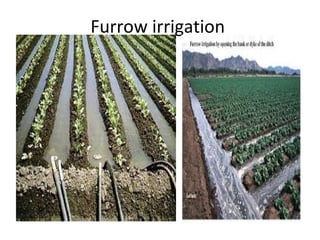
Furrow irrigation
• In this method only one-fifth and one-half of the land
surface is wetted by water.
• Result in less evaporation and permits cultivation
sooner after irrigation
• It’s a narrow field ditch excavated between two rows
of plants and carry irrigation water through them
• Spacing of ditch decided by types of plant generally 8
to 30 cm deep and 400 m long.
Furrow irrigation
Sprinkler irrigation
• Water is applied to the soil in the forms of a spray
through a network of pipe and pumps
Advantage:-
 applicable for all type of soil and topographies
 All type of crops except paddy
 80-85% distribution efficiency
Types:-
Permanent
Semi permanent
Portable system
Sprinkler system
Limitation of sprinkler irrigation system
 costly affairs
Distortion due to wind velocity
Drip irrigation
• Also known as trickle irrigation
• Latest field irrigation technique
• Adopted where there exist acute scarcity of irrigation
water
Parts of drip irrigation system
1. Main
2. Sub-main
3. Laterals
4. Drippers or emitters (drop nozzle)
Drip irrigation
Drip irrigation
Drip irrigation
Quality of irrigation water
• Sediments concentration in water
• Total concentration of soluble salt
• Bicarbonate concentration
• Bacterial contamination
- Salt concentration is generally express by ppm
- 700-2000 ppm injurious to all crop
- It measure by determine electrical
conductivity
- Sodium absorption ration(SAR)-

Irrigation

  • 1.
  • 2.
    IRRIGATION INTRODUCTION • Irrigationinvolves artificially providing water to crops. This technique is used in farming to enable plants to grow .when there is not enough rain, particularly in arid areas • 66% of the world's water catchment is used in farming, which continues to make increasing use of irrigation. But in most irrigation systems 50 to 60% of the water used does not benefit the plants.
  • 3.
    Benefits of irrigation •Increase in crop yield/Food production • Protection form famine • Cultivation of superior crops • Elimination of mixed cropping • Afforestration • Hydro power generation (runoff river) • Domestic and industrial water supply
  • 4.
    Disadvantage or illeffects of irrigation • Groundwater pollution • Colder and damper climate • Water logging
  • 5.
    Types of irrigation Irrigation Surfaceirrigation Sub-surface irrigation Flood irrigation Basin irrigation Furrow irrigation Check basin irrigation Sprinkler irrigation Dip irrigation Sub-surface dip irrigation Flow irrigation Lift irrigation
  • 6.
    Flood irrigation • Floodirrigation is an ancient method of irrigation crops. It was likely the first form of irrigation used by humans as they begins cultivation crops and is still of the most commonly used methods of irrigation used today. • Also called as inundation irrigation or uncontrolled irrigation.
  • 7.
  • 8.
  • 9.
    Furrow irrigation • Inthis method only one-fifth and one-half of the land surface is wetted by water. • Result in less evaporation and permits cultivation sooner after irrigation • It’s a narrow field ditch excavated between two rows of plants and carry irrigation water through them • Spacing of ditch decided by types of plant generally 8 to 30 cm deep and 400 m long.
  • 10.
  • 11.
    Sprinkler irrigation • Wateris applied to the soil in the forms of a spray through a network of pipe and pumps Advantage:-  applicable for all type of soil and topographies  All type of crops except paddy  80-85% distribution efficiency Types:- Permanent Semi permanent Portable system
  • 12.
  • 13.
    Limitation of sprinklerirrigation system  costly affairs Distortion due to wind velocity
  • 14.
    Drip irrigation • Alsoknown as trickle irrigation • Latest field irrigation technique • Adopted where there exist acute scarcity of irrigation water Parts of drip irrigation system 1. Main 2. Sub-main 3. Laterals 4. Drippers or emitters (drop nozzle)
  • 15.
  • 16.
  • 17.
  • 18.
    Quality of irrigationwater • Sediments concentration in water • Total concentration of soluble salt • Bicarbonate concentration • Bacterial contamination - Salt concentration is generally express by ppm - 700-2000 ppm injurious to all crop - It measure by determine electrical conductivity - Sodium absorption ration(SAR)-