 Iron is a mineral needed by our bodies and it
is one of the most common elements in the
Earth’s crust.
 Iron has several vital functions in the body;
› Serves as a carrier of oxygen to the tissues from
the lungs by haemoglobin
› A transport medium for electrons within cells
› An integrated part of important enzyme systems
in various tissues
STRUCTURE OF Hb
 4 polypeptide chains
 Alpha-1& 2 chains
 Beta-1 & 2 chains
 4 haem groups
 Haem is made up of iron
& porphyrin
 4 iron molecules attached
to each haem groups
 Quaternary structure of
superimposed
polypeptide chains
 “Anaemia" usually refers to a condition in
which your blood has a lower than normal
number of red blood cells.
 Iron is an essential mineral that is needed to
form hemoglobin, an oxygen carrying protein
inside red blood cells.
 Iron deficiency anemia is a condition in
which the body lack enough red blood cell to
transport oxygen-rich blood to body tissues
 Iron is absorbed in the duodenum and upper jejunum by
enterocytes
 2 types of iron
 Haem iron (Fe2+ - from meat)
 Non-haem iron (Fe3+ - from plants)
 Amount of iron absorbed is regulated according to the
body’s needs
 Iron is transported by a protein called ‘transferrin’
 Transferrin transports iron to the erythroblast mitochondria
for the synthesis of ‘haem’.
 Iron is stored in 2 forms; ferritin & hemosiderin in the bone
marrow, liver and spleen.
 DMT-1: divalent metal
transporter-1
 Ferroportin: controls the
export of iron into the
portal plasma and
transport it into the blood
circulation
 Ferrireductase: converts
iron from Fe3+ to Fe2+
state
 Ferrioxidase: converts
Fe2+ back to Fe3+
 Hepcidin: inhibits the
activity of ferroportin
 Iron deficiency anaemia is the most common
nutritional deficiency worldwide affecting 1.3
billion people
 The prevalence of IDA in the United States
varies widely by age, sex, and race
 Infants, toddlers, pregnant women and
menstruating women are mostly affected
WHO region Children
(6-59 months)
Menstruating
women (15-49yrs)
Pregnant women
(15-49yrs)
African region 32% 41% 44%
Region of the Americas 56% 55% 60%
South-East Asia region 41% 45% 47%
European region 54% 55% 62%
Eastern Mediterranean
region
38% 45% 49%
Western Pacific region 64% 59% 61%
Table 1: Estimated percentage (95% CI) of anaemia due to iron deficiency
(2010)
 Inadequate iron intake
› Vegetarians
› Tea-toast type feeding (old age)
 Increased demands
› Pregnancy or blood loss due to menstruation
› Internal bleeding
› Rapid growth
› Lactation
 Inability to absorb iron
› Gastric surgery
› Celiac disease
 General fatigue
 Weakness
 Pale skin
 Shortness of breath
 Dizziness
 Strange cravings to eat items that
aren’t food, such as dirt, ice, or clay
 Tingling or crawling feeling in the legs
 Tongue swelling or soreness
(glossitis)
 Cold hands and feet
 Fast or irregular heartbeat
 Brittle/spoon nails
 Headaches
 Jaundice
 Angular stomatitis
 Enlarged spleen
 Iron deficiency anaemia can lead to;
› Decreased work & school
performance
› Slow cognitive & social
development during childhood
› Difficulty maintaining body
temperature
› Decreased immune function, etc
 Women of childbearing age
 Pregnant women
 People with poor diets
 People who donate blood frequently
 Infants and children
 vegetarians
 Iron deficiency anaemia can become severe
and lead to health problems;
Heart problems: enlarged heart or heart failure
Problems during pregnancy: premature births
and low birth weight babies
Growth problems: delayed growth and
development, increased risk to infections
 Iron required depends on sex and age;
 Male 1 mg
 Women in repr.age 2-3 mg
 Pregnant 3-4 mg
 Infants & toddlers 1-3mg
 Children 8mg
 COMPLETE BLOOD COUNT:
› Hb,Htc,RBC:Low
› MCV,MCH,MCHC:Low
› RDW: High
› Retics: Normal/Low
› Plt:Normal/Low/High
› WBC:Normal/Low
 Smear:Hypochromia,anisocytosis,microc
ytosis, poikilocytosis
 Serum Iron:  (N: 60 – 180 μg/dL)
 TIBC:  (250 - 430 μg/dL)
 Serum Ferritin:  (N:Female;10-150 μg/L,
Male;29-248 μg/L)
 Transferrin saturation (Fe/TIBC):  (<15%)
<5%:definitely indicates iron deficiency
 Serum Transferrin Receptor: 
 Free Erythrocyte Protoporphyrin:  (17 – 27
μg/dL)
 Bone marrow :
› Erythroid hyperplasia,
› Absence of hemosiderin
 Microcytic anemias
› Iron deficiency anemia
› Thalassemia
› Sideroblastic anemia
› Lead poisoning
› Anemia of chronic diseases
Iron
deficiency
Chronic
disease
Thalassemia
Siderobl.
anaemia
Lead
poisoning
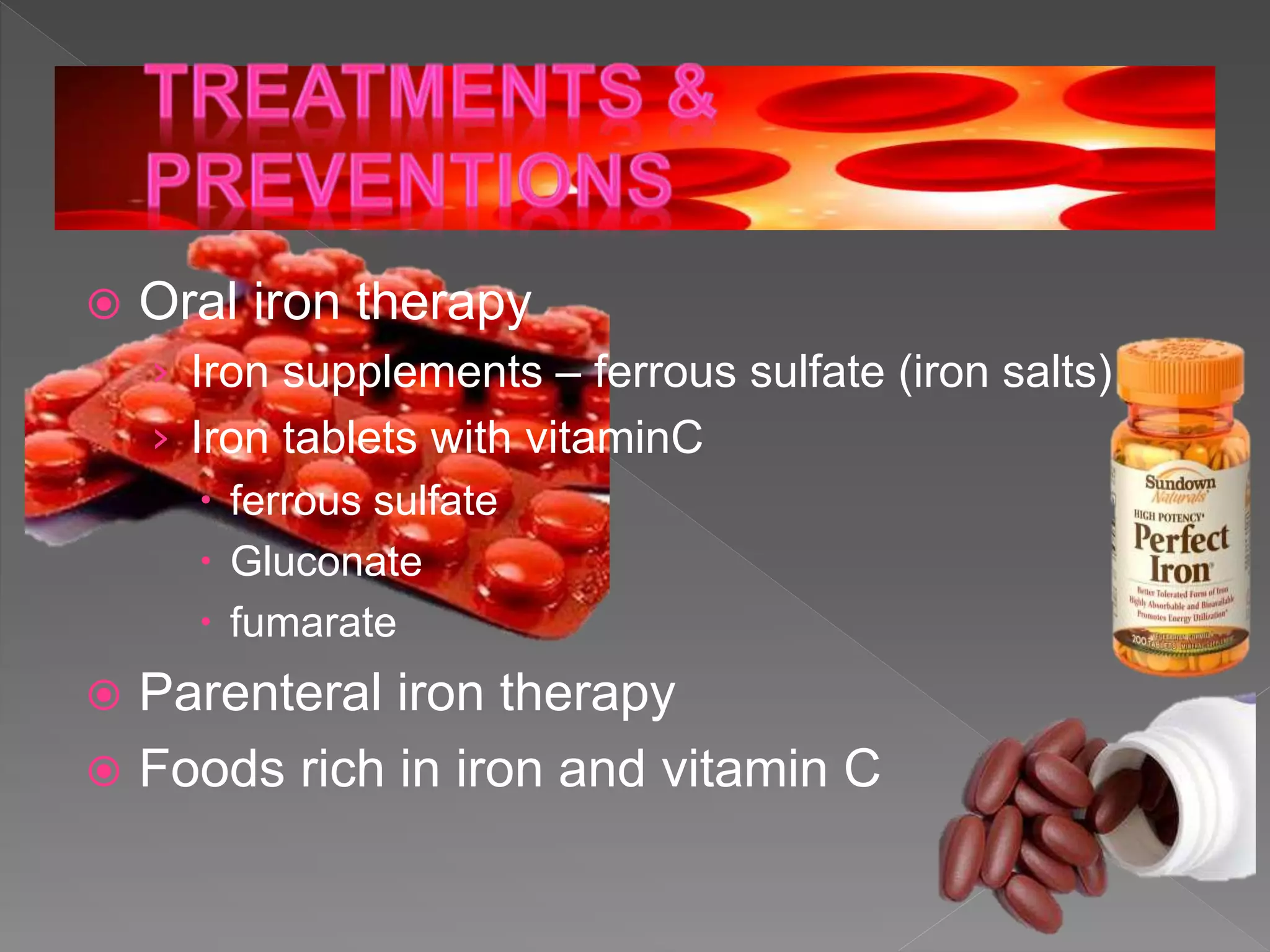
 Oral iron therapy
› Iron supplements – ferrous sulfate (iron salts)
› Iron tablets with vitaminC
 ferrous sulfate
 Gluconate
 fumarate
 Parenteral iron therapy
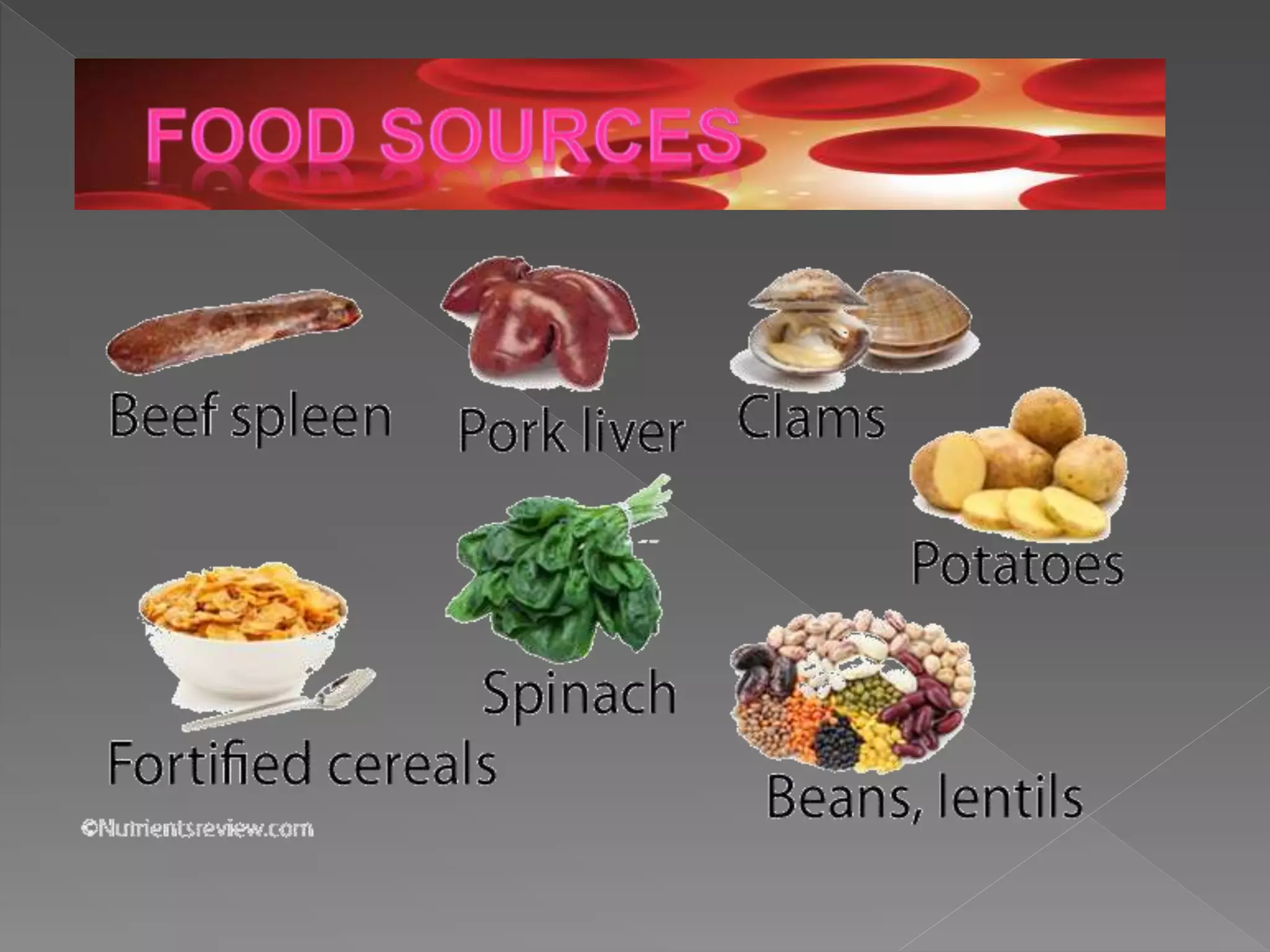
 Foods rich in iron and vitamin C
 http://www.namrata.co/case-study-iron-deficiency-anemia/
 http://www.hematology.org/Fellows/Case-Studies/733.aspx
 https://www.ebi.ac.uk/interpro/potm/2005_10/Page1.htm
 http://www.chm.bris.ac.uk/motm/hemoglobin/hemoglobh.htm
 http://www.merckmanuals.com/professional/hematology-and-
oncology/anemias-caused-by-deficient-erythropoiesis/iron-deficiency-anemia
 http://emedicine.medscape.com/article/202333-overview#showall
 http://www.austincc.edu/emeyerth/hemoglob.htm
 http://chemed.chem.purdue.edu/genchem/topicreview/bp/1biochem/blood3.htm
l
 https://www.boundless.com/biology/textbooks/boundless-biology-textbook/the-
respiratory-system-39/transport-of-gases-in-human-bodily-fluids-222/transport-
of-oxygen-in-the-blood-841-12086/
 http://www.medicinenet.com/script/main/art.asp?articlekey=7431
 http://www.medicinenet.com/iron_and_iron_deficiency/page4.htm#how_is_iron
_deficiency_detected

IRON DEFICIENCY ANAEMIA

  • 2.
     Iron isa mineral needed by our bodies and it is one of the most common elements in the Earth’s crust.  Iron has several vital functions in the body; › Serves as a carrier of oxygen to the tissues from the lungs by haemoglobin › A transport medium for electrons within cells › An integrated part of important enzyme systems in various tissues
  • 3.
    STRUCTURE OF Hb 4 polypeptide chains  Alpha-1& 2 chains  Beta-1 & 2 chains  4 haem groups  Haem is made up of iron & porphyrin  4 iron molecules attached to each haem groups  Quaternary structure of superimposed polypeptide chains
  • 5.
     “Anaemia" usuallyrefers to a condition in which your blood has a lower than normal number of red blood cells.  Iron is an essential mineral that is needed to form hemoglobin, an oxygen carrying protein inside red blood cells.  Iron deficiency anemia is a condition in which the body lack enough red blood cell to transport oxygen-rich blood to body tissues
  • 6.
     Iron isabsorbed in the duodenum and upper jejunum by enterocytes  2 types of iron  Haem iron (Fe2+ - from meat)  Non-haem iron (Fe3+ - from plants)  Amount of iron absorbed is regulated according to the body’s needs  Iron is transported by a protein called ‘transferrin’  Transferrin transports iron to the erythroblast mitochondria for the synthesis of ‘haem’.  Iron is stored in 2 forms; ferritin & hemosiderin in the bone marrow, liver and spleen.
  • 7.
     DMT-1: divalentmetal transporter-1  Ferroportin: controls the export of iron into the portal plasma and transport it into the blood circulation  Ferrireductase: converts iron from Fe3+ to Fe2+ state  Ferrioxidase: converts Fe2+ back to Fe3+  Hepcidin: inhibits the activity of ferroportin
  • 8.
     Iron deficiencyanaemia is the most common nutritional deficiency worldwide affecting 1.3 billion people  The prevalence of IDA in the United States varies widely by age, sex, and race  Infants, toddlers, pregnant women and menstruating women are mostly affected
  • 9.
    WHO region Children (6-59months) Menstruating women (15-49yrs) Pregnant women (15-49yrs) African region 32% 41% 44% Region of the Americas 56% 55% 60% South-East Asia region 41% 45% 47% European region 54% 55% 62% Eastern Mediterranean region 38% 45% 49% Western Pacific region 64% 59% 61% Table 1: Estimated percentage (95% CI) of anaemia due to iron deficiency (2010)
  • 10.
     Inadequate ironintake › Vegetarians › Tea-toast type feeding (old age)  Increased demands › Pregnancy or blood loss due to menstruation › Internal bleeding › Rapid growth › Lactation  Inability to absorb iron › Gastric surgery › Celiac disease
  • 11.
     General fatigue Weakness  Pale skin  Shortness of breath  Dizziness  Strange cravings to eat items that aren’t food, such as dirt, ice, or clay  Tingling or crawling feeling in the legs  Tongue swelling or soreness (glossitis)  Cold hands and feet  Fast or irregular heartbeat  Brittle/spoon nails  Headaches  Jaundice  Angular stomatitis  Enlarged spleen  Iron deficiency anaemia can lead to; › Decreased work & school performance › Slow cognitive & social development during childhood › Difficulty maintaining body temperature › Decreased immune function, etc
  • 12.
     Women ofchildbearing age  Pregnant women  People with poor diets  People who donate blood frequently  Infants and children  vegetarians
  • 13.
     Iron deficiencyanaemia can become severe and lead to health problems; Heart problems: enlarged heart or heart failure Problems during pregnancy: premature births and low birth weight babies Growth problems: delayed growth and development, increased risk to infections
  • 14.
     Iron requireddepends on sex and age;  Male 1 mg  Women in repr.age 2-3 mg  Pregnant 3-4 mg  Infants & toddlers 1-3mg  Children 8mg
  • 15.
     COMPLETE BLOODCOUNT: › Hb,Htc,RBC:Low › MCV,MCH,MCHC:Low › RDW: High › Retics: Normal/Low › Plt:Normal/Low/High › WBC:Normal/Low  Smear:Hypochromia,anisocytosis,microc ytosis, poikilocytosis
  • 16.
     Serum Iron: (N: 60 – 180 μg/dL)  TIBC:  (250 - 430 μg/dL)  Serum Ferritin:  (N:Female;10-150 μg/L, Male;29-248 μg/L)  Transferrin saturation (Fe/TIBC):  (<15%) <5%:definitely indicates iron deficiency  Serum Transferrin Receptor:   Free Erythrocyte Protoporphyrin:  (17 – 27 μg/dL)  Bone marrow : › Erythroid hyperplasia, › Absence of hemosiderin
  • 17.
     Microcytic anemias ›Iron deficiency anemia › Thalassemia › Sideroblastic anemia › Lead poisoning › Anemia of chronic diseases
  • 18.
  • 19.
     Oral irontherapy › Iron supplements – ferrous sulfate (iron salts) › Iron tablets with vitaminC  ferrous sulfate  Gluconate  fumarate  Parenteral iron therapy  Foods rich in iron and vitamin C
  • 21.
     http://www.namrata.co/case-study-iron-deficiency-anemia/  http://www.hematology.org/Fellows/Case-Studies/733.aspx https://www.ebi.ac.uk/interpro/potm/2005_10/Page1.htm  http://www.chm.bris.ac.uk/motm/hemoglobin/hemoglobh.htm  http://www.merckmanuals.com/professional/hematology-and- oncology/anemias-caused-by-deficient-erythropoiesis/iron-deficiency-anemia  http://emedicine.medscape.com/article/202333-overview#showall  http://www.austincc.edu/emeyerth/hemoglob.htm  http://chemed.chem.purdue.edu/genchem/topicreview/bp/1biochem/blood3.htm l  https://www.boundless.com/biology/textbooks/boundless-biology-textbook/the- respiratory-system-39/transport-of-gases-in-human-bodily-fluids-222/transport- of-oxygen-in-the-blood-841-12086/  http://www.medicinenet.com/script/main/art.asp?articlekey=7431  http://www.medicinenet.com/iron_and_iron_deficiency/page4.htm#how_is_iron _deficiency_detected

Editor's Notes

  • #17 Erythroid hyperplasia- kele ia erythroid precursors ua form