EXPERIMENTAL STUDY OF
FLOATING CONCRETE
PROJECT MEMBERS :
LIVINGSTON CHARLES C 950618103003
MOHAMED ABU JASIM P 950618103006
MOHAMED ARSHAD M 950618103005
REJESH B 950618103009
ABSTRACT
Floating concrete is a unique sort of inventive
solid whose density is under 1000 kg/m³. In view of its
low density and moderate scope of compressive
quality, it tends to be utilized in non-basic
applications starting at now. The point of the
exploration is to recognize the material which makes
the solid buoy and it ought to likewise have the
quality. Floating concrete is a kind of concrete having
density not as much as water .The conventional
aggregate are supplanted by light weight aggregate
which makes the solid lighter than the ordinary
concrete. EPS is a lightweight material that has been
utilized .
FLOATING CONCRETE
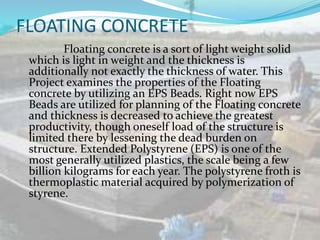
Floating concrete is a sort of light weight solid
which is light in weight and the thickness is
additionally not exactly the thickness of water. This
Project examines the properties of the Floating
concrete by utilizing an EPS Beads. Right now EPS
Beads are utilized for planning of the Floating concrete
and thickness is decreased to achieve the greatest
productivity, though oneself load of the structure is
limited there by lessening the dead burden on
structure. Extended Polystyrene (EPS) is one of the
most generally utilized plastics, the scale being a few
billion kilograms for each year. The polystyrene froth is
thermoplastic material acquired by polymerization of
styrene.
The utilization of extended polystyrene in development has
parcel of preferences contrast and the utilization of traditional
materials which brings about practical future. The utilization of
EPS Beads likewise decreases the ecological dangers that causes
during its removal. The majority of this sort of waste is late
unnoticed and they will prompt an Earth-wide temperature
boost[2]. The utilization of Lightweight concrete (LWC) has been
a component in the development business for a considerable
length of time, yet like other material the desires for the
exhibition have raised and now we are expecting a steady, solid
material and unsurprising attributes. Lightweight concretes can
either be light weight aggregate concrete, frothed concrete or
autoclaved circulated air through. The development business
wherever faces the issues and difficulties; two-third of the world
surface is secured with water. It is in this manner not amazing
that there has been a lot of action with concrete in the ocean in
late decades
APPLICATION OF FLOATING CONCRETE
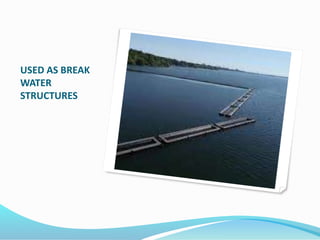
1) Nowadays Mostly the Floating concrete are used as break
water structures ,which is low cost and efficient.
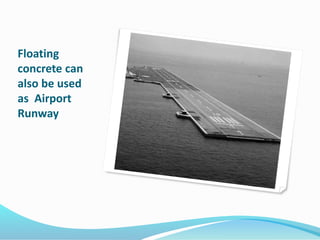
2) Floating concrete can also be used as Airport Runway if
there is no enough space and when the airport near to the
offshore.
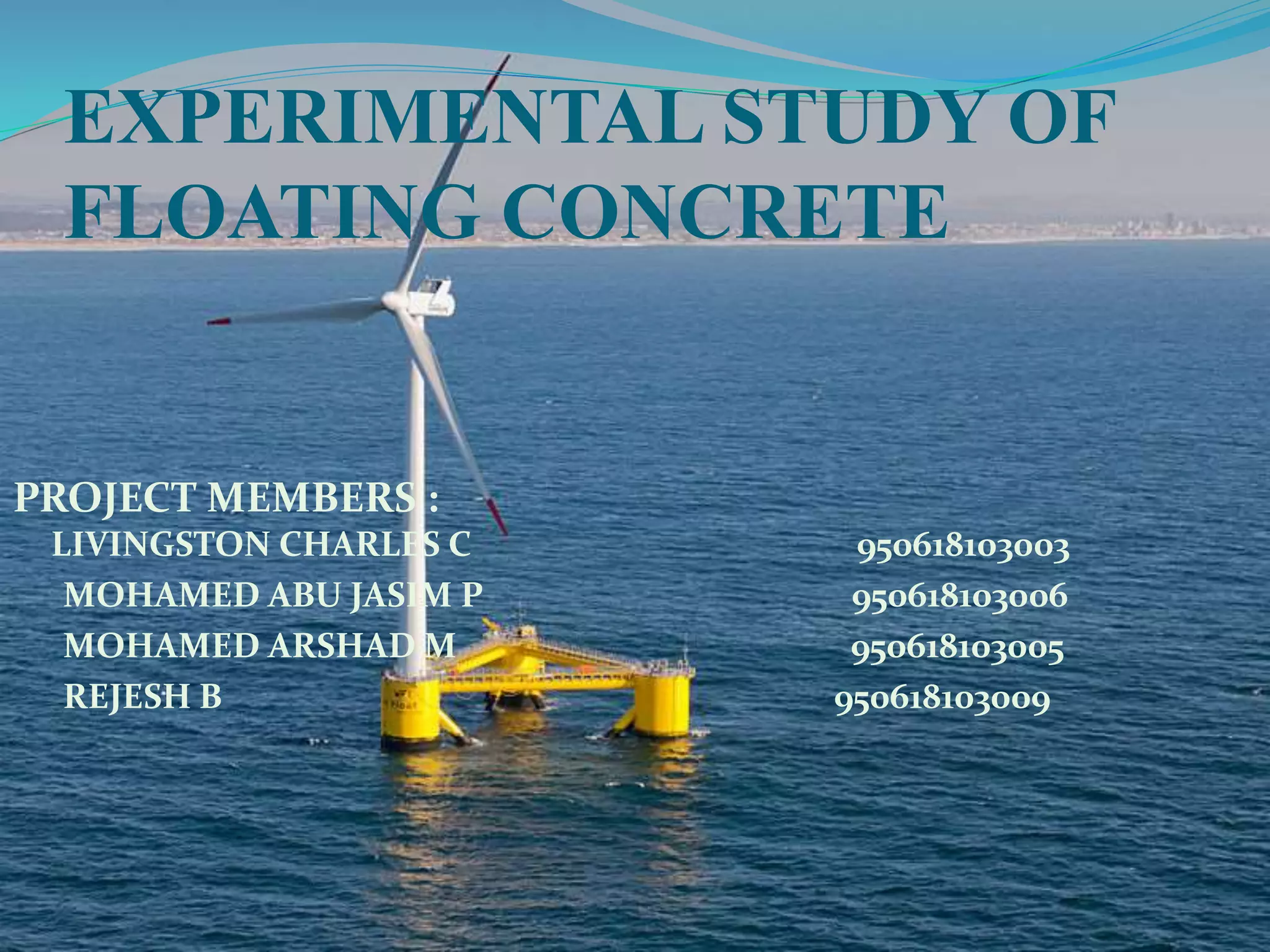
3) Floating concrete can also be used as bed for wind
turbines in sea .
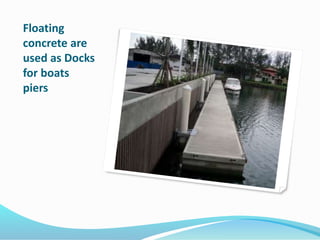
4) Floating concrete are used as Docks for boats ,piers , jetys
and other harbor related structures .
USED AS BREAK
WATER
STRUCTURES
Floating
concrete can
also be used
as Airport
Runway
Floating
concrete are
used as Docks
for boats
piers
LIGHT WEIGHT MATERIAL USED :
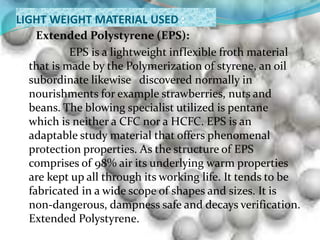
Extended Polystyrene (EPS):
EPS is a lightweight inflexible froth material
that is made by the Polymerization of styrene, an oil
subordinate likewise discovered normally in
nourishments for example strawberries, nuts and
beans. The blowing specialist utilized is pentane
which is neither a CFC nor a HCFC. EPS is an
adaptable study material that offers phenomenal
protection properties. As the structure of EPS
comprises of 98% air its underlying warm properties
are kept up all through its working life. It tends to be
fabricated in a wide scope of shapes and sizes. It is
non-dangerous, dampness safe and decays verification.
Extended Polystyrene.
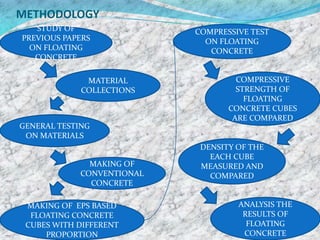
METHODOLOGY
STUDY OF
PREVIOUS PAPERS
ON FLOATING
CONCRETE
MATERIAL
COLLECTIONS
GENERAL TESTING
ON MATERIALS
MAKING OF
CONVENTIONAL
CONCRETE
MAKING OF EPS BASED
FLOATING CONCRETE
CUBES WITH DIFFERENT
PROPORTION
COMPRESSIVE TEST
ON FLOATING
CONCRETE
DENSITY OF THE
EACH CUBE
MEASURED AND
COMPARED
COMPRESSIVE
STRENGTH OF
FLOATING
CONCRETE CUBES
ARE COMPARED
ANALYSIS THE
RESULTS OF
FLOATING
CONCRETE
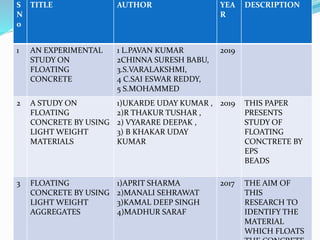
S
N
0
TITLE AUTHOR YEA
R
DESCRIPTION
1 AN EXPERIMENTAL
STUDY ON
FLOATING
CONCRETE
1 L.PAVAN KUMAR
2CHINNA SURESH BABU,
3.S.VARALAKSHMI,
4 C.SAI ESWAR REDDY,
5 S.MOHAMMED
2019
2 A STUDY ON
FLOATING
CONCRETE BY USING
LIGHT WEIGHT
MATERIALS
1)UKARDE UDAY KUMAR ,
2)R THAKUR TUSHAR ,
2) VYARARE DEEPAK ,
3) B KHAKAR UDAY
KUMAR
2019 THIS PAPER
PRESENTS
STUDY OF
FLOATING
CONCTRETE BY
EPS
BEADS
3 FLOATING
CONCRETE BY USING
LIGHT WEIGHT
AGGREGATES
1)APRIT SHARMA
2)MANALI SEHRAWAT
3)KAMAL DEEP SINGH
4)MADHUR SARAF
2017 THE AIM OF
THIS
RESEARCH TO
IDENTIFY THE
MATERIAL
WHICH FLOATS
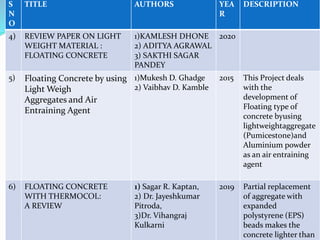
S
N
O
TITLE AUTHORS YEA
R
DESCRIPTION
4) REVIEW PAPER ON LIGHT
WEIGHT MATERIAL :
FLOATING CONCRETE
1)KAMLESH DHONE
2) ADITYA AGRAWAL
3) SAKTHI SAGAR
PANDEY
2020
5) Floating Concrete by using
Light Weigh
Aggregates and Air
Entraining Agent
1)Mukesh D. Ghadge
2) Vaibhav D. Kamble
2015 This Project deals
with the
development of
Floating type of
concrete byusing
lightweightaggregate
(Pumicestone)and
Aluminium powder
as an air entraining
agent
6) FLOATING CONCRETE
WITH THERMOCOL:
A REVIEW
1) Sagar R. Kaptan,
2) Dr. Jayeshkumar
Pitroda,
3)Dr. Vihangraj
Kulkarni
2019 Partial replacement
of aggregate with
expanded
polystyrene (EPS)
beads makes the
concrete lighter than
S
N
O
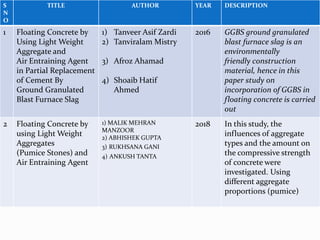
TITLE AUTHOR YEAR DESCRIPTION
1 Floating Concrete by
Using Light Weight
Aggregate and
Air Entraining Agent
in Partial Replacement
of Cement By
Ground Granulated
Blast Furnace Slag
1) Tanveer Asif Zardi
2) Tanviralam Mistry
3) Afroz Ahamad
4) Shoaib Hatif
Ahmed
2016 GGBS ground granulated
blast furnace slag is an
environmentally
friendly construction
material, hence in this
paper study on
incorporation of GGBS in
floating concrete is carried
out
2 Floating Concrete by
using Light Weight
Aggregates
(Pumice Stones) and
Air Entraining Agent
1) MALIK MEHRAN
MANZOOR
2) ABHISHEK GUPTA
3) RUKHSANA GANI
4) ANKUSH TANTA
2018 In this study, the
influences of aggregate
types and the amount on
the compressive strength
of concrete were
investigated. Using
different aggregate
proportions (pumice)
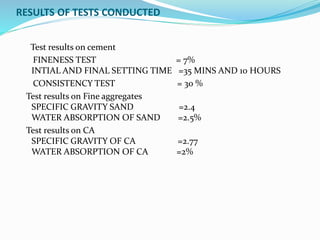
RESULTS OF TESTS CONDUCTED
Test results on cement
FINENESS TEST = 7%
INTIAL AND FINAL SETTING TIME =35 MINS AND 10 HOURS
CONSISTENCY TEST = 30 %
Test results on Fine aggregates
SPECIFIC GRAVITY SAND =2.4
WATER ABSORPTION OF SAND =2.5%
Test results on CA
SPECIFIC GRAVITY OF CA =2.77
WATER ABSORPTION OF CA =2%
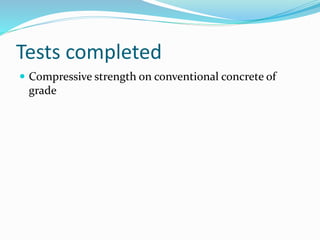
Tests completed
 Compressive strength on conventional concrete of
grade

FLOATING CONCRETE.pptx

  • 1.
    EXPERIMENTAL STUDY OF FLOATINGCONCRETE PROJECT MEMBERS : LIVINGSTON CHARLES C 950618103003 MOHAMED ABU JASIM P 950618103006 MOHAMED ARSHAD M 950618103005 REJESH B 950618103009
  • 2.
    ABSTRACT Floating concrete isa unique sort of inventive solid whose density is under 1000 kg/m³. In view of its low density and moderate scope of compressive quality, it tends to be utilized in non-basic applications starting at now. The point of the exploration is to recognize the material which makes the solid buoy and it ought to likewise have the quality. Floating concrete is a kind of concrete having density not as much as water .The conventional aggregate are supplanted by light weight aggregate which makes the solid lighter than the ordinary concrete. EPS is a lightweight material that has been utilized .
  • 3.
    FLOATING CONCRETE Floating concreteis a sort of light weight solid which is light in weight and the thickness is additionally not exactly the thickness of water. This Project examines the properties of the Floating concrete by utilizing an EPS Beads. Right now EPS Beads are utilized for planning of the Floating concrete and thickness is decreased to achieve the greatest productivity, though oneself load of the structure is limited there by lessening the dead burden on structure. Extended Polystyrene (EPS) is one of the most generally utilized plastics, the scale being a few billion kilograms for each year. The polystyrene froth is thermoplastic material acquired by polymerization of styrene.
  • 4.
    The utilization ofextended polystyrene in development has parcel of preferences contrast and the utilization of traditional materials which brings about practical future. The utilization of EPS Beads likewise decreases the ecological dangers that causes during its removal. The majority of this sort of waste is late unnoticed and they will prompt an Earth-wide temperature boost[2]. The utilization of Lightweight concrete (LWC) has been a component in the development business for a considerable length of time, yet like other material the desires for the exhibition have raised and now we are expecting a steady, solid material and unsurprising attributes. Lightweight concretes can either be light weight aggregate concrete, frothed concrete or autoclaved circulated air through. The development business wherever faces the issues and difficulties; two-third of the world surface is secured with water. It is in this manner not amazing that there has been a lot of action with concrete in the ocean in late decades
  • 5.
    APPLICATION OF FLOATINGCONCRETE 1) Nowadays Mostly the Floating concrete are used as break water structures ,which is low cost and efficient. 2) Floating concrete can also be used as Airport Runway if there is no enough space and when the airport near to the offshore. 3) Floating concrete can also be used as bed for wind turbines in sea . 4) Floating concrete are used as Docks for boats ,piers , jetys and other harbor related structures .
  • 6.
  • 7.
    Floating concrete can also beused as Airport Runway
  • 8.
    Floating concrete are used asDocks for boats piers
  • 9.
    LIGHT WEIGHT MATERIALUSED : Extended Polystyrene (EPS): EPS is a lightweight inflexible froth material that is made by the Polymerization of styrene, an oil subordinate likewise discovered normally in nourishments for example strawberries, nuts and beans. The blowing specialist utilized is pentane which is neither a CFC nor a HCFC. EPS is an adaptable study material that offers phenomenal protection properties. As the structure of EPS comprises of 98% air its underlying warm properties are kept up all through its working life. It tends to be fabricated in a wide scope of shapes and sizes. It is non-dangerous, dampness safe and decays verification. Extended Polystyrene.
  • 10.
    METHODOLOGY STUDY OF PREVIOUS PAPERS ONFLOATING CONCRETE MATERIAL COLLECTIONS GENERAL TESTING ON MATERIALS MAKING OF CONVENTIONAL CONCRETE MAKING OF EPS BASED FLOATING CONCRETE CUBES WITH DIFFERENT PROPORTION COMPRESSIVE TEST ON FLOATING CONCRETE DENSITY OF THE EACH CUBE MEASURED AND COMPARED COMPRESSIVE STRENGTH OF FLOATING CONCRETE CUBES ARE COMPARED ANALYSIS THE RESULTS OF FLOATING CONCRETE
  • 11.
    S N 0 TITLE AUTHOR YEA R DESCRIPTION 1AN EXPERIMENTAL STUDY ON FLOATING CONCRETE 1 L.PAVAN KUMAR 2CHINNA SURESH BABU, 3.S.VARALAKSHMI, 4 C.SAI ESWAR REDDY, 5 S.MOHAMMED 2019 2 A STUDY ON FLOATING CONCRETE BY USING LIGHT WEIGHT MATERIALS 1)UKARDE UDAY KUMAR , 2)R THAKUR TUSHAR , 2) VYARARE DEEPAK , 3) B KHAKAR UDAY KUMAR 2019 THIS PAPER PRESENTS STUDY OF FLOATING CONCTRETE BY EPS BEADS 3 FLOATING CONCRETE BY USING LIGHT WEIGHT AGGREGATES 1)APRIT SHARMA 2)MANALI SEHRAWAT 3)KAMAL DEEP SINGH 4)MADHUR SARAF 2017 THE AIM OF THIS RESEARCH TO IDENTIFY THE MATERIAL WHICH FLOATS
  • 12.
    S N O TITLE AUTHORS YEA R DESCRIPTION 4)REVIEW PAPER ON LIGHT WEIGHT MATERIAL : FLOATING CONCRETE 1)KAMLESH DHONE 2) ADITYA AGRAWAL 3) SAKTHI SAGAR PANDEY 2020 5) Floating Concrete by using Light Weigh Aggregates and Air Entraining Agent 1)Mukesh D. Ghadge 2) Vaibhav D. Kamble 2015 This Project deals with the development of Floating type of concrete byusing lightweightaggregate (Pumicestone)and Aluminium powder as an air entraining agent 6) FLOATING CONCRETE WITH THERMOCOL: A REVIEW 1) Sagar R. Kaptan, 2) Dr. Jayeshkumar Pitroda, 3)Dr. Vihangraj Kulkarni 2019 Partial replacement of aggregate with expanded polystyrene (EPS) beads makes the concrete lighter than
  • 13.
    S N O TITLE AUTHOR YEARDESCRIPTION 1 Floating Concrete by Using Light Weight Aggregate and Air Entraining Agent in Partial Replacement of Cement By Ground Granulated Blast Furnace Slag 1) Tanveer Asif Zardi 2) Tanviralam Mistry 3) Afroz Ahamad 4) Shoaib Hatif Ahmed 2016 GGBS ground granulated blast furnace slag is an environmentally friendly construction material, hence in this paper study on incorporation of GGBS in floating concrete is carried out 2 Floating Concrete by using Light Weight Aggregates (Pumice Stones) and Air Entraining Agent 1) MALIK MEHRAN MANZOOR 2) ABHISHEK GUPTA 3) RUKHSANA GANI 4) ANKUSH TANTA 2018 In this study, the influences of aggregate types and the amount on the compressive strength of concrete were investigated. Using different aggregate proportions (pumice)
  • 14.
    RESULTS OF TESTSCONDUCTED Test results on cement FINENESS TEST = 7% INTIAL AND FINAL SETTING TIME =35 MINS AND 10 HOURS CONSISTENCY TEST = 30 % Test results on Fine aggregates SPECIFIC GRAVITY SAND =2.4 WATER ABSORPTION OF SAND =2.5% Test results on CA SPECIFIC GRAVITY OF CA =2.77 WATER ABSORPTION OF CA =2%
  • 15.
    Tests completed  Compressivestrength on conventional concrete of grade