STABILIZATION OF
EXPANSIVE SOIL USING FLY
ASH
Agenda 1. ABSTRACT
2. INTRODUCTION
3. MATERIALS AND
METHODOLOGY
4. RESULTS AND
DISSCUSION
5. CONCLUSION
ABSTRACT
Nearly 51.8 million hectares of land area in India are
covered with Expansive soil (mainly Black Cotton soil).
The property of these expansive soils, in general, is that
they are very hard when in dry state, but they lose all of
their strength when in wet state. In light of this property
of expansive soils, these soils pose problems worldwide
that serve as challenge to overcome for the Geotechnical
engineers. One of the most important aspects for
construction purposes is soil stabilization, which is used
widely in foundation and road pavement constructions;
this is because such a stabilization regime improves
engineering properties of the soil, such as volume
stability, strength and durability.
INTRODUCTION
Expansive soils, which are also called as swell-shrink soil, have
the tendency to shrink and swell with variation in moisture
content. As a result of this variation in the soil, significant distress
occurs in the soil, which is subsequently followed by damage to
the overlying structures. During periods of greater moisture, like
monsoons, these soils imbibe the water, and swell; subsequently,
they become soft and their water holding capacity diminishes. As
opposed to this, in drier seasons, like summers, these soils lose the
moisture held in them due to evaporation, resulting in their
becoming harder. Generally found in semi-arid and arid regions of
the globe, these type of soils are regarded as potential natural
hazard – if not treated, these can cause extensive damage to the
structures built upon them, as well causing loss in human life.
Soils whose composition includes presence of montmorillonite, in
general, display these kind of properties. Tallied in billions of
dollars annually worldwide, these soils have caused extensive
damage to civil engineering structures.
MATERIALS AND METHODOLOGY
Fly ash
A waste material extracted from the gases emanating from coal fired furnaces, generally of a thermal power
plant, is called fly ash. The mineral residue that is left behind after the burning of coal is the fly ash. The
Electro Static Precipitator (ESP) of the power plants collect these fly ashes. Essentially consisting of alumina,
silica and iron, fly ashes are micro-sized particles. Fly ash particles are generally spherical in size, and this
property makes it easy for them to blend and flow, to make a suitable concoction.
Methodology Adopted
To evaluate the effect of fly ash as a stabilizing additive in expansive soils, series of tests, where the content of
f ly ash in the expansive soil was varied in values of 10% to 50% (multiples of 10) by weight of the total
quantity taken. The Indian Standard codes were followed during the conduction of the following experiments:
1. Standard proctor test – IS : 2720 (Part 7) - 1980
2. Unconfined compressive strength (UCS) test – IS : 2720 (Part 10) – 1991
3. California bearing ratio (CBR) test – IS : 2720 (Part 16) - 1987
4. Free swell index test – IS 2720 (Part 40) – 1977
5. Liquid & Plastic limit test – IS 2720 (Part 5) – 1985
STANDARD PROCTOR COMPACTION (IS 2720-PART VII-1980) :
NEED &SCOPE:
Determination of the relationship between the moisture content and density of soils compacted in a
mound of a given size with a 2.5 kg rammer dropped from a height of 30 cm. the results obtained from
this test will be helpful in increasing the bearing capacity of foundations, Decreasing the undesirable
settlement of structures, Control undesirable volume changes, Reduction in hydraulic conductivity,
Increasing the stability of slopes and so on.
UNCONFINED COMPRESSION TEST
NEED AND SCOPE:
It is not always possible to conduct the bearing capacity test in the field. Sometimes it is cheaper to take the
undisturbed soil sample and test its strength in the laboratory. Also to choose the best material for the
embankment, one has to conduct strength tests on the samples selected. Under these conditions it is easy to
perform the unconfined compression test on undisturbed and remolded soil sample. Now we will investigate
experimentally the strength of a given soil sample.
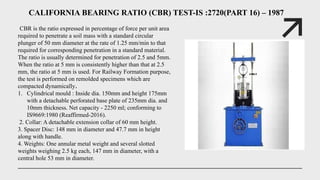
CALIFORNIA BEARING RATIO (CBR) TEST-IS :2720(PART 16) – 1987
CBR is the ratio expressed in percentage of force per unit area
required to penetrate a soil mass with a standard circular
plunger of 50 mm diameter at the rate of 1.25 mm/min to that
required for corresponding penetration in a standard material.
The ratio is usually determined for penetration of 2.5 and 5mm.
When the ratio at 5 mm is consistently higher than that at 2.5
mm, the ratio at 5 mm is used. For Railway Formation purpose,
the test is performed on remolded specimens which are
compacted dynamically.
1. Cylindrical mould : Inside dia. 150mm and height 175mm
with a detachable perforated base plate of 235mm dia. and
10mm thickness. Net capacity - 2250 ml; conforming to
IS9669:1980 (Reaffirmed-2016).
2. Collar: A detachable extension collar of 60 mm height.
3. Spacer Disc: 148 mm in diameter and 47.7 mm in height
along with handle.
4. Weights: One annular metal weight and several slotted
weights weighing 2.5 kg each, 147 mm in diameter, with a
central hole 53 mm in diameter.
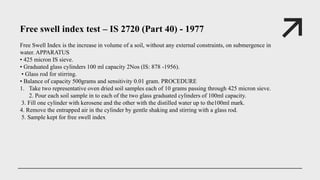
Free swell index test – IS 2720 (Part 40) - 1977
Free Swell Index is the increase in volume of a soil, without any external constraints, on submergence in
water. APPARATUS
• 425 micron IS sieve.
• Graduated glass cylinders 100 ml capacity 2Nos (IS: 878 -1956).
• Glass rod for stirring.
• Balance of capacity 500grams and sensitivity 0.01 gram. PROCEDURE
1. Take two representative oven dried soil samples each of 10 grams passing through 425 micron sieve.
2. Pour each soil sample in to each of the two glass graduated cylinders of 100ml capacity.
3. Fill one cylinder with kerosene and the other with the distilled water up to the100ml mark.
4. Remove the entrapped air in the cylinder by gentle shaking and stirring with a glass rod.
5. Sample kept for free swell index
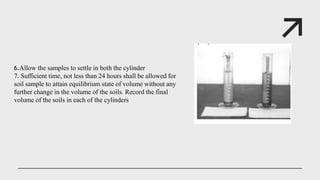
6.Allow the samples to settle in both the cylinder
7. Sufficient time, not less than 24 hours shall be allowed for
soil sample to attain equilibrium state of volume without any
further change in the volume of the soils. Record the final
volume of the soils in each of the cylinders
Conclusion :
Based on the results obtained and comparisons made in the present study, the following
conclusions can be drawn:
• The Maximum Dry Density (MDD) value of the black cotton soil initially decreased with the
addition of fly ash. Then, it showed increment with increasing fly ash content in the soil-fly ash
mixture. The maximum value of MDD was observed for a mixture of soil and 30% of fly ash content
by weight. The MDD values consistently decreased thereafter.
• The Unconfined Compressive Strength (UCS) of the soil with variation of fly ash content showed
similar trend as that of the MDD values, except the fact that the peak value was observed for a fly
ash content of 20% by weight.
• In un-soaked California Bearing Ratio (CBR) tests of soil conducted with varying fly ash content,
the CBR increased gradually with the increase in fly ash content till its valuation was 20% by
weight of the total mixture; it decreased thereafter.
• The change in case of soaked California Bearing Ratio (CBR) tests of soil with varying fly ash
content was, however, uneven. It decreased with the initial addition of fly ash (10% by weight of
total mixture), and then increased till fly ash content reached 30% by weight of total mixture. The
values decreased thereafter.

stabilization of expansive soils by using flash.pptx

  • 1.
  • 2.
    Agenda 1. ABSTRACT 2.INTRODUCTION 3. MATERIALS AND METHODOLOGY 4. RESULTS AND DISSCUSION 5. CONCLUSION
  • 3.
    ABSTRACT Nearly 51.8 millionhectares of land area in India are covered with Expansive soil (mainly Black Cotton soil). The property of these expansive soils, in general, is that they are very hard when in dry state, but they lose all of their strength when in wet state. In light of this property of expansive soils, these soils pose problems worldwide that serve as challenge to overcome for the Geotechnical engineers. One of the most important aspects for construction purposes is soil stabilization, which is used widely in foundation and road pavement constructions; this is because such a stabilization regime improves engineering properties of the soil, such as volume stability, strength and durability.
  • 4.
    INTRODUCTION Expansive soils, whichare also called as swell-shrink soil, have the tendency to shrink and swell with variation in moisture content. As a result of this variation in the soil, significant distress occurs in the soil, which is subsequently followed by damage to the overlying structures. During periods of greater moisture, like monsoons, these soils imbibe the water, and swell; subsequently, they become soft and their water holding capacity diminishes. As opposed to this, in drier seasons, like summers, these soils lose the moisture held in them due to evaporation, resulting in their becoming harder. Generally found in semi-arid and arid regions of the globe, these type of soils are regarded as potential natural hazard – if not treated, these can cause extensive damage to the structures built upon them, as well causing loss in human life. Soils whose composition includes presence of montmorillonite, in general, display these kind of properties. Tallied in billions of dollars annually worldwide, these soils have caused extensive damage to civil engineering structures.
  • 5.
    MATERIALS AND METHODOLOGY Flyash A waste material extracted from the gases emanating from coal fired furnaces, generally of a thermal power plant, is called fly ash. The mineral residue that is left behind after the burning of coal is the fly ash. The Electro Static Precipitator (ESP) of the power plants collect these fly ashes. Essentially consisting of alumina, silica and iron, fly ashes are micro-sized particles. Fly ash particles are generally spherical in size, and this property makes it easy for them to blend and flow, to make a suitable concoction. Methodology Adopted To evaluate the effect of fly ash as a stabilizing additive in expansive soils, series of tests, where the content of f ly ash in the expansive soil was varied in values of 10% to 50% (multiples of 10) by weight of the total quantity taken. The Indian Standard codes were followed during the conduction of the following experiments: 1. Standard proctor test – IS : 2720 (Part 7) - 1980 2. Unconfined compressive strength (UCS) test – IS : 2720 (Part 10) – 1991 3. California bearing ratio (CBR) test – IS : 2720 (Part 16) - 1987 4. Free swell index test – IS 2720 (Part 40) – 1977 5. Liquid & Plastic limit test – IS 2720 (Part 5) – 1985
  • 6.
    STANDARD PROCTOR COMPACTION(IS 2720-PART VII-1980) : NEED &SCOPE: Determination of the relationship between the moisture content and density of soils compacted in a mound of a given size with a 2.5 kg rammer dropped from a height of 30 cm. the results obtained from this test will be helpful in increasing the bearing capacity of foundations, Decreasing the undesirable settlement of structures, Control undesirable volume changes, Reduction in hydraulic conductivity, Increasing the stability of slopes and so on. UNCONFINED COMPRESSION TEST NEED AND SCOPE: It is not always possible to conduct the bearing capacity test in the field. Sometimes it is cheaper to take the undisturbed soil sample and test its strength in the laboratory. Also to choose the best material for the embankment, one has to conduct strength tests on the samples selected. Under these conditions it is easy to perform the unconfined compression test on undisturbed and remolded soil sample. Now we will investigate experimentally the strength of a given soil sample.
  • 7.
    CALIFORNIA BEARING RATIO(CBR) TEST-IS :2720(PART 16) – 1987 CBR is the ratio expressed in percentage of force per unit area required to penetrate a soil mass with a standard circular plunger of 50 mm diameter at the rate of 1.25 mm/min to that required for corresponding penetration in a standard material. The ratio is usually determined for penetration of 2.5 and 5mm. When the ratio at 5 mm is consistently higher than that at 2.5 mm, the ratio at 5 mm is used. For Railway Formation purpose, the test is performed on remolded specimens which are compacted dynamically. 1. Cylindrical mould : Inside dia. 150mm and height 175mm with a detachable perforated base plate of 235mm dia. and 10mm thickness. Net capacity - 2250 ml; conforming to IS9669:1980 (Reaffirmed-2016). 2. Collar: A detachable extension collar of 60 mm height. 3. Spacer Disc: 148 mm in diameter and 47.7 mm in height along with handle. 4. Weights: One annular metal weight and several slotted weights weighing 2.5 kg each, 147 mm in diameter, with a central hole 53 mm in diameter.
  • 8.
    Free swell indextest – IS 2720 (Part 40) - 1977 Free Swell Index is the increase in volume of a soil, without any external constraints, on submergence in water. APPARATUS • 425 micron IS sieve. • Graduated glass cylinders 100 ml capacity 2Nos (IS: 878 -1956). • Glass rod for stirring. • Balance of capacity 500grams and sensitivity 0.01 gram. PROCEDURE 1. Take two representative oven dried soil samples each of 10 grams passing through 425 micron sieve. 2. Pour each soil sample in to each of the two glass graduated cylinders of 100ml capacity. 3. Fill one cylinder with kerosene and the other with the distilled water up to the100ml mark. 4. Remove the entrapped air in the cylinder by gentle shaking and stirring with a glass rod. 5. Sample kept for free swell index
  • 9.
    6.Allow the samplesto settle in both the cylinder 7. Sufficient time, not less than 24 hours shall be allowed for soil sample to attain equilibrium state of volume without any further change in the volume of the soils. Record the final volume of the soils in each of the cylinders
  • 10.
    Conclusion : Based onthe results obtained and comparisons made in the present study, the following conclusions can be drawn: • The Maximum Dry Density (MDD) value of the black cotton soil initially decreased with the addition of fly ash. Then, it showed increment with increasing fly ash content in the soil-fly ash mixture. The maximum value of MDD was observed for a mixture of soil and 30% of fly ash content by weight. The MDD values consistently decreased thereafter. • The Unconfined Compressive Strength (UCS) of the soil with variation of fly ash content showed similar trend as that of the MDD values, except the fact that the peak value was observed for a fly ash content of 20% by weight. • In un-soaked California Bearing Ratio (CBR) tests of soil conducted with varying fly ash content, the CBR increased gradually with the increase in fly ash content till its valuation was 20% by weight of the total mixture; it decreased thereafter. • The change in case of soaked California Bearing Ratio (CBR) tests of soil with varying fly ash content was, however, uneven. It decreased with the initial addition of fly ash (10% by weight of total mixture), and then increased till fly ash content reached 30% by weight of total mixture. The values decreased thereafter.