International Research Journal of Engineering and Technology (IRJET) e-ISSN: 2395-0056
Volume: 06 Issue: 3 | Mar 2019 www.irjet.net p-ISSN: 2395-0072
© 2019, IRJET | Impact Factor value: 7.211 | ISO 9001:2008 Certified Journal | Page 7193
RESIDENTIAL HYDRO POWER GENERATION
Tandale Vaibhav Santoshrao1,Mhetre Tanmay Sujitkumar2, Survase Sumeet Ramchandra3,
Patil Pravin Raghuvir4,
Mr. Bidve Mangesh Angadrao5, Mr. Devshette Ashish Rajkumar6
1,2,3,4 Diploma Students, Department Of Mechanical Engineering,Vishweshwarayya Abhiyantriki Padvika
Mahavidyalay, Almala,Latur,Maharashtra,India
5Head Of Department, Mechanical Engineering Department,Vishweshwarayya Abhiyantriki Padvika
Mahavidyalay,Almala,Latur,Maharashtra,India
6Lecturer, Department Of Mechanical Engineering,Vishweshwarayya Abhiyantriki Padvika
Mahavidyalay,Almala,Latur,Maharashtra,India
---------------------------------------------------------------------***---------------------------------------------------------------------
Abstract - In this paper an attempt is made to construct a model of residential hydro power generation for running the
generator and use of battery to light up the houses which is common to rural folks. The difficulty of getting the fuel and the cost of
fuel are the main problems. Use of other alternative renewable energy such as solar photovoltaic modules, which isavailable fora
number of hours per day, is very costly. It is required to find suitable option to provide cheap and reliable option. While large
hydropower provides electrical power for industry and domestic use, small-scale hydro is making some contributions toward
providing this basic need to remote and off-grid areas especially in developing countries.
This paper is focusing on hydro-power an application which does not require complex design set up. It is cost effective,
environmentally friendly and the turbine can be manufactured locally. Water flow in the domestic pipes has kinetic energy that
potential to generate electricity for energy storage purposes in addition to the routine activities such as laundry, cook and bathe.
The inherent water pressure and flow inside the pipe from utility’s main tank that used for those usual activities is also used to
rotate small scale hydro turbine to drive a generator for electrical power generation. Hence, this project is conductedtodevelopa
small scale hydro generation system using consuming water distributed to houses as an alternative electrical energy source for
residential use.
Key Words: Generator, Hydro power Generation System, Small-scale hydropower, turbine, rural electrification,
Renewable Energy
1. INTRODUCTION
Residential hydro power generation is an application based project model which works on principle of hydro electricity
generation methods with maximum electric output of 3 KW.
It is also called PICO hydro power generator.
Hydropower can bring low-cost electricity to isolated communities without polluting the air or water. Furthermore,
hydropower is a proven technology; people have been obtaining energy from falling water. It is also a versatile power
source. AC electricity can be produced enabling standard electrical appliances to be used. Common examples of devices
which can be powered by hydropower are light bulbs, radio and televisions, and other electric appliances.
It allows electricity generation simply and at no fuel cost. The growing high demand in electrical energy is forcing man to
search for different available energy resources. The equipment used in hydroelectricity generations specialized with its
small and compact design, so that it could be installed in a small area very easily. The main benefit of hydroelectric power
generation is that it has a lower cost per kilowatt compared to that of solar or wind power.
The hydropower plant can be classified according to the size of electrical power it produces as
shown in Table 1.1.
Hydro power Type/Class
 10 MW Large
 10 MW Small
 1 MW Mini
International Research Journal of Engineering and Technology (IRJET) e-ISSN: 2395-0056
Volume: 06 Issue: 3 | Mar 2019 www.irjet.net p-ISSN: 2395-0072
© 2019, IRJET | Impact Factor value: 7.211 | ISO 9001:2008 Certified Journal | Page 7194
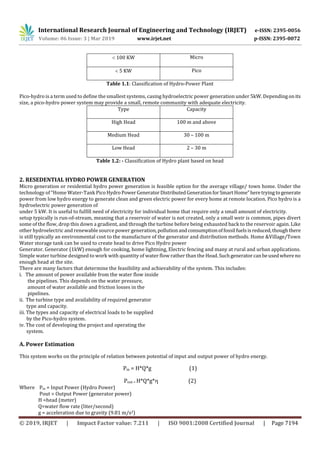
 100 KW Micro
 5 KW Pico
Table 1.1: Classification of Hydro-Power Plant
Pico-hydro is a term used to define the smallest systems, casing hydroelectric power generation under 5kW. Dependingonits
size, a pico-hydro power system may provide a small, remote community with adequate electricity.
Type Capacity
High Head 100 m and above
Medium Head 30 – 100 m
Low Head 2 – 30 m
Table 1.2: - Classification of Hydro plant based on head
2. RESEDENTIAL HYDRO POWER GENERATION
Micro generation or residential hydro power generation is feasible option for the average village/ town home. Under the
technology of “Home Water-Tank PicoHydro PowerGeneratorDistributedGeneration forSmartHome”heretrying togenerate
power from low hydro energy to generate clean and green electric power for every home at remote location. Pico hydro is a
hydroelectric power generation of
under 5 kW. It is useful to fulfill need of electricity for individual home that require only a small amount of electricity.
setup typically is run-of-stream, meaning that a reservoir of water is not created, only a small weir is common, pipes divert
some of the flow, drop this down a gradient, and through the turbine before being exhausted back to the reservoir again. Like
other hydroelectric and renewable source power generation,pollutionandconsumptionoffossil fuelsisreduced,thoughthere
is still typically an environmental cost to the manufacture of the generator and distribution methods. Home &Village/Town
Water storage tank can be used to create head to drive Pico Hydro power
Generator. Generator (1kW) enough for cooking, home lightning, Electric fencing and many at rural and urban applications.
Simple water turbine designed to work with quantity of water flow rather than the Head.Suchgeneratorcanbeusedwhereno
enough head at the site.
There are many factors that determine the feasibility and achievability of the system. This includes:
i. The amount of power available from the water flow inside
the pipelines. This depends on the water pressure,
amount of water available and friction losses in the
pipelines.
ii. The turbine type and availability of required generator
type and capacity.
iii. The types and capacity of electrical loads to be supplied
by the Pico-hydro system.
iv. The cost of developing the project and operating the
system.
A. Power Estimation
This system works on the principle of relation between potential of input and output power of hydro energy.
Pin = H*Q*g (1)
Pout = H*Q*g* (2)
Where Pin = Input Power (Hydro Power)
Pout = Output Power (generator power)
H =head (meter)
Q=water flow rate (liter/second)
g = acceleration due to gravity (9.81 m/s2)
International Research Journal of Engineering and Technology (IRJET) e-ISSN: 2395-0056
Volume: 06 Issue: 3 | Mar 2019 www.irjet.net p-ISSN: 2395-0072
© 2019, IRJET | Impact Factor value: 7.211 | ISO 9001:2008 Certified Journal | Page 7195
= efficiency
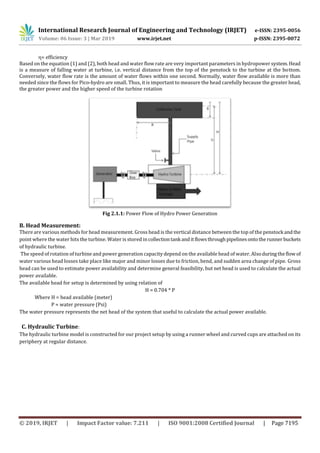
Based on the equation (1) and (2), both head and water flow rate are very important parameters in hydropower system.Head
is a measure of falling water at turbine, i.e. vertical distance from the top of the penstock to the turbine at the bottom.
Conversely, water flow rate is the amount of water flows within one second. Normally, water flow available is more than
needed since the flows for Pico-hydro are small. Thus, it is important to measure the head carefully because the greater head,
the greater power and the higher speed of the turbine rotation
Fig 2.1.1: Power Flow of Hydro Power Generation
B. Head Measurement:
There are various methods for head measurement. Gross head is the vertical distance between the top of the penstock andthe
point where the water hits the turbine. Water is stored in collectiontank anditflowsthroughpipelinesontotherunner buckets
of hydraulic turbine.
The speed of rotation of turbine and power generation capacity depend on the available head of water. Alsoduringtheflowof
water various head losses take place like major and minor losses due to friction, bend, and sudden area change of pipe. Gross
head can be used to estimate power availability and determine general feasibility, but net head is used to calculate the actual
power available.
The available head for setup is determined by using relation of
H = 0.704 * P
Where H = head available (meter)
P = water pressure (Psi)
The water pressure represents the net head of the system that useful to calculate the actual power available.
C. Hydraulic Turbine:
The hydraulic turbine model is constructed for our project setup by using a runner wheel and curved cups are attached on its
periphery at regular distance.
International Research Journal of Engineering and Technology (IRJET) e-ISSN: 2395-0056
Volume: 06 Issue: 3 | Mar 2019 www.irjet.net p-ISSN: 2395-0072
© 2019, IRJET | Impact Factor value: 7.211 | ISO 9001:2008 Certified Journal | Page 7196
Fig 2.1.2: Hydraulic Turbine runner model
The turbine with 6 cups fabricated from polyvinyl chloride (PVC). is used for the proposed system.
Reaction turbine is fully immersed in water and is enclosed in a pressure casing. The runner or rotating element and
casing are carefully engineered so that the clearance between them is minimized. In contrast, impulse turbine can operate
in air and works with high-speed jet of water.
Pelton Turbine: Pelton turbines are suitable to high head, low flow applications. It can be outfitted with one, two, or more
nozzles for higher output. Typically, when using this type of turbine, water is piped down a hillside so that at the lower end
of the pipe, it emerges from a narrow nozzle as a jet with very high velocity to the turbine blades.
Fig 2.1.3: Working Of cross flow turbine
As the fluid passes through the turbine, the fluid transfers energy to the turbine blades, creating angular momentum that
rotates a central shaft and generates electricity.
D. Flow rate:
The flow rate water flowing through pipelines from water tank to turbine depend on the elevation of tank above the
ground surface. The relation between flow rate and speed of turbine is given by
Q = A*V
The flow rate of the distributed water is diverted into a bucket or barrel and the time it takes for the container to fill is
recorded. The volume of the container is known and the flow rate is simply obtained by dividingthisvolumebythefillingtime.
For example, the flow rate of water that filled 20 liters bucket within one minute is 20 liters per minute or 0.333 l/s. This is
repeated several times to give more consistent and accurate measurement.
International Research Journal of Engineering and Technology (IRJET) e-ISSN: 2395-0056
Volume: 06 Issue: 3 | Mar 2019 www.irjet.net p-ISSN: 2395-0072
© 2019, IRJET | Impact Factor value: 7.211 | ISO 9001:2008 Certified Journal | Page 7197
D. Pipeline System and Friction Loss:
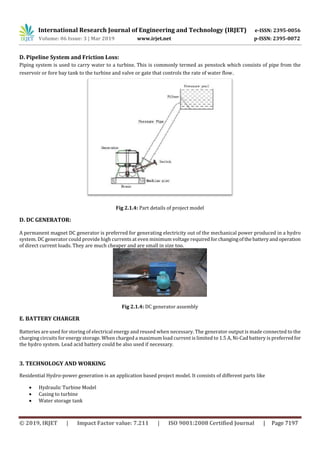
Piping system is used to carry water to a turbine. This is commonly termed as penstock which consists of pipe from the
reservoir or fore bay tank to the turbine and valve or gate that controls the rate of water flow.
Fig 2.1.4: Part details of project model
D. DC GENERATOR:
A permanent magnet DC generator is preferred for generating electricity out of the mechanical power produced in a hydro
system. DC generator could provide high currents at even minimum voltage requiredforchangingofthe batteryandoperation
of direct current loads. They are much cheaper and are small in size too.
Fig 2.1.4: DC generator assembly
E. BATTERY CHARGER
Batteries are used for storing of electrical energy and reused when necessary. The generator output is made connected to the
charging circuits for energy storage. When charged a maximum load current is limited to 1.5 A, Ni-Cad battery is preferredfor
the hydro system. Lead acid battery could be also used if necessary.
3. TECHNOLOGY AND WORKING
Residential Hydro-power generation is an application based project model. It consists of different parts like
 Hydraulic Turbine Model
 Casing to turbine
 Water storage tank
International Research Journal of Engineering and Technology (IRJET) e-ISSN: 2395-0056
Volume: 06 Issue: 3 | Mar 2019 www.irjet.net p-ISSN: 2395-0072
© 2019, IRJET | Impact Factor value: 7.211 | ISO 9001:2008 Certified Journal | Page 7198
 Pipelines
 Nozzle
 DC generator
 12 V battery
 Bearings
 Shaft
 Water sump
All above parts are arranged in a required manner to construct a project model.
Water is stored in storage tank in large quantity at the roof of buildings or at appropriate elevation above earth surface. This
provides the potential energy in stored water.
When water is allowed to freely flow through pipe then potential energy is converted into kinetic energy.
This water flow strikes on the buckets of turbine runner through nozzle.
Due to pressure head and high flow rate the turbine rotates with high speed so power is produced.
This rotation of turbine is transferred to electric generator by the shaft and bearings arrangement.
Generator converts mechanical energy into electric energy and get stored into battery.
The blade is most significant component of micro wind turbines which extracted Kinetic Energy from wind and convert into
electricity through generators. Production of Kinetic energy is influenced by Aerodynamic shape of micro wind turbines.
Micro Hydro Turbine is widely used in hydro power plants with the high head from 2m to 200m.Design water flow from
0.1m3/S to 3m3/S. Runner diameter from 0.8cm to
1meter. Capacity from 5KW to 100KW for one single turbine.
3.1 Structure of Pelton Wheel Turbine:
 The Pelton wheel is a universal component used in hydroelectricpowerproduction.ThemainpartsofthePeltonwheel are
runner, spray pipe, baffle plate, spiral casting, diversion plate.
 The main material requirements are high strength, abrasion resistance, casting suitability and ability to withstand
extensive use in water. Materials generally used are Aluminum, Copper Alloys, Grey Cast Iron, Stainless Steel and Plastic.
 Electricity from waste energy can be used for charging mobile phones in restaurants, coffee shops,hotelsorresortswhich
will have large source of waste water. This can be considered as green engineering as it is recovering waste energy. Apart
from charging mobile phones, another application may be to power to small lights on pathways.
Material Specification :
Base rod dimensions:
Length of base -1000 mm
Breadth of base -500 mm
Height of base -1020 mm
Width of rod -5 mm
Outer casing specification:
Diameter of casing -890 mm
Thickness of casing sheet -1.5 mm
Pelton wheel specification:
Diameter of pelton wheel -700mm
Width of pelton wheel sheet -50mm
Total number of cups attached -12
Motor pump specification:
Power -1 HP
Capacity -8000 LITRES/HOUR
Water inlet - 22 mm
Water outlet -8 mm
International Research Journal of Engineering and Technology (IRJET) e-ISSN: 2395-0056
Volume: 06 Issue: 3 | Mar 2019 www.irjet.net p-ISSN: 2395-0072
© 2019, IRJET | Impact Factor value: 7.211 | ISO 9001:2008 Certified Journal | Page 7199
Fig 3.1: Pelton Wheel Without Bucket
Fig 3.2: Pelton Wheel with bucket
3.2 Structure of Frame:
Design of the frame is of great importance as it has to be manufactured in order accordingly with the design and scale of
the project. The frame should have the capacity to hold the whole project firmly so that it could not fall or break down
during the running of water or running of the Pelton wheel during its live operation.
Fig3.3: Frame
3.3 Nozzle:
Nozzles are used to provide the high velocity jet coming out of the pump to thePelton wheel.Wehadmadethese differentsizes
of nozzles. The diameters of the nozzles are 20, 25, and 30mm.
3.4 Shaft:
To connect the alternator and the shaft, coupling is used. For coupling, one part of the shaft is threaded to join the alternator.
We make a key slot on the shaft and the coupling part, which is done in the lathe and the shaper machine so that the rotatory
motion of the shaft is being transferred to
alternator/generator.
International Research Journal of Engineering and Technology (IRJET) e-ISSN: 2395-0056
Volume: 06 Issue: 3 | Mar 2019 www.irjet.net p-ISSN: 2395-0072
© 2019, IRJET | Impact Factor value: 7.211 | ISO 9001:2008 Certified Journal | Page 7200
Fig3.4: Shaft
4. RESULTS:
After completion of all the required parts, an alternator/generator is fitted to the main shaft of the rotating turbine and a
proper cover is made by using sheet metal so that water could not get entered inside the turbine which may cause some
problems to the alternator used. As all the required parts are manufactured and fabricated painting is done ontheall required
parts so that there should not be any rusting problem. Painting also gives an attractive look to the model.
Fig 4.1: Final project Model
5. DISCUSSION ON PROJECT MODEL :
 The design and fabricated model have given around 500 rpm when rotated with the help of a pump under theartificial headof
15m. This rpm can be further enhanced by using a higher head resulting in more discharge of water and more jet velocity.
 The Pelton wheel may not rotate after a while or stop rotating if enough RPM is not generated as per the limitations of the
Alternator due to partial excitation of the rotor. Partial excitation of the rotor inside the alternatorgeneratesopposition force
to the rotating shaft. If we can overcome this force, then only current will be generated produced/generatedinthealternator.
 If there is manufacturing defect in the alignment of the Pelton wheel, then there will be vibrations to the Pelton wheel which
may result in fewer rotations or zero rotations
 The Pelton wheel, shaft and Alternator should be held tightly in the frame so that there must be lesser vibrations as much as
possible.
 The design of the nozzle should be such that it could discharge the required amount of water without any failure with a high
velocity. This velocity of jet would generate the force on the Pelton wheel will lastly rote the conductor of the Alternator.
International Research Journal of Engineering and Technology (IRJET) e-ISSN: 2395-0056
Volume: 06 Issue: 3 | Mar 2019 www.irjet.net p-ISSN: 2395-0072
© 2019, IRJET | Impact Factor value: 7.211 | ISO 9001:2008 Certified Journal | Page 7201
6. CONCLUSION:
Residential hydro power generation system is to be designed as an alternative energy resource by consuming water from
the water tank of residential buildings. This could be a reliable and eco-friendly form of energy, which can be generated to
develop small scale hydro generation. This is very versatile power source that could be used to generate AC electricity even
at remote places along around the globe.
Hydroelectric power has an important role to play in the future, and provides considerable benefits to an integrated electric
system.
7. REFRENCES:
 A Textbook of Hydraulic machines- by R.K. Rajput
 Principles of electrical machines- by V.K. Mehta and Rohit Mehta
 www.ehow.com
 www.googlescholar.com
 Ministry of power, Government of India 2010 www.powermin.nic.in
 Renewables 2011 Global Status Reports, page25, Hydropower
 D. Singh, Micro-Hydro-Power, Resource Assessment Handbook, An Initiative of the Asian and Pacific Center for Transfer of
Technology, September (2009).

IRJET- Residential Hydro Power Generation

  • 1.
    International Research Journalof Engineering and Technology (IRJET) e-ISSN: 2395-0056 Volume: 06 Issue: 3 | Mar 2019 www.irjet.net p-ISSN: 2395-0072 © 2019, IRJET | Impact Factor value: 7.211 | ISO 9001:2008 Certified Journal | Page 7193 RESIDENTIAL HYDRO POWER GENERATION Tandale Vaibhav Santoshrao1,Mhetre Tanmay Sujitkumar2, Survase Sumeet Ramchandra3, Patil Pravin Raghuvir4, Mr. Bidve Mangesh Angadrao5, Mr. Devshette Ashish Rajkumar6 1,2,3,4 Diploma Students, Department Of Mechanical Engineering,Vishweshwarayya Abhiyantriki Padvika Mahavidyalay, Almala,Latur,Maharashtra,India 5Head Of Department, Mechanical Engineering Department,Vishweshwarayya Abhiyantriki Padvika Mahavidyalay,Almala,Latur,Maharashtra,India 6Lecturer, Department Of Mechanical Engineering,Vishweshwarayya Abhiyantriki Padvika Mahavidyalay,Almala,Latur,Maharashtra,India ---------------------------------------------------------------------***--------------------------------------------------------------------- Abstract - In this paper an attempt is made to construct a model of residential hydro power generation for running the generator and use of battery to light up the houses which is common to rural folks. The difficulty of getting the fuel and the cost of fuel are the main problems. Use of other alternative renewable energy such as solar photovoltaic modules, which isavailable fora number of hours per day, is very costly. It is required to find suitable option to provide cheap and reliable option. While large hydropower provides electrical power for industry and domestic use, small-scale hydro is making some contributions toward providing this basic need to remote and off-grid areas especially in developing countries. This paper is focusing on hydro-power an application which does not require complex design set up. It is cost effective, environmentally friendly and the turbine can be manufactured locally. Water flow in the domestic pipes has kinetic energy that potential to generate electricity for energy storage purposes in addition to the routine activities such as laundry, cook and bathe. The inherent water pressure and flow inside the pipe from utility’s main tank that used for those usual activities is also used to rotate small scale hydro turbine to drive a generator for electrical power generation. Hence, this project is conductedtodevelopa small scale hydro generation system using consuming water distributed to houses as an alternative electrical energy source for residential use. Key Words: Generator, Hydro power Generation System, Small-scale hydropower, turbine, rural electrification, Renewable Energy 1. INTRODUCTION Residential hydro power generation is an application based project model which works on principle of hydro electricity generation methods with maximum electric output of 3 KW. It is also called PICO hydro power generator. Hydropower can bring low-cost electricity to isolated communities without polluting the air or water. Furthermore, hydropower is a proven technology; people have been obtaining energy from falling water. It is also a versatile power source. AC electricity can be produced enabling standard electrical appliances to be used. Common examples of devices which can be powered by hydropower are light bulbs, radio and televisions, and other electric appliances. It allows electricity generation simply and at no fuel cost. The growing high demand in electrical energy is forcing man to search for different available energy resources. The equipment used in hydroelectricity generations specialized with its small and compact design, so that it could be installed in a small area very easily. The main benefit of hydroelectric power generation is that it has a lower cost per kilowatt compared to that of solar or wind power. The hydropower plant can be classified according to the size of electrical power it produces as shown in Table 1.1. Hydro power Type/Class  10 MW Large  10 MW Small  1 MW Mini
  • 2.
    International Research Journalof Engineering and Technology (IRJET) e-ISSN: 2395-0056 Volume: 06 Issue: 3 | Mar 2019 www.irjet.net p-ISSN: 2395-0072 © 2019, IRJET | Impact Factor value: 7.211 | ISO 9001:2008 Certified Journal | Page 7194  100 KW Micro  5 KW Pico Table 1.1: Classification of Hydro-Power Plant Pico-hydro is a term used to define the smallest systems, casing hydroelectric power generation under 5kW. Dependingonits size, a pico-hydro power system may provide a small, remote community with adequate electricity. Type Capacity High Head 100 m and above Medium Head 30 – 100 m Low Head 2 – 30 m Table 1.2: - Classification of Hydro plant based on head 2. RESEDENTIAL HYDRO POWER GENERATION Micro generation or residential hydro power generation is feasible option for the average village/ town home. Under the technology of “Home Water-Tank PicoHydro PowerGeneratorDistributedGeneration forSmartHome”heretrying togenerate power from low hydro energy to generate clean and green electric power for every home at remote location. Pico hydro is a hydroelectric power generation of under 5 kW. It is useful to fulfill need of electricity for individual home that require only a small amount of electricity. setup typically is run-of-stream, meaning that a reservoir of water is not created, only a small weir is common, pipes divert some of the flow, drop this down a gradient, and through the turbine before being exhausted back to the reservoir again. Like other hydroelectric and renewable source power generation,pollutionandconsumptionoffossil fuelsisreduced,thoughthere is still typically an environmental cost to the manufacture of the generator and distribution methods. Home &Village/Town Water storage tank can be used to create head to drive Pico Hydro power Generator. Generator (1kW) enough for cooking, home lightning, Electric fencing and many at rural and urban applications. Simple water turbine designed to work with quantity of water flow rather than the Head.Suchgeneratorcanbeusedwhereno enough head at the site. There are many factors that determine the feasibility and achievability of the system. This includes: i. The amount of power available from the water flow inside the pipelines. This depends on the water pressure, amount of water available and friction losses in the pipelines. ii. The turbine type and availability of required generator type and capacity. iii. The types and capacity of electrical loads to be supplied by the Pico-hydro system. iv. The cost of developing the project and operating the system. A. Power Estimation This system works on the principle of relation between potential of input and output power of hydro energy. Pin = H*Q*g (1) Pout = H*Q*g* (2) Where Pin = Input Power (Hydro Power) Pout = Output Power (generator power) H =head (meter) Q=water flow rate (liter/second) g = acceleration due to gravity (9.81 m/s2)
  • 3.
    International Research Journalof Engineering and Technology (IRJET) e-ISSN: 2395-0056 Volume: 06 Issue: 3 | Mar 2019 www.irjet.net p-ISSN: 2395-0072 © 2019, IRJET | Impact Factor value: 7.211 | ISO 9001:2008 Certified Journal | Page 7195 = efficiency Based on the equation (1) and (2), both head and water flow rate are very important parameters in hydropower system.Head is a measure of falling water at turbine, i.e. vertical distance from the top of the penstock to the turbine at the bottom. Conversely, water flow rate is the amount of water flows within one second. Normally, water flow available is more than needed since the flows for Pico-hydro are small. Thus, it is important to measure the head carefully because the greater head, the greater power and the higher speed of the turbine rotation Fig 2.1.1: Power Flow of Hydro Power Generation B. Head Measurement: There are various methods for head measurement. Gross head is the vertical distance between the top of the penstock andthe point where the water hits the turbine. Water is stored in collectiontank anditflowsthroughpipelinesontotherunner buckets of hydraulic turbine. The speed of rotation of turbine and power generation capacity depend on the available head of water. Alsoduringtheflowof water various head losses take place like major and minor losses due to friction, bend, and sudden area change of pipe. Gross head can be used to estimate power availability and determine general feasibility, but net head is used to calculate the actual power available. The available head for setup is determined by using relation of H = 0.704 * P Where H = head available (meter) P = water pressure (Psi) The water pressure represents the net head of the system that useful to calculate the actual power available. C. Hydraulic Turbine: The hydraulic turbine model is constructed for our project setup by using a runner wheel and curved cups are attached on its periphery at regular distance.
  • 4.
    International Research Journalof Engineering and Technology (IRJET) e-ISSN: 2395-0056 Volume: 06 Issue: 3 | Mar 2019 www.irjet.net p-ISSN: 2395-0072 © 2019, IRJET | Impact Factor value: 7.211 | ISO 9001:2008 Certified Journal | Page 7196 Fig 2.1.2: Hydraulic Turbine runner model The turbine with 6 cups fabricated from polyvinyl chloride (PVC). is used for the proposed system. Reaction turbine is fully immersed in water and is enclosed in a pressure casing. The runner or rotating element and casing are carefully engineered so that the clearance between them is minimized. In contrast, impulse turbine can operate in air and works with high-speed jet of water. Pelton Turbine: Pelton turbines are suitable to high head, low flow applications. It can be outfitted with one, two, or more nozzles for higher output. Typically, when using this type of turbine, water is piped down a hillside so that at the lower end of the pipe, it emerges from a narrow nozzle as a jet with very high velocity to the turbine blades. Fig 2.1.3: Working Of cross flow turbine As the fluid passes through the turbine, the fluid transfers energy to the turbine blades, creating angular momentum that rotates a central shaft and generates electricity. D. Flow rate: The flow rate water flowing through pipelines from water tank to turbine depend on the elevation of tank above the ground surface. The relation between flow rate and speed of turbine is given by Q = A*V The flow rate of the distributed water is diverted into a bucket or barrel and the time it takes for the container to fill is recorded. The volume of the container is known and the flow rate is simply obtained by dividingthisvolumebythefillingtime. For example, the flow rate of water that filled 20 liters bucket within one minute is 20 liters per minute or 0.333 l/s. This is repeated several times to give more consistent and accurate measurement.
  • 5.
    International Research Journalof Engineering and Technology (IRJET) e-ISSN: 2395-0056 Volume: 06 Issue: 3 | Mar 2019 www.irjet.net p-ISSN: 2395-0072 © 2019, IRJET | Impact Factor value: 7.211 | ISO 9001:2008 Certified Journal | Page 7197 D. Pipeline System and Friction Loss: Piping system is used to carry water to a turbine. This is commonly termed as penstock which consists of pipe from the reservoir or fore bay tank to the turbine and valve or gate that controls the rate of water flow. Fig 2.1.4: Part details of project model D. DC GENERATOR: A permanent magnet DC generator is preferred for generating electricity out of the mechanical power produced in a hydro system. DC generator could provide high currents at even minimum voltage requiredforchangingofthe batteryandoperation of direct current loads. They are much cheaper and are small in size too. Fig 2.1.4: DC generator assembly E. BATTERY CHARGER Batteries are used for storing of electrical energy and reused when necessary. The generator output is made connected to the charging circuits for energy storage. When charged a maximum load current is limited to 1.5 A, Ni-Cad battery is preferredfor the hydro system. Lead acid battery could be also used if necessary. 3. TECHNOLOGY AND WORKING Residential Hydro-power generation is an application based project model. It consists of different parts like  Hydraulic Turbine Model  Casing to turbine  Water storage tank
  • 6.
    International Research Journalof Engineering and Technology (IRJET) e-ISSN: 2395-0056 Volume: 06 Issue: 3 | Mar 2019 www.irjet.net p-ISSN: 2395-0072 © 2019, IRJET | Impact Factor value: 7.211 | ISO 9001:2008 Certified Journal | Page 7198  Pipelines  Nozzle  DC generator  12 V battery  Bearings  Shaft  Water sump All above parts are arranged in a required manner to construct a project model. Water is stored in storage tank in large quantity at the roof of buildings or at appropriate elevation above earth surface. This provides the potential energy in stored water. When water is allowed to freely flow through pipe then potential energy is converted into kinetic energy. This water flow strikes on the buckets of turbine runner through nozzle. Due to pressure head and high flow rate the turbine rotates with high speed so power is produced. This rotation of turbine is transferred to electric generator by the shaft and bearings arrangement. Generator converts mechanical energy into electric energy and get stored into battery. The blade is most significant component of micro wind turbines which extracted Kinetic Energy from wind and convert into electricity through generators. Production of Kinetic energy is influenced by Aerodynamic shape of micro wind turbines. Micro Hydro Turbine is widely used in hydro power plants with the high head from 2m to 200m.Design water flow from 0.1m3/S to 3m3/S. Runner diameter from 0.8cm to 1meter. Capacity from 5KW to 100KW for one single turbine. 3.1 Structure of Pelton Wheel Turbine:  The Pelton wheel is a universal component used in hydroelectricpowerproduction.ThemainpartsofthePeltonwheel are runner, spray pipe, baffle plate, spiral casting, diversion plate.  The main material requirements are high strength, abrasion resistance, casting suitability and ability to withstand extensive use in water. Materials generally used are Aluminum, Copper Alloys, Grey Cast Iron, Stainless Steel and Plastic.  Electricity from waste energy can be used for charging mobile phones in restaurants, coffee shops,hotelsorresortswhich will have large source of waste water. This can be considered as green engineering as it is recovering waste energy. Apart from charging mobile phones, another application may be to power to small lights on pathways. Material Specification : Base rod dimensions: Length of base -1000 mm Breadth of base -500 mm Height of base -1020 mm Width of rod -5 mm Outer casing specification: Diameter of casing -890 mm Thickness of casing sheet -1.5 mm Pelton wheel specification: Diameter of pelton wheel -700mm Width of pelton wheel sheet -50mm Total number of cups attached -12 Motor pump specification: Power -1 HP Capacity -8000 LITRES/HOUR Water inlet - 22 mm Water outlet -8 mm
  • 7.
    International Research Journalof Engineering and Technology (IRJET) e-ISSN: 2395-0056 Volume: 06 Issue: 3 | Mar 2019 www.irjet.net p-ISSN: 2395-0072 © 2019, IRJET | Impact Factor value: 7.211 | ISO 9001:2008 Certified Journal | Page 7199 Fig 3.1: Pelton Wheel Without Bucket Fig 3.2: Pelton Wheel with bucket 3.2 Structure of Frame: Design of the frame is of great importance as it has to be manufactured in order accordingly with the design and scale of the project. The frame should have the capacity to hold the whole project firmly so that it could not fall or break down during the running of water or running of the Pelton wheel during its live operation. Fig3.3: Frame 3.3 Nozzle: Nozzles are used to provide the high velocity jet coming out of the pump to thePelton wheel.Wehadmadethese differentsizes of nozzles. The diameters of the nozzles are 20, 25, and 30mm. 3.4 Shaft: To connect the alternator and the shaft, coupling is used. For coupling, one part of the shaft is threaded to join the alternator. We make a key slot on the shaft and the coupling part, which is done in the lathe and the shaper machine so that the rotatory motion of the shaft is being transferred to alternator/generator.
  • 8.
    International Research Journalof Engineering and Technology (IRJET) e-ISSN: 2395-0056 Volume: 06 Issue: 3 | Mar 2019 www.irjet.net p-ISSN: 2395-0072 © 2019, IRJET | Impact Factor value: 7.211 | ISO 9001:2008 Certified Journal | Page 7200 Fig3.4: Shaft 4. RESULTS: After completion of all the required parts, an alternator/generator is fitted to the main shaft of the rotating turbine and a proper cover is made by using sheet metal so that water could not get entered inside the turbine which may cause some problems to the alternator used. As all the required parts are manufactured and fabricated painting is done ontheall required parts so that there should not be any rusting problem. Painting also gives an attractive look to the model. Fig 4.1: Final project Model 5. DISCUSSION ON PROJECT MODEL :  The design and fabricated model have given around 500 rpm when rotated with the help of a pump under theartificial headof 15m. This rpm can be further enhanced by using a higher head resulting in more discharge of water and more jet velocity.  The Pelton wheel may not rotate after a while or stop rotating if enough RPM is not generated as per the limitations of the Alternator due to partial excitation of the rotor. Partial excitation of the rotor inside the alternatorgeneratesopposition force to the rotating shaft. If we can overcome this force, then only current will be generated produced/generatedinthealternator.  If there is manufacturing defect in the alignment of the Pelton wheel, then there will be vibrations to the Pelton wheel which may result in fewer rotations or zero rotations  The Pelton wheel, shaft and Alternator should be held tightly in the frame so that there must be lesser vibrations as much as possible.  The design of the nozzle should be such that it could discharge the required amount of water without any failure with a high velocity. This velocity of jet would generate the force on the Pelton wheel will lastly rote the conductor of the Alternator.
  • 9.
    International Research Journalof Engineering and Technology (IRJET) e-ISSN: 2395-0056 Volume: 06 Issue: 3 | Mar 2019 www.irjet.net p-ISSN: 2395-0072 © 2019, IRJET | Impact Factor value: 7.211 | ISO 9001:2008 Certified Journal | Page 7201 6. CONCLUSION: Residential hydro power generation system is to be designed as an alternative energy resource by consuming water from the water tank of residential buildings. This could be a reliable and eco-friendly form of energy, which can be generated to develop small scale hydro generation. This is very versatile power source that could be used to generate AC electricity even at remote places along around the globe. Hydroelectric power has an important role to play in the future, and provides considerable benefits to an integrated electric system. 7. REFRENCES:  A Textbook of Hydraulic machines- by R.K. Rajput  Principles of electrical machines- by V.K. Mehta and Rohit Mehta  www.ehow.com  www.googlescholar.com  Ministry of power, Government of India 2010 www.powermin.nic.in  Renewables 2011 Global Status Reports, page25, Hydropower  D. Singh, Micro-Hydro-Power, Resource Assessment Handbook, An Initiative of the Asian and Pacific Center for Transfer of Technology, September (2009).