International Research Journal of Engineering and Technology (IRJET) e-ISSN: 2395-0056
Volume: 06 Issue: 03 | Mar 2019 www.irjet.net p-ISSN: 2395-0072
© 2019, IRJET | Impact Factor value: 7.211 | ISO 9001:2008 Certified Journal | Page 5397
IOT Based Real-Time Water Quality Monitoring and Reporting
Kalpesh Misal1, Shubham Nagare2, Sandip Walunj3, Nikhil Dugaje4,
Shubham Yadav5, Tushar Kute6
1U. G. Student, Sandip Institute of Technology and Research Centre, Maharashtra, India
2U. G. Student, Sandip Institute of Technology and Research Centre, Maharashtra, India
3Asst. Professor, Sandip Institute of Technology and Research Centre, Maharashtra, India
4U. G. Student, Sandip Institute of Technology and Research Centre, Maharashtra, India
5U. G. Student, Sandip Institute of Technology and Research Centre, Maharashtra, India
6Associate Director, MITU Skillologies, Maharashtra, India
---------------------------------------------------------------------***---------------------------------------------------------------------
Abstract - Water is one of the essential resources for life on
the earth. And the major concern is to find that whether the
water is contaminated or pure. In Internet of Things (IOT)
environment there is increase in development of various
technological advanced systems. For real-timedataacquisition,
transmission and processing the water quality monitoring
system monitors various parameters that defines the nature of
water. This system is the implementation of integration of
sensors with Single Board Computer for real time water quality
monitoring in an IOT environment.Thenbasedoncollecteddata
generate the water quality report and forward the same to the
officials who are intended to resolve those issues. This
immediate reporting cause to resolve the issues in less time so
citizens will not face those issues for longer time. This water
quality monitoring system consists of Raspberry pi, sensors,
GPRS based wireless communicationmoduleandcloudstorage.
The Raspberry pi is the core component of the proposed system
and it has programs in Python programming language to
operate with different kinds of sensors used in system.
Whenever unacceptable qualityofwaterisdetectedthesystem
will report about quality of water to respected authorities or
officials. Also, the residents of the particular area can viewthe
intended data, alerts and notifications on web portal. This
system relies on the raspberry pi, sensors used and the
availability of cloud service.
Keywords: Internet of Things, Single Board Computer,
real-time, water quality report, sensors, web portal, cloud
service
1.INTRODUCTION
Water is a limited resource on the earth and is important for
existence of human being and other creatures. Water is also
necessary for agriculture and industrial uses. Whileusingthe
water it is important to determine the quality of water as it
has many bad effects on human beings if it is contaminated
[4]. People face many health-related issues because of using
contaminated water. An efficient water quality monitoring
system is potential constraint for determining quality of
water for domestic usage [1]. Internet of Things (IoT) is a
network of intelligent things. In which these things or object
communicate with each other. The IoT is used to sense the
object and control them remotely over available functioning
network resources,whichgiveadvantageof directintegration
between the physical world and digital systems along with
benefits in terms of efficiency, accuracy and economic.
Monitoring of water level is used for determining how much
amount of water is being used. So, it will help to determine
average amount of water resource may require in future.
Also, to track excess use of water that allows to save water as
much as possible [2]. The existing water quality monitoring
systems monitors quality of water in dams, large silos and
reservoirs. But many times, there are incidents of supply of
impure water to citizens still after the treatment process.
Where water contains turbidity, inadmissible pH level and
many dissolved substances that can be determined by
checking conductivity of water. In such incidents people have
to complaint regarding it to the authorities. So, this became
the time taking process. Because of that people have to face
the problem for longer time. But the proposed system will
overcome this issue. This system will keep monitoring the
quality of water continuously. Whenever system detect that,
water quality has crossed the acceptance range of
parameters defining the nature of water, immediately the
report will be generated and sent to the authorities. This
information will be likewise accessible to residents of the
proposed territory through the website.Thissystem consists
of Raspberry Pi, pH sensor, turbidity sensor, conductivity
sensor, temperature sensor, ultrasonic distance sensor and
GPRS module etc. The raspberry pi is the core component of
the system that has an interface to connect multiple sensors.
Raspberry pi collects or read the datafrommultiplesensorsin
parallel and keep in local memory till the interval of sending
collected data to the cloud storage. The turbidity sensor is
used to measure the amount of particles of solid matter
suspended in the water. Water appears to be cloudy if it is
turbid and temperature of water raises as increase in level of
turbidity, because suspended particlesabsorbtheheat. Warm
water holds less dissolved oxygen than cold, so increased
water temperatures result in decreased levels of dissolved
oxygen. The unit of measuring turbidity is NTU i.e.
International Research Journal of Engineering and Technology (IRJET) e-ISSN: 2395-0056
Volume: 06 Issue: 03 | Mar 2019 www.irjet.net p-ISSN: 2395-0072
© 2019, IRJET | Impact Factor value: 7.211 | ISO 9001:2008 Certified Journal | Page 5398
Nephelometric Turbidity Units. Then the pH sensor is usedto
determine the pH level of water. Environmental Protection
Agency concluded that, consuming highly acidic or alkaline
water is harmful for human health. As per the EPA standards
drinking water must have pH value in the range of 6.5 to 8.5.
The conductivity sensor measures the capability of water to
pass electric current. This is an indicator of theconcentration
of dissolved electrolyte ions in the water. It doesn't identify
the specific ions in the water. However, significant increases
in conductivity may be an indicator that polluting discharges
have entered the water. The basic unit of measurement for
conductivity is micromhos per centimetre (µmhos/cm) or
micro siemens per centimetre(µS/cm).Also,thetemperature
sensor is used for monitoring temperature of water.
Raspberry pi continuously collect data from all of these
sensors and holds in memory. After specifictimeintervalthat
data will be sent to cloud storageovertheinternetconnection
which is established using GPRS module. If any of the sensor
value hits the threshold values set as per standards, then the
report is generated and sent to the respective officials. All
this data will be available through website which is easily
accessible to citizens and respective authorities. This system
implementation provides advantage of accuracy, immediate
reporting and efficiency.
2. LITERATURE SURVEY
In this paper [1], they introduced a system for detecting
impurities in the water and maintaining qualityof water. This
system uses pH sensor for detecting pH level of water. Then
the IR circuit is used for determining change in colour of
water. Laser sensor checks the presence of any solid
impurities. Whenever system detects the impurities, it will
successfully produce necessary alerts. This system was
basically proposed for monitoring quality of water in public
water distribution tanks. This system can be improved by
adding more sensors and implementing using IOT.
In this paper [2], author proposed an IOT based system for
detecting level and leakage of water. Italsomonitorsqualityof
water. This system controls waterpumpusingrelayasperthe
level of water. Here the automation was done for filling tanks
of water when they became empty by switching the relay of
water pump. All data collected using pH and turbiditysensors
will be available through website. On occurrenceof particular
event the SMS notifications informing waterlevel,qualityand
pressure are sent to the registered devices.
Online water quality monitoring system [3] introduced by
author consist of multiple monitoring nodes at different
locations that collect data and stores at cloud storage. Here
operating range and specifications of different sensors along
with their working principle are explained. It consists of GUI
platform developed with the help of Borland html and java
programming. This project was proposed for monitoring
quality of water in dams and rivers. Where the solution is
provided for overcoming disadvantagesoftraditionalprocess
of collecting water samples and testing them in laboratories.
This system is limited to monitoring quality of water at dams
and rivers.
Reconfigurable water quality monitoring system [4] was
based on Wireless Sensor Network technology. It consists of
FPGA design board which is programmed using VHDL and C
Programming language. This board was integrated with
sensors and using ZigBee module communication was done
with personal computer. It is local networkinwhichpersonal
computer act as central station where all data sent by
monitoring nodes are stored and one can monitor it. This
system has highly complex architecture which is difficult to
implement. In this paper, author has focused on system
implemented using WSN in an IOT environment.
In this system [5], impurities in water are detected by
measuring capacitance. Here author proposed the design of
the capacitive sensor. This sensor consists of two parallel
copper plates. Second plate has slightly larger dimension for
alignment purpose. The detection circuit usedtheautorange
detection schemes for two different ranges of capacitors. By
using this sensor, data was collected by Arduino Uno
microcontrollerboardandfurtherprocessing wasperformed.
In this paper author also investigatedimpuritieswithvarious
concentrations of Sodium Chloride, Sugar, Ferrous Sulphate
and Copper Sulphate. Then the practical relationships are
developed by which type of impurityanditsconcentrationcan
be determined. This system is accurate enough to serve its
purpose with maximum error less than 6 %.
A wireless sensor networks-based system [6] was developed
for controlling water levels in tanks and to detect pipeline
leakages. Any leak detectioninwaterpipelineisperformedby
using flow sensitive resistor (FSR). Whenever pipeline
leakage is detected sound alerts are generated. Thiswillavoid
the large amount of water being wasted. Also, when water
tank became empty water pump is automatically powered
ON and when tank gets full it will be switched OFF
automatically. The main purpose ofsystemistosaveasmuch
as possible amount of water from getting wasted.Thissystem
successfully performed its activities but it can be improved
by integrating more sensors into system.
An autonomous surface vehicle design was proposed by
authors [7], which can be navigated over water streams as
per the directions provided by monitoring station. This
vehicle collects water quality data from different locations of
water streams. It is equipped with multiple sensors for
determining quality of water. It has ability of laser-based
obstacle avoidance and vision-based inspection capabilities.
This solar powered vehicle is capable of collecting numerous
water quality information throughout watercolumnwhilstin
motion. It can also measurereleaseofvariousgreenhouse gas
emissions. By using this vehicle authors successfully
completed survey of hundreds of kilometres.
International Research Journal of Engineering and Technology (IRJET) e-ISSN: 2395-0056
Volume: 06 Issue: 03 | Mar 2019 www.irjet.net p-ISSN: 2395-0072
© 2019, IRJET | Impact Factor value: 7.211 | ISO 9001:2008 Certified Journal | Page 5399
3. SYSTEM ARCHITECTURE
Water storage is equipped with the sensors such as turbidity
sensor, pH sensor, conductivity sensor for measuring quality
of water, temperature sensor monitors the temperature of
water and ultrasonic distance sensor determine the level of
water in storage tanks. Raspberrypiworks withdigitalinputs
and outputs. But turbidity sensor and pH sensor provide the
output in the analogue format. So, this analogue signal is
converted into digital by using MCP3008 ADC chip and
output of this chip is provided to raspberry pi. Raspberry pi
collects the data in each predefined time interval. This data
remains in memory until it is sent to the cloud storage or if
network is not available then store it in local file system. This
system requires internet connection which is establishusing
Sim800-GPRS module for communicating with cloudstorage.
It is a real time system. Hence, there is no need of any human
or other machine interaction to measure the qualityof water.
Following figure [Fig.1] shows the arrangement of various
components of system.
Fig -1: Architecture of working model
As shown in Fig 1, water storage is equipped with multiple
sensors and these sensors are connected with raspberry pi.
The turbidity sensor, pH sensor and conductivity sensor are
connected to raspberry pi through MCP3008 ADC chip for
converting analog signals from sensors todigitalsignal.These
three sensors and also temperature sensor is immersed in
water. Temperaturesensorandultrasonic distancesensor are
directly connected to raspberry pi. Distance sensor is
mounted at the top of the for determininglevelofwater.Then
raspberry pi sends collected data to cloud storage by using
Sim800 GPRS module. Cloud storage is the place where all
data from raspberry pi is stored into database as well as the
web portal is hosted. All data stored at cloud can be accessed
through web portal. Authorities can login to web portal tosee
all data from past to the current instanceoftime.Theycan get
access to reports generated for quality of water and also can
post some information if required. Citizens can view data
intended to their residential area and alert / notifications,
information post by the authorities. System will send the
reports to authorities by e-mail and SMS. Also, the citizens
who are registered their mobile numbers on system can get
the SMS.
4. EXPERIMENTAL SETUP
The Fig 2 shows the connections of Turbidity sensor SKU:
SEN0189 and custom designed conductivity probe with
raspberry pi. Both the sensors give analog output. So, these
sensors are connected through MCP3008 analog to digital
converter. Turbidity sensor connected to channel 0 and
conductivity sensor connected to channel 1 of the MCP3008.
ADC chip generate digital output and gives it as an input to
the raspberry pi. Operating voltage of both the sensor is 5V.
Turbidity sensor gives analog output in the range of 0 – 4.5V
with response time < 500ms. Then this voltage is mapped
into turbidity value. It also has the digital output mode where
you can set threshold value on sensor rather than in
programs on which it operates. It giveslogic1atoutput when
turbidity value exceeds threshold value.
Fig -2: Connections of turbidity and conductivity
sensor to Raspberry Pi
In Fig 3 the connections of pH sensor, ultrasonic distance
sensor and temperature sensor with raspberrypiareshown.
The pH electrode is connectedtopHsensormoduleusingBNC
connector. The pH sensor also works in analog mode. Hence,
it is also connected through MCP3008 ADC to convert analog
output signal from sensor to digital.Itisconnectedtochannel
2 of ADC chip. This sensor operates at 5V power. If power is
less than 5V sensor gives incorrect output. pH measuring
range of sensor is between 0-14 pH. The temperature sensor
wired in such way that it will allow to enable 1-wire protocol.
This protocol uses only 1 wire to communicate complete
information about the state of the sensor. It is device
communication bus system which gives ability of low-speed
data, signalling and power over a single conductor. It is
possible to connect upto 75 devices to one bus. Sensor works
with 3V - 5V power. An ultrasonic distance sensor (HC-SR04)
is a digital sensor that can be directly connected with
raspberry pi. It consists of Vcc, Trig, Echo and Gnd pins. Here
Echo pin gives output of 5V and Trig pin take
input of 3.3V so there will be variation in voltage levels. This
problem can be eliminated by using voltage divider network.
International Research Journal of Engineering and Technology (IRJET) e-ISSN: 2395-0056
Volume: 06 Issue: 03 | Mar 2019 www.irjet.net p-ISSN: 2395-0072
© 2019, IRJET | Impact Factor value: 7.211 | ISO 9001:2008 Certified Journal | Page 5400
This network will drop the voltage divider network. This
network will drop the voltage to GPIO pin from 5V to 3.3V.
Fig -3: Connection of pH sensor, distance sensor and
temperature sensor to Raspberry Pi
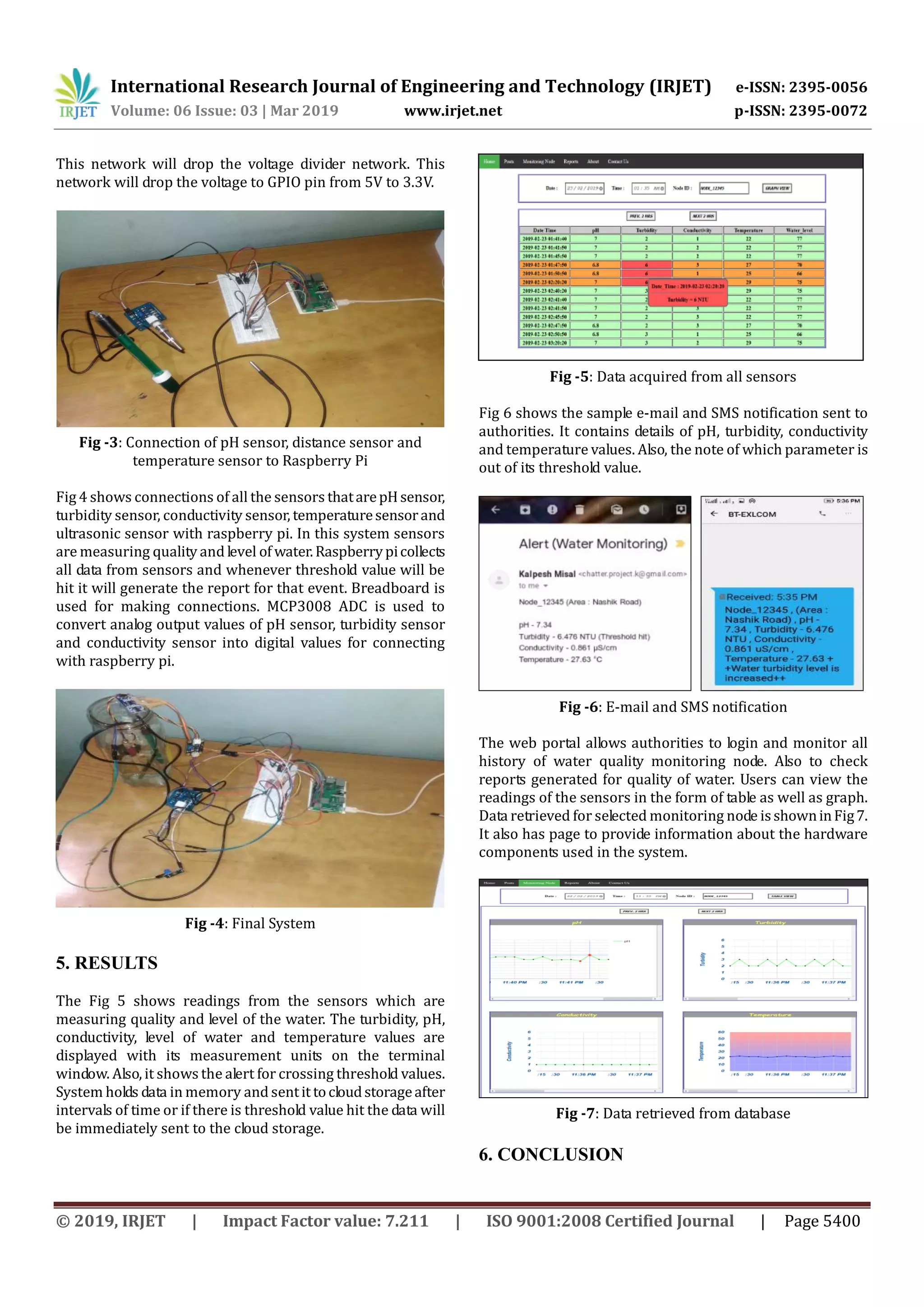
Fig 4 shows connections of all the sensors thatarepHsensor,
turbidity sensor, conductivity sensor, temperaturesensorand
ultrasonic sensor with raspberry pi. In this system sensors
are measuring quality and level of water.Raspberrypicollects
all data from sensors and whenever threshold value will be
hit it will generate the report for that event. Breadboard is
used for making connections. MCP3008 ADC is used to
convert analog output values of pH sensor, turbidity sensor
and conductivity sensor into digital values for connecting
with raspberry pi.
Fig -4: Final System
5. RESULTS
The Fig 5 shows readings from the sensors which are
measuring quality and level of the water. The turbidity, pH,
conductivity, level of water and temperature values are
displayed with its measurement units on the terminal
window. Also, it shows the alert for crossing threshold values.
System holds data in memory and sentit tocloudstorageafter
intervals of time or if there is threshold value hit the data will
be immediately sent to the cloud storage.
Fig -5: Data acquired from all sensors
Fig 6 shows the sample e-mail and SMS notification sent to
authorities. It contains details of pH, turbidity, conductivity
and temperature values. Also, the note of which parameter is
out of its threshold value.
Fig -6: E-mail and SMS notification
The web portal allows authorities to login and monitor all
history of water quality monitoring node. Also to check
reports generated for quality of water. Users can view the
readings of the sensors in the form of table as well as graph.
Data retrieved for selected monitoring node isshowninFig7.
It also has page to provide information about the hardware
components used in the system.
Fig -7: Data retrieved from database
6. CONCLUSION
International Research Journal of Engineering and Technology (IRJET) e-ISSN: 2395-0056
Volume: 06 Issue: 03 | Mar 2019 www.irjet.net p-ISSN: 2395-0072
© 2019, IRJET | Impact Factor value: 7.211 | ISO 9001:2008 Certified Journal | Page 5401
Water is basic need of all the living beings. If that water is
contaminated it will cause harmful effect on human as well
as other living beings. So, to get notified about the level of
contamination in water, this system is proposed. This system
is monitoring quality of water continuously. It reads values
from sensors and check for threshold set for parameter.
When sensor values hit the thresholdvalue,thenotificationof
that event is successfully sent to authorities and citizens.
Users can also access the data of water quality from database
using web portal. So, the system is finally completed and
deployed to perform it’s best.
REFERENCES
[1] Anand K R, Antony K A, Gipin Antony Joseph, Sabareesh
Sajin, Fareeda A Kareem, “Advanced water impurity
detection system”, (IJIRSET) Volume 6, Special Issue 5,
March 2017, ISSN (Online): 2319 – 8753.
[2] Arjun K 1, Dr. Latha C A, Prithviraj, “Detection of water
level, quality and leakageusingraspberrypi withinternet
of things”, (IRJET) Volume: 04 Issue: 06, June -2017, e-
ISSN: 2395 -0056.
[3] M. B. Kalpana, “Online monitoring of water quality using
raspberry pi3 model B”, (IJITR) Volume No.4, Issue No.6,
October – November 2016, 4790-4795.
[4] Cho Zin Myint, Lenin Gopal and Yan Lin Aung,
“Reconfigurable smart water quality monitoring system
in IOT environment”, (IEEE) 2017 IEEE/ACIS 16th
International Conference on Computer and Information
Science (ICIS), ISBN: 978-1-5090-5507-4.
[5] Jamil Wahid and Q.Ahsan, “Detection of impurities in
water by measuring capacitance”, (IEEE) 8th
International Conference on Electrical and Computer
Engineering, 20-22 December, 2014, ISBN:978-1-4799-
4166-7.
[6] J. M. Sudhakar, Prof. K.Prahlada Rao, “An IOT basedsmart
water monitoring system at home”, (IJTIMES) Volume 3,
Issue 11, November-2017, e-ISSN: 2455-2585.
[7] Matthew Dunbabin , Alistair Grinhamand JamesUdy,“An
autonomous surface vehicle for water quality
monitoring”, Australasian Conference on Robotics and
Automation (ACRA), December 2-4, 2009, Sydney,
Australia.
[8] S. Chandrappa, L. Dharmanna,ShyamaSrivatsaBhatta,M.
Sudeeksha Chiploonkar, M. N. Suraksha, S. Thrupthi,
“Design and development of IOT device to measure
quality of water”, I. J. Modern Education and Computer
Science, 2017, 4, 50-56.
[9] Dr. B. B. M. Krishna Kanth, “An effectivewaterqualityand
level monitoring system using wireless sensors through
iot environment.” International Journal of Engineering
Research and Applications (IJERA),vol.7,no.9,2017,pp.
40–44.
[10] Brinda Das, P. C. Jain, “Real-time water qualitymonitoring
system using Internet of Things”, 2017 International
Conference on Computer, Communications and
Electronics (Comptelix) Manipal University Jaipur,
Malaviya National Institute of Technology Jaipur &
IRISWORLD, July 01-02, 2017.
[11] Vaishnavi V. Daigavane and Dr. M. A Gaikwad, “Water
quality monitoring system based on IOT”, Advances in
Wireless and Mobile Communications, Volume 10,
Number 5 (2017), pp. 1107-1116, ISSN 0973-6972.
[12] John Mashford, Dhammika De Silva, Donavan Marney
and Stewart Burn “An approach to leak detection in pipe
networks using analysis of monitoredpressurevaluesby
support vector machine”, Commonwealth Scientific and
Industrial Research Organisation,POBox56,Highett,Vic.
3190, Australia.
[13] A. Fredrick RomanusIshengoma,“ANovelDesignofIEEE
802.15.4 and Solar Based Autonomous Water Quality
Monitoring Prototype using ECHERP”, International
journal of Computer Science & Network Solutions,
January 2014, Volume 2, ISSN: 2345-3397.
[14] A. Purohit and U. Gokhale, “Real Time Water Quality
Measurement System based on GSM”, IOSR Journal of
Electronics and Communication Engineering (IOSR-
JECE), vol. 9, no. 3, pp. 63-67, May - Jun. 2014.

IRJET- IoT based Real-Time Water Quality Monitoring and Reporting

  • 1.
    International Research Journalof Engineering and Technology (IRJET) e-ISSN: 2395-0056 Volume: 06 Issue: 03 | Mar 2019 www.irjet.net p-ISSN: 2395-0072 © 2019, IRJET | Impact Factor value: 7.211 | ISO 9001:2008 Certified Journal | Page 5397 IOT Based Real-Time Water Quality Monitoring and Reporting Kalpesh Misal1, Shubham Nagare2, Sandip Walunj3, Nikhil Dugaje4, Shubham Yadav5, Tushar Kute6 1U. G. Student, Sandip Institute of Technology and Research Centre, Maharashtra, India 2U. G. Student, Sandip Institute of Technology and Research Centre, Maharashtra, India 3Asst. Professor, Sandip Institute of Technology and Research Centre, Maharashtra, India 4U. G. Student, Sandip Institute of Technology and Research Centre, Maharashtra, India 5U. G. Student, Sandip Institute of Technology and Research Centre, Maharashtra, India 6Associate Director, MITU Skillologies, Maharashtra, India ---------------------------------------------------------------------***--------------------------------------------------------------------- Abstract - Water is one of the essential resources for life on the earth. And the major concern is to find that whether the water is contaminated or pure. In Internet of Things (IOT) environment there is increase in development of various technological advanced systems. For real-timedataacquisition, transmission and processing the water quality monitoring system monitors various parameters that defines the nature of water. This system is the implementation of integration of sensors with Single Board Computer for real time water quality monitoring in an IOT environment.Thenbasedoncollecteddata generate the water quality report and forward the same to the officials who are intended to resolve those issues. This immediate reporting cause to resolve the issues in less time so citizens will not face those issues for longer time. This water quality monitoring system consists of Raspberry pi, sensors, GPRS based wireless communicationmoduleandcloudstorage. The Raspberry pi is the core component of the proposed system and it has programs in Python programming language to operate with different kinds of sensors used in system. Whenever unacceptable qualityofwaterisdetectedthesystem will report about quality of water to respected authorities or officials. Also, the residents of the particular area can viewthe intended data, alerts and notifications on web portal. This system relies on the raspberry pi, sensors used and the availability of cloud service. Keywords: Internet of Things, Single Board Computer, real-time, water quality report, sensors, web portal, cloud service 1.INTRODUCTION Water is a limited resource on the earth and is important for existence of human being and other creatures. Water is also necessary for agriculture and industrial uses. Whileusingthe water it is important to determine the quality of water as it has many bad effects on human beings if it is contaminated [4]. People face many health-related issues because of using contaminated water. An efficient water quality monitoring system is potential constraint for determining quality of water for domestic usage [1]. Internet of Things (IoT) is a network of intelligent things. In which these things or object communicate with each other. The IoT is used to sense the object and control them remotely over available functioning network resources,whichgiveadvantageof directintegration between the physical world and digital systems along with benefits in terms of efficiency, accuracy and economic. Monitoring of water level is used for determining how much amount of water is being used. So, it will help to determine average amount of water resource may require in future. Also, to track excess use of water that allows to save water as much as possible [2]. The existing water quality monitoring systems monitors quality of water in dams, large silos and reservoirs. But many times, there are incidents of supply of impure water to citizens still after the treatment process. Where water contains turbidity, inadmissible pH level and many dissolved substances that can be determined by checking conductivity of water. In such incidents people have to complaint regarding it to the authorities. So, this became the time taking process. Because of that people have to face the problem for longer time. But the proposed system will overcome this issue. This system will keep monitoring the quality of water continuously. Whenever system detect that, water quality has crossed the acceptance range of parameters defining the nature of water, immediately the report will be generated and sent to the authorities. This information will be likewise accessible to residents of the proposed territory through the website.Thissystem consists of Raspberry Pi, pH sensor, turbidity sensor, conductivity sensor, temperature sensor, ultrasonic distance sensor and GPRS module etc. The raspberry pi is the core component of the system that has an interface to connect multiple sensors. Raspberry pi collects or read the datafrommultiplesensorsin parallel and keep in local memory till the interval of sending collected data to the cloud storage. The turbidity sensor is used to measure the amount of particles of solid matter suspended in the water. Water appears to be cloudy if it is turbid and temperature of water raises as increase in level of turbidity, because suspended particlesabsorbtheheat. Warm water holds less dissolved oxygen than cold, so increased water temperatures result in decreased levels of dissolved oxygen. The unit of measuring turbidity is NTU i.e.
  • 2.
    International Research Journalof Engineering and Technology (IRJET) e-ISSN: 2395-0056 Volume: 06 Issue: 03 | Mar 2019 www.irjet.net p-ISSN: 2395-0072 © 2019, IRJET | Impact Factor value: 7.211 | ISO 9001:2008 Certified Journal | Page 5398 Nephelometric Turbidity Units. Then the pH sensor is usedto determine the pH level of water. Environmental Protection Agency concluded that, consuming highly acidic or alkaline water is harmful for human health. As per the EPA standards drinking water must have pH value in the range of 6.5 to 8.5. The conductivity sensor measures the capability of water to pass electric current. This is an indicator of theconcentration of dissolved electrolyte ions in the water. It doesn't identify the specific ions in the water. However, significant increases in conductivity may be an indicator that polluting discharges have entered the water. The basic unit of measurement for conductivity is micromhos per centimetre (µmhos/cm) or micro siemens per centimetre(µS/cm).Also,thetemperature sensor is used for monitoring temperature of water. Raspberry pi continuously collect data from all of these sensors and holds in memory. After specifictimeintervalthat data will be sent to cloud storageovertheinternetconnection which is established using GPRS module. If any of the sensor value hits the threshold values set as per standards, then the report is generated and sent to the respective officials. All this data will be available through website which is easily accessible to citizens and respective authorities. This system implementation provides advantage of accuracy, immediate reporting and efficiency. 2. LITERATURE SURVEY In this paper [1], they introduced a system for detecting impurities in the water and maintaining qualityof water. This system uses pH sensor for detecting pH level of water. Then the IR circuit is used for determining change in colour of water. Laser sensor checks the presence of any solid impurities. Whenever system detects the impurities, it will successfully produce necessary alerts. This system was basically proposed for monitoring quality of water in public water distribution tanks. This system can be improved by adding more sensors and implementing using IOT. In this paper [2], author proposed an IOT based system for detecting level and leakage of water. Italsomonitorsqualityof water. This system controls waterpumpusingrelayasperthe level of water. Here the automation was done for filling tanks of water when they became empty by switching the relay of water pump. All data collected using pH and turbiditysensors will be available through website. On occurrenceof particular event the SMS notifications informing waterlevel,qualityand pressure are sent to the registered devices. Online water quality monitoring system [3] introduced by author consist of multiple monitoring nodes at different locations that collect data and stores at cloud storage. Here operating range and specifications of different sensors along with their working principle are explained. It consists of GUI platform developed with the help of Borland html and java programming. This project was proposed for monitoring quality of water in dams and rivers. Where the solution is provided for overcoming disadvantagesoftraditionalprocess of collecting water samples and testing them in laboratories. This system is limited to monitoring quality of water at dams and rivers. Reconfigurable water quality monitoring system [4] was based on Wireless Sensor Network technology. It consists of FPGA design board which is programmed using VHDL and C Programming language. This board was integrated with sensors and using ZigBee module communication was done with personal computer. It is local networkinwhichpersonal computer act as central station where all data sent by monitoring nodes are stored and one can monitor it. This system has highly complex architecture which is difficult to implement. In this paper, author has focused on system implemented using WSN in an IOT environment. In this system [5], impurities in water are detected by measuring capacitance. Here author proposed the design of the capacitive sensor. This sensor consists of two parallel copper plates. Second plate has slightly larger dimension for alignment purpose. The detection circuit usedtheautorange detection schemes for two different ranges of capacitors. By using this sensor, data was collected by Arduino Uno microcontrollerboardandfurtherprocessing wasperformed. In this paper author also investigatedimpuritieswithvarious concentrations of Sodium Chloride, Sugar, Ferrous Sulphate and Copper Sulphate. Then the practical relationships are developed by which type of impurityanditsconcentrationcan be determined. This system is accurate enough to serve its purpose with maximum error less than 6 %. A wireless sensor networks-based system [6] was developed for controlling water levels in tanks and to detect pipeline leakages. Any leak detectioninwaterpipelineisperformedby using flow sensitive resistor (FSR). Whenever pipeline leakage is detected sound alerts are generated. Thiswillavoid the large amount of water being wasted. Also, when water tank became empty water pump is automatically powered ON and when tank gets full it will be switched OFF automatically. The main purpose ofsystemistosaveasmuch as possible amount of water from getting wasted.Thissystem successfully performed its activities but it can be improved by integrating more sensors into system. An autonomous surface vehicle design was proposed by authors [7], which can be navigated over water streams as per the directions provided by monitoring station. This vehicle collects water quality data from different locations of water streams. It is equipped with multiple sensors for determining quality of water. It has ability of laser-based obstacle avoidance and vision-based inspection capabilities. This solar powered vehicle is capable of collecting numerous water quality information throughout watercolumnwhilstin motion. It can also measurereleaseofvariousgreenhouse gas emissions. By using this vehicle authors successfully completed survey of hundreds of kilometres.
  • 3.
    International Research Journalof Engineering and Technology (IRJET) e-ISSN: 2395-0056 Volume: 06 Issue: 03 | Mar 2019 www.irjet.net p-ISSN: 2395-0072 © 2019, IRJET | Impact Factor value: 7.211 | ISO 9001:2008 Certified Journal | Page 5399 3. SYSTEM ARCHITECTURE Water storage is equipped with the sensors such as turbidity sensor, pH sensor, conductivity sensor for measuring quality of water, temperature sensor monitors the temperature of water and ultrasonic distance sensor determine the level of water in storage tanks. Raspberrypiworks withdigitalinputs and outputs. But turbidity sensor and pH sensor provide the output in the analogue format. So, this analogue signal is converted into digital by using MCP3008 ADC chip and output of this chip is provided to raspberry pi. Raspberry pi collects the data in each predefined time interval. This data remains in memory until it is sent to the cloud storage or if network is not available then store it in local file system. This system requires internet connection which is establishusing Sim800-GPRS module for communicating with cloudstorage. It is a real time system. Hence, there is no need of any human or other machine interaction to measure the qualityof water. Following figure [Fig.1] shows the arrangement of various components of system. Fig -1: Architecture of working model As shown in Fig 1, water storage is equipped with multiple sensors and these sensors are connected with raspberry pi. The turbidity sensor, pH sensor and conductivity sensor are connected to raspberry pi through MCP3008 ADC chip for converting analog signals from sensors todigitalsignal.These three sensors and also temperature sensor is immersed in water. Temperaturesensorandultrasonic distancesensor are directly connected to raspberry pi. Distance sensor is mounted at the top of the for determininglevelofwater.Then raspberry pi sends collected data to cloud storage by using Sim800 GPRS module. Cloud storage is the place where all data from raspberry pi is stored into database as well as the web portal is hosted. All data stored at cloud can be accessed through web portal. Authorities can login to web portal tosee all data from past to the current instanceoftime.Theycan get access to reports generated for quality of water and also can post some information if required. Citizens can view data intended to their residential area and alert / notifications, information post by the authorities. System will send the reports to authorities by e-mail and SMS. Also, the citizens who are registered their mobile numbers on system can get the SMS. 4. EXPERIMENTAL SETUP The Fig 2 shows the connections of Turbidity sensor SKU: SEN0189 and custom designed conductivity probe with raspberry pi. Both the sensors give analog output. So, these sensors are connected through MCP3008 analog to digital converter. Turbidity sensor connected to channel 0 and conductivity sensor connected to channel 1 of the MCP3008. ADC chip generate digital output and gives it as an input to the raspberry pi. Operating voltage of both the sensor is 5V. Turbidity sensor gives analog output in the range of 0 – 4.5V with response time < 500ms. Then this voltage is mapped into turbidity value. It also has the digital output mode where you can set threshold value on sensor rather than in programs on which it operates. It giveslogic1atoutput when turbidity value exceeds threshold value. Fig -2: Connections of turbidity and conductivity sensor to Raspberry Pi In Fig 3 the connections of pH sensor, ultrasonic distance sensor and temperature sensor with raspberrypiareshown. The pH electrode is connectedtopHsensormoduleusingBNC connector. The pH sensor also works in analog mode. Hence, it is also connected through MCP3008 ADC to convert analog output signal from sensor to digital.Itisconnectedtochannel 2 of ADC chip. This sensor operates at 5V power. If power is less than 5V sensor gives incorrect output. pH measuring range of sensor is between 0-14 pH. The temperature sensor wired in such way that it will allow to enable 1-wire protocol. This protocol uses only 1 wire to communicate complete information about the state of the sensor. It is device communication bus system which gives ability of low-speed data, signalling and power over a single conductor. It is possible to connect upto 75 devices to one bus. Sensor works with 3V - 5V power. An ultrasonic distance sensor (HC-SR04) is a digital sensor that can be directly connected with raspberry pi. It consists of Vcc, Trig, Echo and Gnd pins. Here Echo pin gives output of 5V and Trig pin take input of 3.3V so there will be variation in voltage levels. This problem can be eliminated by using voltage divider network.
  • 4.
    International Research Journalof Engineering and Technology (IRJET) e-ISSN: 2395-0056 Volume: 06 Issue: 03 | Mar 2019 www.irjet.net p-ISSN: 2395-0072 © 2019, IRJET | Impact Factor value: 7.211 | ISO 9001:2008 Certified Journal | Page 5400 This network will drop the voltage divider network. This network will drop the voltage to GPIO pin from 5V to 3.3V. Fig -3: Connection of pH sensor, distance sensor and temperature sensor to Raspberry Pi Fig 4 shows connections of all the sensors thatarepHsensor, turbidity sensor, conductivity sensor, temperaturesensorand ultrasonic sensor with raspberry pi. In this system sensors are measuring quality and level of water.Raspberrypicollects all data from sensors and whenever threshold value will be hit it will generate the report for that event. Breadboard is used for making connections. MCP3008 ADC is used to convert analog output values of pH sensor, turbidity sensor and conductivity sensor into digital values for connecting with raspberry pi. Fig -4: Final System 5. RESULTS The Fig 5 shows readings from the sensors which are measuring quality and level of the water. The turbidity, pH, conductivity, level of water and temperature values are displayed with its measurement units on the terminal window. Also, it shows the alert for crossing threshold values. System holds data in memory and sentit tocloudstorageafter intervals of time or if there is threshold value hit the data will be immediately sent to the cloud storage. Fig -5: Data acquired from all sensors Fig 6 shows the sample e-mail and SMS notification sent to authorities. It contains details of pH, turbidity, conductivity and temperature values. Also, the note of which parameter is out of its threshold value. Fig -6: E-mail and SMS notification The web portal allows authorities to login and monitor all history of water quality monitoring node. Also to check reports generated for quality of water. Users can view the readings of the sensors in the form of table as well as graph. Data retrieved for selected monitoring node isshowninFig7. It also has page to provide information about the hardware components used in the system. Fig -7: Data retrieved from database 6. CONCLUSION
  • 5.
    International Research Journalof Engineering and Technology (IRJET) e-ISSN: 2395-0056 Volume: 06 Issue: 03 | Mar 2019 www.irjet.net p-ISSN: 2395-0072 © 2019, IRJET | Impact Factor value: 7.211 | ISO 9001:2008 Certified Journal | Page 5401 Water is basic need of all the living beings. If that water is contaminated it will cause harmful effect on human as well as other living beings. So, to get notified about the level of contamination in water, this system is proposed. This system is monitoring quality of water continuously. It reads values from sensors and check for threshold set for parameter. When sensor values hit the thresholdvalue,thenotificationof that event is successfully sent to authorities and citizens. Users can also access the data of water quality from database using web portal. So, the system is finally completed and deployed to perform it’s best. REFERENCES [1] Anand K R, Antony K A, Gipin Antony Joseph, Sabareesh Sajin, Fareeda A Kareem, “Advanced water impurity detection system”, (IJIRSET) Volume 6, Special Issue 5, March 2017, ISSN (Online): 2319 – 8753. [2] Arjun K 1, Dr. Latha C A, Prithviraj, “Detection of water level, quality and leakageusingraspberrypi withinternet of things”, (IRJET) Volume: 04 Issue: 06, June -2017, e- ISSN: 2395 -0056. [3] M. B. Kalpana, “Online monitoring of water quality using raspberry pi3 model B”, (IJITR) Volume No.4, Issue No.6, October – November 2016, 4790-4795. [4] Cho Zin Myint, Lenin Gopal and Yan Lin Aung, “Reconfigurable smart water quality monitoring system in IOT environment”, (IEEE) 2017 IEEE/ACIS 16th International Conference on Computer and Information Science (ICIS), ISBN: 978-1-5090-5507-4. [5] Jamil Wahid and Q.Ahsan, “Detection of impurities in water by measuring capacitance”, (IEEE) 8th International Conference on Electrical and Computer Engineering, 20-22 December, 2014, ISBN:978-1-4799- 4166-7. [6] J. M. Sudhakar, Prof. K.Prahlada Rao, “An IOT basedsmart water monitoring system at home”, (IJTIMES) Volume 3, Issue 11, November-2017, e-ISSN: 2455-2585. [7] Matthew Dunbabin , Alistair Grinhamand JamesUdy,“An autonomous surface vehicle for water quality monitoring”, Australasian Conference on Robotics and Automation (ACRA), December 2-4, 2009, Sydney, Australia. [8] S. Chandrappa, L. Dharmanna,ShyamaSrivatsaBhatta,M. Sudeeksha Chiploonkar, M. N. Suraksha, S. Thrupthi, “Design and development of IOT device to measure quality of water”, I. J. Modern Education and Computer Science, 2017, 4, 50-56. [9] Dr. B. B. M. Krishna Kanth, “An effectivewaterqualityand level monitoring system using wireless sensors through iot environment.” International Journal of Engineering Research and Applications (IJERA),vol.7,no.9,2017,pp. 40–44. [10] Brinda Das, P. C. Jain, “Real-time water qualitymonitoring system using Internet of Things”, 2017 International Conference on Computer, Communications and Electronics (Comptelix) Manipal University Jaipur, Malaviya National Institute of Technology Jaipur & IRISWORLD, July 01-02, 2017. [11] Vaishnavi V. Daigavane and Dr. M. A Gaikwad, “Water quality monitoring system based on IOT”, Advances in Wireless and Mobile Communications, Volume 10, Number 5 (2017), pp. 1107-1116, ISSN 0973-6972. [12] John Mashford, Dhammika De Silva, Donavan Marney and Stewart Burn “An approach to leak detection in pipe networks using analysis of monitoredpressurevaluesby support vector machine”, Commonwealth Scientific and Industrial Research Organisation,POBox56,Highett,Vic. 3190, Australia. [13] A. Fredrick RomanusIshengoma,“ANovelDesignofIEEE 802.15.4 and Solar Based Autonomous Water Quality Monitoring Prototype using ECHERP”, International journal of Computer Science & Network Solutions, January 2014, Volume 2, ISSN: 2345-3397. [14] A. Purohit and U. Gokhale, “Real Time Water Quality Measurement System based on GSM”, IOSR Journal of Electronics and Communication Engineering (IOSR- JECE), vol. 9, no. 3, pp. 63-67, May - Jun. 2014.