
• giuseppe@valueamplify.com
• Linkedin: www.linkedin.com/in/giuseppemascarella
Source: www.microsoft.com
Finding patterns in data is the holy grail (the oil in a barrel!)
What Is Machine Learning?
2. Directed Knowledge
where knowledge created
elsewhere (by a central
authority) will be used to
modify edge behavior
Cloud
1. Observed
Knowledge
which will modify
behavior based on local
learning (context)
Edge
3. Sensor Fusion Knowledge
the combining of sensory data and
data delivery orchestration such
that the resulting information is in
some sense better than would be
possible when these sources were
used individually. See Kalman filter
IoT Scenario
Predictive Maintenance in IoT Traditional Maintenance
Goal
Improve production and/or maintenance
efficiency at lowest cost
Ensure scheduled
maintenance has been done
Data
-Data stream (time varying features)
-Multiple data sources
Tasks completed to be done
Tasks
-Failure prediction
-Fault/failure detection & diagnosis,
-Recommendation maintenance actions
-Fault/failure tracking
-Procedure for Diagnosis
Develop ML model
(MATLAB)
alongside local
university
Optimise code
Reduce runtime
Build
evaluation
module
Refine model
parameters
Develop
user web
front end
IoT Predictive Maintenance – Qantas Airways
~24,000 sensors
Qantas A380 Fleet
Technical Delays
12
$65M+
per A380
50%
Technical Delays
400-700 Fault/warning
messages/day
have potential for predictive
modelling
Configure model
in AML PM
template
Evaluate & refine
model data &
parameters
Visualize results
in Power BI
Months
/year
Orchestrate data
pipeline in Azure
Data Factory
Source: www.microsoft.com
Stay ahead of the curve with Cortana Intelligence Suite
Business
apps
Custom
apps
Sensors
and
devices
People
Automated
systems
Data
Machine Learning
Ecosystem
Cortana Intelligence
Action
Apps
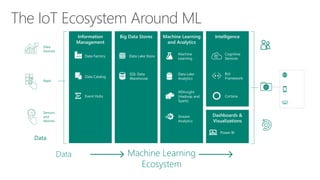
The IoT Ecosystem Around ML
Intelligence
Dashboards &
Visualizations
Information
Management
Big Data Stores Machine Learning
and Analytics
CortanaEvent Hubs
HDInsight
(Hadoop and
Spark)
Stream
Analytics
Data Action
People
Automated
Systems
Apps
Web
Mobile
Bots
Bot
Framework
SQL Data
WarehouseData Catalog
Data Lake
Analytics
Data Factory
Machine
Learning
Data Lake Store
Cognitive
Services
Power BI
Data
Sources
Apps
Sensors
and
devices
Data
Machine Learning
Ecosystem
In The Cloud
Source: www.microsoft.com
Define
Scope
Good Scope for ML Experiment
Question
is sharp.
Data
measures
what they
care
about.
Data is
connected.
Data is
accurate.
A lot of
data.
The better the raw materials, the better the product.
E.g. Predict
whether
component X will
fail in the next Y
days; clear path
of action with
answer
E.g. Identifiers at
the level they are
predicting
E.g. Will be difficult
to predict failure
accurately with few
examples
E.g. Failures are
really failures,
human labels on
root causes; domain
knowledge
translated into
process
E.g. Machine
information linkable
to usage
information
Load
The Data
Labeling
Features
Engineering
Build
The Model
Load The Data: Data Sources
The failure history of a machine
or a component
The repair history
Previous maintenance records,
Components replaced
Maintenance opeators
Performance data collected from
sensors.
FAILURE HISTORY REPAIR HISTORY MACHINECONDITIONS
The features of machine or
components, e.g. production
date, technical specifications.
Environmental features that may
influence a machine’s
performance, e.g. location,
temperature, other interactions.
The attributes of the operator
who uses the machine, e.g. driver.
MACHINE FEATURES OPERATING CONDITIONS OPERATORATTRIBUTES
Define
Scope
Engineer Feature
1. Selected raw features
2. Aggregate features
Define
Scope
Modelling Techniques
Predict failures within a future
period of time
BINARY CLASSIFICATION
Predict failures with their causes within
a future time period.
Predict remaining useful life within
ranges of future periods
MULTICLASSCLASSIFICATION
Predict remaining useful life, the
amount of time before the next failure
REGRESSION
Identify change in normal
trends to find anomalies
ANOMALYDETECTION
Confusion Matrix
Acknowledgements
• We utilized the following publically available data to help us generate realistic data for
the demo shown. We received assistance in creating this solution as a result of this
repository and the donators of the data:
“A. Saxena and K. Goebel (2008). "PHM08 Challenge Data Set", NASA Ames Prognostics
Data Repository (http://ti.arc.nasa.gov/project/prognostic-data-repository), NASA Ames
Research Center, Moffett Field, CA.”
• McKinskey Global Institute, The Internet of Things: Mapping the Value beyond the hype
• Microsoft Cortana Gallery Experiments
Learn and try yourself!
• Learn from Cortana Analytics Gallery
• Solution package material – deploy by hand to learn here
• Try Cortana Analytics Solution Template – Predictive
Maintenance for Aerospace in private preview
• Try Azure IOT pre-configured solution for Predictive
Maintenance
• Read the Predictive Maintenance Playbook for more details
on how to approach these problems
• Run the Modelling Guide R Notebook for a DS walk-
through
• Contact us for 1 free consultation: giuseppe@valueamplify.com
• Twitter: @giuseppeHighTec
• Linkedin: www.linkedin.com/in/giuseppemascarella
IoT Evolution Expo- Machine Learning and the Cloud

IoT Evolution Expo- Machine Learning and the Cloud

  • 1.
    • giuseppe@valueamplify.com • Linkedin:www.linkedin.com/in/giuseppemascarella
  • 3.
  • 4.
    Finding patterns indata is the holy grail (the oil in a barrel!)
  • 6.
    What Is MachineLearning?
  • 7.
    2. Directed Knowledge whereknowledge created elsewhere (by a central authority) will be used to modify edge behavior Cloud 1. Observed Knowledge which will modify behavior based on local learning (context) Edge 3. Sensor Fusion Knowledge the combining of sensory data and data delivery orchestration such that the resulting information is in some sense better than would be possible when these sources were used individually. See Kalman filter
  • 9.
    IoT Scenario Predictive Maintenancein IoT Traditional Maintenance Goal Improve production and/or maintenance efficiency at lowest cost Ensure scheduled maintenance has been done Data -Data stream (time varying features) -Multiple data sources Tasks completed to be done Tasks -Failure prediction -Fault/failure detection & diagnosis, -Recommendation maintenance actions -Fault/failure tracking -Procedure for Diagnosis
  • 10.
    Develop ML model (MATLAB) alongsidelocal university Optimise code Reduce runtime Build evaluation module Refine model parameters Develop user web front end IoT Predictive Maintenance – Qantas Airways ~24,000 sensors Qantas A380 Fleet Technical Delays 12 $65M+ per A380 50% Technical Delays 400-700 Fault/warning messages/day have potential for predictive modelling Configure model in AML PM template Evaluate & refine model data & parameters Visualize results in Power BI Months /year Orchestrate data pipeline in Azure Data Factory Source: www.microsoft.com
  • 11.
    Stay ahead ofthe curve with Cortana Intelligence Suite Business apps Custom apps Sensors and devices People Automated systems Data Machine Learning Ecosystem Cortana Intelligence Action Apps
  • 12.
    The IoT EcosystemAround ML Intelligence Dashboards & Visualizations Information Management Big Data Stores Machine Learning and Analytics CortanaEvent Hubs HDInsight (Hadoop and Spark) Stream Analytics Data Action People Automated Systems Apps Web Mobile Bots Bot Framework SQL Data WarehouseData Catalog Data Lake Analytics Data Factory Machine Learning Data Lake Store Cognitive Services Power BI Data Sources Apps Sensors and devices Data Machine Learning Ecosystem
  • 13.
  • 15.
  • 17.
  • 18.
    Good Scope forML Experiment Question is sharp. Data measures what they care about. Data is connected. Data is accurate. A lot of data. The better the raw materials, the better the product. E.g. Predict whether component X will fail in the next Y days; clear path of action with answer E.g. Identifiers at the level they are predicting E.g. Will be difficult to predict failure accurately with few examples E.g. Failures are really failures, human labels on root causes; domain knowledge translated into process E.g. Machine information linkable to usage information
  • 19.
  • 20.
    Load The Data:Data Sources The failure history of a machine or a component The repair history Previous maintenance records, Components replaced Maintenance opeators Performance data collected from sensors. FAILURE HISTORY REPAIR HISTORY MACHINECONDITIONS The features of machine or components, e.g. production date, technical specifications. Environmental features that may influence a machine’s performance, e.g. location, temperature, other interactions. The attributes of the operator who uses the machine, e.g. driver. MACHINE FEATURES OPERATING CONDITIONS OPERATORATTRIBUTES
  • 21.
  • 22.
    Engineer Feature 1. Selectedraw features 2. Aggregate features
  • 26.
  • 27.
    Modelling Techniques Predict failureswithin a future period of time BINARY CLASSIFICATION Predict failures with their causes within a future time period. Predict remaining useful life within ranges of future periods MULTICLASSCLASSIFICATION Predict remaining useful life, the amount of time before the next failure REGRESSION Identify change in normal trends to find anomalies ANOMALYDETECTION
  • 29.
  • 30.
    Acknowledgements • We utilizedthe following publically available data to help us generate realistic data for the demo shown. We received assistance in creating this solution as a result of this repository and the donators of the data: “A. Saxena and K. Goebel (2008). "PHM08 Challenge Data Set", NASA Ames Prognostics Data Repository (http://ti.arc.nasa.gov/project/prognostic-data-repository), NASA Ames Research Center, Moffett Field, CA.” • McKinskey Global Institute, The Internet of Things: Mapping the Value beyond the hype • Microsoft Cortana Gallery Experiments
  • 31.
    Learn and tryyourself! • Learn from Cortana Analytics Gallery • Solution package material – deploy by hand to learn here • Try Cortana Analytics Solution Template – Predictive Maintenance for Aerospace in private preview • Try Azure IOT pre-configured solution for Predictive Maintenance • Read the Predictive Maintenance Playbook for more details on how to approach these problems • Run the Modelling Guide R Notebook for a DS walk- through
  • 33.
    • Contact usfor 1 free consultation: giuseppe@valueamplify.com • Twitter: @giuseppeHighTec • Linkedin: www.linkedin.com/in/giuseppemascarella

Editor's Notes

  • #6 Check if will prompt music or other services depending on status Guided menu “Press 1,2,3” vs alexa (did you mean x or Y)
  • #7 Designing with artificial intelligence The secret to getting people to engage with products and services is to make interaction as simple as possible. Remove friction and people will embrace your product. But simplicity isn’t the same as minimalism. The secret to getting people to engage with products and services is to make interaction as simple as possible. Remove friction and people will embrace your product. But simplicity isn’t the same as minimalism. For IoT devices, the interface may be as minimal as a few LEDs and a touchpad—and that kind of minimalism can feel obscure and confusing to users. What’s more, IoT devices often need to operate in concert to create delightful services, such as coordinating the levels of light and sound in a room. This simply increases complexity. Unless we come up with new ideas, the world is about to feel terribly broken. That’s why interfaces and services increasingly rely on artificial intelligence technologies. Algorithms make sense of contextual data, anticipate user needs, and accept more natural forms of input, like voice commands. Keeping the interface simple means the device has to become more intelligent. AI isn’t magic—it’s engineering. To develop compelling products, designers and product managers need to understand the constraints and possibilities of AI. They also need to develop new ways of working together so that the resulting products and services feel more… human. This session looks at how algorithms work, examines what they can and can’t do, and explores case studies and examples of how product teams have combined a deep understanding of people with clever design and smart algorithms to produce truly wonderful products. Decisions of what data to keep, ignore, and what to forward to a centralized authority will be required. Many of the kinetic devices will be used and application whose action can neither tolerate long latency nor risk the possibility that the connection with the centralized authority (“the cloud”) is not available. Their decisions must be made instantly with local information and knowledge. Most IoT endpoints will be limited in capabilities due to size, cost, and the power requirements and will need companion computing that is either embedded in the larger system or in a companion gateway. These gateways will primarily bridge between the local device communication domains and higher level network domains and will in most cases make behavioral decisions. As the industry matures, these gateways will also be responsible for allowing data to be exchanged between intended devices, and ensuring the information is protected. Network traffic patterns will be significantly impacted as more device-to-endpoint traffic will occur and more machine-to-machine communication will materialize, shifting from today’s patterns. However, these solutions will not be static, and their evolving behavior will need to vary depending on local characteristics, giving rise to more software-defined functions at both the edge and within the datacenter. Further, their numbers will be vast and their operation cannot require human intervention.
  • #8 Sensory fusion Sensor fusion is a term that covers a number of methods and algorithms, including: Central Limit Theorem, Kalman filter, Bayesian networks, Dempster-Shafer Example: http://www.camgian.com/ http://www.egburt.com/ Kalman is an algorithm that uses a series of measurements observed over time, containing statistical noise and other inaccuracies, and produces estimates of unknown variables that tend to be more precise than those based on a single measurement alone, by using Bayesian inference and estimating a joint probability distribution over the variables for each timeframe.   You have enabled Media Viewer for all files Next time you click on a thumbnail on Wikipedia, Media Viewer will be used.   You have disabled Media Viewer Next time you click on a thumbnail on Wikipedia, you will directly view all file details. Media Viewer is now disabled Enable Media Viewer?   Enable this media viewing feature for all files by default. Learn more Enable Media ViewerCancel Disable Media Viewer?   Skip this viewing feature for all files. You can enable it later through the file details page. Learn more Disable Media ViewerCancel More details The Kalman filter keeps track of the estimated state of the system and the variance or uncertainty of the estimate. The estimate is updated using a state transition model and measurements. denotes the estimate of the system's state at time step k before the k-th measurement yk has been taken into account; is the corresponding uncertainty
  • #22 http://gallery.cortanaanalytics.com/Experiment/Movie-Recommendation-1
  • #25 Selected raw features The raw features are those that are included in the original input data. In order to decide which raw features should be included in the training data, both the detailed data field description and domain knowledge is helpful. In this template, all the sensor measurements (s1-s21) are included in the training data. Other raw features get used are: cycle, setting1-setting3. Aggregate features These features summarize the historical activity of each asset. In the template, two types of aggregate features are created for each of the 21 sensors. The description of these features are shown below. a1-a21: the moving average of sensor values in the most w recent cycles sd1-sd21: the standard deviation of sensor values in the most w recent cycles