International Research Journal of Engineering and Technology (IRJET) e-ISSN: 2395-0056
Volume: 06 Issue: 03 | Mar 2019 www.irjet.net p-ISSN: 2395-0072
© 2019, IRJET | Impact Factor value: 7.211 | ISO 9001:2008 Certified Journal | Page 8055
DEVELOPMENT OF INTELLIGENT ACCELEROMETER AND ITS
IMPLEMENTATION WITH SPEEDCONTROL
KAVUSHIKA M1, MONISHA D2, BABY JANAGAM R3
1,2B.E Student, Dept. of EIE, Dr.Mahalingam College of Engg and Tech, Tamilnadu, India.
3Assistant Professor, Dept. of EIE, Dr.Mahalingam College of Engg and Tech, Tamilnadu, India.
---------------------------------------------------------------------***----------------------------------------------------------------------
Abstract:- In this era of rapidly growing technology,
sensors and transducers are used in almost all the
applications. Without sensors and transducers, IOT,
embedded systems, automation and industrial revolution
cannot happen. This calls for the need of sensors that are
more intelligent than before. An intelligent sensor is ableto
detect conditions and respond to them. Therefore, we
propose an intelligent accelerometer based on IOT and
wireless technology to perform functions such as 3-axis
acceleration sensing, tilt sensing, roll and pitch, freefalling,
tap detection and inactive sensing. This accelerometer can
stand alone since it has its own controller and it’s
rechargeable. Its working is demonstrated with the speed
control of autonomous vehicle at elevations. The sensor
detection can be viewed through mobile app developed via
Wi-Fi and control actions can be made using mobile app.
Thus this sensor can be mounted wherever required and
can be made to share its data to the required control unit
such as micro controller and PLC. Thereby it reduces the
need for programming, data processing and designing of
circuit for acquiring data from sensor.
Keywords: Intelligent accelerometer, 3-axis acceleration
sensing, Tilt sensing, Roll and pitch, Free falling, Tap
detection and Inactive sensing.
1.Introduction
A sensor is a device that measures a physical quantity and
converts it into a signal which can be read by an observer
or by an instrument. An intelligent sensor isa sensorbutit
is extended such that it has advance learning and
adaptation abilities. A sensor is intelligent when it is
capable ofcorrectingerrorsoccurredduringmeasurement
both at the input and output ends.So, we propose an
intelligent accelerometer based on IOT and wireless
technology to perform functions such as 3-axis
acceleration sensing, tilt sensing, roll and pitch sensing,
free falling, tap detection and inactive sensing.
This accelerometer can stand alone since it has its own
controller and it’s rechargeable. Its working is
demonstrated with the speed control of autonomous
vehicle at elevations. The sensor detection can be viewed
through mobile app developed via Wi-Fi and control
actions can be made using mobile app. Thus this sensor
can be mounted wherever required and can be made to
share its data to the required control unit such as micro
controller and PLC.
The main objective of the project is,
• To develop an intelligent accelerometer which has
1)3-axis acceleration sensing,
2)Roll and pitch sensing ,
3)Tilt sensing,
4)Free falling,
5)Tap detection and
6)Inactive sensing.
• To demonstrate its working withthespeedcontrol of
autonomous vehicle at elevations.
1.1 Existing System
 An intelligent accelerometer is not into use now.
 If an analog accelerometer is used, the signal from
the accelerometer is signal conditioned and then
given as input to a micro controller.
 If the accelerometer is digital, then its digital data are
transferred through SPI or I2C communication.
 This micro controller is programmed to process the
data and yield results. To transfer its results through
wireless communication such Zigbee, Bluetooth,Wi-
Fi etc, communication devices are needed to be
interfaced with the controller. Or else controllers
with built in communication modules can be used.
1.2 DRAWBACKS OF EXISTING SYSTEM
 Every time, the controller for the sensor should be
reprogrammed for a new application.
 A sensor which is dedicated for a particular
application cannot be used for another since it can
bring about the repetition for wiring and unwiring.
 Each time, an analogue sensor is used; there comes
the need for the design of signal conditioning circuit.
 If the sensor is to be used for sensing conditions in
remote places, then it has to be made wireless and
rechargeable. Hence communications devices and
rechargeable battery setup should beincluded inthe
circuit accounting for more money, work and time
consumption.
International Research Journal of Engineering and Technology (IRJET) e-ISSN: 2395-0056
Volume: 06 Issue: 03 | Mar 2019 www.irjet.net p-ISSN: 2395-0072
© 2019, IRJET | Impact Factor value: 7.211 | ISO 9001:2008 Certified Journal | Page 8056
2. HARDWARE COMPONENTS
2.1 ADXL345
The ADXL345 is a small, thin, ultra low power, 3-axis
accelerometer with high resolution and a selectable
measurement range of ±2 g, ±4 g, ±8 g, or ±16 g. Digital
output data is formattedas 16-bit twoscomplementandis
accessible through either a SPI (3- or 4-wire)orI2Cdigital
interface.
The ADXL345 is well suited for mobiledeviceapplications.
It measures the staticacceleration ofgravityintilt-sensing
applications, as well as dynamic acceleration resulting
from motion or shock that allows the devicetobeusedasa
tilt sensor.Its high resolution (3.9 mg/LSB) enables
measurement of inclination changes less than 1.0°.
The sensor is a polysilicon surface-micro machined
structurebuilt on top of a siliconwafer.Polysiliconsprings
suspend the structure over the surface of the wafer and
provide a resistance against forces due to applied
acceleration.
Deflection of the structure is measured using differential
capacitors that consist of independent fixed plates and
plates attached to the moving mass. Acceleration deflects
the proof mass and unbalances the differential capacitor,
resulting in a sensor output whose amplitude is
proportional to acceleration. Phase-sensitive
demodulation is used to determine the magnitude and
polarity of the acceleration.
Fig -1: ADXL345
2.2 BATTERY
The battery chosen is 3.7v 1000mAh lithium polymer
battery.The battery is used as supply for accelerometer
and micro controller. The batteryisoperatedwithaswitch
connection. The battery is fixed within the enclosure to
reduce the size of the closed system and to make it
compact for mobile applications.
2.3 TP4056 MODULE
The TP4056 is a complete constant-current/constant-
voltage linear charger for single cell lithium-ion batteries.
Its SOP package and low external component count make
the TP4056 ideally suited for portable applications.
Furthermore, the TP4056 can work within USB and wall
adapter.
No blocking diode is required due to the internal
PMOSFET architecture and have prevent to negative
Charge Current Circuit. Thermal feedback regulates the
charge current to limit the die temperature during high
power operation or high ambient temperature. The
charge voltage is fixed at 4.2V, and the charge current can
be programmed externally with a single resistor. The
TP4056 automatically terminates the charge cycle when
the charge current drops to 1/10th the programmed
value after the final float voltage is reached. TP4056
Other features include current monitor, under voltage
lockout, automatic rechargeand two status pin toindicate
charge termination and the presence of an input voltage.
Fig -2: TP4056 module
2.4 XL6009 STEP-UP POWER MODULE
The XL6009 regulator is a wide input range, current
mode, dc/dc converter which is capable of generating
either positive or negative output voltages. It can be
configured as either a boost, fly back, sepic or inverting
converter. The XL6009 built in n-channel power mosfet
and fixed frequency oscillator, current-modearchitecture
results in stable operation over a wide range of supply
and output voltages. The XL6009 regulator is special
design for portable electronic equipment applications.
Fig -3: XL6009 regulator
2.5 AMS1117 3.3V VOLTAGE REGULATOR
MODULE
The AMS1117 series of adjustable and fixed voltage
regulators are designed to provideup to1A outputcurrent
and to operate down to 1V input-to-output differential.
International Research Journal of Engineering and Technology (IRJET) e-ISSN: 2395-0056
Volume: 06 Issue: 03 | Mar 2019 www.irjet.net p-ISSN: 2395-0072
© 2019, IRJET | Impact Factor value: 7.211 | ISO 9001:2008 Certified Journal | Page 8057
The dropout voltage of the device is guaranteedmaximum
1.3V, decreasing at lower load currents.
On-chip trimming adjusts the reference voltage to 1.5%.
Current limit is set to minimize the stress under overload
conditions on both the regulator and power source
circuitry.
The AMS1117 devicesarepincompatiblewithotherthree-
terminal SCSI regulators and are offered in the low profile
surface mount SOT-223 package, in the 8L SOIC package
and in the TO-252 (DPAK) plastic package.
Fig -4: XL6009 regulator
2.6 NODE MCU
Node MCU is an open source IoT platform. It includes
firmware which runs on the ESP8266 Wi-Fi and
hardware which is based on the ESP-12 module. The term
"NodeMCU" by default refers to thefirmwarethatusesthe
Lua scriptinglanguage. A multipoint control unit (MCU) is
a device commonly used to bridge videoconferencing
connections. The multipointcontrol unit is an endpointon
the LAN that provides the capability for three or more
terminals and gateways to participate in a multipoint
conference.NODEMCUwhichisaESP8266Wi-FiModuleis
a self-containedSOCwithintegratedTCP/IPprotocolstack
that can give any micro controller access to your Wi-Fi
network. The ESP8266 is capable of either hosting an
application or offloading all Wi-Fi networking functions
from another application processor.
NodeMCU board used in our project is Node 1.0 ESP-12E.
Fig -5: Node MCU
2.7 L293D MOTOR DRIVER
L293D is a typical Motor driver or Motor Driver IC which
allows DC motor to drive on either direction. L293D is a
16-pin IC which can control a set of two DC motors
simultaneously in any direction. It means that you can
control two DC motors with a single L293D IC.
It works on the concept of H-bridge. H-bridge is a circuit
which allows the voltage to be flown in either direction.As
you know voltage need to change its direction for being
able to rotate the motor in clockwise or anticlockwise
direction, Hence H-bridge IC are ideal for driving a DC
motor.
In a single L293D chip there aretwoh-Bridgecircuitinside
the IC which can rotate two dc motor independently. Due
its size it is very much used in robotic application for
controlling DC motors.
There are two Enable pins on l293d. Pin 1 and pin 9, for
being able to drive the motor, the pin 1 and 9 need to be
high. For driving the motor with left H-bridge you need to
enable pin 1 to high. And for right H-Bridge you need to
make the pin 9 to high. If anyone of the either pin1or pin9
goes low then the motor in the corresponding section will
suspend working. It’s like a switch.
Fig -6: L293D motor driver
3. BLOCK DIAGRAM
Fig -7: Block Diagram
International Research Journal of Engineering and Technology (IRJET) e-ISSN: 2395-0056
Volume: 06 Issue: 03 | Mar 2019 www.irjet.net p-ISSN: 2395-0072
© 2019, IRJET | Impact Factor value: 7.211 | ISO 9001:2008 Certified Journal | Page 8058
4. WORKING:
In the system of automation sensor data plays a major
role in making the system even more user friendly.The
sensor data which results in occurance of any
acceleration, tilt,roll&pitch, tap,free falling and inactive
has been send into Nodemcu . The lithium ion battery was
employed to power up the controller remotely without
any external power supply.In order to maintain the
proper voltage level in controller voltage regulator &
boost converter has been installed.Internally poweredup
controller with inbuilt Wi-Fi will transfers the data to the
mobile application through Wi-Fi.The data like
acceleration,tilt,roll & pitch which is retrieved in the
Mobile application makes the system user friendly,sothat
the operator need not required much technical skill to
operator the system which tend to work automatically.
Nodemcu-12E has been connected interior with
Nodemcu-32.Whenever the data was sensed from the
sensor by nodemcu-12E it keep transferring the data to
Nodemcu-32.The motor driver(L2930) has been
connected with Nodemcu-32 in order to perform the
speed control operation.Whenever the sensor senses the
effect of tilt, speed variation has been performed as
programmed in nodemcu-32.
5. RESULTS AND OBSERVATIONS
5.1 HARDWARE SETUP
Fig -8: Hardware set up1
Fig -9: Hardware set up2
5.2 MOBILE APPLICATION
Fig -10: Mobile app
6.CONCLUSION
This project showsacceptablereadingsofacceleration,tilt,
roll and pitch, free fall detection,tapdetectionandinactive
sensing. It has been calibrated to yield accurate results.
Our intelligent sensor is compact, small in size and light
weight. For demonstration purpose, ithas been shown by
controlling the speed. The internal control has been
modified such a way that the whole control istaken by the
NodeMCU. This NodeMCU controls the speed of the DC
motor receiving signal from the receiver circuit present in
the second NodeMCU.
The intelligent accelerometer communicates with the
NodeMCU of remote car wirelessly through Wi-Fi and
commands the car to vary its speed according to the tilt
angle which is being monitored by the accelerometer. The
speed variation happens through the PWM generation of
NodeMCU. The required speed for each tilt angle is
programmed into the NodeMCU. Thus an Intelligent
accelerometer has been developed and its working has
been demonstrated with the speed control.
REFERENCES
1. Bogdan Muset, ”Distance Measuring using
Accelerometer and Gyroscope Sensors “, Simina
Emerich Technical University of Cluj-Napoca,
Communication Department.
2. David Hanson, ”Monitoring Cattle Motion using 3-
axis Acceleration andGPSData “,ChangkiMo.School
of Mechanical and Materials Engineering,
Washington State University Tri-Cities,Received18
November, 2014.
3. A.Gonzalez,”The use of vehicle acceleration
measurements to estimate road roughness“,
E.J.O’Brien, Y.Y>Li& K.Cashell. Received 26
May 2007, Published online: 09 May 2008.
4. Alasdair Allan, “Basic Sensors in iOS”, O’Reilly
Media, 1
st
Edition, 2011.

IRJET- Development of Intelligent Accelerometer and its Implementation with Speed control

  • 1.
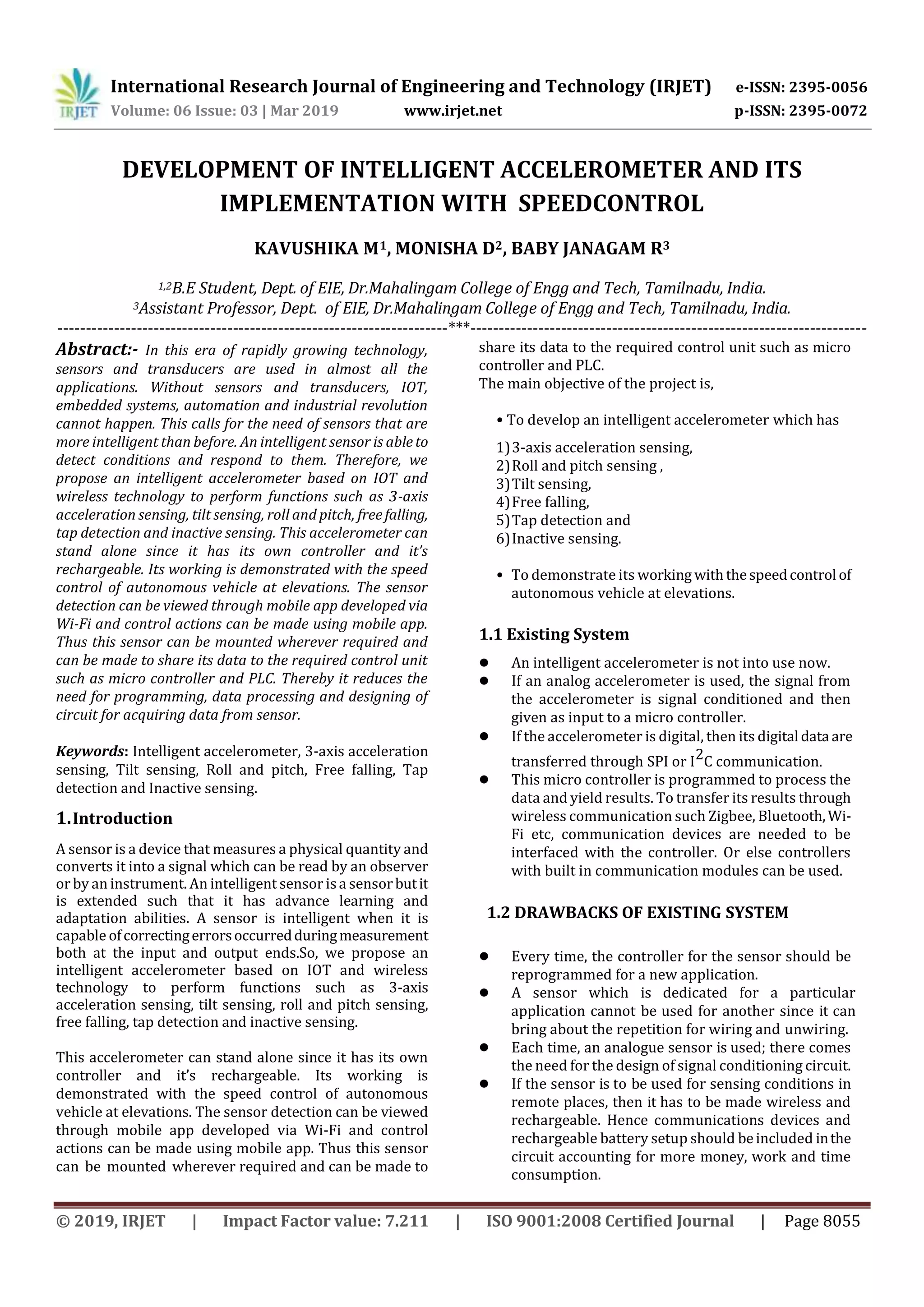
    International Research Journalof Engineering and Technology (IRJET) e-ISSN: 2395-0056 Volume: 06 Issue: 03 | Mar 2019 www.irjet.net p-ISSN: 2395-0072 © 2019, IRJET | Impact Factor value: 7.211 | ISO 9001:2008 Certified Journal | Page 8055 DEVELOPMENT OF INTELLIGENT ACCELEROMETER AND ITS IMPLEMENTATION WITH SPEEDCONTROL KAVUSHIKA M1, MONISHA D2, BABY JANAGAM R3 1,2B.E Student, Dept. of EIE, Dr.Mahalingam College of Engg and Tech, Tamilnadu, India. 3Assistant Professor, Dept. of EIE, Dr.Mahalingam College of Engg and Tech, Tamilnadu, India. ---------------------------------------------------------------------***---------------------------------------------------------------------- Abstract:- In this era of rapidly growing technology, sensors and transducers are used in almost all the applications. Without sensors and transducers, IOT, embedded systems, automation and industrial revolution cannot happen. This calls for the need of sensors that are more intelligent than before. An intelligent sensor is ableto detect conditions and respond to them. Therefore, we propose an intelligent accelerometer based on IOT and wireless technology to perform functions such as 3-axis acceleration sensing, tilt sensing, roll and pitch, freefalling, tap detection and inactive sensing. This accelerometer can stand alone since it has its own controller and it’s rechargeable. Its working is demonstrated with the speed control of autonomous vehicle at elevations. The sensor detection can be viewed through mobile app developed via Wi-Fi and control actions can be made using mobile app. Thus this sensor can be mounted wherever required and can be made to share its data to the required control unit such as micro controller and PLC. Thereby it reduces the need for programming, data processing and designing of circuit for acquiring data from sensor. Keywords: Intelligent accelerometer, 3-axis acceleration sensing, Tilt sensing, Roll and pitch, Free falling, Tap detection and Inactive sensing. 1.Introduction A sensor is a device that measures a physical quantity and converts it into a signal which can be read by an observer or by an instrument. An intelligent sensor isa sensorbutit is extended such that it has advance learning and adaptation abilities. A sensor is intelligent when it is capable ofcorrectingerrorsoccurredduringmeasurement both at the input and output ends.So, we propose an intelligent accelerometer based on IOT and wireless technology to perform functions such as 3-axis acceleration sensing, tilt sensing, roll and pitch sensing, free falling, tap detection and inactive sensing. This accelerometer can stand alone since it has its own controller and it’s rechargeable. Its working is demonstrated with the speed control of autonomous vehicle at elevations. The sensor detection can be viewed through mobile app developed via Wi-Fi and control actions can be made using mobile app. Thus this sensor can be mounted wherever required and can be made to share its data to the required control unit such as micro controller and PLC. The main objective of the project is, • To develop an intelligent accelerometer which has 1)3-axis acceleration sensing, 2)Roll and pitch sensing , 3)Tilt sensing, 4)Free falling, 5)Tap detection and 6)Inactive sensing. • To demonstrate its working withthespeedcontrol of autonomous vehicle at elevations. 1.1 Existing System  An intelligent accelerometer is not into use now.  If an analog accelerometer is used, the signal from the accelerometer is signal conditioned and then given as input to a micro controller.  If the accelerometer is digital, then its digital data are transferred through SPI or I2C communication.  This micro controller is programmed to process the data and yield results. To transfer its results through wireless communication such Zigbee, Bluetooth,Wi- Fi etc, communication devices are needed to be interfaced with the controller. Or else controllers with built in communication modules can be used. 1.2 DRAWBACKS OF EXISTING SYSTEM  Every time, the controller for the sensor should be reprogrammed for a new application.  A sensor which is dedicated for a particular application cannot be used for another since it can bring about the repetition for wiring and unwiring.  Each time, an analogue sensor is used; there comes the need for the design of signal conditioning circuit.  If the sensor is to be used for sensing conditions in remote places, then it has to be made wireless and rechargeable. Hence communications devices and rechargeable battery setup should beincluded inthe circuit accounting for more money, work and time consumption.
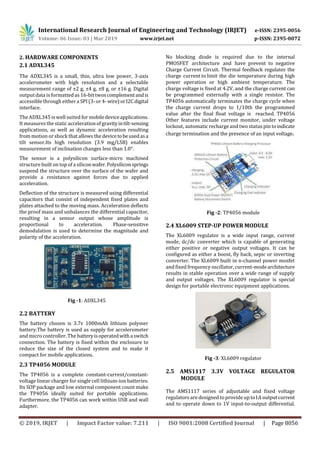
  • 2.
    International Research Journalof Engineering and Technology (IRJET) e-ISSN: 2395-0056 Volume: 06 Issue: 03 | Mar 2019 www.irjet.net p-ISSN: 2395-0072 © 2019, IRJET | Impact Factor value: 7.211 | ISO 9001:2008 Certified Journal | Page 8056 2. HARDWARE COMPONENTS 2.1 ADXL345 The ADXL345 is a small, thin, ultra low power, 3-axis accelerometer with high resolution and a selectable measurement range of ±2 g, ±4 g, ±8 g, or ±16 g. Digital output data is formattedas 16-bit twoscomplementandis accessible through either a SPI (3- or 4-wire)orI2Cdigital interface. The ADXL345 is well suited for mobiledeviceapplications. It measures the staticacceleration ofgravityintilt-sensing applications, as well as dynamic acceleration resulting from motion or shock that allows the devicetobeusedasa tilt sensor.Its high resolution (3.9 mg/LSB) enables measurement of inclination changes less than 1.0°. The sensor is a polysilicon surface-micro machined structurebuilt on top of a siliconwafer.Polysiliconsprings suspend the structure over the surface of the wafer and provide a resistance against forces due to applied acceleration. Deflection of the structure is measured using differential capacitors that consist of independent fixed plates and plates attached to the moving mass. Acceleration deflects the proof mass and unbalances the differential capacitor, resulting in a sensor output whose amplitude is proportional to acceleration. Phase-sensitive demodulation is used to determine the magnitude and polarity of the acceleration. Fig -1: ADXL345 2.2 BATTERY The battery chosen is 3.7v 1000mAh lithium polymer battery.The battery is used as supply for accelerometer and micro controller. The batteryisoperatedwithaswitch connection. The battery is fixed within the enclosure to reduce the size of the closed system and to make it compact for mobile applications. 2.3 TP4056 MODULE The TP4056 is a complete constant-current/constant- voltage linear charger for single cell lithium-ion batteries. Its SOP package and low external component count make the TP4056 ideally suited for portable applications. Furthermore, the TP4056 can work within USB and wall adapter. No blocking diode is required due to the internal PMOSFET architecture and have prevent to negative Charge Current Circuit. Thermal feedback regulates the charge current to limit the die temperature during high power operation or high ambient temperature. The charge voltage is fixed at 4.2V, and the charge current can be programmed externally with a single resistor. The TP4056 automatically terminates the charge cycle when the charge current drops to 1/10th the programmed value after the final float voltage is reached. TP4056 Other features include current monitor, under voltage lockout, automatic rechargeand two status pin toindicate charge termination and the presence of an input voltage. Fig -2: TP4056 module 2.4 XL6009 STEP-UP POWER MODULE The XL6009 regulator is a wide input range, current mode, dc/dc converter which is capable of generating either positive or negative output voltages. It can be configured as either a boost, fly back, sepic or inverting converter. The XL6009 built in n-channel power mosfet and fixed frequency oscillator, current-modearchitecture results in stable operation over a wide range of supply and output voltages. The XL6009 regulator is special design for portable electronic equipment applications. Fig -3: XL6009 regulator 2.5 AMS1117 3.3V VOLTAGE REGULATOR MODULE The AMS1117 series of adjustable and fixed voltage regulators are designed to provideup to1A outputcurrent and to operate down to 1V input-to-output differential.
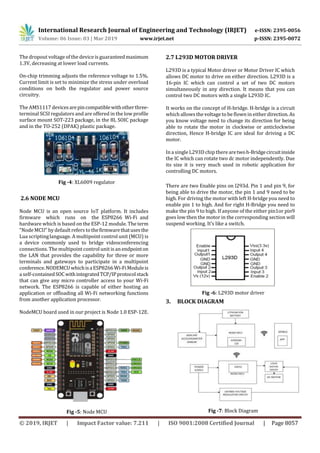
  • 3.
    International Research Journalof Engineering and Technology (IRJET) e-ISSN: 2395-0056 Volume: 06 Issue: 03 | Mar 2019 www.irjet.net p-ISSN: 2395-0072 © 2019, IRJET | Impact Factor value: 7.211 | ISO 9001:2008 Certified Journal | Page 8057 The dropout voltage of the device is guaranteedmaximum 1.3V, decreasing at lower load currents. On-chip trimming adjusts the reference voltage to 1.5%. Current limit is set to minimize the stress under overload conditions on both the regulator and power source circuitry. The AMS1117 devicesarepincompatiblewithotherthree- terminal SCSI regulators and are offered in the low profile surface mount SOT-223 package, in the 8L SOIC package and in the TO-252 (DPAK) plastic package. Fig -4: XL6009 regulator 2.6 NODE MCU Node MCU is an open source IoT platform. It includes firmware which runs on the ESP8266 Wi-Fi and hardware which is based on the ESP-12 module. The term "NodeMCU" by default refers to thefirmwarethatusesthe Lua scriptinglanguage. A multipoint control unit (MCU) is a device commonly used to bridge videoconferencing connections. The multipointcontrol unit is an endpointon the LAN that provides the capability for three or more terminals and gateways to participate in a multipoint conference.NODEMCUwhichisaESP8266Wi-FiModuleis a self-containedSOCwithintegratedTCP/IPprotocolstack that can give any micro controller access to your Wi-Fi network. The ESP8266 is capable of either hosting an application or offloading all Wi-Fi networking functions from another application processor. NodeMCU board used in our project is Node 1.0 ESP-12E. Fig -5: Node MCU 2.7 L293D MOTOR DRIVER L293D is a typical Motor driver or Motor Driver IC which allows DC motor to drive on either direction. L293D is a 16-pin IC which can control a set of two DC motors simultaneously in any direction. It means that you can control two DC motors with a single L293D IC. It works on the concept of H-bridge. H-bridge is a circuit which allows the voltage to be flown in either direction.As you know voltage need to change its direction for being able to rotate the motor in clockwise or anticlockwise direction, Hence H-bridge IC are ideal for driving a DC motor. In a single L293D chip there aretwoh-Bridgecircuitinside the IC which can rotate two dc motor independently. Due its size it is very much used in robotic application for controlling DC motors. There are two Enable pins on l293d. Pin 1 and pin 9, for being able to drive the motor, the pin 1 and 9 need to be high. For driving the motor with left H-bridge you need to enable pin 1 to high. And for right H-Bridge you need to make the pin 9 to high. If anyone of the either pin1or pin9 goes low then the motor in the corresponding section will suspend working. It’s like a switch. Fig -6: L293D motor driver 3. BLOCK DIAGRAM Fig -7: Block Diagram
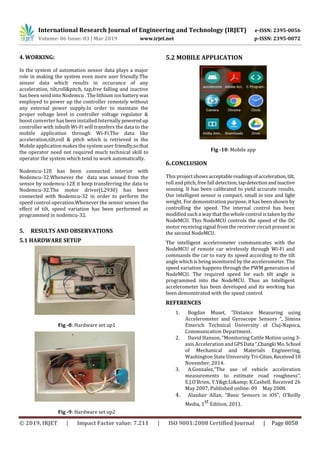
  • 4.
    International Research Journalof Engineering and Technology (IRJET) e-ISSN: 2395-0056 Volume: 06 Issue: 03 | Mar 2019 www.irjet.net p-ISSN: 2395-0072 © 2019, IRJET | Impact Factor value: 7.211 | ISO 9001:2008 Certified Journal | Page 8058 4. WORKING: In the system of automation sensor data plays a major role in making the system even more user friendly.The sensor data which results in occurance of any acceleration, tilt,roll&pitch, tap,free falling and inactive has been send into Nodemcu . The lithium ion battery was employed to power up the controller remotely without any external power supply.In order to maintain the proper voltage level in controller voltage regulator & boost converter has been installed.Internally poweredup controller with inbuilt Wi-Fi will transfers the data to the mobile application through Wi-Fi.The data like acceleration,tilt,roll & pitch which is retrieved in the Mobile application makes the system user friendly,sothat the operator need not required much technical skill to operator the system which tend to work automatically. Nodemcu-12E has been connected interior with Nodemcu-32.Whenever the data was sensed from the sensor by nodemcu-12E it keep transferring the data to Nodemcu-32.The motor driver(L2930) has been connected with Nodemcu-32 in order to perform the speed control operation.Whenever the sensor senses the effect of tilt, speed variation has been performed as programmed in nodemcu-32. 5. RESULTS AND OBSERVATIONS 5.1 HARDWARE SETUP Fig -8: Hardware set up1 Fig -9: Hardware set up2 5.2 MOBILE APPLICATION Fig -10: Mobile app 6.CONCLUSION This project showsacceptablereadingsofacceleration,tilt, roll and pitch, free fall detection,tapdetectionandinactive sensing. It has been calibrated to yield accurate results. Our intelligent sensor is compact, small in size and light weight. For demonstration purpose, ithas been shown by controlling the speed. The internal control has been modified such a way that the whole control istaken by the NodeMCU. This NodeMCU controls the speed of the DC motor receiving signal from the receiver circuit present in the second NodeMCU. The intelligent accelerometer communicates with the NodeMCU of remote car wirelessly through Wi-Fi and commands the car to vary its speed according to the tilt angle which is being monitored by the accelerometer. The speed variation happens through the PWM generation of NodeMCU. The required speed for each tilt angle is programmed into the NodeMCU. Thus an Intelligent accelerometer has been developed and its working has been demonstrated with the speed control. REFERENCES 1. Bogdan Muset, ”Distance Measuring using Accelerometer and Gyroscope Sensors “, Simina Emerich Technical University of Cluj-Napoca, Communication Department. 2. David Hanson, ”Monitoring Cattle Motion using 3- axis Acceleration andGPSData “,ChangkiMo.School of Mechanical and Materials Engineering, Washington State University Tri-Cities,Received18 November, 2014. 3. A.Gonzalez,”The use of vehicle acceleration measurements to estimate road roughness“, E.J.O’Brien, Y.Y>Li& K.Cashell. Received 26 May 2007, Published online: 09 May 2008. 4. Alasdair Allan, “Basic Sensors in iOS”, O’Reilly Media, 1 st Edition, 2011.