International Research Journal of Engineering and Technology (IRJET) e-ISSN: 2395-0056
Volume: 07 Issue: 03 | Mar 2020 www.irjet.net p-ISSN: 2395-0072
© 2020, IRJET | Impact Factor value: 7.34 | ISO 9001:2008 Certified Journal | Page 2242
PLC Based Temperature Controlling using Peltier Element for
Industrial Automation
Dr. S.P. Selvaraj, Mr. S. Dhashnamoorthy, Mr. M. Dhurun, Mr. V. Kishore
1
Dr.S.P.Selvaraj, Professor, EIE Department, Bannari amman Institute of Technology
2,3,4EIE Department, Bannari amman Institute of Technology
---------------------------------------------------------------------***----------------------------------------------------------------------
Abstract - Temperature is the main parameter need to
control in many industry for their industrial purpose of
manufacturing and production. Temperature is controlled
by using peltier element. Peltier element is controlled by
PWM signal. PWM signal is generated by Programmable
Logic Controller(PLC). Relay is used to change the polarity
of the signal supplied to peltier element. On duty cycle of
PWMsignal is applied to the common terminal of the relay.
Off duty cycle of PWM signal is applied to the negative
terminal of peltier element. Positive terminal of peltier
element is connected to the normally open contact
terminal in relay. Whenever the relay is get energized,
supply from common terminal is get transferred to
normally open contact terminal. Now the PWM signal is
supplied to peltier element through relay so that peltier
element get activated by thermal energy by heating and
cooling. When the relay get deenergized, common terminal
is get contact to normally closed terminal. So the peltier
element get deactivated from thermal energy. Relay is
activated by switch, interfaced with PLC, to control the
signal flow.
Key Words: pulse width modulation, PLC, relay, smps,
peltier element.
1.INTRODUCTION
In early days, maintaining desired temperature for
manufacturing and production is at very risk for the
labours who are work in manufacturing and production
industries. Introduction of PLC is the revolution in
industries for automation. PLC can communicate with
any kind of actuators, sensors and transducers. PLC can
do arithmetic, counting, timer and sequencing on off
control action. Pulse width modulation signal is the
output from PLC. This is applied to the common terminal
of relay. When the relay get energized, common terminal
get contacted with normally closed terminal. Peltier
element is one which absorb the heat at one junction and
and release at another junction, when the electric current
passes between the junction. Heating and cooling junction
will change according to the polarity of the electricity that
passes between the junction. On duty cycle of PWM signal
is applied to the common terminal of the relay. Off duty
cycle of PWM signal is applied to the negative terminal of
peltier element. Positive terminal of peltier
element is connected to the normally open contact
terminal in relay. Now the PWM signal is supplied to
peltier element through relay so that peltier element get
activated by thermal energy by heating and cooling.
When the relay get deenergized, common terminal is get
contact to normally closed terminal. So the peltier
element get deactivated from thermal energy. Relay is
energized by switch, it is interfaced with PLC, to control
the switching action. According to the industrial need of
desired temperature, voltage,currentand frequency of the
electric supply is changed which is directly proportional
to the heat produced by the peltier element. Advantage
for this method is to reduce the health injury to the
labours who are all working in the manufacturing and
production industries like wax manufacturing, brake
pedal coating, plastic manufacturing, silver coating etc . . .
and also peltier element will consume very much small
energy for producing thermal energy. But in manual
production of heat tends to consume much large amount
of energy like liquid petrol, diesel, kerosene and much
more fossil fuels, which leads to air pollution thus,
pollution iscontrolled.
2. PROJECT OVERVIEW
In our project, programmable logic controller and peltier
element lays a major role in the producing the thermal
energy on the surface of area above the junction of
peltier element. PWM signal is another factor that will
control the heating and cooling on the peltier device.
PWM signal generated by the PLC is depend upon the
factor of voltage, current and frequency value. This
factors value can be specified in the PLC programming.
PLC is activated by the single phase power supply which
is passes through the switched mode power supply
which is used for the rectification of 230 volt AC power
supply into 24 volt DC power supply with the amps
rating of 5A. PLC device requires only 24 volt DC power
supply. Controlling of peltier element is fully on the PLC
programming which can be reprogrammed to for any
other purpose. Relay is used to change the polarity of the
PWM signal. Relay can be energized by the switch that is
interfaced with PLC input terminal so that input signal is
feed to PLC device by the action of switch.
International Research Journal of Engineering and Technology (IRJET) e-ISSN: 2395-0056
Volume: 07 Issue: 03 | Mar 2020 www.irjet.net p-ISSN: 2395-0072
© 2020, IRJET | Impact Factor value: 7.34 | ISO 9001:2008 Certified Journal | Page 2243
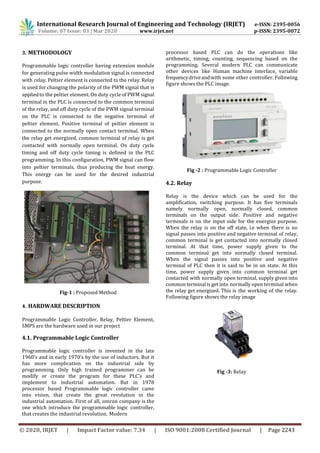
3. METHODOLOGY
Programmable logic controller having extension module
for generating pulse width modulation signal is connected
with relay. Peltier element is connected to the relay. Relay
is used for changing the polarity of the PWM signal that is
appliedto the peltier element. On duty cycle of PWM signal
terminal in the PLC is connected to the common terminal
of the relay, and off duty cycle of the PWM signal terminal
on the PLC is connected to the negative terminal of
peltier element. Positive terminal of peltier element is
connected to the normally open contact terminal. When
the relay get energized, common terminal of relay is get
contacted with normally open terminal. On duty cycle
timing and off duty cycle timing is defined in the PLC
programming. In this configuration, PWM signal can flow
into peltier terminals, thus producing the heat energy.
This energy can be used for the desired industrial
purpose.
Fig-1 : Proposed Method
4. HARDWARE DESCRIPTION
Programmable Logic Controller, Relay, Peltier Element,
SMPS are the hardware used in our project
4.1. Programmable Logic Controller
Programmable logic controller is invented in the late
1960’s and in early 1970’s by the use of inductors. But it
has more complication on the industrial side by
programming. Only high trained programmer can be
modify or create the program for these PLC’s and
implement to industrial automation. But in 1978
processor based Programmable logic controller came
into vision, that create the great revolution in the
industrial automation. First of all, omron company is the
one which introduce the programmable logic controller,
that creates the industrial revolution. Modern
processor based PLC can do the operations like
arithmetic, timing, counting, sequencing based on the
programming. Several modern PLC can communicate
other devices like Human machine interface, variable
frequencydriveandwith some other controller. Following
figure shows the PLC image.
Fig -2 : Programmable Logic Controller
4.2. Relay
Relay is the device which can be used for the
amplification, switching purpose. It has five terminals
namely normally open, normally closed, common
terminals on the output side. Positive and negative
terminals is on the input side for the energize purpose.
When the relay is on the off state, i.e when there is no
signal passes into positive and negative terminal of relay,
common terminal is get contacted into normally closed
terminal. At that time, power supply given to the
common terminal get into normally closed terminal.
When the signal passes into positive and negative
terminal of PLC then it is said to be in on state. At this
time, power supply given into common terminal get
contacted with normally open terminal, supply given into
common terminal is get into normally open terminal when
the relay get energized. This is the working of the relay.
Following figure shows the relay image
Fig -3: Relay
International Research Journal of Engineering and Technology (IRJET) e-ISSN: 2395-0056
Volume: 07 Issue: 03 | Mar 2020 www.irjet.net p-ISSN: 2395-0072
© 2020, IRJET | Impact Factor value: 7.34 | ISO 9001:2008 Certified Journal | Page 2244
4.3. Peltier Element
Peltier element has two sides with the junction between
two sides for the flowing of electricity. Whenever there is
a flowing of electricity in the junction, heat is absorbed at
one side called cold junction, and released at another side
called heat junction. Rate of flow current in the junction
of peltier determine the rate of heating and cooling at the
sides of the peltier element. This is the basic principle
discovered by Jean Charles Athanase Peltier in the year of
1834. Following figure shows the picture if peltier
element following figure shows the peltier picture
Fig -4: Peltier Module
5.SOFTWARE DESCRIPTION
PLC programing can be done in the manufactures defined
software. After the introduction of processor based PLC,
high level computerized programming become more
popular for configuration of PLC to the desired extent.
Now the industrial automation is on the peak of the
country’s economy as well as individual’s personal
economy for the saving of unwanted expenditure, this
automation is done by the introduction of computerized
programming languages for different versions of PLC.
5.1 PLC Programming
Fig -5: Programming
6. RESULT AND CONCLUSION
Thus, the temperature is controlled by PLC using peltier
element. PWM signal plays a major role to control the
peltier element. Voltage, frequency and current value of
PWM signal determine the heating of peltier element.
Following figure shows the PWM signal.
When the input B0000 is set to be ON. Data from D0000
register is transferred to D0001 register. And the output
B0001 is set to be ON. Next, the data from the register
B0001 is transferred to the MW0402 register which
performs the frequency action for pulse width
modulation signal. Output
REFERENCES
Fig -6: Pwm Signal
is generated . The followingfigureshowstheprogramming
of PLC to configure the controller to generate the pulse
width modulation signal.
[1] J. C. Peltier. Nouvelles Experiences sur la Caloricite
des Courants Electriques. Ann. Chim. Phys. 1834, 56,
pp 371–386.
[2] E. H. Lentz. Electrical Experiment of Academician
Lentz. Water Freezing by Galvanic Stream. Bibliotec.
Chten. 1838, 28, pp 44–48.
[3] Jonathan Schoenfeld, Integration of a
Thermoelectric Subcooler Into a Carbon Dioxide
Transcritical Vapor Compression Cycle Refrigeration
System, International Refrigeration and Air
ConditioningConference,2008.
International Research Journal of Engineering and Technology (IRJET) e-ISSN: 2395-0056
Volume: 07 Issue: 03 | Mar 2020 www.irjet.net p-ISSN: 2395-0072
© 2020, IRJET | Impact Factor value: 7.34 | ISO 9001:2008 Certified Journal | Page 2245
[4] Michael Ralf Starke, Thermoelectrics for Cooling
Power Electronics, The University of Tennessee,
Knoxville,2006.
[5] Y.Y. Hsiao, W.C. Chang, S.L. Chen, “A mathematic
model of thermoelectric module with applications
on waste heat recovery from automobile engine” in
Elsevier Journal of Energy volume 35 (2010) pages
447–1454.
[6] AdithyaVenugopal, Karan Narang et al, “Cost-
effective Refrigerator Using Thermoelectric Effect
and Phase Change Materials”, International Journal
of Scientific & Engineering Research, Volume 5,
Issue 2, February- 2014.
[7] Nash, J. D., and J. N. Moum, 1999: Estimating
salinity variance dissipation rate from conductivity
microstructure measurements. J. Atmos. Oceanic
Technol., 16, 263–274.
[8] Oakey, N. S., 1982: Determination of the rate of
dissipation of turbulent energy from simultaneous
temperature and velocity shear microstructure
measurements. J. Phys. Oceanogr., 12, 256–271.
[9] Omega Engineering, 1995: The Temperature
Handbook. Omega Engineering. [Available online
at www.omega.com.] 10. Osborn, 1T.

IRJET - PLC based Temperature Controlling using Peltier Element for Industrial Automation

  • 1.
    International Research Journalof Engineering and Technology (IRJET) e-ISSN: 2395-0056 Volume: 07 Issue: 03 | Mar 2020 www.irjet.net p-ISSN: 2395-0072 © 2020, IRJET | Impact Factor value: 7.34 | ISO 9001:2008 Certified Journal | Page 2242 PLC Based Temperature Controlling using Peltier Element for Industrial Automation Dr. S.P. Selvaraj, Mr. S. Dhashnamoorthy, Mr. M. Dhurun, Mr. V. Kishore 1 Dr.S.P.Selvaraj, Professor, EIE Department, Bannari amman Institute of Technology 2,3,4EIE Department, Bannari amman Institute of Technology ---------------------------------------------------------------------***---------------------------------------------------------------------- Abstract - Temperature is the main parameter need to control in many industry for their industrial purpose of manufacturing and production. Temperature is controlled by using peltier element. Peltier element is controlled by PWM signal. PWM signal is generated by Programmable Logic Controller(PLC). Relay is used to change the polarity of the signal supplied to peltier element. On duty cycle of PWMsignal is applied to the common terminal of the relay. Off duty cycle of PWM signal is applied to the negative terminal of peltier element. Positive terminal of peltier element is connected to the normally open contact terminal in relay. Whenever the relay is get energized, supply from common terminal is get transferred to normally open contact terminal. Now the PWM signal is supplied to peltier element through relay so that peltier element get activated by thermal energy by heating and cooling. When the relay get deenergized, common terminal is get contact to normally closed terminal. So the peltier element get deactivated from thermal energy. Relay is activated by switch, interfaced with PLC, to control the signal flow. Key Words: pulse width modulation, PLC, relay, smps, peltier element. 1.INTRODUCTION In early days, maintaining desired temperature for manufacturing and production is at very risk for the labours who are work in manufacturing and production industries. Introduction of PLC is the revolution in industries for automation. PLC can communicate with any kind of actuators, sensors and transducers. PLC can do arithmetic, counting, timer and sequencing on off control action. Pulse width modulation signal is the output from PLC. This is applied to the common terminal of relay. When the relay get energized, common terminal get contacted with normally closed terminal. Peltier element is one which absorb the heat at one junction and and release at another junction, when the electric current passes between the junction. Heating and cooling junction will change according to the polarity of the electricity that passes between the junction. On duty cycle of PWM signal is applied to the common terminal of the relay. Off duty cycle of PWM signal is applied to the negative terminal of peltier element. Positive terminal of peltier element is connected to the normally open contact terminal in relay. Now the PWM signal is supplied to peltier element through relay so that peltier element get activated by thermal energy by heating and cooling. When the relay get deenergized, common terminal is get contact to normally closed terminal. So the peltier element get deactivated from thermal energy. Relay is energized by switch, it is interfaced with PLC, to control the switching action. According to the industrial need of desired temperature, voltage,currentand frequency of the electric supply is changed which is directly proportional to the heat produced by the peltier element. Advantage for this method is to reduce the health injury to the labours who are all working in the manufacturing and production industries like wax manufacturing, brake pedal coating, plastic manufacturing, silver coating etc . . . and also peltier element will consume very much small energy for producing thermal energy. But in manual production of heat tends to consume much large amount of energy like liquid petrol, diesel, kerosene and much more fossil fuels, which leads to air pollution thus, pollution iscontrolled. 2. PROJECT OVERVIEW In our project, programmable logic controller and peltier element lays a major role in the producing the thermal energy on the surface of area above the junction of peltier element. PWM signal is another factor that will control the heating and cooling on the peltier device. PWM signal generated by the PLC is depend upon the factor of voltage, current and frequency value. This factors value can be specified in the PLC programming. PLC is activated by the single phase power supply which is passes through the switched mode power supply which is used for the rectification of 230 volt AC power supply into 24 volt DC power supply with the amps rating of 5A. PLC device requires only 24 volt DC power supply. Controlling of peltier element is fully on the PLC programming which can be reprogrammed to for any other purpose. Relay is used to change the polarity of the PWM signal. Relay can be energized by the switch that is interfaced with PLC input terminal so that input signal is feed to PLC device by the action of switch.
  • 2.
    International Research Journalof Engineering and Technology (IRJET) e-ISSN: 2395-0056 Volume: 07 Issue: 03 | Mar 2020 www.irjet.net p-ISSN: 2395-0072 © 2020, IRJET | Impact Factor value: 7.34 | ISO 9001:2008 Certified Journal | Page 2243 3. METHODOLOGY Programmable logic controller having extension module for generating pulse width modulation signal is connected with relay. Peltier element is connected to the relay. Relay is used for changing the polarity of the PWM signal that is appliedto the peltier element. On duty cycle of PWM signal terminal in the PLC is connected to the common terminal of the relay, and off duty cycle of the PWM signal terminal on the PLC is connected to the negative terminal of peltier element. Positive terminal of peltier element is connected to the normally open contact terminal. When the relay get energized, common terminal of relay is get contacted with normally open terminal. On duty cycle timing and off duty cycle timing is defined in the PLC programming. In this configuration, PWM signal can flow into peltier terminals, thus producing the heat energy. This energy can be used for the desired industrial purpose. Fig-1 : Proposed Method 4. HARDWARE DESCRIPTION Programmable Logic Controller, Relay, Peltier Element, SMPS are the hardware used in our project 4.1. Programmable Logic Controller Programmable logic controller is invented in the late 1960’s and in early 1970’s by the use of inductors. But it has more complication on the industrial side by programming. Only high trained programmer can be modify or create the program for these PLC’s and implement to industrial automation. But in 1978 processor based Programmable logic controller came into vision, that create the great revolution in the industrial automation. First of all, omron company is the one which introduce the programmable logic controller, that creates the industrial revolution. Modern processor based PLC can do the operations like arithmetic, timing, counting, sequencing based on the programming. Several modern PLC can communicate other devices like Human machine interface, variable frequencydriveandwith some other controller. Following figure shows the PLC image. Fig -2 : Programmable Logic Controller 4.2. Relay Relay is the device which can be used for the amplification, switching purpose. It has five terminals namely normally open, normally closed, common terminals on the output side. Positive and negative terminals is on the input side for the energize purpose. When the relay is on the off state, i.e when there is no signal passes into positive and negative terminal of relay, common terminal is get contacted into normally closed terminal. At that time, power supply given to the common terminal get into normally closed terminal. When the signal passes into positive and negative terminal of PLC then it is said to be in on state. At this time, power supply given into common terminal get contacted with normally open terminal, supply given into common terminal is get into normally open terminal when the relay get energized. This is the working of the relay. Following figure shows the relay image Fig -3: Relay
  • 3.
    International Research Journalof Engineering and Technology (IRJET) e-ISSN: 2395-0056 Volume: 07 Issue: 03 | Mar 2020 www.irjet.net p-ISSN: 2395-0072 © 2020, IRJET | Impact Factor value: 7.34 | ISO 9001:2008 Certified Journal | Page 2244 4.3. Peltier Element Peltier element has two sides with the junction between two sides for the flowing of electricity. Whenever there is a flowing of electricity in the junction, heat is absorbed at one side called cold junction, and released at another side called heat junction. Rate of flow current in the junction of peltier determine the rate of heating and cooling at the sides of the peltier element. This is the basic principle discovered by Jean Charles Athanase Peltier in the year of 1834. Following figure shows the picture if peltier element following figure shows the peltier picture Fig -4: Peltier Module 5.SOFTWARE DESCRIPTION PLC programing can be done in the manufactures defined software. After the introduction of processor based PLC, high level computerized programming become more popular for configuration of PLC to the desired extent. Now the industrial automation is on the peak of the country’s economy as well as individual’s personal economy for the saving of unwanted expenditure, this automation is done by the introduction of computerized programming languages for different versions of PLC. 5.1 PLC Programming Fig -5: Programming 6. RESULT AND CONCLUSION Thus, the temperature is controlled by PLC using peltier element. PWM signal plays a major role to control the peltier element. Voltage, frequency and current value of PWM signal determine the heating of peltier element. Following figure shows the PWM signal. When the input B0000 is set to be ON. Data from D0000 register is transferred to D0001 register. And the output B0001 is set to be ON. Next, the data from the register B0001 is transferred to the MW0402 register which performs the frequency action for pulse width modulation signal. Output REFERENCES Fig -6: Pwm Signal is generated . The followingfigureshowstheprogramming of PLC to configure the controller to generate the pulse width modulation signal. [1] J. C. Peltier. Nouvelles Experiences sur la Caloricite des Courants Electriques. Ann. Chim. Phys. 1834, 56, pp 371–386. [2] E. H. Lentz. Electrical Experiment of Academician Lentz. Water Freezing by Galvanic Stream. Bibliotec. Chten. 1838, 28, pp 44–48. [3] Jonathan Schoenfeld, Integration of a Thermoelectric Subcooler Into a Carbon Dioxide Transcritical Vapor Compression Cycle Refrigeration System, International Refrigeration and Air ConditioningConference,2008.
  • 4.
    International Research Journalof Engineering and Technology (IRJET) e-ISSN: 2395-0056 Volume: 07 Issue: 03 | Mar 2020 www.irjet.net p-ISSN: 2395-0072 © 2020, IRJET | Impact Factor value: 7.34 | ISO 9001:2008 Certified Journal | Page 2245 [4] Michael Ralf Starke, Thermoelectrics for Cooling Power Electronics, The University of Tennessee, Knoxville,2006. [5] Y.Y. Hsiao, W.C. Chang, S.L. Chen, “A mathematic model of thermoelectric module with applications on waste heat recovery from automobile engine” in Elsevier Journal of Energy volume 35 (2010) pages 447–1454. [6] AdithyaVenugopal, Karan Narang et al, “Cost- effective Refrigerator Using Thermoelectric Effect and Phase Change Materials”, International Journal of Scientific & Engineering Research, Volume 5, Issue 2, February- 2014. [7] Nash, J. D., and J. N. Moum, 1999: Estimating salinity variance dissipation rate from conductivity microstructure measurements. J. Atmos. Oceanic Technol., 16, 263–274. [8] Oakey, N. S., 1982: Determination of the rate of dissipation of turbulent energy from simultaneous temperature and velocity shear microstructure measurements. J. Phys. Oceanogr., 12, 256–271. [9] Omega Engineering, 1995: The Temperature Handbook. Omega Engineering. [Available online at www.omega.com.] 10. Osborn, 1T.