International Research Journal of Engineering and Technology (IRJET) e-ISSN: 2395-0056
Volume: 05 Issue: 10 | Oct 2018 www.irjet.net p-ISSN: 2395-0072
© 2018, IRJET | Impact Factor value: 7.211 | ISO 9001:2008 Certified Journal | Page 1588
COMPARISON OF INCREMENTAL DYNAMIC ANALYSIS CURVE
WITH PUSHOVER CURVE
Pathan Hyderkhan1, Dr. P. B. Murnal2
1,2Department of Applied Mechanics Govt. College of Engineering Aurangabad, Maharashtra
----------------------------------------------------------------------***---------------------------------------------------------------------
Abstract - During the past earthquakes, different low ductile failure modes are observed in the structures and thus, the most of
existing damage indices may fail to assess the damage of structures accurately in referring to the two main performance levels:
serviceability and ultimate limit state.
In order to estimate the maximum top story displacement, either the incremental dynamic analysis (IDA) or static push over
analysis has been performed in the literature. Since the pushover analysis is a static analysis it cannottakeintoaccounttheeffects
of energy content, duration and frequency content of an accelerogramswhileIDAanalysisperformadynamicanalysis ofstructure
under input accelerogram and then the effect of those parameters in the maximum top story displacement can be estimated.
Therefore, this study we compare the pushover analysis curve with incremental dynamic analysis curve.
For this purpose we analyzed the G+3, G+6 and G+12 SMRF and OMRF structure with three different past earthquake timehistory
data.
Key Words: Incremental dynamic analysis1, pushover analysis2, SMRF3, OMRF4.
1. INTRODUCTION
1.1 Incremental dynamic analysis
Incremental dynamic analysis is a seismic analysisofstructures basedon performancewhichstatesthe behaviorof the
structures in a range of different intensities of earthquakes. Due to the dynamic and non-linear nature of the earthquake,
certainly the results of this method in comparison to the other types of analyses are closer to the reality of structural behavior
and real earthquakes. From the papers, a review on the history and concepts and techniques of performing incremental
dynamic analysis (IDA) is discussed with a record and multiple records. As it has been specified that the IDA curve with one
record cannot fully express the structural behavior for future events, since IDA would be greatly dependent on the selected
records. Then the Studying of multiple records - series of IDA studies with a record for a structural model under different
accelerograms is necessary. Such a study will produce a series of IDA curves which can be plotted on a sheet by choosing the
same IM and EDP. IDA curves, a set of IDA curves for structural models under different accelerograms that all of them are
parameterized for the same IMs and EDPs.
1.2 Pushover analysis
Pushover analysis of multi-story RCC framed buildings subjected to increasing lateral forces is carried out until the preset
performancelevel(targetdisplacement)isreached.Thepromiseofperformance-basedseismicengineering(PBSE)istoproduce
structures with predictable seismic performance. Pushover analysis is of two types, (i) force controlled and (ii) displacement
controlled. In the force control, the total lateral force is applied to the structureinsmallincrements.Inthedisplacementcontrol,
the displacement of the top story of the structure is incremented step by step, such thattherequiredhorizontalforcepushesthe
structure laterally. The distance through which the structure is pushed, is proportional to the fundamental horizontal
translational mode of the structure. In both types of pushover analysis for each increment of the load or displacement, the
stiffness matrix of the structure may have to be changed, once thestructurepassesfromtheelasticstatetotheinelasticstate,the
displacement controlled pushover analysis is generally preferred over the force controlled one because the analysis could be
carried out up to the desired level of the displacement.
1.3 SMRF and OMRF struture
According to Indian standards moment resisting frames are classified as Ordinary Moment Resisting Frames (OMRF) and
Special Moment Resisting Frames (SMRF) with response reduction factors 3 and 5 respectively. SMRF is a moment-resisting
frame specially detailed to provide ductile behaviour and comply with the requirements given in IS 13920 and OMRF is a
moment-resisting not meeting special detailing requirement for ductile behaviour.
International Research Journal of Engineering and Technology (IRJET) e-ISSN: 2395-0056
Volume: 05 Issue: 10 | Oct 2018 www.irjet.net p-ISSN: 2395-0072
© 2018, IRJET | Impact Factor value: 7.211 | ISO 9001:2008 Certified Journal | Page 1589
2. MODEL DESCRIPTION
The structure analyzed in this study are G+3 SMRF and OMRF, G+6 SMRF and OMRF and G+12 SMRF and OMRF. All the
frames have samefloor plan with 4-5meter baysalong longitudinal direction (X- Direction)and4-4meterbaysalongtransverse
direction (Y-direction) as shown in fig.-1. The story height is 3 meter forall the stories. The live load taken as 3kN/m2onallthe
floors except roof and on roofit taken as 1.5 kN/m2. The floor finish forall the floor is taken as 2 kN/m2 except roofand on roof
it taken as 1 kN/m2. The compressive strength of concreteis taken as 30 kN/m3 andyieldstrengthofsteelreinforcementis415
N/mn2. The modulus of elasticity of concrete and steelare25000N/mm2and2x105N/mm2respectively.TheelevationofG+3,
G+6 and G+12 are shown in fig.-2 respectively.
Fig -1: Typical floor plan for all structures
Fig -2: Elevation of all structures
All the structure mentioned above in which OMRF structure are designed as per IS 456-2000 and IS 1893 (part-I)-2016 and
SMRF structure are designed as per IS 456-2000 and IS 13920-2016. All the structure are situated in seismic zone III with an
importance factor 1 as per IS 1893(part I)-2016. The soiltypeismediumstiffsoil.Thecross-sectiondetailsofbeamsandcolumn
of the frames are shown in the Table-1.
Table -1: Sizes of beam and column
Serial
number
Structure Beam size
(mm)
Column size
(mm)
1 G+3 300x300 300x350
2 G+6 300x450 450x450
3 G+12 450x550 450x600
International Research Journal of Engineering and Technology (IRJET) e-ISSN: 2395-0056
Volume: 05 Issue: 10 | Oct 2018 www.irjet.net p-ISSN: 2395-0072
© 2018, IRJET | Impact Factor value: 7.211 | ISO 9001:2008 Certified Journal | Page 1590
3.0 METHDODLOGY
3.1 Incremental dynamic analysis
Incremental dynamic analysisisanonlineartimehistoryanalysisofstructuresbasedonthestructuralperformancewhichstates
the behavior of the structures in a range of different intensities of earthquake. In this method a structural model subjected to
one (or more) ground motion record(s), each scaled to multiple levels of intensity, thus producing one (or more) curve(s) of
response parameterized versus intensity level. Due to thedynamicandnon-linearnatureoftheearthquake,certainlytheresults
of this method in comparisonto the other types of analysesare closer to therealityofstructuralbehavior.However,thismethod
is a timeconsuming methodand like other kind of timehistory methods, is too dependentontherecords.Moreover,selectionof
intensity measures and engineering demandparametersareimportantissuesinincrementaldynamicanalysis.Thismethodhas
accepted by the guidelines of Federal Emergency Management Agency (FEMA) and can be used as a method in order to
determine the potential collapse capacity of the entire structure.
For incremental dynamic analysis past earthquake records of El-centro earthquake, Bhuj earthquake and Chamoli earthquake
were used. This earthquake records (PGA) were scaled from .1g to 1.1g for this analysis using seismosignal software.
Table-2 Earthquake data used for analysis
3.2 Pushover analysis
In Pushover analysis, a statichorizontal force profile, usually proportional to the design force profiles specifiedinthecodes,
is applied to the structure. The force profile is then incremented in small stepsand the structure is analyzed at each step. As the
loads are increased, the building undergoes yielding at a few locations. Every time such yielding takes place, the structural
properties are modified approximately to reflect the yielding. The analysis is continued till the structure collapses, or the
building reachescertainlevel of lateral displacement. It providesaloadversusdeflectioncurveofthestructurestartingfromthe
state of rest to the ultimate failure of the structure. The load is representative of the equivalent static load of the fundamental
mode of the structure. It is generally taken as the total base shear of the structureand the deflection is selected as the top-story
deflection. The selection of appropriate lateral load distribution is an important step. The first step then is to select a
displacement shape and the vector of lateral loads is determined as
{F } = p[ m]{Φ} (1)
Where {Φ} is the assumed displacement shape,and p is the magnitude of the lateral loads. From equation (1), it followsthat the
lateral force at anylevel is proportional to the assumed displacement shapeand storymass. If the assumeddisplacementshape
was exact and remained constant during ground shaking, then distribution of lateral forces would be equal to distribution of
effective earthquake forces.
4.0 RESULTS AND DISCUSSION
To compare the incremental dynamic analysis with pushover analysis the PGA values of incremental dynamic analysis are
multiplied with the seismic weight of the structure. The calculated seismic weight of structures are shown in table below
Table 3 Seismic weight of Structures
Serial number Frame Seismic Weight(kN/g)
1 G+3 993.7883
2 G+6 2000.669
3 G+12 4401.574
Name of Earthquake Date PGA(g)
El-Centro 18-5-1940 Scaled from .1g to 1.1g
Bhuj 26-01-2001 Scaled from .1g to 1.1g
Chamoli 29-3-1999 Scaled from .1g to 1.1g
International Research Journal of Engineering and Technology (IRJET) e-ISSN: 2395-0056
Volume: 05 Issue: 10 | Oct 2018 www.irjet.net p-ISSN: 2395-0072
© 2018, IRJET | Impact Factor value: 7.211 | ISO 9001:2008 Certified Journal | Page 1591
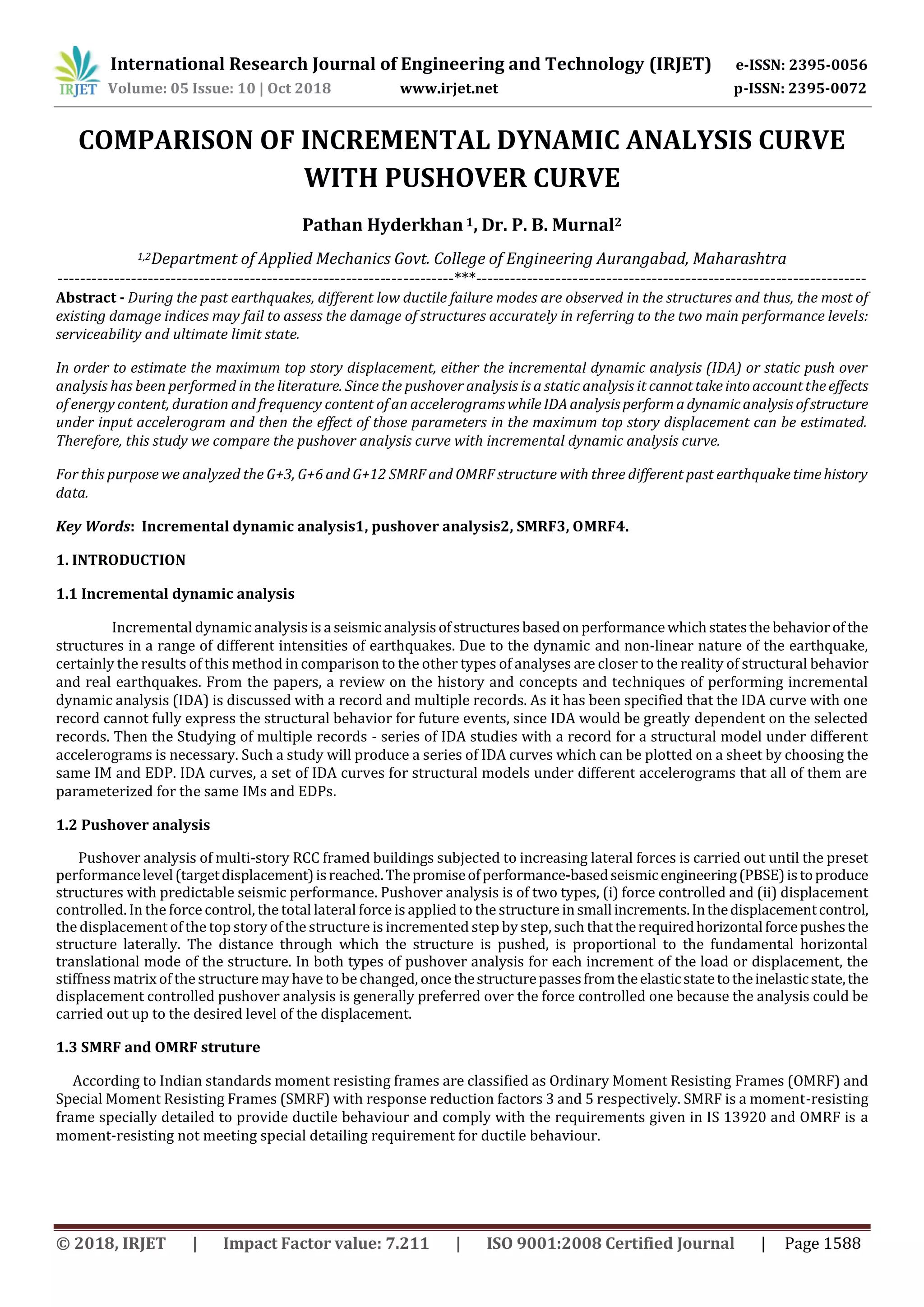
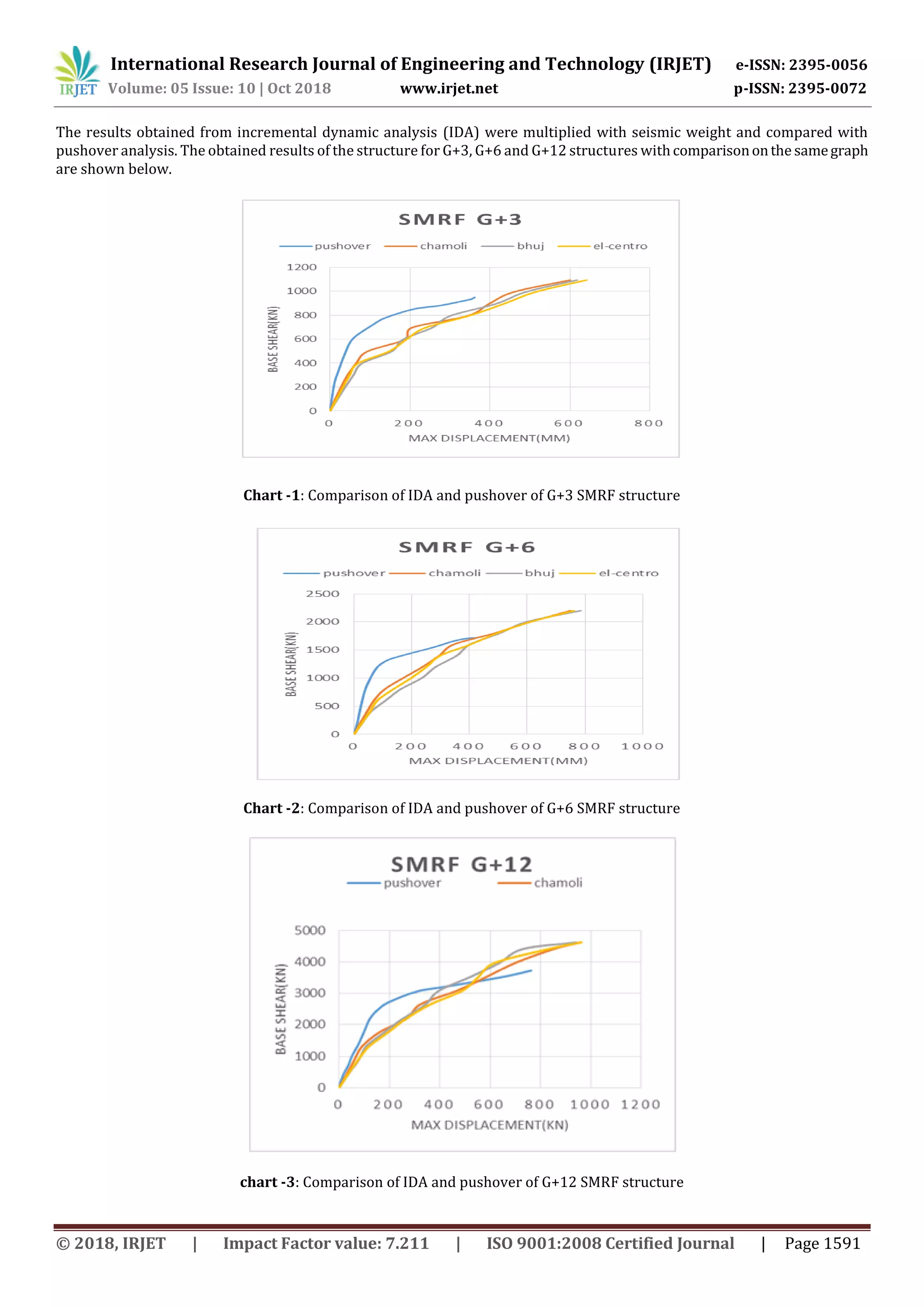
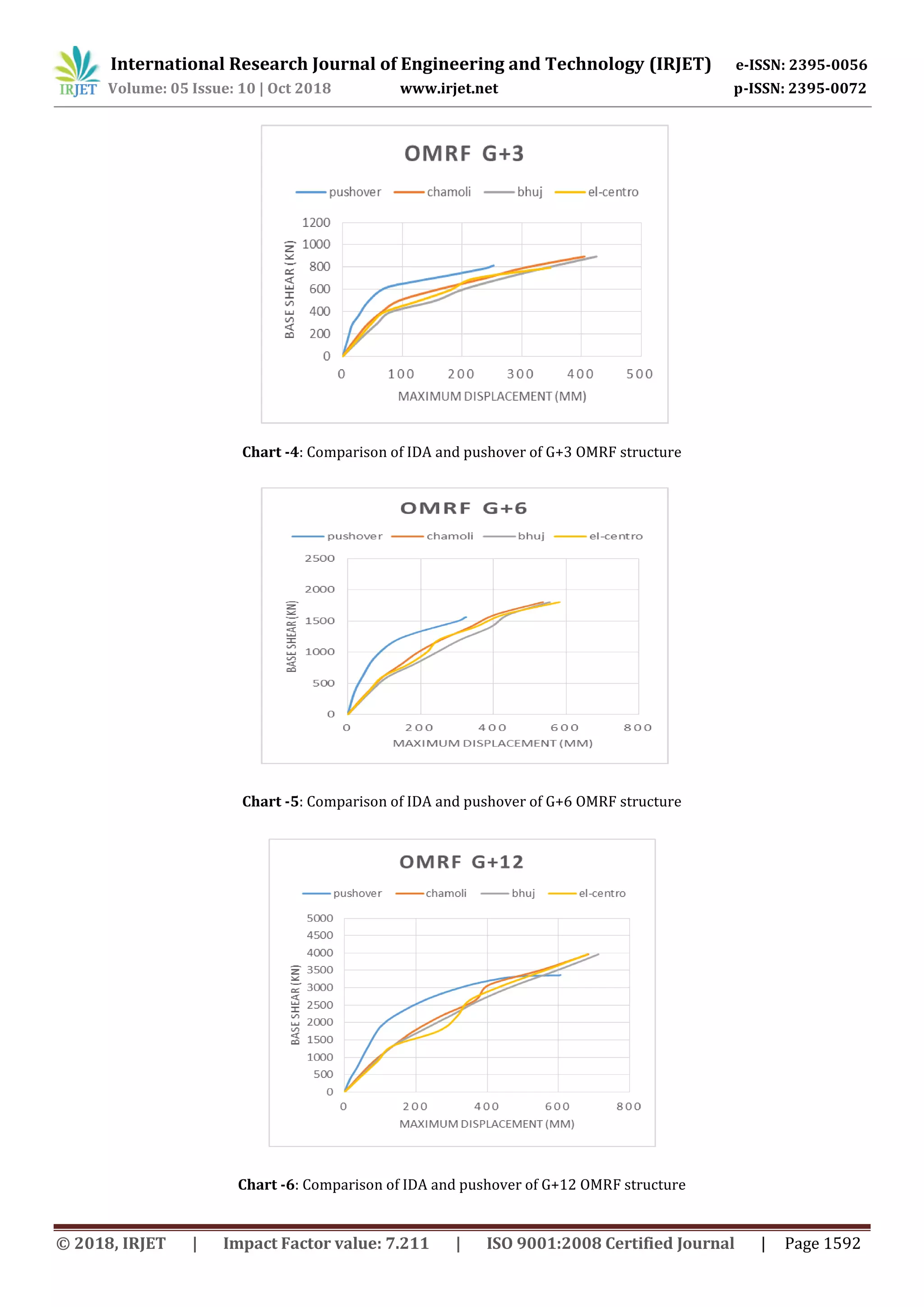
The results obtained from incremental dynamic analysis (IDA) were multiplied with seismic weight and compared with
pushover analysis. The obtained results of the structure for G+3, G+6 and G+12 structures withcomparisononthe samegraph
are shown below.
Chart -1: Comparison of IDA and pushover of G+3 SMRF structure
Chart -2: Comparison of IDA and pushover of G+6 SMRF structure
chart -3: Comparison of IDA and pushover of G+12 SMRF structure
International Research Journal of Engineering and Technology (IRJET) e-ISSN: 2395-0056
Volume: 05 Issue: 10 | Oct 2018 www.irjet.net p-ISSN: 2395-0072
© 2018, IRJET | Impact Factor value: 7.211 | ISO 9001:2008 Certified Journal | Page 1592
Chart -4: Comparison of IDA and pushover of G+3 OMRF structure
Chart -5: Comparison of IDA and pushover of G+6 OMRF structure
Chart -6: Comparison of IDA and pushover of G+12 OMRF structure
International Research Journal of Engineering and Technology (IRJET) e-ISSN: 2395-0056
Volume: 05 Issue: 10 | Oct 2018 www.irjet.net p-ISSN: 2395-0072
© 2018, IRJET | Impact Factor value: 7.211 | ISO 9001:2008 Certified Journal | Page 1593
The comparison of pushover and incremental dynamic analysis shows that for G+3 structure the maximum top story
displacement fortimehistory analysis is 77.58% and 68.19%morecomparetopushoveranalysisforSMRFandOMRFstructure
respectively. For G+12 structure this value decreased to 26.15% and 17.57% for SMRF and OMRF respectively. The base shear
values for time history analysis are 15.28% and 22.15% more as compare to pushover analysis for G+3 SMRF and OMRF
respectively. And forG+12 structuresthebaseshearvaluesfortimehistoryanalysisare24.22%and30.68%moreascompareto
pushover analysis forSMRF and OMRFstructure. It alsoshows that the displacement valueswithincrementaldynamicanalysis
are always more as compare to pushover analysis.
5. CONCLUSIONS
Incremental dynamic analysis and pushover analysis were conductedforG+3,G+6and G+12withSMRFandOMRFframes
considered in the study in-order to evaluate their seismic performance in terms ofmaximumtopstorydisplacement.Fromthe
obtained results it can be concluded as:
 The response of structures for the same base shear value is more from incremental dynamic analysis as compare to
pushover analysis.
 The values obtained from incremental dynamic analysis are more realistic and higher as compared with nonlinear
static pushover analysis
REFERENCES
[1] Hamed Arshadi, “An Overview on The Concepts And Methodologies of Incremental Dynamic Analysis IDA (With A
Single Record and Multiple Records)” Journal of A Structural Congress (2016), Vol. 3, pp. 168-176.
[2] J. Marasingha, K.K. Wijesundara and U.I. Dissanayake “Comparison of Incremental Dynamic Analysis Curve with
Pushover Curve”, Journals of Symposium on Engineering Advancements (2013), Vol. 2, pp. 155-158.
[3] Athanasia Zacharenaki, Michalis Fragiadakis, Dominic Assimaki and Manolis Papadrakakis “Bias Assessment in
Incremental Dynamic Analysis due to Record Scaling” Journal of Soil Dynamics and Earthquake Engineering
(September 2014) Vol.37, pp. 236-248, Elsevier Science Ltd.
[4] Asghar Bahramirad, Mohsen Tehranizadeh and Amir Moshref, “Equating Incremental Dynamic Analysis with Static
Nonlinear Analysis at Near-Field Excitation” Journal of Earthquake Engineering and Engineering Vibration
(September, 2015) Vol.14, No.3, pp. 789-801.
[5] FEMA (2000) “Prestandard and Commentary for the Seismic Rehabilitation of buildings”, FEMA 356, Federal
Emergency Management Agency, Washington.

IRJET- Comparison of Incremental Dynamic Analysis Curve with Pushover Curve

  • 1.
    International Research Journalof Engineering and Technology (IRJET) e-ISSN: 2395-0056 Volume: 05 Issue: 10 | Oct 2018 www.irjet.net p-ISSN: 2395-0072 © 2018, IRJET | Impact Factor value: 7.211 | ISO 9001:2008 Certified Journal | Page 1588 COMPARISON OF INCREMENTAL DYNAMIC ANALYSIS CURVE WITH PUSHOVER CURVE Pathan Hyderkhan1, Dr. P. B. Murnal2 1,2Department of Applied Mechanics Govt. College of Engineering Aurangabad, Maharashtra ----------------------------------------------------------------------***--------------------------------------------------------------------- Abstract - During the past earthquakes, different low ductile failure modes are observed in the structures and thus, the most of existing damage indices may fail to assess the damage of structures accurately in referring to the two main performance levels: serviceability and ultimate limit state. In order to estimate the maximum top story displacement, either the incremental dynamic analysis (IDA) or static push over analysis has been performed in the literature. Since the pushover analysis is a static analysis it cannottakeintoaccounttheeffects of energy content, duration and frequency content of an accelerogramswhileIDAanalysisperformadynamicanalysis ofstructure under input accelerogram and then the effect of those parameters in the maximum top story displacement can be estimated. Therefore, this study we compare the pushover analysis curve with incremental dynamic analysis curve. For this purpose we analyzed the G+3, G+6 and G+12 SMRF and OMRF structure with three different past earthquake timehistory data. Key Words: Incremental dynamic analysis1, pushover analysis2, SMRF3, OMRF4. 1. INTRODUCTION 1.1 Incremental dynamic analysis Incremental dynamic analysis is a seismic analysisofstructures basedon performancewhichstatesthe behaviorof the structures in a range of different intensities of earthquakes. Due to the dynamic and non-linear nature of the earthquake, certainly the results of this method in comparison to the other types of analyses are closer to the reality of structural behavior and real earthquakes. From the papers, a review on the history and concepts and techniques of performing incremental dynamic analysis (IDA) is discussed with a record and multiple records. As it has been specified that the IDA curve with one record cannot fully express the structural behavior for future events, since IDA would be greatly dependent on the selected records. Then the Studying of multiple records - series of IDA studies with a record for a structural model under different accelerograms is necessary. Such a study will produce a series of IDA curves which can be plotted on a sheet by choosing the same IM and EDP. IDA curves, a set of IDA curves for structural models under different accelerograms that all of them are parameterized for the same IMs and EDPs. 1.2 Pushover analysis Pushover analysis of multi-story RCC framed buildings subjected to increasing lateral forces is carried out until the preset performancelevel(targetdisplacement)isreached.Thepromiseofperformance-basedseismicengineering(PBSE)istoproduce structures with predictable seismic performance. Pushover analysis is of two types, (i) force controlled and (ii) displacement controlled. In the force control, the total lateral force is applied to the structureinsmallincrements.Inthedisplacementcontrol, the displacement of the top story of the structure is incremented step by step, such thattherequiredhorizontalforcepushesthe structure laterally. The distance through which the structure is pushed, is proportional to the fundamental horizontal translational mode of the structure. In both types of pushover analysis for each increment of the load or displacement, the stiffness matrix of the structure may have to be changed, once thestructurepassesfromtheelasticstatetotheinelasticstate,the displacement controlled pushover analysis is generally preferred over the force controlled one because the analysis could be carried out up to the desired level of the displacement. 1.3 SMRF and OMRF struture According to Indian standards moment resisting frames are classified as Ordinary Moment Resisting Frames (OMRF) and Special Moment Resisting Frames (SMRF) with response reduction factors 3 and 5 respectively. SMRF is a moment-resisting frame specially detailed to provide ductile behaviour and comply with the requirements given in IS 13920 and OMRF is a moment-resisting not meeting special detailing requirement for ductile behaviour.
  • 2.
    International Research Journalof Engineering and Technology (IRJET) e-ISSN: 2395-0056 Volume: 05 Issue: 10 | Oct 2018 www.irjet.net p-ISSN: 2395-0072 © 2018, IRJET | Impact Factor value: 7.211 | ISO 9001:2008 Certified Journal | Page 1589 2. MODEL DESCRIPTION The structure analyzed in this study are G+3 SMRF and OMRF, G+6 SMRF and OMRF and G+12 SMRF and OMRF. All the frames have samefloor plan with 4-5meter baysalong longitudinal direction (X- Direction)and4-4meterbaysalongtransverse direction (Y-direction) as shown in fig.-1. The story height is 3 meter forall the stories. The live load taken as 3kN/m2onallthe floors except roof and on roofit taken as 1.5 kN/m2. The floor finish forall the floor is taken as 2 kN/m2 except roofand on roof it taken as 1 kN/m2. The compressive strength of concreteis taken as 30 kN/m3 andyieldstrengthofsteelreinforcementis415 N/mn2. The modulus of elasticity of concrete and steelare25000N/mm2and2x105N/mm2respectively.TheelevationofG+3, G+6 and G+12 are shown in fig.-2 respectively. Fig -1: Typical floor plan for all structures Fig -2: Elevation of all structures All the structure mentioned above in which OMRF structure are designed as per IS 456-2000 and IS 1893 (part-I)-2016 and SMRF structure are designed as per IS 456-2000 and IS 13920-2016. All the structure are situated in seismic zone III with an importance factor 1 as per IS 1893(part I)-2016. The soiltypeismediumstiffsoil.Thecross-sectiondetailsofbeamsandcolumn of the frames are shown in the Table-1. Table -1: Sizes of beam and column Serial number Structure Beam size (mm) Column size (mm) 1 G+3 300x300 300x350 2 G+6 300x450 450x450 3 G+12 450x550 450x600
  • 3.
    International Research Journalof Engineering and Technology (IRJET) e-ISSN: 2395-0056 Volume: 05 Issue: 10 | Oct 2018 www.irjet.net p-ISSN: 2395-0072 © 2018, IRJET | Impact Factor value: 7.211 | ISO 9001:2008 Certified Journal | Page 1590 3.0 METHDODLOGY 3.1 Incremental dynamic analysis Incremental dynamic analysisisanonlineartimehistoryanalysisofstructuresbasedonthestructuralperformancewhichstates the behavior of the structures in a range of different intensities of earthquake. In this method a structural model subjected to one (or more) ground motion record(s), each scaled to multiple levels of intensity, thus producing one (or more) curve(s) of response parameterized versus intensity level. Due to thedynamicandnon-linearnatureoftheearthquake,certainlytheresults of this method in comparisonto the other types of analysesare closer to therealityofstructuralbehavior.However,thismethod is a timeconsuming methodand like other kind of timehistory methods, is too dependentontherecords.Moreover,selectionof intensity measures and engineering demandparametersareimportantissuesinincrementaldynamicanalysis.Thismethodhas accepted by the guidelines of Federal Emergency Management Agency (FEMA) and can be used as a method in order to determine the potential collapse capacity of the entire structure. For incremental dynamic analysis past earthquake records of El-centro earthquake, Bhuj earthquake and Chamoli earthquake were used. This earthquake records (PGA) were scaled from .1g to 1.1g for this analysis using seismosignal software. Table-2 Earthquake data used for analysis 3.2 Pushover analysis In Pushover analysis, a statichorizontal force profile, usually proportional to the design force profiles specifiedinthecodes, is applied to the structure. The force profile is then incremented in small stepsand the structure is analyzed at each step. As the loads are increased, the building undergoes yielding at a few locations. Every time such yielding takes place, the structural properties are modified approximately to reflect the yielding. The analysis is continued till the structure collapses, or the building reachescertainlevel of lateral displacement. It providesaloadversusdeflectioncurveofthestructurestartingfromthe state of rest to the ultimate failure of the structure. The load is representative of the equivalent static load of the fundamental mode of the structure. It is generally taken as the total base shear of the structureand the deflection is selected as the top-story deflection. The selection of appropriate lateral load distribution is an important step. The first step then is to select a displacement shape and the vector of lateral loads is determined as {F } = p[ m]{Φ} (1) Where {Φ} is the assumed displacement shape,and p is the magnitude of the lateral loads. From equation (1), it followsthat the lateral force at anylevel is proportional to the assumed displacement shapeand storymass. If the assumeddisplacementshape was exact and remained constant during ground shaking, then distribution of lateral forces would be equal to distribution of effective earthquake forces. 4.0 RESULTS AND DISCUSSION To compare the incremental dynamic analysis with pushover analysis the PGA values of incremental dynamic analysis are multiplied with the seismic weight of the structure. The calculated seismic weight of structures are shown in table below Table 3 Seismic weight of Structures Serial number Frame Seismic Weight(kN/g) 1 G+3 993.7883 2 G+6 2000.669 3 G+12 4401.574 Name of Earthquake Date PGA(g) El-Centro 18-5-1940 Scaled from .1g to 1.1g Bhuj 26-01-2001 Scaled from .1g to 1.1g Chamoli 29-3-1999 Scaled from .1g to 1.1g
  • 4.
    International Research Journalof Engineering and Technology (IRJET) e-ISSN: 2395-0056 Volume: 05 Issue: 10 | Oct 2018 www.irjet.net p-ISSN: 2395-0072 © 2018, IRJET | Impact Factor value: 7.211 | ISO 9001:2008 Certified Journal | Page 1591 The results obtained from incremental dynamic analysis (IDA) were multiplied with seismic weight and compared with pushover analysis. The obtained results of the structure for G+3, G+6 and G+12 structures withcomparisononthe samegraph are shown below. Chart -1: Comparison of IDA and pushover of G+3 SMRF structure Chart -2: Comparison of IDA and pushover of G+6 SMRF structure chart -3: Comparison of IDA and pushover of G+12 SMRF structure
  • 5.
    International Research Journalof Engineering and Technology (IRJET) e-ISSN: 2395-0056 Volume: 05 Issue: 10 | Oct 2018 www.irjet.net p-ISSN: 2395-0072 © 2018, IRJET | Impact Factor value: 7.211 | ISO 9001:2008 Certified Journal | Page 1592 Chart -4: Comparison of IDA and pushover of G+3 OMRF structure Chart -5: Comparison of IDA and pushover of G+6 OMRF structure Chart -6: Comparison of IDA and pushover of G+12 OMRF structure
  • 6.
    International Research Journalof Engineering and Technology (IRJET) e-ISSN: 2395-0056 Volume: 05 Issue: 10 | Oct 2018 www.irjet.net p-ISSN: 2395-0072 © 2018, IRJET | Impact Factor value: 7.211 | ISO 9001:2008 Certified Journal | Page 1593 The comparison of pushover and incremental dynamic analysis shows that for G+3 structure the maximum top story displacement fortimehistory analysis is 77.58% and 68.19%morecomparetopushoveranalysisforSMRFandOMRFstructure respectively. For G+12 structure this value decreased to 26.15% and 17.57% for SMRF and OMRF respectively. The base shear values for time history analysis are 15.28% and 22.15% more as compare to pushover analysis for G+3 SMRF and OMRF respectively. And forG+12 structuresthebaseshearvaluesfortimehistoryanalysisare24.22%and30.68%moreascompareto pushover analysis forSMRF and OMRFstructure. It alsoshows that the displacement valueswithincrementaldynamicanalysis are always more as compare to pushover analysis. 5. CONCLUSIONS Incremental dynamic analysis and pushover analysis were conductedforG+3,G+6and G+12withSMRFandOMRFframes considered in the study in-order to evaluate their seismic performance in terms ofmaximumtopstorydisplacement.Fromthe obtained results it can be concluded as:  The response of structures for the same base shear value is more from incremental dynamic analysis as compare to pushover analysis.  The values obtained from incremental dynamic analysis are more realistic and higher as compared with nonlinear static pushover analysis REFERENCES [1] Hamed Arshadi, “An Overview on The Concepts And Methodologies of Incremental Dynamic Analysis IDA (With A Single Record and Multiple Records)” Journal of A Structural Congress (2016), Vol. 3, pp. 168-176. [2] J. Marasingha, K.K. Wijesundara and U.I. Dissanayake “Comparison of Incremental Dynamic Analysis Curve with Pushover Curve”, Journals of Symposium on Engineering Advancements (2013), Vol. 2, pp. 155-158. [3] Athanasia Zacharenaki, Michalis Fragiadakis, Dominic Assimaki and Manolis Papadrakakis “Bias Assessment in Incremental Dynamic Analysis due to Record Scaling” Journal of Soil Dynamics and Earthquake Engineering (September 2014) Vol.37, pp. 236-248, Elsevier Science Ltd. [4] Asghar Bahramirad, Mohsen Tehranizadeh and Amir Moshref, “Equating Incremental Dynamic Analysis with Static Nonlinear Analysis at Near-Field Excitation” Journal of Earthquake Engineering and Engineering Vibration (September, 2015) Vol.14, No.3, pp. 789-801. [5] FEMA (2000) “Prestandard and Commentary for the Seismic Rehabilitation of buildings”, FEMA 356, Federal Emergency Management Agency, Washington.