Static Pushover Analysis 
Performance Based Design 
Modeling for Pushover Analysis 
Use of the Pushover Curve 
M. Iqbal Suharwardy 
Computers and Structures, Inc. 
Static Pushover Analysis for Seismic Design 
March 22, 1999
Performance Check of Structures 
Purpose 
How will a structure perform when subjected to 
a given level of earthquake? 
– Definition of structural performance 
– Definition of earthquake level 
– Determination of performance level
Performance Check of Structures 
Process 
Recently released guidelines for Seismic 
Rehabilitation of Buildings: 
– ATC-40 
– FEMA 273 (ATC-33)
Types of Performance Checks 
Linear Static Analysis 
Linear Dynamic Analysis 
Nonlinear Static Analysis 
(Pushover Analysis) 
Nonlinear Dynamic Analysis
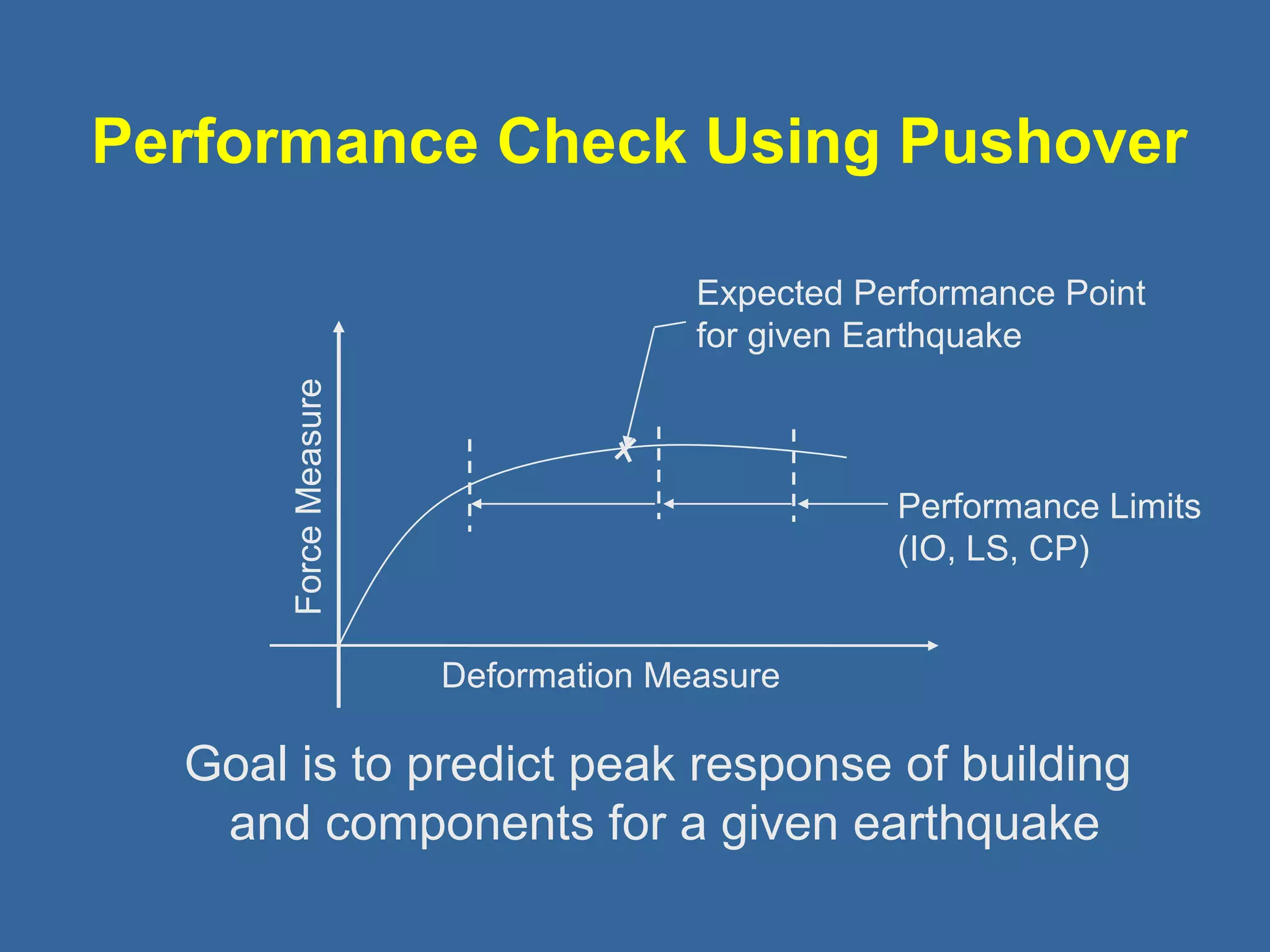
Performance Check Using Pushover 
Expected Performance Point 
for given Earthquake 
Deformation Measure 
Force Measure 
Performance Limits 
(IO, LS, CP) 
Goal is to predict peak response of building 
and components for a given earthquake
Why Do Pushover Analysis? 
Design Earthquakes cause nonlinear 
behavior 
Better understand building behavior 
- Identify weak elements 
- Realistic prediction of element demands 
Less conservative acceptance criteria can be 
used with consequences understood
Steps in Performance Check 
Construct Pushover curve 
Select earthquake level(s) to check 
Select performance level(s) to check 
Select acceptance criteria for each 
performance level 
Verify acceptance 
Capacity Spectrum Method (ATC-40) 
Displacement Coefficient Method (FEMA 273)
Constructing Pushover Curve 
Define Structural Model 
Elements (components) 
Strength - deformation properties 
Define Loads 
Gravity 
Lateral load pattern 
Select Control Displacements or Drifts 
Perform Pushover Analysis
Pushover Modeling 
Definition of Structural Model 
3D or 2D 
Primary and Secondary Elements (components) 
Non structural Elements 
Foundation flexibility 
P-Delta effects
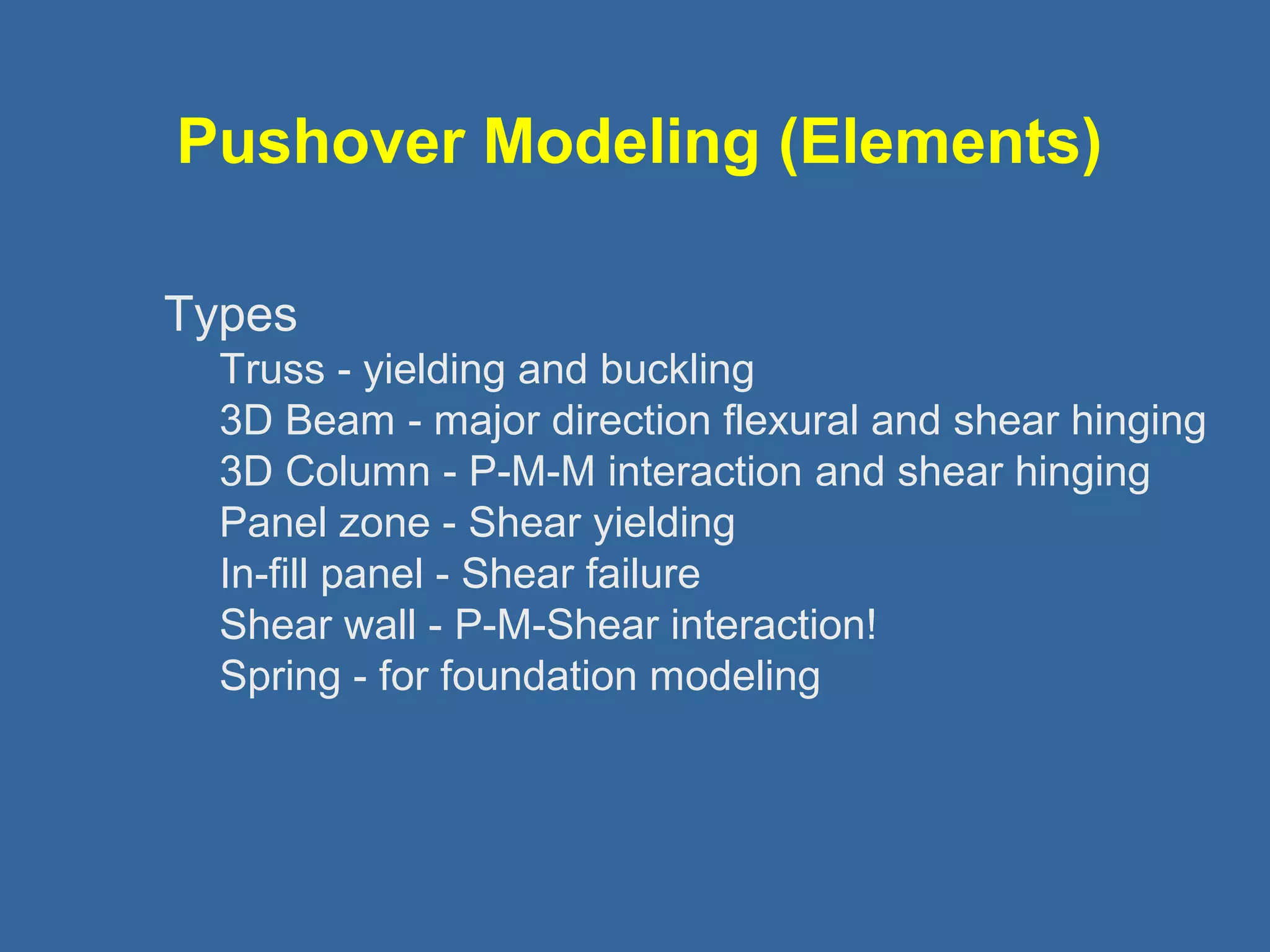
Pushover Modeling (Elements) 
Types 
Truss - yielding and buckling 
3D Beam - major direction flexural and shear hinging 
3D Column - P-M-M interaction and shear hinging 
Panel zone - Shear yielding 
In-fill panel - Shear failure 
Shear wall - P-M-Shear interaction! 
Spring - for foundation modeling
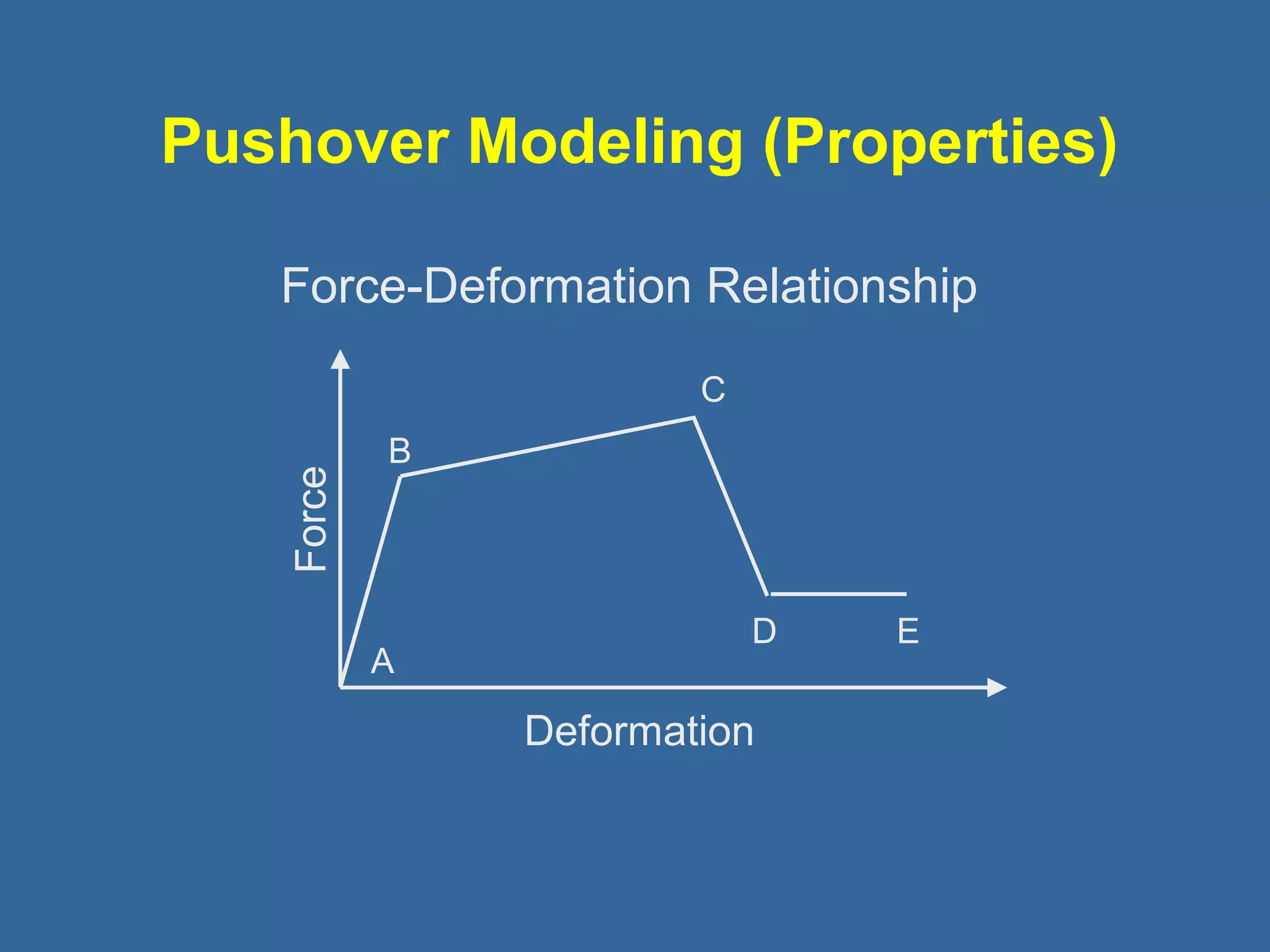
Pushover Modeling (Properties) 
Force-Deformation Relationship 
B 
A 
C 
D E Force 
Deformation
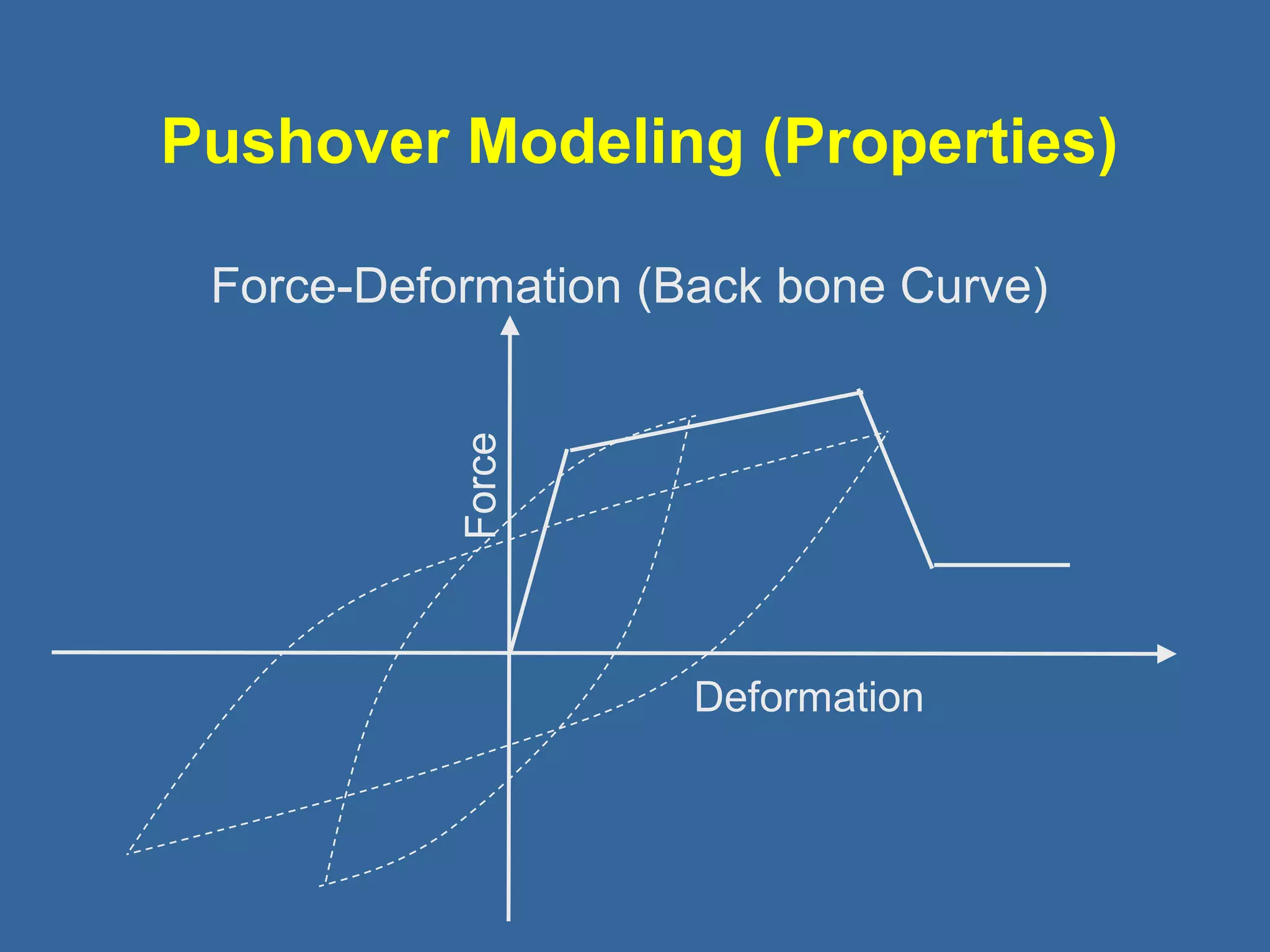
Pushover Modeling (Properties) 
Force-Deformation (Back bone Curve) 
Force 
Deformation
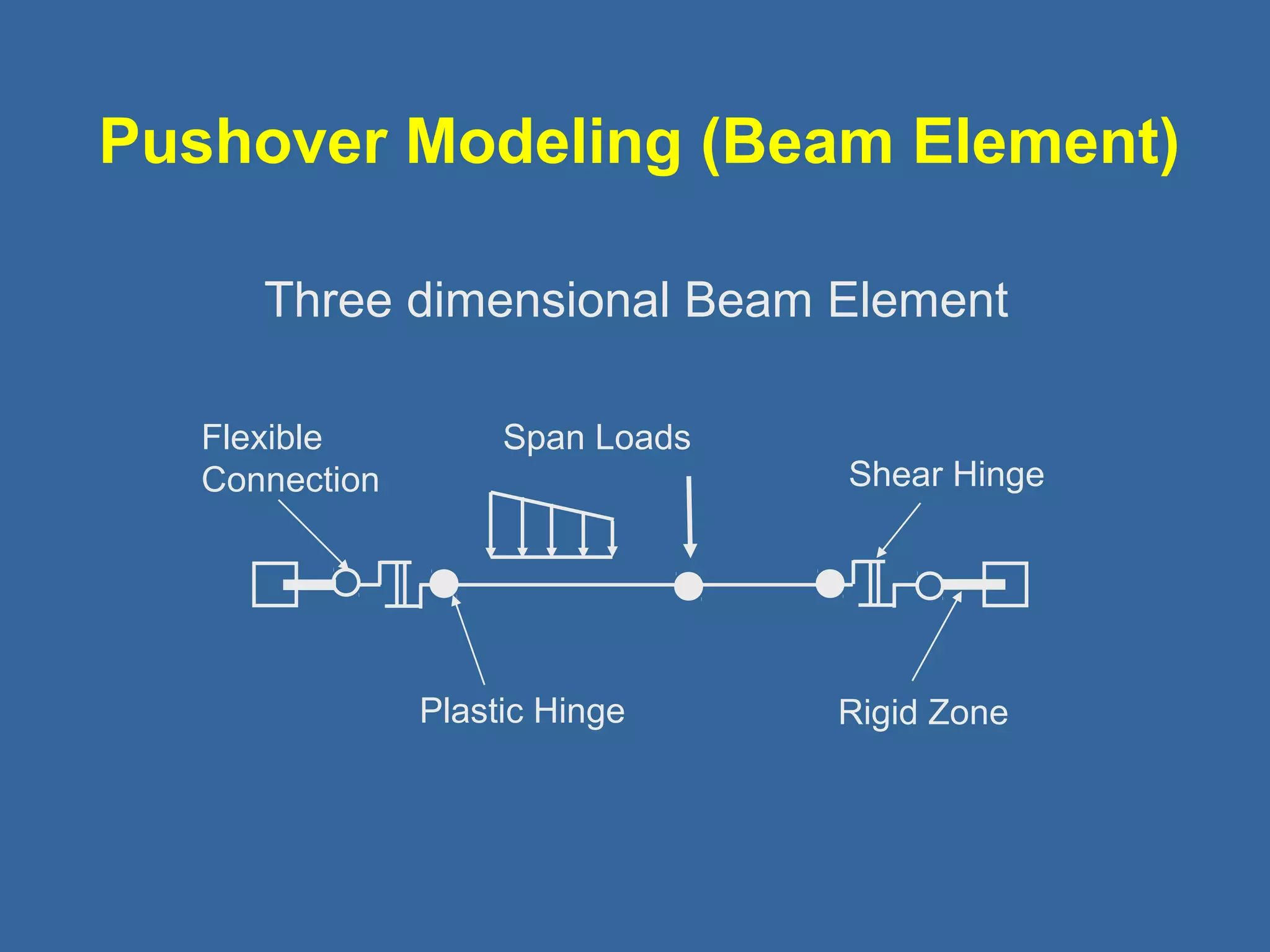
Pushover Modeling (Beam Element) 
Three dimensional Beam Element 
Flexible Span Loads 
Connection Shear Hinge 
Plastic Hinge Rigid Zone
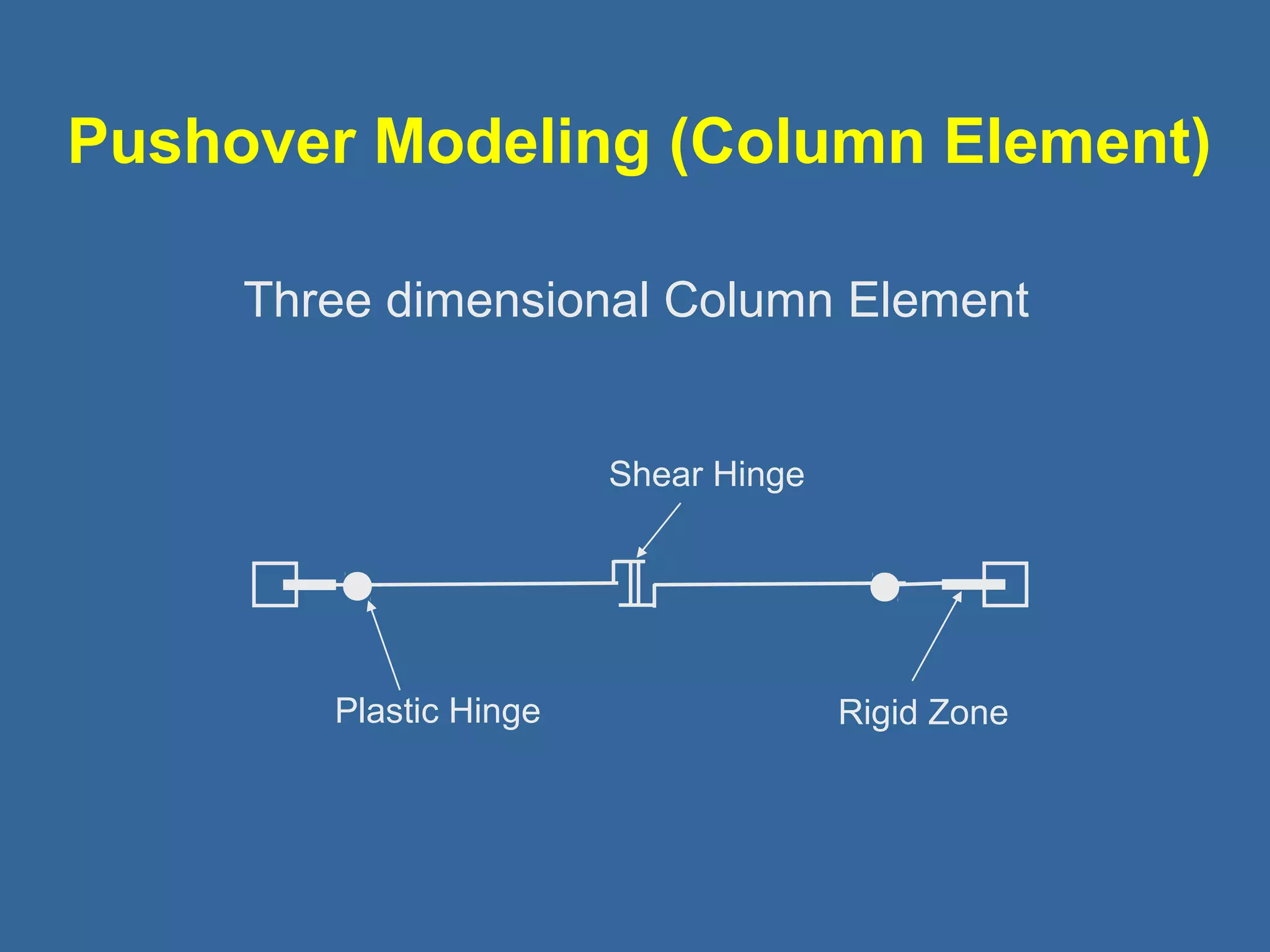
Pushover Modeling (Column Element) 
Three dimensional Column Element 
Shear Hinge 
Plastic Hinge Rigid Zone
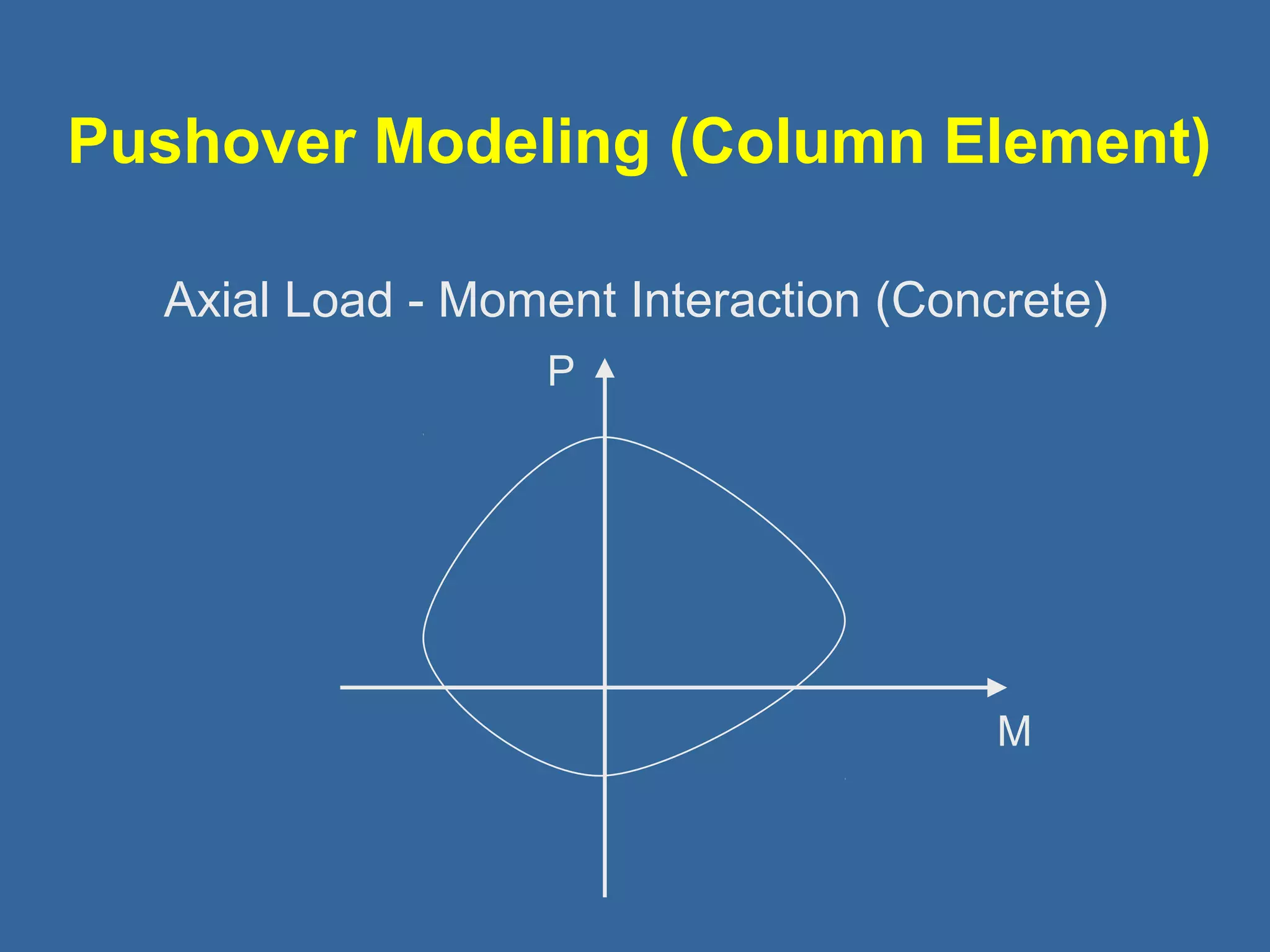
Pushover Modeling (Column Element) 
Axial Load - Moment Interaction (Concrete) 
P 
M
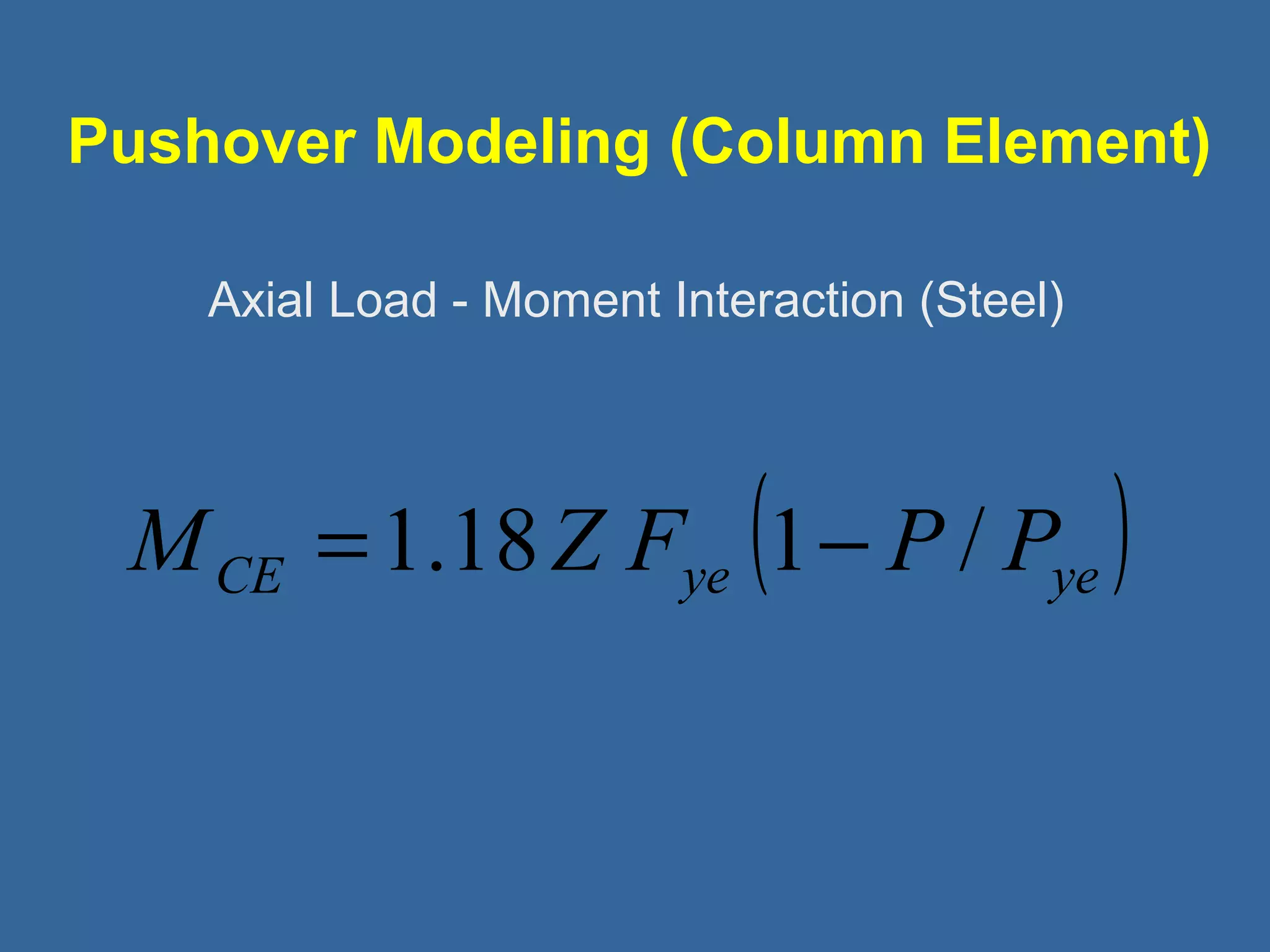
Pushover Modeling (Column Element) 
Axial Load - Moment Interaction (Steel) 
CE ye ( ye ) M =1.18Z F 1- P / P
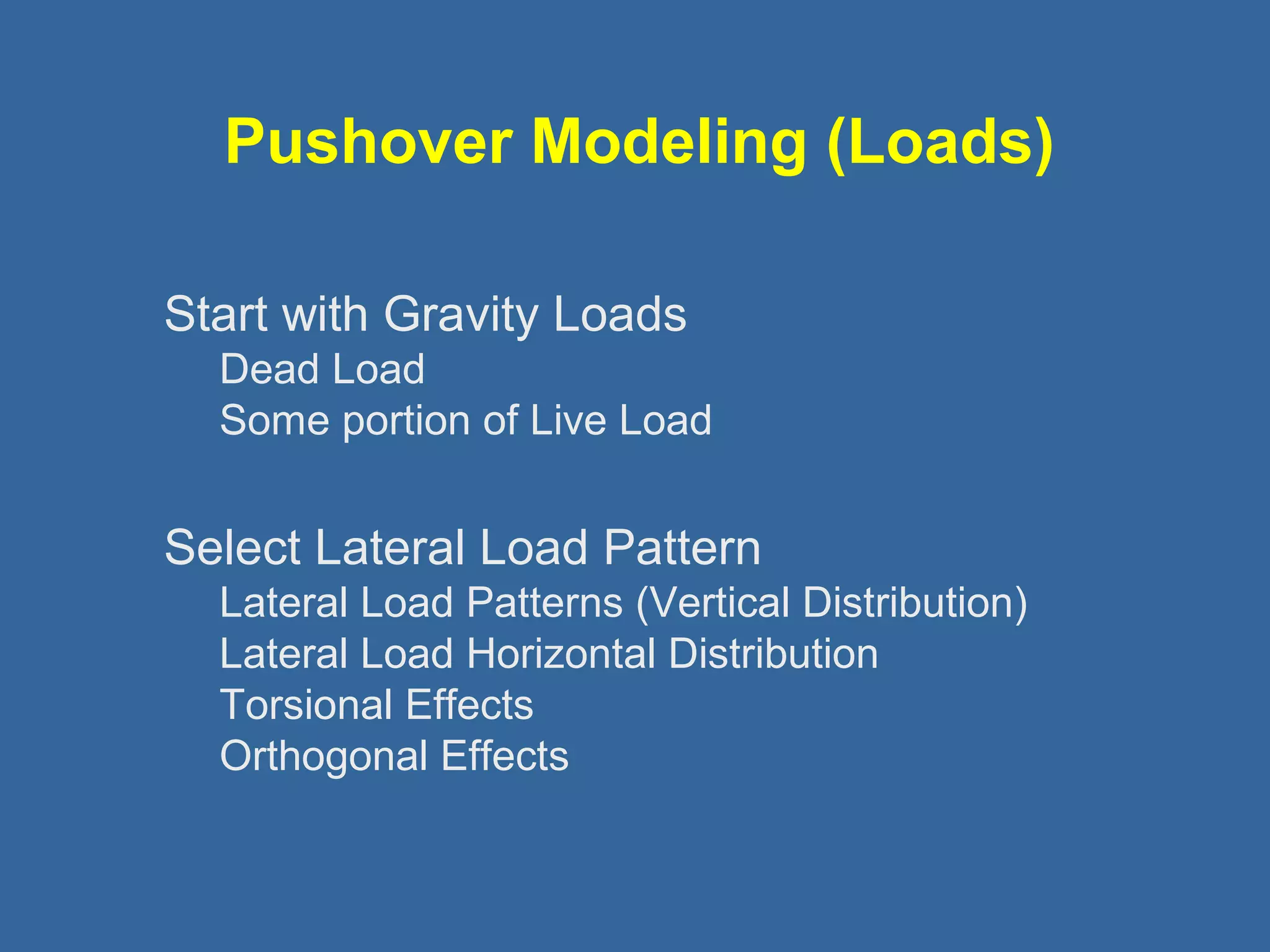
Pushover Modeling (Loads) 
 Start with Gravity Loads 
Dead Load 
Some portion of Live Load 
 Select Lateral Load Pattern 
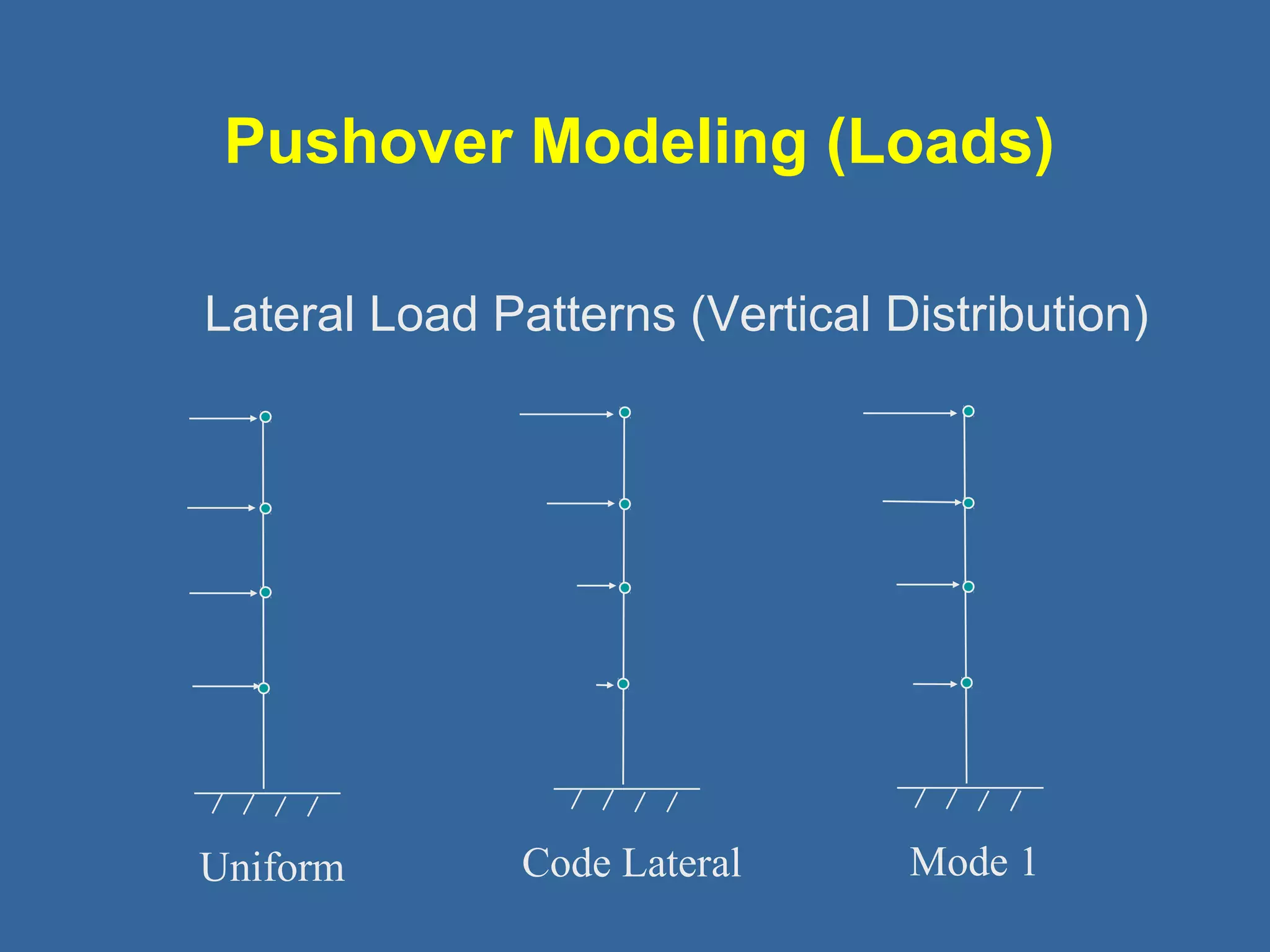
Lateral Load Patterns (Vertical Distribution) 
Lateral Load Horizontal Distribution 
Torsional Effects 
Orthogonal Effects
Pushover Modeling (Loads) 
Lateral Load Patterns (Vertical Distribution) 
Uniform Code Lateral Mode 1
Pushover Analysis (Control) 
 Force controlled analysis 
 Deformation controlled analysis 
Roof Displacement 
Generalized Displacement Definitions 
 Limit of analysis 
Instability - loss of gravity load carrying capacity 
Excessive distortions
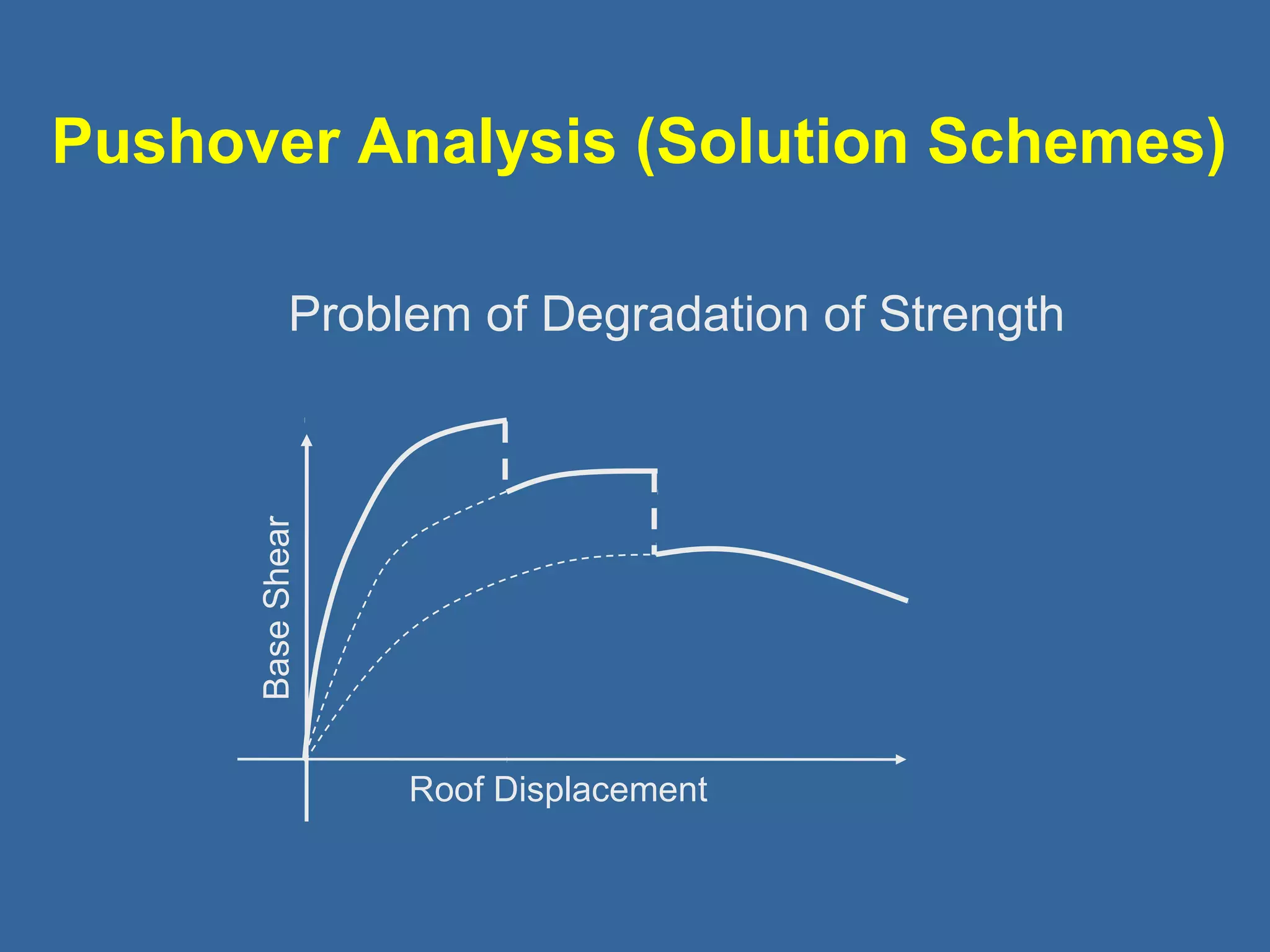
Pushover Analysis (Solution Schemes) 
 Event by Event Strategies 
Manual 
 Newton-Raphson Type Strategies 
Constant stiffness iterations 
Tangent stiffness iterations 
 Problem of degradation of strength 
 Ritz Modes (Reduced Space) Strategies
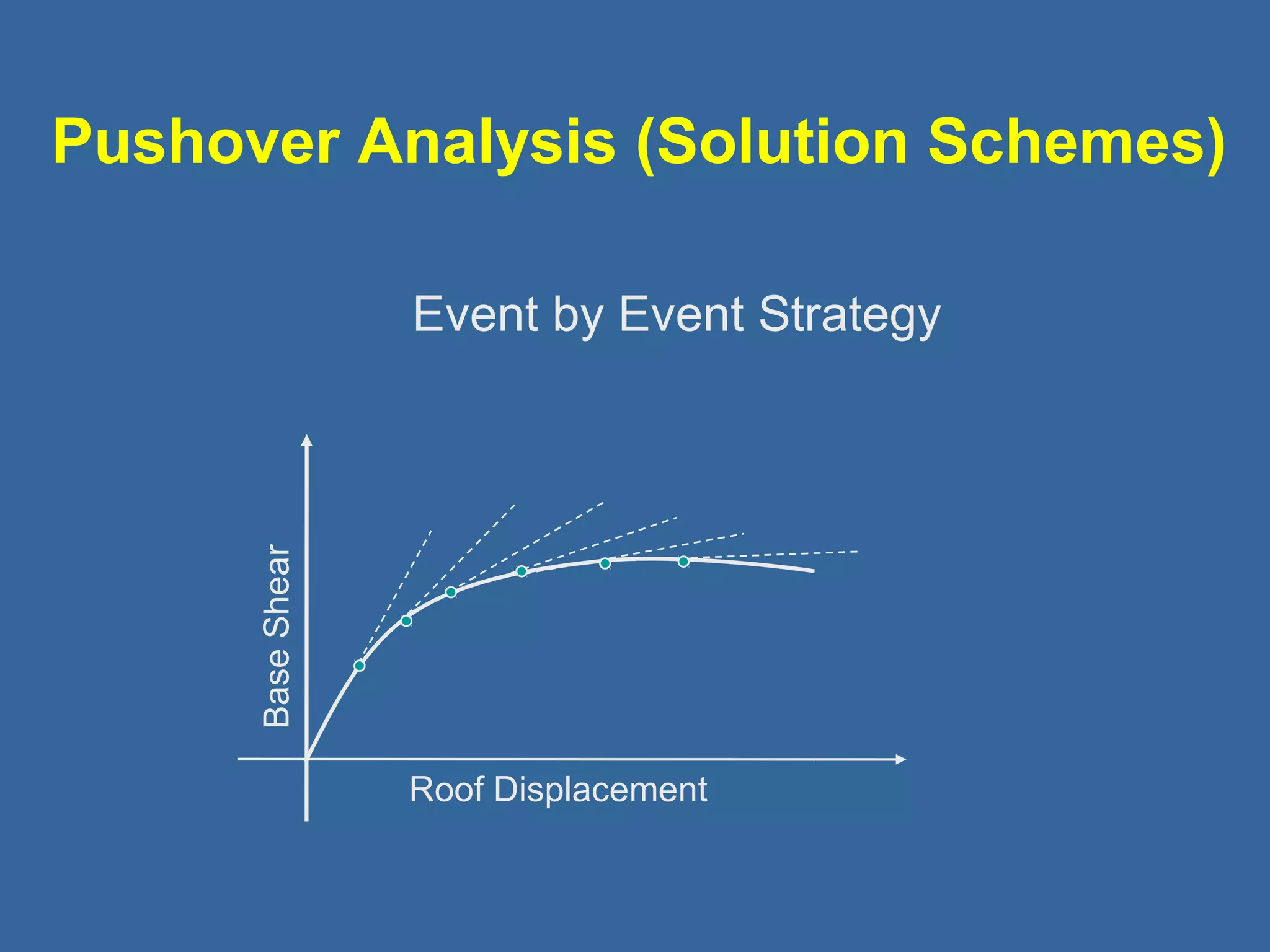
Pushover Analysis (Solution Schemes) 
Event by Event Strategy 
Roof Displacement 
Base Shear
Pushover Analysis (Solution Schemes) 
Problem of Degradation of Strength 
Roof Displacement 
Base Shear
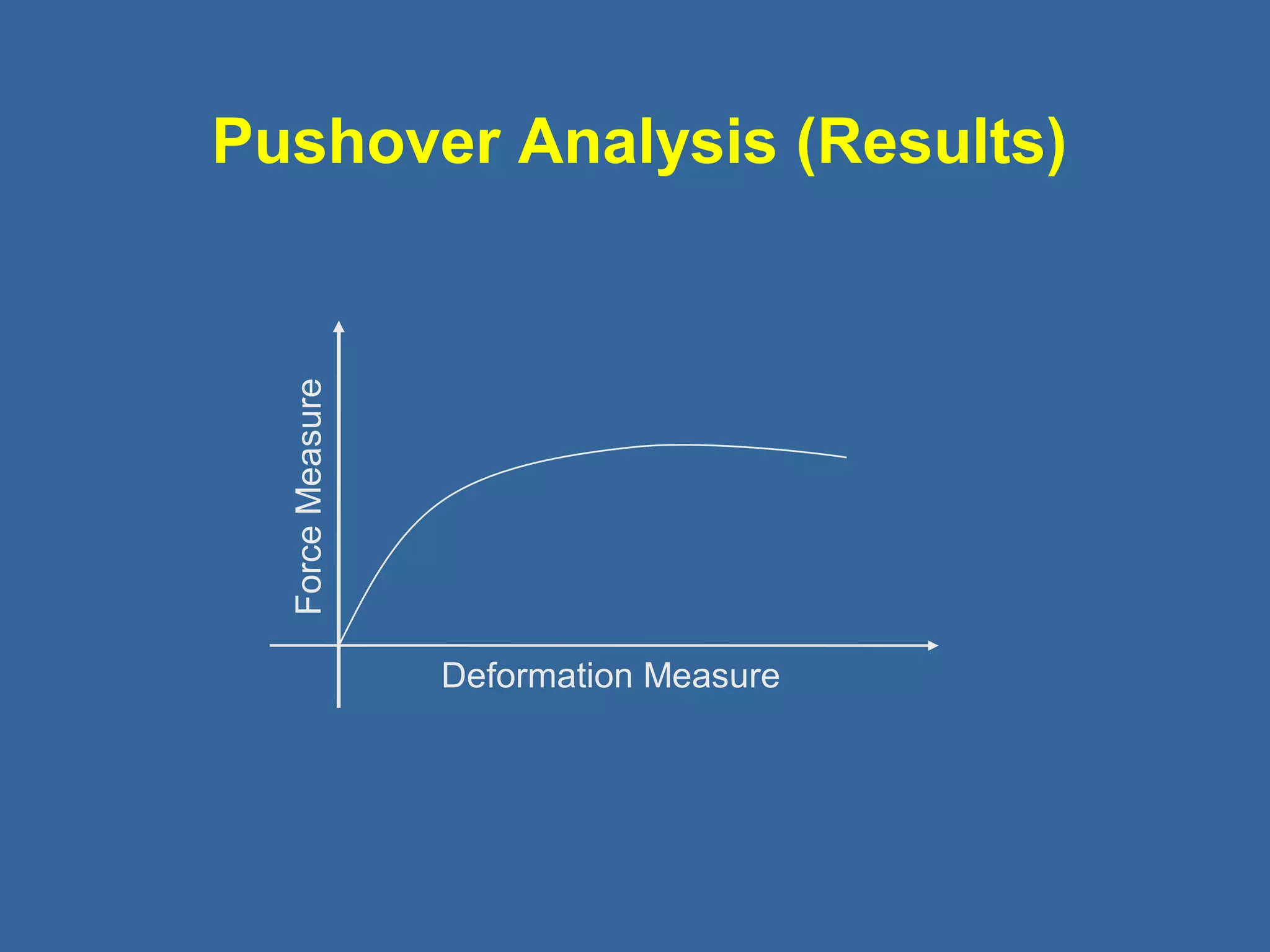
Pushover Analysis (Results) 
Deformation Measure 
Force Measure
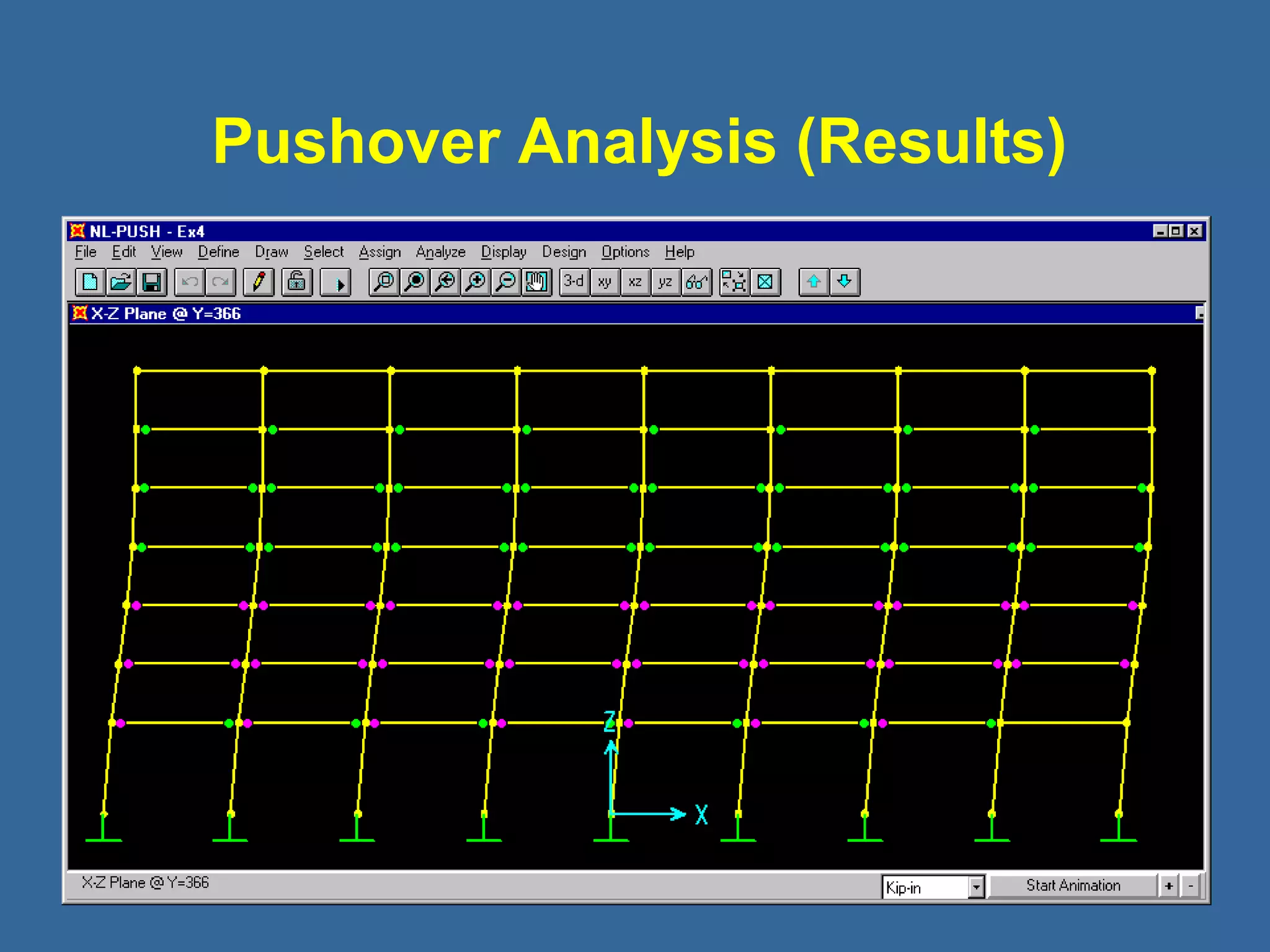
Pushover Analysis (Results)
Use of Pushover Curve 
 Capacity Spectrum Method 
- detailed in ATC-40 
- and as alternate method in FEMA-273 
 Displacement Coefficient Method 
- detailed in FEMA-273
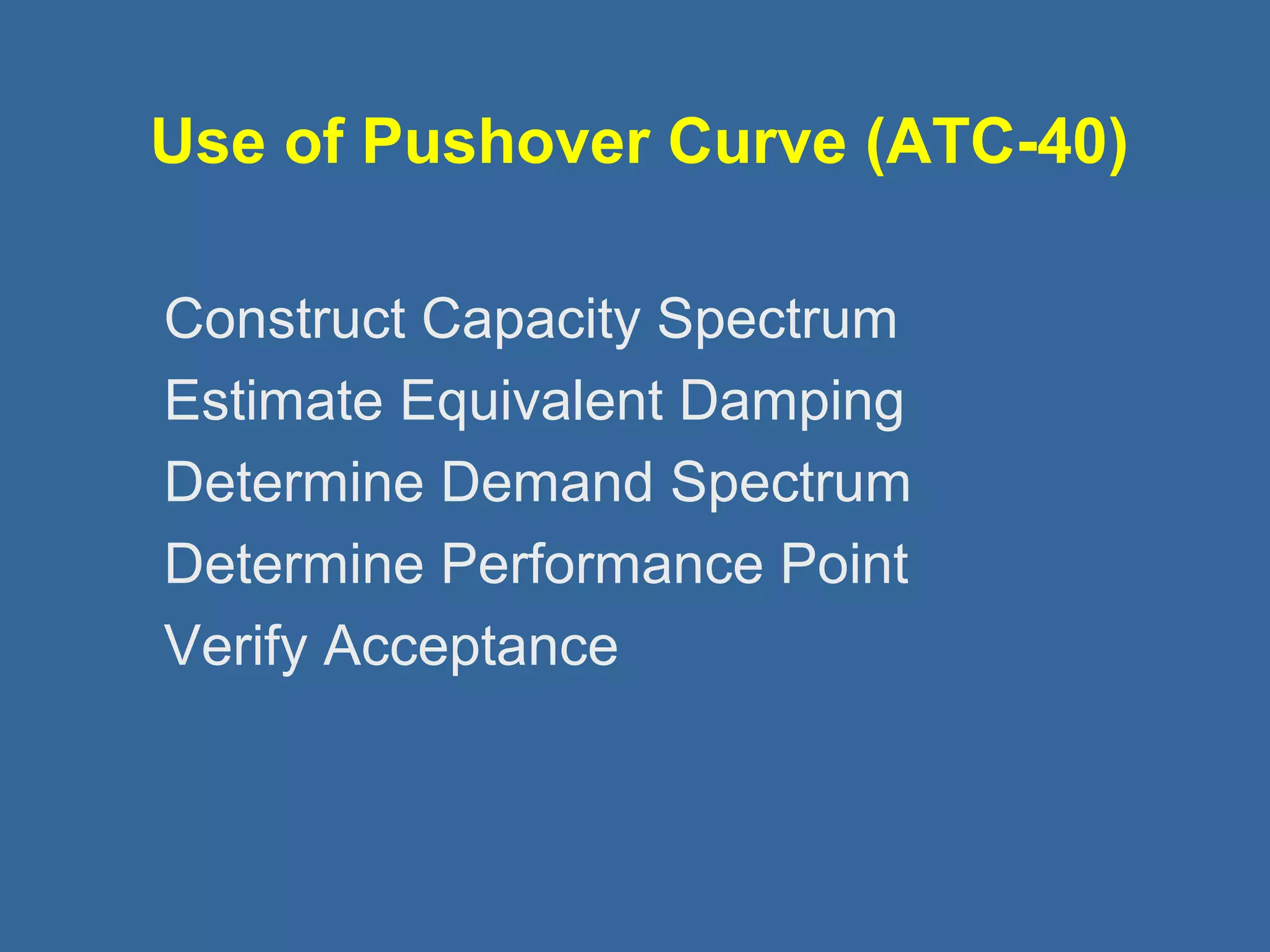
Use of Pushover Curve (ATC-40) 
 Construct Capacity Spectrum 
 Estimate Equivalent Damping 
 Determine Demand Spectrum 
 Determine Performance Point 
 Verify Acceptance
Use of Pushover Curve (ATC-40) 
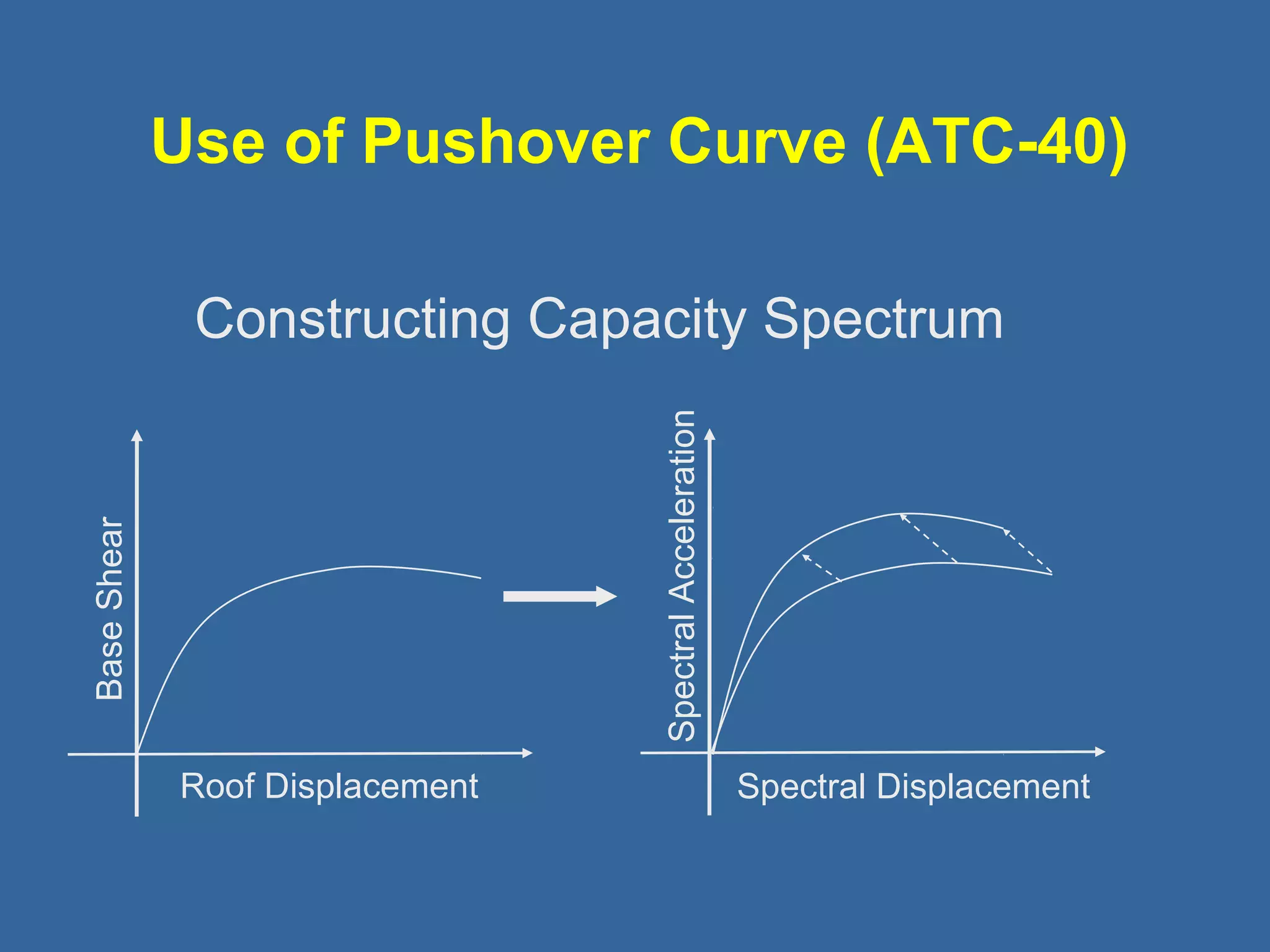
Constructing Capacity Spectrum 
Roof Displacement 
Base Shear 
Spectral Displacement 
Spectral Acceleration
Use of Pushover Curve (ATC-40) 
Constructing Capacity Spectrum 
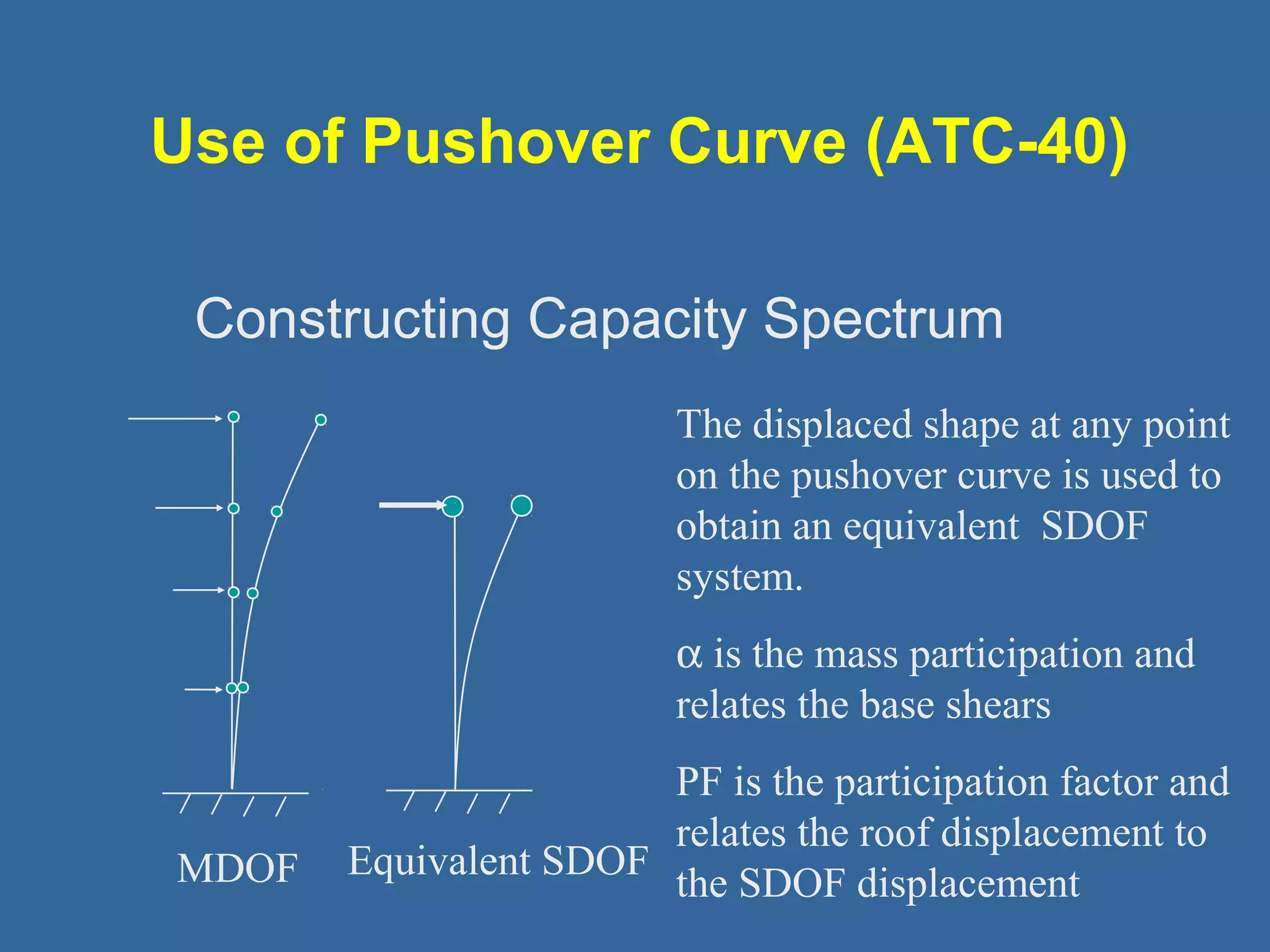
MDOF Equivalent SDOF 
The displaced shape at any point 
on the pushover curve is used to 
obtain an equivalent SDOF 
system. 
a is the mass participation and 
relates the base shears 
PF is the participation factor and 
relates the roof displacement to 
the SDOF displacement
Use of Pushover Curve (ATC-40) 
Constructing Capacity Spectrum 
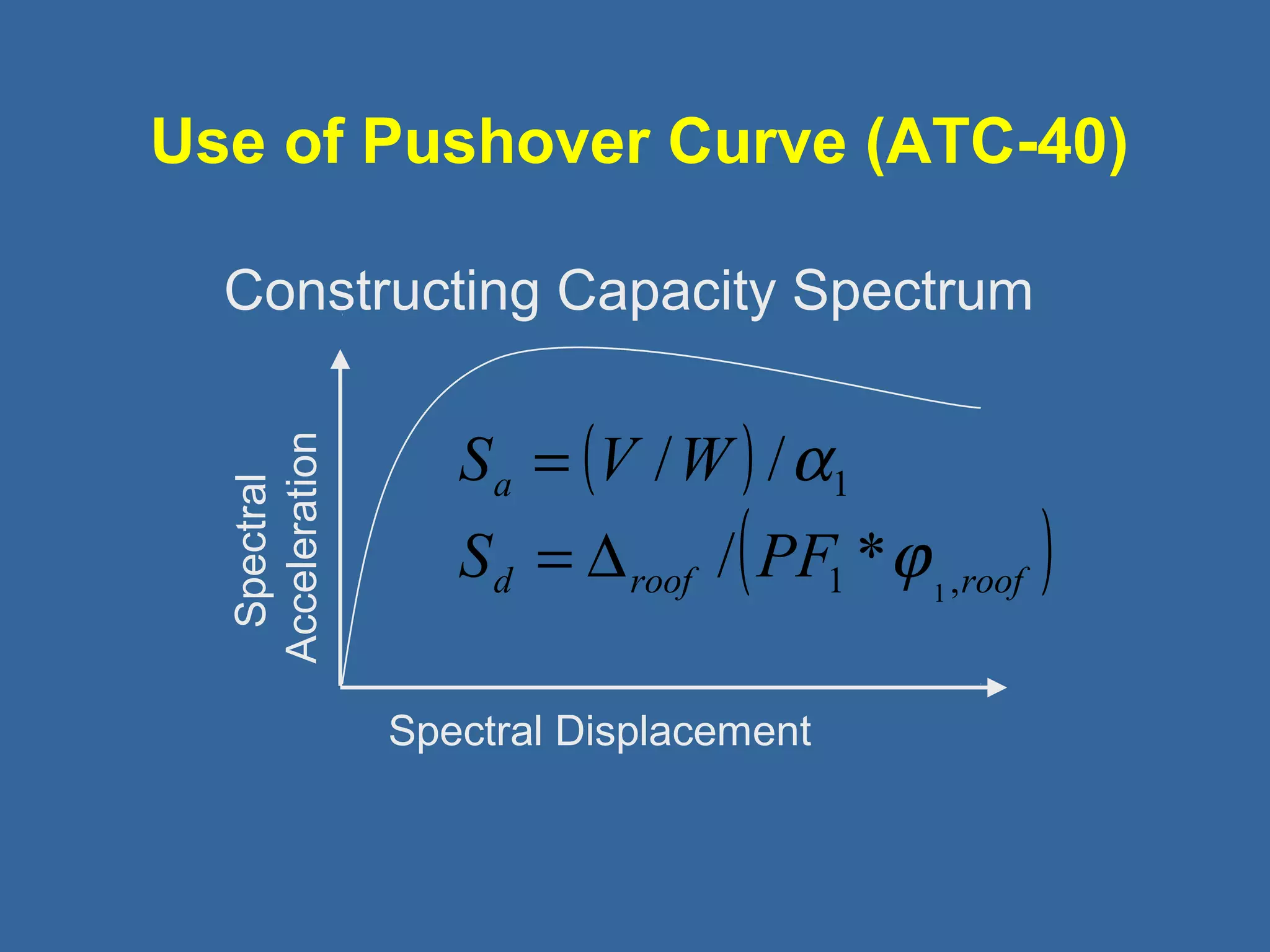
Spectral 
Acceleration 
( ) 
S = 
V W 
a 
S PF 
1 
d roof ( roof ) 
1 / * 
Spectral Displacement 
1 , 
/ / 
j 
a 
= D
Use of Pushover Curve (ATC-40) 
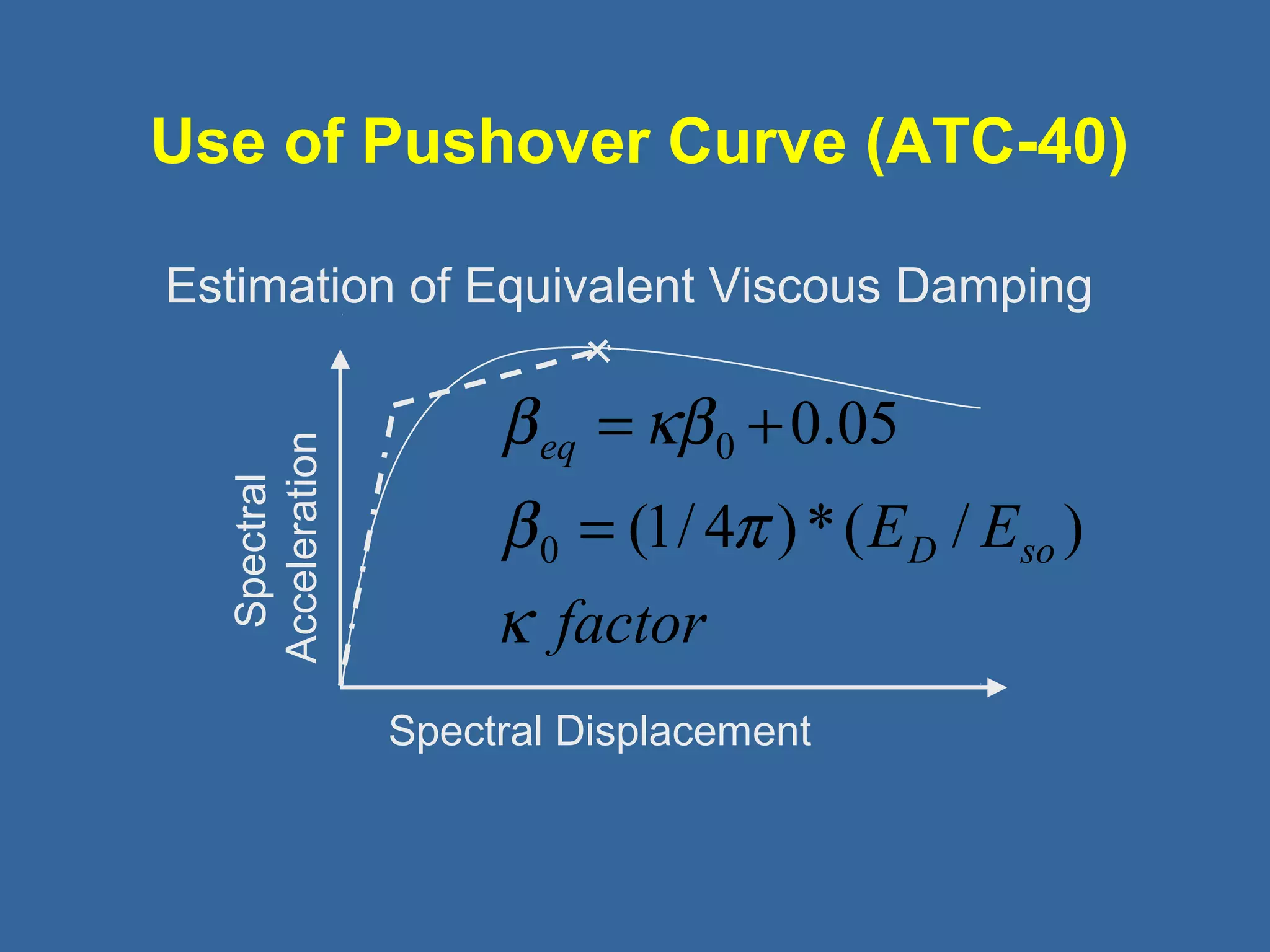
Estimation of Equivalent Viscous Damping 
Spectral 
Acceleration 
b kb 
= + 
b p 
factor 
0.05 
Spectral Displacement 
ED Eso 
eq 
k 
(1/ 4 )*( / ) 
0 
0 
=
Use of Pushover Curve (ATC-40) 
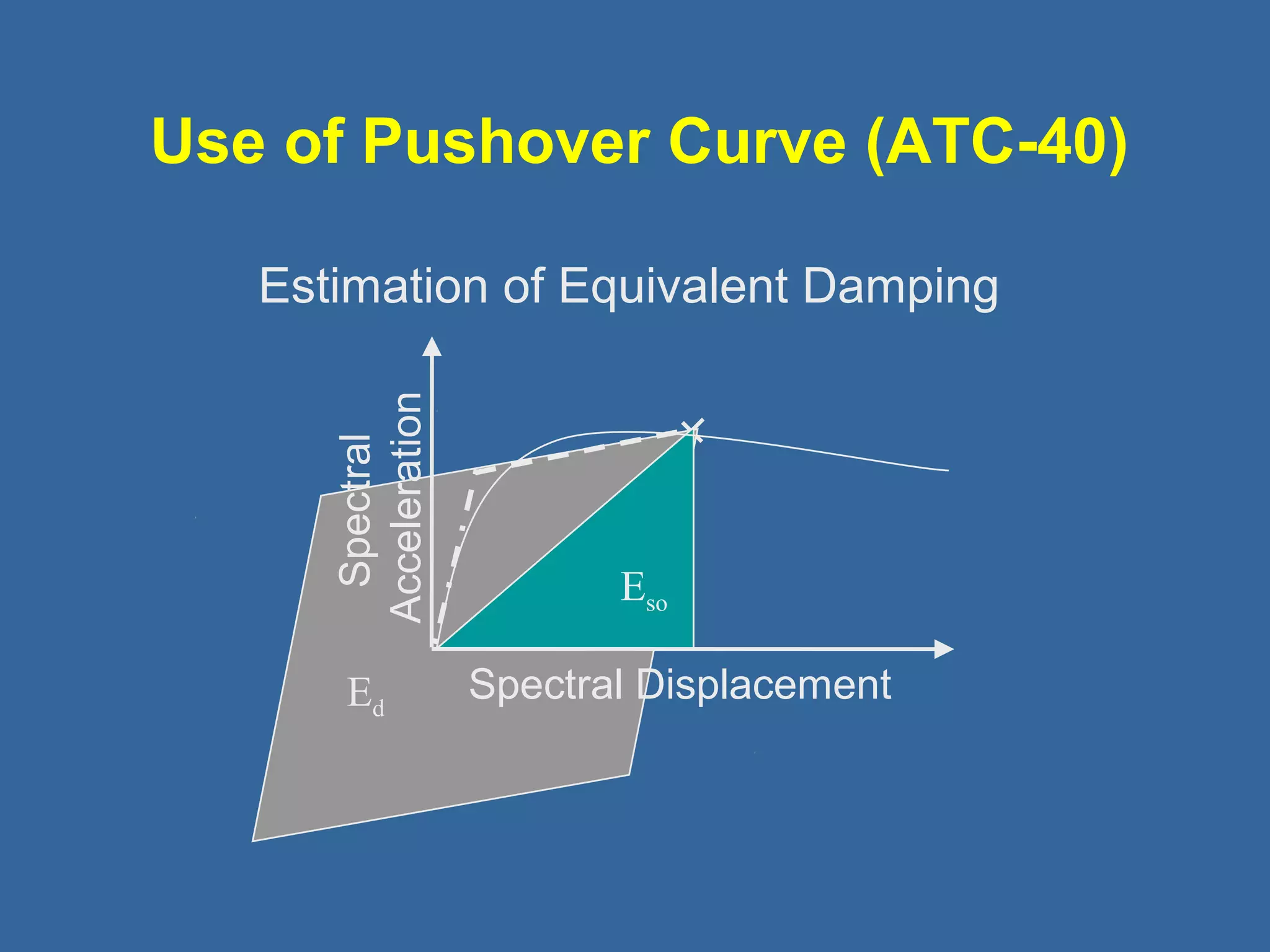
Estimation of Equivalent Damping 
Ed 
Eso 
Spectral Displacement 
Spectral 
Acceleration
Use of Pushover Curve (ATC-40) 
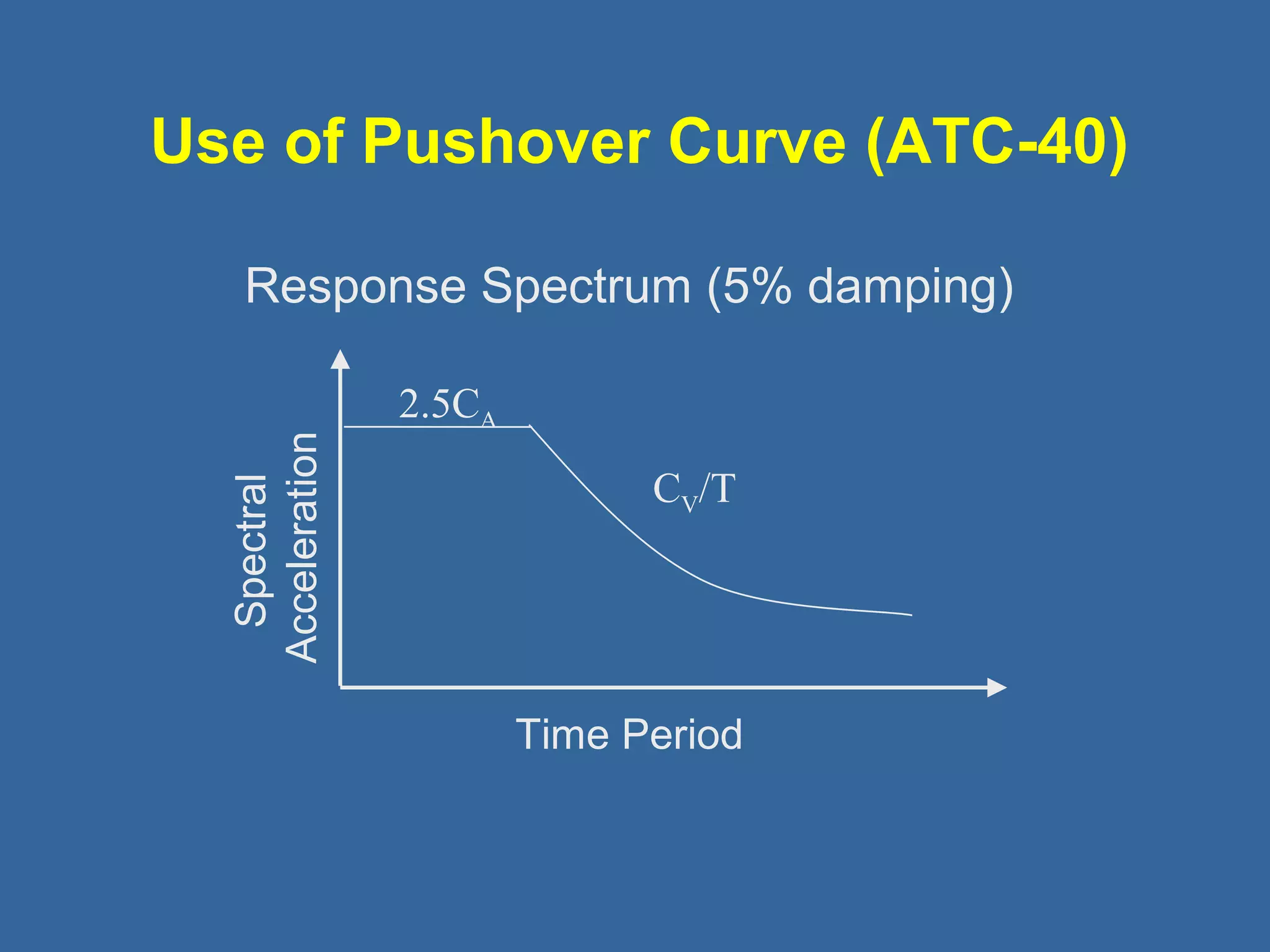
Response Spectrum (5% damping) 
Spectral 
Acceleration 
Time Period 
2.5CA 
CV/T
Use of Pushover Curve (ATC-40) 
 
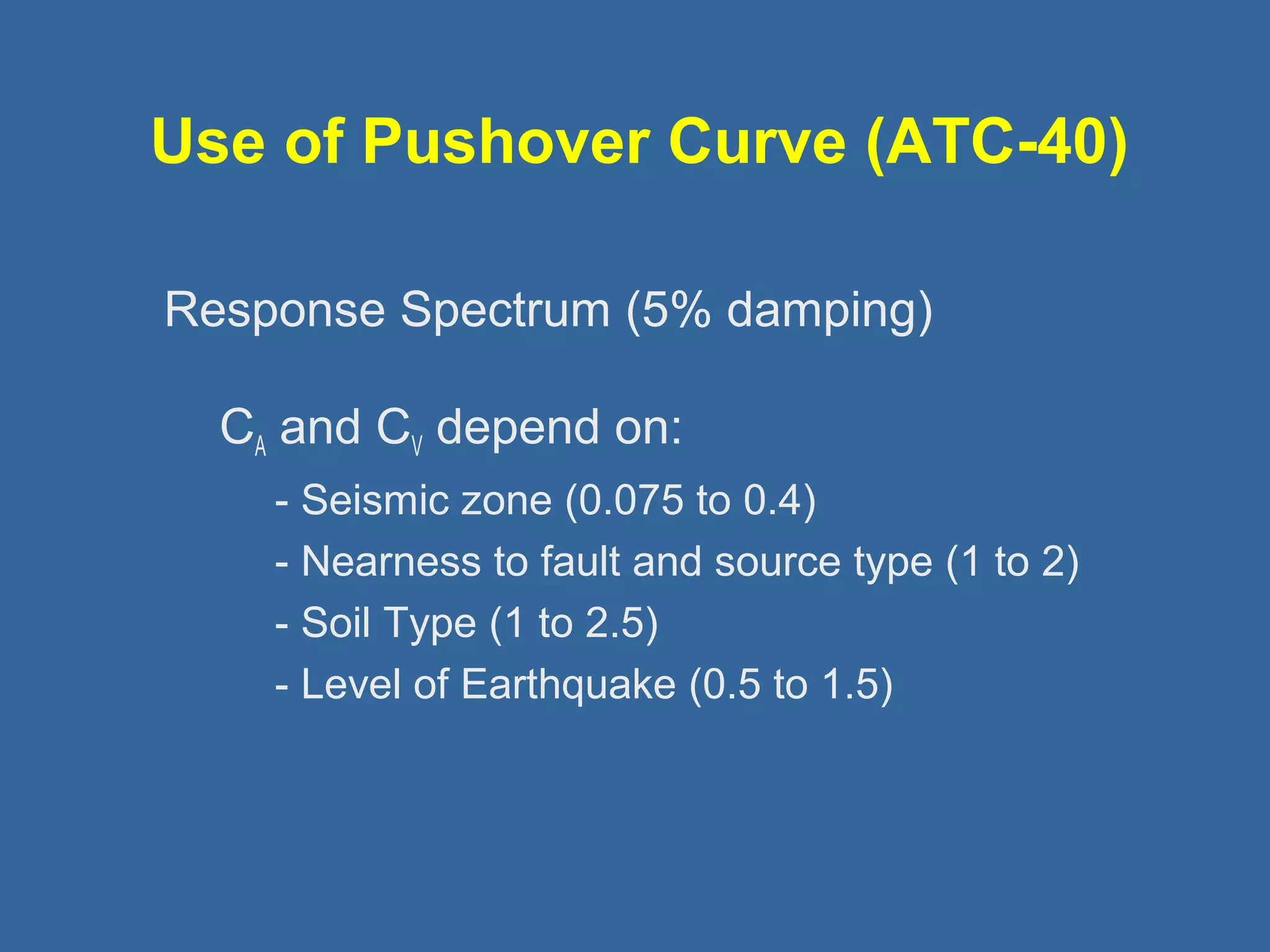
Response Spectrum (5% damping) 
CA and CV depend on: 
- Seismic zone (0.075 to 0.4) 
- Nearness to fault and source type (1 to 2) 
- Soil Type (1 to 2.5) 
- Level of Earthquake (0.5 to 1.5)
Use of Pushover Curve (ATC-40) 
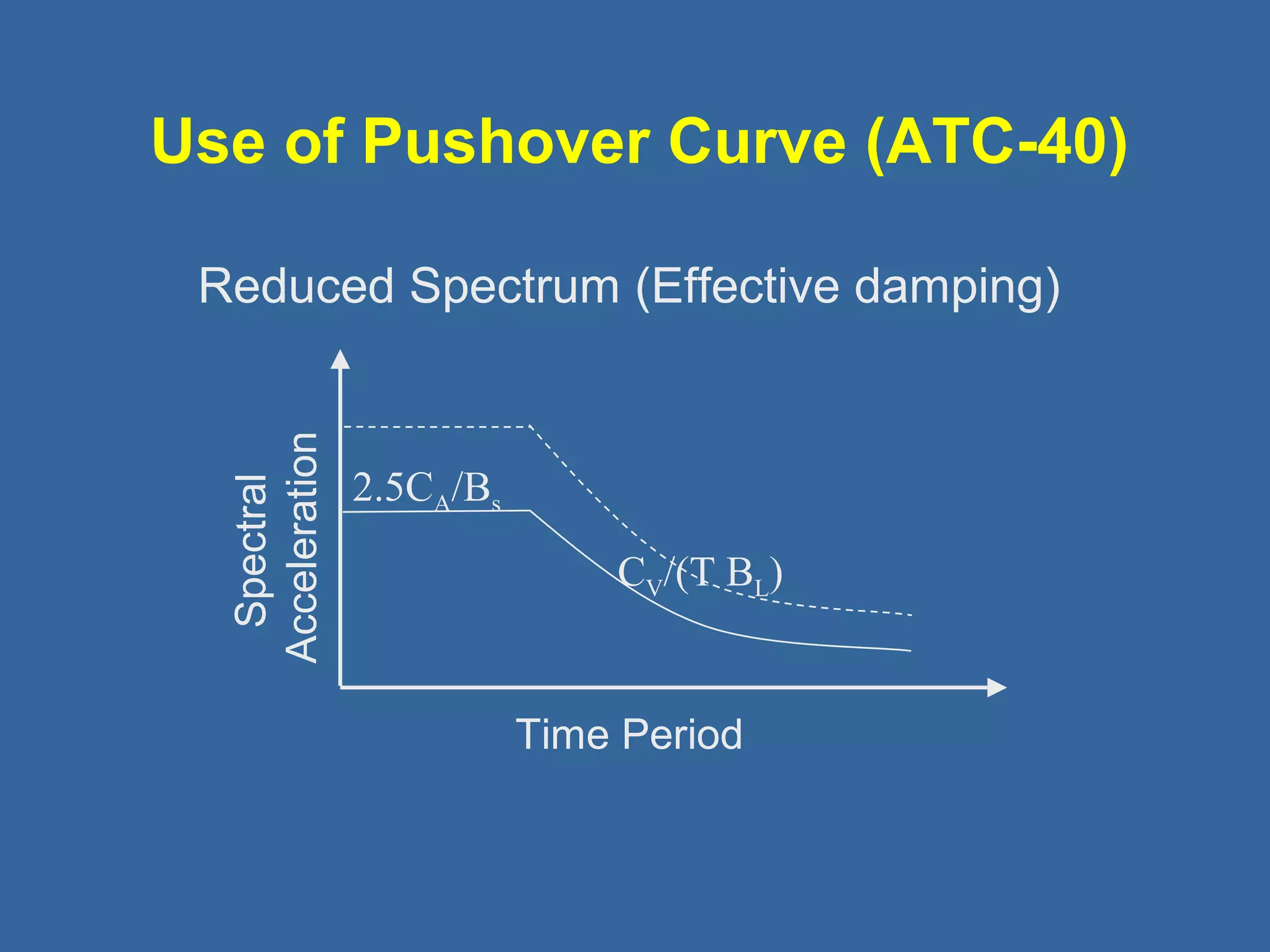
Reduced Spectrum (Effective damping) 
Spectral 
Acceleration 
Time Period 
2.5CA/Bs 
CV/(T BL)
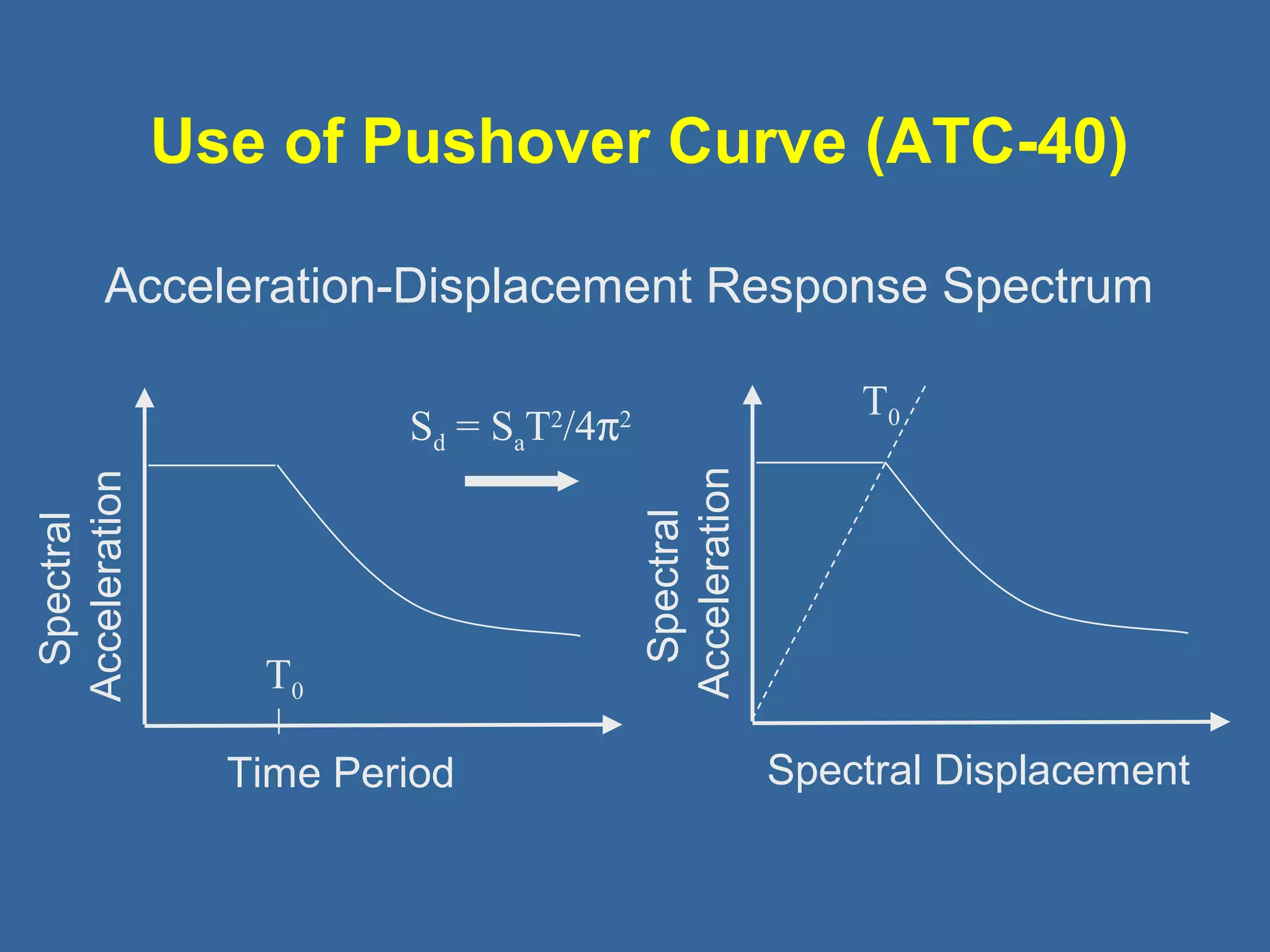
Use of Pushover Curve (ATC-40) 
Acceleration-Displacement Response Spectrum 
Spectral 
Acceleration 
T0 
S T0 d = SaT2/4p2 
Time Period 
Spectral 
Acceleration 
Spectral Displacement
Use of Pushover Curve (ATC-40) 
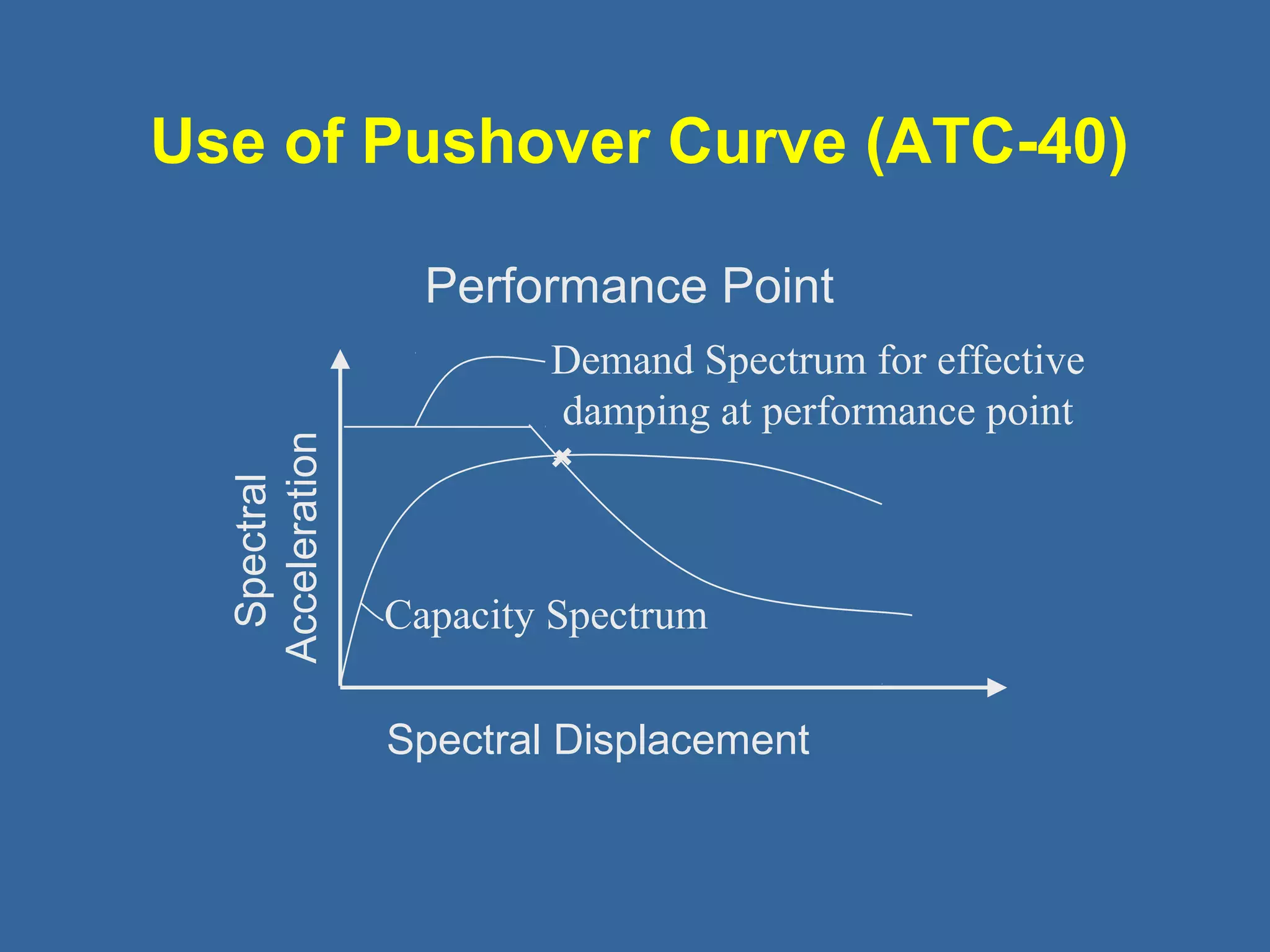
Performance Point 
Spectral 
Acceleration 
Demand Spectrum for effective 
damping at performance point 
Capacity Spectrum 
Spectral Displacement
Use of Pushover Curve (ATC-40) 
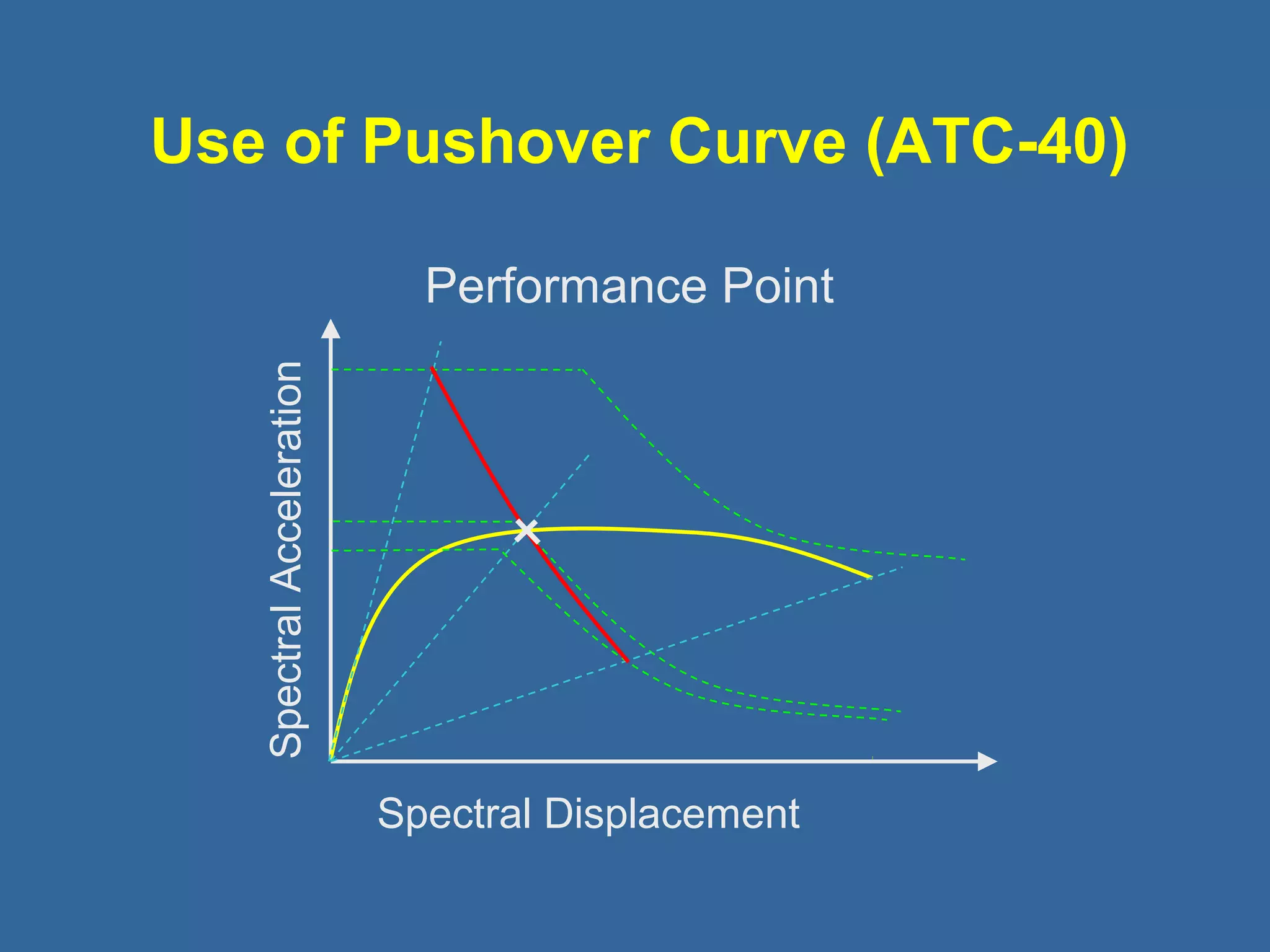
Performance Point 
Spectral Acceleration 
Spectral Displacement
Use of Pushover Curve (ATC-40) 
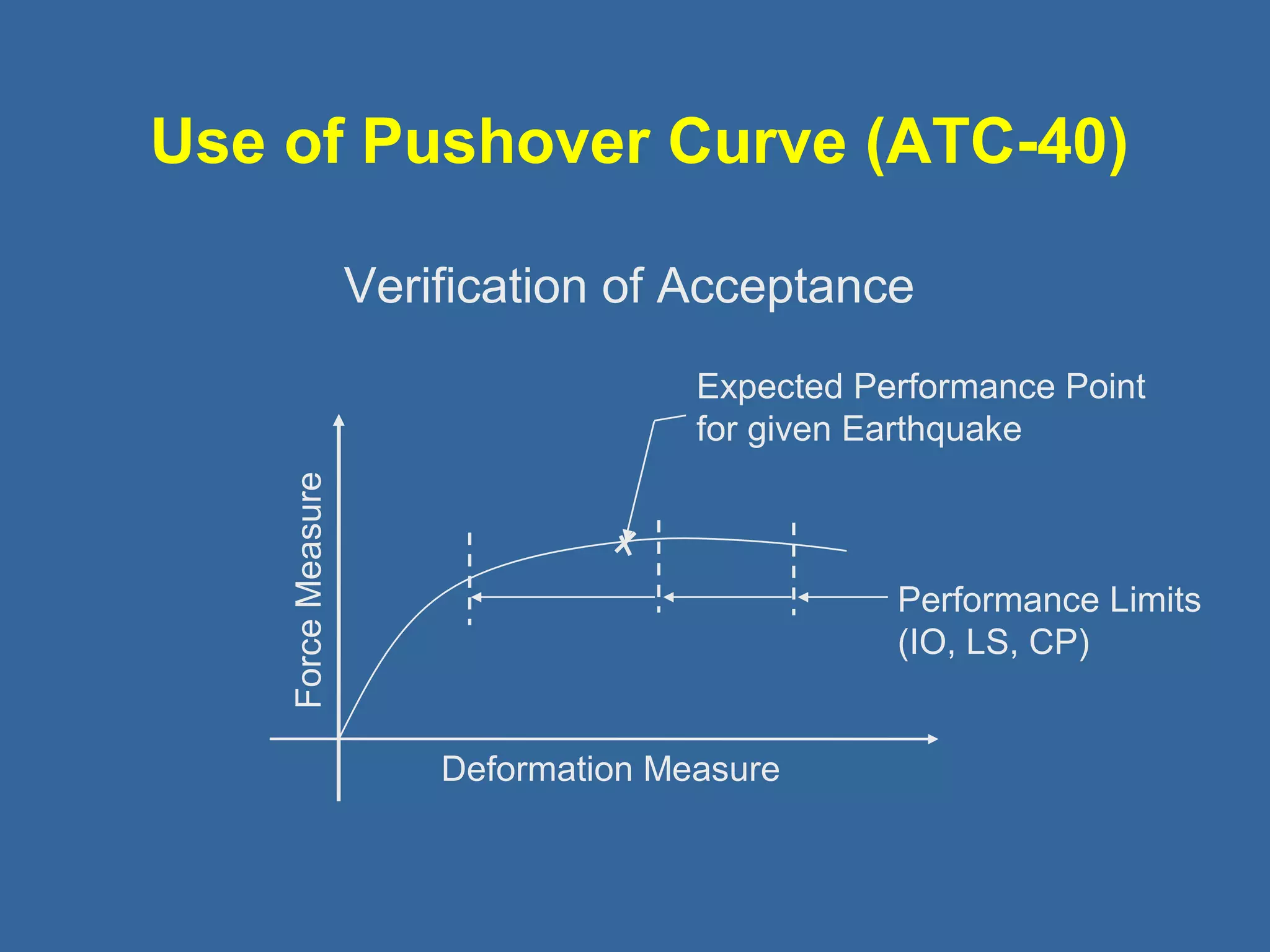
Verification of Acceptance 
Expected Performance Point 
for given Earthquake 
Deformation Measure 
Force Measure 
Performance Limits 
(IO, LS, CP)
Use of Pushover Curve (ATC-40)
Use of Pushover Curve (FEMA-273) 
 (Displacement Coefficient Method) 
Estimate Target Displacement 
Verify Acceptance
Use of Pushover Curve (FEMA-273) 
 
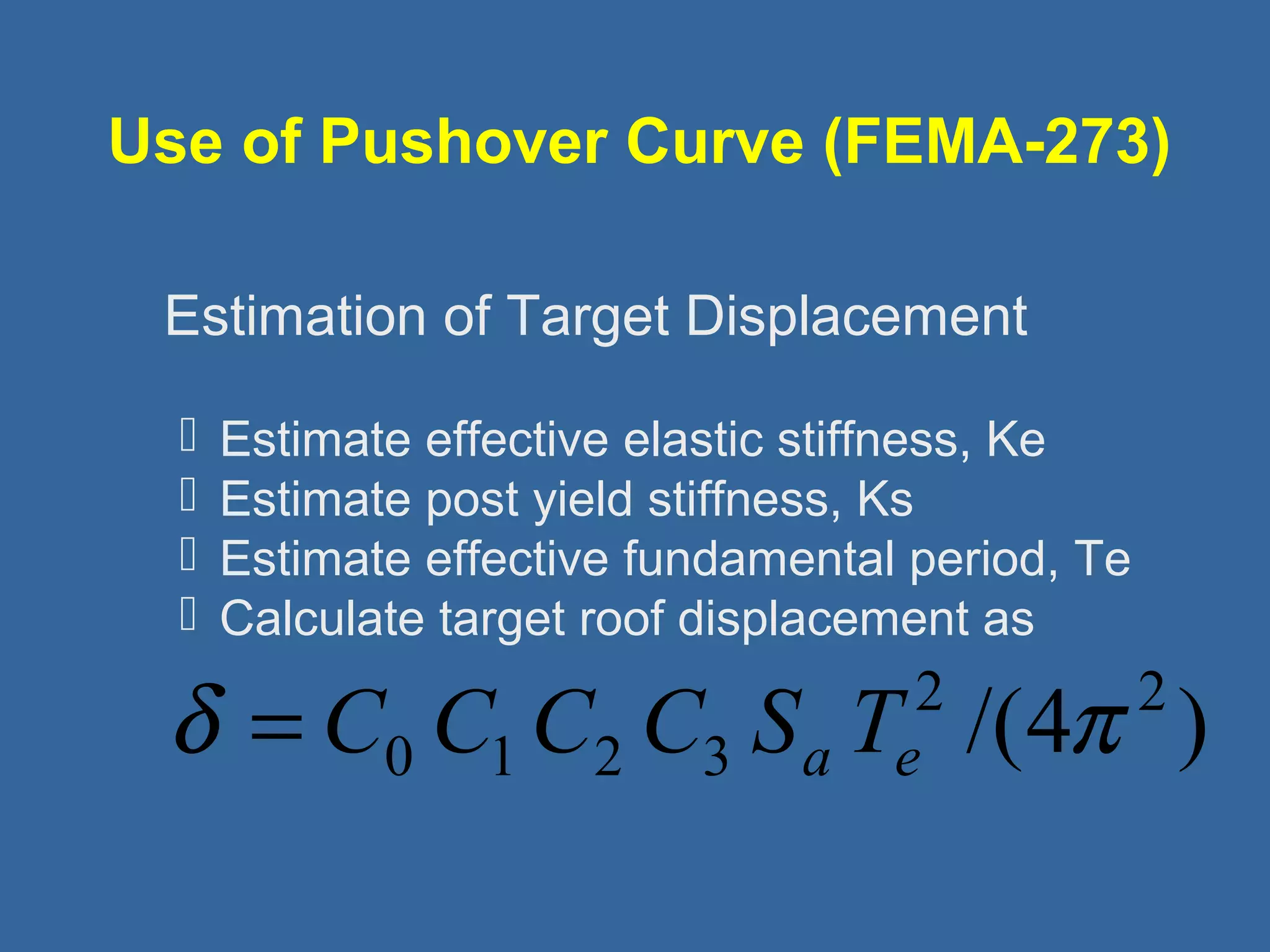
Estimation of Target Displacement 
 Estimate effective elastic stiffness, Ke 
 Estimate post yield stiffness, Ks 
 Estimate effective fundamental period, Te 
 Calculate target roof displacement as 
2 /(4 2 ) 
d = C0 C1C2 C3 Sa Te p
Use of Pushover Curve (FEMA-273) 
 
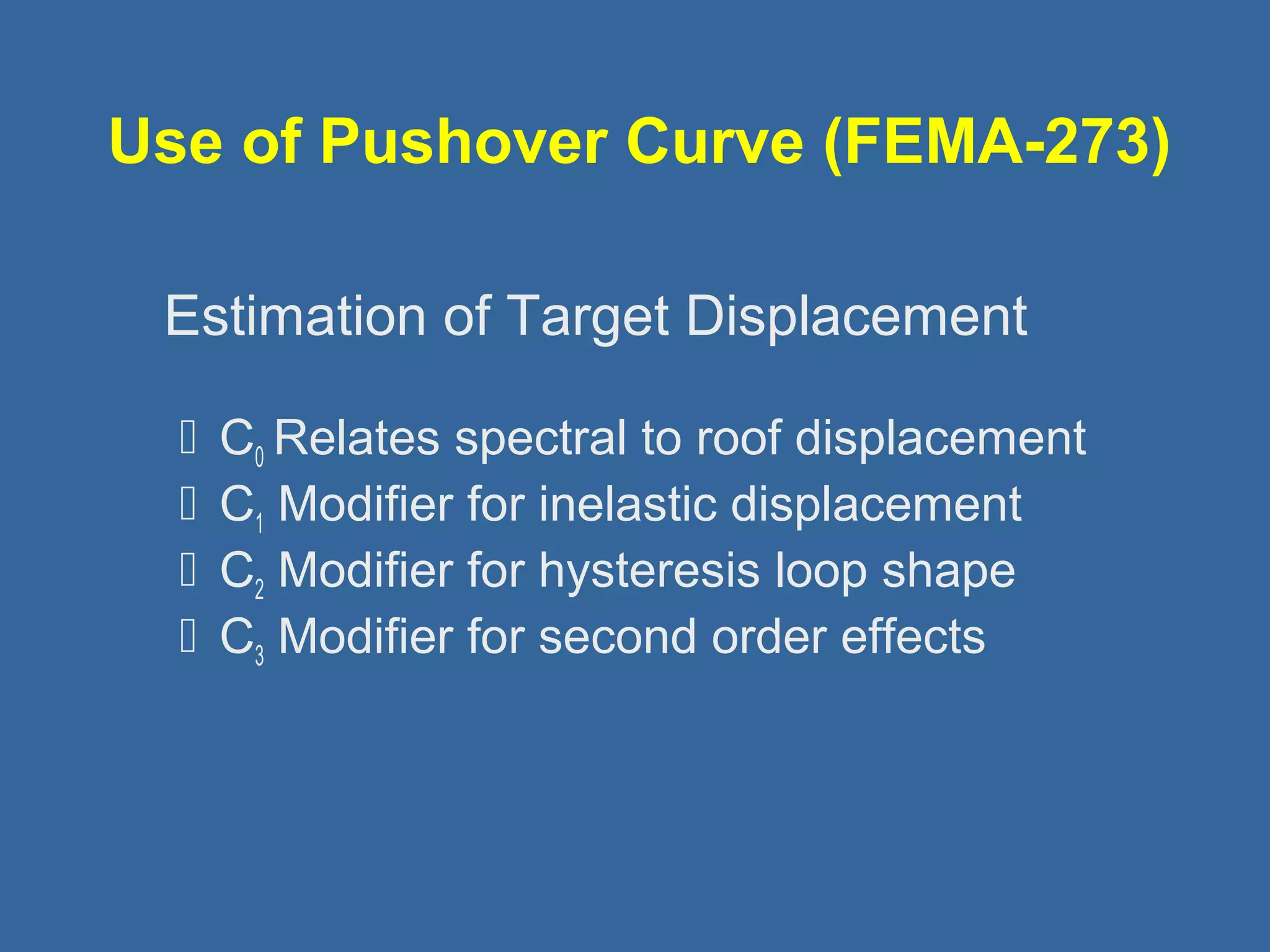
Estimation of Target Displacement 
 C0 Relates spectral to roof displacement 
 C1 Modifier for inelastic displacement 
 C2 Modifier for hysteresis loop shape 
 C3 Modifier for second order effects
Use of Pushover Curve (ATC-40) 
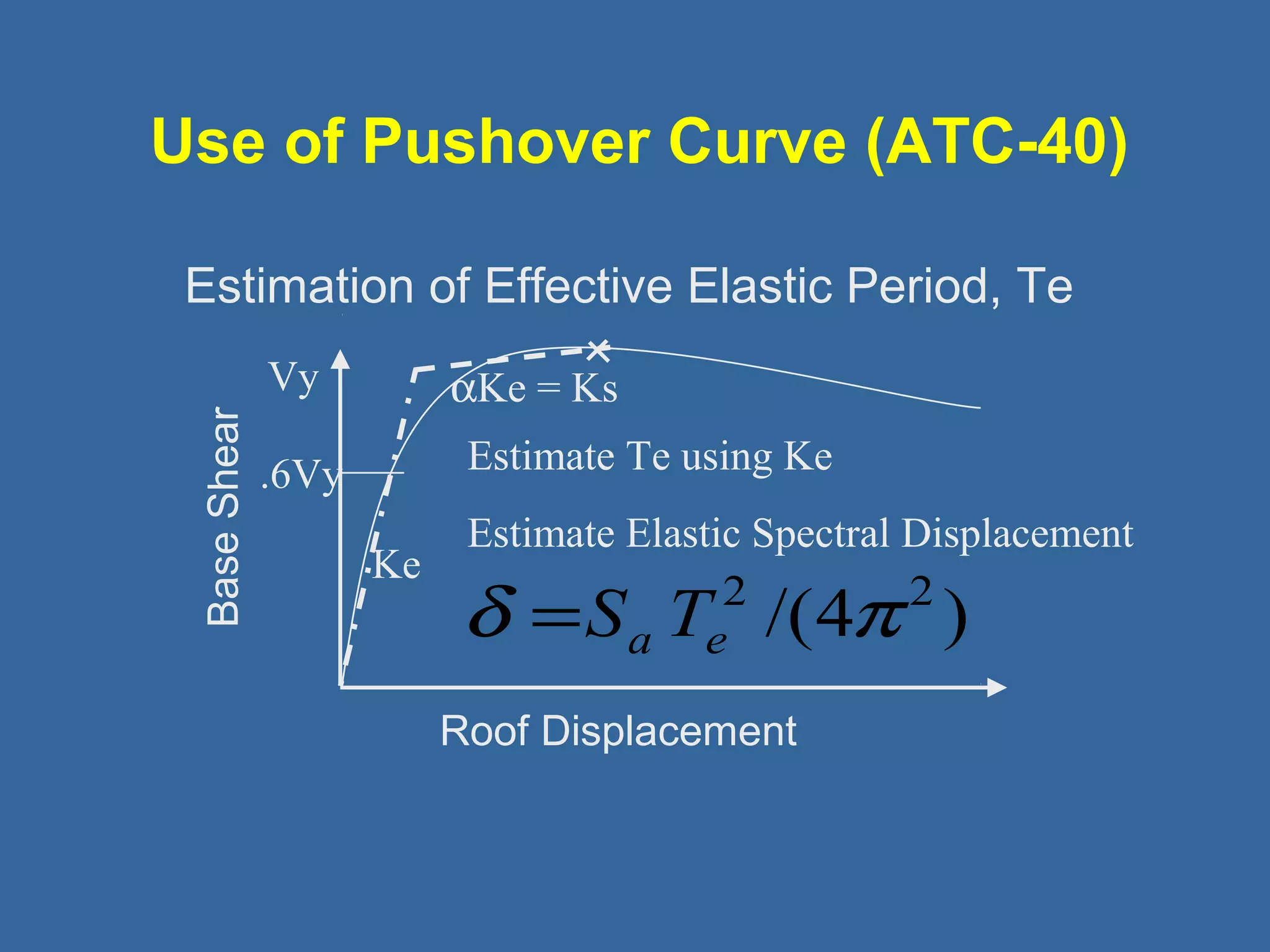
Estimation of Effective Elastic Period, Te 
Vy 
.6Vy 
Base Shear Roof Displacement 
Ke 
aKe = Ks 
Estimate Te using Ke 
Estimate Elastic Spectral Displacement 
d =Sa Te2 /(4p 2 )
Use of Pushover Curve (FEMA-273) 
 
Calculation of C0 
 Relates spectral to roof displacement 
 - use modal participation factor for control 
node from first mode 
 - or use modal participation factor for 
control node from deflected shape at the 
target displacement 
 - or use tables based on number of stories 
and varies from 1 to 1.5
Use of Pushover Curve (FEMA-273) 
 
Calculation of C1 
 Modifier for inelastic displacement 
Spectral 
Acceleration 
C1 = [1 +(R-1)T0/Te]/R 
C1 = 1 
T0 
Time Period 
R is elastic strength 
demand to yield 
strength
Use of Pushover Curve (FEMA-273) 
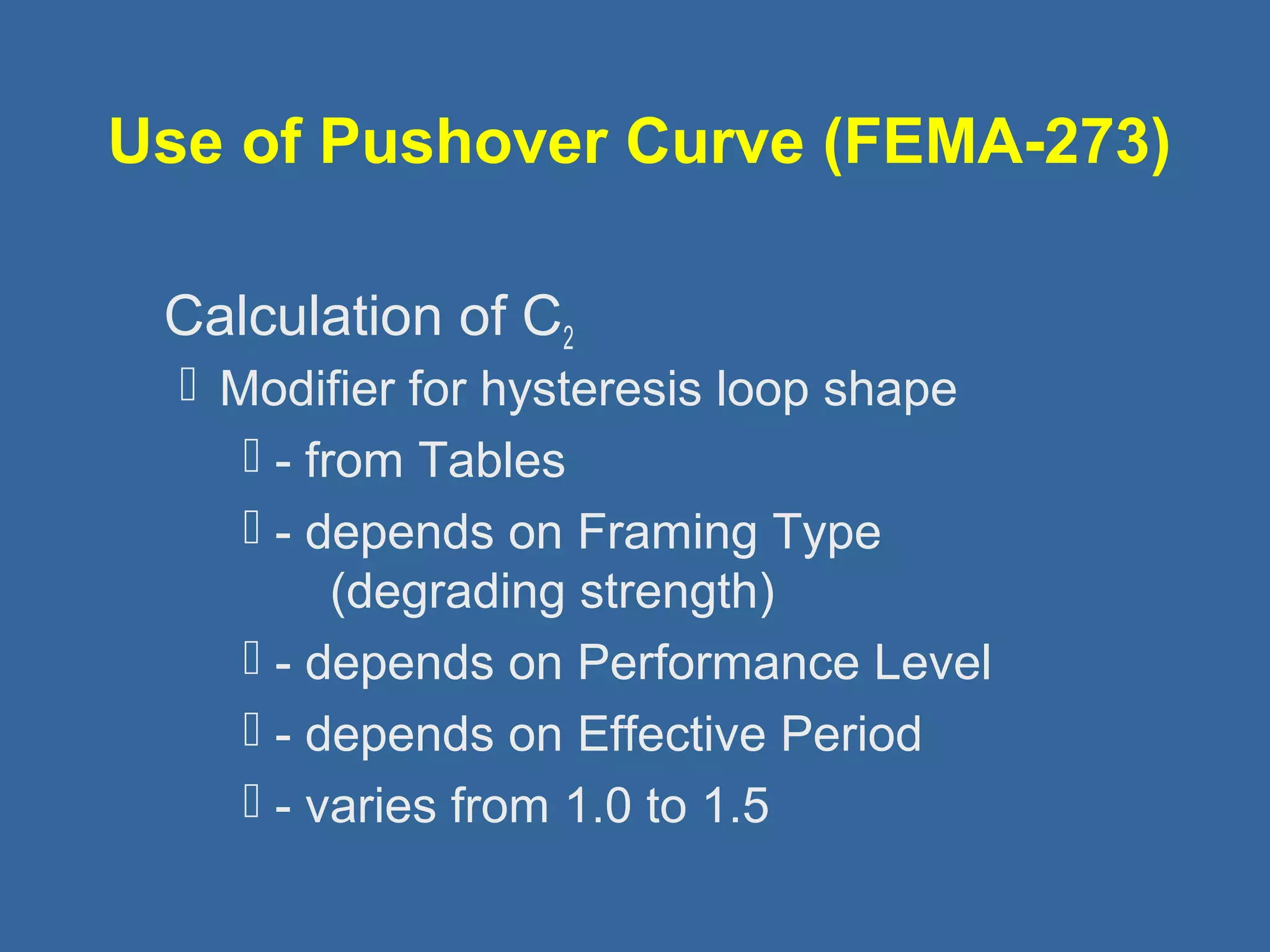
 Calculation of C2 
 Modifier for hysteresis loop shape 
 - from Tables 
 - depends on Framing Type 
(degrading strength) 
 - depends on Performance Level 
 - depends on Effective Period 
 - varies from 1.0 to 1.5
Use of Pushover Curve (FEMA-273) 
 Calculation of C3 
 Modifier for dynamic second order effects 
 C3 = 1 if post yield slope, a is positive 
 else 
 C3 = 1 +[ |a|(R-1)3/2 ]/Te
Use of Pushover Curve (FEMA-273) 
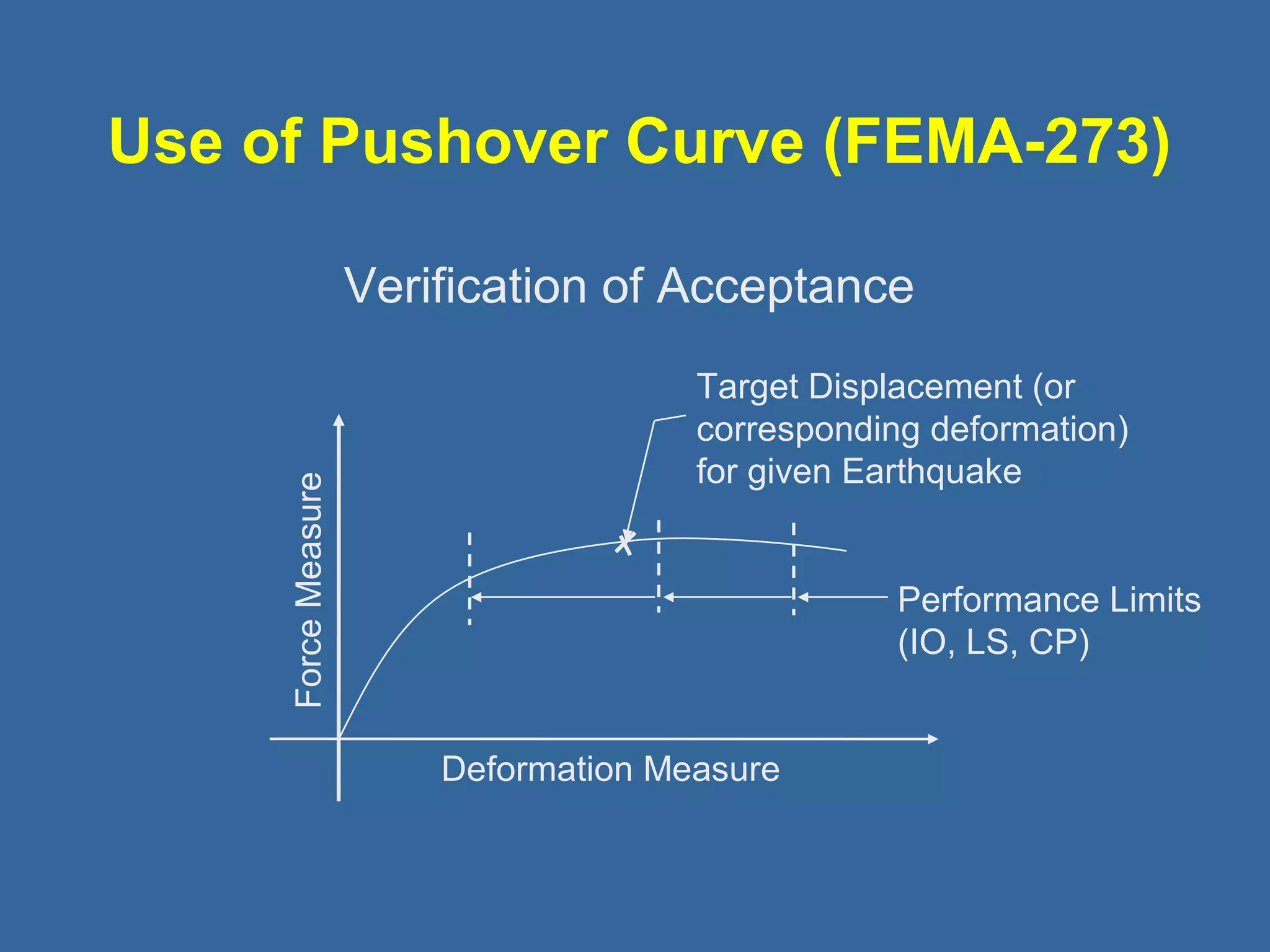
Verification of Acceptance 
Target Displacement (or 
corresponding deformation) 
for given Earthquake 
Deformation Measure 
Force Measure 
Performance Limits 
(IO, LS, CP)
How do they compare with each other? 
 - Observed damage 
- Multi-degree of freedom systems 
- Single degree of freedom systems 
 - Nonlinear time history analysis 
 Comparisons with: 
 Do these methods work? 
Use of Pushover Curve
SAP2000/ETABS Pushover Options 
 SAP2000 released September, 1998 
 Full 3D implementation 
 Single model for 
- linear static analysis 
- linear response spectrum analysis 
- linear time history analysis 
- nonlinear time history analysis 
- nonlinear static pushover analysis 
- steel and concrete design
SAP2000/ETABS Pushover Options 
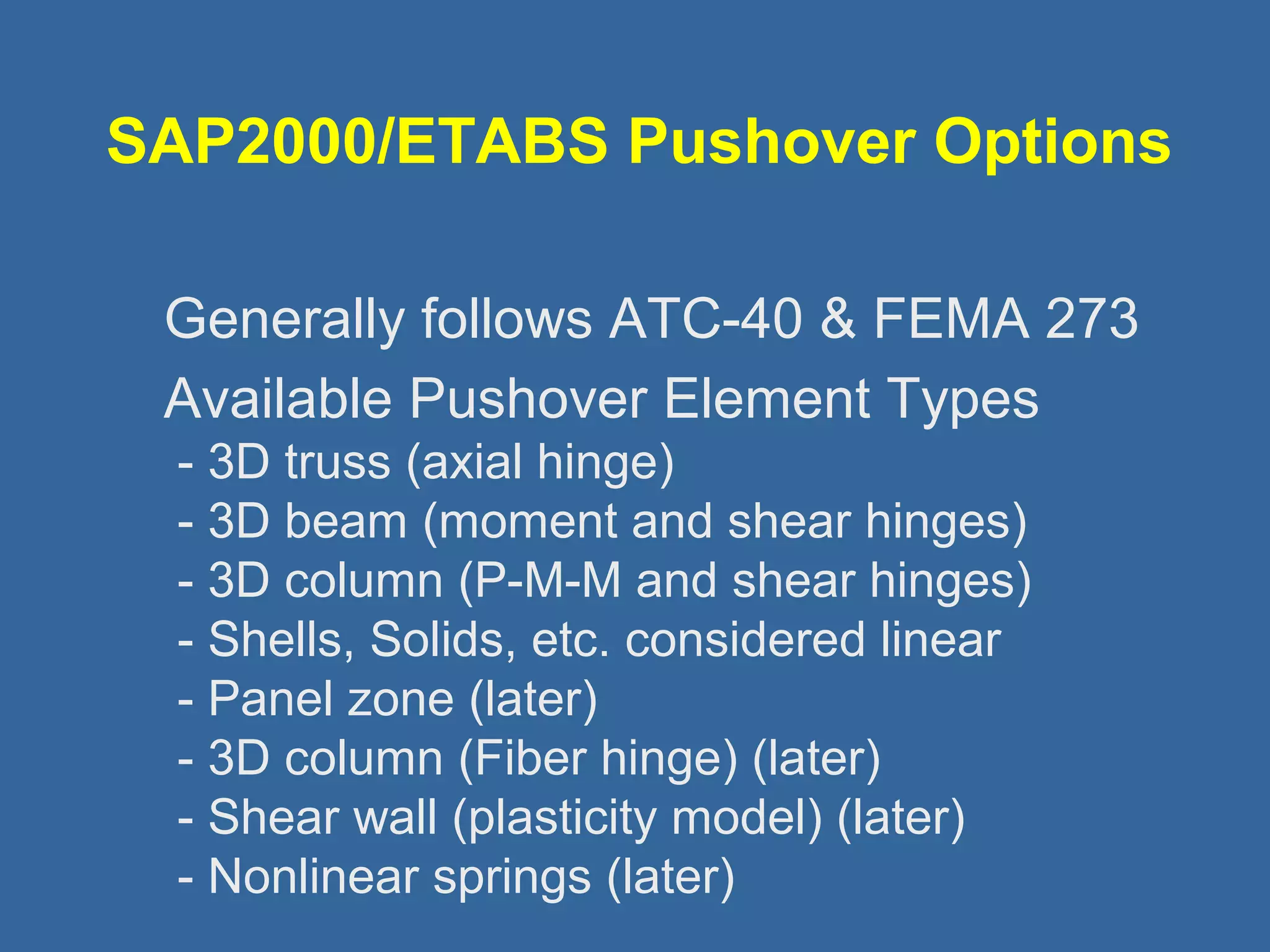
 Generally follows ATC-40  FEMA 273 
 Available Pushover Element Types 
- 3D truss (axial hinge) 
- 3D beam (moment and shear hinges) 
- 3D column (P-M-M and shear hinges) 
- Shells, Solids, etc. considered linear 
- Panel zone (later) 
- 3D column (Fiber hinge) (later) 
- Shear wall (plasticity model) (later) 
- Nonlinear springs (later)
SAP2000/ETABS Pushover Options 
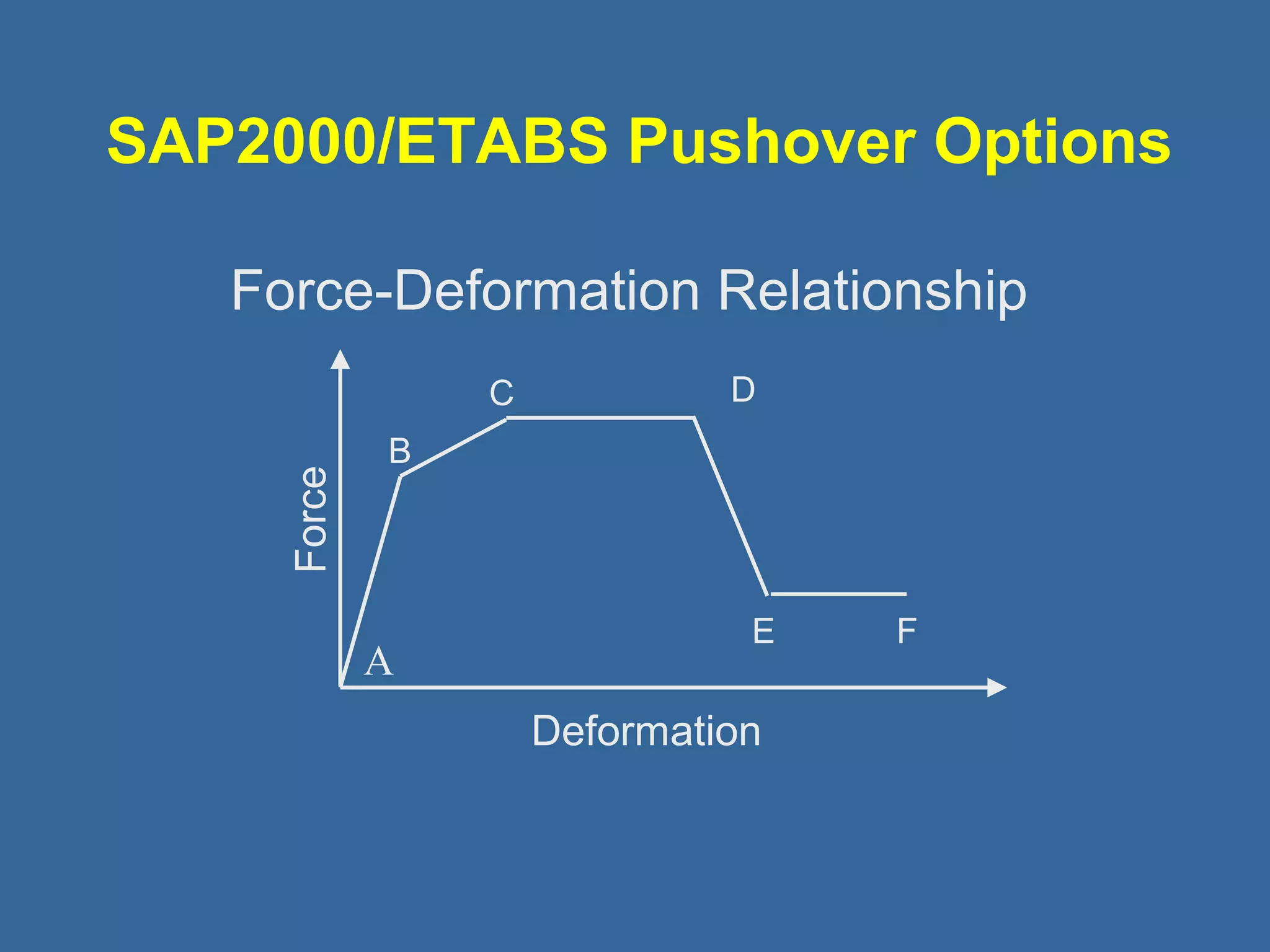
Force-Deformation Relationship 
B 
C D 
E F 
Deformation 
Force A
SAP2000/ETABS Pushover Options 
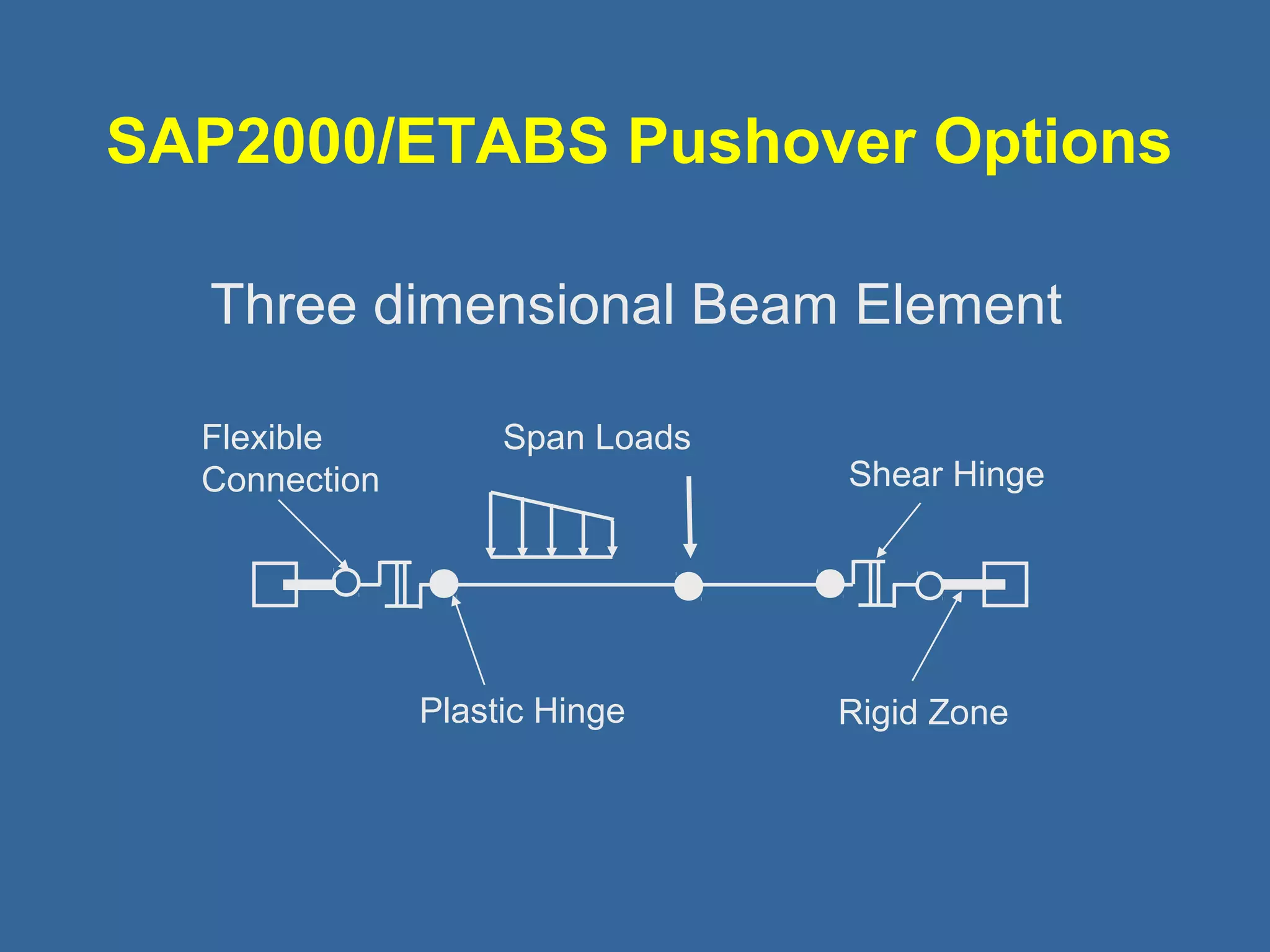
Three dimensional Beam Element 
Flexible Span Loads 
Connection Shear Hinge 
Plastic Hinge Rigid Zone
SAP2000/ETABS Pushover Options 
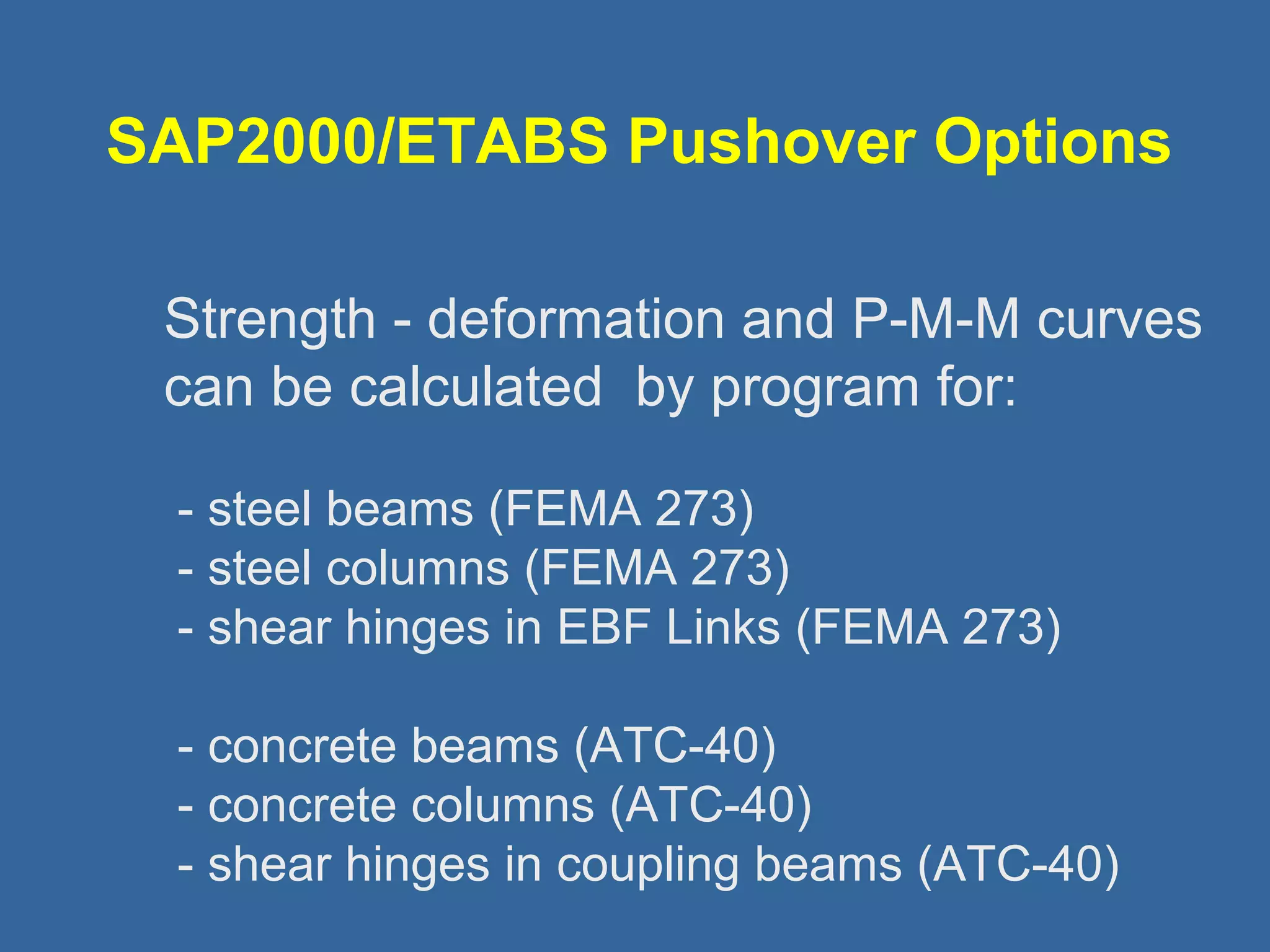
 Strength - deformation and P-M-M curves 
can be calculated by program for: 
- steel beams (FEMA 273) 
- steel columns (FEMA 273) 
- shear hinges in EBF Links (FEMA 273) 
- concrete beams (ATC-40) 
- concrete columns (ATC-40) 
- shear hinges in coupling beams (ATC-40)
SAP2000/ETABS Pushover Options 
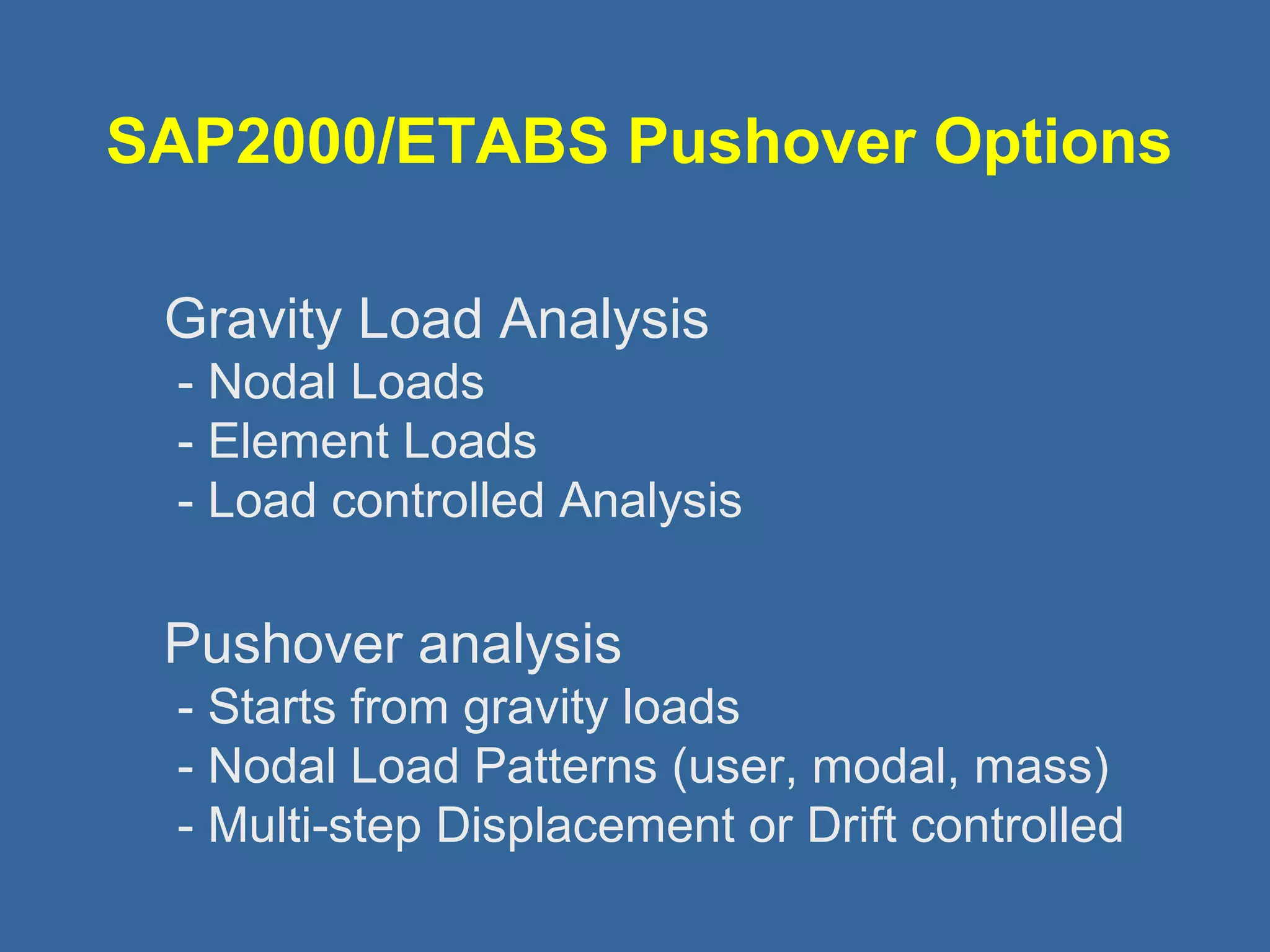
 Gravity Load Analysis 
- Nodal Loads 
- Element Loads 
- Load controlled Analysis 
 Pushover analysis 
- Starts from gravity loads 
- Nodal Load Patterns (user, modal, mass) 
- Multi-step Displacement or Drift controlled
SAP2000/ETABS Pushover Options 
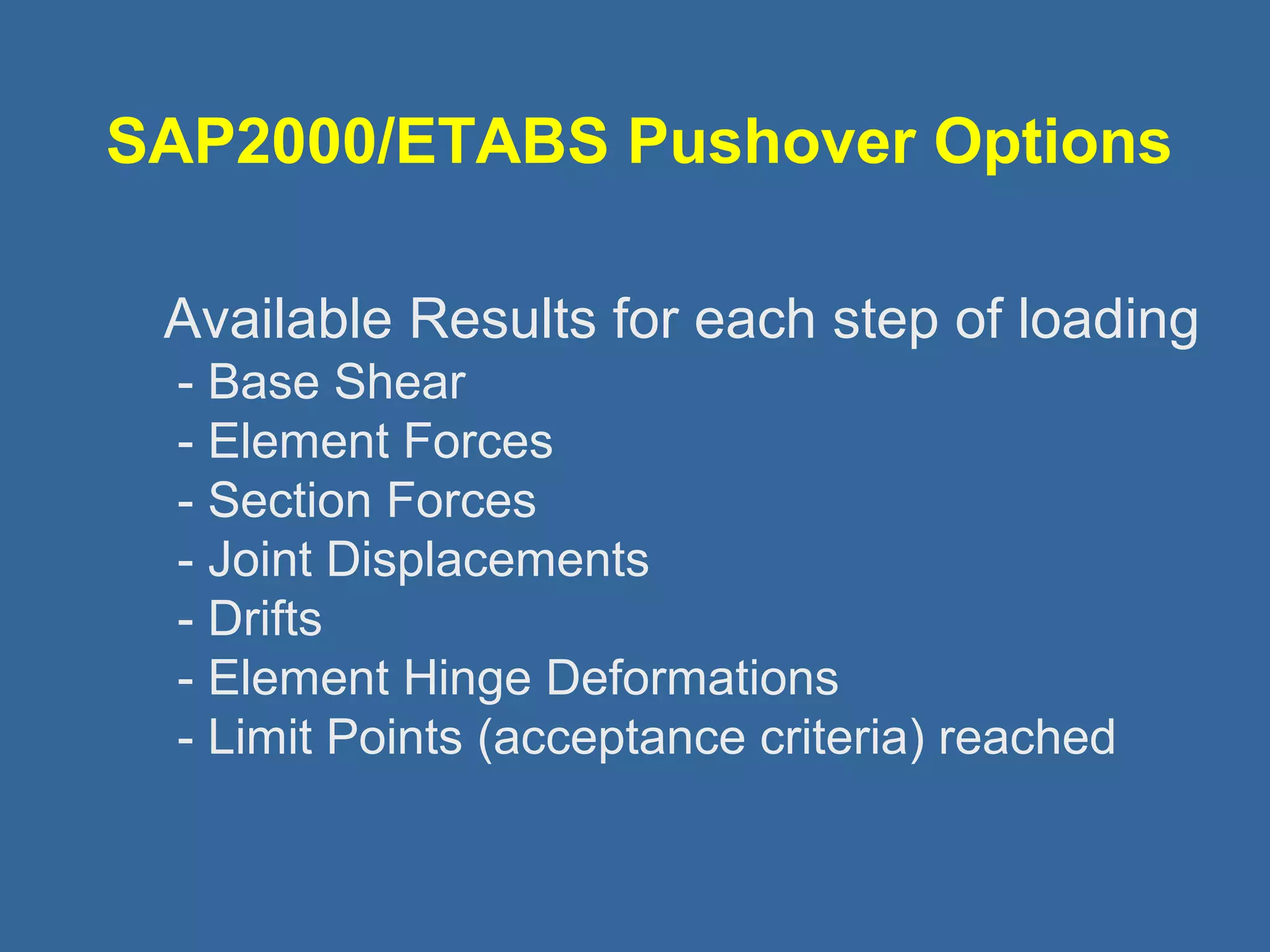
 Available Results for each step of loading 
- Base Shear 
- Element Forces 
- Section Forces 
- Joint Displacements 
- Drifts 
- Element Hinge Deformations 
- Limit Points (acceptance criteria) reached
SAP2000/ETABS Pushover Options 
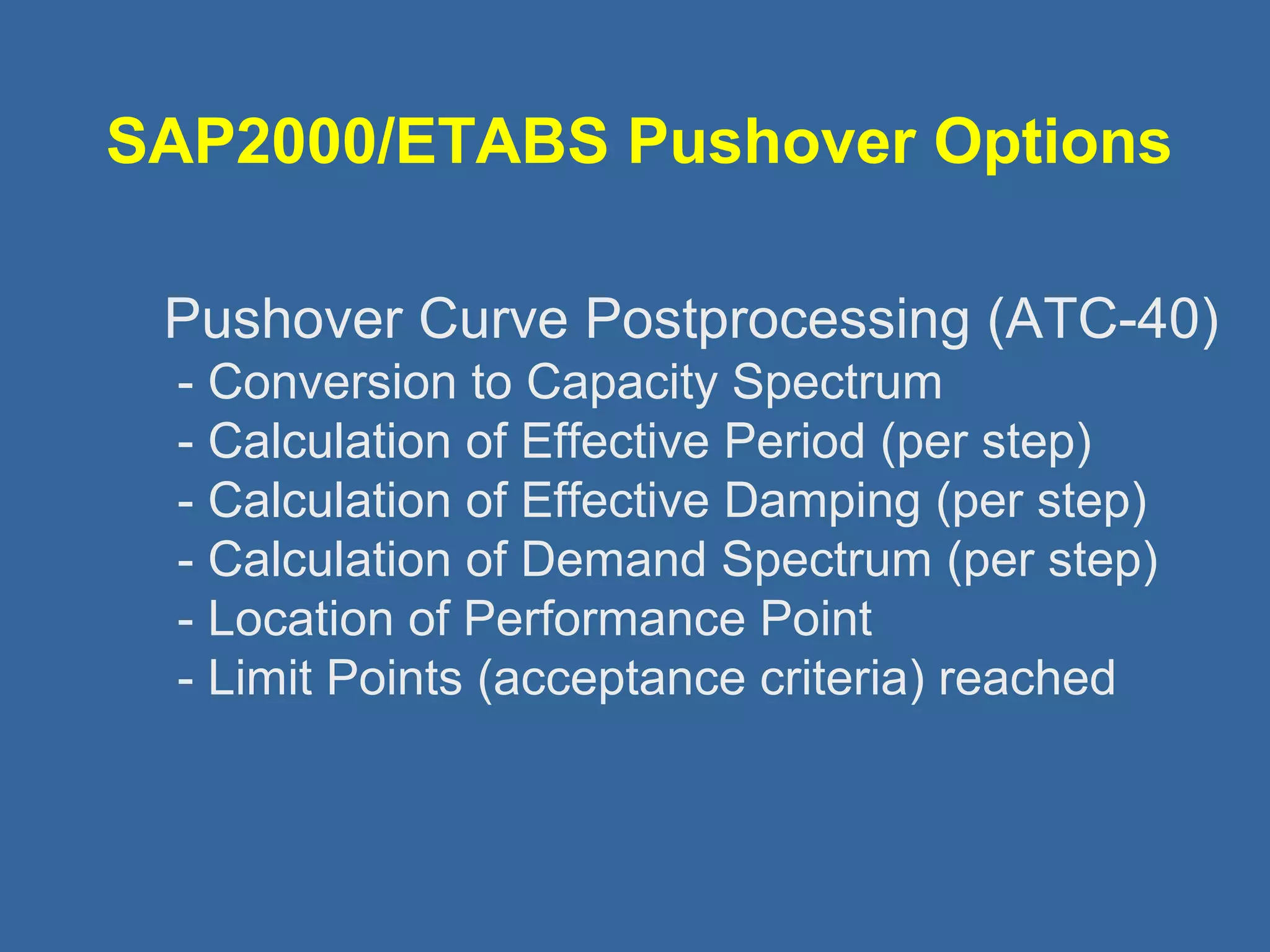
 Pushover Curve Postprocessing (ATC-40) 
- Conversion to Capacity Spectrum 
- Calculation of Effective Period (per step) 
- Calculation of Effective Damping (per step) 
- Calculation of Demand Spectrum (per step) 
- Location of Performance Point 
- Limit Points (acceptance criteria) reached
SAP2000/ETABS Pushover Options 
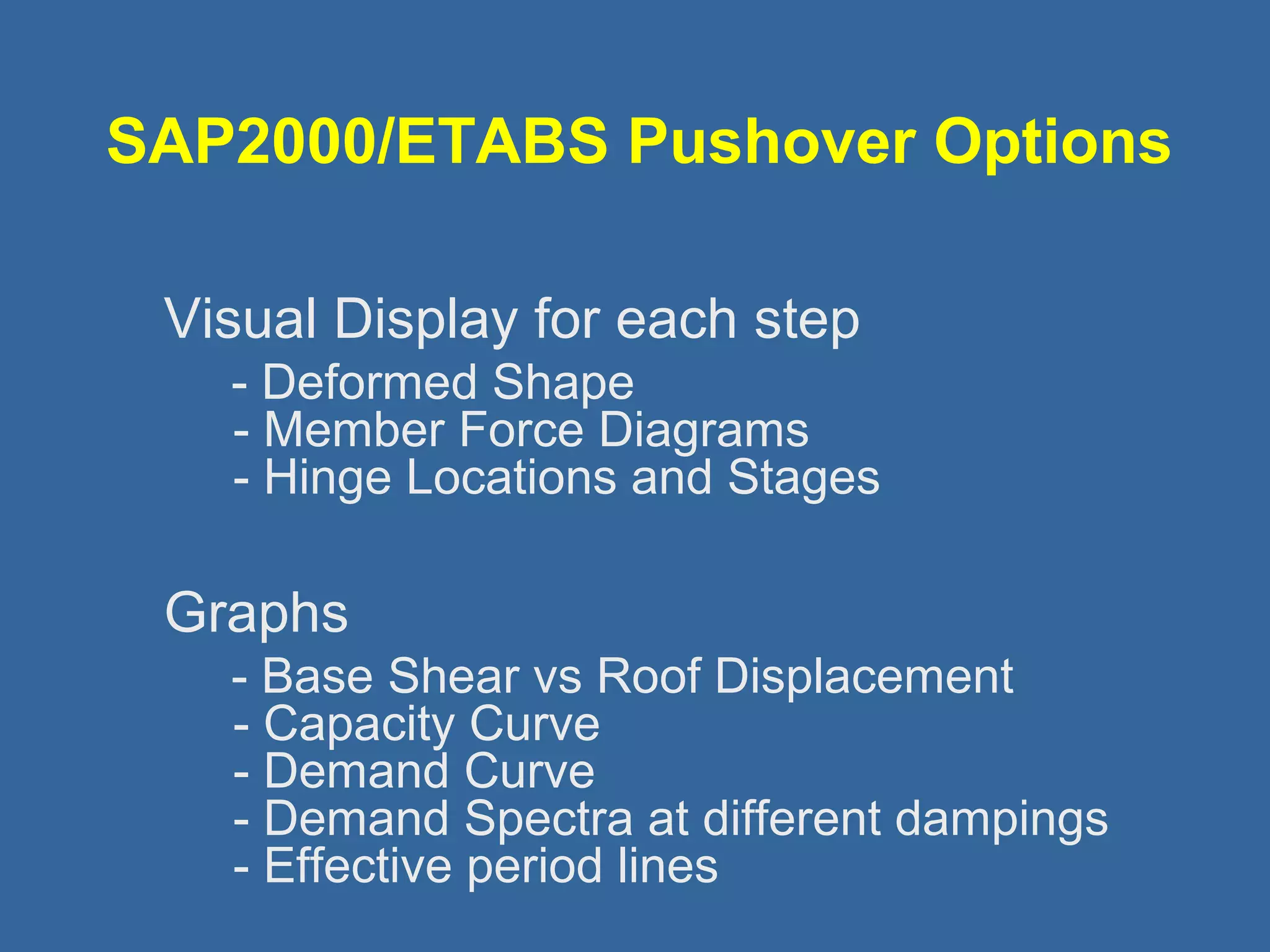
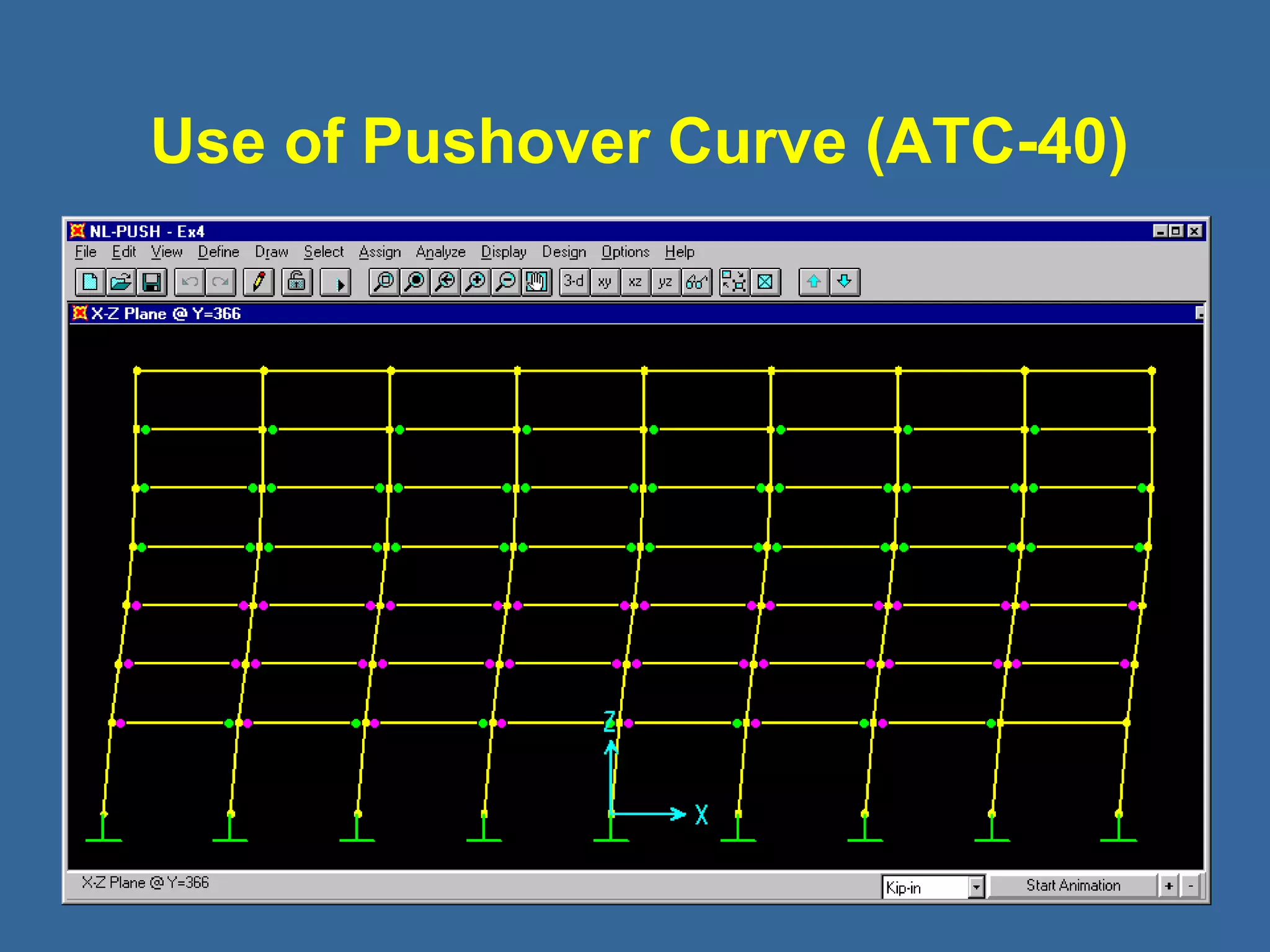
 Visual Display for each step 
- Deformed Shape 
- Member Force Diagrams 
- Hinge Locations and Stages 
 Graphs 
- Base Shear vs Roof Displacement 
- Capacity Curve 
- Demand Curve 
- Demand Spectra at different dampings 
- Effective period lines
1223989 static pushover analysis

  • 1.
    Static Pushover Analysis Performance Based Design Modeling for Pushover Analysis Use of the Pushover Curve M. Iqbal Suharwardy Computers and Structures, Inc. Static Pushover Analysis for Seismic Design March 22, 1999
  • 2.
    Performance Check ofStructures Purpose How will a structure perform when subjected to a given level of earthquake? – Definition of structural performance – Definition of earthquake level – Determination of performance level
  • 3.
    Performance Check ofStructures Process Recently released guidelines for Seismic Rehabilitation of Buildings: – ATC-40 – FEMA 273 (ATC-33)
  • 4.
    Types of PerformanceChecks Linear Static Analysis Linear Dynamic Analysis Nonlinear Static Analysis (Pushover Analysis) Nonlinear Dynamic Analysis
  • 5.
    Performance Check UsingPushover Expected Performance Point for given Earthquake Deformation Measure Force Measure Performance Limits (IO, LS, CP) Goal is to predict peak response of building and components for a given earthquake
  • 6.
    Why Do PushoverAnalysis? Design Earthquakes cause nonlinear behavior Better understand building behavior - Identify weak elements - Realistic prediction of element demands Less conservative acceptance criteria can be used with consequences understood
  • 7.
    Steps in PerformanceCheck Construct Pushover curve Select earthquake level(s) to check Select performance level(s) to check Select acceptance criteria for each performance level Verify acceptance Capacity Spectrum Method (ATC-40) Displacement Coefficient Method (FEMA 273)
  • 8.
    Constructing Pushover Curve Define Structural Model Elements (components) Strength - deformation properties Define Loads Gravity Lateral load pattern Select Control Displacements or Drifts Perform Pushover Analysis
  • 9.
    Pushover Modeling Definitionof Structural Model 3D or 2D Primary and Secondary Elements (components) Non structural Elements Foundation flexibility P-Delta effects
  • 10.
    Pushover Modeling (Elements) Types Truss - yielding and buckling 3D Beam - major direction flexural and shear hinging 3D Column - P-M-M interaction and shear hinging Panel zone - Shear yielding In-fill panel - Shear failure Shear wall - P-M-Shear interaction! Spring - for foundation modeling
  • 11.
    Pushover Modeling (Properties) Force-Deformation Relationship B A C D E Force Deformation
  • 12.
    Pushover Modeling (Properties) Force-Deformation (Back bone Curve) Force Deformation
  • 13.
    Pushover Modeling (BeamElement) Three dimensional Beam Element Flexible Span Loads Connection Shear Hinge Plastic Hinge Rigid Zone
  • 14.
    Pushover Modeling (ColumnElement) Three dimensional Column Element Shear Hinge Plastic Hinge Rigid Zone
  • 15.
    Pushover Modeling (ColumnElement) Axial Load - Moment Interaction (Concrete) P M
  • 16.
    Pushover Modeling (ColumnElement) Axial Load - Moment Interaction (Steel) CE ye ( ye ) M =1.18Z F 1- P / P
  • 17.
    Pushover Modeling (Loads) Start with Gravity Loads Dead Load Some portion of Live Load Select Lateral Load Pattern Lateral Load Patterns (Vertical Distribution) Lateral Load Horizontal Distribution Torsional Effects Orthogonal Effects
  • 18.
    Pushover Modeling (Loads) Lateral Load Patterns (Vertical Distribution) Uniform Code Lateral Mode 1
  • 19.
    Pushover Analysis (Control) Force controlled analysis Deformation controlled analysis Roof Displacement Generalized Displacement Definitions Limit of analysis Instability - loss of gravity load carrying capacity Excessive distortions
  • 20.
    Pushover Analysis (SolutionSchemes) Event by Event Strategies Manual Newton-Raphson Type Strategies Constant stiffness iterations Tangent stiffness iterations Problem of degradation of strength Ritz Modes (Reduced Space) Strategies
  • 21.
    Pushover Analysis (SolutionSchemes) Event by Event Strategy Roof Displacement Base Shear
  • 22.
    Pushover Analysis (SolutionSchemes) Problem of Degradation of Strength Roof Displacement Base Shear
  • 23.
    Pushover Analysis (Results) Deformation Measure Force Measure
  • 24.
  • 25.
    Use of PushoverCurve Capacity Spectrum Method - detailed in ATC-40 - and as alternate method in FEMA-273 Displacement Coefficient Method - detailed in FEMA-273
  • 26.
    Use of PushoverCurve (ATC-40) Construct Capacity Spectrum Estimate Equivalent Damping Determine Demand Spectrum Determine Performance Point Verify Acceptance
  • 27.
    Use of PushoverCurve (ATC-40) Constructing Capacity Spectrum Roof Displacement Base Shear Spectral Displacement Spectral Acceleration
  • 28.
    Use of PushoverCurve (ATC-40) Constructing Capacity Spectrum MDOF Equivalent SDOF The displaced shape at any point on the pushover curve is used to obtain an equivalent SDOF system. a is the mass participation and relates the base shears PF is the participation factor and relates the roof displacement to the SDOF displacement
  • 29.
    Use of PushoverCurve (ATC-40) Constructing Capacity Spectrum Spectral Acceleration ( ) S = V W a S PF 1 d roof ( roof ) 1 / * Spectral Displacement 1 , / / j a = D
  • 30.
    Use of PushoverCurve (ATC-40) Estimation of Equivalent Viscous Damping Spectral Acceleration b kb = + b p factor 0.05 Spectral Displacement ED Eso eq k (1/ 4 )*( / ) 0 0 =
  • 31.
    Use of PushoverCurve (ATC-40) Estimation of Equivalent Damping Ed Eso Spectral Displacement Spectral Acceleration
  • 32.
    Use of PushoverCurve (ATC-40) Response Spectrum (5% damping) Spectral Acceleration Time Period 2.5CA CV/T
  • 33.
    Use of PushoverCurve (ATC-40) Response Spectrum (5% damping) CA and CV depend on: - Seismic zone (0.075 to 0.4) - Nearness to fault and source type (1 to 2) - Soil Type (1 to 2.5) - Level of Earthquake (0.5 to 1.5)
  • 34.
    Use of PushoverCurve (ATC-40) Reduced Spectrum (Effective damping) Spectral Acceleration Time Period 2.5CA/Bs CV/(T BL)
  • 35.
    Use of PushoverCurve (ATC-40) Acceleration-Displacement Response Spectrum Spectral Acceleration T0 S T0 d = SaT2/4p2 Time Period Spectral Acceleration Spectral Displacement
  • 36.
    Use of PushoverCurve (ATC-40) Performance Point Spectral Acceleration Demand Spectrum for effective damping at performance point Capacity Spectrum Spectral Displacement
  • 37.
    Use of PushoverCurve (ATC-40) Performance Point Spectral Acceleration Spectral Displacement
  • 38.
    Use of PushoverCurve (ATC-40) Verification of Acceptance Expected Performance Point for given Earthquake Deformation Measure Force Measure Performance Limits (IO, LS, CP)
  • 39.
    Use of PushoverCurve (ATC-40)
  • 40.
    Use of PushoverCurve (FEMA-273) (Displacement Coefficient Method) Estimate Target Displacement Verify Acceptance
  • 41.
    Use of PushoverCurve (FEMA-273) Estimation of Target Displacement  Estimate effective elastic stiffness, Ke  Estimate post yield stiffness, Ks  Estimate effective fundamental period, Te  Calculate target roof displacement as 2 /(4 2 ) d = C0 C1C2 C3 Sa Te p
  • 42.
    Use of PushoverCurve (FEMA-273) Estimation of Target Displacement  C0 Relates spectral to roof displacement  C1 Modifier for inelastic displacement  C2 Modifier for hysteresis loop shape  C3 Modifier for second order effects
  • 43.
    Use of PushoverCurve (ATC-40) Estimation of Effective Elastic Period, Te Vy .6Vy Base Shear Roof Displacement Ke aKe = Ks Estimate Te using Ke Estimate Elastic Spectral Displacement d =Sa Te2 /(4p 2 )
  • 44.
    Use of PushoverCurve (FEMA-273) Calculation of C0  Relates spectral to roof displacement  - use modal participation factor for control node from first mode  - or use modal participation factor for control node from deflected shape at the target displacement  - or use tables based on number of stories and varies from 1 to 1.5
  • 45.
    Use of PushoverCurve (FEMA-273) Calculation of C1  Modifier for inelastic displacement Spectral Acceleration C1 = [1 +(R-1)T0/Te]/R C1 = 1 T0 Time Period R is elastic strength demand to yield strength
  • 46.
    Use of PushoverCurve (FEMA-273) Calculation of C2  Modifier for hysteresis loop shape  - from Tables  - depends on Framing Type (degrading strength)  - depends on Performance Level  - depends on Effective Period  - varies from 1.0 to 1.5
  • 47.
    Use of PushoverCurve (FEMA-273) Calculation of C3  Modifier for dynamic second order effects  C3 = 1 if post yield slope, a is positive  else  C3 = 1 +[ |a|(R-1)3/2 ]/Te
  • 48.
    Use of PushoverCurve (FEMA-273) Verification of Acceptance Target Displacement (or corresponding deformation) for given Earthquake Deformation Measure Force Measure Performance Limits (IO, LS, CP)
  • 49.
    How do theycompare with each other? - Observed damage - Multi-degree of freedom systems - Single degree of freedom systems - Nonlinear time history analysis Comparisons with: Do these methods work? Use of Pushover Curve
  • 50.
    SAP2000/ETABS Pushover Options SAP2000 released September, 1998 Full 3D implementation Single model for - linear static analysis - linear response spectrum analysis - linear time history analysis - nonlinear time history analysis - nonlinear static pushover analysis - steel and concrete design
  • 51.
    SAP2000/ETABS Pushover Options Generally follows ATC-40 FEMA 273 Available Pushover Element Types - 3D truss (axial hinge) - 3D beam (moment and shear hinges) - 3D column (P-M-M and shear hinges) - Shells, Solids, etc. considered linear - Panel zone (later) - 3D column (Fiber hinge) (later) - Shear wall (plasticity model) (later) - Nonlinear springs (later)
  • 52.
    SAP2000/ETABS Pushover Options Force-Deformation Relationship B C D E F Deformation Force A
  • 53.
    SAP2000/ETABS Pushover Options Three dimensional Beam Element Flexible Span Loads Connection Shear Hinge Plastic Hinge Rigid Zone
  • 54.
    SAP2000/ETABS Pushover Options Strength - deformation and P-M-M curves can be calculated by program for: - steel beams (FEMA 273) - steel columns (FEMA 273) - shear hinges in EBF Links (FEMA 273) - concrete beams (ATC-40) - concrete columns (ATC-40) - shear hinges in coupling beams (ATC-40)
  • 55.
    SAP2000/ETABS Pushover Options Gravity Load Analysis - Nodal Loads - Element Loads - Load controlled Analysis Pushover analysis - Starts from gravity loads - Nodal Load Patterns (user, modal, mass) - Multi-step Displacement or Drift controlled
  • 56.
    SAP2000/ETABS Pushover Options Available Results for each step of loading - Base Shear - Element Forces - Section Forces - Joint Displacements - Drifts - Element Hinge Deformations - Limit Points (acceptance criteria) reached
  • 57.
    SAP2000/ETABS Pushover Options Pushover Curve Postprocessing (ATC-40) - Conversion to Capacity Spectrum - Calculation of Effective Period (per step) - Calculation of Effective Damping (per step) - Calculation of Demand Spectrum (per step) - Location of Performance Point - Limit Points (acceptance criteria) reached
  • 58.
    SAP2000/ETABS Pushover Options Visual Display for each step - Deformed Shape - Member Force Diagrams - Hinge Locations and Stages Graphs - Base Shear vs Roof Displacement - Capacity Curve - Demand Curve - Demand Spectra at different dampings - Effective period lines