Safety Assessment and Retrofitting of Existing Structures and Infrastructures
Fabio Di Trapani
NONLINEAR MODELLING OF RC FRAME STRUCTURES
Non-Linear response of frame structures
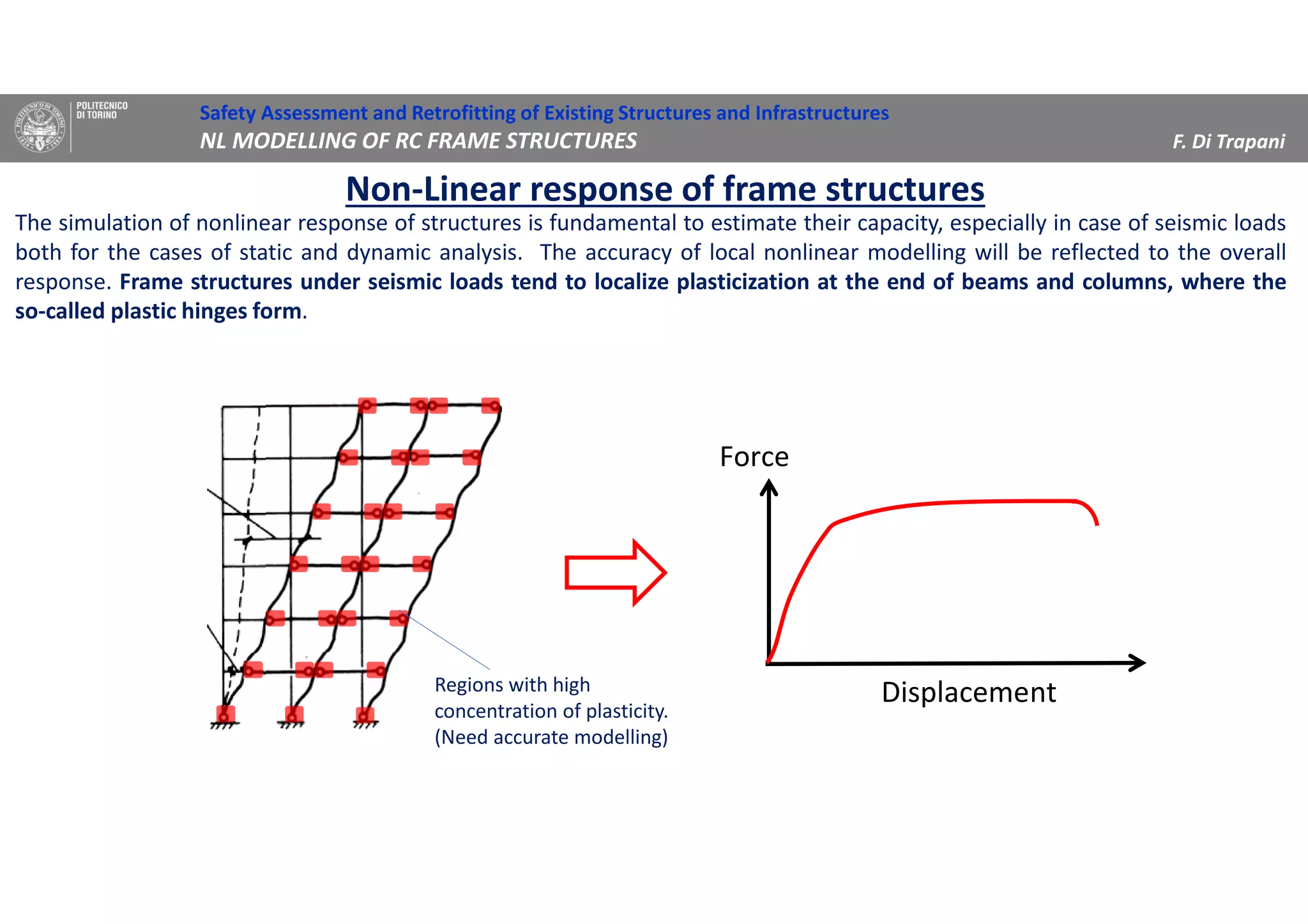
The simulation of nonlinear response of structures is fundamental to estimate their capacity, especially in case of seismic loads
both for the cases of static and dynamic analysis. The accuracy of local nonlinear modelling will be reflected to the overall
response. Frame structures under seismic loads tend to localize plasticization at the end of beams and columns, where the
so-called plastic hinges form.
ntDisplaceme
Force
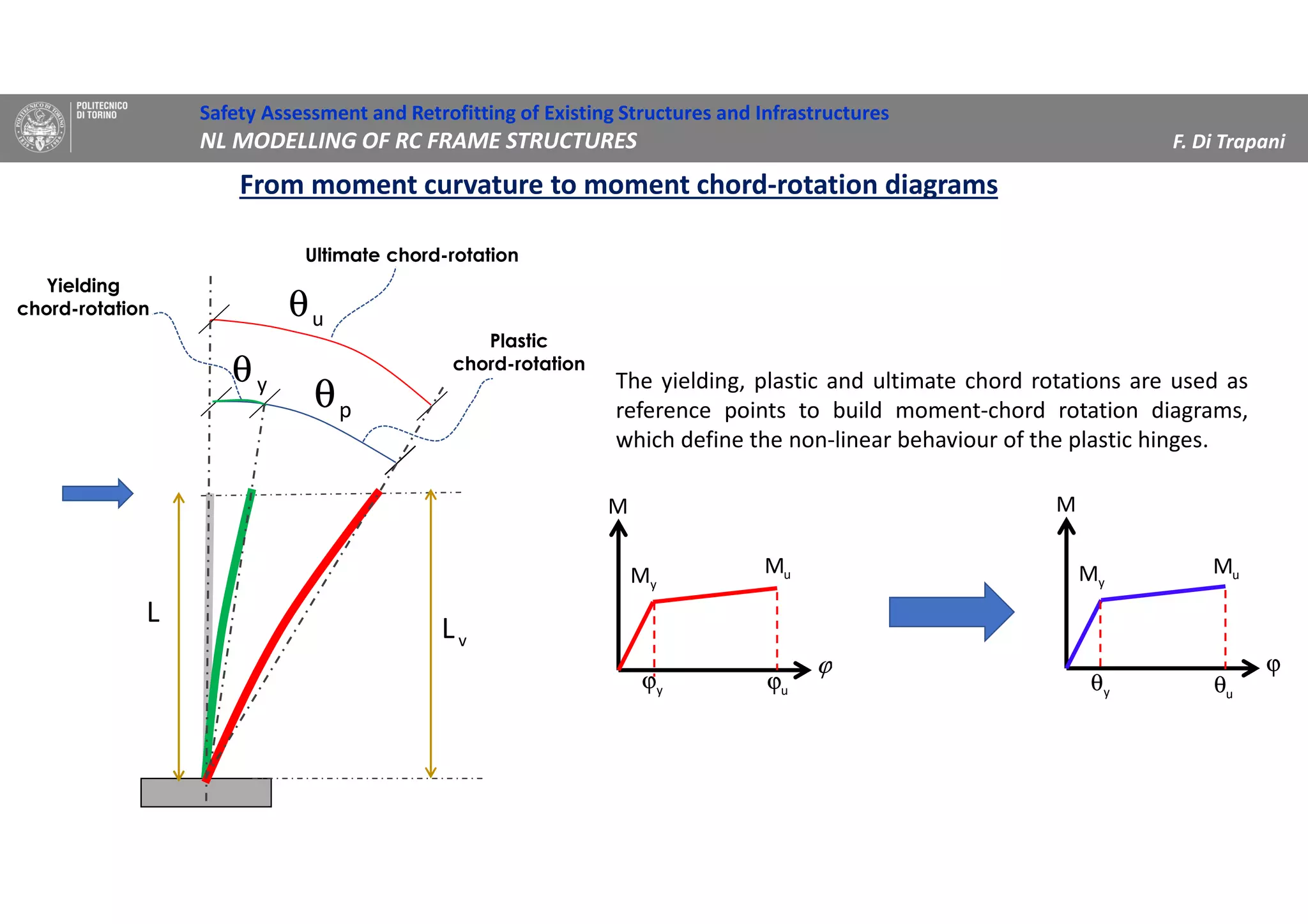
Regions with high
concentration of plasticity.
(Need accurate modelling)
Safety Assessment and Retrofitting of Existing Structures and Infrastructures
NL MODELLING OF RC FRAME STRUCTURES F. Di Trapani
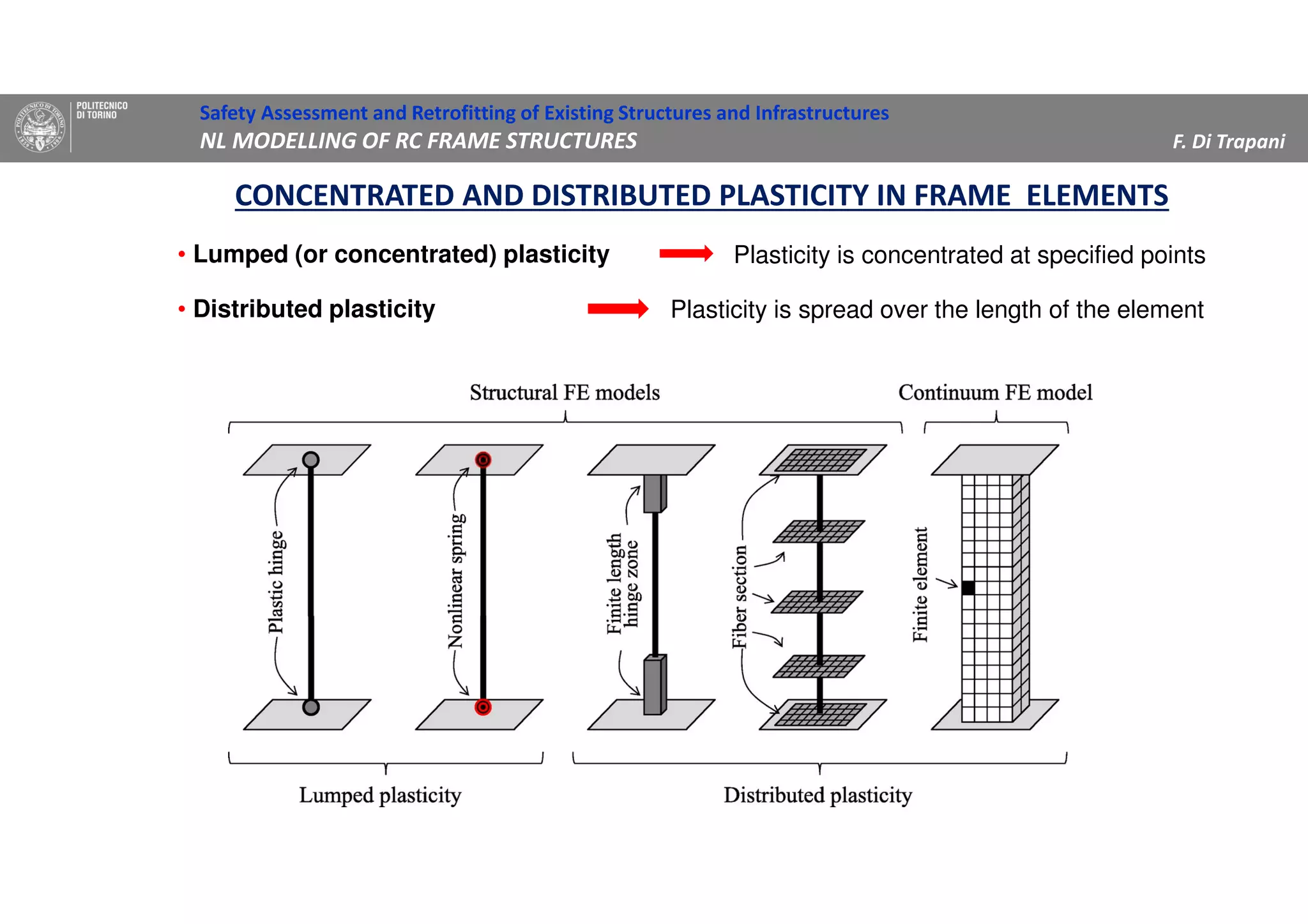
• Distributed plasticity Plasticity is spread over the length of the element
• Lumped (or concentrated) plasticity Plasticity is concentrated at specified points
CONCENTRATED AND DISTRIBUTED PLASTICITY IN FRAME ELEMENTS
Safety Assessment and Retrofitting of Existing Structures and Infrastructures
NL MODELLING OF RC FRAME STRUCTURES F. Di Trapani
Safety Assessment and Retrofitting of Existing Structures and Infrastructures
Fabio Di Trapani
CONCENTRATED PLASTICITY APPROACH
Concentrated plasticity
Safety Assessment and Retrofitting of Existing Structures and Infrastructures
NL MODELLING OF RC FRAME STRUCTURES F. Di Trapani
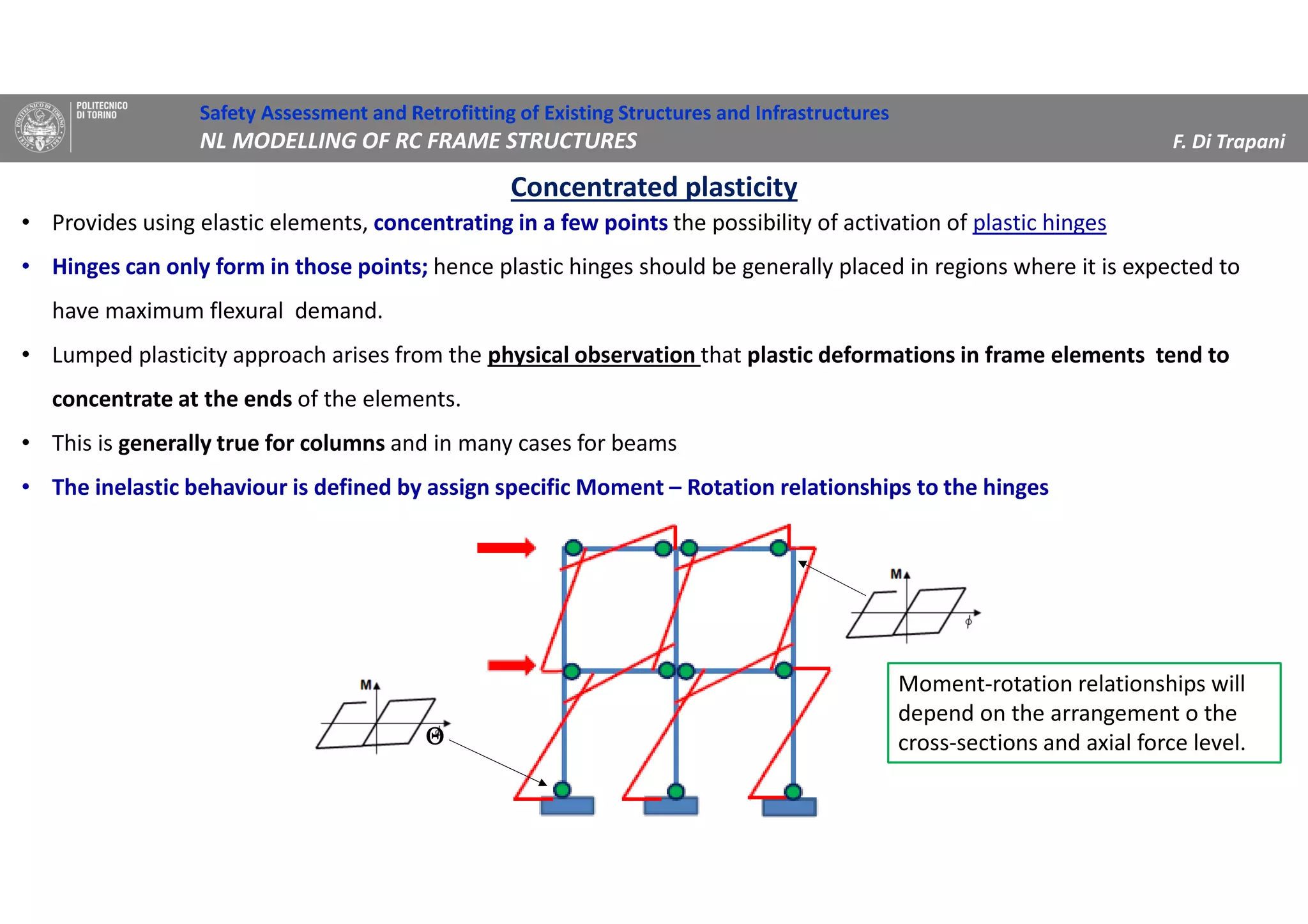
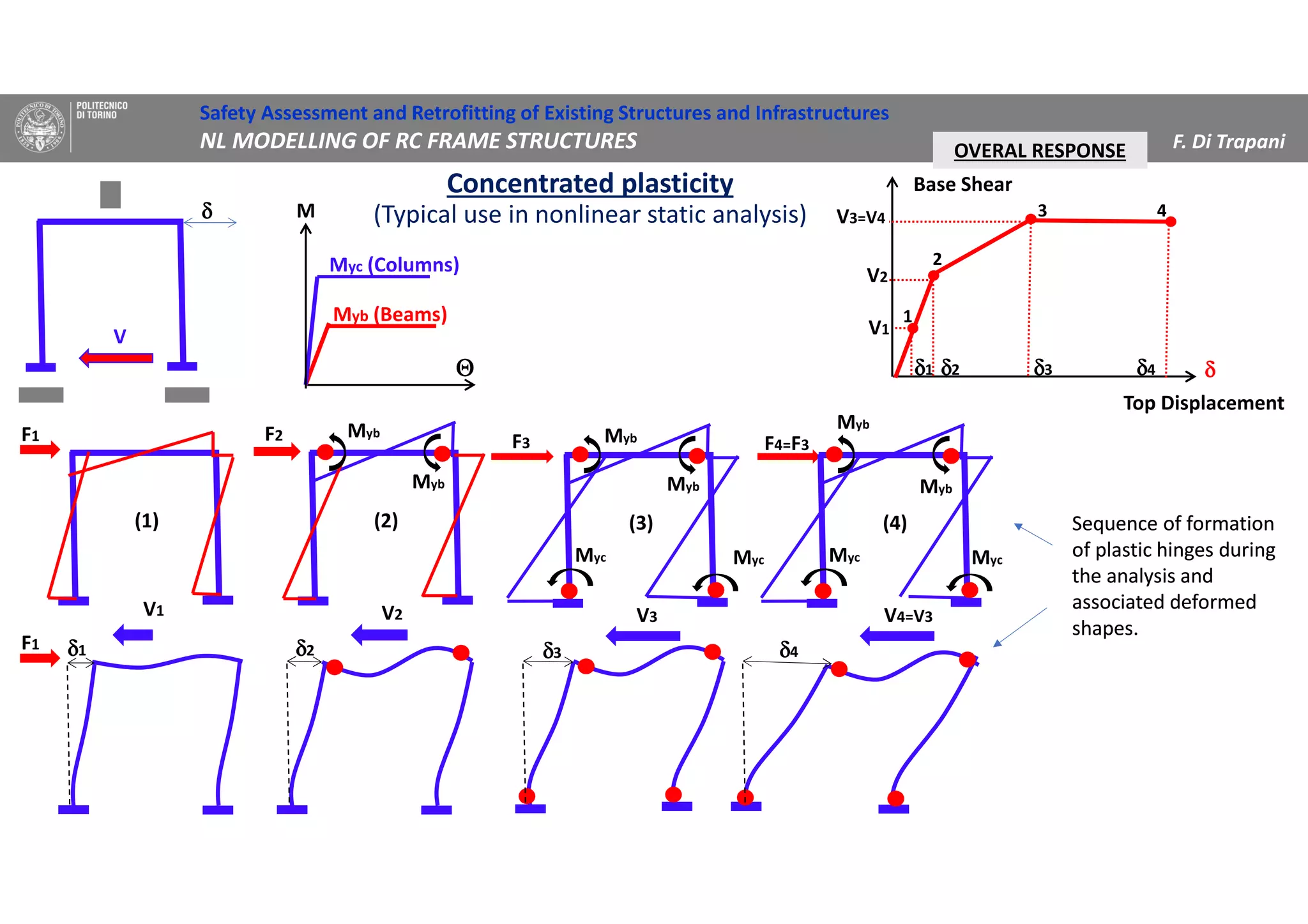
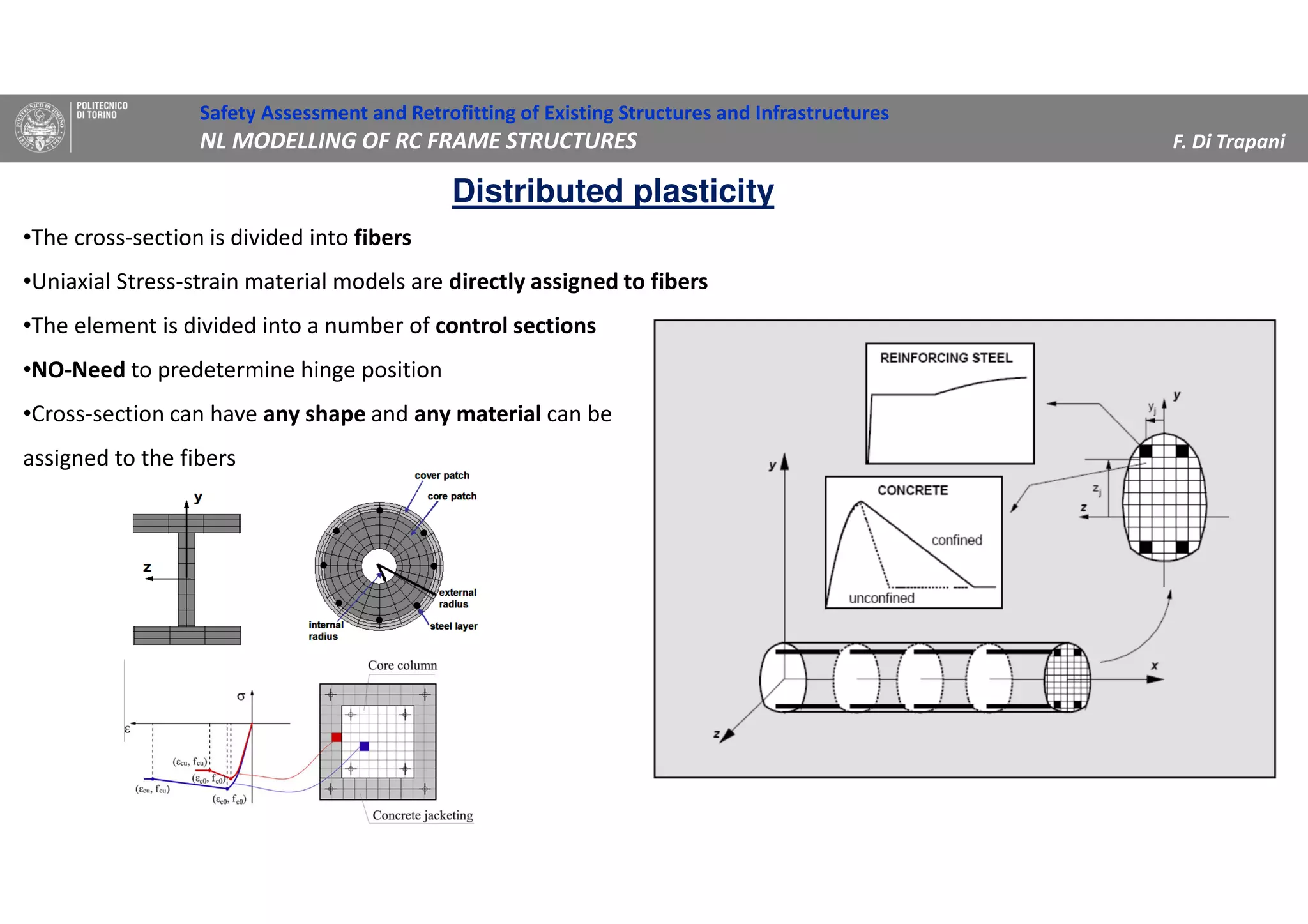
• Provides using elastic elements, concentrating in a few points the possibility of activation of plastic hinges
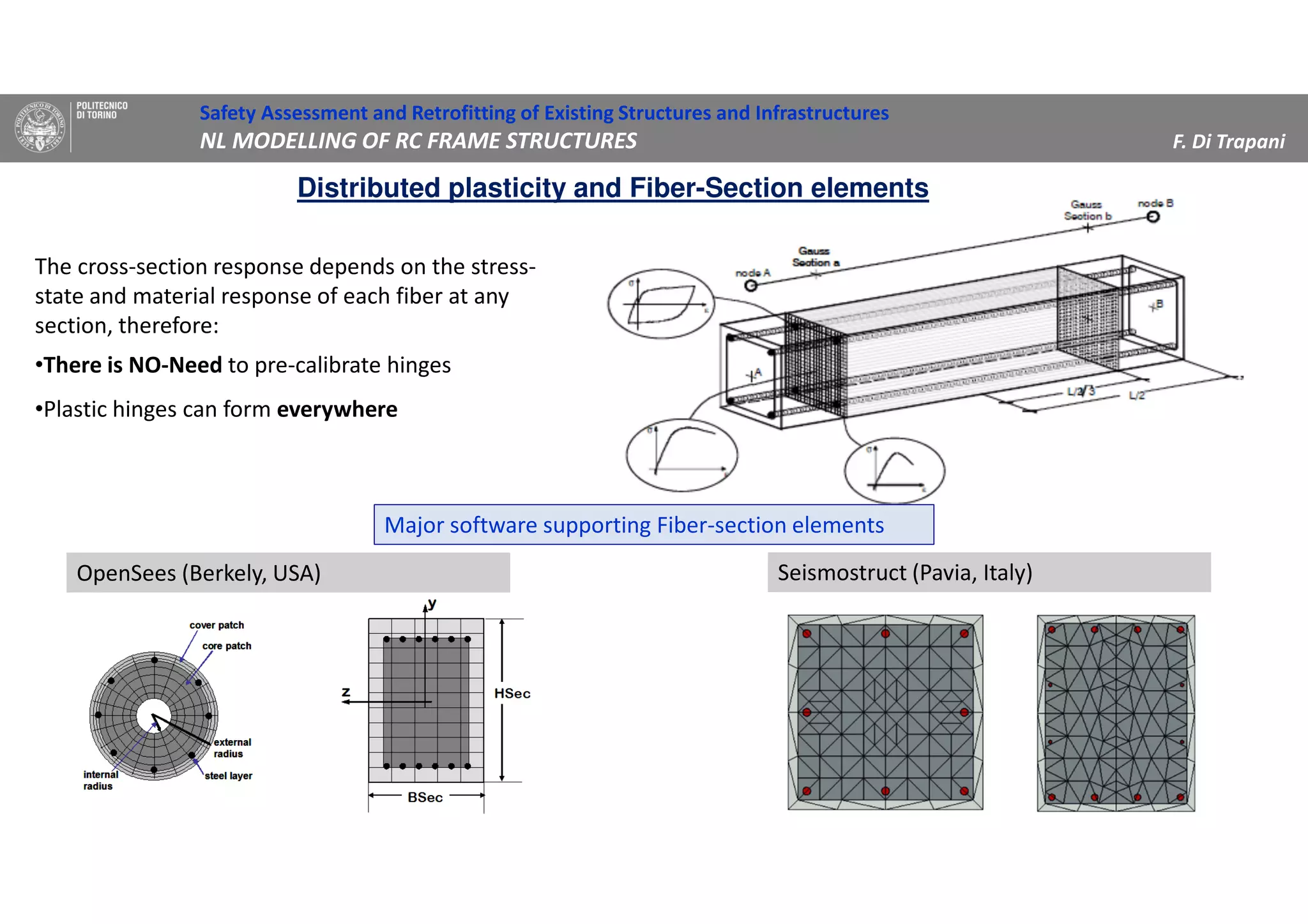
• Hinges can only form in those points; hence plastic hinges should be generally placed in regions where it is expected to
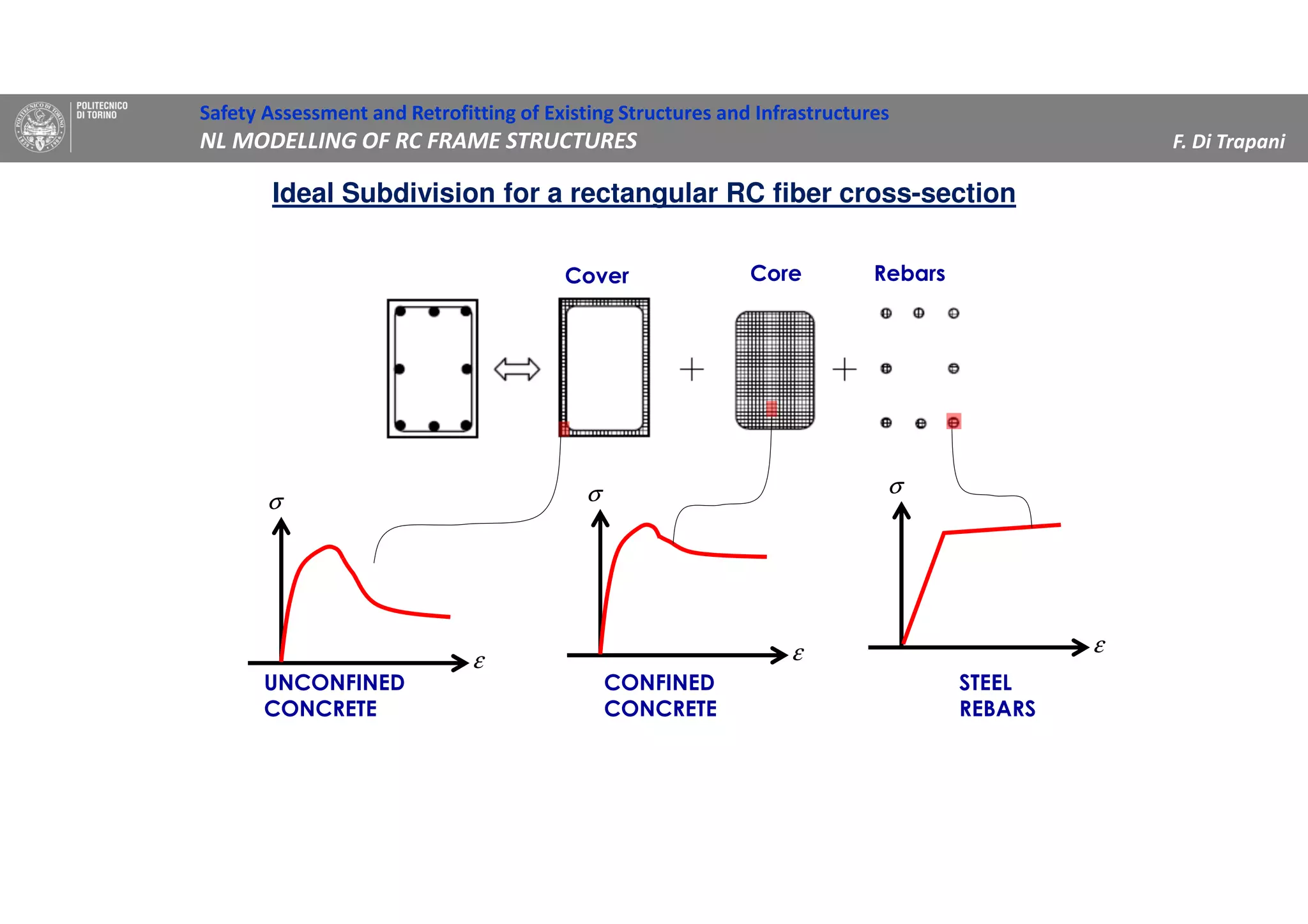
have maximum flexural demand.
• Lumped plasticity approach arises from the physical observation that plastic deformations in frame elements tend to
concentrate at the ends of the elements.
• This is generally true for columns and in many cases for beams
• The inelastic behaviour is defined by assign specific Moment – Rotation relationships to the hinges
ΘΘΘΘ
Moment-rotation relationships will
depend on the arrangement o the
cross-sections and axial force level.
Concentrated plasticity
(Typical use in nonlinear static analysis)
Safety Assessment and Retrofitting of Existing Structures and Infrastructures
NL MODELLING OF RC FRAME STRUCTURES F. Di Trapani
(1) (2)
Myb
Myb
V1 V2
(3)
Myb
V3
Myb
Myc Myc
F1 F2 F3
(4)
V4=V3
Myc Myc
F4=F3
F1 δδδδ1 δδδδ2 δδδδ3 δδδδ4
Myb
Myb
OVERAL RESPONSEOVERAL RESPONSE
Base Shear
δδδδ
1
2
3 4
V2
V3=V4
V1
δδδδ3 δδδδ4δδδδ2δδδδ1
Top Displacement
M
Myb (Beams)
Myc (Columns)
δδδδ
ΘΘΘΘ
V
Sequence of formation
of plastic hinges during
the analysis and
associated deformed
shapes.
Sequence of formation
of plastic hinges during
the analysis and
associated deformed
shapes.
From moment curvature to moment chord-rotation diagrams
Safety Assessment and Retrofitting of Existing Structures and Infrastructures
NL MODELLING OF RC FRAME STRUCTURES F. Di Trapani
Chord-rotation
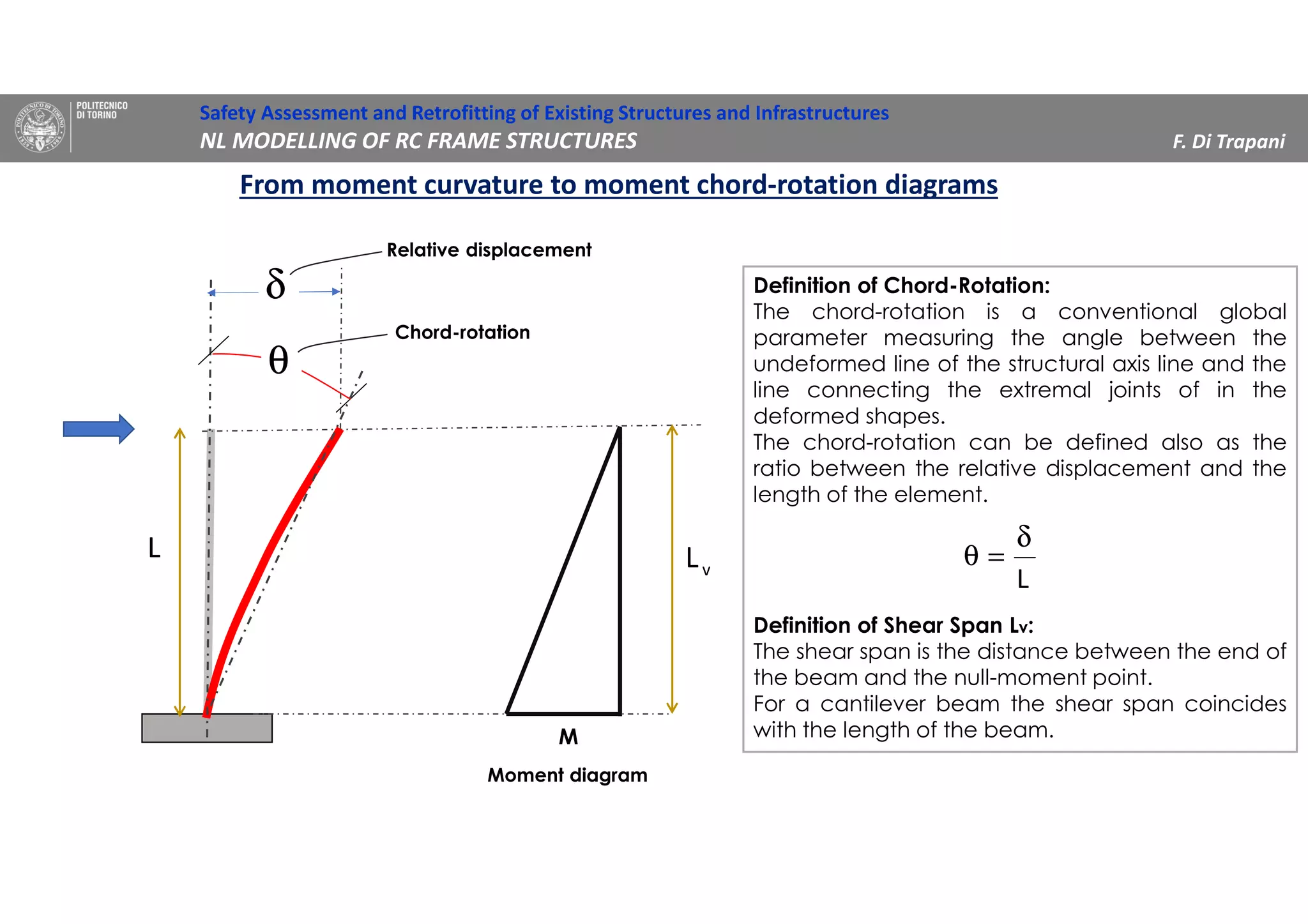
Definition of Chord-Rotation:
The chord-rotation is a conventional global
parameter measuring the angle between the
undeformed line of the structural axis line and the
line connecting the extremal joints of in the
deformed shapes.
The chord-rotation can be defined also as the
ratio between the relative displacement and the
length of the element.
Definition of Shear Span Lv:
The shear span is the distance between the end of
the beam and the null-moment point.
For a cantilever beam the shear span coincides
with the length of the beam.M
vLL
δ
θ
L
δ
=θ
Moment diagram
Relative displacement
From moment curvature to moment chord-rotation diagrams
Safety Assessment and Retrofitting of Existing Structures and Infrastructures
NL MODELLING OF RC FRAME STRUCTURES F. Di Trapani
θ
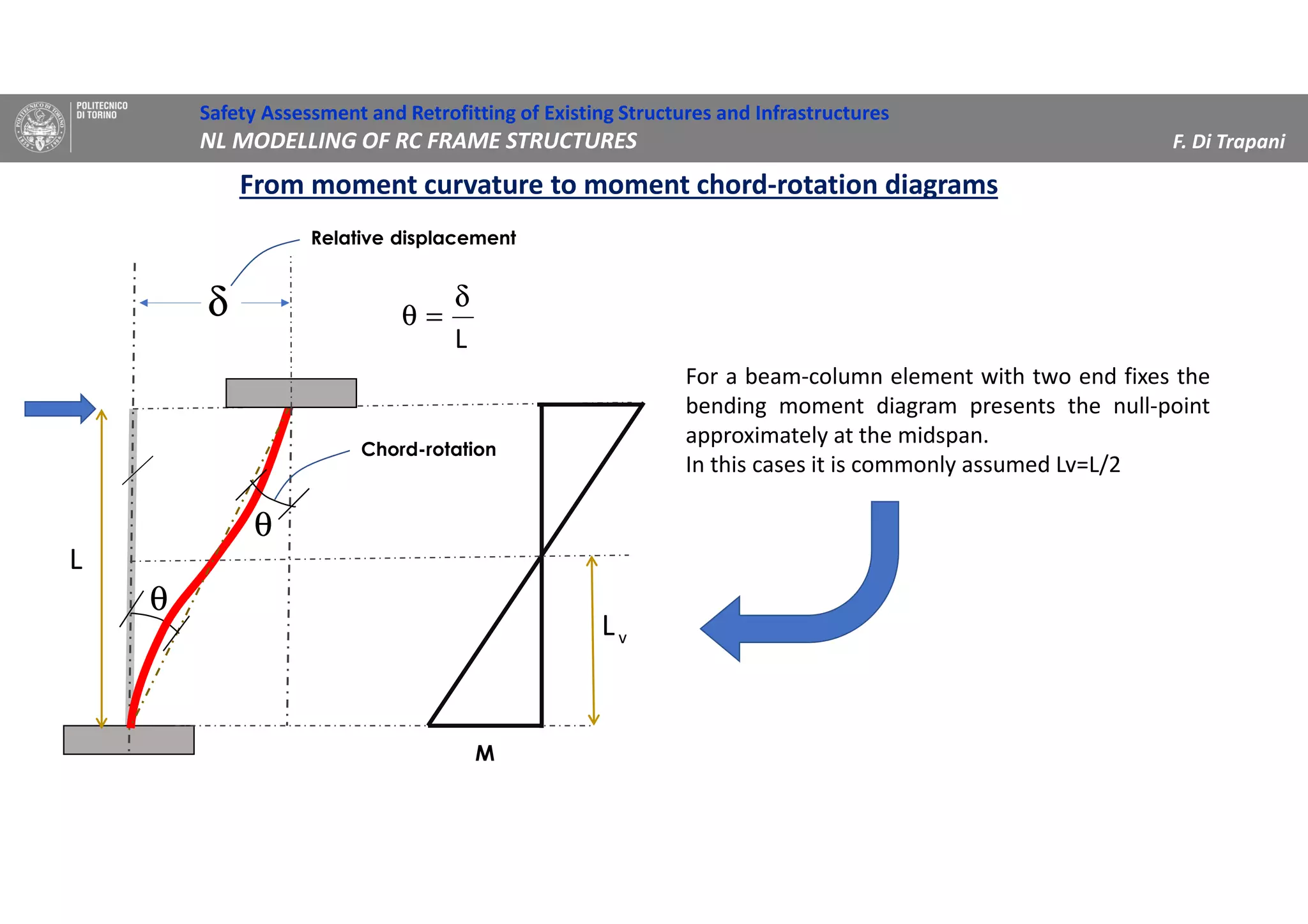
For a beam-column element with two end fixes the
bending moment diagram presents the null-point
approximately at the midspan.
In this cases it is commonly assumed Lv=L/2
M
vL
Chord-rotation
L
θ
δ
Relative displacement
L
δ
=θ
MM
VV
0VLM2 =−
L
2
L
V
M
LV ==
Lv
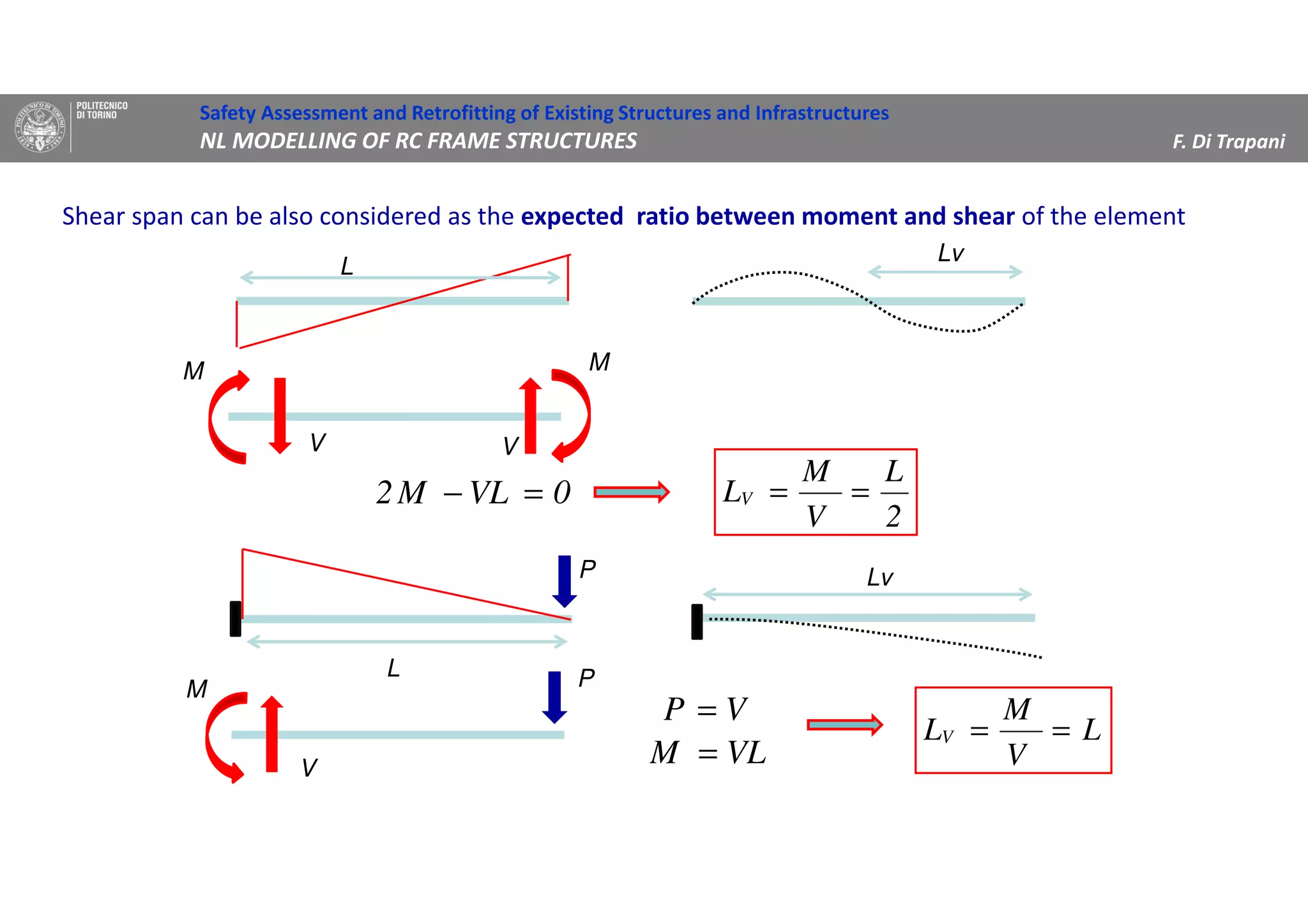
Shear span can be also considered as the expected ratio between moment and shear of the element
M
V
VLM =
L P
VP =
L
V
M
LV ==
LvP
Safety Assessment and Retrofitting of Existing Structures and Infrastructures
NL MODELLING OF RC FRAME STRUCTURES F. Di Trapani
From moment curvature to moment chord-rotation diagrams
pθ
Yielding
chord-rotation
yθ
uθ
Ultimate chord-rotation
vL
Plastic
chord-rotation
L
The yielding, plastic and ultimate chord rotations are used as
reference points to build moment-chord rotation diagrams,
which define the non-linear behaviour of the plastic hinges.
yM
ϕ
M
yϕ uϕ
yM uM
ϕ
M
yθ uθ
uM
Safety Assessment and Retrofitting of Existing Structures and Infrastructures
NL MODELLING OF RC FRAME STRUCTURES F. Di Trapani
Safety Assessment and Retrofitting of Existing Structures and Infrastructures
NL MODELLING OF RC FRAME STRUCTURES F. Di Trapani
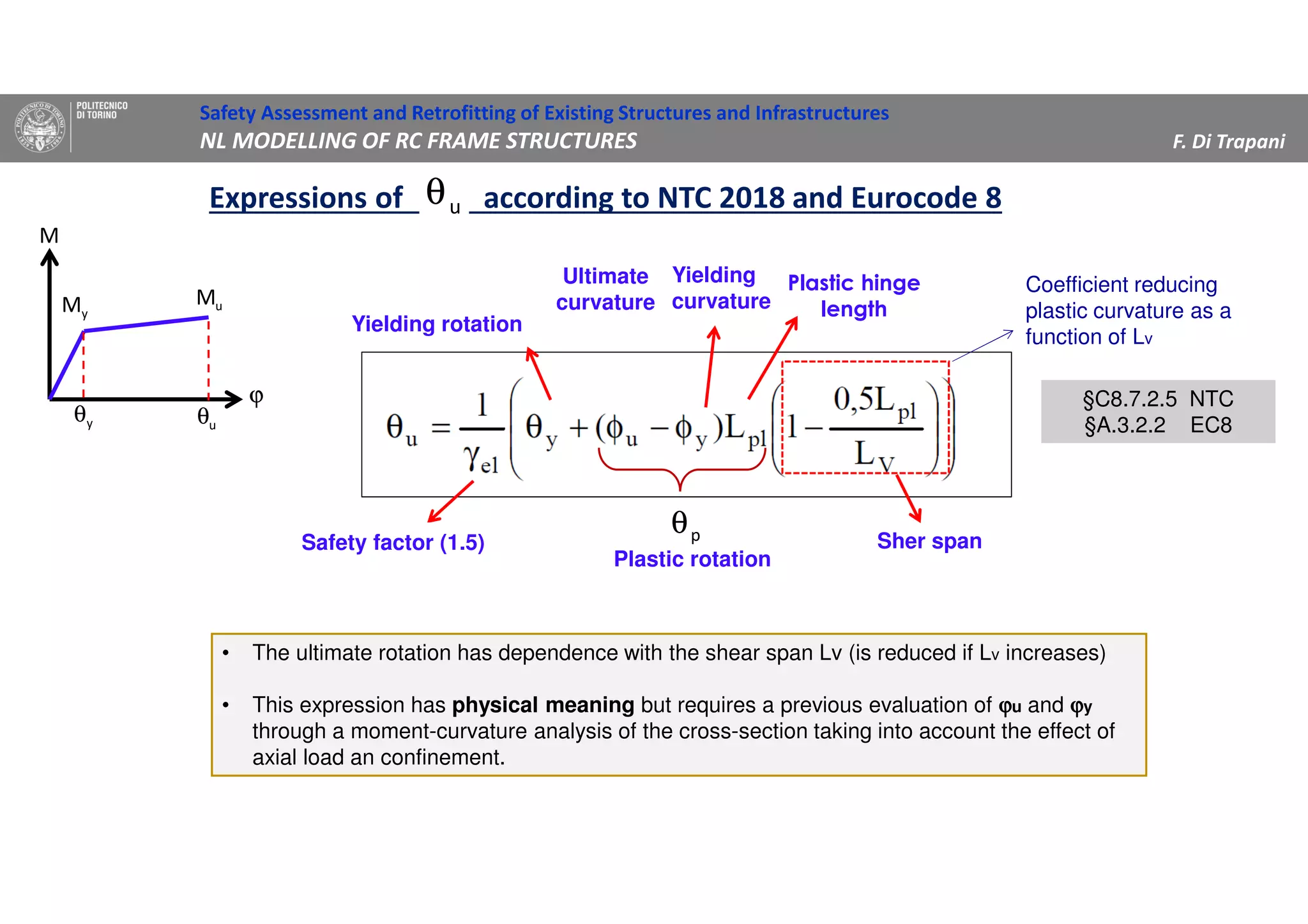
Expressions of according to NTC 2018 and Eurocode 8uθ
yM uM
ϕ
M
yθ uθ
Yielding rotation
Yielding
curvature
Ultimate
curvature
Plastic hinge
length
Sher spanSafety factor (1.5)
§C8.7.2.5 NTC
§A.3.2.2 EC8
§C8.7.2.5 NTC
§A.3.2.2 EC8
Coefficient reducing
plastic curvature as a
function of Lv
pθ
Plastic rotation
• The ultimate rotation has dependence with the shear span Lv (is reduced if Lv increases)
• This expression has physical meaning but requires a previous evaluation of ϕϕϕϕu and ϕϕϕϕy
through a moment-curvature analysis of the cross-section taking into account the effect of
axial load an confinement.
Safety Assessment and Retrofitting of Existing Structures and Infrastructures
NL MODELLING OF RC FRAME STRUCTURES F. Di Trapani
Expressions of according to NTC 2018 and Eurocode 8uθ
yM uM
ϕ
M
yθ uθ
Empirical expression by Pangiotakos and Fardis (2001)
§C8.7.2.1 NTC
§A.3.2.2 EC8
§C8.7.2.1 NTC
§A.3.2.2 EC8
• The ultimate rotation has dependence with the shear span Lv
• This expression is empirical (no physical meaning) but allows avoiding the evaluation of
ϕϕϕϕu and ϕϕϕϕy. Effect of axial load an confinement are also directly accounted
spanShearL
bhf
N
bhf
f'A
';
bhf
fA
5.1
v
c
c
ys
c
ys
el
=
=ν
=ω=ω
=γ
sn
d
x,st
x,st
s
h,b
sb
A
αα=α
=
=
=ρ
⋅
=ρ
base and height of the cross section
Stirrups spacing
Confinement effectiveness coefficient
Eventual geometric ratio of diagonal reinforcement
Geometric ratio of transverse reinforcement
x 0.85
(in absence of seismic
detailing)
Safety Assessment and Retrofitting of Existing Structures and Infrastructures
NL MODELLING OF RC FRAME STRUCTURES F. Di Trapani
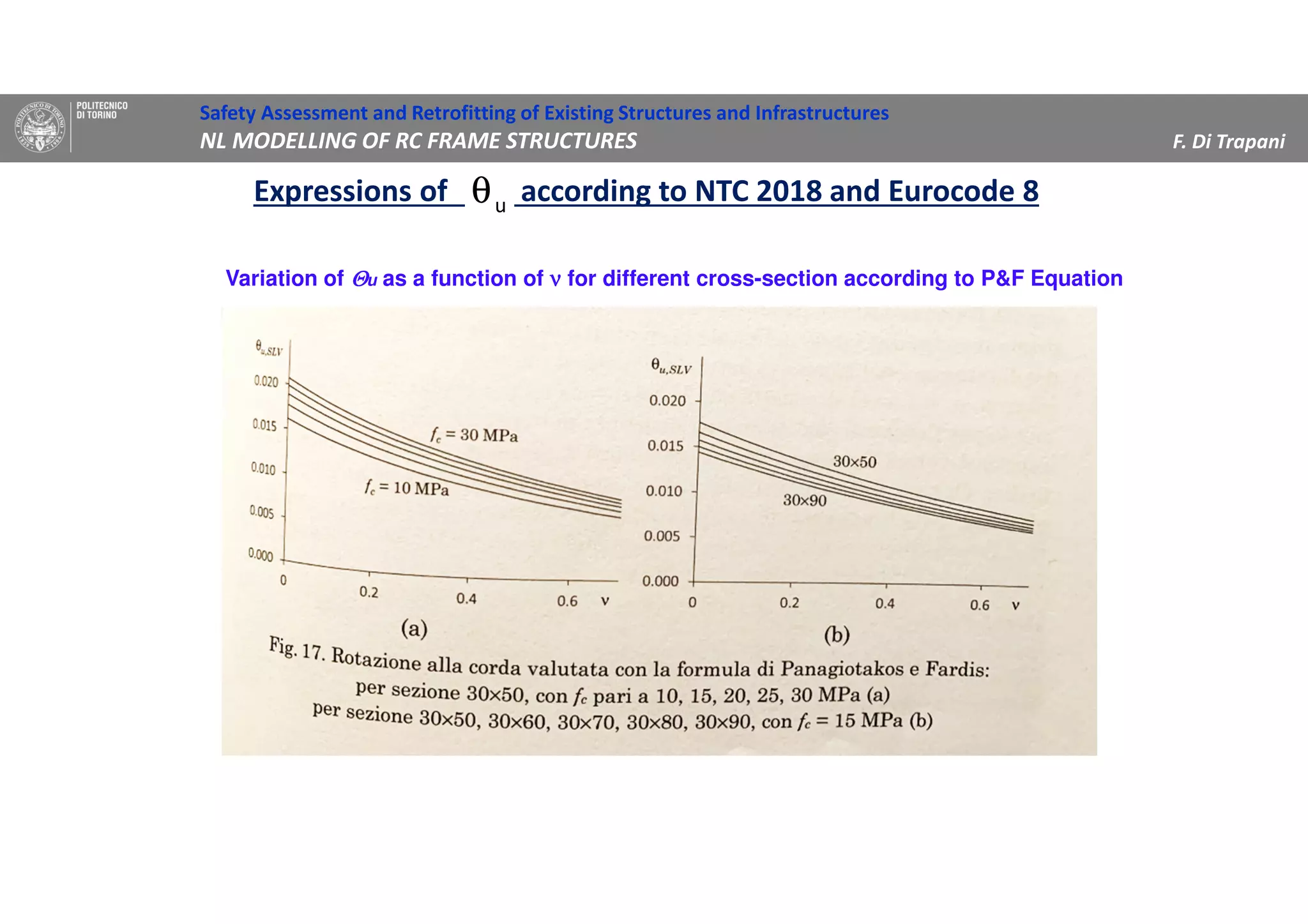
Variation of ΘΘΘΘu as a function of νννν for different cross-section according to P&F Equation
Expressions of according to NTC 2018 and Eurocode 8uθ
h: Cross-section height
db: average diameter of longitudinal rebars
Safety Assessment and Retrofitting of Existing Structures and Infrastructures
NL MODELLING OF RC FRAME STRUCTURES F. Di Trapani
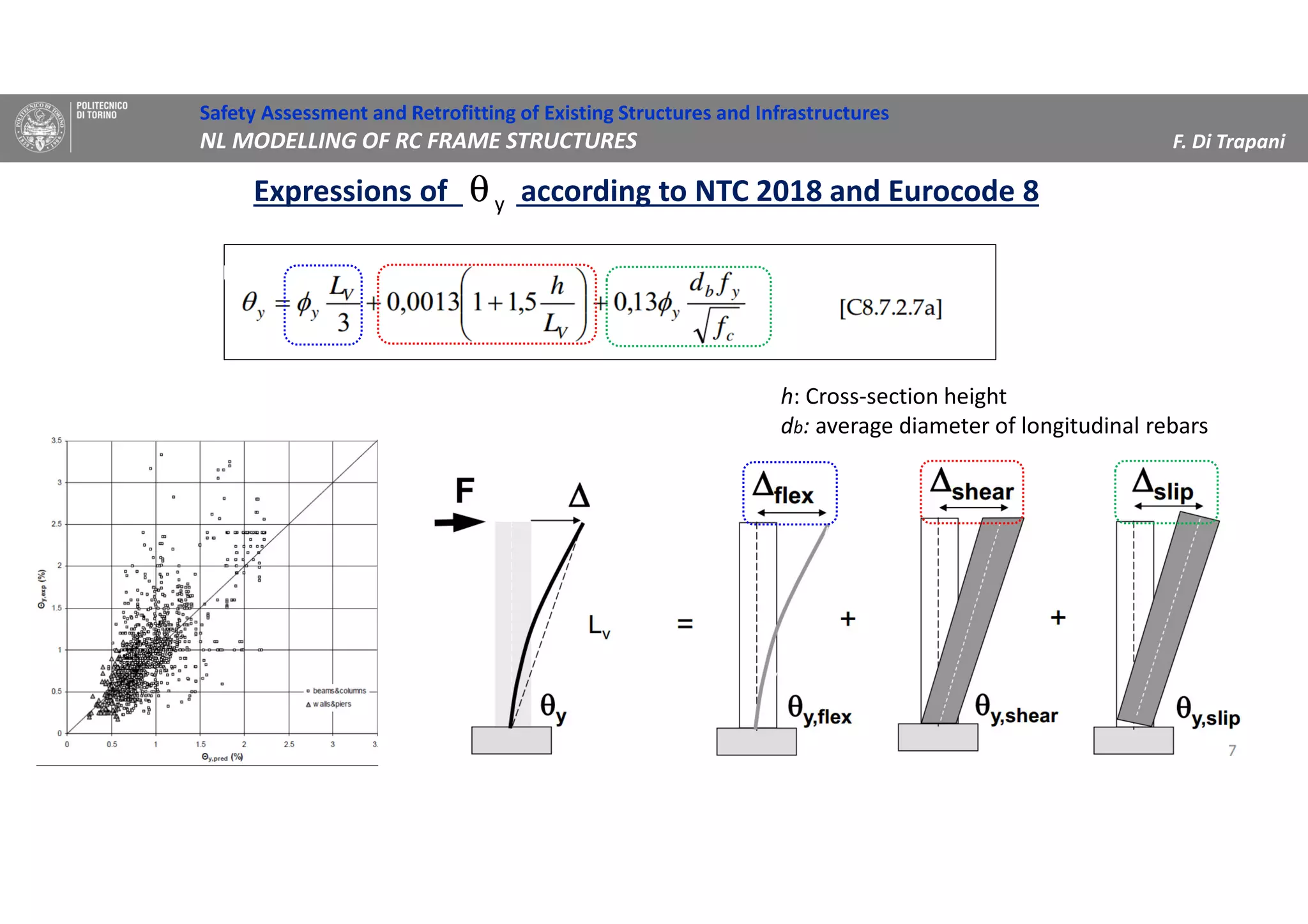
Expressions of according to NTC 2018 and Eurocode 8yθ
h: Cross-section height
db: average diameter of longitudinal rebars
Safety Assessment and Retrofitting of Existing Structures and Infrastructures
NL MODELLING OF RC FRAME STRUCTURES F. Di Trapani
Expression of according to NTC 2018 and Eurocode 8plL
Plastic hinge penetration
length into the joint
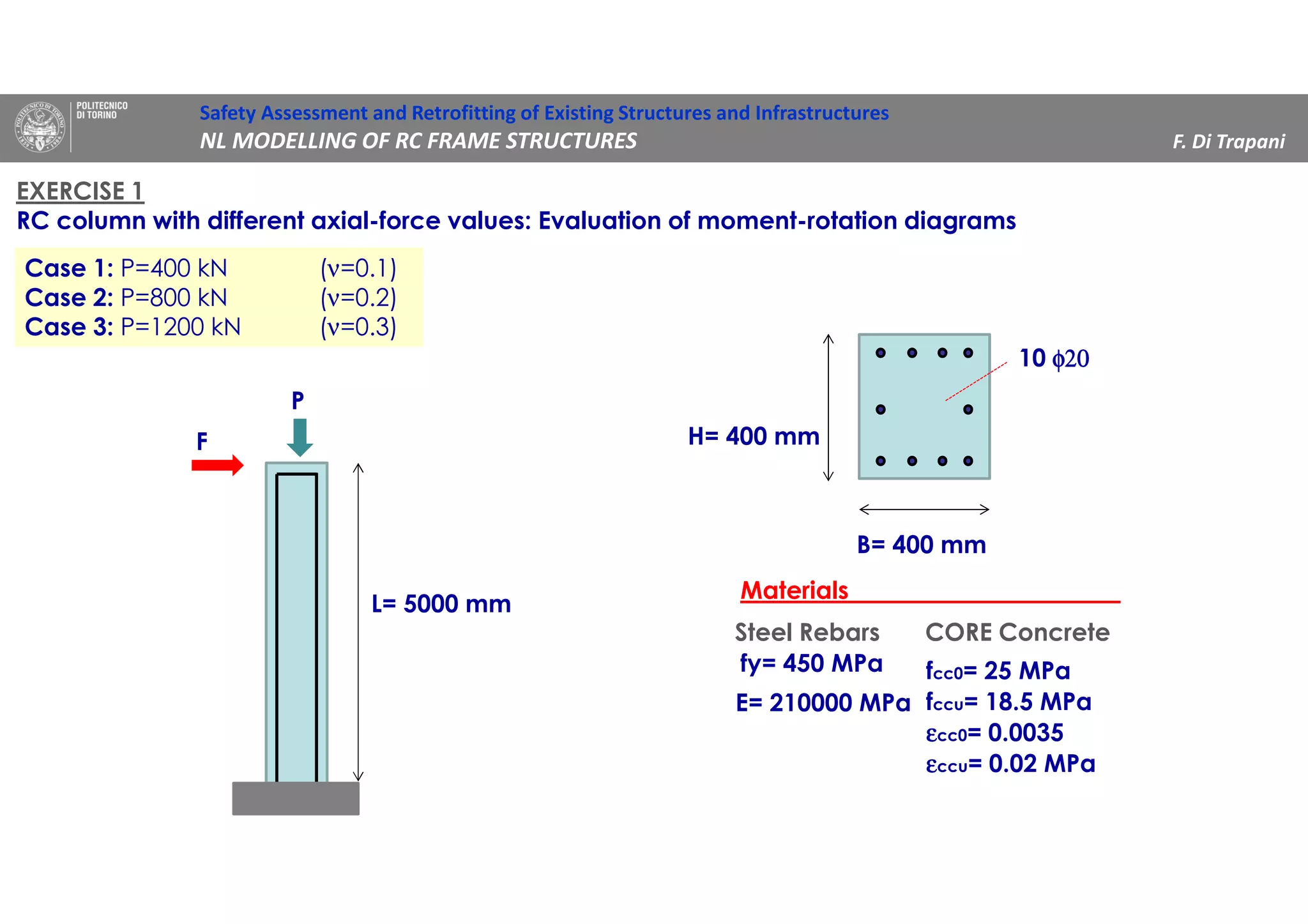
EXERCISE 1
RC column with different axial-force values: Evaluation of moment-rotation diagrams
B= 400 mm
P
H= 400 mm
fy= 450 MPa
E= 210000 MPa
fcc0= 25 MPa
fccu= 18.5 MPa
εεεεcc0= 0.0035
εεεεccu= 0.02 MPa
Materials
Steel Rebars CORE Concrete
L= 5000 mm
F
10 φ20φ20φ20φ20
Case 1: P=400 kN (ν=0.1)
Case 2: P=800 kN (ν=0.2)
Case 3: P=1200 kN (ν=0.3)
Safety Assessment and Retrofitting of Existing Structures and Infrastructures
NL MODELLING OF RC FRAME STRUCTURES F. Di Trapani
EXERCISE 1
Moment – curvature analysis of the cross-section
Case 1: P=400 kN (ν=0.1)
Case 2: P=800 kN (ν=0.2)
Case 3: P=1600 kN(ν=0.4)
0
50
100
150
200
250
300
350
400
0 0,00005 0,0001 0,00015 0,0002 0,00025
M[kNm]
φφφφ [1/mm]
M-φφφφ diagrams
N=400 kN
N=800 kN
N=1200 kN
N=400 kN N=800 kN N=1200 kN
φφφφu [1/mm] 0.0002244 0.0001442 0.00011
φφφφy [1/mm] 0.0000099 0.0000111 0.00001237
My (ideal.) [kNm] 276.9 312 340
Ultimate curvature
Yielding curvature
Idealized yielding moment
Evaluate …
B= 400 mm
H= 400 mm
10 φ20φ20φ20φ20
Safety Assessment and Retrofitting of Existing Structures and Infrastructures
NL MODELLING OF RC FRAME STRUCTURES F. Di Trapani
EXERCISE 1
Evaluation of Moment – Rotation diagrams
Case 1: P=400 kN (ν=0.1)
Case 2: P=800 kN (ν=0.2)
Case 3: P=1600 kN(ν=0.4)
SECTION 400x400 Nu (kN) 4000
N v φφφφ u φφφφ y H B L L v fc dbl fy Lpl ΘΘΘΘ u ΘΘΘΘ y
(kN) - 1/mm 1/mm mm mm mm mm MPa mm MPa mm rad rad
400 0.10 0.00022 0.0000099 400 400 5000 5000 28 20 450 976.2 0.2091 0.0201
800 0.20 0.00014 0.00001111 400 400 5000 5000 28 20 450 976.2 0.1397 0.0224
1200 0.30 0.00011 0.00001237 400 400 5000 5000 28 20 450 976.2 0.1108 0.0248
0
50
100
150
200
250
300
350
0 0,05 0,1 0,15 0,2 0,25
M[kNm]
ΘΘΘΘ [rad]
M-ΘΘΘΘ diagrams
N=400 kN
N=800 kN
N=1200 kN
Safety Assessment and Retrofitting of Existing Structures and Infrastructures
NL MODELLING OF RC FRAME STRUCTURES F. Di Trapani
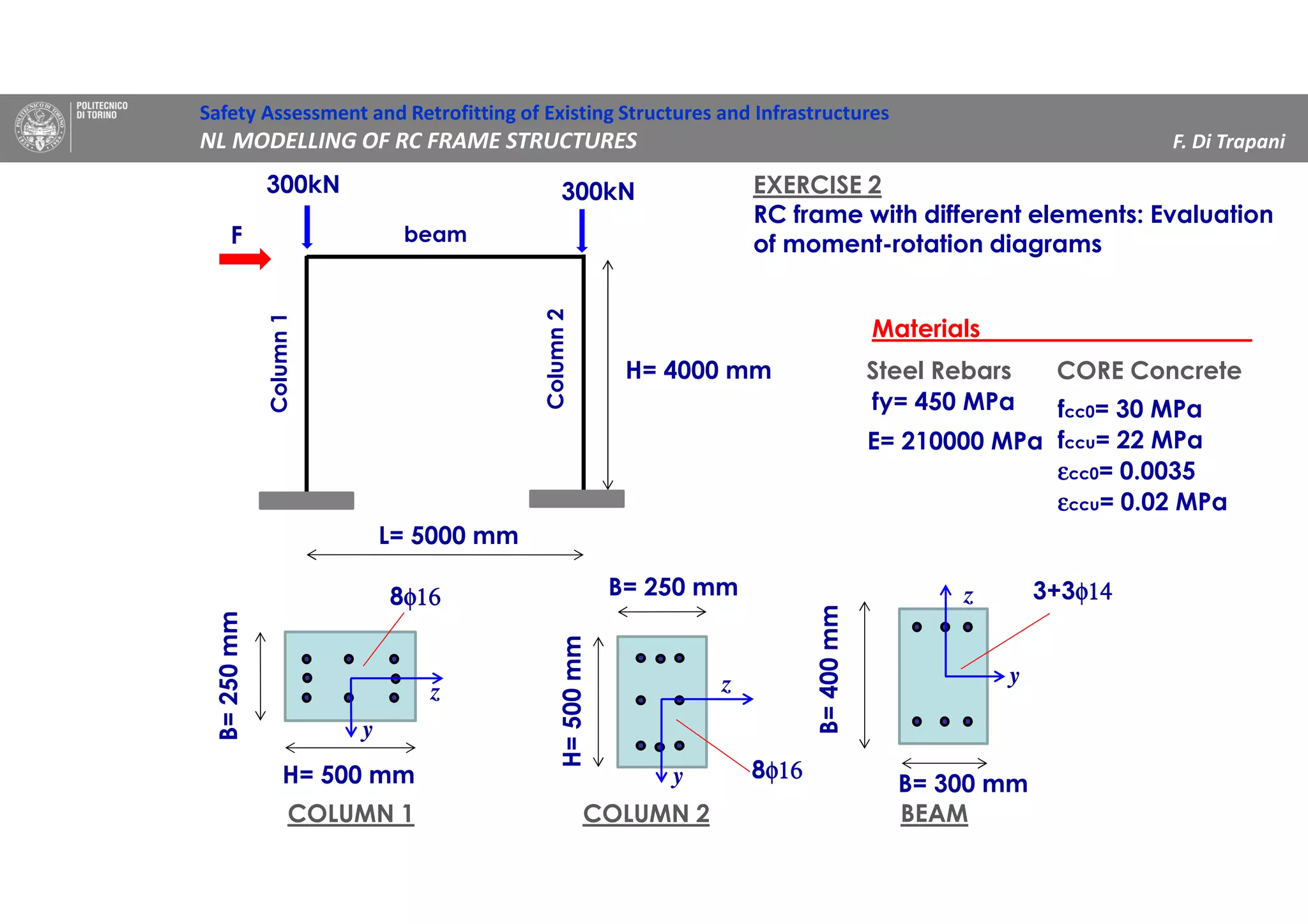
L= 5000 mm
F
H= 500 mm
B=250mm
B= 300 mm
B=400mm
3+3φ14φ14φ14φ148φ16φ16φ16φ16
H= 4000 mm
COLUMN 1 BEAM
300kN300kN
beam
Column1
Column2
H=500mm
B= 250 mm
8φ16φ16φ16φ16
COLUMN 2
z
y
z
y
z
y
fy= 450 MPa
E= 210000 MPa
fcc0= 30 MPa
fccu= 22 MPa
εεεεcc0= 0.0035
εεεεccu= 0.02 MPa
Materials
Steel Rebars CORE Concrete
Safety Assessment and Retrofitting of Existing Structures and Infrastructures
NL MODELLING OF RC FRAME STRUCTURES F. Di Trapani
EXERCISE 2
RC frame with different elements: Evaluation
of moment-rotation diagrams
0
50
100
150
200
250
0 0,0001 0,0002 0,0003 0,0004 0,0005 0,0006
M[kNm]
φφφφ [1/mm]
M-φφφφ diagrams
Column 1
Column 2
Beam
Column 1 Column 2 Beam
N=400 kN N=800 kN N=1200 kN
φφφφu 0.0002059 0.0004 0.000524
φφφφy 0.00000697 0.00001578 0.0000075
My (idealized) 215 97 75
EXERCISE 2
Moment – curvature analysis of the cross-sections
Safety Assessment and Retrofitting of Existing Structures and Infrastructures
NL MODELLING OF RC FRAME STRUCTURES F. Di Trapani
N=300 kN N=300 kN N=0
0
50
100
150
200
250
0 0,05 0,1 0,15 0,2 0,25 0,3 0,35
M[kNm]
ΘΘΘΘ [rad]
M-ΘΘΘΘ diagrams
Column 1
Column 2
Beam
Nu N v (-) φφφφu φφφφy H B L Lv fc dbl N fi long fy Lpl ΘΘΘΘu ΘΘΘΘy My
kN kN (1/mm) (1/mm) (mm) (mm) (mm) (mm) (MPa) (mm) - (MPa) (mm) (mm) (mm) (kNm)
Column 1 3125 300 0.10 0.00021 0.00001 500 250 4000 2000 25 16 8 450 630.6 0.1134 0.0077 215
Column 2 3125 300 0.10 0.00040 0.00002 250 500 4000 2000 25 16 8 450 588.1 0.2078 0.015 97
Beam 3000 0 0.00 0.00052 0.00001 400 300 5000 2500 25 14 6 450 620.4 0.2898 0.0091 75
EXERCISE 2
Evaluation of Moment – Rotation diagrams
Safety Assessment and Retrofitting of Existing Structures and Infrastructures
NL MODELLING OF RC FRAME STRUCTURES F. Di Trapani
Safety Assessment and Retrofitting of Existing Structures and Infrastructures
NL MODELLING OF RC FRAME STRUCTURES F. Di Trapani
θ
M
ELASTIC
Plastic Hinge Plastic Hinge
θ
M
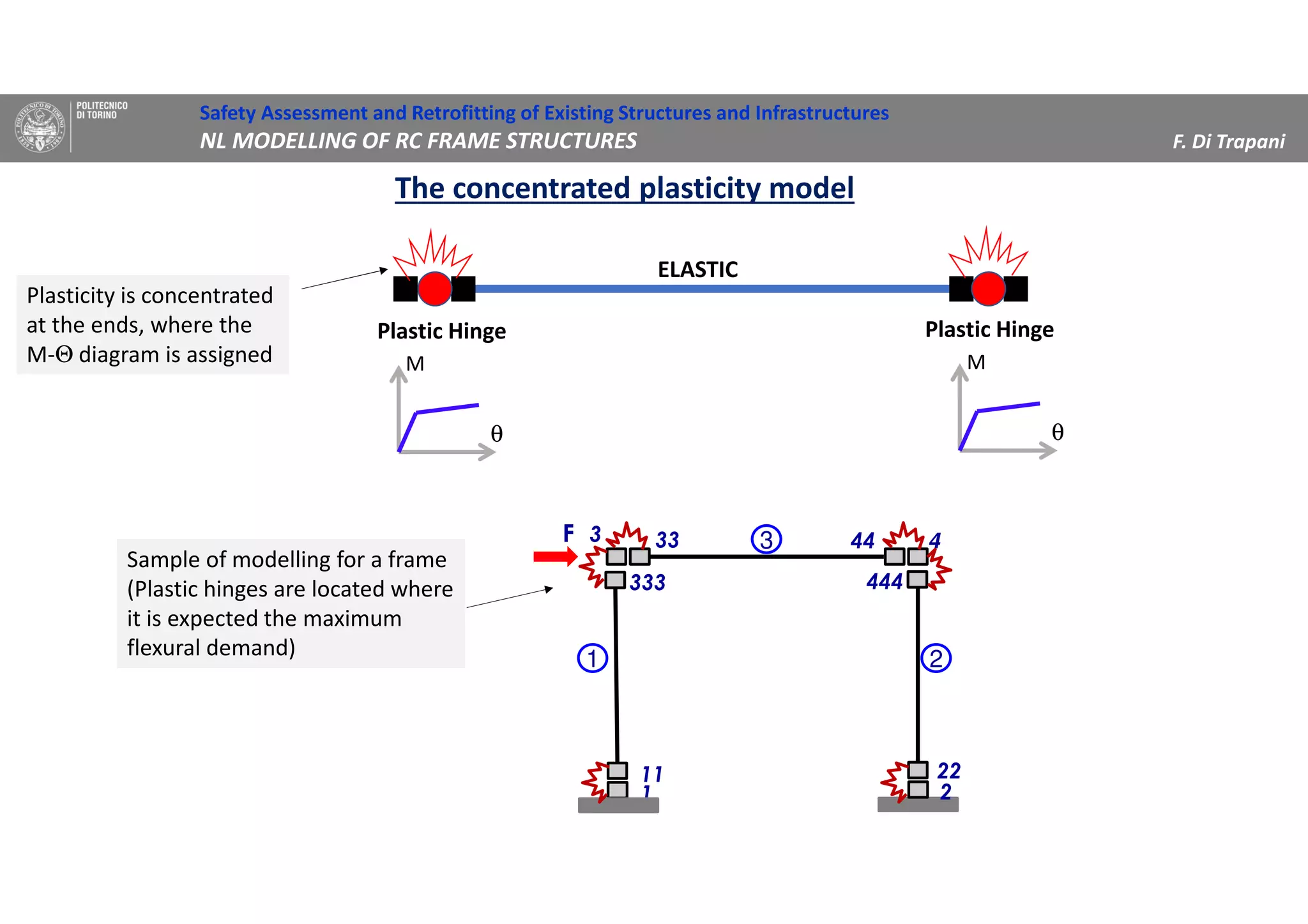
The concentrated plasticity model
Plasticity is concentrated
at the ends, where the
M-Θ diagram is assigned
Plasticity is concentrated
at the ends, where the
M-Θ diagram is assigned
1
11 22
2
3 33 4
1
3
2
F
333 444
44
Sample of modelling for a frame
(Plastic hinges are located where
it is expected the maximum
flexural demand)
Sample of modelling for a frame
(Plastic hinges are located where
it is expected the maximum
flexural demand)
Safety Assessment and Retrofitting of Existing Structures and Infrastructures
NL MODELLING OF RC FRAME STRUCTURES F. Di Trapani
The concentrated plasticity model
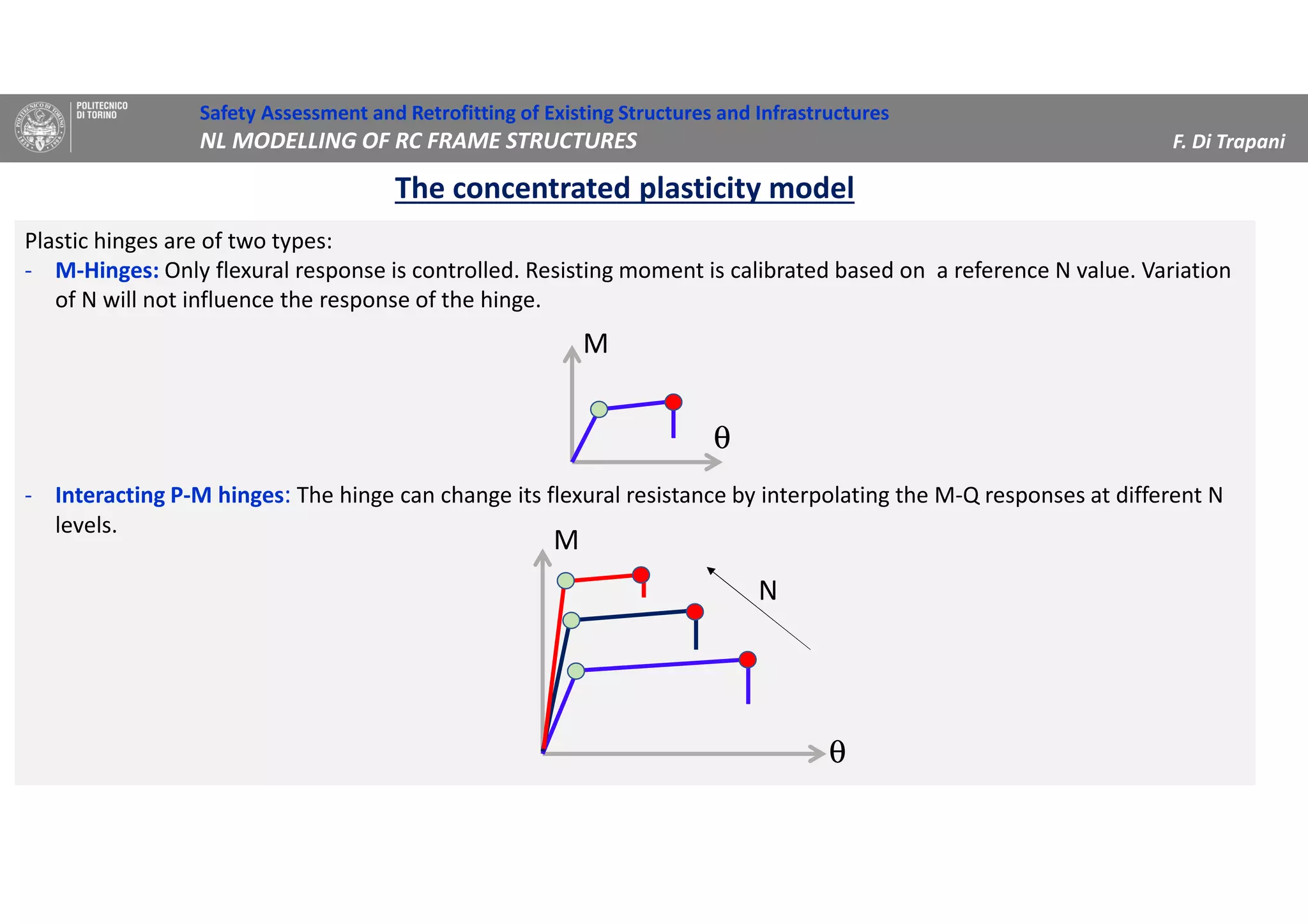
Plastic hinges are of two types:
- M-Hinges: Only flexural response is controlled. Resisting moment is calibrated based on a reference N value. Variation
of N will not influence the response of the hinge.
- Interacting P-M hinges: The hinge can change its flexural resistance by interpolating the M-Q responses at different N
levels.
Plastic hinges are of two types:
- M-Hinges: Only flexural response is controlled. Resisting moment is calibrated based on a reference N value. Variation
of N will not influence the response of the hinge.
- Interacting P-M hinges: The hinge can change its flexural resistance by interpolating the M-Q responses at different N
levels.
θ
M
θ
M
N
Final considerations
Concentrated plasticity
• The approach is generally convenient from the computational cost point of view
• Plastic hinges have to be calibrated for each element in any section where is expected plastic
deformation.
• Axial force – bending moment interaction can be accounted of not
• If axial force is accounted, M-Θ diagram should be evaluated for different axial force levels.
• The position of hinges is pre-assigned by the user
• Reliability depends on the calibration models used
Safety Assessment and Retrofitting of Existing Structures and Infrastructures
NL MODELLING OF RC FRAME STRUCTURES F. Di Trapani
DISTRIBUTED PLASTICITY APPROACH
Safety Assessment and Retrofitting of Existing Structures and Infrastructures
NL MODELLING OF RC FRAME STRUCTURES F. Di Trapani
•The cross-section is divided into fibers
•Uniaxial Stress-strain material models are directly assigned to fibers
•The element is divided into a number of control sections
•NO-Need to predetermine hinge position
•Cross-section can have any shape and any material can be
assigned to the fibers
Distributed plasticity
Safety Assessment and Retrofitting of Existing Structures and Infrastructures
NL MODELLING OF RC FRAME STRUCTURES F. Di Trapani
The cross-section response depends on the stress-
state and material response of each fiber at any
section, therefore:
•There is NO-Need to pre-calibrate hinges
•Plastic hinges can form everywhere
Distributed plasticity and Fiber-Section elements
Safety Assessment and Retrofitting of Existing Structures and Infrastructures
NL MODELLING OF RC FRAME STRUCTURES F. Di Trapani
OpenSees (Berkely, USA) Seismostruct (Pavia, Italy)
Major software supporting Fiber-section elements
ε
σ
ε
σ
Cover Core Rebars
ε
σ
UNCONFINED
CONCRETE
CONFINED
CONCRETE
STEEL
REBARS
Ideal Subdivision for a rectangular RC fiber cross-section
Safety Assessment and Retrofitting of Existing Structures and Infrastructures
NL MODELLING OF RC FRAME STRUCTURES F. Di Trapani
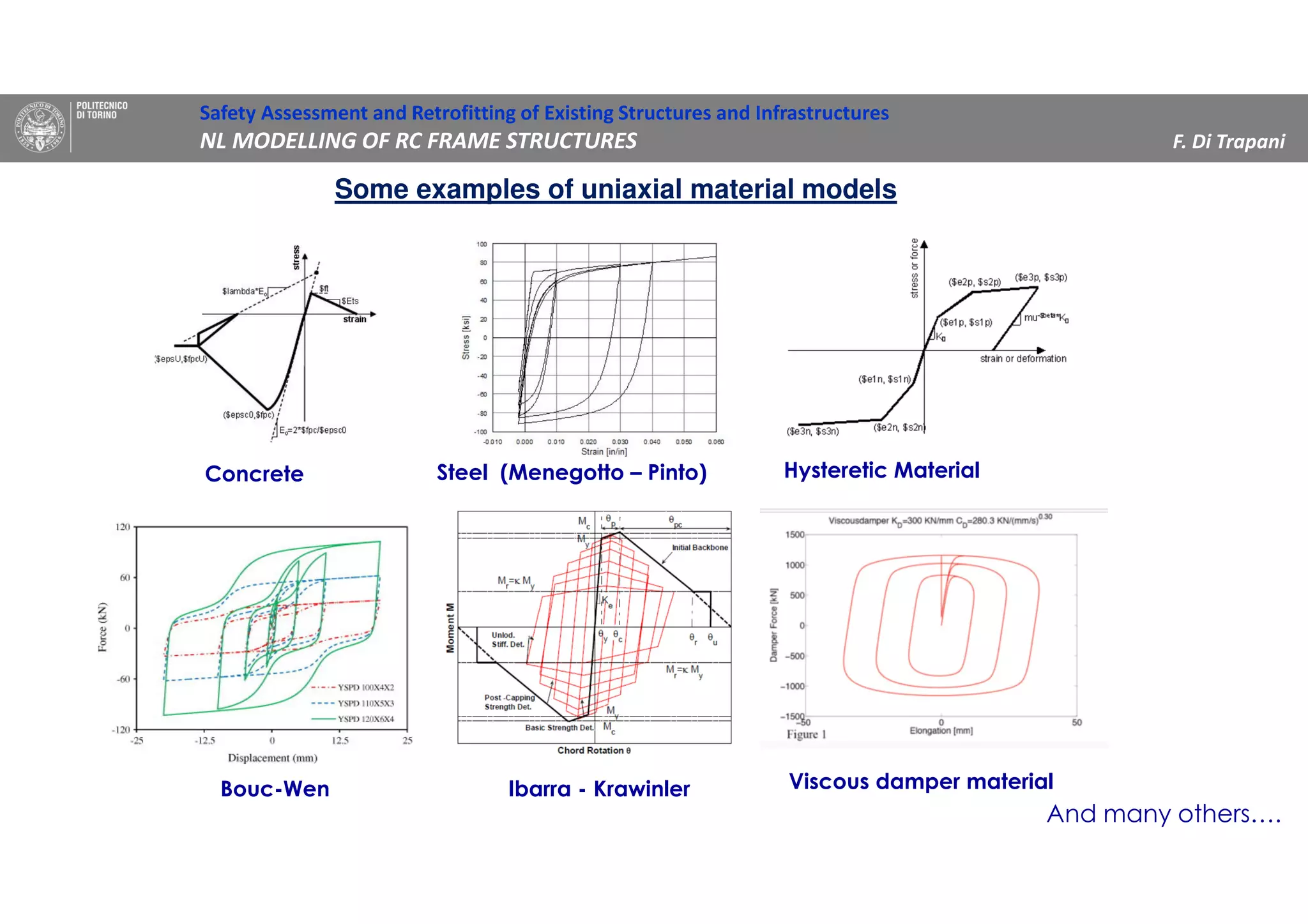
Some examples of uniaxial material models
Safety Assessment and Retrofitting of Existing Structures and Infrastructures
NL MODELLING OF RC FRAME STRUCTURES F. Di Trapani
Concrete Steel (Menegotto – Pinto) Hysteretic Material
Viscous damper materialIbarra - KrawinlerBouc-Wen
And many others….
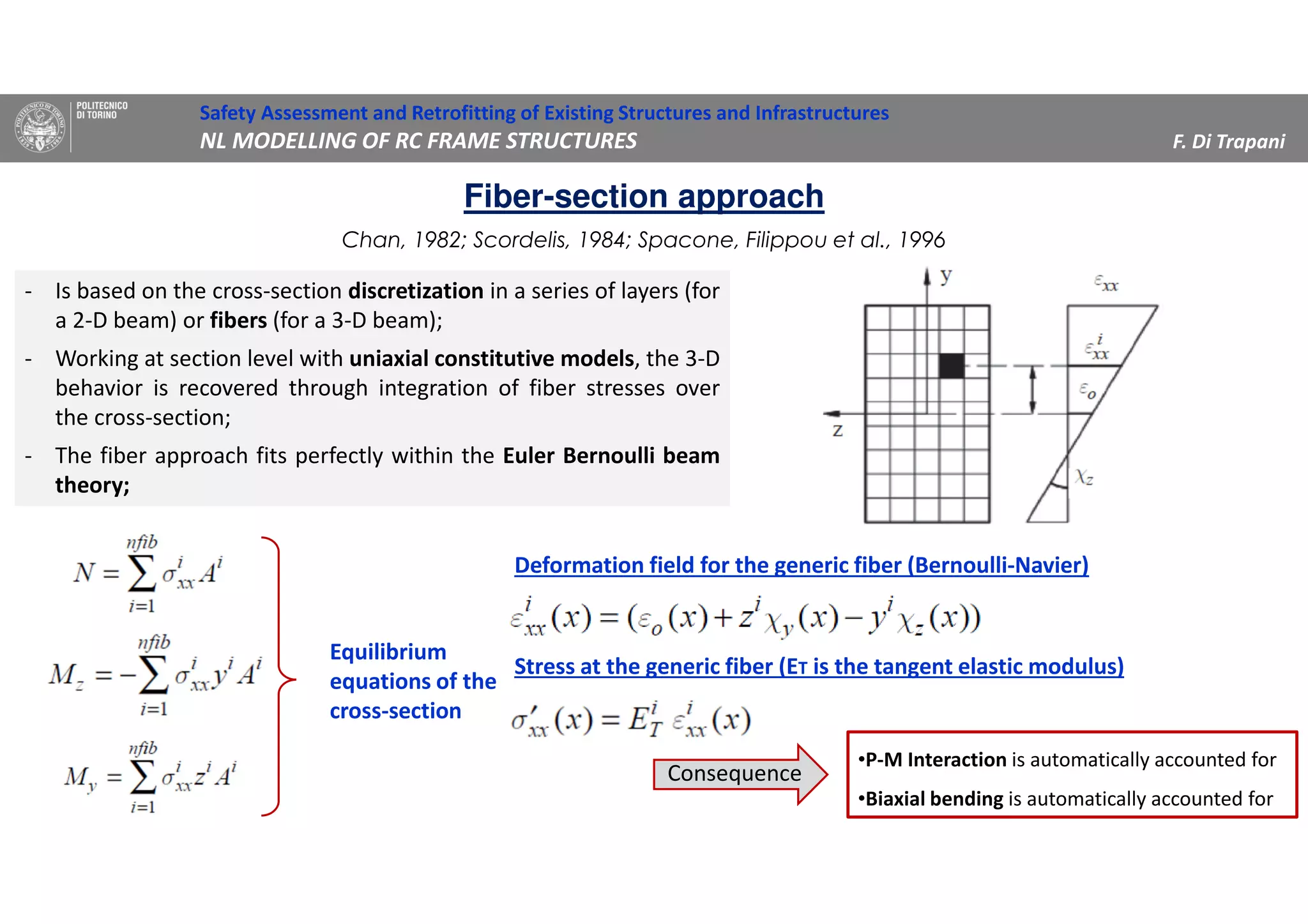
Chan, 1982; Scordelis, 1984; Spacone, Filippou et al., 1996
- Is based on the cross-section discretization in a series of layers (for
a 2-D beam) or fibers (for a 3-D beam);
- Working at section level with uniaxial constitutive models, the 3-D
behavior is recovered through integration of fiber stresses over
the cross-section;
- The fiber approach fits perfectly within the Euler Bernoulli beam
theory;
Safety Assessment and Retrofitting of Existing Structures and Infrastructures
NL MODELLING OF RC FRAME STRUCTURES F. Di Trapani
Fiber-section approach
Equilibrium
equations of the
cross-section
Deformation field for the generic fiber (Bernoulli-Navier)
Stress at the generic fiber (ET is the tangent elastic modulus)
•P-M Interaction is automatically accounted for
•Biaxial bending is automatically accounted for
Consequence
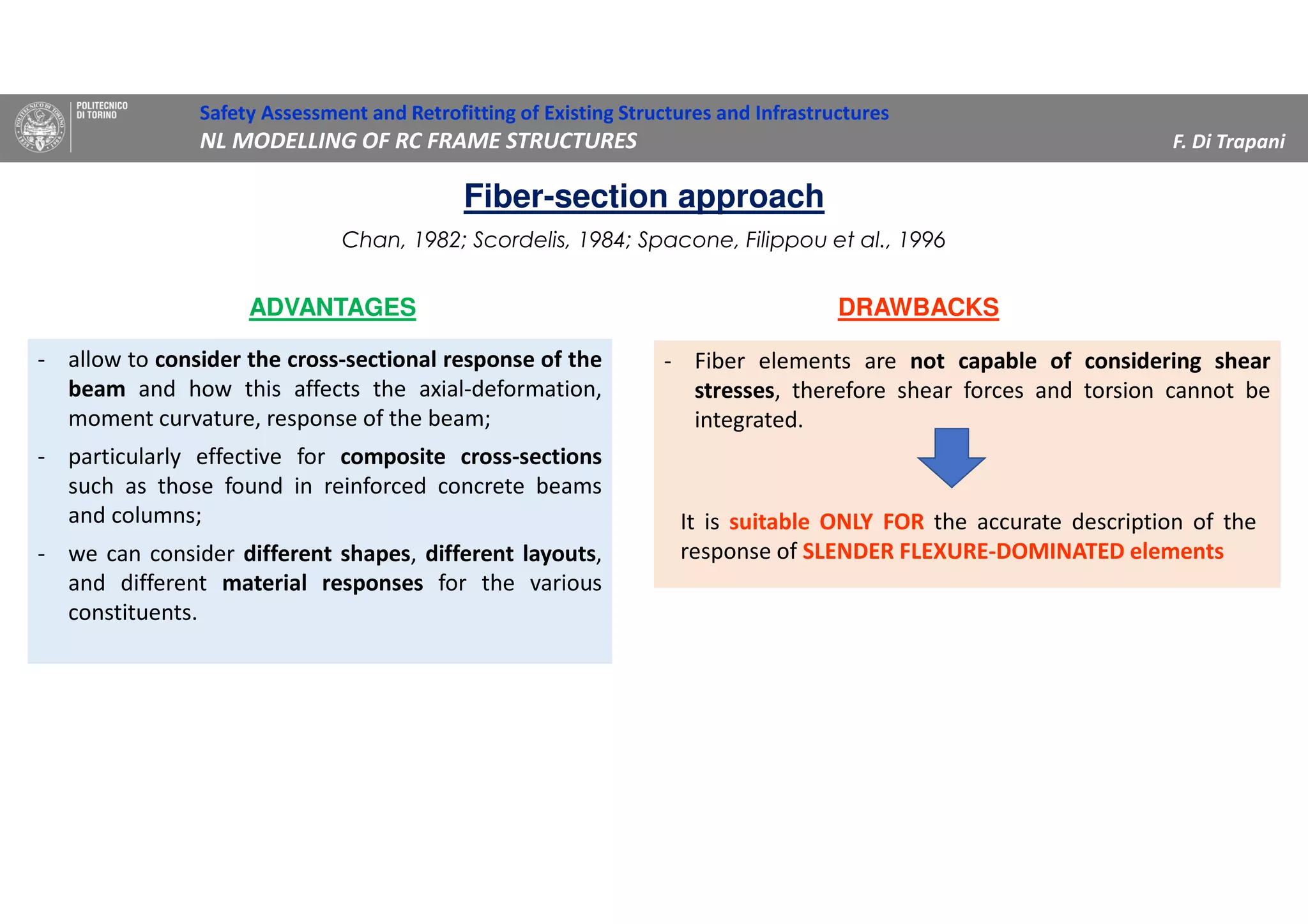
- allow to consider the cross-sectional response of the
beam and how this affects the axial-deformation,
moment curvature, response of the beam;
- particularly effective for composite cross-sections
such as those found in reinforced concrete beams
and columns;
- we can consider different shapes, different layouts,
and different material responses for the various
constituents.
- Fiber elements are not capable of considering shear
stresses, therefore shear forces and torsion cannot be
integrated.
ADVANTAGES DRAWBACKS
It is suitable ONLY FOR the accurate description of the
response of SLENDER FLEXURE-DOMINATED elements
Safety Assessment and Retrofitting of Existing Structures and Infrastructures
NL MODELLING OF RC FRAME STRUCTURES F. Di Trapani
Chan, 1982; Scordelis, 1984; Spacone, Filippou et al., 1996
Fiber-section approach
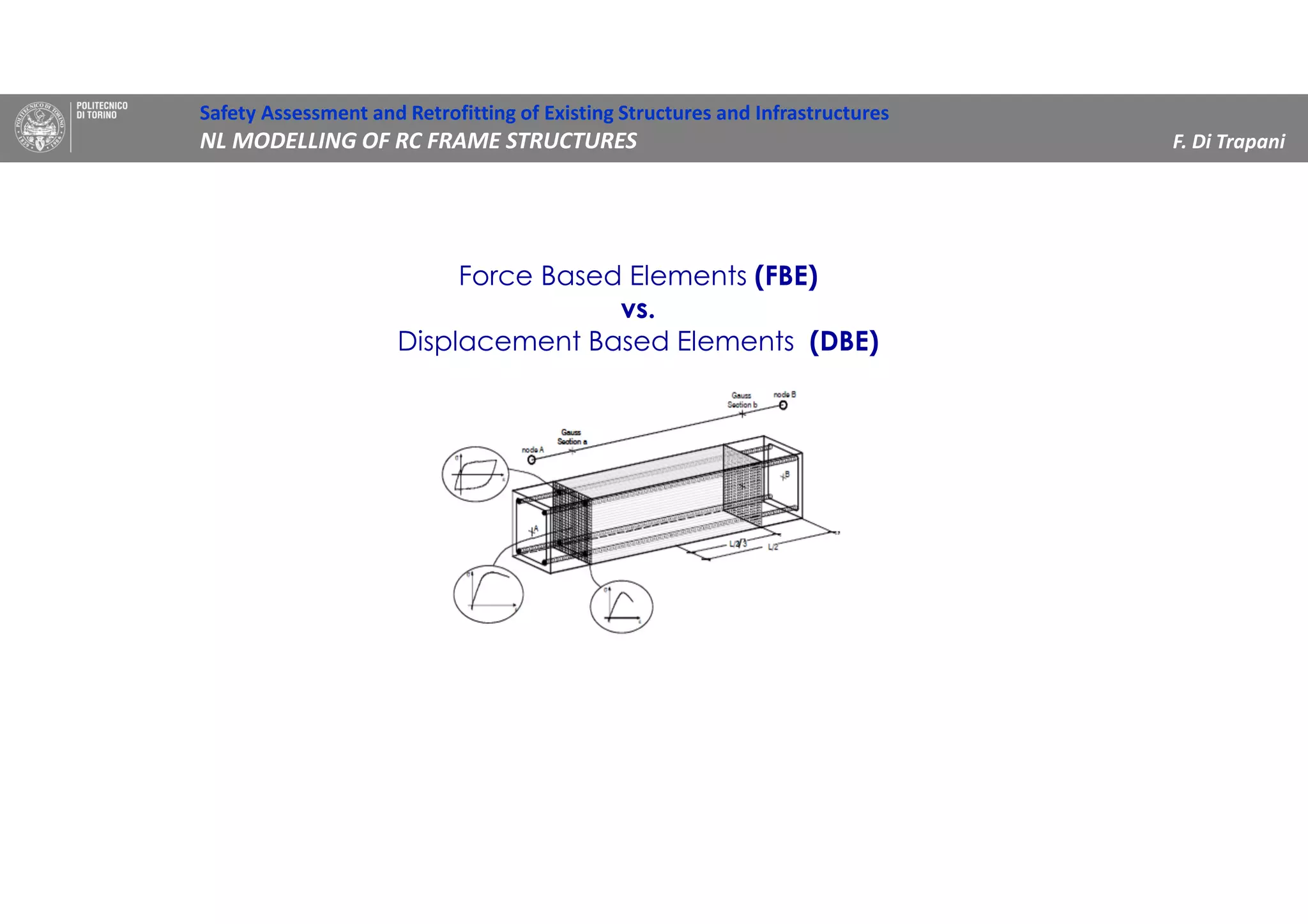
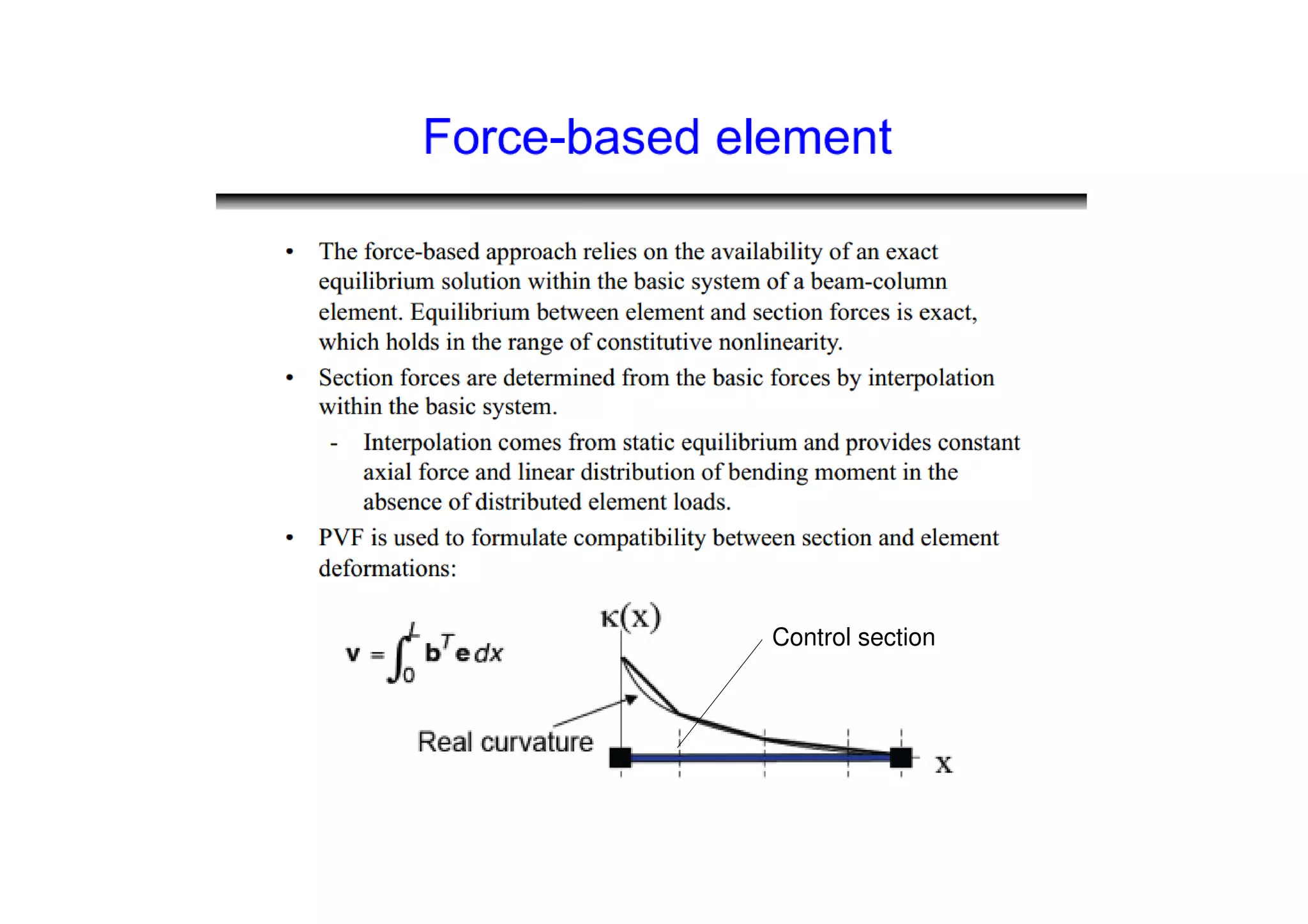
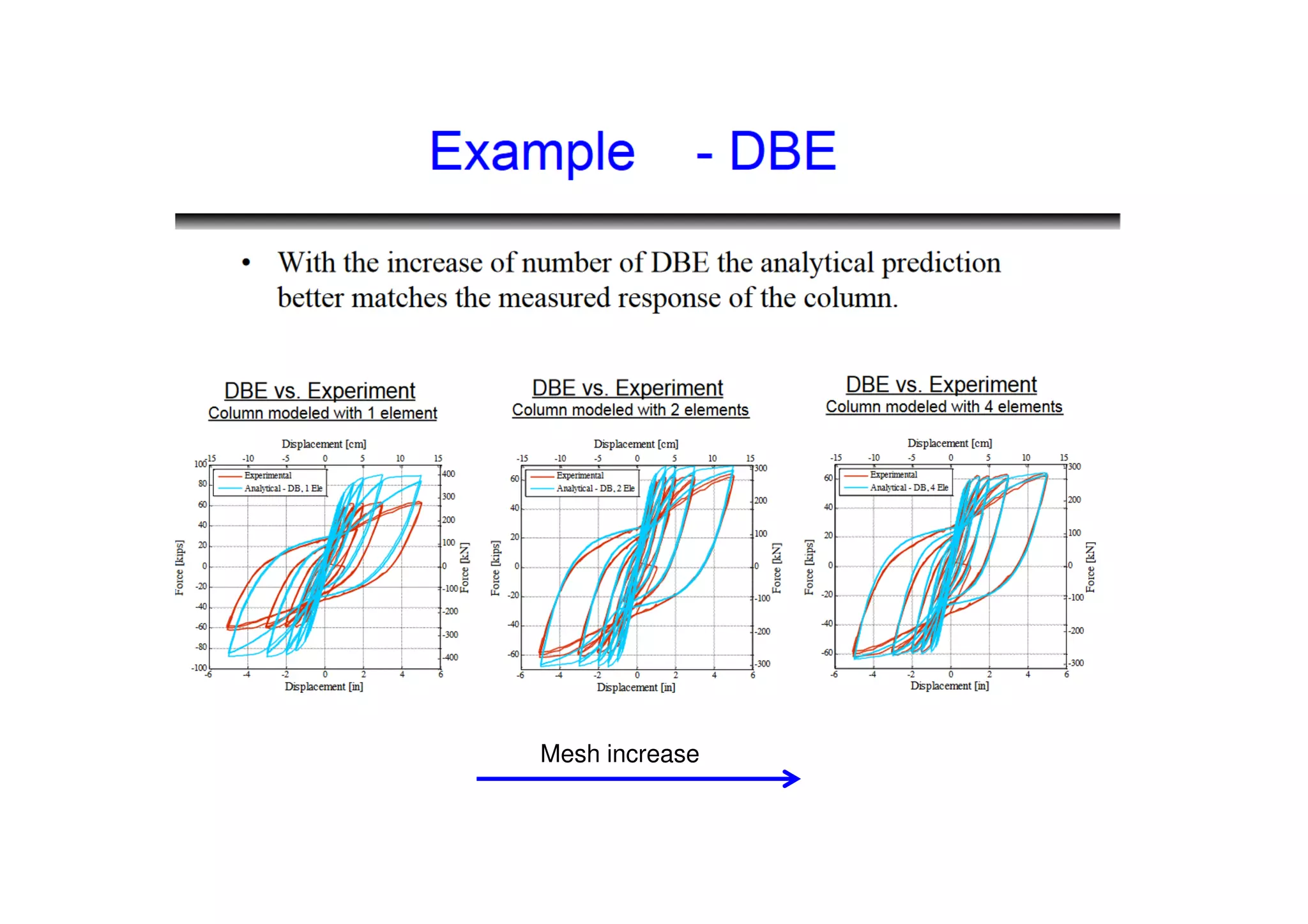
Force Based Elements (FBE)
vs.
Displacement Based Elements (DBE)
Safety Assessment and Retrofitting of Existing Structures and Infrastructures
NL MODELLING OF RC FRAME STRUCTURES F. Di Trapani
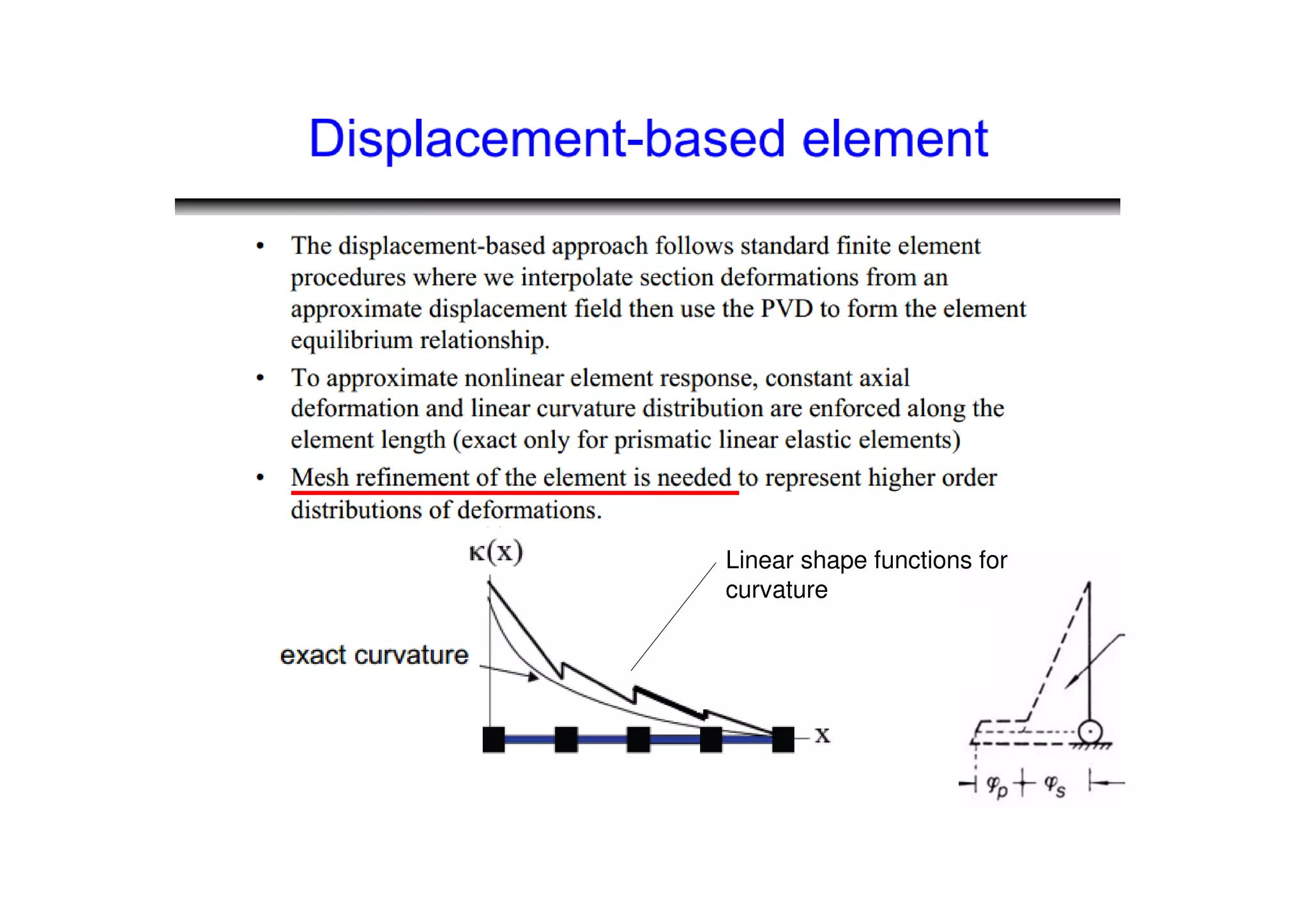
Linear shape functions for
curvature
Control section
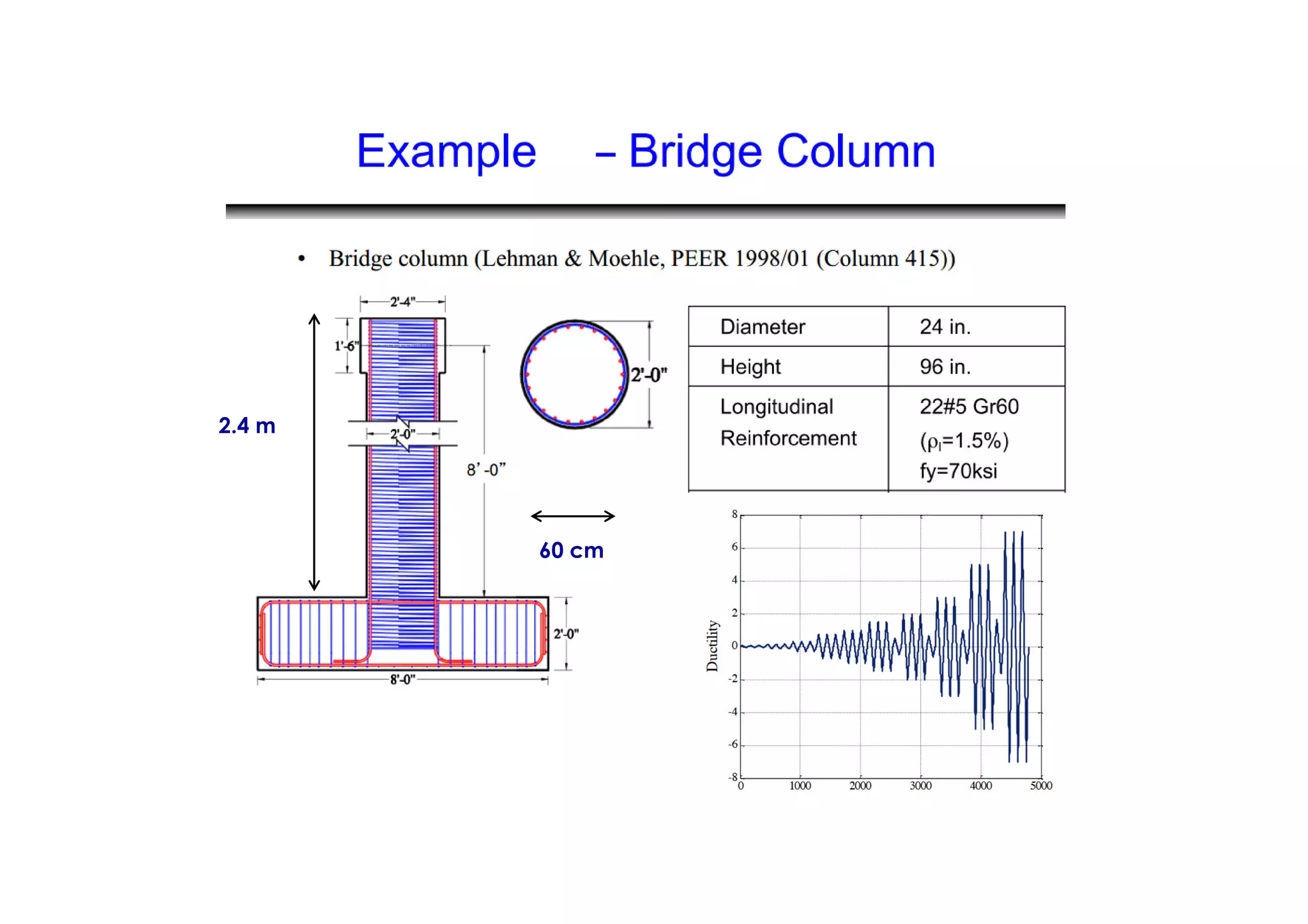
2.4 m
60 cm
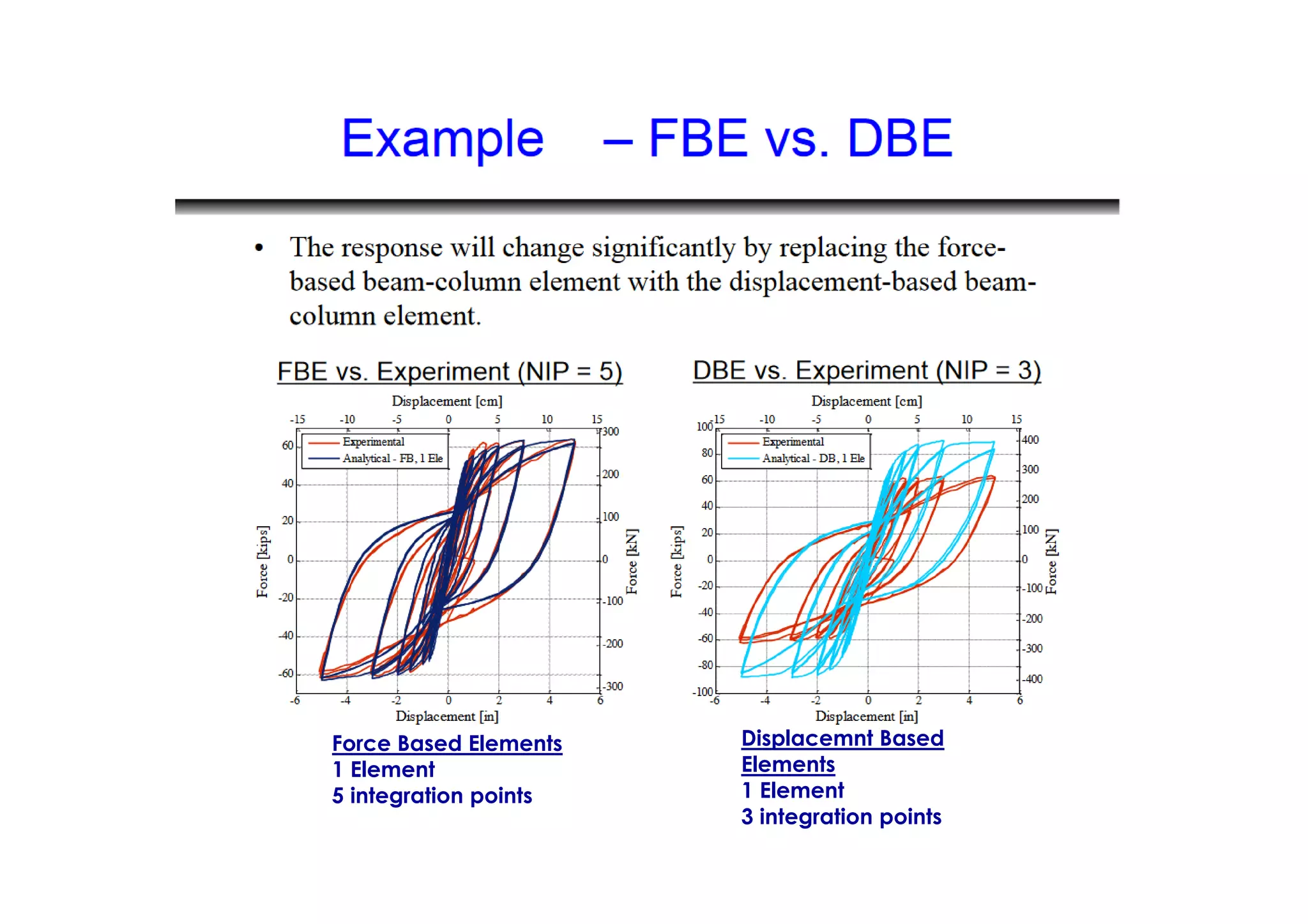
Force Based Elements
1 Element
5 integration points
Displacemnt Based
Elements
1 Element
3 integration points
Mesh increase
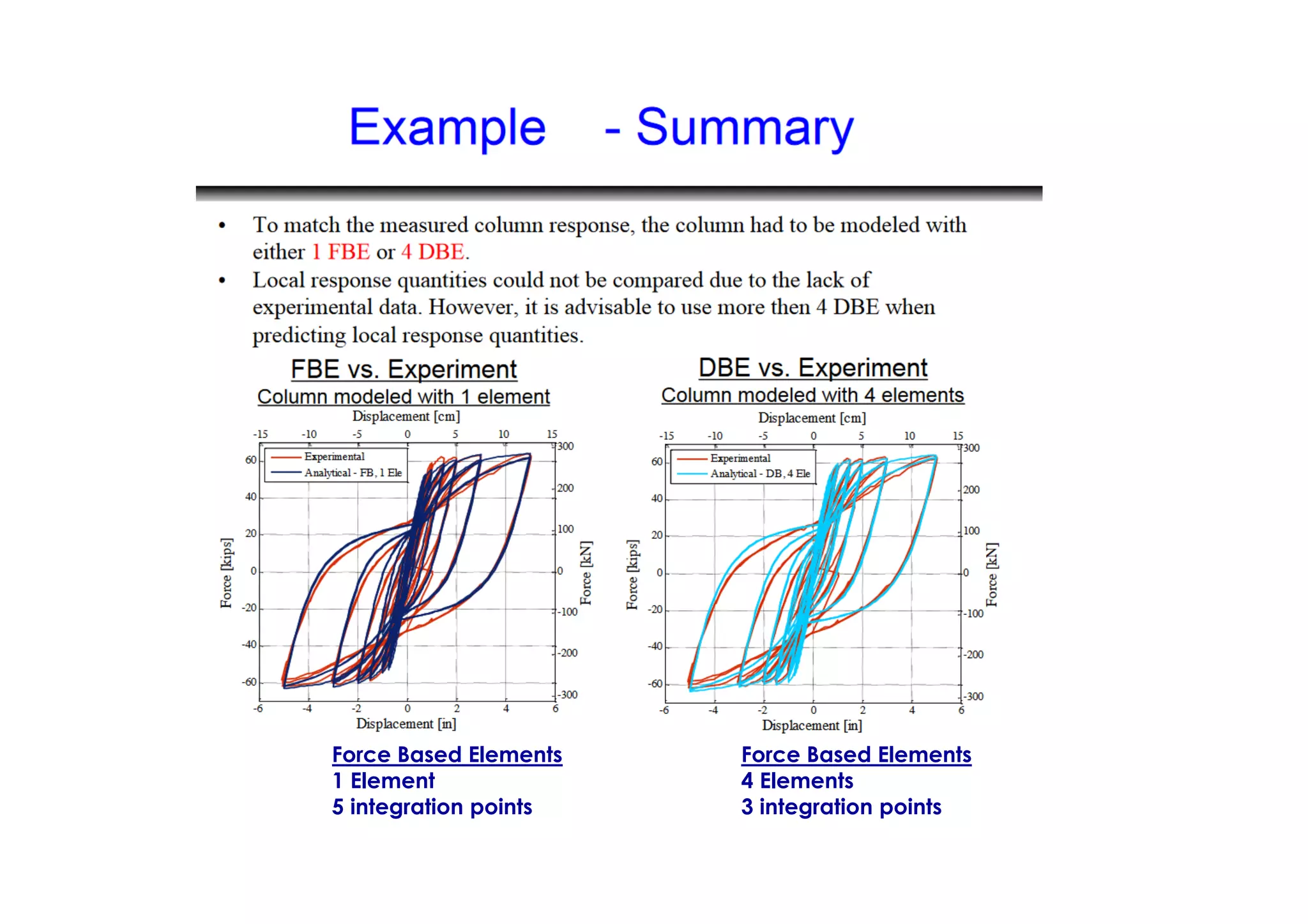
Force Based Elements
1 Element
5 integration points
Force Based Elements
4 Elements
3 integration points
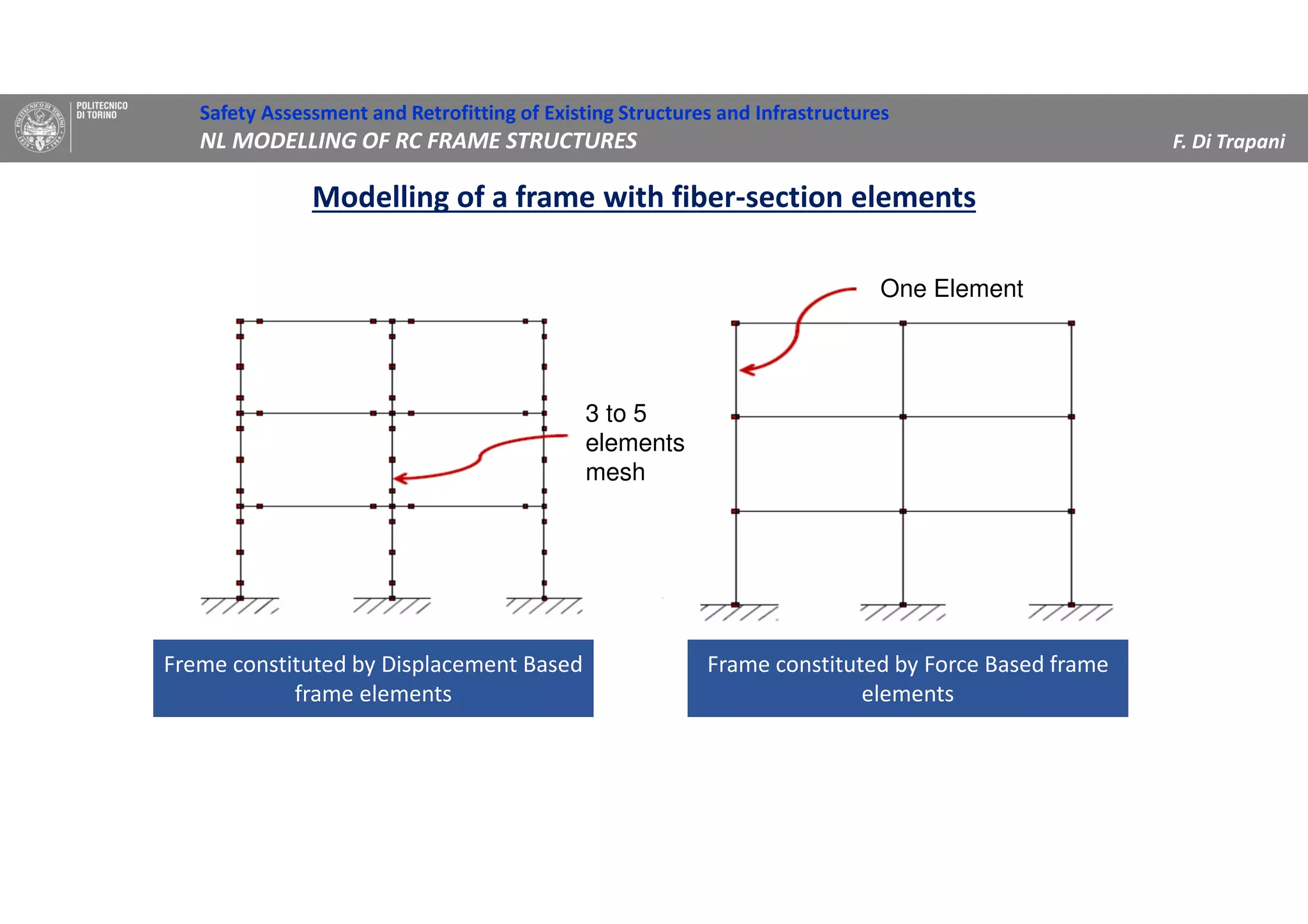
Freme constituted by Displacement Based
frame elements
Frame constituted by Force Based frame
elements
One Element
3 to 5
elements
mesh
Safety Assessment and Retrofitting of Existing Structures and Infrastructures
NL MODELLING OF RC FRAME STRUCTURES F. Di Trapani
Modelling of a frame with fiber-section elements
Safety Assessment and Retrofitting of Existing Structures and Infrastructures
NL MODELLING OF RC FRAME STRUCTURES F. Di Trapani
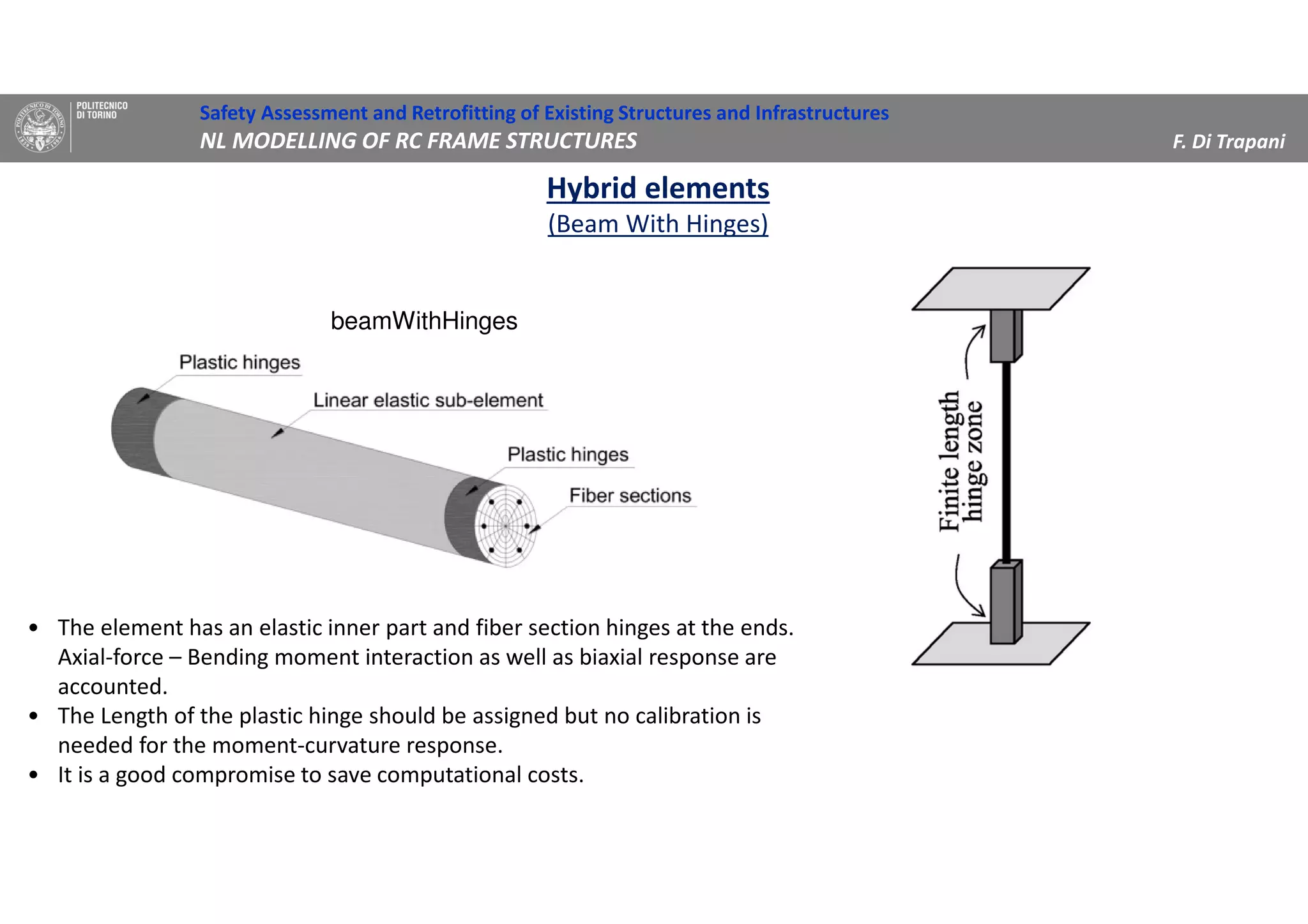
Hybrid elements
(Beam With Hinges)
beamWithHinges
• The element has an elastic inner part and fiber section hinges at the ends.
Axial-force – Bending moment interaction as well as biaxial response are
accounted.
• The Length of the plastic hinge should be assigned but no calibration is
needed for the moment-curvature response.
• It is a good compromise to save computational costs.
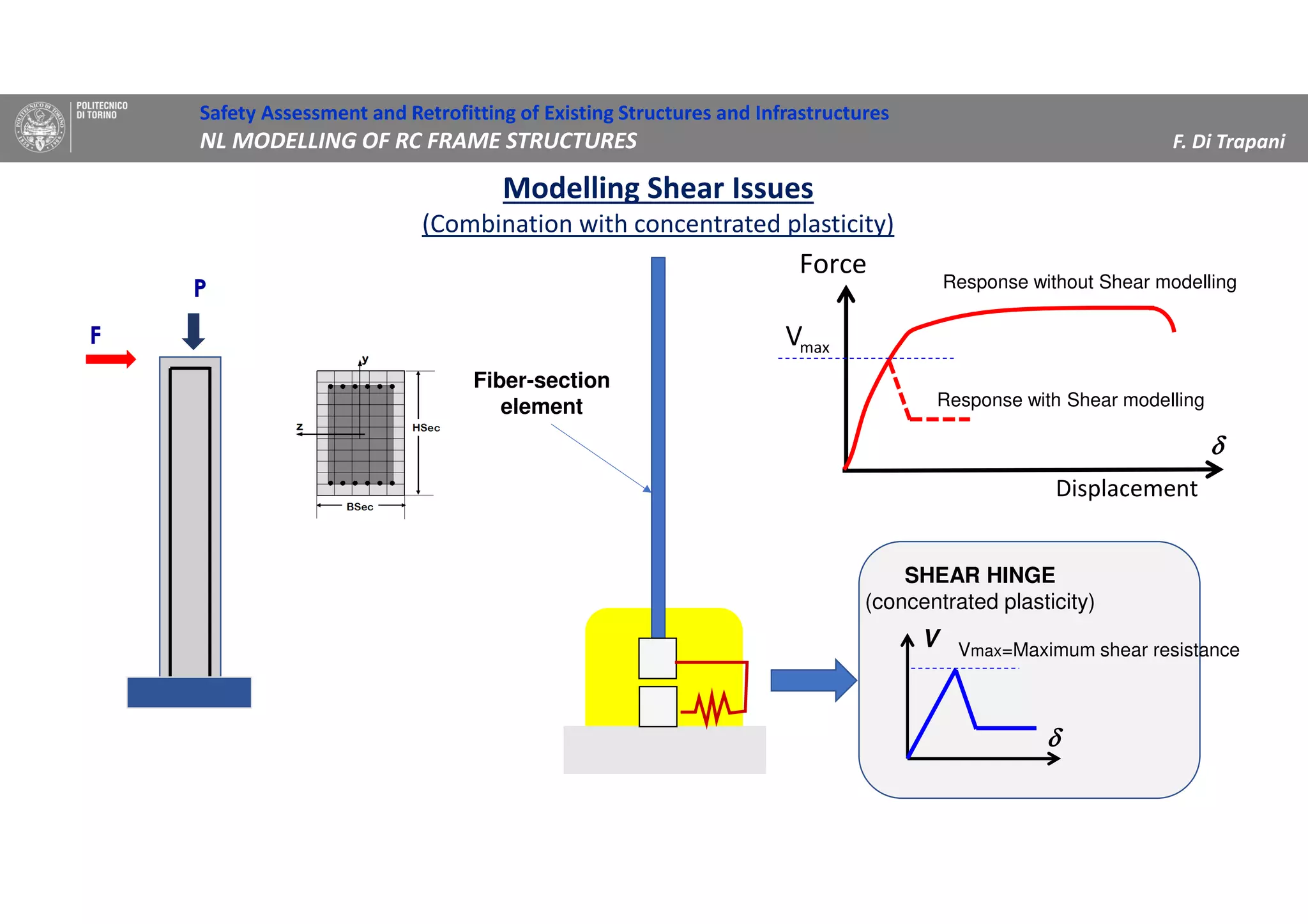
F
P
SHEAR HINGE
(concentrated plasticity)
V
δδδδ
Safety Assessment and Retrofitting of Existing Structures and Infrastructures
NL MODELLING OF RC FRAME STRUCTURES F. Di Trapani
Modelling Shear Issues
(Combination with concentrated plasticity)
ntDisplaceme
Force
δδδδ
Fiber-section
element
Vmax=Maximum shear resistance
maxV
Response with Shear modelling
Response without Shear modelling
Final considerations
Distributed plasticity with fiber section elements
• Plastic hinges can from everywhere and there is no need for calibration
• Axial force – bending moment interaction is directedly accounted be accounted of not
• The cross-section can have any shape and can be constituted by any material
• Biaxial bending issues are automatically solved giving accurate prediction of strength and deformation
• Shear problems cannot be accounted (shear damage can be modelled using concentrated plasticity for
shear hinges)
• Reliability depends on the accuracy and adequacy of stress-stain models used
• The approach requires more computational effort with respect to concentrated plasticity but is it
sufficiently fast to be used in practice.
• Beam with hinge elements represent a good compromise.
Safety Assessment and Retrofitting of Existing Structures and Infrastructures
NL MODELLING OF RC FRAME STRUCTURES F. Di Trapani

Nonlinear modelling of RC frame structures

  • 1.
    Safety Assessment andRetrofitting of Existing Structures and Infrastructures Fabio Di Trapani NONLINEAR MODELLING OF RC FRAME STRUCTURES
  • 2.
    Non-Linear response offrame structures The simulation of nonlinear response of structures is fundamental to estimate their capacity, especially in case of seismic loads both for the cases of static and dynamic analysis. The accuracy of local nonlinear modelling will be reflected to the overall response. Frame structures under seismic loads tend to localize plasticization at the end of beams and columns, where the so-called plastic hinges form. ntDisplaceme Force Regions with high concentration of plasticity. (Need accurate modelling) Safety Assessment and Retrofitting of Existing Structures and Infrastructures NL MODELLING OF RC FRAME STRUCTURES F. Di Trapani
  • 3.
    • Distributed plasticityPlasticity is spread over the length of the element • Lumped (or concentrated) plasticity Plasticity is concentrated at specified points CONCENTRATED AND DISTRIBUTED PLASTICITY IN FRAME ELEMENTS Safety Assessment and Retrofitting of Existing Structures and Infrastructures NL MODELLING OF RC FRAME STRUCTURES F. Di Trapani
  • 4.
    Safety Assessment andRetrofitting of Existing Structures and Infrastructures Fabio Di Trapani CONCENTRATED PLASTICITY APPROACH
  • 5.
    Concentrated plasticity Safety Assessmentand Retrofitting of Existing Structures and Infrastructures NL MODELLING OF RC FRAME STRUCTURES F. Di Trapani • Provides using elastic elements, concentrating in a few points the possibility of activation of plastic hinges • Hinges can only form in those points; hence plastic hinges should be generally placed in regions where it is expected to have maximum flexural demand. • Lumped plasticity approach arises from the physical observation that plastic deformations in frame elements tend to concentrate at the ends of the elements. • This is generally true for columns and in many cases for beams • The inelastic behaviour is defined by assign specific Moment – Rotation relationships to the hinges ΘΘΘΘ Moment-rotation relationships will depend on the arrangement o the cross-sections and axial force level.
  • 6.
    Concentrated plasticity (Typical usein nonlinear static analysis) Safety Assessment and Retrofitting of Existing Structures and Infrastructures NL MODELLING OF RC FRAME STRUCTURES F. Di Trapani (1) (2) Myb Myb V1 V2 (3) Myb V3 Myb Myc Myc F1 F2 F3 (4) V4=V3 Myc Myc F4=F3 F1 δδδδ1 δδδδ2 δδδδ3 δδδδ4 Myb Myb OVERAL RESPONSEOVERAL RESPONSE Base Shear δδδδ 1 2 3 4 V2 V3=V4 V1 δδδδ3 δδδδ4δδδδ2δδδδ1 Top Displacement M Myb (Beams) Myc (Columns) δδδδ ΘΘΘΘ V Sequence of formation of plastic hinges during the analysis and associated deformed shapes. Sequence of formation of plastic hinges during the analysis and associated deformed shapes.
  • 7.
    From moment curvatureto moment chord-rotation diagrams Safety Assessment and Retrofitting of Existing Structures and Infrastructures NL MODELLING OF RC FRAME STRUCTURES F. Di Trapani Chord-rotation Definition of Chord-Rotation: The chord-rotation is a conventional global parameter measuring the angle between the undeformed line of the structural axis line and the line connecting the extremal joints of in the deformed shapes. The chord-rotation can be defined also as the ratio between the relative displacement and the length of the element. Definition of Shear Span Lv: The shear span is the distance between the end of the beam and the null-moment point. For a cantilever beam the shear span coincides with the length of the beam.M vLL δ θ L δ =θ Moment diagram Relative displacement
  • 8.
    From moment curvatureto moment chord-rotation diagrams Safety Assessment and Retrofitting of Existing Structures and Infrastructures NL MODELLING OF RC FRAME STRUCTURES F. Di Trapani θ For a beam-column element with two end fixes the bending moment diagram presents the null-point approximately at the midspan. In this cases it is commonly assumed Lv=L/2 M vL Chord-rotation L θ δ Relative displacement L δ =θ
  • 9.
    MM VV 0VLM2 =− L 2 L V M LV == Lv Shearspan can be also considered as the expected ratio between moment and shear of the element M V VLM = L P VP = L V M LV == LvP Safety Assessment and Retrofitting of Existing Structures and Infrastructures NL MODELLING OF RC FRAME STRUCTURES F. Di Trapani
  • 10.
    From moment curvatureto moment chord-rotation diagrams pθ Yielding chord-rotation yθ uθ Ultimate chord-rotation vL Plastic chord-rotation L The yielding, plastic and ultimate chord rotations are used as reference points to build moment-chord rotation diagrams, which define the non-linear behaviour of the plastic hinges. yM ϕ M yϕ uϕ yM uM ϕ M yθ uθ uM Safety Assessment and Retrofitting of Existing Structures and Infrastructures NL MODELLING OF RC FRAME STRUCTURES F. Di Trapani
  • 11.
    Safety Assessment andRetrofitting of Existing Structures and Infrastructures NL MODELLING OF RC FRAME STRUCTURES F. Di Trapani Expressions of according to NTC 2018 and Eurocode 8uθ yM uM ϕ M yθ uθ Yielding rotation Yielding curvature Ultimate curvature Plastic hinge length Sher spanSafety factor (1.5) §C8.7.2.5 NTC §A.3.2.2 EC8 §C8.7.2.5 NTC §A.3.2.2 EC8 Coefficient reducing plastic curvature as a function of Lv pθ Plastic rotation • The ultimate rotation has dependence with the shear span Lv (is reduced if Lv increases) • This expression has physical meaning but requires a previous evaluation of ϕϕϕϕu and ϕϕϕϕy through a moment-curvature analysis of the cross-section taking into account the effect of axial load an confinement.
  • 12.
    Safety Assessment andRetrofitting of Existing Structures and Infrastructures NL MODELLING OF RC FRAME STRUCTURES F. Di Trapani Expressions of according to NTC 2018 and Eurocode 8uθ yM uM ϕ M yθ uθ Empirical expression by Pangiotakos and Fardis (2001) §C8.7.2.1 NTC §A.3.2.2 EC8 §C8.7.2.1 NTC §A.3.2.2 EC8 • The ultimate rotation has dependence with the shear span Lv • This expression is empirical (no physical meaning) but allows avoiding the evaluation of ϕϕϕϕu and ϕϕϕϕy. Effect of axial load an confinement are also directly accounted spanShearL bhf N bhf f'A '; bhf fA 5.1 v c c ys c ys el = =ν =ω=ω =γ sn d x,st x,st s h,b sb A αα=α = = =ρ ⋅ =ρ base and height of the cross section Stirrups spacing Confinement effectiveness coefficient Eventual geometric ratio of diagonal reinforcement Geometric ratio of transverse reinforcement x 0.85 (in absence of seismic detailing)
  • 13.
    Safety Assessment andRetrofitting of Existing Structures and Infrastructures NL MODELLING OF RC FRAME STRUCTURES F. Di Trapani Variation of ΘΘΘΘu as a function of νννν for different cross-section according to P&F Equation Expressions of according to NTC 2018 and Eurocode 8uθ
  • 14.
    h: Cross-section height db:average diameter of longitudinal rebars Safety Assessment and Retrofitting of Existing Structures and Infrastructures NL MODELLING OF RC FRAME STRUCTURES F. Di Trapani Expressions of according to NTC 2018 and Eurocode 8yθ
  • 15.
    h: Cross-section height db:average diameter of longitudinal rebars Safety Assessment and Retrofitting of Existing Structures and Infrastructures NL MODELLING OF RC FRAME STRUCTURES F. Di Trapani Expression of according to NTC 2018 and Eurocode 8plL Plastic hinge penetration length into the joint
  • 16.
    EXERCISE 1 RC columnwith different axial-force values: Evaluation of moment-rotation diagrams B= 400 mm P H= 400 mm fy= 450 MPa E= 210000 MPa fcc0= 25 MPa fccu= 18.5 MPa εεεεcc0= 0.0035 εεεεccu= 0.02 MPa Materials Steel Rebars CORE Concrete L= 5000 mm F 10 φ20φ20φ20φ20 Case 1: P=400 kN (ν=0.1) Case 2: P=800 kN (ν=0.2) Case 3: P=1200 kN (ν=0.3) Safety Assessment and Retrofitting of Existing Structures and Infrastructures NL MODELLING OF RC FRAME STRUCTURES F. Di Trapani
  • 17.
    EXERCISE 1 Moment –curvature analysis of the cross-section Case 1: P=400 kN (ν=0.1) Case 2: P=800 kN (ν=0.2) Case 3: P=1600 kN(ν=0.4) 0 50 100 150 200 250 300 350 400 0 0,00005 0,0001 0,00015 0,0002 0,00025 M[kNm] φφφφ [1/mm] M-φφφφ diagrams N=400 kN N=800 kN N=1200 kN N=400 kN N=800 kN N=1200 kN φφφφu [1/mm] 0.0002244 0.0001442 0.00011 φφφφy [1/mm] 0.0000099 0.0000111 0.00001237 My (ideal.) [kNm] 276.9 312 340 Ultimate curvature Yielding curvature Idealized yielding moment Evaluate … B= 400 mm H= 400 mm 10 φ20φ20φ20φ20 Safety Assessment and Retrofitting of Existing Structures and Infrastructures NL MODELLING OF RC FRAME STRUCTURES F. Di Trapani
  • 18.
    EXERCISE 1 Evaluation ofMoment – Rotation diagrams Case 1: P=400 kN (ν=0.1) Case 2: P=800 kN (ν=0.2) Case 3: P=1600 kN(ν=0.4) SECTION 400x400 Nu (kN) 4000 N v φφφφ u φφφφ y H B L L v fc dbl fy Lpl ΘΘΘΘ u ΘΘΘΘ y (kN) - 1/mm 1/mm mm mm mm mm MPa mm MPa mm rad rad 400 0.10 0.00022 0.0000099 400 400 5000 5000 28 20 450 976.2 0.2091 0.0201 800 0.20 0.00014 0.00001111 400 400 5000 5000 28 20 450 976.2 0.1397 0.0224 1200 0.30 0.00011 0.00001237 400 400 5000 5000 28 20 450 976.2 0.1108 0.0248 0 50 100 150 200 250 300 350 0 0,05 0,1 0,15 0,2 0,25 M[kNm] ΘΘΘΘ [rad] M-ΘΘΘΘ diagrams N=400 kN N=800 kN N=1200 kN Safety Assessment and Retrofitting of Existing Structures and Infrastructures NL MODELLING OF RC FRAME STRUCTURES F. Di Trapani
  • 19.
    L= 5000 mm F H=500 mm B=250mm B= 300 mm B=400mm 3+3φ14φ14φ14φ148φ16φ16φ16φ16 H= 4000 mm COLUMN 1 BEAM 300kN300kN beam Column1 Column2 H=500mm B= 250 mm 8φ16φ16φ16φ16 COLUMN 2 z y z y z y fy= 450 MPa E= 210000 MPa fcc0= 30 MPa fccu= 22 MPa εεεεcc0= 0.0035 εεεεccu= 0.02 MPa Materials Steel Rebars CORE Concrete Safety Assessment and Retrofitting of Existing Structures and Infrastructures NL MODELLING OF RC FRAME STRUCTURES F. Di Trapani EXERCISE 2 RC frame with different elements: Evaluation of moment-rotation diagrams
  • 20.
    0 50 100 150 200 250 0 0,0001 0,00020,0003 0,0004 0,0005 0,0006 M[kNm] φφφφ [1/mm] M-φφφφ diagrams Column 1 Column 2 Beam Column 1 Column 2 Beam N=400 kN N=800 kN N=1200 kN φφφφu 0.0002059 0.0004 0.000524 φφφφy 0.00000697 0.00001578 0.0000075 My (idealized) 215 97 75 EXERCISE 2 Moment – curvature analysis of the cross-sections Safety Assessment and Retrofitting of Existing Structures and Infrastructures NL MODELLING OF RC FRAME STRUCTURES F. Di Trapani N=300 kN N=300 kN N=0
  • 21.
    0 50 100 150 200 250 0 0,05 0,10,15 0,2 0,25 0,3 0,35 M[kNm] ΘΘΘΘ [rad] M-ΘΘΘΘ diagrams Column 1 Column 2 Beam Nu N v (-) φφφφu φφφφy H B L Lv fc dbl N fi long fy Lpl ΘΘΘΘu ΘΘΘΘy My kN kN (1/mm) (1/mm) (mm) (mm) (mm) (mm) (MPa) (mm) - (MPa) (mm) (mm) (mm) (kNm) Column 1 3125 300 0.10 0.00021 0.00001 500 250 4000 2000 25 16 8 450 630.6 0.1134 0.0077 215 Column 2 3125 300 0.10 0.00040 0.00002 250 500 4000 2000 25 16 8 450 588.1 0.2078 0.015 97 Beam 3000 0 0.00 0.00052 0.00001 400 300 5000 2500 25 14 6 450 620.4 0.2898 0.0091 75 EXERCISE 2 Evaluation of Moment – Rotation diagrams Safety Assessment and Retrofitting of Existing Structures and Infrastructures NL MODELLING OF RC FRAME STRUCTURES F. Di Trapani
  • 22.
    Safety Assessment andRetrofitting of Existing Structures and Infrastructures NL MODELLING OF RC FRAME STRUCTURES F. Di Trapani θ M ELASTIC Plastic Hinge Plastic Hinge θ M The concentrated plasticity model Plasticity is concentrated at the ends, where the M-Θ diagram is assigned Plasticity is concentrated at the ends, where the M-Θ diagram is assigned 1 11 22 2 3 33 4 1 3 2 F 333 444 44 Sample of modelling for a frame (Plastic hinges are located where it is expected the maximum flexural demand) Sample of modelling for a frame (Plastic hinges are located where it is expected the maximum flexural demand)
  • 23.
    Safety Assessment andRetrofitting of Existing Structures and Infrastructures NL MODELLING OF RC FRAME STRUCTURES F. Di Trapani The concentrated plasticity model Plastic hinges are of two types: - M-Hinges: Only flexural response is controlled. Resisting moment is calibrated based on a reference N value. Variation of N will not influence the response of the hinge. - Interacting P-M hinges: The hinge can change its flexural resistance by interpolating the M-Q responses at different N levels. Plastic hinges are of two types: - M-Hinges: Only flexural response is controlled. Resisting moment is calibrated based on a reference N value. Variation of N will not influence the response of the hinge. - Interacting P-M hinges: The hinge can change its flexural resistance by interpolating the M-Q responses at different N levels. θ M θ M N
  • 24.
    Final considerations Concentrated plasticity •The approach is generally convenient from the computational cost point of view • Plastic hinges have to be calibrated for each element in any section where is expected plastic deformation. • Axial force – bending moment interaction can be accounted of not • If axial force is accounted, M-Θ diagram should be evaluated for different axial force levels. • The position of hinges is pre-assigned by the user • Reliability depends on the calibration models used Safety Assessment and Retrofitting of Existing Structures and Infrastructures NL MODELLING OF RC FRAME STRUCTURES F. Di Trapani
  • 25.
    DISTRIBUTED PLASTICITY APPROACH SafetyAssessment and Retrofitting of Existing Structures and Infrastructures NL MODELLING OF RC FRAME STRUCTURES F. Di Trapani
  • 26.
    •The cross-section isdivided into fibers •Uniaxial Stress-strain material models are directly assigned to fibers •The element is divided into a number of control sections •NO-Need to predetermine hinge position •Cross-section can have any shape and any material can be assigned to the fibers Distributed plasticity Safety Assessment and Retrofitting of Existing Structures and Infrastructures NL MODELLING OF RC FRAME STRUCTURES F. Di Trapani
  • 27.
    The cross-section responsedepends on the stress- state and material response of each fiber at any section, therefore: •There is NO-Need to pre-calibrate hinges •Plastic hinges can form everywhere Distributed plasticity and Fiber-Section elements Safety Assessment and Retrofitting of Existing Structures and Infrastructures NL MODELLING OF RC FRAME STRUCTURES F. Di Trapani OpenSees (Berkely, USA) Seismostruct (Pavia, Italy) Major software supporting Fiber-section elements
  • 28.
    ε σ ε σ Cover Core Rebars ε σ UNCONFINED CONCRETE CONFINED CONCRETE STEEL REBARS IdealSubdivision for a rectangular RC fiber cross-section Safety Assessment and Retrofitting of Existing Structures and Infrastructures NL MODELLING OF RC FRAME STRUCTURES F. Di Trapani
  • 29.
    Some examples ofuniaxial material models Safety Assessment and Retrofitting of Existing Structures and Infrastructures NL MODELLING OF RC FRAME STRUCTURES F. Di Trapani Concrete Steel (Menegotto – Pinto) Hysteretic Material Viscous damper materialIbarra - KrawinlerBouc-Wen And many others….
  • 30.
    Chan, 1982; Scordelis,1984; Spacone, Filippou et al., 1996 - Is based on the cross-section discretization in a series of layers (for a 2-D beam) or fibers (for a 3-D beam); - Working at section level with uniaxial constitutive models, the 3-D behavior is recovered through integration of fiber stresses over the cross-section; - The fiber approach fits perfectly within the Euler Bernoulli beam theory; Safety Assessment and Retrofitting of Existing Structures and Infrastructures NL MODELLING OF RC FRAME STRUCTURES F. Di Trapani Fiber-section approach Equilibrium equations of the cross-section Deformation field for the generic fiber (Bernoulli-Navier) Stress at the generic fiber (ET is the tangent elastic modulus) •P-M Interaction is automatically accounted for •Biaxial bending is automatically accounted for Consequence
  • 31.
    - allow toconsider the cross-sectional response of the beam and how this affects the axial-deformation, moment curvature, response of the beam; - particularly effective for composite cross-sections such as those found in reinforced concrete beams and columns; - we can consider different shapes, different layouts, and different material responses for the various constituents. - Fiber elements are not capable of considering shear stresses, therefore shear forces and torsion cannot be integrated. ADVANTAGES DRAWBACKS It is suitable ONLY FOR the accurate description of the response of SLENDER FLEXURE-DOMINATED elements Safety Assessment and Retrofitting of Existing Structures and Infrastructures NL MODELLING OF RC FRAME STRUCTURES F. Di Trapani Chan, 1982; Scordelis, 1984; Spacone, Filippou et al., 1996 Fiber-section approach
  • 32.
    Force Based Elements(FBE) vs. Displacement Based Elements (DBE) Safety Assessment and Retrofitting of Existing Structures and Infrastructures NL MODELLING OF RC FRAME STRUCTURES F. Di Trapani
  • 33.
  • 34.
  • 35.
  • 36.
    Force Based Elements 1Element 5 integration points Displacemnt Based Elements 1 Element 3 integration points
  • 37.
  • 38.
    Force Based Elements 1Element 5 integration points Force Based Elements 4 Elements 3 integration points
  • 39.
    Freme constituted byDisplacement Based frame elements Frame constituted by Force Based frame elements One Element 3 to 5 elements mesh Safety Assessment and Retrofitting of Existing Structures and Infrastructures NL MODELLING OF RC FRAME STRUCTURES F. Di Trapani Modelling of a frame with fiber-section elements
  • 40.
    Safety Assessment andRetrofitting of Existing Structures and Infrastructures NL MODELLING OF RC FRAME STRUCTURES F. Di Trapani Hybrid elements (Beam With Hinges) beamWithHinges • The element has an elastic inner part and fiber section hinges at the ends. Axial-force – Bending moment interaction as well as biaxial response are accounted. • The Length of the plastic hinge should be assigned but no calibration is needed for the moment-curvature response. • It is a good compromise to save computational costs.
  • 41.
    F P SHEAR HINGE (concentrated plasticity) V δδδδ SafetyAssessment and Retrofitting of Existing Structures and Infrastructures NL MODELLING OF RC FRAME STRUCTURES F. Di Trapani Modelling Shear Issues (Combination with concentrated plasticity) ntDisplaceme Force δδδδ Fiber-section element Vmax=Maximum shear resistance maxV Response with Shear modelling Response without Shear modelling
  • 42.
    Final considerations Distributed plasticitywith fiber section elements • Plastic hinges can from everywhere and there is no need for calibration • Axial force – bending moment interaction is directedly accounted be accounted of not • The cross-section can have any shape and can be constituted by any material • Biaxial bending issues are automatically solved giving accurate prediction of strength and deformation • Shear problems cannot be accounted (shear damage can be modelled using concentrated plasticity for shear hinges) • Reliability depends on the accuracy and adequacy of stress-stain models used • The approach requires more computational effort with respect to concentrated plasticity but is it sufficiently fast to be used in practice. • Beam with hinge elements represent a good compromise. Safety Assessment and Retrofitting of Existing Structures and Infrastructures NL MODELLING OF RC FRAME STRUCTURES F. Di Trapani