NORTHERN IRELAND
THE TROUBLES
The Troubles:
• 30 years of repeated acts of intense
violence between :
Northern Ireland's Nationalist community
(principally Roman Catholic)
Unionist community (principally Protestant)
• 1968-1998
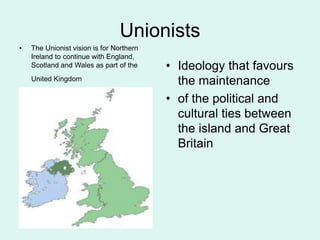
Unionists
• The Unionist vision is for Northern
Ireland to continue with England,
Scotland and Wales as part of the
United Kingdom
• Ideology that favours
the maintenance
• of the political and
cultural ties between
the island and Great
Britain
Nationalists
• political and social
movements inspired
by a love for Irish
culture, language and
history
• Today: United Ireland
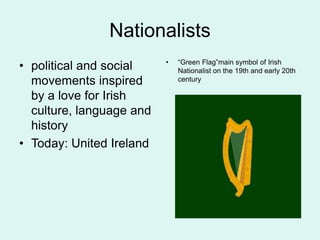
• “Green Flag”main symbol of Irish
Nationalist on the 19th and early 20th
century
Conflict
• Status of Northern Ireland within the
United Kingdom
• Domination and discrimination of
Nationalist by Unionist
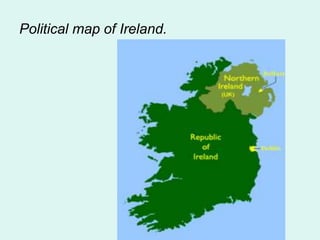
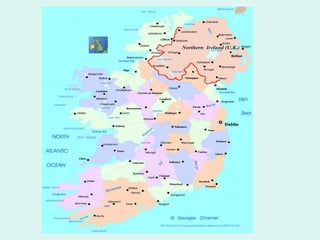
Political map of Ireland.
• Republic of Ireland gained sovereignty in
1922, relations between North and South
improved.
• Irish Republican Army (IRA) continued the
struggle to end partition of Ireland.
• 1966-1969 rioting and street fighting
Protestants and Catholics occurred in
Londonderry.
• Religious communities became hostile
armed camps.
• British troops were brought in to separate
them.
• They became target to the Catholics and
IRA.
• IRA´s goal: to eject the British and unify
Northern Ireland with the Irish Republic to
the South.
• Protestants remained loyal to the UK.
• Direct rule from London and the presence
of British troops failed to stop the violence.
1968, 5 October
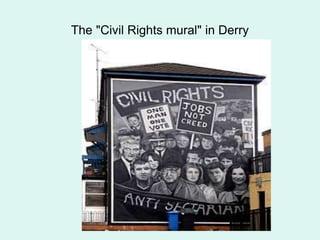
• A civil rights march in Derry was banned by
the Northern Ireland government, who let an
Apprentice Boys* march take place instead.
When civil rights activists defied the ban,
they were attacked by the RUC (Royal Ulster
Constabulary -was the name of the police
force in Northern Ireland from 1922 to 2001) ,
leading to three days of rioting.
*Protestant fraternal society with a worldwide
membership, founded in 1814. They are based
in the city of Derry, Northern Ireland
The "Civil Rights mural" in Derry
1970–1979
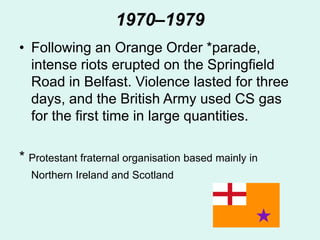
• Following an Orange Order *parade,
intense riots erupted on the Springfield
Road in Belfast. Violence lasted for three
days, and the British Army used CS gas
for the first time in large quantities.
* Protestant fraternal organisation based mainly in
Northern Ireland and Scotland
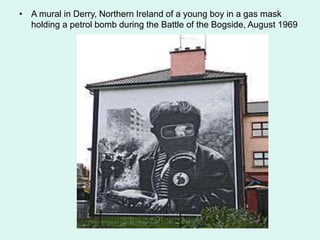
• A mural in Derry, Northern Ireland of a young boy in a gas mask
holding a petrol bomb during the Battle of the Bogside, August 1969
1970
• the Social Democratic and Labour Party
(SDLP) was formed.
1971
• Gunner Robert Curtis became the first
British Soldier to die in the Troubles when
he was shot by the IRA
• During street disturbances, British soldiers
shot dead two Catholic civilians in Free
Derry. As a result, riots erupted in the city
• 1972
• Bloody Sunday - 27 civilians were shot, of
whom 14 were killed by the British Army
during a civil rights march in Derry.
• "Give Ireland Back to the Irish" is a Paul and Linda
McCartney song written in response to the events of
Bloody Sunday in Northern Ireland on 30 January 1972.
The song was released on 25 February 1972
• banned by the BBC, Radio Luxembourg and the
Independent Television Authority
• A bomb explodes without warning in the Abercorn
Restaurant on Castle Lane in Belfast. Two are killed
and 130 injured.
• The IRA explode twenty-four bombs in towns and
cities across Northern Ireland. There was also
fourteen shootouts between the IRA and security
forces
• Bloody Friday - within the space of seventy-five
minutes, the PIRA exploded twenty-two bombs in
Belfast. Six civilians, two British Army soldiers and
one UDA member were killed, while 130 were
injured.
1973
• 28 june-Northern Ireland Assembly elections
took place.
1974
• 4 February M62 coach bombing - twelve people
were killed when a PIRA bomb exploded on a
bus as it was travelling along the M62
motorway in West Yorkshire, England. It was
carrying British Army soldiers and some of their
family members. Nine soldiers and three
civilians were killed.
• The Troubles claimed its 1000th victim
1975
• The PIRA agreed on a ceasefire with the British
government and the Northern Ireland Office.
1976
• Christopher Ewart Biggs, the British Ambassador
to Ireland, and his secretary Judith Cook, were
assassinated by a bomb planted in Mr. Biggs’
car in Dublin.
• 1977
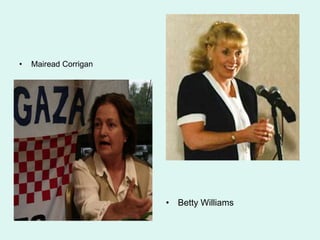
11 December Mairead Corrigan and Betty Williams
received the Nobel Peace Prize.
• Mairead Corrigan
• Betty Williams
1978
• La Mon restaurant bombing - eleven civilians
and an RUC officer were killed and thirty
wounded by a PIRA (Provisional Irish
Republican Army ) incendiary bomb at the La
Mon Restaurant near Belfast
1979
• The PIRA assassinated Richard Sykes, the
British ambassador to the Netherlands, in Den
Haag. The group also exploded twenty-four
bombs in various locations across Northern
Ireland
• During a visit, Pope John Paul II appealed for an
end to the violence in Northern Ireland
1980-1989
• 1980: Dunmurry train explosion
1981: Norman and his son's assassination
1982: The PIRA explodes bombs in Belfast
1983: New Ireland Forum
1984: Brighton Hotel bombing
1985: Anglo- Irish Agreement
1986: Northern Ireland Assembly dissolved.
1987: Remembrance Day bombing.
1988: SLDP John Hume and Gery Adams'
meeting: beginning of Peace Process.
1989: Republican solicitor Pat Tinucane's
assassination
1990-1999
• Irish National Liberation Army declare a
ceasefire. End of trouble.
2000 Present: The Bloody Sunday Inquiry.
2001: BBC bombing
2007: Northern Ireland Assembly elections
2008: IRA continues bombing
2009: INLA formally adopts peaceful
political means to its aims.
2010: UDA and INLA announced
dicommisation of weapons.

Northern ireland

  • 1.
  • 2.
    The Troubles: • 30years of repeated acts of intense violence between : Northern Ireland's Nationalist community (principally Roman Catholic) Unionist community (principally Protestant) • 1968-1998
  • 3.
    Unionists • The Unionistvision is for Northern Ireland to continue with England, Scotland and Wales as part of the United Kingdom • Ideology that favours the maintenance • of the political and cultural ties between the island and Great Britain
  • 4.
    Nationalists • political andsocial movements inspired by a love for Irish culture, language and history • Today: United Ireland • “Green Flag”main symbol of Irish Nationalist on the 19th and early 20th century
  • 5.
    Conflict • Status ofNorthern Ireland within the United Kingdom • Domination and discrimination of Nationalist by Unionist
  • 6.
  • 8.
    • Republic ofIreland gained sovereignty in 1922, relations between North and South improved. • Irish Republican Army (IRA) continued the struggle to end partition of Ireland. • 1966-1969 rioting and street fighting Protestants and Catholics occurred in Londonderry. • Religious communities became hostile armed camps. • British troops were brought in to separate them.
  • 9.
    • They becametarget to the Catholics and IRA. • IRA´s goal: to eject the British and unify Northern Ireland with the Irish Republic to the South. • Protestants remained loyal to the UK. • Direct rule from London and the presence of British troops failed to stop the violence.
  • 10.
    1968, 5 October •A civil rights march in Derry was banned by the Northern Ireland government, who let an Apprentice Boys* march take place instead. When civil rights activists defied the ban, they were attacked by the RUC (Royal Ulster Constabulary -was the name of the police force in Northern Ireland from 1922 to 2001) , leading to three days of rioting. *Protestant fraternal society with a worldwide membership, founded in 1814. They are based in the city of Derry, Northern Ireland
  • 11.
    The "Civil Rightsmural" in Derry
  • 12.
    1970–1979 • Following anOrange Order *parade, intense riots erupted on the Springfield Road in Belfast. Violence lasted for three days, and the British Army used CS gas for the first time in large quantities. * Protestant fraternal organisation based mainly in Northern Ireland and Scotland
  • 13.
    • A muralin Derry, Northern Ireland of a young boy in a gas mask holding a petrol bomb during the Battle of the Bogside, August 1969
  • 14.
    1970 • the SocialDemocratic and Labour Party (SDLP) was formed. 1971 • Gunner Robert Curtis became the first British Soldier to die in the Troubles when he was shot by the IRA • During street disturbances, British soldiers shot dead two Catholic civilians in Free Derry. As a result, riots erupted in the city
  • 15.
    • 1972 • BloodySunday - 27 civilians were shot, of whom 14 were killed by the British Army during a civil rights march in Derry. • "Give Ireland Back to the Irish" is a Paul and Linda McCartney song written in response to the events of Bloody Sunday in Northern Ireland on 30 January 1972. The song was released on 25 February 1972 • banned by the BBC, Radio Luxembourg and the Independent Television Authority
  • 16.
    • A bombexplodes without warning in the Abercorn Restaurant on Castle Lane in Belfast. Two are killed and 130 injured. • The IRA explode twenty-four bombs in towns and cities across Northern Ireland. There was also fourteen shootouts between the IRA and security forces • Bloody Friday - within the space of seventy-five minutes, the PIRA exploded twenty-two bombs in Belfast. Six civilians, two British Army soldiers and one UDA member were killed, while 130 were injured.
  • 17.
    1973 • 28 june-NorthernIreland Assembly elections took place. 1974 • 4 February M62 coach bombing - twelve people were killed when a PIRA bomb exploded on a bus as it was travelling along the M62 motorway in West Yorkshire, England. It was carrying British Army soldiers and some of their family members. Nine soldiers and three civilians were killed. • The Troubles claimed its 1000th victim
  • 18.
    1975 • The PIRAagreed on a ceasefire with the British government and the Northern Ireland Office. 1976 • Christopher Ewart Biggs, the British Ambassador to Ireland, and his secretary Judith Cook, were assassinated by a bomb planted in Mr. Biggs’ car in Dublin. • 1977 11 December Mairead Corrigan and Betty Williams received the Nobel Peace Prize.
  • 19.
  • 20.
    1978 • La Monrestaurant bombing - eleven civilians and an RUC officer were killed and thirty wounded by a PIRA (Provisional Irish Republican Army ) incendiary bomb at the La Mon Restaurant near Belfast 1979 • The PIRA assassinated Richard Sykes, the British ambassador to the Netherlands, in Den Haag. The group also exploded twenty-four bombs in various locations across Northern Ireland • During a visit, Pope John Paul II appealed for an end to the violence in Northern Ireland
  • 21.
    1980-1989 • 1980: Dunmurrytrain explosion 1981: Norman and his son's assassination 1982: The PIRA explodes bombs in Belfast 1983: New Ireland Forum 1984: Brighton Hotel bombing 1985: Anglo- Irish Agreement 1986: Northern Ireland Assembly dissolved. 1987: Remembrance Day bombing. 1988: SLDP John Hume and Gery Adams' meeting: beginning of Peace Process. 1989: Republican solicitor Pat Tinucane's assassination
  • 22.
    1990-1999 • Irish NationalLiberation Army declare a ceasefire. End of trouble. 2000 Present: The Bloody Sunday Inquiry. 2001: BBC bombing 2007: Northern Ireland Assembly elections 2008: IRA continues bombing 2009: INLA formally adopts peaceful political means to its aims. 2010: UDA and INLA announced dicommisation of weapons.