Unicast RoUting PRotocols
Routing protocol have been created in response to the
demand for dynamic routing tables . A routing protocol is a
combination of rules and procedures that lets that lets routers
in the internet information each other of changes .It allows
routers to share whatever they know about the internet or
their neighborhood.
intRa –inteRdomain RoUting
An internet can be so large that one routing protocol cannot handle the task of
updating the routing tables of all routers. For this reason, an internet is
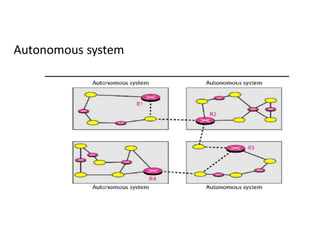
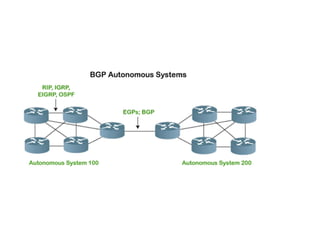
divided into autonomous systems. An autonomous system (AS) is a group of
networks and routers under the authority of a single administration. Routing
inside an autonomous system is referred to as intradomain routing. Routing
between autonomous systems is referred to as interdomain routing .Each
autonomous system can choose one or more intradomain routing protocol to
handle routing inside the autonomous system. However , only one
interdomain routing protocol handles routing between autonomous systerm
Autonomous system
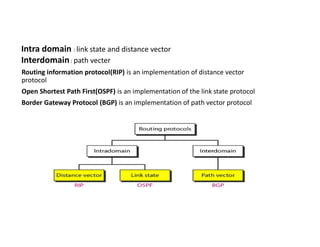
Routing information protocol(RIP) is an implementation of distance vector
protocol
Open Shortest Path First(OSPF) is an implementation of the link state protocol
Border Gateway Protocol (BGP) is an implementation of path vector protocol
Intra domain : link state and distance vector
Interdomain: path vecter
intRa domain RoUting
• Routing inside autonomous system is referred to as intradomain routing.
• Each autonomous system can choose one or more intradomain routing protocol.
• Based on unreliable datagram delivery.
• Distance Vector
a) routing Information Protocol(RIP)
b) Each neighbor exchange information periodically to its neighbors
• Link State
a) Open Shortest Path First(OSPF)
b) Each network share information periodically to other routers.
distance VectoR RoUting
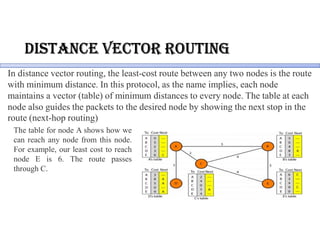
In distance vector routing, the least-cost route between any two nodes is the route
with minimum distance. In this protocol, as the name implies, each node
maintains a vector (table) of minimum distances to every node. The table at each
node also guides the packets to the desired node by showing the next stop in the
route (next-hop routing)
The table for node A shows how we
can reach any node from this node.
For example, our least cost to reach
node E is 6. The route passes
through C.
RoUting inFoRmation PRotocol
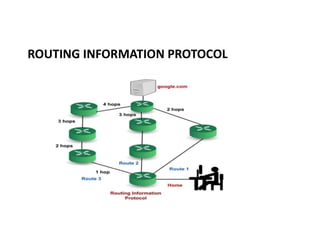
RIP implement distance vector routing directly with following consideration
• Autonomous system deals with routers and networks, routers have routing tables
• Destination in the routing table is a network , which means first column defines a
network address
• The metric used by RIP is very simple, the metric in RIP is called as a hop count.
• The next-node column defines the address of the router to which the packet is to
sent.
ROUTING INFORMATION PROTOCOL
linK state RoUting
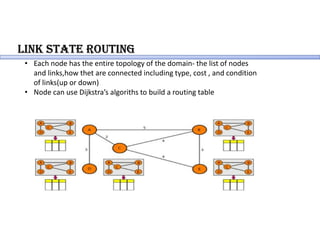
• Each node has the entire topology of the domain- the list of nodes
and links,how thet are connected including type, cost , and condition
of links(up or down)
• Node can use Dijkstra’s algoriths to build a routing table
oPen sHoRtest PatH FiRst
• All routers in the domain come to a consistent view of topology.
• Router describes its local connectivity in an link state
advertisement.
• Bulk of OSPF processing is due to LSA.
• OSPF processing impacts convergence
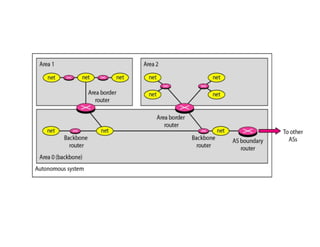
• Areas to handle routing efficiently and in a timely manner , OSPF
divides an autonomonus system into areas
inteRdomain RoUting
• Routing between autonomous system.
• Only one interdomain routing protocol handles routing
between autonomous system
• One node acts on behalf of entire autonomous system.
• Path vector protocol
a) Border Gateway Protocol(BGP)
PatH VectoR RoUting
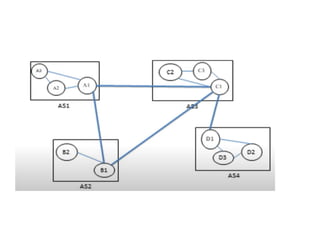
Path vector routing is similar to distance vector routing . There is at lest one
node , called the speakers node , in each AS that creates a routing table and
advertises it to speakers nodes in the neighbouring Ass.
Only the speaker nodes communicate .
The speacker node advertises the path , not the metric of the nodes.
BoRdeR gateWaY PRotocol (BgP)
• Each domain is identified a unique Autonomous System (AS) number
• BGP does not suffer from the count to identify problems that affect distance
vector routing protocols.
• BGP router does not send the entire contents of its routing tables to its
neighbours regularly.
• A BGP session is established between two routers belonging to two
different domains that are directly connected.
ReFeRnces
Data communication and networking
by Behrouz A. Forouzan
www.tutorialspoint.com

ppt (it).pdf

  • 2.
    Unicast RoUting PRotocols Routingprotocol have been created in response to the demand for dynamic routing tables . A routing protocol is a combination of rules and procedures that lets that lets routers in the internet information each other of changes .It allows routers to share whatever they know about the internet or their neighborhood.
  • 3.
    intRa –inteRdomain RoUting Aninternet can be so large that one routing protocol cannot handle the task of updating the routing tables of all routers. For this reason, an internet is divided into autonomous systems. An autonomous system (AS) is a group of networks and routers under the authority of a single administration. Routing inside an autonomous system is referred to as intradomain routing. Routing between autonomous systems is referred to as interdomain routing .Each autonomous system can choose one or more intradomain routing protocol to handle routing inside the autonomous system. However , only one interdomain routing protocol handles routing between autonomous systerm
  • 4.
  • 5.
    Routing information protocol(RIP)is an implementation of distance vector protocol Open Shortest Path First(OSPF) is an implementation of the link state protocol Border Gateway Protocol (BGP) is an implementation of path vector protocol Intra domain : link state and distance vector Interdomain: path vecter
  • 6.
    intRa domain RoUting •Routing inside autonomous system is referred to as intradomain routing. • Each autonomous system can choose one or more intradomain routing protocol. • Based on unreliable datagram delivery. • Distance Vector a) routing Information Protocol(RIP) b) Each neighbor exchange information periodically to its neighbors • Link State a) Open Shortest Path First(OSPF) b) Each network share information periodically to other routers.
  • 7.
    distance VectoR RoUting Indistance vector routing, the least-cost route between any two nodes is the route with minimum distance. In this protocol, as the name implies, each node maintains a vector (table) of minimum distances to every node. The table at each node also guides the packets to the desired node by showing the next stop in the route (next-hop routing) The table for node A shows how we can reach any node from this node. For example, our least cost to reach node E is 6. The route passes through C.
  • 8.
    RoUting inFoRmation PRotocol RIPimplement distance vector routing directly with following consideration • Autonomous system deals with routers and networks, routers have routing tables • Destination in the routing table is a network , which means first column defines a network address • The metric used by RIP is very simple, the metric in RIP is called as a hop count. • The next-node column defines the address of the router to which the packet is to sent.
  • 9.
  • 10.
    linK state RoUting •Each node has the entire topology of the domain- the list of nodes and links,how thet are connected including type, cost , and condition of links(up or down) • Node can use Dijkstra’s algoriths to build a routing table
  • 11.
    oPen sHoRtest PatHFiRst • All routers in the domain come to a consistent view of topology. • Router describes its local connectivity in an link state advertisement. • Bulk of OSPF processing is due to LSA. • OSPF processing impacts convergence • Areas to handle routing efficiently and in a timely manner , OSPF divides an autonomonus system into areas
  • 13.
    inteRdomain RoUting • Routingbetween autonomous system. • Only one interdomain routing protocol handles routing between autonomous system • One node acts on behalf of entire autonomous system. • Path vector protocol a) Border Gateway Protocol(BGP)
  • 14.
    PatH VectoR RoUting Pathvector routing is similar to distance vector routing . There is at lest one node , called the speakers node , in each AS that creates a routing table and advertises it to speakers nodes in the neighbouring Ass. Only the speaker nodes communicate . The speacker node advertises the path , not the metric of the nodes.
  • 16.
    BoRdeR gateWaY PRotocol(BgP) • Each domain is identified a unique Autonomous System (AS) number • BGP does not suffer from the count to identify problems that affect distance vector routing protocols. • BGP router does not send the entire contents of its routing tables to its neighbours regularly. • A BGP session is established between two routers belonging to two different domains that are directly connected.
  • 18.
    ReFeRnces Data communication andnetworking by Behrouz A. Forouzan www.tutorialspoint.com