IPV4 & IPV6
IPV4 ( IP Version 4 )
IPv4 (Internet Protocol Version 4) is the fourth revision of the
Internet Protocol (IP) used to identify devices on a network
through an addressing system. The Internet Protocol is
designed for use in interconnected systems of packet-
switched computer communication networks. It is the most
widely deployed Internet protocol used to connect devices to
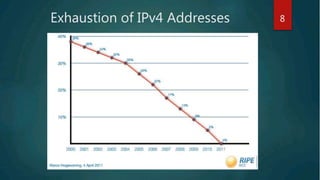
the Internet. With the growth of the Internet it is expected that
the number of unused IPv4 addresses will eventually run out
because every device including computers, smartphones and
game consoles that connects to the Internet requires an
address.
Some advantages and disadvantages
of IPv4
• Connectionless Protocol and Best effort based.
• Addresses are easier to remember.
• Existing networks are already using it.
• Classful and classless addressing.
• Millions of addresses are wasted.
• Planning for excessive growth was not foreseen, addresses are running
out.
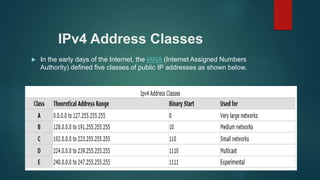
IPv4 Address Classes
 In the early days of the Internet, the IANA (Internet Assigned Numbers
Authority) defined five classes of public IP addresses as shown below.
Class A addresses
 Class A addresses are used for very large networks and always start with
a leftmost bit being a zero. Each class A network can hold as many as
16,777,216 hosts.
 There are only 127 class A addresses and these were very quickly used up
- examples include Apple, IBM and MIT.
 Many host addresses have been released back to ICANN to support
classless addresses.
Class B addresses
 These addresses are used for medium sized networks and always start
with the leftmost bits 10. Each class B network can hold as many as
65,534 hosts.
 There are 16,384 class B addresses which are all used up - examples
include Microsoft and Glasgow University.
 As with class A addresses, some of the host addresses have been
released back to ICANN to support classless addressing.
IPv6 (IP Version 6)
A new Internet addressing system Internet Protocol version 6
(IPv6) is being deployed to fulfill the need for more Internet
addresses. IPv6 (Internet Protocol Version 6) is also called IPNG
(Internet Protocol next generation). IPv6 is the successor to
Internet Protocol Version 4 (IPv4). It was designed as an
evolutionary upgrade to the Internet Protocol and will, in fact,
coexist with the older IPv4 for some time. IPv6 is designed to
allow the Internet to grow steadily, both in terms of the number of
hosts connected and the total amount of data traffic transmitted.
Some advantages and disadvantages
of IPv6
• New header format.
• Large address space.
• Efficient routing
• Built in security.
• Larger addresses harder to remember.
• Transition takes time and is not always smooth.
• Not always usable some machines have to be replaced.
ipv4 & ipv6
ipv4 & ipv6

ipv4 & ipv6

  • 1.
  • 4.
    IPV4 ( IPVersion 4 ) IPv4 (Internet Protocol Version 4) is the fourth revision of the Internet Protocol (IP) used to identify devices on a network through an addressing system. The Internet Protocol is designed for use in interconnected systems of packet- switched computer communication networks. It is the most widely deployed Internet protocol used to connect devices to the Internet. With the growth of the Internet it is expected that the number of unused IPv4 addresses will eventually run out because every device including computers, smartphones and game consoles that connects to the Internet requires an address.
  • 6.
    Some advantages anddisadvantages of IPv4 • Connectionless Protocol and Best effort based. • Addresses are easier to remember. • Existing networks are already using it. • Classful and classless addressing. • Millions of addresses are wasted. • Planning for excessive growth was not foreseen, addresses are running out.
  • 7.
    IPv4 Address Classes In the early days of the Internet, the IANA (Internet Assigned Numbers Authority) defined five classes of public IP addresses as shown below.
  • 8.
    Class A addresses Class A addresses are used for very large networks and always start with a leftmost bit being a zero. Each class A network can hold as many as 16,777,216 hosts.  There are only 127 class A addresses and these were very quickly used up - examples include Apple, IBM and MIT.  Many host addresses have been released back to ICANN to support classless addresses.
  • 9.
    Class B addresses These addresses are used for medium sized networks and always start with the leftmost bits 10. Each class B network can hold as many as 65,534 hosts.  There are 16,384 class B addresses which are all used up - examples include Microsoft and Glasgow University.  As with class A addresses, some of the host addresses have been released back to ICANN to support classless addressing.
  • 11.
    IPv6 (IP Version6) A new Internet addressing system Internet Protocol version 6 (IPv6) is being deployed to fulfill the need for more Internet addresses. IPv6 (Internet Protocol Version 6) is also called IPNG (Internet Protocol next generation). IPv6 is the successor to Internet Protocol Version 4 (IPv4). It was designed as an evolutionary upgrade to the Internet Protocol and will, in fact, coexist with the older IPv4 for some time. IPv6 is designed to allow the Internet to grow steadily, both in terms of the number of hosts connected and the total amount of data traffic transmitted.
  • 13.
    Some advantages anddisadvantages of IPv6 • New header format. • Large address space. • Efficient routing • Built in security. • Larger addresses harder to remember. • Transition takes time and is not always smooth. • Not always usable some machines have to be replaced.