Intellectual Property Rights & Agriculture in India:
Prospects & Challenges
Dr. Tabrez Ahmad,
Professor & Director,
1
1. Challenges of Indian Agriculture
2. Intellectual Property Protection of Agriculture
Sector
3. Patent Protection
4. Protection of Plant Varieties & Farmers Rights
5. Geographical Indication
Agenda
2Dr. Tabrez Ahmad, Confidential & Proprietary
Agriculture: Key Sector and Valuable Living
Heritage
• Agriculture, the key sector of Indian economy
• 1% increase in output in agriculture pushes up growth rate of total
economy by 0.22%
• 1% change in agriculture growth results in 0.38% change in growth
of industrial output
• Rural India’s share in total consumption of consumer goods like
tooth paste, food-products and consumers durables has exceeded
urban India’s share
• Rural market is a sleeping giant. The whole world is after this
• Slow down in agricultural growth after mid 1990s.
• Slow down began in 1995-96 for livestock, 1996-97 for crop sector,
1998-99 for fruits and horticulture, 1996-97 for crops other than
fruits and vegetables
Dr. Tabrez Ahmad, Confidential & Proprietary 3
Why slowed down?
Some suggestive explanations
• Deterioration in terms of trade for agri towards late 1990s and
beyond
• Output price intervention in agriculturally underdeveloped regions
which have potential for raising productivity and production was not
effective
• Public investment did not increase to keep pace with the needs of
output growth
• Adoption of modern technology was slow
• Agriculture has become less rewarding and a drag
• Size of farm holding is fast decreasing, less than 1.41 ha
• 78% of our operational holdings are less than 2% ha
• Rural poor still meet 84% of their credit needs from non-formal
sources
• Public extension system has become obsolete
Dr. Tabrez Ahmad, Confidential & Proprietary 4
Contd../-
• The use of purchased inputs by farmers has multiplied by 283 times
since independence
• About 77% of the marketing costs are avoidable
• 25 to 30% of our produce is wasted
• Value addition in agricultural commodities is less than 10%
• Weather uncertainties again reemerging in a big way
• Quality, labeling, brands, IPR issues, dumping etc. are increasingly
heard
• Water and market wars ahead!
• Onwards 2005 Broad based dietary revolution taking place
• Can agriculture meet such demands of the market-variety, cheap,
safe, timely, round the year, stable supply?
• It can, if it exploits new technologies
• How to ensure food security
Dr. Tabrez Ahmad, Confidential & Proprietary 5
Use of New Technology in Agriculture and IPR
• Patent Protection
• WTO
• TRIPS
• CBD
• UPOV
• Sui-generis system
• Protection of Plant Varieties & Farmers Rights
• Geographical Indication
6Dr. Tabrez Ahmad, Confidential & Proprietary
What is a PATENT?
• A patent is an exclusive right granted for an invention, which is a
product or a process that provides a new way of doing
something, or offers a new technical solution to a problem
• The limited monopoly right granted by the state enables an
inventor to prohibit another person from manufacturing, using or
selling the patented product or from using the patented process,
without permission.
• Period of Patents - 20 Years
7Dr. Tabrez Ahmad, Confidential & Proprietary
WHAT CAN BE PATENTED?
Inventions in all fields of technology, whether products or
processes, if they meet the criteria of
• Novelty;
• Non-obviousness (inventive step);
• Industrial application (utility).
8Dr. Tabrez Ahmad, Confidential & Proprietary
INVENTIONS – NOT PATENTABLE
A machine whose primary or intended use or commercial
exploitation of which could be contrary to Public order or morality
or which causes serious prejudice to human, animal or plant life or
health or to the environment :
 Gambling machine
 device for house-breaking
 Biological warfare material or device
 Terminator gene technology
 embryonic stem cell
9
Dr. Tabrez Ahmad, Confidential & Proprietary
INVENTIONS – NOT PATENTABLE
Mere Discovery of a Scientific Principle
or Formulation of an Abstract Theory
or discovery of any living thing or non–living substance occurring
in nature
• Discovery adds to the human knowledge by
disclosing something ,not seen before, whereas,
• Invention adds to human knowledge by suggesting an action
resulting in a new product or new process
• e.g. Archimedes Principle, Superconducting Phenomenon as such – not
patentable , However,
• An apparatus /method for technological application may be patentable
10
Dr. Tabrez Ahmad, Confidential & Proprietary
INVENTIONS – NOT PATENTABLE
The mere discovery of a new form of a known substance which does not
result in the enhancement of the known efficacy of that substance OR
the mere discovery of any new property or new use for a known
substance OR
of the mere use of a known process, machine
or apparatus, unless such known process
results in a new product or employs at
least one new reactant.
11
Dr. Tabrez Ahmad, Confidential & Proprietary
INVENTIONS – NOT PATENTABLE
A substance obtained by mere admixture resulting
only in the aggregation of the properties of the
components thereof or a process for producing such
substance, e.g.
Paracetamol (Antipyretic) +Brufen (analgesic) = A drug (antipyretic &
analgesic)
• A soft drink that is only a mixture of sugar and some colorants
in water
But, a mixture resulting in synergistic properties of
mixture of ingredients may be patentable e.g
Soap, Detergent, lubricant.
12
Dr. Tabrez Ahmad, Confidential & Proprietary
Not patentable
Method of Agriculture or Horticulture
• e. g. Cultivation of algae ,
Producing new form of a known plant,
preparation of an improved soil
However, Agricultural Equipments
are patentable
13Dr. Tabrez Ahmad, Confidential & Proprietary
Inventions - Not Patentable
Plants & animals in whole or any part
thereof other than micro- organisms,
but including seeds, varieties and species
and essentially biological process for
production or propagation of plants & animals e.g.
– Clones and new varieties of plants:
– A process for production of plants or animals if it consists
entirely of natural phenomena such as crossing or selection
14
Dr. Tabrez Ahmad, Confidential & Proprietary
What is a Geographical Indication?
Geographical Indication is an indication which identifies goods as
agricultural goods, natural goods or manufactured goods as
originating, or manufactured in the territory of country, or a region or
locality in that territory, where a given quality, reputation or other
characteristic of such goods is essentially attributable to its
geographical origin.
Explanation clarifies that GI need not be a geographical name
E.g. Alphonso, Basmati
Goods include goods of handicraft or of industry and also foodstuff.
In India, geographical indications have to be registered.
Geographical Indications Registry examines and publishes the application
before registration
Registration is valid for 10 years but can be renewed indefinitely
15
Dr. Tabrez Ahmad, Confidential & Proprietary
Plant Varieties and Farmer’s Rights
• Registrable varieties and criteria:
 New Varieties
 Novelty, Distinctiveness, uniformity and stability
 Extant varieties
 Distinctiveness, uniformity and stability
• Persons who can Register
 Breeders, farmers, universities, agricultural institutes
• Period of protection
 15 years for annual crops
 18 years for trees and vines
16Dr. Tabrez Ahmad, Confidential & Proprietary
Rights of Breeders
• Production
• Sale
• Marketing
• Distribution
• Export
• Import
However, if the breeders’ variety is essentially derived
from a farmers’ variety, the breeder cannot give any
authorisation without the consent of the farmers or
communities from whose varieties the protected
variety is derived.
17Dr. Tabrez Ahmad, Confidential & Proprietary
Farmers’ Rights
• To save, use, sow, re-sow, exchange, share or sell his
farm produce including seed in the same manner as he
was entitled earlier (Seeds for sale should not be
branded)
• To full disclosure of the expected performance of the
Seeds or planting material by the plant breeder. Where
these fail to perform in the manner claimed by the
breeder, the farmer may claim compensation from the
plant breeder.
18Dr. Tabrez Ahmad, Confidential & Proprietary
Researchers’ Rights
Free and complete access to protected
materials for research use in developing new
varieties of plants.
However, authorisation of the breeder is
required “whose repeated use of such variety
as parental line is necessary for commercial
production of such other newly developed
variety”.
19Dr. Tabrez Ahmad, Confidential & Proprietary
Licensing of an IP & Technology Transfer
• Licence is a permission granted by an IP owner to another person to use
the IP on agreed terms and conditions, while he continues to retain
ownership of the IP
• Licensing creates an income source
• It establishes a legal framework for transfer of technology to a wider group
of researchers and engineers
• Creates market presence for the technology or trademark
Conditions for Licensing
• Owners of IP prefer to transfer technology through licensing agreements
only. All rights or limited rights can be licensed
• Can be exclusive or non-excusive or sole (owner and licensee)
• Most such agreements provide for royalty payment and non-transfer to a
third party.
• Royalties can be upfront, part upfront and part % per production/sale, only
% per production/sale
• The particular uses for which the IP can be used are also generally
specified. Needs to be careful about the Competition law
20
Dr. Tabrez Ahmad, Confidential & Proprietary
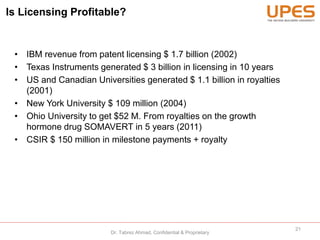
Is Licensing Profitable?
• IBM revenue from patent licensing $ 1.7 billion (2002)
• Texas Instruments generated $ 3 billion in licensing in 10 years
• US and Canadian Universities generated $ 1.1 billion in royalties
(2001)
• New York University $ 109 million (2004)
• Ohio University to get $52 M. From royalties on the growth
hormone drug SOMAVERT in 5 years (2011)
• CSIR $ 150 million in milestone payments + royalty
21
Dr. Tabrez Ahmad, Confidential & Proprietary
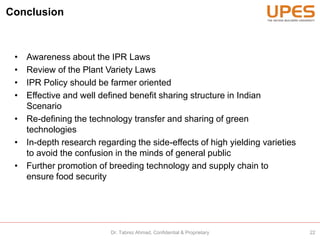
Conclusion
• Awareness about the IPR Laws
• Review of the Plant Variety Laws
• IPR Policy should be farmer oriented
• Effective and well defined benefit sharing structure in Indian
Scenario
• Re-defining the technology transfer and sharing of green
technologies
• In-depth research regarding the side-effects of high yielding varieties
to avoid the confusion in the minds of general public
• Further promotion of breeding technology and supply chain to
ensure food security
22Dr. Tabrez Ahmad, Confidential & Proprietary
23Dr. Tabrez Ahmad, Confidential & Proprietary

Tabrez agro supply chain conf 7 oct 2016

  • 1.
    Intellectual Property Rights& Agriculture in India: Prospects & Challenges Dr. Tabrez Ahmad, Professor & Director, 1
  • 2.
    1. Challenges ofIndian Agriculture 2. Intellectual Property Protection of Agriculture Sector 3. Patent Protection 4. Protection of Plant Varieties & Farmers Rights 5. Geographical Indication Agenda 2Dr. Tabrez Ahmad, Confidential & Proprietary
  • 3.
    Agriculture: Key Sectorand Valuable Living Heritage • Agriculture, the key sector of Indian economy • 1% increase in output in agriculture pushes up growth rate of total economy by 0.22% • 1% change in agriculture growth results in 0.38% change in growth of industrial output • Rural India’s share in total consumption of consumer goods like tooth paste, food-products and consumers durables has exceeded urban India’s share • Rural market is a sleeping giant. The whole world is after this • Slow down in agricultural growth after mid 1990s. • Slow down began in 1995-96 for livestock, 1996-97 for crop sector, 1998-99 for fruits and horticulture, 1996-97 for crops other than fruits and vegetables Dr. Tabrez Ahmad, Confidential & Proprietary 3
  • 4.
    Why slowed down? Somesuggestive explanations • Deterioration in terms of trade for agri towards late 1990s and beyond • Output price intervention in agriculturally underdeveloped regions which have potential for raising productivity and production was not effective • Public investment did not increase to keep pace with the needs of output growth • Adoption of modern technology was slow • Agriculture has become less rewarding and a drag • Size of farm holding is fast decreasing, less than 1.41 ha • 78% of our operational holdings are less than 2% ha • Rural poor still meet 84% of their credit needs from non-formal sources • Public extension system has become obsolete Dr. Tabrez Ahmad, Confidential & Proprietary 4
  • 5.
    Contd../- • The useof purchased inputs by farmers has multiplied by 283 times since independence • About 77% of the marketing costs are avoidable • 25 to 30% of our produce is wasted • Value addition in agricultural commodities is less than 10% • Weather uncertainties again reemerging in a big way • Quality, labeling, brands, IPR issues, dumping etc. are increasingly heard • Water and market wars ahead! • Onwards 2005 Broad based dietary revolution taking place • Can agriculture meet such demands of the market-variety, cheap, safe, timely, round the year, stable supply? • It can, if it exploits new technologies • How to ensure food security Dr. Tabrez Ahmad, Confidential & Proprietary 5
  • 6.
    Use of NewTechnology in Agriculture and IPR • Patent Protection • WTO • TRIPS • CBD • UPOV • Sui-generis system • Protection of Plant Varieties & Farmers Rights • Geographical Indication 6Dr. Tabrez Ahmad, Confidential & Proprietary
  • 7.
    What is aPATENT? • A patent is an exclusive right granted for an invention, which is a product or a process that provides a new way of doing something, or offers a new technical solution to a problem • The limited monopoly right granted by the state enables an inventor to prohibit another person from manufacturing, using or selling the patented product or from using the patented process, without permission. • Period of Patents - 20 Years 7Dr. Tabrez Ahmad, Confidential & Proprietary
  • 8.
    WHAT CAN BEPATENTED? Inventions in all fields of technology, whether products or processes, if they meet the criteria of • Novelty; • Non-obviousness (inventive step); • Industrial application (utility). 8Dr. Tabrez Ahmad, Confidential & Proprietary
  • 9.
    INVENTIONS – NOTPATENTABLE A machine whose primary or intended use or commercial exploitation of which could be contrary to Public order or morality or which causes serious prejudice to human, animal or plant life or health or to the environment :  Gambling machine  device for house-breaking  Biological warfare material or device  Terminator gene technology  embryonic stem cell 9 Dr. Tabrez Ahmad, Confidential & Proprietary
  • 10.
    INVENTIONS – NOTPATENTABLE Mere Discovery of a Scientific Principle or Formulation of an Abstract Theory or discovery of any living thing or non–living substance occurring in nature • Discovery adds to the human knowledge by disclosing something ,not seen before, whereas, • Invention adds to human knowledge by suggesting an action resulting in a new product or new process • e.g. Archimedes Principle, Superconducting Phenomenon as such – not patentable , However, • An apparatus /method for technological application may be patentable 10 Dr. Tabrez Ahmad, Confidential & Proprietary
  • 11.
    INVENTIONS – NOTPATENTABLE The mere discovery of a new form of a known substance which does not result in the enhancement of the known efficacy of that substance OR the mere discovery of any new property or new use for a known substance OR of the mere use of a known process, machine or apparatus, unless such known process results in a new product or employs at least one new reactant. 11 Dr. Tabrez Ahmad, Confidential & Proprietary
  • 12.
    INVENTIONS – NOTPATENTABLE A substance obtained by mere admixture resulting only in the aggregation of the properties of the components thereof or a process for producing such substance, e.g. Paracetamol (Antipyretic) +Brufen (analgesic) = A drug (antipyretic & analgesic) • A soft drink that is only a mixture of sugar and some colorants in water But, a mixture resulting in synergistic properties of mixture of ingredients may be patentable e.g Soap, Detergent, lubricant. 12 Dr. Tabrez Ahmad, Confidential & Proprietary
  • 13.
    Not patentable Method ofAgriculture or Horticulture • e. g. Cultivation of algae , Producing new form of a known plant, preparation of an improved soil However, Agricultural Equipments are patentable 13Dr. Tabrez Ahmad, Confidential & Proprietary
  • 14.
    Inventions - NotPatentable Plants & animals in whole or any part thereof other than micro- organisms, but including seeds, varieties and species and essentially biological process for production or propagation of plants & animals e.g. – Clones and new varieties of plants: – A process for production of plants or animals if it consists entirely of natural phenomena such as crossing or selection 14 Dr. Tabrez Ahmad, Confidential & Proprietary
  • 15.
    What is aGeographical Indication? Geographical Indication is an indication which identifies goods as agricultural goods, natural goods or manufactured goods as originating, or manufactured in the territory of country, or a region or locality in that territory, where a given quality, reputation or other characteristic of such goods is essentially attributable to its geographical origin. Explanation clarifies that GI need not be a geographical name E.g. Alphonso, Basmati Goods include goods of handicraft or of industry and also foodstuff. In India, geographical indications have to be registered. Geographical Indications Registry examines and publishes the application before registration Registration is valid for 10 years but can be renewed indefinitely 15 Dr. Tabrez Ahmad, Confidential & Proprietary
  • 16.
    Plant Varieties andFarmer’s Rights • Registrable varieties and criteria:  New Varieties  Novelty, Distinctiveness, uniformity and stability  Extant varieties  Distinctiveness, uniformity and stability • Persons who can Register  Breeders, farmers, universities, agricultural institutes • Period of protection  15 years for annual crops  18 years for trees and vines 16Dr. Tabrez Ahmad, Confidential & Proprietary
  • 17.
    Rights of Breeders •Production • Sale • Marketing • Distribution • Export • Import However, if the breeders’ variety is essentially derived from a farmers’ variety, the breeder cannot give any authorisation without the consent of the farmers or communities from whose varieties the protected variety is derived. 17Dr. Tabrez Ahmad, Confidential & Proprietary
  • 18.
    Farmers’ Rights • Tosave, use, sow, re-sow, exchange, share or sell his farm produce including seed in the same manner as he was entitled earlier (Seeds for sale should not be branded) • To full disclosure of the expected performance of the Seeds or planting material by the plant breeder. Where these fail to perform in the manner claimed by the breeder, the farmer may claim compensation from the plant breeder. 18Dr. Tabrez Ahmad, Confidential & Proprietary
  • 19.
    Researchers’ Rights Free andcomplete access to protected materials for research use in developing new varieties of plants. However, authorisation of the breeder is required “whose repeated use of such variety as parental line is necessary for commercial production of such other newly developed variety”. 19Dr. Tabrez Ahmad, Confidential & Proprietary
  • 20.
    Licensing of anIP & Technology Transfer • Licence is a permission granted by an IP owner to another person to use the IP on agreed terms and conditions, while he continues to retain ownership of the IP • Licensing creates an income source • It establishes a legal framework for transfer of technology to a wider group of researchers and engineers • Creates market presence for the technology or trademark Conditions for Licensing • Owners of IP prefer to transfer technology through licensing agreements only. All rights or limited rights can be licensed • Can be exclusive or non-excusive or sole (owner and licensee) • Most such agreements provide for royalty payment and non-transfer to a third party. • Royalties can be upfront, part upfront and part % per production/sale, only % per production/sale • The particular uses for which the IP can be used are also generally specified. Needs to be careful about the Competition law 20 Dr. Tabrez Ahmad, Confidential & Proprietary
  • 21.
    Is Licensing Profitable? •IBM revenue from patent licensing $ 1.7 billion (2002) • Texas Instruments generated $ 3 billion in licensing in 10 years • US and Canadian Universities generated $ 1.1 billion in royalties (2001) • New York University $ 109 million (2004) • Ohio University to get $52 M. From royalties on the growth hormone drug SOMAVERT in 5 years (2011) • CSIR $ 150 million in milestone payments + royalty 21 Dr. Tabrez Ahmad, Confidential & Proprietary
  • 22.
    Conclusion • Awareness aboutthe IPR Laws • Review of the Plant Variety Laws • IPR Policy should be farmer oriented • Effective and well defined benefit sharing structure in Indian Scenario • Re-defining the technology transfer and sharing of green technologies • In-depth research regarding the side-effects of high yielding varieties to avoid the confusion in the minds of general public • Further promotion of breeding technology and supply chain to ensure food security 22Dr. Tabrez Ahmad, Confidential & Proprietary
  • 23.
    23Dr. Tabrez Ahmad,Confidential & Proprietary