LOGO
Ethics in social sciEncE and iPR
in agRicultuRE.
Vijaylaxmi . B Somanatti
M.Sc in agril. Extension
UAS, dharwad -05
contEnts
Introduction
Concept of ethics
Principles of ethics
Policies on ethics
Ethical issues in research
IPR issues
Research studies
Conclusion
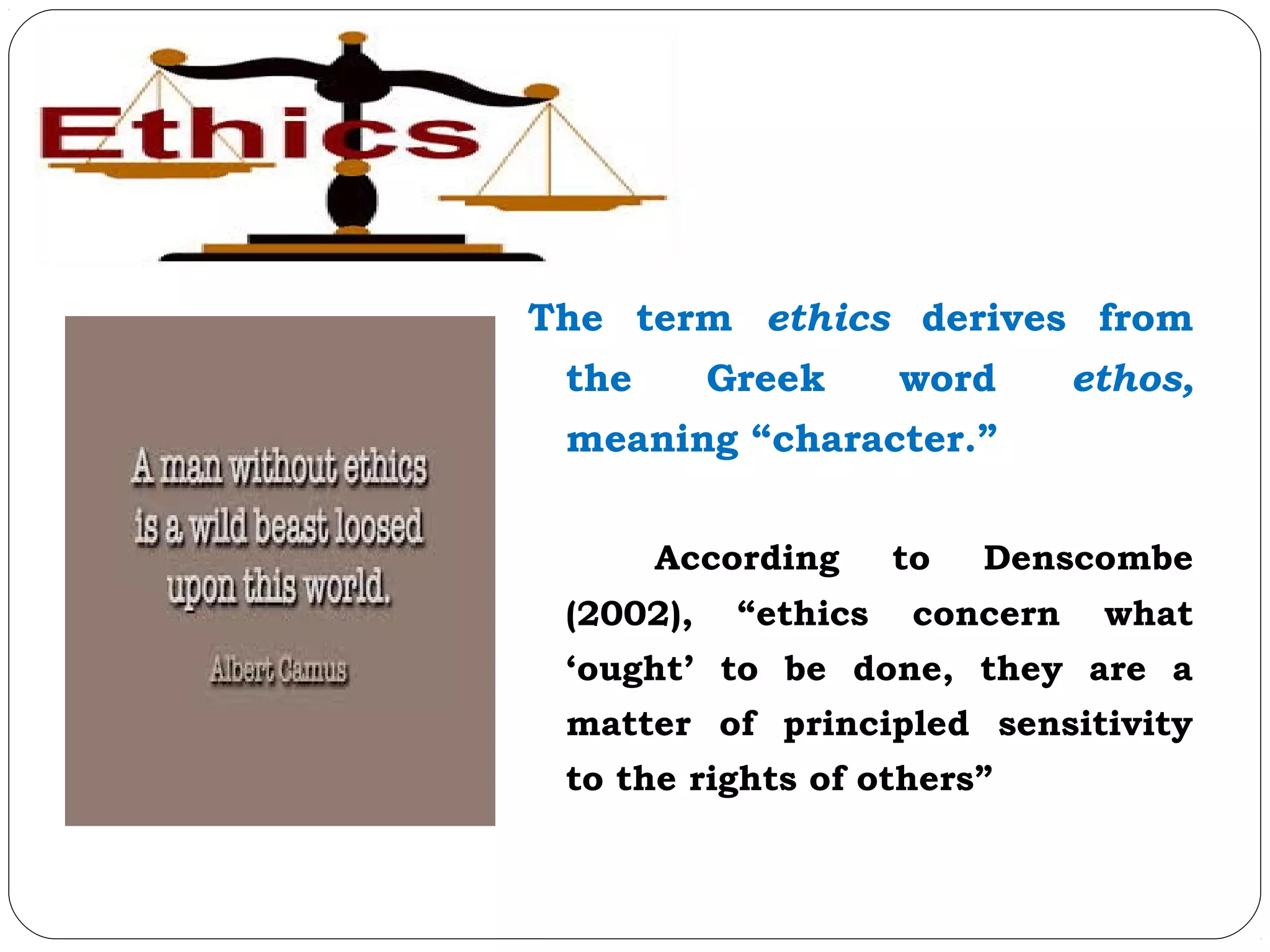
The term ethics derives from
the Greek word ethos,
meaning “character.”
According to Denscombe
(2002), “ethics concern what
‘ought’ to be done, they are a
matter of principled sensitivity
to the rights of others”
Core principles of research
ethics :
‘Do no harm’
Informed consent
Protection of anonymity and
Confidentiality
-Denscombe (2002)
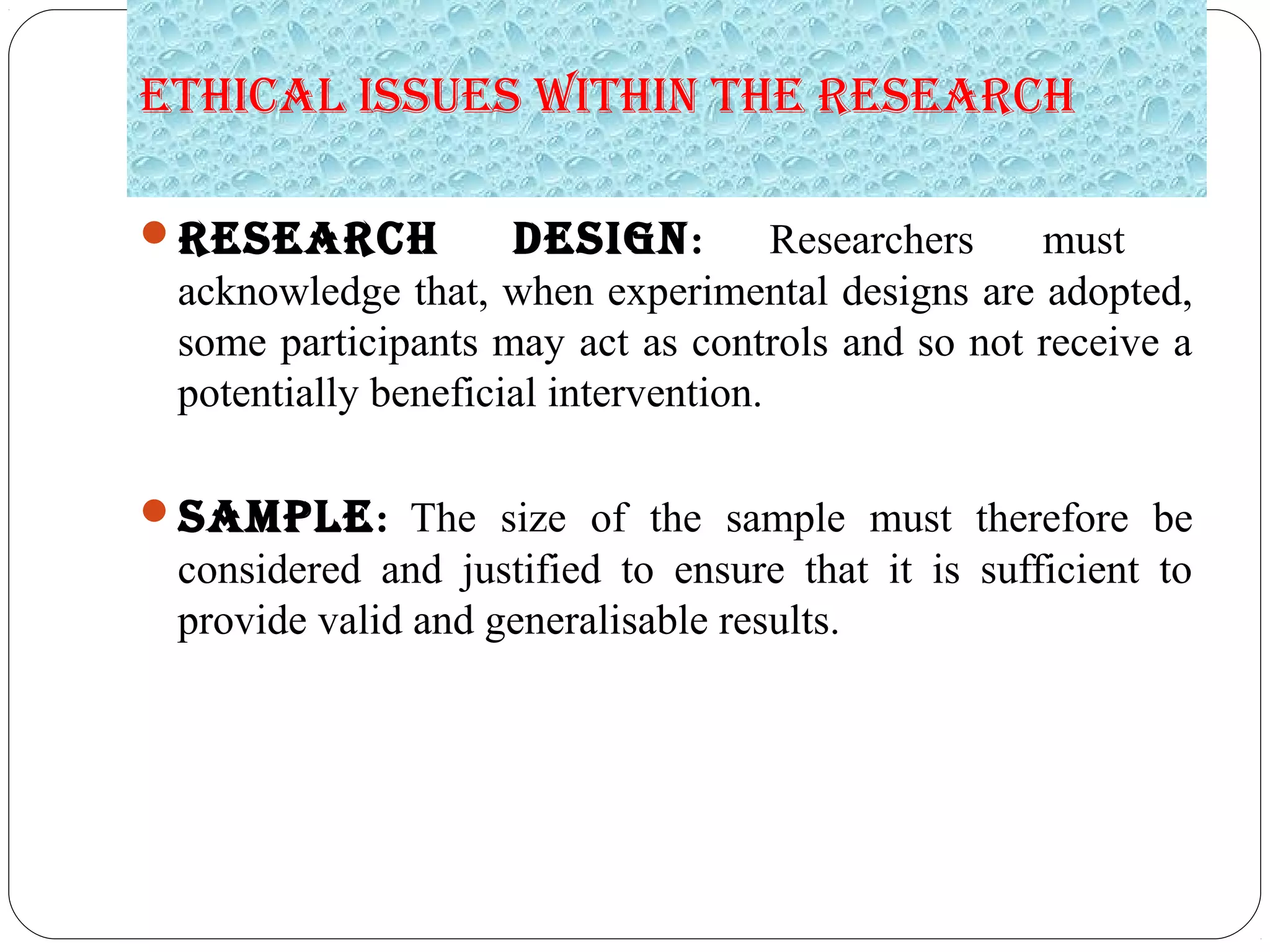
Policies on research ethics
1 Enable researchers to
 enhance their capability to undertake ethical research
 maintain their independence, especially when confronted
with undue influence or pressure which may compromise their
integrity .
2. Serve as a basis for policymakers and to provide an enabling
environment for the practice of ethical research
3. Provide an additional resource for the teaching and training of
students in research and ethical practice
4. Discourage unethical research practice
5. Make ethics an integral part of the planning and methodology
of research
6. Preserve and promote the autonomy, quality, legitimacy and
credibility of research
7. Protect and promote the rights of research participants and
honor their trust in researchers and research
8. Strengthen the research ethics review system in the University
where research involves human participants, animals, data,
institutions or other living or genetically modified organisms
Ethical issuEs within thE REsEaRch
REsEaRch dEsign: Researchers must
acknowledge that, when experimental designs are adopted,
some participants may act as controls and so not receive a
potentially beneficial intervention.
samPlE: The size of the sample must therefore be
considered and justified to ensure that it is sufficient to
provide valid and generalisable results.
Contd…
data collEction: The design will determine the
methods of data collection to be used; these must be clearly
described. A number of ethical problems can arise in determining
data collection techniques. Ex. covert methods of data collection
(e.g. participant observation); this should be used only where
data cannot be collected in any other way.
 unfoREsEEn nEEds: Clear plans must be in place to
address particular needs that may arise during the course of any
research but which may lie outside the researcher’s knowledge,
skills or expertise, bearing in mind the need for confidentiality.
Ethical issues in social science research
Consent: The prospective research participants must be fully
informed about the procedures and risks involved in research and
must give their consent to participate.
Risk of harm:Ethical standards also require that researchers not put
participants in a situation where they might be at risk of harm as a
result of their participation. Harm can be defined as both physical
and psychological.
Confidentiality: Almost all research guarantees the
participants confidentiality -- they are assured that identifying
information will not be made available to anyone who is not directly
involved in the study.
Anonymity : anonymity which essentially means that the
participant will remain anonymous throughout the study -- even
to the researchers themselves. Clearly, the anonymity standard is
a stronger guarantee of privacy, but it is sometimes difficult to
accomplish, especially in situations where participants have to be
measured at multiple time points (e.g., a pre-post study).
Authorization:: It should be based on the quantum of
contribution made interms of ideas, conceptualization actual
performance of the research analysis and writing of the report or
any publication based on the research. Also whose contribution
is made the conduct and completion of research or publication
possible should be properly acknowledged.
Contd…
Integrity: The quality of being honest and having strong
moral principle in conducting the research. The researcher
should ensure that there is honest and transparency at every
stage of research.
Data security: As the technology advancement now-a-
days it is difficult to protect the data. Ensuring
confidentiality of research data becomes crucial in relation
to data processing and release and measures to ensure data
privacy have to be implemented as part of the data
processing. The materials used in socio-economic research
is predominantly protected by IPR such as copyright, data
base and software protection
Intellectual property rights:
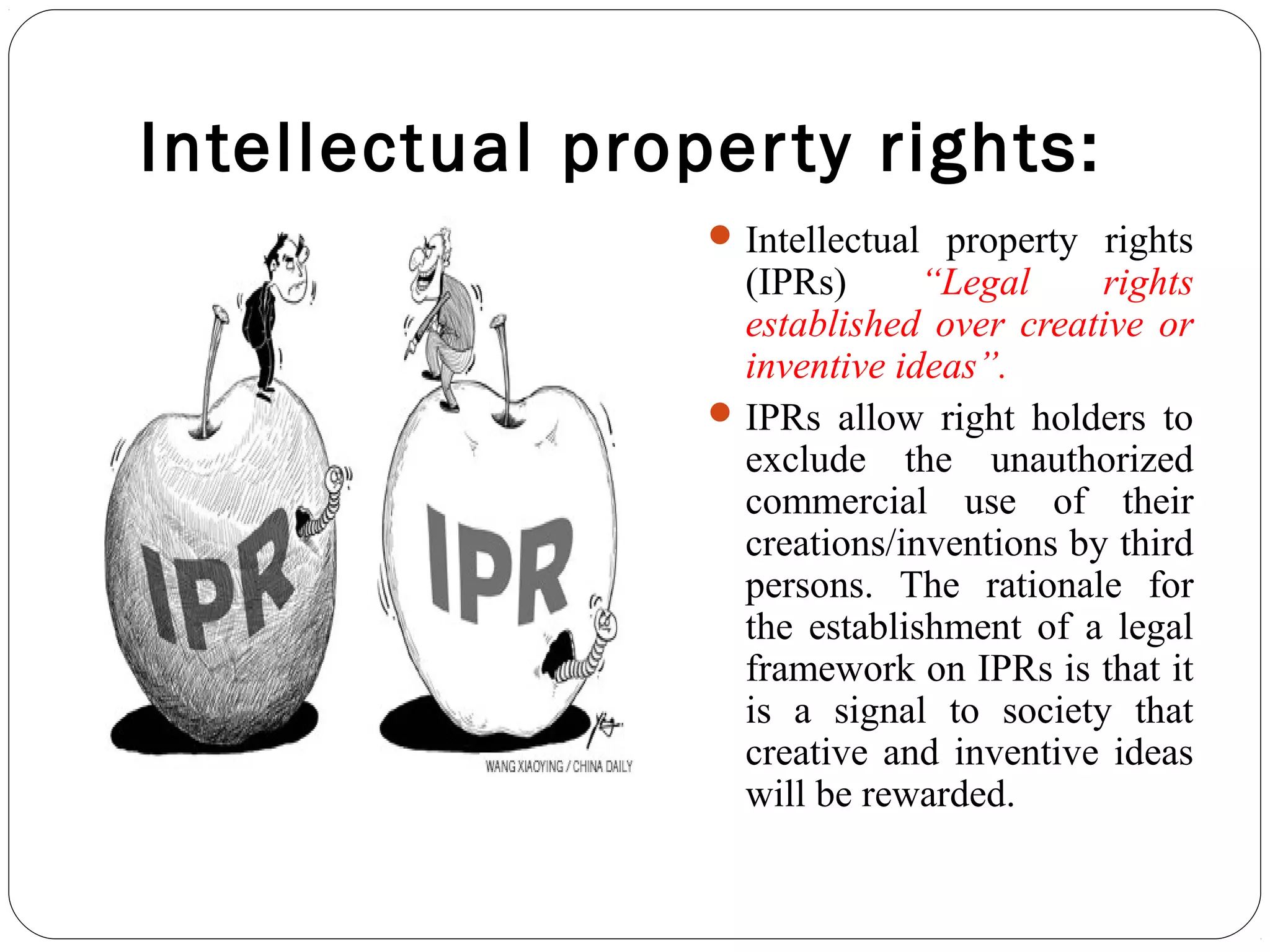
Intellectual property rights
(IPRs) “Legal rights
established over creative or
inventive ideas”.
IPRs allow right holders to
exclude the unauthorized
commercial use of their
creations/inventions by third
persons. The rationale for
the establishment of a legal
framework on IPRs is that it
is a signal to society that
creative and inventive ideas
will be rewarded.
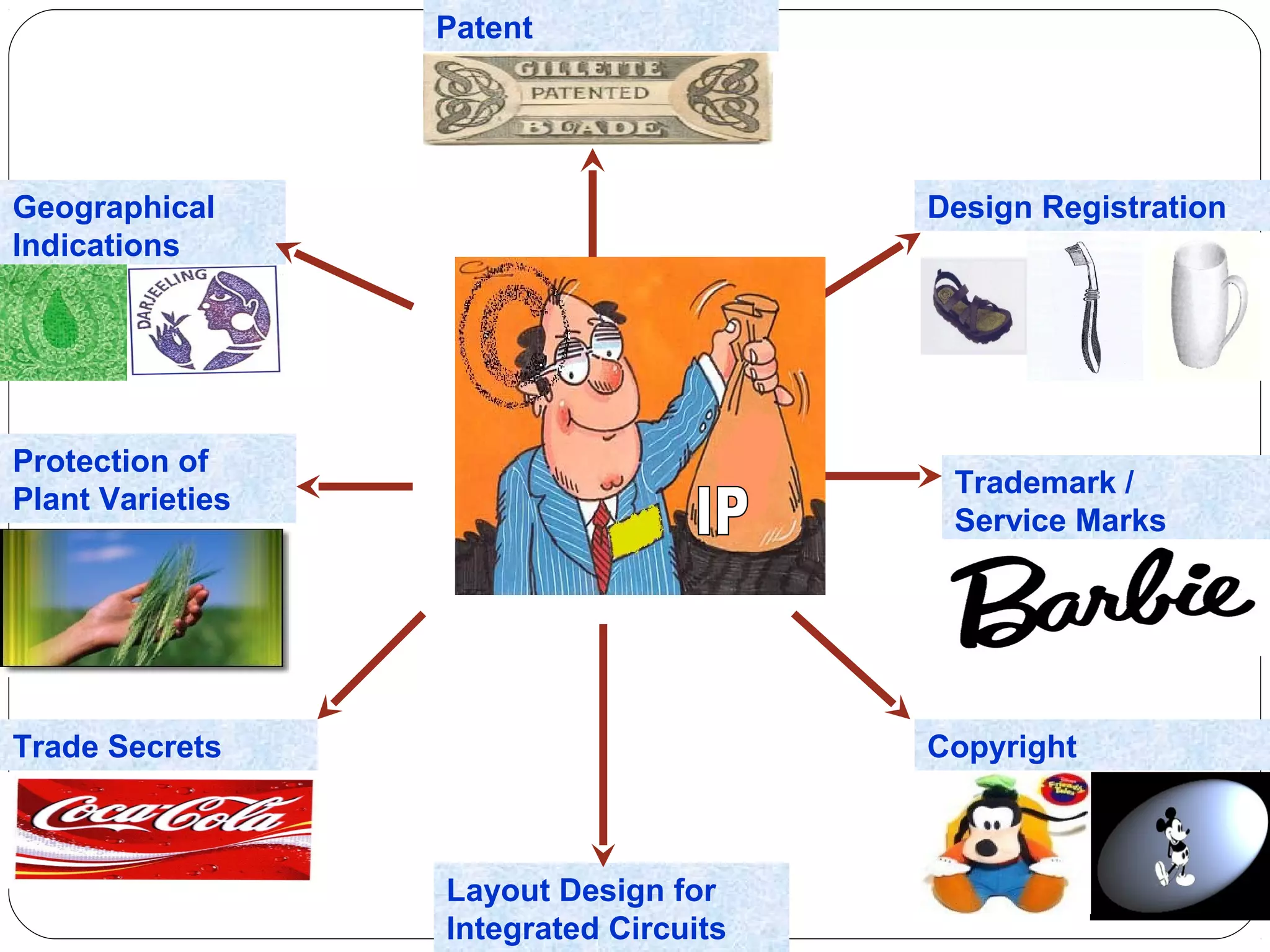
Patent
Design Registration
Trademark /
Service Marks
Copyright
Layout Design for
Integrated Circuits
Trade Secrets
Protection of
Plant Varieties
Geographical
Indications
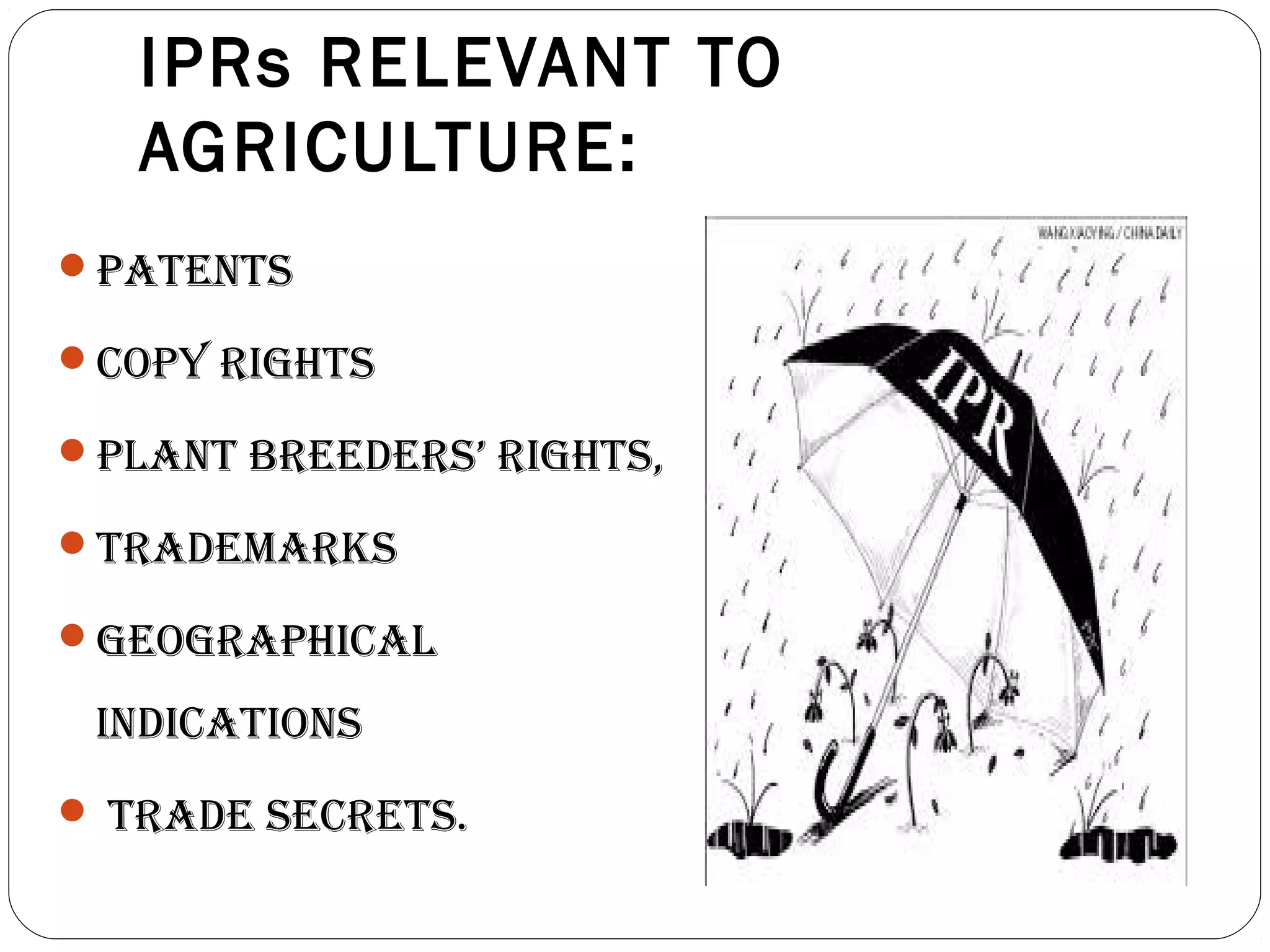
IPRs RELEVANT TO
AGRICULTURE:
Patents
CoPy rights
Plant Breeders’ rights,
trademarks
geograPhiCal
indiCations
 trade seCrets.
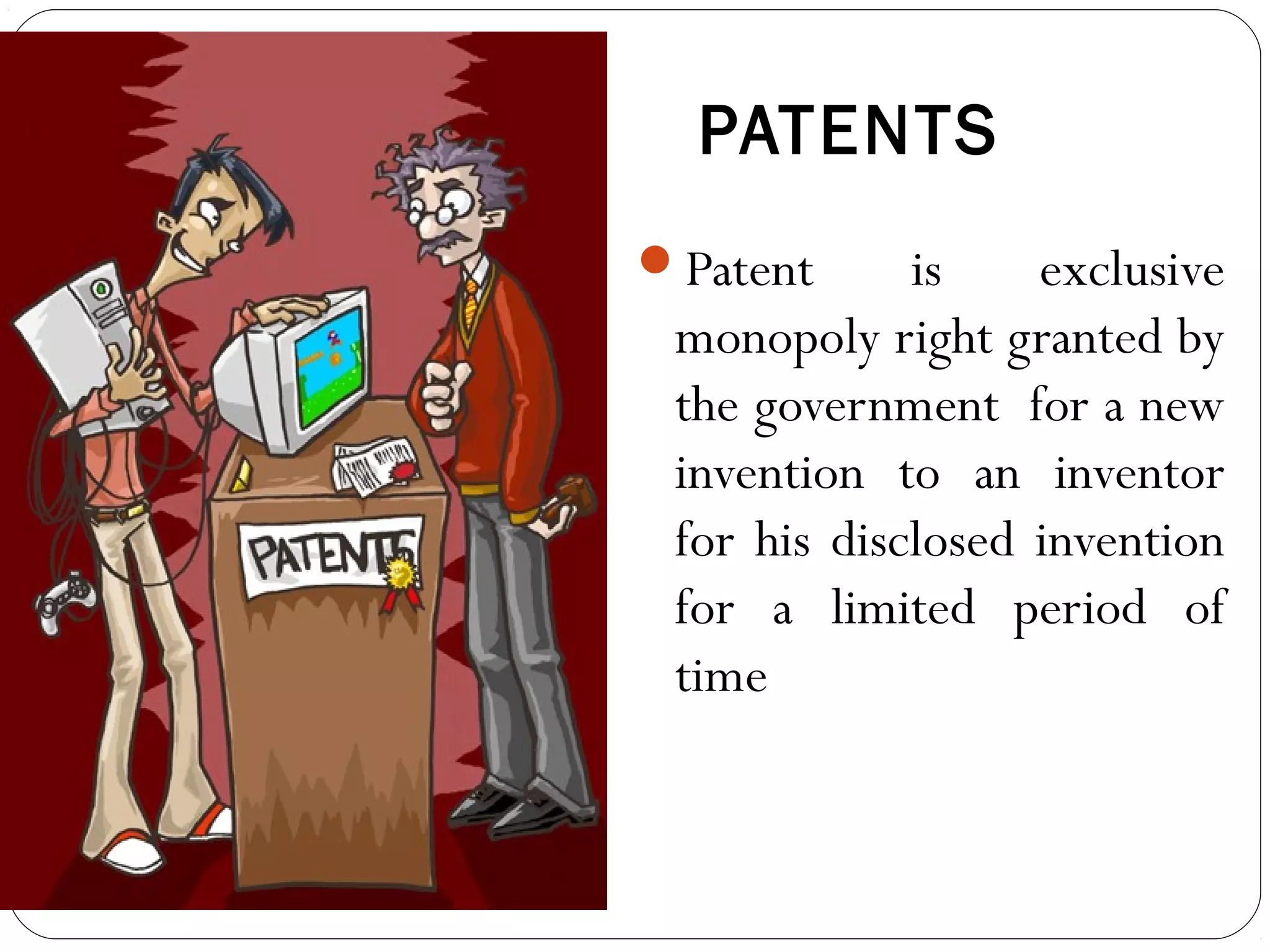
PATENTS
Patent is exclusive
monopoly right granted by
the government for a new
invention to an inventor
for his disclosed invention
for a limited period of
time
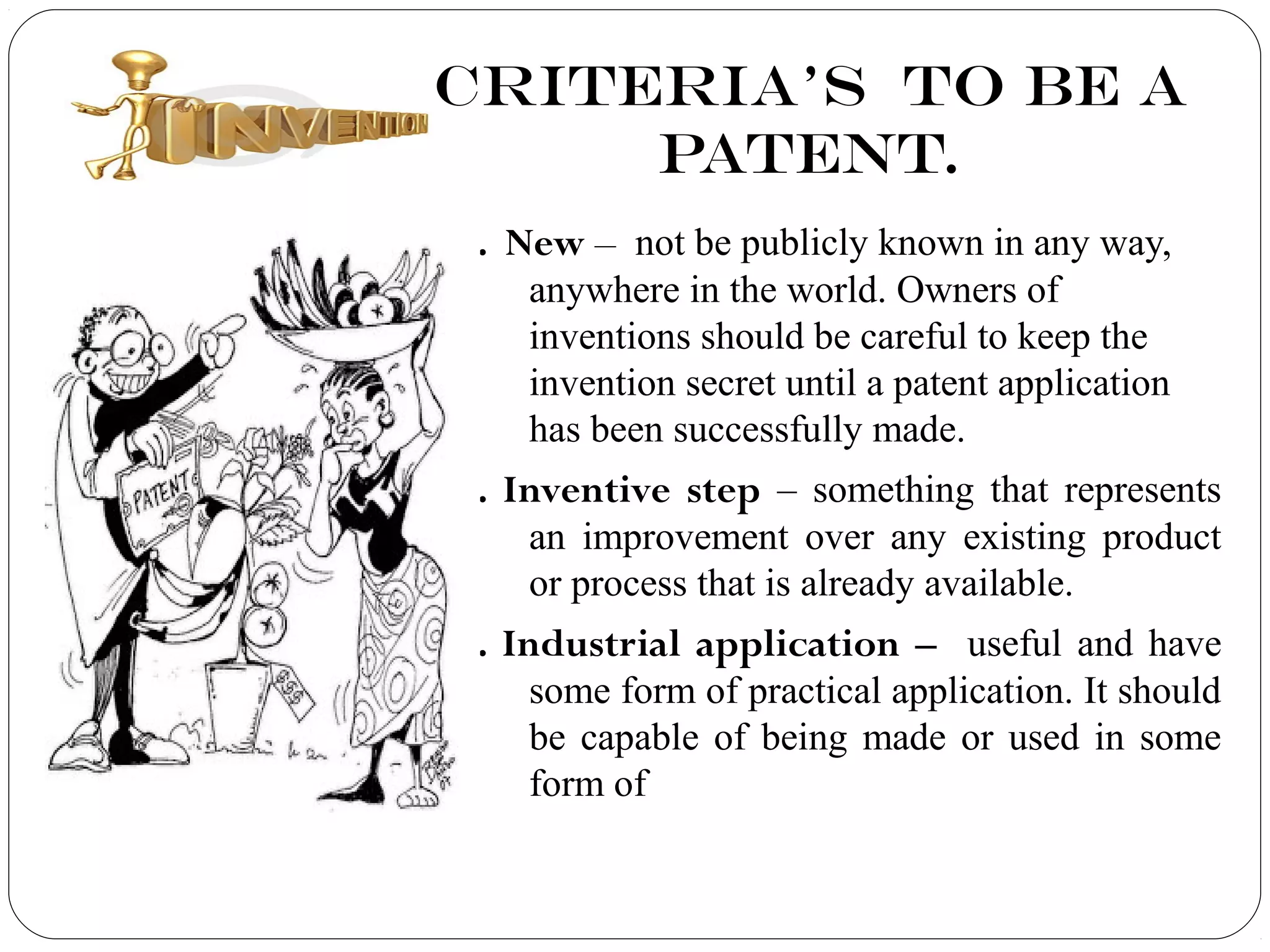
CRITERIA’S TO BE A
PATENT.
1. New – not be publicly known in any way,
anywhere in the world. Owners of
inventions should be careful to keep the
invention secret until a patent application
has been successfully made.
2. Inventive step – something that represents
an improvement over any existing product
or process that is already available.
3. Industrial application – useful and have
some form of practical application. It should
be capable of being made or used in some
form of
Generally not Patentable
Discoveries
Mathematical Models
ScientificTheories
Schemes
Rules
Playing games
Method of Business
Programmes for computers
Presentation of Information
ADVANTAGES OF PANTENTS
 Protection to the patentee, enabling him to enjoy the right
and to raise the capital for working his invention on a
commercial scale.
The patentee would be able to make a profitable use of his
invention by selling his patent or by granting license to
others, permitting the use of his invention.
Helps for industrial growth by introducing new
technologies.
The scientific knowledge contained in the patent
specification helps as a stepping stone for further research.
Provide inventive and creative ideas for further R & D in
the field.
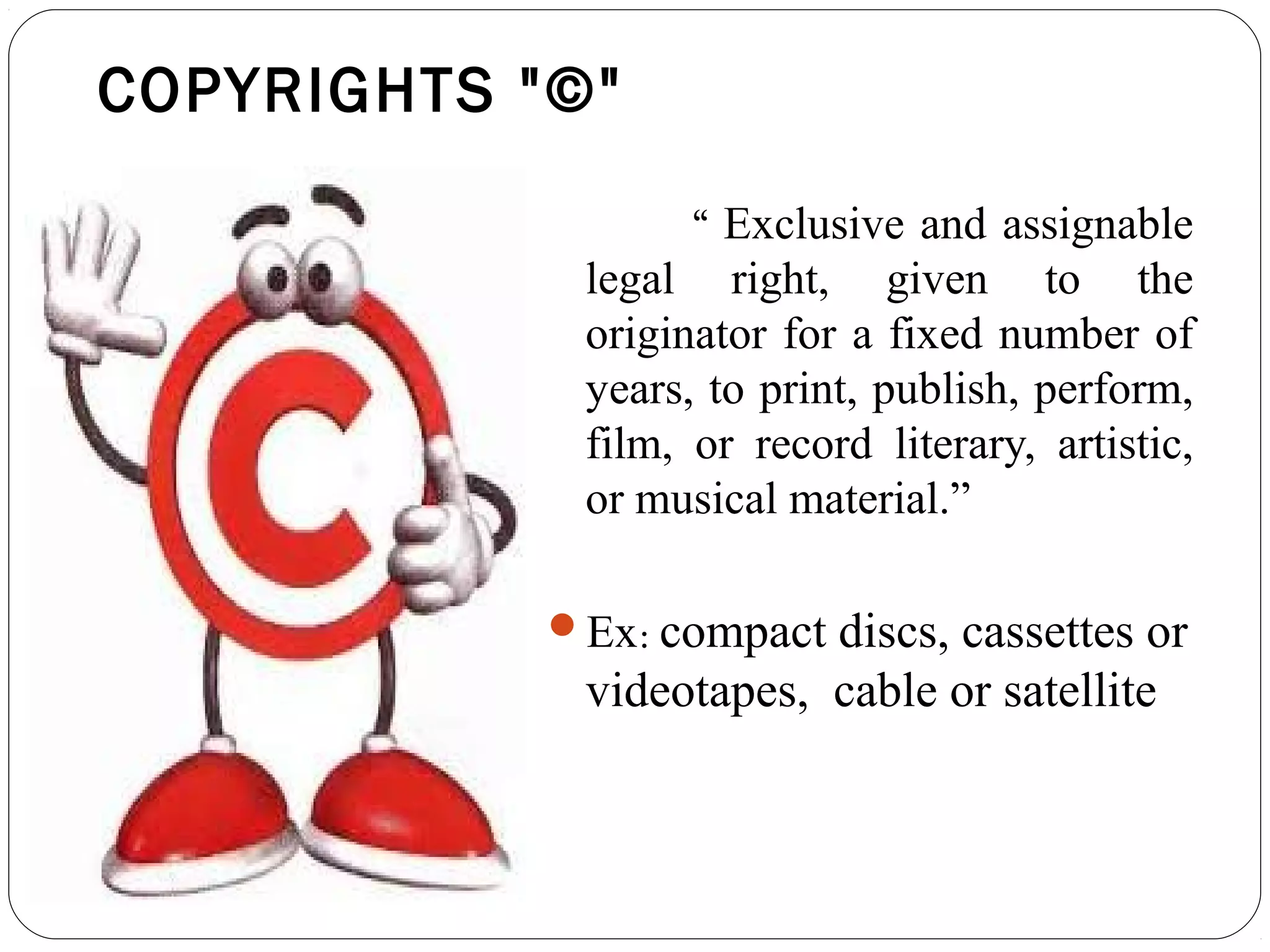
COPYRIGHTS "©"
“ Exclusive and assignable
legal right, given to the
originator for a fixed number of
years, to print, publish, perform,
film, or record literary, artistic,
or musical material.”
Ex: compact discs, cassettes or
videotapes, cable or satellite
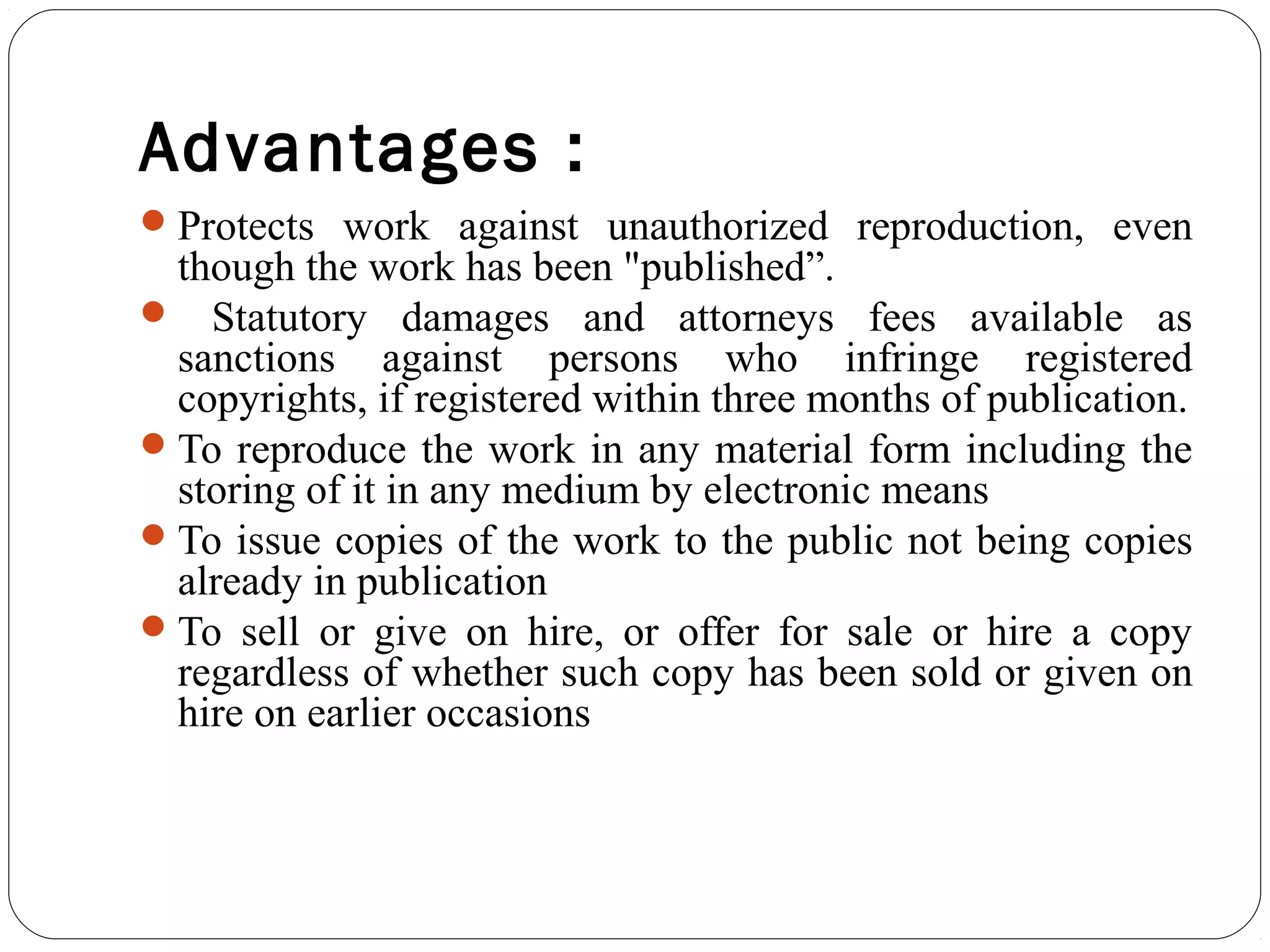
Copyright
Literary works
Dramatic works
Musical works
Artistic works
Cinematographic
Sound recording
Computer programmes
Advantages :
Protects work against unauthorized reproduction, even
though the work has been "published”.
 Statutory damages and attorneys fees available as
sanctions against persons who infringe registered
copyrights, if registered within three months of publication.
To reproduce the work in any material form including the
storing of it in any medium by electronic means
To issue copies of the work to the public not being copies
already in publication
To sell or give on hire, or offer for sale or hire a copy
regardless of whether such copy has been sold or given on
hire on earlier occasions
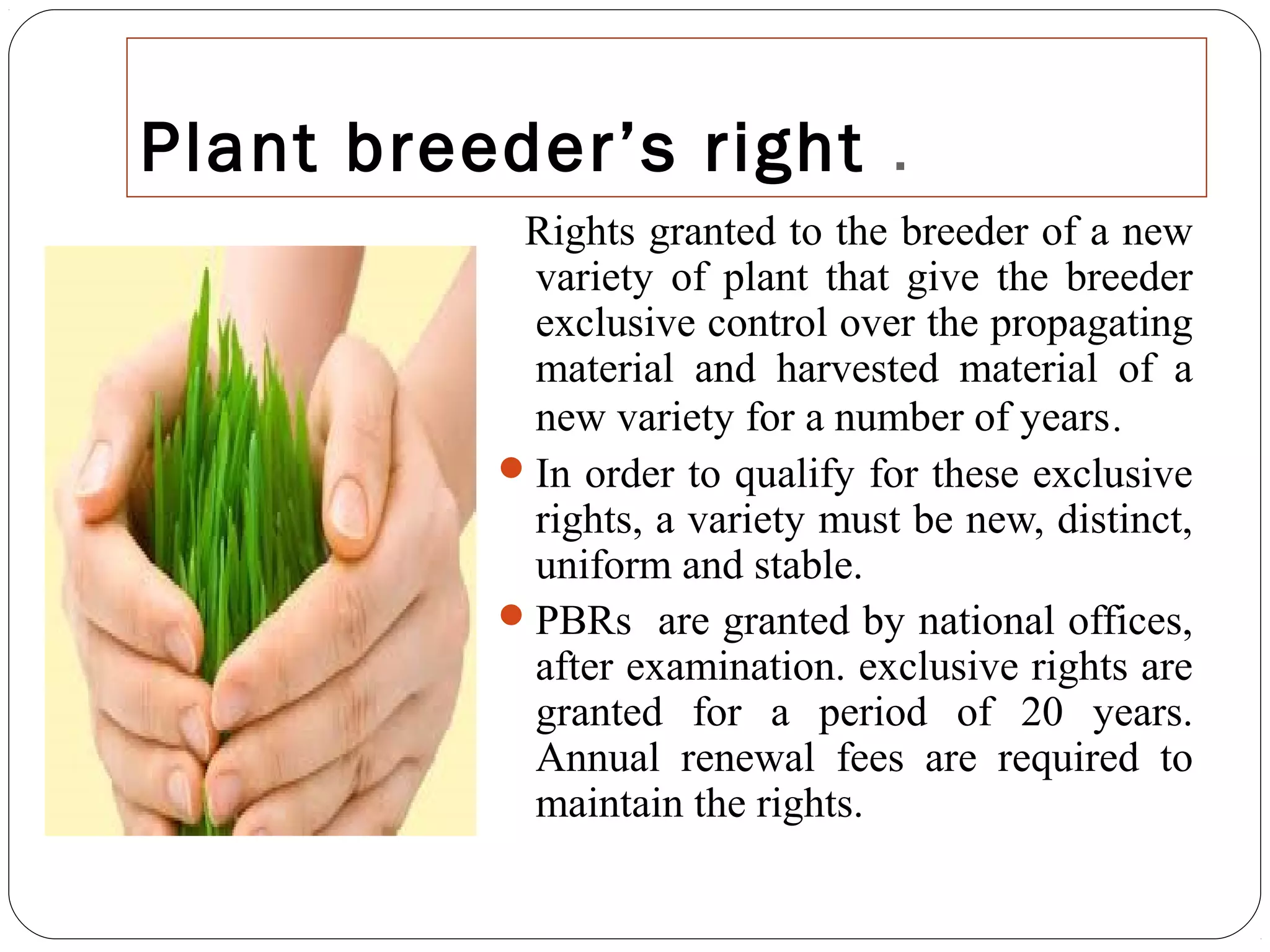
Plant breeder’s right .
Rights granted to the breeder of a new
variety of plant that give the breeder
exclusive control over the propagating
material and harvested material of a
new variety for a number of years.
In order to qualify for these exclusive
rights, a variety must be new, distinct,
uniform and stable.
PBRs are granted by national offices,
after examination. exclusive rights are
granted for a period of 20 years.
Annual renewal fees are required to
maintain the rights.
BENEFITS:
PBR protection allows you to exclude others from:
producing or reproducing the material
conditioning the material for the purpose of propagation
offering the material for sale
selling the material
importing the material
exporting the material
stocking the material for any of the purposes described
above
TRADE MARKS
Recognizable sign, design or expression which identifies
products or services of a particular source from others. The
trademark owner can be an individual, business organization,
or any legal entity.
Typically a name, word, phrase, logo, symbol, design, image,
or a combination of these elements.
Trademarks are used to claim exclusive properties of products
or services.
The usage of trademarks by its owner can cause legal issues if
this usage makes them guilty of false advertising or if the
trademark is offensive. Trademarks can be owned, but also
licensed.
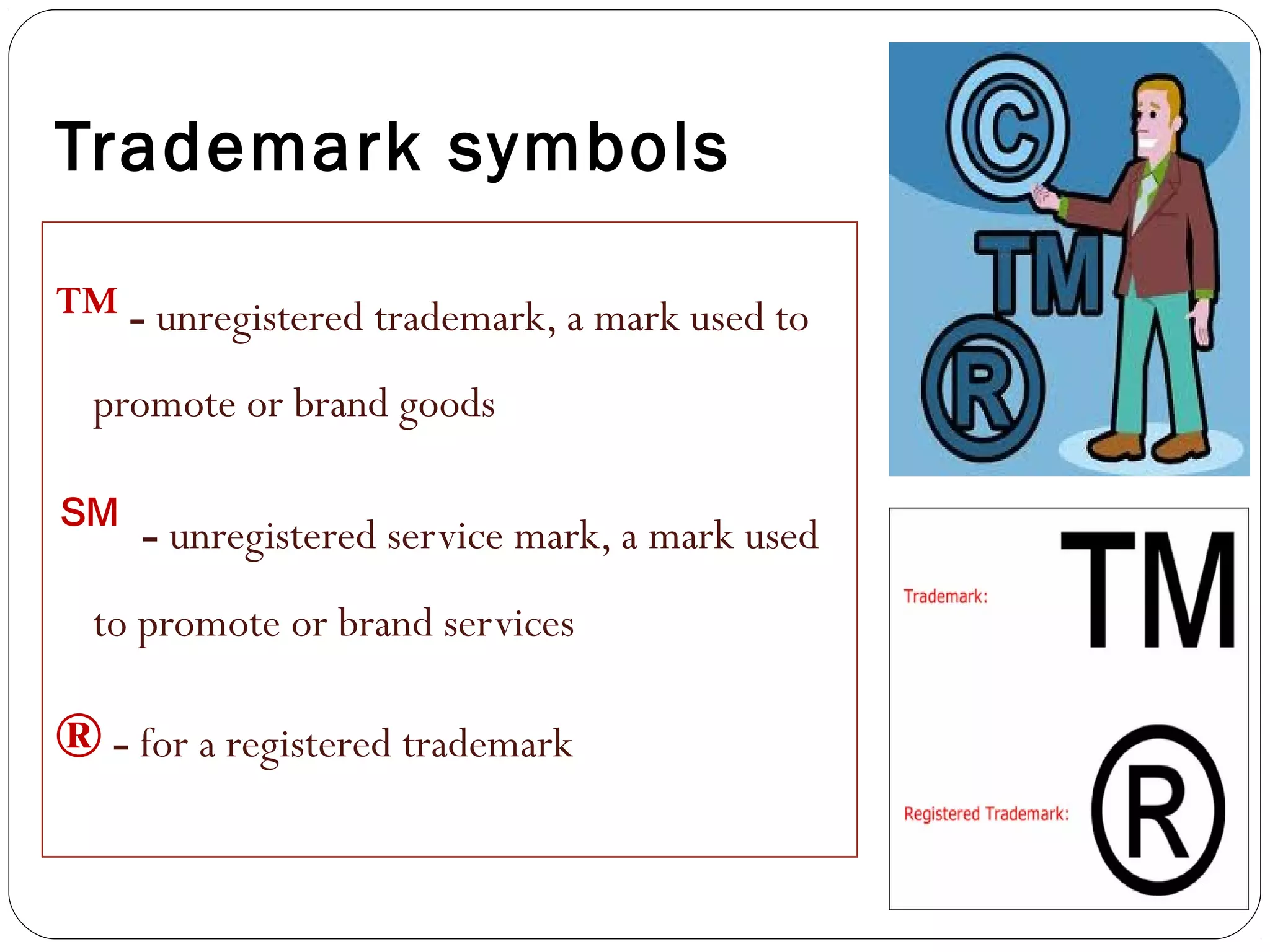
Trademark symbols
™ - unregistered trademark, a mark used to
promote or brand goods
℠ - unregistered service mark, a mark used
to promote or brand services
® - for a registered trademark
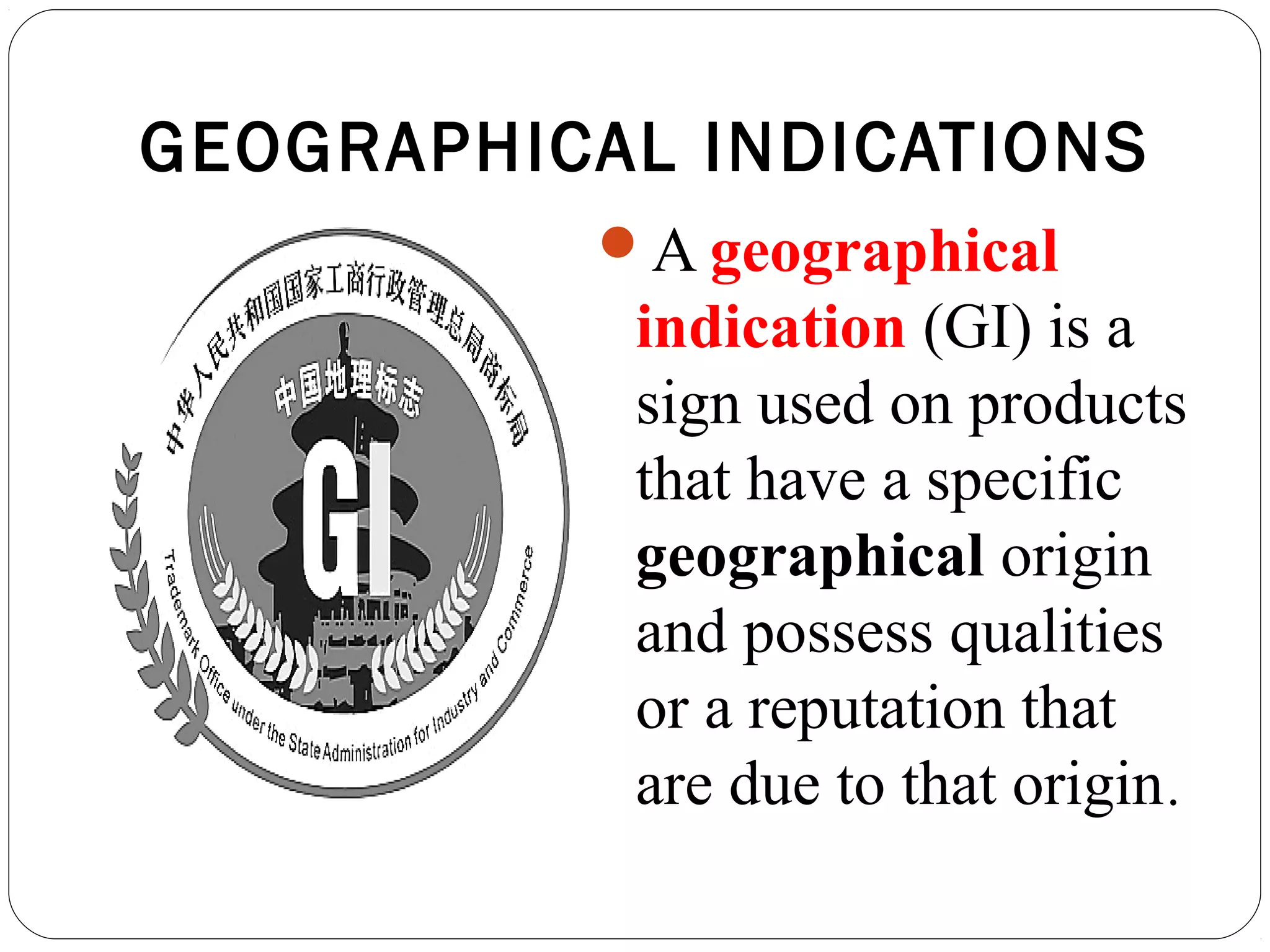
GEOGRAPHICAL INDICATIONS
A geographical
indication (GI) is a
sign used on products
that have a specific
geographical origin
and possess qualities
or a reputation that
are due to that origin.
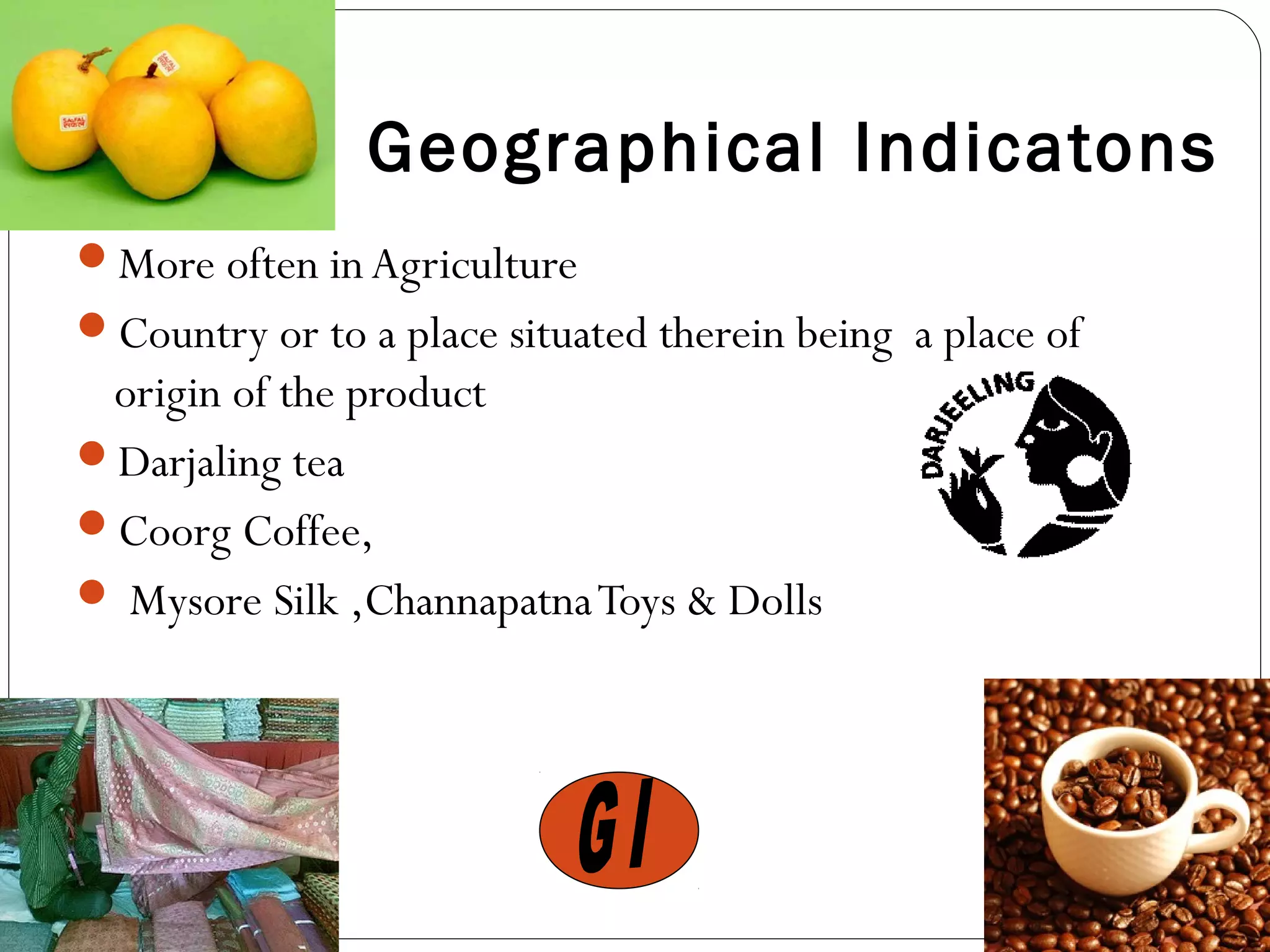
Geographical Indicatons
More often inAgriculture
Country or to a place situated therein being a place of
origin of the product
Darjaling tea
Coorg Coffee,
 Mysore Silk ,ChannapatnaToys & Dolls
BENEFITS
Confers legal protection to GIs in India.
Prevents unauthorized use of a GI by
others.
Helps consumers to get quality products of
desired brands.
Promotes economic prosperity of the
producers of goods.
Essential to get protection in other
countries.
TRADE SECRECTS
Protects businesses from the
unauthorized disclosure or use of
confidential information.
Confidential information includes
inventions not yet at the patenting
stage, ways of organizing business,
client lists, purchasing
specifications, and so on.
 In agriculture, breeders rely on
trade secrets to protect hybrid
plant varieties
Protection of trade secrets is not limited in time but, unlike
patents, the disadvantage of this type of protection is that it is
lost the moment it is discovered independently by a third
party.
 The advantage, at least to the proprietor, is that, unlike
patents, there is no obligation to disclose the inventive or
creative ideas to society.
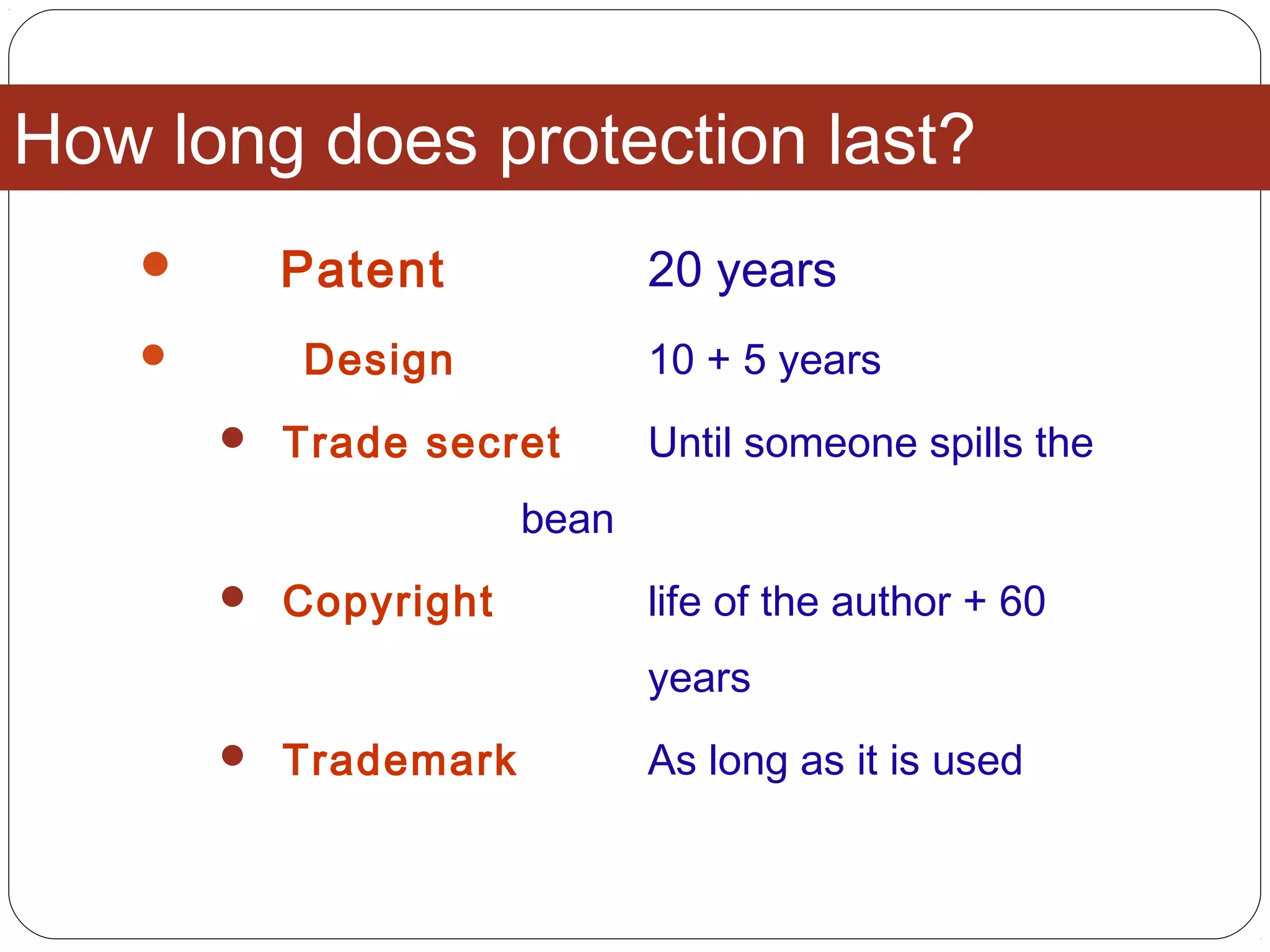
How long does protection last?
 Patent 20 years
 Design 10 + 5 years
 Trade secret Until someone spills the
bean
 Copyright life of the author + 60
years
 Trademark As long as it is used
Click to add title
RESEARC
H
STUDIES
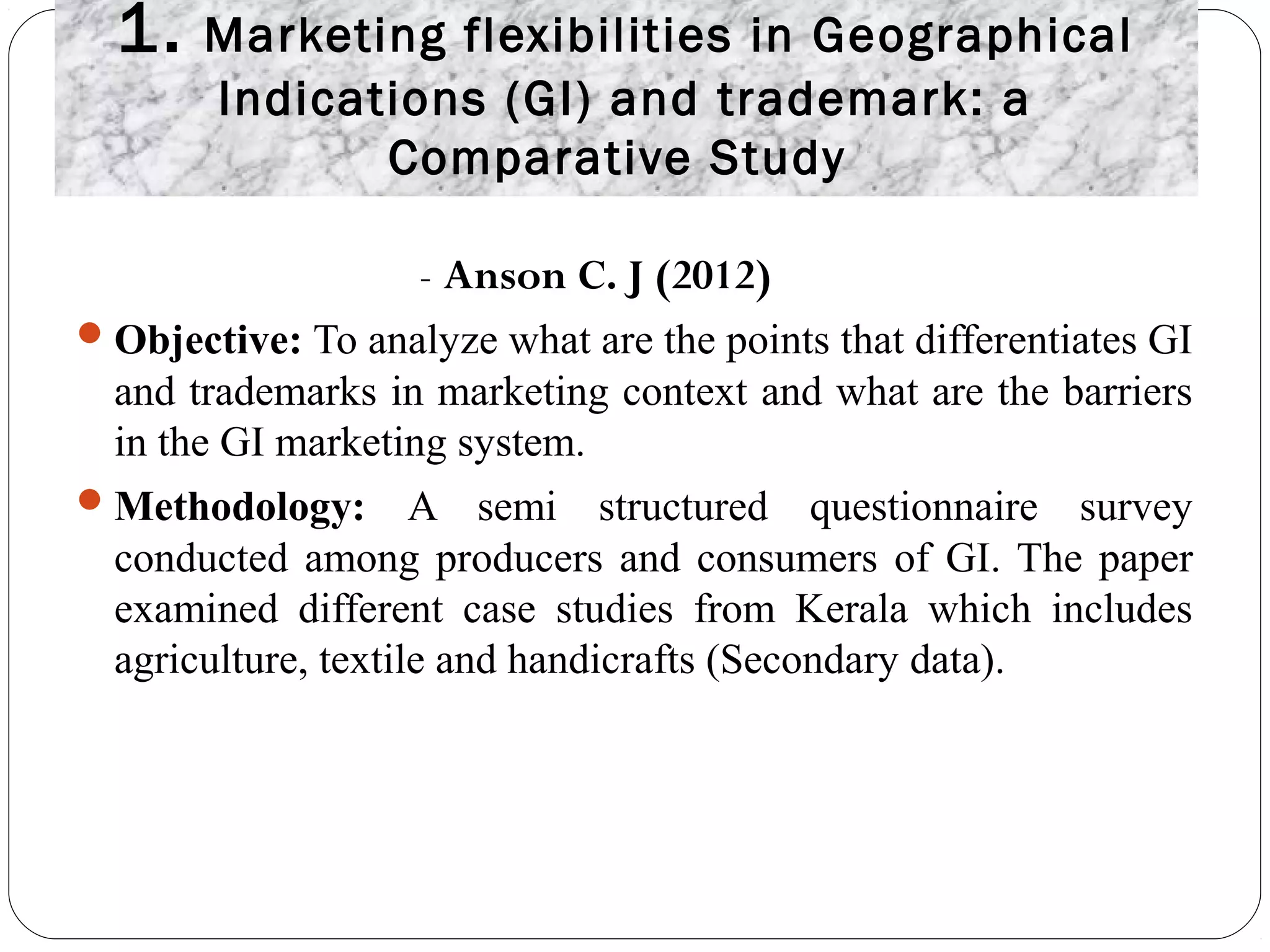
1. Marketing flexibilities in Geographical
Indications (GI) and trademark: a
Comparative Study
- Anson C. J (2012)
Objective: To analyze what are the points that differentiates GI
and trademarks in marketing context and what are the barriers
in the GI marketing system.
Methodology: A semi structured questionnaire survey
conducted among producers and consumers of GI. The paper
examined different case studies from Kerala which includes
agriculture, textile and handicrafts (Secondary data).
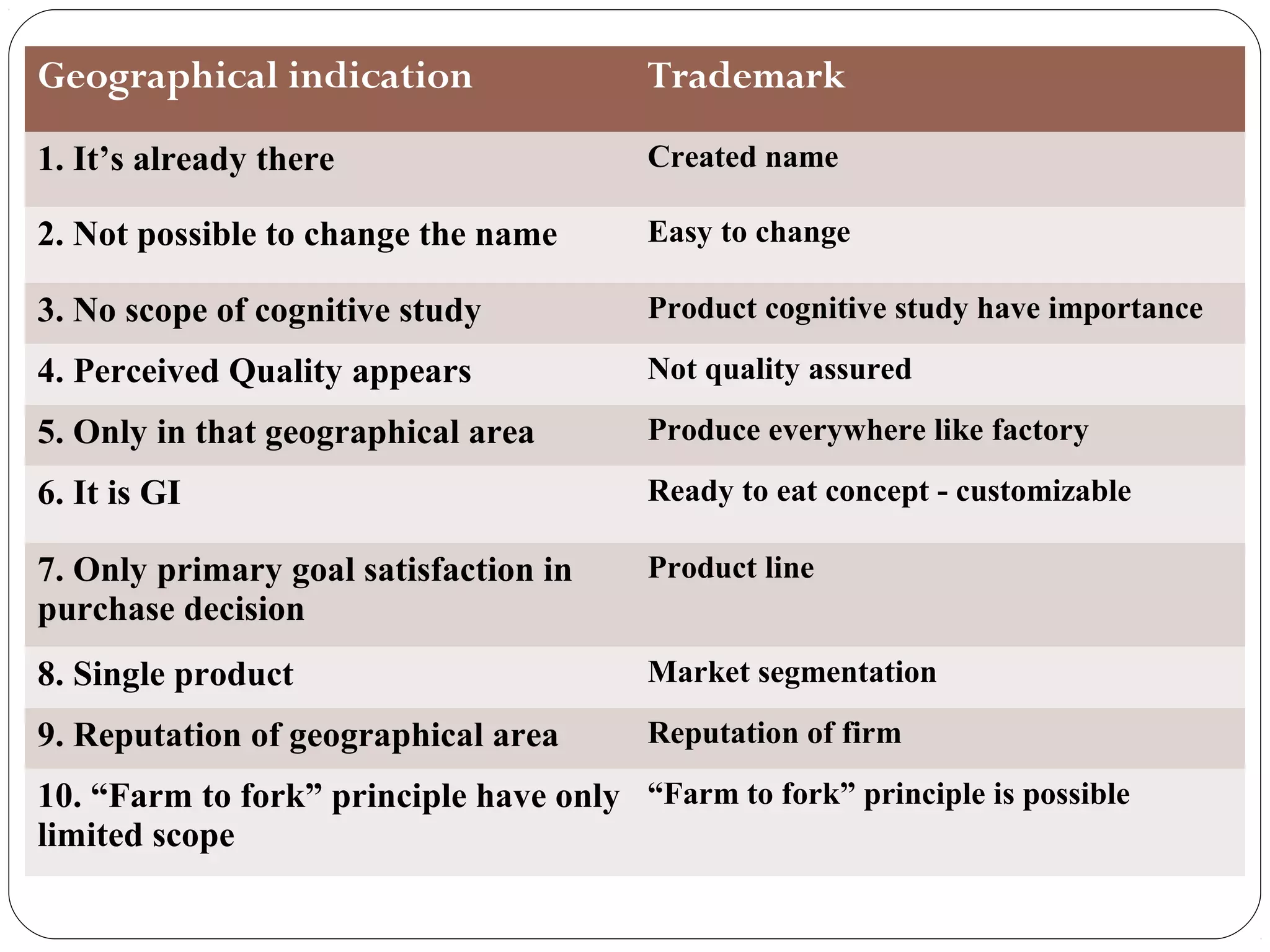
Table .1
Geographical indication Trademark
1. It’s already there Created name
2. Not possible to change the name Easy to change
3. No scope of cognitive study Product cognitive study have importance
4. Perceived Quality appears Not quality assured
5. Only in that geographical area Produce everywhere like factory
6. It is GI Ready to eat concept - customizable
7. Only primary goal satisfaction in
purchase decision
Product line
8. Single product Market segmentation
9. Reputation of geographical area Reputation of firm
10. “Farm to fork” principle have only
limited scope
“Farm to fork” principle is possible
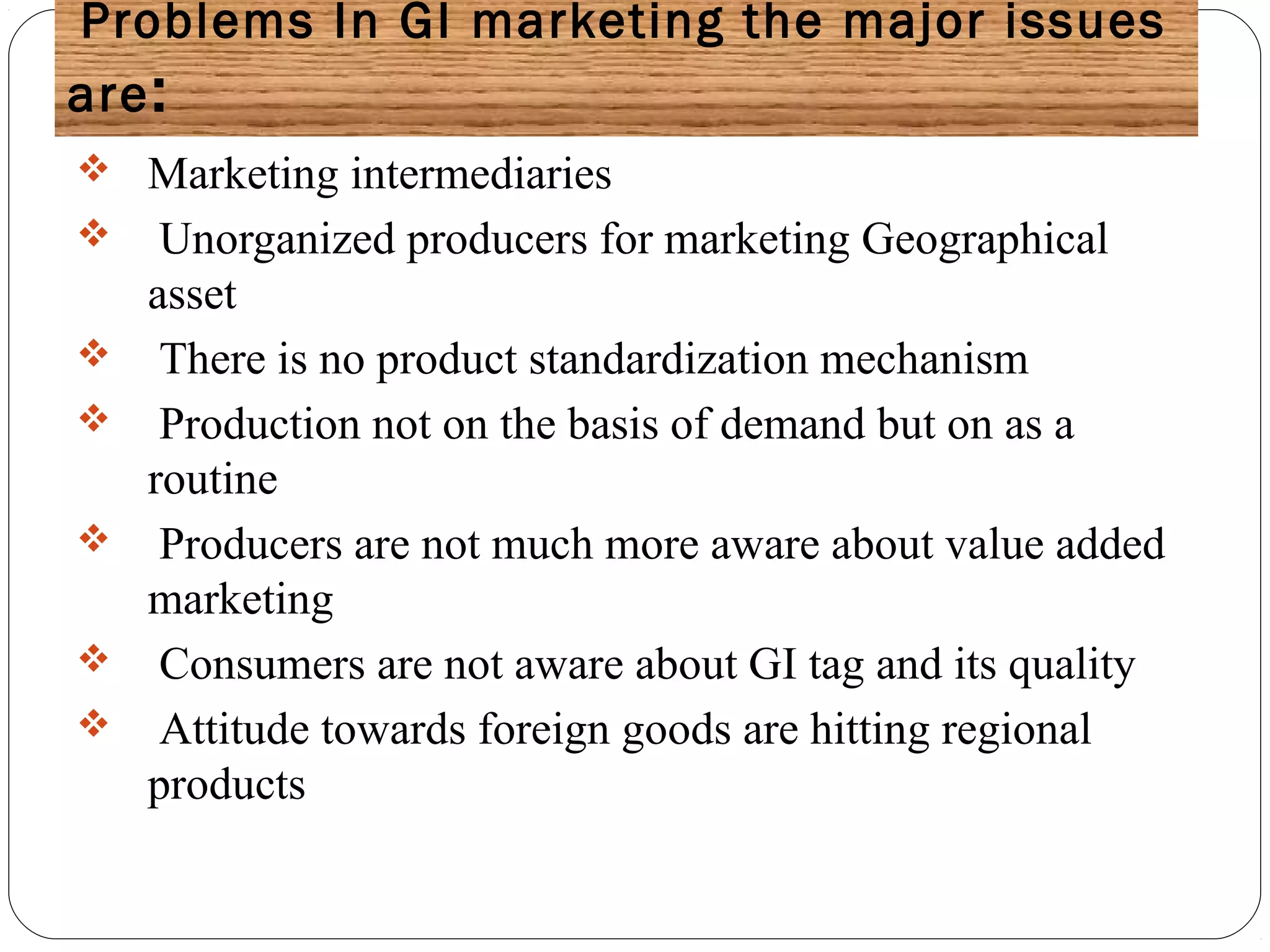
Problems In GI marketing the major issues
are:
 Marketing intermediaries
 Unorganized producers for marketing Geographical
asset
 There is no product standardization mechanism
 Production not on the basis of demand but on as a
routine
 Producers are not much more aware about value added
marketing
 Consumers are not aware about GI tag and its quality
 Attitude towards foreign goods are hitting regional
products
2.The Protection of Geographical Indications in
India: Issues and Challenges
-Nitya et al (2013)
Methodology:
Survey conducted by TERI for three registered GI-
Banarsi sari, Malabar pepper and Bikaneri Bhujia, on the basis
of a standard questionnaire prepared especially for the purpose
with 60 respondents.
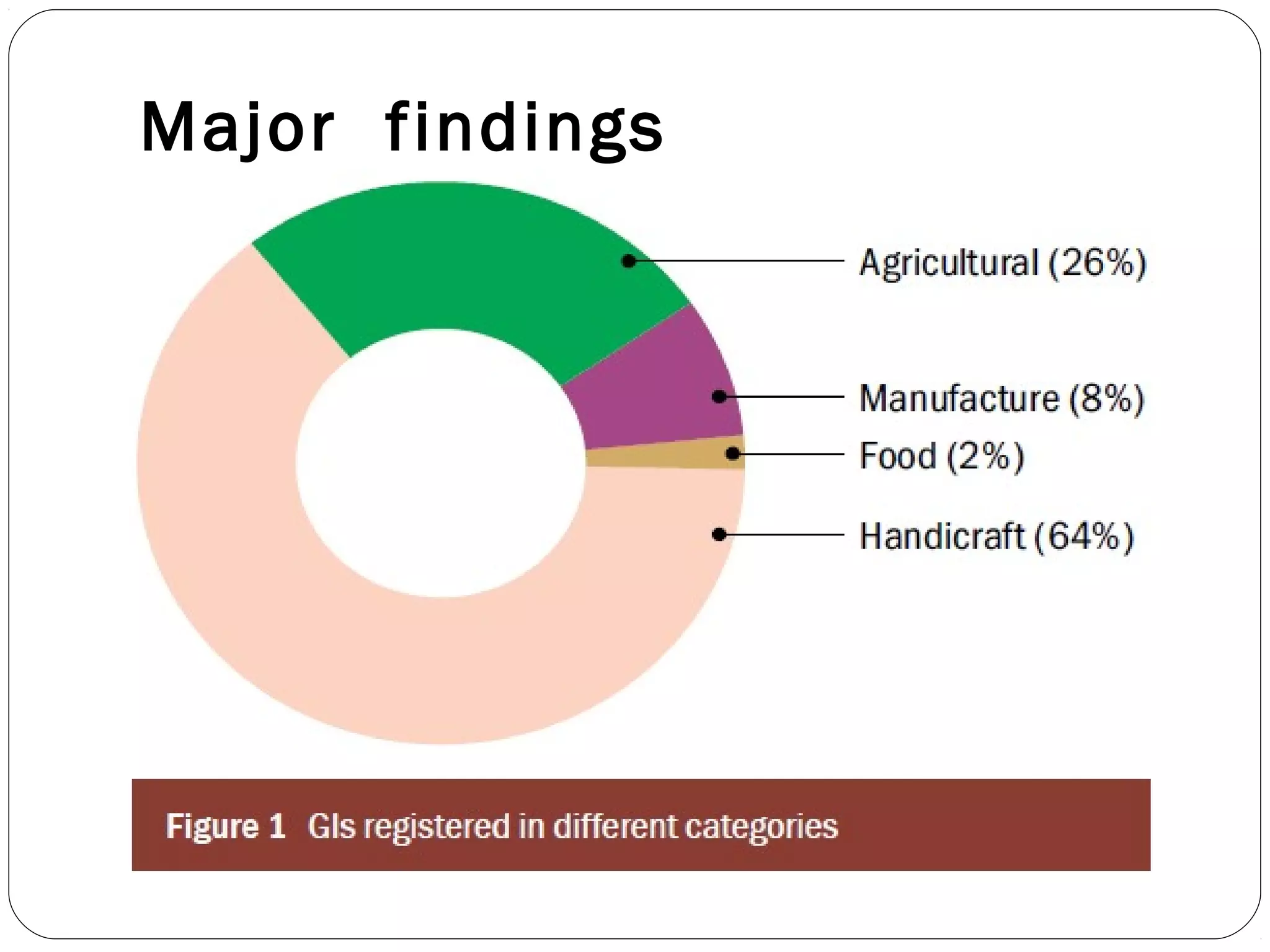
Major findings
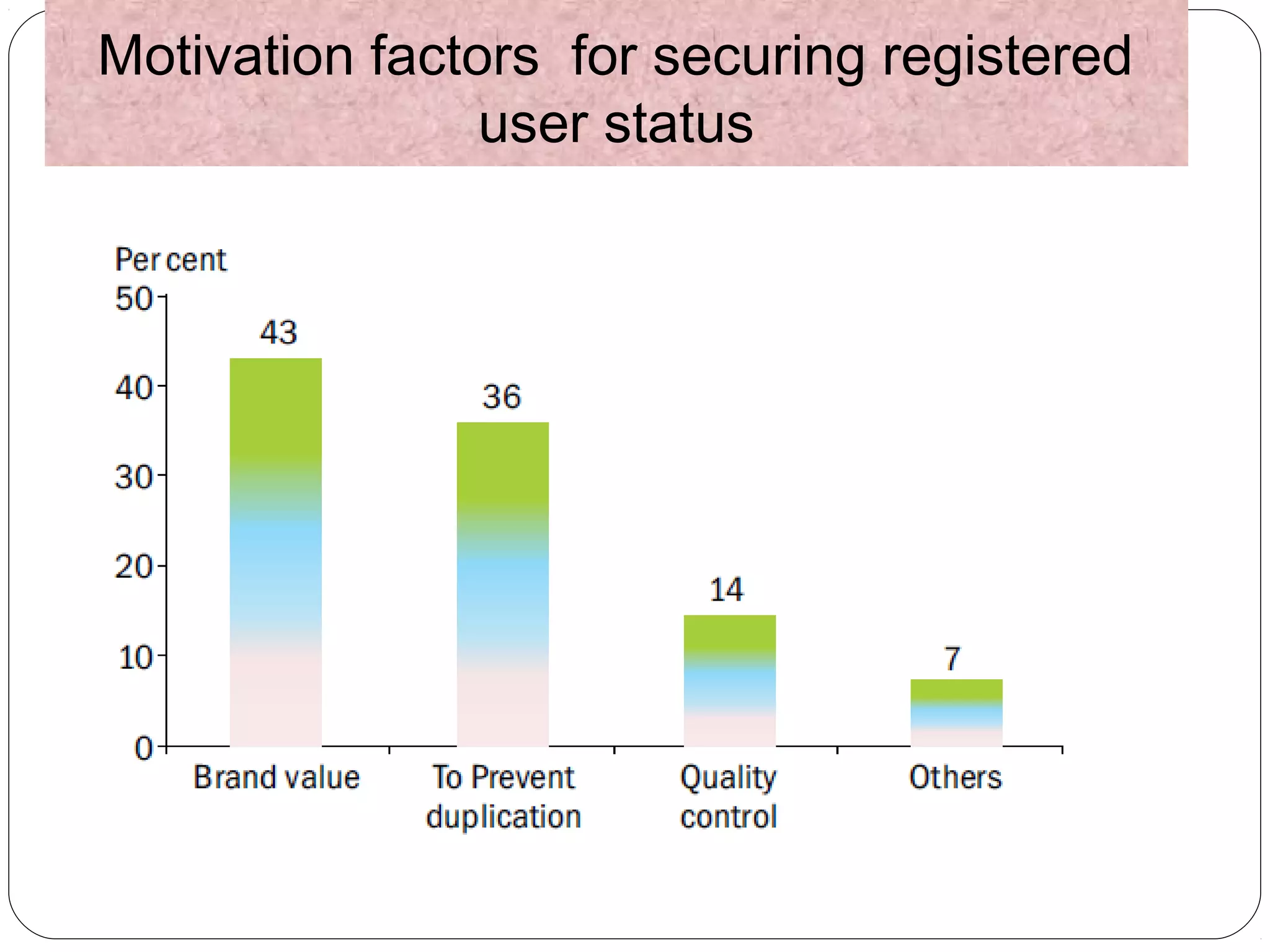
Motivation factors for securing registered
user status
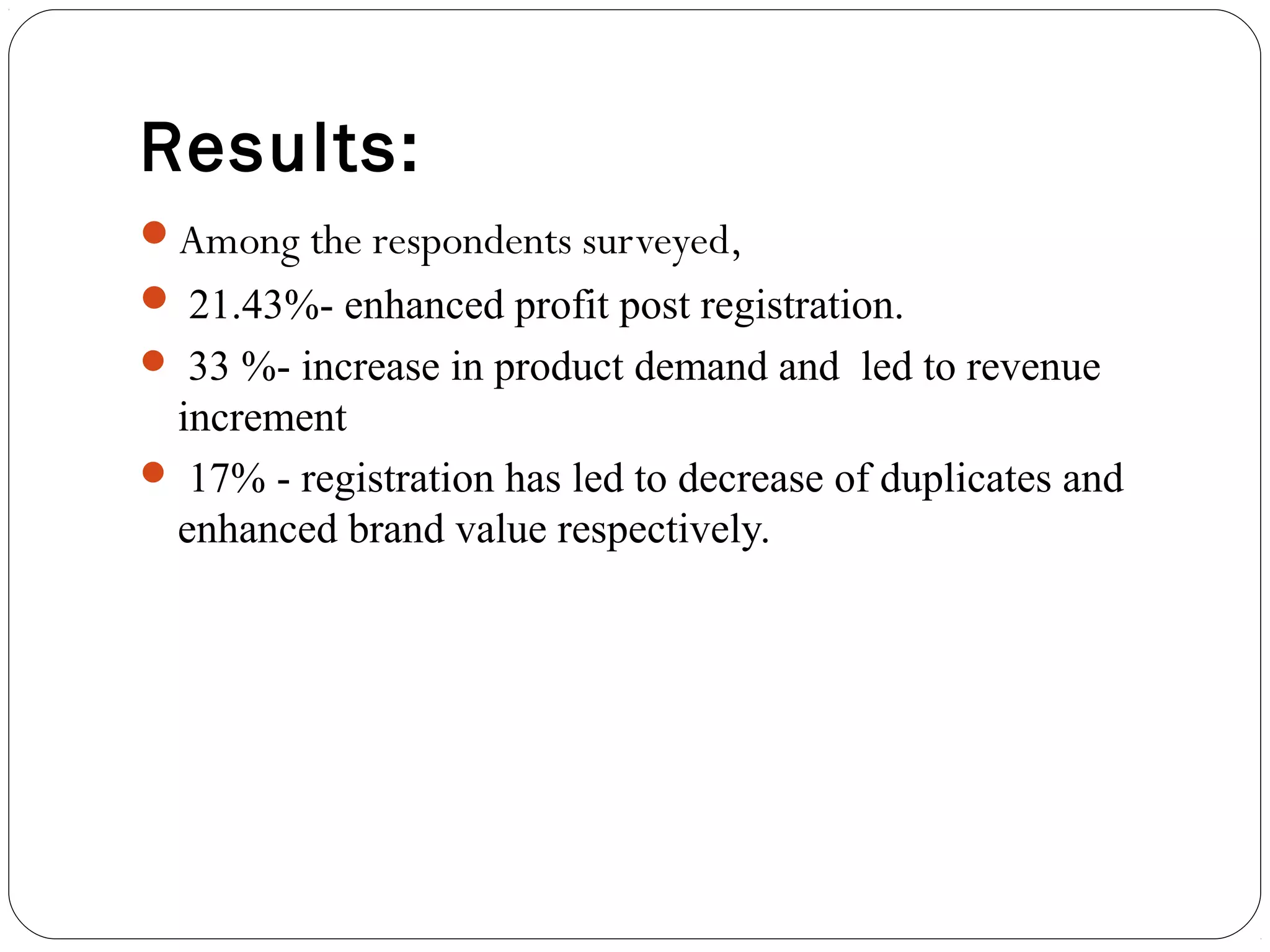
Results:
Among the respondents surveyed,
 21.43%- enhanced profit post registration.
 33 %- increase in product demand and led to revenue
increment
 17% - registration has led to decrease of duplicates and
enhanced brand value respectively.
3.Geographical indications in Croatia
A case study of Virovitica pepper
-Marija et al (2006)
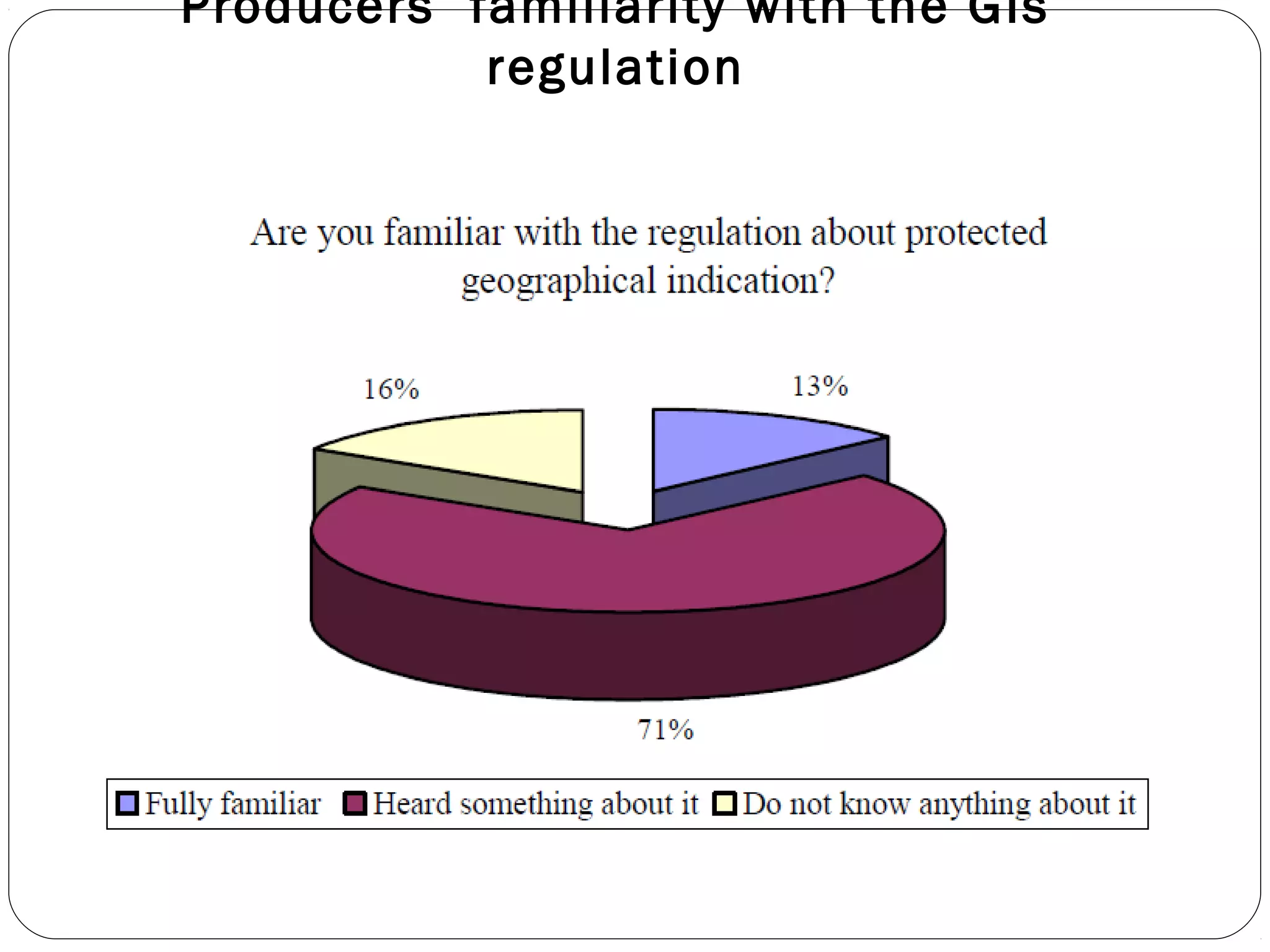
Producers’ familiarity with the GIs
regulation
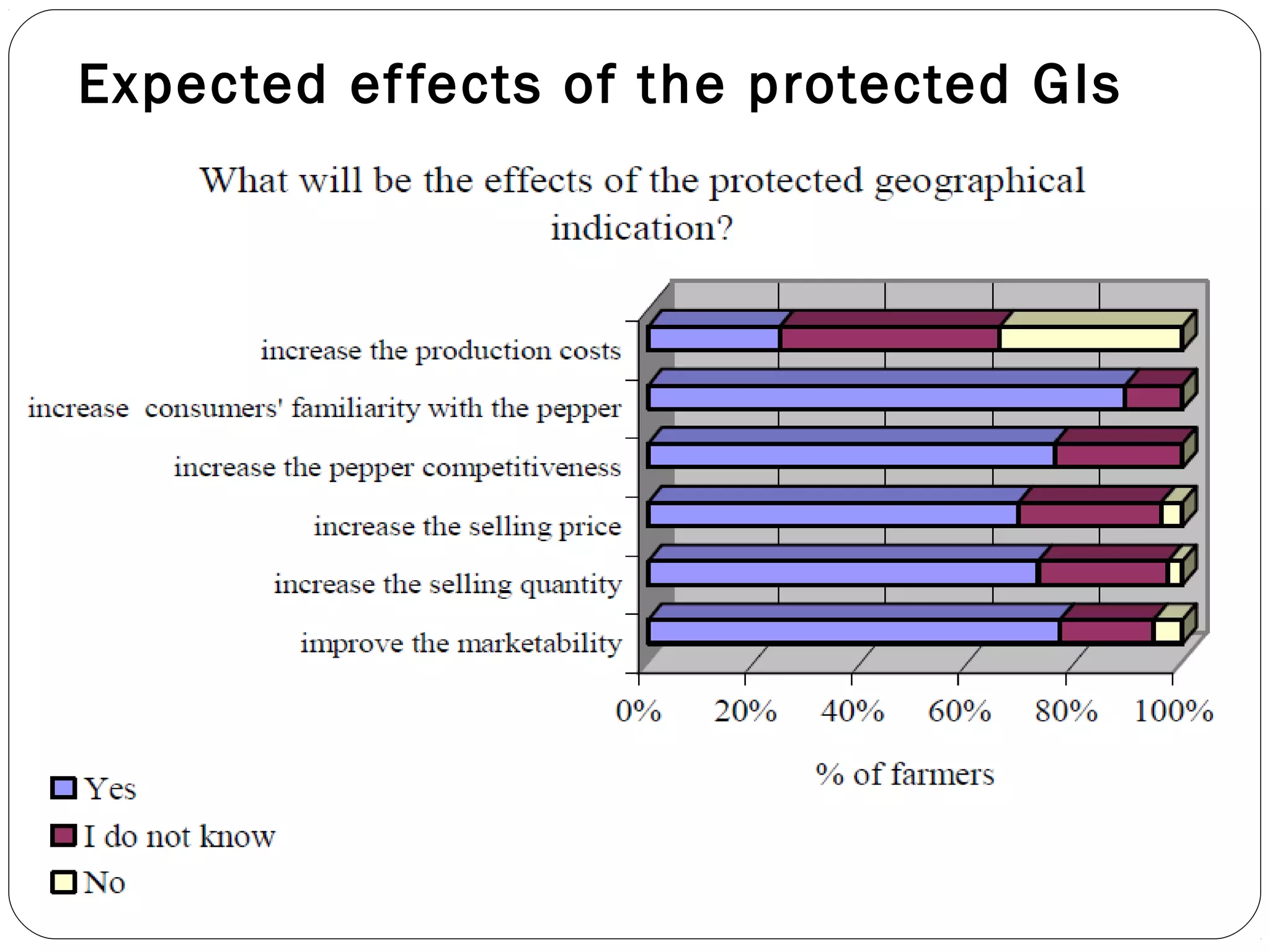
Expected effects of the protected GIs
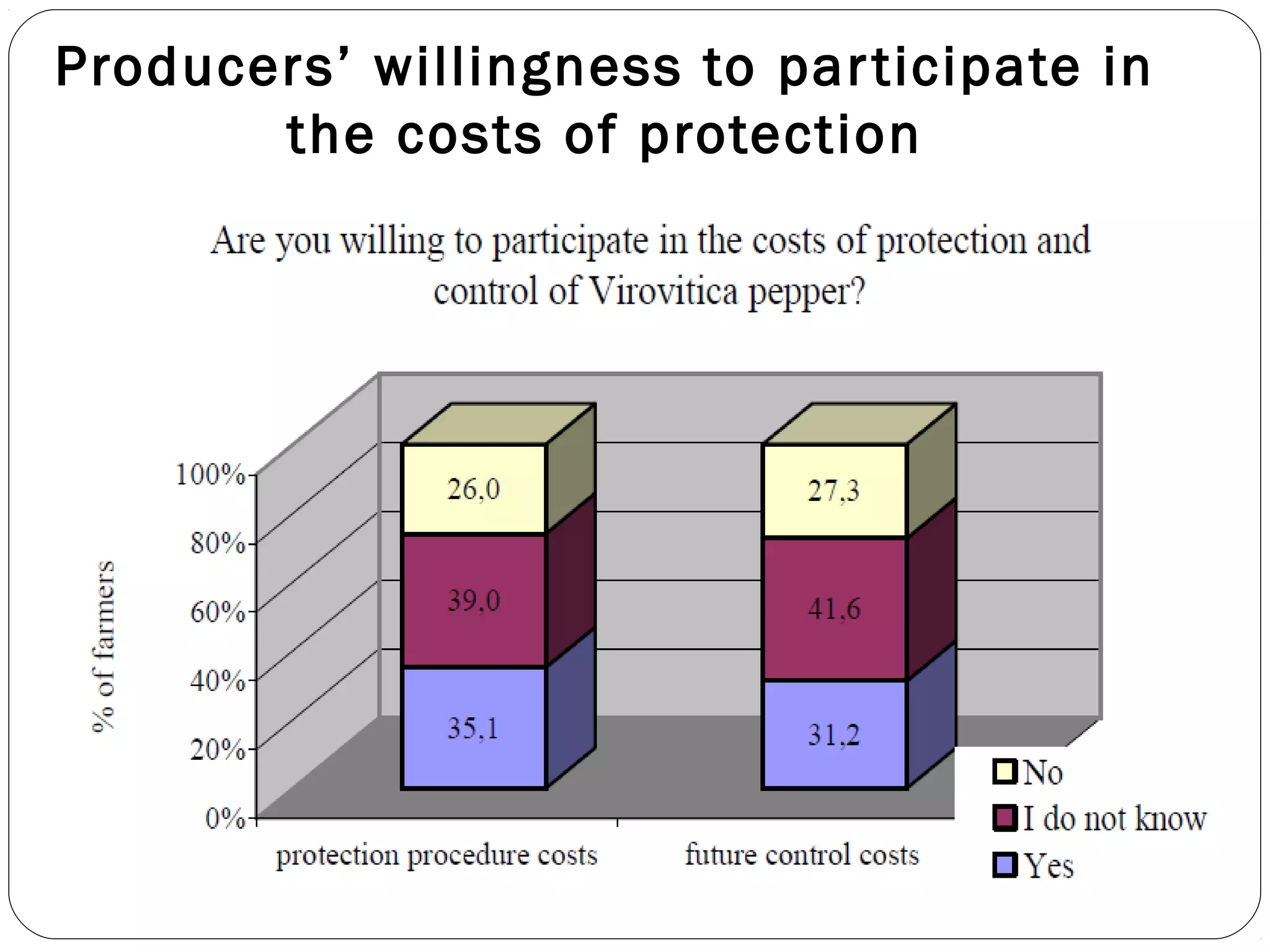
Producers’ willingness to participate in
the costs of protection
4.Celebrated issues of patents
in india :
 Farmers will no longer be able to use these products without
paying royalties
 Consumers will also be deprived of cheap medicines
 Local communities should receive a share of the commercial
gains: after all — the argument goes — the companies owning
the patents learnt of the value of the species through local
knowledge, so they have a debt to repay.
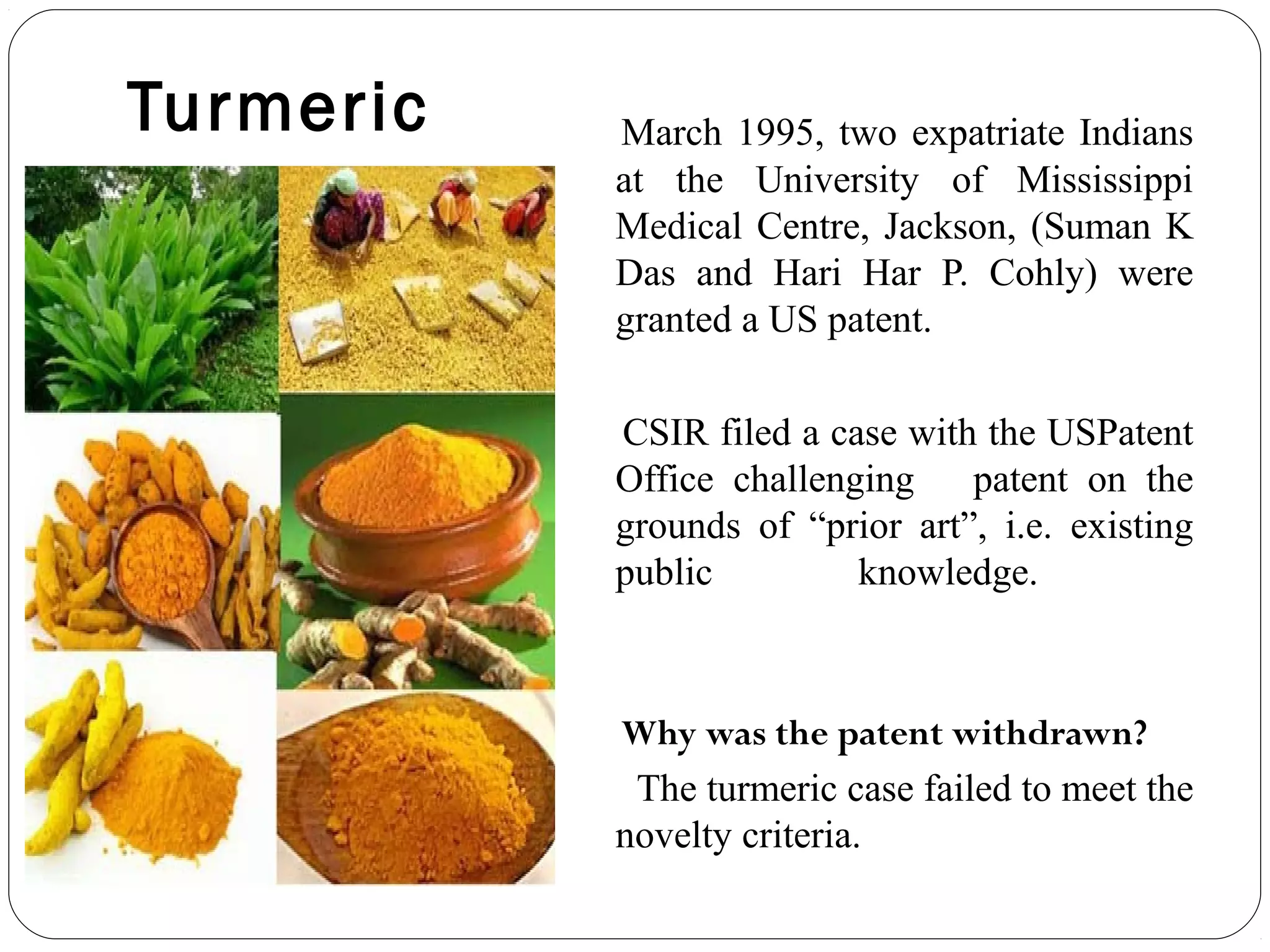
Turmeric March 1995, two expatriate Indians
at the University of Mississippi
Medical Centre, Jackson, (Suman K
Das and Hari Har P. Cohly) were
granted a US patent.
CSIR filed a case with the USPatent
Office challenging patent on the
grounds of “prior art”, i.e. existing
public knowledge.
Why was the patent withdrawn? 
The turmeric case failed to meet the
novelty criteria.
Neem : The Green Gold
Numerous neem products have received patents. Several of these
have been granted to Indian companies for a range of products
including a contraceptive ( National Institute of Immunology in
1993) and an environmentally safe pesticide (for Godrej Soaps in
1994).
Controversial patents granted to the US company WR Grace & Co.
1990 -improving the storage stability of neem seed extracts
containing azadirachtin
 1994 -storage of stable insecticidal composition comprising neem
seed extract.
Farmers protested that the patents would prevent them from using
neem as a source of home-made pesticide.
Contd..
Indian government filed a complaint to the US Patent Office
accusing WR Grace of copying an Indian invention.
 However, in the end, the government withdrew its complaint
as it realized that the US-based company had in fact created a
new invention for the neem extraction process, and the patent
was not based on traditional knowledge.  
It is only these specific newly invented processes that are
covered by the patents. Farmers always have and will continue
to be free to use neem in any traditional way they desire.
The use of neem extract, or its seeds or leaves, cannot be
patented, since they have been used for centuries. Its properties
can only be patented if they are considerably modified.
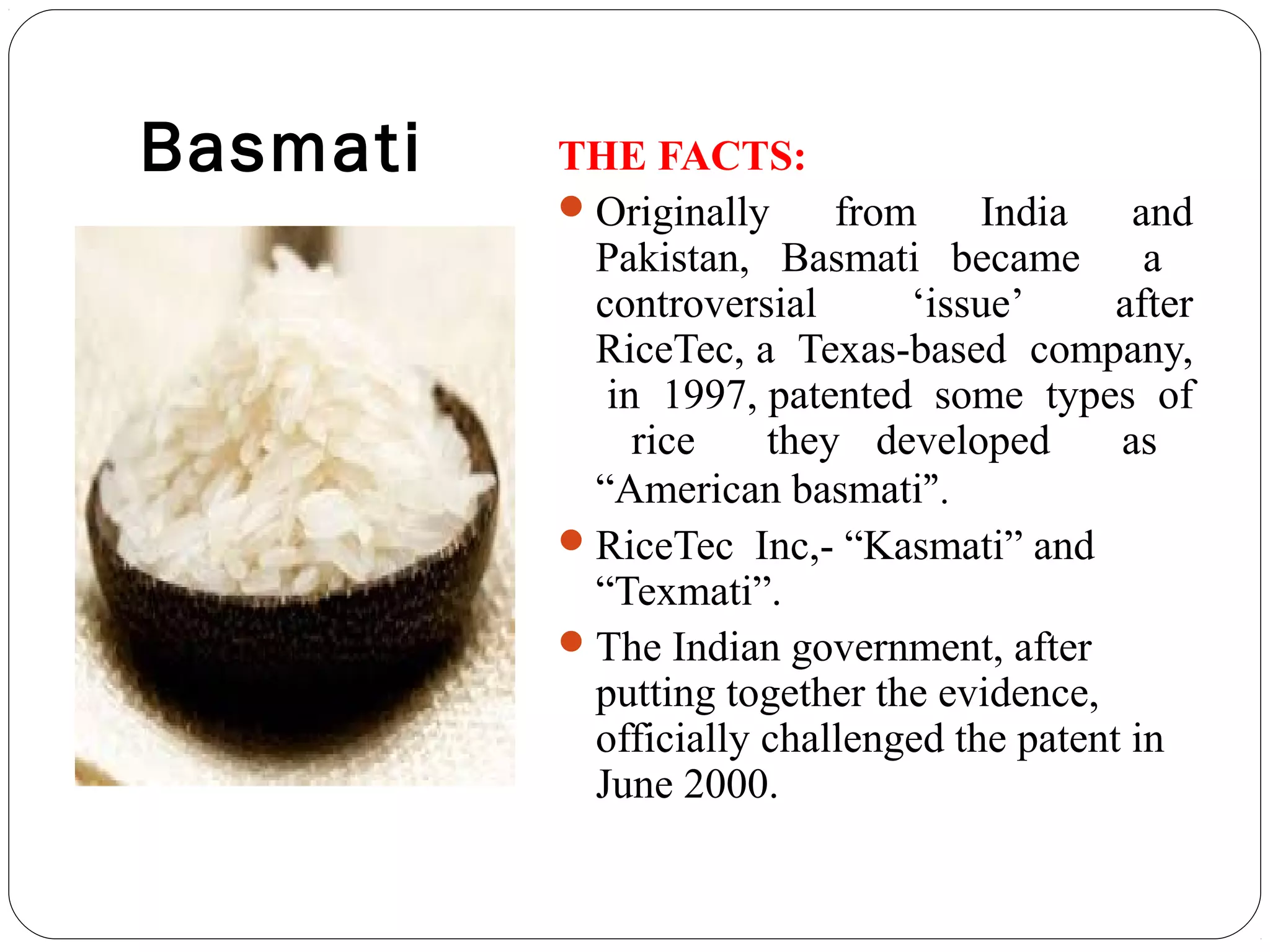
Basmati THE FACTS:
Originally from India and
Pakistan, Basmati became a
controversial ‘issue’ after
RiceTec, a Texas-based company,
in 1997, patented some types of
rice they developed as
“American basmati”.
RiceTec Inc,- “Kasmati” and
“Texmati”.
The Indian government, after
putting together the evidence,
officially challenged the patent in
June 2000.
Threats
Indian farmers export $250 million in Basmati every year
and U.S. is a target market. RiceTec Inc. had attempted to
sell its long-grain rice in Europe .
 However, if the patent is not revoked, RiceTec Inc., can now
sell its rice under the brand name Basmati which will
definitely cut into India’s and Pakistan’s global market share,
especially as the rice grown in the US could be sold cheaper
than the Indian and Pakistani varieties.
Of 40 cases filed, India has been successful in winning 15
cases against countries like Britain, Australia, France, Spain,
Chile and UAE.
Moral of the issues
Many indigenous communities don’t have a written
tradition/culture, recognition ofTK through system of
IPR-difficult and complex.
It highlighted the advantages inherent in the recording of
traditional knowledge.
Socio-economics of protecting GIs: a case
analysis of the indian handloom sector
-Kasturi das (2009)
Sample : Random sample of 256 manufacturers of Nalgonda and
Warangal districts of the Indian state of Andhra Pradesh
‘Pochampally Handloom Weavers’ Co operative Society‐
Limited’ and ‘Pochampally Handloom Tie and Dye
Manufacturers’Association’. Registration was awarded by the
GI Registry on 31 December 2004.
Immediately after the registration, ‘Pochampally Ikat’ received
huge publicity in the media. The demand for ‘Pochampally
Ikat’ sarees increased by 15 20‐ %.
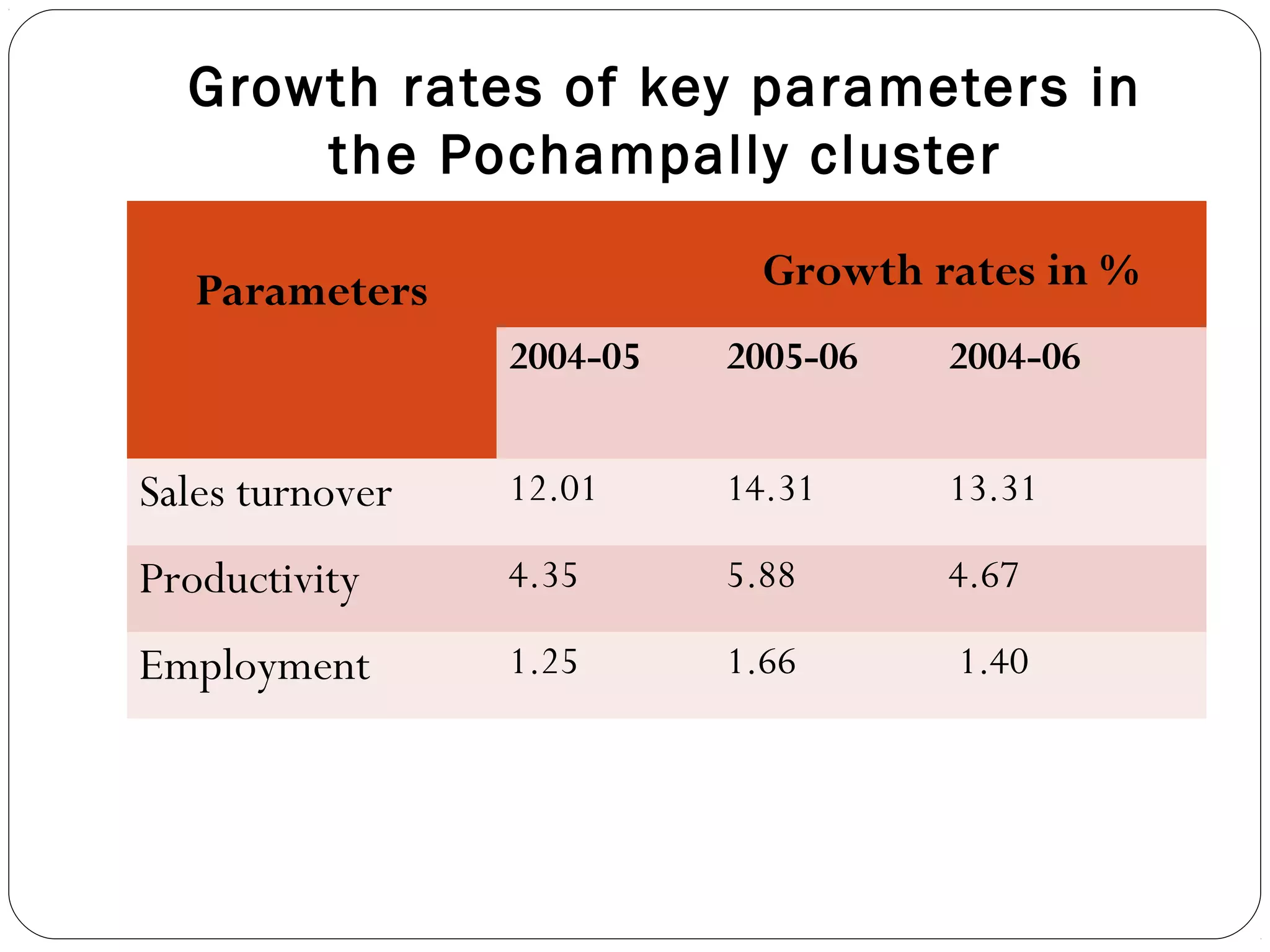
Growth rates of key parameters in
the Pochampally cluster
Parameters Growth rates in %
2004-05 2005-06 2004-06
Sales turnover 12.01 14.31 13.31
Productivity 4.35 5.88 4.67
Employment 1.25 1.66 1.40
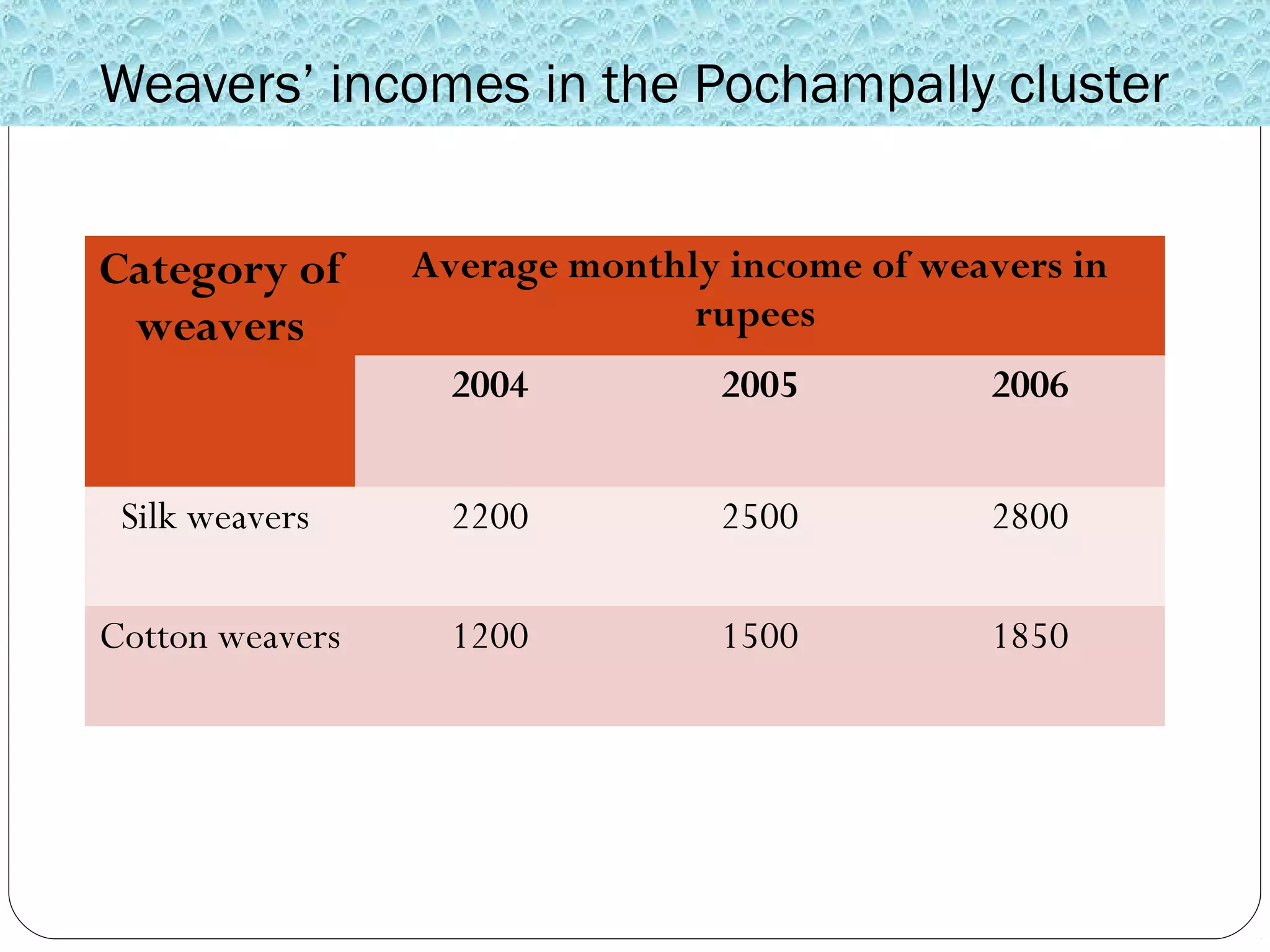
Weavers’ incomes in the Pochampally cluster
Category of
weavers
Average monthly income of weavers in
rupees
2004 2005 2006
Silk weavers 2200 2500 2800
Cotton weavers 1200 1500 1850
CONCLUSION
ETHICS AND IPR ISSUES

ETHICS AND IPR ISSUES

  • 1.
    LOGO Ethics in socialsciEncE and iPR in agRicultuRE. Vijaylaxmi . B Somanatti M.Sc in agril. Extension UAS, dharwad -05
  • 2.
    contEnts Introduction Concept of ethics Principlesof ethics Policies on ethics Ethical issues in research IPR issues Research studies Conclusion
  • 3.
    The term ethicsderives from the Greek word ethos, meaning “character.” According to Denscombe (2002), “ethics concern what ‘ought’ to be done, they are a matter of principled sensitivity to the rights of others”
  • 4.
    Core principles ofresearch ethics : ‘Do no harm’ Informed consent Protection of anonymity and Confidentiality -Denscombe (2002)
  • 5.
    Policies on researchethics 1 Enable researchers to  enhance their capability to undertake ethical research  maintain their independence, especially when confronted with undue influence or pressure which may compromise their integrity . 2. Serve as a basis for policymakers and to provide an enabling environment for the practice of ethical research 3. Provide an additional resource for the teaching and training of students in research and ethical practice 4. Discourage unethical research practice
  • 6.
    5. Make ethicsan integral part of the planning and methodology of research 6. Preserve and promote the autonomy, quality, legitimacy and credibility of research 7. Protect and promote the rights of research participants and honor their trust in researchers and research 8. Strengthen the research ethics review system in the University where research involves human participants, animals, data, institutions or other living or genetically modified organisms
  • 7.
    Ethical issuEs withinthE REsEaRch REsEaRch dEsign: Researchers must acknowledge that, when experimental designs are adopted, some participants may act as controls and so not receive a potentially beneficial intervention. samPlE: The size of the sample must therefore be considered and justified to ensure that it is sufficient to provide valid and generalisable results.
  • 8.
    Contd… data collEction: Thedesign will determine the methods of data collection to be used; these must be clearly described. A number of ethical problems can arise in determining data collection techniques. Ex. covert methods of data collection (e.g. participant observation); this should be used only where data cannot be collected in any other way.  unfoREsEEn nEEds: Clear plans must be in place to address particular needs that may arise during the course of any research but which may lie outside the researcher’s knowledge, skills or expertise, bearing in mind the need for confidentiality.
  • 9.
    Ethical issues insocial science research Consent: The prospective research participants must be fully informed about the procedures and risks involved in research and must give their consent to participate. Risk of harm:Ethical standards also require that researchers not put participants in a situation where they might be at risk of harm as a result of their participation. Harm can be defined as both physical and psychological. Confidentiality: Almost all research guarantees the participants confidentiality -- they are assured that identifying information will not be made available to anyone who is not directly involved in the study.
  • 10.
    Anonymity : anonymitywhich essentially means that the participant will remain anonymous throughout the study -- even to the researchers themselves. Clearly, the anonymity standard is a stronger guarantee of privacy, but it is sometimes difficult to accomplish, especially in situations where participants have to be measured at multiple time points (e.g., a pre-post study). Authorization:: It should be based on the quantum of contribution made interms of ideas, conceptualization actual performance of the research analysis and writing of the report or any publication based on the research. Also whose contribution is made the conduct and completion of research or publication possible should be properly acknowledged.
  • 11.
    Contd… Integrity: The qualityof being honest and having strong moral principle in conducting the research. The researcher should ensure that there is honest and transparency at every stage of research. Data security: As the technology advancement now-a- days it is difficult to protect the data. Ensuring confidentiality of research data becomes crucial in relation to data processing and release and measures to ensure data privacy have to be implemented as part of the data processing. The materials used in socio-economic research is predominantly protected by IPR such as copyright, data base and software protection
  • 13.
    Intellectual property rights: Intellectualproperty rights (IPRs) “Legal rights established over creative or inventive ideas”. IPRs allow right holders to exclude the unauthorized commercial use of their creations/inventions by third persons. The rationale for the establishment of a legal framework on IPRs is that it is a signal to society that creative and inventive ideas will be rewarded.
  • 14.
    Patent Design Registration Trademark / ServiceMarks Copyright Layout Design for Integrated Circuits Trade Secrets Protection of Plant Varieties Geographical Indications
  • 15.
    IPRs RELEVANT TO AGRICULTURE: Patents CoPyrights Plant Breeders’ rights, trademarks geograPhiCal indiCations  trade seCrets.
  • 16.
    PATENTS Patent is exclusive monopolyright granted by the government for a new invention to an inventor for his disclosed invention for a limited period of time
  • 17.
    CRITERIA’S TO BEA PATENT. 1. New – not be publicly known in any way, anywhere in the world. Owners of inventions should be careful to keep the invention secret until a patent application has been successfully made. 2. Inventive step – something that represents an improvement over any existing product or process that is already available. 3. Industrial application – useful and have some form of practical application. It should be capable of being made or used in some form of
  • 18.
    Generally not Patentable Discoveries MathematicalModels ScientificTheories Schemes Rules Playing games Method of Business Programmes for computers Presentation of Information
  • 19.
    ADVANTAGES OF PANTENTS Protection to the patentee, enabling him to enjoy the right and to raise the capital for working his invention on a commercial scale. The patentee would be able to make a profitable use of his invention by selling his patent or by granting license to others, permitting the use of his invention. Helps for industrial growth by introducing new technologies. The scientific knowledge contained in the patent specification helps as a stepping stone for further research. Provide inventive and creative ideas for further R & D in the field.
  • 20.
    COPYRIGHTS "©" “ Exclusiveand assignable legal right, given to the originator for a fixed number of years, to print, publish, perform, film, or record literary, artistic, or musical material.” Ex: compact discs, cassettes or videotapes, cable or satellite
  • 21.
    Copyright Literary works Dramatic works Musicalworks Artistic works Cinematographic Sound recording Computer programmes
  • 22.
    Advantages : Protects workagainst unauthorized reproduction, even though the work has been "published”.  Statutory damages and attorneys fees available as sanctions against persons who infringe registered copyrights, if registered within three months of publication. To reproduce the work in any material form including the storing of it in any medium by electronic means To issue copies of the work to the public not being copies already in publication To sell or give on hire, or offer for sale or hire a copy regardless of whether such copy has been sold or given on hire on earlier occasions
  • 23.
    Plant breeder’s right. Rights granted to the breeder of a new variety of plant that give the breeder exclusive control over the propagating material and harvested material of a new variety for a number of years. In order to qualify for these exclusive rights, a variety must be new, distinct, uniform and stable. PBRs are granted by national offices, after examination. exclusive rights are granted for a period of 20 years. Annual renewal fees are required to maintain the rights.
  • 24.
    BENEFITS: PBR protection allowsyou to exclude others from: producing or reproducing the material conditioning the material for the purpose of propagation offering the material for sale selling the material importing the material exporting the material stocking the material for any of the purposes described above
  • 25.
    TRADE MARKS Recognizable sign,design or expression which identifies products or services of a particular source from others. The trademark owner can be an individual, business organization, or any legal entity. Typically a name, word, phrase, logo, symbol, design, image, or a combination of these elements. Trademarks are used to claim exclusive properties of products or services. The usage of trademarks by its owner can cause legal issues if this usage makes them guilty of false advertising or if the trademark is offensive. Trademarks can be owned, but also licensed.
  • 26.
    Trademark symbols ™ -unregistered trademark, a mark used to promote or brand goods ℠ - unregistered service mark, a mark used to promote or brand services ® - for a registered trademark
  • 27.
    GEOGRAPHICAL INDICATIONS A geographical indication(GI) is a sign used on products that have a specific geographical origin and possess qualities or a reputation that are due to that origin.
  • 28.
    Geographical Indicatons More ofteninAgriculture Country or to a place situated therein being a place of origin of the product Darjaling tea Coorg Coffee,  Mysore Silk ,ChannapatnaToys & Dolls
  • 29.
    BENEFITS Confers legal protectionto GIs in India. Prevents unauthorized use of a GI by others. Helps consumers to get quality products of desired brands. Promotes economic prosperity of the producers of goods. Essential to get protection in other countries.
  • 30.
    TRADE SECRECTS Protects businessesfrom the unauthorized disclosure or use of confidential information. Confidential information includes inventions not yet at the patenting stage, ways of organizing business, client lists, purchasing specifications, and so on.  In agriculture, breeders rely on trade secrets to protect hybrid plant varieties
  • 31.
    Protection of tradesecrets is not limited in time but, unlike patents, the disadvantage of this type of protection is that it is lost the moment it is discovered independently by a third party.  The advantage, at least to the proprietor, is that, unlike patents, there is no obligation to disclose the inventive or creative ideas to society.
  • 32.
    How long doesprotection last?  Patent 20 years  Design 10 + 5 years  Trade secret Until someone spills the bean  Copyright life of the author + 60 years  Trademark As long as it is used
  • 33.
    Click to addtitle RESEARC H STUDIES
  • 34.
    1. Marketing flexibilitiesin Geographical Indications (GI) and trademark: a Comparative Study - Anson C. J (2012) Objective: To analyze what are the points that differentiates GI and trademarks in marketing context and what are the barriers in the GI marketing system. Methodology: A semi structured questionnaire survey conducted among producers and consumers of GI. The paper examined different case studies from Kerala which includes agriculture, textile and handicrafts (Secondary data).
  • 35.
    Table .1 Geographical indicationTrademark 1. It’s already there Created name 2. Not possible to change the name Easy to change 3. No scope of cognitive study Product cognitive study have importance 4. Perceived Quality appears Not quality assured 5. Only in that geographical area Produce everywhere like factory 6. It is GI Ready to eat concept - customizable 7. Only primary goal satisfaction in purchase decision Product line 8. Single product Market segmentation 9. Reputation of geographical area Reputation of firm 10. “Farm to fork” principle have only limited scope “Farm to fork” principle is possible
  • 36.
    Problems In GImarketing the major issues are:  Marketing intermediaries  Unorganized producers for marketing Geographical asset  There is no product standardization mechanism  Production not on the basis of demand but on as a routine  Producers are not much more aware about value added marketing  Consumers are not aware about GI tag and its quality  Attitude towards foreign goods are hitting regional products
  • 37.
    2.The Protection ofGeographical Indications in India: Issues and Challenges -Nitya et al (2013) Methodology: Survey conducted by TERI for three registered GI- Banarsi sari, Malabar pepper and Bikaneri Bhujia, on the basis of a standard questionnaire prepared especially for the purpose with 60 respondents.
  • 38.
  • 39.
    Motivation factors forsecuring registered user status
  • 40.
    Results: Among the respondentssurveyed,  21.43%- enhanced profit post registration.  33 %- increase in product demand and led to revenue increment  17% - registration has led to decrease of duplicates and enhanced brand value respectively.
  • 41.
    3.Geographical indications inCroatia A case study of Virovitica pepper -Marija et al (2006)
  • 42.
  • 43.
    Expected effects ofthe protected GIs
  • 44.
    Producers’ willingness toparticipate in the costs of protection
  • 45.
    4.Celebrated issues ofpatents in india :  Farmers will no longer be able to use these products without paying royalties  Consumers will also be deprived of cheap medicines  Local communities should receive a share of the commercial gains: after all — the argument goes — the companies owning the patents learnt of the value of the species through local knowledge, so they have a debt to repay.
  • 46.
    Turmeric March 1995,two expatriate Indians at the University of Mississippi Medical Centre, Jackson, (Suman K Das and Hari Har P. Cohly) were granted a US patent. CSIR filed a case with the USPatent Office challenging patent on the grounds of “prior art”, i.e. existing public knowledge. Why was the patent withdrawn?  The turmeric case failed to meet the novelty criteria.
  • 47.
    Neem : TheGreen Gold Numerous neem products have received patents. Several of these have been granted to Indian companies for a range of products including a contraceptive ( National Institute of Immunology in 1993) and an environmentally safe pesticide (for Godrej Soaps in 1994). Controversial patents granted to the US company WR Grace & Co. 1990 -improving the storage stability of neem seed extracts containing azadirachtin  1994 -storage of stable insecticidal composition comprising neem seed extract. Farmers protested that the patents would prevent them from using neem as a source of home-made pesticide.
  • 48.
    Contd.. Indian government fileda complaint to the US Patent Office accusing WR Grace of copying an Indian invention.  However, in the end, the government withdrew its complaint as it realized that the US-based company had in fact created a new invention for the neem extraction process, and the patent was not based on traditional knowledge.   It is only these specific newly invented processes that are covered by the patents. Farmers always have and will continue to be free to use neem in any traditional way they desire. The use of neem extract, or its seeds or leaves, cannot be patented, since they have been used for centuries. Its properties can only be patented if they are considerably modified.
  • 49.
    Basmati THE FACTS: Originallyfrom India and Pakistan, Basmati became a controversial ‘issue’ after RiceTec, a Texas-based company, in 1997, patented some types of rice they developed as “American basmati”. RiceTec Inc,- “Kasmati” and “Texmati”. The Indian government, after putting together the evidence, officially challenged the patent in June 2000.
  • 50.
    Threats Indian farmers export$250 million in Basmati every year and U.S. is a target market. RiceTec Inc. had attempted to sell its long-grain rice in Europe .  However, if the patent is not revoked, RiceTec Inc., can now sell its rice under the brand name Basmati which will definitely cut into India’s and Pakistan’s global market share, especially as the rice grown in the US could be sold cheaper than the Indian and Pakistani varieties. Of 40 cases filed, India has been successful in winning 15 cases against countries like Britain, Australia, France, Spain, Chile and UAE.
  • 51.
    Moral of theissues Many indigenous communities don’t have a written tradition/culture, recognition ofTK through system of IPR-difficult and complex. It highlighted the advantages inherent in the recording of traditional knowledge.
  • 52.
    Socio-economics of protectingGIs: a case analysis of the indian handloom sector -Kasturi das (2009) Sample : Random sample of 256 manufacturers of Nalgonda and Warangal districts of the Indian state of Andhra Pradesh ‘Pochampally Handloom Weavers’ Co operative Society‐ Limited’ and ‘Pochampally Handloom Tie and Dye Manufacturers’Association’. Registration was awarded by the GI Registry on 31 December 2004. Immediately after the registration, ‘Pochampally Ikat’ received huge publicity in the media. The demand for ‘Pochampally Ikat’ sarees increased by 15 20‐ %.
  • 53.
    Growth rates ofkey parameters in the Pochampally cluster Parameters Growth rates in % 2004-05 2005-06 2004-06 Sales turnover 12.01 14.31 13.31 Productivity 4.35 5.88 4.67 Employment 1.25 1.66 1.40
  • 54.
    Weavers’ incomes inthe Pochampally cluster Category of weavers Average monthly income of weavers in rupees 2004 2005 2006 Silk weavers 2200 2500 2800 Cotton weavers 1200 1500 1850
  • 55.