ON-SITE & HOSTED
IPPBX SYSTEMS

A Bicom Systems Whitepaper examining
On-Site and Hosted IPPBX Systems
November 2012
www.bicomsystems.com
INTRODUCTION
As the IPPBX market has evolved in the past ten years, it has grown to include more ‘virtual’, ‘internetbased’, and ‘in the cloud’ solutions. IPPBX support infrastructure has become increasingly reliable and
hosted options have become a real option. Today, more than ever before, end users are able to choose
the exact features and services they want at an afforded price.
In the past, hosted solutions were typically limited to Centrex – they were based on a central system that
was controlled by the local incumbent service provider. Remote extensions or branch offices had to be
linked to the central system by the service provider using their copper lines. However, IPPBX systems
based on VoIP and using Internet as the transport have caused a paradigm shift in the
telecommunications industry both on-site and hosted.
The following paragraphs will outline the different types of IPPBX systems available for end users today
and discuss the advantages and disadvantages of each. While hosted systems are a new and exciting
option with many advantages, there still remains a significant need for onsite systems. Given the
increasingly varied end user setups, requirements, and often unique requests, any solutions provider
needs to be able to offer all possibilities if they are to remain in business; you simply do not know what
your next customer will want.

On-Site & Hosted IPPBX Systems | Bicom Systems

1
IPPBX SYSTEM OPTIONS
On-site Systems

Hosted Systems

On-site PBX systems are owned or leased and
maintained by the end user with the physical
equipment installed at their location.

Hosted IPPBX systems are ideal for end users
that need reliable service without the higher costs
and responsibility of an on-site system. Hosted
systems do not require any hardware purchase
or installation, creating a less expensive and
more streamlined solution for end users. The
service provider will be responsible for backups,
upgrades, etc., freeing the end user to focus on
his business.

On-site systems involve a higher up-front cost
and more maintenance than hosted systems,
but offer certain advantages that appeal to
some end users. For example, on-site systems
give the owner complete control, allowing more
customization and updates or upgrades at will.
They are also integrable via API/network. End
users with a large number of extensions
probably have better access to competent
internal resource and, as such, may find onsite solutions to be worth the extra initial cost
and maintenance for the additional flexibility
and control. On-site systems will not involve
monthly commitments or supplier risk and can
be added to balance sheets.
Advantages
 More control
 Customizable
 Direct access
 Compatible with
PSTN

Disadvantages
 Responsibility for
maintenance and
updates
 Higher up-front
cost

On-Site & Hosted IPPBX Systems | Bicom Systems

The service provider is able to offer bundles to
end users with more features and flexibility than
they would be able to obtain by their own
means. Adding or removing extensions is simple
and easy.
Advantages
 Inexpensive setup
 Maintenance and
support from host
 More features
available
 Costs are more
flexible to
requirement.

Disadvantages
 Less control over
the system
 Upgrades depend
on the host

2
EXAMPLE SCENARIOS
The difference between hosted and on-site solutions is not black and white; there is no absolute rule to
dictate which type of IPPBX solution is superior. The following scenarios illustrate the differing needs and
situations of end users and their appropriate solutions. Read these examples to understand when to use
hosted, on-site, or combination solutions.

Scenario 1

Scenario 2

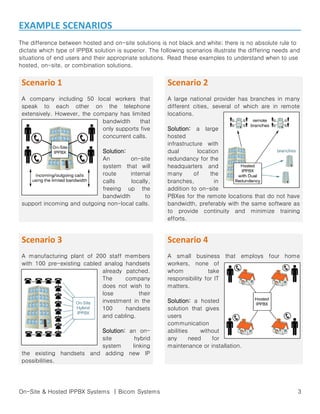
A company including 50 local workers that
speak to each other on the telephone
extensively. However, the company has limited
bandwidth
that
only supports five
concurrent calls.

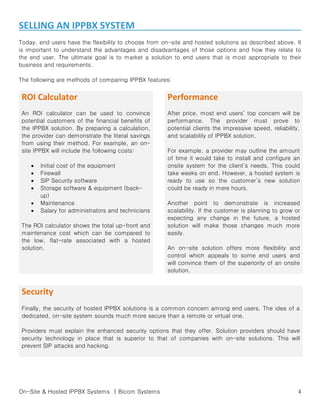
A large national provider has branches in many
different cities, several of which are in remote
locations.

Solution:
An
on-site
system that will
route
internal
calls
locally,
freeing up the
bandwidth
to
support incoming and outgoing non-local calls.

Solution: a large
hosted
infrastructure with
dual
location
redundancy for the
headquarters and
many
of
the
branches,
in
addition to on-site
PBXes for the remote locations that do not have
bandwidth, preferably with the same software as
to provide continuity and minimize training
efforts.

Scenario 3

Scenario 4

A manufacturing plant of 200 staff members
with 100 pre-existing cabled analog handsets
already patched.
The
company
does not wish to
lose
their
investment in the
100
handsets
and cabling.

A small business that employs four home
workers, none of
whom
take
responsibility for IT
matters.

Solution: an onsite
hybrid
system
linking
the existing handsets and adding new IP
possibilities.

On-Site & Hosted IPPBX Systems | Bicom Systems

Solution: a hosted
solution that gives
users
communication
abilities
without
any
need
for
maintenance or installation.

3
SELLING AN IPPBX SYSTEM
Today, end users have the flexibility to choose from on-site and hosted solutions as described above. It
is important to understand the advantages and disadvantages of those options and how they relate to
the end user. The ultimate goal is to market a solution to end users that is most appropriate to their
business and requirements.
The following are methods of comparing IPPBX features:

ROI Calculator

Performance

An ROI calculator can be used to convince
potential customers of the financial benefits of
the IPPBX solution. By preparing a calculation,
the provider can demonstrate the literal savings
from using their method. For example, an onsite IPPBX will include the following costs:

After price, most end users’ top concern will be
performance. The provider must prove to
potential clients the impressive speed, reliability,
and scalability of IPPBX solution.








Initial cost of the equipment
Firewall
SIP Security software
Storage software & equipment (backup)
Maintenance
Salary for administrators and technicians

The ROI calculator shows the total up-front and
maintenance cost which can be compared to
the low, flat-rate associated with a hosted
solution.

For example, a provider may outline the amount
of time it would take to install and configure an
onsite system for the client’s needs. This could
take weeks on end. However, a hosted system is
ready to use so the customer’s new solution
could be ready in mere hours.
Another point to demonstrate is increased
scalability. If the customer is planning to grow or
expecting any change in the future, a hosted
solution will make those changes much more
easily.
An on-site solution offers more flexibility and
control which appeals to some end users and
will convince them of the superiority of an onsite
solution.

Security
Finally, the security of hosted IPPBX solutions is a common concern among end users. The idea of a
dedicated, on-site system sounds much more secure than a remote or virtual one.
Providers must explain the enhanced security options that they offer. Solution providers should have
security technology in place that is superior to that of companies with on-site solutions. This will
prevent SIP attacks and hacking.

On-Site & Hosted IPPBX Systems | Bicom Systems

4
CONCLUSION
In conclusion, the past decade has opened the doors to a new era in which end users have various
options of IPPBX systems. While on-site solutions remain a large part of the market, providers now have
the option – and responsibility – to offer hosted solutions as well. Those who will make best headway will
be those that can offer the best solution to whoever their next client is. Take this opportunity to begin
offering more solutions today.

On-Site & Hosted IPPBX Systems | Bicom Systems

5

Ippbx

  • 1.
    ON-SITE & HOSTED IPPBXSYSTEMS A Bicom Systems Whitepaper examining On-Site and Hosted IPPBX Systems November 2012 www.bicomsystems.com
  • 2.
    INTRODUCTION As the IPPBXmarket has evolved in the past ten years, it has grown to include more ‘virtual’, ‘internetbased’, and ‘in the cloud’ solutions. IPPBX support infrastructure has become increasingly reliable and hosted options have become a real option. Today, more than ever before, end users are able to choose the exact features and services they want at an afforded price. In the past, hosted solutions were typically limited to Centrex – they were based on a central system that was controlled by the local incumbent service provider. Remote extensions or branch offices had to be linked to the central system by the service provider using their copper lines. However, IPPBX systems based on VoIP and using Internet as the transport have caused a paradigm shift in the telecommunications industry both on-site and hosted. The following paragraphs will outline the different types of IPPBX systems available for end users today and discuss the advantages and disadvantages of each. While hosted systems are a new and exciting option with many advantages, there still remains a significant need for onsite systems. Given the increasingly varied end user setups, requirements, and often unique requests, any solutions provider needs to be able to offer all possibilities if they are to remain in business; you simply do not know what your next customer will want. On-Site & Hosted IPPBX Systems | Bicom Systems 1
  • 3.
    IPPBX SYSTEM OPTIONS On-siteSystems Hosted Systems On-site PBX systems are owned or leased and maintained by the end user with the physical equipment installed at their location. Hosted IPPBX systems are ideal for end users that need reliable service without the higher costs and responsibility of an on-site system. Hosted systems do not require any hardware purchase or installation, creating a less expensive and more streamlined solution for end users. The service provider will be responsible for backups, upgrades, etc., freeing the end user to focus on his business. On-site systems involve a higher up-front cost and more maintenance than hosted systems, but offer certain advantages that appeal to some end users. For example, on-site systems give the owner complete control, allowing more customization and updates or upgrades at will. They are also integrable via API/network. End users with a large number of extensions probably have better access to competent internal resource and, as such, may find onsite solutions to be worth the extra initial cost and maintenance for the additional flexibility and control. On-site systems will not involve monthly commitments or supplier risk and can be added to balance sheets. Advantages  More control  Customizable  Direct access  Compatible with PSTN Disadvantages  Responsibility for maintenance and updates  Higher up-front cost On-Site & Hosted IPPBX Systems | Bicom Systems The service provider is able to offer bundles to end users with more features and flexibility than they would be able to obtain by their own means. Adding or removing extensions is simple and easy. Advantages  Inexpensive setup  Maintenance and support from host  More features available  Costs are more flexible to requirement. Disadvantages  Less control over the system  Upgrades depend on the host 2
  • 4.
    EXAMPLE SCENARIOS The differencebetween hosted and on-site solutions is not black and white; there is no absolute rule to dictate which type of IPPBX solution is superior. The following scenarios illustrate the differing needs and situations of end users and their appropriate solutions. Read these examples to understand when to use hosted, on-site, or combination solutions. Scenario 1 Scenario 2 A company including 50 local workers that speak to each other on the telephone extensively. However, the company has limited bandwidth that only supports five concurrent calls. A large national provider has branches in many different cities, several of which are in remote locations. Solution: An on-site system that will route internal calls locally, freeing up the bandwidth to support incoming and outgoing non-local calls. Solution: a large hosted infrastructure with dual location redundancy for the headquarters and many of the branches, in addition to on-site PBXes for the remote locations that do not have bandwidth, preferably with the same software as to provide continuity and minimize training efforts. Scenario 3 Scenario 4 A manufacturing plant of 200 staff members with 100 pre-existing cabled analog handsets already patched. The company does not wish to lose their investment in the 100 handsets and cabling. A small business that employs four home workers, none of whom take responsibility for IT matters. Solution: an onsite hybrid system linking the existing handsets and adding new IP possibilities. On-Site & Hosted IPPBX Systems | Bicom Systems Solution: a hosted solution that gives users communication abilities without any need for maintenance or installation. 3
  • 5.
    SELLING AN IPPBXSYSTEM Today, end users have the flexibility to choose from on-site and hosted solutions as described above. It is important to understand the advantages and disadvantages of those options and how they relate to the end user. The ultimate goal is to market a solution to end users that is most appropriate to their business and requirements. The following are methods of comparing IPPBX features: ROI Calculator Performance An ROI calculator can be used to convince potential customers of the financial benefits of the IPPBX solution. By preparing a calculation, the provider can demonstrate the literal savings from using their method. For example, an onsite IPPBX will include the following costs: After price, most end users’ top concern will be performance. The provider must prove to potential clients the impressive speed, reliability, and scalability of IPPBX solution.       Initial cost of the equipment Firewall SIP Security software Storage software & equipment (backup) Maintenance Salary for administrators and technicians The ROI calculator shows the total up-front and maintenance cost which can be compared to the low, flat-rate associated with a hosted solution. For example, a provider may outline the amount of time it would take to install and configure an onsite system for the client’s needs. This could take weeks on end. However, a hosted system is ready to use so the customer’s new solution could be ready in mere hours. Another point to demonstrate is increased scalability. If the customer is planning to grow or expecting any change in the future, a hosted solution will make those changes much more easily. An on-site solution offers more flexibility and control which appeals to some end users and will convince them of the superiority of an onsite solution. Security Finally, the security of hosted IPPBX solutions is a common concern among end users. The idea of a dedicated, on-site system sounds much more secure than a remote or virtual one. Providers must explain the enhanced security options that they offer. Solution providers should have security technology in place that is superior to that of companies with on-site solutions. This will prevent SIP attacks and hacking. On-Site & Hosted IPPBX Systems | Bicom Systems 4
  • 6.
    CONCLUSION In conclusion, thepast decade has opened the doors to a new era in which end users have various options of IPPBX systems. While on-site solutions remain a large part of the market, providers now have the option – and responsibility – to offer hosted solutions as well. Those who will make best headway will be those that can offer the best solution to whoever their next client is. Take this opportunity to begin offering more solutions today. On-Site & Hosted IPPBX Systems | Bicom Systems 5