Vincent Brown
IP1
Powerpoint Presentation
learners?
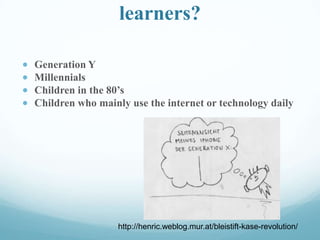
Generation Y
Millennials
Children in the 80’s
Children who mainly use the internet or technology daily
http://henric.weblog.mur.at/bleistift-kase-revolution/
Characteristics of today’s
learners
Up to date cellphone users
Computer savvy
Technology dependent
Possess internet use skills
In need of variety for learning
How are they different from
other generations
Mindset
Previous generations used radio and TV.
This generation use internet
technology for formal and
informal learning
Formally
o Classroom instruction
o Differentiation
o As engagement
o Communication
o To create projects
Informally
o Learning games
o Learning apps
o Collaboration and technology
o To critique each others work
o Cellphone Use in the Classroom
What is Informal Learning
Student Centered
Lacks Strategic Structure
Includes Technology Use
Cellphones and the Internet
Takes place in any Location
What is Formal Learning
Strategically Planned
Created prior to lessons
Professional lessons
Prepared in lieu of a Curriculum
Teacher assessments
Classroom Instruction/ Reading
Under achieving students
Slow readers
Emerging readers
Comprehension
Engagement
Differentiation
Math
Technology
Students’ with disabilities
Hands-on Interaction
Engagement
Increase interaction
Motivation
Increase Performance skills
Communicate
Generational gap in methods of communication
Critical Thinking
Expression
Technology as a tool to communicate
Project Based Learning
Student learning
Projects as a way to learn
Learning through engagement
Skill development
Learning games
Build skills
Engage students
Create active learners
Immediate feedback
Numerous lessons
Learning apps
STEM
Apps
Classroom use
Creativity
Responsibility
Collaboration and technology
Communication
Technology
Teamwork
Effectiveness
Engineering
Critiquing classmates work
 Feedback
Cellphone Use in the
Classroom
Cellphones
Computer use
Facebook
Social websites
Communication
Effects of technology on
learning environments
Positive
Negative
Barriers
Assessments
Cont.… Positive
Teacher use of Technology
Increase Student Knowledge
Increase Self-Efficacy
Best Practices
 It is recommended that teachers begin to integrate technology
into the daily classroom instruction (p. 24). Technology is
moving forward and students are becoming more
knowledgeable about the use of technology; therefore,
supporting the fact that technology is needed in a formal and
informal education setting.
Conclusion
 Although many put different emphasizes on learning
through the use of technology, they fail to see the benefits
that students gain. There are often students who drop out
of school, but later return as nontraditional learners
because of the availability of classes offered via
technology and the Internet. In order to continue to
increase learning, there must continue to be research
conducted to identify the effects of technology use in
education (Milheim, 2007).
 Reference
 Chu, R. H., Minasian, R. A., & Xiaoke, Y. (2012). Inspiring student learning in ICT communications electronics
through a new integrated project-based learning approach. International Journal Of Electrical Engineering
Education, 49(2), 127-135. doi:10.7227/IJEEE.49.2.3
 Davis, T. N., Barnard-Brak, L., & Arredondo, P. L. (2013). Assistive Technology: Decision-making Practices in
Public Schools. Rural Special Education Quarterly, 32(4), 15-23.
 Explore. Creative Commons. (2014). Retrieved from https://www.flickr.com/creativecommons/by-2.0/
 Feiertag, J., & Berge, Z. L. (2008). Training generation N: How educators should approach the net generation.
Education & Training, 50(6), 457-464. doi:http://dx.doi.org/10.1108/00400910810901782
 Kelley, T. R. (2013). STL GUIDING THE 21ST CENTURY thinker. Technology & Engineering
Teacher, 73(4), 18-23.
 McLean, K. (2013). Literacy and technology in the early years of education: Looking to the familiar to inform
educator practice. Australasian Journal Of Early Childhood, 38(4), 30-41.
 Milheim, K. L. (2007). Influence of Technology on Informal Learning. Adult Basic Education & Literacy
Journal, 1(1), 21-26.
 Pereira, R., Baranauskas, M. C., & Sergio Roberto, P. d. S. (2013). Social software and educational technology:
Informal, formal and technical values. Journal of Educational Technology & Society, 16(1), 4-n/a. Retrieved
from http://search.proquest.com.library.capella.edu/docview/1287028458?accountid=27965
 Ribble, M. (2011). Digital citizenship in schools. (2nd ed.). Washington, DC: International Society for
technology in education.
 Tabatabaei, M., & Lam, M. (2013). Awareness and usage of collaboration and communication technologies in
student teamwork. Journal of International Technology and Information Management, 22(2), 71-III. Retrieved
from http://search.proquest.com.library.capella.edu/docview/1518254188?accountid=27965

Ip 1 powerpoint vincent brown

  • 1.
  • 2.
    learners? Generation Y Millennials Children inthe 80’s Children who mainly use the internet or technology daily http://henric.weblog.mur.at/bleistift-kase-revolution/
  • 3.
    Characteristics of today’s learners Upto date cellphone users Computer savvy Technology dependent Possess internet use skills In need of variety for learning
  • 4.
    How are theydifferent from other generations Mindset Previous generations used radio and TV. This generation use internet
  • 5.
    technology for formaland informal learning Formally o Classroom instruction o Differentiation o As engagement o Communication o To create projects Informally o Learning games o Learning apps o Collaboration and technology o To critique each others work o Cellphone Use in the Classroom
  • 6.
    What is InformalLearning Student Centered Lacks Strategic Structure Includes Technology Use Cellphones and the Internet Takes place in any Location
  • 7.
    What is FormalLearning Strategically Planned Created prior to lessons Professional lessons Prepared in lieu of a Curriculum Teacher assessments
  • 8.
    Classroom Instruction/ Reading Underachieving students Slow readers Emerging readers Comprehension Engagement
  • 9.
  • 10.
  • 11.
    Communicate Generational gap inmethods of communication Critical Thinking Expression Technology as a tool to communicate
  • 12.
    Project Based Learning Studentlearning Projects as a way to learn Learning through engagement Skill development
  • 13.
    Learning games Build skills Engagestudents Create active learners Immediate feedback Numerous lessons
  • 14.
  • 15.
  • 16.
  • 17.
    Cellphone Use inthe Classroom Cellphones Computer use Facebook Social websites Communication
  • 18.
    Effects of technologyon learning environments Positive Negative Barriers Assessments
  • 19.
    Cont.… Positive Teacher useof Technology Increase Student Knowledge Increase Self-Efficacy
  • 20.
    Best Practices  Itis recommended that teachers begin to integrate technology into the daily classroom instruction (p. 24). Technology is moving forward and students are becoming more knowledgeable about the use of technology; therefore, supporting the fact that technology is needed in a formal and informal education setting.
  • 21.
    Conclusion  Although manyput different emphasizes on learning through the use of technology, they fail to see the benefits that students gain. There are often students who drop out of school, but later return as nontraditional learners because of the availability of classes offered via technology and the Internet. In order to continue to increase learning, there must continue to be research conducted to identify the effects of technology use in education (Milheim, 2007).
  • 22.
     Reference  Chu,R. H., Minasian, R. A., & Xiaoke, Y. (2012). Inspiring student learning in ICT communications electronics through a new integrated project-based learning approach. International Journal Of Electrical Engineering Education, 49(2), 127-135. doi:10.7227/IJEEE.49.2.3  Davis, T. N., Barnard-Brak, L., & Arredondo, P. L. (2013). Assistive Technology: Decision-making Practices in Public Schools. Rural Special Education Quarterly, 32(4), 15-23.  Explore. Creative Commons. (2014). Retrieved from https://www.flickr.com/creativecommons/by-2.0/  Feiertag, J., & Berge, Z. L. (2008). Training generation N: How educators should approach the net generation. Education & Training, 50(6), 457-464. doi:http://dx.doi.org/10.1108/00400910810901782  Kelley, T. R. (2013). STL GUIDING THE 21ST CENTURY thinker. Technology & Engineering Teacher, 73(4), 18-23.  McLean, K. (2013). Literacy and technology in the early years of education: Looking to the familiar to inform educator practice. Australasian Journal Of Early Childhood, 38(4), 30-41.  Milheim, K. L. (2007). Influence of Technology on Informal Learning. Adult Basic Education & Literacy Journal, 1(1), 21-26.  Pereira, R., Baranauskas, M. C., & Sergio Roberto, P. d. S. (2013). Social software and educational technology: Informal, formal and technical values. Journal of Educational Technology & Society, 16(1), 4-n/a. Retrieved from http://search.proquest.com.library.capella.edu/docview/1287028458?accountid=27965  Ribble, M. (2011). Digital citizenship in schools. (2nd ed.). Washington, DC: International Society for technology in education.  Tabatabaei, M., & Lam, M. (2013). Awareness and usage of collaboration and communication technologies in student teamwork. Journal of International Technology and Information Management, 22(2), 71-III. Retrieved from http://search.proquest.com.library.capella.edu/docview/1518254188?accountid=27965

Editor's Notes

  • #3 According to Feiertag & Berge, (2008) children, who were born after the 1980’s, are the leaners of today. They refer to the learners of today as “Generation Y, Millennials, the Net Generation” (Feiertag, & Berge, p. 457) and a host of other names. These learners have experienced the use of technology from the beginning and as a continuing part of the learning process (p. 458). The learners of today are needed to move the economy into the next phase. The best way to do that is to prepare them for the real world and careers.
  • #4 Today’s learners are in constant need of technology integration. They must be able to implement the use of technology into their classwork in order to gain the knowledge and interest that they need to succeed (Ribble, 2011). They must posses critical thinking skills, become problem solvers in their own context, work in groups with effective communication, and they must be able to reform in any way that is needed for he purpose of success. As these learners posses these skills, they adapt to social norms such as cellphone use while depending on computers and technology.
  • #5 The new generation of learners is more dependent on the Internet than previous generations. The previous generation had access to the radio, television and political figures (Feiertag, & Berge, 2008). Parents were more supportive to the previous generation than they are today, which forces students to learn according to the ways of their generation, with or without the support of their parents. This generation of learners is different than those of the past, because of their need to learn and the materials that they need to solve problems that exist in society (p. 458).
  • #7 The use of informal learning has increased the number of students who are in school. Most informal leaning takes place at the will of the student with limited control by the teacher (Milheim, 2007). Students often use either cellular devices or computers to access the Internet. Through programs, app, and technology use, students are learning while they are unaware (p. 22). Social settings, that takes place either in the classroom or at home, can be informal learning environments. Since students are believed to learn through communicating with others, social communication through informal settings is beneficial.
  • #8 Formal classrooms are usually set according to the desires of the instructor. They create an environment that allows them to successfully administer lessons that have been preplanned according to a curriculum or a guide (Milheim, 2007). Through the use of technology, students are allowed to navigate through software that is strategically set by an administrator such as the teacher, to accomplish a set goal.
  • #9 According to McLean (2013) students are benefiting more in the area of reading due to the use of technology. The conceptual understanding of reading has deteriorated over the years for some students. Students are getting by through accommodation instead of being able to read and comprehend text that is presented to them. Through the use of strategies and technology, students will be able to comprehend as well as relay their thinking process (p. 30).
  • #10 There are a number of issues that have been identified as the cause of students lacking in the area of math. Davis, Barnard-Brak, & Arredondo, (2013) notes that through the use of assistive technology, students with disabilities can gain knowledge of basic skills and reach the learning level of students in their grade level. Through the use of assistive technology, students with disabilities can be taught the same curriculum as those in general education. Assistive technology is considered to be different devices that can be used to advance students with disabilities in education (p. 15). Through assistive technology, students are able to interact and become more hands-on.
  • #11 Student’s who have been introduced to technology use in the classroom, benefit greatly from its use (Davis et al., 2013). They not only feel more confident with their work, but they tend to participate more actively during class instruction (p. 16). As students are assigned class work on the computer or different sources of technology, they begin to increase their performance by building their basic skill levels.
  • #12 The gap between generations has widened due to the use of technology. Students are communicating less verbally than expected (Feiertag & Berge, 2008). Students of this generation communicate more, but they use technology such as cellphones and the Internet to express themselves. Although both generations are different, they express themselves in the way that is best for them (p. 463).
  • #13 According to Chu, Minasian, & Xiaoke, (2012) students in the 21st century need a new method of learning that will engage them as well as teach them. Through project based learning, students gain basic learning skills as well as problem solving skills. “Information and communications technology (ICT)” (p. 127) has been identified as a way to engage students actively as well as a way to challenge their thinking. This generation of learners has an increasing need for differentiation; therefore, giving need to the use of technology programs such as ICT.
  • #14 Kelley (2013) notes that students learn differently than those who are before them. Students of the 21st century have a need for learning that includes the use of technology. Because of the technology drive that society has placed on learning, education has become more engage through games and technology. Technology is being used to engage students and increase their way of thinking. Through games and applications, students have become more creative and willing to take a chance in furthering their education. The high demand for problem solvers has forced teachers to incorporate game technology to increase student’s basic skills knowledge.
  • #15 Through Science, Technology, Engineering, and Mathematics (STEM), students will be come creators of tools that will become necessary in society (Kelley, 2013). Students are creating apps and programs that are used in the classroom as well as in the workforce. Through multiple applications, students are becoming more creative and aware of their learning. They begin to take responsibility of the things that they create, which becomes personal to them (p. 19).
  • #16 Through collaboration, teamwork in the educational system has increased for students. Due to the research that has been used to support the use of group work and communication, students are expected to improve learning (Tabatabaei, M., & Lam, M., 2013). Technology has been used to link students to each other as well as aide in the learning process. Through the use of teamwork, students gain skills that are needed in the classroom as well as in the workforce (p. 72). With each skill students learn, they are expected to become engineers of many things, which fulfills the STEM program.
  • #17 As stated by Tabatabaei & Lam, (2013) the use of technology in teamwork gives students a new different way to view and critique student work. They become reflective leaners as well as develop skills of critical thinkers. Through technology integration for group projects, students develop the basic skills that are needed to succeed in society. Through positive communication skills, each group member becomes aware of the critical need to assess each other for improvement. Through online courses such as this, students become more aware of the use of technology and the sensitivity as well as the benefit of working with others (p. 78).
  • #18 Software has been created to show the connection between technology, informal use and the students. In the classroom, students have found a way to use cellphones and computers to communicate to classmates and teachers Pereira, Baranauskas, & Sergio Roberto, (2013). Through the use of social sites such as Facebook, students have become motivated to communicate to others where they would not have otherwise (p. 6). Pereira et al., (2013) note that the use of informal technology in education promotes motivation for students as well as gives them a resourceful association.
  • #19 According to research, the use of technology has increased learning for students of all ages (Milheim, 2007). There are negative aspects of the use of technology in education, which can be identified as barriers. The ability to access technology can cause a learning block for certain learners as well as not have Internet access. The education level of the individual can also become a barrier. Some students have a low comprehension rate, which will affect their reading. This will hinder workloads in coursework (p. 24). There are also positive outcomes to technology use in learning environments.
  • #20 For positive results, teachers use technology as a supplement to the regular education lessons that are administered daily (Milheim, 2007). Students not only increase their knowledge, they become more confident in their work. Through the use of technology instruction in informal learning settings, students’ self esteem rises because of the sense of security that they feel through organized classroom discussions (p. 23).
  • #21 It is recommended that teachers begin to integrate technology into the daily classroom instruction (p. 24). Technology is moving forward and students are becoming more knowledgeable about the use of technology; therefore, supporting the fact that technology is needed in a formal and informal education setting.
  • #23 ReferenceChu, R. H., Minasian, R. A., & Xiaoke, Y. (2012). Inspiring student learning in ICT communications electronics through a new integrated project-based learning approach. International Journal Of Electrical Engineering Education, 49(2), 127-135. doi:10.7227/IJEEE.49.2.3Davis, T. N., Barnard-Brak, L., & Arredondo, P. L. (2013). Assistive Technology: Decision-making Practices in Public Schools. Rural Special Education Quarterly, 32(4), 15-23.Explore. Creative Commons. (2014). Retrieved from https://www.flickr.com/creativecommons/by-2.0/Feiertag, J., & Berge, Z. L. (2008). Training generation N: How educators should approach the net generation. Education & Training, 50(6), 457-464. doi:http://dx.doi.org/10.1108/00400910810901782Kelley, T. R. (2013). STL GUIDING THE 21ST CENTURY thinker. Technology & Engineering Teacher, 73(4), 18-23.McLean, K. (2013). Literacy and technology in the early years of education: Looking to the familiar to inform educator practice. Australasian Journal Of Early Childhood, 38(4), 30-41.Milheim, K. L. (2007). Influence of Technology on Informal Learning. Adult Basic Education & Literacy Journal, 1(1), 21-26.Pereira, R., Baranauskas, M. C., & Sergio Roberto, P. d. S. (2013). Social software and educational technology: Informal, formal and technical values. Journal of Educational Technology & Society, 16(1), 4-n/a. Retrieved from http://search.proquest.com.library.capella.edu/docview/1287028458?accountid=27965Ribble, M. (2011). Digital citizenship in schools. (2nd ed.). Washington, DC: International Society for technology in education. Tabatabaei, M., & Lam, M. (2013). Awareness and usage of collaboration and communication technologies in student teamwork. Journal of International Technology and Information Management, 22(2), 71-III. Retrieved from http://search.proquest.com.library.capella.edu/docview/1518254188?accountid=27965