IoT: What's in it for me? 
Team Emertxe @ NIT, Warangal 
Hackathon on: Aug 23-24, 2014
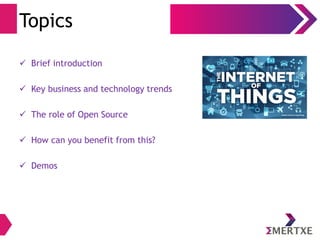
Topics 
 Brief introduction 
 Key business and technology trends 
 The role of Open Source 
 How can you benefit from this? 
 Demos
Brief Introduction
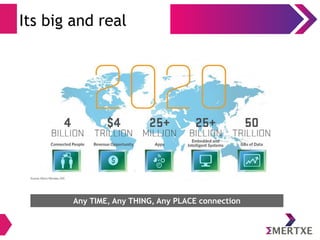
Its big and real 
Any TIME, Any THING, Any PLACE connection
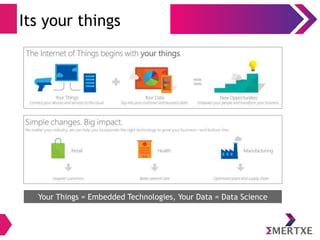
Its your things 
Your Things = Embedded Technologies, Your Data = Data Science
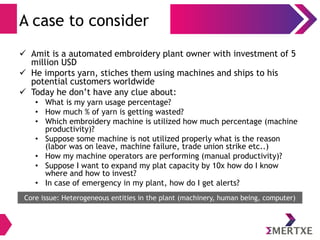
A case to consider 
 Amit is a automated embroidery plant owner with investment of 5 
million USD 
 He imports yarn, stiches them using machines and ships to his 
potential customers worldwide 
 Today he don’t have any clue about: 
• What is my yarn usage percentage? 
• How much % of yarn is getting wasted? 
• Which embroidery machine is utilized how much percentage (machine 
productivity)? 
• Suppose some machine is not utilized properly what is the reason 
(labor was on leave, machine failure, trade union strike etc..) 
• How my machine operators are performing (manual productivity)? 
• Suppose I want to expand my plat capacity by 10x how do I know 
where and how to invest? 
• In case of emergency in my plant, how do I get alerts? 
Core issue: Heterogeneous entities in the plant (machinery, human being, computer)
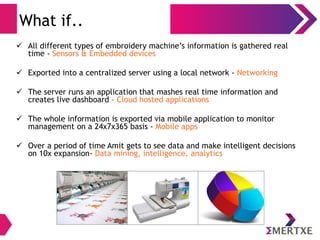
What if.. 
 All different types of embroidery machine’s information is gathered real 
time - Sensors & Embedded devices 
 Exported into a centralized server using a local network - Networking 
 The server runs an application that mashes real time information and 
creates live dashboard – Cloud hosted applications 
 The whole information is exported via mobile application to monitor 
management on a 24x7x365 basis - Mobile apps 
 Over a period of time Amit gets to see data and make intelligent decisions 
on 10x expansion- Data mining, intelligence, analytics
Key Trends
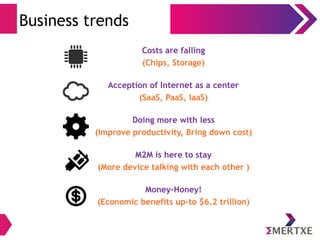
Business trends 
Costs are falling 
(Chips, Storage) 
Acception of Internet as a center 
(SaaS, PaaS, IaaS) 
Doing more with less 
(Improve productivity, Bring down cost) 
M2M is here to stay 
(More device talking with each other ) 
Money-Honey! 
(Economic benefits up-to $6.2 trillion)
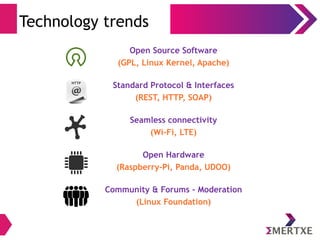
Technology trends 
Open Source Software 
(GPL, Linux Kernel, Apache) 
Standard Protocol & Interfaces 
(REST, HTTP, SOAP) 
Seamless connectivity 
(Wi-Fi, LTE) 
Open Hardware 
(Raspberry-Pi, Panda, UDOO) 
Community & Forums - Moderation 
(Linux Foundation)
The role of Open Source
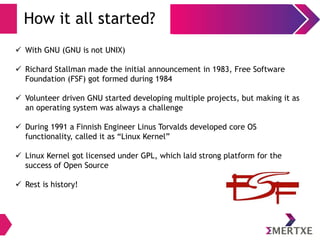
How it all started? 
 With GNU (GNU is not UNIX) 
 Richard Stallman made the initial announcement in 1983, Free Software 
Foundation (FSF) got formed during 1984 
 Volunteer driven GNU started developing multiple projects, but making it as 
an operating system was always a challenge 
 During 1991 a Finnish Engineer Linus Torvalds developed core OS 
functionality, called it as “Linux Kernel” 
 Linux Kernel got licensed under GPL, which laid strong platform for the 
success of Open Source 
 Rest is history!
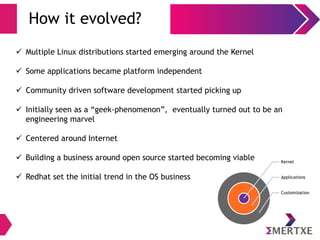
How it evolved? 
Kernel 
Applications 
Customization 
 Multiple Linux distributions started emerging around the Kernel 
 Some applications became platform independent 
 Community driven software development started picking up 
 Initially seen as a “geek-phenomenon”, eventually turned out to be an 
engineering marvel 
 Centered around Internet 
 Building a business around open source started becoming viable 
 Redhat set the initial trend in the OS business
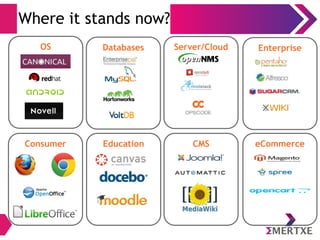
Where it stands now? 
OS Databases Server/Cloud Enterprise 
Consumer Education CMS eCommerce
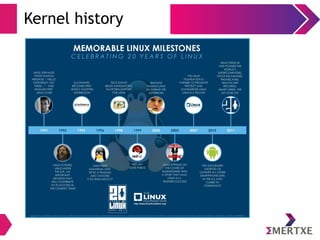
Kernel history
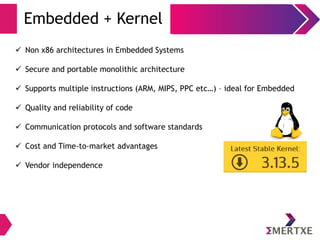
Embedded + Kernel 
 Non x86 architectures in Embedded Systems 
 Secure and portable monolithic architecture 
 Supports multiple instructions (ARM, MIPS, PPC etc…) – ideal for Embedded 
 Quality and reliability of code 
 Communication protocols and software standards 
 Cost and Time-to-market advantages 
 Vendor independence
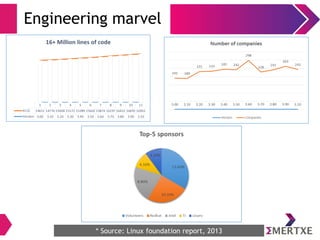
Engineering marvel 
* Source: Linux foundation report, 2013
How you can benefit from this?
Three RECW stories
WIIFM: Three things 
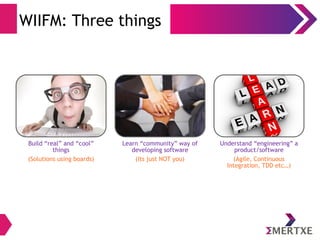
Build “real” and “cool” 
things 
(Solutions using boards) 
Learn “community” way of 
developing software 
(Its just NOT you) 
Understand “engineering” a 
product/software 
(Agile, Continuous 
Integration, TDD etc…)
Stay connected 
About us: Emertxe is India’s one of the top IT finishing schools & self learning kits 
provider. Our primary focus is on Embedded with diversification focus on Java, 
Oracle and Android areas 
Emertxe Information Technologies, 
No-1, 9th Cross, 5th Main, 
Jayamahal Extension, 
Bangalore, Karnataka 560046 
T: +91 80 6562 9666 
E: training@emertxe.com 
https://www.facebook.com/Emertxe https://twitter.com/EmertxeTweet https://www.slideshare.net/EmertxeSlides
THANK YOU

IoT : Whats in it for me?

  • 1.
    IoT: What's init for me? Team Emertxe @ NIT, Warangal Hackathon on: Aug 23-24, 2014
  • 2.
    Topics  Briefintroduction  Key business and technology trends  The role of Open Source  How can you benefit from this?  Demos
  • 3.
  • 4.
    Its big andreal Any TIME, Any THING, Any PLACE connection
  • 5.
    Its your things Your Things = Embedded Technologies, Your Data = Data Science
  • 6.
    A case toconsider  Amit is a automated embroidery plant owner with investment of 5 million USD  He imports yarn, stiches them using machines and ships to his potential customers worldwide  Today he don’t have any clue about: • What is my yarn usage percentage? • How much % of yarn is getting wasted? • Which embroidery machine is utilized how much percentage (machine productivity)? • Suppose some machine is not utilized properly what is the reason (labor was on leave, machine failure, trade union strike etc..) • How my machine operators are performing (manual productivity)? • Suppose I want to expand my plat capacity by 10x how do I know where and how to invest? • In case of emergency in my plant, how do I get alerts? Core issue: Heterogeneous entities in the plant (machinery, human being, computer)
  • 7.
    What if.. All different types of embroidery machine’s information is gathered real time - Sensors & Embedded devices  Exported into a centralized server using a local network - Networking  The server runs an application that mashes real time information and creates live dashboard – Cloud hosted applications  The whole information is exported via mobile application to monitor management on a 24x7x365 basis - Mobile apps  Over a period of time Amit gets to see data and make intelligent decisions on 10x expansion- Data mining, intelligence, analytics
  • 8.
  • 9.
    Business trends Costsare falling (Chips, Storage) Acception of Internet as a center (SaaS, PaaS, IaaS) Doing more with less (Improve productivity, Bring down cost) M2M is here to stay (More device talking with each other ) Money-Honey! (Economic benefits up-to $6.2 trillion)
  • 10.
    Technology trends OpenSource Software (GPL, Linux Kernel, Apache) Standard Protocol & Interfaces (REST, HTTP, SOAP) Seamless connectivity (Wi-Fi, LTE) Open Hardware (Raspberry-Pi, Panda, UDOO) Community & Forums - Moderation (Linux Foundation)
  • 11.
    The role ofOpen Source
  • 12.
    How it allstarted?  With GNU (GNU is not UNIX)  Richard Stallman made the initial announcement in 1983, Free Software Foundation (FSF) got formed during 1984  Volunteer driven GNU started developing multiple projects, but making it as an operating system was always a challenge  During 1991 a Finnish Engineer Linus Torvalds developed core OS functionality, called it as “Linux Kernel”  Linux Kernel got licensed under GPL, which laid strong platform for the success of Open Source  Rest is history!
  • 13.
    How it evolved? Kernel Applications Customization  Multiple Linux distributions started emerging around the Kernel  Some applications became platform independent  Community driven software development started picking up  Initially seen as a “geek-phenomenon”, eventually turned out to be an engineering marvel  Centered around Internet  Building a business around open source started becoming viable  Redhat set the initial trend in the OS business
  • 14.
    Where it standsnow? OS Databases Server/Cloud Enterprise Consumer Education CMS eCommerce
  • 15.
  • 16.
    Embedded + Kernel  Non x86 architectures in Embedded Systems  Secure and portable monolithic architecture  Supports multiple instructions (ARM, MIPS, PPC etc…) – ideal for Embedded  Quality and reliability of code  Communication protocols and software standards  Cost and Time-to-market advantages  Vendor independence
  • 17.
    Engineering marvel *Source: Linux foundation report, 2013
  • 18.
    How you canbenefit from this?
  • 19.
  • 20.
    WIIFM: Three things Build “real” and “cool” things (Solutions using boards) Learn “community” way of developing software (Its just NOT you) Understand “engineering” a product/software (Agile, Continuous Integration, TDD etc…)
  • 21.
    Stay connected Aboutus: Emertxe is India’s one of the top IT finishing schools & self learning kits provider. Our primary focus is on Embedded with diversification focus on Java, Oracle and Android areas Emertxe Information Technologies, No-1, 9th Cross, 5th Main, Jayamahal Extension, Bangalore, Karnataka 560046 T: +91 80 6562 9666 E: training@emertxe.com https://www.facebook.com/Emertxe https://twitter.com/EmertxeTweet https://www.slideshare.net/EmertxeSlides
  • 22.