PTS: 2017
Presented By- Vasundhara Sharma (7EC, D3)
Sufiyan Ahmed (7EC, D3)
Embedded Systems Design and Programming
&
Internet of Things
About Eduvance
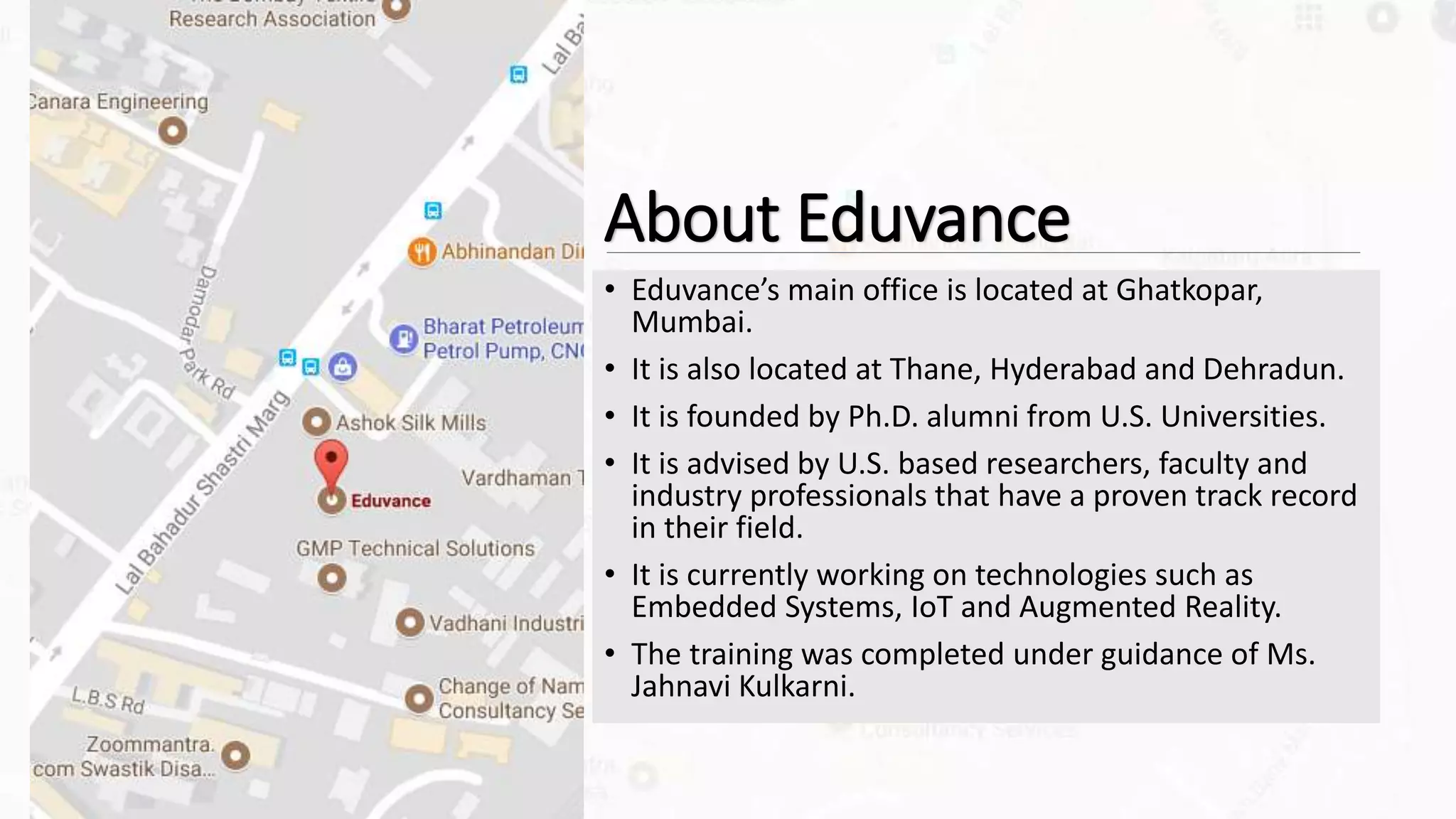
• Eduvance’s main office is located at Ghatkopar,
Mumbai.
• It is also located at Thane, Hyderabad and Dehradun.
• It is founded by Ph.D. alumni from U.S. Universities.
• It is advised by U.S. based researchers, faculty and
industry professionals that have a proven track record
in their field.
• It is currently working on technologies such as
Embedded Systems, IoT and Augmented Reality.
• The training was completed under guidance of Ms.
Jahnavi Kulkarni.
Eduvance conducts training and internship
program called the “Summer Industrial Training in
Embedded Systems and IoT”.
This training is in collaboration with ARM
University Program and Cypress Semiconductors
University Alliance.
The training was divided into 4 Parts:
•Mini Projects using Arduino UNO
•ARM “Mbed” platform and ARM Embedded
Systems Programming
•Cypress Programmable System on Chip
•Internet of Things (IoT).
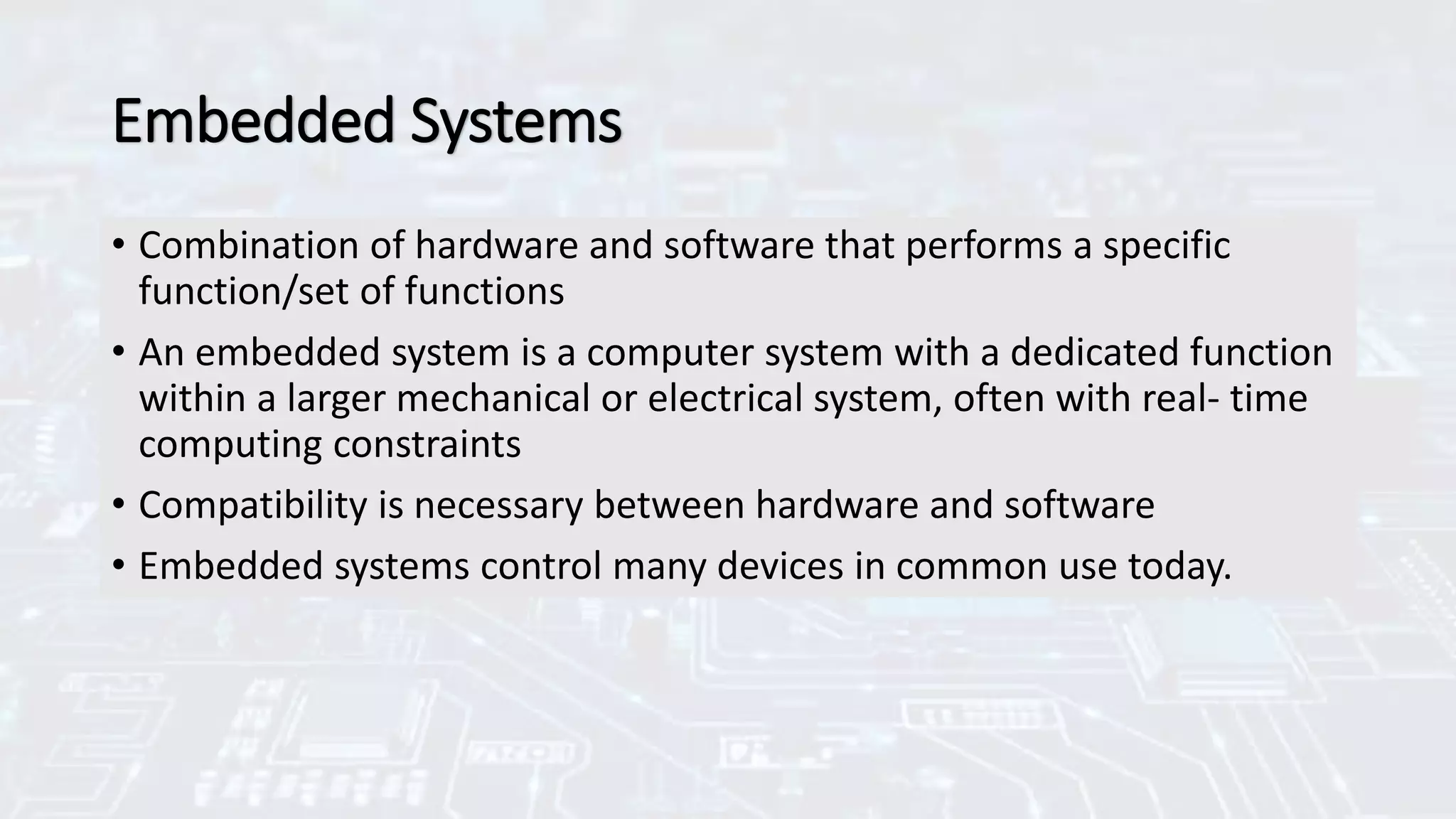
Embedded Systems
• Combination of hardware and software that performs a specific
function/set of functions
• An embedded system is a computer system with a dedicated function
within a larger mechanical or electrical system, often with real- time
computing constraints
• Compatibility is necessary between hardware and software
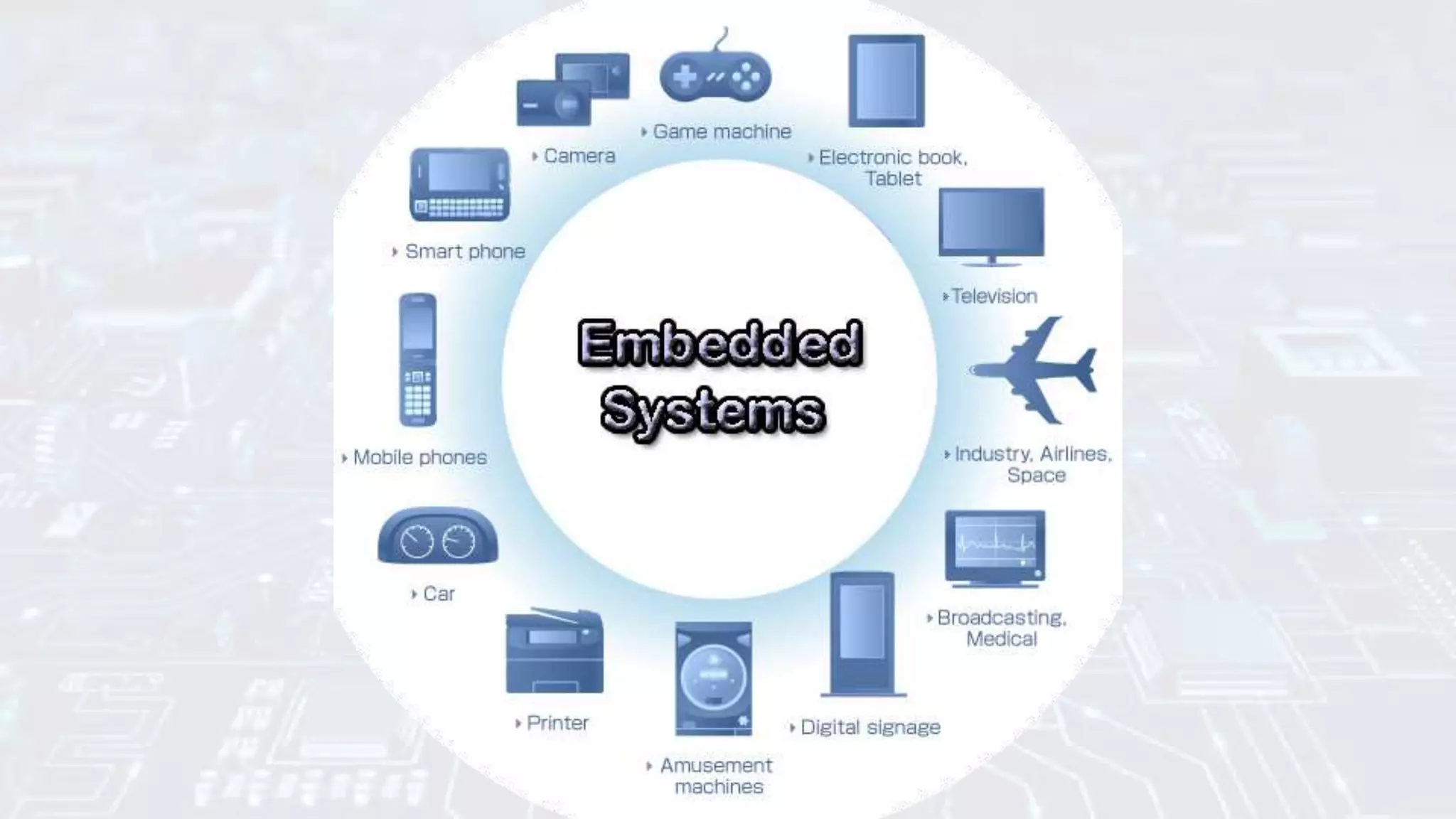
• Embedded systems control many devices in common use today.
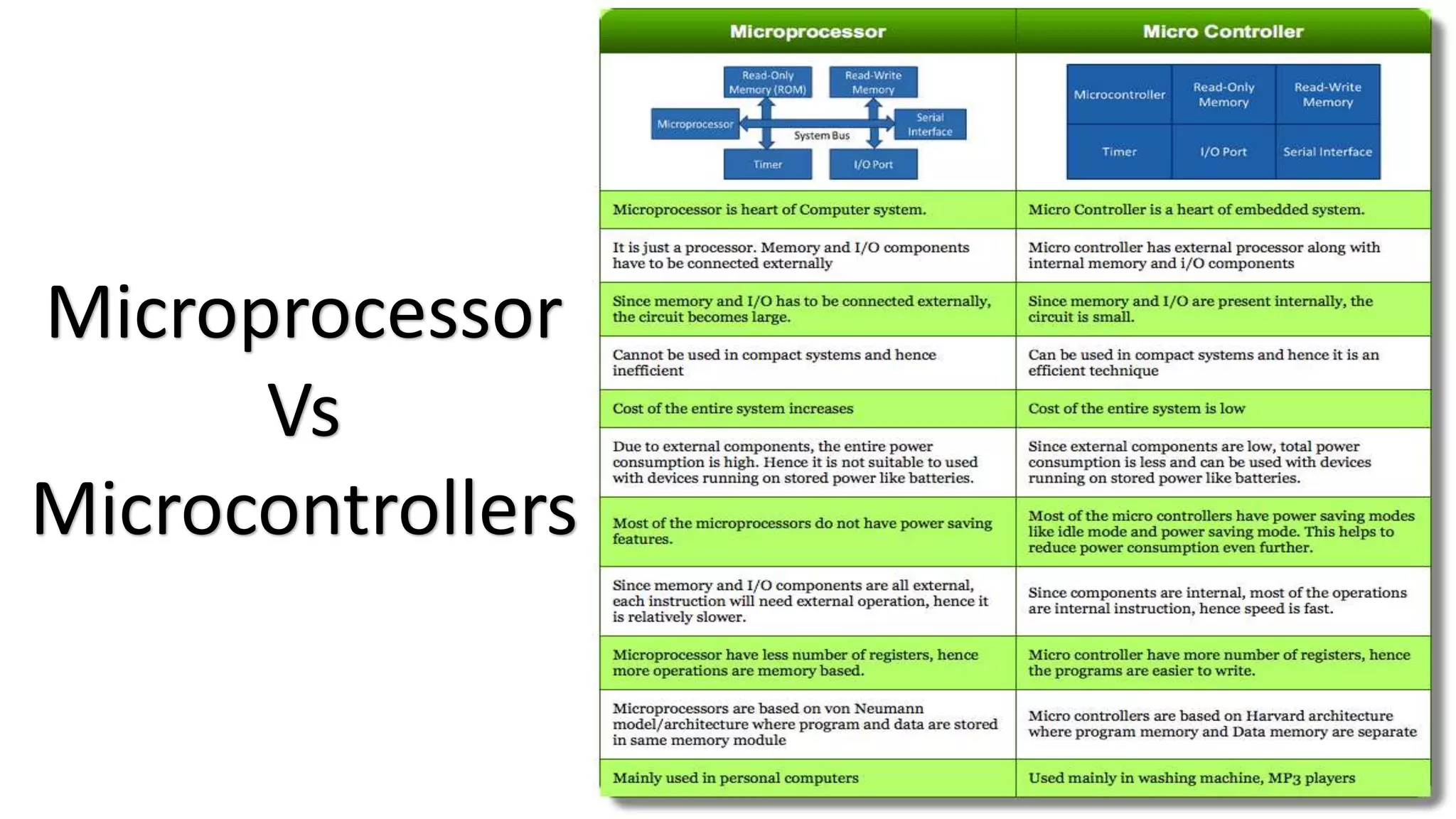
Microprocessor
Vs
Microcontrollers
Some Sensors Used in Training
 LDR (Light Dependent Resistor)
 Thermistor
 Accelerometers
 Gyroscopes
 Touch Sensors
 Potentiometers
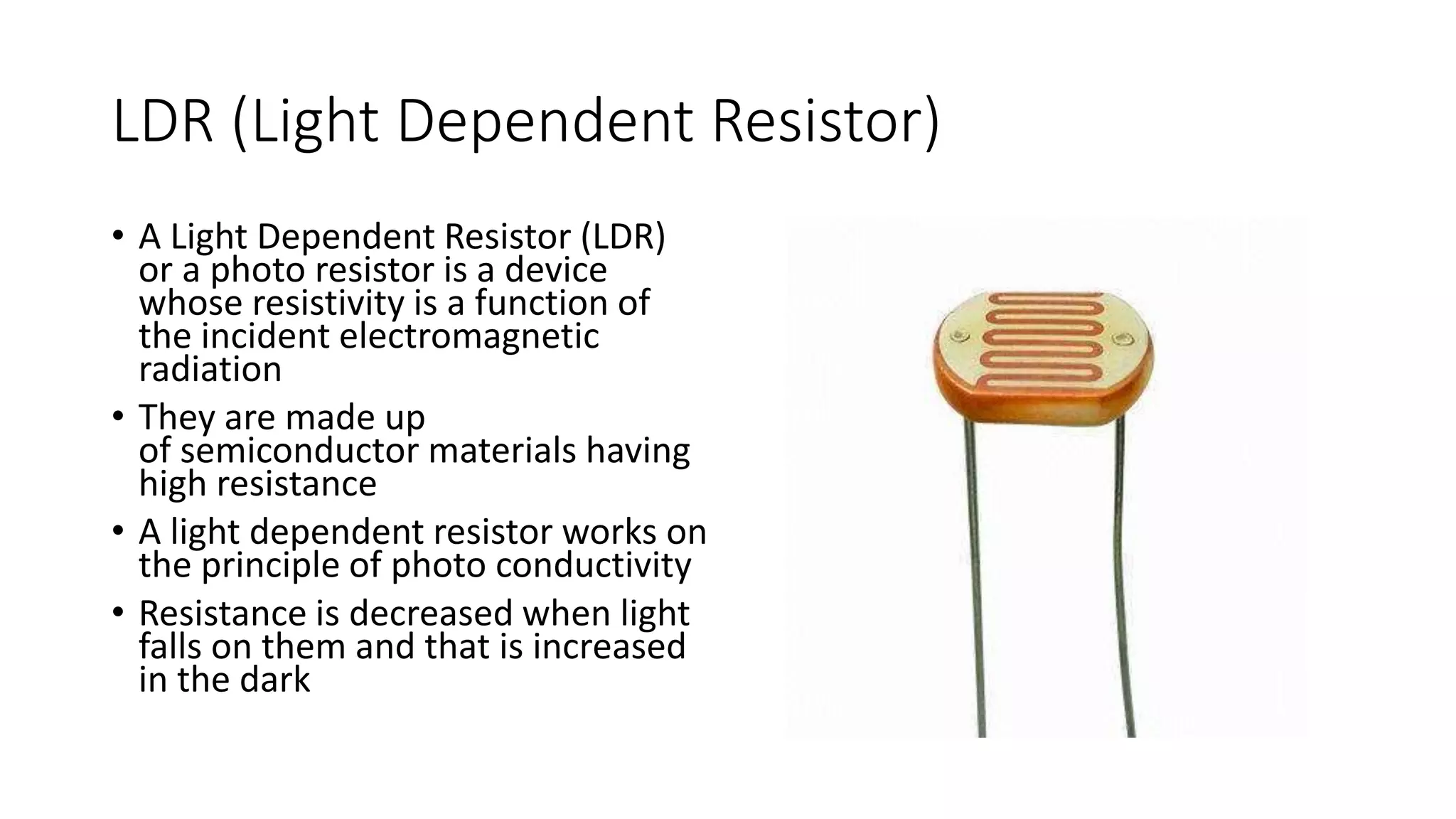
LDR (Light Dependent Resistor)
• A Light Dependent Resistor (LDR)
or a photo resistor is a device
whose resistivity is a function of
the incident electromagnetic
radiation
• They are made up
of semiconductor materials having
high resistance
• A light dependent resistor works on
the principle of photo conductivity
• Resistance is decreased when light
falls on them and that is increased
in the dark
Accelerometer
• Accelerometers are devices that measure acceleration in
meters per second squared (m/s2) or in G-forces (g). A
single G-force for us here on planet Earth is equivalent to
9.8 m/s2
• Accelerometers are useful for sensing vibrations in
systems or for orientation applications
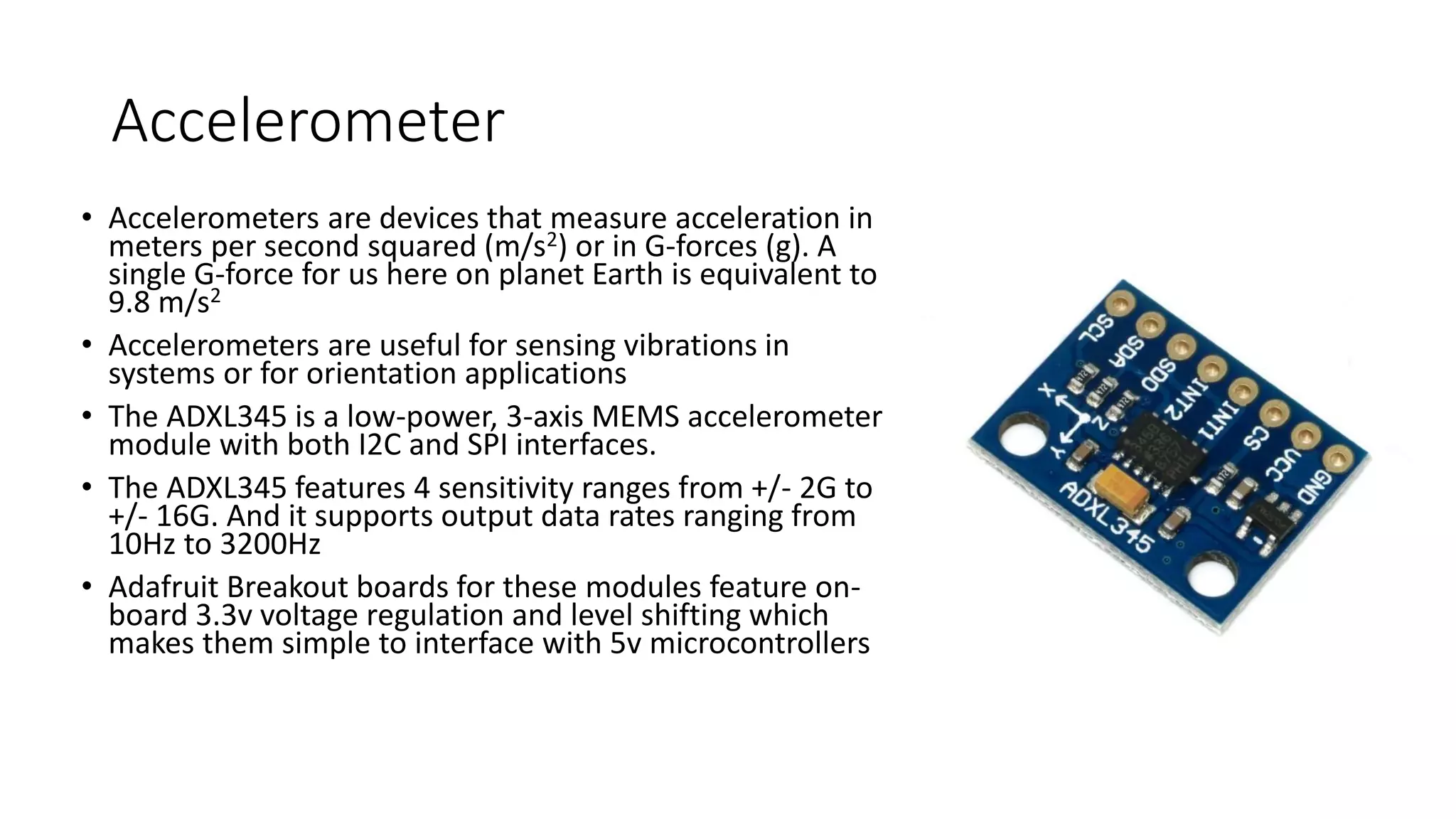
• The ADXL345 is a low-power, 3-axis MEMS accelerometer
module with both I2C and SPI interfaces.
• The ADXL345 features 4 sensitivity ranges from +/- 2G to
+/- 16G. And it supports output data rates ranging from
10Hz to 3200Hz
• Adafruit Breakout boards for these modules feature on-
board 3.3v voltage regulation and level shifting which
makes them simple to interface with 5v microcontrollers
Gyroscope
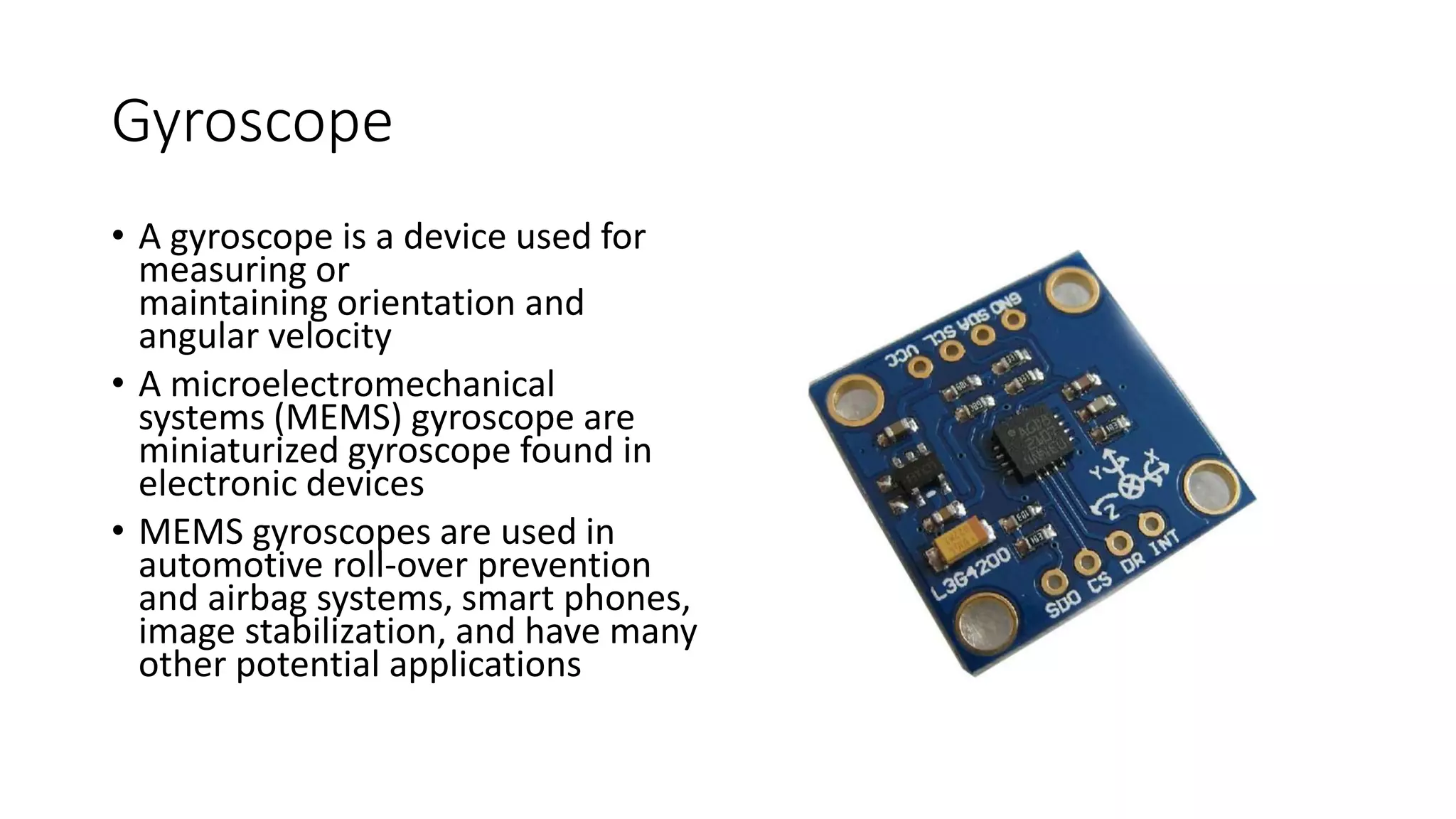
• A gyroscope is a device used for
measuring or
maintaining orientation and
angular velocity
• A microelectromechanical
systems (MEMS) gyroscope are
miniaturized gyroscope found in
electronic devices
• MEMS gyroscopes are used in
automotive roll-over prevention
and airbag systems, smart phones,
image stabilization, and have many
other potential applications
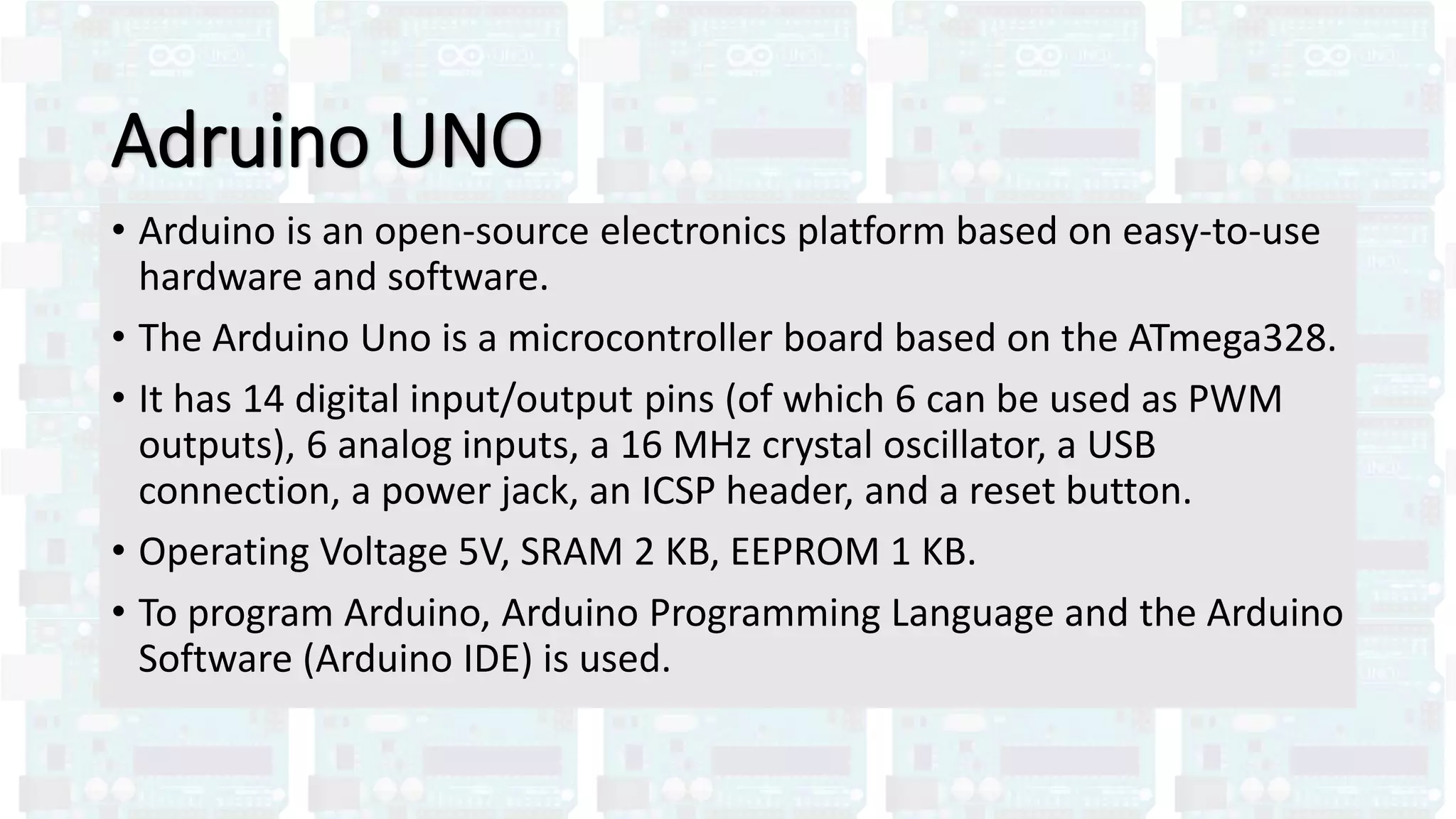
Adruino UNO
• Arduino is an open-source electronics platform based on easy-to-use
hardware and software.
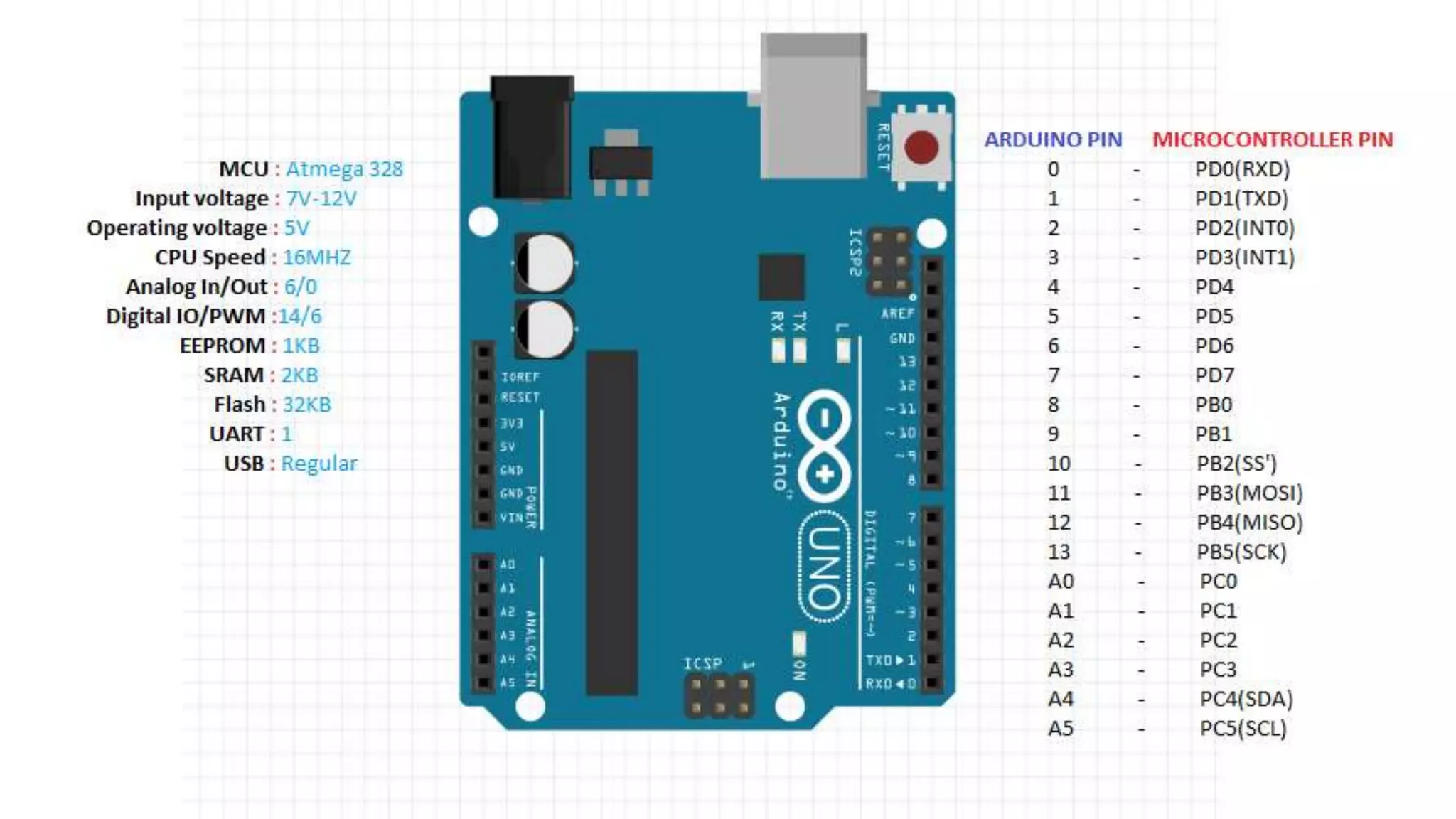
• The Arduino Uno is a microcontroller board based on the ATmega328.
• It has 14 digital input/output pins (of which 6 can be used as PWM
outputs), 6 analog inputs, a 16 MHz crystal oscillator, a USB
connection, a power jack, an ICSP header, and a reset button.
• Operating Voltage 5V, SRAM 2 KB, EEPROM 1 KB.
• To program Arduino, Arduino Programming Language and the Arduino
Software (Arduino IDE) is used.
Programs made using Arduino UNO
• Programs related to LED (Light Emitting Diode)
• Programs related to LCD (Liquid Crystal Display, 16x2)
• Programs related to sensors like accelerometer (ADXL345), temperature
sensor (thermistor), light sensor (LDR-Light Dependent Resistor)
• Programs related to counters
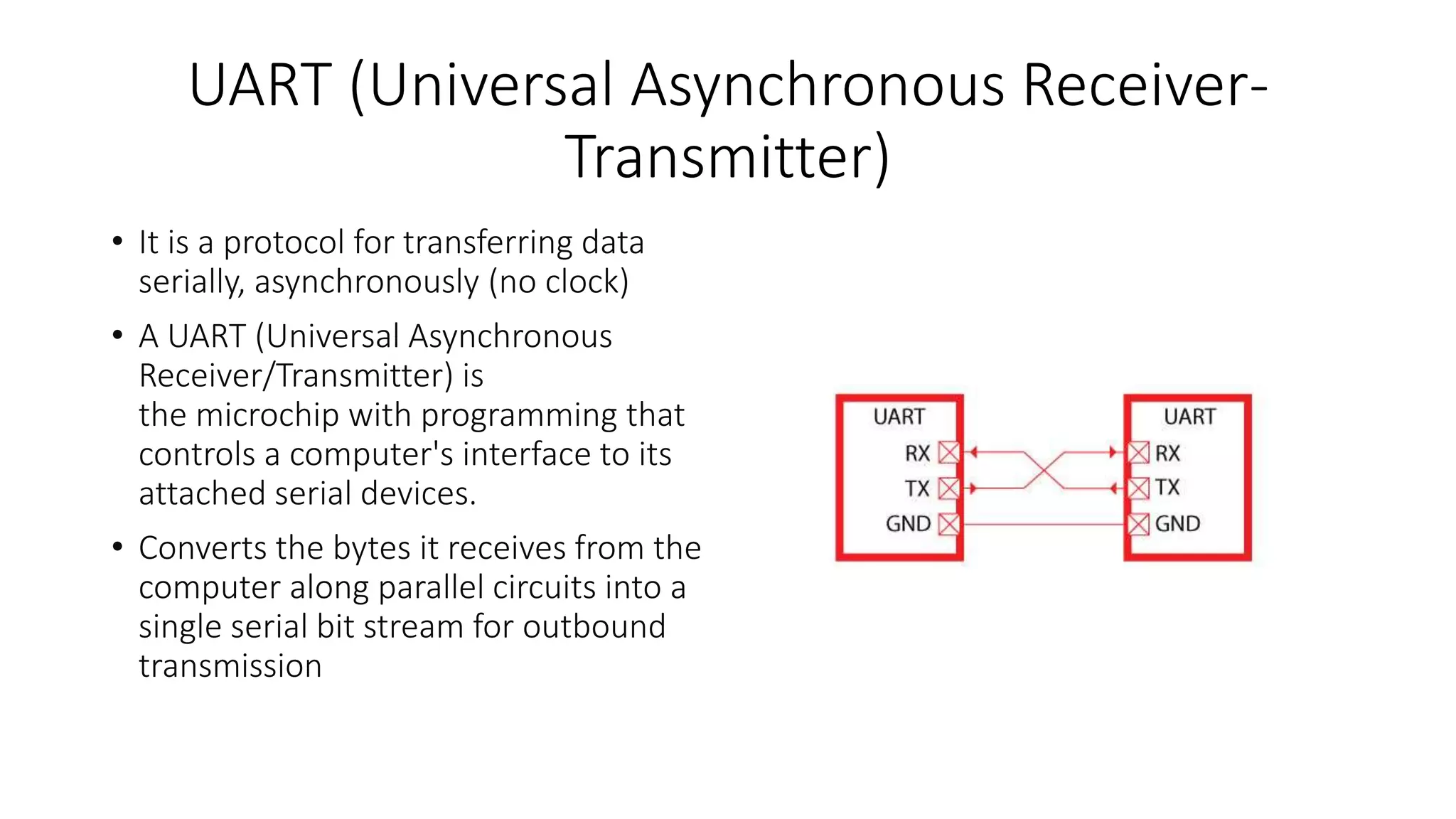
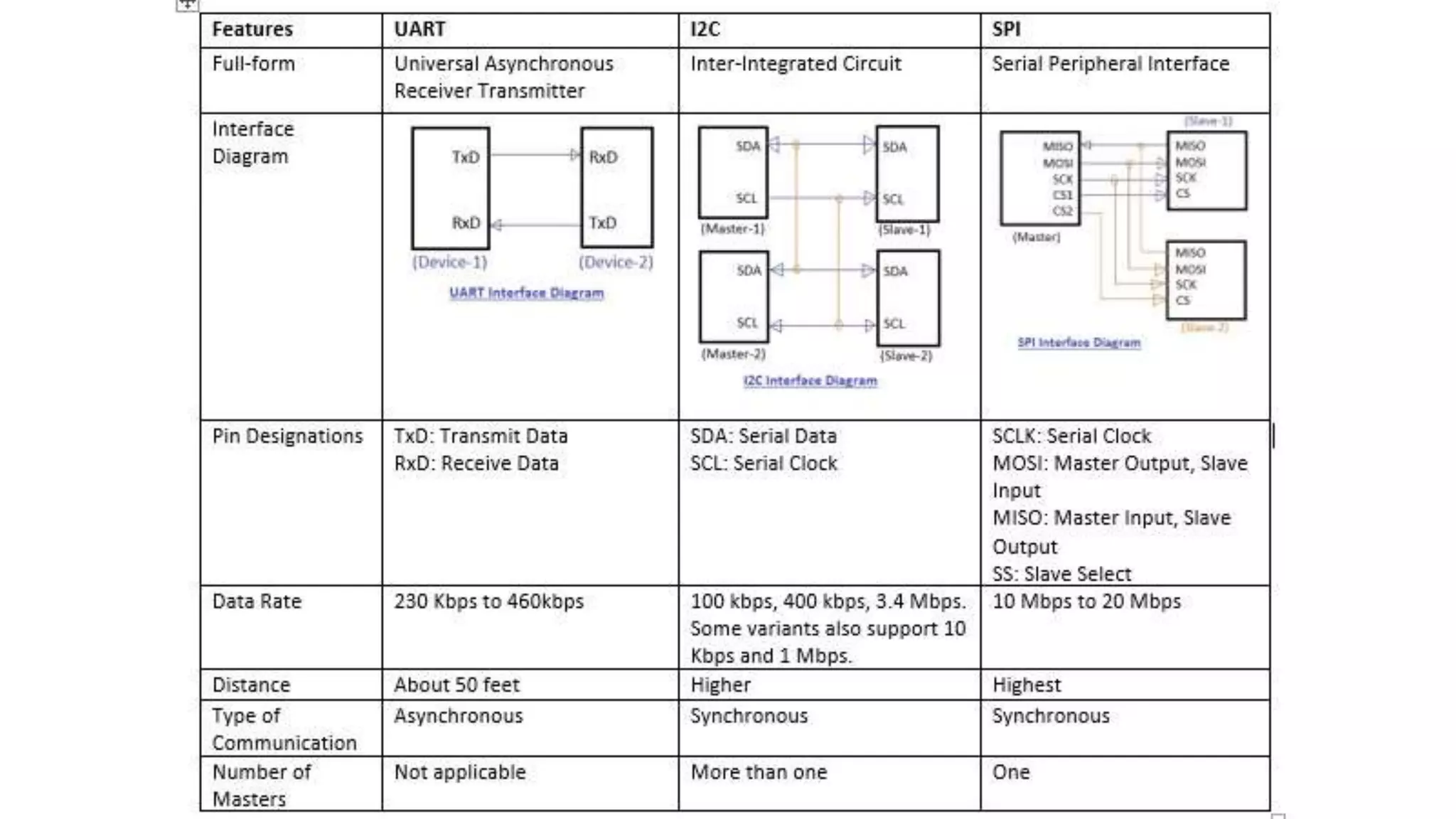
UART (Universal Asynchronous Receiver-
Transmitter)
• It is a protocol for transferring data
serially, asynchronously (no clock)
• A UART (Universal Asynchronous
Receiver/Transmitter) is
the microchip with programming that
controls a computer's interface to its
attached serial devices.
• Converts the bytes it receives from the
computer along parallel circuits into a
single serial bit stream for outbound
transmission
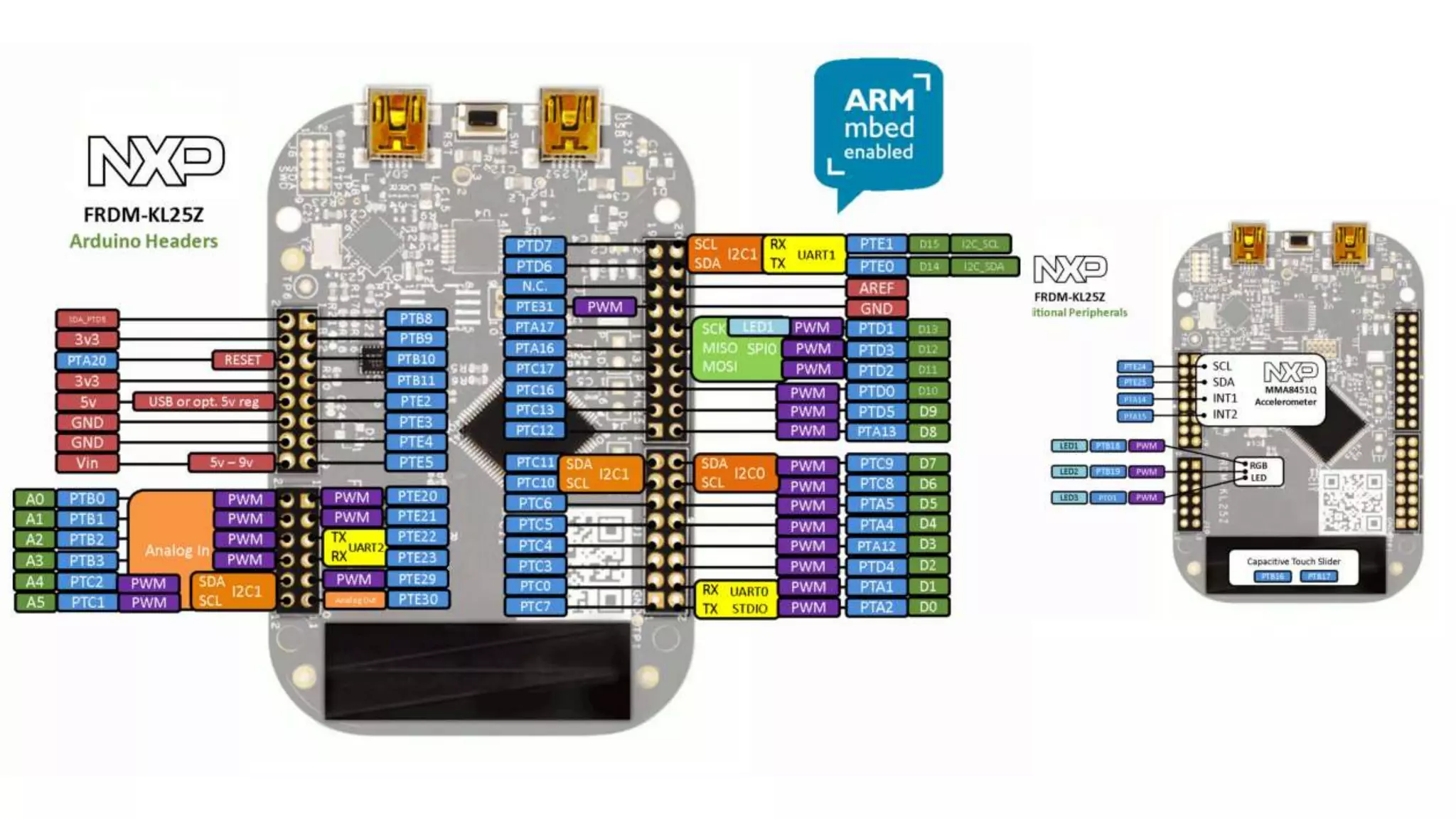
FRDM-KL25ZDesigned by NXP in collaboration with mbed
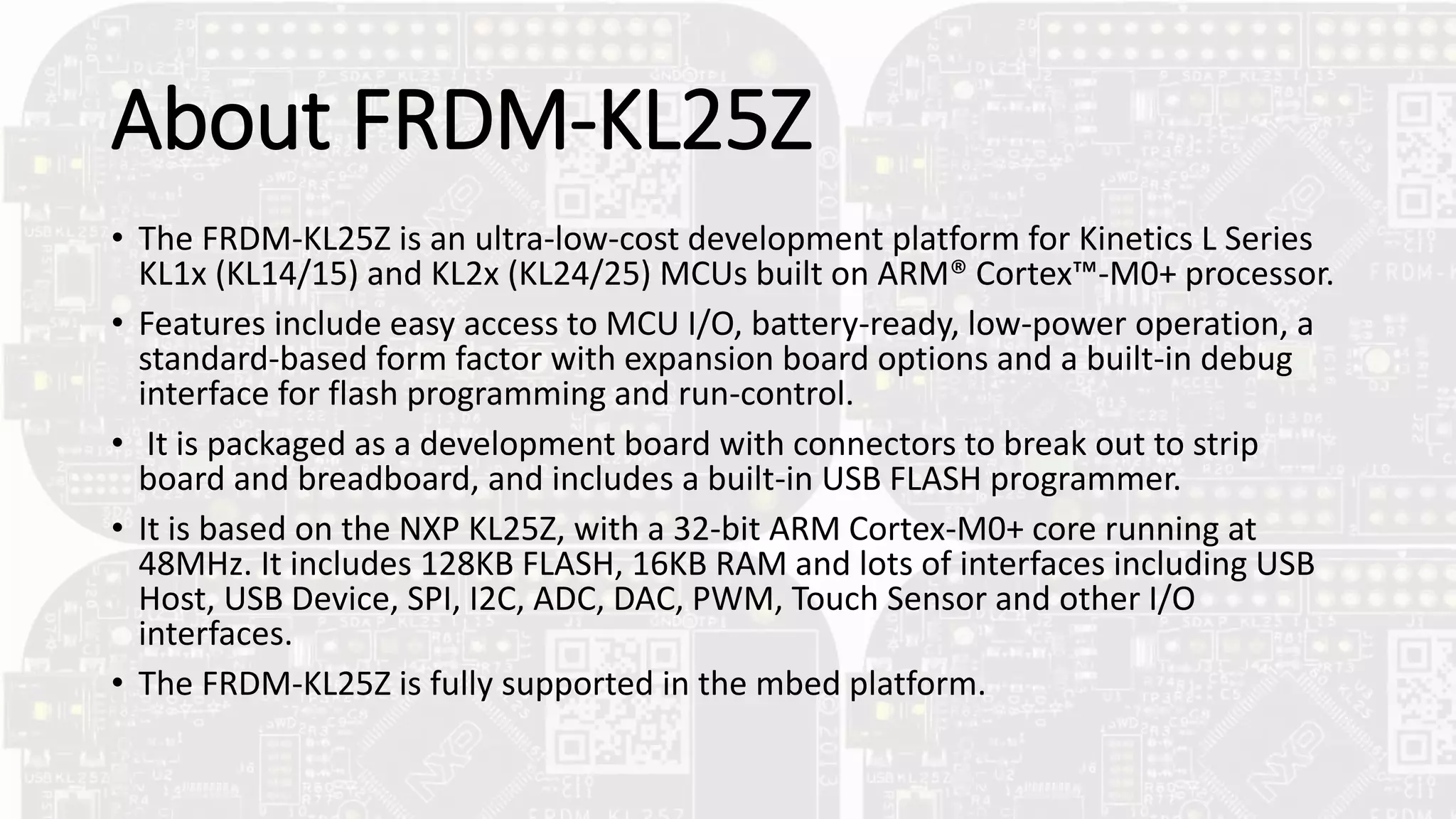
About FRDM-KL25Z
• The FRDM-KL25Z is an ultra-low-cost development platform for Kinetics L Series
KL1x (KL14/15) and KL2x (KL24/25) MCUs built on ARM® Cortex™-M0+ processor.
• Features include easy access to MCU I/O, battery-ready, low-power operation, a
standard-based form factor with expansion board options and a built-in debug
interface for flash programming and run-control.
• It is packaged as a development board with connectors to break out to strip
board and breadboard, and includes a built-in USB FLASH programmer.
• It is based on the NXP KL25Z, with a 32-bit ARM Cortex-M0+ core running at
48MHz. It includes 128KB FLASH, 16KB RAM and lots of interfaces including USB
Host, USB Device, SPI, I2C, ADC, DAC, PWM, Touch Sensor and other I/O
interfaces.
• The FRDM-KL25Z is fully supported in the mbed platform.
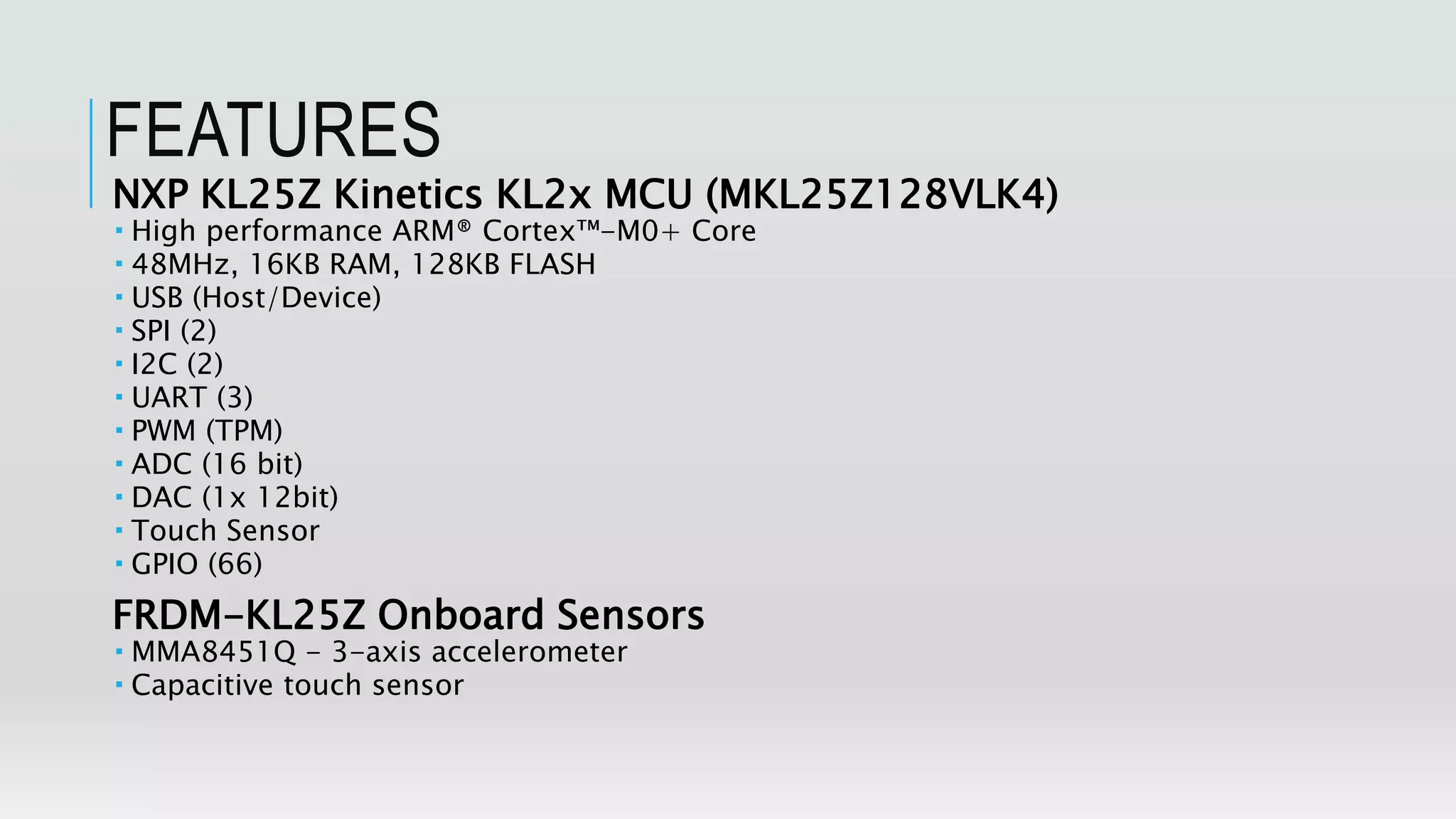
FEATURES
NXP KL25Z Kinetics KL2x MCU (MKL25Z128VLK4)
 High performance ARM® Cortex™-M0+ Core
 48MHz, 16KB RAM, 128KB FLASH
 USB (Host/Device)
 SPI (2)
 I2C (2)
 UART (3)
 PWM (TPM)
 ADC (16 bit)
 DAC (1x 12bit)
 Touch Sensor
 GPIO (66)
FRDM-KL25Z Onboard Sensors
 MMA8451Q - 3-axis accelerometer
 Capacitive touch sensor
Some projects made using FRDM-KL25Z
• PWM
• Multi‐channel DAQ (Data Acquisition System) using Serial Port Plotter
• USB Mouse
• Air Mouse using nRF24L01P
• Other programs using accelerometer, RGB LED, potentiometer, LDR,
thermistor etc.
BLE (Bluetooth Low Energy)
• Bluetooth Low Energy (Bluetooth LE, BLE,
marketed as Bluetooth Smart) is
a wireless personal area
network technology designed and
marketed by the Bluetooth Special
Interest Group
• Bluetooth Smart was originally introduced
under the name Wibree by Nokia in 2006
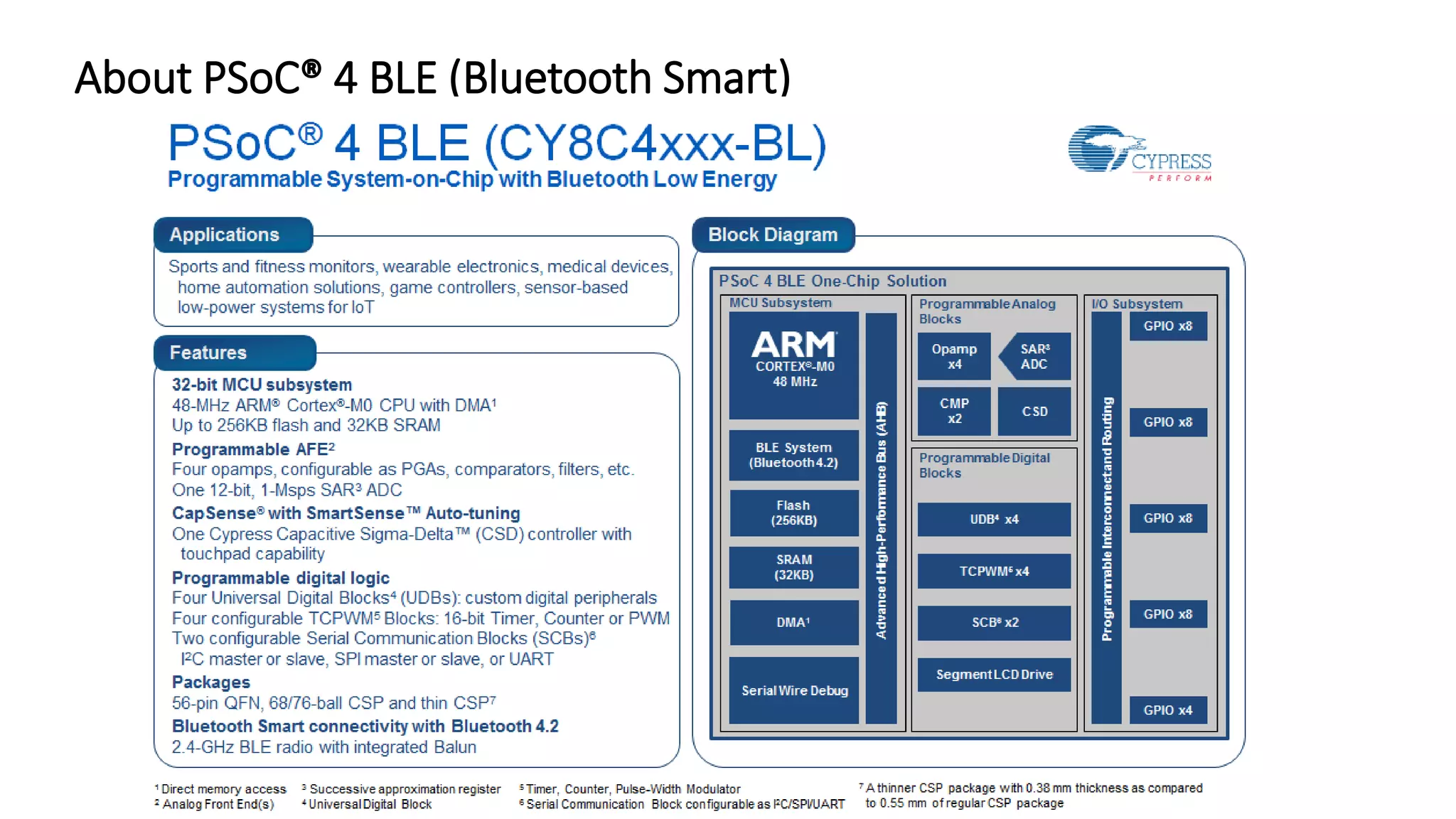
• PSoC 4 BLE enables system designers to
create sensor-based, low-power wireless
systems using integrated programmable
analog front ends, programmable digital
peripherals, industry-leading CapSense
user interfaces and the Bluetooth Low
Energy
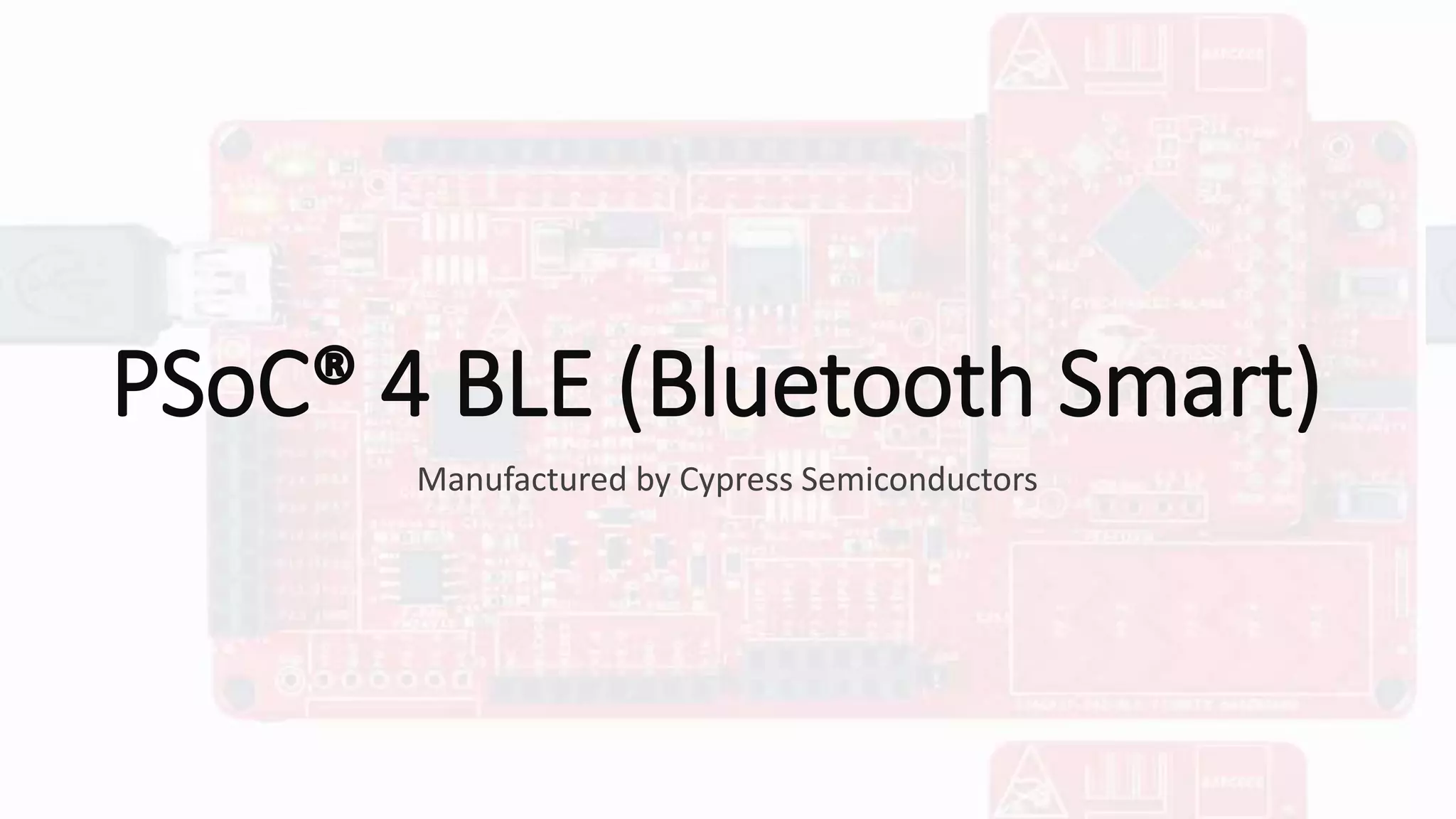
PSoC® 4 BLE (Bluetooth Smart)
Manufactured by Cypress Semiconductors
About PSoC® 4 BLE (Bluetooth Smart)
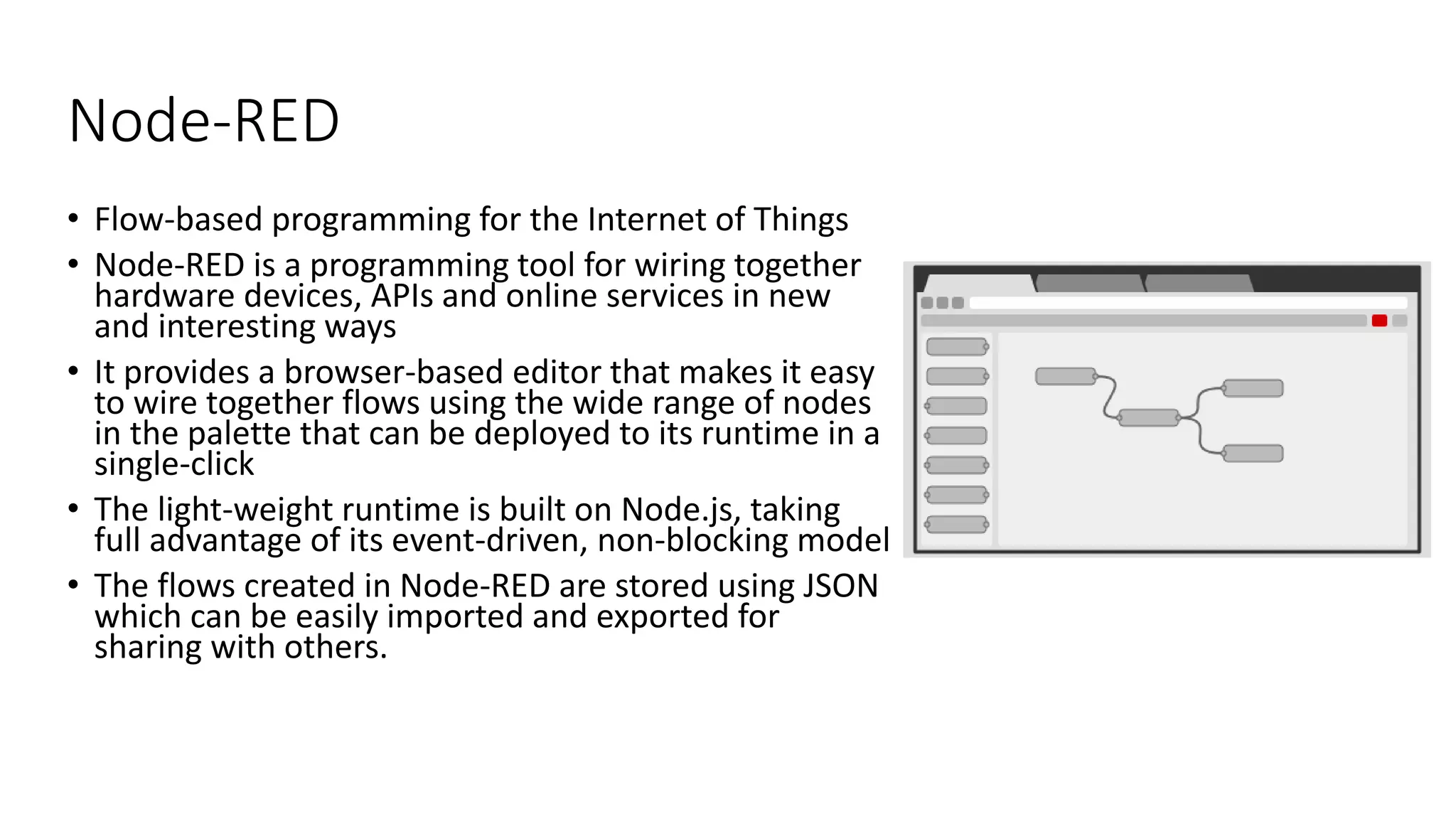
Node-RED
• Flow-based programming for the Internet of Things
• Node-RED is a programming tool for wiring together
hardware devices, APIs and online services in new
and interesting ways
• It provides a browser-based editor that makes it easy
to wire together flows using the wide range of nodes
in the palette that can be deployed to its runtime in a
single-click
• The light-weight runtime is built on Node.js, taking
full advantage of its event-driven, non-blocking model
• The flows created in Node-RED are stored using JSON
which can be easily imported and exported for
sharing with others.
Internet of Things
• The Internet of things (IoT) is the network of
physical devices, vehicles, and other
items embedded with electronics, software, s
ensors, actuators, and network
connectivity which enable these objects to
collect and exchange data.
• The IoT allows objects to be sensed or
controlled remotely across existing network
infrastructure
• One IoT device connects to another to
transmit information using Internet transfer
protocols. IoT platforms serve as the bridge
between the devices' sensors and the data
networks
• Applications of IoT include smart home,
wearables, smart cities, industrial internet etc.
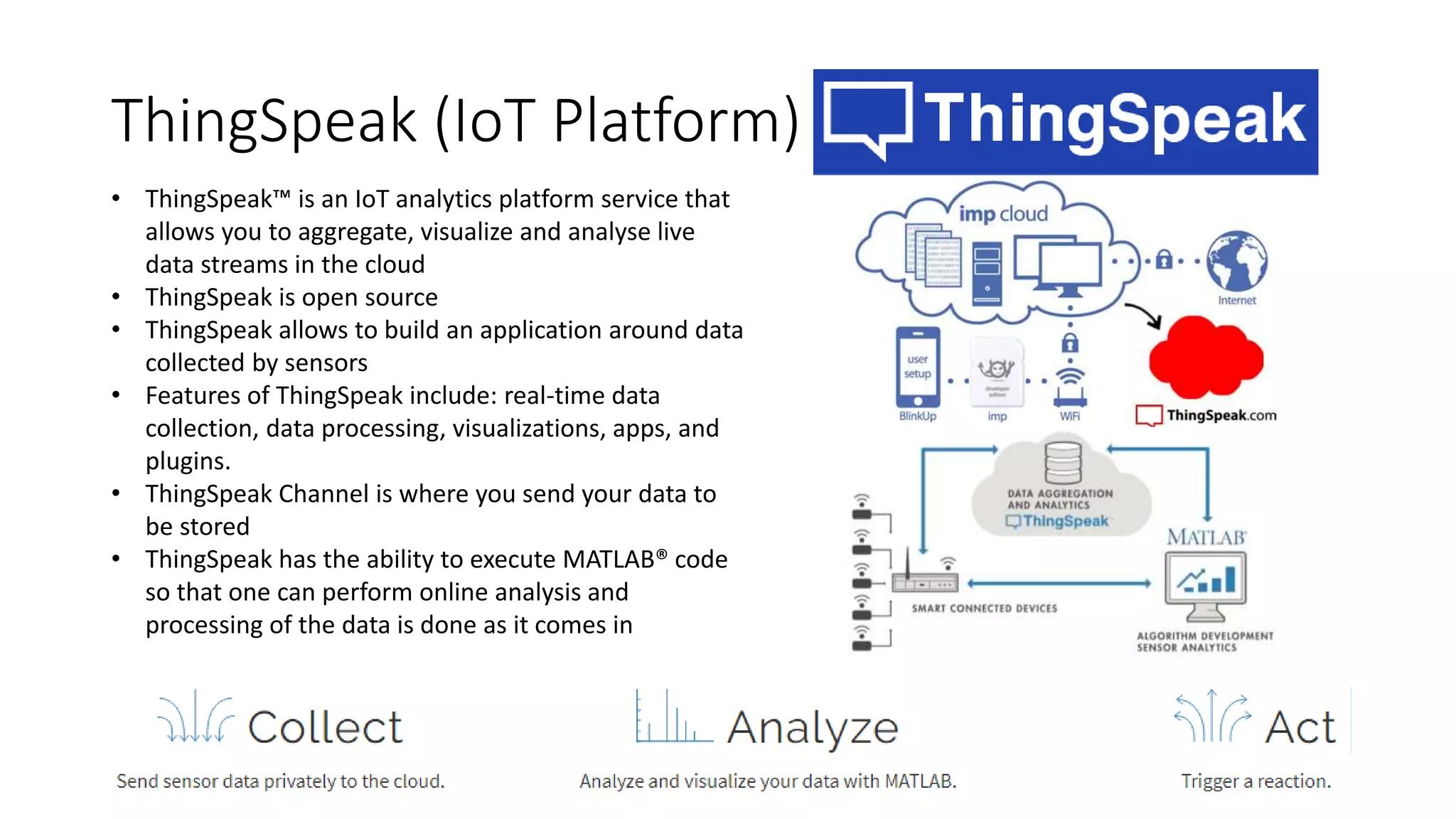
ThingSpeak (IoT Platform)
• ThingSpeak™ is an IoT analytics platform service that
allows you to aggregate, visualize and analyse live
data streams in the cloud
• ThingSpeak is open source
• ThingSpeak allows to build an application around data
collected by sensors
• Features of ThingSpeak include: real-time data
collection, data processing, visualizations, apps, and
plugins.
• ThingSpeak Channel is where you send your data to
be stored
• ThingSpeak has the ability to execute MATLAB® code
so that one can perform online analysis and
processing of the data is done as it comes in
Final Project – Temperature Monitoring System
• The project was realized by using FRDM-KL25Z
• It involved nRF24L01P (NRF), Node-RED and ThingSpeak (IoT Platform)
• Four members worked on the project
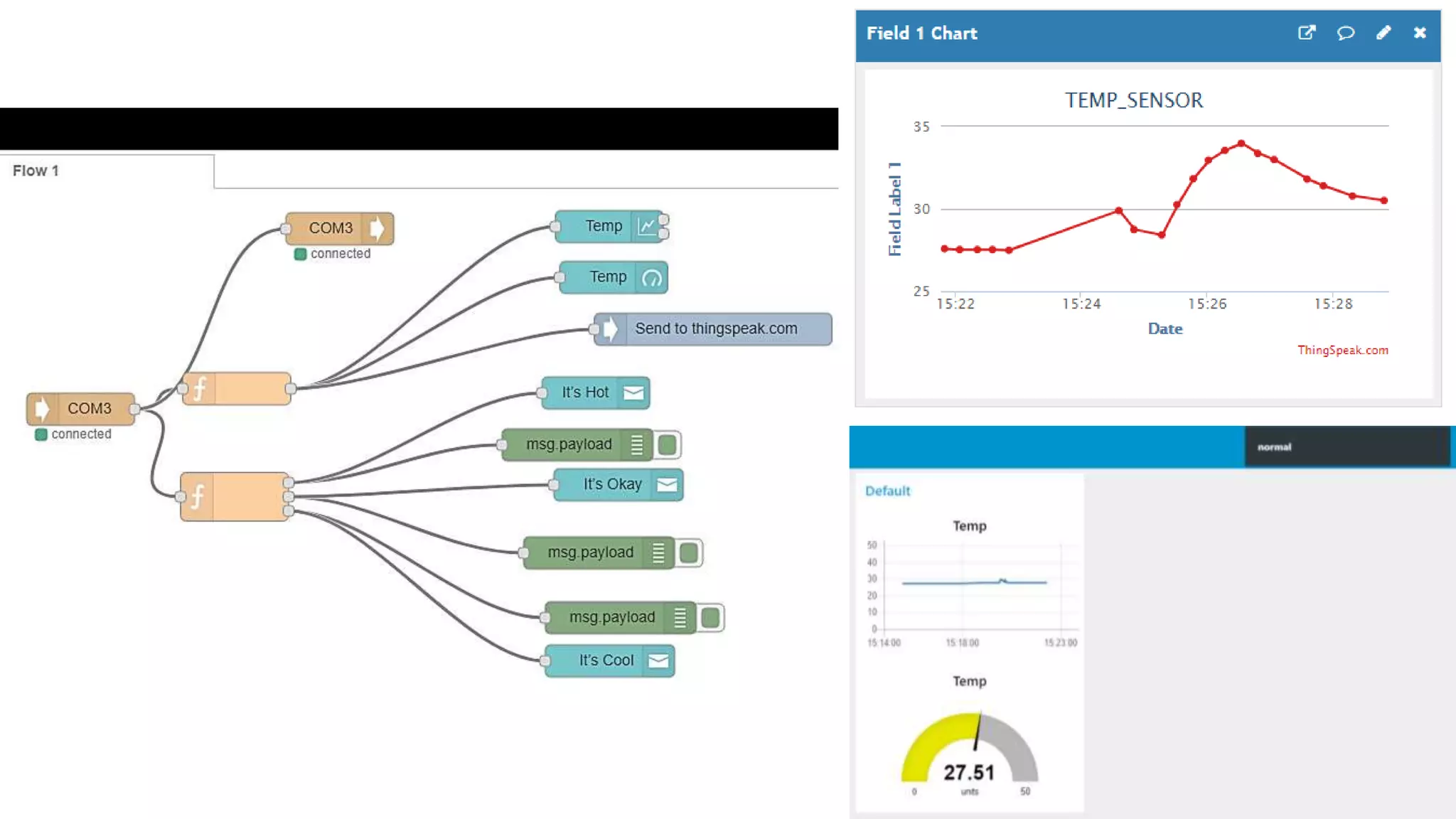
• The FRDM‐KL25Z transmits calibrated temperature data with accuracy up
to 2 decimal digits through NRF. The FRDM‐KL25Z (receiver) receives the
calibrated temperature data via NRF and sends it to Node‐RED.
• Via Node‐RED the data is displayed on a chart, gauge meter and sent to
ThingSpeak where a real‐time graph is plotted.
• Pop-Up Notifications with RGB LED was also used.
Conclusion
 The field I studied during my training was Embedded Systems, its programming
and Internet of Things which are used in many applications today.
 From starting with basic devices such as LEDs, LCDs to advanced sensors and
systems like MEMS sensors and PSoC were covered during training.
 The topics covered during these 60 days of training is an integral part of
electronics and modern day technology.
 The applications of Embedded Systems and Internet of Things are vast and the
training in the same field proved to be very helpful.
THANK YOU

Embedded Systems Design and Programming & Internet of Things

  • 2.
    PTS: 2017 Presented By-Vasundhara Sharma (7EC, D3) Sufiyan Ahmed (7EC, D3)
  • 3.
    Embedded Systems Designand Programming & Internet of Things
  • 4.
    About Eduvance • Eduvance’smain office is located at Ghatkopar, Mumbai. • It is also located at Thane, Hyderabad and Dehradun. • It is founded by Ph.D. alumni from U.S. Universities. • It is advised by U.S. based researchers, faculty and industry professionals that have a proven track record in their field. • It is currently working on technologies such as Embedded Systems, IoT and Augmented Reality. • The training was completed under guidance of Ms. Jahnavi Kulkarni.
  • 5.
    Eduvance conducts trainingand internship program called the “Summer Industrial Training in Embedded Systems and IoT”. This training is in collaboration with ARM University Program and Cypress Semiconductors University Alliance.
  • 6.
    The training wasdivided into 4 Parts: •Mini Projects using Arduino UNO •ARM “Mbed” platform and ARM Embedded Systems Programming •Cypress Programmable System on Chip •Internet of Things (IoT).
  • 7.
    Embedded Systems • Combinationof hardware and software that performs a specific function/set of functions • An embedded system is a computer system with a dedicated function within a larger mechanical or electrical system, often with real- time computing constraints • Compatibility is necessary between hardware and software • Embedded systems control many devices in common use today.
  • 9.
  • 10.
    Some Sensors Usedin Training  LDR (Light Dependent Resistor)  Thermistor  Accelerometers  Gyroscopes  Touch Sensors  Potentiometers
  • 11.
    LDR (Light DependentResistor) • A Light Dependent Resistor (LDR) or a photo resistor is a device whose resistivity is a function of the incident electromagnetic radiation • They are made up of semiconductor materials having high resistance • A light dependent resistor works on the principle of photo conductivity • Resistance is decreased when light falls on them and that is increased in the dark
  • 12.
    Accelerometer • Accelerometers aredevices that measure acceleration in meters per second squared (m/s2) or in G-forces (g). A single G-force for us here on planet Earth is equivalent to 9.8 m/s2 • Accelerometers are useful for sensing vibrations in systems or for orientation applications • The ADXL345 is a low-power, 3-axis MEMS accelerometer module with both I2C and SPI interfaces. • The ADXL345 features 4 sensitivity ranges from +/- 2G to +/- 16G. And it supports output data rates ranging from 10Hz to 3200Hz • Adafruit Breakout boards for these modules feature on- board 3.3v voltage regulation and level shifting which makes them simple to interface with 5v microcontrollers
  • 13.
    Gyroscope • A gyroscopeis a device used for measuring or maintaining orientation and angular velocity • A microelectromechanical systems (MEMS) gyroscope are miniaturized gyroscope found in electronic devices • MEMS gyroscopes are used in automotive roll-over prevention and airbag systems, smart phones, image stabilization, and have many other potential applications
  • 14.
    Adruino UNO • Arduinois an open-source electronics platform based on easy-to-use hardware and software. • The Arduino Uno is a microcontroller board based on the ATmega328. • It has 14 digital input/output pins (of which 6 can be used as PWM outputs), 6 analog inputs, a 16 MHz crystal oscillator, a USB connection, a power jack, an ICSP header, and a reset button. • Operating Voltage 5V, SRAM 2 KB, EEPROM 1 KB. • To program Arduino, Arduino Programming Language and the Arduino Software (Arduino IDE) is used.
  • 16.
    Programs made usingArduino UNO • Programs related to LED (Light Emitting Diode) • Programs related to LCD (Liquid Crystal Display, 16x2) • Programs related to sensors like accelerometer (ADXL345), temperature sensor (thermistor), light sensor (LDR-Light Dependent Resistor) • Programs related to counters
  • 17.
    UART (Universal AsynchronousReceiver- Transmitter) • It is a protocol for transferring data serially, asynchronously (no clock) • A UART (Universal Asynchronous Receiver/Transmitter) is the microchip with programming that controls a computer's interface to its attached serial devices. • Converts the bytes it receives from the computer along parallel circuits into a single serial bit stream for outbound transmission
  • 19.
    FRDM-KL25ZDesigned by NXPin collaboration with mbed
  • 20.
    About FRDM-KL25Z • TheFRDM-KL25Z is an ultra-low-cost development platform for Kinetics L Series KL1x (KL14/15) and KL2x (KL24/25) MCUs built on ARM® Cortex™-M0+ processor. • Features include easy access to MCU I/O, battery-ready, low-power operation, a standard-based form factor with expansion board options and a built-in debug interface for flash programming and run-control. • It is packaged as a development board with connectors to break out to strip board and breadboard, and includes a built-in USB FLASH programmer. • It is based on the NXP KL25Z, with a 32-bit ARM Cortex-M0+ core running at 48MHz. It includes 128KB FLASH, 16KB RAM and lots of interfaces including USB Host, USB Device, SPI, I2C, ADC, DAC, PWM, Touch Sensor and other I/O interfaces. • The FRDM-KL25Z is fully supported in the mbed platform.
  • 21.
    FEATURES NXP KL25Z KineticsKL2x MCU (MKL25Z128VLK4)  High performance ARM® Cortex™-M0+ Core  48MHz, 16KB RAM, 128KB FLASH  USB (Host/Device)  SPI (2)  I2C (2)  UART (3)  PWM (TPM)  ADC (16 bit)  DAC (1x 12bit)  Touch Sensor  GPIO (66) FRDM-KL25Z Onboard Sensors  MMA8451Q - 3-axis accelerometer  Capacitive touch sensor
  • 23.
    Some projects madeusing FRDM-KL25Z • PWM • Multi‐channel DAQ (Data Acquisition System) using Serial Port Plotter • USB Mouse • Air Mouse using nRF24L01P • Other programs using accelerometer, RGB LED, potentiometer, LDR, thermistor etc.
  • 24.
    BLE (Bluetooth LowEnergy) • Bluetooth Low Energy (Bluetooth LE, BLE, marketed as Bluetooth Smart) is a wireless personal area network technology designed and marketed by the Bluetooth Special Interest Group • Bluetooth Smart was originally introduced under the name Wibree by Nokia in 2006 • PSoC 4 BLE enables system designers to create sensor-based, low-power wireless systems using integrated programmable analog front ends, programmable digital peripherals, industry-leading CapSense user interfaces and the Bluetooth Low Energy
  • 25.
    PSoC® 4 BLE(Bluetooth Smart) Manufactured by Cypress Semiconductors
  • 26.
    About PSoC® 4BLE (Bluetooth Smart)
  • 27.
    Node-RED • Flow-based programmingfor the Internet of Things • Node-RED is a programming tool for wiring together hardware devices, APIs and online services in new and interesting ways • It provides a browser-based editor that makes it easy to wire together flows using the wide range of nodes in the palette that can be deployed to its runtime in a single-click • The light-weight runtime is built on Node.js, taking full advantage of its event-driven, non-blocking model • The flows created in Node-RED are stored using JSON which can be easily imported and exported for sharing with others.
  • 28.
    Internet of Things •The Internet of things (IoT) is the network of physical devices, vehicles, and other items embedded with electronics, software, s ensors, actuators, and network connectivity which enable these objects to collect and exchange data. • The IoT allows objects to be sensed or controlled remotely across existing network infrastructure • One IoT device connects to another to transmit information using Internet transfer protocols. IoT platforms serve as the bridge between the devices' sensors and the data networks • Applications of IoT include smart home, wearables, smart cities, industrial internet etc.
  • 29.
    ThingSpeak (IoT Platform) •ThingSpeak™ is an IoT analytics platform service that allows you to aggregate, visualize and analyse live data streams in the cloud • ThingSpeak is open source • ThingSpeak allows to build an application around data collected by sensors • Features of ThingSpeak include: real-time data collection, data processing, visualizations, apps, and plugins. • ThingSpeak Channel is where you send your data to be stored • ThingSpeak has the ability to execute MATLAB® code so that one can perform online analysis and processing of the data is done as it comes in
  • 30.
    Final Project –Temperature Monitoring System • The project was realized by using FRDM-KL25Z • It involved nRF24L01P (NRF), Node-RED and ThingSpeak (IoT Platform) • Four members worked on the project • The FRDM‐KL25Z transmits calibrated temperature data with accuracy up to 2 decimal digits through NRF. The FRDM‐KL25Z (receiver) receives the calibrated temperature data via NRF and sends it to Node‐RED. • Via Node‐RED the data is displayed on a chart, gauge meter and sent to ThingSpeak where a real‐time graph is plotted. • Pop-Up Notifications with RGB LED was also used.
  • 32.
    Conclusion  The fieldI studied during my training was Embedded Systems, its programming and Internet of Things which are used in many applications today.  From starting with basic devices such as LEDs, LCDs to advanced sensors and systems like MEMS sensors and PSoC were covered during training.  The topics covered during these 60 days of training is an integral part of electronics and modern day technology.  The applications of Embedded Systems and Internet of Things are vast and the training in the same field proved to be very helpful.
  • 33.