The document discusses a smart attendance system utilizing fingerprint biometrics on a Raspberry Pi, highlighting its capability for real-time authentication and database management. It describes the implementation process, hardware architecture, and software algorithms used to achieve fingerprint recognition, including the integration of a fingerprint reader and GUI. The paper also emphasizes the accuracy and reliability of fingerprint technology in various applications, and suggests future potential for wider usage in educational institutions.
![@ IJTSRD | Available Online @ www.ijtsrd.com | Volume – 1 | Issue – 5 | July-Aug 2017 Page: 514
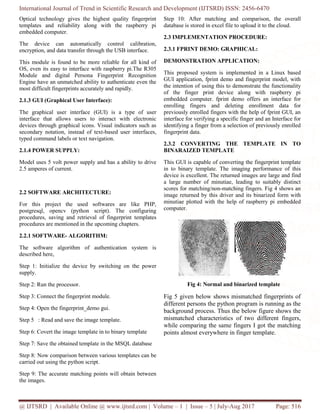
ISSN No: 2456 - 6470 | www.ijtsrd.com | Volume - 1 | Issue – 5
International Journal of Trend in Scientific
Research and Development (IJTSRD)
UGC Approved International Open Access Journal
Smart Attendance System using Raspberry Pi
Pradeep Kumar M S
Asst. Professor, Dept. of TCE, DBIT College,
Bangalore, Karnataka, India
Dr. K. Suresh
Principal, SDMIT college, Ujire, Karnataka, India
Indumati T
Asst. Professor, Dept. of CSE, EWIT College,
Bangalore, India
Kishor kumar
Asst. Professor, Dept. of TCE, DBIT College,
Bangalore, Karnataka, India
ABSTRACT
Biometric authentication is one of the most popular
and accurate technology. Now days, it is used in many
real time applications. However, recognizing finger
prints in Linux based embedded computers (raspberry
pi) is still a very complex problem. This entire work is
done on the Linux based embedded computer called
raspberry pi, in which database creation, fingerprint
reader access, authentication and recognition using
python were entirely done on raspberry pi This paper
discusses on the standardized authentication model
which is capable of extracting the finger prints of
individual and store that in database . Then the use of
final finger print to match with others in finger prints
present in the database to show the capability of this
model and also updating the database obtained to the
organisation by creating an application through cloud.
Keywords: finger print authentication, python,
raspberry pi
1. INTRODUCTION
The human body has the privilege of having features
that are unique and exclusive to each individual. This
exclusivity and unique characteristic has led to the
field of biometrics and its application in ensuring
security in various fields with various embedded
controllers and embedded computers. Biometrics has
gained popularity and has proved itself to be a reliable
mode of ensuring privacy, maintaining security and
identifying individuals. It has wide acceptance
throughout the globe and now is being used at places
like airports, hospitals, schools, colleges, corporate
offices etc.
Biometrics is the study of identifying a person by
their physical traits that are inherent and unique to
only the person concerned. Biometric identification
include fingerprint verification, palm geometry, face
recognition, iris recognition, etc. The above
mentioned techniques work with different levels of
functionality and accuracy.
Accuracy and reliability are the two most important
parameters when it comes to biometric applications
and that too with advanced embedded computers.
Fingerprint verification is one of the oldest known
biometric techniques known but still is the most
widely used because of its simplicity and good levels
of accuracy. It’s a well known fact that every human
being is born with a different pattern on the fingers
and this feature is exploited to identify and
differentiate between two different persons that is
what the factor which helped to initiate the model.
1.1 LITERATURE SURVEY
Sonam Shukla, Pradeep Mishra suggested increasing
the Accuracy of an Existing Fingerprint Recognition
System Using Adaptive Technique, in this approach
developer mainly focusing on Integrated Automated
Fingerprint Identification Service (IAFIS) of the most
famous police agencies. [1] They extracted fingerprint
pattern is characterized by a set of ridgelines that](https://image.slidesharecdn.com/77smartattendancesystemusingraspberrypi-180810071802/85/Smart-Attendance-System-using-Raspberry-Pi-1-320.jpg)
![@ IJTSRD | Available Online @ www.ijtsrd.com | Volume – 1 | Issue – 5 | July-Aug 2017 Page: 514
ISSN No: 2456 - 6470 | www.ijtsrd.com | Volume - 1 | Issue – 5
International Journal of Trend in Scientific
Research and Development (IJTSRD)
UGC Approved International Open Access Journal
Smart Attendance System using Raspberry Pi
Pradeep Kumar M S
Asst. Professor, Dept. of TCE, DBIT College,
Bangalore, Karnataka, India
Dr. K. Suresh
Principal, SDMIT college, Ujire, Karnataka, India
Indumati T
Asst. Professor, Dept. of CSE, EWIT College,
Bangalore, India
Kishor kumar
Asst. Professor, Dept. of TCE, DBIT College,
Bangalore, Karnataka, India
ABSTRACT
Biometric authentication is one of the most popular
and accurate technology. Now days, it is used in many
real time applications. However, recognizing finger
prints in Linux based embedded computers (raspberry
pi) is still a very complex problem. This entire work is
done on the Linux based embedded computer called
raspberry pi, in which database creation, fingerprint
reader access, authentication and recognition using
python were entirely done on raspberry pi This paper
discusses on the standardized authentication model
which is capable of extracting the finger prints of
individual and store that in database . Then the use of
final finger print to match with others in finger prints
present in the database to show the capability of this
model and also updating the database obtained to the
organisation by creating an application through cloud.
Keywords: finger print authentication, python,
raspberry pi
1. INTRODUCTION
The human body has the privilege of having features
that are unique and exclusive to each individual. This
exclusivity and unique characteristic has led to the
field of biometrics and its application in ensuring
security in various fields with various embedded
controllers and embedded computers. Biometrics has
gained popularity and has proved itself to be a reliable
mode of ensuring privacy, maintaining security and
identifying individuals. It has wide acceptance
throughout the globe and now is being used at places
like airports, hospitals, schools, colleges, corporate
offices etc.
Biometrics is the study of identifying a person by
their physical traits that are inherent and unique to
only the person concerned. Biometric identification
include fingerprint verification, palm geometry, face
recognition, iris recognition, etc. The above
mentioned techniques work with different levels of
functionality and accuracy.
Accuracy and reliability are the two most important
parameters when it comes to biometric applications
and that too with advanced embedded computers.
Fingerprint verification is one of the oldest known
biometric techniques known but still is the most
widely used because of its simplicity and good levels
of accuracy. It’s a well known fact that every human
being is born with a different pattern on the fingers
and this feature is exploited to identify and
differentiate between two different persons that is
what the factor which helped to initiate the model.
1.1 LITERATURE SURVEY
Sonam Shukla, Pradeep Mishra suggested increasing
the Accuracy of an Existing Fingerprint Recognition
System Using Adaptive Technique, in this approach
developer mainly focusing on Integrated Automated
Fingerprint Identification Service (IAFIS) of the most
famous police agencies. [1] They extracted fingerprint
pattern is characterized by a set of ridgelines that](https://image.slidesharecdn.com/77smartattendancesystemusingraspberrypi-180810071802/75/Smart-Attendance-System-using-Raspberry-Pi-1-2048.jpg)
![International Journal of Trend in Scientific Research and Development (IJTSRD) ISSN: 2456-6470
@ IJTSRD | Available Online @ www.ijtsrd.com | Volume – 1 | Issue – 5 | July-Aug 2017 Page: 515
often flow in parallel, but intersect and terminate at
some points. The uniqueness of a fingerprint is
determined by the local ridge characteristics and their
relationships. Main drawback of this model is this
approach is not so apt for real time applications but
the accuracy of system is highly adaptable. Most
automatic systems for fingerprint comparison are
based on minutiae matching.
Le Hoang Thai and Ha Nhat Tam in 2010 suggested
Fingerprint recognition using standardized fingerprint
model, now a days, fingerprint recognition is one of
the most Important biometric technologies based on
fingerprint distinctiveness,[2] in this approach they
focused on improving the quality of fingerprint
images. In fingerprint recognition process, the
important step which affects on system accuracy is
matching between template and query fingerprint
This approach functions based on the uniqueness of
each person and it integrating the biometric device to
transmit the information obtained in this approach
they are using fingerprint extraction and matching
algorithm and they maintaining the database to
authenticate the person who approaching for the
access through the
On line web page created in the local server.
2. SYSTEM OUTLINE:
2.1. HARDWARE ARCHITECTURE:
This proposed system consists of raspberry pi and
fingerprint module. This system provides the features
of real time authentication facilities
Fig 1: Proposed System Block Diagram
2.1.1 RASPBERRY PI:
Hardware is a physical device that can be touched or
held, like a hard drive or a mobile phone. Software
can be thought of as a program or a collection of
programs that instruct a computer on what to do and
how to do it. Below is an image of the Raspberry Pi
which describes some of the components that make
up the hardware.
Fig.2. Hardware Components of Raspberry Pi
Fig.2 shows the hardware description of raspberry pi.
The real time vehicle tracking system uses the GPIO
pin, Micro SD slot, USB port and Micro USB
connector. The GPIO pins are used for serial
communication for interfacing GSM and GPS. It uses
8GB SD for installing the Raspbian OS and for
storage. The USB port is used for connecting
keyboard, mouse, dongle and pen drive. The power
supply is given through USB connector.
2.1.2 FINGERPRINT READER:
The R305 is the module which is used in the project.
This module supports both windows and Linux based
operating system. This self-contained module
optically scans the fingerprint when the user touches
the glowing window.
Fig 3: Finger print module
RASP PI 3B
CLOUD
Wi-Fi
Power supply
Finger
Print
Reader
GUI](https://image.slidesharecdn.com/77smartattendancesystemusingraspberrypi-180810071802/85/Smart-Attendance-System-using-Raspberry-Pi-2-320.jpg)

![International Journal of Trend in Scientific Research and Development (IJTSRD) ISSN: 2456-6470
@ IJTSRD | Available Online @ www.ijtsrd.com | Volume – 1 | Issue – 5 | July-Aug 2017 Page: 518
4. CONCLUSIONS AND FUTURE WORK:
Fingerprint recognition is one of the most popular and
accurate Biometric technologies. Nowadays, it is used
in many real time applications. However, recognizing
fingerprints in Linux based recognition using python
were entirely done on raspberry pi This paper
discusses on the standardized fingerprint model which
is used to synthesize the template of fingerprints. In
this model, after pre- processing step, find the
transformation between templates, adjust parameters
and synthesize fingerprint. Then the use of final
fingerprint to match with others in fingerprints present
in the database to show the capability of this model.
Embedded computers (raspberry pi) are still a very
complex problem. This entire work is done on the
Linux based embedded computer called raspberry pi ,
in which database creation and management,
fingerprint reader access, authentication and fine
tuning has to be done to improve the accuracy of the
system and developing the system for real time higher
end application development using cloud created are
done. In future this single device can also be
implemented, and used by many lecturers.
5. ANDROID
Android is a mobile operating system developed by
Google, based on the Linux kernel and designed
primarily for touch screen mobile devices such as
smart phones and tablets. Application is created to see
the student attendance report for organisation use.
REFERENCES
1) Sonam Shukla, Pradeep Mishra
[2012],"Increasing The Accuracy Of An Existing
Recognition System Using Adaptive Technique"
International Journal of Advanced Research in
Computer Science and Software Engineering,
Volume 2, Issue 6, PP 52-57.
2) Le Hoang Thai and Ha Nhat Tam [2010],"
Fingerprint recognition using Standardized M
fingerprint model" IJCSI International Journal of
Computer Science Issues, Vol. 7, Issue 3, PP
1116.
3) Mukesh Kumar Thakur, Ravi Shankar Kumar,
Mohit Kumar, Raju Kumar [2013],"Wireless
Fingerprint Based Security System Using Zigbee
Technology" International Journal of Inventive
Engineering and Sciences (IJIES),ISSN:2319–
9598, Volume-1, Issue-5, PP 14-17
4) Arun, Emmanuel., Diwakar& Rajeswari
Automated attendance system using biometrics
with Embedded web server‖ Graduate Research in
Engineering and Technology (GRET): An
International Journal, page No-(54to57).
5) Karthik Vignesh E, Shanmuganathan S,
A.Sumithra S.Kishore and P. Karthikeyan ―A
Foolproof Biometric Attendance Management
System‖ International Journal of Information and
ComputationTechnology.ISSN:0974-2239.](https://image.slidesharecdn.com/77smartattendancesystemusingraspberrypi-180810071802/85/Smart-Attendance-System-using-Raspberry-Pi-5-320.jpg)


