Volume 1, Issue I, December 2018 | 43
e-ISSN : 2620 3502
p-ISSN : 2615 3785
International Journal on Integrated
Education
An IoT Based Patient Health Monitoring System
Vishal Dineshkumar Soni
Department of Information Technology, Campbellsville University,
Campbellsville, Kentucky
ABSTRACT
There are a number of scopes for IoT in order to make a difference in lives of patients. The devices can
capture as well as monitor related data regarding patient and allows the providers to obtain the insights without
bringing the patients visiting. The procedure can assist the patient results as well as preventing the possible
communications for the process that involves risk. However, lack of electronic health record (EHR) system
integration is one of the major issues faced while using IoT in healthcare. Some of the EHR systems allow the
patients importing data into the record. However, it remains limited to a few dominant where the EHR players as
well as leaves providers unspecific of the processingdata that can be helpful for the organization to use the process.
The challenges for interoperability in order to keep data in distinctive medical devices depend on the purpose and
ordering physician.
Keywords: Electronic health record, wireless technology, Diastolic Blood Pressure, Electromyography (EMG)
muscle activity.
1. INTRODUCTION
Nowadays, wireless technology has increased in various sectors such as control, automation, etc. To
provide better healthcare service, the biomedical field uses the Internet of Things. The Internet of Things is used
in hospitals as well as personal health care systems. To ensure innovative work this kind of technology is used by
doctors. IoT is treated as smart technology, various parameters are present in this technology to measure consumer
power, enhance efficiency, and evaluate cost-related issues. Doctors can detect various chronic diseases by using
this technology. Various factors are maintained by this technology in healthcare such as heart rate, body
temperature, respiration rate, blood pressure, and this technology is involved in the diagnosis of disease. This
paper has been described about the system of Internet of Things and its use in the health care department.
2. IOT IN HEALTHCARE SYSTEM
Modern healthcare systems are conducted with the help of various technical aspects such as wearable
devices, a cloud of things, and IoT. According to Krishnan et al. (2018), the health care department can monitor
all activities of patients, record patient's data, and send these data remotely with the presence of the Internet of
Things. Secure data transmission is important to maintain this connection. To implement IoT in the healthcare
department, this technology is designed properly with high-performing and multiple communication standards.
To maintain information-intensive health applications a resource-based data retrieving method is introduced. To
control the activities of patients this technology is combined with a smart box, which is treated as a medical
system. To increase security in data transmission, Web Real-Time Communication process is implemented
properly.
An electronic sphygmomanometer is enabled to maintain communication via Bluetooth and other
android applications. This technology is involved in the recording of any transmitted data by using mobile devices
and other electrical devices. Distributed flow environment for Internet of Things healthcare is involved in real-
time application. To maintain patient's information local server and communication process is implemented when
a patient is under the observation of any healthcare department. To analyze electrocardiogramsignals an IoT based
system with embedded medical platforms is used, this systemis conducted by maintaining various heart functions.
In a few cases, to increase mobility of patient IoT Portable Medical devices are implemented in the healthcare
system. However, use of IoT Portable Medical Devices can increase security threats and negative drawbacks. To
predict various kinds of disease, light-weight IoT devices are used with existing databases. Therefore, IoT can
implement a cloud-based high-performing fine-grained health information access control framework to collect
information about security related issues and cloud reciprocity issues.
To challenge real-world application a proxy-based approach is implemented for IoT devices. For blind
people, the Internet of Things can introduce a portable electrical device with mounted ultrasonic range finders.
These devices help blind people to detect any obstacle near then, by using Bluetooth headphones. To alert blind
people by vibrio tactile feedback, IoT can introduce depth sensor-based den navigation systems, however, this
system is consists of a limitation of database connectivity. Akhila et al. (2017) stated that, implementation of IoT
is conducted by maintaining four-protocol layers. Sensors and transmitters are linked with systems in the physical
layer. Signal transmission from sensors to the cloudlets is conducted through a network layer. The Middleware
layer can store data in the cloud and incense availability of data. Analysis and diagnosis processes are conducted
in the application layer.
Volume 1, Issue I, December 2018 | 44
e-ISSN : 2620 3502
p-ISSN : 2615 3785
International Journal on Integrated
Education
3. DATA COLLECTION AND TRANSMISSION
Important wearable sensors are provided towards patients to maintain Electromyography (EMG)
muscle activity, respiratory rate, and Temperature. These devices are implemented in the healthcare system to
detect and analyze various diseases such as fever, arrhythmia, and blood pressure. IoT can introduce high-
performing technologies that are able to be connected with skin and multiple body parts to detect and measure
diseases. Various physiological parameters are involved in the measurement of physiological data. Therefore, to
transmit acquired data, a small hardware system is capable of creating communication software and involved in
the preprocessing of collected data. Small sensors are conducted with effective batteries, without charging and
replacement these batteries are able to work continuously.
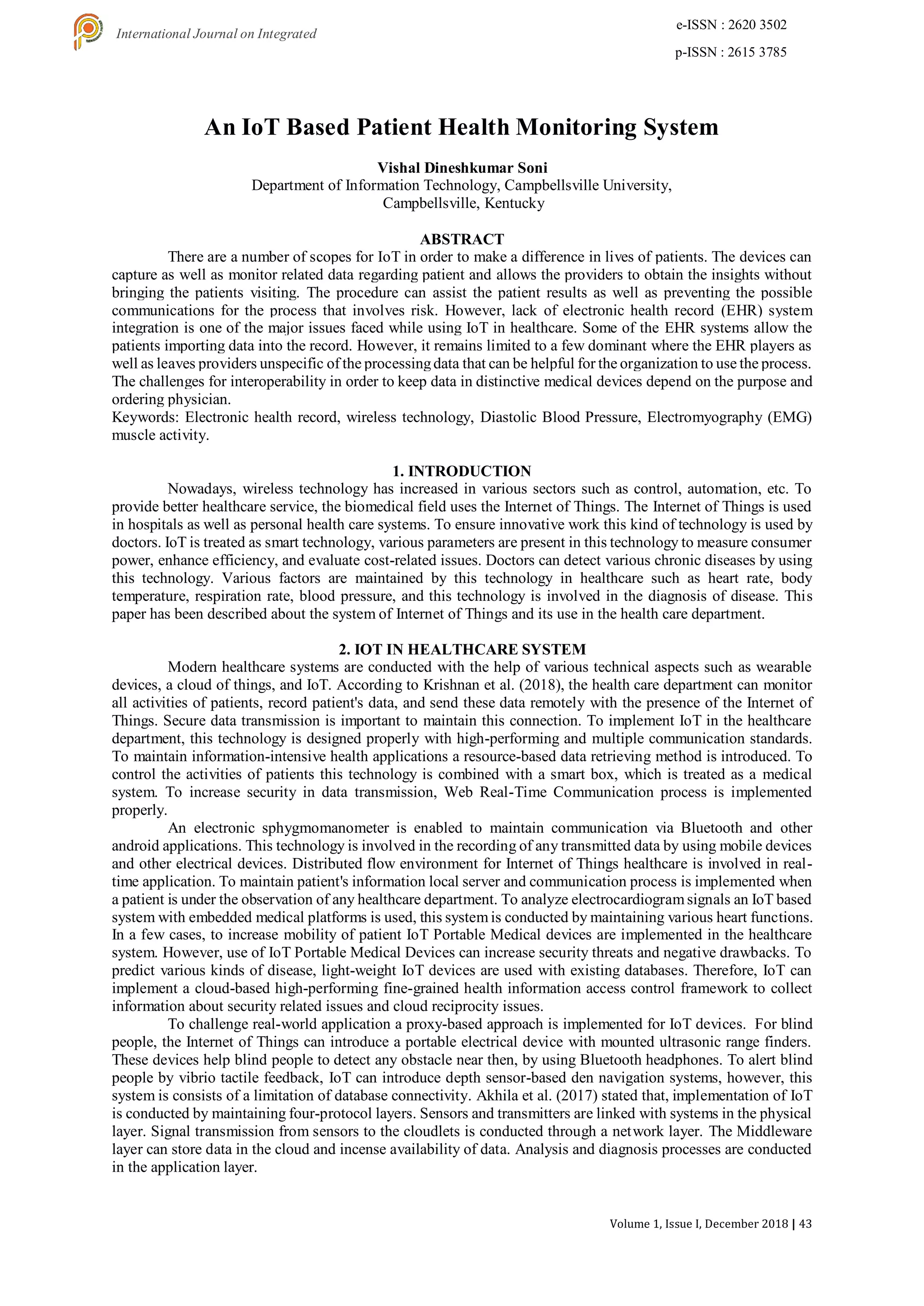
Figure1: data collection and ntranscription of IoT in healthcare
(Source Thota et al. 2018, p. 526)
Data transmission is conducted with the presence of system components, recorded data of patients is
transferred one location to the healthcare department with the presence of these system components. Collected
data is relayed towards healthcare through the internet for storage. Sensors of Internet of Things can work via
concentration such as smartphones with the presence of the internet. To remodify all sensing nodes in the health
monitoring system, IoT tries to customize existing Wireless Sensor Network. This customization process depends
on distance between sensors and health care, this factory helps the health monitoring system to collect more
physical Information by avoiding redundant tasks. To handle emergencies, IoT can maintain a low energy
consumption process and set accurate threshold levels. The low power protocol for communication is increased
by IoT to maintain the limit of energy consumption (Thota et al. 2018).
4. SYSTEM OF IOT
4.1 Block diagram
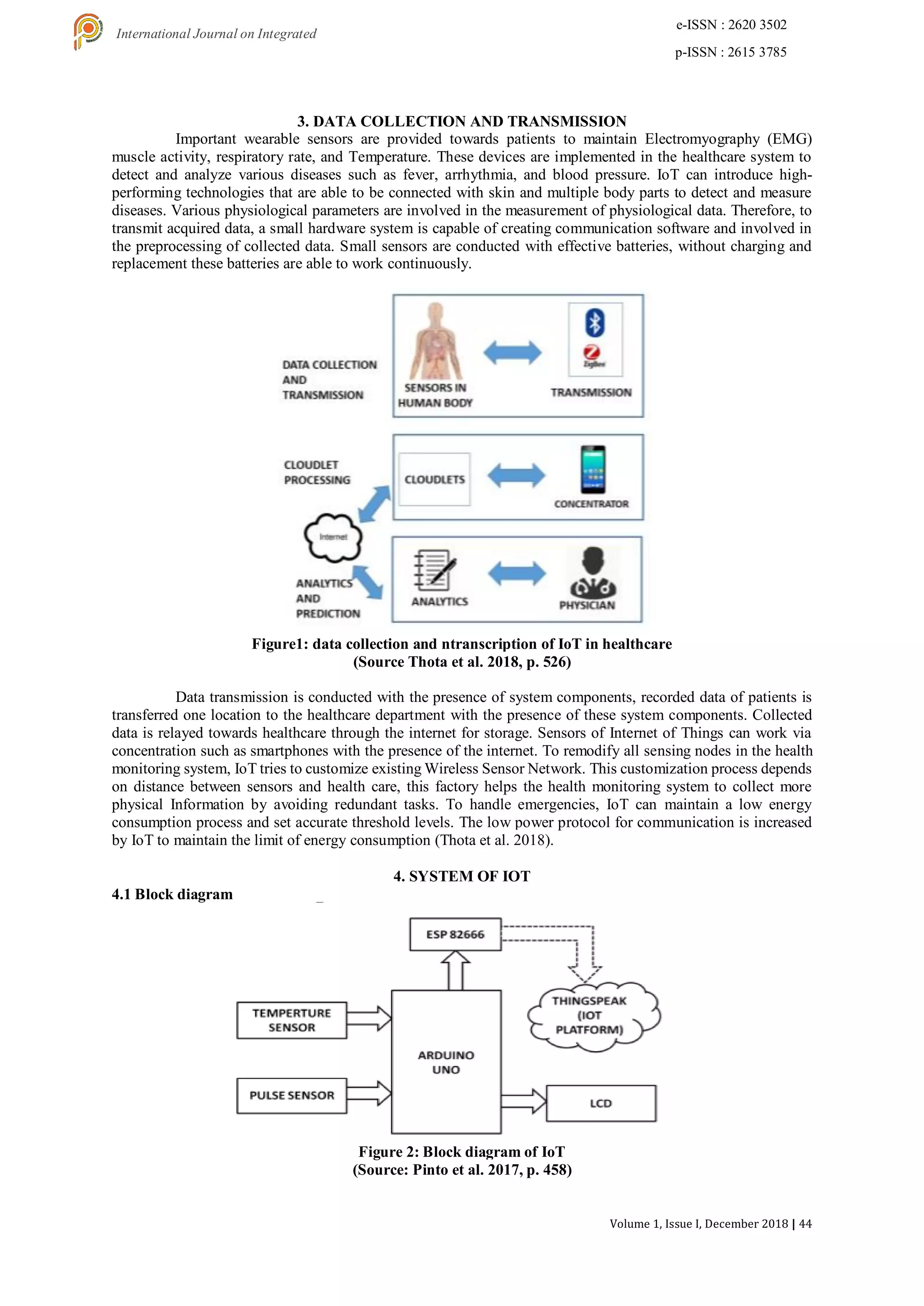
Figure 2: Block diagram of IoT
(Source: Pinto et al. 2017, p. 458)
Volume 1, Issue I, December 2018 | 45
e-ISSN : 2620 3502
p-ISSN : 2615 3785
International Journal on Integrated
Education
Figure 2 depicts that the proposed systemof the Internet of Things. To collect health-related data various
health monitoring sensors are used, such as, communication and data acquisition are conducted by controllers,
who are involved in data transmission via the internet. Server is able to maintain data processing, where all data
is collected and aggregated properly. This entire process is shown in the web page to provide an understandable
format of health-related information such as data management (Pinto et al. 2017).
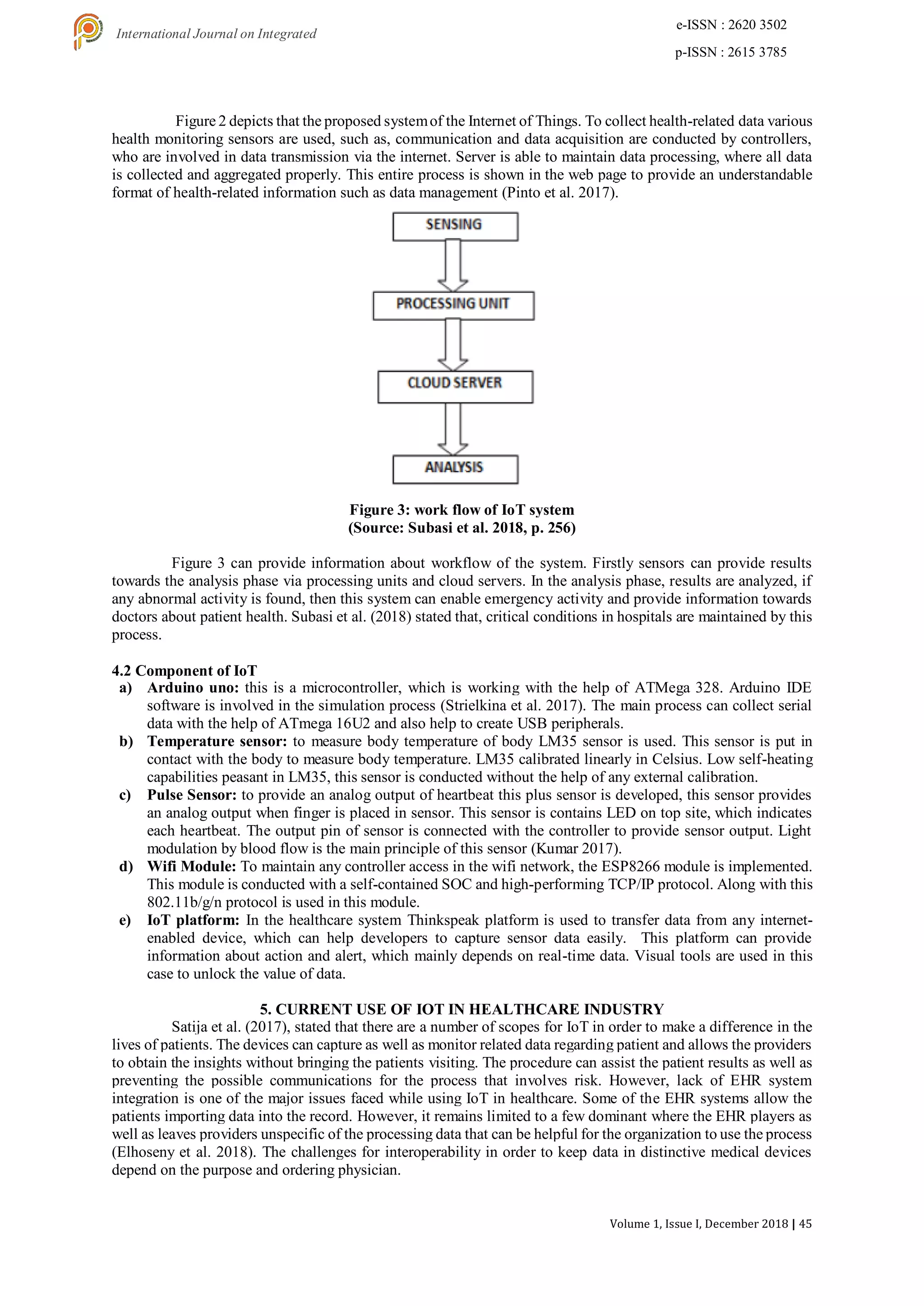
Figure 3: work flow of IoT system
(Source: Subasi et al. 2018, p. 256)
Figure 3 can provide information about workflow of the system. Firstly sensors can provide results
towards the analysis phase via processing units and cloud servers. In the analysis phase, results are analyzed, if
any abnormal activity is found, then this system can enable emergency activity and provide information towards
doctors about patient health. Subasi et al. (2018) stated that, critical conditions in hospitals are maintained by this
process.
4.2 Component of IoT
a) Arduino uno: this is a microcontroller, which is working with the help of ATMega 328. Arduino IDE
software is involved in the simulation process (Strielkina et al. 2017). The main process can collect serial
data with the help of ATmega 16U2 and also help to create USB peripherals.
b) Temperature sensor: to measure body temperature of body LM35 sensor is used. This sensor is put in
contact with the body to measure body temperature. LM35 calibrated linearly in Celsius. Low self-heating
capabilities peasant in LM35, this sensor is conducted without the help of any external calibration.
c) Pulse Sensor: to provide an analog output of heartbeat this plus sensor is developed, this sensor provides
an analog output when finger is placed in sensor. This sensor is contains LED on top site, which indicates
each heartbeat. The output pin of sensor is connected with the controller to provide sensor output. Light
modulation by blood flow is the main principle of this sensor (Kumar 2017).
d) Wifi Module: To maintain any controller access in the wifi network, the ESP8266 module is implemented.
This module is conducted with a self-contained SOC and high-performing TCP/IP protocol. Along with this
802.11b/g/n protocol is used in this module.
e) IoT platform: In the healthcare system Thinkspeak platform is used to transfer data from any internet-
enabled device, which can help developers to capture sensor data easily. This platform can provide
information about action and alert, which mainly depends on real-time data. Visual tools are used in this
case to unlock the value of data.
5. CURRENT USE OF IOT IN HEALTHCARE INDUSTRY
Satija et al. (2017), stated that there are a number of scopes for IoT in order to make a difference in the
lives of patients. The devices can capture as well as monitor related data regarding patient and allows the providers
to obtain the insights without bringing the patients visiting. The procedure can assist the patient results as well as
preventing the possible communications for the process that involves risk. However, lack of EHR system
integration is one of the major issues faced while using IoT in healthcare. Some of the EHR systems allow the
patients importing data into the record. However, it remains limited to a few dominant where the EHR players as
well as leaves providers unspecific of the processing data that can be helpful for the organization to use the process
(Elhoseny et al. 2018). The challenges for interoperability in order to keep data in distinctive medical devices
depend on the purpose and ordering physician.
Volume 1, Issue I, December 2018 | 46
e-ISSN : 2620 3502
p-ISSN : 2615 3785
International Journal on Integrated
Education
IoT helps to grow an interest in leading healthcare device manufacturers, dealers as well as suppliers to
invest heavily in the Internet of Things. In result, they get returns in terms of real time promotions as well as
efficient inventory management that helps to grow sales and reduced operational expenses. The Internet of Things
is fragmented as well as the expertise referred to exist across the various parts of the value chain such as
communications connectivity provider, hardware OEMs, data storage, analytics and applications (Subasi et al.,
2018). The aim of this paper is to analyze the IoT opportunities for healthcare device manufactures and the
limitations within the ecosystem.Nurses and technicians are responsible for inputtingpatient data into a centralized
digital system.
Accortding to Maksimović (2018), mobile industry have led to standardized qualitative care for patients
and a superior healthcare professional that enhanced and garner patient’s multitude of needs. Health and fitness
app help them to keep track of their daily food intake ,thus maintain proper nutrition level of all inhabitants and
doesn’t led switch them to anorexia nervosa and bulimia nervosa by offering customized solutions.
The key opportunities for healthcare manufacturers are described below,
1. Infotainment: In car streaming as well as other customer services
2. Operational: such as predictive maintenance, telemetric, software updates
3. Autonomous healthcare device
Across the wide swath of industrial IoT distributions the majority of successful use cases have been in the
operational area. In this area early deployments have tended to exist.
6. SECURITY ISSUES OF USING IOT IN PATIENT HEALTH MONITORING SYSTEM
The state of IoT security shows the following information in their latest research report Some other issues
of IoT that left an impact on healthcare sector are
● Cloud attacks
● Understanding IoT
● Internet Walls
There are some solutions that can be helpful to overcome the security purpose issue in IoT.
1. Use of Security Analytics
2. Ensure Communication Protection
3. Use Public Key Infrastructure
4. Secure the Network
5. Ensure Device Authentication
1. Use IoT security analytics: It can be said that the security issues as well as the vulnerabilities regarding IoT,
may be reduced by implementing the security analytics. It can help IoT security providers to detect potential
threats as well as bite such issues in the bud.
2. Ensure Communication Protection: The concept of IoT has an impact on connecting different devices.
Some implemented encryptions are HTTP, AES 128, AES 256 as well as a host of others (Aktas et al.,
2018).
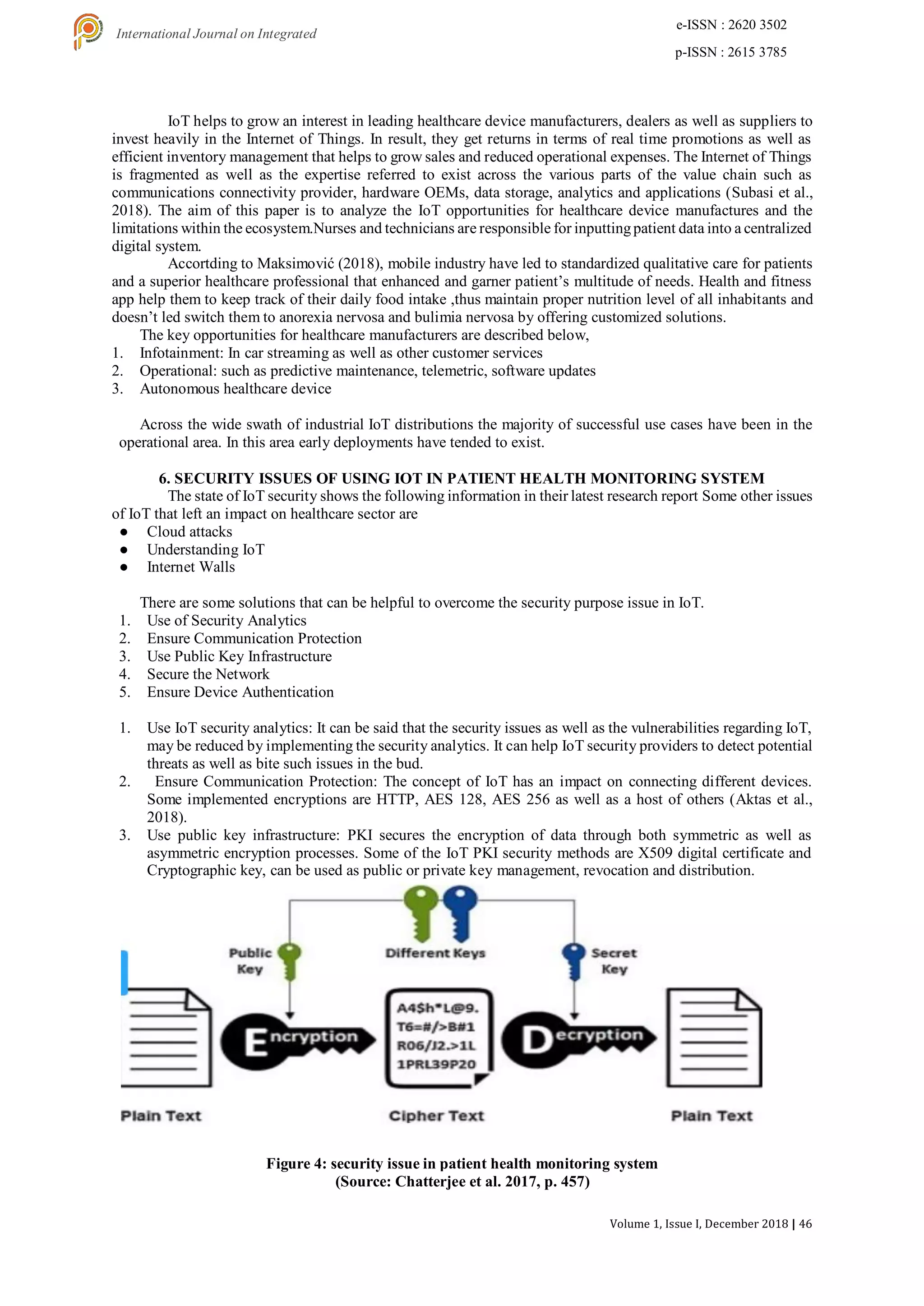
3. Use public key infrastructure: PKI secures the encryption of data through both symmetric as well as
asymmetric encryption processes. Some of the IoT PKI security methods are X509 digital certificate and
Cryptographic key, can be used as public or private key management, revocation and distribution.
Figure 4: security issue in patient health monitoring system
(Source: Chatterjee et al. 2017, p. 457)
Volume 1, Issue I, December 2018 | 47
e-ISSN : 2620 3502
p-ISSN : 2615 3785
International Journal on Integrated
Education
4. Secure the network: The systems are already connected to an IoT network via the Internet. The network
creates obstacles in the smooth operations of the IoT devices.
5. Ensure device authentication: There are some authentication features that play a significant role in
Healthcare industry. The features are including two-factor authentication, digital certificates as well as
biometric, used to ensure that no one can have illegal access to users devices.
7. OVERALL IMPACT OF IOT IN PATIENT MONITORING SYSTEM
Efficient methods to teach would be able to be applied. For example, individual needs of the patients
can be catered to. This would mean that patients who need special care and attention can be given proper care and
attention. This would enable patients to learn outside of the classroom with the help of various video classes they
would be able to learn various topics. This will also allow patients to explore various topics. This would broaden
the outlook for patients in the case of various topics. Also the interactivity of the classes with the help of smart
boards would be enhanced greatly. The classes due to its interactivity would help patients to better understand the
subjects. The impact of the IOT in the healthcare system is discussed in the following sections.
 Better management of facilities- The various facilities will be better managed with IOT devices. Due to the
sophisticated chips and sensors which would transmit valuable data. This would help people in the better
understanding of various things, how they work and how they work together. The common internet of things
(IOT) platform brings the diverse information together. The internet of things also give the devices and mobile
applications a common language to communicate with each other.
 Implementation of electronic attendance system – This will allow the implementation of an electronic
attendance system which will greatly benefit various institutions in a great way. This include the various
details of the patients being easily manageable. Also for patients whose attendance falls short of the required
percentage the electronic attendance system might also help in contacting the parents of the children along
with a picture of their attendance sheets. The electronic attendance systems will be easier to manage in
comparison to the normal attendance system (Muhammed et al. 2018).
CONCLUSION
IoT data is one of the meaningful ways for keeping the full health record. Several providers support the
process of collection. However, the process of valuable data can be helpful to manage the process. There are
several cases within the context of full patient chart along with timeline. In this perspective, it is important to
make the process and collection meaningful patient data between the visits. On the contrary, there are several
cases, where the data are collected from wearable devices. Data security may be the causes for concerns in
implementing IoT in healthcare. The food and drug administration is the procedure of defining the common
security practice as well as standards for the medical devices. Hence, continuous change in hardware as well as
connectivity technology is the major issue faced while using IoT in healthcare.
REFERENCES
1. Akhila, V., Vasavi, Y., Nissie, K. and Rao, P.V., 2017. An IoT based Patient Health Monitoring Systemusing
Arduino Uno. International Journal of Research in Information Technology, 1(1), pp.1-9.
2. Chatterjee, P., Cymberknop, L.J. and Armentano, R.L., 2017, November. IoT-based decision support system
for intelligent healthcare—applied to cardiovascular diseases. In 2017 7th International Conference on
Communication Systems and Network Technologies (CSNT) (pp. 362-366). IEEE.
3. Elhoseny, M., Ramírez-González, G., Abu-Elnasr, O.M., Shawkat, S.A., Arunkumar, N. and Farouk, A.,
2018. Secure medical data transmission model for IoT-based healthcare systems. Ieee Access, 6, pp.20596-
20608.
4. Krishnan, D.S.R., Gupta, S.C. and Choudhury, T., 2018, June. An IoT based patient health monitoringsystem.
In 2018 International Conference on Advances in Computing and Communication Engineering
(ICACCE) (pp. 01-07). IEEE.
5. Kumar, N., 2017, August. IoT architecture and system design for healthcare systems. In 2017 International
Conference on Smart Technologies for Smart Nation (SmartTechCon) (pp. 1118-1123). IEEE.
6. Maksimović, M., 2018. Implementation of Fog computing in IoT-based healthcare system. Jita-Journal Of
Information Technology And Aplications, 14(2).
7. Muhammed, T., Mehmood, R., Albeshri, A. and Katib, I., 2018. UbeHealth: a personalized ubiquitous cloud
and edge-enabled networked healthcare system for smart cities. IEEE Access, 6, pp.32258-32285.
8. Pinto, S., Cabral, J. and Gomes, T., 2017, March. We-care: An IoT-based health care system for elderly
people. In 2017 IEEE International Conference on Industrial Technology (ICIT) (pp. 1378-1383). IEEE.
9. Satija, U., Ramkumar, B. and Manikandan, M.S., 2017. Real-time signal quality-aware ECG telemetrysystem
for IoT-based health care monitoring. IEEE Internet of Things Journal, 4(3), pp.815-823.
Volume 1, Issue I, December 2018 | 48
e-ISSN : 2620 3502
p-ISSN : 2615 3785
International Journal on Integrated
Education
10. Strielkina, A., Uzun, D. and Kharchenko, V., 2017, September. Modelling of healthcare IoT using the
queueing theory. In 2017 9th IEEE
11. Subasi, A., Radhwan, M., Kurdi, R. and Khateeb, K., 2018, February. IoT based mobile healthcare system
for human activity recognition. In 2018 15th Learning and Technology Conference (L&T) (pp. 29-34). IEEE.
12. Thota, C., Sundarasekar, R., Manogaran, G., Varatharajan, R. and Priyan, M.K., 2018. Centralized fog
computing security platform for IoT and cloud in healthcare system. In Fog computing: Breakthroughs in
research and practice (pp. 365-378). IGI global.

An IoT Based Patient Health Monitoring System

  • 1.
    Volume 1, IssueI, December 2018 | 43 e-ISSN : 2620 3502 p-ISSN : 2615 3785 International Journal on Integrated Education An IoT Based Patient Health Monitoring System Vishal Dineshkumar Soni Department of Information Technology, Campbellsville University, Campbellsville, Kentucky ABSTRACT There are a number of scopes for IoT in order to make a difference in lives of patients. The devices can capture as well as monitor related data regarding patient and allows the providers to obtain the insights without bringing the patients visiting. The procedure can assist the patient results as well as preventing the possible communications for the process that involves risk. However, lack of electronic health record (EHR) system integration is one of the major issues faced while using IoT in healthcare. Some of the EHR systems allow the patients importing data into the record. However, it remains limited to a few dominant where the EHR players as well as leaves providers unspecific of the processingdata that can be helpful for the organization to use the process. The challenges for interoperability in order to keep data in distinctive medical devices depend on the purpose and ordering physician. Keywords: Electronic health record, wireless technology, Diastolic Blood Pressure, Electromyography (EMG) muscle activity. 1. INTRODUCTION Nowadays, wireless technology has increased in various sectors such as control, automation, etc. To provide better healthcare service, the biomedical field uses the Internet of Things. The Internet of Things is used in hospitals as well as personal health care systems. To ensure innovative work this kind of technology is used by doctors. IoT is treated as smart technology, various parameters are present in this technology to measure consumer power, enhance efficiency, and evaluate cost-related issues. Doctors can detect various chronic diseases by using this technology. Various factors are maintained by this technology in healthcare such as heart rate, body temperature, respiration rate, blood pressure, and this technology is involved in the diagnosis of disease. This paper has been described about the system of Internet of Things and its use in the health care department. 2. IOT IN HEALTHCARE SYSTEM Modern healthcare systems are conducted with the help of various technical aspects such as wearable devices, a cloud of things, and IoT. According to Krishnan et al. (2018), the health care department can monitor all activities of patients, record patient's data, and send these data remotely with the presence of the Internet of Things. Secure data transmission is important to maintain this connection. To implement IoT in the healthcare department, this technology is designed properly with high-performing and multiple communication standards. To maintain information-intensive health applications a resource-based data retrieving method is introduced. To control the activities of patients this technology is combined with a smart box, which is treated as a medical system. To increase security in data transmission, Web Real-Time Communication process is implemented properly. An electronic sphygmomanometer is enabled to maintain communication via Bluetooth and other android applications. This technology is involved in the recording of any transmitted data by using mobile devices and other electrical devices. Distributed flow environment for Internet of Things healthcare is involved in real- time application. To maintain patient's information local server and communication process is implemented when a patient is under the observation of any healthcare department. To analyze electrocardiogramsignals an IoT based system with embedded medical platforms is used, this systemis conducted by maintaining various heart functions. In a few cases, to increase mobility of patient IoT Portable Medical devices are implemented in the healthcare system. However, use of IoT Portable Medical Devices can increase security threats and negative drawbacks. To predict various kinds of disease, light-weight IoT devices are used with existing databases. Therefore, IoT can implement a cloud-based high-performing fine-grained health information access control framework to collect information about security related issues and cloud reciprocity issues. To challenge real-world application a proxy-based approach is implemented for IoT devices. For blind people, the Internet of Things can introduce a portable electrical device with mounted ultrasonic range finders. These devices help blind people to detect any obstacle near then, by using Bluetooth headphones. To alert blind people by vibrio tactile feedback, IoT can introduce depth sensor-based den navigation systems, however, this system is consists of a limitation of database connectivity. Akhila et al. (2017) stated that, implementation of IoT is conducted by maintaining four-protocol layers. Sensors and transmitters are linked with systems in the physical layer. Signal transmission from sensors to the cloudlets is conducted through a network layer. The Middleware layer can store data in the cloud and incense availability of data. Analysis and diagnosis processes are conducted in the application layer.
  • 2.
    Volume 1, IssueI, December 2018 | 44 e-ISSN : 2620 3502 p-ISSN : 2615 3785 International Journal on Integrated Education 3. DATA COLLECTION AND TRANSMISSION Important wearable sensors are provided towards patients to maintain Electromyography (EMG) muscle activity, respiratory rate, and Temperature. These devices are implemented in the healthcare system to detect and analyze various diseases such as fever, arrhythmia, and blood pressure. IoT can introduce high- performing technologies that are able to be connected with skin and multiple body parts to detect and measure diseases. Various physiological parameters are involved in the measurement of physiological data. Therefore, to transmit acquired data, a small hardware system is capable of creating communication software and involved in the preprocessing of collected data. Small sensors are conducted with effective batteries, without charging and replacement these batteries are able to work continuously. Figure1: data collection and ntranscription of IoT in healthcare (Source Thota et al. 2018, p. 526) Data transmission is conducted with the presence of system components, recorded data of patients is transferred one location to the healthcare department with the presence of these system components. Collected data is relayed towards healthcare through the internet for storage. Sensors of Internet of Things can work via concentration such as smartphones with the presence of the internet. To remodify all sensing nodes in the health monitoring system, IoT tries to customize existing Wireless Sensor Network. This customization process depends on distance between sensors and health care, this factory helps the health monitoring system to collect more physical Information by avoiding redundant tasks. To handle emergencies, IoT can maintain a low energy consumption process and set accurate threshold levels. The low power protocol for communication is increased by IoT to maintain the limit of energy consumption (Thota et al. 2018). 4. SYSTEM OF IOT 4.1 Block diagram Figure 2: Block diagram of IoT (Source: Pinto et al. 2017, p. 458)
  • 3.
    Volume 1, IssueI, December 2018 | 45 e-ISSN : 2620 3502 p-ISSN : 2615 3785 International Journal on Integrated Education Figure 2 depicts that the proposed systemof the Internet of Things. To collect health-related data various health monitoring sensors are used, such as, communication and data acquisition are conducted by controllers, who are involved in data transmission via the internet. Server is able to maintain data processing, where all data is collected and aggregated properly. This entire process is shown in the web page to provide an understandable format of health-related information such as data management (Pinto et al. 2017). Figure 3: work flow of IoT system (Source: Subasi et al. 2018, p. 256) Figure 3 can provide information about workflow of the system. Firstly sensors can provide results towards the analysis phase via processing units and cloud servers. In the analysis phase, results are analyzed, if any abnormal activity is found, then this system can enable emergency activity and provide information towards doctors about patient health. Subasi et al. (2018) stated that, critical conditions in hospitals are maintained by this process. 4.2 Component of IoT a) Arduino uno: this is a microcontroller, which is working with the help of ATMega 328. Arduino IDE software is involved in the simulation process (Strielkina et al. 2017). The main process can collect serial data with the help of ATmega 16U2 and also help to create USB peripherals. b) Temperature sensor: to measure body temperature of body LM35 sensor is used. This sensor is put in contact with the body to measure body temperature. LM35 calibrated linearly in Celsius. Low self-heating capabilities peasant in LM35, this sensor is conducted without the help of any external calibration. c) Pulse Sensor: to provide an analog output of heartbeat this plus sensor is developed, this sensor provides an analog output when finger is placed in sensor. This sensor is contains LED on top site, which indicates each heartbeat. The output pin of sensor is connected with the controller to provide sensor output. Light modulation by blood flow is the main principle of this sensor (Kumar 2017). d) Wifi Module: To maintain any controller access in the wifi network, the ESP8266 module is implemented. This module is conducted with a self-contained SOC and high-performing TCP/IP protocol. Along with this 802.11b/g/n protocol is used in this module. e) IoT platform: In the healthcare system Thinkspeak platform is used to transfer data from any internet- enabled device, which can help developers to capture sensor data easily. This platform can provide information about action and alert, which mainly depends on real-time data. Visual tools are used in this case to unlock the value of data. 5. CURRENT USE OF IOT IN HEALTHCARE INDUSTRY Satija et al. (2017), stated that there are a number of scopes for IoT in order to make a difference in the lives of patients. The devices can capture as well as monitor related data regarding patient and allows the providers to obtain the insights without bringing the patients visiting. The procedure can assist the patient results as well as preventing the possible communications for the process that involves risk. However, lack of EHR system integration is one of the major issues faced while using IoT in healthcare. Some of the EHR systems allow the patients importing data into the record. However, it remains limited to a few dominant where the EHR players as well as leaves providers unspecific of the processing data that can be helpful for the organization to use the process (Elhoseny et al. 2018). The challenges for interoperability in order to keep data in distinctive medical devices depend on the purpose and ordering physician.
  • 4.
    Volume 1, IssueI, December 2018 | 46 e-ISSN : 2620 3502 p-ISSN : 2615 3785 International Journal on Integrated Education IoT helps to grow an interest in leading healthcare device manufacturers, dealers as well as suppliers to invest heavily in the Internet of Things. In result, they get returns in terms of real time promotions as well as efficient inventory management that helps to grow sales and reduced operational expenses. The Internet of Things is fragmented as well as the expertise referred to exist across the various parts of the value chain such as communications connectivity provider, hardware OEMs, data storage, analytics and applications (Subasi et al., 2018). The aim of this paper is to analyze the IoT opportunities for healthcare device manufactures and the limitations within the ecosystem.Nurses and technicians are responsible for inputtingpatient data into a centralized digital system. Accortding to Maksimović (2018), mobile industry have led to standardized qualitative care for patients and a superior healthcare professional that enhanced and garner patient’s multitude of needs. Health and fitness app help them to keep track of their daily food intake ,thus maintain proper nutrition level of all inhabitants and doesn’t led switch them to anorexia nervosa and bulimia nervosa by offering customized solutions. The key opportunities for healthcare manufacturers are described below, 1. Infotainment: In car streaming as well as other customer services 2. Operational: such as predictive maintenance, telemetric, software updates 3. Autonomous healthcare device Across the wide swath of industrial IoT distributions the majority of successful use cases have been in the operational area. In this area early deployments have tended to exist. 6. SECURITY ISSUES OF USING IOT IN PATIENT HEALTH MONITORING SYSTEM The state of IoT security shows the following information in their latest research report Some other issues of IoT that left an impact on healthcare sector are ● Cloud attacks ● Understanding IoT ● Internet Walls There are some solutions that can be helpful to overcome the security purpose issue in IoT. 1. Use of Security Analytics 2. Ensure Communication Protection 3. Use Public Key Infrastructure 4. Secure the Network 5. Ensure Device Authentication 1. Use IoT security analytics: It can be said that the security issues as well as the vulnerabilities regarding IoT, may be reduced by implementing the security analytics. It can help IoT security providers to detect potential threats as well as bite such issues in the bud. 2. Ensure Communication Protection: The concept of IoT has an impact on connecting different devices. Some implemented encryptions are HTTP, AES 128, AES 256 as well as a host of others (Aktas et al., 2018). 3. Use public key infrastructure: PKI secures the encryption of data through both symmetric as well as asymmetric encryption processes. Some of the IoT PKI security methods are X509 digital certificate and Cryptographic key, can be used as public or private key management, revocation and distribution. Figure 4: security issue in patient health monitoring system (Source: Chatterjee et al. 2017, p. 457)
  • 5.
    Volume 1, IssueI, December 2018 | 47 e-ISSN : 2620 3502 p-ISSN : 2615 3785 International Journal on Integrated Education 4. Secure the network: The systems are already connected to an IoT network via the Internet. The network creates obstacles in the smooth operations of the IoT devices. 5. Ensure device authentication: There are some authentication features that play a significant role in Healthcare industry. The features are including two-factor authentication, digital certificates as well as biometric, used to ensure that no one can have illegal access to users devices. 7. OVERALL IMPACT OF IOT IN PATIENT MONITORING SYSTEM Efficient methods to teach would be able to be applied. For example, individual needs of the patients can be catered to. This would mean that patients who need special care and attention can be given proper care and attention. This would enable patients to learn outside of the classroom with the help of various video classes they would be able to learn various topics. This will also allow patients to explore various topics. This would broaden the outlook for patients in the case of various topics. Also the interactivity of the classes with the help of smart boards would be enhanced greatly. The classes due to its interactivity would help patients to better understand the subjects. The impact of the IOT in the healthcare system is discussed in the following sections.  Better management of facilities- The various facilities will be better managed with IOT devices. Due to the sophisticated chips and sensors which would transmit valuable data. This would help people in the better understanding of various things, how they work and how they work together. The common internet of things (IOT) platform brings the diverse information together. The internet of things also give the devices and mobile applications a common language to communicate with each other.  Implementation of electronic attendance system – This will allow the implementation of an electronic attendance system which will greatly benefit various institutions in a great way. This include the various details of the patients being easily manageable. Also for patients whose attendance falls short of the required percentage the electronic attendance system might also help in contacting the parents of the children along with a picture of their attendance sheets. The electronic attendance systems will be easier to manage in comparison to the normal attendance system (Muhammed et al. 2018). CONCLUSION IoT data is one of the meaningful ways for keeping the full health record. Several providers support the process of collection. However, the process of valuable data can be helpful to manage the process. There are several cases within the context of full patient chart along with timeline. In this perspective, it is important to make the process and collection meaningful patient data between the visits. On the contrary, there are several cases, where the data are collected from wearable devices. Data security may be the causes for concerns in implementing IoT in healthcare. The food and drug administration is the procedure of defining the common security practice as well as standards for the medical devices. Hence, continuous change in hardware as well as connectivity technology is the major issue faced while using IoT in healthcare. REFERENCES 1. Akhila, V., Vasavi, Y., Nissie, K. and Rao, P.V., 2017. An IoT based Patient Health Monitoring Systemusing Arduino Uno. International Journal of Research in Information Technology, 1(1), pp.1-9. 2. Chatterjee, P., Cymberknop, L.J. and Armentano, R.L., 2017, November. IoT-based decision support system for intelligent healthcare—applied to cardiovascular diseases. In 2017 7th International Conference on Communication Systems and Network Technologies (CSNT) (pp. 362-366). IEEE. 3. Elhoseny, M., Ramírez-González, G., Abu-Elnasr, O.M., Shawkat, S.A., Arunkumar, N. and Farouk, A., 2018. Secure medical data transmission model for IoT-based healthcare systems. Ieee Access, 6, pp.20596- 20608. 4. Krishnan, D.S.R., Gupta, S.C. and Choudhury, T., 2018, June. An IoT based patient health monitoringsystem. In 2018 International Conference on Advances in Computing and Communication Engineering (ICACCE) (pp. 01-07). IEEE. 5. Kumar, N., 2017, August. IoT architecture and system design for healthcare systems. In 2017 International Conference on Smart Technologies for Smart Nation (SmartTechCon) (pp. 1118-1123). IEEE. 6. Maksimović, M., 2018. Implementation of Fog computing in IoT-based healthcare system. Jita-Journal Of Information Technology And Aplications, 14(2). 7. Muhammed, T., Mehmood, R., Albeshri, A. and Katib, I., 2018. UbeHealth: a personalized ubiquitous cloud and edge-enabled networked healthcare system for smart cities. IEEE Access, 6, pp.32258-32285. 8. Pinto, S., Cabral, J. and Gomes, T., 2017, March. We-care: An IoT-based health care system for elderly people. In 2017 IEEE International Conference on Industrial Technology (ICIT) (pp. 1378-1383). IEEE. 9. Satija, U., Ramkumar, B. and Manikandan, M.S., 2017. Real-time signal quality-aware ECG telemetrysystem for IoT-based health care monitoring. IEEE Internet of Things Journal, 4(3), pp.815-823.
  • 6.
    Volume 1, IssueI, December 2018 | 48 e-ISSN : 2620 3502 p-ISSN : 2615 3785 International Journal on Integrated Education 10. Strielkina, A., Uzun, D. and Kharchenko, V., 2017, September. Modelling of healthcare IoT using the queueing theory. In 2017 9th IEEE 11. Subasi, A., Radhwan, M., Kurdi, R. and Khateeb, K., 2018, February. IoT based mobile healthcare system for human activity recognition. In 2018 15th Learning and Technology Conference (L&T) (pp. 29-34). IEEE. 12. Thota, C., Sundarasekar, R., Manogaran, G., Varatharajan, R. and Priyan, M.K., 2018. Centralized fog computing security platform for IoT and cloud in healthcare system. In Fog computing: Breakthroughs in research and practice (pp. 365-378). IGI global.