Vitamin A
Dr Yash Alok
Assistant Professor
Dept. of Community Medicine
KMC Manipal
Function of vitamin A:
• Production of retinol pigments needed for proper vision
• Normal functioning of glandular and epithelial tissue
• Supports skeletal growth
• Anti-infective
• Protects against epithelial cancers like bronchial cancers
Sources of Vitamin A:
• Animal food- liver, egg, butter, milk, meat, fish
• Plant food- carrot, papaya, mango, pumpkin
• Fortified foods- Vanaspati, butter, milk
Deficiency of Vitamin A:
Ocular
Night blindness
Conjunctival xerosis
Bitots spot
Corneal xerosis
Keratomalacia
Non Ocular
Hyperkeratosis
Anorexia
Growth retardation
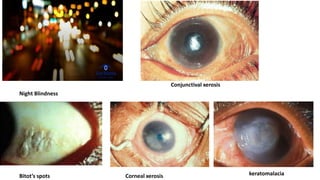
Night Blindness
Conjunctival xerosis
Bitot’s spots Corneal xerosis keratomalacia
Treatment
• Treated urgently
• All early stages can be reversed by a massive dose of 2lac IU of retinol palmitate
orally on two successive days
• All children with corneal ulcers – vit. A
Prevention
• 2 forms- improvement of people’s diet with foods rich in Vit. A
• Reducing the frequency and severity of contributory factors eg. PEM, RTIs, diarrhea,
measles
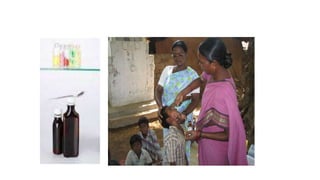
Vit. A prophylaxis programme
• Under MoHFw
• 9 months – 1st dose (1 lac IU)
• 15 months – 2nd dose (2 lac IU)
• Every 6 months upto 3 years
• Severely malnourished children >3 years- 1 dose(2 lac IU)
• Children with measles- additional dose as per age
Vitamin A toxicity
• Nausea
• vomiting
• Anorexia
• sleep disorders
• Skin desquamation
• enlarged liver
• papilledema
• teratogenicity
IODINE DEFICIENCY DISORDERS
12
Introduction
• Iodine is required for the synthesis of the thyroid hormones, thyroxine (T4) and
triiodothyronine (T3)
• essential for the normal growth and development and well being of all humans.
• 100-150 microgram is reqd. for normal growth and development
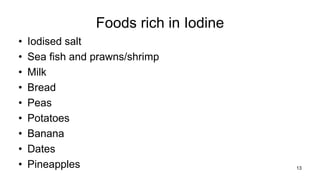
Foods rich in Iodine
13
• Iodised salt
• Sea fish and prawns/shrimp
• Milk
• Bread
• Peas
• Potatoes
• Banana
• Dates
• Pineapples
14
15
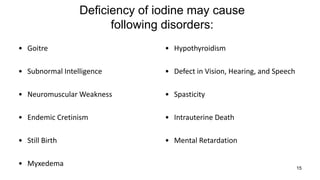
Deficiency of iodine may cause
following disorders:
• Goitre
• Subnormal Intelligence
• Neuromuscular Weakness
• Endemic Cretinism
• Still Birth
• Myxedema
• Hypothyroidism
• Defect in Vision, Hearing, and Speech
• Spasticity
• Intrauterine Death
• Mental Retardation
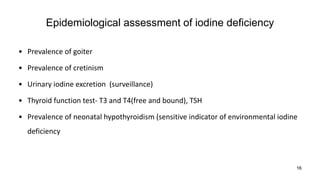
Epidemiological assessment of iodine deficiency
• Prevalence of goiter
• Prevalence of cretinism
• Urinary iodine excretion (surveillance)
• Thyroid function test- T3 and T4(free and bound), TSH
• Prevalence of neonatal hypothyroidism (sensitive indicator of environmental iodine
deficiency
16
17
NIDDCP
• 1962- National Goitre Control Program
• 100% centrally sponsored program
• 1992- renamed as NIDDCP
18
• Goal:
• To reduce the prevalence of IDDs below 10 % in the entire
country by 2012 AD
• Objectives:
1. surveys to assess the magnitude of the IDDs
2. Supply of iodised salt in the place of common salt
3. Resurvey after every 5 years to assess the extent of IDDs and
the impact of iodised salt
4. Lab monitoring of iodised salt and urine iodine excretion
5. Health education and publicity
19
Organization
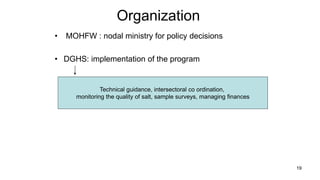
• MOHFW : nodal ministry for policy decisions
• DGHS: implementation of the program
Technical guidance, intersectoral co ordination,
monitoring the quality of salt, sample surveys, managing finances
20
• Salt commissioner’s office under Ministry of Industry-
licensing, production and distribution of salt to states / UTs
• State / union territory IDD cell
• Conduct prevalece surveys, monitoring quality, issue
notification – banning entry and sale of non iodated salt,
conduct training and reporting to DGHS
21
Achievements
• Private sector permitted to produce salt
• Ministry of railways provides category B priority for transport of
iodised salt next to defence
• Central govt issued ban on sale of non iodised salt
• Stds laid- Iodine content at production level- 30 ppm and at
consumption level – 15 ppm
• NIDDCP included in PMs 20 point program
22
• Each state to establish IDD control cell
• National Reference lab set up
4 regional lab set up – NIN , Hyderabad
All India Institute of Hygeine and
Public Health, Kolkata
AIIMS, new Delhi
NICDs , Delhi
23
• Each state is sanctioned one IDD monitoring lab
• on spot test kits
• A central steerng committee has been set up under
chairmanship of Secretary of Health and Family Welfare
24
Drawbacks
• Universal iodisation of salt not yet achieved
• Strengthening of transport by roads and railways needed
• Boosting political and bureaucratic commitment reqd.
• Difference in guidelines for assessment of IDD between Indian
and international organizations
• Resistance in the consumption of iodised salt
• Low funding as compared to other National programs
25
Thank you

vit. A and IDDs.pptx

  • 1.
    Vitamin A Dr YashAlok Assistant Professor Dept. of Community Medicine KMC Manipal
  • 2.
    Function of vitaminA: • Production of retinol pigments needed for proper vision • Normal functioning of glandular and epithelial tissue • Supports skeletal growth • Anti-infective • Protects against epithelial cancers like bronchial cancers
  • 3.
    Sources of VitaminA: • Animal food- liver, egg, butter, milk, meat, fish • Plant food- carrot, papaya, mango, pumpkin • Fortified foods- Vanaspati, butter, milk
  • 4.
    Deficiency of VitaminA: Ocular Night blindness Conjunctival xerosis Bitots spot Corneal xerosis Keratomalacia Non Ocular Hyperkeratosis Anorexia Growth retardation
  • 5.
    Night Blindness Conjunctival xerosis Bitot’sspots Corneal xerosis keratomalacia
  • 6.
    Treatment • Treated urgently •All early stages can be reversed by a massive dose of 2lac IU of retinol palmitate orally on two successive days • All children with corneal ulcers – vit. A
  • 7.
    Prevention • 2 forms-improvement of people’s diet with foods rich in Vit. A • Reducing the frequency and severity of contributory factors eg. PEM, RTIs, diarrhea, measles
  • 8.
    Vit. A prophylaxisprogramme • Under MoHFw • 9 months – 1st dose (1 lac IU) • 15 months – 2nd dose (2 lac IU) • Every 6 months upto 3 years • Severely malnourished children >3 years- 1 dose(2 lac IU) • Children with measles- additional dose as per age
  • 10.
    Vitamin A toxicity •Nausea • vomiting • Anorexia • sleep disorders • Skin desquamation • enlarged liver • papilledema • teratogenicity
  • 11.
  • 12.
    12 Introduction • Iodine isrequired for the synthesis of the thyroid hormones, thyroxine (T4) and triiodothyronine (T3) • essential for the normal growth and development and well being of all humans. • 100-150 microgram is reqd. for normal growth and development
  • 13.
    Foods rich inIodine 13 • Iodised salt • Sea fish and prawns/shrimp • Milk • Bread • Peas • Potatoes • Banana • Dates • Pineapples
  • 14.
  • 15.
    15 Deficiency of iodinemay cause following disorders: • Goitre • Subnormal Intelligence • Neuromuscular Weakness • Endemic Cretinism • Still Birth • Myxedema • Hypothyroidism • Defect in Vision, Hearing, and Speech • Spasticity • Intrauterine Death • Mental Retardation
  • 16.
    Epidemiological assessment ofiodine deficiency • Prevalence of goiter • Prevalence of cretinism • Urinary iodine excretion (surveillance) • Thyroid function test- T3 and T4(free and bound), TSH • Prevalence of neonatal hypothyroidism (sensitive indicator of environmental iodine deficiency 16
  • 17.
    17 NIDDCP • 1962- NationalGoitre Control Program • 100% centrally sponsored program • 1992- renamed as NIDDCP
  • 18.
    18 • Goal: • Toreduce the prevalence of IDDs below 10 % in the entire country by 2012 AD • Objectives: 1. surveys to assess the magnitude of the IDDs 2. Supply of iodised salt in the place of common salt 3. Resurvey after every 5 years to assess the extent of IDDs and the impact of iodised salt 4. Lab monitoring of iodised salt and urine iodine excretion 5. Health education and publicity
  • 19.
    19 Organization • MOHFW :nodal ministry for policy decisions • DGHS: implementation of the program Technical guidance, intersectoral co ordination, monitoring the quality of salt, sample surveys, managing finances
  • 20.
    20 • Salt commissioner’soffice under Ministry of Industry- licensing, production and distribution of salt to states / UTs • State / union territory IDD cell • Conduct prevalece surveys, monitoring quality, issue notification – banning entry and sale of non iodated salt, conduct training and reporting to DGHS
  • 21.
    21 Achievements • Private sectorpermitted to produce salt • Ministry of railways provides category B priority for transport of iodised salt next to defence • Central govt issued ban on sale of non iodised salt • Stds laid- Iodine content at production level- 30 ppm and at consumption level – 15 ppm • NIDDCP included in PMs 20 point program
  • 22.
    22 • Each stateto establish IDD control cell • National Reference lab set up 4 regional lab set up – NIN , Hyderabad All India Institute of Hygeine and Public Health, Kolkata AIIMS, new Delhi NICDs , Delhi
  • 23.
    23 • Each stateis sanctioned one IDD monitoring lab • on spot test kits • A central steerng committee has been set up under chairmanship of Secretary of Health and Family Welfare
  • 24.
    24 Drawbacks • Universal iodisationof salt not yet achieved • Strengthening of transport by roads and railways needed • Boosting political and bureaucratic commitment reqd. • Difference in guidelines for assessment of IDD between Indian and international organizations • Resistance in the consumption of iodised salt • Low funding as compared to other National programs
  • 25.