I/O Scalability in Xen

Kevin Tian kevin.tian@intel.com
Eddie Dong eddie.dong@intel.com
Yang Zhang yang.zhang@intel.com


Sponsored by:

                &       &
Agenda

Overview of I/O Scalability Issues
• Excessive Interrupts Hurt
• I/O NUMA Challenge


Proposals
• Soft interrupt throttling in Xen
• Interrupt-Less NAPI (ILNAPI)
• Host I/O NUMA
• Guest I/O NUMA


                                     2
Retrospect…


2009 Xen Summit (Eddie Dong, …)
       Extending I/O Scalability in Xen


Covered topics
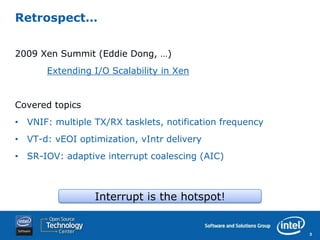
• VNIF: multiple TX/RX tasklets, notification frequency
• VT-d: vEOI optimization, vIntr delivery
• SR-IOV: adaptive interrupt coalescing (AIC)


                 Interrupt is the hotspot!


                                                          3
New Challenges Always Exist

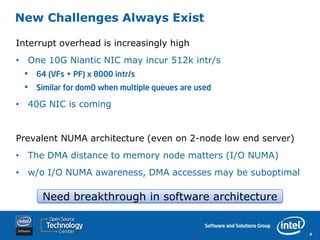
Interrupt overhead is increasingly high
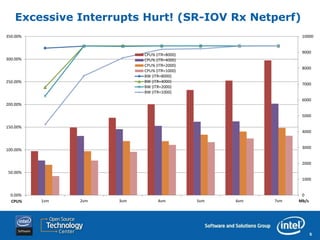
• One 10G Niantic NIC may incur 512k intr/s
 •   64 (VFs + PF) x 8000 intr/s
 •   Similar for dom0 when multiple queues are used

• 40G NIC is coming


Prevalent NUMA architecture (even on 2-node low end server)
• The DMA distance to memory node matters (I/O NUMA)
• w/o I/O NUMA awareness, DMA accesses may be suboptimal

      Need breakthrough in software architecture


                                                              4
Excessive Interrupts Hurt! (SR-IOV Rx Netperf)
350.00%                                                          10000


                                                                 9000
                            CPU% (ITR=8000)
300.00%                     CPU% (ITR=4000)
                            CPU% (ITR=2000)
                                                                 8000
                            CPU% (ITR=1000)
                            BW (ITR=8000)
250.00%                     BW (ITR=4000)
                                                                 7000
                            BW (ITR=2000)
                            BW (ITR=1000)
                                                                 6000
200.00%

                                                                 5000

150.00%
                                                                 4000


                                                                 3000
100.00%


                                                                 2000

 50.00%
                                                                 1000


  0.00%                                                          0
  CPU%    1vm   2vm   3vm         4vm         5vm   6vm   7vm   Mb/s


                                                                       5
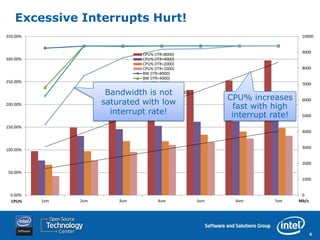
Excessive Interrupts Hurt!
350.00%                                                                              10000


                                CPU% (ITR=8000)                                      9000
300.00%                         CPU% (ITR=4000)
                                CPU% (ITR=2000)
                                CPU% (ITR=1000)                                      8000
                                BW (ITR=8000)
                                BW (ITR=4000)
250.00%                         BW (ITR=2000)                                        7000
                                BW (ITR=1000)
                       Bandwidth is not
                                Linear (CPU% (ITR=8000))
                                                                 CPU% increases
                      saturated with low                                             6000
200.00%
                                                                   fast with high
                        interrupt rate!                           interrupt rate!    5000

150.00%
                                                                                     4000


                                                                                     3000
100.00%


                                                                                     2000

 50.00%
                                                                                     1000


  0.00%                                                                              0
  CPU%    1vm   2vm       3vm          4vm                 5vm     6vm      7vm     Mb/s


                                                                                           6
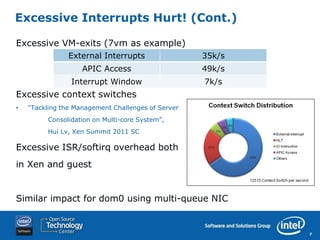
Excessive Interrupts Hurt! (Cont.)

Excessive VM-exits (7vm as example)
                External Interrupts                 35k/s
                    APIC Access                     49k/s
                Interrupt Window                    7k/s
Excessive context switches
•   “Tackling the Management Challenges of Server
         Consolidation on Multi-core System”,
         Hui Lv, Xen Summit 2011 SC

Excessive ISR/softirq overhead both
in Xen and guest


Similar impact for dom0 using multi-queue NIC


                                                            7
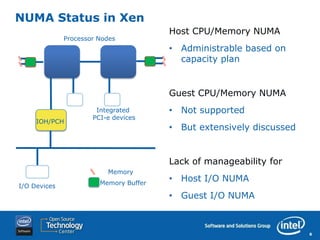
NUMA Status in Xen
                                        Host CPU/Memory NUMA
              Processor Nodes
                                        • Administrable based on
                                          capacity plan


                                        Guest CPU/Memory NUMA
                       Integrated       • Not supported
                      PCI-e devices
     IOH/PCH
                                        • But extensively discussed


                                        Lack of manageability for
                          Memory
                        Memory Buffer
                                        • Host I/O NUMA
I/O Devices
                                        • Guest I/O NUMA


                                                                      8
NUMA Related Structures

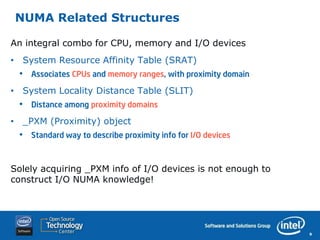
An integral combo for CPU, memory and I/O devices
• System Resource Affinity Table (SRAT)
 •   Associates CPUs and memory ranges, with proximity domain

• System Locality Distance Table (SLIT)
 •   Distance among proximity domains

• _PXM (Proximity) object
 •   Standard way to describe proximity info for I/O devices


Solely acquiring _PXM info of I/O devices is not enough to
construct I/O NUMA knowledge!


                                                                9
Host I/O NUMA Issues

No host I/O NUMA awareness in Dom0
•   Dom0 owns the majority of I/O devices
•   Dom0 memory is first allocated by skipping DMA zone
•   DMA memory is reallocated for continuity later
•   Above allocations are made within node_affinity mask round-robin
    •   No consideration on actual I/O NUMA topology


Complex and confusing if dom0 handles host I/O NUMA itself
•   Implicates physical CPU/Memory awareness in dom0 too
    •   Virtual NUMA vs. Host NUMA?

Xen however has no knowledge of _PXM()


                                                                       10
Guest I/O NUMA Issues

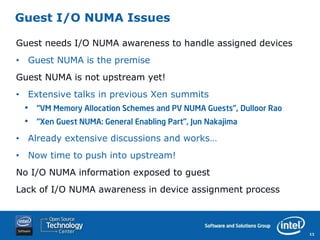
Guest needs I/O NUMA awareness to handle assigned devices
• Guest NUMA is the premise
Guest NUMA is not upstream yet!
• Extensive talks in previous Xen summits
 •   “VM Memory Allocation Schemes and PV NUMA Guests”, Dulloor Rao
 •   “Xen Guest NUMA: General Enabling Part”, Jun Nakajima

• Already extensive discussions and works…
• Now time to push into upstream!
No I/O NUMA information exposed to guest
Lack of I/O NUMA awareness in device assignment process


                                                                      11
Proposals


Per-interrupt overhead has been studied extensively!


   Now we want to reduce the interrupt number!


                                                       12
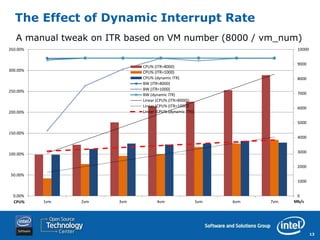
The Effect of Dynamic Interrupt Rate
   A manual tweak on ITR based on VM number (8000 / vm_num)
350.00%                                                                       10000


                                                                              9000
                             CPU% (ITR=8000)
300.00%                      CPU% (ITR=1000)
                             CPU% (dynamic ITR)                               8000
                             BW (ITR=8000)
250.00%                      BW (ITR=1000)
                             BW (dynamic ITR)                                 7000
                             Linear (CPU% (ITR=8000))
                             Linear (CPU% (ITR=1000))                         6000
200.00%                      Linear (CPU% (dynamic ITR))

                                                                              5000

150.00%
                                                                              4000


100.00%                                                                       3000


                                                                              2000
 50.00%
                                                                              1000


  0.00%                                                                       0
  CPU%    1vm   2vm    3vm          4vm                    5vm   6vm   7vm   Mb/s


                                                                                      13
Software Interrupt Throttling in Xen


Throttle virtual interrupts based on administrative policies
• Based on shared resources (e.g. bandwidth/VM_number)
• Based on priority and SLAs
• Apply to both PV and HVM guests


Fewer virtual interrupts reduces guest ISR/softirq overhead
It may further throttle physical interrupts too!
• If the device doesn’t trigger a new interrupt when an earlier
  request is still pending


                                                                  14
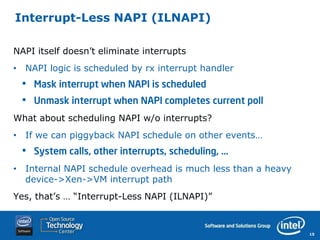
Interrupt-Less NAPI (ILNAPI)

NAPI itself doesn’t eliminate interrupts
• NAPI logic is scheduled by rx interrupt handler
 •   Mask interrupt when NAPI is scheduled
 •   Unmask interrupt when NAPI completes current poll
What about scheduling NAPI w/o interrupts?
• If we can piggyback NAPI schedule on other events…
 •   System calls, other interrupts, scheduling, …
• Internal NAPI schedule overhead is much less than a heavy
  device->Xen->VM interrupt path
Yes, that’s … “Interrupt-Less NAPI (ILNAPI)”


                                                              15
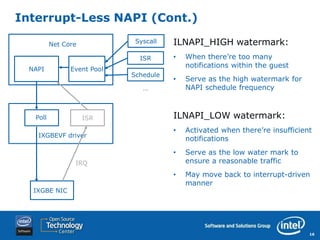
Interrupt-Less NAPI (Cont.)

          Net Core            Syscall   ILNAPI_HIGH watermark:
                               ISR      •   When there’re too many
                                            notifications within the guest
  NAPI          Event Pool
                             Schedule
                                        •   Serve as the high watermark for
                                …           NAPI schedule frequency


   Poll              ISR                ILNAPI_LOW watermark:
                                        •   Activated when there’re insufficient
    IXGBEVF driver
                                            notifications
                                        •   Serve as the low water mark to
                 IRQ                        ensure a reasonable traffic
                                        •   May move back to interrupt-driven
                                            manner
   IXGBE NIC


                                                                               16
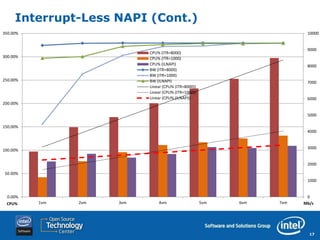
Interrupt-Less NAPI (Cont.)
350.00%                                                                   10000


                                                                          9000
                            CPU% (ITR=8000)
300.00%                     CPU% (ITR=1000)
                            CPU% (ILNAPI)                                 8000
                            BW (ITR=8000)
                            BW (ITR=1000)
250.00%                     BW (ILNAPI)                                   7000
                            Linear (CPU% (ITR=8000))
                            Linear (CPU% (ITR=1000))
                            Linear (CPU% (ILNAPI))                        6000
200.00%

                                                                          5000

150.00%
                                                                          4000


                                                                          3000
100.00%


                                                                          2000

 50.00%
                                                                          1000


  0.00%                                                                   0
 CPU%     1vm   2vm   3vm       4vm                    5vm   6vm   7vm   Mb/s


                                                                           17
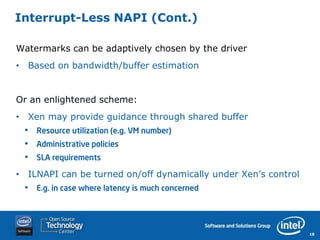
Interrupt-Less NAPI (Cont.)

Watermarks can be adaptively chosen by the driver
• Based on bandwidth/buffer estimation


Or an enlightened scheme:
• Xen may provide guidance through shared buffer
 •   Resource utilization (e.g. VM number)
 •   Administrative policies
 •   SLA requirements

• ILNAPI can be turned on/off dynamically under Xen’s control
 •   E.g. in case where latency is much concerned


                                                                18
Proposals


   We need close the Xen architecture gaps for
    both host I/O NUMA and guest I/O NUMA!


                                                 19
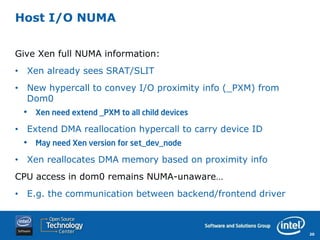
Host I/O NUMA


Give Xen full NUMA information:
• Xen already sees SRAT/SLIT
• New hypercall to convey I/O proximity info (_PXM) from
  Dom0
 •   Xen need extend _PXM to all child devices

• Extend DMA reallocation hypercall to carry device ID
 •   May need Xen version for set_dev_node

• Xen reallocates DMA memory based on proximity info
CPU access in dom0 remains NUMA-unaware…
• E.g. the communication between backend/frontend driver


                                                           20
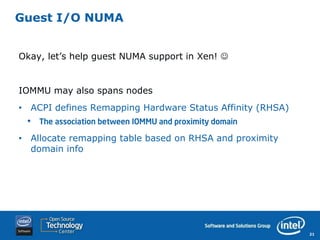
Guest I/O NUMA


Okay, let’s help guest NUMA support in Xen! 


IOMMU may also spans nodes
• ACPI defines Remapping Hardware Status Affinity (RHSA)
 •   The association between IOMMU and proximity domain

• Allocate remapping table based on RHSA and proximity
  domain info


                                                           21
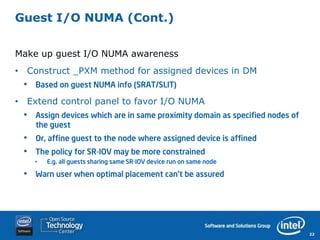
Guest I/O NUMA (Cont.)


Make up guest I/O NUMA awareness
• Construct _PXM method for assigned devices in DM
 •   Based on guest NUMA info (SRAT/SLIT)

• Extend control panel to favor I/O NUMA
 •   Assign devices which are in same proximity domain as specified nodes of
     the guest
 •   Or, affine guest to the node where assigned device is affined
 •   The policy for SR-IOV may be more constrained
     •   E.g. all guests sharing same SR-IOV device run on same node

 •   Warn user when optimal placement can’t be assured


                                                                               22
Summary


I/O scalability is always challenging every time when we re-
examine it! 


Excessive interrupts hurt I/O scalability, but there’re some
means both in Xen and in guest to mitigate it!


CPU/Memory NUMA has been well managed in Xen, but I/O
NUMA awareness is still not in place!


                                                               23
Legal Information

INFORMATION IN THIS DOCUMENT IS PROVIDED IN CONNECTION
WITH INTEL® PRODUCTS. EXCEPT AS PROVIDED IN INTEL'S TERMS
AND CONDITIONS OF SALE FOR SUCH PRODUCTS, INTEL ASSUMES
NO LIABILITY WHATSOEVER, AND INTEL DISCLAIMS ANY EXPRESS OR
IMPLIED WARRANTY RELATING TO SALE AND/OR USE OF INTEL
PRODUCTS, INCLUDING LIABILITY OR WARRANTIES RELATING TO
FITNESS FOR A PARTICULAR PURPOSE, MERCHANTABILITY, OR
INFRINGEMENT OF ANY PATENT, COPYRIGHT, OR OTHER
INTELLECTUAL PROPERTY RIGHT.
Intel may make changes to specifications, product descriptions, and
plans at any time, without notice.
All dates provided are subject to change without notice.
Intel is a trademark of Intel Corporation in the U.S. and other
countries.
*Other names and brands may be claimed as the property of others.
Copyright © 2007, Intel Corporation. All rights are protected.


                                                                      24
25

I/O Scalability in Xen

  • 1.
    I/O Scalability inXen Kevin Tian kevin.tian@intel.com Eddie Dong eddie.dong@intel.com Yang Zhang yang.zhang@intel.com Sponsored by: & &
  • 2.
    Agenda Overview of I/OScalability Issues • Excessive Interrupts Hurt • I/O NUMA Challenge Proposals • Soft interrupt throttling in Xen • Interrupt-Less NAPI (ILNAPI) • Host I/O NUMA • Guest I/O NUMA 2
  • 3.
    Retrospect… 2009 Xen Summit(Eddie Dong, …) Extending I/O Scalability in Xen Covered topics • VNIF: multiple TX/RX tasklets, notification frequency • VT-d: vEOI optimization, vIntr delivery • SR-IOV: adaptive interrupt coalescing (AIC) Interrupt is the hotspot! 3
  • 4.
    New Challenges AlwaysExist Interrupt overhead is increasingly high • One 10G Niantic NIC may incur 512k intr/s • 64 (VFs + PF) x 8000 intr/s • Similar for dom0 when multiple queues are used • 40G NIC is coming Prevalent NUMA architecture (even on 2-node low end server) • The DMA distance to memory node matters (I/O NUMA) • w/o I/O NUMA awareness, DMA accesses may be suboptimal Need breakthrough in software architecture 4
  • 5.
    Excessive Interrupts Hurt!(SR-IOV Rx Netperf) 350.00% 10000 9000 CPU% (ITR=8000) 300.00% CPU% (ITR=4000) CPU% (ITR=2000) 8000 CPU% (ITR=1000) BW (ITR=8000) 250.00% BW (ITR=4000) 7000 BW (ITR=2000) BW (ITR=1000) 6000 200.00% 5000 150.00% 4000 3000 100.00% 2000 50.00% 1000 0.00% 0 CPU% 1vm 2vm 3vm 4vm 5vm 6vm 7vm Mb/s 5
  • 6.
    Excessive Interrupts Hurt! 350.00% 10000 CPU% (ITR=8000) 9000 300.00% CPU% (ITR=4000) CPU% (ITR=2000) CPU% (ITR=1000) 8000 BW (ITR=8000) BW (ITR=4000) 250.00% BW (ITR=2000) 7000 BW (ITR=1000) Bandwidth is not Linear (CPU% (ITR=8000)) CPU% increases saturated with low 6000 200.00% fast with high interrupt rate! interrupt rate! 5000 150.00% 4000 3000 100.00% 2000 50.00% 1000 0.00% 0 CPU% 1vm 2vm 3vm 4vm 5vm 6vm 7vm Mb/s 6
  • 7.
    Excessive Interrupts Hurt!(Cont.) Excessive VM-exits (7vm as example) External Interrupts 35k/s APIC Access 49k/s Interrupt Window 7k/s Excessive context switches • “Tackling the Management Challenges of Server Consolidation on Multi-core System”, Hui Lv, Xen Summit 2011 SC Excessive ISR/softirq overhead both in Xen and guest Similar impact for dom0 using multi-queue NIC 7
  • 8.
    NUMA Status inXen Host CPU/Memory NUMA Processor Nodes • Administrable based on capacity plan Guest CPU/Memory NUMA Integrated • Not supported PCI-e devices IOH/PCH • But extensively discussed Lack of manageability for Memory Memory Buffer • Host I/O NUMA I/O Devices • Guest I/O NUMA 8
  • 9.
    NUMA Related Structures Anintegral combo for CPU, memory and I/O devices • System Resource Affinity Table (SRAT) • Associates CPUs and memory ranges, with proximity domain • System Locality Distance Table (SLIT) • Distance among proximity domains • _PXM (Proximity) object • Standard way to describe proximity info for I/O devices Solely acquiring _PXM info of I/O devices is not enough to construct I/O NUMA knowledge! 9
  • 10.
    Host I/O NUMAIssues No host I/O NUMA awareness in Dom0 • Dom0 owns the majority of I/O devices • Dom0 memory is first allocated by skipping DMA zone • DMA memory is reallocated for continuity later • Above allocations are made within node_affinity mask round-robin • No consideration on actual I/O NUMA topology Complex and confusing if dom0 handles host I/O NUMA itself • Implicates physical CPU/Memory awareness in dom0 too • Virtual NUMA vs. Host NUMA? Xen however has no knowledge of _PXM() 10
  • 11.
    Guest I/O NUMAIssues Guest needs I/O NUMA awareness to handle assigned devices • Guest NUMA is the premise Guest NUMA is not upstream yet! • Extensive talks in previous Xen summits • “VM Memory Allocation Schemes and PV NUMA Guests”, Dulloor Rao • “Xen Guest NUMA: General Enabling Part”, Jun Nakajima • Already extensive discussions and works… • Now time to push into upstream! No I/O NUMA information exposed to guest Lack of I/O NUMA awareness in device assignment process 11
  • 12.
    Proposals Per-interrupt overhead hasbeen studied extensively! Now we want to reduce the interrupt number! 12
  • 13.
    The Effect ofDynamic Interrupt Rate A manual tweak on ITR based on VM number (8000 / vm_num) 350.00% 10000 9000 CPU% (ITR=8000) 300.00% CPU% (ITR=1000) CPU% (dynamic ITR) 8000 BW (ITR=8000) 250.00% BW (ITR=1000) BW (dynamic ITR) 7000 Linear (CPU% (ITR=8000)) Linear (CPU% (ITR=1000)) 6000 200.00% Linear (CPU% (dynamic ITR)) 5000 150.00% 4000 100.00% 3000 2000 50.00% 1000 0.00% 0 CPU% 1vm 2vm 3vm 4vm 5vm 6vm 7vm Mb/s 13
  • 14.
    Software Interrupt Throttlingin Xen Throttle virtual interrupts based on administrative policies • Based on shared resources (e.g. bandwidth/VM_number) • Based on priority and SLAs • Apply to both PV and HVM guests Fewer virtual interrupts reduces guest ISR/softirq overhead It may further throttle physical interrupts too! • If the device doesn’t trigger a new interrupt when an earlier request is still pending 14
  • 15.
    Interrupt-Less NAPI (ILNAPI) NAPIitself doesn’t eliminate interrupts • NAPI logic is scheduled by rx interrupt handler • Mask interrupt when NAPI is scheduled • Unmask interrupt when NAPI completes current poll What about scheduling NAPI w/o interrupts? • If we can piggyback NAPI schedule on other events… • System calls, other interrupts, scheduling, … • Internal NAPI schedule overhead is much less than a heavy device->Xen->VM interrupt path Yes, that’s … “Interrupt-Less NAPI (ILNAPI)” 15
  • 16.
    Interrupt-Less NAPI (Cont.) Net Core Syscall ILNAPI_HIGH watermark: ISR • When there’re too many notifications within the guest NAPI Event Pool Schedule • Serve as the high watermark for … NAPI schedule frequency Poll ISR ILNAPI_LOW watermark: • Activated when there’re insufficient IXGBEVF driver notifications • Serve as the low water mark to IRQ ensure a reasonable traffic • May move back to interrupt-driven manner IXGBE NIC 16
  • 17.
    Interrupt-Less NAPI (Cont.) 350.00% 10000 9000 CPU% (ITR=8000) 300.00% CPU% (ITR=1000) CPU% (ILNAPI) 8000 BW (ITR=8000) BW (ITR=1000) 250.00% BW (ILNAPI) 7000 Linear (CPU% (ITR=8000)) Linear (CPU% (ITR=1000)) Linear (CPU% (ILNAPI)) 6000 200.00% 5000 150.00% 4000 3000 100.00% 2000 50.00% 1000 0.00% 0 CPU% 1vm 2vm 3vm 4vm 5vm 6vm 7vm Mb/s 17
  • 18.
    Interrupt-Less NAPI (Cont.) Watermarkscan be adaptively chosen by the driver • Based on bandwidth/buffer estimation Or an enlightened scheme: • Xen may provide guidance through shared buffer • Resource utilization (e.g. VM number) • Administrative policies • SLA requirements • ILNAPI can be turned on/off dynamically under Xen’s control • E.g. in case where latency is much concerned 18
  • 19.
    Proposals We need close the Xen architecture gaps for both host I/O NUMA and guest I/O NUMA! 19
  • 20.
    Host I/O NUMA GiveXen full NUMA information: • Xen already sees SRAT/SLIT • New hypercall to convey I/O proximity info (_PXM) from Dom0 • Xen need extend _PXM to all child devices • Extend DMA reallocation hypercall to carry device ID • May need Xen version for set_dev_node • Xen reallocates DMA memory based on proximity info CPU access in dom0 remains NUMA-unaware… • E.g. the communication between backend/frontend driver 20
  • 21.
    Guest I/O NUMA Okay,let’s help guest NUMA support in Xen!  IOMMU may also spans nodes • ACPI defines Remapping Hardware Status Affinity (RHSA) • The association between IOMMU and proximity domain • Allocate remapping table based on RHSA and proximity domain info 21
  • 22.
    Guest I/O NUMA(Cont.) Make up guest I/O NUMA awareness • Construct _PXM method for assigned devices in DM • Based on guest NUMA info (SRAT/SLIT) • Extend control panel to favor I/O NUMA • Assign devices which are in same proximity domain as specified nodes of the guest • Or, affine guest to the node where assigned device is affined • The policy for SR-IOV may be more constrained • E.g. all guests sharing same SR-IOV device run on same node • Warn user when optimal placement can’t be assured 22
  • 23.
    Summary I/O scalability isalways challenging every time when we re- examine it!  Excessive interrupts hurt I/O scalability, but there’re some means both in Xen and in guest to mitigate it! CPU/Memory NUMA has been well managed in Xen, but I/O NUMA awareness is still not in place! 23
  • 24.
    Legal Information INFORMATION INTHIS DOCUMENT IS PROVIDED IN CONNECTION WITH INTEL® PRODUCTS. EXCEPT AS PROVIDED IN INTEL'S TERMS AND CONDITIONS OF SALE FOR SUCH PRODUCTS, INTEL ASSUMES NO LIABILITY WHATSOEVER, AND INTEL DISCLAIMS ANY EXPRESS OR IMPLIED WARRANTY RELATING TO SALE AND/OR USE OF INTEL PRODUCTS, INCLUDING LIABILITY OR WARRANTIES RELATING TO FITNESS FOR A PARTICULAR PURPOSE, MERCHANTABILITY, OR INFRINGEMENT OF ANY PATENT, COPYRIGHT, OR OTHER INTELLECTUAL PROPERTY RIGHT. Intel may make changes to specifications, product descriptions, and plans at any time, without notice. All dates provided are subject to change without notice. Intel is a trademark of Intel Corporation in the U.S. and other countries. *Other names and brands may be claimed as the property of others. Copyright © 2007, Intel Corporation. All rights are protected. 24
  • 25.