Graphics Virtualization Challenges

             April-29-2010
                Allen Kay
          allen.m.kay@intel.com
Agenda

• Background
   – High Level PCI Driver Operation Flow
   – Native Device Initialization
   – QEMU IO Virtualization
   – Device Pass-through
• Graphics Pass-through
   – Base Changes
   – Discrete Graphics
   – Integrated Graphics Device (IGD)
• Current Status
• Future Work


                             Intel Confidential
                                                  2
High Level PCI Driver Operation Flow
• Initialize device base on vendor_id and device_id
• Map device MMIO area containing device control registers
• Using device control registers to initiate DMA
• Device interrupts CPU when DMA completes


                         Intel Confidential
                                                             3
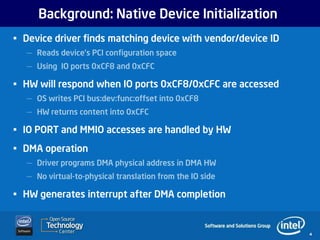
Background: Native Device Initialization
• Device driver finds matching device with vendor/device ID
   – Reads device’s PCI configuration space
   – Using IO ports 0xCF8 and 0xCFC
• HW will respond when IO ports 0xCF8/0xCFC are accessed
   – OS writes PCI bus:dev:func:offset into 0xCF8
   – HW returns content into 0xCFC
• IO PORT and MMIO accesses are handled by HW
• DMA operation
   – Driver programs DMA physical address in DMA HW
   – No virtual-to-physical translation from the IO side
• HW generates interrupt after DMA completion


                              Intel Confidential
                                                              4
Background: QEMU IO Virtualization
• QEMU provides virtual platform for HVM guests
   – Virtual PCI bus 0
   – Virtual PCI devices hangs off on virtual PCI bus 0
• Virtual PCI vendor/device ID’s in PCI configuration space are
  hardcoded to match the real HW
   – i.e. E1000 NIC has vendor_id = 0x8086, device_id = 0x100E
   – Guest pci config info stored in pci_dev->config[4096]
• Guest PCI config accesses are trapped and emulated
   – Reading virtual E1000 NIC’s device_id returns 0x100E
   – This allows E1000 driver in guest OS to initialize successfully
• IO ports and MMIO accesses are trapped and handled by QEMU
• DMA operations and interrupts are also emulated
                              Intel Confidential
                                                                       5
Background: QEMU IO Virtualization


           Intel Confidential
                                     6
Background: PCI Device Pass-through
• QEMU still provides virtual platform as before
   –   Virtual PCI bus 0
   –   Virtual PCI devices and pass-through devices hang off virtual bus 0
• PCI config handling
   –   Pass-through device config space values are read off from real HW
   –   Vendor and device IDs reflects pass-through device values
   –   Native driver in the guest can be successfully initialized
   –   Most registers are emulated by QEMU as before
   –   Read/Write of some registers are pass-through to HW (i.e. COMMAND)


                                Intel Confidential
                                                                             7
Background: PCI Device Pass-through
• IO port handling
   –   Xen hypervisor intercepts guest IO port accesses
   –   Converts guest IO port to host IO port
   –   Check for host IO port access permission
   –   Read/Write host IO port on guest’s behalf

• MMIO handling
   –   Maps GPA to HPA mapping in hypervisor
   –   Guest can access device MMIO without causing VM exits

• DMA operations can be done without VM exits
   –   Guest device driver programs GPA to the device DMA engine
   –   IOMMU HW translates GPA to HPA

• Interrupt handling
   –   Interrupts from pass-through device is intercepted by hypervisor
   –   Re-injected to the guest via vioapic->vlapic->vmcs mechanism


                                  Intel Confidential
                                                                          8
Graphics Pass-through: Base Changes
• All changes are in user mode
   – QEMU and hvmloader
• Need to execute video BIOS in guest
   – Copy content of physical address 0xC0000 to guest memory
   – Execute at guest BIOS startup
• Allow access to legacy video specific IO Ports
   – 0x3B0 - 0x3BC
   – 0x3C0 – 0x3E0
• Setup GPA to HPA mapping of legacy video MMIO range
   – 0xA0000 – 0xBFFFF


                           Intel Confidential
                                                                9
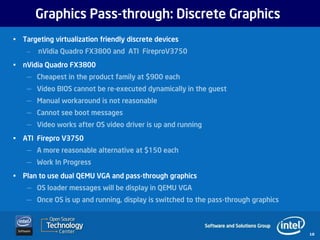
Graphics Pass-through: Discrete Graphics
• Targeting virtualization friendly discrete devices
    –   nVidia Quadro FX3800 and ATI FireproV3750
• nVidia Quadro FX3800
    –   Cheapest in the product family at $900 each
    –   Video BIOS cannot be re-executed dynamically in the guest
    –   Manual workaround is not reasonable
    –   Cannot see boot messages
    –   Video works after OS video driver is up and running
• ATI Firepro V3750
    –   A more reasonable alternative at $150 each
    –   Work In Progress
• Plan to use dual QEMU VGA and pass-through graphics
    –   OS loader messages will be display in QEMU VGA
    –   Once OS is up and running, display is switched to the pass-through graphics


                                   Intel Confidential
                                                                                      10
Graphics Pass-through: Integrated Graphics
• Integrated Graphics Device (IGD) OpRegion
   – MMIO memory used for runtime driver/BIOS communication
   – Reported at vendor specific offset 0xFC in PCI config space
   – Not reported in PCI BAR
   – Need additional function call to map this region
• Non-IGD device accessing
   – IGD historically was part of the chipset
   – Driver accesses IOH registers for such info as Top Of Memory
         • Registers accesses are HW implementation dependent
         • Future HW will shadow these registers in IGD device (0:2.0)
   –   Driver also accesses PCH on newer platforms with on die graphics
         • Windows driver hard codes device 00:1f.0
   –   QEMU needs to allow such accesses when there is IGD pass-through


                                Intel Confidential
                                                                          11
Current Status
• Run Environment
   – Guest owns the graphics device
   – Access dom0 via VNC
• Xen 4.0 and xen-unstable supports
   – Quadro FX3800 (with no boot messages)
   – Q35/Q45/GM45 integrated graphics
• Working and need to submit upstream
  – Core i3/i5
  – Sandybridge
• Work In Progress
  – Enabling ATI Firepro V3750 discrete graphics


                            Intel Confidential
                                                   12
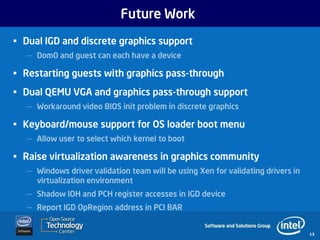
Future Work
• Dual IGD and discrete graphics support
   – Dom0 and guest can each have a device
• Restarting guests with graphics pass-through
• Dual QEMU VGA and graphics pass-through support
   – Workaround video BIOS init problem in discrete graphics
• Keyboard/mouse support for OS loader boot menu
   – Allow user to select which kernel to boot
• Raise virtualization awareness in graphics community
   – Windows driver validation team will be using Xen for validating drivers in
       virtualization environment
   –   Shadow IOH and PCH register accesses in IGD device
   –   Report IGD OpRegion address in PCI BAR

                              Intel Confidential
                                                                                  13
Questions?


Intel Confidential
                     14
Backup


Intel Confidential
                     15
Background: PCI Pass-through Example
• Pass-through E1000 NIC device at BDF 1:0.0
• QEMU reads PCI configuration space register using libpci
• QEMU constructs a virtual PCI configuration space with same
  content as 1:0.0 on real platform
   – Example: vendor_id = 0x8086, device_ID = 0x10b9
   – Example: 1:0.0 on real platform is mapped to 2:0.0 on virtual platform
• Guest PCI configuration accesses to device 2:0.0 is handled as
  pass-through device
   – Most read only registers are handled same as QEMU device
   – Some registers are passed through to HW: command register
• Access to any non pass-through devices are emulated
   – Example: host bridge device 0:0.0

                             Intel Confidential
                                                                              16
VT-d : Hardware Overview
            DMA Requests
                                                                         Dev 31, Func 7
Device ID IO Virtual Address Length …
                                                                          Dev P, Func 2
                                                             Bus 255
                                                                                                                   4KB
                                                             Bus N
                                                                                                                   Page
                                                                                                                  Frame
                             Fault Generation
                                                              Bus 0
                                                                         Dev P, Func 1
                                                                                                    4KB Page
                                                                                                     Tables
                                                                          Dev 0, Func 0


                                                                                                Address Translation
       VT-d                                                                           Device D1
                                                                                                  Structures for
     Hardware                                                      Device                           Domain A
                                                                   Context
                          Translation Cache                       Structures
                                                                                      Device D2
                                                                                                  Address Translation
                                                                                                    Structures for
                           Context Cache                                                              Domain B


Memory Access with Host Physical                                       Memory-resident IO Partitioning &
           Address                                                         Translation Structures
                                        Intel Confidential
                                                                                                                          17
Resources

• VT-d specification:
   – http://download.intel.com/technology/computing/vptech/Intel(r)_VT_for
      _Direct_IO.pdf

• Xen VT-d wiki:
   – http://wiki.xensource.com/xenwiki/VTdHowTo
• SR-IOV Specification:
   – http://www.pcisig.com/members/downloads/specifications/iov/sr-
      iov1.0_11Sep07.pdf

• ATS 1.1 Specification:
   – http://www.pcisig.com/members/downloads/specifications/iov/ats_r1.1
      _22Apr08.pdf


                           Intel Confidential
                                                                             18
Legal Information

• INFORMATION IN THIS DOCUMENT IS PROVIDED IN CONNECTION
  WITH INTEL® PRODUCTS. EXCEPT AS PROVIDED IN INTEL'S TERMS
  AND CONDITIONS OF SALE FOR SUCH PRODUCTS, INTEL ASSUMES NO
  LIABILITY WHATSOEVER, AND INTEL DISCLAIMS ANY EXPRESS OR
  IMPLIED WARRANTY RELATING TO SALE AND/OR USE OF INTEL
  PRODUCTS, INCLUDING LIABILITY OR WARRANTIES RELATING TO
  FITNESS FOR A PARTICULAR PURPOSE, MERCHANTABILITY, OR
  INFRINGEMENT OF ANY PATENT, COPYRIGHT, OR OTHER
  INTELLECTUAL PROPERTY RIGHT.
• Intel may make changes to specifications, product descriptions, and
  plans at any time, without notice.
• All dates provided are subject to change without notice.
• Intel is a trademark of Intel Corporation in the U.S. and other
  countries.
• *Other names and brands may be claimed as the property of others.
• Copyright © 2007, Intel Corporation. All rights are protected.

                          Intel Confidential
                                                                        19
Intel Confidential
                     20

Graphics virtualization

  • 1.
    Graphics Virtualization Challenges April-29-2010 Allen Kay allen.m.kay@intel.com
  • 2.
    Agenda • Background – High Level PCI Driver Operation Flow – Native Device Initialization – QEMU IO Virtualization – Device Pass-through • Graphics Pass-through – Base Changes – Discrete Graphics – Integrated Graphics Device (IGD) • Current Status • Future Work Intel Confidential 2
  • 3.
    High Level PCIDriver Operation Flow • Initialize device base on vendor_id and device_id • Map device MMIO area containing device control registers • Using device control registers to initiate DMA • Device interrupts CPU when DMA completes Intel Confidential 3
  • 4.
    Background: Native DeviceInitialization • Device driver finds matching device with vendor/device ID – Reads device’s PCI configuration space – Using IO ports 0xCF8 and 0xCFC • HW will respond when IO ports 0xCF8/0xCFC are accessed – OS writes PCI bus:dev:func:offset into 0xCF8 – HW returns content into 0xCFC • IO PORT and MMIO accesses are handled by HW • DMA operation – Driver programs DMA physical address in DMA HW – No virtual-to-physical translation from the IO side • HW generates interrupt after DMA completion Intel Confidential 4
  • 5.
    Background: QEMU IOVirtualization • QEMU provides virtual platform for HVM guests – Virtual PCI bus 0 – Virtual PCI devices hangs off on virtual PCI bus 0 • Virtual PCI vendor/device ID’s in PCI configuration space are hardcoded to match the real HW – i.e. E1000 NIC has vendor_id = 0x8086, device_id = 0x100E – Guest pci config info stored in pci_dev->config[4096] • Guest PCI config accesses are trapped and emulated – Reading virtual E1000 NIC’s device_id returns 0x100E – This allows E1000 driver in guest OS to initialize successfully • IO ports and MMIO accesses are trapped and handled by QEMU • DMA operations and interrupts are also emulated Intel Confidential 5
  • 6.
    Background: QEMU IOVirtualization Intel Confidential 6
  • 7.
    Background: PCI DevicePass-through • QEMU still provides virtual platform as before – Virtual PCI bus 0 – Virtual PCI devices and pass-through devices hang off virtual bus 0 • PCI config handling – Pass-through device config space values are read off from real HW – Vendor and device IDs reflects pass-through device values – Native driver in the guest can be successfully initialized – Most registers are emulated by QEMU as before – Read/Write of some registers are pass-through to HW (i.e. COMMAND) Intel Confidential 7
  • 8.
    Background: PCI DevicePass-through • IO port handling – Xen hypervisor intercepts guest IO port accesses – Converts guest IO port to host IO port – Check for host IO port access permission – Read/Write host IO port on guest’s behalf • MMIO handling – Maps GPA to HPA mapping in hypervisor – Guest can access device MMIO without causing VM exits • DMA operations can be done without VM exits – Guest device driver programs GPA to the device DMA engine – IOMMU HW translates GPA to HPA • Interrupt handling – Interrupts from pass-through device is intercepted by hypervisor – Re-injected to the guest via vioapic->vlapic->vmcs mechanism Intel Confidential 8
  • 9.
    Graphics Pass-through: BaseChanges • All changes are in user mode – QEMU and hvmloader • Need to execute video BIOS in guest – Copy content of physical address 0xC0000 to guest memory – Execute at guest BIOS startup • Allow access to legacy video specific IO Ports – 0x3B0 - 0x3BC – 0x3C0 – 0x3E0 • Setup GPA to HPA mapping of legacy video MMIO range – 0xA0000 – 0xBFFFF Intel Confidential 9
  • 10.
    Graphics Pass-through: DiscreteGraphics • Targeting virtualization friendly discrete devices – nVidia Quadro FX3800 and ATI FireproV3750 • nVidia Quadro FX3800 – Cheapest in the product family at $900 each – Video BIOS cannot be re-executed dynamically in the guest – Manual workaround is not reasonable – Cannot see boot messages – Video works after OS video driver is up and running • ATI Firepro V3750 – A more reasonable alternative at $150 each – Work In Progress • Plan to use dual QEMU VGA and pass-through graphics – OS loader messages will be display in QEMU VGA – Once OS is up and running, display is switched to the pass-through graphics Intel Confidential 10
  • 11.
    Graphics Pass-through: IntegratedGraphics • Integrated Graphics Device (IGD) OpRegion – MMIO memory used for runtime driver/BIOS communication – Reported at vendor specific offset 0xFC in PCI config space – Not reported in PCI BAR – Need additional function call to map this region • Non-IGD device accessing – IGD historically was part of the chipset – Driver accesses IOH registers for such info as Top Of Memory • Registers accesses are HW implementation dependent • Future HW will shadow these registers in IGD device (0:2.0) – Driver also accesses PCH on newer platforms with on die graphics • Windows driver hard codes device 00:1f.0 – QEMU needs to allow such accesses when there is IGD pass-through Intel Confidential 11
  • 12.
    Current Status • RunEnvironment – Guest owns the graphics device – Access dom0 via VNC • Xen 4.0 and xen-unstable supports – Quadro FX3800 (with no boot messages) – Q35/Q45/GM45 integrated graphics • Working and need to submit upstream – Core i3/i5 – Sandybridge • Work In Progress – Enabling ATI Firepro V3750 discrete graphics Intel Confidential 12
  • 13.
    Future Work • DualIGD and discrete graphics support – Dom0 and guest can each have a device • Restarting guests with graphics pass-through • Dual QEMU VGA and graphics pass-through support – Workaround video BIOS init problem in discrete graphics • Keyboard/mouse support for OS loader boot menu – Allow user to select which kernel to boot • Raise virtualization awareness in graphics community – Windows driver validation team will be using Xen for validating drivers in virtualization environment – Shadow IOH and PCH register accesses in IGD device – Report IGD OpRegion address in PCI BAR Intel Confidential 13
  • 14.
  • 15.
  • 16.
    Background: PCI Pass-throughExample • Pass-through E1000 NIC device at BDF 1:0.0 • QEMU reads PCI configuration space register using libpci • QEMU constructs a virtual PCI configuration space with same content as 1:0.0 on real platform – Example: vendor_id = 0x8086, device_ID = 0x10b9 – Example: 1:0.0 on real platform is mapped to 2:0.0 on virtual platform • Guest PCI configuration accesses to device 2:0.0 is handled as pass-through device – Most read only registers are handled same as QEMU device – Some registers are passed through to HW: command register • Access to any non pass-through devices are emulated – Example: host bridge device 0:0.0 Intel Confidential 16
  • 17.
    VT-d : HardwareOverview DMA Requests Dev 31, Func 7 Device ID IO Virtual Address Length … Dev P, Func 2 Bus 255 4KB Bus N Page Frame Fault Generation Bus 0 Dev P, Func 1 4KB Page Tables Dev 0, Func 0 Address Translation VT-d Device D1 Structures for Hardware Device Domain A Context Translation Cache Structures Device D2 Address Translation Structures for Context Cache Domain B Memory Access with Host Physical Memory-resident IO Partitioning & Address Translation Structures Intel Confidential 17
  • 18.
    Resources • VT-d specification: – http://download.intel.com/technology/computing/vptech/Intel(r)_VT_for _Direct_IO.pdf • Xen VT-d wiki: – http://wiki.xensource.com/xenwiki/VTdHowTo • SR-IOV Specification: – http://www.pcisig.com/members/downloads/specifications/iov/sr- iov1.0_11Sep07.pdf • ATS 1.1 Specification: – http://www.pcisig.com/members/downloads/specifications/iov/ats_r1.1 _22Apr08.pdf Intel Confidential 18
  • 19.
    Legal Information • INFORMATIONIN THIS DOCUMENT IS PROVIDED IN CONNECTION WITH INTEL® PRODUCTS. EXCEPT AS PROVIDED IN INTEL'S TERMS AND CONDITIONS OF SALE FOR SUCH PRODUCTS, INTEL ASSUMES NO LIABILITY WHATSOEVER, AND INTEL DISCLAIMS ANY EXPRESS OR IMPLIED WARRANTY RELATING TO SALE AND/OR USE OF INTEL PRODUCTS, INCLUDING LIABILITY OR WARRANTIES RELATING TO FITNESS FOR A PARTICULAR PURPOSE, MERCHANTABILITY, OR INFRINGEMENT OF ANY PATENT, COPYRIGHT, OR OTHER INTELLECTUAL PROPERTY RIGHT. • Intel may make changes to specifications, product descriptions, and plans at any time, without notice. • All dates provided are subject to change without notice. • Intel is a trademark of Intel Corporation in the U.S. and other countries. • *Other names and brands may be claimed as the property of others. • Copyright © 2007, Intel Corporation. All rights are protected. Intel Confidential 19
  • 20.