






Prototype PV
 Drivers in SeaBIOS
 with upstream qemu
  Daniel
      Daniel Castro Velasco
                POSTECH


Sponsored by:

                 &        &

&
What is SeaBIOS


Components


Current Work


Future Work


Questions
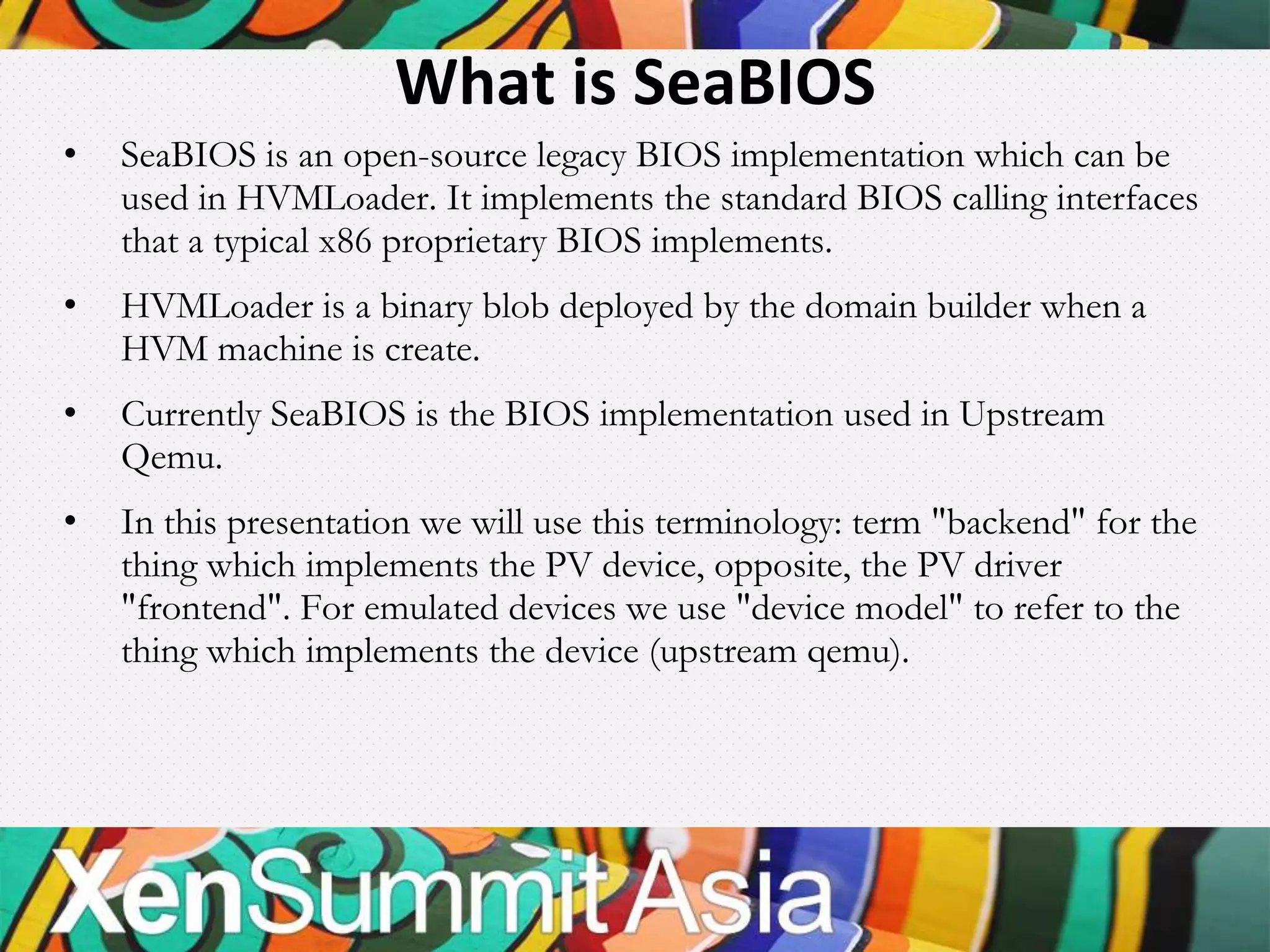
What is SeaBIOS
•   SeaBIOS is an open-source legacy BIOS implementation which can be
    used in HVMLoader. It implements the standard BIOS calling interfaces
    that a typical x86 proprietary BIOS implements.
•   HVMLoader is a binary blob deployed by the domain builder when a
    HVM machine is create.
•   Currently SeaBIOS is the BIOS implementation used in Upstream
    Qemu.
•   In this presentation we will use this terminology: term "backend" for the
    thing which implements the PV device, opposite, the PV driver
    "frontend". For emulated devices we use "device model" to refer to the
    thing which implements the device (upstream qemu).
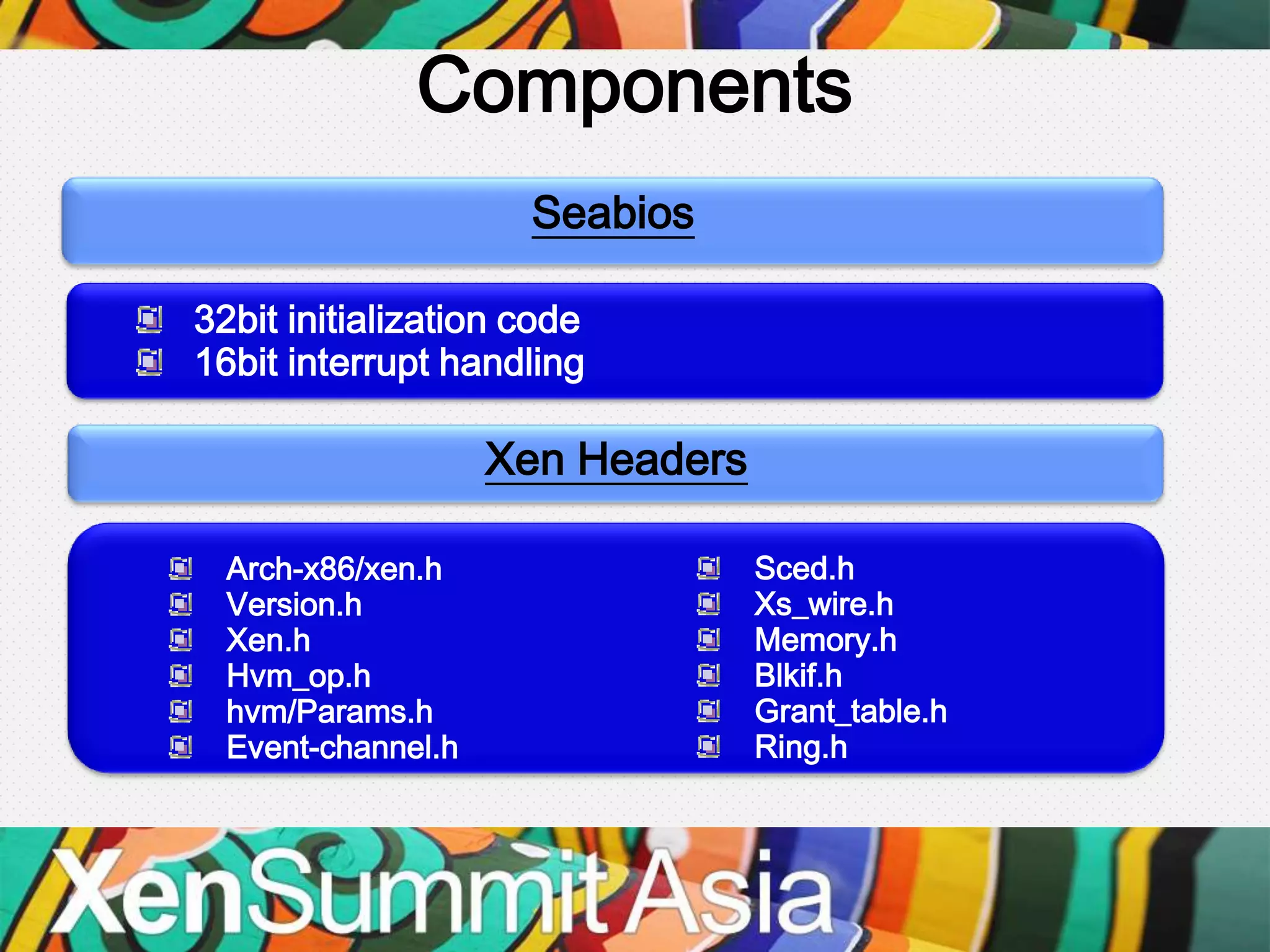
Components
                     Seabios

32bit initialization code
16bit interrupt handling

                    Xen Headers

  Arch-x86/xen.h                  Sced.h
  Version.h                       Xs_wire.h
  Xen.h                           Memory.h
  Hvm_op.h                        Blkif.h
  hvm/Params.h                    Grant_table.h
  Event-channel.h                 Ring.h
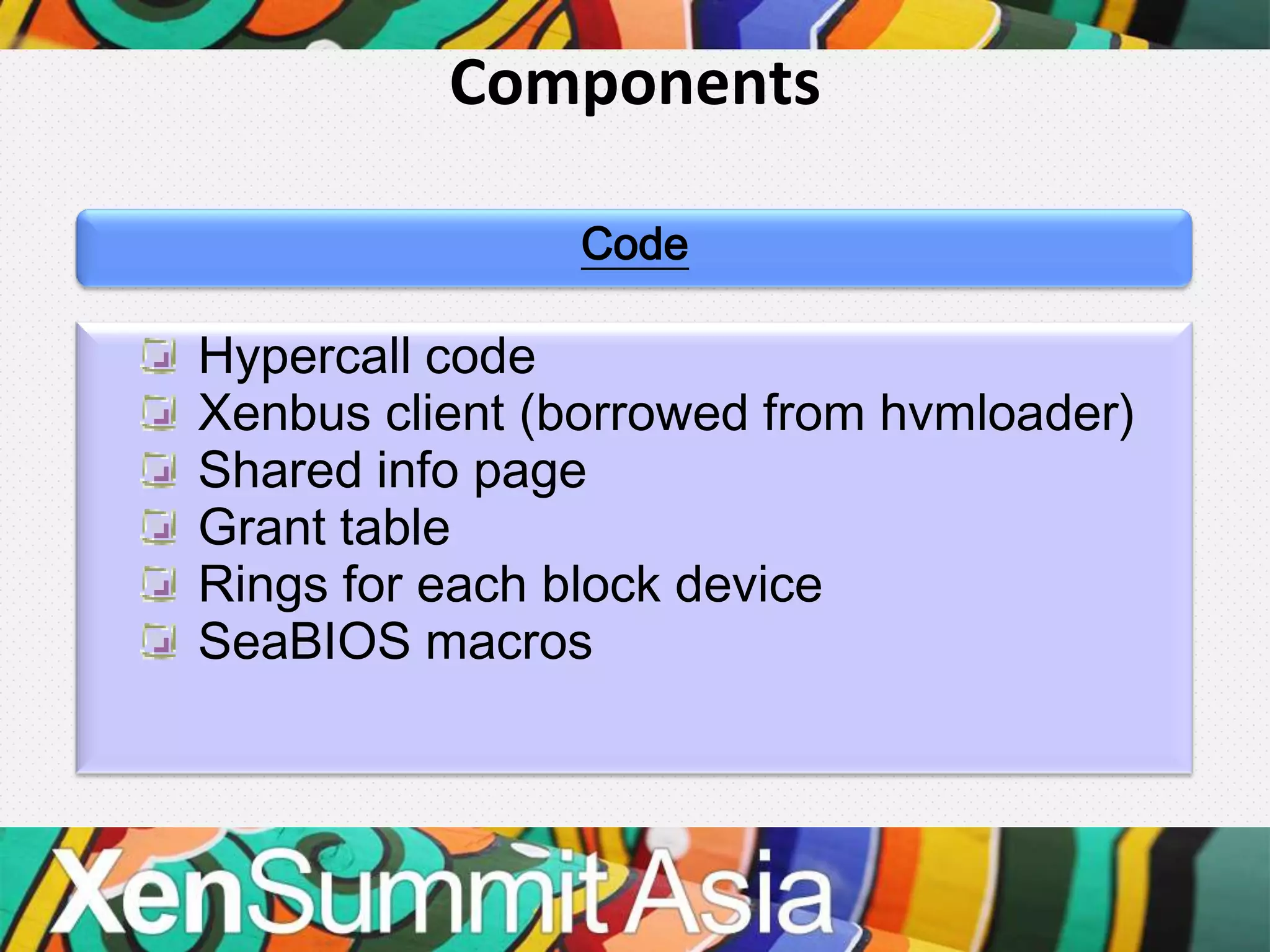
Components

               Code

Hypercall code
Xenbus client (borrowed from hvmloader)
Shared info page
Grant table
Rings for each block device
SeaBIOS macros
SeaBIOS Help Macros
Each low function modifies the segment pointers, if not specified
   SeaBIOS uses Code Segment pointer, if size of segment
           exceeds 256 kbytes, the segment grows.
             Malloc_low: allocate in CS Segment
  memalign_high allocate in last segment, maybe above 1MB
                             barrier.
 SET_GLOBAL - GET_GLOBAL so global variables are usable
                           from 16Bit
   SET/GET_SEG – GET_PTRFLAT, to specify from which
   segment create the pointer, the later turns a pointer from
            segment:offset to full pointer –in 32bit
    Container_of, return the container struct of drive_s: i.e.
                          xendrive_s
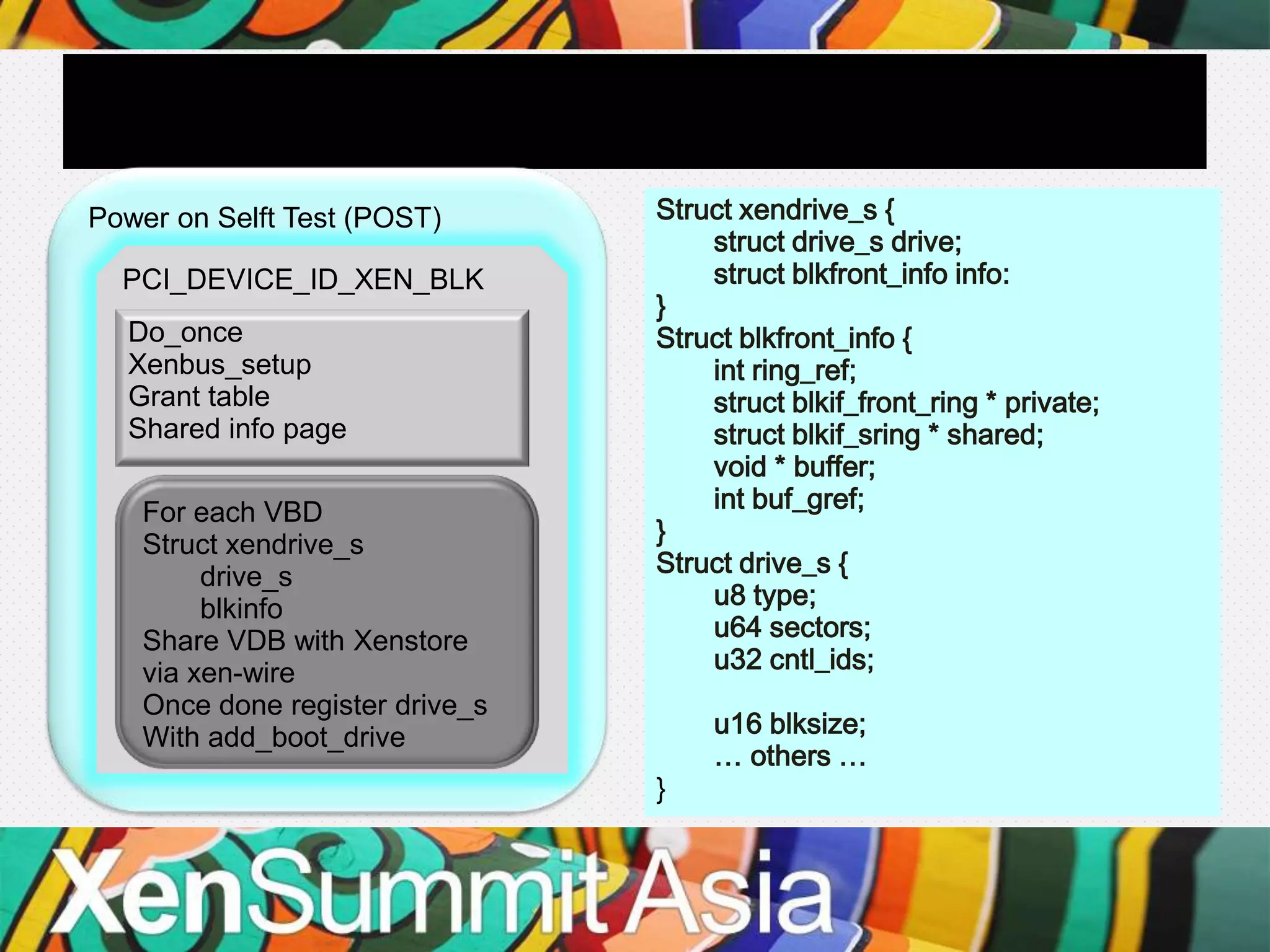
Init Workflow (32 Bit code)
Power on Selft Test (POST)      Struct xendrive_s {
                                    struct drive_s drive;
  PCI_DEVICE_ID_XEN_BLK             struct blkfront_info info:
                                }
  Do_once                       Struct blkfront_info {
  Xenbus_setup                      int ring_ref;
  Grant table                       struct blkif_front_ring * private;
  Shared info page                  struct blkif_sring * shared;
                                    void * buffer;
   For each VBD                     int buf_gref;
   Struct xendrive_s            }
        drive_s                 Struct drive_s {
        blkinfo                     u8 type;
   Share VDB with Xenstore          u64 sectors;
   via xen-wire                     u32 cntl_ids;
   Once done register drive_s
   With add_boot_drive              u16 blksize;
                                    … others …
                                }
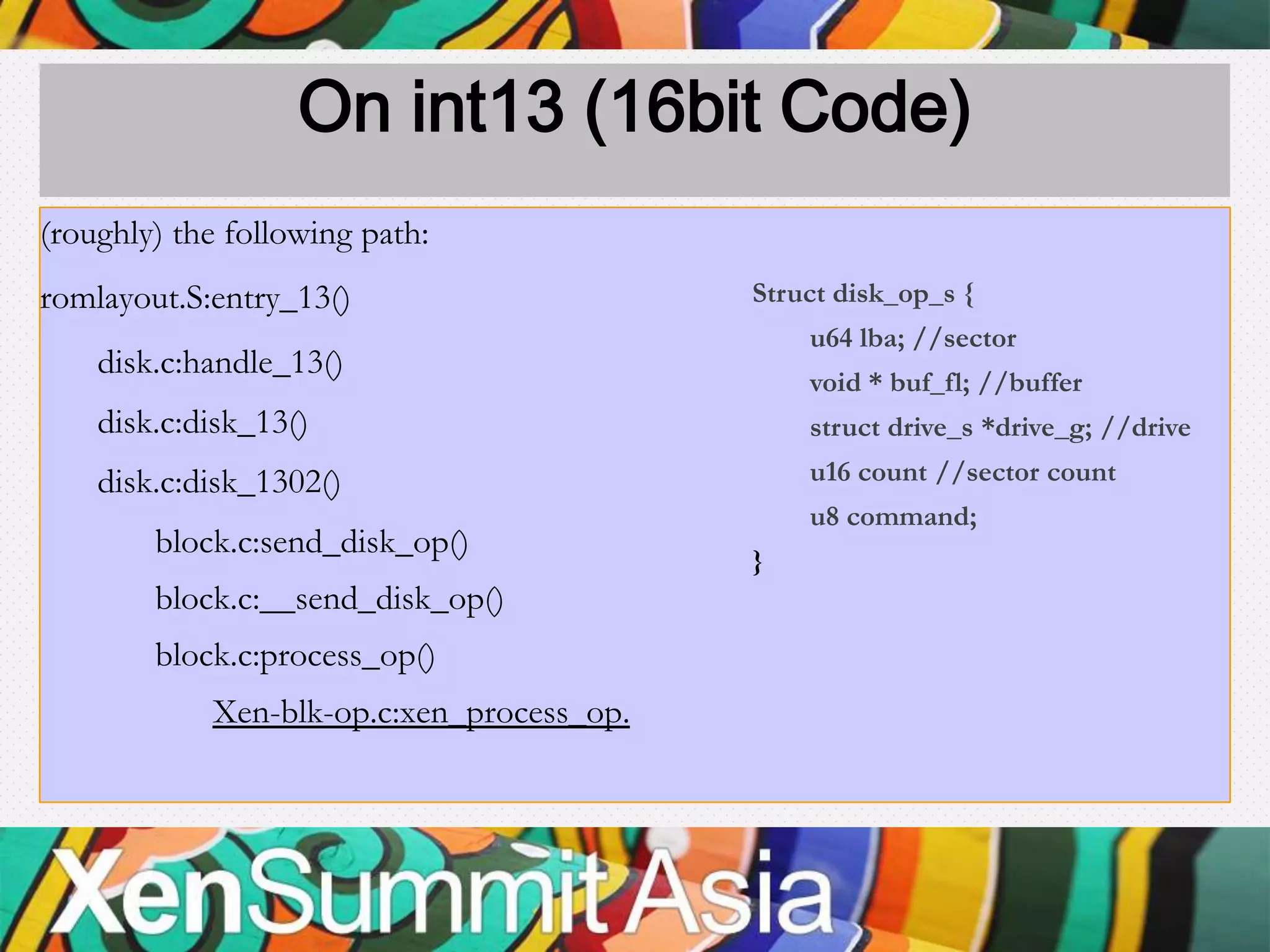
On int13 (16bit Code)
(roughly) the following path:
romlayout.S:entry_13()                     Struct disk_op_s {
                                               u64 lba; //sector
    disk.c:handle_13()
                                               void * buf_fl; //buffer
    disk.c:disk_13()                           struct drive_s *drive_g; //drive
    disk.c:disk_1302()                         u16 count //sector count
                                               u8 command;
        block.c:send_disk_op()
                                           }
        block.c:__send_disk_op()
        block.c:process_op()
            Xen-blk-op.c:xen_process_op.
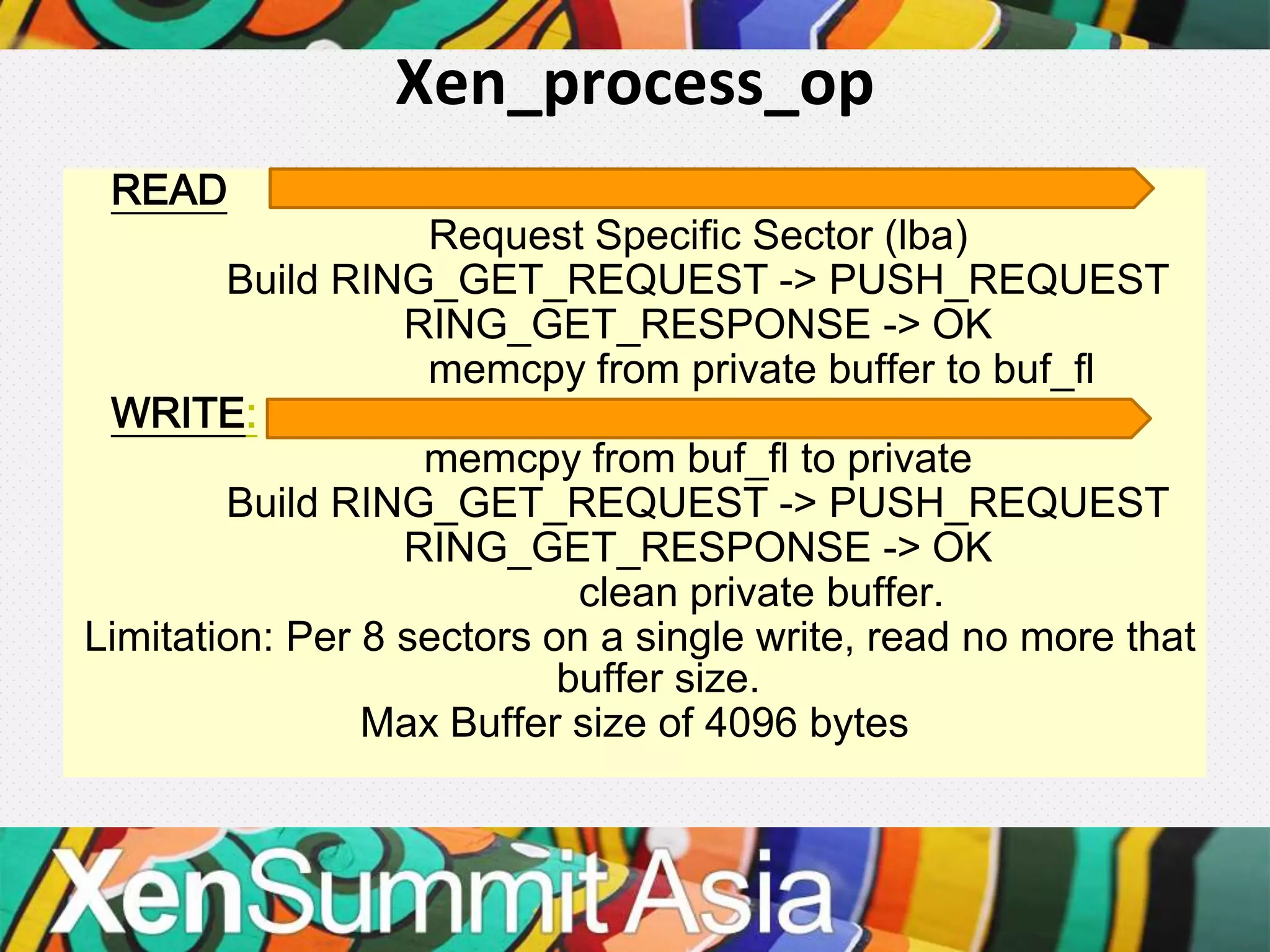
Xen_process_op
 READ
                   Request Specific Sector (lba)
        Build RING_GET_REQUEST -> PUSH_REQUEST
                  RING_GET_RESPONSE -> OK
                   memcpy from private buffer to buf_fl
 WRITE:
                   memcpy from buf_fl to private
        Build RING_GET_REQUEST -> PUSH_REQUEST
                  RING_GET_RESPONSE -> OK
                            clean private buffer.
Limitation: Per 8 sectors on a single write, read no more that
                           buffer size.
                Max Buffer size of 4096 bytes
Future Work

Xen_process_op can avoid using the private
buffer, but has to manage (many more) grefs in
the shared buffer instead
No shutdown sequence (free memory, channels,
rings… etc.)
Net PV Drivers - Possibly PXE Support
Benchmarks on performance
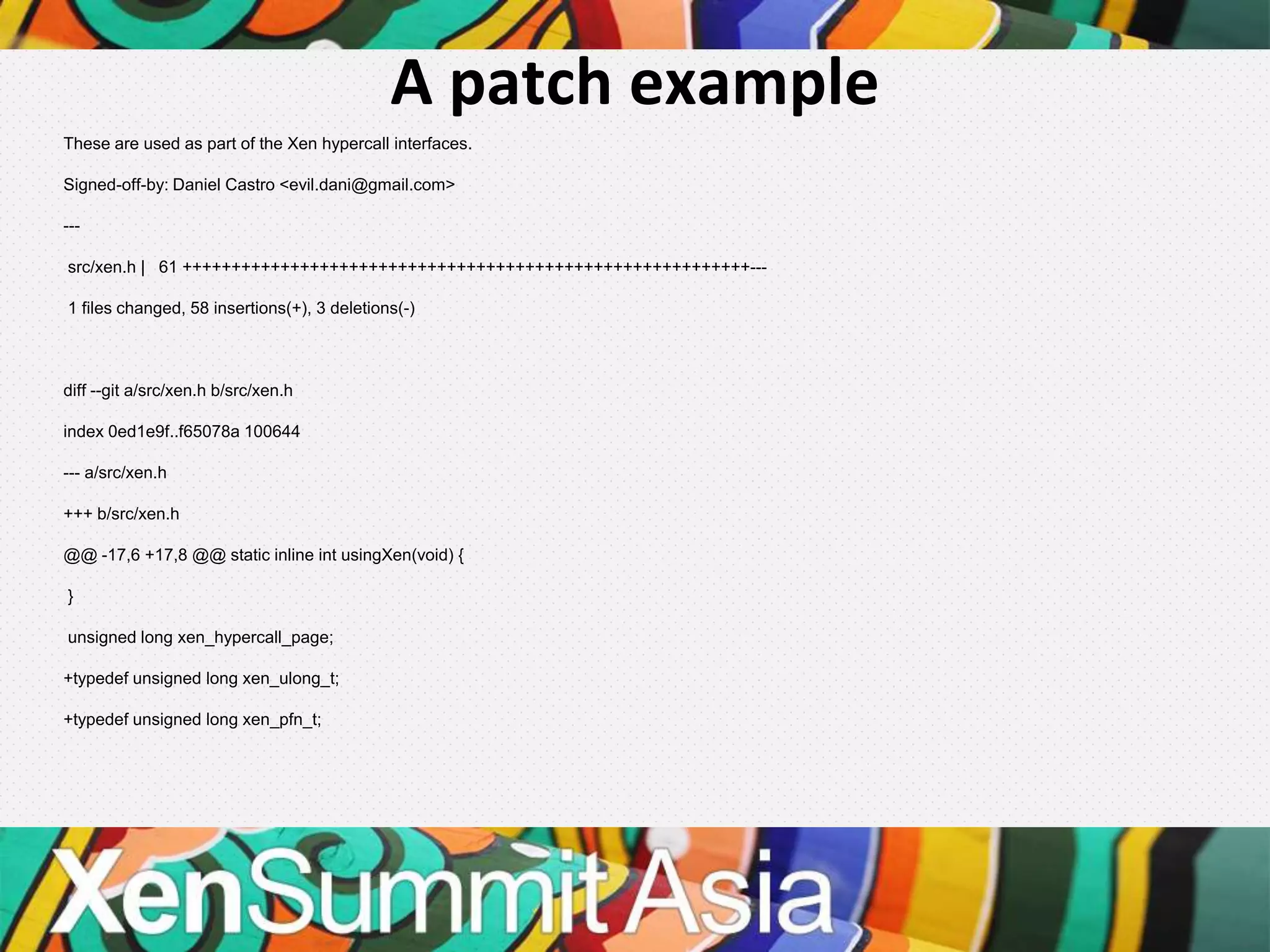
A patch example
These are used as part of the Xen hypercall interfaces.

Signed-off-by: Daniel Castro <evil.dani@gmail.com>

---

src/xen.h | 61 ++++++++++++++++++++++++++++++++++++++++++++++++++++++++++---

1 files changed, 58 insertions(+), 3 deletions(-)


diff --git a/src/xen.h b/src/xen.h

index 0ed1e9f..f65078a 100644

--- a/src/xen.h

+++ b/src/xen.h

@@ -17,6 +17,8 @@ static inline int usingXen(void) {

}

unsigned long xen_hypercall_page;

+typedef unsigned long xen_ulong_t;

+typedef unsigned long xen_pfn_t;
Questions
Questions
Special Thanks
This work was sponsored by Google
          Summer of code
          Ian Campbell
Thank you.

PV-Drivers for SeaBIOS using Upstream Qemu

  • 1.
    Prototype PV Driversin SeaBIOS with upstream qemu Daniel Daniel Castro Velasco POSTECH Sponsored by: & & &
  • 2.
    What is SeaBIOS Components CurrentWork Future Work Questions
  • 3.
    What is SeaBIOS • SeaBIOS is an open-source legacy BIOS implementation which can be used in HVMLoader. It implements the standard BIOS calling interfaces that a typical x86 proprietary BIOS implements. • HVMLoader is a binary blob deployed by the domain builder when a HVM machine is create. • Currently SeaBIOS is the BIOS implementation used in Upstream Qemu. • In this presentation we will use this terminology: term "backend" for the thing which implements the PV device, opposite, the PV driver "frontend". For emulated devices we use "device model" to refer to the thing which implements the device (upstream qemu).
  • 4.
    Components Seabios 32bit initialization code 16bit interrupt handling Xen Headers Arch-x86/xen.h Sced.h Version.h Xs_wire.h Xen.h Memory.h Hvm_op.h Blkif.h hvm/Params.h Grant_table.h Event-channel.h Ring.h
  • 5.
    Components Code Hypercall code Xenbus client (borrowed from hvmloader) Shared info page Grant table Rings for each block device SeaBIOS macros
  • 6.
    SeaBIOS Help Macros Eachlow function modifies the segment pointers, if not specified SeaBIOS uses Code Segment pointer, if size of segment exceeds 256 kbytes, the segment grows. Malloc_low: allocate in CS Segment memalign_high allocate in last segment, maybe above 1MB barrier. SET_GLOBAL - GET_GLOBAL so global variables are usable from 16Bit SET/GET_SEG – GET_PTRFLAT, to specify from which segment create the pointer, the later turns a pointer from segment:offset to full pointer –in 32bit Container_of, return the container struct of drive_s: i.e. xendrive_s
  • 7.
    Init Workflow (32Bit code) Power on Selft Test (POST) Struct xendrive_s { struct drive_s drive; PCI_DEVICE_ID_XEN_BLK struct blkfront_info info: } Do_once Struct blkfront_info { Xenbus_setup int ring_ref; Grant table struct blkif_front_ring * private; Shared info page struct blkif_sring * shared; void * buffer; For each VBD int buf_gref; Struct xendrive_s } drive_s Struct drive_s { blkinfo u8 type; Share VDB with Xenstore u64 sectors; via xen-wire u32 cntl_ids; Once done register drive_s With add_boot_drive u16 blksize; … others … }
  • 8.
    On int13 (16bitCode) (roughly) the following path: romlayout.S:entry_13() Struct disk_op_s { u64 lba; //sector disk.c:handle_13() void * buf_fl; //buffer disk.c:disk_13() struct drive_s *drive_g; //drive disk.c:disk_1302() u16 count //sector count u8 command; block.c:send_disk_op() } block.c:__send_disk_op() block.c:process_op() Xen-blk-op.c:xen_process_op.
  • 9.
    Xen_process_op READ Request Specific Sector (lba) Build RING_GET_REQUEST -> PUSH_REQUEST RING_GET_RESPONSE -> OK memcpy from private buffer to buf_fl WRITE: memcpy from buf_fl to private Build RING_GET_REQUEST -> PUSH_REQUEST RING_GET_RESPONSE -> OK clean private buffer. Limitation: Per 8 sectors on a single write, read no more that buffer size. Max Buffer size of 4096 bytes
  • 10.
    Future Work Xen_process_op canavoid using the private buffer, but has to manage (many more) grefs in the shared buffer instead No shutdown sequence (free memory, channels, rings… etc.) Net PV Drivers - Possibly PXE Support Benchmarks on performance
  • 11.
    A patch example Theseare used as part of the Xen hypercall interfaces. Signed-off-by: Daniel Castro <evil.dani@gmail.com> --- src/xen.h | 61 ++++++++++++++++++++++++++++++++++++++++++++++++++++++++++--- 1 files changed, 58 insertions(+), 3 deletions(-) diff --git a/src/xen.h b/src/xen.h index 0ed1e9f..f65078a 100644 --- a/src/xen.h +++ b/src/xen.h @@ -17,6 +17,8 @@ static inline int usingXen(void) { } unsigned long xen_hypercall_page; +typedef unsigned long xen_ulong_t; +typedef unsigned long xen_pfn_t;
  • 12.
  • 13.
    Special Thanks This workwas sponsored by Google Summer of code Ian Campbell
  • 14.