Molasses as a feedstock for alcohol production 89
Chapter 6
Molasses as a feedstock for alcohol production
J.E. Murtagh
Murtagh & Associates, Winchester, Virginia
Introduction
Molasses differs from other feedstocks for alcohol
production such as corn, milo and potatoes in
that these plant products contain carbohydrate
stored as starch. As a result, these feedstocks
must be pre-treated by cooking and enzymatic
action to hydrolyze starch into fermentable
sugars. In contrast, the carbohydrates in molasses
are already in the form of sugars and need no
pretreatment.
Basic sugar chemistry
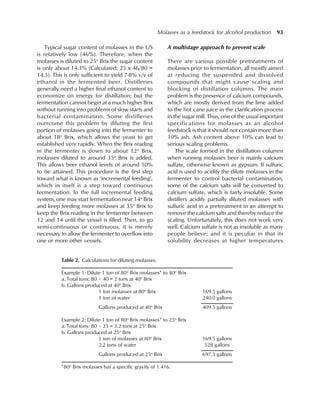
The simplest form of sugar is glucose, which is
fermented by normal distillery and brewery
yeasts. It has the formula C6
H12
O6
and is made
up of molecules with a single ring structure
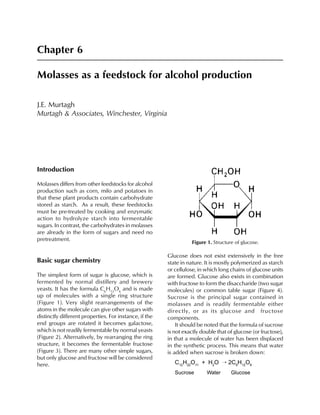
(Figure 1). Very slight rearrangements of the
atoms in the molecule can give other sugars with
distinctly different properties. For instance, if the
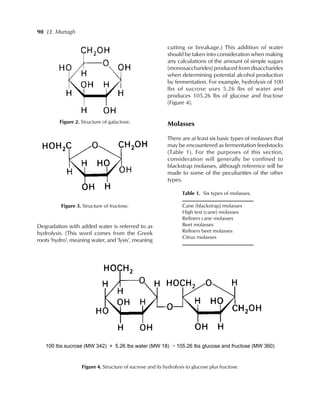
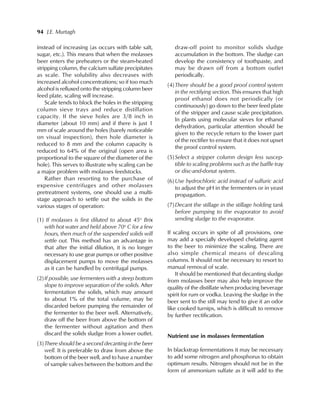
end groups are rotated it becomes galactose,
which is not readily fermentable by normal yeasts
(Figure 2). Alternatively, by rearranging the ring
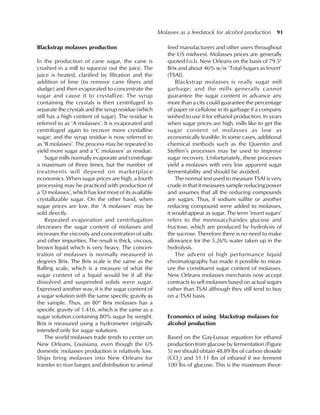
structure, it becomes the fermentable fructose
(Figure 3). There are many other simple sugars,
but only glucose and fructose will be considered
here.
Figure 1. Structure of glucose.
Glucose does not exist extensively in the free
state in nature. It is mostly polymerized as starch
or cellulose, in which long chains of glucose units
are formed. Glucose also exists in combination
with fructose to form the disaccharide (two sugar
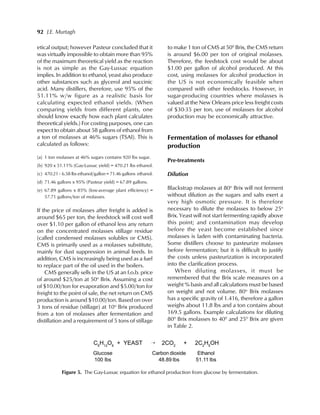
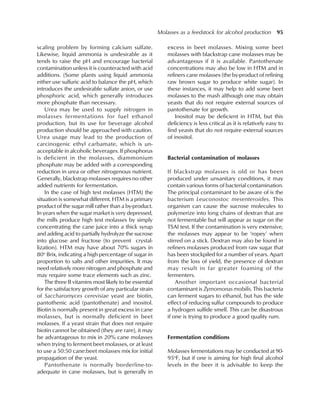
molecules) or common table sugar (Figure 4).
Sucrose is the principal sugar contained in
molasses and is readily fermentable either
directly, or as its glucose and fructose
components.
It should be noted that the formula of sucrose
is not exactly double that of glucose (or fructose),
in that a molecule of water has been displaced
in the synthetic process. This means that water
is added when sucrose is broken down:
C12
H22
O11
+ H2
O ÷ 2C6
H12
O6
Sucrose Water Glucose
90 J.E. Murtagh
Figure 2. Structure of galactose.
Figure 3. Structure of fructose.
Degradation with added water is referred to as
hydrolysis. (This word comes from the Greek
roots ‘hydro’, meaning water, and ‘lysis’, meaning
cutting or breakage.) This addition of water
should be taken into consideration when making
any calculations of the amount of simple sugars
(monosaccharides) produced from disaccharides
when determining potential alcohol production
by fermentation. For example, hydrolysis of 100
lbs of sucrose uses 5.26 lbs of water and
produces 105.26 lbs of glucose and fructose
(Figure 4).
Molasses
There are at least six basic types of molasses that
may be encountered as fermentation feedstocks
(Table 1). For the purposes of this section,
consideration will generally be confined to
blackstrap molasses, although reference will be
made to some of the peculiarities of the other
types.
Table 1. Six types of molasses.
Cane (blackstrap) molasses
High test (cane) molasses
Refiners cane molasses
Beet molasses
Refiners beet molasses
Citrus molasses
Figure 4. Structure of sucrose and its hydrolysis to glucose plus fructose.
100 lbs sucrose (MW 342) + 5.26 lbs water (MW 18) ÷ 105.26 lbs glucose and fructose (MW 360)
Molasses as a feedstock for alcohol production 91
Blackstrap molasses production
In the production of cane sugar, the cane is
crushed in a mill to squeeze out the juice. The
juice is heated, clarified by filtration and the
addition of lime (to remove cane fibers and
sludge) and then evaporated to concentrate the
sugar and cause it to crystallize. The syrup
containing the crystals is then centrifuged to
separate the crystals and the syrup residue (which
still has a high content of sugar). The residue is
referred to as ‘A molasses’. It is evaporated and
centrifuged again to recover more crystalline
sugar; and the syrup residue is now referred to
as ‘B molasses’. The process may be repeated to
yield more sugar and a ‘C molasses’ as residue.
Sugar mills normally evaporate and centrifuge
a maximum of three times, but the number of
treatments will depend on marketplace
economics. When sugar prices are high, a fourth
processing may be practiced with production of
a ‘D molasses’, which has lost most of its available
crystallizable sugar. On the other hand, when
sugar prices are low, the ‘A molasses’ may be
sold directly.
Repeated evaporation and centrifugation
decreases the sugar content of molasses and
increases the viscosity and concentration of salts
and other impurities. The result is thick, viscous,
brown liquid which is very heavy. The concen-
tration of molasses is normally measured in
degrees Brix. The Brix scale is the same as the
Balling scale, which is a measure of what the
sugar content of a liquid would be if all the
dissolved and suspended solids were sugar.
Expressed another way, it is the sugar content of
a sugar solution with the same specific gravity as
the sample. Thus, an 800
Brix molasses has a
specific gravity of 1.416, which is the same as a
sugar solution containing 80% sugar by weight.
Brix is measured using a hydrometer originally
intended only for sugar solutions.
The world molasses trade tends to center on
New Orleans, Louisiana, even though the US
domestic molasses production is relatively low.
Ships bring molasses into New Orleans for
transfer to river barges and distribution to animal
feed manufacturers and other users throughout
the US midwest. Molasses prices are generally
quoted f.o.b. New Orleans on the basis of 79.50
Brix and about 46% w/w ‘Total Sugars as Invert’
(TSAI).
Blackstrap molasses is really sugar mill
garbage; and the mills generally cannot
guarantee the sugar content in advance any
more than a city could guarantee the percentage
of paper or cellulose in its garbage if a company
wished to use it for ethanol production. In years
when sugar prices are high, mills like to get the
sugar content of molasses as low as
economically feasible. In some cases, additional
chemical methods such as the Quentin and
Steffen’s processes may be used to improve
sugar recovery. Unfortunately, these processes
yield a molasses with very low apparent sugar
fermentability and should be avoided.
The normal test used to measure TSAI is very
crude in that it measures sample reducing power
and assumes that all the reducing compounds
are sugars. Thus, if sodium sulfite or another
reducing compound were added to molasses,
it would appear as sugar. The term ‘invert sugars’
refers to the monosaccharides glucose and
fructose, which are produced by hydrolysis of
the sucrose. Therefore there is no need to make
allowance for the 5.26% water taken up in the
hydrolysis.
The advent of high performance liquid
chromatography has made it possible to meas-
ure the constituent sugar content of molasses.
New Orleans molasses merchants now accept
contracts to sell molasses based on actual sugars
rather than TSAI although they still tend to buy
on a TSAI basis.
Economics of using blackstrap molasses for
alcohol production
Based on the Gay-Lussac equation for ethanol
production from glucose by fermentation (Figure
5) we should obtain 48.89 lbs of carbon dioxide
(CO2
) and 51.11 lbs of ethanol if we ferment
100 lbs of glucose. This is the maximum theor-
92 J.E. Murtagh
etical output; however Pasteur concluded that it
was virtually impossible to obtain more than 95%
of the maximum theoretical yield as the reaction
is not as simple as the Gay-Lussac equation
implies. In addition to ethanol, yeast also produce
other substances such as glycerol and succinic
acid. Many distillers, therefore, use 95% of the
51.11% w/w figure as a realistic basis for
calculating expected ethanol yields. (When
comparing yields from different plants, one
should know exactly how each plant calculates
theoretical yields.) For costing purposes, one can
expect to obtain about 58 gallons of ethanol from
a ton of molasses at 46% sugars (TSAI). This is
calculated as follows:
(a) 1 ton molasses at 46% sugars contains 920 lbs sugar.
(b) 920 x 51.11% (Gay-Lussac yield) = 470.21 lbs ethanol.
(c) 470.21) 6.58 lbs ethanol/gallon = 71.46 gallons ethanol.
(d) 71.46 gallons x 95% (Pasteur yield) = 67.89 gallons.
(e) 67.89 gallons x 85% (low-average plant efficiency) =
57.71 gallons/ton of molasses.
If the price of molasses after freight is added is
around $65 per ton, the feedstock will cost well
over $1.10 per gallon of ethanol less any return
on the concentrated molasses stillage residue
(called condensed molasses solubles or CMS).
CMS is primarily used as a molasses substitute,
mainly for dust suppression in animal feeds. In
addition, CMS is increasingly being used as a fuel
to replace part of the oil used in the boilers.
CMS generally sells in the US at an f.o.b. price
of around $25/ton at 50o
Brix. Assuming a cost
of $10.00/ton for evaporation and $5.00/ton for
freight to the point of sale, the net return on CMS
production is around $10.00/ton. Based on over
3 tons of residue (stillage) at 10o
Brix produced
from a ton of molasses after fermentation and
distillation and a requirement of 5 tons of stillage
to make 1 ton of CMS at 500
Brix, the CMS return
is around $6.00 per ton of original molasses.
Therefore, the feedstock cost would be about
$1.00 per gallon of alcohol produced. At this
cost, using molasses for alcohol production in
the US is not economically feasible when
compared with other feedstocks. However, in
sugar-producing countries where molasses is
valued at the New Orleans price less freight costs
of $30-35 per ton, use of molasses for alcohol
production may be economically attractive.
Fermentation of molasses for ethanol
production
Pre-treatments
Dilution
Blackstrap molasses at 80o
Brix will not ferment
without dilution as the sugars and salts exert a
very high osmotic pressure. It is therefore
necessary to dilute the molasses to below 25o
Brix. Yeast will not start fermenting rapidly above
this point; and contamination may develop
before the yeast become established since
molasses is laden with contaminating bacteria.
Some distillers choose to pasteurize molasses
before fermentation; but it is difficult to justify
the costs unless pasteurization is incorporated
into the clarification process.
When diluting molasses, it must be
remembered that the Brix scale measures on a
weight % basis and all calculations must be based
on weight and not volume. 80o
Brix molasses
has a specific gravity of 1.416, therefore a gallon
weighs about 11.8 lbs and a ton contains about
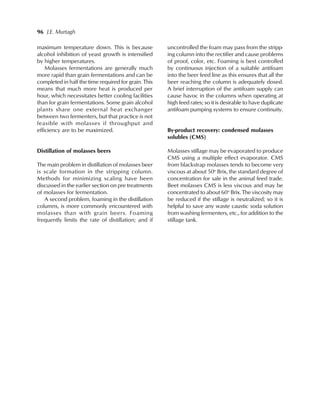
169.5 gallons. Example calculations for diluting
800
Brix molasses to 400
and 250
Brix are given
in Table 2.
C6
H12
O6
+ YEAST ÷ 2CO2
+ 2C2
H5
OH
Glucose Carbon dioxide Ethanol
100 lbs 48.89 lbs 51.11 lbs
Figure 5. The Gay-Lussac equation for ethanol production from glucose by fermentation.
Molasses as a feedstock for alcohol production 93
Typical sugar content of molasses in the US
is relatively low (46%). Therefore, when the
molasses is diluted to 25o
Brix the sugar content
is only about 14.3% (Calculated: 25 x 46/80 =
14.3). This is only sufficient to yield 7-8% v/v of
ethanol in the fermented beer. Distilleries
generally need a higher final ethanol content to
economize on energy for distillation; but the
fermentation cannot begin at a much higher Brix
without running into problems of slow starts and
bacterial contamination. Some distilleries
overcome this problem by diluting the first
portion of molasses going into the fermenter to
about 18o
Brix, which allows the yeast to get
established very rapidly. When the Brix reading
in the fermenter is down to about 12o
Brix,
molasses diluted to around 35o
Brix is added.
This allows beer ethanol levels of around 10%
to be attained. This procedure is the first step
toward what is known as ‘incremental feeding’,
which in itself is a step toward continuous
fermentation. In the full incremental feeding
system, one may start fermentation near 14o
Brix
and keep feeding more molasses at 35o
Brix to
keep the Brix reading in the fermenter between
12 and 14 until the vessel is filled. Then, to go
semi-continuous or continuous, it is merely
necessary to allow the fermenter to overflow into
one or more other vessels.
A multistage approach to prevent scale
There are various possible pretreatments of
molasses prior to fermentation, all mostly aimed
at reducing the suspended and dissolved
compounds that might cause scaling and
blocking of distillation columns. The main
problem is the presence of calcium compounds,
which are mostly derived from the lime added
to the hot cane juice in the clarification process
in the sugar mill. Thus, one of the usual important
specifications for molasses as an alcohol
feedstock is that it should not contain more than
10% ash. Ash content above 10% can lead to
serious scaling problems.
The scale formed in the distillation columns
when running molasses beer is mainly calcium
sulfate, otherwise known as gypsum. If sulfuric
acid is used to acidify the dilute molasses in the
fermenter to control bacterial contamination,
some of the calcium salts will be converted to
calcium sulfate, which is fairly insoluble. Some
distillers acidify partially diluted molasses with
sulfuric acid in a pretreatment in an attempt to
remove the calcium salts and thereby reduce the
scaling. Unfortunately, this does not work very
well. Calcium sulfate is not as insoluble as many
people believe; and it is peculiar in that its
solubility decreases at higher temperatures
Table 2. Calculations for diluting molasses.
Example 1: Dilute 1 ton of 80o
Brix molasses* to 40o
Brix
a. Total tons: 80 ) 40 = 2 tons at 40o
Brix
b. Gallons produced at 40o
Brix
1 ton molasses at 80o
Brix 169.5 gallons
1 ton of water 240.0 gallons
Gallons produced at 40o
Brix 409.5 gallons
Example 2: Dilute 1 ton of 80o
Brix molasses* to 25o
Brix
a. Total tons: 80 ) 25 = 3.2 tons at 25o
Brix
b. Gallons produced at 25o
Brix
1 ton of molasses at 80o
Brix 169.5 gallons
2.2 tons of water 528 gallons
Gallons produced at 25o
Brix 697.5 gallons
*80o
Brix molasses has a specific gravity of 1.416.
94 J.E. Murtagh
instead of increasing (as occurs with table salt,
sugar, etc.). This means that when the molasses
beer enters the preheaters or the steam-heated
stripping column, the calcium sulfate precipitates
as scale. The solubility also decreases with
increased alcohol concentrations; so if too much
alcohol is refluxed onto the stripping column beer
feed plate, scaling will increase.
Scale tends to block the holes in the stripping
column sieve trays and reduce distillation
capacity. If the sieve holes are 3/8 inch in
diameter (about 10 mm) and if there is just 1
mm of scale around the holes (barely noticeable
on visual inspection), then hole diameter is
reduced to 8 mm and the column capacity is
reduced to 64% of the original (open area is
proportional to the square of the diameter of the
hole). This serves to illustrate why scaling can be
a major problem with molasses feedstocks.
Rather than resorting to the purchase of
expensive centrifuges and other molasses
pretreatment systems, one should use a multi-
stage approach to settle out the solids in the
various stages of operation:
(1) If molasses is first diluted to about 45o
Brix
with hot water and held above 70o
C for a few
hours, then much of the suspended solids will
settle out. This method has an advantage in
that after the initial dilution, it is no longer
necessary to use gear pumps or other positive
displacement pumps to move the molasses
as it can be handled by centrifugal pumps.
(2)If possible, use fermenters with a steep bottom
slope to improve separation of the solids. After
fermentation the solids, which may amount
to about 1% of the total volume, may be
discarded before pumping the remainder of
the fermenter to the beer well. Alternatively,
draw off the beer from above the bottom of
the fermenter without agitation and then
discard the solids sludge from a lower outlet.
(3)There should be a second decanting in the beer
well. It is preferable to draw from above the
bottom of the beer well, and to have a number
of sample valves between the bottom and the
draw-off point to monitor solids sludge
accumulation in the bottom. The sludge can
develop the consistency of toothpaste, and
may be drawn off from a bottom outlet
periodically.
(4)There should be a good proof control system
in the rectifying section. This ensures that high
proof ethanol does not periodically (or
continuously) go down to the beer feed plate
of the stripper and cause scale precipitation.
In plants using molecular sieves for ethanol
dehydration, particular attention should be
given to the recycle return to the lower part
of the rectifier to ensure that it does not upset
the proof control system.
(5)Select a stripper column design less suscep-
tible to scaling problems such as the baffle tray
or disc-and-donut system.
(6)Use hydrochloric acid instead of sulfuric acid
to adjust the pH in the fermenters or in yeast
propagation.
(7)Decant the stillage in the stillage holding tank
before pumping to the evaporator to avoid
sending sludge to the evaporator.
If scaling occurs in spite of all provisions, one
may add a specially developed chelating agent
to the beer to minimize the scaling. There are
also simple chemical means of descaling
columns. It should not be necessary to resort to
manual removal of scale.
It should be mentioned that decanting sludge
from molasses beer may also help improve the
quality of the distillate when producing beverage
spirit for rum or vodka. Leaving the sludge in the
beer sent to the still may tend to give it an odor
like cooked turnips, which is difficult to remove
by further rectification.
Nutrient use in molasses fermentation
In blackstrap fermentations it may be necessary
to add some nitrogen and phosphorus to obtain
optimum results. Nitrogen should not be in the
form of ammonium sulfate as it will add to the
Molasses as a feedstock for alcohol production 95
scaling problem by forming calcium sulfate.
Likewise, liquid ammonia is undesirable as it
tends to raise the pH and encourage bacterial
contamination unless it is counteracted with acid
additions. (Some plants using liquid ammonia
either use sulfuric acid to balance the pH, which
introduces the undesirable sulfate anion, or use
phosphoric acid, which generally introduces
more phosphate than necessary.
Urea may be used to supply nitrogen in
molasses fermentations for fuel ethanol
production, but its use for beverage alcohol
production should be approached with caution.
Urea usage may lead to the production of
carcinogenic ethyl carbamate, which is un-
acceptable in alcoholic beverages. If phosphorus
is deficient in the molasses, diammonium
phosphate may be added with a corresponding
reduction in urea or other nitrogenous nutrient.
Generally, blackstrap molasses requires no other
added nutrients for fermentation.
In the case of high test molasses (HTM) the
situation is somewhat different. HTM is a primary
product of the sugar mill rather than a by-product.
In years when the sugar market is very depressed,
the mills produce high test molasses by simply
concentrating the cane juice into a thick syrup
and adding acid to partially hydrolyze the sucrose
into glucose and fructose (to prevent crystal-
lization). HTM may have about 70% sugars in
80o
Brix, indicating a high percentage of sugar in
proportion to salts and other impurities. It may
need relatively more nitrogen and phosphate and
may require some trace elements such as zinc.
The three B vitamins most likely to be essential
for the satisfactory growth of any particular strain
of Saccharomyces cerevisiae yeast are biotin,
pantothenic acid (pantothenate) and inositol.
Biotin is normally present in great excess in cane
molasses, but is normally deficient in beet
molasses. If a yeast strain that does not require
biotin cannot be obtained (they are rare), it may
be advantageous to mix in 20% cane molasses
when trying to ferment beet molasses, or at least
to use a 50:50 cane:beet molasses mix for initial
propagation of the yeast.
Pantothenate is normally borderline-to-
adequate in cane molasses, but is generally in
excess in beet molasses. Mixing some beet
molasses with blackstrap cane molasses may be
advantageous if it is available. Pantothenate
concentrations may also be low in HTM and in
refiners cane molasses (the by-product of refining
raw brown sugar to produce white sugar). In
these instances, it may help to add some beet
molasses to the mash although one may obtain
yeasts that do not require external sources of
pantothenate for growth.
Inositol may be deficient in HTM, but this
deficiency is less critical as it is relatively easy to
find yeasts that do not require external sources
of inositol.
Bacterial contamination of molasses
If blackstrap molasses is old or has been
produced under unsanitary conditions, it may
contain various forms of bacterial contamination.
The principal contaminant to be aware of is the
bacterium Leuconostoc mesenteroides. This
organism can cause the sucrose molecules to
polymerize into long chains of dextran that are
not fermentable but will appear as sugar on the
TSAI test. If the contamination is very extensive,
the molasses may appear to be ‘ropey’ when
stirred on a stick. Dextran may also be found in
refiners molasses produced from raw sugar that
has been stockpiled for a number of years. Apart
from the loss of yield, the presence of dextran
may result in far greater foaming of the
fermenters.
Another important occasional bacterial
contaminant is Zymomonas mobilis. This bacteria
can ferment sugars to ethanol, but has the side
effect of reducing sulfur compounds to produce
a hydrogen sulfide smell. This can be disastrous
if one is trying to produce a good quality rum.
Fermentation conditions
Molasses fermentations may be conducted at 90-
95o
F, but if one is aiming for high final alcohol
levels in the beer it is advisable to keep the
96 J.E. Murtagh
maximum temperature down. This is because
alcohol inhibition of yeast growth is intensified
by higher temperatures.
Molasses fermentations are generally much
more rapid than grain fermentations and can be
completed in half the time required for grain. This
means that much more heat is produced per
hour, which necessitates better cooling facilities
than for grain fermentations. Some grain alcohol
plants share one external heat exchanger
between two fermenters, but that practice is not
feasible with molasses if throughput and
efficiency are to be maximized.
Distillation of molasses beers
The main problem in distillation of molasses beer
is scale formation in the stripping column.
Methods for minimizing scaling have been
discussed in the earlier section on pre treatments
of molasses for fermentation.
A second problem, foaming in the distillation
columns, is more commonly encountered with
molasses than with grain beers. Foaming
frequently limits the rate of distillation; and if
uncontrolled the foam may pass from the stripp-
ing column into the rectifier and cause problems
of proof, color, etc. Foaming is best controlled
by continuous injection of a suitable antifoam
into the beer feed line as this ensures that all the
beer reaching the column is adequately dosed.
A brief interruption of the antifoam supply can
cause havoc in the columns when operating at
high feed rates; so it is desirable to have duplicate
antifoam pumping systems to ensure continuity.
By-product recovery: condensed molasses
solubles (CMS)
Molasses stillage may be evaporated to produce
CMS using a multiple effect evaporator. CMS
from blackstrap molasses tends to become very
viscous at about 50o
Brix, the standard degree of
concentration for sale in the animal feed trade.
Beet molasses CMS is less viscous and may be
concentrated to about 60o
Brix. The viscosity may
be reduced if the stillage is neutralized; so it is
helpful to save any waste caustic soda solution
from washing fermenters, etc., for addition to the
stillage tank.

chapt06.pdf

  • 1.
    Molasses as afeedstock for alcohol production 89 Chapter 6 Molasses as a feedstock for alcohol production J.E. Murtagh Murtagh & Associates, Winchester, Virginia Introduction Molasses differs from other feedstocks for alcohol production such as corn, milo and potatoes in that these plant products contain carbohydrate stored as starch. As a result, these feedstocks must be pre-treated by cooking and enzymatic action to hydrolyze starch into fermentable sugars. In contrast, the carbohydrates in molasses are already in the form of sugars and need no pretreatment. Basic sugar chemistry The simplest form of sugar is glucose, which is fermented by normal distillery and brewery yeasts. It has the formula C6 H12 O6 and is made up of molecules with a single ring structure (Figure 1). Very slight rearrangements of the atoms in the molecule can give other sugars with distinctly different properties. For instance, if the end groups are rotated it becomes galactose, which is not readily fermentable by normal yeasts (Figure 2). Alternatively, by rearranging the ring structure, it becomes the fermentable fructose (Figure 3). There are many other simple sugars, but only glucose and fructose will be considered here. Figure 1. Structure of glucose. Glucose does not exist extensively in the free state in nature. It is mostly polymerized as starch or cellulose, in which long chains of glucose units are formed. Glucose also exists in combination with fructose to form the disaccharide (two sugar molecules) or common table sugar (Figure 4). Sucrose is the principal sugar contained in molasses and is readily fermentable either directly, or as its glucose and fructose components. It should be noted that the formula of sucrose is not exactly double that of glucose (or fructose), in that a molecule of water has been displaced in the synthetic process. This means that water is added when sucrose is broken down: C12 H22 O11 + H2 O ÷ 2C6 H12 O6 Sucrose Water Glucose
  • 2.
    90 J.E. Murtagh Figure2. Structure of galactose. Figure 3. Structure of fructose. Degradation with added water is referred to as hydrolysis. (This word comes from the Greek roots ‘hydro’, meaning water, and ‘lysis’, meaning cutting or breakage.) This addition of water should be taken into consideration when making any calculations of the amount of simple sugars (monosaccharides) produced from disaccharides when determining potential alcohol production by fermentation. For example, hydrolysis of 100 lbs of sucrose uses 5.26 lbs of water and produces 105.26 lbs of glucose and fructose (Figure 4). Molasses There are at least six basic types of molasses that may be encountered as fermentation feedstocks (Table 1). For the purposes of this section, consideration will generally be confined to blackstrap molasses, although reference will be made to some of the peculiarities of the other types. Table 1. Six types of molasses. Cane (blackstrap) molasses High test (cane) molasses Refiners cane molasses Beet molasses Refiners beet molasses Citrus molasses Figure 4. Structure of sucrose and its hydrolysis to glucose plus fructose. 100 lbs sucrose (MW 342) + 5.26 lbs water (MW 18) ÷ 105.26 lbs glucose and fructose (MW 360)
  • 3.
    Molasses as afeedstock for alcohol production 91 Blackstrap molasses production In the production of cane sugar, the cane is crushed in a mill to squeeze out the juice. The juice is heated, clarified by filtration and the addition of lime (to remove cane fibers and sludge) and then evaporated to concentrate the sugar and cause it to crystallize. The syrup containing the crystals is then centrifuged to separate the crystals and the syrup residue (which still has a high content of sugar). The residue is referred to as ‘A molasses’. It is evaporated and centrifuged again to recover more crystalline sugar; and the syrup residue is now referred to as ‘B molasses’. The process may be repeated to yield more sugar and a ‘C molasses’ as residue. Sugar mills normally evaporate and centrifuge a maximum of three times, but the number of treatments will depend on marketplace economics. When sugar prices are high, a fourth processing may be practiced with production of a ‘D molasses’, which has lost most of its available crystallizable sugar. On the other hand, when sugar prices are low, the ‘A molasses’ may be sold directly. Repeated evaporation and centrifugation decreases the sugar content of molasses and increases the viscosity and concentration of salts and other impurities. The result is thick, viscous, brown liquid which is very heavy. The concen- tration of molasses is normally measured in degrees Brix. The Brix scale is the same as the Balling scale, which is a measure of what the sugar content of a liquid would be if all the dissolved and suspended solids were sugar. Expressed another way, it is the sugar content of a sugar solution with the same specific gravity as the sample. Thus, an 800 Brix molasses has a specific gravity of 1.416, which is the same as a sugar solution containing 80% sugar by weight. Brix is measured using a hydrometer originally intended only for sugar solutions. The world molasses trade tends to center on New Orleans, Louisiana, even though the US domestic molasses production is relatively low. Ships bring molasses into New Orleans for transfer to river barges and distribution to animal feed manufacturers and other users throughout the US midwest. Molasses prices are generally quoted f.o.b. New Orleans on the basis of 79.50 Brix and about 46% w/w ‘Total Sugars as Invert’ (TSAI). Blackstrap molasses is really sugar mill garbage; and the mills generally cannot guarantee the sugar content in advance any more than a city could guarantee the percentage of paper or cellulose in its garbage if a company wished to use it for ethanol production. In years when sugar prices are high, mills like to get the sugar content of molasses as low as economically feasible. In some cases, additional chemical methods such as the Quentin and Steffen’s processes may be used to improve sugar recovery. Unfortunately, these processes yield a molasses with very low apparent sugar fermentability and should be avoided. The normal test used to measure TSAI is very crude in that it measures sample reducing power and assumes that all the reducing compounds are sugars. Thus, if sodium sulfite or another reducing compound were added to molasses, it would appear as sugar. The term ‘invert sugars’ refers to the monosaccharides glucose and fructose, which are produced by hydrolysis of the sucrose. Therefore there is no need to make allowance for the 5.26% water taken up in the hydrolysis. The advent of high performance liquid chromatography has made it possible to meas- ure the constituent sugar content of molasses. New Orleans molasses merchants now accept contracts to sell molasses based on actual sugars rather than TSAI although they still tend to buy on a TSAI basis. Economics of using blackstrap molasses for alcohol production Based on the Gay-Lussac equation for ethanol production from glucose by fermentation (Figure 5) we should obtain 48.89 lbs of carbon dioxide (CO2 ) and 51.11 lbs of ethanol if we ferment 100 lbs of glucose. This is the maximum theor-
  • 4.
    92 J.E. Murtagh eticaloutput; however Pasteur concluded that it was virtually impossible to obtain more than 95% of the maximum theoretical yield as the reaction is not as simple as the Gay-Lussac equation implies. In addition to ethanol, yeast also produce other substances such as glycerol and succinic acid. Many distillers, therefore, use 95% of the 51.11% w/w figure as a realistic basis for calculating expected ethanol yields. (When comparing yields from different plants, one should know exactly how each plant calculates theoretical yields.) For costing purposes, one can expect to obtain about 58 gallons of ethanol from a ton of molasses at 46% sugars (TSAI). This is calculated as follows: (a) 1 ton molasses at 46% sugars contains 920 lbs sugar. (b) 920 x 51.11% (Gay-Lussac yield) = 470.21 lbs ethanol. (c) 470.21) 6.58 lbs ethanol/gallon = 71.46 gallons ethanol. (d) 71.46 gallons x 95% (Pasteur yield) = 67.89 gallons. (e) 67.89 gallons x 85% (low-average plant efficiency) = 57.71 gallons/ton of molasses. If the price of molasses after freight is added is around $65 per ton, the feedstock will cost well over $1.10 per gallon of ethanol less any return on the concentrated molasses stillage residue (called condensed molasses solubles or CMS). CMS is primarily used as a molasses substitute, mainly for dust suppression in animal feeds. In addition, CMS is increasingly being used as a fuel to replace part of the oil used in the boilers. CMS generally sells in the US at an f.o.b. price of around $25/ton at 50o Brix. Assuming a cost of $10.00/ton for evaporation and $5.00/ton for freight to the point of sale, the net return on CMS production is around $10.00/ton. Based on over 3 tons of residue (stillage) at 10o Brix produced from a ton of molasses after fermentation and distillation and a requirement of 5 tons of stillage to make 1 ton of CMS at 500 Brix, the CMS return is around $6.00 per ton of original molasses. Therefore, the feedstock cost would be about $1.00 per gallon of alcohol produced. At this cost, using molasses for alcohol production in the US is not economically feasible when compared with other feedstocks. However, in sugar-producing countries where molasses is valued at the New Orleans price less freight costs of $30-35 per ton, use of molasses for alcohol production may be economically attractive. Fermentation of molasses for ethanol production Pre-treatments Dilution Blackstrap molasses at 80o Brix will not ferment without dilution as the sugars and salts exert a very high osmotic pressure. It is therefore necessary to dilute the molasses to below 25o Brix. Yeast will not start fermenting rapidly above this point; and contamination may develop before the yeast become established since molasses is laden with contaminating bacteria. Some distillers choose to pasteurize molasses before fermentation; but it is difficult to justify the costs unless pasteurization is incorporated into the clarification process. When diluting molasses, it must be remembered that the Brix scale measures on a weight % basis and all calculations must be based on weight and not volume. 80o Brix molasses has a specific gravity of 1.416, therefore a gallon weighs about 11.8 lbs and a ton contains about 169.5 gallons. Example calculations for diluting 800 Brix molasses to 400 and 250 Brix are given in Table 2. C6 H12 O6 + YEAST ÷ 2CO2 + 2C2 H5 OH Glucose Carbon dioxide Ethanol 100 lbs 48.89 lbs 51.11 lbs Figure 5. The Gay-Lussac equation for ethanol production from glucose by fermentation.
  • 5.
    Molasses as afeedstock for alcohol production 93 Typical sugar content of molasses in the US is relatively low (46%). Therefore, when the molasses is diluted to 25o Brix the sugar content is only about 14.3% (Calculated: 25 x 46/80 = 14.3). This is only sufficient to yield 7-8% v/v of ethanol in the fermented beer. Distilleries generally need a higher final ethanol content to economize on energy for distillation; but the fermentation cannot begin at a much higher Brix without running into problems of slow starts and bacterial contamination. Some distilleries overcome this problem by diluting the first portion of molasses going into the fermenter to about 18o Brix, which allows the yeast to get established very rapidly. When the Brix reading in the fermenter is down to about 12o Brix, molasses diluted to around 35o Brix is added. This allows beer ethanol levels of around 10% to be attained. This procedure is the first step toward what is known as ‘incremental feeding’, which in itself is a step toward continuous fermentation. In the full incremental feeding system, one may start fermentation near 14o Brix and keep feeding more molasses at 35o Brix to keep the Brix reading in the fermenter between 12 and 14 until the vessel is filled. Then, to go semi-continuous or continuous, it is merely necessary to allow the fermenter to overflow into one or more other vessels. A multistage approach to prevent scale There are various possible pretreatments of molasses prior to fermentation, all mostly aimed at reducing the suspended and dissolved compounds that might cause scaling and blocking of distillation columns. The main problem is the presence of calcium compounds, which are mostly derived from the lime added to the hot cane juice in the clarification process in the sugar mill. Thus, one of the usual important specifications for molasses as an alcohol feedstock is that it should not contain more than 10% ash. Ash content above 10% can lead to serious scaling problems. The scale formed in the distillation columns when running molasses beer is mainly calcium sulfate, otherwise known as gypsum. If sulfuric acid is used to acidify the dilute molasses in the fermenter to control bacterial contamination, some of the calcium salts will be converted to calcium sulfate, which is fairly insoluble. Some distillers acidify partially diluted molasses with sulfuric acid in a pretreatment in an attempt to remove the calcium salts and thereby reduce the scaling. Unfortunately, this does not work very well. Calcium sulfate is not as insoluble as many people believe; and it is peculiar in that its solubility decreases at higher temperatures Table 2. Calculations for diluting molasses. Example 1: Dilute 1 ton of 80o Brix molasses* to 40o Brix a. Total tons: 80 ) 40 = 2 tons at 40o Brix b. Gallons produced at 40o Brix 1 ton molasses at 80o Brix 169.5 gallons 1 ton of water 240.0 gallons Gallons produced at 40o Brix 409.5 gallons Example 2: Dilute 1 ton of 80o Brix molasses* to 25o Brix a. Total tons: 80 ) 25 = 3.2 tons at 25o Brix b. Gallons produced at 25o Brix 1 ton of molasses at 80o Brix 169.5 gallons 2.2 tons of water 528 gallons Gallons produced at 25o Brix 697.5 gallons *80o Brix molasses has a specific gravity of 1.416.
  • 6.
    94 J.E. Murtagh insteadof increasing (as occurs with table salt, sugar, etc.). This means that when the molasses beer enters the preheaters or the steam-heated stripping column, the calcium sulfate precipitates as scale. The solubility also decreases with increased alcohol concentrations; so if too much alcohol is refluxed onto the stripping column beer feed plate, scaling will increase. Scale tends to block the holes in the stripping column sieve trays and reduce distillation capacity. If the sieve holes are 3/8 inch in diameter (about 10 mm) and if there is just 1 mm of scale around the holes (barely noticeable on visual inspection), then hole diameter is reduced to 8 mm and the column capacity is reduced to 64% of the original (open area is proportional to the square of the diameter of the hole). This serves to illustrate why scaling can be a major problem with molasses feedstocks. Rather than resorting to the purchase of expensive centrifuges and other molasses pretreatment systems, one should use a multi- stage approach to settle out the solids in the various stages of operation: (1) If molasses is first diluted to about 45o Brix with hot water and held above 70o C for a few hours, then much of the suspended solids will settle out. This method has an advantage in that after the initial dilution, it is no longer necessary to use gear pumps or other positive displacement pumps to move the molasses as it can be handled by centrifugal pumps. (2)If possible, use fermenters with a steep bottom slope to improve separation of the solids. After fermentation the solids, which may amount to about 1% of the total volume, may be discarded before pumping the remainder of the fermenter to the beer well. Alternatively, draw off the beer from above the bottom of the fermenter without agitation and then discard the solids sludge from a lower outlet. (3)There should be a second decanting in the beer well. It is preferable to draw from above the bottom of the beer well, and to have a number of sample valves between the bottom and the draw-off point to monitor solids sludge accumulation in the bottom. The sludge can develop the consistency of toothpaste, and may be drawn off from a bottom outlet periodically. (4)There should be a good proof control system in the rectifying section. This ensures that high proof ethanol does not periodically (or continuously) go down to the beer feed plate of the stripper and cause scale precipitation. In plants using molecular sieves for ethanol dehydration, particular attention should be given to the recycle return to the lower part of the rectifier to ensure that it does not upset the proof control system. (5)Select a stripper column design less suscep- tible to scaling problems such as the baffle tray or disc-and-donut system. (6)Use hydrochloric acid instead of sulfuric acid to adjust the pH in the fermenters or in yeast propagation. (7)Decant the stillage in the stillage holding tank before pumping to the evaporator to avoid sending sludge to the evaporator. If scaling occurs in spite of all provisions, one may add a specially developed chelating agent to the beer to minimize the scaling. There are also simple chemical means of descaling columns. It should not be necessary to resort to manual removal of scale. It should be mentioned that decanting sludge from molasses beer may also help improve the quality of the distillate when producing beverage spirit for rum or vodka. Leaving the sludge in the beer sent to the still may tend to give it an odor like cooked turnips, which is difficult to remove by further rectification. Nutrient use in molasses fermentation In blackstrap fermentations it may be necessary to add some nitrogen and phosphorus to obtain optimum results. Nitrogen should not be in the form of ammonium sulfate as it will add to the
  • 7.
    Molasses as afeedstock for alcohol production 95 scaling problem by forming calcium sulfate. Likewise, liquid ammonia is undesirable as it tends to raise the pH and encourage bacterial contamination unless it is counteracted with acid additions. (Some plants using liquid ammonia either use sulfuric acid to balance the pH, which introduces the undesirable sulfate anion, or use phosphoric acid, which generally introduces more phosphate than necessary. Urea may be used to supply nitrogen in molasses fermentations for fuel ethanol production, but its use for beverage alcohol production should be approached with caution. Urea usage may lead to the production of carcinogenic ethyl carbamate, which is un- acceptable in alcoholic beverages. If phosphorus is deficient in the molasses, diammonium phosphate may be added with a corresponding reduction in urea or other nitrogenous nutrient. Generally, blackstrap molasses requires no other added nutrients for fermentation. In the case of high test molasses (HTM) the situation is somewhat different. HTM is a primary product of the sugar mill rather than a by-product. In years when the sugar market is very depressed, the mills produce high test molasses by simply concentrating the cane juice into a thick syrup and adding acid to partially hydrolyze the sucrose into glucose and fructose (to prevent crystal- lization). HTM may have about 70% sugars in 80o Brix, indicating a high percentage of sugar in proportion to salts and other impurities. It may need relatively more nitrogen and phosphate and may require some trace elements such as zinc. The three B vitamins most likely to be essential for the satisfactory growth of any particular strain of Saccharomyces cerevisiae yeast are biotin, pantothenic acid (pantothenate) and inositol. Biotin is normally present in great excess in cane molasses, but is normally deficient in beet molasses. If a yeast strain that does not require biotin cannot be obtained (they are rare), it may be advantageous to mix in 20% cane molasses when trying to ferment beet molasses, or at least to use a 50:50 cane:beet molasses mix for initial propagation of the yeast. Pantothenate is normally borderline-to- adequate in cane molasses, but is generally in excess in beet molasses. Mixing some beet molasses with blackstrap cane molasses may be advantageous if it is available. Pantothenate concentrations may also be low in HTM and in refiners cane molasses (the by-product of refining raw brown sugar to produce white sugar). In these instances, it may help to add some beet molasses to the mash although one may obtain yeasts that do not require external sources of pantothenate for growth. Inositol may be deficient in HTM, but this deficiency is less critical as it is relatively easy to find yeasts that do not require external sources of inositol. Bacterial contamination of molasses If blackstrap molasses is old or has been produced under unsanitary conditions, it may contain various forms of bacterial contamination. The principal contaminant to be aware of is the bacterium Leuconostoc mesenteroides. This organism can cause the sucrose molecules to polymerize into long chains of dextran that are not fermentable but will appear as sugar on the TSAI test. If the contamination is very extensive, the molasses may appear to be ‘ropey’ when stirred on a stick. Dextran may also be found in refiners molasses produced from raw sugar that has been stockpiled for a number of years. Apart from the loss of yield, the presence of dextran may result in far greater foaming of the fermenters. Another important occasional bacterial contaminant is Zymomonas mobilis. This bacteria can ferment sugars to ethanol, but has the side effect of reducing sulfur compounds to produce a hydrogen sulfide smell. This can be disastrous if one is trying to produce a good quality rum. Fermentation conditions Molasses fermentations may be conducted at 90- 95o F, but if one is aiming for high final alcohol levels in the beer it is advisable to keep the
  • 8.
    96 J.E. Murtagh maximumtemperature down. This is because alcohol inhibition of yeast growth is intensified by higher temperatures. Molasses fermentations are generally much more rapid than grain fermentations and can be completed in half the time required for grain. This means that much more heat is produced per hour, which necessitates better cooling facilities than for grain fermentations. Some grain alcohol plants share one external heat exchanger between two fermenters, but that practice is not feasible with molasses if throughput and efficiency are to be maximized. Distillation of molasses beers The main problem in distillation of molasses beer is scale formation in the stripping column. Methods for minimizing scaling have been discussed in the earlier section on pre treatments of molasses for fermentation. A second problem, foaming in the distillation columns, is more commonly encountered with molasses than with grain beers. Foaming frequently limits the rate of distillation; and if uncontrolled the foam may pass from the stripp- ing column into the rectifier and cause problems of proof, color, etc. Foaming is best controlled by continuous injection of a suitable antifoam into the beer feed line as this ensures that all the beer reaching the column is adequately dosed. A brief interruption of the antifoam supply can cause havoc in the columns when operating at high feed rates; so it is desirable to have duplicate antifoam pumping systems to ensure continuity. By-product recovery: condensed molasses solubles (CMS) Molasses stillage may be evaporated to produce CMS using a multiple effect evaporator. CMS from blackstrap molasses tends to become very viscous at about 50o Brix, the standard degree of concentration for sale in the animal feed trade. Beet molasses CMS is less viscous and may be concentrated to about 60o Brix. The viscosity may be reduced if the stillage is neutralized; so it is helpful to save any waste caustic soda solution from washing fermenters, etc., for addition to the stillage tank.