Intro.to RNN
(Recurrent Neural
Network)
Machine learning Course
Introduction to RNN
1. What is RNN ?
2. Why to use RNN ?
3. When to use and not to use RNN ?
4. Applications on RNN.
What Is RNN ?
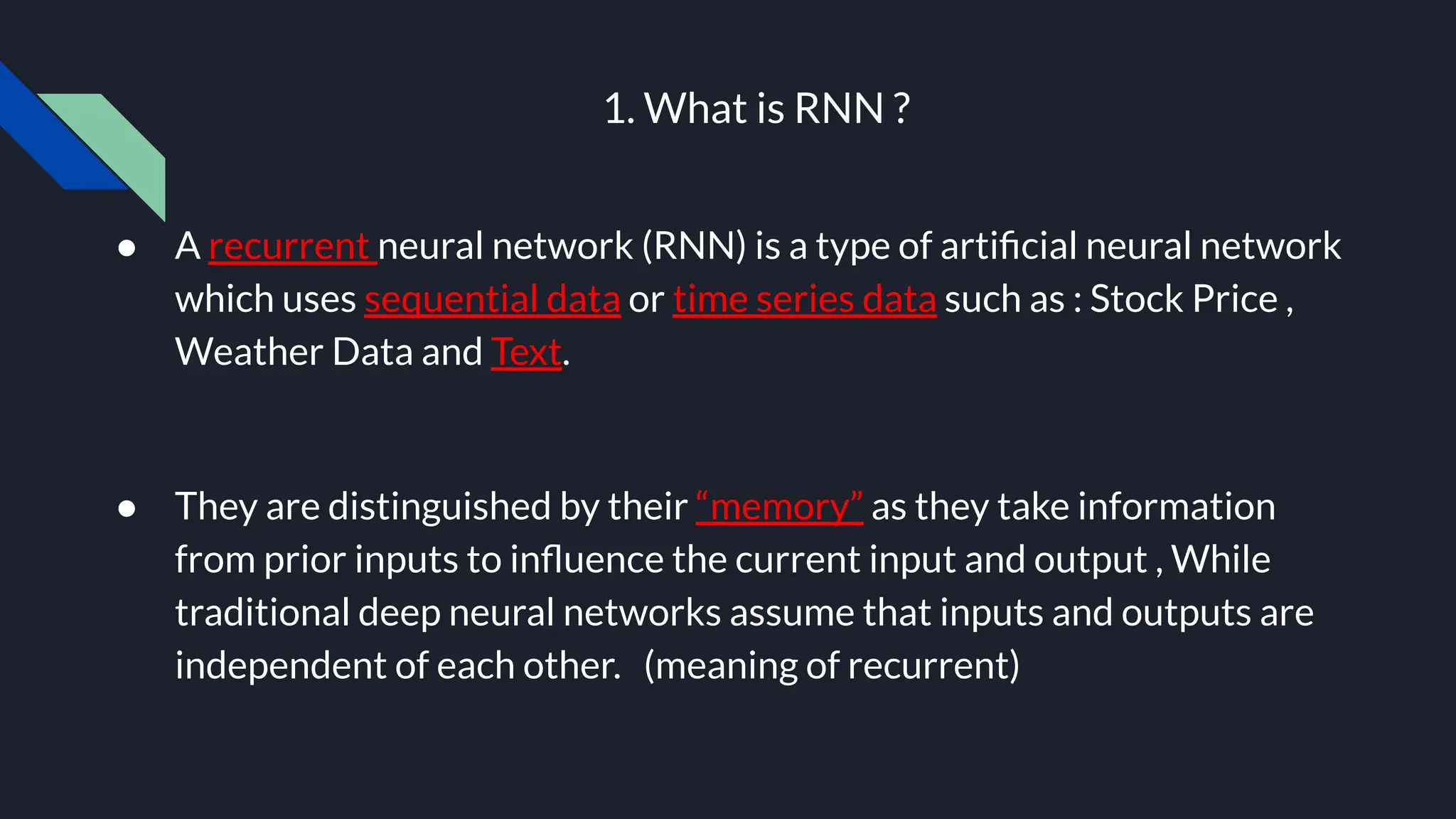
1. What is RNN ?
● A recurrent neural network (RNN) is a type of artificial neural network
which uses sequential data or time series data such as : Stock Price ,
Weather Data and Text.
● They are distinguished by their “memory” as they take information
from prior inputs to influence the current input and output , While
traditional deep neural networks assume that inputs and outputs are
independent of each other. (meaning of recurrent)
Simple Structure of RNN
Why to Use RNN ?
Why to use RNN ?
1. Sequential Data Processing: RNNs are designed to work with data that
occurs in a specific order, like text, time series, audio, or video.
2. Temporal Relationships: They are effective at modeling and
understanding temporal relationships in data, making them suitable for
tasks like predicting the next word in a sentence, recognizing speech, or
forecasting stock prices.
3. Variable-Length Sequences: RNNs can handle sequences of varying
lengths, making them flexible for tasks like language translation or
sentiment analysis on different-length sentences.
Why to use RNN ?
4. Contextual Understanding:RNNs maintain an internal state that allows them to
remember and utilize information from previous time steps, enabling them to consider
context when making predictions.
5. Natural Language Processing:RNNs are widely used in natural language processing tasks
like language generation, sentiment analysis, and machine translation, where
understanding the context of words in a sentence is crucial.
In summary, RNNs are used to process and understand data that unfolds over time, making
them a valuable tool for tasks involving sequences and temporal dependencies.
When to Use and not to Use RNN ?
When to use RNN ?
● Sequential Data: Use RNNs for tasks where the order of data
matters, such as time series analysis, natural language
processing, speech recognition, and video analysis.
● Variable-Length Sequences: RNNs are suitable for handling
sequences of varying lengths, making them flexible for tasks
like text classification or speech synthesis.
When to use RNN ?(2)
● Real-time Data Processing: RNNs are appropriate for
real-time applications like speech recognition and video
analysis, where data arrives sequentially and predictions
must be made incrementally.
● Small to Medium-sized Datasets: RNNs can perform well
with smaller datasets, as they can leverage their ability to
capture sequential patterns effectively.
When not to use RNN ?
● Long Dependencies: RNNs struggle with capturing very long-range
dependencies in data. If your task involves very long sequences.
● Structured Data: For structured data with well-defined features and no
inherent sequential order, traditional machine learning algorithms or
feedforward neural networks may be more suitable.
In summary, RNNs are valuable tool for tasks involving sequential data, but
they have limitations, and the choice of architecture depends on the specific
characteristics and requirements of your problem. Consider the nature of
your data and the challenges it presents when deciding whether to use RNNs
or explore alternative neural network architectures.
Applications on RNN.
1. Weather Forecasting
2. ChatBots
3. NLP (Natural Language Processing)=>(Text Generation , Machine
Translation)
4. Speech Recognition
5. Stock Market Prediction
6. Handwriting Recognition
7. HealthCare
8. Recommendation Systems
9. etc.
Examples on RNN
Team Members :)
1. Omar Mohamed ElDesoky 200255
2. Mohamed Tawfeq Mostafa 200299
3. Ziad Ahmed Abied 200154
4. Mohamed Ahmed Sayed 200291
5. AbdAlrahman Moamen Mohamed Shreif 200233
6. Mohamed Khaled Essa 200305
7. Mohamed Saeed Gaber 200316
8. Mahmoud Ahmed Soliman 200351
9. Sayed Ahmed Sayed 200174
Thanks …..

Intro.to RNN (Recurrent Neural Network).pdf

  • 1.
  • 2.
    Introduction to RNN 1.What is RNN ? 2. Why to use RNN ? 3. When to use and not to use RNN ? 4. Applications on RNN.
  • 3.
  • 4.
    1. What isRNN ? ● A recurrent neural network (RNN) is a type of artificial neural network which uses sequential data or time series data such as : Stock Price , Weather Data and Text. ● They are distinguished by their “memory” as they take information from prior inputs to influence the current input and output , While traditional deep neural networks assume that inputs and outputs are independent of each other. (meaning of recurrent)
  • 5.
  • 6.
  • 7.
    Why to useRNN ? 1. Sequential Data Processing: RNNs are designed to work with data that occurs in a specific order, like text, time series, audio, or video. 2. Temporal Relationships: They are effective at modeling and understanding temporal relationships in data, making them suitable for tasks like predicting the next word in a sentence, recognizing speech, or forecasting stock prices. 3. Variable-Length Sequences: RNNs can handle sequences of varying lengths, making them flexible for tasks like language translation or sentiment analysis on different-length sentences.
  • 8.
    Why to useRNN ? 4. Contextual Understanding:RNNs maintain an internal state that allows them to remember and utilize information from previous time steps, enabling them to consider context when making predictions. 5. Natural Language Processing:RNNs are widely used in natural language processing tasks like language generation, sentiment analysis, and machine translation, where understanding the context of words in a sentence is crucial. In summary, RNNs are used to process and understand data that unfolds over time, making them a valuable tool for tasks involving sequences and temporal dependencies.
  • 9.
    When to Useand not to Use RNN ?
  • 10.
    When to useRNN ? ● Sequential Data: Use RNNs for tasks where the order of data matters, such as time series analysis, natural language processing, speech recognition, and video analysis. ● Variable-Length Sequences: RNNs are suitable for handling sequences of varying lengths, making them flexible for tasks like text classification or speech synthesis.
  • 11.
    When to useRNN ?(2) ● Real-time Data Processing: RNNs are appropriate for real-time applications like speech recognition and video analysis, where data arrives sequentially and predictions must be made incrementally. ● Small to Medium-sized Datasets: RNNs can perform well with smaller datasets, as they can leverage their ability to capture sequential patterns effectively.
  • 12.
    When not touse RNN ? ● Long Dependencies: RNNs struggle with capturing very long-range dependencies in data. If your task involves very long sequences. ● Structured Data: For structured data with well-defined features and no inherent sequential order, traditional machine learning algorithms or feedforward neural networks may be more suitable. In summary, RNNs are valuable tool for tasks involving sequential data, but they have limitations, and the choice of architecture depends on the specific characteristics and requirements of your problem. Consider the nature of your data and the challenges it presents when deciding whether to use RNNs or explore alternative neural network architectures.
  • 13.
    Applications on RNN. 1.Weather Forecasting 2. ChatBots 3. NLP (Natural Language Processing)=>(Text Generation , Machine Translation) 4. Speech Recognition 5. Stock Market Prediction 6. Handwriting Recognition 7. HealthCare 8. Recommendation Systems 9. etc.
  • 14.
  • 15.
    Team Members :) 1.Omar Mohamed ElDesoky 200255 2. Mohamed Tawfeq Mostafa 200299 3. Ziad Ahmed Abied 200154 4. Mohamed Ahmed Sayed 200291 5. AbdAlrahman Moamen Mohamed Shreif 200233 6. Mohamed Khaled Essa 200305 7. Mohamed Saeed Gaber 200316 8. Mahmoud Ahmed Soliman 200351 9. Sayed Ahmed Sayed 200174
  • 16.