B.Tech Specialization in Artificial Intelligence and Data Science
Semester: 5th
Deep Learning
BTAI-25-508
Unit : $
Jyoti Bala
E.Code :
E24T6554
FACULTY OF ENGINEERING TECHNOLOGY & COMPUTING
Recurrent Networks:
An Overview
Recurrent Neural Networks (RNNs) are a class of artificial neural networks
designed to process sequential data. Unlike traditional neural networks,
RNNs utilise an internal memory to process sequences of inputs, making
them ideal for tasks in language, speech, and time-series analysis. Their
unique architecture allows them to handle variable-length inputs via
recurrent connections, forming the foundation for many advanced sequence
models we rely on today.
Traditional Recurrent Neural Networks (RNNs)
Sequential Processing
RNNs process data points in a sequence, with each step's
output depending on previous computations.
Internal Memory
They maintain a 'hidden state' that acts as a memory,
capturing information from prior steps.
Parameter Sharing
Weights and biases are shared across all time steps,
enabling learning of sequential patterns.
Gradient Challenges
Prone to vanishing/exploding gradients, hindering learning
of long-term dependencies.
The hidden state is updated as (a^{langle t rangle} = g(W_{aa}a^{langle t-1 rangle} + W_{ax}x^{langle t rangle} + b_a)), and the
output is (y^{langle t rangle} = g(W_{ya}a^{langle t rangle} + b_y)).
FACULTY OF ENGINEERING TECHNOLOGY & COMPUTING
Bidirectional Recurrent Neural Networks (BRNNs)
BRNNs enhance traditional RNNs by processing sequences in both forward and backward
directions simultaneously. This dual processing allows the network to capture context from
both past and future time steps for each point in the sequence, offering a more
comprehensive understanding.
The architecture typically involves two distinct RNN layers: one that reads the input
sequence from left to right, and another that reads it from right to left.
FACULTY OF ENGINEERING TECHNOLOGY & COMPUTING
Architectural Foundations
Encoder-Decoder Systems
Encode Input
Generate Context
Decode Output
FACULTY OF ENGINEERING TECHNOLOGY & COMPUTING
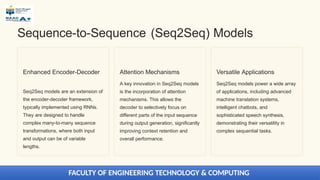
Sequence-to-Sequence (Seq2Seq) Models
Enhanced Encoder-Decoder
Seq2Seq models are an extension of
the encoder-decoder framework,
typically implemented using RNNs.
They are designed to handle
complex many-to-many sequence
transformations, where both input
and output can be of variable
lengths.
Attention Mechanisms
A key innovation in Seq2Seq models
is the incorporation of attention
mechanisms. This allows the
decoder to selectively focus on
different parts of the input sequence
during output generation, significantly
improving context retention and
overall performance.
Versatile Applications
Seq2Seq models power a wide array
of applications, including advanced
machine translation systems,
intelligent chatbots, and
sophisticated speech synthesis,
demonstrating their versatility in
complex sequential tasks.
FACULTY OF ENGINEERING TECHNOLOGY & COMPUTING
Deep Recurrent Neural Networks
• Hierarchical Feature Learning: Deep RNNs stack multiple recurrent
layers on top of each other, allowing the network to learn features at
various levels of abstraction. Lower layers capture basic patterns, while
higher layers learn more complex representations.
• Increased Capacity: This hierarchical structure significantly improves the
model's capacity and representation power, enabling it to handle more
intricate sequence modeling tasks.
• Training Considerations: Training Deep RNNs requires careful
techniques such as gradient clipping to manage exploding gradients and
robust regularisation methods to prevent overfitting.
• Complex Applications: They are particularly effective in complex
sequence modeling scenarios, such as detailed video analysis, where
deep understanding of temporal dependencies is crucial.
FACULTY OF ENGINEERING TECHNOLOGY & COMPUTING
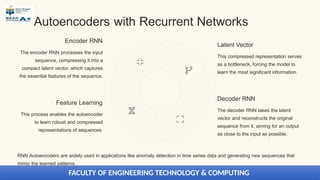
Autoencoders with Recurrent Networks
Encoder RNN
The encoder RNN processes the input
sequence, compressing it into a
compact latent vector, which captures
the essential features of the sequence.
Latent Vector
This compressed representation serves
as a bottleneck, forcing the model to
learn the most significant information.
Decoder RNN
The decoder RNN takes the latent
vector and reconstructs the original
sequence from it, aiming for an output
as close to the input as possible.
Feature Learning
This process enables the autoencoder
to learn robust and compressed
representations of sequences.
RNN Autoencoders are widely used in applications like anomaly detection in time series data and generating new sequences that
mimic the learned patterns.
FACULTY OF ENGINEERING TECHNOLOGY & COMPUTING
Mastering RNN Training
Techniques & Challenges
Backpropagation Through Time
Gradient Clipping
LSTM/GRU Units
Large Datasets & Regularization
Applications of Recurrent Networks
• Natural Language Processing (NLP): Fundamental for machine translation, sentiment analysis, and text summarization.
• Speech Recognition and Synthesis: Powers voice assistants and converts text to speech.
• Time Series Forecasting: Used in predicting stock prices, weather patterns, and energy consumption.
• Video and Music Generation: Enables creation of realistic video sequences and composing musical pieces.
FACULTY OF ENGINEERING TECHNOLOGY & COMPUTING
Summary & Future Directions
Recurrent Neural Networks are foundational for modeling sequential data, with advanced variants like LSTM and GRU effectively
addressing historical limitations. Encoder-decoder and Sequence-to-Sequence architectures have enabled complex tasks such
as machine translation and chatbots. The future of recurrent networks lies in their seamless integration with attention
mechanisms and the broader Transformer architecture, promising even more powerful and efficient models for sequence
processing across various domains.
FACULTY OF ENGINEERING TECHNOLOGY & COMPUTING
Thank You
FACULTY OF ENGINEERING TECHNOLOGY & COMPUTING
For Any Query Contact :
Er. Jyoti Bala
ap4.cse@deshbhagatuniversity.in
Unit-4 Notes on Deep learning-compressed.pptx

  • 1.
    B.Tech Specialization inArtificial Intelligence and Data Science Semester: 5th Deep Learning BTAI-25-508 Unit : $ Jyoti Bala E.Code : E24T6554 FACULTY OF ENGINEERING TECHNOLOGY & COMPUTING
  • 2.
    Recurrent Networks: An Overview RecurrentNeural Networks (RNNs) are a class of artificial neural networks designed to process sequential data. Unlike traditional neural networks, RNNs utilise an internal memory to process sequences of inputs, making them ideal for tasks in language, speech, and time-series analysis. Their unique architecture allows them to handle variable-length inputs via recurrent connections, forming the foundation for many advanced sequence models we rely on today.
  • 3.
    Traditional Recurrent NeuralNetworks (RNNs) Sequential Processing RNNs process data points in a sequence, with each step's output depending on previous computations. Internal Memory They maintain a 'hidden state' that acts as a memory, capturing information from prior steps. Parameter Sharing Weights and biases are shared across all time steps, enabling learning of sequential patterns. Gradient Challenges Prone to vanishing/exploding gradients, hindering learning of long-term dependencies. The hidden state is updated as (a^{langle t rangle} = g(W_{aa}a^{langle t-1 rangle} + W_{ax}x^{langle t rangle} + b_a)), and the output is (y^{langle t rangle} = g(W_{ya}a^{langle t rangle} + b_y)). FACULTY OF ENGINEERING TECHNOLOGY & COMPUTING
  • 4.
    Bidirectional Recurrent NeuralNetworks (BRNNs) BRNNs enhance traditional RNNs by processing sequences in both forward and backward directions simultaneously. This dual processing allows the network to capture context from both past and future time steps for each point in the sequence, offering a more comprehensive understanding. The architecture typically involves two distinct RNN layers: one that reads the input sequence from left to right, and another that reads it from right to left. FACULTY OF ENGINEERING TECHNOLOGY & COMPUTING
  • 5.
    Architectural Foundations Encoder-Decoder Systems EncodeInput Generate Context Decode Output FACULTY OF ENGINEERING TECHNOLOGY & COMPUTING
  • 6.
    Sequence-to-Sequence (Seq2Seq) Models EnhancedEncoder-Decoder Seq2Seq models are an extension of the encoder-decoder framework, typically implemented using RNNs. They are designed to handle complex many-to-many sequence transformations, where both input and output can be of variable lengths. Attention Mechanisms A key innovation in Seq2Seq models is the incorporation of attention mechanisms. This allows the decoder to selectively focus on different parts of the input sequence during output generation, significantly improving context retention and overall performance. Versatile Applications Seq2Seq models power a wide array of applications, including advanced machine translation systems, intelligent chatbots, and sophisticated speech synthesis, demonstrating their versatility in complex sequential tasks. FACULTY OF ENGINEERING TECHNOLOGY & COMPUTING
  • 7.
    Deep Recurrent NeuralNetworks • Hierarchical Feature Learning: Deep RNNs stack multiple recurrent layers on top of each other, allowing the network to learn features at various levels of abstraction. Lower layers capture basic patterns, while higher layers learn more complex representations. • Increased Capacity: This hierarchical structure significantly improves the model's capacity and representation power, enabling it to handle more intricate sequence modeling tasks. • Training Considerations: Training Deep RNNs requires careful techniques such as gradient clipping to manage exploding gradients and robust regularisation methods to prevent overfitting. • Complex Applications: They are particularly effective in complex sequence modeling scenarios, such as detailed video analysis, where deep understanding of temporal dependencies is crucial. FACULTY OF ENGINEERING TECHNOLOGY & COMPUTING
  • 8.
    Autoencoders with RecurrentNetworks Encoder RNN The encoder RNN processes the input sequence, compressing it into a compact latent vector, which captures the essential features of the sequence. Latent Vector This compressed representation serves as a bottleneck, forcing the model to learn the most significant information. Decoder RNN The decoder RNN takes the latent vector and reconstructs the original sequence from it, aiming for an output as close to the input as possible. Feature Learning This process enables the autoencoder to learn robust and compressed representations of sequences. RNN Autoencoders are widely used in applications like anomaly detection in time series data and generating new sequences that mimic the learned patterns. FACULTY OF ENGINEERING TECHNOLOGY & COMPUTING
  • 9.
    Mastering RNN Training Techniques& Challenges Backpropagation Through Time Gradient Clipping LSTM/GRU Units Large Datasets & Regularization
  • 10.
    Applications of RecurrentNetworks • Natural Language Processing (NLP): Fundamental for machine translation, sentiment analysis, and text summarization. • Speech Recognition and Synthesis: Powers voice assistants and converts text to speech. • Time Series Forecasting: Used in predicting stock prices, weather patterns, and energy consumption. • Video and Music Generation: Enables creation of realistic video sequences and composing musical pieces. FACULTY OF ENGINEERING TECHNOLOGY & COMPUTING
  • 11.
    Summary & FutureDirections Recurrent Neural Networks are foundational for modeling sequential data, with advanced variants like LSTM and GRU effectively addressing historical limitations. Encoder-decoder and Sequence-to-Sequence architectures have enabled complex tasks such as machine translation and chatbots. The future of recurrent networks lies in their seamless integration with attention mechanisms and the broader Transformer architecture, promising even more powerful and efficient models for sequence processing across various domains. FACULTY OF ENGINEERING TECHNOLOGY & COMPUTING
  • 12.
    Thank You FACULTY OFENGINEERING TECHNOLOGY & COMPUTING For Any Query Contact : Er. Jyoti Bala ap4.cse@deshbhagatuniversity.in