GLOBALIZATION
Introduction
to
DEFINITION OF
GLOBALIZATION
What is globalization?
Thomas Larson (2001)
“The process of world shrinkage of
distances getting shorter , things moving
closer. ”
🌍
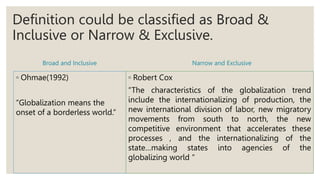
Definition could be classified as Broad &
Inclusive or Narrow & Exclusive.
Broad and Inclusive
◦ Ohmae(1992)
“Globalization means the
onset of a borderless world.“
Narrow and Exclusive
◦ Robert Cox
“The characteristics of the globalization trend
include the internationalizing of production, the
new international division of labor, new migratory
movements from south to north, the new
competitive environment that accelerates these
processes , and the internationalizing of the
state…making states into agencies of the
globalizing world “
Ritzer (2015)
“Globalization is a trans planetary process or onset
processes involving increasing liquidity and the
growing multidirectional flows of people, objects,
places, and information as well as the structures the
encounter and create that are barriers to, or expedite
those flows. ”
Fragmentation
Integration
VS.
LET US UNDERSTAND GLOBALIZATION
According to
perception
Arjun Appadurai (1996)
-
“Globalization is a’ world of things ‘ that have
different speeds, axes, points of origin and
termination, and varied relationships to
institutional structures in different regions,
nations, or societies.”
LET US UNDERSTAND GLOBALIZATION
According to
Sociologist Cesare Poppi (1997)
-“Globalization is the debate and the debate is
globalization ”
LET US UNDERSTAND GLOBALIZATION
Globalization is a reality
-“Globalization changes as human society
develops. We should expect that fluidity and
complexity of globalization as a concept, which
made more debates, discussion, and definition
than agreements on it. ”
METAPHORS OF
GLOBALIZATION
What is metaphor?
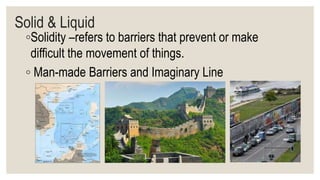
Solid & Liquid
◦Solidity –refers to barriers that prevent or make
difficult the movement of things.
◦ Man-made Barriers and Imaginary Line
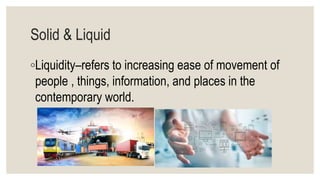
Solid & Liquid
◦Liquidity–refers to increasing ease of movement of
people , things, information, and places in the
contemporary world.
Characteristics of Liquidity
Zygmunt Bauman’s ideas about
liquidity
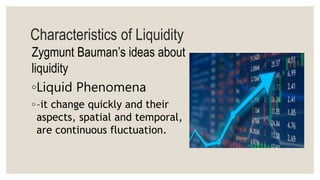
◦Liquid Phenomena
◦–it change quickly and their
aspects, spatial and temporal,
are continuous fluctuation.
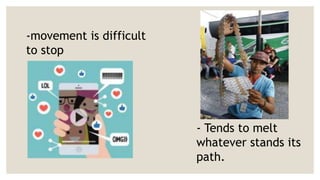
-movement is difficult
to stop
- Tends to melt
whatever stands its
path.
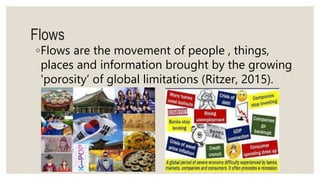
◦Flows are the movement of people , things,
places and information brought by the growing
'porosity’ of global limitations (Ritzer, 2015).
Flows
GLOBALIZATION
THEORIES
Culture, Economic, Political
Homogeneity VS Heterogeneity
Homogeneity
◦ Increasing sameness in the
world as cultural inputs,
economic factors, and political
orientations of societies to
create common practice, same
economes, similar form of
government.
Heterogeneity
◦ The creation of various cultural
practices, new economies, and
political groups because of the
interaction of elements from
different societies from the
world.
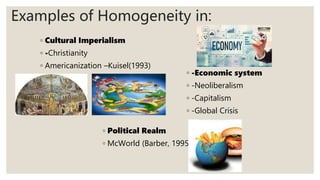
◦ Cultural Imperialism
◦ -Christianity
◦ Americanization –Kuisel(1993)
Examples of Homogeneity in:
◦ -Economic system
◦ -Neoliberalism
◦ -Capitalism
◦ -Global Crisis
◦ Political Realm
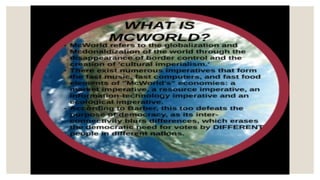
◦ McWorld (Barber, 1995)
◦ (Cowen, 2002) TV,Books, and Movies are perceived as imposed on developing
countries by the West.
◦ McDonaldization- involves the global spread of rational system , such as
efficiency, calculability, predictability, and control.
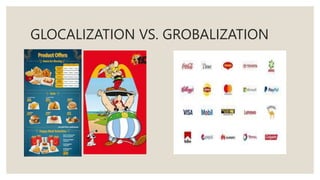
◦ Grobalization – is a process wherein countries or nations, corporation, etc.
impose themselves in geographic areas, in order to gain profits, power, and so
on.
MEDIA IMPERIALISM
CULTURAL IMPERIALISM
◦ Denies the agency of viewers, but people around the world often interpret the
same medium in significantly different ways.
◦ Glocalization
◦ -Coined by Roland Robertson in 1992. Global forces interact
with Local factors or specific geographic area. Then “Glocal “
is being reproduced.
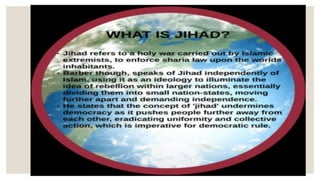
◦ JIHAD
◦ -Alternate of McWorld. Ritzer (2008) mentioned that it refres
to the political groups that are engaged in an intensification
of nationalism and that leads to greater political
heterogeneity throughout the world.
Heterogeneity
GLOCALIZATION VS. GROBALIZATION
MCWORLD VS. JIHAD
DYNAMICS OF
GLOBAL AND LOCAL
CULTURE
Differentialism, Hybridization, Convergence
CULTURAL DIFFERENTIALISM
◦Culture are different / only superficially affected
by global flows. Which believes that the
interaction of cultures deemed to contain the
potential for “catastrophic collision ”
◦Ex. Clash of Civilization by Samuel Huntington
CULTURAL HYBRIDIZATION
◦Integration of Local and Global Culture
◦Globalization is considered as a creative process
which give s rise to hybrid entities that are not
reducible to either the global or local.
◦Ex. GLOCALIZATION
CULTURAL CONVERGENCE
◦Stresses homogeneity introduce by globalization.
◦Cultures are deemed to be radically altered by
strong flows .
Cultural Imperialism
- One culture imposes itself on and tends to
destroy at least part of other culture.
Cultural Imperialism
( John Tomlinson)
- Deterritorialization of Culture
◦Means that it is much more difficult to tie culture to
a specific point of origin.
◦Example: WW2 deterritorialized Jews by banning
and burning books that contradicted Hitler’s values,
and reterritorialized by replacing them with his own.
CULTURAL CONVERGENCE
ANY QUESTIONS?

Introduction.pptx

  • 1.
  • 2.
  • 3.
    Thomas Larson (2001) “Theprocess of world shrinkage of distances getting shorter , things moving closer. ” 🌍
  • 4.
    Definition could beclassified as Broad & Inclusive or Narrow & Exclusive. Broad and Inclusive ◦ Ohmae(1992) “Globalization means the onset of a borderless world.“ Narrow and Exclusive ◦ Robert Cox “The characteristics of the globalization trend include the internationalizing of production, the new international division of labor, new migratory movements from south to north, the new competitive environment that accelerates these processes , and the internationalizing of the state…making states into agencies of the globalizing world “
  • 5.
    Ritzer (2015) “Globalization isa trans planetary process or onset processes involving increasing liquidity and the growing multidirectional flows of people, objects, places, and information as well as the structures the encounter and create that are barriers to, or expedite those flows. ”
  • 6.
  • 7.
    LET US UNDERSTANDGLOBALIZATION According to perception Arjun Appadurai (1996) - “Globalization is a’ world of things ‘ that have different speeds, axes, points of origin and termination, and varied relationships to institutional structures in different regions, nations, or societies.”
  • 8.
    LET US UNDERSTANDGLOBALIZATION According to Sociologist Cesare Poppi (1997) -“Globalization is the debate and the debate is globalization ”
  • 9.
    LET US UNDERSTANDGLOBALIZATION Globalization is a reality -“Globalization changes as human society develops. We should expect that fluidity and complexity of globalization as a concept, which made more debates, discussion, and definition than agreements on it. ”
  • 10.
  • 11.
    Solid & Liquid ◦Solidity–refers to barriers that prevent or make difficult the movement of things. ◦ Man-made Barriers and Imaginary Line
  • 12.
    Solid & Liquid ◦Liquidity–refersto increasing ease of movement of people , things, information, and places in the contemporary world.
  • 13.
    Characteristics of Liquidity ZygmuntBauman’s ideas about liquidity ◦Liquid Phenomena ◦–it change quickly and their aspects, spatial and temporal, are continuous fluctuation.
  • 14.
    -movement is difficult tostop - Tends to melt whatever stands its path.
  • 15.
    ◦Flows are themovement of people , things, places and information brought by the growing 'porosity’ of global limitations (Ritzer, 2015). Flows
  • 16.
  • 17.
    Homogeneity VS Heterogeneity Homogeneity ◦Increasing sameness in the world as cultural inputs, economic factors, and political orientations of societies to create common practice, same economes, similar form of government. Heterogeneity ◦ The creation of various cultural practices, new economies, and political groups because of the interaction of elements from different societies from the world.
  • 18.
    ◦ Cultural Imperialism ◦-Christianity ◦ Americanization –Kuisel(1993) Examples of Homogeneity in: ◦ -Economic system ◦ -Neoliberalism ◦ -Capitalism ◦ -Global Crisis ◦ Political Realm ◦ McWorld (Barber, 1995)
  • 19.
    ◦ (Cowen, 2002)TV,Books, and Movies are perceived as imposed on developing countries by the West. ◦ McDonaldization- involves the global spread of rational system , such as efficiency, calculability, predictability, and control. ◦ Grobalization – is a process wherein countries or nations, corporation, etc. impose themselves in geographic areas, in order to gain profits, power, and so on. MEDIA IMPERIALISM CULTURAL IMPERIALISM ◦ Denies the agency of viewers, but people around the world often interpret the same medium in significantly different ways.
  • 20.
    ◦ Glocalization ◦ -Coinedby Roland Robertson in 1992. Global forces interact with Local factors or specific geographic area. Then “Glocal “ is being reproduced. ◦ JIHAD ◦ -Alternate of McWorld. Ritzer (2008) mentioned that it refres to the political groups that are engaged in an intensification of nationalism and that leads to greater political heterogeneity throughout the world. Heterogeneity
  • 21.
  • 22.
  • 25.
    DYNAMICS OF GLOBAL ANDLOCAL CULTURE Differentialism, Hybridization, Convergence
  • 26.
    CULTURAL DIFFERENTIALISM ◦Culture aredifferent / only superficially affected by global flows. Which believes that the interaction of cultures deemed to contain the potential for “catastrophic collision ” ◦Ex. Clash of Civilization by Samuel Huntington
  • 27.
    CULTURAL HYBRIDIZATION ◦Integration ofLocal and Global Culture ◦Globalization is considered as a creative process which give s rise to hybrid entities that are not reducible to either the global or local. ◦Ex. GLOCALIZATION
  • 28.
    CULTURAL CONVERGENCE ◦Stresses homogeneityintroduce by globalization. ◦Cultures are deemed to be radically altered by strong flows . Cultural Imperialism - One culture imposes itself on and tends to destroy at least part of other culture.
  • 29.
    Cultural Imperialism ( JohnTomlinson) - Deterritorialization of Culture ◦Means that it is much more difficult to tie culture to a specific point of origin. ◦Example: WW2 deterritorialized Jews by banning and burning books that contradicted Hitler’s values, and reterritorialized by replacing them with his own. CULTURAL CONVERGENCE
  • 30.