Introduction to Wireless
Communication
History of wireless communication
 Guglielmo Marconi invented the wireless telegraph in
1896
 Communication by encoding alphanumeric characters in
analog signal
 Sent telegraphic signals across the Atlantic Ocean
 1914 – first voice communication over radio waves
 Communications satellites launched in 1960s
 Advances in wireless technology
 Radio, television, mobile telephone, communication satellites
 More recently
 Satellite communications, wireless networking, cellular
technology
Basics of Wireless Communication
What is Wireless Communication ?
 Transmitting voice and data using electromagnetic
waves in open space (atmosphere)
 Electromagnetic waves
 Travel at speed of light (c = 3x10⁸ m/s)
 Has a frequency (f) and wavelength (l)
 c = f x l
 Higher frequency means higher energy photons
 The higher the energy photon the more penetrating is
the radiation
Types of wireless communication
celullar wireless computer network radio service
Electromagnetic radiation spectrum
Wavelength of Some Technologies
 GSM Phones:
 frequency ~= 900 Mhz
 wavelength ~= 33cm
 PCS Phones
 frequency ~= 1.8 Ghz
 wavelength ~= 17.5 cm
 Bluetooth:
 frequency ~= 2.4Gz
 wavelength ~= 12.5cm
Types of electromagnetic carriers
 when the distance between the sender and receiver is
short (e.g. TV box and a remote control) infrared
waves are used
 for long range distances between sender and receiver
(e.g. TV broadcasting and cellular service) both
microwaves and radio waves are used
 radio waves are ideal when large areas need to be coverd and
obstacles exist in the transmission path
 microwaves are good when large areas need to be coverd and
no obstacles exist in the transmission path
Wireless applications (services)
Advantages and disadvantages of
wireless communication
 advantages:
 mobility
 a wireless communication network is a solution in areas where
cables are impossible to install (e.g. hazardous areas, long
distances etc.)
 easier to maintain
 disadvantages:
 has security vulnerabilities
 high costs for setting the infrastructure
 unlike wired comm., wireless comm. is influenced by physical
obstructions, climatic conditions, interference from other
wireless devices
Frequency Carries/Channels
 The information from sender to receiver is carrier
over a well defined frequency band.
 This is called a channel
 Each channel has a fixed frequency bandwidth (in
KHz) and Capacity (bit-rate)
 Different frequency bands (channels) can be used to
transmit information in parallel and independently.
Example
Channel 1 (b - b+30)
Channel 2 (b+30 - b+60)
Channel 3 (b+60 - b+90)
Station A Station B
 Assume a spectrum of 90KHz is allocated over a base frequency b
for communication between stations A and B
 Assume each channel occupies 30KHz.
 There are 3 channels
 Each channel is simplex (Transmission occurs in one way)
 For full duplex communication:
 Use two different channels (front and reverse channels)
 Use time division in a channel
Basics of Radio Communication
Radio waves generation
 when a high-frequency alternating current (AC) passes
through a copper conductor it generates radio waves
which are propagated into the air using an antena
 radio waves have frequencies between:
 3 Hz – 300 KHz - low frequency
 300 KHz – 30 MHz – high frequency
 30 MHz – 300 MHz – very high frequency
Radio propagation
Radio propagation (2)
 radio waves are generated by an antenna and they
propagate in all directions as a straight line
 radio waves travel at a velocity of 186.000 miles per
second
 radio waves become weaker as they travel a long
distance
Radio propagation (3)
 there are 3 modes of propagation:
 surface mode – for low frequency waves
 direct mode – for high frequency waves
 ionospheric mode – long distance high frequency waves
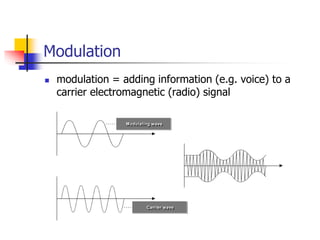
Modulation
 modulation = adding information (e.g. voice) to a
carrier electromagnetic (radio) signal
Frequency Modulation (FM).
Amplitude Modulation (AM)
Radio frequency interference
Radio signal attenuation (path loss)

Introduction_to_Wireless_Communication_R.ppt

  • 1.
  • 2.
    History of wirelesscommunication  Guglielmo Marconi invented the wireless telegraph in 1896  Communication by encoding alphanumeric characters in analog signal  Sent telegraphic signals across the Atlantic Ocean  1914 – first voice communication over radio waves  Communications satellites launched in 1960s  Advances in wireless technology  Radio, television, mobile telephone, communication satellites  More recently  Satellite communications, wireless networking, cellular technology
  • 3.
    Basics of WirelessCommunication
  • 4.
    What is WirelessCommunication ?  Transmitting voice and data using electromagnetic waves in open space (atmosphere)  Electromagnetic waves  Travel at speed of light (c = 3x10⁸ m/s)  Has a frequency (f) and wavelength (l)  c = f x l  Higher frequency means higher energy photons  The higher the energy photon the more penetrating is the radiation
  • 5.
    Types of wirelesscommunication celullar wireless computer network radio service
  • 6.
  • 7.
    Wavelength of SomeTechnologies  GSM Phones:  frequency ~= 900 Mhz  wavelength ~= 33cm  PCS Phones  frequency ~= 1.8 Ghz  wavelength ~= 17.5 cm  Bluetooth:  frequency ~= 2.4Gz  wavelength ~= 12.5cm
  • 8.
    Types of electromagneticcarriers  when the distance between the sender and receiver is short (e.g. TV box and a remote control) infrared waves are used  for long range distances between sender and receiver (e.g. TV broadcasting and cellular service) both microwaves and radio waves are used  radio waves are ideal when large areas need to be coverd and obstacles exist in the transmission path  microwaves are good when large areas need to be coverd and no obstacles exist in the transmission path
  • 9.
  • 10.
    Advantages and disadvantagesof wireless communication  advantages:  mobility  a wireless communication network is a solution in areas where cables are impossible to install (e.g. hazardous areas, long distances etc.)  easier to maintain  disadvantages:  has security vulnerabilities  high costs for setting the infrastructure  unlike wired comm., wireless comm. is influenced by physical obstructions, climatic conditions, interference from other wireless devices
  • 11.
    Frequency Carries/Channels  Theinformation from sender to receiver is carrier over a well defined frequency band.  This is called a channel  Each channel has a fixed frequency bandwidth (in KHz) and Capacity (bit-rate)  Different frequency bands (channels) can be used to transmit information in parallel and independently.
  • 12.
    Example Channel 1 (b- b+30) Channel 2 (b+30 - b+60) Channel 3 (b+60 - b+90) Station A Station B  Assume a spectrum of 90KHz is allocated over a base frequency b for communication between stations A and B  Assume each channel occupies 30KHz.  There are 3 channels  Each channel is simplex (Transmission occurs in one way)  For full duplex communication:  Use two different channels (front and reverse channels)  Use time division in a channel
  • 13.
    Basics of RadioCommunication
  • 14.
    Radio waves generation when a high-frequency alternating current (AC) passes through a copper conductor it generates radio waves which are propagated into the air using an antena  radio waves have frequencies between:  3 Hz – 300 KHz - low frequency  300 KHz – 30 MHz – high frequency  30 MHz – 300 MHz – very high frequency
  • 15.
  • 16.
    Radio propagation (2) radio waves are generated by an antenna and they propagate in all directions as a straight line  radio waves travel at a velocity of 186.000 miles per second  radio waves become weaker as they travel a long distance
  • 17.
    Radio propagation (3) there are 3 modes of propagation:  surface mode – for low frequency waves  direct mode – for high frequency waves  ionospheric mode – long distance high frequency waves
  • 18.
    Modulation  modulation =adding information (e.g. voice) to a carrier electromagnetic (radio) signal
  • 19.
  • 20.
  • 21.