Introduction to
Cooperative Learning

Principles of Teaching
Payam Shoghi
http://payamshoghi.com/
Cooperative Learning?
* Definition *
“An instructional arrangement in which
small groups or teams of students work
together to achieve team-success in a
manner that promotes the students’
responsibility for their own learning as
well as the learning of others.
[Mercer & Mercer, 2001]
What is
Cooperative Learning?
Superior to individual/competitive learning
 Students work together in small groups to
maximize their own and each other’s learning
 Provides students the opportunity to practice
skills or learn content given by teacher
 Largest empirical and research base of any
educational innovation

What Cooperative Learning
is NOT?
Any group-work is NOT cooperative learning. If
not done well…
 Groups get into conflicts and power struggles
 A member sits quietly, too shy to participate
 One member does the work, while the other
members talk about unrelated things
 A more talented member comes up with all the
answers, dictates to the group, or works
separately, ignoring other group members
Cooperative Learning needs to
be Structured
It does not occur by chance
 Facilitate learning; don’t allow things to just
happen
 Cannot be based on the assumption that all
students have proper social and learning skills
 Occurs best only when essential components
for each cooperative learning activity are
ensured
 Need to be learned, practiced and mastered

Three Standards of
Cooperative Learning


Active Listening



Happy Talk



Everyone Participates
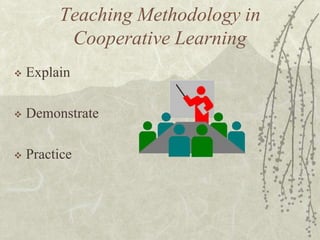
Teaching Methodology in
Cooperative Learning


Explain



Demonstrate



Practice
Six Key Elements
of Cooperative Learning
Teams
 Classroom Management
 Will to Cooperate
 Skill to Cooperate
 Four Basic Principles
 Cooperative Learning Structures

Concept 1: Teams


What is a Cooperative team?
Strong, positive team identity among students

Four members (preferably)
Endures over time
Heterogeneous
Teams learn to learn together
Concept 1: Teams…


How are teams formed?
Based on friendships or interests? – Can have
discipline problems; exclusivity: leaving others out
Random teams? – Can end up with four low
achievers on the same team

Teacher assigned heterogeneous teams?–Maximize
the probability of peer tutoring and improving
diverse-background and cross-gender relations
Concept 1: Teams…


How big should teams be?
Four per team: Allows pairs work which
doubles participation
Teams of more than four do not allow for
enough participation and are harder to manage
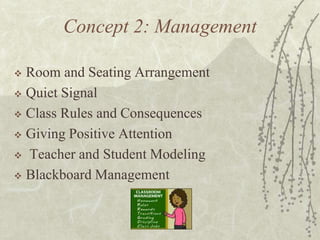
Concept 2: Management
Room and Seating Arrangement
 Quiet Signal
 Class Rules and Consequences
 Giving Positive Attention
 Teacher and Student Modeling
 Blackboard Management

Concept 3: Will to Cooperate


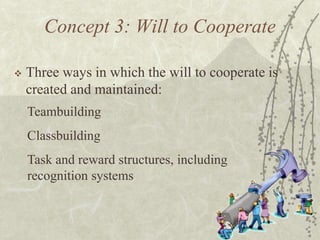
Three ways in which the will to cooperate is
created and maintained:
Teambuilding
Classbuilding
Task and reward structures, including
recognition systems
Concept 3: Will to Cooperate…


Teambuilding and Classbuilding
Team and classbuilding provide unique
learning experiences not offered by traditional
methods that focus only on academic content
Found in workplace–should be in classrooms
too
Concept 4: Skill to Cooperate


Developing Social Skills (a defining
characteristic of Cooperative Learning)
Modeling
Defining
Reinforcing
Role-playing

Structures
Reflection (debriefing)
Concept 5: Basic Principles


Four Basic Principles of Cooperative
Learning
Positive Interdependence
Individual Accountability
Equal Participation

Simultaneous Interaction
Concept 5: Basic Principles…


Positive Interdependence
The success of every team member is not possible
without success/contributions of each
The success of a team is not possible without
success or contribution of each member
Concept 5: Basic Principles…


Individual Accountability
Each student is responsible for a unique portion
of a team’s learning product
Whatever the form of individual accountability,
the contribution of each individual is valuable to
the team
Concept 5: Basic Principles…


Equal Participation
Every student is actively involved in the learning
process
No passive learners
Success of the team depends on participation of
all team members
Concept 5: Basic Principles…


Simultaneous Interaction
Discuss Topics: All students discuss views in pairs

Share Answers: All students engage in choral
response
Receive Help: Students ask a teammate and
receive immediate help
Three Basic Types of
Structures


Mastery



Thinking Skills



Information Sharing
Examples of Cooperative
Learning Structures
Agreement Circles
 Blind Sequencing
 Circle-the-Sage
 Corners
 Fan-N-Pick
 Find My Rule
 Find Someone Who
 Find the Fib
 Flashcard Game

Cooperative Learning Structures…
Formations
 Four “S” Brainstorming
 Idea Spinner
 Jigsaw Problem Solving
 Line Ups
 Match Mine
 Mix N Match
 One Stray
 Pairs Check

Common Cooperative Learning
Structures
Inside/Outside Circle
 Numbered Heads Together
 Round Robin
 Think-Pair-Share
 Timed-Pair-Share
 Think-Pair-Write-Share
 Pair-Discussion
 Pair-Discussion-Share
 Group Discussion

Benefits of Cooperative Learning
Teambuilding and cooperation
 Breaking down of differences
 Development of social skills
 Provides for more than one “teacher”
 Mastery
 Higher Order Thinking skills
 Communication skills
 Better comprehension and longer retention
 Children enjoy learning
 Enhanced classroom discipline
 Students motivated as effort is acknowledged

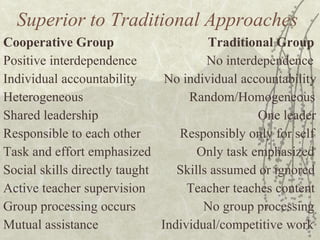
Superior to Traditional Approaches
Cooperative Group
Traditional Group
Positive interdependence
No interdependence
Individual accountability
No individual accountability
Heterogeneous
Random/Homogeneous
Shared leadership
One leader
Responsible to each other
Responsibly only for self
Task and effort emphasized
Only task emphasized
Social skills directly taught
Skills assumed or ignored
Active teacher supervision
Teacher teaches content
Group processing occurs
No group processing
Mutual assistance
Individual/competitive work
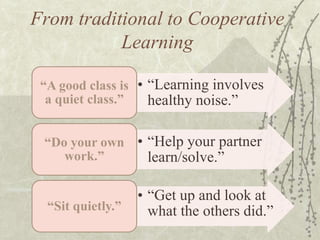
From traditional to Cooperative
Learning
“A good class is • “Learning involves
a quiet class.”
healthy noise.”
“Do your own • “Help your partner
work.”
learn/solve.”

“Sit quietly.”

• “Get up and look at
what the others did.”
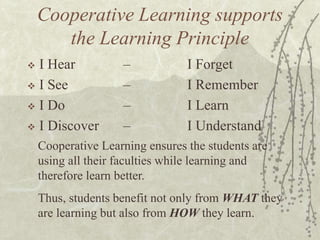
Cooperative Learning supports
the Learning Principle
I Hear
 I See
 I Do
 I Discover


–
–
–
–

I Forget
I Remember
I Learn
I Understand

Cooperative Learning ensures the students are
using all their faculties while learning and
therefore learn better.
Thus, students benefit not only from WHAT they
are learning but also from HOW they learn.
Cooperative Games
Same principles as Cooperative Learning
 Not just any game is ‘Cooperative Game’
 These are specific games designed after
years of experimentation and observation
 Help teach children cooperation and key
moral values
 Nobody wins or loses in these games
 Care should be taken not to make these
games competitive


Introduction to the Structural Approach to Cooperative Learning

  • 1.
    Introduction to Cooperative Learning Principlesof Teaching Payam Shoghi http://payamshoghi.com/
  • 2.
    Cooperative Learning? * Definition* “An instructional arrangement in which small groups or teams of students work together to achieve team-success in a manner that promotes the students’ responsibility for their own learning as well as the learning of others. [Mercer & Mercer, 2001]
  • 3.
    What is Cooperative Learning? Superiorto individual/competitive learning  Students work together in small groups to maximize their own and each other’s learning  Provides students the opportunity to practice skills or learn content given by teacher  Largest empirical and research base of any educational innovation 
  • 4.
    What Cooperative Learning isNOT? Any group-work is NOT cooperative learning. If not done well…  Groups get into conflicts and power struggles  A member sits quietly, too shy to participate  One member does the work, while the other members talk about unrelated things  A more talented member comes up with all the answers, dictates to the group, or works separately, ignoring other group members
  • 5.
    Cooperative Learning needsto be Structured It does not occur by chance  Facilitate learning; don’t allow things to just happen  Cannot be based on the assumption that all students have proper social and learning skills  Occurs best only when essential components for each cooperative learning activity are ensured  Need to be learned, practiced and mastered 
  • 6.
    Three Standards of CooperativeLearning  Active Listening  Happy Talk  Everyone Participates
  • 7.
    Teaching Methodology in CooperativeLearning  Explain  Demonstrate  Practice
  • 8.
    Six Key Elements ofCooperative Learning Teams  Classroom Management  Will to Cooperate  Skill to Cooperate  Four Basic Principles  Cooperative Learning Structures 
  • 9.
    Concept 1: Teams  Whatis a Cooperative team? Strong, positive team identity among students Four members (preferably) Endures over time Heterogeneous Teams learn to learn together
  • 10.
    Concept 1: Teams…  Howare teams formed? Based on friendships or interests? – Can have discipline problems; exclusivity: leaving others out Random teams? – Can end up with four low achievers on the same team Teacher assigned heterogeneous teams?–Maximize the probability of peer tutoring and improving diverse-background and cross-gender relations
  • 11.
    Concept 1: Teams…  Howbig should teams be? Four per team: Allows pairs work which doubles participation Teams of more than four do not allow for enough participation and are harder to manage
  • 12.
    Concept 2: Management Roomand Seating Arrangement  Quiet Signal  Class Rules and Consequences  Giving Positive Attention  Teacher and Student Modeling  Blackboard Management 
  • 13.
    Concept 3: Willto Cooperate  Three ways in which the will to cooperate is created and maintained: Teambuilding Classbuilding Task and reward structures, including recognition systems
  • 14.
    Concept 3: Willto Cooperate…  Teambuilding and Classbuilding Team and classbuilding provide unique learning experiences not offered by traditional methods that focus only on academic content Found in workplace–should be in classrooms too
  • 15.
    Concept 4: Skillto Cooperate  Developing Social Skills (a defining characteristic of Cooperative Learning) Modeling Defining Reinforcing Role-playing Structures Reflection (debriefing)
  • 16.
    Concept 5: BasicPrinciples  Four Basic Principles of Cooperative Learning Positive Interdependence Individual Accountability Equal Participation Simultaneous Interaction
  • 17.
    Concept 5: BasicPrinciples…  Positive Interdependence The success of every team member is not possible without success/contributions of each The success of a team is not possible without success or contribution of each member
  • 18.
    Concept 5: BasicPrinciples…  Individual Accountability Each student is responsible for a unique portion of a team’s learning product Whatever the form of individual accountability, the contribution of each individual is valuable to the team
  • 19.
    Concept 5: BasicPrinciples…  Equal Participation Every student is actively involved in the learning process No passive learners Success of the team depends on participation of all team members
  • 20.
    Concept 5: BasicPrinciples…  Simultaneous Interaction Discuss Topics: All students discuss views in pairs Share Answers: All students engage in choral response Receive Help: Students ask a teammate and receive immediate help
  • 21.
    Three Basic Typesof Structures  Mastery  Thinking Skills  Information Sharing
  • 22.
    Examples of Cooperative LearningStructures Agreement Circles  Blind Sequencing  Circle-the-Sage  Corners  Fan-N-Pick  Find My Rule  Find Someone Who  Find the Fib  Flashcard Game 
  • 23.
    Cooperative Learning Structures… Formations Four “S” Brainstorming  Idea Spinner  Jigsaw Problem Solving  Line Ups  Match Mine  Mix N Match  One Stray  Pairs Check 
  • 24.
    Common Cooperative Learning Structures Inside/OutsideCircle  Numbered Heads Together  Round Robin  Think-Pair-Share  Timed-Pair-Share  Think-Pair-Write-Share  Pair-Discussion  Pair-Discussion-Share  Group Discussion 
  • 25.
    Benefits of CooperativeLearning Teambuilding and cooperation  Breaking down of differences  Development of social skills  Provides for more than one “teacher”  Mastery  Higher Order Thinking skills  Communication skills  Better comprehension and longer retention  Children enjoy learning  Enhanced classroom discipline  Students motivated as effort is acknowledged 
  • 26.
    Superior to TraditionalApproaches Cooperative Group Traditional Group Positive interdependence No interdependence Individual accountability No individual accountability Heterogeneous Random/Homogeneous Shared leadership One leader Responsible to each other Responsibly only for self Task and effort emphasized Only task emphasized Social skills directly taught Skills assumed or ignored Active teacher supervision Teacher teaches content Group processing occurs No group processing Mutual assistance Individual/competitive work
  • 27.
    From traditional toCooperative Learning “A good class is • “Learning involves a quiet class.” healthy noise.” “Do your own • “Help your partner work.” learn/solve.” “Sit quietly.” • “Get up and look at what the others did.”
  • 28.
    Cooperative Learning supports theLearning Principle I Hear  I See  I Do  I Discover  – – – – I Forget I Remember I Learn I Understand Cooperative Learning ensures the students are using all their faculties while learning and therefore learn better. Thus, students benefit not only from WHAT they are learning but also from HOW they learn.
  • 29.
    Cooperative Games Same principlesas Cooperative Learning  Not just any game is ‘Cooperative Game’  These are specific games designed after years of experimentation and observation  Help teach children cooperation and key moral values  Nobody wins or loses in these games  Care should be taken not to make these games competitive 