

The 7 Cooperative Principles
October 2016
The Experience Enterprise Cooperative
for Pelion Paradise
CONNECTING PELION
2
Working together for success
3
• An autonomous association of persons united voluntarily to meet their
common economic, social, and cultural needs and aspirations through a
jointly-owned and democratically-controlled enterprise.
• Cooperative marketing is a more cost-effective means of raising the
destination’s profile in the marketplace and showcasing a destinations
products and experiences.
Connecting through a
Cooperative
4
• Cooperative businesses are more economically resilient than many other
forms of enterprise, with twice the number of cooperatives (80%)
surviving their first five years compared with other business ownership
models (41%).
Advantages of a Cooperative
The 7Cooperative Principles
5
The 7Cooperative Principles
6
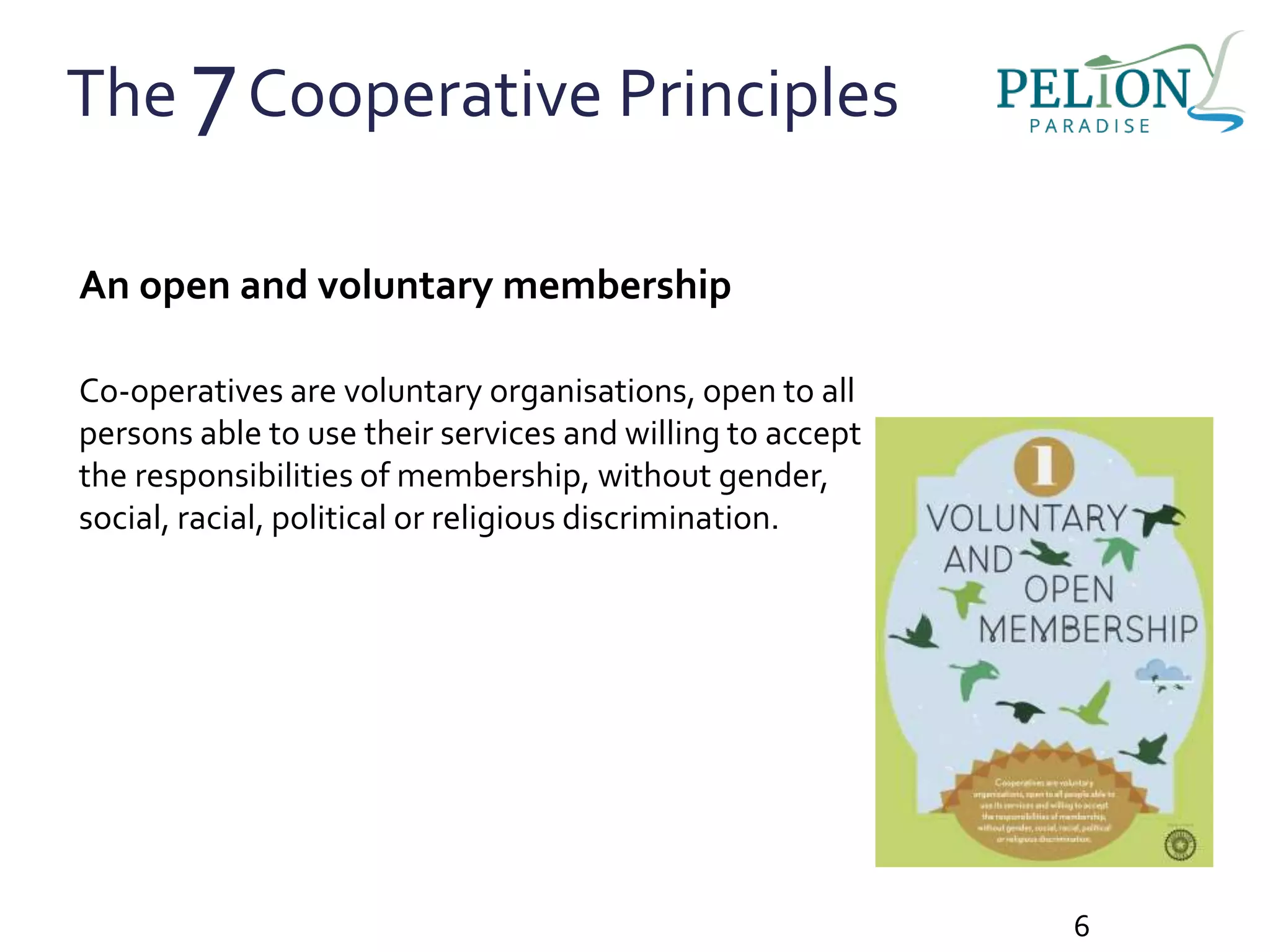
An open and voluntary membership
Co-operatives are voluntary organisations, open to all
persons able to use their services and willing to accept
the responsibilities of membership, without gender,
social, racial, political or religious discrimination.
The 7Cooperative Principles
7
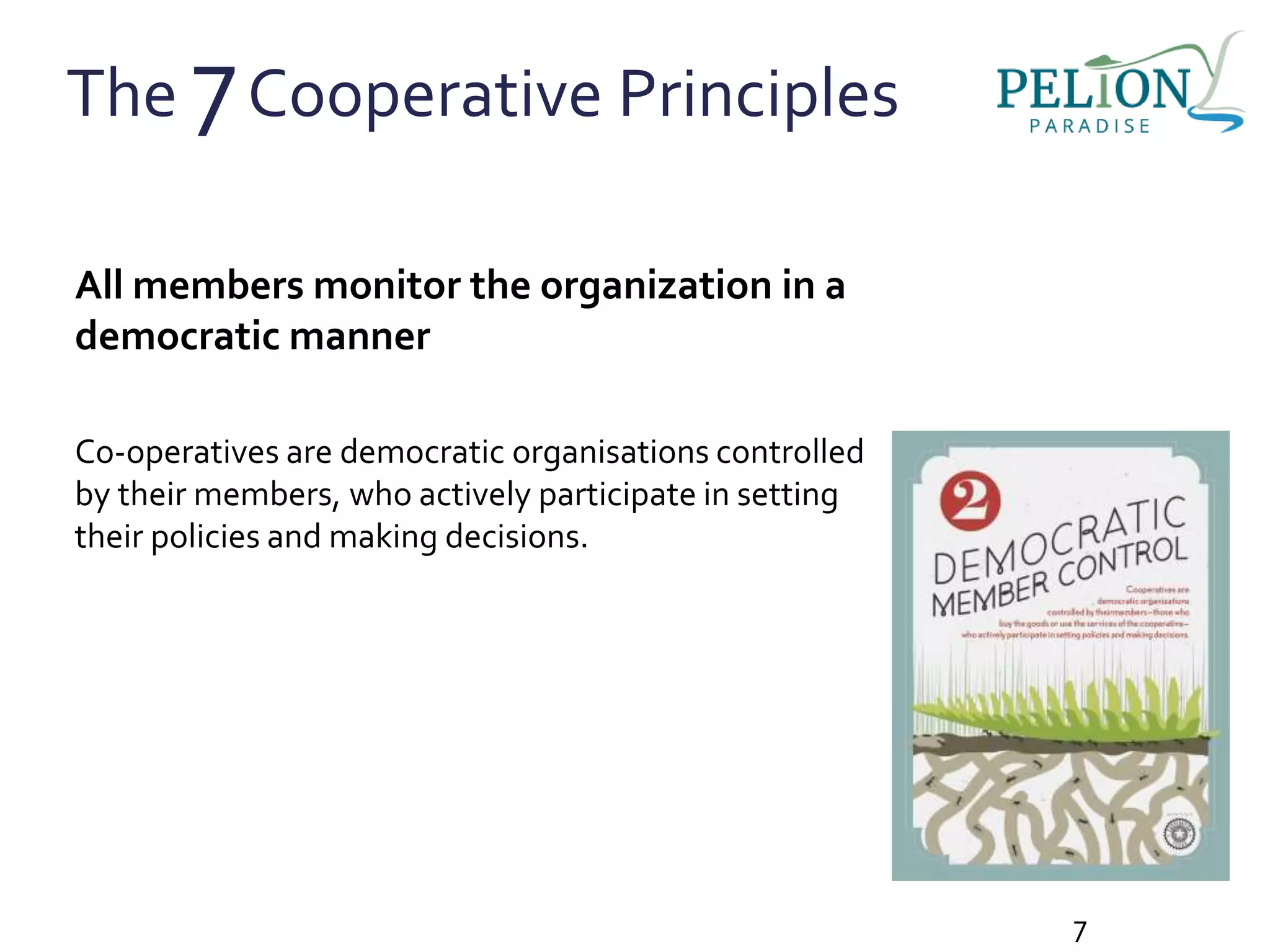
All members monitor the organization in a
democratic manner
Co-operatives are democratic organisations controlled
by their members, who actively participate in setting
their policies and making decisions.
The 7Cooperative Principles
8
All members participate economically
Members contribute equitably to, and democratically
control, the capital of their co-operative.At least part
of that capital is usually the common property of the
co-operative. Members usually receive limited
compensation, if any, on capital subscribed as a
condition of membership.
The 7Cooperative Principles
9
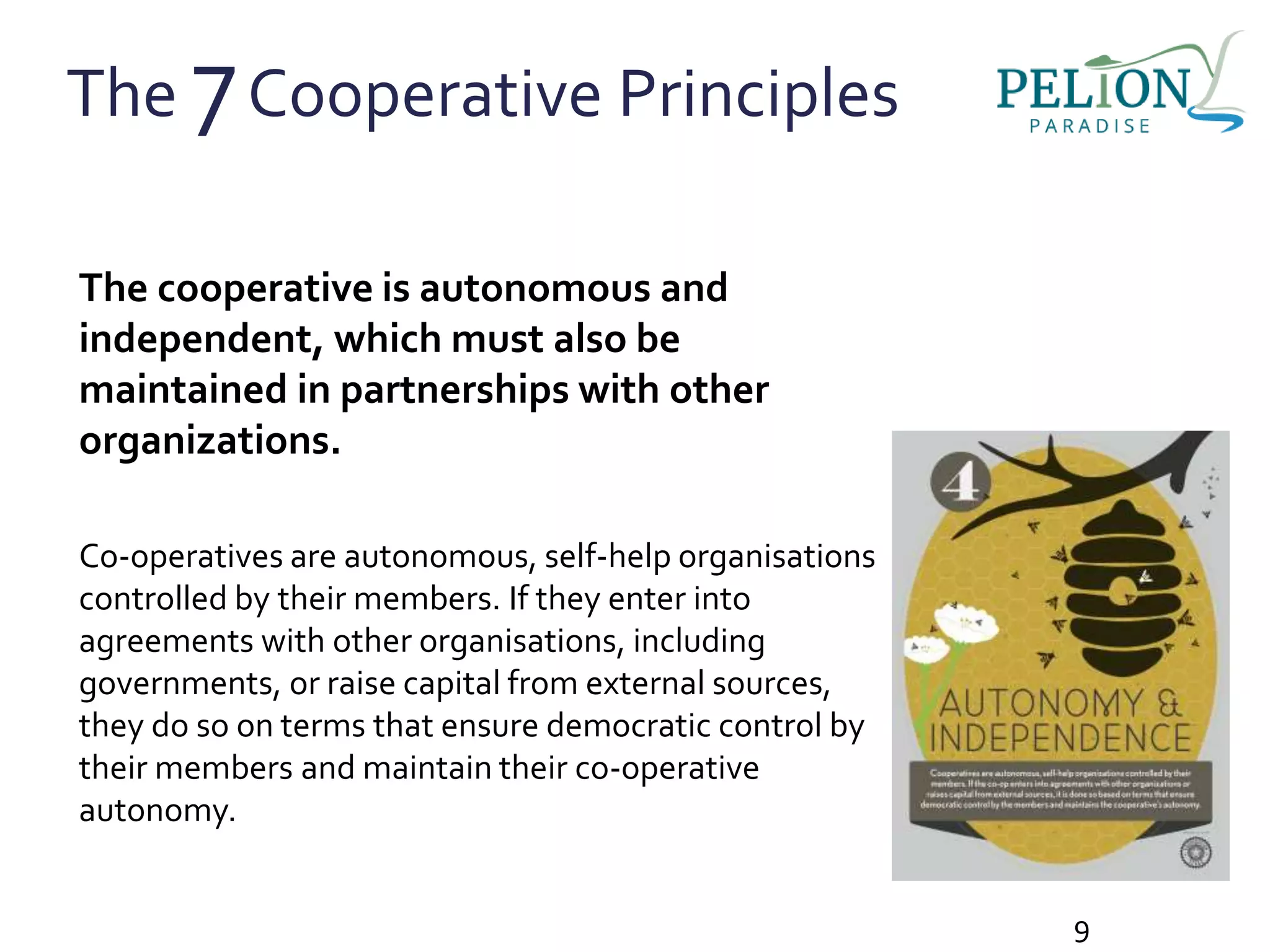
The cooperative is autonomous and
independent, which must also be
maintained in partnerships with other
organizations.
Co-operatives are autonomous, self-help organisations
controlled by their members. If they enter into
agreements with other organisations, including
governments, or raise capital from external sources,
they do so on terms that ensure democratic control by
their members and maintain their co-operative
autonomy.
The 7Cooperative Principles
10
Education, training and information-sharing
is a condition for democratic control and
effective member participation.
Co-operatives provide education and training for their
members, elected representatives, managers, and
employees so they can contribute effectively to the
development of their co-operatives.
The 7Cooperative Principles
11
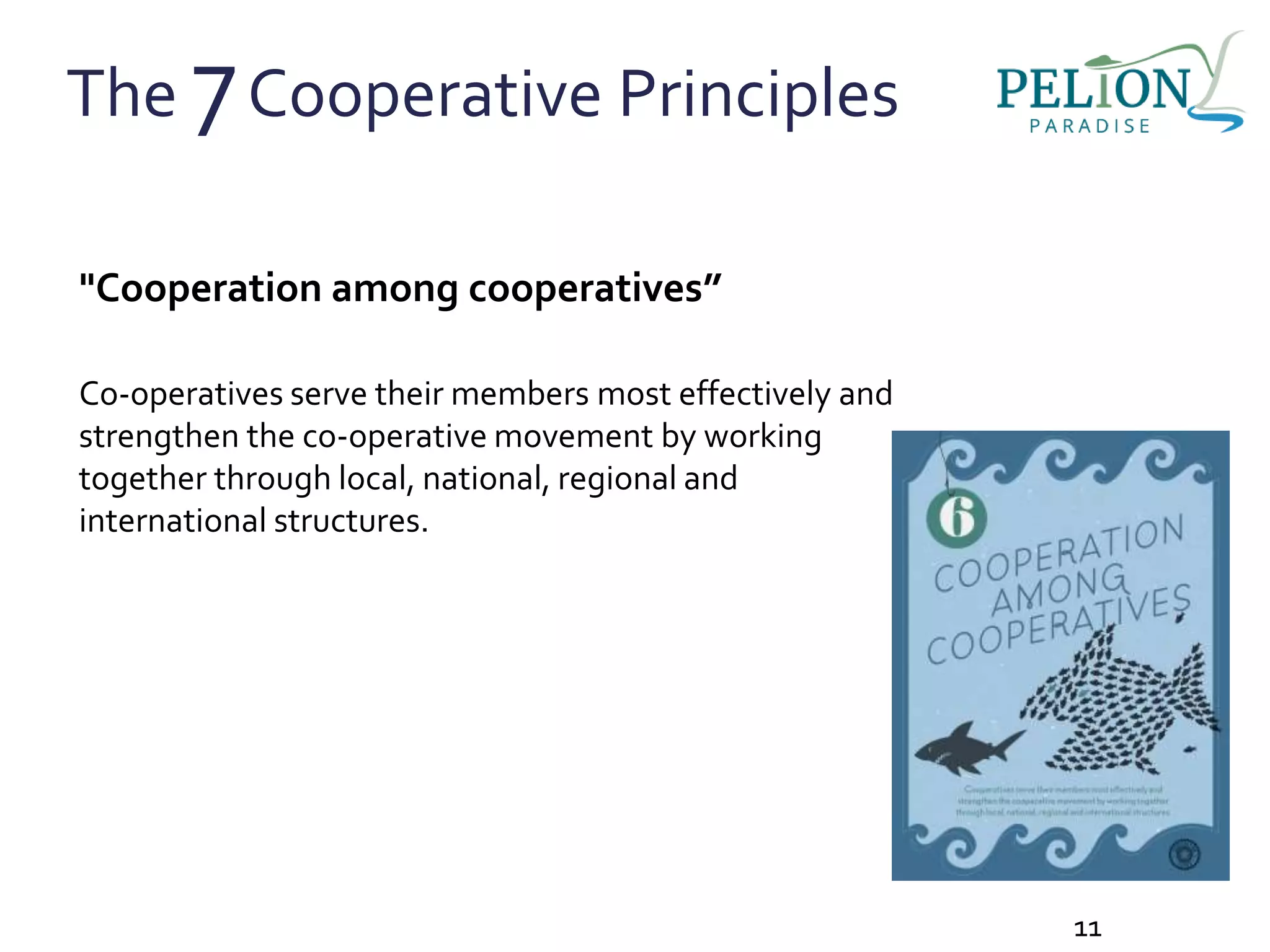
"Cooperation among cooperatives”
Co-operatives serve their members most effectively and
strengthen the co-operative movement by working
together through local, national, regional and
international structures.
The 7Cooperative Principles
12
"Attention to the (local) community"
Co-operatives work for the sustainable development of
their communities through policies approved by their
members.

The 7 cooperative principles

  • 1.
    The 7 CooperativePrinciples October 2016 The Experience Enterprise Cooperative for Pelion Paradise
  • 2.
  • 3.
    3 • An autonomousassociation of persons united voluntarily to meet their common economic, social, and cultural needs and aspirations through a jointly-owned and democratically-controlled enterprise. • Cooperative marketing is a more cost-effective means of raising the destination’s profile in the marketplace and showcasing a destinations products and experiences. Connecting through a Cooperative
  • 4.
    4 • Cooperative businessesare more economically resilient than many other forms of enterprise, with twice the number of cooperatives (80%) surviving their first five years compared with other business ownership models (41%). Advantages of a Cooperative
  • 5.
  • 6.
    The 7Cooperative Principles 6 Anopen and voluntary membership Co-operatives are voluntary organisations, open to all persons able to use their services and willing to accept the responsibilities of membership, without gender, social, racial, political or religious discrimination.
  • 7.
    The 7Cooperative Principles 7 Allmembers monitor the organization in a democratic manner Co-operatives are democratic organisations controlled by their members, who actively participate in setting their policies and making decisions.
  • 8.
    The 7Cooperative Principles 8 Allmembers participate economically Members contribute equitably to, and democratically control, the capital of their co-operative.At least part of that capital is usually the common property of the co-operative. Members usually receive limited compensation, if any, on capital subscribed as a condition of membership.
  • 9.
    The 7Cooperative Principles 9 Thecooperative is autonomous and independent, which must also be maintained in partnerships with other organizations. Co-operatives are autonomous, self-help organisations controlled by their members. If they enter into agreements with other organisations, including governments, or raise capital from external sources, they do so on terms that ensure democratic control by their members and maintain their co-operative autonomy.
  • 10.
    The 7Cooperative Principles 10 Education,training and information-sharing is a condition for democratic control and effective member participation. Co-operatives provide education and training for their members, elected representatives, managers, and employees so they can contribute effectively to the development of their co-operatives.
  • 11.
    The 7Cooperative Principles 11 "Cooperationamong cooperatives” Co-operatives serve their members most effectively and strengthen the co-operative movement by working together through local, national, regional and international structures.
  • 12.
    The 7Cooperative Principles 12 "Attentionto the (local) community" Co-operatives work for the sustainable development of their communities through policies approved by their members.

Editor's Notes

  • #6 Born out of the experience of the Rochdale Society of Equitable Pioneers in Rochdale, England, these principles form the backbone of the cooperative economy, serving as “guidelines by which co-operatives put their values into practice”—values such as self-help, self-responsibility, democracy, equality, equity and solidarity. Voluntary and Open Membership Democratic Member Control Member Economic Participation Autonomy and Independence Education, Training and Information Co-operation among Co-operatives Concern for Community Article Objectives and values? Interaction is key, both with the The Experience Enterprise Cooperatives Association, the experience expert (s) and the participants themselves. The Experience Enterprise Cooperatives Association, has adopted the seven principles of the International Cooperative Alliance (ICA), which originate in the Rochdale Society of Equitable Pioneers: An open and voluntary membership for members. All members participate economically All members monitor the organization in a democratic manner The cooperative is autonomous and independent, which must also be maintained in partnerships with other organizations. Education, training and information-sharing is a condition for democratic control and effective member participation. "Cooperation between cooperatives” serves to strengthen the cooperative movement by working together through local, regional, national and international structures. "Attention to the (local) community," recognizes that members of the cooperative in some way are connected to their own environment and to contribute to sustainable development of that through the cooperative .
  • #7 1. Voluntary and Open Membership Co-operatives are voluntary organisations, open to all persons able to use their services and willing to accept the responsibilities of membership, without gender, social, racial, political or religious discrimination. 1. Open en vrijwillig lidmaatschap Coöperaties zijn gebaseerd op vrijwilligheid, je kunt niet verplicht worden om lid te worden. Ze zijn open voor iedereen die gebruik kan maken van hun diensten en die verantwoordelijkheid als lid wil opnemen – zonder enige discriminatie op basis van gender, sociale afkomst, ras, politieke voorkeur of religie. + ++ Qv¼j +++++++++++++++++++++++++++++++++++++++++++++++++++++++++++++++++++0 1\ 7ujn w
  • #8 2. Democratic Member Control Co-operatives are democratic organisations controlled by their members, who actively participate in setting their policies and making decisions. Men and women serving as elected representatives are accountable to the membership. Primary co-operatives members have equal voting rights (one member, one vote) and also at other levels are organised in a democratic manner. 2. Democratische controle door de leden Coöperaties zijn democratische organisaties die door hun leden worden gecontroleerd. De leden participeren actief in het uitstippelen van het beleid en in het nemen van beslissingen. Wie een verkozen mandaat krijgt, is verantwoordelijk voor de onderneming en verantwoordt zich tegenover de leden. Leden van een coöperatie hebben zeggenschap naar de mate waarin ze gebruik maken van de coöperatie. De manier waarop met die regel wordt omgegaan verschilt sterk. Op zich is het logisch dat de mate van zeggenschap evenredig is aan de mate waarin leden gebruik maken van de coöperatie (en waarin ze erin investeren). Niettemin zijn er veel coöperaties waarin – als het ware om elk democratisch misverstand te voorkomen – de regel ‘one man one vote’ geldt. Het belangrijkste verschil met andere vormen van ondernemerschap is dat bij coöperaties het belang van de leden-gebruikers centraal staat en niet het rendement op ingebracht vermogen. Dat geeft een andere focus.
  • #9 3. Member Economic Participation Members contribute equitably to, and democratically control, the capital of their co-operative. At least part of that capital is usually the common property of the co-operative. Members usually receive limited compensation, if any, on capital subscribed as a condition of membership. Members allocate surpluses for any or all of the following purposes: developing their co-operative, possibly by setting up reserves, part of which at least would be indivisible; benefiting members in proportion to their transactions with the co-operative; and supporting other activities approved by the membership. 3. Economische participatie van de leden Zoals een beursvennootschap haar financiering haalt bij externe beleggers, zo moet een coöperatie het hebben van gebruikers die er geld in willen steken. Als de leden niet de financiers zijn, zijn ze ook niet de eigenaars en hebben ze ook niet de zeggenschap. Er zijn een aantal zaken die dat financieren kunnen vergemakkelijken. Op de eerste plaats een aansprakelijkheid van de leden. De coöperatie gaat verplichtingen aan (bijvoorbeeld leningen) en de leden zijn daar aansprakelijk voor (alleen indien de coöperatie liquideert). Bij een beginnende coöperatie is dat vaak goed te doen, maar zeker na enige groei zal men daar wat huiverig over worden. Alternatieven voor financiering zijn een stevig entreegeld en een veel gebruikte methode is om het financiële exploitatiesaldo zoveel mogelijk binnen het bedrijf te houden. Zo bouwt het coöperatieve bedrijf een eigen vermogen op, op basis waarvan de onderneming minder afhankelijk wordt van de leden. Dit alles leidt tot bijzondere coöperatieve situaties: De eerste is dat coöperaties – net als andere verenigingen en stichtingen – in de loop der jaren kapitaal kunnen opbouwen ‘in de dode hand’. Dat klinkt heel treurig, maar het komt erop neer dat het geld dat in de coöperatie (of de vereniging) achterblijft, eigendom wordt van het coöperatieve bedrijf en dus eigenlijk van niemand. In wezen heeft de coöperatieve vereniging alleen het vruchtgebruik: het betreffende vermogen is van de coöperatie maar tegelijk is het van niemand. De leden kunnen het doorgaans niet opeisen, behalve bij liquidatie. Een bekend voorbeeld van dit fenomeen is de Rabobank: een van de meest kredietwaardige banken ter wereld die uiteindelijk van niemand blijkt te zijn. Niemand kan op dit vermogen aanspraak maken. Leden hebben wel inspraak over de aanwending van het vermogen. Jaarlijks wordt een deel van de winst (die anders zou zijn uitgekeerd aan beleggers) in de coöperatie gehouden. Op zich zou je dat deel op naam van de leden kunnen laten staan, maar dan creëer je toch weer een soort aandeelhouderschap dat op termijn een scheefheid in de zeggenschapsrelatie kan geven. Niettemin zien we de laatste decennia wel de invoering van vermogen op naam. Om te bewaken dat het gebruik en niet het rendement op ingebracht vermogen centraal blijft staan, is het zaak dat de leden investeren naar de mate waarin ze van de coöperatie gebruik maken. Het effect van die regel is dat het rendement op ingelegd vermogen geen bijzondere rol hoeft te spelen in de discussie: elk lid investeert per eenheid gebruik en of de coöperatie het goed of slecht doet merk je ook per eenheid product. De leden van de coöperatie krijgen een beperkt rendement op het ingebracht vermogen. In sommige landen is dit zelfs wettelijk vastgelegd. De uitkering van deze winst (of: exploitatiesaldo) is gebaseerd op de conditie van de relatie tussen de leden en de coöperatie.
  • #10 4. Autonomy and Independence Co-operatives are autonomous, self-help organisations controlled by their members. If they enter into agreements with other organisations, including governments, or raise capital from external sources, they do so on terms that ensure democratic control by their members and maintain their co-operative autonomy. 4. Autonomie en onafhankelijkheid Coöperaties zijn autonome, zelfredzame organisaties onder toezicht van de leden. Als ze overeenkomsten aangaan met andere organisaties en/of met overheden, of als ze extern kapitaal aantrekken, doen ze dat op zo’n manier dat de democratische controle van de leden en de autonomie van de coöperatie gewaarborgd is. “Een coöperatie is een zeer toekomstbestendige ondernemingsvorm.” Trienke Elshof, Lid ledenraad FrieslandCampina
  • #11 5. Education, Training and Information Co-operatives provide education and training for their members, elected representatives, managers, and employees so they can contribute effectively to the development of their co-operatives. They inform the general public - particularly young people and opinion leaders - about the nature and benefits of co-operation. 5. Onderwijs, vorming en informatie Coöperaties voorzien leden, bestuurders, directie en werknemers van onderwijs en vorming, zodat zij werkelijk kunnen bijdragen aan de ontwikkeling van hun coöperatie. Zij informeren het grote publiek over de aard en de voordelen van coöperatief ondernemen. In een coöperatie gaat het in wezen vooral om de vraag wat het ledenbelang nu eigenlijk is. Die vraag is helemaal niet zo simpel. En toch: als een coöperatie aan haar doelstellingen wil voldoen moeten niet alleen bestuur en directie maar ook de leden kunnen uitleggen wat volgens hen belangrijk is. Dus niet alleen de scholing en opleiding van bestuursleden van de coöperatieve vereniging is van belang maar zeker ook de scholing van de (kader-)leden. Met het opleiden van haar leden zorgt de coöperatie ervoor dat deze leden kunnen groeien in hun vak, en dat ze het succes van hun bedrijf kunnen vergroten.
  • #12 6. Co-operation among Co-operatives Co-operatives serve their members most effectively and strengthen the co-operative movement by working together through local, national, regional and international structures. 6. Samenwerking tussen coöperaties Door samen te werken in lokale, regionale, nationale en internationale structuren, versterken coöperaties de coöperatieve beweging en bieden ze doeltreffende dienstverlening aan hun leden.
  • #13 7. Concern for Community Co-operatives work for the sustainable development of their communities through policies approved by their members. 7. Zorg voor een duurzame maatschappij Coöperaties dragen bij aan de duurzame ontwikkeling van de samenleving. Coöperaties zetten zich in voor hun leden en (lokale) gemeenschappen. Een coöperatie onderneemt in het economische belang van haar leden. Winst is hierbij een middel en geen doel. De ontwikkeling op lange termijn staat bij de coöperatie centraal. Zorg voor de samenleving en duurzaamheid zijn hier onlosmakelijk aan verbonden.