S
o
f
t
w
a
r
e
T
e
s
t
i
n
g
Presented by
Saptarshi Dutta Chowdhury
MCA, Heritage Institute of Technology
It is the process used to identify the correctness,
completeness and quality of developed computer
software.
It is the process of executing a program/application
under positive and negative conditions by manual or
automated means. It checks for the :-
 Specification
 Functionality
 Performance
INTRODUCTION
OBJECTIVES
Uncover as many as errors (or bugs) as possible in a given product.
Demonstrate a given software product matching its requirement
specifications.
Validate the quality of a software testing using the minimum cost
and efforts.
Generate high quality test cases, perform effective tests, and issue
correct and helpful problem reports.
Error, Bug, Fault & Failure
Error : It is a human action that produces the incorrect
result that produces a fault.
Bug : The presence of error at the time of execution of the
software.
Fault : State of software caused by an error.
Failure : Deviation of the software from its expected result. It is
an event.
 Standard model used word wide to develop a software.
 A framework that describes the activities performed at
each stage of a software development project.
 Necessary to ensure the quality of the software.
 Logical steps taken to develop a software product.
SDLC(Software Development Life Cycle)
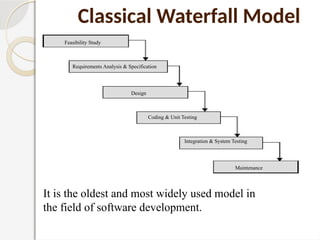
Feasibility Study
Requirements Analysis & Specification
Design
Coding & Unit Testing
Integration & System Testing
Maintenance
Classical Waterfall Model
It is the oldest and most widely used model in
the field of software development.
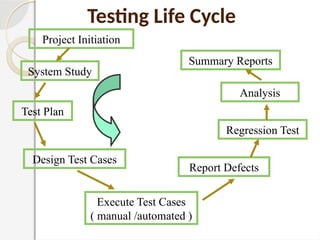
Project Initiation
System Study
Summary Reports
Analysis
Regression Test
Report Defects
Execute Test Cases
( manual /automated )
Design Test Cases
Test Plan
Testing Life Cycle
Test Plan
It is a systematic approach to test a system i.e.
software. The plan typically contains a detailed
understanding of what the eventual testing
workflow will be.
Test Case
It is a specific procedure of testing a particular
requirement.
It will include:
Identification of specific requirement tested
Test case success/failure criteria
Specific steps to execute test
Test data
• Verification: The software should confirm to its
specification (Are we building the product right?)
• Validation: The software should do what the user really
requires (Are we building the right product?)
Verification vs Validation
Testing Methodologies
Black box testing
White box testing
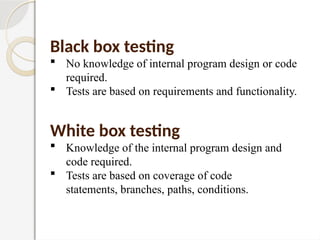
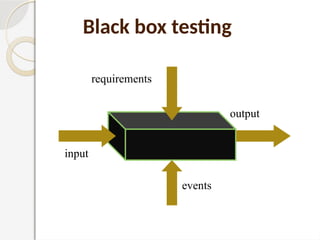
Black box testing
 No knowledge of internal program design or code
required.
 Tests are based on requirements and functionality.
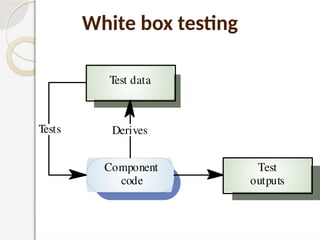
White box testing
 Knowledge of the internal program design and
code required.
 Tests are based on coverage of code
statements, branches, paths, conditions.
Black box testing
requirements
input
events
output
White box testing
Component
code
Test
outputs
Test data
Derives
Tests
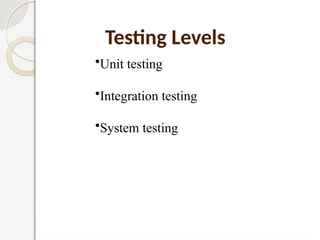
Testing Levels
•Unit testing
•Integration testing
•System testing
UNIT TESTING
Tests each module individually.
Follows a white box testing (Logic of the program).
Done by developers.
INTEGRATION TESTING
Once all the modules have been unit tested, integration
testing is performed.
It is systematic testing.
Produce tests to identify errors associated with interfacing.
Types:
Big Bang Integration testing
Top Down Integration testing
Bottom Up Integration testing
Mixed Integration testing
SYSTEM TESTING
 The system as a whole is tested to uncover
requirement errors.
 Verifies that all system elements work properly
and that overall system function and
performance has been achieved.
Types:
Alpha Testing
Beta Testing
Acceptance Testing
Performance Testing
Alpha Testing
It is carried out by the test team within the developing
organization .
Beta Testing
It is performed by a selected group of friendly customers.
Acceptance Testing
It is performed by the customer to determine whether to accept or
reject the delivery of the system.
Performance Testing
It is carried out to check whether the system meets the
nonfunctional requirements identified in the SRS document.
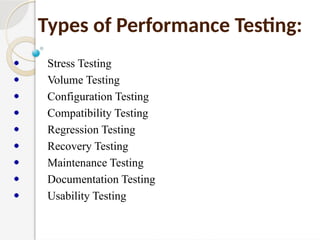
Types of Performance Testing:
Stress Testing
Volume Testing
Configuration Testing
Compatibility Testing
Regression Testing
Recovery Testing
Maintenance Testing
Documentation Testing
Usability Testing
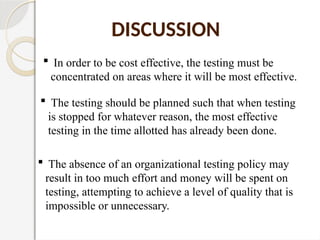
 In order to be cost effective, the testing must be
concentrated on areas where it will be most effective.
DISCUSSION
 The testing should be planned such that when testing
is stopped for whatever reason, the most effective
testing in the time allotted has already been done.
 The absence of an organizational testing policy may
result in too much effort and money will be spent on
testing, attempting to achieve a level of quality that is
impossible or unnecessary.
THANK YOU

softwaretestingpowerpointpresentation.pptx

  • 1.
    S o f t w a r e T e s t i n g Presented by Saptarshi DuttaChowdhury MCA, Heritage Institute of Technology
  • 2.
    It is theprocess used to identify the correctness, completeness and quality of developed computer software. It is the process of executing a program/application under positive and negative conditions by manual or automated means. It checks for the :-  Specification  Functionality  Performance INTRODUCTION
  • 3.
    OBJECTIVES Uncover as manyas errors (or bugs) as possible in a given product. Demonstrate a given software product matching its requirement specifications. Validate the quality of a software testing using the minimum cost and efforts. Generate high quality test cases, perform effective tests, and issue correct and helpful problem reports.
  • 4.
    Error, Bug, Fault& Failure Error : It is a human action that produces the incorrect result that produces a fault. Bug : The presence of error at the time of execution of the software. Fault : State of software caused by an error. Failure : Deviation of the software from its expected result. It is an event.
  • 5.
     Standard modelused word wide to develop a software.  A framework that describes the activities performed at each stage of a software development project.  Necessary to ensure the quality of the software.  Logical steps taken to develop a software product. SDLC(Software Development Life Cycle)
  • 6.
    Feasibility Study Requirements Analysis& Specification Design Coding & Unit Testing Integration & System Testing Maintenance Classical Waterfall Model It is the oldest and most widely used model in the field of software development.
  • 7.
    Project Initiation System Study SummaryReports Analysis Regression Test Report Defects Execute Test Cases ( manual /automated ) Design Test Cases Test Plan Testing Life Cycle
  • 8.
    Test Plan It isa systematic approach to test a system i.e. software. The plan typically contains a detailed understanding of what the eventual testing workflow will be.
  • 9.
    Test Case It isa specific procedure of testing a particular requirement. It will include: Identification of specific requirement tested Test case success/failure criteria Specific steps to execute test Test data
  • 10.
    • Verification: Thesoftware should confirm to its specification (Are we building the product right?) • Validation: The software should do what the user really requires (Are we building the right product?) Verification vs Validation
  • 11.
    Testing Methodologies Black boxtesting White box testing
  • 12.
    Black box testing No knowledge of internal program design or code required.  Tests are based on requirements and functionality. White box testing  Knowledge of the internal program design and code required.  Tests are based on coverage of code statements, branches, paths, conditions.
  • 13.
  • 14.
  • 15.
  • 16.
    UNIT TESTING Tests eachmodule individually. Follows a white box testing (Logic of the program). Done by developers.
  • 17.
    INTEGRATION TESTING Once allthe modules have been unit tested, integration testing is performed. It is systematic testing. Produce tests to identify errors associated with interfacing. Types: Big Bang Integration testing Top Down Integration testing Bottom Up Integration testing Mixed Integration testing
  • 18.
    SYSTEM TESTING  Thesystem as a whole is tested to uncover requirement errors.  Verifies that all system elements work properly and that overall system function and performance has been achieved. Types: Alpha Testing Beta Testing Acceptance Testing Performance Testing
  • 19.
    Alpha Testing It iscarried out by the test team within the developing organization . Beta Testing It is performed by a selected group of friendly customers. Acceptance Testing It is performed by the customer to determine whether to accept or reject the delivery of the system. Performance Testing It is carried out to check whether the system meets the nonfunctional requirements identified in the SRS document.
  • 20.
    Types of PerformanceTesting: Stress Testing Volume Testing Configuration Testing Compatibility Testing Regression Testing Recovery Testing Maintenance Testing Documentation Testing Usability Testing
  • 21.
     In orderto be cost effective, the testing must be concentrated on areas where it will be most effective. DISCUSSION  The testing should be planned such that when testing is stopped for whatever reason, the most effective testing in the time allotted has already been done.  The absence of an organizational testing policy may result in too much effort and money will be spent on testing, attempting to achieve a level of quality that is impossible or unnecessary.
  • 22.