Name:
Shahzad Sharif
Reg # No:
2016-ag-2486
Supervisor:
Dr. Irfan Majeed sb.
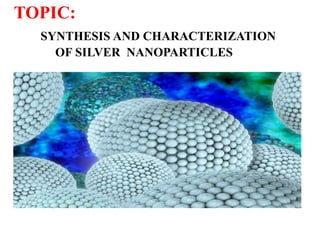
TOPIC:
SYNTHESIS AND CHARACTERIZATION
OF SILVER NANOPARTICLES
Contents :
 Introduction
 Synthesis of Silver nanoparticles
 Physical approaches
 Chemical approaches
 Biological approaches
 characterization of Ag nano particles
 Applications of Silver nanoparticles
Introduction :
What do you mean by Nano Particles ?
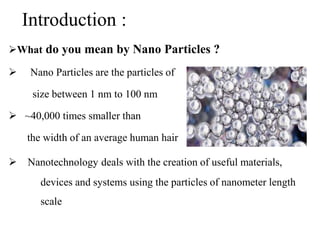
 Nano Particles are the particles of
size between 1 nm to 100 nm
 ~40,000 times smaller than
the width of an average human hair
 Nanotechnology deals with the creation of useful materials,
devices and systems using the particles of nanometer length
scale
 Recently, nanoparticle (NP) synthesis is among the
most interesting scientific fields.
 there are two approaches to nanoparticle production:
 Top-down: milling generates small particles from the
corresponding bulk materials
 Bottom-up: produces nanoparticles by starting from
the atomic level
 There is growing attention to produce nanoparticles (NPs) using
environmental friendly methods (green chemistry).
 Green synthesis approaches include polysaccharides,biological and
irradiation methods
 Various physical, chemical and biological synthetic methods
have been developed to obtain silver nanoparticles (Ag NPs) of
various shapes and sizes.
Methods for synthesis of silver nanoparticles
A. Physical approaches
1) Evaporation-condensation
2) Laser ablation
B. Chemical approaches
1) Tollens method
C. Biological approaches
1) green synthesis
 A) Physical approaches
 The most important physical approaches include
evaporation- condensation and laser ablation.
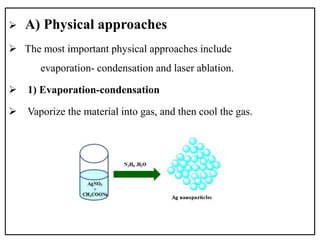
 1) Evaporation-condensation
 Vaporize the material into gas, and then cool the gas.
 a) Using a tube furnace has some disadvantages
 The tube furnace consumes a great amount of energy.
 Raises the environmental temperature around the source
material.
 b) Using a small ceramic heater with a local heating source
 The evaporated vapor can cool faster than tube furnace.
2) Laser ablation
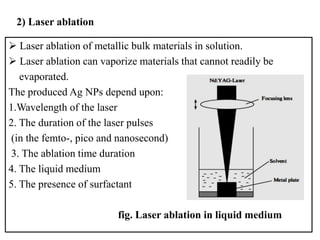
 Laser ablation of metallic bulk materials in solution.
 Laser ablation can vaporize materials that cannot readily be
evaporated.
The produced Ag NPs depend upon:
1.Wavelength of the laser
2. The duration of the laser pulses
(in the femto-, pico and nanosecond)
3. The ablation time duration
4. The liquid medium
5. The presence of surfactant
fig. Laser ablation in liquid medium
Advantages of laser ablation technique compared to other
methods for production of metal colloids:
1. Absence of chemical reducing agents
2. Pure and uncontaminated metal colloids can be prepared
by this technique.
chemical approach
Tollens method
 It involves the reduction of
[Ag(NH3)2]+ (as a Tollens reagent)
by an aldehyde.
 In the modified Tollens procedure,
silver ions are reduced by saccharides
in the presence of ammonia.
 [Ag(NH3)2]+(aq) + RCHO(aq)
Ag(s) +RCOOH(aq)
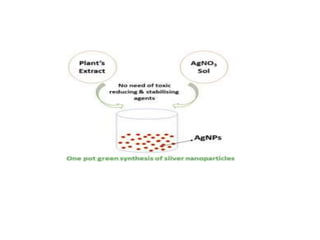
Synthesis of Ag NPs by plants
1) Green synthesis & eco-friendly
2) Low cost
3) Can be used for large scale synthesis
4) No need to use high pressure, energy, temperature and
toxic chemicals
5) Not require any special culture preparation and isolation
Techniques
6) Synthesize by green tea extract, black tea leaf extract etc.
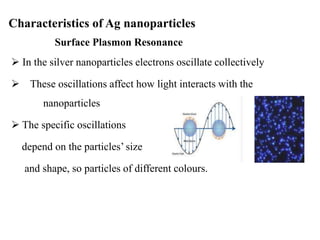
Characteristics of Ag nanoparticles
Surface Plasmon Resonance
 In the silver nanoparticles electrons oscillate collectively
 These oscillations affect how light interacts with the
nanoparticles
 The specific oscillations
depend on the particles’ size
and shape, so particles of different colours.
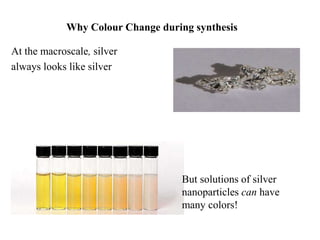
Why Colour Change during synthesis
At the macroscale, silver
always looks like silver
But solutions of silver
nanoparticles can have
many colors!
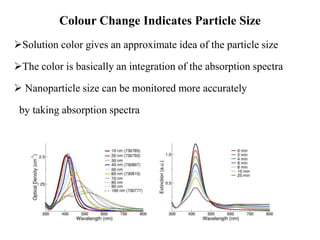
Colour Change Indicates Particle Size
Solution color gives an approximate idea of the particle size
The color is basically an integration of the absorption spectra
 Nanoparticle size can be monitored more accurately
by taking absorption spectra
Application of Ag nanoparticles
 In 18th century, used in treatment of ulcer
 In 19th century, antimicrobial activity was first identified
 In 1920s, Ag nanoparticles was accepted by US food and drug
administration
 penicillin in the 1940s,antibiotics became standard treatment
and use of Ag nanoparticles diminished
 In 1960s,to be used in treatment of burn patients
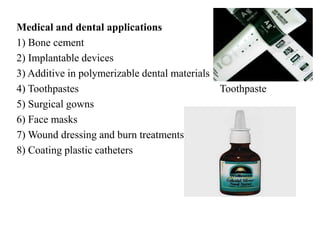
Medical and dental applications
1) Bone cement
2) Implantable devices
3) Additive in polymerizable dental materials
4) Toothpastes Toothpaste
5) Surgical gowns
6) Face masks
7) Wound dressing and burn treatments
8) Coating plastic catheters
Nasal spray
Other applications
1) Food storage packaging
2) Textile coatings, socks and athletic clothing
3) Packaging
4) Cosmetics
5) Water treatment
6) Washing machines
7) Detergents, soaps and shampoos
8) Air and water filters
introduction to silver nanoparticles and characterization

introduction to silver nanoparticles and characterization

  • 2.
    Name: Shahzad Sharif Reg #No: 2016-ag-2486 Supervisor: Dr. Irfan Majeed sb.
  • 3.
  • 4.
    Contents :  Introduction Synthesis of Silver nanoparticles  Physical approaches  Chemical approaches  Biological approaches  characterization of Ag nano particles  Applications of Silver nanoparticles
  • 5.
    Introduction : What doyou mean by Nano Particles ?  Nano Particles are the particles of size between 1 nm to 100 nm  ~40,000 times smaller than the width of an average human hair  Nanotechnology deals with the creation of useful materials, devices and systems using the particles of nanometer length scale
  • 6.
     Recently, nanoparticle(NP) synthesis is among the most interesting scientific fields.  there are two approaches to nanoparticle production:  Top-down: milling generates small particles from the corresponding bulk materials  Bottom-up: produces nanoparticles by starting from the atomic level
  • 7.
     There isgrowing attention to produce nanoparticles (NPs) using environmental friendly methods (green chemistry).  Green synthesis approaches include polysaccharides,biological and irradiation methods  Various physical, chemical and biological synthetic methods have been developed to obtain silver nanoparticles (Ag NPs) of various shapes and sizes.
  • 8.
    Methods for synthesisof silver nanoparticles A. Physical approaches 1) Evaporation-condensation 2) Laser ablation B. Chemical approaches 1) Tollens method C. Biological approaches 1) green synthesis
  • 9.
     A) Physicalapproaches  The most important physical approaches include evaporation- condensation and laser ablation.  1) Evaporation-condensation  Vaporize the material into gas, and then cool the gas.
  • 10.
     a) Usinga tube furnace has some disadvantages  The tube furnace consumes a great amount of energy.  Raises the environmental temperature around the source material.  b) Using a small ceramic heater with a local heating source  The evaporated vapor can cool faster than tube furnace.
  • 11.
    2) Laser ablation Laser ablation of metallic bulk materials in solution.  Laser ablation can vaporize materials that cannot readily be evaporated. The produced Ag NPs depend upon: 1.Wavelength of the laser 2. The duration of the laser pulses (in the femto-, pico and nanosecond) 3. The ablation time duration 4. The liquid medium 5. The presence of surfactant fig. Laser ablation in liquid medium
  • 12.
    Advantages of laserablation technique compared to other methods for production of metal colloids: 1. Absence of chemical reducing agents 2. Pure and uncontaminated metal colloids can be prepared by this technique.
  • 13.
    chemical approach Tollens method It involves the reduction of [Ag(NH3)2]+ (as a Tollens reagent) by an aldehyde.  In the modified Tollens procedure, silver ions are reduced by saccharides in the presence of ammonia.  [Ag(NH3)2]+(aq) + RCHO(aq) Ag(s) +RCOOH(aq)
  • 14.
    Synthesis of AgNPs by plants 1) Green synthesis & eco-friendly 2) Low cost 3) Can be used for large scale synthesis 4) No need to use high pressure, energy, temperature and toxic chemicals 5) Not require any special culture preparation and isolation Techniques 6) Synthesize by green tea extract, black tea leaf extract etc.
  • 16.
    Characteristics of Agnanoparticles Surface Plasmon Resonance  In the silver nanoparticles electrons oscillate collectively  These oscillations affect how light interacts with the nanoparticles  The specific oscillations depend on the particles’ size and shape, so particles of different colours.
  • 17.
    Why Colour Changeduring synthesis At the macroscale, silver always looks like silver But solutions of silver nanoparticles can have many colors!
  • 18.
    Colour Change IndicatesParticle Size Solution color gives an approximate idea of the particle size The color is basically an integration of the absorption spectra  Nanoparticle size can be monitored more accurately by taking absorption spectra
  • 19.
    Application of Agnanoparticles  In 18th century, used in treatment of ulcer  In 19th century, antimicrobial activity was first identified  In 1920s, Ag nanoparticles was accepted by US food and drug administration  penicillin in the 1940s,antibiotics became standard treatment and use of Ag nanoparticles diminished  In 1960s,to be used in treatment of burn patients
  • 20.
    Medical and dentalapplications 1) Bone cement 2) Implantable devices 3) Additive in polymerizable dental materials 4) Toothpastes Toothpaste 5) Surgical gowns 6) Face masks 7) Wound dressing and burn treatments 8) Coating plastic catheters Nasal spray
  • 21.
    Other applications 1) Foodstorage packaging 2) Textile coatings, socks and athletic clothing 3) Packaging 4) Cosmetics 5) Water treatment 6) Washing machines 7) Detergents, soaps and shampoos 8) Air and water filters