B Y A S A D S H A H
R O L L N O . 1 5
M . P H I L ( Z O O L O G Y )
S U B J E C T : B I O N A N O T E C H N O L O G Y
U N I V E R S I T Y O F B A L O C H I S T A N Q U E T T A
Presentation Topic
Silver Nanoparticles
Silver Nanoparticles (Ag NPs)
Contents
 Introduction
 Synthesis of Ag NPs
 Properties
 Applications
 Toxicity And Challenges
 Comparison of Ag NPs with other NPs
 Conclusion
 References
Silver Nanoparticles (Ag NPs)
Introduction
 The use of Ag NPs is rapidly increasing in current
century because of their outstanding optical, microbial,
electrical and chemical properties.
 Some of the uses of Ag NPs are in drug delivery,
pathology, bioscience, detection of pathogens, catalysis,
tumor detection, diagnostics, wound healing,
antimicrobials etc.
 Physical And chemical Properties:
 The properties of NPs depend on aspect ratio, crystal
size, crystalline density and morphology.
Silver Nanoparticles (Ag NPs)
Introduction
Physical And chemical Properties:
 Narrow sized and uniformly distributed
nanoparticles possess higher chemical and physical
properties due to their higher aspect ratio.
Silver Nanoparticles (Ag NPs)
Introduction
Ag NPs have significance due to their unique:
I. Optical properties
II. Antimicrobial Properties
III. Electrical Properties
IV. Physical Properties
V. Possible applications
(The change of energy level from continuous band to
discrete band of Ag NPs with decrease in size of
particles gives strong size dependent chemical and
physical properties.)
Silver Nanoparticles (Ag NPs)
Introduction
Toxicity of Ag NPs to:
I. Human  Lower toxicity
II. Micro-organism  Higher toxicity
 Ag NPs have Scope for:
I. Medical Instruments
II. Antibacterial applications
III. products for health care (i.e. scaffolds, burn
dressing, water purification)
IV. Agriculture use
Silver Nanoparticles (Ag NPs)
Introduction
Ag NPs synthesis:
 Ag NPs can be synthesized with different shapes and
sizes such as spheres, wires, rods and plates using
various methods.
 Two Main methods:
a. Physical Process:
I. laser ablation
II. Condensation
III. Evaporation
Silver Nanoparticles (Ag NPs)
Introduction
b. Chemical Process:
I. Hydrazine
II. Sodium boro-hydride
III. Green synthesis
Biosynthesis which replacing chemical method of
synthesis can be performed by fungi, bacteria, yeast
or plant extracts.
(Among all these methods green synthesis is non-
toxic, eco-friendly and cost effective.)
Silver Nanoparticles (Ag NPs)
Synthesis of Ag NPs
 Ag NPs synthesized using various methods
primarily classified two types of methods:
a. Physical process:
I. Laser Method/Laser Ablation
II. Condensation/laser Irradiation
III. Evaporation
b. Chemical process:
I. Hydrazine
II. Sodium boro-hydride
III. Green synthesis/ Biosynthesis
 Most popular process for Synthesis of Ag NPs Are:
 Green synthesis OR Bio synthesis
 Physical process laser ablation
 Chemical process boro-hydride
Silver Nanoparticles (Ag NPs)
Synthesis of Ag NPs
 Physical Process:
I. Laser Method/Laser Ablation Process:
 Earlier Ag NPs were produced by laser ablation
in sodium dodecyl sulphate (aq.) solution.
 Requirements:
I. A minimum number of reagents
II. Laser  Nd:YAG-laser
III. Only pure solvent  Acetonitrile
IV. Bulk metal Ag sample (either in liquid media [78-
79%] or in aerosols.)
Silver Nanoparticles (Ag NPs)
 Laser Ablation Process:
 Procedure:
 Ag (Silver) Immersed Aquas solution.
 A lasser is strocked immersed Sample NPs formation.
 By Laser ablation  Synthesize spherical Ag NPs Normal
size distribution.
 Ag NPs of (average diameter of particles 2.2 nm –
3.9 nm)  Synthesized.
 No of NPs(syn.) ∝ Laser power
 The average size of NPs(syn.):
INC  increasing the power of
radiation decreasing the concentration of surfactant.
II. Condensation/Laser irradiation Process:
 Laser irradiation is another process of synthesis of Ag NP.
 This process aerosol of Ag micro-particles (1.2 μm) in
nitrogen is irradiated by laser.
Silver Nanoparticles (Ag NPs)
b. Laser irradiation Process:
Consist of:
I. Ag NP nucleation
II. Ag accumulation
III. Ag growth
Procedure: Steps
1. First laser induced heating Ag micro-Ps  particles
evaporate  finally ionize.
2. Disintegration of micro particles starts  generating
shock wave.
3. Another shock wave from laser beam comes  colloids
with this shock wave inside a particle.
Silver Nanoparticles (Ag NPs)
 Procedure: Steps
4. The collusion heats the micro-particles to its critical
temperature  initiates catastrophic condensation of
vapor (atomic).
5. Finally local NP  formed in the area of shock wave at
low pressure zone.
b. Chemical Process:
II. Sodium Boro-hydride Method:
 Reduction of salt of Ag with Na Boro-hydride  synthesis
Ag NP  become most extensively used method  because
of its higher reactivity than citrate and lower toxicity than
hydrazine.
Silver Nanoparticles (Ag NPs)
II. Sodium Boro-hydride Method:
Procedure: Steps
1. Solution of (AgNO3) and (NaBH4)  molar ratio 1:6
2. Cooling at 0 ċ  temperature on active stirring.
3. The diameter of synthesized Ag NPs  1-10 nm  found
a band of absorption spectrum  maximum wavelength
of (λ=400 nm).
4. Nucleation of colloid particles occurs.
5. The growth mechanism of particles happens  by
reduction of silver ions on the surface of previously
formed clusters.
Silver Nanoparticles (Ag NPs)
II. Sodium Boro-hydride Method:
 Synthesis of spherical Ag NPs:
 Silver perchlorate (AgClO4) and Sodium boro-hydride
(NaBH4) solution.
 Gives different colour in different stage of reduction.
 Change in Colour in Different Stages:
1) The colour of the solution  dark muddy green.
2) Changed  light yellow.
3) Finally the solution again appeared  dark.
 Characteristic absorption spectral band found  at
wavelength of λ=200 nm  in 1st stage.
Silver Nanoparticles (Ag NPs)
II. Sodium Boro-hydride Method:
 The characteristic absorption spectral band abruptly
improved at wavelength of (λ=390 nm)  decreased at
wavelength of (λ=220 nm)  2nd stage.
 This phenomenon was described by  growth in the size of Ag
NP triggered by  link of clusters into thicker aggregate (7-9
nm).
 Elemental analysis of Ag+ ion content  carried out at various
moment of growth to  confirm the growth mechanism of Ag
NPs.
 It was found that Ag+ ion content was same at every cases 
means no Ag+ ion was lost.
Silver Nanoparticles (Ag NPs)
II. Sodium Boro-hydride Method:
 Confirms that reduction of Ag  occurs first few seconds
of the synthesis  made impossible  growth
mechanism of particles happens  reduction of Ag ions
on the surface of previously formed clusters.
 A considerable drawback  method was the unfeasibility
 achieve high conc; of Ag NPs in final solutions made
aggregate instable.
 A stabilizing media  “laponite” (A synthetic inorganic
material) used.
 Cluster of Ag particle  adsorbed on the surface of
laponite  made their aggregation impossible.
Silver Nanoparticles (Ag NPs)
b. Chemical Process:
III. Green synthesis/ Biosynthesis
Green synthesis of Ag NPs are divided into five types namely:
A. Biological methods
 (In biological method (Biosynthesis) synthesis of Ag NPs occurs by
the reduction of silver ion with the help of extracts of micro-
organisms)
B. Polysacharide methods
 (Preparation of Ag NPs using polysaccharides and water as a capping
agent is known as polysaccharide method)
C. Irradiation methods
 (Ag NPs are synthesized by using various irradiation methods such
as formation of Ag NPs of various size and shape by laser irradiation
of silver salt (aq.) and surfactant)
Silver Nanoparticles (Ag NPs)
b. Chemical Process:
D. Tollens methods
 (Ag NPs can also be fabricated by tollens methods)
E. Polyoxomerales methods
 (Ag NPs can also be fabricated by polyoxomerales
methods)
III. Green synthesis/ Biosynthesis
A. Biological methods
 In biosynthesis process stable spherical Ag NPs
(diameter 0.5 nm to 150 nm)  produced at various
conc; of silver nitrate (AgNO3)  synthesis of Ag NPs
 using extract of plant.
Silver Nanoparticles (Ag NPs)
III. Green synthesis/ Biosynthesis
A. Biological methods
o Advantages:
It has various advantages than physical, chemical
and microbial synthesis because  there is no
need to use of hazardous chemicals, wasteful
purifications and high energy requirements.
Basically green synthesis is the environmental
friendly and cost effective alternative to physical
and chemical methods.
Silver Nanoparticles (Ag NPs)
III. Green synthesis/ Biosynthesis
A. Biological methods
Procedure: Steps
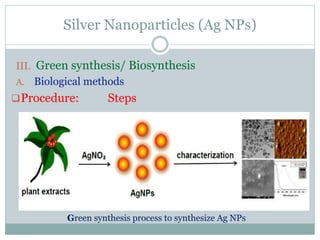
Plant extract is the common reducing agent in green
synthesis.
i. Commonly silver ions get reduced in aqueous solution
 produce different nm diameter of colloidal silver.
ii. In crystallization route primarily  Ag ions reduce 
Ag atoms  grow into oligomeric clusters.
iii. Finally these clusters assist to develop the colloidal Ag
particles.
Silver Nanoparticles (Ag NPs)
III. Green synthesis/ Biosynthesis
A. Biological methods
Procedure: Steps
Green synthesis process to synthesize Ag NPs
Silver Nanoparticles (Ag NPs)
III. Green synthesis/ Biosynthesis
A. Biological methods
Procedure: Steps
 Three main principles:
i. Solvent medium selection
ii. Picking environment friendly reducing agent
iii. Choice of nontoxic substances to stabilize Ag NPs.
iv. Using plant extracts  vast collection of secondary
metabolites  originated in plants  have redox
capacity  biosynthesis of Ag NPs.
 “Ag NPs  formed from Ag+ ion by bio-reduction with
the help of  plant metabolites”.
Silver Nanoparticles (Ag NPs)
Properties of Ag NPs:
1. Antibacterial Activity of Ag NPs:
 Antibacterial effect against anaerobic and aerobic
bacteria of Ag NPs.
 Small concentration of Ag NPs is harmless for human cell
but deadly for majority of viruses and bacteria.
 NPs show high Antibacterial activity because of  their
finely honed surface  they are small enough to
penetrate  membrane of cell to disturb  the
intracellular processes.
 Ag NPs  higher antibacterial effect due to their formation
of free radicals on its surface.
 The high affinity of Ag NPs towards phosphorus and sulphur
is the main fact of the antibacterial effect.
Silver Nanoparticles (Ag NPs)
Properties of Ag NPs:
2. Optical Properties of Ag NPs:
Ag NPs has specific strong interaction on
electromagnetic radiation.
The first application of Ag NPs is to prepare
pigments for fabrication ceramics and glass.
 Optical properties of Ag NPs depend on:
i. Individual particles shape
ii. Individual particles size
iii. Individual particles composition
iv. Their environment & presence
v. Structure of adsorption layers.
Silver Nanoparticles (Ag NPs)
Properties of Ag NPs:
2. Optical Properties of Ag NPs:
 The distinctive feature of spectrum of scattering and
absorption of Ag NPs above 2 nm diameter is the
appearance of a strong and wide-ranging band in the
visible range or near -UV or -IR Ranges  band is known
as Surface Plasmon Resonance (SPR).
 Ag shows the highest SPR band intensity  than any
other metals like Cu and Au.
 A change in the shape of Ag NPs from spherical particles
especially the arrival of sharp corners causes the shift of
absorption peak to longer wavelengths.
Silver Nanoparticles (Ag NPs)
Applications:
1. Medical Science Applications:
 Divided into two types of Uses:
i. Diagnostic:
 Lim et al found that Surface Enhanced Raman Spectroscopy
(SERS) based on Ag NPs can be used in cancer detection in
non-invasive way.
 This process of cancer detection will be inevitable part of
cancer detection in near future.
ii. Therapeutic:
 Ag is used for wound dressing, scaffolds, eye treatment and
dental hygiene bone substitute biomaterials.
 Kwan et al shows that after wood healing Ag NPs improves
collagen alignment which results superior mechanical
strength.
Silver Nanoparticles (Ag NPs)
Applications:
1. Medical Science Applications:
ii. Therapeutic:
 Central venous catheters (CVC) contained silver
nanoparticles are less infective in blood stream.
 According to Sun et al human serum contains albumin
stabilized silver nanoparticle which provides antiviral
properties.
 Recent studies of Ag NPs lead to utilization in some
important applications such as diagnostic imaging,
therapy, bio-sensing and cancer diagnosis
Silver Nanoparticles (Ag NPs)
Applications:
2. Textile Applications:
 Nano materials are now commercially used in textile
industries.
 Nanoparticles are incorporated into fiber or coated on fiber.
 Ag NPs are used in T shirt, sporting clothes, underwear, socks
etc.
3. Food Industry Applications:
 Ag NPs used in food industry  due to antibacterial actions
and free of preservative.
 Small concentration of Ag NPs is harmless for human cell but
deadly for majority of viruses and bacteria.
 Ag NPs used in decontamination of food and water and as
infection resistor in medicine.
Silver Nanoparticles (Ag NPs)
Applications:
3. Food Industry Applications:
 Ag NPs are widely used in consumer product namely soaps,
food, plastics, pastes and textiles due to their anti-
fungicidal and anti-bactericidal activities.
4. Optical Applications:
 Ag NPs are used in Solar cells, medical imaging, optical
limiters, plasmonic devices etc.
5. Conductive Applications:
 LCDs, High intensity LEDs, touch screens, are using silver
nanoparticles.
Silver Nanoparticles (Ag NPs)
Toxicity And Challenges:
 Prime challenges of the upcoming decade would be:
i. the transition of lab treatment of Ag NPs to
commercial application.
ii. Researchers and Scientists around the world who
are devoted to synthesis NPs and studies their
properties face  challenges in their attempt  to
synthesize of these NPs.
iii. If Ag NPs display a minor amount of toxicity to
body, it would be fatal.
iv. Treatment of burn patients with ionic silver causes
reactions of hyper-sensitivity.
v. Aggregation occurs because of their high surface
energy.
Silver Nanoparticles (Ag NPs)
Comparison Of Ag Nps With Other Nps:
 Ag NPs shows the highest surface plasmon resonance band
intensity than any other NPs like Cu and Au.
 Having surface plasmon resonance effect both Ag NPs and
Gold NPs are usually employed in optical detection.
 Since Ag NPs show sharper and stronger peaks of plasmon
resonance than that of Gold NPs at the equal concentration of
particles its efficiency of plasmon efficiency is higher.
 Ag NPs impart better sensitivity for applications like surface
enhanced Raman scattering or localized surface plasmon
resonance.
 Plasmon surface absorbance of gold NPs is in the wavelength
range of 500 nm to 600 nm while most fluorophores emit
above 500 nm.
 Ag NPs have stronger fluorescent signal than gold NPs.
Silver Nanoparticles (Ag NPs)
Conclusion:
 Recent advances in Ag nanotechnology help us to
design and synthesize Ag NPs.
 Biosynthesis is best of all other synthesis processes of
Ag NPs because of their nontoxic nature.
 Their unique optical, physical, and antimicrobial
properties would lead Ag NPs wide spread uses in
medical and different sectors like would healing, food
sanitation, drug delivery etc.
 Future investigations should be preparation of Ag NPs
which aim at overcoming these kinds of challenges and
would be useful in designing effective drug delivery
agent, diagnosing and treating fatal diseases besides
ensuring higher safety and efficacy.
Silver Nanoparticles (Ag NPs)
References:
 [1] M. G. Guzman, J. Dille, S. Godet, “Synthesis of Silver Nanoparticles
by Chemical Reduction Method and Their Antibacterial Activity”, World
Acad Sci Eng Technol, vol. 43, pp. 357–364, 2008.
 [2] D. J. Xiong, M. L. Chen, H. Li, “Synthesis of Para-Sulfonatocalix [4]
Arene-Modified Silver Nanoparticles as Colorimetric Histidine Probes”.
Chem Commun, vol. 2008, pp. 880–882, 2008.
 [3] S. Basu, S. Jana, S. Pande, T. Pal, “Interaction of DNA Bases With
Silver NaNoparticles: Assembly Quantified Through SPRS and SERS”, J
Colloid Interface Sci, vol. 321, no. 2, 288-293, 2008.
 [4] K. Anandan, V. Rajendran, “Morphological and Size Effects of Nio
Nanoparticles via Solvothermal Process and Their Optical Properties”,
Mater. Sci. Semicond. Process. vol. 14, pp. 43-47, 2011.
 [5] P. Laokul, V. Amornkitbamrung, S. Seraphin, S. Maensiri, S,
“Characterization And Magnetic Properties Of Nanocrystalline CuFe2O4,
NiFe2O4, ZnFe2O4 Powders Prepared By The Aloe Vera Extract
Solution”, Curr. Appl. Phys, vol. 11, pp. 101, 2011
 [6] Y. Y. Mu, H. Liang, J. Hu, L. Jiang L. J. Wan, “Controllable Pt
Nanoparticle Deposition on Carbon Nanotubes as an Anode Catalyst for
Direct Methanol Fuel Cells”. J. Phys. Chem. B, vol. 109, pp. 47, pp.
22212–22216, 2005.
Silver Nanoparticles (Ag NPs)
References:
 [7] M. Rai, A. Yadav, A. Gade, ‘’Silver Nanoparticles As A New Generation of
Antimicrobials’’, Biotechnology Advances, vol. 27, pp. 76-83, 2009
 [8] R. Karimzadeh, N. Mansour, “The Effect of Concentration on the Thermo-
Optical Properties of Colloidal Silver Nanoparticles”, Opt. Laser Technol., vol. 42,
pp. 783, 2010.
 [9] G. W. Yang, G. Y. Gao, C. Wang, C. L. Xu, H. L. Li, “Controllable Deposition of
Ag Nanoparticles on Carbon Nanotubes as a Catalyst for Hydrazine Oxidation”
Carbon, vol. 46, pp. 747, 2008.
 [10] D. Mubarak-Ali, N. Thajuddin, K. Jeganathan, M. Gunasekaran, “Plant
Extract Mediated Synthesis of Silver and Gold Nanoparticles and Its
Antibacterial Activity against Clinically Isolated Pathogens”, Colloids Surf. B
Biointerfaces, vol. 85, pp. 360, 2011.
 [11] M. A. Kostowskyj, D. W. Kirk, S. J. Thorpe, “Ag And Ag-Mn Nanowire
Catalysts for Alkaline Fuel Cells”, Int. J. Hydrogen Energ., vol. 35, pp. 5666,
2010.
 [12] J. H. Lee, N. R. Kim, B. J. Kim, Y. C. Joo “Improved Mechanical
Performance of Solution-Processed MWCNT/Ag Nanoparticle Composite Films
With Oxygenpressure-Controlled Annealing”, Carbon, vol. 50, pp. 98, 2012.

Asad Shah Ag NPs presentation

  • 1.
    B Y AS A D S H A H R O L L N O . 1 5 M . P H I L ( Z O O L O G Y ) S U B J E C T : B I O N A N O T E C H N O L O G Y U N I V E R S I T Y O F B A L O C H I S T A N Q U E T T A Presentation Topic Silver Nanoparticles
  • 2.
    Silver Nanoparticles (AgNPs) Contents  Introduction  Synthesis of Ag NPs  Properties  Applications  Toxicity And Challenges  Comparison of Ag NPs with other NPs  Conclusion  References
  • 3.
    Silver Nanoparticles (AgNPs) Introduction  The use of Ag NPs is rapidly increasing in current century because of their outstanding optical, microbial, electrical and chemical properties.  Some of the uses of Ag NPs are in drug delivery, pathology, bioscience, detection of pathogens, catalysis, tumor detection, diagnostics, wound healing, antimicrobials etc.  Physical And chemical Properties:  The properties of NPs depend on aspect ratio, crystal size, crystalline density and morphology.
  • 4.
    Silver Nanoparticles (AgNPs) Introduction Physical And chemical Properties:  Narrow sized and uniformly distributed nanoparticles possess higher chemical and physical properties due to their higher aspect ratio.
  • 5.
    Silver Nanoparticles (AgNPs) Introduction Ag NPs have significance due to their unique: I. Optical properties II. Antimicrobial Properties III. Electrical Properties IV. Physical Properties V. Possible applications (The change of energy level from continuous band to discrete band of Ag NPs with decrease in size of particles gives strong size dependent chemical and physical properties.)
  • 6.
    Silver Nanoparticles (AgNPs) Introduction Toxicity of Ag NPs to: I. Human  Lower toxicity II. Micro-organism  Higher toxicity  Ag NPs have Scope for: I. Medical Instruments II. Antibacterial applications III. products for health care (i.e. scaffolds, burn dressing, water purification) IV. Agriculture use
  • 7.
    Silver Nanoparticles (AgNPs) Introduction Ag NPs synthesis:  Ag NPs can be synthesized with different shapes and sizes such as spheres, wires, rods and plates using various methods.  Two Main methods: a. Physical Process: I. laser ablation II. Condensation III. Evaporation
  • 8.
    Silver Nanoparticles (AgNPs) Introduction b. Chemical Process: I. Hydrazine II. Sodium boro-hydride III. Green synthesis Biosynthesis which replacing chemical method of synthesis can be performed by fungi, bacteria, yeast or plant extracts. (Among all these methods green synthesis is non- toxic, eco-friendly and cost effective.)
  • 9.
    Silver Nanoparticles (AgNPs) Synthesis of Ag NPs  Ag NPs synthesized using various methods primarily classified two types of methods: a. Physical process: I. Laser Method/Laser Ablation II. Condensation/laser Irradiation III. Evaporation b. Chemical process: I. Hydrazine II. Sodium boro-hydride III. Green synthesis/ Biosynthesis  Most popular process for Synthesis of Ag NPs Are:  Green synthesis OR Bio synthesis  Physical process laser ablation  Chemical process boro-hydride
  • 10.
    Silver Nanoparticles (AgNPs) Synthesis of Ag NPs  Physical Process: I. Laser Method/Laser Ablation Process:  Earlier Ag NPs were produced by laser ablation in sodium dodecyl sulphate (aq.) solution.  Requirements: I. A minimum number of reagents II. Laser  Nd:YAG-laser III. Only pure solvent  Acetonitrile IV. Bulk metal Ag sample (either in liquid media [78- 79%] or in aerosols.)
  • 11.
    Silver Nanoparticles (AgNPs)  Laser Ablation Process:  Procedure:  Ag (Silver) Immersed Aquas solution.  A lasser is strocked immersed Sample NPs formation.  By Laser ablation  Synthesize spherical Ag NPs Normal size distribution.  Ag NPs of (average diameter of particles 2.2 nm – 3.9 nm)  Synthesized.  No of NPs(syn.) ∝ Laser power  The average size of NPs(syn.): INC  increasing the power of radiation decreasing the concentration of surfactant. II. Condensation/Laser irradiation Process:  Laser irradiation is another process of synthesis of Ag NP.  This process aerosol of Ag micro-particles (1.2 μm) in nitrogen is irradiated by laser.
  • 12.
    Silver Nanoparticles (AgNPs) b. Laser irradiation Process: Consist of: I. Ag NP nucleation II. Ag accumulation III. Ag growth Procedure: Steps 1. First laser induced heating Ag micro-Ps  particles evaporate  finally ionize. 2. Disintegration of micro particles starts  generating shock wave. 3. Another shock wave from laser beam comes  colloids with this shock wave inside a particle.
  • 13.
    Silver Nanoparticles (AgNPs)  Procedure: Steps 4. The collusion heats the micro-particles to its critical temperature  initiates catastrophic condensation of vapor (atomic). 5. Finally local NP  formed in the area of shock wave at low pressure zone. b. Chemical Process: II. Sodium Boro-hydride Method:  Reduction of salt of Ag with Na Boro-hydride  synthesis Ag NP  become most extensively used method  because of its higher reactivity than citrate and lower toxicity than hydrazine.
  • 14.
    Silver Nanoparticles (AgNPs) II. Sodium Boro-hydride Method: Procedure: Steps 1. Solution of (AgNO3) and (NaBH4)  molar ratio 1:6 2. Cooling at 0 ċ  temperature on active stirring. 3. The diameter of synthesized Ag NPs  1-10 nm  found a band of absorption spectrum  maximum wavelength of (λ=400 nm). 4. Nucleation of colloid particles occurs. 5. The growth mechanism of particles happens  by reduction of silver ions on the surface of previously formed clusters.
  • 15.
    Silver Nanoparticles (AgNPs) II. Sodium Boro-hydride Method:  Synthesis of spherical Ag NPs:  Silver perchlorate (AgClO4) and Sodium boro-hydride (NaBH4) solution.  Gives different colour in different stage of reduction.  Change in Colour in Different Stages: 1) The colour of the solution  dark muddy green. 2) Changed  light yellow. 3) Finally the solution again appeared  dark.  Characteristic absorption spectral band found  at wavelength of λ=200 nm  in 1st stage.
  • 16.
    Silver Nanoparticles (AgNPs) II. Sodium Boro-hydride Method:  The characteristic absorption spectral band abruptly improved at wavelength of (λ=390 nm)  decreased at wavelength of (λ=220 nm)  2nd stage.  This phenomenon was described by  growth in the size of Ag NP triggered by  link of clusters into thicker aggregate (7-9 nm).  Elemental analysis of Ag+ ion content  carried out at various moment of growth to  confirm the growth mechanism of Ag NPs.  It was found that Ag+ ion content was same at every cases  means no Ag+ ion was lost.
  • 17.
    Silver Nanoparticles (AgNPs) II. Sodium Boro-hydride Method:  Confirms that reduction of Ag  occurs first few seconds of the synthesis  made impossible  growth mechanism of particles happens  reduction of Ag ions on the surface of previously formed clusters.  A considerable drawback  method was the unfeasibility  achieve high conc; of Ag NPs in final solutions made aggregate instable.  A stabilizing media  “laponite” (A synthetic inorganic material) used.  Cluster of Ag particle  adsorbed on the surface of laponite  made their aggregation impossible.
  • 18.
    Silver Nanoparticles (AgNPs) b. Chemical Process: III. Green synthesis/ Biosynthesis Green synthesis of Ag NPs are divided into five types namely: A. Biological methods  (In biological method (Biosynthesis) synthesis of Ag NPs occurs by the reduction of silver ion with the help of extracts of micro- organisms) B. Polysacharide methods  (Preparation of Ag NPs using polysaccharides and water as a capping agent is known as polysaccharide method) C. Irradiation methods  (Ag NPs are synthesized by using various irradiation methods such as formation of Ag NPs of various size and shape by laser irradiation of silver salt (aq.) and surfactant)
  • 19.
    Silver Nanoparticles (AgNPs) b. Chemical Process: D. Tollens methods  (Ag NPs can also be fabricated by tollens methods) E. Polyoxomerales methods  (Ag NPs can also be fabricated by polyoxomerales methods) III. Green synthesis/ Biosynthesis A. Biological methods  In biosynthesis process stable spherical Ag NPs (diameter 0.5 nm to 150 nm)  produced at various conc; of silver nitrate (AgNO3)  synthesis of Ag NPs  using extract of plant.
  • 20.
    Silver Nanoparticles (AgNPs) III. Green synthesis/ Biosynthesis A. Biological methods o Advantages: It has various advantages than physical, chemical and microbial synthesis because  there is no need to use of hazardous chemicals, wasteful purifications and high energy requirements. Basically green synthesis is the environmental friendly and cost effective alternative to physical and chemical methods.
  • 21.
    Silver Nanoparticles (AgNPs) III. Green synthesis/ Biosynthesis A. Biological methods Procedure: Steps Plant extract is the common reducing agent in green synthesis. i. Commonly silver ions get reduced in aqueous solution  produce different nm diameter of colloidal silver. ii. In crystallization route primarily  Ag ions reduce  Ag atoms  grow into oligomeric clusters. iii. Finally these clusters assist to develop the colloidal Ag particles.
  • 22.
    Silver Nanoparticles (AgNPs) III. Green synthesis/ Biosynthesis A. Biological methods Procedure: Steps Green synthesis process to synthesize Ag NPs
  • 23.
    Silver Nanoparticles (AgNPs) III. Green synthesis/ Biosynthesis A. Biological methods Procedure: Steps  Three main principles: i. Solvent medium selection ii. Picking environment friendly reducing agent iii. Choice of nontoxic substances to stabilize Ag NPs. iv. Using plant extracts  vast collection of secondary metabolites  originated in plants  have redox capacity  biosynthesis of Ag NPs.  “Ag NPs  formed from Ag+ ion by bio-reduction with the help of  plant metabolites”.
  • 24.
    Silver Nanoparticles (AgNPs) Properties of Ag NPs: 1. Antibacterial Activity of Ag NPs:  Antibacterial effect against anaerobic and aerobic bacteria of Ag NPs.  Small concentration of Ag NPs is harmless for human cell but deadly for majority of viruses and bacteria.  NPs show high Antibacterial activity because of  their finely honed surface  they are small enough to penetrate  membrane of cell to disturb  the intracellular processes.  Ag NPs  higher antibacterial effect due to their formation of free radicals on its surface.  The high affinity of Ag NPs towards phosphorus and sulphur is the main fact of the antibacterial effect.
  • 25.
    Silver Nanoparticles (AgNPs) Properties of Ag NPs: 2. Optical Properties of Ag NPs: Ag NPs has specific strong interaction on electromagnetic radiation. The first application of Ag NPs is to prepare pigments for fabrication ceramics and glass.  Optical properties of Ag NPs depend on: i. Individual particles shape ii. Individual particles size iii. Individual particles composition iv. Their environment & presence v. Structure of adsorption layers.
  • 26.
    Silver Nanoparticles (AgNPs) Properties of Ag NPs: 2. Optical Properties of Ag NPs:  The distinctive feature of spectrum of scattering and absorption of Ag NPs above 2 nm diameter is the appearance of a strong and wide-ranging band in the visible range or near -UV or -IR Ranges  band is known as Surface Plasmon Resonance (SPR).  Ag shows the highest SPR band intensity  than any other metals like Cu and Au.  A change in the shape of Ag NPs from spherical particles especially the arrival of sharp corners causes the shift of absorption peak to longer wavelengths.
  • 27.
    Silver Nanoparticles (AgNPs) Applications: 1. Medical Science Applications:  Divided into two types of Uses: i. Diagnostic:  Lim et al found that Surface Enhanced Raman Spectroscopy (SERS) based on Ag NPs can be used in cancer detection in non-invasive way.  This process of cancer detection will be inevitable part of cancer detection in near future. ii. Therapeutic:  Ag is used for wound dressing, scaffolds, eye treatment and dental hygiene bone substitute biomaterials.  Kwan et al shows that after wood healing Ag NPs improves collagen alignment which results superior mechanical strength.
  • 28.
    Silver Nanoparticles (AgNPs) Applications: 1. Medical Science Applications: ii. Therapeutic:  Central venous catheters (CVC) contained silver nanoparticles are less infective in blood stream.  According to Sun et al human serum contains albumin stabilized silver nanoparticle which provides antiviral properties.  Recent studies of Ag NPs lead to utilization in some important applications such as diagnostic imaging, therapy, bio-sensing and cancer diagnosis
  • 29.
    Silver Nanoparticles (AgNPs) Applications: 2. Textile Applications:  Nano materials are now commercially used in textile industries.  Nanoparticles are incorporated into fiber or coated on fiber.  Ag NPs are used in T shirt, sporting clothes, underwear, socks etc. 3. Food Industry Applications:  Ag NPs used in food industry  due to antibacterial actions and free of preservative.  Small concentration of Ag NPs is harmless for human cell but deadly for majority of viruses and bacteria.  Ag NPs used in decontamination of food and water and as infection resistor in medicine.
  • 30.
    Silver Nanoparticles (AgNPs) Applications: 3. Food Industry Applications:  Ag NPs are widely used in consumer product namely soaps, food, plastics, pastes and textiles due to their anti- fungicidal and anti-bactericidal activities. 4. Optical Applications:  Ag NPs are used in Solar cells, medical imaging, optical limiters, plasmonic devices etc. 5. Conductive Applications:  LCDs, High intensity LEDs, touch screens, are using silver nanoparticles.
  • 31.
    Silver Nanoparticles (AgNPs) Toxicity And Challenges:  Prime challenges of the upcoming decade would be: i. the transition of lab treatment of Ag NPs to commercial application. ii. Researchers and Scientists around the world who are devoted to synthesis NPs and studies their properties face  challenges in their attempt  to synthesize of these NPs. iii. If Ag NPs display a minor amount of toxicity to body, it would be fatal. iv. Treatment of burn patients with ionic silver causes reactions of hyper-sensitivity. v. Aggregation occurs because of their high surface energy.
  • 32.
    Silver Nanoparticles (AgNPs) Comparison Of Ag Nps With Other Nps:  Ag NPs shows the highest surface plasmon resonance band intensity than any other NPs like Cu and Au.  Having surface plasmon resonance effect both Ag NPs and Gold NPs are usually employed in optical detection.  Since Ag NPs show sharper and stronger peaks of plasmon resonance than that of Gold NPs at the equal concentration of particles its efficiency of plasmon efficiency is higher.  Ag NPs impart better sensitivity for applications like surface enhanced Raman scattering or localized surface plasmon resonance.  Plasmon surface absorbance of gold NPs is in the wavelength range of 500 nm to 600 nm while most fluorophores emit above 500 nm.  Ag NPs have stronger fluorescent signal than gold NPs.
  • 33.
    Silver Nanoparticles (AgNPs) Conclusion:  Recent advances in Ag nanotechnology help us to design and synthesize Ag NPs.  Biosynthesis is best of all other synthesis processes of Ag NPs because of their nontoxic nature.  Their unique optical, physical, and antimicrobial properties would lead Ag NPs wide spread uses in medical and different sectors like would healing, food sanitation, drug delivery etc.  Future investigations should be preparation of Ag NPs which aim at overcoming these kinds of challenges and would be useful in designing effective drug delivery agent, diagnosing and treating fatal diseases besides ensuring higher safety and efficacy.
  • 34.
    Silver Nanoparticles (AgNPs) References:  [1] M. G. Guzman, J. Dille, S. Godet, “Synthesis of Silver Nanoparticles by Chemical Reduction Method and Their Antibacterial Activity”, World Acad Sci Eng Technol, vol. 43, pp. 357–364, 2008.  [2] D. J. Xiong, M. L. Chen, H. Li, “Synthesis of Para-Sulfonatocalix [4] Arene-Modified Silver Nanoparticles as Colorimetric Histidine Probes”. Chem Commun, vol. 2008, pp. 880–882, 2008.  [3] S. Basu, S. Jana, S. Pande, T. Pal, “Interaction of DNA Bases With Silver NaNoparticles: Assembly Quantified Through SPRS and SERS”, J Colloid Interface Sci, vol. 321, no. 2, 288-293, 2008.  [4] K. Anandan, V. Rajendran, “Morphological and Size Effects of Nio Nanoparticles via Solvothermal Process and Their Optical Properties”, Mater. Sci. Semicond. Process. vol. 14, pp. 43-47, 2011.  [5] P. Laokul, V. Amornkitbamrung, S. Seraphin, S. Maensiri, S, “Characterization And Magnetic Properties Of Nanocrystalline CuFe2O4, NiFe2O4, ZnFe2O4 Powders Prepared By The Aloe Vera Extract Solution”, Curr. Appl. Phys, vol. 11, pp. 101, 2011  [6] Y. Y. Mu, H. Liang, J. Hu, L. Jiang L. J. Wan, “Controllable Pt Nanoparticle Deposition on Carbon Nanotubes as an Anode Catalyst for Direct Methanol Fuel Cells”. J. Phys. Chem. B, vol. 109, pp. 47, pp. 22212–22216, 2005.
  • 35.
    Silver Nanoparticles (AgNPs) References:  [7] M. Rai, A. Yadav, A. Gade, ‘’Silver Nanoparticles As A New Generation of Antimicrobials’’, Biotechnology Advances, vol. 27, pp. 76-83, 2009  [8] R. Karimzadeh, N. Mansour, “The Effect of Concentration on the Thermo- Optical Properties of Colloidal Silver Nanoparticles”, Opt. Laser Technol., vol. 42, pp. 783, 2010.  [9] G. W. Yang, G. Y. Gao, C. Wang, C. L. Xu, H. L. Li, “Controllable Deposition of Ag Nanoparticles on Carbon Nanotubes as a Catalyst for Hydrazine Oxidation” Carbon, vol. 46, pp. 747, 2008.  [10] D. Mubarak-Ali, N. Thajuddin, K. Jeganathan, M. Gunasekaran, “Plant Extract Mediated Synthesis of Silver and Gold Nanoparticles and Its Antibacterial Activity against Clinically Isolated Pathogens”, Colloids Surf. B Biointerfaces, vol. 85, pp. 360, 2011.  [11] M. A. Kostowskyj, D. W. Kirk, S. J. Thorpe, “Ag And Ag-Mn Nanowire Catalysts for Alkaline Fuel Cells”, Int. J. Hydrogen Energ., vol. 35, pp. 5666, 2010.  [12] J. H. Lee, N. R. Kim, B. J. Kim, Y. C. Joo “Improved Mechanical Performance of Solution-Processed MWCNT/Ag Nanoparticle Composite Films With Oxygenpressure-Controlled Annealing”, Carbon, vol. 50, pp. 98, 2012.