DTM
Generation
Using
Interferometery
Interferometery
Interferometery
•
The location and examination of sources of
electromagnetic radiation through the
simultaneous use of two or more separated
telescopes
telescopes.
. Interferometers produce
Interferometers produce
overlapping wave patterns from the
radiation
radiation.
. These patterns are studied to
These patterns are studied to
determine the brightness and angular
structure of the emitting source
.
.
Commonly used wavelengths
•
X_band(3cm)
X_band(3cm)
•
C_band(5cm)
C_band(5cm)
•
L_band(25cm)
L_band(25cm)
abstract
abstract
•
synthetic aperture radar (InSAR) is a rapidly
evolving technology for DTM generation. It
exploits the coherent nature of SAR imaging
to measure Interferometric stereo parallaxes
in the mm and cm regime from phase
differences
differences
.
.
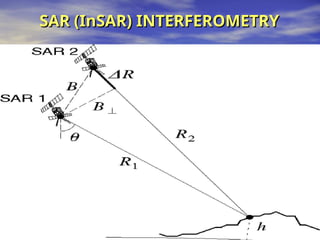
SAR (InSAR)
SAR (InSAR) INTERFEROMETRY
INTERFEROMETRY
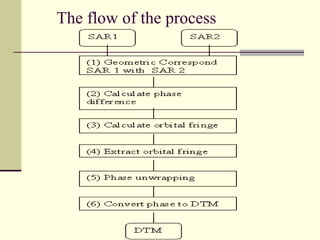
The flow of the process
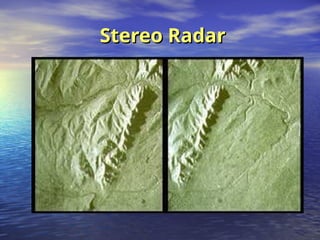
Stereo Radar
Stereo Radar
•
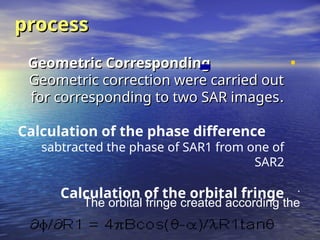
Geometric Corresponding
Geometric correction were carried out
for corresponding to two SAR images
for corresponding to two SAR images.
.
Calculation of the phase difference
sabtracted the phase of SAR1 from one of
SAR2
Calculation of the orbital fringe
process
process
.
The orbital fringe created according the
•
Phase unwrapping
.
. The phase distributed 0 to 360 ,Therefore, the phase
must be integrated. However, it is difficult to process
by influence of the noise. Some method were
proposed, but the best one is unknown
.
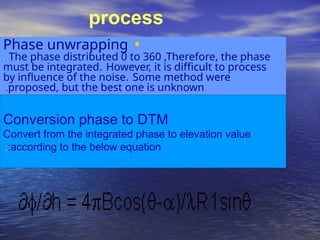
Conversion phase to DTM
Convert from the integrated phase to elevation value
according to the below equation
:
.
process
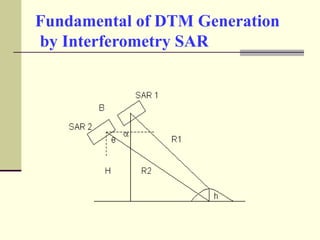
Fundamental of DTM Generation
by Interferometry SAR
equations of DTM Generation
The difference of the slant length of SAR 1 and SAR 2 is
approximated the next equation
the relation of difference of phase and elevation value
shows the nest equation
Then, the elevation values are calculated by the following equation
according to the geometry of interferometry
Fundamental equations of DTM Generation
by Interferometry SAR
•
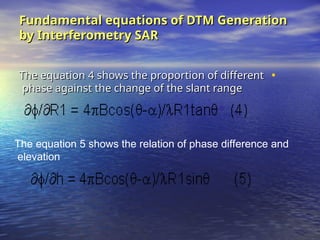
The equation 4 shows the proportion of different
phase against the change of the slant range
The equation 5 shows the relation of phase difference and
elevation
DTMs: accuracy
DTMs: accuracy
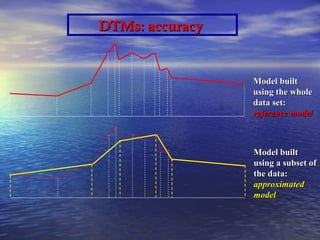
Model built
Model built
using the whole
using the whole
data set:
data set:
reference model
reference model
Model built
Model built
using a subset of
using a subset of
the data:
the data:
approximated
approximated
model
model
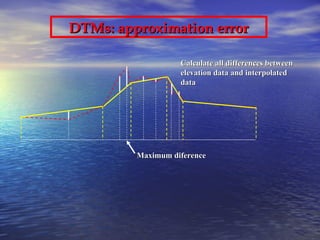
DTMs: approximation error
Maximum diference
Maximum diference
Calculate all differences between
elevation data and interpolated
data
data
Error assessment for Digital
Terrain Models
(non-interferometey)
1
1.Errors produced when heights are
.Errors produced when heights are
interpolated from digitiszd contours
.
.
2
2.Differences in the results produce by
.Differences in the results produce by
different algorithms for estimating terrain
characteristics such as gradient or aspect
InSAR DTM ACCURACY
InSAR DTM ACCURACY
•
The accuracy of an interferometrically
generated DTM is determined by these
three factors
three factors
:
:
1
-
Measurement accuracy of the phase
of a pixel
2
-
Accuracy of the imaging geometry
3
-
constancy of the wave propagation
conditions
Phase Accuracy
Phase Accuracy
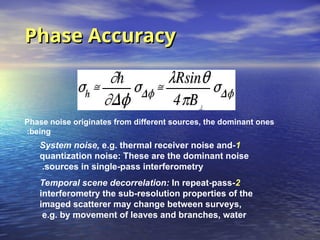
Phase noise originates from different sources, the dominant ones
being
:
1
-
System noise, e.g. thermal receiver noise and
quantization noise: These are the dominant noise
sources in single-pass interferometry
.
2
-
Temporal scene decorrelation: In repeat-pass
interferometry the sub-resolution properties of the
imaged scatterer may change between surveys,
e.g. by movement of leaves and branches, water
Orbit accuracy
Orbit accuracy
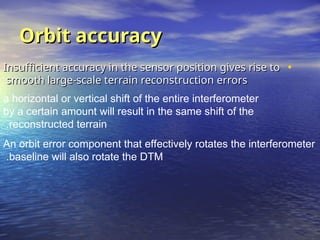
•
Insufficient accuracy in the sensor position gives rise to
smooth large-scale terrain reconstruction errors
a horizontal or vertical shift of the entire interferometer
by a certain amount will result in the same shift of the
reconstructed terrain
.
An orbit error component that effectively rotates the interferometer
baseline will also rotate the DTM
.
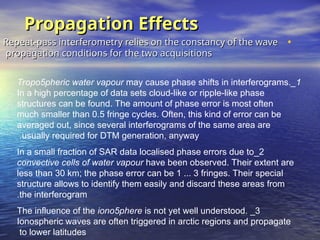
Propagation Effects
Propagation Effects
•
Repeat-pass interferometry relies on the constancy of the wave
propagation conditions for the two acquisitions
1
_
Tropo5pheric water vapour may cause phase shifts in interferograms.
In a high percentage of data sets cloud-like or ripple-like phase
structures can be found. The amount of phase error is most often
much smaller than 0.5 fringe cycles. Often, this kind of error can be
averaged out, since several interferograms of the same area are
usually required for DTM generation, anyway
.
2
_
In a small fraction of SAR data localised phase errors due to
convective cells of water vapour have been observed. Their extent are
less than 30 km; the phase error can be 1 ... 3 fringes. Their special
structure allows to identify them easily and discard these areas from
the interferogram
.
3
_
The influence of the iono5phere is not yet well understood.
Ionospheric waves are often triggered in arctic regions and propagate
to lower latitudes
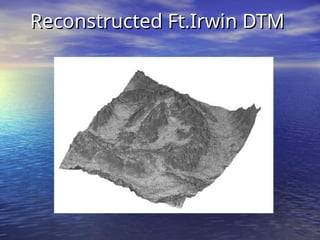
Reconstructed Ft.Irwin DTM
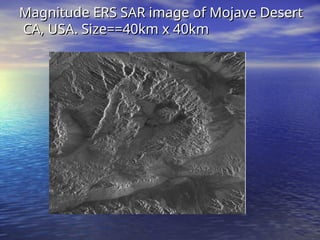
Magnitude ERS SAR image of Mojave Desert
CA, USA. Size==40km x 40km
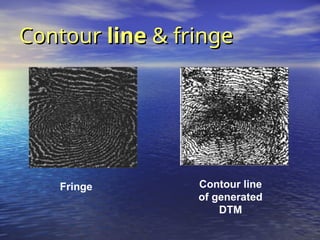
Contour
Contour line
line & fringe
& fringe
Fringe Contour line
of generated
DTM
•
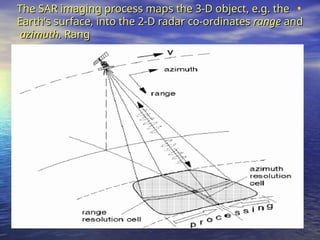
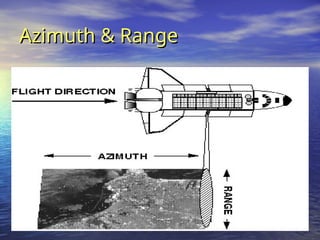
The SAR imaging process maps the 3-D object, e.g. the
Earth's surface, into the 2-D radar co-ordinates
Earth's surface, into the 2-D radar co-ordinates range
range and
and
azimuth.
azimuth. Rang
Rang
Azimuth & Range
Azimuth & Range
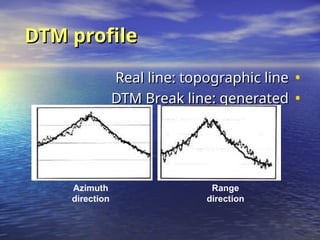
DTM profile
DTM profile
•
Real line: topographic line
•
DTM Break line: generated
Azimuth
direction
Range
direction
Tkanks
Thanks

SAR (InSAR) INTERFEROMETRY+ remote sensing

  • 1.
  • 2.
    Interferometery Interferometery • The location andexamination of sources of The location and examination of sources of electromagnetic radiation through the electromagnetic radiation through the simultaneous use of two or more separated simultaneous use of two or more separated telescopes telescopes. . Interferometers produce Interferometers produce overlapping wave patterns from the overlapping wave patterns from the radiation radiation. . These patterns are studied to These patterns are studied to determine the brightness and angular determine the brightness and angular structure of the emitting source structure of the emitting source . .
  • 3.
    Commonly used wavelengths Commonlyused wavelengths • X_band(3cm) X_band(3cm) • C_band(5cm) C_band(5cm) • L_band(25cm) L_band(25cm)
  • 4.
    abstract abstract • synthetic aperture radar(InSAR) is a rapidly synthetic aperture radar (InSAR) is a rapidly evolving technology for DTM generation. It evolving technology for DTM generation. It exploits the coherent nature of SAR imaging exploits the coherent nature of SAR imaging to measure Interferometric stereo parallaxes to measure Interferometric stereo parallaxes in the mm and cm regime from phase in the mm and cm regime from phase differences differences . .
  • 5.
    SAR (InSAR) SAR (InSAR)INTERFEROMETRY INTERFEROMETRY
  • 6.
    The flow ofthe process
  • 7.
  • 8.
    • Geometric Corresponding Geometric Corresponding Geometriccorrection were carried out Geometric correction were carried out for corresponding to two SAR images for corresponding to two SAR images. . Calculation of the phase difference sabtracted the phase of SAR1 from one of SAR2 Calculation of the orbital fringe process process . The orbital fringe created according the
  • 9.
    • Phase unwrapping . . Thephase distributed 0 to 360 ,Therefore, the phase must be integrated. However, it is difficult to process by influence of the noise. Some method were proposed, but the best one is unknown . Conversion phase to DTM Convert from the integrated phase to elevation value according to the below equation : . process
  • 10.
    Fundamental of DTMGeneration by Interferometry SAR
  • 11.
    equations of DTMGeneration equations of DTM Generation The difference of the slant length of SAR 1 and SAR 2 is The difference of the slant length of SAR 1 and SAR 2 is approximated the next equation approximated the next equation the relation of difference of phase and elevation value shows the nest equation Then, the elevation values are calculated by the following equation according to the geometry of interferometry
  • 12.
    Fundamental equations ofDTM Generation Fundamental equations of DTM Generation by Interferometry SAR by Interferometry SAR • The equation 4 shows the proportion of different The equation 4 shows the proportion of different phase against the change of the slant range phase against the change of the slant range The equation 5 shows the relation of phase difference and elevation
  • 13.
    DTMs: accuracy DTMs: accuracy Modelbuilt Model built using the whole using the whole data set: data set: reference model reference model Model built Model built using a subset of using a subset of the data: the data: approximated approximated model model
  • 14.
    DTMs: approximation error DTMs:approximation error Maximum diference Maximum diference Calculate all differences between Calculate all differences between elevation data and interpolated elevation data and interpolated data data
  • 15.
    Error assessment forDigital Terrain Models (non-interferometey) 1 1.Errors produced when heights are .Errors produced when heights are interpolated from digitiszd contours interpolated from digitiszd contours . . 2 2.Differences in the results produce by .Differences in the results produce by different algorithms for estimating terrain different algorithms for estimating terrain characteristics such as gradient or aspect characteristics such as gradient or aspect
  • 16.
    InSAR DTM ACCURACY InSARDTM ACCURACY • The accuracy of an interferometrically The accuracy of an interferometrically generated DTM is determined by these generated DTM is determined by these three factors three factors : : 1 - Measurement accuracy of the phase of a pixel 2 - Accuracy of the imaging geometry 3 - constancy of the wave propagation conditions
  • 17.
    Phase Accuracy Phase Accuracy Phasenoise originates from different sources, the dominant ones being : 1 - System noise, e.g. thermal receiver noise and quantization noise: These are the dominant noise sources in single-pass interferometry . 2 - Temporal scene decorrelation: In repeat-pass interferometry the sub-resolution properties of the imaged scatterer may change between surveys, e.g. by movement of leaves and branches, water
  • 18.
    Orbit accuracy Orbit accuracy • Insufficientaccuracy in the sensor position gives rise to Insufficient accuracy in the sensor position gives rise to smooth large-scale terrain reconstruction errors smooth large-scale terrain reconstruction errors a horizontal or vertical shift of the entire interferometer by a certain amount will result in the same shift of the reconstructed terrain . An orbit error component that effectively rotates the interferometer baseline will also rotate the DTM .
  • 19.
    Propagation Effects Propagation Effects • Repeat-passinterferometry relies on the constancy of the wave Repeat-pass interferometry relies on the constancy of the wave propagation conditions for the two acquisitions propagation conditions for the two acquisitions 1 _ Tropo5pheric water vapour may cause phase shifts in interferograms. In a high percentage of data sets cloud-like or ripple-like phase structures can be found. The amount of phase error is most often much smaller than 0.5 fringe cycles. Often, this kind of error can be averaged out, since several interferograms of the same area are usually required for DTM generation, anyway . 2 _ In a small fraction of SAR data localised phase errors due to convective cells of water vapour have been observed. Their extent are less than 30 km; the phase error can be 1 ... 3 fringes. Their special structure allows to identify them easily and discard these areas from the interferogram . 3 _ The influence of the iono5phere is not yet well understood. Ionospheric waves are often triggered in arctic regions and propagate to lower latitudes
  • 20.
  • 21.
    Magnitude ERS SARimage of Mojave Desert Magnitude ERS SAR image of Mojave Desert CA, USA. Size==40km x 40km CA, USA. Size==40km x 40km
  • 22.
    Contour Contour line line &fringe & fringe Fringe Contour line of generated DTM
  • 23.
    • The SAR imagingprocess maps the 3-D object, e.g. the The SAR imaging process maps the 3-D object, e.g. the Earth's surface, into the 2-D radar co-ordinates Earth's surface, into the 2-D radar co-ordinates range range and and azimuth. azimuth. Rang Rang
  • 24.
  • 25.
    DTM profile DTM profile • Realline: topographic line Real line: topographic line • DTM Break line: generated DTM Break line: generated Azimuth direction Range direction
  • 27.